Odd Hadwiger number and graph products
The Odd Hadwiger number of a graph $G$ is the largest integer $r$ such that $G$ has a clique of size $r$ as an odd minor. In this paper, we investigate how large is the Odd Hadwiger number of the product of two graphs, when considering any of the fou…
Authors: Henry Echeverría, Andrea Jiménez, Suchismita Mishra
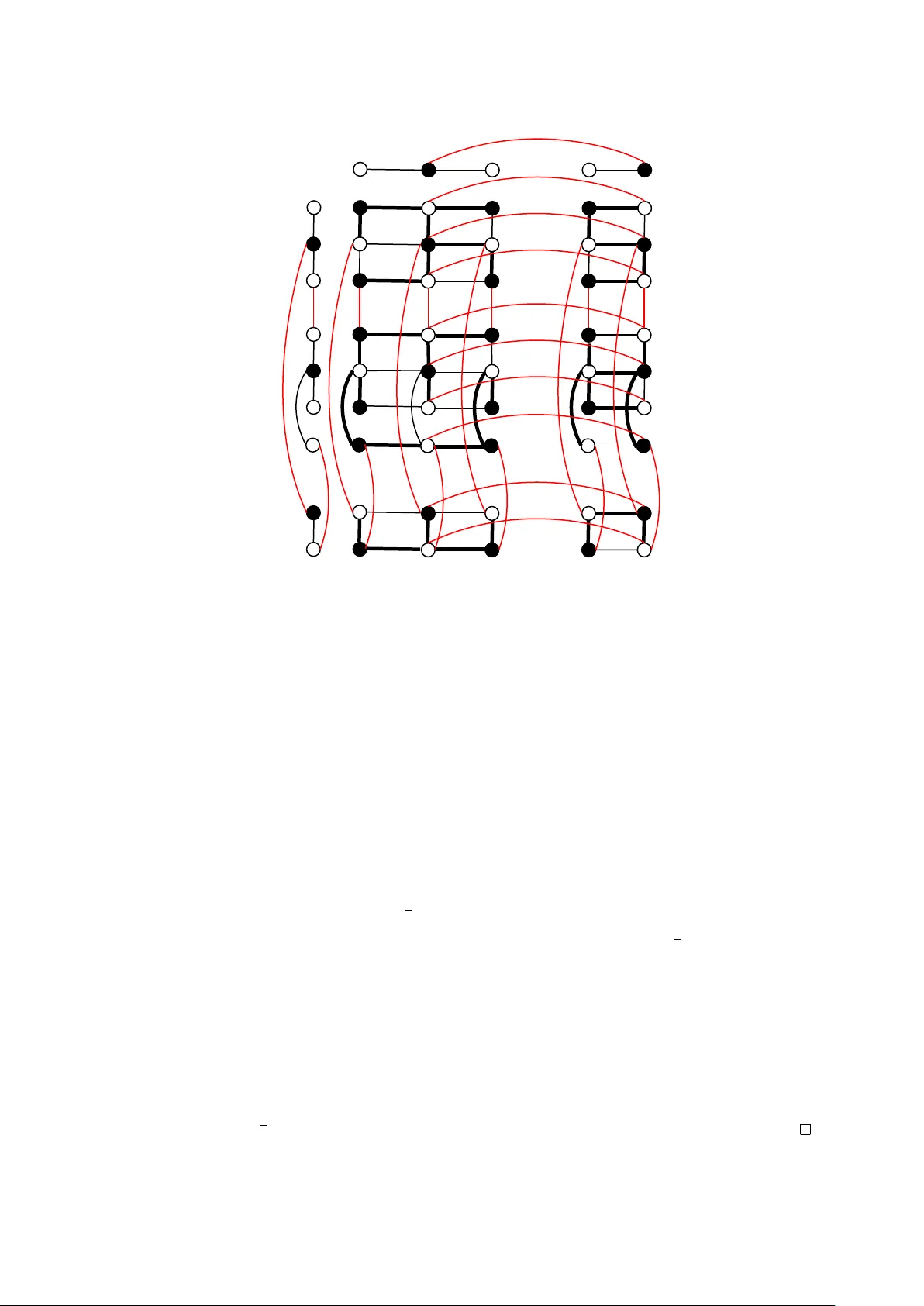
Odd Hadwiger n um b er and graph pro ducts Henry Ec heverría 1 , Andrea Jiménez 1,2 , Suc hismita Mishra 3 , Daniel A. Quiroz 1 , and Mauricio Y épez 1 1 Instituto de Ingeniería Matemática-CIMF A V, Universidad de V alparaíso, Chile. 2 Millennium Nucleus for So cial Data Science (SODAS), Santiago, Chile 3 Institute of Mathematical Science, Chennai, India Marc h 31, 2026 Abstract The Odd Hadwiger num b er of a graph G is the largest integer r such that G has a clique of size r as an o dd minor. In this pap er, we in vestigate ho w large is the Odd Hadwiger num b er of the pro duct of tw o graphs, when considering an y of the four standard graph pro ducts: Cartesian, direct, lexicographic, strong. W e provide an optimal low er b ound in the cases of the strong and lexicographic pro ducts. Keyw ords: o dd minor, lexicographic pro duct, strong product, Cartesian pro duct, direct product 1 In tro duction Since W agner’s characterization of planar graphs b y excluded minors [17], the theory of graph minors has been a cen tral topic in Graph Theory . The Hadwiger num b er, h( G ) , of a graph G is the maximum in teger t such that K t is a minor of G . This is a widely studied parameter. In particular, a famous conjecture of Hadwiger [9], whic h aims at a great generalisation of the F our Colour Theorem, states the follo wing: for every graph G , we hav e χ ( G ) ≤ h( G ) . This conjecture holds trivially when h( G ) ≤ 2 . Dirac [5] show ed that any graph G with h( G ) = 3 is three colourable. By another result of W agner [17], the F our Colour Theorem implies the case for h( G ) = 4 . F urther, by using the F our Colour Theorem, Rob ertson, Seymour and Thomas [14] verified the case h( G ) = 5 . F or larger v alues, a recent result of Delcourt and Postle [4] says that every graph G with h( G ) ≤ t − 1 is O ( t log log t ) colourable. A graph H is said to b e an o dd minor of another graph G if we can obtain H from G by (iterativ ely) deleting vertices and edges, and contracting all the edges of an edge-cut. The Odd Hadwiger num b er, oh( G ) , of a graph G , is the maximum in teger t such that K t is an o dd minor of G . While classes with b ounded Hadwiger num b er are sparse, classes with b ounded Odd Hadwiger num b er can b e arbitrarily dense. F or instance, it is not hard to see that bipartite graphs exclude K 3 as an o dd minor. Indeed, G is bipartite if and only if oh( G ) ≤ 2 . Odd minors hav e mostly b een considered through a strengthening of Hadwiger’s conjecture which w as proposed b y Gerards and Seymour (see [10]): for every graph G , we hav e χ ( G ) ≤ oh( G ) . This conjecture, known as the Odd Hadwiger conjecture, trivially holds for oh( G ) ≤ 2 , and w as prov ed for oh( G ) = 3 by Catlin [1]. After muc h work on this conjecture (see e.g. [7, 8, 13, 15, 16]), it w as recently dispro ved by Kühn, Sauerman, Steiner and Wigderson [11]. In this pap er, w e inv estigate the b eha viour of the Odd Hadwiger num ber not in terms of the chromatic n umber, but in regard to the Cartesian, direct, lexicographic, and strong pro duct of graphs. Our main result is the following. Theorem 1.1. L et G and H b e two gr aphs with Odd Hadwiger numb ers t and r , r esp e ctively, then oh( G ∗ H ) ≥ oh( K s ∗ K t ) , wher e ∗ is either Cartesian, lexic o gr aphic or str ong pr o duct. T o our knowledge, our pap er is the first one to deal with the relationship b et ween o dd minors and graph pro ducts. How ev er, there are v arious pap ers dealing with the relation betw een (usual) minors 1 and graph pro ducts, esp ecially regarding Certesian pro duct. In 1976, Zelinka [20] show ed that for every pair of graphs G and H w e hav e h( G 2 H ) ≥ h( G ) + h( H ) − 1 . Chandran, Kostochka, and Ra ju [2] strengthened this result b y pro ving a b ound of h( G 2 H ) ≥ h( G ) p h( H )(1 − o (1)) , which is b est p ossible and gives an asymptotic answer to a question of Miller [12]. W o o d [18] provided v arious related results and also studied the structure of the Cartesian pro duct of graphs with b ounded Hadwiger num b er. As an application of Theorem 1.1, we prov e the following result, whic h essentially generalises Zelinka’s initial result, sav e for one vertex. Theorem 1.2. L et G and H b e gr aphs with oh( G ) = s ≥ 2 and oh ( H ) = t ≥ 2 , then oh( G □ H ) ≥ s + t − 2 . W e do not know if this can b e improv ed, for instance by generalising the result of Chandran, Kostochka and Ra ju to o dd minors. W e leav e this as an op en problem. Problem 1.3. L et G and H b e gr aphs with oh( G ) = s and oh( H ) = t . Is it true that oh ( G □ H ) ∈ Ω( s √ t ) ? The lexicographic and strong pro duct cases of Theorem 1.1, follow from the next low er b ound since K s ⊠ K t = K s # K t = K st , and thus oh ( K s ⊠ K t ) = oh( K s # K t ) = st . Theorem 1.4. L et G and H b e gr aphs with oh( G ) = s ≥ 2 and oh( H ) = t ≥ 2 . If ∗ ∈ { # , ⊠ } , then oh( G ∗ H ) ≥ st . While Theorem 1.4 is tigh t, there exist graphs G, H for whic h oh( G ⊠ H ) can b e arbitrarily larger than oh ( G ) · oh( H ) . The following result tells us that this is true even for stars, and gives an alternative lo wer b ound to that of Theorem 1.4. (Here the first inequality comes simply from the fact that G ⊠ H is a subgraph of G # H .) Theorem 1.5. F or any two gr aphs G and H , oh( G # H ) ≥ oh( G ⊠ H ) ≥ ( ∆( G ) + 1 , if ∆( G ) = ∆( H ) min { ∆( G ) , ∆( H ) } + 2 , otherwise. While we could not prov e a version of Theorem 1.1 for the direct pro duct, w e conjecture that such a result holds. Moreov er, w e prov e a couple of low er b ounds for the direct pro duct of tw o cliques. T o end this introduction, we mention also that our main result is inspired b y results in [3, 6, 19] whic h relate graph pro ducts to other notions of containmen t b et w een graphs, namely immersions and totally o dd immersions. The rest of the pap er is organised as follows. In Section 2, we present an equiv alent definition for o dd minors which we use throughout the pap er, as well as the precise definition of each pro duct to b e studied. In Section 3, w e pro ve that Theorem 1.1 holds for Cartesian pro ducts and prov e Theorem 1.2. In Section 4, w e pro ve Theorems 1.4 and 1.5. Finally , in Section 5, w e study the b eha viour of o dd Ha wiger num b er in the direct pro duct. 2 Preliminaries All graphs in this pap er are finite, simple and lo opless. A graph G is called an expansion of another graph H if there is a family of vertex-disjoin t trees ( T v ) v ∈ V ( H ) in G such that for every edge uv ∈ E ( H ) , there exists at least one edge b et ween T u and T v . It is easy to see that G con tains H as a minor if and only if G is an expansion of H . No w, supp ose that G is an expansion of H and that there exists a 2 -colouring of G which is a prop er colouring in each T u , u ∈ V ( H ) , while for any pair of trees T u , T v , with u, v ∈ V ( H ) , at least one edge joining them is mono c hromatic. Then we sa y that G is an o dd expansion of H , and that G con tains H as an o dd minor. Here, the graphs T v are called the branc h trees and the colouring c is called the witness colouring. The lexicographic pro duct of G and H , denoted b y G # H is the graph on v ertices V ( G ) × V ( H ) and where tw o vertices ( v 1 , u 1 ) , ( v 2 , u 2 ) are adjacent if v 1 v 2 ∈ E ( G ) , or v 1 = v 2 and u 1 u 2 ∈ E ( H ) . The Cartesian pro duct of G and H , denoted b y G 2 H , is the graph on ve rtices V ( G ) × V ( H ) where t wo v ertices ( v 1 , u 1 ) , ( v 2 , u 2 ) are adjacent if v 1 = v 2 and u 1 u 2 ∈ E ( H ) , or u 1 = u 2 and v 1 v 2 ∈ E ( G ) . The 2 direct pro duct (also known as tensor pro duct) of G and H , denoted b y G × H , is the graph with the set of vertex V ( G ) × V ( H ) and where tw o vertices ( v 1 , u 1 ) , ( v 2 , u 2 ) are adjacent if v 1 v 2 ∈ E ( G ) and u 1 u 2 ∈ E ( H ) . Let E 1 and E 2 b e tw o sets of edges in G and H resp ectively . Then E 1 × E 2 is defined as { ( x, y )( x ′ , y ′ ) | xx ′ ∈ E 1 and y y ′ ∈ E 2 } . The strong product of G and H , denoted by G ⊠ H , corresp onds to the union ( G 2 H ) ∪ ( G × H ) ; that is, V ( G ⊠ H ) = V ( G ) × V ( H ) and tw o vertices ( v 1 , u 1 ) , ( v 2 , u 2 ) are adjacen t if v 1 = v 2 and u 1 u 2 ∈ E ( H ) , or u 1 = u 2 and v 1 v 2 ∈ E ( G ) , or v 1 v 2 ∈ E ( G ) and u 1 u 2 ∈ E ( H ) . 3 Cartesian Pro duct In this section, we show that Theorem 1.1 holds for the Cartesian pro duct. Then w e apply it to prov e Theorem 1.2. W e start with a key lemma, for which we need the follo wing setup. Let G and H be tw o connected graphs with oh( G ) = s and oh( H ) = t . Let S = { S 1 , S 2 , . . . , S s } b e a set of trees of G , and edges u i u j ∈ E ( G ) , 1 ≤ i < j ≤ s , b e such that together with S witness an o dd expansion of K s in G with witness colouring c G : V ( G ) → { 1 , 2 } . Let T = { T 1 , T 2 , . . . , T t } and v i v j ∈ E ( H ) , 1 ≤ i < j ≤ t , form an o dd expansion of K t in H with a witness colouring c H : V ( H ) → { 1 , 2 } . Let T ij b e a spanning tree of the connected graph S i 2 T j , for every i ∈ { 1 , 2 , . . . , s } and j ∈ { 1 , 2 , . . . , t } . The set of trees witnessing an odd expansion which we pro vide in order to prov e Theorem 3.2 are defined as suitable unions of spanning trees T ij . Let c 1 b e a 2-colouring on S i ∈ [ s ] ,j ∈ [ t ] T ij defined as follows c 1 (( u, v )) = ( 1 , if c G ( u ) = c H ( v ) , 2 , if c G ( u ) = c H ( v ) . (1) See Figure 1, for an illustration of an o dd minor mo del obtained from the T ij ’s and c 1 . Additionally , let c 1 denote the 2-colouring obtained by interc hanging the colour class of 1 with that of 2 , in the definition of c 1 . Lemma 3.1. The 2 -c olouring in (1) is a pr op er c olouring of T ij , for al l 1 ≤ i ≤ s and 1 ≤ j ≤ t . F urthermor e for any p air of distinct ( i, j ) , ( i ′ , j ′ ) ∈ [ s ] × [ t ] satisfying either i = i ′ or j = j ′ , ther e exists a mono chr omatic e dge e = e ( i,j )( i ′ j ′ ) b etwe en T ij and T i ′ j ′ . Pr o of. Let 1 ≤ i ≤ s and 1 ≤ j ≤ t b e t wo natural n um b ers. First, w e show that c 1 is a prop er colouring on T ij . Let ( u, v )( u ′ , v ′ ) be an edge in T ij . By symmetry , we may assume that u = u ′ and v is a neighbour of v ′ in T j . Since c H is a prop er colouring of H , c H ( v ) = c H ( v ′ ) . Therefore, exactly one among c H ( v ) and c H ( v ′ ) is same as c G ( u ) . Therefore, b y the definition of c 1 , we can conclude that c 1 ( u, v ) = c 1 ( u, v ′ ) . Hence, c 1 is prop er in S i 2 T j . No w, for any 1 ≤ j < j ′ ≤ t , we sho w the existence of a mono c hromatic edge b et ween T ij and T ij ′ in the colouring c 1 . Let u b e any v ertex in V ( S i ) . By the definition of o dd expansion, we know that there exists a mono c hromatic edge b etw een T j and T j ′ , say v j v j ′ for some v j ∈ T j , v j ′ ∈ T j ′ (that is c H ( v j ) = c H ( v j ′ ) ). Thus, c G ( u ) = c H ( v j ) if and only if c G ( u ) = c H ( v j ′ ) . Now the definition of c 1 ensures that ( u, v j )( u, v j ′ ) is a mono c hromatic edge. Analogously , one can show that for all 1 ≤ i < i ′ ≤ s and 1 ≤ j ≤ t , there exists a mono c hromatic edge b et w een T ij and T i ′ j . The Cartesian pro duct case of Theorem 1.1, reads as follows. Theorem 3.2. L et G and H b e gr aphs with oh( G ) = s and oh( H ) = t , then oh( G 2 H ) ≥ oh( K s 2 K t ) . Pr o of. Set m := oh ( K s 2 K t ) . W e wan t to sho w that G 2 H has as an o dd expansion of K m . Let S 1 , . . . , S s b e the trees in an o dd expansion of K s in G , and T 1 , . . . , T t the trees in an o dd expansion of K t in H . F urther, let T b e the union of fixed spanning trees T i,j of S i 2 T j , with 1 ≤ i ≤ s and 1 ≤ j ≤ t . If w e let c G and c H b e the colourings corresp onding to the o dd expansions of G and H , resp ectiv ely , and define c 1 o ver T as in (1), then each T i,j is prop erly coloured under c 1 due to Lemma 3.1. F urthermore, also due to Lemma 3.1, for all pairs of trees T ij and T i ′ j ′ , we hav e a mono c hromatic edge e = e ( i,j )( i ′ j ′ ) joining them in the case that i = i ′ or j = j ′ . Let R = { R 1 , R 2 , . . . , R m } b e trees and e ij , for 1 ≤ i < j ≤ m , b e edges such that, together, they form an o dd expansion of K m in K s 2 K t , let c R b e the 2-colouring witnessing this o dd expansion. Set 3 T 1 T 2 S 1 S 2 S 3 Figure 1: The Cartesian pro duct of an o dd expansions of K 3 and an o dd expansion of K 2 . The subgraphs S i 2 T j are depicted with black edges, with b old blac k edges represen ting the spanning trees T ij . Moreov er, the red edges are the corresp onding mono c hromatic edges in the o dd expansions. The colour 1 from c 1 is depicted as black and the colour 2 as white. V ( K s ) = { v 1 , v 2 . . . , v s } and V ( K t ) = { u 1 , u 2 , . . . , u t } , and consider the mapping f : T → V ( K s 2 K t ) defined by f ( T i,j ) = ( u i , v j ) . F or each 1 ≤ k ≤ m , we define the tree Z k as the one with V ( Z k ) = [ x ∈ V ( R k ) f − 1 ( x ) ⊂ T and ha ving the following edges in G 2 H : if ( u i , v j )( u i ′ , v j ′ ) ∈ E ( R k ) , then pick the mono c hromatic (under c 1 ) edge e ( i,j )( i ′ j ′ ) b et w een f − 1 (( u i , v j )) and f − 1 (( u i ′ , v j ′ )) which exists since i = i ′ or j = j ′ . No w, we define a 2-colouring C for V ( Z 1 ) ∪ V ( Z 2 ) ∪ . . . ∪ V ( Z m ) according to the following rule: for eac h fixed k ∈ { 1 , . . . , m } and each T i,j = f − 1 (( u i , v j )) with ( u i , v j ) ∈ R k , we define C ( V ( T i,j )) = ( c 1 ( V ( T i,j )) if c R (( u i , v j )) = 1 c 1 ( V ( T i,j )) if c R (( u i , v j )) = 2 , where C ( V ( T i,j )) denotes the restriction of C to V ( T i,j ) (and similarly for c 1 and c 1 ). Let us chec k that C is a prop er colouring on V ( Z k ) for each k ∈ { 1 , . . . , m } . On the one hand, if t wo adjacen t vertices are in the same tree T i,j , then its colours under C are different since c 1 and c 1 are prop er colourings for any tree T i,j . On the other hand, if tw o adjacent vertices y , y ′ are in distinct trees T i,j , T i ′ ,j ′ , then, by construction, they form a mono chromatic edge under c 1 . A t the same time, w e must hav e that ( u i , v j )( u i ′ , v j ′ ) is an edge in R k and th us c R ( f ( T i,j )) = c R ( f ( T i ′ ,j ′ )) , implying that y , y ′ get distinct colours under C . Finally , w e hav e to show that there is a monochromatic edge b et ween every pair of trees in Z 1 , . . . , Z m . F or each pair of trees R, R ′ ∈ R , there are vertice s x ∈ V ( R ) , x ′ ∈ V ( R ′ ) such that xy ∈ E ( K s 2 K t ) and c ( x ) = c ( x ′ ) . Hence, if w e lo ok at the prop er colourings of f − 1 ( x ) and f − 1 ( x ′ ) under the C they are either b oth c 1 or b oth c 1 . In b oth cases we get a mono c hromatic edge under C , thanks to Lemma 3.1. 4 Theorem 1.2 follows directly from Theorem 3.2 ab o ve and the follo wing. Theorem 3.3. If s ≥ 2 and t ≥ 2 , then oh ( K s 2 K t ) ≥ s + t − 2 . Pr o of. Set V ( K s ) := { u 1 , u 2 , . . . , u s } and V ( K t ) := { v 1 , v 2 , . . . , v t } W e are lo oking for a K s + t − 2 as an o dd minor in K s 2 K t . F or all i ∈ { 2 , 3 , . . . , s } , let S ( u i ,v t ) b e a star of cen ter ( u i , v t ) and leav es ( u i , v j ) for all j ∈ { 1 , 2 , . . . , t − 1 } . F or each k ∈ { 1 , . . . s + t − 2 } , w e define Z k = ( ( u 1 , v k ) if k ∈ { 1 , 2 , . . . , t − 1 } , S ( u k +2 − t ,v t ) if k ∈ { t, t + 1 , . . . , s + t − 2 } . F or every vertex ( u, v ) in Z 1 ∪ Z 2 ∪ . . . ∪ Z s + t − 2 , we define C (( u, v )) = ( 2 if ( u, v ) is the center of a star S ( u,v ) , 1 otherwise. See Figure 2 for an example of the definition of the Z k ’s and the 2-colouring C . Clearly , C induces a prop er 2-colouring on eac h Z k ∈ Z . so it suffices to pro ve that there is a mono c hromatic edge b et ween Z k and Z k ′ with 1 ≤ k < k ′ ≤ s + t − 2 . This follows from the next three cases. When 1 ≤ k < k ′ ≤ t − 1 , Z k and Z k ′ are the singletons ( u 1 , v k ) , ( u 1 , v k ′ ) coloured with 1, hence there is a mono c hromatic edge b etw een them. When 1 ≤ k ≤ t − 1 and t ≤ k ′ ≤ s + t − 2 , Z k is the singleton ( u 1 , v k ) with colour 1, and Z k ′ is a star containing ( u k +2 − t , v k ) as a leaf with colour 1. Thus the edge ( u 1 , v k )( u k +2 − t , v k ) is mono c hromatic. When t ≤ k < k ′ ≤ s + t − 2 , Z k and Z k ′ are stars with centers ( u k +2 − t , v t ) and ( u k ′ +2 − t , v t ) , resp ectiv ely , which are coloured with 2 and hence these form a mono chromatic edge. v 1 v 2 v 3 v 4 v 5 v 6 u 1 u 2 u 3 . . . u s . . . . . . . . . . . . . . . . . . Figure 2: T rees Z 1 , Z 2 , . . . , Z s +4 and C from the Theorem 3.3 in the case that t = 6 . The colour 1 is represen t by black and the colour 2 by red. Note that Z 1 , . . . , Z 6 are vertices, the vertex ( u 1 , v 6 ) is not used in any tree in Z , and Z 7 , . . . , Z s +4 are stars with 5 leav es. W e apply Theorem 3.3 to Hamming graphs. Giv en d, q , ∈ N , the the Hamming graph H d t is the Cartesian pro duct of d complete graphs K t . The next corollary follows by induction. Corollary 3.4. F or al l d, q ∈ N , we have oh ( H d n ) ≥ d ( n − 2) + 2 . 4 Lexicographic Pro duct and Strong Pro duct In this section, we provide t wo low er b ounds for the Odd Hadwiger num b er of the lexicographic or strong pro duct of tw o graphs. W e start by proving Theorem 1.4, and later prov e a lemma whic h implies Theorem 1.5. 5 Pr o of of The or em 1.4. By definition G ⊠ H is a subgraph of G # H . Th us, it is enough to pro ve the theorem for the strong pro duct of graphs. W e kno w that G has an o dd expansion of K s and H has an odd expansion and K t . Let S = { S 1 , S 2 , . . . , S s } b e a set of trees of that witnesses an odd expansion of K s in G with a witness 2- colouring c G . F urther, let T = { T 1 , T 2 , . . . , T t } b e a set of trees that witness an o dd expansion of K t in H with witness a witness 2-colouring c H . F or eac h 1 ≤ i ≤ s and 1 ≤ j ≤ t , w e let T ij b e a spanning tree of S i 2 T j ⊂ S i ⊠ T j . Note that these threes are pairwise vertex disjoint. Now, w e consider the 2-colouring c 1 of S i ∈ [ s ] ,j ∈ [ t ] V ( T ij ) defined in (1). Due to Lemma 3.1, we know that c 1 is a prop er 2-colouring on the tree T ij , for all 1 ≤ i ≤ s and 1 ≤ j ≤ t . Let ( i, j ) and ( i ′ , j ′ ) b e tw o distinct elements in [ s ] × [ t ] . W e need to sho w the existence of mono c hromatic edge b et ween T i,j and T i ′ ,j ′ . Due to Lemma 3.1, we may assume that i = i ′ and j = j ′ . W e know there is an edge u i u i ′ ∈ E ( G ) from S i to S ′ i that is monochromatic under c G , and an edge v j v j ′ ∈ E ( H ) from T j to T j ′ that is mono c hromatic under c H . By definition of strong pro duct, G ⊠ H con tains the edge ( u i , v j )( u i ′ , v j ′ ) , and by definition of c 1 w e get that c 1 (( u i , v j )) = c 1 (( u i ′ , v j ′ )) . The result follows. The b ound in Theorem 1.4 is tight. How ev er, there exist graphs G, H for which oh ( G ⊠ H ) can b e arbitrarily larger than oh ( G ) · oh( H ) . As an example, in the following lemma, we study stars, where we let S k , b e the star with k leav es. Note that each star has Odd Hadwiger num ber 2 , and hence the low er b ound given by Theorem 1.4 for the pro duct of tw o stars is 4 . In Lemma 4.1, we give a low er b ound for the Odd Hadwiger num ber of the pro duct of t wo stars which dep ends on the maximum degree of these. This result immediately implies Theorem 1.5. Lemma 4.1. F or any two inte gers r, t ≥ 1 we have oh( S r ⊠ S t ) ≥ ( r + 1 , if r = t min { r, t } + 2 , otherwise. Pr o of. Let S r and S t b e the stars with central vertices u 0 and v 0 , resp ectiv ely . Supp ose { u 1 , . . . , u r } and { v 1 , . . . , v t } are the sets of leav es in S r and S t , resp ectiv ely . Without loss of generalit y , we may assume that t ≥ r . W e first construct an o dd expansion of K r in S r ⊠ S t . That is, we construct a collection of r v ertex disjoin t trees, say Z = { Z 1 , Z 2 , · · · , Z r } together with a 2-colouring c on V ( Z 1 ) ∪ V ( Z 2 ) ∪ . . . V ( Z r ) suc h that c is a prop er 2-colouring on each tree in Z and there is a mono c hromatic edge b etw een eac h pair of distinct trees in Z . Then we extend this o dd expansion b y adding a single-vertex tree together with an appropriate colour. When t > r , we further expanding this o dd expansion by adding another single-v ertex tree with appropriate colouring. Consider the paths Z i := ( u i , v 0 ) , ( u i , v i ) , ( u 0 , v i ) , for all 1 ≤ i ≤ r . F or all 1 ≤ i ≤ r , we define c as follows: w e colour the central vertex ( u i , v i ) with colour 1 and the vertices ( u i , v 0 ) and ( u 0 , v i ) with colour 2 . This is a prop er 2-colouring on Z i . F urther, note that for any 1 ≤ i < i ′ ≤ r , the vertices ( u i , v 0 ) and ( u 0 , v i ′ ) are adjacent. Since both had receive colour 2, this edge is mono c hromatic edge connecting Z i with Z i ′ . Now w e extend this collection b y adding ( u 0 , v 0 ) as a new tree and assign colour 2 to ( u 0 , v 0 ) . Since ( u 0 , v 0 ) is adjacen t to ( u i , v 0 ) , for all 1 ≤ i ≤ s , this provides an o dd expansion of K r +1 . W e extend this o dd expansion by one, when t > r . Consider the v ertex ( u 0 , v t ) and colour it with colour 2 . F or an y 1 ≤ i ≤ r , there exists an edge with endp oin ts ( u i , v 0 ) and ( u 0 , v t ) , which is mono c hromatic under the extension of c . F urther, ( u 0 , v 0 ) is adjacent to ( u 0 , v t ) . Hence, the product graph admits K r +2 as an o dd minor. 5 Direct Pro duct W e now study the Odd Hadwiger num b er of the direct pro duct of tw o graphs and prov e (Theorem 5.3) that in general, oh ( K t × K s ) ≥ t ⌊ s/ 3 ⌋ for all s ≥ 3 , t ≥ 3 . Lemma 5.1. F or t ≥ 6 , oh( K t × K 3 ) = t + 2 Pr o of. Supp ose t ≥ 6 , let { u 1 , u 2 , u 3 , . . . , u t } b e the vertices of K t and v 1 , v 2 , v 3 b e the vertices of K 3 . 6 Lo wer Bound: W e are lo oking for a K t +2 as an o dd minor, thus we need to find t + 2 disjoint trees Z = { Z 1 , Z 2 , . . . , Z t +2 } and a 2-colouring c for K t × K 3 suc h that for each pair of trees Z, Z ′ ∈ Z there are vertices x ∈ V ( Z ) , y ∈ V ( Z ′ ) such that uv ∈ E ( K t × K 3 ) and c ( x ) = c ( y ) , and c Z and c Z ′ are prop er 2-colourings where c Z represen ts the colouring c restricted to the tree Z . W e now define the trees Z 1 , Z 2 , . . . , Z t +2 according to T able 1 for t ≥ 7 . The third column of T able 1 con tains a partial description of the 2-colouring c of K t × K 3 , which is prop er on ev ery Z i : the color of exactly one vertex of each tree Z i is prescrib ed, and the remaining vertices are colored according to the giv en prescription, ensuring that each tree Z i receiv es a prop er coloring. Thus, this partial description of c allows it to extend c to a prop er 2-coloring of all trees Z 1 , Z 2 , . . . , Z t +2 . i Z i c is such that 1 ( u 1 , v 1 ) − ( u 2 , v 2 ) c ( u 1 , v 1 ) = 1 2 ( u 2 , v 1 ) − ( u 3 , v 2 ) c ( u 2 , v 1 ) = 2 3 ( u 1 , v 3 ) − ( u 3 , v 1 ) c ( u 1 , v 3 ) = 1 4 ( u 3 , v 3 ) − ( u 4 , v 1 ) c ( u 4 , v 1 ) = 1 5 ( u 4 , v 2 ) − ( u 5 , v 3 ) c ( u 5 , v 3 ) = 1 6 ( u 5 , v 2 ) − ( u 6 , v 3 ) c ( u 5 , v 2 ) = 2 7 ( u 1 , v 2 ) − ( u 2 , v 3 ) − ( u 5 , v 1 ) c ( u 2 , v 3 ) = 1 8 ( u 7 , v 1 ) − ( u 4 , v 3 ) − ( u 6 , v 2 ) c ( u 4 , v 3 ) = 2 9 ≤ i ≤ t + 1 , i o dd ( u i − 1 , v 2 ) − ( u i − 3 , v 1 ) − ( u i − 2 , v 3 ) c ( u i − 3 , v 1 ) = 2 10 ≤ i ≤ t + 1 , i even ( u i − 1 , v 1 ) − ( u i − 3 , v 2 ) − ( u i − 2 , v 3 ) c ( u i − 3 , v 2 ) = 2 t + 2 o dd ( u t , v 2 ) − ( u t − 1 , v 1 ) − ( u t , v 3 ) c ( u t − 1 , v 1 ) = 2 t + 2 even ( u t , v 1 ) − ( u t − 1 , v 2 ) − ( u t , v 3 ) c ( u t − 1 , v 2 ) = 2 T able 1: The set of trees Z and a partial description of colouring c . As an example, for the tree Z 1 = ( u i , v 1 ) − ( u 2 , v 2 ) , we prescrib e c ( u 1 , v 1 ) = 1 and hence, c ( u 2 , v 2 ) = 2 . F or the sp ecial case of t = 6 , the trees Z 1 , Z 2 , . . . , Z 7 are defined according to T able 1, and tree Z 8 is the path ( u 6 , v 1 ) − ( u 4 , v 3 ) − ( u 6 , v 2 ) with c ( u 4 , v 3 ) = 2 (See Figure 5). v 1 v 2 v 3 u 1 u 2 u 3 u 4 u 5 u 6 Figure 3: Case t = 6 . Recall that Z 8 is defined as ( u 6 , v 1 ) − ( u 4 , v 3 ) − ( u 6 , v 2 ) . v 1 v 2 v 3 u 1 u 2 u 3 u 4 u 5 u 6 u 7 Figure 4: Case t = 7 . T ree Z 9 is obtained from the row t + 2 o dd in T able 1. Figure 5: An illustration of the trees in Lemma 5.1. Solid white v ertices represent vertices colored with 2 and the remaining vertices with 1. W e now establish the existence of mono c hromatic edges b et ween ev ery pair of elemen ts in Z , which implies that these trees form an o dd expansion of K t +2 . 7 First note that for trees Z i , Z j with 9 ≤ i, j ≤ t + 2 , if i, j are b oth o dd or b oth ev en, then there is a mono c hromatic edge (with b oth vertices colored 1) b et ween the end vertices of Z i and Z j , and now if i , j are of distinct parity , then there is a mono c hromatic edge (with b oth vertices colored 2) b et ween the inner vertices of Z i and Z j . Let us now deal with the trees Z 1 , . . . , Z 8 . By an exhaustive examination, one can find a mono c hro- matic edge b et ween ev ery pair of trees in Z 1 , . . . , Z 8 (this is describ ed in T able 2). W e note that for the case t = 6 , the same edges describ ed in T able 2 witness the mono chromatic edges b et ween trees Z 1 , . . . , Z 7 , Z 8 except for the connection betw een Z 8 and Z 6 since v ertex ( u 7 , v 1 ) do es not exists in K 6 × K 3 , but in this case, we consider the edge (5 , 2)(6 , 1) , which is mono chromatic since b oth v ertices are coloured 1. Z 2 Z 3 Z 4 Z 5 Z 6 Z 7 Z 8 Z 1 (1 , 1)(3 , 2) (2 , 2)(3 , 1) (2 , 2)(3 , 3) (1 , 1)(5 , 3) (1 , 1)(5 , 2) (1 , 1)(2 , 3) (1 , 1)(6 , 2) Z 2 - (3 , 2)(1 , 3) (2 , 2)(3 , 3) (2 , 2)(4 , 2) (2 , 2)(6 , 3) (2 , 2)(1 , 2) (2 , 2)(4 , 3) Z 3 - - (1 , 3)(4 , 1) (3 , 1)(4 , 2) (1 , 3)(5 , 2) (3 , 1)(1 , 2) (1 , 3)(6 , 2) Z 4 - - - (4 , 1)(5 , 3) (4 , 1)(5 , 2) (4 , 1)(2 , 3) (4 , 1)(6 , 2) Z 5 - - - - (4 , 2)(6 , 3) (4 , 2)(5 , 1) (5 , 3)(6 , 2) Z 6 - - - - - (6 , 3)(5 , 1) (5 , 2)(7 , 1) Z 7 - - - - - - (5 , 1)(4 , 3) T able 2: Mono c hromatic edges b et ween trees Z 1 , . . . , Z 8 . In the table, vertex ( u i , v j ) is denoted b y ( i, j ) . In the case t = 6 , instead of (5 , 2)(7 , 1) , the edge (5 , 2)(6 , 1) is used. No w, note that each Z 1 , Z 4 con tains a vertex of the form ( u i , v 1 ) for some i ≤ 4 colored 1, and that eac h Z 2 , Z 6 , Z 8 con tains a v ertex of the form ( u i , v 2 ) for some i ≤ 6 again colored 1. F urthermore, eac h path Z 9 , . . . , Z t +2 has an end vertex ( u j , v 3 ) for some j ≥ 7 colored 1. Thus, there are mono chromatic edges b etw een each Z 1 , Z 2 , Z 4 , Z 6 , Z 8 , and each of the paths Z 9 , . . . , Z t +2 . The only mono chromatic connections still missing are those b et ween the trees Z 3 , Z 5 and the paths Z 9 , . . . , Z t +2 . Note that Z 3 con tains vertex (1 , 3) and Z 5 v ertex (5 , 3) , b oth vertices are colored 1, and eac h tree in Z 9 , . . . , Z t +2 con tains either a vertex of the form ( u i , v 1 ) , or ( u i , v 2 ) with i ≥ 8 colored with 1 as well. This finishes the argument of the existence of an o dd expansion of K t +2 . Upp er Bound: W e now establish the upp er b ound. First, we show that trees consisting of a single edge and singletons constrain each other. Consider a largest o dd expansion of a complete graph in K t × K 3 . Let D denote the num b er of trees isomorphic to K 2 , and let S denote the num b er of singletons used in the expansion. Note that S ≤ 3 . Since every remaining tree in the expansion m ust con tain at least three vertices, the total num b er of trees is at most 3 t − 2 D − S 3 + D + S. (2) In particular, the total num ber of trees is b ounded by t + 2 , as the num b er of p ossible edges is constrained b y the num b er of singletons used in the expansion, as we show b elo w. Claim 5.2. L et S ≤ 3 b e the numb er of singletons use d in the exp ansion. Then, D ≤ 6 − 2 S . Pr o of. Due to definition, a vertex in K t × K 3 has the form ( u, v 1 ) , ( u, v 2 ) , or ( u, v 3 ) , with u ∈ V ( K t ) . Th us, there are three p ossible w ays to classify an edge according to the second coordinate of its endp oin ts: ( u, v 1 )( u ′ , v 2 ) , ( u, v 2 )( u ′ , v 3 ) , ( u, v 1 )( u ′ , v 3 ) with u, u ′ ∈ V ( K t ) . W e refer to these as types 1 , 2 , and 3 , resp ectiv ely . Therefore, there are at most tw o edges of each type in D , since otherwise there would exist a pair of edges in D with no mono c hromatic connection. In particular, D ≤ 6 . No w supp ose that the singletons in S are all colored with color 1 . Consider a singleton in S of the form ( u, v i ) with i ∈ { 1 , 2 , 3 } , and without loss of generality assume i = 1 . This forbids the existence of an edge of type 1 and an edge of type 3 , namely any edge whose endp oint has second co ordinate v 1 colored 1 . Since the sets of edges forbidden by distinct singletons in S are pairwise disjoint, we conclude that D ≤ 6 − 2 S. 8 Ev aluating the b ound from Claim 5.2 in (2), we obtain that 3 t − 2 D − S 3 + D + S ≤ t + 2 . as required. Using the ⌊ s/ 3 ⌋ pairwise disjoint triangles in K s , we extend the result of Lemma 5.1. Theorem 5.3. F or e ach t ≥ 4 and s ≥ 3 , we have oh( K t × K s ) ≥ t ⌊ s/ 3 ⌋ . Pr o of. Without loss of generality , assume s ≡ 0 (mo d 3) . Let { u 1 , u 2 , . . . , u t } and { v 1 , v 2 , . . . , v s } b e the v ertex sets of K t and K s , resp ectively . W e lo ok for an o dd expansion of K ts/ 3 in K t × K s , i.e., we need to find ts/ 3 disjoint trees Z = { Z 1 , Z 2 , · · · , Z ts/ 3 } and a 2-colouring c for V ( Z 1 ) ∪ V ( Z 2 ) ∪ · · · ∪ V ( Z ts/ 3 ) suc h that c is a prop er 2-colouring on each tree Z ∈ Z and for each pair of trees Z, Z ′ ∈ Z there are v ertices x ∈ V ( Z ) , y ∈ V ( Z ′ ) such that xy ∈ E ( K t × K s ) and c ( x ) = c ( y ) . W e can decomp ose K s in to s/ 3 triangles. F or each ℓ ∈ { 1 , 2 , . . . , s/ 3 } , j ∈ { 1 , 2 , 3 } , denote v ℓ j := v j +3( ℓ − 1) . That is, v ℓ 1 , v ℓ 2 , v ℓ 3 are the v ertices in the ℓ -th triangle in K s . Our strategy is as follo ws. First, we construct an o dd expansion of K t in the graph K t × K s [ v 1 1 , v 1 2 , v 1 3 ] . Then, for eac h ℓ ≥ 2 , we construct an o dd expansion of K t − 2 in the graph K t × K s [ v ℓ 1 , v ℓ 2 , v ℓ 3 ] . Finally , for each 2 ≤ ℓ ≤ s/ 3 , we construct tw o additional trees that connect the ℓ -th triangle to the ( ℓ + 1) -th triangle. W e construct the ts/ 3 trees as follow. See Figure 6 for an example. First, for ℓ = 1 the trees are defined as follows Z i, 1 = ( u i , v i ) for i ∈ { 1 , 3 } ( u 3 , v 1 ) − ( u 2 , v 2 ) for i = 2 ( u 2 , v 1 ) − ( u 1 , v 2 ) − ( u 4 , v 3 ) for i = 4 ( u i − 1 , v 1 ) − ( u i − 2 , v 2 ) − ( u i , v 3 ) for 5 ≤ i ≤ t F urthermore, for each 3 ≤ i ≤ t and 2 ≤ ℓ ≤ s/ 3 , we define Z i,ℓ = ( u i , v ℓ 3 ) − ( u i − 2 , v ℓ 2 ) − ( u i − 1 , v ℓ 1 ) , and, for 2 ≤ ℓ ≤ ⌊ s/ 3 ⌋ , w e define Z 1 ,ℓ = ( u 1 , v ℓ 3 ) − ( u t , v ℓ − 1 1 ) − ( u t − 1 , v ℓ − 1 2 ) and Z 2 ,ℓ = ( u t , v ℓ − 1 2 ) − ( u 1 , v ℓ 1 ) − ( u 2 , v ℓ 3 ) . The wa y the tress Z i,ℓ are defined ensures that they are pairwise disjoin t. Let Z ℓ = S t k =1 { Z k,ℓ } b e the set of all trees of the ℓ -th triangle. No w, for each v ertex ( u, v ) ∈ V ( Z i,ℓ ) we define the following 2-colouring c ( u, v ) = 1 if ( u, v ) has degree at most 1 in Z i,ℓ except for i = 2 and ℓ = 1 1 if ( u, v ) = ( u 2 , v 2 ) 2 if ( u, v ) = ( u 3 , v 1 ) 2 otherwise Due to the definition, the coloring c is a prop er 2-colouring on each Z i,ℓ . See Figure 6 for a represen- tation of the trees and the 2-colouring. It remains to guarantee the existence of mono c hromatic edges b et ween ev ery pair of trees in Z . First, note that the tw o singletons ( u 1 , v 1 ) , ( u 3 , v 3 ) are adjacent, and b oth are connected to the end v ertex ( u 2 , v 2 ) of Z 2 , 1 , which is colored with 1 . F urthermore, for each i ∈ { 1 , 2 , 3 } , the vertex ( u i , v i ) is connected to at least one of the end vertices of every 3 -path (coloured with 1 by definition of c ) in Z \ { Z 1 , 1 , Z 2 , 1 , Z 3 , 1 } , with the exception of the path Z 2 , 2 = ( u t , v 2 )( u 1 , v 2 1 )( u 2 , v 2 3 ) . 9 v 1 v 2 v 3 v 4 v 5 v 6 u 1 u 2 u 3 u 4 u 5 u 6 Figure 6: The figure illustrates a K 12 as an o dd minor of the graph K 6 × K 6 from Theorem 5.3. Also, the tress and the 2-colouring of it are sho wed, the colour 1 is red and the colour 2 is black. There are t wo singletons trees represented by ( u 1 , v 1 ) , and ( u 3 , v 3 ) . White vertices are not used in the construction of the o dd minor. In this case, ( u 2 , v 2 ) is neither connected to ( u t , v 2 ) , nor to ( u 2 , v 2 3 ) , and we consider the mono c hromatic edge ( u 3 , v 1 )( u 1 , v 2 1 ) b etw een Z 2 , 1 and Z 2 , 2 . The ab ov e observ ation follows from the fact that, for every path Z ∈ Z \ { Z 1 , 1 , Z 2 , 1 , Z 3 , 1 } , at least one of the end vertices of Z do es not contain u i = u 1 i and v i = v 1 i with i ∈ { 1 , 2 , 3 } , which is enough to guarantee a mono c hromatic edge b etw een ( u i , v i ) with i ∈ { 1 , 2 , 3 } and Z . The case of the path Z 2 , 2 is exceptional since every end vertex of Z 2 , 2 , namely ( u 4 , v 2 ) and ( u 2 , v 2 3 ) contain u 2 or v 2 . Finally , we argue that every pair of 3-paths in Z ∈ Z \ { Z 1 , 1 , Z 2 , 1 , Z 3 , 1 } is connected with a mono chro- matic edge. Note that for every pair of paths Z, Z ′ ∈ Z \ { Z 1 , 1 , Z 2 , 1 , Z 3 , 1 } with in ternal vertices ( u, v ) , ( u ′ , v ′ ) , resp ectiv ely , satisfying { u, v } ∩ { u ′ , v ′ } = ∅ , edge ( u, v ) , ( u ′ , v ′ ) exists and it is mono chro- matic, b oth vertices are coloured 2. Thus, we need to study the situation when { u, v } ∩ { u ′ , v ′ } = ∅ . Case 1 u = u ′ . If u = u i = u 1 , then an end vertex of Z is ( u i +1 , v ℓ 2 ) and an end vertex of Z ′ is ( u i +2 , v ℓ ′ 2 ) for some distinct ℓ, ℓ ′ . This v ertices are connected and form a monochromatic edge. If u = u 1 , then ev ery path Z with internal vertex of the form ( u 1 , v ) has as end vertex either ( u 2 , v ℓ 1 ) or ( u 2 , v ℓ ′ 3 ) for some ℓ, ℓ ′ . No w, supp ose that at least one path Z , Z ′ is not as describ ed b efore, then it is a path Z 2 ,ℓ for some ℓ , or Z 4 , 1 . Eac h path Z 2 ,ℓ has as end vertex ( u t , v ℓ − 1 2 ) which is connected to all v ertices ( u 2 , v ℓ ′ 1 ) , ( u 2 , v ℓ ′ 3 ) for each ℓ ′ . F urthermore, the path Z 4 , 1 con tains ( u 4 , v 3 ) as an end v ertex, which is also connected to all vertices ( u 2 , v ℓ ′ 1 ) , ( u 2 , v ℓ ′ 3 ) for each ℓ ′ ≥ 2 . This completes this case. Case 2 v = v ′ . In this case v = v ℓ 2 for ℓ ≥ 1 . Note that every tw o paths Z, Z ′ with such internal vertices ( u i , v ℓ 2 ) , ( u j , v ℓ 2 ) , with i < j contain end vertices ( u i +1 , v ℓ 1 ) , ( u j +2 , v ℓ 3 ) which are connected and hence form a mono chromatic edge. The result follows. 10 6 A c kno wledgmen ts H. Ec heverría is supported b y ANID BECAS/DOCTORADO NA CIONAL 21231147; A. Jiménez is sup- p orted b y ANID/F ondecyt Regular 1220071 and ANID-MILENIO-NCN2024-103; D.A. Quiroz is sup- p orted by ANID/F ondecyt Regular 1252197 and MA TH-AMSUD MA TH230035; M. Y ép ez is supp orted b y ANID BECAS/DOCTORADO NACIONAL 21231444. References [1] P . A. Catlin. Ha jós’ graph-coloring conjecture: V ariations and counterexamples. J. Com bin. Theory , Ser. B, 26(2):268–274, 1979. [2] L.S. Chandran, A. K osto chka, and J. K. Ra ju. Hadwiger num b er and the Cartesian pro duct of graphs. Graphs and Combinatorics, 24(4):291–301, 2008. [3] K.L. Collins, M.E. Heenehan, and J. McDonald. Clique immersion in graph pro ducts. Discrete Mathematics, 346(8):113421, 2023. [4] M. Delcourt and L. P ostle. Reducing linear Hadwiger’s conjecture to coloring small graphs. Journal of the American Mathematical So ciet y, 38(2):481–507, 2025. [5] G.A. Dirac. A prop erty of 4-chromatic graphs and some remarks on critical graphs. Journal of the London Mathematical So ciety, 1(1):85–92, 1952. [6] H. Echev erría, A. Jiménez, S. Mishra, D. A. Quiroz, and M. Yép ez. T otally o dd immersions of complete graphs in graph pro ducts. arXiv preprint arXiv:2502.10227, 2025. [7] H. Echev erría, A. Jiménez, S. Mishra, A. Pastine, D.A. Quiroz, and M. Y ép ez. T otally o dd sub di- visions in Kneser graphs. arXiv preprin t arXiv:2505.02812, 2025. [8] J. Geelen, B. Gerards, B. Reed, P . Seymour, and A. V etta. On the o dd-minor v arian t of Hadwiger’s conjecture. Journal of Combinatorial Theory , Series B, 99(1):20–29, 2009. [9] H. Hadwiger. Üb er eine klassifikation der streck enkomplexe. Vierteljsc hr. Naturforsch. Ges. Zürich, 88(2):133–142, 1943. [10] T.R. Jensen and B. T oft. Graph coloring problems. John Wiley & Sons, 2011. [11] M. Kühn, L. Sauermann, R. Steiner, and Y. Wigderson. Dispro of of the Odd Hadwiger Conjecture. arXiv preprint arXiv:2512.20392, 2025. [12] Z. Miller. Con tractions of graphs: A theorem of Ore and an extremal problem. Discrete Mathematics, 21(3):261–272, 1978. [13] S. Norin and Z.-X. Song. A new upp er b ound on the chromatic num b er of graphs with no o dd K t minor. Combinatorica, 42(1):137–149, 2022. [14] N. Rob ertson, P . Seymour, and R.Thomas. Hadwiger’s conjecture for K 6 -free graphs. Com binatorica, 13(3):279–361, 1993. [15] Z.-X. Song and B. Thomas. Hadwiger’s conjecture for graphs with forbidden holes. SIAM Journal on Discrete Mathematics, 31(3):1572–1580, 2017. [16] R. Steiner. Asymptotic equiv alence of Hadwiger’s Conjecture and its o dd minor-v ariant. Journal of Com binatorial Theory , Series B, 155:45–51, 2022. [17] K. W agner. Üb er eine Eigenschaft der eb enen Komplexe. Mathematische Annalen, 114(1):570–590, 1937. [18] D. R. W o o d. Clique minors in Cartesian pro ducts of graphs. New Y ork J. Math, 17:627–682, 2011. 11 [19] C. W u and Z. Deng. A note on clique immersion of strong pro duct graphs. Discrete Mathematics, 348(1):114237, 2025. [20] B. Zelinka. Hadwiger num b ers of finite graphs. Mathematica Slov aca, 26(1):23–30, 1976. MSC: 05C10, 05C35, 05C99. 12
Original Paper
Loading high-quality paper...
Comments & Academic Discussion
Loading comments...
Leave a Comment