Geometry of ample/lopsided sets
Lopsided sets were introduced by Jim Lawrence in 1983 when he studied the subsets of $\{-1,+1\}^E$ that encode the intersection pattern of a convex set $K$ with the orthants of ${\mathbb R}^E$. Lopsided sets have been independently rediscovered by se…
Authors: Hans--Jürgen B, elt, Victor Chepoi
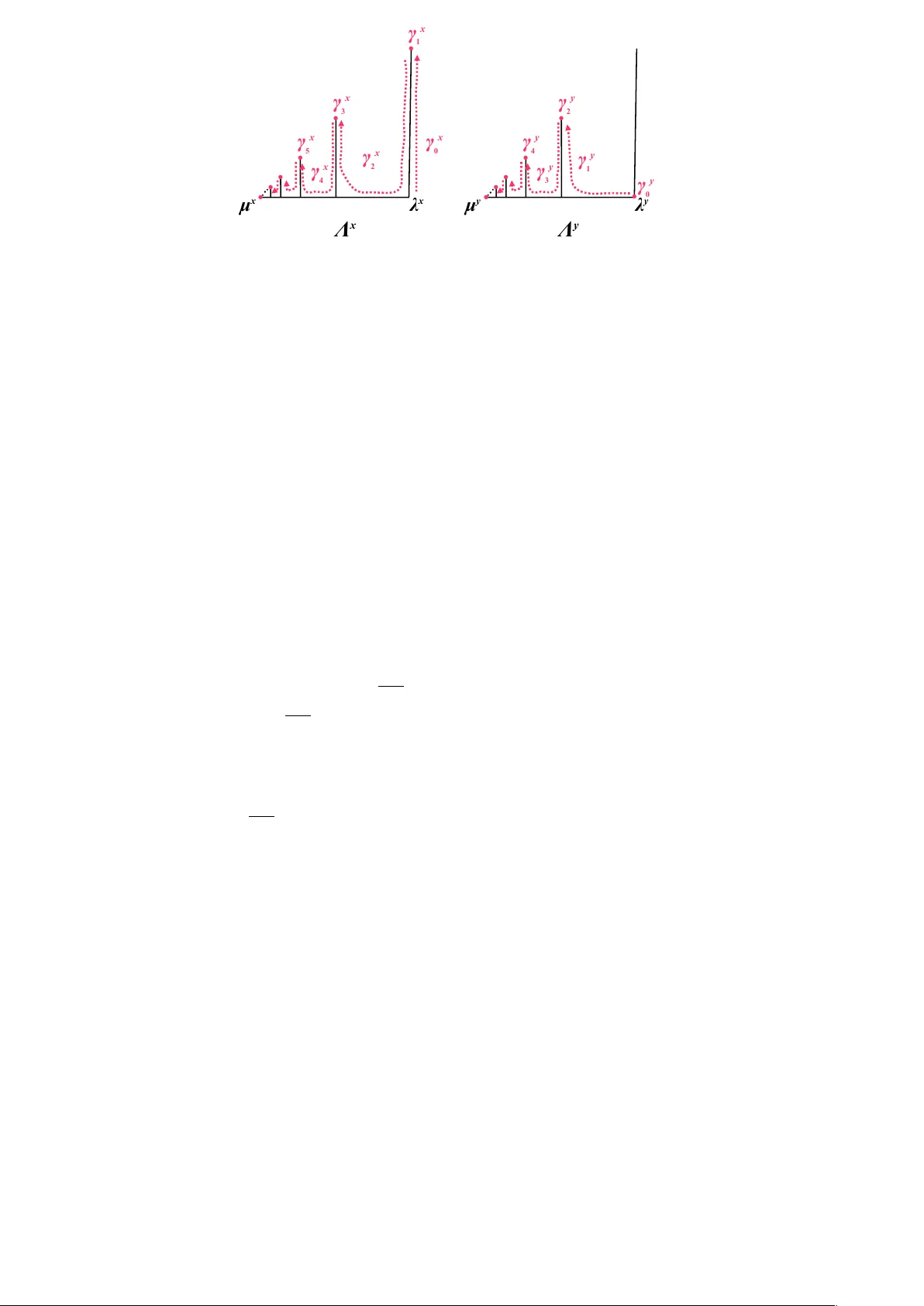
GEOMETR Y OF AMPLE/LOPSIDED SETS HANS–JÜR GEN BANDEL T, VICTOR CHEPOI, ANDREAS DRESS, AND JA CK KOOLEN Abstra ct. Lopsided sets w ere in troduced by Jim La wrence in 1983 when he studied the subsets L of {− 1 , +1 } E that enco de the in tersection pattern of a con v ex set K with the orthan ts of R E . He iden tified a strong com binatorial condition on L (that he dubbed lopside dness ) that is necessary (y et, as he show ed, not sufficien t) for the existence of suc h a con v ex set K , gav e a n um b er of equiv alen t conditions, and noted its close connections with v arious other topics studied in combinatorics. Lopsided sets hav e b een indep endently redisco v ered by several other authors, in particular by Andreas Dress in 1995, who called them ample sets. Dress defined ample sets as the set families satisfying equality in a combinatorial inequalit y , which holds for all set families. Ample/lopsided sets can be regarded as the isometric subgraphs of hypercub es for which the in tersections with all subhypercub es yield isometric subgraphs. Alternative ly , they correspond to set families L suc h that when a subset A of the ground set E is shattered b y L , then A is strongly shattered b y L , i.e., some subh ypercub e defined by A is fully included in L . In a previous article we c haracterized ample sets in v arious com binatorial and graph- theoretical wa ys. In this pap er we study geometric realizations of ample sets as cubihedra (cub e complexes), which yields several new characterizations. One such characterization es- tablishes that the cubihedra of ample sets endow ed with the intrinsic ℓ 1 -metric are exactly the isometric subspaces of ℓ 1 -spaces (which we call, w eakly conv ex sets). W e also view the barycen ter maps of faces of cubihedra of ample sets as collections of {± 1 , 0 } -sign vectors and, in analogy with the characterization of orien ted matroids by the cov ectors and the cocircuits. Moreo v er, we characterize the collections of {± 1 , 0 } -sign v ectors corresp onding to barycen ter maps of all faces and all maximal faces of an ample set. F urthermore, we sho w that any ample set L ⊆ {− 1 , +1 } E is realizable as the intersection pattern of a w eakly conv ex set K with the orthan ts of R E . All this testifies that the concept of ample sets is quite natural in the context of cub e complexes. 1. Intr oduction This pap er is the follow-up of [3], in which we presen ted a list of com binatorial, recursive, and graph-theoretical c haracterizations of lopside d sets first introduced and inv estigated by Lawrence [14] and redisco v ered indep enden tly b y Bollobàs and Ratcliffe [6], Dress [9], and Wiedemann [22], who dubb ed them extr emal , ample , and simple sets , resp ectively . In the present pap er, we call suc h sets ample (adopting the name from [9], which w e find the most appropriate since it p erfectly reflects their combinatorial quintessence) and we provide several geometric c haracterizations of ample sets, eac h emphasizing one or another feature of ampleness and its relationships with some fundamental concepts from the geometry of ℓ 1 -spaces. W e will rep eatedly refer to the first part [3] for definitions, prop erties and characterizations of ample sets. Ampleness. Throughout this pap er, E denotes a finite set with n := # E elemen ts, {± 1 } E is the set of all maps from E into {± 1 } = {− 1 , +1 } , {± 1 , 0 } E is the set of all maps from E in to {± 1 , 0 } = {− 1 , 0 , +1 } . Th us R E is the vector space consisting of all maps from E in to R . The solid hyp er cub e H ( E ) = [ − 1 , +1] E ⊂ R E consists of all maps from E in to the interv al [ − 1 , +1] . W e consider H ( E ) as a cub e complex, i.e., as a con v ex p olyhedron together with its face structure. The 0-skeleton of H ( E ) is {± 1 } E , its 1-skeleton H (1) ( E ) is the gr aphic hyp er cub e , and {± 1 , 0 } E is the set of sign maps of the barycenters of faces of H ( E ) . F or any tw o maps r ′ , r ′′ ∈ R E , we denote by d ( r ′ , r ′′ ) their ℓ 1 -distance || r ′ , r ′′ || 1 = P e ∈ E | r ′ ( e ) − r ′′ ( e ) | . T w o v ertices s ′ , s ′′ ∈ {± 1 } E define an edge (of length 2) of H (1) ( E ) if and only if d ( s ′ , s ′′ ) = 2 . 1 2 HANS–JÜRGEN BANDEL T, VICTOR CHEPOI, ANDREAS DRESS, AND JA CK KOOLEN In most of the pap er, we will consider subsets L of {± 1 } E . Alternatively , such a set L can be view ed as a collection of subsets of E . The set-theoretic complement of L is written as L ∗ : L ∗ := {± 1 } E − L. W e denote b y G ( L ) the subgraph of the graphic hypercub e H (1) ( E ) induced b y L . The set L is called c onne cte d if G ( L ) is connected, and it is called isometric if every pair of vertices s ′ , s ′′ of L can b e connected in G ( L ) by a path of length d ( s ′ , s ′′ ) . Giv en an y subset A of E , one can alwa ys asso ciate t w o subsets L A and L A of {± 1 } E − A with an arbitrary set L ⊆ {± 1 } E of sign maps: L A := { t ∈ {± 1 } E − A : some extension s ∈ {± 1 } E of t b elongs to L } , L A := { t ∈ {± 1 } E − A : ev ery extension s ∈ {± 1 } E of t b elongs to L } . L A = { s | E − A : s ∈ L } enco des the pro jection of L onto {± 1 } ( E − A ) . In con trast to L A , the smaller set L A requires the existence of a full fib er isomorphic to {± 1 } A within L rather than just one p oint from L . The tw o op erators L A and L A suggest tw o w a ys to derive an abstract simplicial complex from L : X ( L ) := { A ⊆ E : L E − A = {± 1 } A } , X ( L ) := { A ⊆ E : L A = ∅ } . Simplices of X ( L ) are usually called sets shatter e d b y L and simplices of X ( L ) are called sets str ongly shatter e d by L [8, 17]. The largest size of a simplex of X ( L ) is called the V apnik- Chervonenkis dimension ( VC-dimension for short) of L (viewed as a set family). Example 1. Let E = { 1 , 2 , 3 } and consider the subset L of {± 1 } E that consists of all sign maps except the tw o constant ones. Then L enco des an isometric 6-cycle in H (1) ( E ) . F or every singleton A the pro jection of L on to {± 1 } E − A is surjectiv e, but L do es not include a full fib er isomorphic to this 2-cub e. Therefore X ( L ) comprises all prop er subsets of { 1 , 2 , 3 } , whereas X ( L ) consists of the empt y set and the three singletons. In [9] and [3] it is sho wn that # X ( L ) ≤ # L ≤ # X ( L ) holds for any L ⊆ {± 1 } E (the inequalit y # L ≤ # X ( L ) w as pro v ed before b y Pa jor [19]). A set L is called ample if the equalit y # L = # X ( L ) holds. Ampleness turned out to be preserved when passing to the complementary set L ∗ and to the sets L A , L A , and to imply connectedness (and, ev en more, isometricity) of L . It follo w ed that L A and L A had to be connected (isometric) subsets of {± 1 } E − A for every ample subset L of {± 1 } E . Conv ersely , connectivit y (or isometricit y) of L A for all A ⊆ E turned out to imply ampleness, suggesting to call such subsets sup er c onne cte d or sup erisometric . F urther inv estigation finally resulted in recognizing that our ample sets coincided exactly with Lawrence’s lopsided sets and that an amazingly ric h and multi–facetted theory regarding such subsets of {± 1 } E could b e dev eloped. Here is a list of the most remark able prop erties of ample sets established in [3], each of which could b e used to define them: (1) Sup erisometry: L A is isometric for all A ⊆ E , (2) Sup er c onne ctivity: L A is connected for all A ⊆ E , (3) Isometric r e cursivity: L is isometric, and b oth L e and L e are ample for some e ∈ E , (4) Conne cte d r e cursivity: L is connected, and L e is ample for every e ∈ E , (5) Commutativity: ( L A ) B = ( L B ) A holds for an y disjoint A, B ⊆ E , (6) Ampleness: # L = # X ( L ) , (7) Sp arseness : # L = # X ( L ) , (8) L opside dness : for all A, B ⊆ E with A ∩ B = ∅ and A ∪ B = E , either A ∈ X ( L ) or B ∈ X ( L ∗ ) . GEOMETR Y OF AMPLE/LOPSIDED SETS 3 (9) Her e ditary Euler char acteristic 1: for every face F of H ( E ) in tersecting L , X i ≥ 0 ( − 1) i f i ( L ∩ F ) = 1 , where f i ( L ∩ F ) coun ts the n umber of graphic i -cub es contained in the intersection of L with F . The second-last c haracterization was the original definition of lopsidedness by La wrence [14]. The last characterization was first pro ved b y Wiedemann [22]. W e also recall the follo wing nice c haracterization of ample sets due to La wrence [14]: (10) T otal asymmetry: If the in tersection of L with a face F of H ( E ) is closed b y taking an tip o des, then either F ∩ L is empty or coincide with F ∩ {± 1 } E . La wrence [14] presented several examples of ample sets. In particular, he prov ed that the sign vectors of the closed orthan ts of R E in tersecting a conv ex set K is ample (he also presen ted an example of an ample set not realizable in this wa y). Additionally , in [3], w e prov ed that v ertex-sets of median graphs (CA T(0) cub e complexes) are ample, and, more generally , that con vex geometries and their b ouquets (which w e called conditional antimatroids) are ample. Our results. Every subset L of {± 1 } X giv es rise to a (not necessarily connected) cub e c omplex comprising all faces of the h yp ercub e H ( E ) all of whose vertices b elong to L ; cf. [21]. This (compact) cubical p olyhedron (a cubihe dr on for short) will b e denoted by | L | and called the ge ometric r e alization of L . The vertices of | L | are exactly the elements in L . The 1-skeleton of this cubihedron is the graph G ( L ) defined ab ov e. If L is connected, then | L | is connected as w ell and therefore can b e endow ed with an intrinsic ℓ 1 -metric d | L | . The resulting metric space ( | L | , d | L | ) is complete and geo desic but is not necessarily p ath- ℓ 1 -isometric (in the sense that an y r ′ , r ′′ ∈ | L | can b e connected in | L | b y an ℓ 1 -geo desic). F or example, if L is defined as in Example 1, then | L | is a solid 6-cycle of R 3 . The ℓ 1 -distance b etw een the midp oin ts of tw o opp osite sides of this cycle is 4, while the in trinsic ℓ 1 -distance is 6. In this pap er, we will establish that path- ℓ 1 -isometricit y of the asso ciated cube complex | L | is y et another characteristic feature of ampleness, th us demonstrating that ample sets constitute a fundamental domain for ℓ 1 -geometry: (11) Path- ℓ 1 -isometricity: ( | L | , d | L | ) is a path- ℓ 1 -isometric subspace of the ℓ 1 -space ( R E , d ) . Since the metric space ( | L | , d | L | ) is complete, b y Menger’s theorem [15], the path- ℓ 1 - isometricit y of | L | is equiv alent to its Menger conv exity , whic h in our particular ℓ 1 -case will b e dubb ed weak con vexit y: K ⊆ R E is called we akly c onvex if for any r ′ , r ′′ ∈ | L | there exists r ∈ | L | different from r ′ and r ′′ suc h that d ( r ′ , r ′′ ) = d ( r ′ , r ) + d ( r , r ′′ ) . Conv ex sets of R E are w eakly conv ex, explaining the chosen name. W eak conv exity is not the w eak est requiremen t to | L | , which still c haracterizes ampleness of L . W e call a subset K of R E sign-c onvex if for any r ′ , r ′′ ∈ K and every e ∈ E with r ′ ( e ) r ′′ ( e ) < 0 there exists some r ∈ K with r ( e ) = 0 and sign( r ( f )) ∈ { sign( r ′ ( f )) , sign( r ′′ ( f )) } for all f ∈ E with r ′ ( f ) r ′′ ( f ) ≥ 0 . (12) W e ak and sign c onvexity: | L | is weakly conv ex (equiv alently , | L | is sign-conv ex). While w eakly con vex subsets of R E are ob viously connected, sign-conv exity is more admissiv e b ecause finite subsets of R E ma y b e sign-conv ex. In fact we show that sign-conv exity c haracter- izes the set Baryc( L ) of the barycen ter maps of faces of | L | of ample sets L . La wrence [14] sho wed how to derive ample sets L ( K ) from con vex subsets K of R E . There is also a canonical construction which allo ws to derive ample sets L ( J ) from certain subsets J of {± 1 , 0 } E . Consider the standard ordering ≺ of signs − 1 , +1 , 0 for whic h − 1 and +1 are incomparable, 0 ≺ − 1 and 0 ≺ +1 and endow {± 1 , 0 } E with the pro duct ordering, denoted also by ≺ . The upwar d closur e ↑ J of a subset J ⊆ {± 1 , 0 } E consists of all t ′ ∈ {± 1 , 0 } E suc h that t ≺ t ′ for some t ∈ J . If L is ample, then L can be retriev ed from the set Baryc( L ) as L = Baryc( L ) ∩ {± 1 } E = ↑ Baryc( L ) ∩ {± 1 } E . Therefore, one may ask for which subsets J of {± 1 , 0 } E , the set ↑ J ∩ {± 1 } E is ample. W e prov e that sign-conv exity of the upp er closure of J is sufficient to characterize ampleness of ↑ J ∩ {± 1 } E : 4 HANS–JÜRGEN BANDEL T, VICTOR CHEPOI, ANDREAS DRESS, AND JACK KOOLEN (13) Sign-c onvexity of upwar d closur e: L ( J ) is ample if and only if ↑ J is sign-conv ex. F urthermore, J can b e retriev ed from L = ↑ J ∩ {± 1 } E as Baryc( L ) . The previous result can b e viewed as an analog of the characterization of oriented matroids via cov ectors, see [5]. T o c haracterize the subsets J of {± 1 , 0 } E for whic h ↑ J ∩ {± 1 } E is ample, we need y et another relaxation of con vexit y in R E : K ⊆ R E is called 0 -c onvex if for any r ′ , r ′′ ∈ K and ev ery e ∈ E with r ′ ( e ) r ′′ ( e ) < 0 there exists some r ∈ K with r ( e ) = 0 and sign( r ( f )) ∈ { 0 , sign( r ′ ( f )) , sign( r ′′ ( f )) } for all f ∈ E \ { e } . Each w eakly con vex or sign-conv ex subset of R E is 0-conv ex but the conv erse is not true. In case of subsets of {± 1 , 0 } E , 0-conv exity is analogous to the “weak elimination” axiom for signed circuits in oriented matroids [5] and is equiv alent to the following signe d-cir cuit axiom (SCA) : Signe d-cir cuit axiom: for all t ′ , t ′′ ∈ J and e ∈ E with r ′ ( e ) · t ′′ ( e ) = − 1 there exists some t ∈ J suc h that t ( e ) = 0 and t ( f ) ∈ { 0 , t ′ ( f ) , t ′′ ( f ) } for all f ∈ E . (14) 0-Convexity and (SCA): ↑ J ∩ {± 1 } E is ample if and only if J is 0-conv ex, i.e., J satisfies (SCA). Ev ery subset J of {± 1 , 0 } E can b e extended to the cubihedron [ J ] consisting of all cub es whose barycenters b elong to J . F rom the previous results it follo ws that the cubihedron [ J ] is path- ℓ 1 -isometric if and only if J is 0-conv ex. Ample sets L can also b e characterized via their “co circuits”, i.e. the set Cocirc( L ) of barycen- tric maps of the facets (maximal faces) of the asso ciated cubihedron | L | . F rom our previous c haracterizations we deduce that the co circuits of ample sets are exactly the sign maps that satisfy the signed-circuit axiom (SCA) and consist of pairwise minimal (for ≺ ) maps : (15) Co cir cuits: Co circ( L ) satisfies (SCA) and t, t ′ ∈ Co circ( L ) with t ≺ t ′ implies t = t ′ . F urthermore, if J ⊂ {± 1 , 0 } E satisfies (SCA) and pairwise minimality , then Co circ( L ( J )) = J . The c haracterization of co circuits R ⊆ {± 1 , 0 } E of orien ted matroids also inv olves maximality , the signed-circuit axiom, but, additionally , requires the symmetry ( r ∈ R implies that − r ∈ R ) [5]. Nev ertheless, the lac k of symmetry implies that ample sets can differ substantially from orien ted matroids regarding their combinatorial and geometric structure. The primary motiv ation of Lawrence in [14] was to inv estigate and generalize those subsets L ( K ) := { s ∈ {± 1 } E : { t ∈ K : t ( e ) s ( e ) ≥ 0 for all e ∈ E } = ∅ } of {± 1 } E whic h represent the closed orthants of R E in tersecting a conv ex subset K of R E . He (as w ell as Wiedemann [22]) show ed that such sets are ample. How ev er, not every ample set enco des the orthant intersection pattern for a conv ex set in Euclidean space; see [14]. It comes close, though. As we will sho w b elo w, in order to hav e a full geometric representation, one has to resort to a w eaker concept of weak con vexit y: (16) R e alizability by we akly c onvex sets: L enco des the orthan t intersection pattern for some w eakly con v ex (path- ℓ 1 -isometric) set K of ( R E , || · || 1 ) , that is, a sign v ector s b elongs to L exactly when the orthant determined by s also includes a p oint from K . W e also show that for a subset L of {± 1 } E the (orthogonal) pro jection and geometric real- ization commute exactly when L is ample: (17) Commutativity of pr oje ction and ge ometric r e alization: | L | A = | L A | holds for all A ⊆ E . F urthermore, instead of | L | A = | L A | , it is sufficient to consider only the equalit y b et ween the top ological dimensions of | L | A and | L A | : (18) Equality of dimensions: dim ( | L | A ) = dim ( | L A | ) holds for all A ⊆ E . GEOMETR Y OF AMPLE/LOPSIDED SETS 5 (P ersonal) historical note. Our journey in the world of ample/lopsided sets started in De- cem b er 1995, when A. Dress sen t us a fax with the inequalit y # X ( L ) ≤ # L ≤ # X ( L ) and the suggestion to inv estigate the set families L for which # L = # X ( L ) . Soon after we come up with the largest part of the characterizations and examples presented in [3] and several results of the presen t pap er. In 1996 we discov ered the pap er by Lawrence [14] and show ed that his lopsided sets and our ample sets are the same. This somehow diminished our enth usiasm, nev- ertheless w e contin ued working on the sub ject (as certified, among other do cuments, by a 100 pages fax sent to eac h of us b y A. Dress from New Y ork in 1998). In 2006 w e completed the first part of the pap er, which app eared in [3] (some preliminary results ha ve b een announced in [9]). Soon after the publication of [3], eac h of us got a letter from R. Wiedemann with a copy of his PhD [22] from 1986, informing us that in [22] he rediscov ered ample sets under the name “simple sets”. In 2012 we finished the first version of the curren t pap er and w e came across the master thesis of S. Moran [16], from which we learned that the ample/lopsided sets hav e b een also indep endently rediscov ered by Bollobàs and Ratcliffe [6] under the name “extremal sets” and that the inequality # L ≤ # X ( L ) was previously established by Pa jor [19]. The inequalit y # L ≤ # X ( L ) b ecomes of some importance in com binatorics and computational learning theory , in particular since it implies the classical Sauer-Shelah-Perles inequality # L ≤ n ≤ d (where d is the V C-dimension of L ), whic h is thoroughly used in the theory of VC-dimension. Indeed, the simplices of X ( L ) are the sh uttered by L subsets of E and the size of a largest simplex of X ( L ) is the VC-dimension d . Do to this (and in analogy to Sauer-Shelah-Perles inequalit y), we suggest to call # X ( L ) ≤ # L ≤ # X ( L ) the Dr ess-Pajor ine quality . The set families L for which # L = n ≤ d are called “maximum sets” [11] and they are ample. Maxim um sets hav e b een inv estigated in [11] and they represent imp ortan t concept/hypothesis classes for whic h the sample c ompr ession c onje ctur e [12] from computational learning theory was established. This also motiv ated the inv estigation and the solution of the sample compression conjecture for ample sets [17] (see also [8] for the unlab eled v ersion of this conjecture). Ev en though this article w as not submitted for publication earlier, the obtained results in- spired tw o of us and K. Knauer to introduce the complexes of orien ted matroids (called also conditional orien ted matroids and abbreviated COMs) [4]. COMs are defined in terms of cov- ectors ( {± 1 , 0 } E -v ectors) using similar axioms as the Orien ted Matroids (OMs) [5], only global symmetry and the existence of the zero sign vector, required for Orien ted Matroids, are replaced b y lo cal relative conditions. COMs represent a far reaching common generalization of ample sets, OMs, rankings, and CA T(0) Coxeter zonotopal complexes. COMs can b e endo wed with the structure of a cell complex, in whic h eac h cell is an OM, and this cell complex is con tractible. The ample sets are exactly the COMs in which all cells are cub es. The graphs of top es of COMs ha ve b een c haracterized b y Knauer and Marc [13]. Currently , b oth ample sets and COMs are sub jects of active studies. Organization. The pap er is organized in the following w a y . In Section 2 we presen t the main definitions used in all other sections of the pap er. Sections 3 and 4 con tain preliminary results. In Section 3 we in vestigate metric and com binatorial relaxations of usual con vexit y in linear and metric spaces, which are used in all our characterizations. In Section 4 we discuss the intrinsic path metrics asso ciated with an arbitrary metric space ( M , d ) (this section ma y b e skipp ed at first reading). The next four sections present the main results of the pap er. Sections 5 and 6 present c haracterizations of ample cubihedra via metric conditions, weak and sign-conv exities, and via pro jections. Then the geometric realization of ample sets in terms of in tersection pattern with orthan ts is established in Section 7. Section 8 inv estigates the concepts of circuits and co circuits and their relation to the geometric structure of ample cubihedra. 2. Preliminaries 2.1. Maps and sign maps. Given a finite set E , we denote by # E its cardinality , by {± 1 } E the set of all maps from E into {± 1 } = {− 1 , +1 } , b y {± 1 , 0 } E the set of all maps from E in to {± 1 , 0 } , and by R E the v ector space consisting of all maps r from E into R . Clearly , 6 HANS–JÜRGEN BANDEL T, VICTOR CHEPOI, ANDREAS DRESS, AND JACK KOOLEN {± 1 } E ⊂ {± 1 , 0 } E ⊂ R E . F or r ∈ R E and e ∈ E , we denote b y sign( r ( e )) ∈ {− 1 , 0 , +1 } the sign of r ( e ) . T o eac h map r ∈ R E w e asso ciate its supp ort supp( r ) = { e ∈ E : r ( e ) = 0 } and its sign ve ctor sign( r ) ∈ {± 1 , 0 } E whose co ordinates are sign( r ( e )) , e ∈ E . F or any r ′ , r ′′ ∈ R E , w e denote by ∆( r ′ , r ′′ ) = { e ∈ E : r ′ ( e ) = r ′′ ( e ) } their differ enc e set and b y d ( r ′ , r ′′ ) their ℓ 1 -distance || r ′ , r ′′ || 1 = P e ∈ E | r ′ ( e ) − r ′′ ( e ) | = P e ∈ ∆( r ′ ,r ′′ ) | r ′ ( e ) − r ′′ ( e ) | . Let also [ r ′ , r ′′ ] = { r ∈ R E : d ( r ′ , r ) + d ( r, r ′′ ) = d ( r ′ , r ′′ ) . Note that [ r ′ , r ′′ ] is an axis-parallel b ox. Eac h e ∈ E defines a co ordinate h yp erplane H e = { r ∈ R E : r ( e ) = 0 } of R E , whic h partitions R E − H e in to p ositive and ne gative open halfspaces. The set H = { H e : e ∈ E } is a c entr al arr angement of hyperplanes; H indices a partition R of R E in to op en regions and recursively in to regions defined b y the intersections of some h yp erplanes of H . More sp ecifically , eac h region R ∈ R is the intersection of a set H e , e ∈ E ′ of h yp erplanes of H and a set of p ositiv e or negative halfspaces, one halfspace for each H f , f ∈ E − E ′ . The dimension of eac h R v aries b et ween # E and 0 . The regions of R of maximal dimension are the 2 # E op en orthants of R E . F or every p oint r in R E , the sign v ector sign( r ) is the sign map s ∈ {± 1 , 0 } E suc h that s ( e ) = 0 if r ∈ H e , s ( e ) = +1 if r b elongs to the p ositive halfspace of H e and s ( e ) = − 1 if r b elongs to the negativ e halfspace of H e . All p oin ts r b elonging to the same region R of R hav e the same sign vector and any tw o p oints b elonging to distinct regions of R hav e distinct sign v ectors. In particular, all p oints b elonging to the same op en orthan t O of R E ha ve the same sign vector s ∈ {± 1 } E and O can b e retrieved from s as O = { r ∈ R E : r ( e ) · s ( e ) > 0 for all e ∈ E } . The closure e O of O is a closed orthant of R E and e O can b e also identified by the sign map s as e O = O ( s ) , where O ( s ) := { r ∈ R E : r ( e ) · s ( e ) ≥ 0 for all e ∈ E } . Con versely , given r ∈ R E , the set Sign( r ) := { s ∈ {± 1 } E : r ( e ) · s ( e ) ≥ 0 for all e ∈ E } , indicates the closed orthants of R E to which r b elongs. 2.2. The hypercub e H ( E ) and its faces. By H ( E ) w e denote the solid hyp er cub e [ − 1 , +1] E ⊂ R E and consider H ( E ) as a cub e complex. By H (1) ( E ) we denote the graph representing the 1-skeleton of H ( E ) , i.e., the graph with vertex-set {± 1 } E and whose edge set consists of all pairs { s, s ′ } of {± 1 } E suc h that d ( s, s ′ ) = 2 (equiv alently , ∆( s, s ′ ) = 1 ). This implies that the standard graph distance in H (1) ( E ) betw een an y t wo v ertices s ′ , s ′′ ∈ H (0) is equal to 1 2 d ( s ′ , s ′′ ) . Definition 1 (F aces of H ( E ) and their barycen ters) . A fac e F of the hypercub e H ( E ) is a A -fib er of the form F = H ( A ) × s 0 for some s 0 ∈ {± 1 } E − A with A ⊆ E . By con ven tion, H ( E ) is its E -fib er and its vertices are the faces that are ∅ - fib ers. The b aryc enter of the face F is the map s ∈ {± 1 , 0 } E suc h that s ( e ) = 0 if e ∈ A and s ( e ) = s 0 ( e ) ∈ {− 1 , +1 } if e ∈ E − A . W e sa y that tw o faces F ′ , F ′′ of H ( E ) are p ar al lel if there exist A ⊆ E and s ′ 0 , s ′′ 0 ∈ {± 1 } E − A suc h that F ′ = H ( A ) × s ′ 0 and F ′′ = H ( A ) × s ′′ 0 . Parallel faces thus arise by in tersecting the hypercub e with parallel (affine) A - planes { p ∈ R E : p | E − A = c } for c ∈ H ( E − A ) . F or each r ∈ H ( E ) denote by F ( r ) the (necessarily unique) smallest face of H ( E ) con taining r . F or eac h p oin t r of H ( E ) , the face F ( r ) is determined b y the co ordinates r ( e ) ( e ∈ E ) for whic h − 1 < r ( e ) < +1 : F ( r ) = H ( E ( r )) × r | E − E ( r ) , where E ( r ) := { e ∈ E : − 1 < r ( e ) < +1 } , and r | E − E ( r ) ∈ {± 1 } E − E ( r ) . GEOMETR Y OF AMPLE/LOPSIDED SETS 7 0 – – 0 0 + + 0 00 – + 0 – – – + + – + + ( a ) ( b ) Figure 1. (a) Ordering of signs. (b) Pro duct ordering on {± 1 , 0 } 2 ; the shaded no des corresp ond to the barycenter maps of an ample set. The barycen ter of the face F ( r ) is giv en b y the map from E to {± 1 , 0 } that is the zero map on E ( r ) and coincides with r | E − E ( r ) elsewhere. The set of all barycen ters of faces of H ( E ) is {± 1 , 0 } E . In order to express inclusion of faces of H ( E ) in terms of the corresp onding barycenter maps we use the standard ordering ≺ of signs − 1 , +1 , 0 for whic h − 1 and +1 are incomparable, 0 ≺ − 1 and 0 ≺ +1 ; see Fig. 1(a). The pro duct ordering ≺ E on {± 1 , 0 } E will also b e denoted b y ≺ . The undirected Hasse diagram of ( {± 1 , 0 } E , ≺ ) is a grid graph (viz., the Cartesian E -p ow er of a path with tw o edges) and will b e denoted by G ( {± 1 , 0 } E ) ; see Fig. 1(b) for # E = 2 . Thus, t 1 ≺ t 2 for tw o maps t 1 , t 2 ∈ {± 1 , 0 } E holds if and only if t 1 ( x ) ∈ { 0 , t 2 ( x ) } for all x ∈ E , or equiv alen tly , if for the asso ciated faces the inclusion F ( t 2 ) ⊆ F ( t 1 ) holds. 2.3. Subsets of sign maps, their cubihedra and barycentric completions. F or a subset L of {± 1 } E , we denote b y L ∗ := {± 1 } E − L the set-theoretic complemen t of L and b y G ( L ) the subgraph of H (1) ( E ) induced by L , i.e., the graph with vertex-set L and edge-set consisting of all edges of H (1) ( E ) b et ween tw o vertices of L (again we supp ose that the edges of G ( L ) hav e length 2). The set L is called c onne cte d if G ( L ) is connected, and it is called isometric if ev ery pair of v ertices s ′ , s ′′ of L can b e connected in G ( L ) by a path of length d ( s ′ , s ′′ ) . Definition 2 (The cubihedron) . The ge ometric r e alization (a cubihe dr on for short) of a set L ⊆ {± 1 } E is the cub e complex | L | ⊆ H ( E ) consisting of all faces F of the h yp ercub e H ( E ) for which F ∩ {± 1 } E ⊆ L. The vertices of | L | are the elements of L and the 1-skeleton | L | (1) of | L | coincides with G ( L ) . The fac ets of | L | are the maximal by inclusion faces of | L | . Notice that for each p oint r in | L | , its smallest face F ( r ) in the h yp ercub e H ( E ) necessarily b elongs to | L | . Definition 3 (The barycen tric completion) . F or a subset L of {± 1 } E , the subset of {± 1 , 0 } E consisting of all barycenters of the faces of | L | is called the b aryc entric c ompletion of L and is denoted by Baryc( L ) (or Baryc( | L | ) ). Definition 4 (The upw ard closure and the set of minima) . F or a subset J ⊆ {± 1 , 0 } E , the upwar d closur e ↑ J of J relativ e to the ordering ≺ is defined by ↑ J = { t ′ ∈ {± 1 , 0 } E : t ≺ t ′ for some t ∈ J } . Then J ⊆ {± 1 , 0 } E is called upwar d close d if ↑ J = J . Denote also by Min( J ) = { t ∈ J : t ′ ≺ t implies t ′ = t for all t ′ ∈ J } the set of all minimal elemen ts of the p oset ( J, ≺ ) . W e con tinue with tw o simple prop erties of upw ard closure: Lemma 1. F or any subset J of {± 1 , 0 } E , Baryc( ↑ J ∩ {± 1 } E ) = ↑ J . Pr o of. Indeed, ↑ J consists of the barycen ters t ′ of faces F ( t ′ ) included in faces F ( t ) of H ( E ) with t ∈ J . These are exactly the barycen ters of faces F of H ( E ) for whic h F ∩ {± 1 } E ⊆↑ J ∩ {± 1 } E , i.e., Baryc( ↑ J ∩ {± 1 } E ) . □ Lemma 2. F or any subset L of {± 1 } E , Baryc( L ) is an upwar d close d subset of {± 1 , 0 } E . 8 HANS–JÜRGEN BANDEL T, VICTOR CHEPOI, ANDREAS DRESS, AND JACK KOOLEN Pr o of. If t ∈ Baryc( L ) and t ≺ t ′ , then t ′ is the barycenter of the face F ( t ′ ) contained in F ( t ) . Since F ( t ) b elongs to | L | , F ( t ′ ) also b elongs to | L | , whence t ′ ∈ Baryc( L ) . This sho ws that ↑ Baryc( L ) ⊆ Baryc( L ) . The conv erse inclusion is obvious. □ 2.4. In tersection patterns and pro jections of subsets of R E . T o an y subset K of R E w e asso ciate tw o sets of sign maps L ( K ) ⊆ {± 1 } E and J ( K ) ⊆ {± 1 , 0 } E , enco ding the in tersection patterns of K with the closed orthants of R E and with the regions of the partition R of R E induced by the arrangement H , resp ectiv ely . Definition 5 ( L ( K ) and J ( K ) ) . Given an y subset K of R E , let L ( K ) := [ r ∈ K Sign( r ) = { s ∈ {± 1 } E : ∃ r ∈ K with r ( e ) · s ( e ) > 0 ∀ e ∈ supp( r ) } and J ( K ) := [ r ∈ K sign( r ) = { t ∈ {± 1 , 0 } E : ∃ r ∈ K with sign 0 ( r ) = t } . Th us s ∈ {± 1 } E b elongs to L ( K ) exactly when K ∩ O ( s ) = ∅ , i.e. if exists some r ∈ K with r ( e ) · s ( e ) ≥ 0 for all e ∈ E . Analogously , t ∈ {± 1 , 0 } E b elongs to J ( K ) exactly when there exists some r ∈ K with r ( e ) · t ( e ) > 0 for all e ∈ supp( r ) and t ( e ) = 0 for all e ∈ E − supp( r ) . Note also that L ( L ( K )) = L ( K ) and J ( J ( K )) = J ( K ) . T o an y subset J of {± 1 , 0 } E one asso ciates the set of sign maps L ( J ) = [ r ∈ J Sign( r ) = ↑ J ∩ {± 1 } E = L ( ↑ J ) and the corresp onding geometric realization | L ( J ) | of L ( J ) . This realization can b e compared to the cub e complex [ J ] , whic h is defined as the union of the smallest faces F ( t ) of H ( E ) con taining t for t ∈ J : [ J ] := [ t ∈ L F ( t ) ⊆ | L ( J ) | . One can retriev e the upw ard closure ↑ J from [ J ] as ↑ J = J ([ J ]) = Baryc([ J ]) . W e now introduce the notation K A and K A for subsets K of H ( E ) in analogy to L A and L A for subsets L of {± 1 } E . F or a subset K of R E and a subset A of E , we denote b y K A the image of K relative to to the orthogonal pro jection of K on to the ( E − A ) -plane: K A := { r | E − A : r ∈ K } ⊆ H ( E − A ) . F or a subset K of H ( E ) and A ⊆ E , the set K A := { r | E − A : H ( A ) × r | E − A ⊆ K } ⊆ H ( E − A ) enco des the lo cation of the A -fib ers in K that are also A -fib ers (faces) of H ( E ) . 2.5. In trinsic metric. Let ( M , ρ ) be a metric space, I ⊂ R a non-empt y interv al and γ : I → M a curv e (i.e. a contin uous map). W e define the length ℓ ( γ ) ∈ [0 , ∞ ] of γ by ℓ ( γ ) = sup P k i =1 ρ ( γ ( t i − 1 , t i ) , where the suprem um is taken ov er all k ∈ N and all sequences t 0 ≤ t 1 ≤ . . . t k in I . W e say that γ is r e ctifiable if ℓ ( γ ) < ∞ . The intrinsic metric asso ciated with ρ is the function δ M ,ρ : M × M → [0 , ∞ ] defined b y δ M ,d ( x, y ) = inf ℓ ( γ ) , where the infim um is taken o ver all rectifiable curv es γ : [0 , 1] → M from x to y , i.e. γ (0) = x, γ (1) = y . ( M , ρ ) is called a length sp ac e if δ M ,d = ρ (see the App endix for other related notions and results). A ge o desic of ( M , ρ ) is the image of a contin uous map γ : [0 , α ] → M with α = ρ ( r ′ , r ′′ ) such that γ (0) = r ′ , γ ( α ) = r ′′ and ρ ( γ ( s ) , γ ( t )) = | s − t | for all s, t ∈ [0 , α ] . A metric space ( M , ρ ) is a ge o desic sp ac e [7] if any t wo points r ′ , r ′′ can b e connected in M by a geo desic. In this pap er, w e consider the geo desic metric space ( R E , d ) , where d is the ℓ 1 -distance. An ℓ 1 -ge o desic is a geo desic of ( R E , d ) . GEOMETR Y OF AMPLE/LOPSIDED SETS 9 A metric space ( M , d ) is Menger-c onvex if for any tw o distinct p oints x, y ∈ M there exists some p oint z b etwe en x and y , that is, z b elongs to the se gment [ x, y ] M = { z ∈ M : d ( x, z ) + d ( z , y ) = d ( x, y ) } suc h that, in addition, z is differen t from x and y . Menger [15] has shown that Menger-conv exit y in a complete metric space ( M , d ) entails that ( M , d ) is geo desic (see also [1] or [20, §18.5]). 3. Weak and sign convexities In this section we consider sev eral relaxations of classical conv exity in metric spaces. W e consider every subset K of R E as a metric space ( K , d ) relative to the metric induced on K by the ℓ 1 -metric d (w e denote the induced metric also b y d ). Recall that a subset K of R E is called c onvex if it contains the linear segmen t b etw een any tw o p oin ts r ′ , r ′′ ∈ K . Analogously , K ⊆ R E is called ℓ 1 -c onvex if it contains all ℓ 1 -geo desics b etw een any tw o p oints r ′ , r ′′ ∈ K . Since the linear segments are ℓ 1 -geo desics, every ℓ 1 -con vex set is conv ex. F or any e ∈ E , the co ordinate h yp erplane H e , the op en halfspaces H − e , H + e , and the closed halfspaces H − e , H + e defined b y H e are ℓ 1 -con vex. F urthermore, the faces of the hypercub e H ( E ) are also ℓ 1 -con vex. It is known (and easy to prov e) that the ℓ 1 -con vex subsets of R E are gated in the following sense. A subset K of any metric space ( R E , d ) is called gate d [10] if for ev ery p oin t r ∈ R E there exists a (necessarily unique) p oint r ′ ∈ K, the gate of r in K , for which d ( r , q ) = d ( r, r ′ ) + d ( r ′ , q ) for all q ∈ K. No w, we consider weak er versions of conv exit y . Definition 6 (W eak conv exity) . A subset K of R E is called we akly c onvex if ( K, d ) is complete and Menger-con vex, i.e., if for any tw o distinct p oints r ′ , r ′′ ∈ K there exists some p oint r = r ′ , r ′′ suc h that d ( r ′ , r ′′ ) = d ( r ′ , r ) + d ( r, r ′′ ) . Clearly , ev ery con vex subset of R E is weakly conv ex. The following lemma can b e viewed as a reformulation of the definition of weak con vexit y and follo ws from Menger’s theorem [15] men tioned ab ov e: Lemma 3. F or a subset K of R E such that ( K , d ) is c omplete, the fol lowing c onditions ar e e quivalent: (i) K is we akly c onvex; (ii) ( K, d ) is a length sp ac e; (iii) K is p ath- ℓ 1 -isometric in the sense that the r estriction of the ℓ 1 -metric d on K c onstitutes the intrinsic metric δ K,d of K . W e con tinue with tw o com binatorial relaxations of weak con vexit y: Definition 7 (Sign conv exit y) . A subset K of R E is called sign-c onvex if for any tw o distinct p oin ts r ′ , r ′′ ∈ K and ev ery e ∈ E with r ′ ( e ) r ′′ ( e ) < 0 there exists some p oint r ∈ K with r ( e ) = 0 and sign( r ( f )) ∈ { sign( r ′ ( f )) , sign( r ′′ ( f )) } for all f ∈ E with r ′ ( f ) r ′′ ( f ) ≥ 0 (and no condition on sign( r ( f )) in case r ′ ( f ) r ′′ ( f ) < 0 and f = e ). Lemma 4. Every we akly c onvex (and henc e every c onvex) subset K of R E is sign-c onvex. Pr o of. Pick any r ′ , r ′′ ∈ K and e ∈ E with r ′ ( e ) r ′′ ( e ) < 0 . Since K is w eakly conv ex, r ′ and r ′′ can b e connected in K b y an ℓ 1 -geo desic γ ( r ′ , r ′′ ) . Consider the co ordinate hyperplane H e defined by e . Since r ′ ( e ) r ′′ ( e ) < 0 , r ′ and r ′′ b elong to distinct op en halfspaces defined b y H e . Therefore γ ( r ′ , r ′′ ) intersects H e in a p oint r . Then r ( e ) = 0 , th us sign( r ( e )) = 0 . No w, consider an y f ∈ E suc h that r ′ ( f ) r ′′ ( f ) ≥ 0 . This implies that r ′ and r ′′ b elong to the same closed halfspace defined by the hyperplane H f , say r ′ , r ′′ b elong to the closed negativ e halfspace H − f . Since H − f is ℓ 1 -con vex, the geo desic γ ( r ′ , r ′′ ) as well as the p oint r also b elong to H − f . Therefore r ( f ) ≤ 0 and thus sign( r ( f )) ∈ {− 1 , 0 } . If one of the p oints r ′ , r ′′ b elong to H f and the second p oin t b elong to the open halfspace H − f , then { sign( r ′ ( f )) , sign( r ′′ ( f )) } = {− 1 , 0 } , yielding sign( r ( f )) ∈ { sign( r ′ ( f )) , sign( r ′′ ( f )) } . If b oth p oints r ′ , r ′′ b elong to H f , then r also b elongs 10 HANS–JÜRGEN BANDEL T, VICTOR CHEPOI, ANDREAS DRESS, AND JACK KOOLEN to H f b ecause H f is ℓ 1 -con vex and w e get sign( r ( f )) = sign( r ′ ( f )) = sign( r ′′ ( f )) = 0 . Finally , if b oth p oint s r ′ , r ′′ b elong to the op en halfspace H − f , then r also belongs to H − f b ecause H − f is ℓ 1 -con vex and w e get sign( r ( f )) = sign( r ′ ( f )) = sign( r ′′ ( f )) = − 1 . In all cases, r ′ ( f ) r ′′ ( f ) ≥ 0 implies sign( r ( f )) ∈ { sign( r ′ ( f )) , sign( r ′′ ( f )) } as required. □ W eakly conv ex subsets of R E are path ℓ 1 -isometric, thus they are connected. On the other hand, sign-con v ex sets are not necessarily connected, in particular, they ma y b e finite. F or example, the set {± 1 , 0 } E is sign-conv ex. The follo wing result relates the sign-conv exity of subsets of R E with the sign-con vexit y of subsets of {± 1 , 0 } E . Lemma 5. A subset K of R E is sign-c onvex if and only if the subset J ( K ) of {± 1 , 0 } E is sign- c onvex. Conse quently, K ⊆ R E is sign-c onvex if and only if ther e exists S ⊆ {± 1 , 0 } E such that J ( K ) = J ( S ) . Pr o of. Pick an y r ′ , r ′′ ∈ K and let t ′ = sign( r ′ ) , t ′′ = sign( r ′′ ) . By definition, for any f ∈ E , the inequalit y t ′ ( f ) t ′′ ( f ) ≥ 0 holds if and only if the inequalit y r ′ ( f ) r ′′ ( f ) ≥ 0 holds. First, supp ose that K is sign-con vex. T o show that J ( K ) is sign-con vex, pic k an y t ′ , t ′′ ∈ J ( K ) and e ∈ E suc h that t ′ ( e ) = − 1 and t ′′ ( e ) = +1 . Let r ′ , r ′′ ∈ K b e such that sign( r ′ ) = t ′ and sign( r ′′ ) = t ′′ . Then r ′ ( e ) < 0 and r ′′ ( e ) > 0 . Since K is sign-con vex, there must exist some r ∈ K such that r ( e ) = 0 and sign( r ( f )) ∈ { sign( r ′ ( f )) , sign( r ′′ ( f )) } for any f ∈ E such that r ′ ( f ) r ′′ ( f ) ≥ 0 . Let t = sign( r ) . Then t ( e ) = sign( r ( e )) = 0 . F urthermore, since t ′ ( f ) t ′′ ( f ) ≥ 0 if and only if r ′ ( f ) r ′′ ( f ) ≥ 0 , w e get t ( f ) = sign( r ( f )) ∈ { sign( r ′ ( f )) , sign( r ′′ ( f )) } = { t ′ ( f ) , t ′′ ( f ) } for an y suc h f ∈ E such that t ′ ( f ) t ′′ ( f ) ≥ 0 . Con versely , supp ose that K is a subset of R E suc h that J ( K ) is sign-conv ex. T o prov e that K is sign-con vex let r ′ , r ′′ ∈ K and e ∈ E suc h that r ′ ( e ) r ′′ ( e ) < 0 . Let t ′ = sign( r ′ ) and t ′′ = sign( r ′′ ) . Then t ′ ( e ) t ′′ ( e ) < 0 . Since t ′ , t ′′ ∈ J ( K ) and J ( K ) is sign-con vex, there exists t ∈ J ( K ) such that t ( e ) = 0 and t ( f ) ∈ { t ′ ( f ) , t ′′ ( f ) } for all f ∈ E such that t ′ ( f ) t ′′ ( f ) ≥ 0 . Pic k an y r ∈ K such that sign( r ) = t . Then sign( r ( e )) = t ( e ) = 0 , whence r ( e ) = 0 . F urthermore, since t ′ ( f ) t ′′ ( f ) ≥ 0 if and only if r ′ ( f ) r ′′ ( f ) ≥ 0 , we get sign( r ( f )) = t ( f ) ∈ { t ′ ( f ) , t ′′ ( f ) } = { sign( r ′ ( f )) , sign( r ′′ ( f )) } for an y f ∈ E such that r ′ ( f ) r ′′ ( f ) ≥ 0 . This concludes the pro of. □ Definition 8 ( 0 -conv exity) . A subset K of R E is called 0 -c onvex if for any tw o p oints r ′ , r ′′ ∈ K and every e ∈ E with r ′ ( e ) r ′′ ( e ) < 0 there exists some p oin t r ∈ K with r ( e ) = 0 and sign( r ( f )) ∈ { 0 , sign( r ′ ( f )) , sign( r ′′ ( f )) } for all f ∈ E \ { e } . Notice that 0-conv exit y of subsets of {± 1 , 0 } E comes from the following axiom, which is anal- ogous to the “w eak elimination” axiom for signed circuits in orien ted matroids (see [5, Definition 3.2.1]). W e say that a subset J ⊆ {± 1 , 0 } E satisfies the signe d-cir cuit axiom (SCA) if the follo wing condition holds: for all t ′ , t ′′ ∈ J, and e ∈ E with t ′ ( e ) · t ′′ ( e ) = − 1 there exists some (SCA) t ∈ J such that t ( e ) = 0 and t ( f ) ∈ { 0 , t ′ ( f ) , t ′′ ( f ) } for all f ∈ E . Consequen tly , a subset J of {± 1 , 0 } E is 0 -conv ex if and only if it satisfies (SCA). The difference b etw een sign-conv exity and 0-con vexit y is that for f ∈ E with r ′ ( f ) r ′′ ( f ) = +1 , sign-con vexit y requires that r ( f ) = r ′ ( f ) = r ′′ ( f ) , while 0-conv exit y allo ws r ( f ) to b e 0 or r ′ ( f ) = r ′′ ( f ) . If r ′ ( f ) r ′′ ( f ) = 0 and sa y r ′ ( f ) = 0 , b oth conditions require that r ( f ) ∈ { 0 , r ′′ ( f ) } . Finally , if r ′ ( f ) r ′′ ( f ) = +1 , then b oth sign- and 0-conv exities do not imp ose an y constrain t on the sign of r ( f ) . Therefore, the following holds (where the second assertion follo ws from the first assertion and Lemma 5): Lemma 6. If K is a sign-c onvex subset K of R E , then the sets K and J ( K ) ar e 0-c onvex. An y subset J of {± 1 , 0 } E con taining the zero map (0 , . . . , 0) is 0 -conv ex but not necessarily sign-con vex, showing that 0 -conv exity is w eaker than sign-conv exity . How ev er, for up ward closed subsets of {± 1 , 0 } E , sign-con vexit y and 0-con vexit y are equiv alen t. Moreov er, eac h of them is equiv alent to a “Menger-conv exit y type” condition, requiring that the sign map r in the definitions of sign- and 0-con vexit y b elongs to the b o x [ r ′ , r ′′ ] . GEOMETR Y OF AMPLE/LOPSIDED SETS 11 Prop osition 1. F or an upwar d close d subset J of {± 1 , 0 } E the fol lowing c onditions ar e e quiv- alent: (i) J is sign-c onvex; (i ′ ) for any t 1 , t 2 ∈ J and e ∈ E with t 1 ( e ) t 2 ( e ) = − 1 ther e exists some t 0 ∈ [ t 1 , t 2 ] ∩ J with t 0 ( e ) = 0 and t 0 ( f ) ∈ { t 1 ( f ) , t 2 ( f ) } for any f ∈ E such that t 1 ( f ) t 2 ( f ) ≥ 0 ; (ii) J is 0 -c onvex; (ii ′ ) for any t 1 , t 2 ∈ J and e ∈ E with t 1 ( e ) t 2 ( e ) = − 1 ther e exists some t 0 ∈ [ t 1 , t 2 ] ∩ J with t 0 ( e ) = 0 and t 0 ( f ) ∈ { 0 , t 1 ( f ) , t 2 ( f ) } for any f ∈ E such that t 1 ( f ) t 2 ( f ) ≥ 0 . Every upwar d close d sign-c onvex (0-c onvex) subset J of {± 1 , 0 } E induc es an isometric sub gr aph G ( J ) of the grid G ( {± 1 , 0 } E ) . Pr o of. The implication (i ′ ) ⇒ (i) is trivial and the implication (i) ⇒ (ii) follo ws from Lemma 6. T o pro v e (ii) ⇒ (ii ′ ), supp ose that J is an up w ard closed 0-con vex subset of {± 1 , 0 } E . Pic k an y t 1 , t 2 ∈ J and e ∈ E with t 1 ( e ) t 2 ( e ) = − 1 . 0 -Conv exity yields some t ∈ J with t ( f ) ∈ { 0 , t ′ ( f ) , t ′′ ( f ) } for all f ∈ E − { e } and t ( e ) = 0 . Then the map t 0 defined by t 0 ( f ) := ( t ′ ( f ) if t ( f ) = 0 and f = e, t ( f ) otherwise dominates t and hence b elongs to ↑ J ∩ [ t ′ , t ′′ ] = J ∩ [ t ′ , t ′′ ] . T o prov e (ii ′ ) ⇒ (i ′ ), let t 1 , t 2 ∈ J and e ∈ E with t 1 ( e ) t 2 ( e ) = − 1 . Condition (i ′ ) yields some t ∈ [ t 1 , t 2 ] ∩ J with t ( e ) = 0 and t ( f ) ∈ { 0 , t 1 ( f ) , t 2 ( f ) } for an y f ∈ E \ { e } . Now, pic k any f ∈ E \ { e } such that t 1 ( f ) t 2 ( f ) ≥ 0 . If t ( f ) / ∈ { t 1 ( f ) , t 2 ( f ) } , this implies that t ( f ) = 0 and t 1 ( f ) , t 2 ( f ) ∈ {± 1 } E . Since t 1 ( f ) t 2 ( f ) ≥ 0 , we conclude that t 1 ( f ) = t 2 ( f ) . Since t ∈ [ t 1 , t 2 ] and t ( f ) = 0 , w e obtain a contradiction. Finally , w e prov e that for ev ery upw ard closed sign-conv ex subset J of {± 1 , 0 } E , G ( J ) is an isometric subgraph of G ( {± 1 , 0 } E ) . Supp ose by w a y of contradiction that there were some distinct t 1 , t 2 ∈ J which are not adjacen t in the graph G ( {± 1 , 0 } E ) such that the b ox [ t 1 , t 2 ] in H ( E ) in tersects J only in t 1 and t 2 . If for some e ∈ E we hav e t 1 ( e ) · t 2 ( e ) = − 1 , then there exists some t 0 ∈ [ t 1 , t 2 ] ∩ J with t 0 ( e ) = 0 by condition (i ′ ). Then t 0 / ∈ { t 1 , t 2 } and we obtain a con tradiction with the initial hypothesis. Therefore t 1 ( f ) · t 2 ( f ) ≥ 0 for all f ∈ E , that is, all co ordinates of t 1 and t 2 ha ve comparable signs. Consequently , the join t of t 1 and t 2 exists in the ordered set ( {± 1 , 0 } E , ≺ ) and is given by t ( f ) = min { t 1 ( f ) , t 2 ( f ) } for all f ∈ E . Then t ∈ [ t 1 , t 2 ] ∩ ↑ J = [ t 1 , t 2 ] ∩ J = { t 1 , t 2 } , say t 2 ≺ t = t 1 . Since t 1 and t 2 are not adjacent in the graph G ( {± 1 , 0 } E ) , there exist at least tw o distinct co ordinates e and f at whic h they differ, whence t 2 ( e ) = t 2 ( f ) = 0 and t 1 ( e ) , t 1 ( f ) ∈ {± 1 } . Then the map t ∈ {± 1 , 0 } E defined by t ( g ) := ( 0 if g = e, t 1 ( g ) if g = e is differen t from t 1 and t 2 but belongs to [ t 1 , t 2 ] ∩ ↑ J = [ t 1 , t 2 ] ∩ J, yielding a final con tradiction. This establishes that G ( J ) is an isometric subgraph of G ( {± 1 , 0 } E ) . □ W e conclude this section by showing that 0-con v exity of subsets of {± 1 , 0 } E is equiv alent to 0-con vexit y of their up ward closures: Lemma 7. A subset J of {± 1 , 0 } E is 0-c onvex if and only if its upwar d closur e ↑ J is 0-c onvex. Pr o of. T rivially , J and ↑ J hav e the same set of minimal elemen ts: Min( J ) = Min( ↑ J ) . Assume that J is 0-conv ex and let t ′ 1 , t ′ 2 ∈↑ J with t 1 ≺ t ′ 1 and t 2 ≺ t ′ 2 for some t 1 , t 2 ∈ J. If t ′ 1 ( e ) · t ′ 2 ( e ) = − 1 for some e ∈ E , then t 0 can b e c hosen to b e one of t 1 , t 2 in case that 0 ∈ { t 1 ( e ) , t 2 ( e ) } . Otherwise, one ma y choose t 0 in J with t 0 ( e ) = 0 and t 0 ( f ) ∈ { 0 , t 1 ( f ) , t 2 ( f ) } for all f ∈ E . Con versely , assume that ↑ J is 0-con vex. Since the minimal c hoices relativ e to ≺ for establishing 0-con vexit y in ↑ J b elong to J , it follo ws that 0-con vexit y holds for J as well. □ The analogue of Lemma 7 do es not hold for sign-conv exity: {± 1 , 0 } E is the upp er closure of an y subset J con taining (0 , . . . , 0) , how ever J is not necessarily sign-conv ex. 12 HANS–JÜRGEN BANDEL T, VICTOR CHEPOI, ANDREAS DRESS, AND JACK KOOLEN 4. Intrinsic p a th metrics In this section we recall some basic notions ab out in trinsic path metrics and the length of paths, which are relev ant for the intrinsic metrics of cubihedra. In an arbitrary metric space ( M , d ) one can trivially define the length ℓ ( P ) of a finite x, y -p ath P of p oin ts x =: t 0 , t 1 , . . . , t k := y as the sum ℓ ( P ) := P k i =1 d ( t i − 1 , t i ) . The mo dulus of this path P is the maximum of all single step lengths d ( t i − 1 , t i ) for i = 1 , ..., k . Then the infim um inf { ℓ ( P ) : P is a finite x, y -path in M with mo dulus ( P ) < ϵ } of the lengths of all finite paths betw een tw o p oin ts x and y in M having modulus smaller than ϵ exists b ecause the length of ev ery finite path b etw een x and y is b ounded b elow b y d ( x, y ) by virtue of the triangle inequalit y . Then the suprem um δ M ,d ( x, y ) := sup { inf { ℓ ( P ) : P is a finite x, y -path in M with mo dulus ( P ) < ϵ } : ϵ ∈ R + } will b e called the (intrinsic) finite-p ath distanc e b et ween x and y in the metric space ( M , d ) , whic h may formally tak e the v alue ∞ of the extended real line when the supremum do es not exist. If, how ever, all v alues are real n umbers then we could sp eak of the (intrinsic) finite-p ath metric of ( M , d ) , since evidently ( M , d ) satisfies the triangle inequalit y . If there exists a (general) x, y - p ath in ( M , d ) , that is, a contin uous map γ : [0 , 1] → M with γ (0) = x and γ (1) = y , then its length [19, p.11] L ( γ ) := sup n k X i =1 d ( γ ( t i − 1 ) , γ ( t i )) : 0 ≤ t 0 ≤ t 1 ≤ . . . ≤ t k ≤ 1 where k ≥ 1 o is an upp er b ound for the lengths ℓ ( P ) of all finite x, y -paths P contained in γ . If an x, y - path γ exists with L ( γ ) < ∞ , then x and y are said to b e c onne cte d by a r e ctifiable p ath in ( M , d ) [19, p.35]. T aking the infimum o ver all general x, y -paths, w e obtain δ M ,d ( x, y ) := inf { L ( γ ) : γ is an x, y -path in M } , referred to as the p ath (or length ) distanc e in M relativ e to d (in the bo ok [19] the length distance is denoted b y d ℓ ). If each pair of p oints in M is connected by a rectifiable path, then b y [19, Prop osition 2.1.5] δ M ,d is a metric on M , referred to the (intrinsic) p ath metric of M asso ciated to d. W e thus hav e the inequalities d ( x, y ) ≤ δ M ,d ( x, y ) ≤ δ M ,d ( x, y ) , with the understanding that either δ v alue could equal ∞ . In the extreme case, δ M ,d could be a metric whereas δ M ,d is the constant ∞ map on pairs of distinct p oints. Consider, for example, the rational unit interv al M = Q [ 0 , 1] with its natural metric d : since paths of any mo dulus exist, the in trinsic path metric coincides with the natural metric, but geo desics betw een distinct p oin ts do not exist, whence the intrinsic length distance is infinite. Therefore the adv antage of using δ M ,d rather than δ M ,d is that we do not need to imp ose existence of rectifiable paths. In the imp ortan t case that ( M , d ) is a length (or p ath-metric) sp ac e [19, p.35], that is, d coincides with δ M ,d , both concepts of in trinsic metrics can be equated with the original metric d. The prop erty δ M ,d = d carries ov er to dense subspaces of ( M , d ) . In an arbitrary length space ( M , d ) general x, y -paths of length d ( x, y ) , that is, x, y -geo desics, need not exist. When how ever they exist for all pairs of p oints then the space is called ge o desic . A geo desic space ( M , d ) is called a r e al tr e e if ev ery geo desic constitutes the unique path b etw een its end p oin ts. Note that a compact real tree ( M , d ) may hav e infinitely many br anching p oints , i.e. p oints p for which M − { p } has at least three connected comp onents. Ev ery finite graph G = ( V , E ) has a trivial geometric realization as a 1-dimensional cell complex obtained by replacing each edge { x, y } by a solid link, that is, a copy [ u x , u y ] of the unit in terv al [0 , 1] of the real line suc h that tw o copies in tersect in an endp oin t exactly when the corresponding edges are incident. The resulting geometric graph (alias net work) M inherits its metric δ from the standard-graph metric d of G and the usual distance of [0 , 1] . Informally sp eaking, the distance δ ( p, q ) b etw een a p oint p from a link [ u v , u w ] and a p oint q from a link [ u x , u y ] in the geometric graph M is the smallest of the four sums | p − u v | + d ( v , x ) + | q − u x | , | p − GEOMETR Y OF AMPLE/LOPSIDED SETS 13 u v | + d ( v , y ) + | q − u y | , | p − u w | + d ( w , x ) + | q − u x | , and | p − u w | + d ( w , y ) + | q − u y | . More formally , one can apply the general construction of the length metric as describ ed in [19, Example 2.1.3(iv)] or [7, Section I.1.9]. In this wa y , one obtains a geo desic space ( M , δ ) . Similarly , in ad ho c manner, one could deal with the geometric realization of any finite cubical complex, but for lopsided sets we can obtain the length space prop erty for the asso ciated geometric realizations in a canonical wa y; see b elow. Completeness is an essen tial prerequisite in Menger’s pro of that complete Menger-con v ex spaces are geo desic. Indeed, the intersection ( M , d ) of the Cantor set with the irrational (op en) unit interv al is Menger-conv ex but δ M ,d ( x, y ) = ∞ holds for all pairs x, y of distinct p oin ts. In the absence of Menger-con vexit y the requirement δ M ,d < ∞ together with some lo cal compactness condition can at least guarantee that ( M , δ M ,d ) is a geo desic space. W e sa y that a metric space is b ounde d ly c omp act if every closed b ounded subset is compact. Note that in the con text of Riemannian geometry and length spaces one usually calls these spaces “prop er”. Lemma 8. If a b ounde d ly c omp act metric sp ac e ( M , d ) admits a finite-p ath metric δ M ,d < ∞ , then ( M , δ M ,d ) is a ge o desic sp ac e, whenc e δ M ,d = δ M ,d holds. Pr o of. F or any distinct p oints x, y w e can appro ximate α := δ M ,d ( x, y ) by finite x, y -paths of mo duli 1 /n ( n → ∞ ) . Sp ecifically , for every n ∈ N there exists a finite x, y -path P n of length smaller than α (1 + 1 / (2 n )) and mo dulus smaller than α/ (2 n ) . On each path P n pic k the first p oin t y n for whic h the initial x, y n -subpath P ′ n exceeds length α/ 2 , whence the length of the final y n , y -subpath of P n is then smaller than α (1 + 1 / (2 n )) . Since the sequence ( y n ) is contained in the closed 2 α -ball centered at x , it includes a subsequence ( z n ) con verging to some p oin t z such that, say , d ( z n , z ) < α/ (2 n ) . Inserting this limit p oin t z in to each P n directly after y n yields a path consisting of an initial x, z -subpath plus a final z , y -subpath b oth of mo dulus smaller than α/ (2 n ) and with lengths b etw een α/ 2 − 1 / (2 n ) and α/ 2 + 1 /n. Therefore δ M ,d ( x, z ) + δ M ,d ( z , y ) ≤ α/ 2 + α / 2 = α = δ M ,d ( x, y ) , whence by virtue of the triangle inequalit y z is the midp oint of the segment b etw een x and y relative to the finite path metric δ M ,d . W e can no w iterate this midp oin t construction by applying the pro cedure first to the pairs x, z and z , y , and so on. Then we even tually obtain a dense subset Z of the segment [ x, y ] relative to the metric δ M ,d , admitting an isometry ζ from ( Z, δ M ,d | Z × Z ) to the set of α -multiples of the dyadic fractions of 1 endow ed with the natural metric. Ev ery non-dyadic n umber τ from the unit interv al is the limit of some sequence ( τ n ) of dyadic fractions of 1, for which the α -multiples each ha ve a pre-image u n under ζ in Z . Then ( u n ) is a Cauch y sequence relativ e to δ M ,d and hence to d , which conv erges to some p oint u due to completeness of ( M , d ) . F or an y tw o p oints v and w of Z with ζ ( v ) < ατ and ζ ( w ) > ατ almost all u n are b etw een v and w relativ e to δ M ,d . Therefore one can approximate δ M ,d ( v , w ) b y pairs of concatenated finite v , u n -paths and u n , w -paths of mo duli conv erging to 0 and total lengths con verging to δ M ,d ( v , w ) ( n → ∞ ) . Substituting u n b y u in all paths yields a sequence of concatenated paths approximating b oth δ M ,d ( v , u ) + δ M ,d ( u, w ) and δ M ,d ( v , w ) . This sho ws that u is b etw een v and w relativ e to δ M ,d . In summary , we ha ve thus established an isometry from the closure Z of Z in ( M , δ M ,d ) to the interv al [0 , α ] , where Z is a x, y -geo desic in ( M , δ M ,d ) . □ Let X and Y b e tw o sets of maps from some disjoint nonempt y sets A and B , resp ectively , to a set Λ . Then we write X × Y for the set of all maps r : A ∪ B → Λ for which r | A b elongs to X and r | B b elongs to Y . F or singletons X or Y , set brack ets are omitted. Giv en a finite set E and a nonempty subset A of E , the set Λ A × r 0 for an y r 0 ∈ Λ E − A is called a fib er of the Cartesian p ow er Λ E , namely the A - fib er of Λ E at q 0 × r 0 for any q 0 ∈ Λ A . If Λ is endow ed with a (natural) metric, then w e will denote b y d the pro duct metric d E on the the pro duct space Λ E , where E is a finite set. When Λ is connected, a subspace K of Λ E is called fib er-c onne cte d if the intersection of K with each fib er of Λ E is connected (or empty). Similarly , when Λ is a geo desic space, K ⊆ Λ E is said to be fib er-ge o desic if K in tersects each fib er of Λ E in a geo desic subspace (or the empty set). The E -fib er of Λ E is understo o d to b e the en tire space Λ E . 14 HANS–JÜRGEN BANDEL T, VICTOR CHEPOI, ANDREAS DRESS, AND JACK KOOLEN Prop osition 2. L et Λ b e a b ounde d ly c omp act ge o desic sp ac e. F or a close d subset K of some finite p ower Λ E of Λ (endowe d with the pr o duct metric d = d E ), the fol lowing statements ar e e quivalent: (i) the intrinsic finite-p ath metric δ K,d of K c oincides with the r estriction d | K of the pr o duct distanc e d = d E of Λ E ; (ii) K is a ge o desic subsp ac e of Λ E ; (iii) K is fib er-ge o desic. Pr o of. Clearly , (ii) ⇒ (i)&(iii) and (iii) ⇒ (ii) b oth hold. Since Λ is b oundedly compact and E is finite, Λ E is also b oundedly compact. This carries o ver to ( K , d | K ) b ecause K is a closed subset of Λ E . If (i) holds, then ( K, δ K,d | K ) is a geo desic space b y Lemma 8, b ecause δ K,d | K = d | K < ∞ . Therefore K is a geo desic subspace of Λ E , thus establishing the implication (i) ⇒ (ii). □ Prop osition 2 can b e applied, for instance, to the closed subsets K of the Euclidean space R E : th us, the restriction of the Euclidean ( ℓ 2 -)metric to K constitutes the in trinsic (finite-) path metric of K relativ e to the Euclidean metric exactly when K is closed under taking line segments, that is, K is con vex. In the ℓ 1 case condition (iii) of Prop osition 2 can b e weak ened further dep ending on the space Λ . Namely , in order to replace fib er-geo desity by fib er-connectedness, the factors need to b e real trees. Prop osition 3. L et Λ b e a b ounde d ly c omp act r e al tr e e (e quipp e d with the natur al metric) in which every se gment includes only finitely many br anching p oints. Then a close d subset K of some finite p ower Λ E of Λ is a ge o desic subsp ac e of Λ E if and only if K if fib er-c onne cte d. Pr o of. By Prop osition 2, any closed geo desic subspace of Λ E is fib er-geo desic and hence fib er- connected. Conv ersely assume that K is a fib er-connected closed subspace of Λ E . Since (Λ E , d ) is complete and K is closed, ( K , d | K ) is also a complete metric space. Thus to prov e that K is a geo desic subspace of Λ E , it suffices to establish that K is Menger-con vex with respect to d . W e pro ceed by induction on # E . Since any proper fib er K 0 of K is a closed fib er-connected subset of Λ A × r 0 for a prop er subset A of E and a map r 0 ∈ Λ E − A , b y induction assumption w e can assume that K 0 is a geo desic subspace of Λ A × { r 0 } and Λ E . Suppose by wa y of con tradiction that K is not Menger-conv ex. In view of the induction hypothesis, we may then supp ose that there exist r 1 , r 2 ∈ K with [ r 1 , r 2 ] K = K ∩ [ r 1 , r 2 ] Λ E = { r 1 , r 2 } suc h that r 1 ( x ) = r 2 ( x ) holds for all x ∈ E . F or an y x ∈ E , let Λ x b e the x th factor (a cop y of Λ ) of the pro duct Λ E . Then Λ E −{ x } × r 1 ( x ) is the ( E − { x } ) -fib er of Λ E that contains the p oint r 1 of K . By Λ x + = Λ x + ( r 1 , r 2 ) denote the set of all p oints λ of the real tree Λ x for which r 1 ( x ) is not b etw een λ and r 2 ( x ) , that is, Λ x + := { λ ∈ Λ x : [ λ, r 1 ( x )] Λ E ∩ [ r 1 ( x ) , r 2 ( x )] Λ E = { r 1 ( x ) }} . Then Λ x + is an op en subset of the real tree Λ x and its closure Λ x + = Λ x + ∪ { r 1 ( x ) } is a b oundedly compact subtree of Λ x . T rivially , the closure of Λ E + := Q x ∈ E Λ x + equals Λ E + = Y x ∈ E (Λ x + ∪ { r 1 ( x ) } ) . (Note that Λ E + resp. Λ E + equal the op en resp. closed first orthan t of R E in the case that Λ = R , r 1 = 0 and r 2 > 0 .) W e claim that K ∩ Λ E + = ( K ∩ Λ E + ) ∪ { r 1 ( x ) } . Supp ose the contrary , that is, supp ose that there exists a p oin t r ∈ ( K − { r 1 } ) ∩ Y y ∈ E (Λ y + ∪ { r 1 ( y ) } with r ( x ) = r 1 ( x ) GEOMETR Y OF AMPLE/LOPSIDED SETS 15 ● ● ● ● ● ● γ 0 x γ 2 x γ 4 x γ 1 y γ 3 y γ 0 y λ x λ y μ y μ x Λ x Λ y • • • • • • • • γ 2 y γ 4 y γ 1 x γ 3 x γ 5 x • • • • Figure 2. Pro jection of a geo desic γ in Λ x × Λ y to the factors for some x ∈ E . Then b oth r and r 1 b elong to the fib er Λ E −{ x } × r 1 ( x ) and hence are connected b y a geo desic γ in K , according to the induction hypothesis. On the other hand, as Λ is a real tree, there exists a p oint s of Λ E (the median p oint of r 1 , r , s ) such that [ r 1 , s ] Λ E = [ r 1 , r 2 ] Λ E ∩ [ r 1 , r ] Λ E . The complemen t A = { y ∈ E : r 1 ( y ) = r ( y ) } of the equalizer of r 1 and r do es not con tain the elemen t x . Then the geo desic γ b et ween r 1 and r is included in the A -fib er at r 1 (and r ). By the initial hypothesis, r ( y ) ∈ Λ y + and hence r 1 ( y ) = s ( y ) for eac h y ∈ A . Let ϵ b e the minim um of the distances of r 1 ( y ) and s ( y ) for y ∈ A in the copies of the real tree Λ . Then the in tersection of γ with the closed ball of radius ϵ centered at r 1 is included in the b ox [ r 1 | A , s | A ] Λ A × r 1 | E − A ⊆ [ r 1 , r 2 ] Λ E , whence { r 1 } & γ ∩ [ r 1 , r 2 ] Λ E ⊆ [ r 1 , r 2 ] K , con trary to the assumption that [ r 1 , r 2 ] K = { r 1 , r 2 } . The intersection K + := K ∩ Λ E + is an op en set in the (top ological) subspace K of Λ E that includes r 2 but not r 1 . W e wish to show that K + is closed as w ell. By what has just b een sho wn, K + ⊆ K + ∪ { r 1 } ⊆ K. So supp ose that r 1 ∈ K + . Then there exists a sequence ( s n ) in K + con verging to r 1 . The sequence ( t n ) of median p oints t n of r 1 , r 2 , and s n ( n ∈ N ) also conv erges to r 1 . Since ( s n ) is fully included in Λ E + , so is ( t n ) . It follows from [ r 1 , r 2 ] K = { r 1 , r 2 } that either t n ( x ) = r 2 ( x ) or t n ( x ) is a branc hing p oin t of Λ x for eac h co ordinate x and index n . This, how ever, conflicts with the initial requirement on Λ that all segments of Λ contain only finitely man y branching p oints. W e conclude that K + = K + as asserted. Therefore K + is b oth op en and closed in K , which finally contradicts connectedness of K , and the pro of is complete. □ A standard example shows that the finiteness condition on branc hing p oin ts in segments cannot b e dropp ed in Prop osition 3. Consider the compact tree Λ shown in Figure 2 in tw o copies Λ x and Λ y . It connects three v ertices of a right-angled triangle with legs of length 1 where the sequence of leav es is lo cated on the hypotenuse and conv erges to the intersection p oint µ of the h yp othenuse and one leg. The branching p oints of Λ lie on that leg and con verge also to µ . The total length of Λ equals 3. A path γ = γ 0 ∪ γ 1 ∪ γ 2 ∪ . . . ∪ { ( µ x , µ y ) } b etw een tw o p oin ts ( λ x , λ y ) and ( µ x , µ y ) in Λ x × Λ y can be constructed b y alternating x -fibers γ 0 , γ 2 , . . . and y -fib ers γ 1 , γ 3 , . . . , with ( µ x , µ y ) as limiting p oin t; see Figure 1 for the t wo pro jections of γ on Λ x and Λ y . Then γ intersects the segment b etw een ( λ x , λ y ) and ( µ x , µ y ) only in its tw o end p oin ts. Th us, the closed subset γ of Λ x × Λ y is fib er-connected but not Menger-conv ex and hence do es not constitute a geo desic subspace. 5. Weak and sign convexity of cubihedra In this section we will characterize the ample sets via their cubihedra. W e sho w that they are exactly the subsets of {± 1 } E whose cubihedra are weakly con vex or sign-con vex. W e will also c haracterize the subsets of {± 1 , 0 } E whose upw ard closures are the barycen tric completions of 16 HANS–JÜRGEN BANDEL T, VICTOR CHEPOI, ANDREAS DRESS, AND JACK KOOLEN ample sets as. Namely , w e show that they are exactly the 0-con vex subsets of {± 1 , 0 } E . W e also pro vide other metric characterizations of cubihedra and barycentric completions of ample sets. F or a connected subset L of {± 1 } E , its geometric realization | L | within the hypercub e H ( E ) (endo wed with the ℓ 1 -metric d ) admits an intrinsic path metric d | L | = δ | L | ,d . Indeed, any pair of p oints in | L | can b e connected b y a rectifiable path in | L | relativ e to d, whence d | L | exists by virtue of Lemma 8. Although ( | L | , d | L | ) is a geodesic space in its own right, it is not necessarily a metric subspace of ( R E , d ) , ev en when L is isometric. The first theorem prov ed in this section sho ws that a set of the form K = | L | is a metric subspace of ( R E , d ) (i.e., it is weakly conv ex) if and only if L is ample. Theorem 1. F or a subset L of {± 1 } E , the fol lowing statements ar e e quivalent: (i) L is ample; (ii) | L | is we akly c onvex; (iii) | L | is a sign-c onvex; (iv) Baryc( L ) is sign-c onvex; (v) L is isometric and every fac e of | L | is gate d in ( | L | , d | L | ); (vi) the r estrictions of the intrinsic metric d | L | and the ℓ 1 -metric d on Baryc( L ) c oincide; (vii) the b aryc enters t 1 and t 2 of any two p ar al lel fac es of | L | have the same distanc e with r esp e ct to the intrinsic metric and ℓ 1 -metric: d | L | ( t 1 , t 2 ) = d ( t 1 , t 2 ) . Pr o of. T o prov e the equiv alence of the conditions from (i) to (vii), we establish three c hains of implications (i) ⇒ (ii) ⇒ (iii) ⇒ (iv) ⇒ (vi) ⇒ (vii) , (ii) ⇒ (v) ⇒ (vii) and (vii) ⇒ (i) . T o establish (i) ⇒ (ii), we only need to show that | L | is fib er-connected, by virtue of Prop osi- tions 2 and 3. A fib er F of | L | is the in tersection of | L | with some A -plane, say , F = | L | ∩ ( R A × r | E − A ) for some r ∈ | L | and A ⊆ E . Note that the smallest face of | L | A con taining r | E − A has the form F ( r | E − A ) = H ( B ) × r | E − A − B , where B = E ( r ) − A = { e ∈ E − A : − 1 < r ( e ) < +1 } . Th us, the smallest face of | L | con taining an y p oint of F has the hypercub e H ( B ) as its factor: H ( B ) × F B ⊆ | L | . This can also b e expressed b y saying that F B = { q | E − B : q ∈ F } is the A -fib er of | L B | con taining r | E − B . Since the p ositions at which the p oints of F B ha ve their coordinates prop erly b etw een -1 and +1 all b elong to A, we infer that F B equals the geometric realization of the A -fib er of L B at r | E − B . Since L B and its fib ers are ample and hence connected b y [3, Theorem 3], we conclude that F B is connected and so is F . This shows that (i) ⇒ (ii). The implications (ii) ⇒ (iii) ⇒ (iv) follow from Lemmas 4 and 5. Next we sho w that (iv) ⇒ (vi) holds. Pick any t 1 , t 2 ∈ Baryc( L ) . W e prov e the equalit y d | L | ( t 1 , t 2 ) = d ( t 1 , t 2 ) b y induction on d ( t 1 , t 2 ) . First supp ose that there exists e ∈ E suc h that t 1 ( e ) t 2 ( e ) = − 1 . By Lemma 2, Baryc( L ) is upw ard closed. Therefore, by Prop osition 1 there exists some t 0 ∈ [ t 1 , t 2 ] ∩ Baryc( L ) with t 0 ( e ) = 0 and t 0 ( f ) ∈ { t 1 ( f ) , t 2 ( f ) } for any f ∈ E such that t 1 ( f ) t 2 ( f ) ≥ 0 . Since t 0 ( e ) = 0 , t 0 is differen t from t 1 and t 2 . Since t 0 ∈ [ t 1 , t 2 ] , we hav e d ( t 1 , t 0 ) < d ( t 1 , t 2 ) and d ( t 0 , t 2 ) < d ( t 1 , t 2 ) . By induction hypothesis, d | L | ( t 1 , t 0 ) = d ( t 1 , t 0 ) and d | L | ( t 0 , t 2 ) = d ( t 0 , t 2 ) . Therefore | L | contains a path of length d ( t 1 , t 0 ) joining t 1 and t 0 and a path of length d ( t 0 , t 2 ) joining t 0 and t 2 . The union of these paths is a path of length d ( t 1 , t 2 ) = d ( t 1 , t 0 ) + d ( t 0 , t 2 ) b etw een t 1 and t 2 , sho wing that d | L | ( t 1 , t 2 ) = d ( t 1 , t 2 ) . This concludes the pro of of the implication (iv) ⇒ (vi). The implication (vi) ⇒ (vii) is trivial. W e contin ue with the implications (ii) ⇒ (v) ⇒ (vii) . T o prov e (ii) ⇒ (v), for a face F of | L | and a p oin t r ∈ | L | , tak e the gate r ′ of r in F relativ e to the ℓ 1 -metric d of the hypercub e H ( E ) . Since r ′ ∈ F ⊆ | L | and | L | is path- ℓ 1 -isometric, we hav e d | L | ( r , r ′ ) = d ( r, r ′ ) , whence r ′ also serves as the corresp onding gate within the cubihedron | L | . GEOMETR Y OF AMPLE/LOPSIDED SETS 17 Next w e sho w that (v) ⇒ (vii) holds. If t 1 and t 2 are the barycenters of t wo parallel faces, then these faces are F ( t 1 ) and F ( t 2 ) ha ving the dimension k , sa y . Then they lie on parallel A -planes for some subset A ⊆ E with # A = k . Let q b e an y v ertex of F ( t 1 ) (necessarily belonging to L ) and r b e the corresp onding v ertex from F ( t 2 ) (and L ), thus satisfying q | A = r | A . Since L is isometric and t 1 is the barycen ter of F ( t 1 ) , we ha ve d | L | ( t 1 , r ) ≤ d | L | ( t 1 , q ) + d | L | ( q , r ) = d ( t 1 , q ) + d ( q , r ) = d ( t 1 , r ) , whence equalit y holds. Therefore the gate of t 1 in F ( t 2 ) m ust ha ve distance k / 2 to all vertices of F ( t 2 ) . The unique p oin t in F ( t 2 ) with this prop erty is the barycenter t 2 . Consequently , t 2 is the gate of t 1 in F ( t 2 ) relativ e to the intrinsic metric d | L | . In particular, d | L | ( t 1 , t 2 ) = d ( q , r ) = d ( t 1 , t 2 ) , as required. This establishes (v) ⇒ (vii). Finally , w e establish the implication (vii) ⇒ (i). Connect the barycenters t 1 and t 2 of t wo parallel A -faces F ( t 1 ) and F ( t 2 ) b y a geo desic γ in | L | . Then every p oint r of γ has the same pro jection on H ( A ) as t 1 and t 2 . Therefore F ( r ) has a A -cub e as a factor, and consequen tly , the geo desic γ pro jects on to a geo desic γ A of | L | A whic h connects the vertices t 1 | E − A and t 2 | E − A of L A . T o show that t 1 | E − A and t 2 | E − A are at distance d ( t 1 , t 2 ) in L A , we use induction on the ℓ 1 -distance b etw een t 1 | E − A and t 2 | E − A . Let r b e the p oin t of γ at distance 2 from t 1 . Then F ( r ) is some ( A ∪ B ) -cub e within L with ∅ = B ⊆ E − A, which necessarily includes F ( t 1 ) as a face. Then ev ery p oin t in F ( r | E − A ) b elongs to | L | A . In particular, the neighbor s ′ of r | E − A with r | E − A −{ e } = s ′ | E − A −{ e } and s ′ ( e ) = − r ( e ) for some e ∈ B also b elongs to | L | A and is b et w een t 1 | E − A and t 2 | E − A . By virtue of the induction hypothesis s ′ and t 2 | E − A are at distance d ( s ′ , t 2 | E − A ) = d ( u, v ) − 2 . Therefore L A is isometric and consequently L is ample. □ The second theorem of this section characterizes the subsets J of {± 1 , 0 } E whose up ward closures ↑ J restricted to {± 1 } E are ample. W e prov e that they are exactly the 0-con vex subsets of {± 1 , 0 } E (i.e., the subsets satisfying (SCA)). Theorem 2. F or a subset J of {± 1 , 0 } E and L := ↑ J ∩ {± 1 } E , the fol lowing statements ar e e quivalent: (i) [ J ] is we akly c onvex; (ii) ↑ J is sign-c onvex; (iii) ↑ J is 0-c onvex; (iv) J is 0-c onvex; (v) ↑ J is an isometric subset of the grid gr aph G ( {± 1 , 0 } E ) ; (vi) L is ample such that [ J ] = | L | and ↑ J = Baryc( L ) . Pr o of. If [ J ] is w eakly con v ex, then [ J ] is sign-con v ex b y Lemma 4. By Lemma 5, the set J ([ J ]) = ↑ J is sign-con vex. This establishes (i) ⇒ (ii). The equiv alence (ii) ⇐ ⇒ (iii) follows from the first assertion of Prop osition 1 and the equiv alence (iii) ⇐ ⇒ (iv) follows from Lemma 7. The implication (ii) ⇒ (v) follo ws from the second assertion of Prop osition 1. F or the pro of of (v) ⇒ (vi) w e first claim that the smallest isometric subset U of the grid graph G ( {± 1 , 0 } E ) that includes some A -fib er of {± 1 } E at some vertex s ∈ {± 1 } E is the A -fib er of {± 1 , 0 } E at s . In fact, as {± 1 } A × s | E − A ⊆ U and in each co ordinate 0 is needed to connect − 1 to +1 , we ma y assume b y induction on # A that for some e ∈ A, {± 1 , 0 } A −{ e } × {± 1 } e × s | E − A ⊆ U, whence {± 1 , 0 } A −{ e } × { 0 } e × s | E − A constitutes the set of unique common neighbors in the grid graph for the pairs t 1 , t 2 with t 1 | A −{ e } = t 2 | A −{ e } , { t 1 ( e ) , t 2 ( e ) } = {± 1 } , and t 1 | E − A = s | E − A = t 2 | E − A . Hence {± 1 , 0 } A × s | E − A ⊆ U, as asserted. Since ↑ J is isometric in G ( {± 1 , 0 } E ) , we can apply the preceding observ ation to infer that for L = ↑ J ∩ {± 1 } E the up ward closure ↑ J encompasses Baryc ( L ) . Since the reverse inclusion is trivial b ecause ↑ J is an up ward closed set, we hav e thus established ↑ J = Baryc ( L ) , whence it follo ws that [ J ] = [ ↑ J ] = [ Baryc ( L )] = | L | , 18 HANS–JÜRGEN BANDEL T, VICTOR CHEPOI, ANDREAS DRESS, AND JACK KOOLEN as required. Isometry of ↑ J also en tails that L A is isometric for every A ⊆ E . Indeed, for each pair s 1 , s 2 ∈ L A , the barycen ter maps t i corresp onding to {± 1 } A × s i ( i = 1 , 2) b elong to ↑ J by what has just b een observed. Then any isometric path connecting t 1 and t 2 in ↑ J pro jects to an isometric path connecting s 1 and s 2 in G ( {± 1 , 0 } E − A ) b ecause t 1 | A = t 2 | A is the zero map on A and t i | E − A = s i for i = 1 , 2 . T o show that s 1 and s 2 are actually connected b y a shortest path in G ( {± 1 } E − A ) (which is scale 2 embedded in G ( {± 1 , 0 } E − A ) ), we use a trivial induction on the ℓ 1 -distance b et ween s 1 and s 2 . Let the neighbor w of s 1 on the pro jected path equal 0 at the co ordinate e ∈ E − A. Then the sign map s ′ 1 with s ′ 1 | E − A −{ e } = s 1 | E − A −{ e } = w | E − A −{ e } and s ′ 1 ( e ) = − s 1 ( e ) = s 2 ( e ) b elongs to L A b ecause w ≺ s ′ 1 . Since s ′ 1 is a neighbor of s 1 b et w een s 1 and s 2 in G ( {± 1 } E − A ) , we conclude that L A is isometric. This finally sho ws that L is ample, finishing the pro of of (v) ⇒ (vi). Finally , if (vi) holds, then the geometric realization | L | of the ample set L = ↑ J ∩ {± 1 } E is a w eakly con vex subset of H ( E ) according to Theorem 1 and coincides with [ J ] by (vi). This establishes (i), and the pro of is complete. □ Remark 1. Conditions (ii) − (vi) of Theorem 2 are purely combinatorial and their equiv alence can b e prov en without emplo ying the metric/top ological features of the entire geometric realiza- tion. In fact, our combinatorial pro of established (ii) ⇐ ⇒ (iii) ⇐ ⇒ (iv) and (ii) ⇒ (v) ⇒ (vi) . The implication left, (vi) ⇒ (iii) can b e sho wn directly , without the (de)tour through cubihedra: Assuming that J ⊆ {± 1 , 0 } E satisfies (vi), the “top” set L := ↑ J ∩ {± 1 } E of sign maps is ample, and the second part of (vi) guarantees that all barycen tric maps of the cubihedron | L | b elong to ↑ J . Let t 1 and t 2 b e t wo members of ↑ J with t 1 ( e ) = − 1 and t 2 ( e ) = +1 for some e ∈ E . The zero co ordinates of t i determine the set A i ⫋ E , so that t i enco des some A i -cub e of H (1) ( E ) for i = 1 , 2 . The A 1 -cub e and A 2 -cub e admit mutually nearest vertices (gates) s 1 and s 2 within H (1) ( E ) . Then t 1 ≺ s 1 and t 2 ≺ s 2 . By the choice of e and the gate prop ert y for s 1 and s 2 , w e ha ve e ∈ ∆( s 1 , s 2 ) = { f ∈ E : s 1 ( f ) = s 2 ( f ) } ⊆ E − ( A 1 ∪ A 2 ) . Since L is ample, L A 1 ∩ A 2 is isometric, whence there exists a shortest path P in L connecting s 1 and s 2 , which pro jects onto a shortest path b etw een s 1 | A 1 ∩ A 2 and s 2 | A 1 ∩ A 2 in L A 1 ∩ A 2 . Neces- sarily , P passes through tw o adjacent vertices s ′ 1 and s ′ 2 with s ′ 1 ( e ) = − 1 and s ′ 2 ( e ) = +1 . Th us, there exist A 1 ∩ A 2 -cub es at s ′ 1 and s ′ 2 , whic h are fib ers of a ( A 1 ∩ A 2 ) ∪ { e } -cub e containing s ′ 1 and s ′ 2 . Let t 0 denote the barycen ter map of this latter cub e. Then t 0 ( f ) := 0 if f ∈ ( A 1 ∩ A 2 ) ∪ { e } , s 2 ( f ) = t 2 ( f ) if f ∈ ∆( s 1 , s ′ 1 ) , s 1 ( f ) = t 1 ( f ) if f ∈ ∆( s ′ 1 , s 2 ) , s 1 ( f ) = s 2 ( f ) otherwise. Note that for g ∈ A i − A j one has s i ( g ) = t 0 ( g ) = t j ( g ) , where { i, j } = { 1 , 2 } . Therefore t 0 satisfies the requiremen ts in the definition of (SCA), establishing (vi) ⇒ (iii). 6. Pr ojection and dimension W e will no w sho w that for a subset L of {± 1 } E the op erators of (orthogonal) pro jection and geometric realization comm ute exactly when L is ample. T o this end w e will make use of the calculus inv olving sets of the form ( L B ) A , as developed in [3]. First observe that, essen tially b y definition, we ha ve | L | = [ B ⊆ E [ s ∈ L B H ( B ) × s. (1) Therefore the top ological dimension of the cubihedron | L | can b e expressed as dim | L | = max { # B : L B = ∅ } = max { # B : B ∈ X ( L ) } , GEOMETR Y OF AMPLE/LOPSIDED SETS 19 using the terminology of [3]; see also the Introduction. Applying the ab ov e equation to L A instead of L yields | L A | = [ B ⊆ E − A [ t ∈ ( L A ) B H ( B ) × t. (2) F or the pro jection from H ( E ) to H ( E − A ) applied to K = | L | we compute | L | A = [ B ⊆ E [ s ∈ L B H ( B ) × s A = [ B ⊆ E [ s ∈ L B H ( B − A ) × s | ( E − B ) − A = [ B ⊆ E [ t ∈ ( L B ) A − B H ( B − A ) × t ⊆ [ B ⊆ E [ t ∈ ( L B − A ) A H ( B − A ) × t b ecause for every subset B of E w e hav e the inclusion ( L B ) A − B = (( L B − A ) B ∩ A ) A − B ⊆ (( L B − A ) B ∩ A ) A − B = ( L B − A ) A . Note that here the first and last equations use formulas from (13) of [3], whereas the inclusion is deriv ed from formula (12) of [3]. If B is chosen to b e disjoint from A , then the preceding chain of expressions just collapses to ( L B ) A and H ( B ) equals H ( B − A ) . This shows that actually equalit y holds ab o ve: | L | A = [ B ⊆ E − A [ t ∈ ( L B ) A H ( B ) × t. (3) Since ( L B ) A ⊆ ( L A ) B b y (13) of [3], we infer from (2) and (3) the inclusion | L | A ⊆ | L A | . Using (3), the dimension of the pro jected cubihedron can b e expressed as dim | L | A = max { # B : ( L B ) A = ∅ for some B ⊆ E − A } (4) = max { # B : B ⊆ E − A with L B = ∅ } . No w, the prerequisites for proving the announced result are all in place. Theorem 3. F or a subset L ⊆ {± 1 } E , the fol lowing statements ar e e quivalent: (i) L is ample; (ii) | L | A = | L A | holds for al l A ⊆ E ; (iii) dim | L | A = dim | L A | holds for al l A ⊆ E . Pr o of. If L is ample, then ( L B ) A = ( L A ) B according to [3, Theorem 2] and consequen tly | L | A and | L A | are equal b y (2) and (3). The latter equality trivially implies equality of the corresponding dimensions. T o complete the pro of assume that dim | L | E − A = dim | L E − A | for all A ∈ X ( L ) , that is, A ⊆ E with L E − A = {± 1 } A . Then # A = dim H ( A ) = dim | L E − A | = dim | L | E − A = max { # B : B ⊆ A with L B = ∅ } , whence L A = ∅ , that is, A ∈ X ( L ) . Therefore L is ample b y [3, Theorem 2]. □ 20 HANS–JÜRGEN BANDEL T, VICTOR CHEPOI, ANDREAS DRESS, AND JACK KOOLEN 7. Or thant intersection p a ttern Giv en any subset K of R E , the set L ( K ) = { s ∈ {± 1 } E : K ∩ O ( s ) = ∅ } enco des the intersection pattern of K with the closed orthants of R E determined b y the sign maps of {± 1 } E . This construction was performed for conv ex sets b y Lawrence [14]. He show ed that L ( K ) is ample whenever K is a con vex set in the Euclidean space R E , but not every ample set L can b e realized in this wa y . The clue for a realization within a wider class of subsets of R E with some weak er conv exity prop erties comes from the rather obvious realization L ( | L | ) = L if L ⊆ {± 1 } E is ample . (5) Indeed, the inclusion L ⊆ L ( | L | ) is trivial. Now, if t ∈ L ∗ = {± 1 } E − L, then the corresp onding closed orthant O ( t ) do es not in tersect an y fib er F ⊆ L of {± 1 } E and hence is disjoin t from the face F of | L | , whence t / ∈ | L | . W e will now show that for a closed subset K of R E w eak conv exity suffices to ensure that L ( K ) is ample. T o this end w e may consider only compact subsets of H ( E ) . Since L ( K ) is finite, there exists a finite subset K 0 of K with L ( K 0 ) = L ( K ) . W e may scale K with some λ > 0 such that λK 0 ⊆ H ( E ) . Then e K := H ( E ) ∩ λK is a compact weakly con vex subset of H ( E ) with L ( e K ) = L ( K ) . Theorem 4. A subset L of {± 1 } E is ample if and only if ther e exists a we akly c onvex subset K of R E (or, e quivalently, a c omp act we akly c onvex subset K of H ( E ) ) with L = L ( K ) . Pr o of. It remains to sho w that L := L ( K ) is ample whenev er K is a closed w eakly conv ex subset of H ( E ) . W e pro ceed by induction on # E . Since K is w eakly conv ex, K is path- ℓ 1 -isometric, th us there exists e ∈ E with L e = ∅ . W e claim that L e = L ( K ′ ) , where K ′ = { r | E −{ e } : r ∈ K with r ( e ) = 0 } . Clearly , {± 1 } × L ( K ′ ) ⊆ L . Con v ersely , if s ′ ∈ L e , then b oth extensions s 1 , s 2 ∈ {± 1 } E of s ′ (with s 1 ( e ) = − 1 and s 2 ( e ) = +1 ) belong to L . Hence there exist r 1 , r 2 ∈ K with r 1 ( e ) = − 1 , r 2 ( e ) = +1 and r 1 ( x ) · s ′ ( x ) ≥ 0 , r 2 ( x ) · s ′ ( x ) ≥ 0 for all x ∈ E − { e } . Then any geo desic γ connecting r 1 and r 2 in K must con tain a p oin t r with r ( e ) = 0 , so that necessarily r ( x ) · s ′ ( x ) ≥ 0 for all x ∈ E holds as w ell. This est ablishes L e = L ( K ′ ) . Obviously , the in tersection of K with the e -h yp erplane through 0 is path- ℓ 1 -isometric, and th us w eakly con vex. Therefore L e is ample b y the induction hypothesis. Finally , to prov e that L is isometric, assume that for some subset A with # A > 1 we ha v e s 1 , s 2 ∈ L with s 1 | E − A = s 2 | E − A and { s 1 ( y ) , s 2 ( y ) } = {± 1 } for all y ∈ A. F or notational con venience, assume that s 1 ( y ) = − 1 and s 2 ( y ) = +1 for all y ∈ A. By definition of L there exist r 1 , r 2 ∈ K with r i ( x ) · s i ( x ) ≥ 0 for i = 1 , 2 and all x ∈ E − A but r 1 ( y ) ≤ 0 ≤ r 2 ( y ) for all y ∈ A. Any geo desic γ connecting r 1 and r 2 in K contains a p oint r with r ( z ) = 0 for some z ∈ A such that all interior p oin ts on the subgeo desic of γ connecting r 1 and r hav e negativ e co ordinates at A. Necessarily r ( x ) · s i ( x ) ≥ 0 for i = 1 , 2 and all x ∈ E − A. Therefore the neigh b or s of s 1 on a shortest path b etw een s 1 and s 2 in the graphic h yp ercub e H (1) ( E ) satisfying s ( z ) = +1 and s | E −{ z } = s 1 | E −{ z } b elongs to Sign( r ) ⊆ L. A trivial induction on # A th us shows that L is isometric, and th us connected. Then b y [3, Theorem 4] we conclude that L = L ( K ) is ample. □ 8. Cir cuits and cocir cuits In this section we will characterize the ample sets L via the set Co circ( L ) of the barycen- ter maps of the facets (maximal faces) of their cubihedra | L | . They corresp ond to the set GEOMETR Y OF AMPLE/LOPSIDED SETS 21 Min(Baryc( L )) of minimal elements in Baryc( L ) relativ e to the order ≺ on {± 1 , 0 } (see Defini- tion 4): Co circ( L ) = Min(Baryc( L )) . The mem b ers of Co circ( L ) are referred to as the c o cir cuits of L , since their definition b ears resem blance with the one of co circuits in orien ted matroids [5]. Then Baryc( L ) = ↑ Co circ( L ) = { t ∈ {± 1 , 0 } E : ↑ { t } ∩ {± 1 } E ⊆ L } = { t ∈ {± 1 , 0 } E : t | E − E ( t ) ∈ L E ( t ) } = { t ∈ {± 1 , 0 } E : t | E − E ( t ) / ∈ ( L ∗ ) E ( t ) } , where L ∗ = {± 1 } E − L and E ( t ) = { x ∈ E : − 1 < t ( x ) < +1 } = t − 1 ( { 0 } ) for t ∈ {± 1 , 0 } were defined previously . The set Circ( L ) of cir cuits of L is defined to b e the set Co circ( L ∗ ) of co circuits of L ∗ . Clearly , t ∈ {± 1 , 0 } E is con tained in Co circ( L ∗ ) if and only if t | E − E ( t ) / ∈ L E ( t ) holds, that is, if and only if, for every s ∈ L , there exists some x ∈ E with t ( x ) · s ( x ) = − 1 or – equiv alently – if and only if s ∈ {± 1 } E and t ≺ s implies s / ∈ L. So, Circ ( L ) consists of the minimal elements in {± 1 , 0 } E with that prop erty . It is also easy to see that L coincides with the set of all sign maps s ∈ {± 1 } E with t ≺ s for some t ∈ Co circ( L ) as w ell as with the set of all sign maps s ∈ {± 1 } E with t ⊁ s for all t ∈ Circ( L ) . W e then obtain our final result essen tially as a corollary to Theorem 2: Theorem 5. The fol lowing statements ar e e quivalent for a set L ⊆ {± 1 } E : (i) L is ample; (ii) Baryc( L ) satisfies (SCA); (iii) Co circ( L ) satisfies (SCA); (iv) Baryc( L ∗ ) satisfies (SCA); (v) Circ( L ) satisfies (SCA). F urthermor e, if J ⊂ {± 1 , 0 } E satisfies (SCA) and Min( J ) = J , then the set L = ↑ J ∩ {± 1 } E is ample and Co circ( L ) = J . Pr o of. Given a set L ⊆ {± 1 } E , the asso ciated subset J := Baryc ( L ) is upw ard closed, i.e., ↑ J = L , and yields L back as J ∩ {± 1 } E . In particular, [ J ] = | L | holds b y definition of the tw o cubihedra. Therefore, if L is ample, then condition (vi) of Theorem 2 is satisfied. This establishes (i) ⇒ (ii) (or (iii), resp ectively). T rivially , ↑ Cocirc ( L ) = L, whence (ii) ⇐ ⇒ (iii) immediately follows from the equiv alence of (iii) and (iv) in Theorem 2. If L satisfies (SCA), then L is ample b y the implication from (ii) to (vi) in Theorem 2. Summarizing, we hav e shown that the first three statements (i),(ii),(iii) are equiv alent. Since Circ ( L ) = Co circ ( L ∗ ) and L is ample exactly when its complement L ∗ is (cf. [3, Theorem 2]), statements (iv) and (v) are also equiv alent to (i). If J ⊂ {± 1 , 0 } satisfies (SCA) and Min( J ) = J , then L = ↑ J ∩ {± 1 } E is ample and Baryc( L ) = ↑ J by Theorem 2. Since Min( ↑ J ) = Min( J ) , w e also ha ve Co circ( L ) = J . □ Remark 2. It follo ws that r ∈ Circ ( L ) for some ample subset L of {± 1 } E implies L | A = {± 1 } A for every prop er subset A of E − E ( r ) and hence X ( L E ( r ) ) = P ( E − E ( r )) − { E − E ( r ) } . In other w ords, for ev ery circuit r ∈ Circ ( L ) , the supp ort E − E ( r ) is a “circuit” of X ( L ) , that is, a minimal subset of E not contained in X ( L ) , while r | E − E ( r ) is the unique element in {± 1 } E − E ( r ) not contained in L E ( r ) . In particular, we ha v e # Circ ( L ) = # Circ ( X ( L )) with Circ ( X ( L )) := { A ∈ P ( E ) − X ( L ) : B ∈ X ( L ) for all B ⫋ A } for every ample subset L of {± 1 } E . Remark 3. Although pro v ed differen tly (in a truly com binatorial w ay), the equiv alence b etw een conditions (i), (iii), and (v) of Theorem 5 was one of our first characterizations of ampleness. Later we found the second pro of, which is more geometric and is presented here. How ever, one can decrypt (SCA) in the form ulation of Theorem 5 of [14], c haracterizing the route systems of ample/lopsided sets. The route system corresp ond to the collection of maximal cub es of L ∗ , i.e., 22 HANS–JÜRGEN BANDEL T, VICTOR CHEPOI, ANDREAS DRESS, AND JACK KOOLEN to Circ( L ) in our notation. Therefore [14, Theorem 5] establishes the equiv alence (i) ⇐ ⇒ (v) of Theorem 5 (and the pro of is different). A ckno wledgement. V. Chep oi is partially supp orted by the ANR pro ject MIMETIQUE “Mineurs métriques” (ANR-25-CE48-4089-01). He also would like to ackno wledge J. Chalopin and K. Knauer for discussions ab out [14, Theorem 5]. J.H. K o olen is partially supp orted b y the National Natural Science F oundation of China (No. 12471335), and the Anh ui Initiative in Quan tum Information T echnologies (No. AHY150000). References [1] N. Aronsza jn, Neuer Beweis der Strec ken verbundenheit vollständiger k onv exer Räume, Erg. Math. Koll. Wien 6 (1935), 45–46. [2] H.-J. Bandelt and V. Chepoi, Metric graph theory and geometry: a survey , Surveys on Discrete and Com- putational Geometry: T wen ty Y ears Later (J. E. Go o dman, J. Pac h, and R. Pollac k, eds.), Contemp. Math., v ol. 453, AMS, Pro vid ence, RI, 2008, pp. 49–86. [3] H.-J. Bandelt, V. Chep oi, A. Dress, and J. K o olen, Com binatorics of lopsided sets, European J. Combin. 27 (2006), 669–689. [4] H.-J. Bandelt, V. Chep oi, and K. Knauer, COMs: complexes of oriented matroids, J. Com bi n. Th. Ser. A, 156 (2018), 195–237. [5] A. Björner, M . Las V ergnas, B. Sturmfels, N. White, G. Ziegler, Oriented Matroids, Encyclop edia of Math- ematics and its Applications, v ol. 46, Cambridge Univ ersity Press, Cam bridge, 1993. [6] B. Bollobàs and A. J. Radcliffe, Defect Sauer results, J. Com b. Theory , Ser. A, 72 (1995), 189–208. [7] M. Bridson and A. Haefliger, Metric Spaces of Non-P ositive Curv ature, Springer-V erlag, 1999. [8] J. Chalopin, V. Chep oi, S. Moran, and M. W armuth, Unlab eled sample compression schemes and corner p eelings for ample and maxim um classes, Journal of Computer and System Science, 127 (2022), 1–28. [9] A.W.M. Dress, T ow ards a theory of holistic clustering, in: Mathematical Hierarchies and Biology (Piscat- a w a y , NJ, 1996), 271–289, DIMA CS Ser. Discrete Math. Theoret. Comput. Sci., 37, Amer. Math. Soc., Pro vidence, RI, 1997. [10] A.W.M. Dress and R. Sc harlau, Gated sets in metric spaces, Aequationes Math. 34 (1987), 112–120. [11] B. Gärtner and E. W elzl, V apnik-Chervonenkis dimension and (pseudo-)yp erplane arrangements, Discr. Comput. Geom. 12 (1994), 399–432. [12] S. Flo yd and M.K. W armuth, Sample compression, learnability , and the V apnik-Chervonenkis dimension. Mac h. Learn., 21 (1995), 269–304. [13] K. Knauer and T. Marc, On top e graphs of complexes of oriented matroids, Discr. Comput. Geom. 63 (2020), 377–417. [14] J. La wrence, Lopsided sets and orthan t-intersection of con vex sets, P acific J. Math. 104 (1983), 155–173. [15] K. Menger, Un tersuch ungen üb er allgemeine Metrik, I,I I,I I I, Math. Ann. 100 (1928), 75–163. [16] S. Moran, Shattering-extremal systems, Masters’ thesis, 2012, [17] S. Moran and M.K. W armuth, Labeled compression schemes for extremal classes, AL T 2016, 34–49. [18] A. P a jor, Sous-espaces ℓ n 1 des espaces de Banac h, T rav aux en Cours. Hermann, Paris, 1985. [19] A. Papadopulos, Metric Spaces, Conv exity and Nonp ositive Curv ature, IRMA Lectures in Mathematics and Theoretical Ph ysics, v ol. 6, Europ ean Mathematical Society , 2005. [20] W. Rino w, Die innere Geometrie der metrisc hen Räume, Springer-V erlag, Berlin, 1961. [21] M.L.J. v an de V el, Theory of Con vex Structures, North-Holland, Amsterdam, 1993. [22] D.H. Wiedemann, Hamming Geometry , PhD Thesis, Univ ersity of On tario, 1986, re-typeset July , 2006. F a chbereich Ma thema tik, Universit ä t Hamburg, Bundesstr. 55, D-20146 Hamburg, Germany Email addr ess : bandelt@math.uni-hamburg.de Labora toire d’Informa tique et des Systèmes, Université d’Aix-Marseille, F a cul té des Sciences de Luminy, F-13288 Marseille Cedex 9, France Email addr ess : victor.chepoi@lis-lab.fr University of Science and Technology of China, China Email addr ess : koolen@ustc.edu.cn
Original Paper
Loading high-quality paper...
Comments & Academic Discussion
Loading comments...
Leave a Comment