3-D Representations for Hyperspectral Flame Tomography
Flame tomography is a compelling approach for extracting large amounts of data from experiments via 3-D thermochemical reconstruction. Recent efforts employing neural-network flame representations have suggested improved reconstruction quality compar…
Authors: Nicolas Tricard, Zituo Chen, Sili Deng
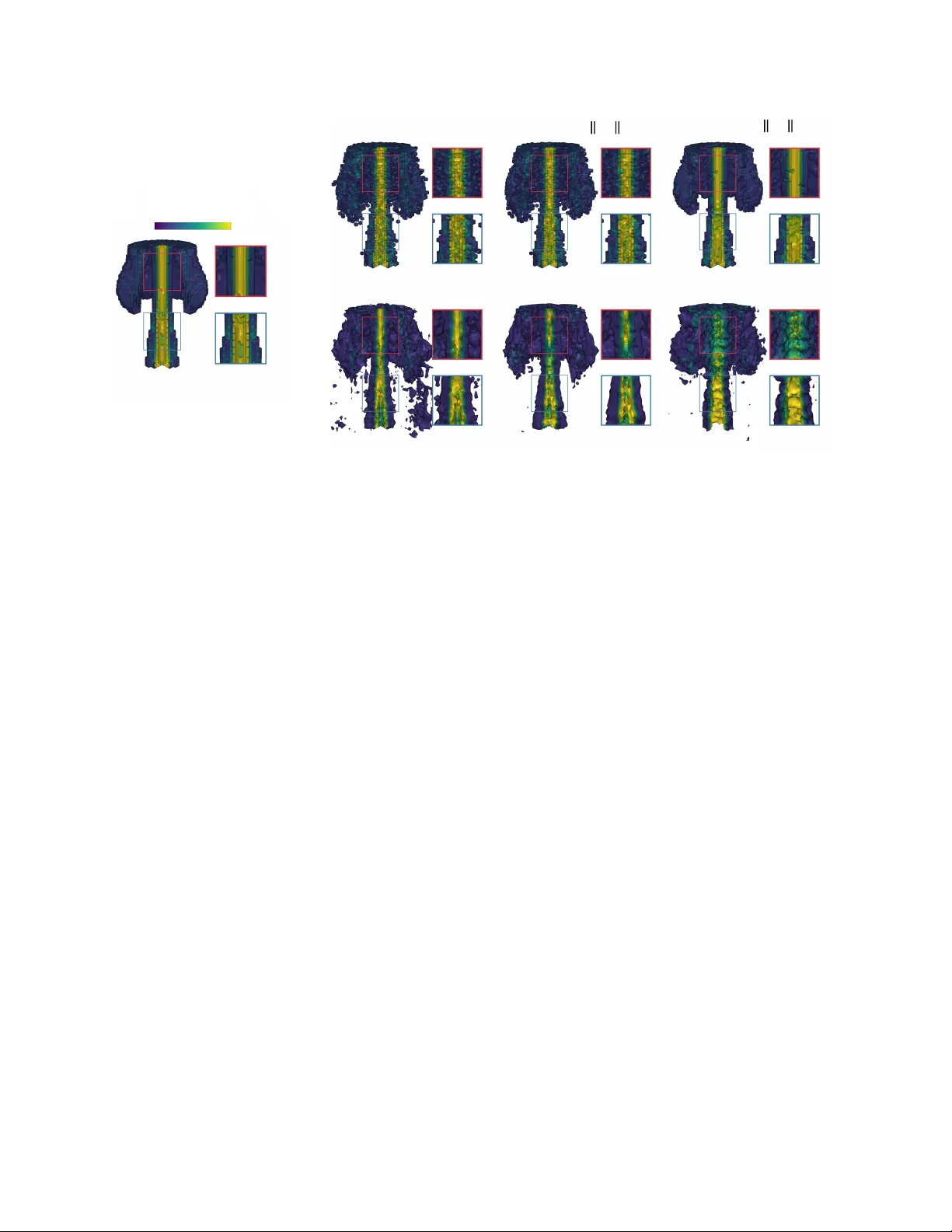
3-D Represen tations for Hyp ersp ectral Flame T omograph y Nicolas T ricard Zituo Chen Sili Deng ∗ Dep artment of Me chanic al Engine ering, Massachusetts Institute of T e chnolo gy 77 Massachusetts Ave, Cambridge, MA 02139, Unite d States Marc h 26, 2026 This manuscript c orr esp onds to the version pr esente d at the 2026 Spring T e chnic al Me eting of the Eastern States Se ction of the Combustion Institute (ESSCI). Extensions of this work ar e planne d for futur e journal public ation. Abstract Flame tomography is a compelling approach for extracting large amounts of data from ex- p erimen ts via 3-D thermo c hemical reconstruction. Recen t efforts employing neural-net work flame representations hav e suggested impro ved reconstruction qualit y compared with classical tomograph y approac hes, but a rigorous quan titativ e comparison with the same algorithm using a v oxel-grid represen tation has not b een conducted. Here, w e compare a classical v oxel-grid repre- sen tation with v arying regularizers to a contin uous neural represen tation (NN) for tomographic reconstruction of a simulated po ol fire. The represen tations are constructed to give temperature and comp osition as a function of location, and a subsequent ra y-tracing step is used to solve the radiativ e transfer equation to determine the sp ectral in tensity inciden t on h yp erspectral infrared cameras, whic h is then conv olved with an instrument lineshape function. W e demonstrate that the vo xel-grid approach with a total-v ariation regularizer repro duces the ground-truth synthetic flame with the highest accuracy for reduced memory intensit y and runtime. F uture work will explore more representations and under experimental configurations. 1 In tro duction Flame tomography for thermochemical state reconstruction has emerged as a leading option for exp erimen tal data pro curement in the age of data-intensiv e com bustion mac hine learning [1]. T o- mograph y , or 3-D flame reconstruction of fields, can b e used to train c hemical kinetic surrogates for predicting p ollutan t emissions, generate data-driv en digital t wins, or c haracterize com bustion flo w while circumv en ting error-prone and exp ensiv e computational fluid dynamics sim ulations b y pro viding exp erimental data directly . Flame tomography can broadly b e divided in to (i) an inference algorithm that maps measure- men ts to the reconstruction and (ii) the 3-D flame representation that parametrizes and stores the thermo c hemical state. Classical techniques, suc h as filtered bac kpro jection (FBP) and alge- braic reconstruction technique (AR T), rely on linear forward mo dels and are therefore restricted to linearized represen tations ( e.g. , vo xel grids and linear basis expansions). Differen tiable rendering (DR), a class of metho ds that uses analytic gradients to iteratively reconstruct a 3-D representa- tion via a forw ard operator, enables a broader range of nonlinear representations [2, 3, 4]. This ∗ Corresp onding author: silideng@mit.edu 1 can eliminate bias from forw ard-mo del linearization, imp ose useful inductive constraints aiding ill-p osed inv ersions, and enable join t end-to-end inference from parameters to measuremen t. DR has provided adv ancements in a range of fields ranging from X-ra y computed tomograph y [5, 6] to h yp erspectral imaging [7]. Recen t work has attempted DR for flame tomography , in particular with neural-implicit represen tations [8, 9, 10]. These approaches show ed that the flame may b e w ell represented by ov erfitting neural netw orks and w ould not suffer from the data bias that ma y emerge from a more traditional pre-training/inference mac hine learning approac h [11]. Thus far, no existing work has rigorously compared the reconstruction quality and computational p erformance b et w een v arious re presen tations in DR for flame emission tomography . Ev aluating the capability of DR in combustion tomography requires determining which of the 3-D represen tations pro duces the b est reconstructions at the low est memory fo otprin t and computational runtime. Of the many representations used in DR pip elines, vo xel grids, akin to finite volumes in com- putational fluid dynamics, are the most classical represen tation [4]. Neural approaches ha ve also b ecome more prominent, where the scene is implicitly represented using a black-box mo del with an input of a spatial/directional query and an output of field quan tities (i.e., temperature) [3]; here, the scene is parametrized by the net work’s trained weigh ts. This has the adv antage of contin uously represen ting the scene, thanks to the neural net works’ contin uous functional mapping from inputs to outputs. Additionally , neural approaches are appreciated for their ability to adaptively resolve high-resolution artifacts during training. The neural radiance field (NeRF), and its man y v ariants, are a prominent example of a neural represen tation that has b een used extensively in the field of DR [2, 12]. In this researc h, we test regularized v ariants of v oxel grids and neural representations in a DR pip eline for three-dimensional tomograph y of a simulated p ool fire to reconstruct comp osition and temp erature. F or eac h approach, we compare its computational performance and reconstruction qualit y to assess whic h is most fa vorable for com bustion field reconstruction. 2 Metho ds 2.1 Preliminaries: F orward and Inv erse Steps The DR pip eline forw ard mo del is shown in Fig. 1. The forw ard op erator H maps our 3-D field represen tation f θ parameterized b y θ to an observ able ˆ g as ˆ g = H [ f θ ]. Here, w e mo del H as an in- stan taneous emission-F ourier transform infrared (FTIR) imaging setup, a broadband measurem en t device that relies on a Mic helson in terferometer for sp ectral m ultiplexing [13]. W e seek to recon- struct temp erature and comp osition. Th us, our 3-D representation f θ maps a ph ysical lo cation x to these v alues. Then, a line-by-line ra y-tracing mo del is solved using f θ to determine the radiativ e emission sp ectra inciden t on a camera [14]. Finally , w e sp ectrally conv olv e the resulting radiation with an sinc-squared instrument lineshap e (ILS) function to obtain the measurement ˆ g [13]. W e rep eat this pro cess for every ray cast through the scene, where ra ys propagate from the camera origins through pixel centerpoints in to the scene. The in verse mo del is to obtain the underlying parameters θ from the measurement g , as f θ = H − 1 [ g ]. In doing so, we obtain a 3-D reconstruction of thermo c hemical states. The parameters are determined b y minimizing a loss function L , defining the deviation b et ween g and our predicted measuremen t ˆ g . Here, we apply L-2 loss, L = || H [ f θ ] − g || 2 2 + λ l Φ { f θ } (1) for regularization parameter λ l (assigned to 0.001), and regularizer Φ, whic h is defined for no regularization as Φ = 0, Tikhono v as Φ = ||∇ f θ || 2 2 , and total v ariation as Φ = ||∇ f θ || 1 , for normalized 2 (3) Instrument Lineshape Function (ILS) Incident Spectru m Measured Sp ectrum (1) Sample the 3 - D representation Voxel Gr id 𝑇 = 𝑇 !"# 𝑋 = 𝑋 !"# 𝜃 𝑇 !!! 𝑇 !"! MLP 𝒙 Neural Network 𝛾 ! (𝒙) 𝛾 " (𝒙) T X 1 … 𝜃 … (5) Backpropagate Gradients 𝑑ℒ 𝑑𝜃 ℒ = 𝑔 ( − 𝑔 $ $ +Φ 𝒇 𝜽 (4) Data & regularization loss (6) Update parameters 𝜃 ! &' = 𝜃 ! − 𝜆 𝑑ℒ 𝑑𝜃 (2) Integrate the Radiative Transfer E quation 𝑑𝐼 ! 𝑑𝑠 = 𝜅 ! 𝐼 "! − 𝐼 ! Spectral /absorption/ coefficient/&/black/body/ emission: 𝜅 ! = 𝜅 ! 𝑇 𝜃 , 𝑋 𝜃 𝐼 "! = 𝐼 "! 𝑇 𝜃 Integrate /flame/emission Figure 1: The tomographic pro cess is conducted iteratively . (1) T emp erature and comp osition are obtained by sampling the 3-D represen tation. W e test con tinuous (Neural Net work) and discrete (v oxel) represen tations. (2) The radiativ e transfer equation is solved along eac h ray for sp ectral in tensity I η ( s ), where s is the path length, η is the w av enum b er, κ η ( T , X ) is the temp erature- and comp osition-dependent spectral absorption co efficien t, and I b,η ( T ) is the blackbo dy emission. (3) The Mic helson sp ectral ILS (triangular ap o dization) is applied to the inciden t sp ectra. (4) The loss function is ev aluated, (5) gradien ts with resp ect to represen tation parameters are computed, and (6) parameters are updated via gradient descent. This pro cedure is rep eated un til the predicted measuremen t ˆ g matches the ground truth g . field quan tities derived from f θ . F or v oxel grids, these regularizers are ev aluated on the normalized temp erature and sp ecies fields using first-order forward finite differences in eac h Cartesian direction, L = ∆ x − 1 D x ∆ y − 1 D y ∆ z − 1 D z , ( D x f ) i,j,k = f i +1 ,j,k − f i,j,k , (2) with analogous definitions for D y and D z . Th us, the total v ariation p enalt y is the sum of the mean absolute directional deriv atives, while the Tikhono v p enalt y is the sum of the mean squared directional deriv atives. F or neural representation, w e use auto differentiation on the implicit field ev aluated at sampled v oxel-cen ter co ordinates to compute these spatial deriv atives directly , a voiding the construction of a full vo xel grid during optimization. The loss is minimized using the iterative gradien t descen t θ i +1 = θ i − λ d L dθ , for iteration i and learning rate λ , where d L dθ is obtained through auto differen tiation of the forward pip eline. 2.2 Represen tations V oxel Grid: V o xel grids (VGs) are a standard con trol-v olume-based approach to 3-D field represen- tation in whic h the domain is decomp osed into a finite n umber of con tiguous axes-aligned b o xes, eac h with uniform field prop erties. The ra y tracing pro cedure is p erformed in the domain via light bac ktracking and classical ray tracing integration [15] through the piecewise homogeneous medium using 3-D Amanatides and W o o algorithm [16]. The unknown parameters are the temp erature and sp ecies mole fractions in eac h vo xel. W e initialize the vo xel grid using the ground truth tested 3 v oxel field (of identical resolution) and p erturb each v oxel with Gaussian random noise of standard deviation 20% of the ground truth v alue. Neur al Implicit Field: Unlike v oxel grids, where parameters directly corresp ond to lo cations in 3-D space, a neural representation uses a neural net work to represen t the scene implicitly . Our approac h is inspired b y Neural Radiance Fields (NeRF) [2], but with t wo ma jor differences. (1) Classical NeRF maps p osition and direction to color intensit y and extinction co efficient ( x , d ) 7→ ( c, σ ), but w e assume that emission from the flame is isotropic and so w e drop the ray-direction input to the neural netw ork. (2) W e apply infrared hypersp ectral volume rendering instead of R GB, adding a sp ectral forward mo del mapping T, X, to spectral opacit y , and producing a high-resolution emission sp ectrum incident to the camera. This results in the neural implicit field: [ T , X ] = f θ ( γ ( x )) (3) for m ulti-lay er p erceptron f θ and sin usoidal p ositional enco ding γ as defined in Ref. [2]. W e use 64 hidden dimensions, 4 hidden la y ers, and 10 p ositional encoding frequencies. Initialization is p erformed ov erfitting the neural netw ork to the same 3-D field used in the vo xel grid initial guess pro cedure. In implementation, w e use t wo MLP branches, a coarse netw ork and a fine netw ork, each queried only by enco ded 3-D p osition. During rendering, rays are first in tersected with the scene’s b ounding b o x to determine near and far b ounds. An initial pass then p erforms stratified sampling along each ra y , ev aluates f θ using the coarse MLP at the sampled p oints to predict T and X , and constructs sampling w eights that concentrate effort in regions of high expected emission and absorption. Unlik e in the original NeRF [2] where imp ortance sampling is based on densit y-derived opacit y , α = 1 − exp( − κδ ), for single-scalar density κ and opacit y α , the absorption co efficien t in our case v aries with wa v enum b er. T o obtain a scalar quantit y for sampling, w e select the Planck-mean absorption co efficien t to conduct this imp ortance sampling routine, defined as κ = R ∞ 0 κ η I bη dη R ∞ 0 I bη dη , (4) whic h enables thermo dynamically consisten t w eigh ting across the sp ectrum. A second fine pass resamples along the ra y using this imp ortance distribution, re-ev aluates the implicit field at the merged sample set, and p erforms v olume rendering on the resulting ( T , X ) profiles. Both coarse and fine net w ork weigh ts are learned during this procedure. This hierarc hical ra y-tracing pro cedure preserv es the con tinuous spatial represen tation of NeRF while adapting it to infrared hypersp ectral flame imaging. 3 Results and Discussion W e test DR on a turbulen t p o ol fire solv ed using OpenFOAM 5.x [17]. This fire consists of a 20 cm diameter CH 4 p ool with a constant-flo w injection rate of 0.01 meters p er second into a 1x1x1 meter cell domain discretized in to 216,000 cells. W e extract a single timestep at t =0.9 s and attempt reconstruction of temp erature and CH 4 , CO 2 , H 2 O, using four cameras at ± 1 . 5 meter x and ± 1 . 5 meter y cen tered origins. Each camera pro duces a 32x32 pixel image with a focal length of 0.59 m. Eac h ray then consists of a 650 cm − 1 to 725 cm − 1 sp ectral range at a line-by-line resolution of 0.04 cm − 1 and FTIR-conv olved resolution of 8 cm − 1 . A visual comparison of temp erature iso con tours is presen ted in Fig. 2 alongside the ground truth. The representations eac h reconstruct the general structure of the flame, alb eit with their 4 Synthetic Ground T ruth Neural Network Vo x e l G r i d Tik hon ov ∇𝑌 ! ! To t a l v a r i a t i o n ∇𝑌 " No regularizer 1500 K 300 K 900 K Te m p e r a t u r e Figure 2: Cuta wa y plots of 3-D reconstructions from the DR pip eline against the ground truth. Iso con tours of temp erature are shown for in terv als of 100 K b et ween 500 and 1500 K. o wn resp ectiv e visualization ca veats: v o xel grids present discrete v oxel ch unks, and NeRF requires probing discrete p oints (w e choose to prob e at the ground truth v oxel-grid centerpoints) to extract 3- D v arying thermochemistry . The neural netw ork approac h, thanks to its con tinuous representation, can provide non-linear in terp olation b et w een v oxel grid p oints and th us smo othly captures details suc h as sharp temperature gradients around the flame centerline. Ho wev er, it suffers from more spurious artifacts than VG despite regularization, arising due to the difficulty of fitting a NN of limited size. W e also rep ort in T able 1 the 3-D mean square error, MSE = ∥ f θ ( x VG ) − f gt ( x VG ) ∥ 2 2 / N , ev aluated for N vo xels at their cen terp oin ts x VG , and fields are normalized to their minim um and maximum v alues. Bet ween the represen tations V G and NN, and the regularization options of no regularizer (NR), Tikhono v (Tikh.), and total v ariation (TV), we see that the VG with TV com bination p erforms b est at reconstructing the flame after 2000 ep o c hs. While TV works b est with VG, Tikh. is the b est performing regularization approac h with NN. The difference arises b ecause NNs already contain n umerous inductive biases arising from their propensity to fit low- frequency signals. V G, mean while, contains no built-in biases and requires a stronger prior. F or b oth representations, emplo ying no regularization results in excessiv e noise due to the problem’s ill-p osed nature. The comparison of field reconstruction qualities in T able 1 sho ws superior reconstruction quality of temp erature o ver mole fraction, with H 2 O reconstructed at the low est quality , lik ely due to its minimal contribution to the o verall flame emission compared to CO 2 . 4 Conclusions W e apply differentiable rendering with vo xel grids and neural implicit fields and compare their p erformance for h yp erspectral infrared flame emission tomograph y . W e formulate the non-linear in verse problem as an iteration ov er a differen tiable forw ard op erator, mapping the scene represen- tation parameters to 2-D FTIR images situated around the flame. The v oxel grid represen tation 5 T able 1: Performance comparison of different 3-D representations for the 3-D p o ol fire. Metho d Ep och Time [ms] Mem. [MB] MSE T MSE C O 2 MSE H 2 O V G/NR 430 3.0 0.0295 0.0436 0.0416 V G/Tikh. 432 3.0 0.0203 0.0391 0.0384 V G/TV 431 3.0 0.0121 0.0219 0.0197 NN/NR 479 65.0 0.0571 0.0871 0.2569 NN/Tikh. 489 66.0 0.0268 0.0705 0.0946 NN/TV 493 66.0 0.0754 0.1427 0.4356 with a total-v ariation regularization penalty p erformed b est b oth qualitativ ely and quan titatively as measured by mean square error. W e note this approac h is limited in n umerous wa ys. (1) Our ground-truth flow-field is synthetic and may not contain all of the flame eddies or bulk structures seen in real flames. (2) The imaging forw ard mo del is based on a concept of a highly-exp ensive and well-calibrated h yp ersp ectral imaging system with no noise. (3) W e neglect soot emission from the po ol flame. F uture work will implemen t this tomographic approach under real conditions seen in exp eriment. 5 Ac kno wledgemen ts W e ackno wledge the funding supp ort from ExxonMobil Corp oration and the Carb on Hub and the Ka vli F oundation Exploration Aw ard in Nanoscience for Sustainabilit y LS-2023-GR-51-2857. In addition, NT thanks the G.E. V ernov a for PhD funding. W e also thank the National Lab oratory of the Ro c kies for GPU computing resources. References [1] Sili Deng, Linzheng W ang, Suyong Kim, and Benjamin C. Ko enig. Scientific machine learning in combustion for discov ery , simulation, and control. Pr o c e e dings of the Combustion Institute , 41:105796, 2025. doi:10.1016/j.proci.2025.105796 . [2] Ben Mildenh all, Pratul P . Sriniv asan, Matthew T ancik, Jonathan T. Barron, Ra vi Ramamo or- thi, and Ren Ng. Nerf: Represen ting scenes as neural radiance fields for view synthesis, 2020. arXiv:2003.08934 . [3] Yiheng Xie, T o waki T akik aw a, Shunsuk e Saito, Or Litany , Shiqin Y an, Numair Khan, F ederico T ombari, James T ompkin, Vincent Sitzmann, and Srinath Sridhar. Neural fields in visual computing and b ey ond, 2022. . [4] Zhengren W ang. 3d represen tation metho ds: A survey , 2024. . [5] Viv ek Gopalakrishnan, Neel Dey , and Polina Golland. In traop erativ e 2d/3d image registra- tion via differen tiable x-ra y rendering. In 2024 IEEE/CVF Confer enc e on Computer Vision and Pattern R e c o gnition (CVPR) , pages 11662–11672, 2024. doi:10.1109/CVPR52733.2024. 01108 . 6 [6] Iv an Grega, William Whitney , and Vikram Sudhir Deshpande. High-sp eed x-ray tomograph y for 4d imaging. Pr o c e e dings of the National A c ademy of Scienc es , 122(51):e2521089122, 2025. doi:10.1073/pnas.2521089122 . [7] Gerry Chen, Sunil Kumar Nara y anan, Thomas Gautier Ottou, Benjamin Missaoui, Harsh Muriki, C ´ edric Pradalier, and Y ongsheng Chen. Hyp erspectral neural radiance fields, 2024. URL: , . [8] Joseph P . Molnar, Jiangnan Xia, Rui Zhang, Samuel J. Grauer, and Chang Liu. Unsupervised neural-implicit laser absorption tomography for quantitativ e imaging of unsteady flames. Com- bustion and Flame , 279:114298, 2025. doi:10.1016/j.combustflame.2025.114298 . [9] F uhao Zhang, W eixuan Zhang, Qingc hun Lei, Xuesong Li, Y uyang Li, and Min Xu. V oxel- free neural volume reconstruction technique for v olumetric flame reconstructions. A er osp ac e Scienc e and T e chnolo gy , 133:108107, 2023. doi:10.1016/j.ast.2023.108107 . [10] Joseph P . Molnar and Samuel J. Grauer. Flow field tomography with uncertaint y quantification using a ba yesian physics-informed neural net work. Me asur ement Scienc e and T e chnolo gy , 33(6):065305, mar 2022. doi:10.1088/1361- 6501/ac5437 . [11] Sam uel J. Grauer, Khadijeh Mohri, T ao Y u, Hecong Liu, and W eiwei Cai. V olumetric emission tomograph y for com bustion processes. Pr o gr ess in Ener gy and Combustion Scienc e , 94:101024, 2023. doi:10.1016/j.pecs.2022.101024 . [12] Jonathan T. Barron, Ben Mildenhall, Matthew T ancik, Peter Hedman, Ricardo Martin- Brualla, and Pratul P . Sriniv asan. Mip-nerf: A multiscale represen tation for anti-aliasing neural radiance fields, 2021. . [13] P eter Griffiths. F ourier transform infrared sp ectrometry . Scienc e (New Y ork, N.Y.) , 222:297– 302, 11 1983. doi:10.1126/science.6623077 . [14] Laurence Rothman, Iouli Gordon, Robert Barb er, Hoang Dothe, Rob ert Gamac he, Aharon Goldman, V alerii P erev alov, Serguei T ashkun, and Jonathan T enn yson. HITEMP , the high- temp erature molecular sp ectroscopic database. Journal of Quantitative Sp e ctr osc opy and R a- diative T r ansfer , 111(15):2139 – 2150, 2010. doi:10.1016/j.jqsrt.2010.05.001 . [15] Mic hael F. Mo dest and Sandip Mazumder. Chapter 20 - The Monte Carlo Metho d for P ar- ticipating Media. In Michael F. Modest and Sandip Mazumder, editors, R adiative He at T r ansfer (F ourth Edition) , pages 737–773. Academic Press, fourth edition edition, 2022. doi:10.1016/B978- 0- 12- 818143- 0.00028- 6 . [16] John Amanatides and Andrew W o o. A fast v oxel trav ersal algorithm for ray tracing. Pr o c e e d- ings of Eur oGr aphics , 87, 08 1987. [17] Henry G. W eller, Ga vin T ab or, Hrvo je Jasak, and Christer F ureb y . A tensorial approac h to computational contin uum mec hanics using ob ject-oriented techniques. Computers in Physics , 12(6), nov 1998. doi:10.1063/1.168744 . 7
Original Paper
Loading high-quality paper...
Comments & Academic Discussion
Loading comments...
Leave a Comment