Unboundedness of the Heesch Number for Hyperbolic Convex Monotiles
We provide a resolution of the Heesch problem for homogeneous (also known as semi-regular) tilings, and as a corollary, for tilings by convex monotiles in the hyperbolic plane. We also provide the first known example of weakly aperiodic convex monoti…
Authors: Arun Maiti
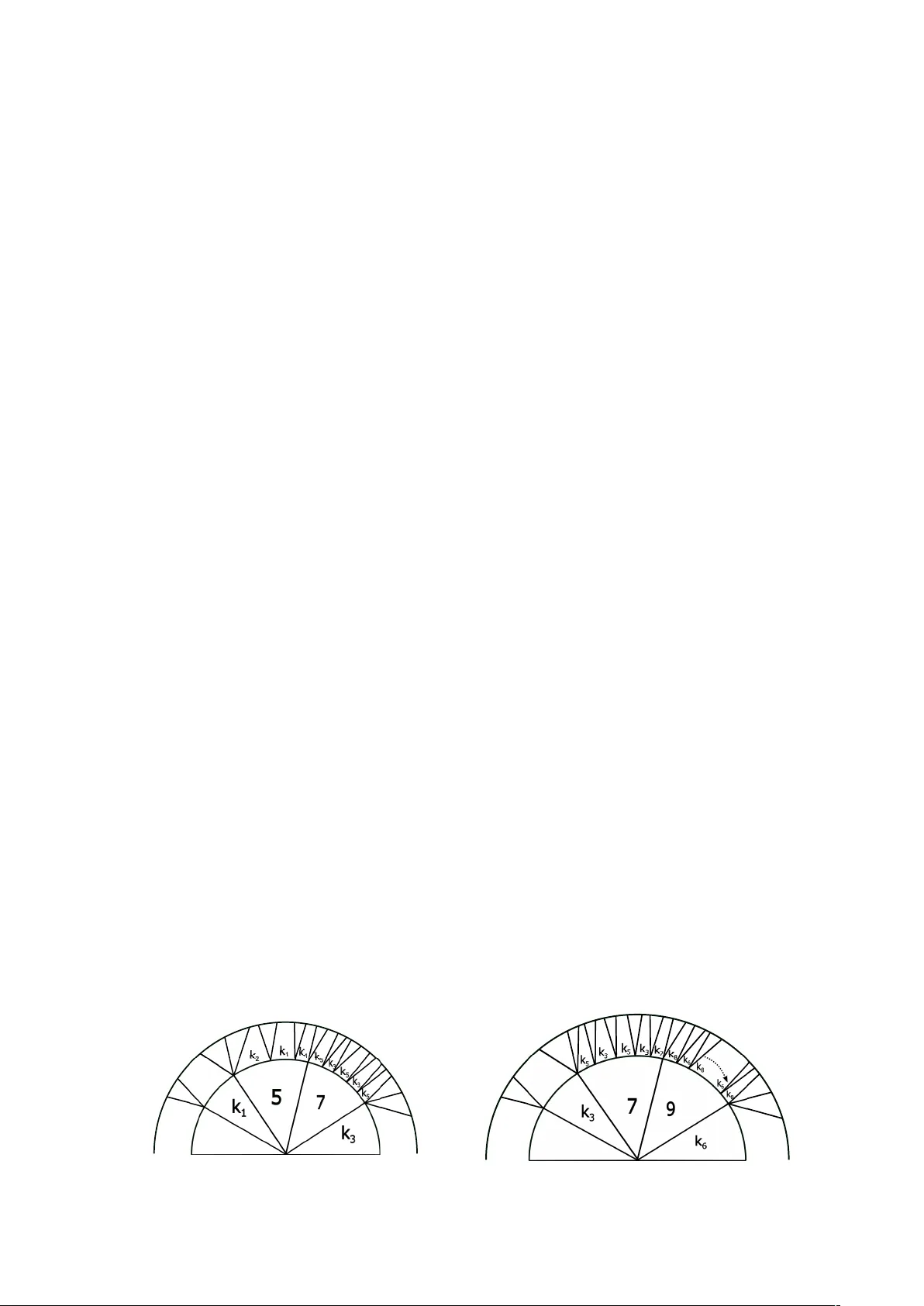
Un b oundedness of the Heesc h Num b er for Hyp erb olic Con v ex Monotiles Arun Maiti Marc h 31, 2026 Abstract W e provide a resolution of the Heesc h problem for homogeneous (also known as semi- regular) tilings, and as a corollary , for tilings by con vex monotiles in the h yp erb olic plane. W e also pro vide the first kno wn example of w eakly aperio dic conv ex monotiles arising from the dual of homogeneous tilings. K eywor ds: h yp erbolic tilings, domino problems, homogeneous tilings, Heesch problem, ap e- rio dic tiles 1 In tro duction The domino problem, a cen tral decision problem in tiling theory , asks whether the in teger lattice Z 2 can b e tiled with unit-square tiles sub ject to lo cal color-matching rules. In tro duced b y W ang in 1961 as a geometric reformulation of satisfiabilit y [22], the problem has since inspired n umerous v arian ts and generalizations across diverse settings [1, 10, 12]. In the hyperb olic plane ( H 2 ), an analogue of the problem can b e form ulated as follows: given a collection of tiles (p olygons with geo desic sides) F in H 2 dra wn from a fixed class of tiles, called a pr otoset , and a tiling rule, is it p ossible to tile H 2 b y isometric copies of the tiles in F ? The problem for arbitrary finite protosets was prov ed to b e undecidable indep enden tly around the same time b y Kari [12] and Margenstern [15]. The Euclidean analogue was established muc h earlier by Berger [4]. The decidabilit y of the domino problem in an y of these settings is closely link ed to the existence of ap erio dic protosets and the Heesch problem. Homogeneous Tilings. Here, we consider the natural v arian t of the domino problem where protosets consist of an arbitrary finite set of regular p olygons together with the tiling rule that the cyclic sequence of p olygons around ev ery vertex is the same and that p olygons meets edge-to-edge. By duality , this problem is closely related to the domino problem for protosets consisting of a single conv ex tile (monotile). The typ e of a v ertex in a tiling is defined to b e the cyclic sequence of the sizes (num ber of sides) of the p olygons incident to a v ertex. A v ertex type and its mirror image are considered to b e the same. A tiling of a surface is called homo gene ous (also known as Arc himedean and semi-regular) if all v ertices hav e the same t yp e. The typ e of a homogeneous tiling is defined to be the type of its vertices. The “angle-sum” of a cyclic tuple k = [ k 1 , k 2 , · · · , k d ] with 3 ≤ k i < ∞ for all i , is defined b y ϑ ( k ) = d X i =1 k i − 2 k i F or a homogeneous tiling of H 2 of t yp e k b y regular p olygons, the side lengths of p olygons are in fact uniquely (up to an isometry) determined b y the type k whenev er k i < ∞ and ϑ ( k ) > 2 ; see Lemma 2.1 in [6]. This essen tially allows us to view homogeneous tilings of H 2 as tilings of 1 the plane (with tiles having contin uous curved sides), and vice-versa: a homogeneous tiling of the plane of t yp e k satisfying ϑ ( k ) > 2 (or ϑ ( k ) = 2 ) can b e realized as a geometric tiling of H 2 (resp ectiv ely of E 2 ) of type k using the Cartan-Hadamard theorem; see Lemma 2.5 in [6]. In ligh t of the ab o v e discussion, we may treat a homogeneous tiling as a top ological tiling of the plane, and accordingly , treat p olygons as faces. F or cyclic tuples that admit a tiling of the plane, a tiling is constructed inductively la yer-b y-la yer. The zero- layer X 0 is a p oin t on the plane, and next, by induction, the k -lay ered tiling X k is a tiling of D k ( X 0 ) (the disc of radius k cen tered at X 0 ) such that no vertex lies in the annular region D k ( X 0 ) \ D k − 1 ( X 0 ) ; see Figure 1.1. The b oundary of X k , ∂ X k , consists of edges of tiles forming the circle of radius k . X 0 Fig. 1.1: Schematic of the la yer-b y-la yer gro wth of a [ 4 , 5 , 4 , 5] tiling cen tered around X 0 F or a d -tuple k = [ k 1 , k 2 , · · · , k d ] , a fan of t yp e k around a vertex is a configuration of d faces in cyclic order around the v ertex with the num ber of sides k 1 , k 2 , · · · , k d suc h that all edges inciden t to v are shared by tw o faces. A p artial fan around v of type k is a configuration of faces around v suc h that all but tw o edges incident to v are shared b y tw o faces, and that it can b e extended to a full fan of t yp e k around the v ertex. Note that in la yer-b y-la yer construction, there is a natural cyclic ordering of the vertices on ∂ X k in the clockwise (or anti-clockwise) direction. A common method is the inductiv e lay er-by-la y er construction, in whic h each lay er is formed b y forming complete fans around each v ertex along ∂ X k in the cyclic order. W e follow the same metho d of construction here. The Heesc h Problem. The study of lo cal-to-global obstructions in a tiling is encapsulated b y the He esch numb er . F or a cyclic tuple k with ϑ ( k ) > 2 , the He esch numb er of k is defined to b e the maximal non-negative in teger r such that the tuple admits a tiling of r complete lay ers. By conv en tion, if the cyclic tuple admits a tiling of the en tire plane, its Heesch n umber is defined to b e infinite [2]. Similarly , for a protoset F , the Heesc h num b er is the maximal non-negative in teger r suc h that eac h prototile from F can b e surrounded b y r la yers of tiling. The He esch pr oblem asks whic h integers can o ccur as Heesch n umbers for a giv en class of tiles. The study of Heesch num bers measures how closely a set of tiles can approximate tiling the hyperb olic plane, links finite local patterns to infinite global structures, and deep ens our understanding of undecidabilit y in tiling theory . In [14], the author show ed that Heesch num b ers are b ounded for finite set of regular p olygons that do not admit a tiling of H 2 . This domino problem for homogeneous tilings has b een explored by numerous authors [6, 9, 13, 19], esp ecially for cyclic tuples of lo w degree, though the problem remains widely op en. An explicit description of cyclic tuples admitting homogeneous tiling up to degree 6 w as given in [5]. Construction of tilings is t ypically done either lay er-b y-lay er or using standard op erations on kno wn vertex-transitiv e tilings. T o the author’s knowledge, every cyclic tuple curren tly known not to admit a tiling also fails to admit a partial tiling b ey ond t wo lay ers, that is, its Heesc h n umber is at most 2 . Our inv estigation into this problem leads to the following result, which illustrates its underlying complexity . Theorem 1.1. F or any given p ositive inte ger n , ther e exists a cyclic tuple k n with He esch numb er n . 2 In the pro of presen ted in §2, the cyclic tuple k n with Heesch num ber n is constructed induc- tiv ely by juxtaposing the cyclic tuple k n − 1 with an appropriate cyclic tuple ¯ k n − 1 . The heuristic of the pro of relies on the observ ation that juxtap osing ¯ k n − 1 eliminates the constraint of con- structing a neighborho o d around an o dd face in k n − 1 that arises at the ( n − 1) -th la yer, while sim ultaneously introducing a new constraint for another o dd face at the n -th lay er. In [20], A. S. T arasov prov ed the existence of a monotile with arbitrary Heesch num b er in the h yp erb olic plane. His example, constructed b y appropriately adding notc hes and ridges to regular k -gons in a tiling of type [ k 3 ] of H 2 , resulted in a non-con v ex aperio dic tile. On the other hand, the dual of a homogeneous tiling is a tiling by a single conv ex p olygon (a conv ex monotile). Therefore, a direct consequence of our theorem is that there exist conv ex monotiles with arbitrarily large Heesch n umber. One indicator of p oten tial undecidabilit y of the domino problem for the Euclidean or the h yp erb olic plane for a giv en class of tiles is the un b oundedness of Heesch num b ers. Indeed, an y a priori upp er b ound on Heesc h n umbers would, in fact, imply decidability . Consequen tly , our result establishing un b ounded Heesch num bers for homogeneous tilings, together with the existence of ap eriodic tilings describ ed later, suggests that the problem in this setting may b e undecidable. Ap erio dicity in the Hyp erb olic Plane. Finally , in §3, we address the existence of ap eriodic tiles, a k ey indicator of undecidability . In the h yp erbolic plane, there are t w o distinct notions of p erio dicit y: w eak and strong. A tiling of H 2 is called str ongly p erio dic if it quotients to a compact domain under the action of its symmetry group, and we akly p erio dic if its symmetry group contains a subgroup of infinite cyclic symmetry [7]. In E 2 , how ev er, these tw o notions coincide. A set of hyperb olic tiles is called we akly ap erio dic if no tiling of H 2 b y isometric copies of them is strongly p erio dic, and strongly ap erio dic if no tiling is even w eakly p erio dic. Ap eriodic tiles play a piv otal role in the study of both the domino problem and the p eriodic domino problem in v arious settings; see [3, 16, 11]. They are a k ey to ol in establishing the undecidabilit y of these problems. In any such setting, if only finitely many ap erio dic solutions exist, the corresp onding domino problem is decidable. The strongly p erio dic domino problem for general protosets of tiles in H 2 w as sho wn to b e undecidable by Margenstern in [16]. In con trast, for regular p olygons in E 2 , the p eriodic domino problem has b een known since an tiquity to b e equiv alent to the (ordinary) domino problem and has a straightforw ard answer [9]. While n umerous examples of protosets that admit p eriodic tilings can b e found in the lit- erature [8], these are t ypically vertex-transitiv e (also kno wn as uniform) constructions, whic h are necessarily homogeneous. Only recen tly hav e examples of regular polygons that admit only tilings with m ultiple v ertex orbits b een presented in the author’s work [13] and in informal notes of Marek Čtrnáct [21]. In [14], the present author used a double coun ting argument to show that there do es not exist any weakly p erio dic tiling of types [ 3 , 5 , k 3 , k 4 ] for 10 ≤ k 3 ≤ k 4 , k 3 , k 4 = 11 , k 3 < k 4 . More precisely , the argument compares t wo differen t coun ts of incidences betw een triangles and p en tagons that would arise in an y strongly p eriodic tiling of this t yp e. The existence of a weakly ap eriodic, let alone strongly aperio dic, cyclic tuple for homo- geneous tiling of H 2 has remained op en. A dapting the idea of double coun ting argument for regular p olygons, we construct an infinite family of cyclic v ertex-types for which an analogous obstruction applies. In particular, we prov e that no strongly p erio dic homogeneous tiling of the t yp e [3 , 5 , k , 5 , l, 5 , m, 5 , l , 5 , k , 5 , l , 5] exists for distinct integers k , l , m ≥ 5 . The existence of homogeneous tilings of these types follows directly from the usual la yer-b y-la yer construction. F urthermore, when 3 , 5 , k , l , m are distinct primes, we prov e that the s ingle dual tile asso ciated with this v ertex type is an ap erio dic conv ex tile. This construction therefore produces infinitely many examples of ap eriodic conv ex monotiles with inner angles (hence the area) rational multiples of π . It should b e noted that examples 3 of conv ex hyperb olic ap eriodic tiles with strictly irrational angles were already pro duced b y Margulis and Mozes in [17]. By contrast, Rao recen tly prov ed that any con vex tile that admits a tiling of E 2 necessarily admits a p erio dic tiling as well [18]. In §4, we presen t a brief discussion of the implications of our results together with additional observ ations concerning a few unresolved problems. 2 Tiles with Arbitrarily Large Heesch Num b ers T o construct homogeneous tiling for a giv en cyclic tuple, one can use the lay er-b y-lay er construc- tion metho d describ ed ab o ve. F or faces of ev en size, it is straigh tforward to build neigh b orho ods around b oundary faces – those sharing a vertex or edges with ∂ X k . How ever, the cyclic con- dition imp oses a significant constrain t when forming neighborho ods around faces of o dd sizes. This rather simple observ ation serv es as a guiding principle in the follo wing pro of of Theorem 1.1 in the introduction concerning Heesc h problem f or homogeneous tilings of H 2 . Pr o of. (Theorem 1.1) F or t wo cyclic tuples k 1 and k 2 , let k 1 ⊕ k 2 denote the cyclic tuple obtained b y juxtap osing k 1 and k 2 . F or i ≥ 1 , let us define the cyclic tuple ¯ k i = [ k 3 i , 2 i + 5 , 2 i + 7 , k 3 i +3 ] ⊕ [2 i + 7 , 2 i + 5 , 2 i + 3] ⊕ [ k 3 i , 2 i + 5 , k 3 i +4 ] ⊕ [2 i + 5 , 2 i + 7 , k 3 i +5 ] ⊕ [ k 3 i +3 , 2 i + 7 , k 3 i +5 ] (2.1) with k l ≥ 8 even and k l = k m for l = m for all l, m ∈ N . F or n > 1 , w e consider the cyclic tuple defined by k n = [ k 1 , 5 , k 2 ] ⊕ [5 , 7] ⊕ [ k 3 , 7 , 5] ⊕ [ k 1 , 5 , k 4 ] ⊕ [5 , 7 , k 5 ] ⊕ [ k 3 , 7 , k 5 ] ⊕ ¯ k 1 ⊕ ¯ k 2 ⊕ · · · ⊕ ¯ k n − 1 (2.2) W e will show that k n admits a partial tiling of n lay ers but do es not admit one with ( n + 1) la yers. A neighborho od of a (2 i + 5) -gon is said to b e of type F 1 if it con tains a (2 i + 7) -gon, otherwise, it is said to b e of type F 2 . W e hav e the following neighborho o d of type F 1 around (2 i + 5) -gons: F or i = 0 , F 1 (5) = [ k 1 , k 2 , 7 , k 1 , k 2 ] and for i > 1 , F 1 (2 i + 5) = [ k 3 i , 2 i + 3 , k 3 i , · · · , 2 i − 3 , 2 i + 5 , 2 i + 7 , · · · · · · k 3 i , 2 i − 3 , k 3 i , 2 i − 3 , k 3 i , 2 i − 3 , · · · 2 i + 5 , k 3 i , 2 i − 3 · · · , 2 i − 3] W e ha ve the follo wing neighborho o ds of t yp e F 2 around the o dd faces (see Fig. 2.1 ) F 2 (2 i + 5) = [ k 3 i , k 3 i +2 , k 3 i , k 3 i +2 , · · · , k 3 i , k 3 i +4 , 2 i + 7] and F 2 (2 i + 7) = [2 i + 5 , k 3 i +5 , k 3 i +3 , k 3 i +5 , k 3 i +3 , · · · , k 3 i +5 , k 3 i +3 ] for i ≥ 0 . k 2 k 1 k 5 k 4 k k 7 k 3 k 3 k 5 Fig. 2.1: Neighborho ods of type F 2 around o dd faces 4 W e will first construct n lay ers of type k n inductiv ely . T o extend i -th la y er to ( i + 1) -th lay er for i < n , we will first construct the neighborho o ds of the o dd faces, and then around the ev en faces. T o this end, our inductive hypothesis is that after the completion of i -th lay er, the partial neigh b orho od of a 2 i + 5 -gon is one of the following t w o types: ( a )[ k 3 i , 2 i + 5 , k 3 i , · · · ] b )( a, 2 i + 5 , ( b ) such that ( · · · , a, 2 i + 5 , b, · · · ) = k for i ≥ 0 . Note that the partial neighborho ods of type (b) exists already in the first la yer. W e can use neigh b orho ods of t yp e F 2 to complete these partial neighborho o ds. W e will then inductiv ely (circular in the clo c kwise direction) construct neigh b orho ods of the ev en faces in lay er i . At any stage of this pro cess, w e clearly hav e fans around either 2 , 3 or 4 consecutiv e vertices of the even faces. The remaining vertices can b e co v ered b y a combination of t wo pro cedures. First by reversing the existing partial neigh b orho od and then by flipping one of the b oundary fans an ev en n umber of times; see Fig. 2.2 for an illustration with k i = 10 with existing partial neighborho o d consisting of fans around four consecutiv e vertices v 1 , v 2 , v 3 and v 4 . 10 v 1 v 2 v 3 v 4 v 6 v 5 v 7 v 10 v 8 v 9 a b c d c d e b b a Fig. 2.2: Completing a partial neighborho o d of a 10-gon It is easy to see that the pro cedure do es not introduce an y new partial neighborho ods of the o dd faces in the ( i + 1) -th lay er. Hence the induction hypothesis holds for i + 1 -lay er. Th us we can construct a partial tiling of n lay ers of type k . Next, we will sho w that k n do es not admit n + 1 la yers. W e claim that there is a 2 i + 5 -gon in the i + 1 -th la yer with a partial neighborho o d of type ( a ) for i ≤ n , and it can only b e extended to a neighborho o d of t yp e F 1 for i < n . It is obviously true for i = 0 . Then the neighborho od of t yp e F 1 of the 5 -gon induces a partial neigh b orho od of type ( a ) around a 7 -gon in the 2 nd la yer. This partial neigh b orhoo d can only b e extended to a neighborho o d of type F 1 of the 7 -gon, and so on. Our claim then follo ws by induction. 7 9 5 k 1 k 2 k 6 5 5 11 k 6 X 1 X 2 X 3 7 7 7 X 0 k 2 k 1 k 3 k 3 k 3 k 9 k 6 k 6 k 9 Fig. 2.3: Sequence of enforced neighborho o ds The pro cess results in neighborho o ds of type F 1 around a sequence of adjacen t o dd faces as illustrated in Fig. 2.3. Now the partial neighborho o d of t yp e ( a ) around the 2( n − 1) + 7 -gon in the n -th la yer cannot b e extended to a neigh b orhoo d anymore (note that there is no 2 n + 7 -gon in the tuple). Thus, k n do es not admit n + 1 lay ers. One exp ects that the dual tile a fan of type k n with Heesc h num b er n also has Heesch num b er n . T o ensure that we m ust show that the dual tile can only b e arranged only in a manner that 5 pro duce dual of a homogeneous tiling of type k n . F or this w e need a suitably mo dified version of the type k n and the following basic lemmas. Lemma 2.1. L et p 1 , . . . , p m b e distinct primes and let a 1 , . . . , a m b e p ositive inte gers. Then m X i =1 a i p i = 1 if and only if m = 1 and a 1 = p 1 . Pr o of. Supp ose m X i =1 a i p i = 1 holds with m ≥ 1 and a i ∈ Z > 0 . Set Q := m Y i =1 p i . Multiplying the equation by Q giv es the in teger equality m X i =1 a i Q p i = Q. (1) Fix an index j ∈ { 1 , . . . , m } . F or i = j the factor Q/p i is divisible by p j , hence a i Q p i ≡ 0 (mo d p j ) for i = j. Reducing (1) mo dulo p j therefore yields a j Q p j ≡ Q ≡ 0 (mo d p j ) . Since gcd( Q/p j , p j ) = 1 , multiplication by the in verse of Q/p j mo dulo p j sho ws that p j | a j . Th us we ma y write a j = p j t j with t j ∈ Z ≥ 1 , for every j = 1 , . . . , m . Substituting a j = p j t j in to the original sum gives m X j =1 a j p j = m X j =1 t j = 1 . But eac h t j ≥ 1 , so the only w ay their sum can equal 1 is that m = 1 and t 1 = 1 . Therefore a 1 = p 1 and no other primes o ccur. Con versely , if m = 1 and a 1 = p 1 then a 1 p 1 = 1 . This completes the pro of. The following lemma can b e pro ven similarly . Lemma 2.2. L et p 1 , . . . , p m and q 1 , . . . , q k b e distinct primes and assume the two lists ar e disjoint. L et a i , b j ∈ Z > 0 . If m X i =1 a i p i + k X j =1 b j 2 q j = 1 , then either k = 0 and the unique solution is m = 1 , a 1 = p 1 , or m = 0 and the only p ossibilities ar e ( k = 1 , b 1 = 2 q 1 ) or ( k = 2 , b 1 = q 1 , b 2 = q 2 ) . 6 The following lemma is a consequence of basic h yp erb olic trignometry . Lemma 2.3. L et P n denote a r e gular n -gon in the hyp erb olic plane with fixe d side length ℓ > 0 . L et r n b e its inr adius (distanc e fr om the c enter to the midp oint of a side). Then r n is a strictly monotone function of n . Theorem 2.4. F or any given p ositive inte ger n , ther e exists a c onvex monotile with He esch numb er n Pr o of. Let k n b e the cyclic tuple with Heesch num b er n as constructed in Theorem 1.1. W e construct a cyclic tuple ¯ k n b y the follo wing mo dification of k n : (i) replace the o dd faces with sizes the first n prime num b ers that are greater than 3 . (ii) replace the ev en faces with sizes k i = 2 q i , where q i ’s are distinct primes and greater than the n primes choosen earlier for the o dd faces. It is easy to see that the pro of of Theorem 1.1 carries o v er to ¯ k n in place of k n , hence ¯ k n also has Heesc h num b er n . Let P n b e the dual tile of a fan of type k n . W e will show that the dual tile P n for the cyclic tuple ¯ k n has the stated prop ert y . A full configuration of copies of P n meeting at a vertex v of P n is given by a finite choice of in tegers k 1 , . . . , k m ∈ k n , p ossibly with rep etitions, suc h that m X i =1 2 π k i = 2 π . With the ab o ve c hoices of sizes for o dd and ev en faces, we ha ve m X i =1 a i p i + k X j =1 b j 2 q j = 1 , where p 1 , . . . , p m and q 1 , . . . , q k are tw o disjoin t lists of distinct primes and a i , b j ∈ Z > 0 . By Lemma 2.2, this equality o ccurs only when either k = 0 , m = 1 , a 1 = p 1 ; or m = 0 with ( k = 1 , b 1 = 2 q 1 ) or ( k = 2 , b 1 = q 1 , b 2 = q 2 ) Case k = 0 and m = 1 , a 1 = p 1 . The configuration around the vertex v must b e formed b y identical corner t yp es of P n . The case of ( k = 1 , b 1 = 2 q 1 ) is very similar. Case ( k = 2 , b 1 = q 1 , b 2 = q 2 ) . Let us call the corner of P n formed at the cen ter of a k i -gon to b e corner of type k i . In this case the configuration around the vertex v must b e formed b y q 1 copies of P n with corner of type 2 q 1 and q 2 copies of P n with corner of type 2 q 2 . Let [ s ′ 1 , 2 q 1 , s ′′ 1 ] and [ s ′ 2 , 2 q 2 , s ′′ 2 ] b e the triples of consecutiv e corners of P n . Supp ose the edge (2 q 1 , s ′ 1 ) ( from the corner 2 q 1 to the corner s ′ 1 )of P n meets an edge (2 q 2 , s ′ 2 ) in the configuration around v . Then b y Lemma 2.3 s ′ 1 = s ′ 2 . This also implies that the corners s ′ 1 and s ′ 2 ( s ′ 1 = s ′ 2 ) meet at a v ertex (sa y v ′ ) adjacen t to v . Hence, by our earlier argument, to form a complete fan around v ′ , s ′ 1 and s ′ 2 m ust b e even. Note further that there are an o dd num b ers ( q 1 , q 2 resp ectiv ely) of corners of t yp e 2 q 1 and 2 q 2 of P n meeting at v . It follo ws that in a full fan around the vertex v , the edge ( q 1 , s ′′ 1 ) must also meet the edge ( q 2 , s ′′ 2 ) . In other w ords, the corner s ′′ 1 meets the corner s ′′ 2 a vertex (sa y v ′′ ) adjacent to v . Consequently , in order to form a complete configuration around v ′′ , s ′′ 1 and s ′′ 2 m ust b e of even type. Th us the triple ( s ′ 1 , 2 q 1 , s ′′ 1 ) consists of only even num b ers. But by definition, the tuple ¯ k do es not con tain three consecutiv e even n umbers, hence a con tradiction. Therefore every v ertex in any partial tiling by P n m ust b e formed by iden tical corner t yp es. It follo ws that the partial tilings of n -lay ers that can b e formed by the dual tile P n are precisely the tilings obtained by dualizing the partial homogeneous tilings of n + 1 -la y ers of t yp e k n +1 . Th us, the Heesc h num b er of the con vex tile P n is n . 7 Remark 2.5. In the pr o of of The or em 1.1, we develop e d a tar gete d lo c al blo cking me chanism exploiting the c onstr aint (r esp. flexibility) in forming neighb ourho o d ar ound o dd fac es (r esp. even fac es) in homo gene ous tilings of some sp e cific typ es. F urther, we showe d that the blo cking effe ct c an b e p asse d on to subse quent layers by incr e asing the size of the cyclic tuples appr opriately to obtain cyclic tuple with higher He esch numb ers. It would b e inter esting to se e if a similar str ate gy c ould addr ess the He esch pr oblem for Euclide an monotiles. It turns out that c onstructing of an Euclide an tile even with He esch numb er 1 having similar pr op erties is quite chal lenging. Such pr op erty r e quir es that the imp ossibility of forming a se c ond layer arises (not ne c essarily solely) fr om a single for c e d lo c al blo cking fe atur e that is for c e d up on the b oundary of al l its p ossible first layers. It is also not known whether ther e exist a tile with He esch numb er 1 such that al l but one of the tiles in one of its first layer c an b e surr ounde d to gether, forming an almost c omplete se c ond layer. 3 Ap erio dicit y in Hyp erb olic Homogeneous Tilings 3.1 W eakly Ap erio dic V ertex T yp es In [14], the presen t author constructed a set of four regular p olygons of sizes { 3 , 5 , k 3 , k 4 } , with k 3 = k 4 and k 3 , k 4 ≥ 12 , which do not admit an y p eriodic tiling. The pro of relied on a sp ecific double-coun ting argumen t to establish the ap erio dicit y of this tile set. T o adapt this metho d to the homogeneous tiling setting and obtain an ap erio dic cyclic tuple, w e consider k a = [3 , 5 , k , 5 , l, 5 , m, 5 , l , 5 , k , 5 , l , 5] for distinct integers k , l , m ≥ 6 . A tiling of type k a can b e easily constructed b y the standard inductiv e lay er-b y-la yer construction metho d. W e refer the readers to [6, 14] for more details of the construction metho d. T o extend the la yer X k to X k +1 , one can first complete the neighbor- ho ods around the triangles, next the p entagons and finally the k -, l ,- and m -gons. Since the triangles and k -, l - and m -gons share edges only with p en tagons in k a , no constraint arises in forming neighborho o ds around them at an y stage of the construction. The only p os- sible edge-adjacency partial neighborho o d around a p en tagon is [3 , k , l ] a after the construction of neighborho o ds around the triangles. Such partial neighborho od can b e extended to full edge- adjacency neighborho od of t yp e [3 , k , l, m, l ] . Hence, there exist a tiling of t yp e k a . The following observ ations holds for an y homogeneous tiling of this type: i) Each triangle shares common edges with three p en tagons, and shares single vertices with fifteen p en tagons – five p en tagons with each vertex of the triangle. ii) Each p en tagon shares at least one common vertex with a triangle; otherwise one cannot form a v alid neigh b orho od of the p en tagon. In a strongly p erio dic tiling, Observ ation (i) implies that the ratio of the total num ber of common edges to the total num b er of common single vertices b et ween the triangles and the p en tagons is 1 : 5 . On the other hand, Observ ation (ii) forces this ratio to b e r : 3 for some r ≤ 1 . This inconsistency yields a con tradiction, and hence these t yp es are weakly aperio dic. Remark 3.1. It c an b e shown without much difficulty that the tilings of typ e k a exhibits a kind of a str ong extendability pr op erty. L et A b e the set of al l p ossible neighb orho o ds of the fac es in k a such that e ach vertex has typ e k a , then every lo c al ly c onsistent p atch c omp ose d of elements fr om A c an b e extende d to an tiling of H 2 of typ e k a . 3.2 Ap erio dic Conv ex Monotiles First note that the dual of a homogeneous tiling is a tiling by a single tile. When 3 , 5 , k , l , m are distinct primes, by a similar argument to that used in Theorem 2.4, we see that any tiling pro duced b y the tile must b e the dual of a homogeneous tiling of t yp e k a . Consequen tly , the 8 dual tile, denoted b y T a , is a con vex ap eriodic monotile. This construction generates an infinite family of ap erio dic con vex monotiles with rational inner angles (specifically , rational multiples of π ). 4 Concluding remarks In this article, w e hav e resolv ed some open problems completely and others only partially . Besides completing the partial answ ers, our results suggest sev eral new directions for further researc h. W e discuss a few of them b elo w. 1 . The domino problem for homogeneous tilings is a long-standing op en problem. The degree of the cyclic tuple k n with Heesc h n umber n presen ted in the proof of Theorem 1.1 is greater than 9 n . W e do not kno w whether there exists a cyclic tuple of degree less than f ( n ) having Heesc h n umber n , for some fixed function f . Establishing the nonexistence of such tuples would imply the decidabilit y of the domino problem as an immediate consequence. On the other hand, a sufficien t condition guaranteeing the existence of tilings for a broad class of cyclic tuples–thereb y supp orting the conjecture of decidability–remains elusiv e. 2 . In the homogeneous case, we exp ect many more examples of weakly ap erio dic vertex types to exist. Ho wev er, it is muc h more c hallenging to pro ve or disprov e the existence of a strongly ap eriodic v ertex t yp e for homogeneous tiling or a conv ex p olygon in the h yp erb olic plane. It should b e noted that examples of non-con vex strongly aperio dic set of tiles w ere provided in [7]. A c kno wledgemen t The author would lik e to thank Subho jo y Gupta, Basudeb Datta for their v aluable suggestions. The research was supp orted b y the Seed Gran t DoRDC/730 of TIET for the year 2024-25. References [1] Nathalie A ubrun, Sebastián Barbieri, and Etienne Moutot, The Domino Pr oblem is Unde- cidable on Surfac e Gr oups , 44th International Symp osium on Mathematical F oundations of Computer Science (MFCS 2019) (Dagstuhl, Germany), Leibniz In ternational Pro ceedings in Informatics (LIPIcs), vol. 138, Schloss Dagstuhl – Leibniz-Zentrum für Informatik, 2019, pp. 46:1–46:14. [2] Bo jan Bašić, The He esch numb er for multiple pr ototiles is unb ounde d , C. R. Math. Acad. Sci. Paris 353 (2015), no. 8, 665–669. MR 3367631 [3] Rob ert Berger, The unde cidability of the domino pr oblem , Ph.d. thesis, Harv ard Universit y , 1964. [4] Rob ert Berger, The unde cidability of the domino pr oblem , Mem. Amer. Math. So c. No. 66 (1966), 72. [5] Eduardo Brandani da Silv a and Giov ana Higinio de Souza, Uniform tilings, b or der automata and orbifolds of the hyp erb olic plane , In ternational Journal of Geometry 11 (2022), no. 1, 138–187. [6] Basudeb Datta and Subho joy Gupta, Semi-r e gular tilings of the hyp erb olic plane , Discrete Comput. Geom. 65 (2021), no. 2, 531–553. MR 4212977 [7] Chaim Go o dman Strauss, A str ongly ap erio dic set of tiles in the hyp erb olic plane , Inv en t. Math. 159 (2005), no. 1, 119–132. 9 [8] Brank o Grünbaum and G. C. Shephard, Incidenc e symb ols and their applic ations , Relations b et w een combinatorics and other parts of mathematics (Pro c. Symp os. Pure Math., Ohio State Univ., Columbus, Ohio, 1978), Pro c. Symp os. Pure Math., XXXIV, Amer. Math. So c., Pro vidence, R.I., 1979, pp. 199–244. [9] , Tilings and p atterns , W. H. F reeman and Company , New Y ork, 1987. [10] Emman uel Jeandel, The p erio dic domino pr oblem r evisite d , Theoretical Computer Science 411 (2010), no. 44, 4010–4016. [11] , The p erio dic domino pr oblem r evisite d , Theoretical Computer Science 411 (2010), no. 44, 4010–4016. [12] J. Kari, The tiling pr oblem r evisite d , Lect. Notes Comput. Sci. 4664 (2007), 72–79. [13] Arun Maiti, Quasi-vertex-tr ansitive maps on the plane , Discrete Math. 343 (2020), no. 7, 111911, 7. MR 4079360 [14] Arun Maiti, Pseudo-homo gene ous tiling of the hyp erb olic plane , arXiv e-prin ts (2023), [15] Maurice Margenstern, The domino pr oblem of the hyp erb olic plane is unde cidable , Theoret- ical Computer Science 407 (2008), no. 1, 29–84. [16] Maurice Margenstern, The p erio dic domino pr oblem is unde cidable in the hyp erb olic plane , Reac hability Problems (Berlin, Heidelb erg) (Olivier Bournez and Igor Potapov, eds.), Springer Berlin Heidelb erg, 2009, pp. 154–165. [17] G. A. Margulis and S. Mozes, Ap erio dic tilings of the hyp erb olic plane by c onvex p olygons , Israel J. Math. 107 (1998), 319–325. [18] Mic hael Rao, Exhaustive se ar ch of c onvex p entagons which tile the plane , arXiv e-prints (2017), [19] D. Renault, The uniform lo c al ly finite tilings of the plane , Journal of Com binatorial Theory , Series B 98 (2008), no. 4, 651–671. [20] A.S. T araso v, On the he esch numb er for the hyp erb olic plane , Math Notes 88 (2010), 97–102. [21] Marek ˘ Ctrnáct, Mor e ab out hybrid hyp erb olic tilings , https://www.reddit.com/r/math/ comments/pbvj5l/more_about_hybrid_hyperbolic_tilings/?utm_source=chatgpt. com , 2021. [22] Hao W ang, Pr oving the or ems by p attern r e c o gnition — ii , The Bell System T echnical Journal 40 (1961), no. 1, 1–41. 10
Original Paper
Loading high-quality paper...
Comments & Academic Discussion
Loading comments...
Leave a Comment