Views on AI Existential Risk Before and After a Public Event at Harvard University
We report the results of identical pre- and post-event surveys given to attendees of a talk, two-sided conversation, and Q&A centered around the book If Anyone Builds It, Everyone Dies at Harvard University in March 2026, covering perceived probabili…
Authors: Greg Kestin, Nate Soares
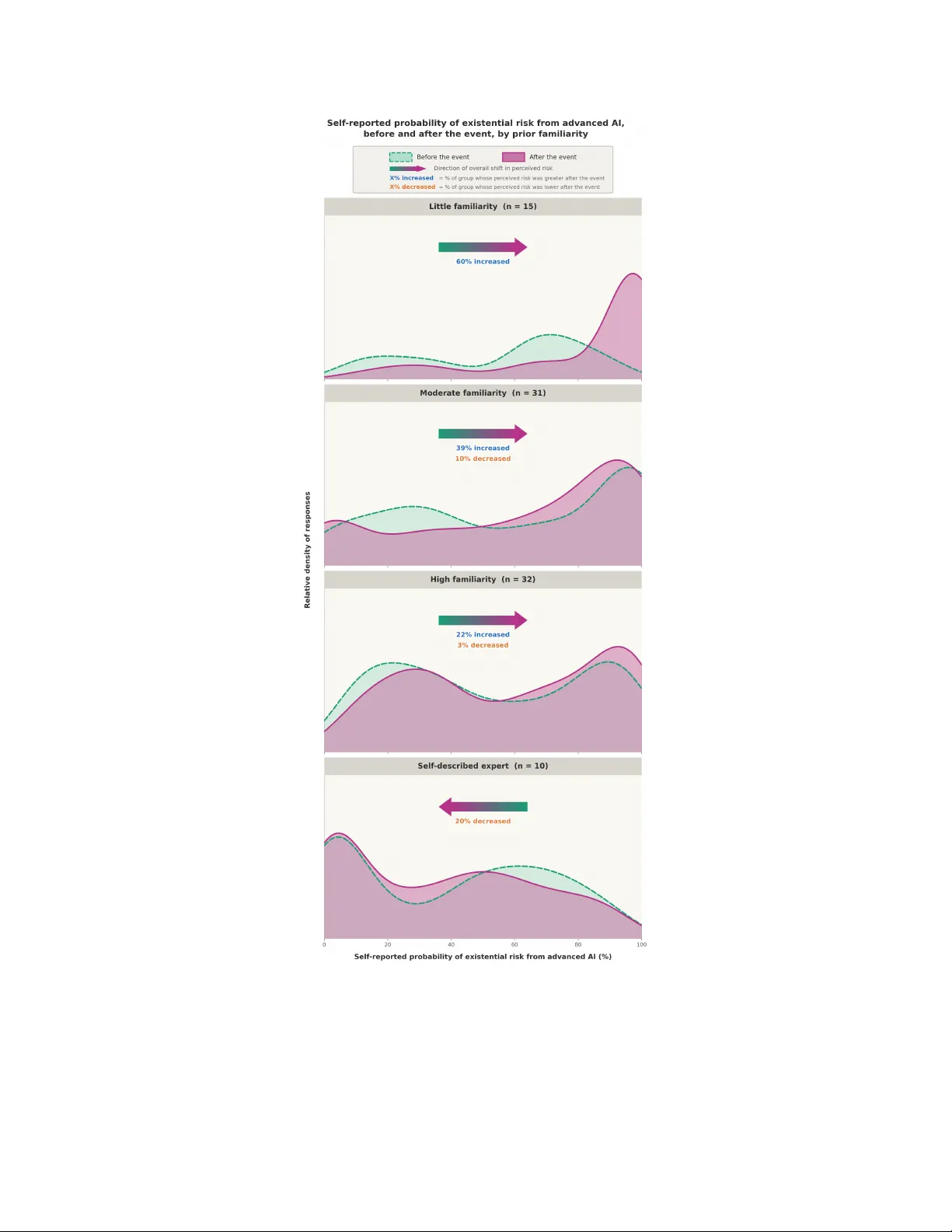
Views on AI Existen tial Risk Before and After a Public Ev en t at Harv ard Univ ersit y Greg Kestin 1 and Nate Soares 2 1 Departmen t of Physics, Harv ard Univ ersity , Cam bridge, MA 2 Mac hine Intelligence Researc h Institute, Berk eley , CA Marc h 2026 Abstract W e rep ort the results of iden tical pre- and p ost-even t surv eys giv en to attendees of a talk, tw o-sided con versation, and Q&A cen tered around the b o ok If A nyone Builds It, Everyone Dies at Harv ard Univ ersit y in March 2026, co vering p erceiv ed probability of AI-caused extinction or severe disemp o wermen t resulting from unimp eded AI de- v elopment, confidence in those estimates, and global priority . Among the 89 matched participan ts, the p ost-even t median estimate of the probability of existential risk from adv anced AI was 70%, and 96% agreed that mitigating AI existen tial risk should b e a global priority . Although these self-selected resp ondents’ pre-ev ent views were already high (50% and 93%, resp ectively) relative to results of similar surveys that were pre- viously administered to exp erts and the general public, the ev ent pro duced increases on all measures when considering the resp ondents in aggregate. The magnitudes of increases in risk probability were negativ ely correlated with prior familiarit y with the topic: among attendees with little prior familiarity , 60% shifted up ward and none shifted do wn ward, whereas among self-describ ed exp erts, no resp onden ts shifted up- w ard and 20% shifted do wn ward. Self-rep orted confidence also increased significantly , and confidence shifts were p ositiv ely correlated with probabilit y shifts. These find- ings indicate that a structured public engagement even t can meaningfully shift risk p erceptions, particularly among newcomers to the topic. 1 In tro duction Public understanding of existen tial risk from adv anced artificial in telligence remains an emerging area of study . While surveys of AI researc hers hav e documented exp ert views on the probabilit y of catastrophic AI outcomes [ Grace et al. , 2024 ], and p olls of the gen- eral public and universit y students ha ve gauged general sen timen t [ AI Policy Institute , 2023 , Hiraba yashi et al. , 2024 ], comparativ ely little w ork has examined how audiences with v arying lev els of prior familiarit y assess AI existen tial risk and up date their beliefs when exp osed to structured argumen ts and discussion ab out these risks. 1 As AI capabilities adv ance rapidly—with AI systems demonstrating capabilities suffi- cien t to win the International Mathematical Olympiad [ Hub ert et al. , 2025 , Huang & Y ang , 2025 ], o ver a decade ahead of forecaster predictions [ Metaculus , 2021 ] and pro ducing no vel con tributions to theoretical physics [ Guev ara et al. , 2026 ]—and as AI systems increasingly op erate autonomously as agen ts in the w orld, understanding ho w the public p erceives these risks b ecomes increasingly imp ortan t. On Marc h 11, 2026, w e conducted a pre/post surv ey at a Harv ard Science Book T alk ev en t (co-hosted by the Harv ard Division of Science, Harv ard Bo ok Store, and Harv ard Library). The even t featured a talk by Nate Soares, presiden t of the Machine In telligence Researc h In- stitute (MIRI), based on the b o ok If A nyone Builds It, Everyone Dies [ Y udko wsky & Soares , 2025 ], follo wed by a structured con v ersation facilitated by Greg Kestin 1 that addressed ar- gumen ts ab out the danger of artificial sup erin telligence along with questions and discussion of those argumen ts. W e rep ort the results of this survey , examining p erceived risk, confidence, and prioritiza- tion of mitigating AI existen tial risk, ho w these shifted follo wing the even t, and ho w shifts v aried by prior familiarity with the topic. W e also compare our results to existing b ench- marks: the 2023 Exp ert Surv ey on Progress in AI [ Grace et al. , 2024 ] for risk probabilit y , and p olls of the general public and universit y students [ AI P olicy Institute , 2023 , Hirabay ashi et al. , 2024 ] for global priority . 2 Metho ds 2.1 Ev en t format The ev en t consisted of an appro ximately 13-min ute talk b y Soares summarizing the case that sufficien tly adv anced AI p oses an extinction threat, follow ed b y a mo derated con versation of appro ximately 35 minutes. The con versation, facilitated b y Kestin, was designed to b e t wo-sided: while drawing out the sp eaker’s arguments, Kestin also raised counterargumen ts, common questions, and alternative p ersp ectiv es gathered b eforehand from colleagues in and outside academia as well as from the AI safet y comm unity . F or example, Kestin raised the question of whether large language models could carry inherent alignment adv antages ov er earlier paradigms, since, for example, LLMs are trained on h uman data and may therefore b e b etter p ositioned to interpret h uman goals and v alues. The even t concluded with an appro ximately 13-min ute audience question-and-answer session. The ev ent w as recorded and is a v ailable at h ttps://youtu.be/TD9AFmJy GY . 2.2 Surv ey design Iden tical surveys w ere administered b efore and after the even t using anonymous p olling. P articipants accessed the survey via QR co de or URL that was presented to them. The pre-ev ent survey contained four questions: 1 Kestin teaches in Harv ard’s Ph ysics Departmen t and serv es as the Asso ciate Director of Science Educa- tion; his role and research hav e a fo cus on AI and its implications. 2 1. Probability of AI existen tial risk. “What probability do you put on future AI adv ances causing h uman extinction or similarly p ermanent and sev ere disemp ow ermen t of the h uman species? (Assume that companies developing AI technology pro ceed largely unimp eded b y external interv en tion.)” The probabilities w ere separated into sev en bins that served as answ er c hoices: Under 5% (v ery unlik ely or impossible), 5– 20% (unlik ely), 20–40% (p ossible but unlikely), 40–60% (roughly a coin flip), 60–80% (more lik ely than not), 80–95% (very likely), and Ab ov e 95% (near certain). This question w as adapted from the 2023 Exp ert Surv ey on Progress in AI [ Grace et al. , 2024 ], whic h asked AI researchers an analogous question with free-form numerical resp onses. W e added a paren thetical clause asking resp ondents to assume that AI dev elopment pro ceeds largely unimp eded, and we used binned resp onses for ease of completion b y a general audience. 2. Confidence. “How confident are y ou in your resp onse to the previous question?” The answ er c hoices w ere a fiv e-p oint scale from “Not at all confident (pure guess)” to “Completely confiden t (firm, unchangeable view).” 3. Global priorit y . “Mitigating the risk of extinction from AI should b e a global priorit y alongside other so cietal-scale risks suc h as pandemics and nuclear w ar.” The answer c hoices w ere a fiv e-p oin t Lik ert scale from “Strongly disagree” to “Strongly agree.” This w ording is taken directly from the Center for AI Safet y (CAIS) statement on AI risk [ Cen ter for AI Safet y , 2023 ]. 4. Role/affiliation. “Which b est describ es your current role or affiliation?” Options included undergraduate student, graduate/professional/p ostdo ctoral student, faculty or academic researc her, univ ersity staff, work outside academia in a scientific field, w ork outside academia in a non-science field, retired, and other. The p ost-ev ent survey rep eated all four questions and added a fifth: 5. Prior exp osure (p ost-ev ent only). “Before to da y , ho w m uch had y ou heard or read ab out argumen ts that adv anced AI (e.g., sup erhuman AI) could p ose an existen tial risk to h umanity?” The five answ er choices w ere: Nothing at all, A little, A mo derate amoun t, A great deal, Exp ert lev el. 2.3 P articipan ts The even t w as an in-p erson public lecture at 6 PM, publicized primarily to the Harv ard F aculty of Arts and Sciences communit y and subscrib ers to the Harv ard Bo ok Store mailing list. A ttendance was v olun tary . Of the approximately 180 attendees, 129 completed the pre-ev ent surv ey and 113 completed the p ost-even t survey . W e matc hed 89 participants who completed b oth surv eys. The unmatc hed participan ts—40 of whom only to ok the pre-even t surv ey and 24 of whom only to ok the p ost-even t survey—w ere excluded from the primary matc hed analysis. The demographic and exp osure comp osition of the matched sample ( n = 89) is shown in T able 1 . 3 T able 1: Comp osition of the matc hed sample ( n = 89) by role and prior exp osure. Role/affiliation n % W ork outside academia, scien tific field 23 26% W ork outside academia, non-science field 22 25% Retired 13 15% Graduate/professional/p ostdo ctoral studen t 9 10% F aculty or academic researc her 8 9% Other 6 7% Univ ersity staff 4 4% Undergraduate studen t 4 4% Prior exp osure to AI risk topic n % A great deal 32 36% A mo derate amoun t 31 35% A little 15 17% Exp ert lev el 10 11% Nothing at all 1 1% 2.4 Analysis F or the primary analysis, w e used the 89 matc hed participan ts. Eac h participan t’s pre- and p ost-even t resp onses to Q1 (probability) w ere compared to determine shift direction: whether the p ost-ev en t resp onse w as higher, lo w er, or unchanged relativ e to the pre-ev en t resp onse. F or n umerical analyses, resp onses were co ded to bin midp oints (2.5%, 12.5%, 30%, 50%, 70%, 87.5%, 97.5%). T o test for o verall shifts, w e used Wilcoxon signed-rank tests. T o assess the relationship b et ween prior exp osure and the magnitude of shifts, we used Sp earman rank correlations. W e rep ort descriptiv e statistics stratified by prior exp osure level (Q5). In addition to p -v alues, w e rep ort likelihoo d ratios (LRs) comparing the b est-fit h yp othe- sis to the n ull. F or shift analyses, the LR compares a mo del where the probabilit y of upw ard shift equals the observ ed prop ortion to the null mo del where up w ard and do wnw ard shifts are equally lik ely . F or correlations, the LR compares the observ ed correlation coefficient to zero. A lik eliho o d ratio of k :1 indicates the data are k times more likely under the b est-fit h yp othesis than under the null. 2.5 Ethics This study inv olv ed v oluntary , anon ymous polling at a public lecture ev ent. No p ersonally iden tifiable information was collected. P articipants w ere informed that their resp onses w ere anon ymous and w ould b e used to compare pre- and p ost-even t views. The surv ey w as administered as part of the even t programming. 2 2 Giv en the anon ymous, volun tary nature of the surv ey and the absence of personally iden tifiable infor- mation, this study is not deemed human sub jects research. 4 3 Results 3.1 Ov erall views b efore and after the ev ent Among the 89 matc hed participan ts, pre-even t estimates of AI existen tial risk w ere high: the median resp onse w as in the 40–60% bin (midp oin t 50%), the mean was 50.5%, and 57% of resp onden ts placed risk at 40% or higher. After the ev en t, these estimates shifted up ward: the median rose to the 60–80% bin (midpoint 70%), the mean increased to 56.9%, and 65% placed risk at 40% or higher. Pre-ev ent confidence in risk estimates w as mo derate, with a mean of 2.72 on the 5- p oin t scale (where 1 = “not at all confident” and 5 = “completely confident”). After the ev ent, mean confidence rose to 3.02, with the prop ortion reporting “V ery” or “Completely” confiden t increasing from 17% to 28%. Agreemen t that AI existential risk should b e a global priority was high b efore the ev ent and increased further (Wilcoxon signed-rank p = 0 . 004, LR 223:1). Pre-ev ent, 93% of matc hed participants agreed to some degree (73% strongly), rising to 96% after (85% strongly). The median resp onse was “Strongly agree” b oth b efore and after. W e found no significan t differences b et w een participan ts affiliated with academia (facult y , studen ts, and staff; n = 25) and those outside academia ( n = 64) on any measure, including pre-ev ent risk estimates, p ost-even t shifts, confidence, and prioritization of AI risk. 3.2 P erceiv ed risk probability shifts stratified b y prior familiarit y The ev ent pro duced a clear gradient in p erceived risk probability shifts across levels of prior familiarit y with AI existential risk (Figure 1 , T able 2 ). Ov erall, self-rep orted probability of AI existen tial risk increased significantly following the even t (Wilcoxon signed-rank W = 73, p < 0 . 001, one-sided; lik eliho o d ratio 3 , 734:1), with a mean shift of +6 p ercentage p oin ts across all 89 matched participants. Of the 35 participan ts whose resp onses changed, 29 shifted up ward and 6 shifted down ward. T able 2: Pre/p ost shifts in p erceived probability of AI existential risk, b y prior familiarity lev el. Mean shift is computed from bin midp oints. Wilcoxon signed-rank tests (one-sided) and likelihoo d ratios (LR) are rep orted for each group, testing for upw ard shift except in the Exp ert ro w which tests for do wn ward shift. Prior familiarit y n % Up % Same % Do wn Mean shift (pp) p LR A little 15 60% 40% 0% +12 0.002 512:1 Mo derate 31 39% 52% 10% +10 < 0.001 18:1 A great deal 32 22% 75% 3% +3 0.023 13:1 Exp ert 10 0% 80% 20% − 4 0.25 4:1 All matc hed 89 33% 61% 7% +6 < 0.001 3 , 734:1 The shift w as significant within eac h familiarity group of sufficient size (i.e. more than ten participants). Among those with little prior familiarit y ( n = 15), 60% rep orted a higher 5 probabilit y after the ev ent, with no participants shifting down ward ( p = 0 . 002). Among those with mo derate familiarit y ( n = 31), 39% increased and 10% decreased their probabilit y ( p < 0 . 001), with 52% unc hanged. Among those with high familiarit y ( n = 32), 22% increased and 3% decreased their probability ( p = 0 . 023). The exp ert group ( n = 10) displa y ed the opp osite pattern: no resp ondents shifted up- w ard, and 20% (2 of 10) shifted down ward. How ev er, with only tw o participan ts shifting, the evidence for a systematic down w ard trend among exp erts is weak ( p = 0 . 25, LR 4:1). The monotonic relationship b etw een prior exposure and probability shift w as confirmed b y Sp earman correlation ( ρ = − 0 . 38, p < 0 . 001, LR 923:1). Pre-ev ent risk estimates did not significan tly predict who shifted. Prior exp osure lev el w as not significantly correlated with pre-ev ent risk estimates, indicating that all familiarit y groups en tered the ev ent with similar baseline risk p erceptions. After the ev ent, ho wev er, a significan t negativ e correlation b et w een exp osure and risk estimates emerged (Sp earman ρ = − 0 . 25, p = 0 . 01, LR 17:1), indicating that the gradien t in p ost-even t views was created by the ev ent rather than pre-existing. 3.3 Confidence increased ov erall Self-rep orted confidence in risk estimates increased significantly follo wing the even t (Wilcoxon signed-rank p < 0 . 001, LR 3 , 591:1; Figure 2 ). Across all 89 matc hed participan ts, 31 (35%) rep orted higher confidence p ost-ev ent, 51 (57%) w ere unc hanged, and 7 (8%) rep orted low er confidence, yielding a mean shift of +0 . 30 on the 5-p oin t confidence scale. Prior exp osure lev el w as negativ ely correlated with confidence shift ( ρ = − 0 . 24, p = 0 . 02, LR 14:1). The largest increase w as among those with little prior familiarity (mean shift +0 . 80), consistent with new comers feeling more certain ab out a previously uncertain domain. 3.4 Probabilit y shifts correlated with confidence shifts P articipants whose risk probabilit y estimates shifted also tended to rep ort increased confi- dence in those estimates (Sp earman ρ = 0 . 29, p = 0 . 006, LR 44:1). This p ositiv e correlation suggests that the observed b elief changes w ere accompanied b y a sense of greater clarity rather than increased uncertaint y—consistent with b elief up dating. 3.5 Comparison with the 2023 Exp ert Surv ey on AI The first question on our survey , ab out the probability of AI-caused extinction or sev ere dis- emp o wermen t, was adapted from a 2023 surv ey of AI researc hers [ Grace et al. , 2024 ]. That surv ey asked 2,778 AI researc hers sev eral differently framed extinction-risk questions with free-form n umerical responses. The question from whic h ours w as adapted—“What proba- bilit y do y ou put on future AI adv ances causing h uman extinction or similarly p ermanent and sev ere disemp o wermen t of the human sp ecies?”—received a median response of 5% and a mean of 16.2% ( n = 1 , 321). The audience at our ev ent sho w ed considerably higher baseline estimates: the median pre- ev ent resp onse was in the 40–60% bin (midp oin t 50%) and the mean w as 50.5%, compared to a median of 5% and mean of 16.2% among AI researchers. This large difference likely reflects the self-selected nature of our sample, differences b etw een the survey ed p opulations, 6 the addition of an “unimp eded” paren thetical to our question, the use of binned v ersus con tinuous resp onses, and the t wo-plus y ear gap b et ween surv eys during which AI capabilities adv anced considerably (see Section 5 for further discussion). 3.6 Comparison with national p olling on global priorit y In Ma y 2023, the Center for AI Safety (CAIS) published a one-sentence statement: “Miti- gating the risk of extinction from AI should b e a global priorit y alongside other so cietal-scale risks suc h as pandemics and n uclear w ar,” signed by hundreds of AI researc hers and industry leaders including the CEOs of Op enAI, Go ogle DeepMind, and Anthropic, as well as T uring Aw ard laureates Geoffrey Hinton and Y oshua Bengio [ Center for AI Safet y , 2023 ]. The third question on our survey , ab out whether AI risk should b e a global priority , uses w ording iden tical to the CAIS statement. This same wording w as used in a July 2023 Y ouGo v p oll of 1,001 U.S. v oters conducted for the AI P olicy Institute [ AI P olicy Institute , 2023 ], and in a 2024 surv ey of 273 Harv ard undergraduates conducted b y the Harv ard Undergraduate Asso ciation [ Hiraba yashi et al. , 2024 ]. In the national p oll, 70% of resp onden ts agreed with the statemen t; among Harv ard undergraduates, approximately 40% agreed. Among our matc hed participants ( n = 89), 93% agreed to some degree before the ev ent (73% strongly agreeing), rising to 96% after (85% strongly agreeing). Direct comparison is limited by the differences in p opulations, timing, and context of the surv eys, as well as the substantial adv ances in AI capabilities during the in tervening p erio d (see Section 5 ). Nonetheless, these surveys show a mo derate to high degree of agreement that AI merits global attention alongside other existentia l risks. 4 Discussion Our results demonstrate that a single public engagemen t even t can pro duce measurable and statistically significant shifts in p erceived AI risk ( p < 0 . 001, LR 3 , 734:1). The 60% upw ard shift rate among those with little prior familiarit y—with zero down w ard shifts—suggests that direct, in-p erson engagement with ideas ab out AI existen tial risk is most likely to shift the views of new comers (LR 512:1). The p ositive correlation b etw een probabilit y shifts and confidence shifts ( ρ = 0 . 29, p = 0 . 006, LR 44:1) pro vides additional evidence that these w ere b elief updates: participan ts who c hanged their risk estimates also felt more confiden t in their revised views, rather than more uncertain. The exp ert rev ersal is notew orth y , alb eit ten tative given the low sample size. Self- describ ed exp erts w ere the only group in whic h the sole direction of mo vemen t w as do wnw ard. One interpretation is that exp erts were b etter positioned to engage with the questions and p ersp ectiv es raised during the mo derated con v ersation, such as the question of whether large language mo dels could carry inherent alignment adv antages due to b eing trained on h uman data—a question that might resonate more with individuals who hav e though t deeply ab out AI arc hitectures and AI alignmen t researc h. The increase in confidence across the sample as a whole, including among those whose risk estimates did not change, suggests that the even t left participan ts feeling more certain ab out their views, whether or not those views c hanged. 7 The high and increasing lev els of agreemen t that AI risk should b e a global priority (96% of matched p ost-even t resp onden ts agreeing to some degree, p = 0 . 004, LR 223:1) substan- tially exceeds agreement lev els in b oth a national p oll (70%) and a Harv ard undergraduate surv ey (approximately 40%) [ AI Policy Institute , 2023 , Hiraba yashi et al. , 2024 ]. While the gap b etw een our sample and the national p oll ma y partly reflect differences in the survey ed p opulations, the result is also consisten t with the hypothesis that prioritization views hav e increased as AI technology has adv anced. The further increase follo wing the even t suggests that direct engagement with arguments ab out AI risk can shift prioritization views ev en among audiences who already lean tow ard agreemen t. 5 Limitations Sev eral limitations warran t mention, relating to the representativ eness of our sample, our measuremen t approac h, the external comparisons, and the generalizability of a single-even t study . There is lik ely self-selection bias in our sample given that attendees c hose to attend an ev ent with a prov o cativ e title ab out AI existential risk. Of the approximately 180 atten- dees, only a subset completed the surveys, introducing a p otential nonresponse bias. Tw o subgroups—the exp ert group ( n = 10) and the “nothing at all” group ( n = 1)—are to o small for robust statistical inference. Sev eral asp ects of our measurement approach also deserve consideration. P articipants who attended a talk arguing that AI p oses an existen tial risk and then saw the same surv ey questions ma y ha v e felt so cial pressure to rep ort higher risk estimates; the anon ymous polling format mitigates this somewhat but cannot eliminate it. Our use of seven resp onse bins limits the gran ularity of detected c hanges—a one-bin shift could represen t a c hange of 5 percentage p oin ts at the tails or 20 p ercen tage p oints in the middle range. The familiarit y categories are based on participants’ own assessments, which may not corresp ond to ob jectiv e knowledge lev els. The external comparisons we draw are sub ject to additional cav eats. The 2023 Exp ert Surv ey on Progress in AI [ Grace et al. , 2024 ] surv eyed AI researc hers, whose estimates ma y b e impacted by selection bias and domain-sp ecific knowledge—while appreciation of tec hnical challenges could lead to higher probability estimates, in tuitions ab out tractabilit y of alignmen t and career selection could bias tow ard low er estimates of p otential associated dangers. Additionally , our probability question included a parenthetical asking resp ondents to assume AI developmen t pro ceeds largely unimp eded, which ma y hav e pushed estimates up ward relative to the exp ert survey . The 2023 Y ouGo v p oll [ AI P olicy Institute , 2023 ] surv eyed a nationally representativ e sample of U.S. voters with no particular connection to the topic. The 2024 Harv ard undergraduate surv ey [ Hiraba yashi et al. , 2024 ] captured views of a sp ecific demographic whose views may not generalize broadly . All three external surv eys w ere conducted one to three y ears before our even t, during whic h time AI capabilities adv anced considerably with the release of mo dels such as GPT-4, GPT-5, Claude 3, Claude 4, and subsequen t generations; it is plausible that risk p erceptions hav e shifted across all p opulations o ver this p erio d. Finally , this is a single ev ent with a single sp eaker presenting one p ersp ective, alb eit 8 with structured questions and a t wo-sided con ver sation. Generalizability to other formats, sp eak ers, or audiences is unknown. 6 Conclusion W e presen t evidence that a public engagement ev ent ab out AI existen tial risk—featuring a talk and t wo-sided conv ersation—pro duced statistically significant shifts in p erceived risk probabilit y ( p < 0 . 001, LR 3 , 734:1), confidence ( p < 0 . 001, LR 3 , 591:1), and global prior- itization ( p = 0 . 004, LR 223:1). The median p erceiv ed probability of existential risk from adv anced AI developed unimp eded rose from 50% to 70%, and 96% of p ost-even t resp onden ts agreed that AI existential risk should b e a global priority . The magnitude of the probability shift decreased monotonically with prior familiarit y ( ρ = − 0 . 38, p < 0 . 001, LR 923:1), and the p ositiv e correlation betw een probabilit y and confidence shifts ( ρ = 0 . 29, p = 0 . 006, LR 44:1) suggests these c hanges reflected b elief up dating. These results con tribute to a nascent literature on ho w public audiences pro cess information ab out AI risk. Ac kno wle dgmen ts W e thank Melissa F ranklin, Jeffrey May ersohn, Marina W erb eloff, Seth Lewis, Erin Collins, Cassie Davis, Elliott Ronna, Mic hael Leac h, and Ronald Lacey for organizing and supp orting the ev ent; the Harv ard Division of Science, Harv ard Bo ok Store, and Harv ard Library for co- organizing the Harv ard Science Bo ok T alk series; and the audience mem b ers who participated in the surv ey . W e also thank Logan McCart y and Eric Mosko witz for discussions of the data. W e also ackno wledge the assistance of Claude (An thropic) in the preparation of this man uscript. References AI P olicy Institute (2023). P oll shows ov erwhelming concern ab out risks from AI. h ttps://theaipi.org/p oll- shows- o verwhelming- concern- ab out- risks- from- ai/ . Cen ter for AI Safety (2023). Statemen t on AI risk. Retriev ed from h ttps://www.safe.ai/statement- on- ai- risk . Grace, K., Stew art, H., Sandk ¨ uhler, J. F., Thomas, S., W einstein-Raun, B., Brauner, J., & Korzekw a, R. C. (2024). Thousands of AI authors on the future of AI. arXiv pr eprint , Guev ara, A., Lupsasca, A., Skinner, D., Strominger, A., & W eil, K. (2026). Single-minus gluon tree amplitudes are nonzero. arXiv pr eprint , Hiraba yashi, S., Jain, R., Jurk ovi ´ c, N., & W u, G. (2024). Harv ard undergraduate surv ey on generativ e AI. arXiv pr eprint , 9 Huang, Y., & Y ang, L. F. (2025). Winning gold at IMO 2025 with a mo del-agnostic v erification-and-refinement pip eline. arXiv pr eprint , Hub ert, T., Meh ta, R., Sartran, L., et al. (2025). Olympiad-level formal mathematical reasoning with reinforcemen t learning. Natur e . h ttps://doi.org/10.1038/s41586- 025- 09833- y . Metaculus (2021). When will an op en-source AI win a gold medal in the International Math Olympiad? Retrieved from https://www.metaculus.com/questions/6728/ . Y udko wsky , E., & Soares, N. (2025). If A nyone Builds It, Everyone Dies . Little, Brown and Compan y . 10 Figure 1: Changes in self-rep orted probabilit y of existen tial risk from adv anced AI dev elop ed unimp eded, b efore and after the ev ent, stratified by prior familiarity . Eac h panel sho ws k ernel densit y estimates of pre-ev ent (teal, dashed outline) and p ost-even t (purple/pink, solid) distributions for one familiarit y group. Arrows indicate the direction of net shift, with p ercen tages sho wing the fraction of participan ts whose estimates increased or decreased. The “Nothing at all” exp osure group is omitted since there is only one mem b er in that group. The gradient from “little familiarit y” to “exp ert” rev eals a monotonic decrease in upw ard shifts and the emergence of down w ard shifts. 11 Figure 2: Direction and magnitude of individual pre–p ost b elief shifts across all three survey questions, stratified b y self-rep orted prior exp osure to the topic of AI existential risk. Each bar shows the prop ortion of matc hed participan ts whose resp onses shifted do wn (orange, left), remained unc hanged (gra y , cen ter), or shifted up (blue, right), with coun ts shown inside eac h segment. Righ t-hand lab els indicate the net mean shift in p ercentage p oints (Q1) or scale p oints on a five-point scale (Q2, Q3). The “Nothing at all” exp osure group is omitted since there is only one member in that group. A gradient of decreasing upw ard shifts with increasing prior exp osure is visible across all three questions. 12
Original Paper
Loading high-quality paper...
Comments & Academic Discussion
Loading comments...
Leave a Comment