Sensitivity Analysis for Instrumental Variables Under Joint Relaxations of Monotonicity and Independence
In this paper I develop a breakdown frontier approach to assess the sensitivity of Local Average Treatment Effects (LATE) estimates to violations of monotonicity and independence of the instrument. I parametrize violations of independence using the c…
Authors: Pedro Picchetti
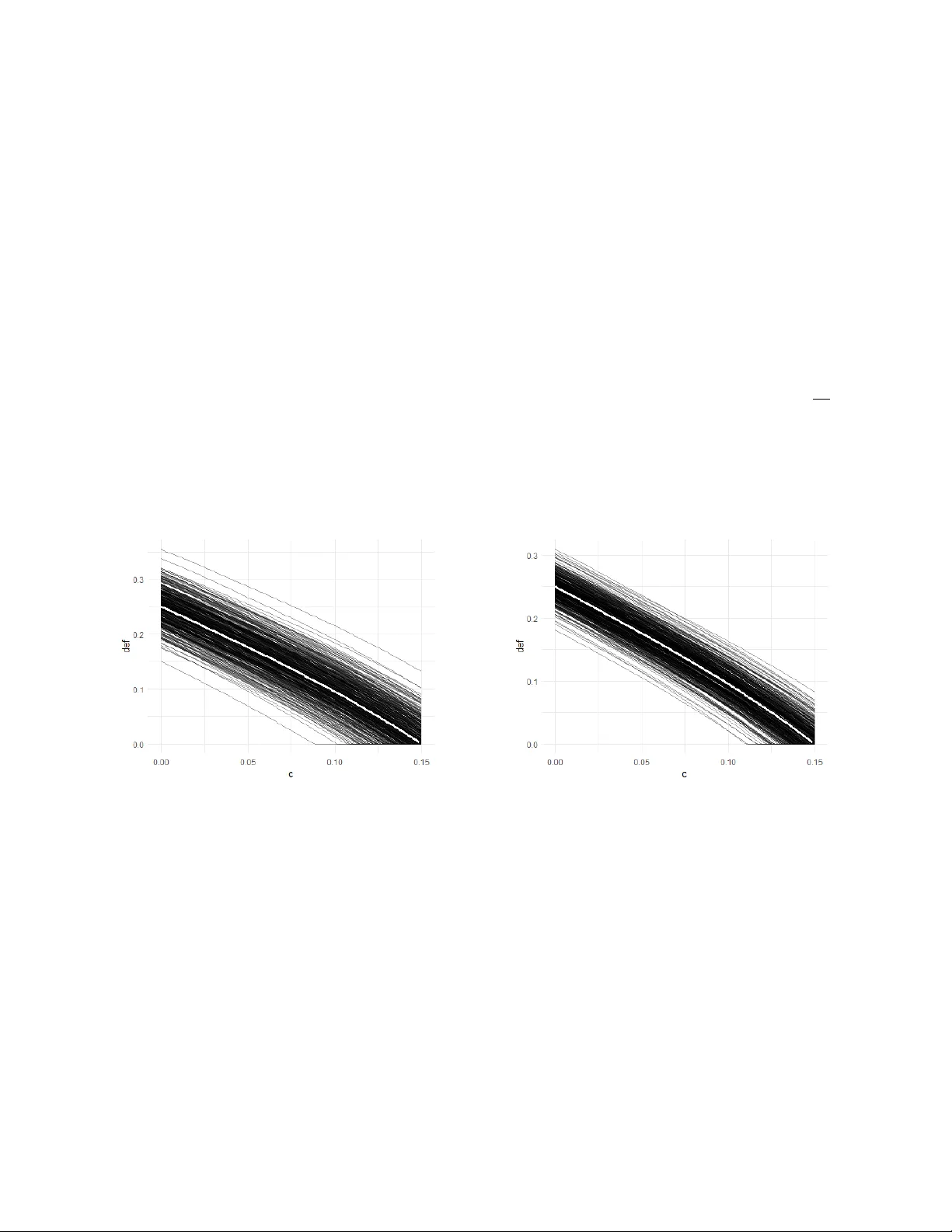
Sensitivit y Analysis for Instrumen tal V ariables Under Join t Relaxations of Monotonicit y and Indep endence P edro Picc hetti ∗ Institute of Economics, PUC-Chile Marc h 27, 2026 Abstract In this pap er I dev elop a breakdown fron tier approach to assess the sensitivity of Lo cal A v erage T reatmen t Eects (LA TE) estimates to violations of monotonicit y and indep endence of the instrumen t. I parametrize violations of indep endence using the concept of -dep endence from Masten & Poirier ( 2018 ) and allo w for the share of deers to be greater than zero but smaller than the share of compliers. I derive iden tied sets for the LA TE and the A verage T reatmen t Eect (A TE) in which the b ounds are functions of these t wo sensitivit y parameters. Using these b ounds, I derive the breakdo wn frontier for the LA TE, which is the weak est set of assumptions such that a conclusion regarding the LA TE holds. I derive consistent sample analogue estimators for the breakdo wn frontiers and provide a v alid b o otstrap pro cedure for inference. Mon te Carlo simulations sho w the desirable nite-sample prop erties of the estimators and an empirical application sho ws that the conclusions regarding the eect of family size on unemploymen t from Angrist & Ev ans ( 1998 ) are highly sensitiv e to violations of indep endence and monotonicity . K eywor ds: P artial identication, heterogeneous treatment eects, selection on unobserv- ables. ∗ p e dr o.pic chetti@uc.cl 1 1 In tro duction Instrumen tal v ariables (IV) tec hniques are among the most widely used empirical to ols in so cial sciences. In the canonical IV setting, the causal eect of a binary treatment is iden tied by exploiting v ariations in a binary instrument in the form of the W ald ( 1940 ) estimand. Poin t iden tication is achiev ed if the instrument satises a set of assumptions. F or instance, the instrumen tal v ariable must b e indep endent from p oten tial treatments and p oten tial outcomes. Also, the instrument must aect treatmen t uptak e in the same direction for all individuals, which is usually referred to as the monotonicit y assumption. If the instrumen t satises the indep endence and the monotonicity assumption, along addi- tional assumptions, then the W ald estimand identies the av erage eect of the treatment for compliers, the subp opulation of individuals whose treatmen t status mimics its assign- men t, which is called the Lo cal A v erage T reatmen t Eect, or simply LA TE ( Imbens & Angrist 1994 ). In the recen t years, applied researc hers ha ve grown increasingly skeptical of IV metho ds ( Cinelli & Hazlett 2025 ). The iden tifying assumptions are often unv eriable, and although in certain cases some assumptions are readily justied (for instance, the indep endence assumption in exp erimental studies with imp erfect compliance), in most cases they are defended b y app ealing to con text-sp ecic knowledge. In this pap er I study what can b e learned ab out treatment eects in IV settings under relaxations of indep endence and monotonicit y and dev elop a breakdown frontier approach for assessing the sensitivit y of IV estimates. I fo cus in the case where the outcome is binary . I b egin by deriving b ounds for p oten tial treatments and p otential outcomes under a b ounded dep endence assumption called c-dep endenc e ( Masten & Poirier 2018 ), whic h b ounds the distance b etw een the probabilit y of receiving the instrumen t given observed 2 co v ariates and unobserved p otential quantities and the probability of b eing treated given just the observed cov ariates. I then use the b ounds for potential quan tities to deriv e iden tied sets for the causal eect of assignmen t (which I will refer to as the In ten tion-to-T reat, or simply ITT) and the LA TE, under a share of deers which is greater than zero, but alw ays smaller than the share of compliers. I derive the conditions under which these iden tied sets are sharp. In the cases where these conditions do not hold, the identied sets still provide a v alid outer region for the parameters of interest. One can argue that once the iden tifying assumptions for IV settings are violated, the LA TE is no longer an interesting causal parameter. Th us, I also deriv e the identied set for the A v erage T reatment Eect (A TE) and show how the b ounds under violations of indep endence and monotonicity are connected to well kno wn b ounds for the A TE using IV s in the causal inference literature ( Balk e & Pearl 1997 , Chen et al. 2017 ). I use the bounds of the ITT and the LA TE to construct breakdo wn fron tiers for conclusions regarding causal eects. The breakdo wn frontier in this setting provides the largest com bi- nation of violations of indep endence and monotonicity under whic h a particular conclusion holds. F or instance, supp ose a researcher nds a p ositive p oin t estimate for the LA TE, but is skeptical to w ards the identifying assumptions. T o provide evidence of robustness of the qualitativ e tak eaw ays of its ndings (for instance, that the eect is indeed p ositive), the researc her can use the breakdown frontier to show the combinations of violations under whic h one can still conclude that the LA TE is greater than zero. I prop ose nonparametric estimators for the b ounds of causal eects and breakdown v alues, and deriv e their asymptotic prop erties using conv ergence results for Hadamar d dir e ctional dier entiable functions ( F ang & Santos 2018 ). Standard inference metho ds suc h as the nonparametric b o otstrap are not consistent for the breakdo wn frontiers. I sho w, how ever, 3 that v alid uniform condence bands can b e estimated using the b o ostrap pro cedure for Hadamar d dir e ctional dier entiable functions in F ang & Santos ( 2018 ) and the numerical estimator for the Hadamard deriv ative from Hong & Li ( 2018 ). Monte Carlo simulations sho w the desirable nite sample prop erties of the estimators and inference pro cedures. F or the empirical application, I revisit Angrist & Ev ans ( 1998 ), which studies the eects of family size on female emplo yment using same-sex siblings as the instrumen t. The estimated breakdo wn frontier for the LA TE shows that the qualitative tak eaw ay from this study only holds under v ery small violations of the iden tifying assumptions. Therefore, the breakdown fron tier approach suggests that the conclusions of the study are highly sensitiv e to violations of indep endence and monotonicity . Related Literature: This pap er relates broadly to three strands of the causal inference literature. First, it is connected to the literature on partial identication and sensitivity analysis in IV settings. Most pap ers in this literature fo cus on partial identication and sensitivit y analysis under violations of indep endence and the exclusion restriction( Conley et al. 2012 , W ang et al. 2018 , Masten & P oirier 2021 , Cinelli & Hazlett 2025 ). There also pap ers that fo cus on identication and sensitivit y analysis under violations of mono- tonicit y ( de Chaisemartin 2017 , Noack 2026 ). In this pap er, I consider b oth relaxations of indep endence and monotonicity . Second, this pap er relates to the literature on the iden tication of breakdo wn v alues, in- tro duced by Horo witz & Manski ( 1995 ). My approach to inference follo ws closely the one in tro duced in Masten & Poirier ( 2020 a ) as it also uses -dep endence to parametrize viola- tions of indep endence. While most of the work in this literature fo cuses on missing data settings ( Kline & Santos 2013 ) and selection on observ ables ( Masten & Poirier 2020 a ), this is one of the rst pap ers studying inference for breakdown v alues in settings with non- compliance. In that sense, it is closely related to the w ork of Noac k ( 2026 ), but under a 4 dieren t parametrization for violations of monotonicity . A desirable feature of the break- do wn analysis in this pap er is that the violations of indep endence and monotonicit y are measured in the same unit, which makes the interpretation of the tradeos of violations displa yed by the breakdown fron tier particularly easy . Finally , this pap er is related to the literature on IV settings with binary outcomes, which dates back to the seminal work of Heckman ( 1978 ). While most prominent work on this literature focuses on the iden tication of the a v erage structural functions ( V ytlacil & Yildiz 2007 , Shaikh & V ytlacil 2011 ) or partial identication of A v erage T reatment Eects ( Balk e & Pearl 1997 , Chen et al. 2017 , Machado et al. 2019 ), this pap er considers b oth the partial iden tication of the LA TE and the A TE. Outline of the pap er: The rest of the pap er is organized as follows: Section 2 describ es the framework and target parameters in the setting. Section 3 provides the partial identi- cation of p otential treatments and outcomes, and in Section 4 I deriv e the identied sets for the ITT and the LA TE show the iden tication of the breakdown fron tiers. I also derive the identied sets for the A TE. Section 5 introduces the estimators and their asymptotic prop erties, as well as the b o otstrap pro cedure used for inference. Section 6 presen ts the Mon te Carlo sim ulation studies. Section 7 presents the empirical application and Section 8 concludes. App endix A contains the main pro ofs from the results in the pap er, and App endix B contains auxiliary lemmas. 2 General F ramew ork Setup Let denote a binary v ariable that indicates whether an individual was assigned to treatmen t ( ) or con trol ( ). In this setting, non-compliance is allo wed, 5 whic h means that not all individuals assigned to treatmen t will actually tak e the treatmen t and not all individuals assigned to control will remain untreated. Rather than determining treatmen t status, the assignment represen ts an encouragement (or discouragemen t) to wards treatmen t. Let denote the actual treatment status. Dene the p otential treatmen t asso ci- ated to assignment as . W e observe the treatmen t status Let denote the observed binary outcome. The p otential outcome asso ciated to assignmen t is dened as . A t rst, I allo w p otential outcomes dep end arbitrarily on treatment and assignment. Observed and p oten tial outcomes are related by Let b e a vector of observed co v ariates and b e the observ ed prop ensity score for assignmen t. I maintain the following assumption regarding the join t distribution of throughout the pap er: Assumption 1: F or each and : 1. 2. 3. 4. Assumptions 1.1 and 1.2 state that the supp ort of p oten tial quan tities do es not dep end on the assignment. Assumption 1.3 states that all individuals can b e assigned to treatment and con trol with probability greater than zero, and is usually referred to as the common supp ort, or ov erlap assumption. 6 I also maintain the standard exclusion restriction assumption from IV settings, whic h im- p oses that assignment do es not aect p otential outcomes directly . Assumption 2: F or , . In order to identify treatment eects with instrumen tal v ariables, it is standard to assume that the instrument is indep endent of p otential outcomes and p oten tial treatmen ts condi- tional on . The goal of this identication analysis is to study what can b e said ab out treatmen t eects when standard IV assumptions fail to hold. T o do this, I replace these standard assumptions b y a b ounded dep endence assumption, called c-dep endenc e ( Masten & P oirier 2018 ): Denition ( -dep endence): Let and . Let b e a scalar b etw een 0 and 1. is conditionally -dep endent with given if sup where is the supp ort of conditional on . Con- ditional -dep endence provides a parametrization of violations of indep endence which has a straightforw ard interpretation. The sensitivity parameter can b e in terpreted as the dif- ference b etw een the unobserv ed assignment probabilit y and the observ ed prop ensity score in terms of probability units. When , indep endence holds, and p oten tial probabili- ties and are p oint iden tied. Throughout this pap er, -dep endence is assume to hold. Assumption 3: is -dep enden t with giv en and giv en . Without further assumptions, individuals can b e partitioned into four groups regarding ho w they resp ond to assignment: alwa ys-takers ( ), never-tak ers ( ), compliers ( ) and 7 deers ( ). Let denote the prop ortion of individuals from group with co v ariates equal to . The fundamental b ehavioral assumption in IV settings is the monotonicit y assumption, which imp oses that for all , . I relax this assumption to allow for the presence of deers, but I restrict the prop ortion of deers to b e smaller than the share of compliers: Assumption 4: F or all , . Assumption 4 is analogous to Assumption 5 from de Chaisemartin ( 2017 ). If this assump- tion holds, then the the estimate for the rst-stage is p ositive 1 . Thus, the sensitivity parameter can b e seen as a measure of deviation b etw een the prop ortion of compli- ers and the rst-stage estimand in terms of probabilit y units. If assumption 3 holds with , then p otential quantities are identied. If Assumption 4 further holds with for all , then w e go back to the standard IV setting with binary outcomes, where the LA TE is p oint identied by the W ald estimand, and the A TE is partially identied within the b ounds provided by Balke & P earl ( 1997 ). T arget P arameters In this pap er, I fo cus on the partial Identication of the Local A v erage T reatment Eect for compliers, which is usually the target parameter in IV settings and the A verage T reatment Eect (A TE), whic h is typically the causal parameter that researchers would ideally like to iden tify . Dene as the lo cal av erage treatment eect for group , with . W e are thus, interested in the partial identication of and the identication of a breakdown fron tier whic h can b e used to assess the robustness of results from studies that employ IV metho ds. 1 See Noack ( 2026 ) for a partial ID framework where deance is allo wed which relaxes this assumption. 8 Researc hers often rep ort a p oint estimate of the paramerer b ecause they assume the parameter is p oin t identied in their instrumen tal v ariable setting. How ever, it is often argued that is not necessarily a relev ant parameter ( Hub er et al. 2017 ). Moreov er, once the instrument is not assumed to b e indep enden t from conditional quantities, nor it is assumed to b e monotonic, then p otential quantities for the sub-p opulation of compliers are no longer p oint iden tied. Therefore, I also fo cus on the partial identication of the A TE. The partial identication approac h is built using the follo wing steps. First, I derive the b ounds for conditional p otential joint probabilities . Then, I derive the b ounds for the marginal probabilities of p otential outcomes and p oten- tial treatments, and . Then, I derive b ounds for the parameter , which is the LA TE for compliers conditional on , and a breakdown frontier, and nally b ounds for the conditional A TE. Unconditional quan ti- ties are partially iden tied by in tegrating the conditional b ounds ov er the distribution of co v ariates. 3 P artial Iden tication of P oten tial Probabilities I b egin with the identied set for the joint probability of p otential quantities. I b egin with the joint probability of p otential quantities. Under Assumptions 1 and 2, the results from Prop osition 5 of Masten & P oirier ( 2018 ) can b e readily adapted to the IV setting and the mo died conditional -dep endence assumption. Let : Prop osition 1. Supp ose A ssumptions 1-3 hold. Then the sharp identie d set for is 9 wher e max 1 min 1 1 The notation introduced in Prop osition 1 for the b ounds on the joint probability of p o- ten tial quantities illustrates the fact the b ounds are functions of the sensitivity parameter . When the joint probability is p oin t identied b y the conditional probabilit y ,and as increases the identied set b ecomes larger un til w e reach the worst-case iden tied set. The b ounds from Prop osition 1 can b e com bined using the La w of T otal Probabilities to obtain b ounds for the marginal probabilities of p otential quantities. I b egin with the b ounds for p otential outcomes: Prop osition 2. Supp ose A ssumptions 1-3 hold. Then the identie d set for is wher e max min 10 Mor e over, if and min , then the identie d set is sharp. Prop osition 2 shows that the b ounds for p otential outcomes can b e obtained by com bining the b ounds for join p otential quantities, and the additional conditions under which the iden tied set is sharp. Essentially , the additional conditions imply that the upp er bound for join t p otential probabilities simplies to , and that the low er b ound simplies to . If this conditions do not hold, the identied set still pro vides a v alid outer region. The results from Prop osition 2 can b e easily adapted to obtain b ounds for p otential treat- men ts: Prop osition 3. Supp ose A ssumptions 1-3 hold. Then the identie d set for is wher e max min Mor e over, if and min , then the identie d set is sharp. Bounds for unconditional p otential probabilities are obtained by integrating the b ounds of conditional probabilities o v er the distribution of cov ariates. The b ounds derived in this 11 section are the building blo c ks for the partial identication of treatmen t eects which is presen ted in the next section. 4 P artial Iden tication of T reatmen t Eects 4.1 P artial Iden tication of I b egin deriving b ounds for the av erage treatmen t eects of the sub-population of compliers. In the standard IV setting with cov ariates, the parameter is partially iden tied b y the conditional W ald estimand: The numerator of the W ald estimand, usually referred to as the reduced form estimand, iden ties the causal eect of assignment, , whic h is equal to the treatment eect for compliers multiplied by the share of compliers in the standard IV setting. This parameter is often called the Inten tion-to-T reat eect (I will refer to its conditional as and its unconditional version as ). The ITT is rarely the parameter of interest in IV settings, but it carries imp ortant information regarding the LA TE for compliers. F or instance, the paramater has the same sign as the ITT if monotonicit y holds, or if the share of compliers is greater than the share of deers. The next proposition provides the b ounds for the ITT as functions of the sensitivit y parameters and , as well as the conditions under which these b ounds are sharp. Prop osition 4. Supp ose A ssumptions 1-4 hold. Then , wher e min max 12 Mor e over, if max min min for al l and , then the identie d set is sharp. Prop osition 4 provides b ounds for the conditional ITT. The b ounds for the unconditional ITT are obtained by integrating the conditional b ounds o v er the distribution of cov ariates. Under additional assumptions, the b ound is sharp. These assumptions restrict the share of complier to lie within the F réchet-feasible interv al (i), the v alues which joint p oten tial probabilities can take (ii), the v alues which the sensitivity parameter can take (iii) and the share of deers to lie in an interv al in whic h the truncations of the b ounds are not activ e (iv). If these assumptions fail to hold, the b ounds still provide a v alid outer region for the ITT. Prop osition 4 provides b ounds for the ITT. Once b ounds for the share of compliers are obtained, one can derive the iden tied set for : Prop osition 5. Supp ose A ssumptions 1-4 hold. Then the identie d set for is , wher e 13 min max with min max Mor e over, if max min for al l and , then the identie d set is sharp. Prop osition 5 provides the b ounds for the LA TE of compliers. In general, the b ounds will not b e sharp, since under violations of indep endence (Assumption 4 holds with ), the upp er b ound of the conditional ITT and the low er b ound of the conditional share of compliers (and vice-v ersa) cannot b e attained sim ultaneously while satisfying Assumptions 1-4. Nevertheless, in the case where indep endence holds and the share of compliers is suc h that it satises the F rec het inequalities and the b ounds for the share of compliers are not the w orst-case b ounds, the iden tied set is sharp. 14 4.2 Breakdo wn F ron tier In this section I pro vide a breakdo wn fron tier approac h to assess the robustness of ITT and LA TE estimates to violations of indep endence and monotonicit y . I fo cus on the breakdo wn fron tiers for the conclusions that and . Cho osing and equal to 0, for instance, pro vides us the breakdo wn analysis for the conclusion that the treatment has a p ositive eect. First, consider all the v alues of and under which the conclusion holds. This sets are called the robust regions and are dened for the ITT and the LA TE, resp ectively , as Robust regions are simply combinations of which resp ectively deliv er identied sets for the ITT and that contain the v alues and . The breakdo wn frontiers are the sets in the b oundary of the robust region for given conclusions. The breakdo wn frontiers are Solving for in the equations and yields Therefore, w e obtain the follo wing analytical expressions for the breakdown frontiers: 15 min max min max The frontiers pro vide the largest relaxations and under which predetermined conclu- sions regarding the ITT and the LA TE hold. The shap e of the frontier allo ws us to analyze the trade-o b etw een the t wo types of relaxations considered when dra wing conclusions regarding the target parameters. A desirable feature of this approac h is that the sensitivit y parameters and are measured in the same unit. Although this is not necessary , it certainly can b e helpful. Note that when w e are interested in assessing the conclusion regarding the sign of treatmen t eect we can alwa ys use the breakdo wn frontiers for the ITT, as . Next, I pro vide a simple n umerical illustration of the b ounds of the treatmen t eects and the breakdo wn frontier approach. 4.2.1 Numerical Illustration I consider a simple DGP with a single cov ariate where . The instrument is assigned according to a Bernoulli distribution with parameter . The cov ariate is distributed according to a Bernoulli distribution with parameter . Poten tial outcomes and treatments are dened in a wa y such that for , w e hav e Therefore, in the absence of violations of the iden tifying assumptions in IV settings, the ITT is equal to 0.25 and the LA TE is equal to 0.5 under this DGP . T o analyze the sensitivity 16 to violations of indep endence and monotonicit y , Figures 1 sho ws the iden tied sets for the LA TE under dierent shares of deers. Figure 1: Iden tied Sets for the LA TE Note: Left: Identied set for the LA TE as a function of setting . Right: Identied set for the LA TE as a function of setting The vertical lines represent the values of under which the b ounds b ecome uninformative. The plot on the left of Figure 1 shows the identied set for the LA TE under the monotonicit y assumption ( for all ). When , the identied set collapses to 0.5, which is the v alue which would b e p oint identied in the absence of any violation. As increases, the set b ecomes less informative. The vertical dotted line marks the largest violation under whic h the iden tied set do es not contain 0. That is, in the absence of deers, w e can conclude that the LA TE is p ositiv e under violations of indep endence for all sensitivit y parameters . The plot on the righ t shows the identied set when deance is allow ed (I set for all ). Note that in this case, the LA TE is no longer p oint iden tied when . The v ertical dotted line is mo v ed to the left, and shows that w e can conclude that the LA TE is p ositiv e for violation parameters . The plots with the identied sets under dieren t shares of compliers illustrates the tradeo b et ween the magnitude of the violations when assessing the robustness of a giv en conclusion regarding the LA TE. If we wan t to conclude that the LA TE is p ositive, we can allow for 17 smallest deviations from indep endence as w e allow for largest shares of deers. The breakdown frontier format captures the tradeos b et w een these violations. Figure 2 sho ws the breakdown frontiers for t wo conclusions regarding the LA TE. Figure 2: Breakdo wn F rontiers Note: Left: Breakdown frontier for the conclusion that the LA TE is greater than zero. Right: Breakdown frontier for the conclusion that the LA TE is greater than 0.25. The blue areas are the robust regions for the conclusions. The plot on the left of Figure 2 provides the breakdown frontier for the conclusion that . The area painted in blue represents the robust region for the conclu- sion that the LA TE is p ositiv e, and the blac k line denotes the breakdown frontier. The breakdo wn fron tier sho ws that if we are willing to assume indep endence, then the share of deers can b e as great as 0.25 and the conclusion that the LA TE is p ositive still holds. If w e are willing to assume monotonicit y , then the observ ed and unobserv ed propensity scores can dier by up to 0.15 probability units and the conclusion still holds. The plot on the right sho ws the robust region and the breakdo wn fron tier for the conclusion that , whic h is half of the v alue that is p oin t identied under the standard assumptions. Note that the robust region is smaller that the one for the conclusion that the LA TE is p ositive, and smaller violations of monotonicity are admitted in order for the conclusion to hold. If we are willing to assume that indep endence holds, then we can allo w for a share of compliers no greater than 0.1. If w e are willing to assume monotonicit y , 18 then the observ ed and unobserved prop ensit y scores can dier by up to 0.075 probability units and the conclusion still holds. 4.3 P artial Iden tication of the A TE Researc hers usually rep ort the LA TE in IV settings b ecause that is the causal parameter that is p oint iden tied under the standard IV assumptions ( Imbens & Angrist 1994 ). Ho w- ev er, whether or not the LA TE is a relev ant parameter dep ends on the empirical context ( Hub er et al. 2017 , Chen et al. 2017 ). Researc hers are typically interested in the A v erage T reatment Eect (A TE), which is the most general a verage causal parameter. Moreov er, once the standard IV assumptions are violated and p otential quan tities are no longer p oint iden tied for the group of compliers, it might b e of interest to analyze what can b e learned ab out the A TE. The A TE is a parameter that is not p oin t identied in standard IV settings, as the quan- tities and cannot b e p oint identied from the data without further assumptions. If violations of monotonicity are allo wed, further p oten tial outcomes cannot b e p oint iden tied. If violations of indep endence is also allow ed, then none of the p otential quantities are iden tied. The next prop osition shows what are the b ounds for the A TE under violations of monotonicity and indep endence. Prop osition 6. Supp ose A ssumptions 1-4 hold. Then, , wher e with 19 min max min min max min Mor e over, if 20 max min min for al l and , then the identie d set is sharp. The b ounds in Prop osition 6 can b e directly connected to the existing b ounds for the A TE in the IV literature. The next corollary sho ws that the b ounds from prop osition 6 are equiv alen t to the b ounds from Balke & P earl ( 1997 ) and Chen et al. ( 2017 ) in the absence of violations. Corollary 1. Supp ose A ssumptions 1-4 hold. F urthermor e, supp ose that A ssumption 3 holds with and A ssumption 4 holds with . Then, the b ounds for b e c ome 21 5 Estimation and Inference In this section, I study estimation and inference of the b ounds for the LA TE and the breakdo wn fron tiers for the LA TE and ITT dened in Section 4.1. The b ounds and the breakdo wn frontier are known functionals of conditional probabilities of treatmen ts and outcomes giv en assignments and cov ariates, and the conditional probabilities of assign- men ts given co v ariates. Hence, I prop ose nonparametric sample analogue estimators for the b ounds and the breakdown fron tier. First I assume a random sample of data is a v ailable for the researcher: Assumption 5: The random v ariables are indep endently and identi- cally distributed according to the distribution of . F urthermore, assume that the supp ort of the vector of cov ariates is discrete: Assumption 6: The supp ort of is discrete and nite. Let . Next, I inv oke an assumption whic h is an imp ortant regularity condition for the deriv ation of the asymptotic prop erties of the estimator. Assumption 7: F or all , we hav e min . Assumption 7 is necessary for the prop osed b ounds to b e sharp, but is also k ey for asymp- totics. The asymptotic results are obtained using a delta metho d for directionally dier- en tiable functionals. Under assumption 7, the indicator functions inside the min and max op erators that determines the b ounds disapp ear, and therefore, there are no Dirac delta functions in the analytical expression. I b egin with the asymptotic prop erties of the b ounds for the LA TE and its breakdown fron tier. 22 5.1 LA TE and Breakdown F ron tier The parameters of interest dened in Section 4.1 are functionals of the parameters , and . Let 1 1 1 1 1 1 denote the sample analog estimators of these probabilities. In Lemma 1 of App endix B, I sho w that the estimators of these quan tities conv erge uniformly to a Gaussian process at a -rate. The b ounds in Prop ositions 1-6 are functionals ev aluated at , and . The b ounds are estimated by these functionals ev aluated at the sample analogue estimators. If these functionals are Hadamar d dir e ctional dier entiable , then -con vergence in distri- bution of the sample analogue estimators will carry ov er to the functionals by the delta metho d. I use the functional delta metho d for Hadamard directionally dierentiable mappings ( F ang & San tos 2018 ) to show conv ergence in distribution of the estimators. Conv ergence is usu- ally to a non-Gaussian limiting pro cess. Thus, analytical asymptotic bands are challenging to obtain. I follow Masten & Poirier ( 2020 a ) and prop ose a b o otstrap pro cedure to ob- tain asymptotically v alid uniform condence bands for the breakdo wn fron tier and the estimators for the b ounds. Consider the b ounds from Prop osition 1. Under Assumptions 1-7, we estimate them by 23 min min The estimators p erform p o orly when is close to . Assumption 7 ensures that is b ounded aw ay from . The estimators for the b ounds of p otential treatments are anal- ogous. In Lemmas 3 and 4 from App endix B I sho w that these estimators conv erge in distribution to a nonstandard distribution. F or the main results in this section I establish con vergence uniformly ov er , where is a nite grid min for all . Therefore, the asymptotic results are v alid for v alues of which satisfy Assumption 7. Next, consider the b ounds for the conditional ITT in tro duced in Prop osition 4. W e estimate them b y min min The unconditional b ounds are estimated by in tegrating ov er the empirical distribution of the co v ariates . Let and In Lemma 5 of App endix B, I show that these estimators for the ITT b ounds conv erge w eakly to a Gaussian elemen t. No w, consider the estimation for the breakdo wn frontier for the conclusion that the ITT is ab ov e a certain threshold . Although the ITT is not the usual parameter of in terest 24 in IV settings, the breakdo wn fron tier for the conclusion that the ITT is greater than zero coincides with the breakdown frontier for the conclusion that the LA TE is greater than zero, so it is interesting to analyze its asymptotic prop erties. Denote the breakdown frontier for the conclusion that b y min max where I sho w that the estimator for the breakdown fron tier of the ITT conv erges in distribution. Theorem 1. Supp ose A ssumptions 1-7 hold and that for some nite grid min . L et b e a nite grid of p oints. Then, Z a tight r andom element of . No w, consider the b ounds for the conditional LA TE introduced in Prop osition 5. They are obtained by combining the b ounds for the ITT with the b ounds for the share of compliers. W e estimate the b ounds for the share of compliers by min max The unconditional b ounds are estimated by in tegrating ov er the empirical distribution of the co v ariates . Let and 25 In Lemma 6 of App endix B, I show that these estimators conv erge w eakly to a Gaussian elemen t. The estimators for the b ounds of the LA TE are obtained b y combining the bounds of the ITT and the share of compliers: min max In Lemma 7 of App endix B, I show that these estimators conv erge w eakly to a Gaussian elemen t. The estimator for the breakdo wn frontier for the conclusion that is min max where I sho w that the estimator for the breakdown fron tier of the ITT conv erges in distribution. Theorem 2. Supp ose A ssumptions 1-7 hold and that for some nite grid min . L et b e a nite grid of p oints. Then, Z a tight r andom element of . The results in this section essentially follow from the -con vergence rate of the sample analogue estimators to a Gaussian pro cess and by sequential applications of the Delta Metho d for Hadamard directionally dierentiable functions. 26 5.2 Bo otstrap Inference The limiting pro cesses of the estimators presented in this Section are non-Gaussian, so relying on analytical estimates of quan tiles of functionals of these pro cesses would b e chal- lenging. In order to ov ercome these challenges I use the b o otstrap pro cedure from Masten & P oirier ( 2020 a ). The b o otstrap pro cedure is subsequen tly used to construct uniform condence bands for the breakdown fron tiers. Let and . Let denote a parameter of in terest and b e an estimator of based on . Dene A , where is a draw from the nonparametric b o otstrap distribution of . I fo cus on and Let Z denote the limiting distribution of , which is dened in Lemma 1 of App endix B. It is w ell known that A con verges w eakly to Z . The parameters of interest are functionals of . F or Hadamard dierentiable functions, the nonparametric b o otstrap is v alid ( F ang & San tos 2018 ). How ever, when parameters are only Hadamard directionally dieren tiable, which is the case for the b ounds of the ITT and LA TE, and the breakdo wn fron tiers, the nonparametric b ootstrap is not consistent. T o construct a consistent b ootstrap distribution, I use the b o otstrap pro cedure from F ang & Santos ( 2018 ), which relies on a consistent estimator of the Hadamard deriv ative at . These estimates can b e obtained b y using the n umerical deriv ative estimator prop osed b y Hong & Li ( 2018 ), which is 27 and is computed across the b o otstrap estimates Under the constraints and and additional regularity conditions, this n umerical deriv ative b o otstrap pro cedure is consistent (Li and Hong, 2018). I use this b o otstrap pro cedure construct uniform condence bands for the breakdown fron- tiers. I fo cus on one-sided lo w er uniform condence bands. I am looking for a lo w er b ound function suc h that lim for all I consider bands of the form where is a scalar and is a known function. Note that under Assumptions 1-7, the estimators for the breakdown frontiers can b e written as , where is Hadamard directionally dieren tiable. If w e further assume that and , then the conditions in Proposition 2 from Masten & P oirier ( 2020 a ) hold, and the estimator inf sup is consisten t for , the quantile of the cdf of sup Z Note that this holds for the estimators of b oth breakdo wn fron tiers. It follo ws that the prop osed lo wer bands are v alid uniformly on the grid . In the next section, I study the nite-sample prop erties of the estimation and inference pro cedures for breakdown fron tiers. 28 6 Mon te Carlo Sim ulations In this section I study the nite sample p erformance of the estimation and inference pro- cedures prop osed in Section 5. I consider the same DGP from the n umerical illustration in Section 4.2.1, which implies a join t distribution for from whic h I dra w indep enden tly . I consider tw o sample sizes, and . F or eac h sample size, I conduct 500 Mon te Carlo simulations. F or each exercise, I compute the estimated breakdo wn frontier and a 95% low er b o otstrap uniform condence band. In all sim ulations, I set , whic h yields the naive b o otstrap for the construction of the low er condence bands. Figure 3: Sampling Distribution of the Breakdo wn F ron tier Estimator Note: Left: N = 1.000. Right: N = 2000. These plots show the sampling distribution of our breakdown frontier estimator by gathering the p oint estimates of the breakdown frontier across all Monte Carlo simulations into one plot. The true breakdown frontier is shown on top in white. Figure 3 sho ws the shows the sampling distribution of the breakdo wn frontier estimator for the conclusion that the LA TE is greater than zero. The rst thing that shows out is that, as implied by the consistency result in Section 5, the distribution of the estimator b ecomes tigh ter around the true frontier as the sample size increases. Second, the sampling distri- bution lo oks fairly symmetric around the true frontier. This con trasts with the ndings of Masten & P oirier ( 2020 b ), which nd that the estimator for the breakdown frontier of 29 Figure 4: Finite-Sample Bias of the Breakdo wn F ron tier Estimator Note: This plot shows the nite-sample bias of the breakdown frontier estimator. The solid line is the true frontier, the dashed line the estimated nite sample mean of the frontier estimates and the dotted line the estimated nite sample mean of the 95% lower condence bands. Distributional T reatmen t Eects is biased down wards. The dierence migh t arise due to sev eral factors: we consider dierent target parameters and dierent sensitivity parame- ters for the relaxation of the identifying assumptions, whic h inevitably leads to dierent functional forms for the breakdown fron tiers. Nev ertheless, the fact that the estimator for the breakdown fron tier of the LA TE is symmetric around the true fron tier is a desirable feature whic h is do es not hold generally for breakdown approach settings. Figure 4 sho ws the true breakdo wn fron tier as the solid line, and the sample mean of breakdo wn estimates across the Monte Carlo sim ulations with as the dotted line. The tw o lines are prett y m uc h o v erlapp ed, whic h sho ws that the nite-sample bias of the estimator for the frontier is very small across all considered v alues of . The dashed line b elow represen ts the sample mean of the low er condence band with nominal cov erage 30 . Ov erall the results of the Monte Carlo exercise sho w desirable nite-sample prop erties of the estimator for the breakdown fron tier. A p erv asive concern when conducting inference pro- cedures in IV settings is the so-called w eak instrument problem. Although there are several b o otstrap pro cedures that improv e inference in settings with weak instrumen ts where the standard assumptions hold, it is unclear how to impro ve the b o otstrap for nondierentiable functions. I lea ve this analysis for future work. 7 Empirical Application In this section, I use the estimators from Section 5 to p erform the breakdown analysis for the results regarding family size and female employmen t in Angrist & Ev ans ( 1998 ), using data from the US Census Public Use Microsamples married mothers aged 21–35 in 1980 with at least 2 children and oldest child less than 18. In this setting, the dep endent v ariable is and indicator for women who did not w ork for pa y in 1979. T reatment is an indicator for women ha ving three or more children, and the instrumen t is an indicator for w omen whose rst tw o children hav e the same sex. The authors con trol for age, age at the rst birth, race and sex of the rst t w o children as co v ariates. T wo concerns regarding the assumptions that lead to p oint identication of the LA TE in this setting arise. The rst, regards violations of monotonicity . The assumption holds if all paren ts in the sample hav e w eak preferences tow ards mixed-sibling comp ositions. Although there is evidence that more families with tw o same-sex siblings ha ve a higher probabilit y of third birth than families with tw o siblings with mixed comp osition, this do es not guarantee that there are no families whic h prefer same-sex siblings ov er mixed 31 comp ositions. The second concern comes from the indep endence assumption. Genetic conditions which determine fertilit y outcomes can be correlated to economic outcomes ( F arbmacher et al. 2018 ), which would lead to violations of indep endence. Under the ligh t of this concerns, the Angrist & Ev ans ( 1998 ) setting seems to b e well suited for the breakdo wn analysis approach. T o b egin the sensitivity analysis, I use selection on observ ables to to calibrate the b eliefs regarding the amoun t of selection on unobserv ables. I take the approach from Altonji et al. ( 2008 ) and Masten & Poirier ( 2018 ). I partition the v ector of co v ariates as , where is the -th comp onent and is a vector with remaining comp onents. The measures used to calibrate the b eliefs regarding deviations from indep endence are sup sup In the data, the largest v alue obtained form is asso ciated to to the indicator for women whose second child is a man, which was estimated to b e . Using this result as a reference for the breakdown analysis, a robust result would hav e a breakdo wn frontier which admits v alues of ab ov e . T o calibrate the b eliefs regarding violations of monotonicit y , I follow de Chaisemartin ( 2017 ), which uses a survey from P eru in whic h women w ere asked ab out their ideal sex comp osition for their children. In the survey , 1.8% of the resp onden ts had three children or more and declared that ideal sex sibship comp osition would hav e b een tw o b oys and no girl, or no b oy and tw o girls. Th us, one can argue that these w omen seem to ha ve b een induced to ha ving a third c hild b ecause their rst t wo children w ere a b o y and a girl. Using this result as a reference, a robust result would hav e a breakdown frontier whic h admits a share of deers greater than 0.018. Figure 5 shows the estimated breakdown fron tier for the conclusion that the the eects of 32 Figure 5: Breakdo wn F rontier for the Eect of F amily Size on Unemploymen t Note: Estimated breakdown frontier (solid l ine) for the conclusion that the eect of family size on unemploymen t is greater than zero. The dotted line is the 95% low er condence band. family size on emplo ymen t is negativ e. The solid line is the estimated breakdown fron tier, and the dashed line is the low er condence band at the lev el. One can think of this the breakdown fron tier as the frontier for the conclusion that the qualitativ e takea wa ys from Angrist & Ev ans ( 1998 ) hold. The plot shows that when inde- p endence holds ( ) the maxim um share of deers uner whic h the qualitative tak eaw ays hold is 0.008, whic h lies b elo w the baseline share of deers implied the by the Peruvian surv ey . When monotonicity holds ( ) the largest admissible dierence b etw een the observ able and unobserv able prop ensity scores is around 0.004 p ercen tage units, which lies b elow the baseline violation of 0.011 implied by the calibration based on selection on observ ables. Ov erall, the results from this breakdown analysis suggest that the conclusion that eect of 33 family size on emplo ymen t is negative is not robust to violations of indep endence or mono- tonicit y of the same-sex siblings instrumen t. The results align with the ndings of Noac k ( 2026 ) which shows that small violations of monotonicity lead to uninformative results in this setting,and also add to the discussion that small deviations from indep endence also lead to uninformative results. 8 Conclusion In this pap er, I provide a breakdo wn frontier approac h to sensitivity analysis in Instrumen- tal V ariables settings. I study the partial identication of the LA TE under parametriza- tions of violations of indep endence and monotonicit y . The b ounds for the LA TE are used to deriv ed breakdown frontiers, the w eakest set of assumptions suc h that a particular con- clusion of interest holds. Also, I deriv e iden tied set for the A TE under violations of indep endence and monotonicit y given the fact that when the population of compliers is not p oin t-identied, the LA TE is no longer such a relev ant parameter. I prop ose sample analogue estimators and uniform condence bands for the breakdo wn fron tiers. Monte Carlo sim ulations show that the estimator exhibits desirable nite-sample prop erties. Finally , I use the prop osed breakdo wn fron tier approach to revisit the results from An- grist & Ev ans ( 1998 ), and nd that the conclusions regarding the eect of family size on unemplo yment are highly sensitive to violations of indep endence and monotonicit y . References Altonji, J. G., Elder, T. E. & T ab er, C. R. (2008), ‘Using selection on observed v ariables to assess bias from unobserv ables when ev aluating swan-ganz catheterization’, A meric an 34 Ec onomic R eview 98 (2), 345–50. URL: https://www.ae aweb.or g/articles?id=10.1257/aer.98.2.345 Angrist, J. D. & Ev ans, W. N. (1998), ‘Children and their paren ts’ lab or supply: Evidence from exogenous v ariation in family size’, The A meric an Ec onomic R eview 88 (3), 450– 477. URL: http://www.jstor.or g/stable/116844 Balk e, A. & P earl, J. (1997), ‘Bounds on treatment eects from studies with imp erfect compliance’, Journal of the A meric an Statistic al A sso ciation 92 (439), 1171–1176. URL: https://doi.or g/10.1080/01621459.1997.10474074 Chen, X., Flores, C. A. & Flores-Lagunes, A. (2017), ‘Going b eyond late: Bounding av erage treatmen t eects of job corps training’, Journal of Human R esour c es . URL: https://jhr.uwpr ess.or g/c ontent/e arly/2017/09/01/jhr.53.4.1015.7483R1 Cinelli, C. & Hazlett, C. (2025), ‘An omitted v ariable bias framework for sensitivit y analysis of instrumen tal v ariables’, Biometrika p. asaf004. URL: https://doi.or g/10.1093/biomet/asaf004 Conley , T. G., Hansen, C. B. & Rossi, P . E. (2012), ‘Plausibly exogenous’, The R eview of Ec onomics and Statistics 94 (1), 260–272. URL: https://doi.or g/10.1162/REST_a_00139 de Chaisemartin, C. (2017), ‘T olerating deance? lo cal av erage treatment eects without monotonicit y’, Quantitative Ec onomics 8 (2), 367–396. URL: https://onlinelibr ary.wiley.c om/doi/abs/10.3982/QE601 F ang, Z. & San tos, A. (2018), ‘Inference on directionally dieren tiable functions’, The R eview of Ec onomic Studies 86 (1), 377–412. URL: https://doi.or g/10.1093/r estud/r dy049 35 F arbmacher, H., Gub er, R. & Vikström, J. (2018), ‘Increasing the credibility of the twin birth instrumen t’, Journal o f A pplie d Ec onometrics 33 (3), 457–472. URL: https://onlinelibr ary.wiley.c om/doi/abs/10.1002/jae.2616 Hec kman, J. J. (1978), ‘Dummy endogenous v ariables in a simultaneous equation system’, Ec onometric a 46 (4), 931–959. URL: http://www.jstor.or g/stable/1909757 Hong, H. & Li, J. (2018), ‘The n umerical delta metho d’, Journal of Ec onometrics 206 (2), 379–394. Sp ecial issue on Adv ances in Econometric Theory: Essa ys in honor of T ak eshi Amemiya. URL: https://www.scienc e dir e ct.c om/scienc e/article/pii/S0304407618300988 Horo witz, J. L. & Manski, C. F. (1995), ‘Identication and robustness with contaminated and corrupted data’, Ec onometric a 63 (2), 281–302. URL: http://www.jstor.or g/stable/2951627 Hub er, M., Laers, L. & Mellace, G. (2017), ‘Sharp iv b ounds on av erage treatment eects on the treated and other p opulations under endogeneity and noncompliance’, Journal of A pplie d Ec onometrics 32 (1), 56–79. URL: https://onlinelibr ary.wiley.c om/doi/abs/10.1002/jae.2473 Im b ens, G. W. & Angrist, J. D. (1994), ‘Iden tication and estimation of lo cal av erage treatmen t eects’, Ec onometric a 62 (2), 467–475. URL: http://www.jstor.or g/stable/2951620 Kitaga wa, T. (2015), ‘A test for instrument v alidity’, Ec onometric a 83 (5), 2043–2063. URL: https://onlinelibr ary.wiley.c om/doi/abs/10.3982/ECT A11974 Kline, P . & Santos, A. (2013), ‘Sensitivity to missing data assumptions: Theory and an 36 ev aluation of the u.s. wage structure’, Quantitative Ec onomics 4 (2), 231–267. URL: https://onlinelibr ary.wiley.c om/doi/abs/10.3982/QE176 Mac hado, C., Shaikh, A. M. & V ytlacil, E. J. (2019), ‘Instrumental v ariables and the sign of the av erage treatment eect’, Journal of Ec onometrics 212 (2), 522–555. URL: https://www.scienc e dir e ct.c om/scienc e/article/pii/S0304407619301381 Masten, M. A. & Poirier, A. (2018), ‘Identication of treatmen t eects under conditional partial indep endence’, Ec onometric a 86 (1), 317–351. URL: https://onlinelibr ary.wiley.c om/doi/abs/10.3982/ECT A14481 Masten, M. A. & Poirier, A. (2020 a ), ‘Inference on breakdo wn frontiers’, Quantitative Ec onomics 11 (1), 41–111. URL: https://onlinelibr ary.wiley.c om/doi/abs/10.3982/QE1288 Masten, M. A. & Poirier, A. (2020 b ), ‘Supplemen t to “inference on breakdo wn frontiers” ’, Quantitative Ec onomics Supplemental Material 11 (1). URL: https://doi.or g/10.3982/QE1288 Masten, M. A. & P oirier, A. (2021), ‘Salv aging falsied instrumental v ariable mo dels’, Ec onometric a 89 (3), 1449–1469. URL: https://onlinelibr ary.wiley.c om/doi/abs/10.3982/ECT A17969 Noac k, C. (2026), ‘Sensitivity of late estimates to violations of the monotonicity assump- tion’, W orking Pap er . Shaikh, A. M. & V ytlacil, E. J. (2011), ‘Partial identication in triangular systems of equations with binary dep endent v ariables’, Ec onometric a 79 (3), 949–955. URL: https://onlinelibr ary.wiley.c om/doi/abs/10.3982/ECT A9082 V ytlacil, E. & Yildiz, N. (2007), ‘Dummy endogenous v ariables in w eakly separable mo dels’, 37 Ec onometric a 75 (3), 757–779. URL: https://onlinelibr ary.wiley.c om/doi/abs/10.1111/j.1468-0262.2007.00767.x W ald, A. (1940), ‘The tting of straight lines if b oth v ariables are sub ject to error’, The A nnals of Mathematic al Statistics 11 (3), 284–300. URL: http://www.jstor.or g/stable/2235677 W ang, X., Jiang, Y., Zhang, N. R. & Small, D. S. (2018), ‘Sensitivity analysis and p o wer for instrumen tal v ariable studies’, Biometrics 74 (4), 1150–1160. URL: https://onlinelibr ary.wiley.c om/doi/abs/10.1111/biom.12873 App endix A Pro of of Prop osition 1 V alidit y The proof is the same as the one from Prop osition 5 in Masten & Poirier ( 2018 ), adapted to the v ersion of conditional -dep endence where the probability of assignment is conditional on b oth p otential outcomes and treatments. Sharpness T o sho w sharpness of the interior, with exhibit t wo joint distributions consisten t with the data and Assumptions 1-3. The rst one yields the ele- men t and the second one yields the elemen t . If b oth b ounds are attainable from DGPs which are consisten t with the data and the assumptions, then all p oin ts in the identied set can b e obtained b y mixtures of these DGPs, and sharpness follo ws. Since the distribution of is observ ed, w e need to sp ecify a distribution for 38 . W e alw ays observe . Hence, we only need to sp ecify a distribution for . I b egin by sp ecifying a v alue of such that 1. 2. . 3. Conditional -dep endence is satised. Pro of of 1: Cho ose It follo ws that Pro of of 2: Note that and that . More- o ver, note that . And therefore, it follo ws that . Pro of of 3: Conditional -dep endence implies that for all , Using Ba yes’ rule, write as 39 Decomp osing the denominator using the Law of T otal Probabilities, we nd that in order for -dep endence to hold, it m ust b e the case that lies in the interv al Note that Also, note that And th us, Assumption 3 holds. No w, I sp ecify a v alue of suc h that 1. 2. . 3. Conditional -dep endence is satised. Pro of of 1: Cho ose 40 It follo ws that Pro of of 2: Since b oth and lie b etw een zero and one, it follo ws that . Also, we hav e min Pro of of 3: F ollows from the pro of for the upp er b ound. Therefore, there are DGPs consistent with the data and Assumptions 1-3 which attain the upp er and the low er b ound, from which sharpness follo ws. Pro of of Prop osition 2 V alidit y By the Law fo T otal Probabilities, w e hav e 41 Hence, it follows that and Also, note that whic h lies in the in terv al , whic h concludes the pro of. Sharpness The pro of is conducted the same wa y as in prop osition 1. I b egin by nding a DGP consisten t with the data and Assumptions 1-3 that attains the upp er b ound. Cho ose Then w e obtain 42 Also, note that under the additional restrictions, , so it follows that Finally , -dep endence is satised b ecause the b ounds on the join t probabilities satisfy the inequalit y provided in Pr o of of 3 in Prop osition 1. Therefore, there is a DGP consistent with the data and Assumptions 1-3 which attains the upp er b ound for p otential outcomes. A DGP consistent with the data and Assumptions 1-3 which attains the low er b ound can b e obtained analogously , and therefore, sharpness follo ws. Pro of of Prop osition 3 The pro of is analogous to the one in Prop osition 2. Pro of of Prop osition 4 V alidit y The ITT conditional on can b e expressed as Using theorem 2 (i) from De Chaisemartin (2017), we write as Therefore, it follows that and 43 Sharpness The pro of is conducted with the same structure as the pro ofs of sharpness in the previous prop ositions. I b egin by constructing a DGP that attains the upp er b ound. Cho ose It follo ws that from the choice, we hav e and . Cho ose a deer share consisten t with the F rechet b ounds implies that the group shares are all nonnegativ e and sum up to one. Dra w the compliance groups with probabilities describ ed ab ov e. Set p otential treatments as usual: for at for co for n t for def 44 W e now set the p otential outcomes. F or the group of deers, set almost surely . F or the remaining groups, set These are all probabilities that lie b etw een 0 and 1. Under this construction, we obtain And therefore, Similarly , And therefore, F rom whic h we conclude that 45 By construction, the join t probabilities are exactly the sharpness-attaining joint probabil- ities from Prop osition 1, so the observed distribution and Assumptions 1-3 are resp ected. Assumption 4 holds b ecause the chosen share of deers is smaller than the implied share of compliers. T o construct a DGP which attains the low er b ound, set Keep the same group shares dened for the pro of of the upp er b ound, and set almost surely for deers. F or the remaining p otential outcomes, set Under this construction, we obtain And therefore, 46 Similarly , And therefore, F rom whic h we conclude that By construction, the join t probabilities are exactly the sharpness-attaining joint probabil- ities from Prop osition 1, so the observed distribution and Assumptions 1-3 are resp ected. Assumption 4 holds b ecause the chosen share of deers is smaller than the implied share of compliers. Pro of of Prop osition 5 V alidit y Note that from Theorem 2(i) from De Chaisemartin (2017), w e hav e that 47 It follo ws that Note that min max Com bining this inequalities with the b ounds for from Prop osition 4 yields the result. Sharpness Note that if , the joint p otential probabilities are p oin t identied by for all . Therefore, it implies that Dene the compliance group shares b y By the feasibility restriction on the share of the deers, these shares are nonnegative and sum to one. 48 Dra w the groups with probability indep enden t of conditional on . Set p otential treatments as for at for co for n t for def F or deers, set almost surely . F or the remaining p otential outcomes for other compliance groups, set It is easy to see that the upp er b ound is attained and that the assumptions are satised. T o obtain the lo w er b ound, k eep the same choice for the compliance group shares and p oten tial treatments. Set for deer almost surely . F or the remaining p otential outcomes for other compliance groups, set 49 It is also to see that the low er b ound is attained, and that the DGP is consisten t with the data and assumptions. Hence, sharpness follows. Pro of of Prop osition 6 V alidit y F ollowing Hub er (2015), decomp ose as Com bining this result with the w orst-case upp er b ound for yields the prop osed upp er b ound. Com bining this result with the worst-case low er b ound for yields the prop osed low er b ound. Com bining the Hub er et al. ( 2017 ) decomp osition of with its worst- case b ounds yields its identied set. Combining the b ounds of p otential outcomes yields the b ounds for the A TE, which concludes the pro of. Sharpness I b egin with the DGP that attains the upp er b ound. Set , and . Set p otential treatments as usual. Set the following joint probabilities: 50 No w, set p otential outcomes. F or the group of deers, set al- most surely . F or alwa ys-takers and never-tak ers, set , and . F or the remaining p otential outcomes, set Substituting these quantities in the expression of yields . In order to construct the DGP that attains the low er b ounds, set p otential treatmen ts and the compliance group shares the same wa y . Set the following joint probabilities: 51 No w, set p otential outcomes. F or the group of deers, set al- most surely . F or alwa ys-takers and never-tak ers, set , and . F or the remaining p otential outcomes, set Substituting these quantities in the expression of yields . Therefore, sharpness follows. Pro of of Corollary 1 I sho w that the b ounds for the A TE coincide with the b ounds from Balke & Pearl ( 1997 ) and Chen et al. ( 2017 ) when the sensitivity parameters are set to 0. I b egin with the upp er b ound. Note that if , then min If w e further assume that , then it follows from Kitaga wa ( 2015 ) that min and b ecause the upp er b ound of is achiev ed by setting , it follows that 52 And th us, the upp er b ound b ecomes In the case of the lo wer b ound we apply the same reasoning, but this time w e use the fact that min where the rst result follo ws from Kitagaw a ( 2015 ) and the second from the fact that the low er b ound of is achiev ed by setting . And therefore, whic h concludes the pro of. Pro of of Theorem 1 Recall that . By lemma 3, w e know that con v erges uniformly ov er . Lemma 3 further implies that Z Z Z Z 53 where Z is a random elemen t of . And th us, con verges to a random elemen t in . Therefore, b y the delta metho d for Hadamard direc- tionally dierentiable functions, con verges in pro cess, whic h concludes the pro of. Pro of of Theorem 2 The pro of is analogous to Theorem 1. App endix B Lemma 1. Supp ose A ssumptions 5 and 6 hold. Then, Z a me an-zer o Gaussian pr o c ess in . with c ovarianc e kernel dene d in the pr o of. Pro of: By a second-order T aylor Expansion, we obtain 1 1 1 1 1 1 1 1 54 and hence, conv erges in distribution to a mean-zero Gaussian pro- cess with contin uous paths. Similarly , one obtains the follo wing linear representations: 1 1 1 The co v ariance kernel has diagonal elements resp ectively equal to 1 1 1 1 and all remaining elements equal to zero, which completes the pro of. Lemma 2. Supp ose A ssumptions 1-7 hold. Then, Z a tight element of . Pro of: Let and . F or xed , and xed , dene the mapping b y 55 min max where is the j-th comp onent of . Note that The mapping is comprised with max and min op erators, along with six other functions. W e b egin b y computing the Hadamard deriv ative of these functions with resp ect to using F ang & Santos ( 2018 ) and the Chain rule for Hadamard dierentiable functions to obtain the deriv ativ e of . Let . First, consider , which has Hadamard deriv a- tiv e equal to Next, has Hadamard deriv ative equal to Next, has Hadamard deriv ative equal to No w, we turn to the functionals inside the min op erator. First, w e hav e , whic h has Hadamard deriv ativ e equal to 56 Next, has Hadamard deriv ative equal to Finally , . Using this notation, we write the functional as min max Using the chain rule ( Masten & Poirier 2020 a ), the Hadamard deriv ativ e of at is 1 max 1 max 1 max 1 min 1 min 1 min 1 min 1 min 1 min 1 min 1 max 1 max 1 max 1 max By Lemma 1, Z . Using the Delta Metho d for Hadamard dier- en tiable functions, we obtain 57 Z Z This result holds uniformly o ver any nite grid of v alues for and b y considering the Hadamard directional dierentiabilit y of a vector of these mappings indexed at dieren t v alues of and , whic h yields the pro cess Z . Lemma 3. Supp ose A ssumptions 1-7 hold. Then, Z a tight element of . Pro of: Recall that min It follo ws from Lemma 2 ab ov e and Theorem 2.1 from F ang & Santos ( 2018 ) that Z Z 1 min Z Z 1 1 Z The estimator for the low er b ound is 58 It follo ws from Lemma 2 that Z Z Z And therefore, we hav e Z Z Z whic h concludes the pro of. Lemma 4. Supp ose A ssumptions 1-7 hold. Then, Z a tight element of . Pro of: Recall that min It follo ws from Lemma 2 ab ov e and Theorem 2.1 from F ang & Santos ( 2018 ) that 59 Z Z 1 min Z Z 1 1 Z The estimator for the low er b ound is It follo ws from Lemma 2 that Z Z Z And therefore, we hav e Z Z Z whic h concludes the pro of. Lemma 5. Supp ose A ssumptions 1-7 hold. Then, Z a tight element of . 60 Pro of: F rom Lemma 3, it follows that Z Z Z Z Z Let denote the estimates for the b ounds of p oten tial outcomes and their p opulation v alues. F or xed , and , dene the mapping b y min max The Hadamard deriv ative for is The Hadamard deriv ative for is equal to 0. The Hadamard deriv ative for is and nally , the The Hadamard deriv ative for is equal to 0. Hence, the Hadamard directional deriv ative of ev aluated at is 1 min 1 1 max 1 61 By Lemma 3 and the Delta Metho d for Hadamard directionally dierentiable functions, Z Z whic h yields the pro cess Z . It follo ws directly that the estimator for the unconditional upp er b ound conv erges w eakly to a Gaussian elemen t: Z Z Z A similar result holds yields Z whic h concludes the pro of. Lemma 6. Supp ose A ssumptions 1-7 hold. Then, Z a tight element of . Pro of: F rom Lemma 4, it follows that Z Z Z Z Z Let denote the estimates for the b ounds of p oten tial outcomes and their p opulation v alues. F or xed , and , dene the mapping 62 b y min max The Hadamard deriv ative for is The Hadamard deriv ative for is equal to 0. The Hadamard deriv ative for is and nally , the The Hadamard deriv ative for is equal to 0. Hence, the Hadamard directional deriv ative of ev aluated at is 1 min 1 1 max 1 By Lemma 4 and the Delta Metho d for Hadamard directionally dierentiable functions, Z Z whic h yields the pro cess Z . It follows directly that the estimator for the unconditional upp er b ound conv erges w eakly to a Gaussian elemen t: 63 Z Z Z A similar result holds for the estimator of the unconditional low er b ound for the rst-stage, whic h concludes the pro of. Lemma 7. Supp ose A ssumptions 1-7 hold. Then, Z a tight element of . Pro of: F rom Lemmas 5 and 6, we ha v e Z Z Z Z Z Let denote the estimated parameters ab ov e and denote its p opulation v alues. F or xed , dene the mapping b y min max 64 The Hadamard deriv ative for is equal to The Hadamard deriv ative for is equal to . The hadamard deriv ativ e for is equal to And the Hadamard deriv ative for is equal to . Hence, the Hadamard directional deriv ative of ev aluated at is 1 min 1 1 max 1 By the Delta Metho d for Hadamard directionally dierentiable functions, Z Z whic h yields the pro cess Z . 65
Original Paper
Loading high-quality paper...
Comments & Academic Discussion
Loading comments...
Leave a Comment