Optimal threshold resetting in collective diffusive search
Stochastic resetting has attracted significant attention in recent years due to its wide-ranging applications across physics, biology, and search processes. In most existing studies, however, resetting events are governed by an external timer and rem…
Authors: Arup Biswas, Satya N Majumdar, Arnab Pal
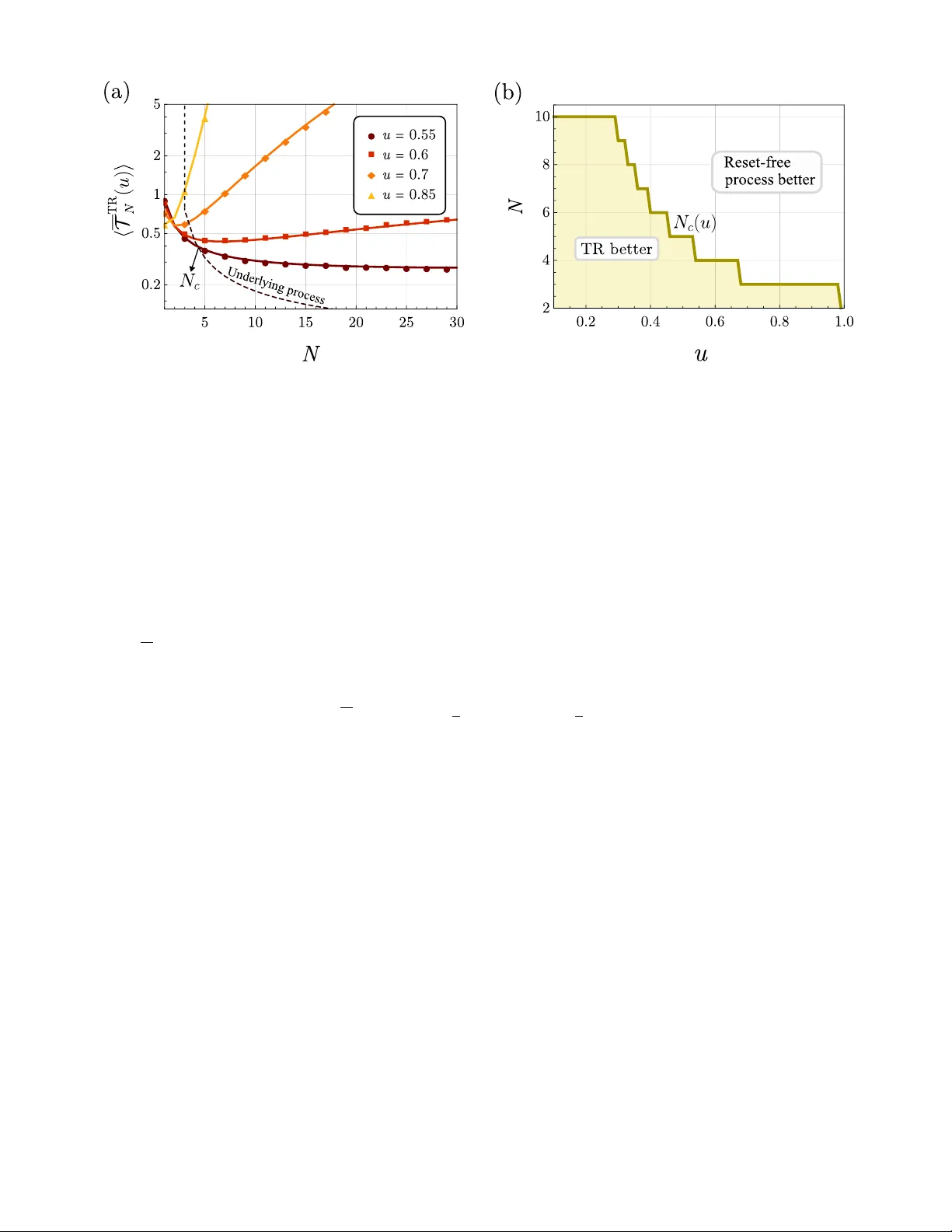
Optimal threshold resetting in collectiv e diffusiv e searc h Arup Biswas, 1, 2 , ∗ Sat ya N Ma jumdar, 3 , † and Arnab P al 1 , ‡ 1 The Institute of Mathematic al Scienc es, CIT Campus, T ar amani, Chennai 600113, India & Homi Bhabha National Institute, T r aining Scho ol Complex, Anushakti Nagar, Mumb ai 400094, India 2 Scho ol of Engine ering and Applie d Scienc es, Harvar d University, Cambridge, MA 02138, USA 3 L abor atoir e de Physique Th´ eorique et Mo d` eles Statistiques (LPTMS), Universit´ e de Paris-Sud, Bˆ atiment 100, 91405 Orsay Ce dex, F r anc e Sto c hastic resetting has attracted significan t attention in recen t y ears due to its wide-ranging ap- plications across physics, biology , and searc h processes. In most existing studies, ho wev er, resetting ev ents are gov erned by an external timer and remain decoupled from the system’s intrinsic dynam- ics. In a recent Letter by Biswas et al [ 1 ], w e in tro duced thr eshold r esetting (TR) as an alternativ e, ev ent-driv en optimization strategy for target search problems. Under TR, the entire process is reset whenev er an y searcher reaches a prescrib ed threshold, thereb y coupling the resetting mechanism directly to the in ternal dynamics. In this work, we study TR-enabled search b y N non-in teracting diffusive searc hers in a one dimensional b o x [0 , L ], with the target at the origin and the threshold at L . By optimally tuning the scaled threshold distance u = x 0 /L , the mean first-passage time can be significan tly reduced for N ≥ 2. W e identify a critical p opulation size N c ( u ) below which TR outp erforms reset-free dynamics. F urthermore, we sho w that, for fixed u , the MFPT dep ends non-monotonically on N , attaining a minimum at N opt ( u ). W e further quantify the achiev able sp eed-up and analyze the op erational cost of TR, rev ealing a non trivial optimization landscape. These findings highlight threshold resetting as an efficient and realistic optimization mec hanism for complex sto c hastic searc h pro cesses. I. INTR ODUCTION Ov er the past decade, stochastic resetting has emerged as a cen tral theme in statistical physics and the study of sto c hastic processes. In essence, resetting in terrupts the natural ev olution of a system and restarts it from its initial configuration. This externally imp osed interv ention, which t ypically incurs an energetic cost, drives the system out of equilibrium and gives rise to a v ariety of ric h dynamical features. One of its most notable consequences is its abilit y to significan tly enhance first-passage (FP) pro cesses, often leading to faster and more efficien t target searc h. Originally introduced in 2011 [ 2 , 3 ], sto c hastic resetting has since inspired a v ast b ody of work due to its wide-ranging applications ranging from statistical physics [ 4 – 35 ], c hemical and biological pro cesses [ 36 – 39 ], quan tum ph ysics [ 40 – 42 ], computer algorithm [ 43 – 45 ], even extending to economics [ 46 , 47 ] and op eration research [ 48 – 50 ]. Alongside the theoretical dev elopmen t, tabletop exp erimen ts [ 51 – 58 ] ha v e enabled the confirmation of the theoretical predictions and pro vided further practical insights and research av en ues. In the paradigmatic model of resetting [ 2 ], a sto c hastic process is set to restart at random epo c hs drawn from an external clo c k or distribution, indep enden t of the system dynamics. While suc h proto cols ha v e b een the sub ject of extensiv e research, another pragmatic approach to their implementation is through threshold-crossing even ts [ 59 , 60 ]. In here, a resetting even t is triggered when the system crosses a predefined threshold. Threshold crossing even ts play a piv otal role in a wide range of physical processes, setting a ‘safety rule’ for the system to operate. A well-kno wn example is the in tegrate-and-fire neuron mo del, which captures how neurons resp ond to stim uli: when the membrane p oten tial crosses a threshold, the neuron fires an action p oten tial b efore resetting to its resting state [ 61 – 63 ]. In finance, stop-loss and take-profit strategies rely on predefined thresholds to trigger the sale of assets, minimizing losses or securing profits [ 64 – 67 ]. In physics, fibre bundle mo dels desc ribe systems in which fibres share a common load until a failure threshold is reac hed, after which ruptures redistribute stress among the remaining fibres [ 68 , 69 ]. In soft ware engineering, circuit break ers act as thresholds to preven t systems from rep eatedly calling failing services, enhancing stability and resilience [ 70 – 72 ]. Simple strob oscopic threshold mec hanisms hav e also been employ ed to obtain sustained temp oral regularity in chaotic systems with applications to laser mo deling [ 73 , 74 ]. More recently , it w as shown that applying an energy threshold in the H ´ enon-Heiles Hamiltonian system can accelerate escape dynamics and suppress noise-enhanced stabilit y [ 75 ]. ∗ arupb@imsc.res.in † saty anarayan.majumdar@cnrs.fr ‡ arnabpal@imsc.res.in 2 While threshold-driv en processes ha ve been extensively studied across disciplines, relativ ely little atten tion has been paid to ho w thresholds influence sto c hastic searc h dynamics. In [ 59 , 60 ], the authors fo cus on the spatial properties of a single particle under the threshold resetting (TR) strategy . Recen tly , the spatial properties such as the steady state, order statistics and counting statistics of N non-interacting diffusing particles under TR hav e b een in vestigated in [ 76 ]. In con trast, in [ 1 ], we prop osed a FP optimization technique based on TR. In that study , w e considered a FP pro cess conducted by a group of searchers in parallel. F urthermore, the pro cess is interrupted when an y of the searchers reaches a threshold. Upon hitting the threshold, a system-wide global reset is triggered, after which all the searchers return to the initial p osition from where the search resumes. Suc h a collective reset strategy has natural prev alence in a m yriad of pro cesses, suc h as dynamics of fish school [ 77 – 79 ], sw arming robots [ 80 , 81 ] and clonal raider ants ( Oo c er ae a bir oi ) [ 82 ]. A similar rationale was analytically studied muc h earlier in the con text of op eration researc h [ 44 ] where a job is subdivided into N parallel components and sub ject to restart upon failure. Suc h sim ultaneous resetting introduces strong correlations among the otherwise indep enden t searchers, effectively coupling their dynamics [ 83 – 93 ] (see [ 89 ] for an exp erimen tal demonstration of this mechanism and [ 94 ] for a p erspective on this topic). In [ 1 ], a general framework was developed to analyze any arbitrary searc h processes under TR. Using a simple mo del of b al listic searchers with randomly assigned initial v elo cities in one dimension, w e demonstrated that TR can yield ric h and nontrivial optimization b eha vior in the searc h time. The aim of the present study is to in vestigate the impact of the TR mechanism on a target search pro cess in volving N non-interacting diffusive searchers. Our primary fo cus is on the fastest first-passage time—the time taken by the earliest among the N searchers to reach the target—a quantit y of cen tral in terest in extreme v alue statistics [ 95 ]. In the absence of an y resetting or threshold mec hanism, it is kno wn that the mean first-passage time (MFPT) for diffusive searc hers b ecomes finite only for N ≥ 3, and diverges otherwise [ 96 ]. This raises a natural question: Can resetting impro ve the efficiency of the diffusiv e searc h process? Recen t studies ha ve shown that standard stochastic resetting can indeed reduce the MFPT, with an optimal resetting rate enhancing search p erformance [ 84 ]. In particular, tw o differen t search proto cols w ere studied in [ 84 ] – when eac h of them resets (a) independently and (b) sim ultaneously . In b oth the cases, it was shown that there exists a critical num b er of searchers N c b elo w which resetting is b eneficial. In particular, for the case (a), it w as found that N c = 8, which w as also deriv ed separately in [ 18 ]. On the other hand, for the case (b), it was shown that N c = 7 [ 84 ]. Complemen tary to that work, the current pap er addresses the follo wing questions: Ho w do es first-passage optimization manifest in diffusive search when the simultaneous resetting protocol (similar to case (b)) is internally generated triggered by a threshold rather than externally controlled? In particular, ho w do es the trade-off b etw een the n umber of diffusiv e w alk ers and the threshold distance influence performance? While some preliminary results for diffusive w alkers w ere rep orted in [ 1 ], the primary focus there w as on ballistic searc h. In contrast, here we employ the general formalism developed in [ 1 ] to provide a detailed analysis of diffusiv e searc h and uncov er its rich optimization b eha vior with resp ect to b oth the threshold and the num b er of searchers. T o address these questions systematically , w e consider N diffusiv e searchers (starting from x 0 ) in one-dimension engaged in lo cating the target at x = 0 with the threshold b eing at x = L (see Fig. 1 ). F or a single diffusive searc her, one would exp ect the MFPT to decrease monotonically with reducing L since the searcher can not escap e far aw a y from the target. How ev er, w e find MFPT shows non-monotonic b eha viour with resp ect to L whenever the n umber of searc hers is greater than unit y . Analogous to tuning the resetting rate, w e show the existence of a scaled optimal threshold distance u opt = x 0 /L that significantly accelerates the search for N ≥ 2. Moreo ver, we identify a critical num ber of searchers N = N c ( u ) b elo w whic h TR consistently yields a lo wer MFPT than the no-reset scenario. Com bined together, w e pro vide a phase diagram in the u − N plane that captures the region where TR exp edites the reset-free pro cess. Next, we optimize the MFPT with respect to N that yields an optimal n um b er of searc hers N opt ( u ) for which the collective search is alwa ys useful. W e then analyze the speed-up ratios which capture ho w muc h faster the search b ecomes when the TR strategy is emplo y ed at its optimal threshold, compared to a solo and resetting-free diffusiv e process resp ectiv ely . Finally , we quantify the cost of TR searc h, following [ 1 ], and demonstrate its ric h optimization landscape with resp ect to the threshold parameter. In particular, we show that the cost function is optimal with resp ect to u for any n um b er of searchers. In summary , the presen t work provides a comprehensiv e analysis of threshold-mediated optimization in diffusive systems, elucidating the in terpla y betw een collectiv e dynamics, and threshold to the first-passage efficiency . The paper is organized as follows; First, w e describ e the problem set-up in detail in Sec. I I . The we prop ose t w o differen t formalisms to extract the first-passage statistics of the searc h pro cess under TR in Sec. I I A and I I B . Then in Sec. I II we illustrate the formalism presen ted earlier with the example of N independent diffusiv e searchers. In particular, we discuss in detail the v ariation of the MFPT with resp ect to the threshold distance in Sec. II I A and the n umber of searc hers in Sec. II I B . The optimal speed-up due to collectiv e TR is discussed in Sec. II I C . Finally , w e define the cost function asso ciated with the target search pro cess with TR and discuss its b eha viour for the diffusive searc h pro cess in Sec. IV . W e conclude with a brief discussion in Sec. V . 3 FIG. 1. Schematic representation of threshold resetting with N = 4 non-in teracting diffusiv e searc hers. If an y one of them reac hes the target at x = 0 w e mark the pro cess as complete and note the asso ciated first passage time T TR N ( L, x 0 ). How ev er, if any of them reaches the threshold at L first, then all of them are sim ultaneously reset to x 0 from where they renew their searc h. Our aim is to compute the MFPT to the target by these diffusiv e searchers. Notations used in the article Before pro ceeding to the main results, we briefly introduce the key notations used throughout the paper for the reader’s con venience. • T TR N ( L, x 0 ) ≡ F astest first passage time of N searchers to reach the target at x = 0 starting from x = x 0 in presence of the threshold at x = L (describ ed in detail in Sec. II ). This is the primary observ able of in terest in our study . • T N ( L, x 0 ) ≡ Unconditional fastest first passage time of any one of N searchers to reach either of the target or threshold. • q N ( L, x 0 , t ) ≡ Surviv al probability that none of the N searchers hav e found either the threshold or the target up to time t . • Q TR N ( L, x 0 , t ) ≡ Surviv al probability of N searc hers under TR. This estimates the probabilit y that none of the N searc hers has hit the target up to time t . • j L,N ( L, x 0 , t ) (or j 0 ,N ( L, x 0 , t )) ≡ probability current contributed by any of the N searchers reaching the threshold (or target) at time t . • ϵ L ( N , L, x 0 ) (or ϵ 0 ( N , L, x 0 )) ≡ splitting probabilit y for any of the N searc hers to first reach the threshold at the x = L (target at x = 0) b efore hitting the target (threshold). • Q ( x 0 , t ) ≡ Single searcher surviv al probabilit y of not finding either the target or the threshold up to time t . I I. PR OBLEM SET-UP AND METHODOLOGY W e consider a system of N non-interacting sto chastic searchers confined to the finite interv al x ∈ [0 , L ], each initialized at the same p osition x 0 ∈ (0 , L ) (see Fig. 1 ). The searc hers ev olve indep enden tly according to a general sto c hastic dynamics, which can encompass diffusion or other random motion mo dels. The left b oundary at x = 0 is designated as the tar get , and the searc h is deemed successful—and the pro cess terminates—as soon as any one of the N searchers reaches this p oin t. In contrast, the right boundary at x = L serves as a r esetting thr eshold . Whenev er any of the searchers hits this boundary , a global reset is triggered: all N searc hers are simultaneously returned to the initial p osition x 0 , and the search restarts from this configuration. This mechanism defines the thr eshold r esetting (TR) proto col under in vestigation. Our primary ob jective is to compute and analyze the statistical prop erties of the first-passage time, denoted by T TR N , to the target under this TR mec hanism. T o this end, w e will adapt tw o complemen tary renewal approaches: first as delineated in [ 1 ] using surviv al probabilit y , and second, using the first- passage time random v ariables directly as formulated in [ 9 ]. 4 A. F ormalism I- Renewal approach with surviv al probability W e start b y denoting the surviv al probabilit y of the N searcher system under TR b y Q TR N ( L, x 0 , t ). This measures the probabilit y that none of the searc hers has found the target at x = 0 up to time t , starting from x 0 . They can, ho wev er, hit the resetting b oundary at x = L once or m ultiple times. It is thus also useful to introduce q N ( L, x 0 , t ) as the surviv al probabilit y that none of the searc hers has hit either of the b oundaries at x = 0 or x = L up to time t . With these definitions at hand, one can write the follo wing renewal equation for the surviv al probability under TR mec hanism [ 1 ] Q TR N ( L, x 0 , t ) = q N ( L, x 0 , t ) + Z t 0 dt ′ j L,N ( L, x 0 , t ′ ) Q TR N ( L, x 0 , t − t ′ ) , (1) where j L,N ( L, x 0 , t ′ ) is the probability curren t contributed b y any of the N searchers reac hing the threshold L at time t ′ . The physical in terpretation of the ab o ve equation is as follows: Starting from the p osition x 0 , all the N searchers can survive up to time t in tw o wa ys. First, the searc hers survive without hitting either of the targets whic h o ccurs with the probability q N ( L, x 0 , t ) – this is the “no resetting” scenario. Secondly , the searchers may hit the threshold at L m ultiple times without hitting the target upto time t . In that case, whenev er an y one of the N searc hers hits the threshold for the very first time (say at t ′ ), all the searc hers are instan taneously reset to the starting p osition x 0 and the pro cess renews. The contribution for an y searc her hitting the resetting boundary at L is essentially the flux j L,N ( L, x 0 , t ′ ) follow ed b y the surviv al probability Q TR N ( L, x 0 , t − t ′ ) for the remaining duration. T aking the Laplace transform of the renew al equation Eq. ( 1 ) and rearranging, we find e Q TR N ( L, x 0 , s ) = e q N ( L, x 0 , s ) 1 − e j L,N ( L, x 0 , s ) , (2) where we define the Laplace transformed quantities as, e Q TR N ( L, x 0 , s ) = R ∞ 0 dt e − st Q TR N ( L, x 0 , t ), e q N ( L, x 0 , s ) = R ∞ 0 dt e − st q N ( L, x 0 , t ) , and e j L,N ( L, x 0 , s ) = R ∞ 0 dt e − st j L,N ( L, x 0 , t ). Imp ortan tly , b oth the surviv al probability q N ( L, x 0 , t ) and the flux j L,N ( L, x 0 , t ) can b e expressed in terms of the single searc her observ ables, assuming they are non-interacting in nature, in the following wa y q N ( L, x 0 , t ) = [ Q ( L, x 0 , t )] N , (3) j L,N ( L, x 0 , t ) = N j L, 1 ( L, x 0 , t ) [ Q ( L, x 0 , t )] N − 1 , (4) where Q ( L, x 0 , t ) is the surviv al probabilit y for a single searcher in the in terv al [0 , L ] and j L, 1 ( L, x 0 , t ) is the single searc her probabilit y curren t through the threshold at x = L . W e note that the first passage time density f T TR N ( L, x 0 , t ) is related to the surviv al probability through the relation f T TR N ( L, x 0 , t ) = − ∂ Q TR N ( L, x 0 , t ) ∂ t , whic h, in the Laplace space, translates to ⟨ e − s T TR N ⟩ ≡ Z ∞ 0 dt e − st f T TR N ( L, x 0 , t ) = 1 − s e Q TR N ( L, x 0 , s ) . (5) Finally , the m th momen t of the first passage time can b e obtained from the following relation [ T TR N ( L, x 0 )] m = ( − 1) m lim s → 0 ∂ m ∂ s m h ⟨ e − s T TR N ⟩ i = ( − 1) m +1 m ∂ m − 1 e Q TR N ( L, x 0 , s ) ∂ s m − 1 s → 0 . (6) In what follows, w e explicitly derive an exact expression for the mean first passage time (MFPT) starting from Eq. ( 6 ). 5 Me an first p assage time The mean first passage time, follo wing Eq. ( 6 ), reads ⟨T TR N ( L, x 0 ) ⟩ = e Q TR N ( L, x 0 , s → 0) = ⟨ T N ( L, x 0 ) ⟩ ϵ 0 ( N , L, x 0 ) , (7) where ⟨ T N ( L, x 0 ) ⟩ is the unc onditional MFPT for an y of the N searchers to reach either the threshold or the target and is giv en by ⟨ T N ( L, x 0 ) ⟩ = Z ∞ 0 dt [ Q ( L, x 0 , t )] N . (8) On the other hand, ϵ 0 ( N , L, x 0 ) = 1 − ϵ L ( N , L, x 0 ) = 1 − R ∞ 0 dt j L,N ( L, x 0 , t ) = R ∞ 0 dt j 0 ,N ( L, x 0 , t ) is simply the splitting probability for an y of the N searchers to first reach the target at the origin before hitting the threshold at L . In terms of the single searcher observ ables, this splitting probabilit y can b e written in the following form [ 97 ] ϵ 0 ( N , L, x 0 ) = Z ∞ 0 dt N j 0 , 1 ( L, x 0 , t )[ Q ( L, x 0 , t )] N − 1 , (9) where j 0 , 1 ( L, x 0 , t ) is the single searcher probability current through the target at x = 0. Finally , com bining all the ab o ve results we arriv e at ⟨T TR N ( L, x 0 ) ⟩ = R ∞ 0 dt [ Q ( L, x 0 , t )] N R ∞ 0 dt N j 0 , 1 ( L, x 0 , t )[ Q ( L, x 0 , t )] N − 1 , (10) whic h was deriv ed in [ 1 ]. The deriv ed expression is neither particular to an y underlying dynamics nor it dep ends on the precise nature of the resetting boundary . Finally , although the formalism is illustrated using a one dimensional set-up, the results are general and hold in higher dimensions as w ell. B. F ormalism II- Renew al approac h with first-passage time v ariables In this section, we pro vide a complementary approac h based on the renewal theory of first-passage time random v ariables to extract the statistics. W e start b y denoting T 0 ,N as the random v ariable asso ciated with the FPT by any of the N searchers to the target at x = 0. Similarly , we denote T L,N as the FPT by any of the N searc hers to hit the threshold. With these definitions, one can then write the renew al equation for the random v ariable associated with the first-passage time of the complete pro cess T TR N as T TR N = ( T 0 ,N , if T 0 ,N < T L,N T L,N + T ′ TR N , if T L,N ≤ T 0 ,N , (11) where T ′ TR N is an indep enden t and identically distributed (i.i.d.) cop y of T TR N . The ab o ve equation can be interpreted in the follo wing w a y . Starting from an initial condition, if the searc hers find the target before hitting the threshold, the process therein ends and thus T TR N = T 0 ,N . Otherwise, up on reac hing the threshold prior to the target, all the searc hers are simultaneously brought back to the resetting co ordinate from where the search renews. This is reflected in to the second condition of Eq. ( 11 ). Eq. ( 11 ) can be written in a more compact wa y as T TR N = I ( T 0 ,N < T L,N ) T 0 ,N + I ( T L,N ≤ T 0 ,N )[ T L,N + T ′ TR N ] , (12) where I ( X < Y ) denotes a indicator function whic h tak es the v alue unit y only when X < Y , otherwise zero. W e can no w find the moment-generating function of the random v ariable T TR N as ⟨ e − s T TR N ⟩ = ⟨ I ( T 0 ,N < T L,N ) e − s T 0 ,N ⟩ + ⟨ I ( T L,N ≤ T 0 ,N ) e − s [ T L,N + T ′ TR N ] ⟩ = ⟨ I ( T 0 ,N < T L,N ) e − s T 0 ,N ⟩ + ⟨ I ( T L,N ≤ T 0 ,N ) e − s T L,N ⟩⟨ e − s T ′ TR N ⟩ = ⟨ I ( T 0 ,N < T L,N ) e − s T 0 ,N ⟩ + ⟨ I ( T L,N ≤ T 0 ,N ) e − s T L,N ⟩⟨ e − s T TR N ⟩ , (13) 6 where w e hav e used the indep enden t and iden tical prop ert y of T TR N and T ′ TR N . Rearranging, w e find ⟨ e − s T TR N ⟩ = ⟨ I ( T 0 ,N < T L,N ) e − s T 0 ,N ⟩ 1 − ⟨ I ( T L,N ≤ T 0 ,N ) e − s T L,N ⟩ . (14) Our next task is to compute the numerator and denominator written in terms of the indicator functions. Let us compute the n umerator first, which is ⟨ I ( T 0 ,N < T L,N ) e − s T 0 ,N ⟩ = Pr( T 0 ,N < T L,N ) ⟨ e − s {T 0 ,N |T 0 ,N < T L,N } ⟩ . (15) Here Pr( T 0 ,N < T L,N ) stands for the probability that T 0 ,N < T L,N , which is essentially the splitting probabilit y ϵ 0 ( N , L, x 0 ) defined in Eq. ( 9 ). The quan tit y T c 0 ,N ≡ {T 0 ,N |T 0 ,N < T L,N } is the conditional time for any of the N searc hers to reach the target first b efore hitting the threshold at x = L and its normalized densit y can b e written as [ 98 ] f T c 0 ,N ( t ) = j 0 ,N ( L, x 0 , t ) Pr( T 0 ,N < T L,N ) , (16) where j 0 ,N ( L, x 0 , t ) is the probability current at the target x = 0 at time t due to any one of the N searchers. Using the ab o ve-men tioned definition in Eq. ( 16 ), w e arrive at the result (see App endix A ) ⟨ I ( T 0 ,N < T L,N ) e − s T 0 ,N ⟩ = Z ∞ 0 dt e − st j 0 ,N ( L, x 0 , t ) = e j 0 ,N ( L, x 0 , s ) . (17) Similarly , following App endix A , w e find ⟨ I ( T L,N ≤ T 0 ,N ) e − s T L,N ⟩ = e j L,N ( L, x 0 , s ) . (18) Finally com bining all those results we hav e the ge n erating function of the FPT given by ⟨ e − s T TR N ⟩ = e j 0 ,N ( L, x 0 , s ) 1 − e j L,N ( L, x 0 , s ) . (19) In terms of the surviv al probability , this reads e Q TR N ( L, x 0 , s ) = 1 s 1 − ⟨ e − s T TR N ⟩ = 1 s 1 − [ e j 0 ,N ( L, x 0 , s ) + e j L,N ( L, x 0 , s )] 1 − e j L,N ( L, x 0 , s ) , (20) whic h leads to Eq. ( 2 ) due to the following relation b et ween the surviv al probability and the currents (see App endix B for details) e q N ( L, x 0 , s ) = 1 s h 1 − ( e j 0 ,N ( L, x 0 , s ) + e j L,N ( L, x 0 , s )) i , (21) th us justifying the equiv alence b et ween the tw o formalisms. In what follows, we consider N non-interacting diffusive searc hers in one spatial dimension (1D), and by applying the metho dology developed ab o ve, we derive explicit results and rev eal nontrivial features of the search dynamics under the TR proto col. I II. OPTIMIZED DIFFUSIVE SEARCH Let us consider the case of N diffusive searchers with the same set-up as shown in Fig. 1 . T o pro ceed, we will need the single searcher diffusive propagator G ( x, t | x 0 ) in the presence of tw o absorbing b oundaries at x = 0 and x = L . This is w ell known in literature and is given by [ 98 ] G ( x, t | x 0 ) = 2 L ∞ X n =0 sin π nx L sin π nx 0 L e − n 2 π 2 Dt L 2 , (22) 7 FIG. 2. Panel (a) shows the v ariation of the non-dimensionalized MFPT ⟨T TR N ( u ) ⟩ as a function of u = x 0 /L for v arious v alues of N as in Eq. ( 31 ). F or any v alues of N > 1, the curves show non-monotonic b ehaviour with resp ect to u with the optimal MFPT b eing at u = u opt . P anel (b) shows the v ariation of the p oin t u opt with resp ect to N . where D is the diffusion constant. The single searc her surviv al probability Q ( L, x 0 , t ), the flux through the origin j 0 , 1 ( L, x 0 , t ) and the threshold j L, 1 ( L, x 0 , t ) resp ectiv ely can b e obtained using the following relations Q ( L, x 0 , t ) = Z L 0 G ( x, t | x 0 ) dx, (23) j 0 , 1 ( L, x 0 , t ) = D ∂ G ( x, t | x 0 ) ∂ x x =0 , (24) j L, 1 ( L, x 0 , t ) = − D ∂ G ( x, t | x 0 ) ∂ x x = L . (25) Using the exact expression of the propagator for the diffusiv e searchers, we find Q ( u, t ) = 2 π ∞ X n =1 1 − ( − 1) n n sin ( nπu ) e − n 2 π 2 t τ d , (26) j 0 , 1 ( u, t ) = 2 π τ d ∞ X n =1 n sin ( nπ u ) e − n 2 π 2 t τ d , (27) j L, 1 ( u, t ) = − 2 π τ d ∞ X n =1 n ( − 1) n sin ( nπu ) e − n 2 π 2 t τ d , (28) where w e hav e in tro duced u = x 0 L , τ d = L 2 D . (29) Eviden tly , u is a dimensionless v ariable with 0 ≤ u ≤ 1 while τ d is the diffusiv e time scale. Note that ev en b efore doing an y calculation, one can predict that the dimensionless MFPT under TR should b e a function of the parameters u and N only , so that ⟨T TR N ( u ) ⟩ = D x 2 0 ⟨T TR N ( L, x 0 ) ⟩ = F ( u, N ) , (30) with F ( u, N ) being the scaling function. Substituting the relev an t observ ables for the single searcher as obtained in Eq. ( 26 )-( 28 ) in to Eq. ( 10 ), we obtain the exact expression of the scaling function F ( u, N ) given by 8 F ( u, N ) = 1 u 2 R ∞ 0 dt h 2 π P ∞ n =1 1 − ( − 1) n n sin ( nπu ) e − n 2 π 2 t i N N R ∞ 0 dt 2 π P ∞ n =1 n sin ( nπ u ) e − n 2 π 2 t h 2 π P ∞ n =1 1 − ( − 1) n n sin ( nπu ) e − n 2 π 2 t i N − 1 . (31) Through the ab o v e change of v ariables, we hav e recast the dimensionless mean first-passage time (MFPT), ⟨T TR N ( u ) ⟩ , as a function of a single dimensionless parameter u ∈ (0 , 1), effectively eliminating dep endence on the original param- eters L , x 0 , and D . While the expression in Eq. ( 31 ) does not admit a closed-form solution for arbitrary N , it can b e ev aluated numerically with high precision using Mathematica. In what follows, we examine in detail the b eha vior of the scaled MFPT—i.e., the scaling function F ( u, N )—as a function of b oth u and N , and highlight the ph ysical insigh ts that emerge from this analysis. A. Optimization with resp ect to threshold In canonical resetting framew orks, it is w ell established that the MFPT can b e optimized b y tuning the resetting frequency [ 2 , 9 ]. Unlike these externally timed proto cols, the TR mechanism induces event-driven resets—triggered when a searcher reaches a prescrib ed spatial threshold. In this setup, with fixed x 0 , v arying the threshold p osition L allows control ov er the effectiv e resetting rate. F or instance, in the limit L → ∞ , resetting b ecomes negligible, as the threshold is rarely reac hed. Conv ersely , when L → x 0 , the threshold is close to the starting p oin t, resulting in frequen t resets. In terms of the dimensionless parameter u = x 0 /L , the limit u → 1 corresponds to high r esetting fr e quency , while u → 0 captures the low fr e quency regime. This naturally raises the question: can v arying u in the TR framew ork lead to an optimal MFPT, akin to externally driven resetting sc hemes? T o explore this, w e plot the analytical result for MFPT in Eq. ( 31 ) as a function of u in Fig. 2 (a) for v arious v alues of N . Remark ably , for all N ≥ 2, the MFPT exhibits a clear minim um at an optimal v alue of u . How ever, this optimization is absen t in the single-searc her case ( N = 1). In what follows, we analyze these tw o cases in detail. Single diffusive se ar cher ( N = 1) : F or a single diffusiv e searcher, the MFPT can b e computed by setting N = 1 in Eq. ( 31 ) to obtain F ( u, N = 1) = 1 u 2 2 π P ∞ n =1 1 − ( − 1) n n sin ( nπu ) R ∞ 0 dt e − n 2 π 2 t 2 π P ∞ n =1 n sin ( nπ u ) R ∞ 0 dt e − n 2 π 2 t , = π 2 u 2 2 P ∞ n =1 1 − ( − 1) n n 3 π 3 sin ( nπu ) P ∞ n =1 sin( nπ u ) n , (32) whic h can b e simplified by noting that in the n umerator only o dd n will contribute and by noting the following iden tities [ 99 ] ∞ X n =0 sin (2 n + 1) x (2 n + 1) 3 = π 2 x 8 − π x 2 8 , 0 < x < π (33) ∞ X n =1 sin( nx ) n = π − x 2 , 0 < x < 2 π. (34) F urther simplification leads to ⟨T TR 1 ( u ) ⟩ = F ( u, N = 1) = 1 2 u . (35) F rom Eq. ( 35 ) it is evident that the MFPT for a s ingle diffusive searcher decreases as u − 1 as also shown in Fig. 2 (a). It is the low est when L → x 0 ( u → 1) where ⟨T TR 1 ( u = 1) ⟩⟩ = 1 / 2. Clearly here u → 1 is the optimal p oin t ( u opt ) as also observed in Fig. 2 (b). Physically , suc h b eha vior can b e explained in the following wa y: The threshold effectively biases the searcher’s motion tow ards the target by resetting it to x 0 whenev er it go es aw ay from the target. Keeping x 0 fixed, as one decreases L , therefore increasing u , the chances of the searchers wandering aw a y from the target also 9 FIG. 3. P anel (a) shows the v ariation of the non-dimensionalized MFPT with the num ber of searchers N for v arious v alues of u . The solid line represen ts the analytical results (Eq. ( 31 )) and the mark ers represent results from sim ulation. The dashed line corresp onds to the underlying pro cess ( i.e. u → 0). Note that, for a fixed u , when the solid curves with u = 0 lie b elo w the dashed curve, MFPT with TR turns out to b e a fa vourable strategy than the underlying pro cess. The intersection point where these t wo curv es cross each other is denoted by N c ( u ). This is the critical num b er of searchers, below which TR serves as a b etter strategy than the underlying pro cess. In panel (b) we sho w the v ariation of N c ( u ) with u (the solid line). Eviden tly , when N ≤ N c ( u ), TR helps to exp edite the collective searc h pro cess (sho wn by the shaded region). diminish, resulting in a lo wer MFPT. Multiple diffusive se ar chers ( N ≥ 2) : The MFPT exhibits quite distinct features for N ≥ 2 than that for N = 1. In here, the MFPT curves sho w a non-monotonic b eha viour with resp ect to u as seen in Fig. 2 (a). In the follo wing, we delve further to discuss v arious limits of the curv es and quantify the optimization features. The limit u → 0 is just the reset-free case where the threshold is kept at infinit y (assuming x 0 to b e fixed). In this case, the MFPT ⟨T TR N ( u → 0) ⟩ is just the mean fastest first passage time out of N searc hers to reach the target in the absence of the threshold. The MFPT in this limit (App endix C ) is found to b e ⟨T TR N ( u → 0) ⟩ = 1 2 Z ∞ 0 dy y erf 1 y N , (36) whic h is infinite for N = 1 , 2 but b ecomes finite only for N ≥ 3. How ev er, as one increases u the MFPT starts to decrease, showing an optimum at some intermediate v alue u = u opt (as shown in Fig. 2 (a)) b efore increasing again as u approaches unity . Here, u opt can b e thought of as the analog of optimal resetting rate in the traditional resetting set-up [ 2 ]. I n Fig. 2 (b) w e show the v ariation of u opt with resp ect to N . F or N = 1 w e find u opt = 1 since the low est MFPT o ccurs only at u = 1 as evident from Eq. ( 35 ). How ev er, for an y other v alues of N ≥ 2 we find 0 < u opt < 1. While the MFPT without TR ( u → 0) for diffusiv e searc hers remains finite for N ≥ 3 (App endix C ), further reduction can b e observed by tuning u . This is clearly due to a finite threshold that preven ts the searchers from wandering off the target. In turn, when u → 1, the MFPT increases again for N ≥ 2 (in con trast to N = 1). Since the searc hers start v ery close to the threshold in this limit, the splitting probabilit y ϵ L to hit the threshold is significantly higher and thus, the TR mechanism will imp ede the o verall searc h pro cess. With increasing N , the probabilit y of hitting the threshold increases even more and even tually , the probability of finding the target diminishes, leading to steady increase in the MFPT. W e refer to section I I I C for a quantitativ e analysis of the efficiency gained through optimal threshold resetting with resp ect to the reset-free pro cess ( u → 0). B. Optimization with resp ect to num b er of searchers Besides the optimization with resp ect to the threshold, the MFPT also sho ws rich optimization features with respect to the num ber of searc hers N . In this section, we discuss the v ariation of the scaled MFPT (as in Eq. ( 31 )) with resp ect to N . It turns out that, for a fixed u , there exists tw o distinct kinds of optimization. In the first case, we note an optimization rendered by collective searc h in comparison to the underlying reset-free pro cess – we find a critical 10 n umber of searchers N c ( u ) such that for an y N ≤ N c ( u ), the MFPT with TR is lo w er than that of the underlying reset-free pro cess. In the second case, we find that there exists an optimal num b er of searc hers N opt ( u ) for whic h the MFPT under TR can b e made the low est. In the following, we elaborate on b oth of these cases separately . 1. Critic al numb er of se ar chers T o demonstrate the efficiency gained b y the collective search, we turn our atten tion to Fig. 3 (a) that shows the v ariation of MFPT ⟨T TR N ( u ) ⟩ with resp ect to the num b er of searchers for different u . The dashed line represents the MFPT as a function of N for the underlying reset-free pro cess ( u → 0) as in Eq. ( 36 ). The dashed line intersects the solid lines (MFPT with TR) at a critical n um b er N c ( u ) for each u (for instance, N c ( u = 0 . 55) = 4as shown in Fig. 3 (a)). F or N < N c ( u ), w e alwa ys find that the MFPT under TR is low er than the underlying ( u → 0) pro cess. The critical n umber of searchers, N c ( u ), v aries with the parameter u , and this dep endency is captured by the solid line in Fig. 3 (b), whic h delineates the phase b oundary . The shaded region in the diagram identifies the regime where threshold resetting (TR) leads to a more efficient searc h compared to the reset-free case. This phase diagram provides practical insight: for a fixed u , one can determine the minim um num b er of searchers N < N c ( u ) required to b enefit from TR. Conv ersely , for a fixed num b er of searc hers, the diagram helps identify critical threshold p ositions—encoded in u —that yield a sp eed-up in the search pro cess. 2. Optimal numb er of se ar chers W e also observe an optimization under TR with resp ect to the num b er of searc hers. F rom Fig. 3 (a), it is observ ed that the MFPT sho ws non-monotonic dep endence on N for certain choices of u .F or instance, consider the MFPT plot with u = 0 . 6 as also sho wn in the inset of Fig. 4 . In this case, there exists an optimal num b er of searchers N opt ( u = 0 . 6) = 7 for whic h the MFPT is the low est. Mathematically , for a fixed v alue of u at N = N opt ( u ) the MFPT is lo west so that one has d ⟨T TR N ( u ) ⟩ dN N = N opt = 0 . (37) Fig. 4 sho ws the v ariation of N opt ( u ) with respect to u , where we note that beyond a critical v alue of u = u c ≈ 0 . 8, the optimal num ber of searc hers is fixed to one. This in turn implies that, beyond u > u c , the MFPT will grow monotonically with N , making the collectiv e search detrimental. How ev er, for u < u c , the MFPT can b e minimized for a suitable c hoice of N opt ( u ) ≥ 2. FIG. 4. V ariation of the optimal num ber of searchers N opt ( u ) where the MFPT with TR is the low est with respect to u . As a representativ e case, in the inset, w e show the N opt ( u = 0 . 6) for marked by the star. The critical u c ≈ 0 . 8, b ey ond which the collectiv e search becomes detrimen tal, is marked by an open circle. 11 Asymptotic b ehaviour : Let us no w discuss the limiting cases of Fig. 3 (a). F or a single searcher ( N = 1) the MFPT is alw a ys finite giv en an y v alues of u as can b e seen from Eq. ( 35 ). How ev er, as N → ∞ , the MFPT is not guaran teed to be finite for any arbitrary choice of u . F or instance, consider the case when the searc hers start very close to the threshold so that x 0 → L or equiv alen tly , u → 1. In that case, for N ≫ 1, at least one of the N searchers will hit the threshold in a muc h shorter span than hitting the target. Naturally , the frequency of resetting will b e m uch higher. Moreov er, increasing N will further enhance the probabilit y of hitting the threshold, causing further delay in the target searc h. Quantitativ ely , this can also b e seen b y lo oking at the asymptotic expression for the splitting probabilities, giv en by (see [ 100 ] for a detailed deriv ation) ϵ 0 ( N ≫ 1 , L, x 0 ) = 1 − ϵ L ( N → ∞ , L, x 0 ) ≈ ( 1 , when L → ∞ (or u → 0) , η (ln N ) ρ N 1 − β , when L → x 0 (or u → 1) , (38) where β = x 0 L − x 0 2 , ρ = β − 1 2 , η = p β π β − 1 Γ( β ) . Eviden tly , with increasing N the splitting probabilit y to the target decreases as in Eq. ( 38 ) and the splitting probability to the threshold approaches unity . The asymptotic v alue of the unconditional first passage time to reach either the target or the threshold i.e., ⟨ T N ≫ 1 ( L, x 0 ) ⟩ is w ell known in the literature of extreme v alue statistics [ 101 ] given by ⟨ T N ≫ 1 ( u ) ⟩ ≈ x 2 0 4 D min { 1 , ( 1 u − 1) 2 } ln N . (39) Plugging the results from Eq. ( 38 ) and Eq. ( 39 ) into Eq. ( 7 ) and writing in terms of dimensionless quantities, we finally arriv e at the following asymptotic result for the MFPT under TR ⟨T TR N ≫ 1 ( u ) ⟩ ≈ min 1 , ( 1 u − 1) 2 1 ln N , when u → 0 , min { 1 , ( 1 u − 1) 2 } 4 η N β − 1 (ln N ) ρ +1 , when u → 1 . (40) It is also p ossible to derive the ab o ve result from Eq. ( 31 ) following the approximation metho ds for the unconditional MFPT (i.e., the n umerator) as outlined in [ 101 ] and the splitting probability (i.e., the denominator) as outlined in [ 100 ]. Ho wev er, we omit the details of this deriv ation here for the sak e of compactness. Although a practical realization of the abov e asymptotic results requires the c hoice of sufficiently high v alues of N , the qualitative behaviour is somewhat prominen t from Fig. 3 (a). F or instance, in the case of u = 0 . 85 the MFPT monotonically increases with N . F rom Eq. ( 40 ) we find that the increase is precisely go verned by ∼ N β − 1 (ln N ) ρ +1 b eha viour while β > 1. On the other hand, for u = 0 . 55 we see that the MFPT decreases with N . The Eq. ( 40 ) tells us that the asymptotic deca y is ∼ 1 / ln N . In b et ween these tw o extreme regimes, MFPT shows an optimal b eha viour with N . C. Optimal sp eed-up due to collective TR In this section, we aim to quan tify the efficiency gain achiev ed b y employing threshold resetting (TR) in a system of N non-interacting diffusive searchers. Sp ecifically , w e assess the speed-up pro vided by the collectiv e TR mechanism b y ev aluating how m uch it reduces the mean first-passage time (MFPT) compared to alternative searc h strategies. T o do so, we fo cus on the minimum MFPT obtained under TR, which o ccurs at the optimal threshold parameter u = u opt , and denote it as ⟨T TR N ( u opt ) ⟩ . This represen ts the best-case p erformance of the TR proto col for a given n umber of searc hers N . W e then compare this optimized TR-MFPT with tw o relev an t baseline MFPTs derived from con ven tional search setups, eac h optimized in its o wn righ t. These comparisons define t wo complementary notions of optimal sp e e d-up , as detailed b elo w. These measures allow us to systematically characterize the adv antage offered b y threshold resetting. 1. Sp e ed-up r elative to the c ol le ctive TR str ate gy The speed-up function S 1 ( N ) = ⟨T TR N =1 ( u opt ) ⟩ ⟨T TR N ( u opt ) ⟩ quan tifies the efficiency gained with optimal TR by employing multiple searc hers ( N ≥ 2) compared to a single searcher ( N = 1). The v ariation of this quantit y with resp ect to N is shown b y the blue crosses in Fig. 5 with its v alues marked in the left y -axis of the plot. In general, we observe a speed-up for an y N ≥ 3. With increasing N further, the sp eed-up also enhances significantly . 12 FIG. 5. V ariation of the optimal sp eed-up gained under threshold resetting mechanism with N . F or the function v alues > 1 (mark ed on the y -axis), TR optimizes the search pro cess. The blue cross sho ws the v ariation of S 1 ( N ), whic h quantifies the sp eed-up with gained with multiple searchers compared to a single searc her. The quantit y S 2 ( N ) sho wn b y the red squares amoun ts to the speed-up gained with TR in comparison to the underlying reset-free search pro cess. 2. Sp e ed-up r elative to the r eset-fr e e pr o c ess The function S 2 ( N ) = ⟨T TR N ( u =0) ⟩ ⟨T TR N ( u opt ) ⟩ quan tifies the sp eed-up ac hiev ed b y the TR mec hanism relativ e to the baseline reset-free process which can be obtained b y setting L → ∞ , or equiv alen tly , u → 0 (depicted by the red squares in Fig. 5 , with corresp onding v alues indicated on the righ t y -axis). As previously discussed, for N ≤ 2, the MFPT in the absence of resetting is div ergen t, whereas TR renders it finite—highlighting an immediate speed-up. F or N ≥ 3, although the reset-free MFPT is already finite, in tro ducing optimal TR still results in a further reduction. This impro vemen t is evident in Fig. 5 , where the sp eed-up exceeds unity for N ≥ 3. How ev er, as N contin ues to increase, the benefit from TR gradually diminishes, and the sp eed-up approaches unit y—indicating that TR offers no additional adv antage in the large- N limit. IV. COST FUNCTION A key c hallenge in any optimization problem is managing the cost inv olved in achieving a globally optimal outcome for a giv en observ able. In the context of traditional stochastic resetting, where the dynamics are reset after random w aiting times, the notion of cost (thermodynamic and dynamic) has b een previously studied in v arious w orks [ 51 , 59 , 102 – 107 ]. In TR optimization problems, a cost can b e incorp orated into an ob jectiv e function to balance b et w een faster completion times and the p enalt y asso ciated with each resetting even t. Thus, the cost function C N ( u ) for our threshold resetting (TR) setup, follo wing the formulation originally prop osed in [ 1 ], can b e written as C N ( u ) = ⟨T TR N ( u ) ⟩ + β N ⟨N TR ( N , u ) ⟩ , (41) where ⟨N TR ( N , u ) ⟩ is the mean n umber of resetting even ts before the first passage with TR and β is some arbitrary constan t that has the dimension of the in verse of time. Ph ysically β can b e though t of as some constant cost p er resetting ev ent. The existence of optimality of C N for certain choice of system parameters w ould in principle imply that the MFPT can sufficiently be optimized at those parameter v alues without pa ying too muc h cost for resetting ev ents. The quantit y ⟨N TR ( N , u ) ⟩ can b e easily found from a tra jectory based analysis. Suppose there are k n umber of resetting ev ents in a single chosen tra jectory until the first passage. Notice that the probability that a resetting even t will o ccur is nothing but the splitting probability to the threshold i.e., ϵ L ( N , u ). As there are k resetting even ts th us the particular tra jectory occurs with probability [ ϵ L ( N , u )] k × ϵ 0 ( N , u ). The quantit y ϵ 0 ( N , u ) = 1 − ϵ L ( N , u ) is multiplied to tak e care of the probability of finding the target after the k th resetting even t. The mean n umber of 13 FIG. 6. V ariation of cost function as defined in Eq. ( 43 ) for diffusiv e search with TR with respect to u = x 0 /L . Note that, unlik e the MFPT, the cost function shows non-monotonic b eha viour even for N = 1. The v ariation of optimal u ∗ where cost is minimized is shown for v arious v alues of N in the inset. resetting ev ents till the first passage then can b e found as ⟨N TR ( N , u ) ⟩ = ∞ X k =0 k [ ϵ L ( N , u )] k × ϵ 0 ( N , u ) = ϵ L ( N , u ) ϵ 0 ( N , u ) . (42) Finally w e can find the cost function as C N ( u ) = ⟨T TR N ( u ) ⟩ + β N ϵ L ( N , u ) ϵ 0 ( N , u ) . (43) In Fig. 6 we sho w the v ariation of the cost function for diffusiv e searc hers b oth with resp ect to u . Note that the cost function shows optimal behaviour with resp ect to u even for a single diffusive searcher. This is because, although the MFPT is optimal while u → 1, the mean num ber of resetting diverges in this limit. V ariation of the optimal v alue of u ∗ where the cost b ecomes the lo west is shown in the inset of Fig. 6 for different choices of N . It is observed that u ∗ → 0 as num b er of searchers N increases. This is b ecause the MFPT at larger v alue of N is already optimal for the reset-free process (recall that u opt → 0 as N ≫ 1). Thus in tro duction of resetting (or a finite v alue of u ) only increases the contribution from the second term in Eq. ( 43 ) without an y substantial improv emen t in the MFPT. Concluding, this analysis highligh ts ho w an optimal resetting strategy can effectively mitigate larger, more detrimen tal outcomes. This approach can b e seen as an optimization technique, balancing the cost of resetting against the p oten tial savings in long-term p erformance, ensuring that the system op erates in the most efficient manner p ossible in threshold-driven ev ents. V. DISCUSSION AND OUTLOOK T o summarize, in this work, we hav e emplo yed the strategy of threshold resetting originally developed in [ 1 ] to in vestigate the target searc h prop erties by N non-interacting diffusiv e searchers. Besides revisiting the formalism presen ted in [ 1 ], w e also provide an alternate metho d based on the renewal theory of random v ariables to extract the first passage statistics of the pro cess. Then we elaborate the formalism with the paradigmatic example of diffusive searc hers on one dimension. In our set-up, the origin x = 0 is the target, and the b oundary at x = L serv es as the resetting threshold. W e consider a resetting proto col in which all searchers are reset simultaneously to the initial p osition whenever an y one of them reaches the threshold. W e found that akin to resetting rate in the externally driv en resetting protocol, under TR one can tune the dimensionless parameter u = x 0 /L to mo dulate the resetting frequency . F or a single diffusive searc her, we find the MFPT monotonically decreases with u with u = 1 b eing the optimal p oin t. Quite in terestingly , when the searc h is conducted by more than one diffusive searcher, we find a ric h optimization b eha vior with resp ect to u . A preliminary version of this result was rep orted in [ 1 ]. Here, we present a more detailed and comprehensive analysis of collective diffusive search. In particular, we demonstrate that the system exhibits rich optimization b eha vior with resp ect to the threshold and the n um b er of searchers. Com bining b oth the results, w e 14 found a parameter space in u − N plane that separates the regimes where TR is helpful from those where it is not. W e see for a fixed u there exists a critical num b er of searchers N c ( u ) b elo w whic h the searc h with TR will exp edite the reset-free searc h pro cess. Next, we optimize the MFPT with resp ect to the num ber of searchers ( N ), which allows us to iden tify an optimal p opulation size N opt ( u ) that maximizes the efficiency of collective search. This establishes a clear bound b ey ond whic h adding more searchers no longer yields additional b enefit. W e further c haracterize the op erational cost of the search, follo wing [ 1 ], and reveal that it exhibits a rich and nontrivial dep endence on the threshold parameter. In particular, w e find that the cost function admits an optimal threshold for any given num b er of searc hers, highlighting an inherent trade-off b et ween search efficiency and resource exp enditure. Although threshold resetting appears in a wide range of natural and engineered systems, it has receiv ed considerably less theoretical attention compared to the more con ven tional externally driv en resetting frameworks. F urther v aluable extensions going b ey ond diffusive searc hers would b e the study of first-passage prop erties under TR for more complex dynamics and in teracting agen ts. A natural extension w ould b e to generalize the TR-driv en search pro cess to higher dimensions where geometric effects can pla y a significant role. It w ould also b e in teresting to consider scenarios with m ultiple targets, where comp etition betw een targets and the interpla y with threshold-triggered resetting may giv e rise to new optimization features. Exploring these directions could provide deep er insight into the efficiency and robustness of threshold-based searc h strategies in more realistic settings. Bey ond ph ysics, TR has p oten tial applications in div erse fields including economics, p opulation dynamics, and op erations research. W e hop e that the present work serv es as a foundation for a broader exploration of threshold-driv en resetting phenomena. VI. A CKNOWLEDGEMENT SNM thanks M. Biroli, S. Redner and G. Sc hehr for discussions on related mo dels. AP sincerely thanks D. Ghosh for p oin ting tow ards some relev an t works. The n umerical calculations rep orted in this work w ere carried out on the Kamet cluster, whic h is main tained and supp orted b y the Institute of Mathematical Science’s High- P erformance Computing Center. AB ackno wledges support from USIEF, India, for the F ulbrigh t-Nehru do ctoral researc h fello wship. AB and AP gratefully ackno wledge research supp ort from the Department of Atomic Energy , Go vernmen t of India. SNM ackno wledges support from ANR Grant No. ANR23- CE30-0020-01 EDIPS. SNM and AP thank the Higgs Cen ter for Theoretical Physics, Edinburgh, for hospitality during the workshop “New Vistas in Sto c hastic Resetting” and Korea Institute for adv anced Study(KIAS), Seoul, for hospitality during the conference “Nonequilibrium Statistical Physics of Complex Systems” where sev eral discussions related to the pro ject to ok place. SNM and AP also ac knowledge the research supp ort from the International Research Pro ject (IRP) titled “Classical and quan tum dynamics in out of equilibrium systems” by CNRS, F rance. AP ac kno wledges researc h funding under the sc heme ANRF/ARGM/2025/001623 from ANRF, India. APPENDIX App endix A: Additional steps related to F ormalism I I In this section, we present the additional steps used to derive the expressions in tro duced in the main text. W e start b y recalling Eq. ( 14 ) from the main text ⟨ e − s T TR N ⟩ = ⟨ I ( T 0 ,N < T L,N ) e − s T 0 ,N ⟩ 1 − ⟨ I ( T L,N ≤ T 0 ,N ) e − s T L,N ⟩ . (A1) The n umerator can b e written as ⟨ I ( T 0 ,N < T L,N ) e − s T 0 ,N ⟩ = Pr( T 0 ,N < T L,N ) ⟨ e − s {T 0 ,N |T 0 ,N < T L,N } ⟩ = Pr( T 0 ,N < T L,N ) Z ∞ 0 dt f T c 0 ,N ( L, x 0 , t ) e − st (A2) where f T c 0 ,N ( L, x 0 , t ) is the density asso ciated with the conditional time T c 0 ,N ≡ {T 0 ,N |T 0 ,N < T L,N } . This density can b e written as f T c 0 ,N ( t ) = j 0 ,N ( L, x 0 , t ) Pr( T 0 ,N < T L,N ) , (A3) 15 where j 0 ,N ( L, x 0 , t ) is the probability current at the target x = 0 at time t due to any one of the N searchers. Using the ab o ve relation, we finally arriv e at the result ⟨ I ( T 0 ,N < T L,N ) e − s T 0 ,N ⟩ = Z ∞ 0 dt e − st j 0 ,N ( L, x 0 , t ) = e j 0 ,N ( L, x 0 , s ) , (A4) with e j 0 ,N ( L, x 0 , s ) being the Laplace transform of j 0 ,N ( L, x 0 , t ). Similarly , one can also find the denominator of Eq. ( 14 ) as ⟨ I ( T L,N ≤ T 0 ,N ) e − s T L,N ⟩ = e j L,N ( L, x 0 , s ) . (A5) Th us, the generating function of the FPT can b e written as ⟨ e − s T TR N ⟩ = e j 0 ,N ( L, x 0 , s ) 1 − e j L,N ( L, x 0 , s ) , (A6) whic h is ( 19 ) from the main text. App endix B: Equiv alence b et ween the surviv al probability and the currents as in Eq. ( 21 ) In here, we establish the relation ( 21 ) betw een the surviv al probability and the currents that was used in the main text. T o this end, note that the unconditional FPT T N can b e expressed in the following wa y (similar to Eq. ( 11 )) T N = ( T 0 ,N , if T 0 ,N < T L,N T L,N , if T L,N ≤ T 0 ,N . (B1) The ab o ve equation can then b e written as T N = I ( T 0 ,N < T L,N ) T 0 ,N + I ( T L,N ≤ T 0 ,N ) T L,N , (B2) whic h allows one to compute the moment-generating function in the following wa y ⟨ e − sT N ⟩ = ⟨ I ( T 0 ,N < T L,N ) e − s T 0 ,N ⟩ + ⟨ I ( T L,N ≤ T 0 ,N ) e − s T L,N ⟩ . (B3) No w the first and second terms in the RHS of the ab o v e equation w ere already computed in the main text with the results giv en b y Eq. ( 17 ) and Eq. ( 18 ), respectively . Even tually , combining all these results the moment-generating function of T N is giv en by ⟨ e − sT N ⟩ = e j 0 ,N ( L, x 0 , s ) + e j L,N ( L, x 0 , s ) , (B4) whic h sam e as in Eq. ( 21 ) in the main text. One can then employ the relation betw een the surviv al probability and the momen t generating function as in Eq. ( 5 ) to obtain e q N ( L, x 0 , s ) = 1 s 1 − ⟨ e − sT N ⟩ , = 1 s h 1 − ( e j 0 ,N ( L, x 0 , s ) + e j L,N ( L, x 0 , s )) i , (B5) as in Eq. ( 21 ) of the main text. App endix C: MFPT for diffusive searchers in absence of threshold In this section, we recall the results for the MFPT of N Brownian searcher in the presence of a single target placed at the origin. These results are kno wn in the literature [ 96 , 108 ] and here, we summarize them for completeness. 16 Let us recall that the single-searc her surviv al probabilit y Q ( x 0 , t ) in the presence of a target at x = 0 (in absence of threshold) and starting from x 0 is a classical result from the first-passage theory and is giv en by [ 98 , 109 ] Q ( x 0 , t ) = erf x 0 2 √ D t . (C1) F or N searc hers, the surviv al probabilit y decays faster as its gets multiplied N -times. The MFPT of the underlying pro cess is therefore given by ⟨ T N ( x 0 ) ⟩ = Z ∞ 0 dt [ Q ( x 0 , t )] N = Z ∞ 0 dt erf x 0 2 √ D t N . (C2) With the substitution y = 2 √ Dt x 0 w e obtain the dimensionless MFPT as ⟨T TR N ( u → 0) ⟩ = D x 2 0 ⟨ T N ( x 0 ) ⟩ = 1 2 Z ∞ 0 dy y erf 1 y N . (C3) The n umerical v alue of the MFPT ev aluated from the abov e expression is exactly equal to that obtained by setting u → 0 in Eq. ( 31 ). How ever, the data obtained from Eq. ( C3 ) is sligh tly more accurate since it do es not in volv e an infinite sum as in Eq. ( 31 ). F rom Eq. ( C3 ) it can b e easily c heck ed that the in tegral con verges only when N ≥ 3 whic h in turn gives a finite v alue of the MFPT of the underlying pro cess as also discussed in the main text. 17 [1] A. Bisw as, S. N. Ma jumdar, and A. Pal, Phys. Rev. Lett. 135 , 227101 (2025). [2] M. R. Ev ans and S. N. Ma jumdar, Physical Review Letters 106 , 160601 (2011). [3] M. R. Ev ans and S. N. Ma jumdar, Journal of Physics A: Mathematical and Theoretical 44 , 435001 (2011). [4] M. R. Ev ans, S. N. Ma jumdar, and G. Schehr, Journal of Ph ysics A: Mathematical and Theoretical 53 , 193001 (2020). [5] S. Gupta and A. M. Jay annav ar, F rontiers in Ph ysics , 130 (2022). [6] L. Kusmierz, S. N. Ma jumdar, S. Sabhapandit, and G. Schehr, Physical Review Letters 113 , 220602 (2014). [7] A. P al, A. Kundu, and M. R. Ev ans, Journal of Physics A: Mathematical and Theoretical 49 , 225001 (2016). [8] S. Reuv eni, Physical Review Letters 116 , 170601 (2016). [9] A. P al and S. Reuv eni, Physical Review Letters 118 , 030603 (2017). [10] A. Chec hkin and I. Sok olov, Ph ysical Review Letters 121 , 050601 (2018). [11] S. Belan, Physical Review Letters 120 , 080601 (2018). [12] A. P al, I. Eliazar, and S. Reuveni, Ph ysical Review Letters 122 , 020602 (2019). [13] A. Kumar and A. Pal, Ph ysical Review Letters 130 , 157101 (2023). [14] B. De Bruyne and F. Mori, Ph ysical Review Research 5 , 013122 (2023). [15] A. P al and V. V. Prasad, Physical Review Researc h 1 , 032001 (2019). [16] G. K. Sar, A. Ray , D. Ghosh, C. Hens, and A. Pal, Soft Matter (2023). [17] B. De Bruyne, S. N. Ma jumdar, and G. Schehr, Ph ysical Review Letters 128 , 200603 (2022). [18] U. Bhat, C. De Bacco, and S. Redner, Journal of Statistical Mechanics: Theory and Exp erimen t 2016 , 083401 (2016). [19] D. Campos and V. M´ endez, Physical Review E 92 , 062115 (2015). [20] A. P al, L. Kusmierz, and S. Reuveni, Ph ysical Review Research 2 , 043174 (2020). [21] A. Bisw as, A. Kundu, and A. Pal, Ph ysical Review E 110 , L042101 (2024). [22] A. Nagar and S. Gupta, Physical Review E 93 , 060102 (2016). [23] G. Garc ´ ıa-V alladares, A. Prados, A. Manacorda, and C. A. Plata, Physical Review E 113 , 024107 (2026). [24] A. Mas´ o-Puigdellosas, D. Camp os, and V. M´ endez, Ph ysical Review E 100 , 042104 (2019). [25] V. Domazetoski, A. Mas´ o-Puigdellosas, T. Sandev, V. M´ endez, A. Iomin, and L. Ko carev, Ph ysical Review Research 2 , 033027 (2020). [26] R. K. Singh, R. Metzler, and T. Sandev, Journal of Physics A: Mathematical and Theoretical 53 , 505003 (2020). [27] P . Singh and A. Pal, Ph ysical Review E 103 , 052119 (2021). [28] S. Gupta, S. N. Ma jumdar, and G. Sc hehr, Physical Review Letters 112 , 220601 (2014). [29] M. R. Ev ans and S. Ray , Physical Review Letters 134 , 247102 (2025). [30] D. Boy er, M. R. Ev ans, and S. N. Ma jumdar, Journal of Statistical Mec hanics: Theory and Exp erimen t 2017 , 023208 (2017). [31] S. P al, L. Dagdug, D. Ghosh, D. Boy er, and A. Pal, Physical Review E 112 , 034116 (2025). [32] F. Huang and H. Chen, Physical Review E 103 , 062132 (2021). [33] I. Santra, U. Basu, and S. Sabhapandit, Journal of Statistical Mechanics: Theory and Exp erimen t 2020 , 113206 (2020). [34] A. Shee, Physical Review E 113 , 025424 (2026). [35] T. D. Keidar, O. Blumer, B. Hirsh b erg, and S. Reuveni, Nature Comm unications 16 , 7259 (2025). [36] S. Reuv eni, M. Urbakh, and J. Klafter, Pro ceedings of the National Academy of Sciences 111 , 4391 (2014). [37] A. Bisw as, A. Pal, D. Mondal, and S. Ray , The Journal of Chemical Ph ysics 159 (2023). [38] S. Ra y , D. Mondal, and S. Reuv eni, Journal of Physics A: Mathematical and Theoretical 52 , 255002 (2019). [39] P . C. Bressloff, Physical Review E 102 , 022115 (2020). [40] B. Mukherjee, K. Sengupta, and S. N. Ma jumdar, Physical Review B 98 , 104309 (2018). [41] R. Yin and E. Bark ai, Physical Review Letters 130 , 050802 (2023). [42] M. Magoni, F. Carollo, G. Perfetto, and I. Lesanovsky , Ph ysical Review A 106 , 052210 (2022). [43] I. Loshc hilov and F. Hutter, arXiv preprint arXiv:1608.03983 (2016). [44] S. Asm ussen, P . Fiorini, L. Lipsky , T. Rolski, and R. Sheahan, Mathematics of Op erations Researc h 33 , 932 (2008). [45] J. R. Churc h, O. Blumer, T. D. Keidar, L. Ploutno, S. Reuveni, and B. Hirshberg, Journal of Chemical Theory and Computation 21 , 605 (2025). [46] P . Jolakoski, A. Pal, T. Sandev, L. Ko carev, R. Metzler, and V. Sto jk oski, Chaos, Solitons & F ractals 175 , 113921 (2023). [47] V. Sto jkoski, P . Jolakoski, A. P al, T. Sandev, L. Ko carev, and R. Metzler, Philosophical T ransactions of the Roy al So ciet y A 380 , 20210157 (2022). [48] O. L. Bonomo, A. Pal, and S. Reuveni, PNAS Nexus 1 (2022). [49] S. M. Maurer and B. A. Huberman, Journal of Economic Dynamics and Con trol 25 , 641 (2001). [50] R. Ro y , A. Biswas, and A. Pal, Journal of Physics: Complexity 5 , 021001 (2024). [51] O. T al-F riedman, A. P al, A. Sekhon, S. Reuv eni, and Y. Roichman, The Journal of Physical Chemistry Letters 11 , 7350 (2020). [52] B. Besga, A. Bov on, A. Petrosy an, S. N. Ma jumdar, and S. Ciliberto, Ph ysical Review Research 2 , 032029 (2020). [53] F. F aisant, B. Besga, A. P etrosy an, S. Cilib erto, and S. N. Ma jumdar, Journal of Statistical Mechanics: Theory and Exp erimen t 2021 , 113203 (2021). 18 [54] A. Altshuler, O. L. Bonomo, N. Gorohovsky , S. Marchini, E. Rosen, O. T al-F riedman, S. Reuv eni, and Y. Roichman, Ph ysical Review Research 6 , 023255 (2024). [55] R. V atash and Y. Roichman, Ph ysical Review Research 7 , L032020 (2025). [56] S. P aramanick, A. Bisw as, H. Soni, A. P al, and N. Kumar, PRX Life 2 , 033007 (2024). [57] R. Goerlich, M. Li, L. B. Pires, P .-A. Hervieux, G. Manfredi, and C. Genet, Physical Review E 112 , 064116 (2025). [58] S. Kundu, D. Mondal, A. Biswas, A. Pal, and M. Khan, arXiv preprint arXiv:2509.21903 (2025). [59] B. De Bruyne, J. Randon-F urling, and S. Redner, Physical Review Letters 125 , 050602 (2020). [60] B. De Bruyne and S. Redner, Journal of Statistical Mechanics: Theory and Exp erimen t 2021 , 013203 (2021). [61] A. N. Burkitt, Biological cyb ernetics 95 , 1 (2006). [62] M. Bac har, J. J. Batzel, and S. Ditlevsen, Sto chastic biomathematic al mo dels: with applic ations to neur onal mo deling , V ol. 2058 (Springer, 2012). [63] G. L. Gerstein and B. Mandelbrot, Bioph ysical journal 4 , 41 (1964). [64] P . J. Kaufman, T r ading Systems and Metho ds,+ Website , V ol. 591 (John Wiley & Sons, 2013). [65] A. N. Shiryaev, Optimal stopping rules , V ol. 8 (Springer Science & Business Media, 2007). [66] Q. Zhang, SIAM Journal on Control and Optimization 40 , 64 (2001). [67] M. H. Miller and D. Orr, The Quarterly journal of economics 80 , 413 (1966). [68] S. Pradhan, A. Hansen, and B. K. Chakrabarti, Reviews of modern ph ysics 82 , 499 (2010). [69] A. Hansen, P . C. Hemmer, and S. Pradhan, The fib er bund le mo del: mo deling failure in materials (John Wiley & Sons, 2015). [70] M. Nygard, R ele ase it!: design and deploy pr o duction-r e ady softwar e (The Pragmatic Bo okshelf, 2018). [71] K. Surendro, W. D. Sunindyo, et al. , in IOP Confer enc e Series: Materials Scienc e and Engine ering , V ol. 1077 (IOP Publishing, 2021) p. 012065. [72] F. Mon tesi and J. W eb er, in Pr o c e edings of the 33r d annual A CM symp osium on applie d c omputing (2018) pp. 1733–1735. [73] S. Sinha, Physical Review E 63 , 036212 (2001). [74] S. K. Bhowmic k, D. Ghosh, P . Ro y , S. K. Dana, K. Murali, and S. Sinha, International Journal of Bifurcation and Chaos 24 , 1450014 (2014). [75] J. Can tis´ an, A. R. Nieto, J. M. Seoane, and M. A. Sanju´ an, Physical Review E 109 , 024201 (2024). [76] M. Biroli, S. N. Ma jumdar, and G. Sc hehr, Europhysics Letters 153 , 31002 (2026). [77] I. D. Couzin, J. Krause, N. R. F ranks, and S. A. Levin, Nature 433 , 513 (2005). [78] I. D. Couzin, C. C. Ioannou, G. Demirel, T. Gross, C. J. T orney , A. Hartnett, L. Conradt, S. A. Levin, and N. E. Leonard, science 334 , 1578 (2011). [79] L. Conradt and T. J. Rop er, T rends in ecology & evolution 20 , 449 (2005). [80] M. Bram billa, E. F errante, M. Birattari, and M. Dorigo, Sw arm Intelligence 7 , 1 (2013). [81] K. Lerman, A. Martinoli, and A. Galsty an, in International workshop on swarm rob otics (Springer, 2004) pp. 143–152. [82] D. L. Chase and O. Peleg, Annual Review of Bioph ysics 54 , 329 (2025). [83] M. Biroli, H. Larralde, S. N. Ma jumdar, and G. Schehr, Physical Review Letters 130 , 207101 (2023). [84] M. Biroli, S. N. Ma jumdar, and G. Sc hehr, Physical Review E 107 , 064141 (2023). [85] M. Biroli, H. Larralde, S. N. Ma jumdar, and G. Schehr, Physical Review E 109 , 014101 (2024). [86] D. Bo yer and S. N. Ma jumdar, Journal of Ph ysics A: Mathematical and Theoretical 59 , 125001 (2026). [87] G. de Mauro, M. Biroli, S. N. Ma jumdar, and G. Sc hehr, Physical Review E 113 , 014120 (2026). [88] M. Biroli, M. Kulk arni, S. N. Ma jumdar, and G. Sc hehr, Physical Review E 109 , L032106 (2024). [89] M. Biroli, S. Ciliberto, M. Kulk arni, S. N. Ma jumdar, A. Petrosy an, and G. Schehr, arXiv preprint (2025). [90] S. Sabhapandit and S. N. Ma jumdar, Journal of Physics A: Mathematical and Theoretical 57 , 335003 (2024). [91] N. Mesquita, S. N. Ma jumdar, and S. Sabhapandit, Journal of Statistical Mechanics: Theory and Experiment 2025 , 103207 (2025). [92] T. Galla, arXiv preprint arXiv:2602.21635 (2026). [93] K. S. Olsen, arXiv preprint arXiv:2603.01852 (2026). [94] S. N. Ma jumdar and G. Schehr, arXiv preprint arXiv:2603.03162 (2026). [95] S. N. Ma jumdar, A. Pal, and G. Schehr, Ph ysics Rep orts 840 , 1 (2020). [96] K. Linden b erg, V. Seshadri, K. Shuler, and G. H. W eiss, Journal of Statistical Ph ysics 23 , 11 (1980). [97] P . Krapivsky , S. N. Ma jumdar, and A. Rosso, Journal of Physics A: Mathematical and Theoretical 43 , 315001 (2010). [98] S. Redner, A Guide to First-Passage Pro c esses (Cam bridge Universit y Press, 2001). [99] I. S. Gradshteyn and I. M. Ryzhik, T able of inte gr als, series, and pr o ducts (Academic press, 2014). [100] S. Linn and S. D. Lawley , Journal of Physics A: Mathematical and Theoretical 55 , 345002 (2022). [101] G. H. W eiss, K. E. Shuler, and K. Lindenberg, Journal of Statistical Physics 31 , 255 (1983). [102] J. C. Sunil, R. A. Blythe, M. R. Ev ans, and S. N. Ma jumdar, Journal of Physics A: Mathematical and Theoretical 56 , 395001 (2023). [103] J. C. Sunil, R. A. Blythe, M. R. Ev ans, and S. N. Ma jumdar, Physical Review E 110 , 054122 (2024). [104] O. T al-F riedman, T. D. Keidar, S. Reuveni, and Y. Roichman, Ph ysical Review Research 7 , 013033 (2025). [105] K. S. Olsen, D. Gupta, F. Mori, and S. Krishnamurth y , Physical Review Researc h 6 , 033343 (2024). [106] D. Gupta, C. A. Plata, and A. P al, Physical Review Letters 124 , 110608 (2020). [107] P . S. P al, A. Pal, H. Park, and J. S. Lee, Physical Review E 108 , 044117 (2023). 19 [108] C. Mej ´ ıa-Monasterio, G. Oshanin, and G. Schehr, Journal of Statistical Mec hanics: Theory and Exp erimen t 2011 , P06022 (2011). [109] A. J. Bray , S. N. Ma jumdar, and G. Schehr, Adv ances in Physics 62 , 225 (2013).
Original Paper
Loading high-quality paper...
Comments & Academic Discussion
Loading comments...
Leave a Comment