On Port-Hamiltonian Formulation of HystereticEnergy Storage Elements: The Backlash Case
This paper presents a port-Hamiltonian formulation of hysteretic energy storage elements. First, we revisit the passivity property of backlash-driven storage elements by presenting a family of storage functions associated to the dissipativity propert…
Authors: Jurrien Keulen, Bayu Jayawardhana, Arjan van der Schaft
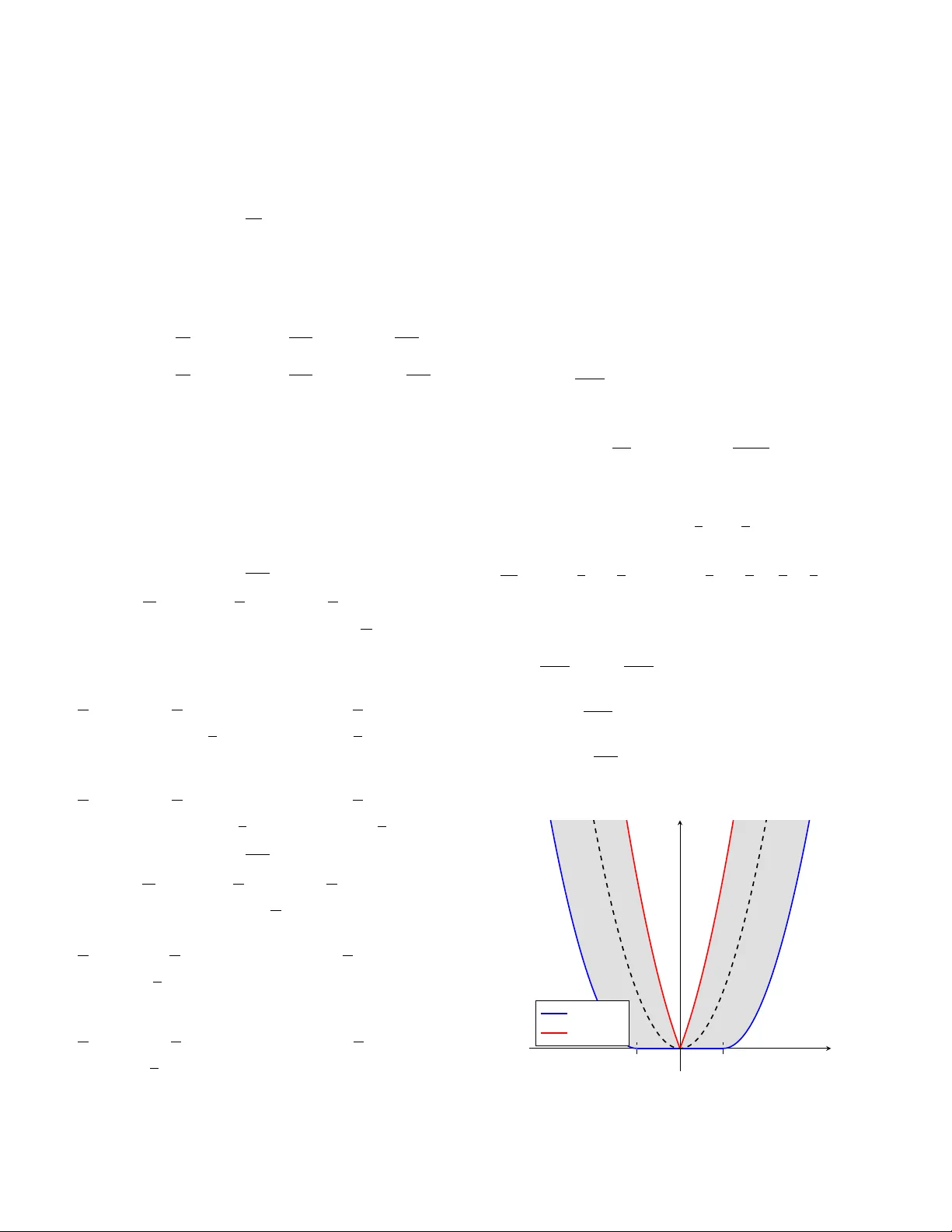
On P or t-Hamiltonian F or mulation of Hysteretic Energy Storage Elements: The Bac klash Case J .R. K eulen, B . Ja ya wardhana, A.J . v an der Schaft Abstract — This paper presents a port-Hamiltonian for- mulation of hysteretic energy storage elements. First, we revisit the passivity pr operty of backlash-driven storage elements b y presenting a family of storage functions as- sociated to the dissipativity property of such elements. We explicitl y derive the corresponding av ailable storage and required supply functions ` a la Willems [1], and show the interlacing property of the aforementioned family of storage functions sandwiched between the availab le storage and required supply functions. Second, using the pr oposed family of storage functions, we present a port-Hamiltonian form ulation of hysteretic inductors as prototypical storage elements in por t-Hamiltonian systems. In par ticular , we show how a Hamiltonian function can be c hosen from the family of storage functions and how the hysteretic ele- ments can be expressed as port-Hamiltonian system with feedthr ough term, where the f eedthrough term represents energy dissipation. Correspondingly , we illustrate its ap- plicability in describing an RLC circuit (in parallel and in series) containing a hysteretic inductor element. Index T erms — Hysteresis; Dissipative Systems; Back- lash; P ort-Hamiltonian Systems; Nonlinear RLC Circuits; P assivity . I . I N T R O D U C T I O N M ODERN high-precision technology increasingly op- erates at the nano- and microscale. At these scales, hysteresis is a fundamental limiting factor for system perfor- mance, stability and ef ficiency . Hysteresis is a phenomenon where the current state does not only depend on the current input, but also on the history of previous inputs. Such behavior is encountered in a wide spectrum of physical systems that contain ferromagnetic-, piezoelectric materials, magnetostric- tiv e actuators, shape-memory alloys, etc. [2], [3]. In ther- modynamics and in electro-mechanical systems, the presence of hysteresis loop is alw ays associated to ener gy dissipation, where the enclosed area of a hysteresis loop represents the dissipated energy per cycle. Over the past decades, accurate modeling of hysteresis phenomena has been inv estigated for This research project is suppor ted by the TKI (T opconsor tia voor K ennis en Innov atie) grant 22.0027 under the T op Sector High-T ech Systems and Materials (HTSM). J.R. Keulen and B. J ay aw ardhana are with the Engineering and T echnology Institute Groningen, Faculty of Science and Engineer ing, University of Groningen, 9747A G Groningen, The Netherlands (e-mails: j.r .keulen@rug.nl, b .ja ya wardhana@rug.nl) A.J. van der Schaft is with the Bernoulli Institute for Mathe- matics, Computer Science, and Ar tificial Intelligence, Univ ersity of Groningen, Nijenborgh 9, 9747 AG Groningen, Netherlands (e-mail: a.j.van.der .schaft@rug.nl). analyzing systems performance, for compensating the hys- teresis through the deployment of in verse hysteresis and for embracing hysteresis as a new class of set-and-forget actuators [4]–[6]. Sev eral mathematical frameworks hav e been proposed to describe hysteresis, including operator-based models such as the Preisach and Prandtl-Ishlinskii (PI) models [2], and dif fer- ential equation-based models such as the Duhem models [7]. The backlash operator , also the fundamental building block of the PI model, belongs to a subfamily of Duhem operators with counterclockwise input-output dynamics [8], [9], a property that is connected to passivity in [10], where it is sho wn that hysteretic systems do not generate energy but dissipate it over each cycle. In the dissipati vity framework of W illems [1], a system is dissipative if there e xists a storage function satisfying a dissipation inequality with a given supply-rate function. For hysteretic systems, the characterization of such storage functions is non-trivial due to the path-dependent, multiv alued nature of the input-output map, where a single input v alue may correspond to multiple outputs. While passivity of the backlash operator has been established [11], an explicit characterization of the family of admissible storage functions, bounded by the av ailable storage and required supply functions, has not been addressed in the literature. Moreover , the non-conservati ve nature of hysteresis makes the unified formulation into an energy-based framework such as port-Hamiltonian systems particularly challenging. Port-Hamiltonian (pH) systems provide a structured, energy-based, modeling framework that has proven effecti ve for physical systems across multiple domains [12], [13]. Howe ver , physical elements exhibiting hysteresis beha vior cannot be represented by a single storage port and dissipa- tion port alone [13]. In [14], [15], hysteretic systems are modeled by introducing an additional nonlinear dissipative element to capture hysteretic energy dissipation. In recent years, irreversible pH formulations hav e been proposed [16], where the dissipated energy is accounted for as thermal energy (entropy). A modular passivity based pH of piezo actuators has been proposed in [17], using ’hysterons’ as in [15] to capture the hysteretic behavior . Nevertheless, a systematic pH formulation that directly incorporates hysteretic dissipation through a nonlinear potential, consistent with the W illems dissipativity framework, remains an open problem. In this paper , we address these challenges by de veloping a pH formulation of the backlash-driv en storage elements. By considering the backlash hysteretic phenomenon in a nonlinear inductor element, we present a family of storage functions which are sandwiched between the av ailable storage and required supply functions in the sense of W illems [1]. Based on these results, we show ho w to define an appropriate Hamiltonian function that allows us to cast the nonlinear in- ductor into a general port-Hamiltonian formalism that includes feedthrough terms. Accordingly , we show how we can include this hysteretic inductor element to represent an interconnected RLC circuit via the general pH formalism. I I . P R E L I M I N A R I E S A. Dissipativity Theory Consider a dynamical system Σ [1, Definition 1] with state space X ⊆ R n , input space U ⊆ R m , and output space Y ⊆ R m , described by its set of admissible trajectories ( u ( · ) , x ( · ) , y ( · )) on intervals of R . A supply rate w : U × Y → R is a locally integrable function quantifying the rate at which generalized power is exchanged through the external ports of Σ . Finally , let a multiv alued sign mapping be defined by sign ( V ) = − 1 , V < 0 , 1 , V > 0 , [ − 1 , 1] , V = 0 . (1) Definition II.1. [1, Definition 2] The system Σ is dissipative with r espect to the supply rate w if there exists a non-negative function S : X → R ≥ 0 , called a storage function , such that the dissipation inequality S x ( t 1 ) ≤ S x ( t 0 ) + Z t 1 t 0 w u ( t ) , y ( t ) d t (2) holds for all t 1 ≥ t 0 and all admissible trajectories. If S is differ entiable, (2) is equivalent to ˙ S ( x ) ≤ w ( u, y ) . In this paper , we consider a class of dissipative systems so- called passive systems. The system Σ is called passive if it is dissipativ e w .r .t. the supply rate w ( u, y ) = u ⊤ y . The storage function satisfying Definition II.1 is in general not unique, i.e., there may exist other storage functions that can satisfy (2). W illems in [1] characterized this family through two extremal storage functions. The available storage S a ( x 0 ) = sup u ( · ) , T ≥ 0 − T Z 0 w u ( t ) , y ( t ) d t, x (0) = x 0 (3) is the maximum energy that can be extracted from Σ starting at x 0 , and the requir ed supply S r ( x 0 ) = inf u ( · ) , T ≥ 0 0 Z − T w u ( t ) , y ( t ) d t, (4) where x ( − T ) = x ∗ , x (0) = x 0 , is the minimum energy needed to reach x 0 from a reference state x ∗ ∈ X . These functions bound any admissible storage function S via the av ailable storage and required supply bounds S a ( x ) ≤ S ( x ) ≤ S r ( x ) + S a ( x ∗ ) ∀ x ∈ X , (5) and Σ is dissipativ e if and only if S a ( x ) < ∞ for all x ∈ X [1]. B. P or t-Hamiltonian systems For describing the hysteretic storage elements as pH sys- tems, we require a general form of pH systems as follo ws [18], [19]. A finite dimensional port-Hamiltonian system, with nonlinear dissipation, takes the form − ˙ x y = − J ( x ) − G ( x ) G ⊤ ( x ) M ( x ) e u + ∂ P ∂ e ( x, e, u ) ∂ P ∂ u ( x, e, u ) , (6) where x ∈ R n is the state, e = ∂ H ∂ x and u, y ∈ R m are the conjugate port v ariables. The Hamiltonian H : R n → R represents the stored energy and is continuously differen- tiable. The interconnection matrices satisfies J ( x ) = − J ( x ) ⊤ , M ( x ) = − M ( x ) ⊤ , while G ( x ) denotes the input matrix, and the dissipation potential P : R n × R n × R m → R is such that e ⊤ ∂ P ∂ e ( x, e, u ) + u ⊤ ∂ P ∂ u ( x, e, u ) ≥ 0 , for all x, e and u . Using ske w-symmetry of the first matrix block, one can verify d dt H − u ⊤ y = − e ⊤ u ⊤ − ˙ x y = − e ⊤ ∂ P ∂ e − u ⊤ ∂ P ∂ u ≤ 0 , where the last inequality follo ws from the dissipation condi- tion. This shows that the system is passive with supply rate u ⊤ y and that H serves as a storage function. I I I . P A S S I V I T Y O F B A C K L A S H - D R I V E N S T O R A G E E L E M E N T S In this section, we introduce a family of storage func- tions for hysteretic storage elements, which will be described shortly . Furthermore we present explicitly the associated av ail- able storage and required supply functions of such hysteretic storage elements. For concreteness, we restrict attention to nonlinear inductors as the energy storage elements, which allow us to couple the hysteretic elements to the ph ysical equations and port v ariables in a straightforward manner . Consider a backlash inductor element ev olving in the ( I , ϕ ) plane, where I is the electrical curr ent and ϕ is the magnetic flux , as illustrated in Figure 1. In this case, the electrical current and the magnetic flux are described by a backlash operator with width 2 h and slope − h + h − h + h I ϕ Fig. 1. Phase plot of a simple ’f erromagnetic’ bac klash operator , with the variables I and ϕ . The adjective ’ferromagnetic’ here stems from the physical la w that we attach to this operator , where ϕ is coupled to a por t variable V by d ϕ d t = V . The slope of the diagonal line defines the inductance L . L , which is associated with the inductance. W e note that the backlash behavior sho wn in Figure 1 can be considered an idealization of the hysteresis behavior commonly found in in- ductors with ferromagnetic cores. The corresponding physical equation for nonlinear inductors is the Lorentz induction law , which couples the potential field V to the magnetic flux ϕ by d ϕ d t = V . (7) The pair of variables ( I , V ) are the port variables of the inductor . Let us firstly present a family of storage functions for the backlash operators as follows. Proposition III.1. F or any γ ∈ [ − h, h ] , the function S γ ( I , ϕ ) = 1 2 L ( ϕ + γ ) 2 − h + γ 2 2 ∀ ϕ > h − γ 2 , 1 2 L ( ϕ − γ ) 2 − h + γ 2 2 ∀ ϕ < − h − γ 2 , 0 elsewher e, (8) defines an admissible storag e function for the backlash induc- tor with minimum value of 0 . P R O O F . W e will prov e Proposition III.1 by e v aluating the time-deriv ative of S γ along admissible trajectories of the backlash operator . Firstly , let us fix γ ∈ [ − h, h ] . In order to ev aluate the time-deriv ati ve of S γ , we consider two different cases following the definition of S γ in (8) as follows. Case 1: For the case ϕ > h − γ 2 , we hav e d dt S γ ( I , ϕ ) = 1 L ( ϕ + γ ) ˙ ϕ = 1 L ( ϕ + γ ) V (9) When V = 0 it follo ws immediately that d dt S γ ( I , ϕ ) = 0 . On the one hand, when V < 0 , which corresponds to the downw ard motion along the left line of the backlash diagram, the RHS of (9) satisfies 1 L ( ϕ + γ ) V = 1 L ( ϕ − h + γ + h ) V = I V + 1 L ( γ + h ) V ≤ I V , which is due to I = 1 L ( ϕ − h ) , and V < 0 , 1 L ( γ + h ) ≥ 0 . On the other hand, when V > 0 (i.e. the upward path along the right line of backlash diagram), the RHS of (9) becomes 1 L ( ϕ + γ ) V = 1 L ( ϕ + h + γ − h ) V = I V + 1 L ( γ − h ) V ≤ I V , where we have used I = 1 L ( ϕ + h ) , V > 0 and 1 L ( γ − h ) ≤ 0 . Case 2: For the case ϕ < h − γ 2 , it can be checked that d dt S γ ( I , ϕ ) = 1 L ( ϕ − γ ) ˙ ϕ = 1 L ( ϕ − γ ) V . (10) Similar as before, V = 0 ⇒ d dt S γ ( I , ϕ ) = 0 . When V < 0 (along the downw ard path), the RHS of (10) satisfies 1 L ( ϕ − γ ) V = 1 L ( ϕ − h − γ + h ) V = I V + 1 L ( − γ + h ) V ≤ I V , where I = 1 L ( ϕ − h ) , V < 0 , and ( − γ + h ) V ≤ 0 . Finally , when V > 0 (along the upward path), the RHS of (10) becomes 1 L ( ϕ − γ ) V = 1 L ( ϕ + h − γ − h )) V = I V − 1 L ( γ + h ) V ≤ I V , where I = 1 L ( ϕ + h ) , V > 0 and ( γ + h ) V ≥ 0 . □ One can check that along an y closed trajectory in the ( I , ϕ ) plane between ϕ 2 ≥ ϕ 1 (contained within the backlash characteristic) the total dissipated ener gy is giv en as 2 h [ ϕ 2 − ϕ 1 ] for every γ ∈ [ − h, h ] . This quantity equals to the area enclosed by the trajectory . It can also be shown that S γ has monotonicity property with respect to γ . More precisely , one can check that for all ( I , ϕ ) , we have the interlacing property S γ 1 ( I , ϕ ) ≤ S γ 2 ( I , ϕ ) for all − h ≤ γ 1 ≤ γ 2 ≤ h . Figure 2 shows the plot of S − h , S h and the shaded gray area that encapsulates the family of storage functions S γ as giv en in (8), which satisfy this property as formalized in the following proposition. Proposition III.2. Let S γ be defined by (8) . Then for any − h ≤ γ 1 < γ 2 ≤ h , S γ 1 ( I , ϕ ) ≤ S γ 2 ( I , ϕ ) for all ( I , ϕ ) . (11) P R O O F . W e distinguish four cases based on the v alue of ϕ of our backlash inductor element as shown in Figure 1. Case 1: ϕ > h − γ 1 2 . Both S γ 1 and S γ 2 are gi ven by the first case of (8). The inequality S γ 1 ( ϕ ) ≤ S γ 2 ( ϕ ) is equi v alent to showing that g ( γ ) = 1 2 L " ( ϕ + γ ) 2 − h + γ 2 2 # is strictly increasing in γ . Expanding and canceling the ϕ 2 terms, this reduces to showing that g ( γ ) = 2 ϕγ + 3 4 γ 2 − h 2 γ is strictly increasing in γ . Computing the gradient of g yields d g d γ = 2 ϕ + 3 2 γ − h 2 > h − γ + 3 2 γ − h 2 = h 2 + 1 2 γ ≥ 0 , where we used 2 ϕ > h − γ and γ ≥ − h . This implies that g is strictly increasing in γ . Accordingly , if γ 1 < γ 2 then S γ 1 ( ϕ ) < S γ 2 ( ϕ ) . Case 2: h − γ 1 2 ≥ ϕ > h − γ 2 2 . Here S γ 1 ( ϕ ) = 0 while S γ 2 ( ϕ ) ≥ 0 , i.e. (11) holds. Case 3: | ϕ | ≤ h − γ 2 2 . In this case, both storage functions are zero. Case 4: ϕ < − h − γ 2 . For this final case, the proof follo ws similarly as before due to the symmetry in (8). □ h − h ϕ S γ ( ϕ ) γ = − h γ = h Fig. 2. Admissible storage functions S γ ( ϕ ) for the backlash operator . The extreme cases γ = ± h bound the family , while the shaded region represents all admissible functions for γ ∈ [ − h, h ] . All functions attain a minimum value of zero. The dashed line indicates the admissible Hamiltonian of the backlash inductor , der ived in (21) . In the following discussion, we consider the notion of av ail- able storage and required supply functions for the backlash inductor elements, as introduced before in Section II-A. As we are dealing with a multiv alued backlash operator , instead of using the zero state as the origin in the definition of av ailable and required storage function, we consider the set X 0 := { ( I , ϕ ) | I = 0 , ϕ ∈ [ − h, h ] } as the gr ound state set . In this way , the av ailable storage function corresponds to the maximum energy that can be extracted from any state ( I 0 , ϕ 0 ) ∈ R 2 to X 0 . The general definition (3) is then implemented for the backlash operator as follows. Definition III.1. The available storage function S a of the backlash inductor elements is defined by S a ( I 0 , ϕ 0 ) = sup ( I ( · ) ,V ( · )) ,T ≥ 0 − Z T 0 I ( t ) V ( t ) dt (12) with V ( t ) = ˙ ϕ and I (0) = I 0 , ϕ (0) = ϕ 0 . Proposition III.3. F or the backlash inductor element with width 2 h and inductance L , the available storage function is given by S a ( I 0 , ϕ 0 ) = S − h ( I 0 , ϕ 0 ) , where S − h is as in (8) with γ = − h , i.e., S a ( I 0 , ϕ 0 ) = 1 2 L ( ϕ 0 − h ) 2 ∀ ϕ 0 > h, 1 2 L ( ϕ 0 + h ) 2 ∀ ϕ 0 < − h, 0 elsewher e . (13) P R O O F . The RHS of (12) corresponds to the maximum en- ergy that can be extracted from the hysteretic storage element, where the extracted energy is equal to − R T 0 I ( t ) V ( t ) dt . In the following, we will prove this proposition by constructing an input signal V that maximizes the energy extraction without inducing energy dissipation along the path. Let us consider ϕ 0 > h and an external port signal V ( t ) = d ϕ ( t ) d t ≤ 0 such that ϕ (0) = ϕ 0 , ϕ ( T ) = h and V ( t ) = 0 for all t ≥ T . In this case, the trajectory follows the line I ( t ) = ϕ ( t ) − h L for all t ∈ [0 , T ] (cf. Figure 1) and it holds that − Z T 0 I ( t ) V ( t ) d t = − Z T 0 1 L ( ϕ ( t ) − h ) V ( t ) d t = − 1 L Z h ϕ 0 ( ϕ − h ) d ϕ = 1 2 L ( ϕ 0 − h ) 2 . (14) Let us now consider port signal V that first increases ϕ to ϕ 0 + ϵ by taking V ( t ) > 0 for t ∈ [0 , t 1 ] , then applying V ( t ) ≤ 0 as before for t ∈ [ t 1 , T ] such that ϕ ( T ) = h , and thereafter V ( t ) = 0 for all t > T . For this case, the trajectory of I will satisfy I ( t ) = ϕ ( t )+ h L for all t ∈ [0 , t 1 ] and I ( t ) = ϕ ( t ) − h L for all t ∈ [ t 1 , T ] (cf. Figure 1). Accordingly , it can be calculated that − Z T 0 I ( t ) V ( t ) d t = − Z t 1 0 1 L ( ϕ ( t ) + h ) V ( t ) d t − Z T t 1 1 L ( ϕ ( t ) − h ) V ( t ) d t = − 1 L Z ϕ 0 + ϵ ϕ 0 ( ϕ + h ) d ϕ − 1 L Z h ϕ 0 + ϵ ( ϕ − h ) d ϕ = − 1 L Z ϕ 0 + ϵ ϕ 0 ( ϕ + h ) d ϕ − 1 L Z ϕ 0 ϕ 0 + ϵ ( ϕ − h ) d ϕ − 1 L Z h ϕ 0 ( ϕ − h ) d ϕ = 1 2 L ( ϕ 0 − h ) 2 − ∆( ϵ ) , (15) where ∆( ϵ ) = 1 L R ϕ 0 + ϵ ϕ 0 ( ϕ + h ) d ϕ − 1 L R ϕ 0 + ϵ ϕ 0 ( ϕ − h ) d ϕ = 2 ϵh > 0 . Correspondingly , since ∆( ϵ ) > 0 , it is clear from the two cases of port signal V ( t ) as above that ev aluating (12) corresponds to the first choice of V ( t ) that gi ves us (14), i.e., the first case in (13) holds. Furthermore, any trajectory where ϕ ( T ) < h stays on the line I ( t ) = 1 L ( ϕ ( t ) − h ) past ϕ = h , where I ( t ) < 0 and V ( t ) ≤ 0 , so I ( t ) V ( t ) ≥ 0 and extending the trajectory only reduces the extracted energy . T ogether with the argument above, this confirms that (14) is indeed the supremum. The same argumentation applies also when ϕ 0 < − h , in which case the second case in (13) is also satisfied. It remains to prove the last case in (13). When ϕ 0 ∈ [ − h, h ] and the state ( I 0 , ϕ 0 ) ∈ X 0 , we have I 0 = 0 . For any V = ˙ ϕ = 0 , the backlash characteristic in Figure 1 shows that I ( t ) immediately takes the same sign as V ( t ) , so that I ( t ) V ( t ) ≥ 0 for all t ≥ 0 . Therefore − Z T 0 I ( t ) V ( t ) d t ≤ 0 , with equality only when V = 0 . Since the supremum in (12) is taken over all admissible inputs, the maximum is attained by V = 0 so that S a ( I 0 , ϕ 0 ) = 0 . □ As discussed before, the av ailable storage function corre- sponds to the maximum energy that can be extracted from the backlash operator starting at any given state ( I 0 , ϕ 0 ) . The dual notion, the required supply function (4) corresponds to the minimum energy needed to bring the system from the ground state ( I ( − T ) , ϕ ( − T )) = ( I ∗ , ϕ ∗ ) to a giv en state ( I (0) , ϕ (0)) = ( I 0 , ϕ 0 ) , where we can take any point ( I ∗ , ϕ ∗ ) from the set X ∗ := { ( I , ϕ ) | ϕ = 0 , I ∈ [ − h, h ] } as the ground state. In the following definition and proposition, we use the origin as the ground state. Definition III.2. The requir ed supply S r of the backlash inductor elements is defined by S r ( I 0 , ϕ 0 ) = inf ( I ( · ) ,V ( · )) , T ≥ 0 Z 0 − T I ( t ) V ( t ) d t, (16) with V ( t ) = d ϕ ( t ) d t and I (0) = I 0 , ϕ (0) = ϕ 0 , with the gr ound state ( I ( − T ) , ϕ ( − T )) = ( I ∗ , ϕ ∗ ) ∈ X ∗ . Proposition III.4. F or the backlash inductor elements, the r equir ed supply (4) with origin as the gr ound state is given by S r ( I 0 , ϕ 0 ) = S h ( I 0 , ϕ 0 ) , wher e S h is as in (8) with γ = h , i.e., S r ( I 0 , ϕ 0 ) = ( 1 2 L ( ϕ 0 + h ) 2 − 1 2 L h 2 if ϕ 0 ≥ 0 , 1 2 L ( ϕ 0 − h ) 2 − 1 2 L h 2 if ϕ 0 ≤ 0 . (17) P R O O F . W e construct admissible port signals ( I , V ) that achiev e the infimum in (16) for any given state ( I 0 , ϕ 0 ) , starting from the given ground state ( I ∗ , ϕ ∗ ) = 0 . The infimum in (16) is achieved by the monotonically increasing trajectory with V ( t ) > 0 for all t ∈ [ − T , 0] , along which I ( t ) = ϕ ( t )+ h L . Indeed, any trajectory that is not monotone introduces additional dissipation ∆( ϵ ) > 0 as shown in (15), and is therefore not optimal. The required supply along the optimal path is Z 0 − T I ( t ) V ( t ) d t = Z ϕ 0 ϕ ∗ ϕ + h L d ϕ = 1 2 L ( ϕ 0 + h ) 2 − 1 2 L ( ϕ ∗ + h ) 2 , (18) which, after substituting ϕ ∗ = 0 , yields the first case of (17). The case ϕ 0 ≤ 0 follows by symmetry; an analogous argument with V ( t ) < 0 and I ( t ) = ϕ ( t ) − h L yields the second case of (17). □ Follo wing the av ailable storage and required supply bounds as in (5), any admissible storage function S satisfies S a ( I , ϕ ) ≤ S ( I , ϕ ) ≤ S r ( I , ϕ ) , (19) where S a = S − h and S r = S h are the e xtremal elements of the family S γ defined in (8). Here we have used the fact that S a ( I ∗ , ϕ ∗ ) = 0 . I V . P O R T - H A M I L TO N I A N F O R M U L A T I O N In this section, we first derive a port-Hamiltonian (pH) rep- resentation of the backlash inductor element. For illustration purpose, we present its interconnection with a linear resistor and linear capacitor in series and in parallel. A. Bac klash inductor element in pH Consider the backlash diagram in the ( I , ϕ ) -plane as shown in Fig. 1. Using the multi v alued sign mapping as in (1), a port-Hamiltonian representation of the backlash inductor can be given by ˙ ϕ = V , I = ∂ H bf ∂ ϕ + h L sign ( V ) , (20) with Hamiltonian H bf ( ϕ ) = 1 2 L ϕ 2 . (21) Note that H bf is equal to the magnetic energy of a linear inductor with inductance L . As sho wn in Fig. 2, H bf (shown in dashed-line) is an admissible storage function for the backlash inductor element in the sense that it is bounded by S a ( I , ϕ ) and S r ( I , ϕ ) as in (19). The first term in (20) corresponds to the energy-storing linear inductance, while the second one is the term that induces hysteretic dissipation. The latter acts as a nonlinear feedthrough mapping and is structurally analogous to Coulomb friction. In other words, the presence of backlash in the storage element induces energy dissipation through a feedthrough term, unlike the usual nonlinear dissipation elements that appear directly in the state equation. The energy balance follows directly from (20), i.e. d dt H bf = ∂ H bf ∂ ϕ ˙ ϕ = I − h L sign ( V ) V , (22) and since h L sign ( V ) V ≥ 0 , it follows that d dt H bf ≤ I V . This shows that the backlash inductor is passive with respect to the port variables ( V , I ) . The model in (20) can be rewritten as follows, using con ve x analysis. Note that the monotone multi-value d sign mapping can be expressed as the sub-differential of the conv ex function P ( V ) := h L | V | , (23) so that ∂ P ( V ) ∂ V = h L sign ( V ) . Consequently , the pH system of (20) can be also written as ˙ ϕ = V , I = ∂ H bf ∂ ϕ + ∂ P ( V ) ∂ V . (24) This corresponds to the port-Hamiltonian system formulation (6) with nonlinear dissipation, where x = ϕ , u = V , y = I , J = 0 , G = 1 , and M = 0 . B. RC network with backlash ferromagnet inductor Let us now consider an RLC network consisting of a back- lash inductor interconnected to a linear resistor of resistance R and a linear capacitor of capacitance C . W e deriv e the port-Hamiltonian formulation for both the series and parallel interconnection configurations as shown in Fig. 3 and Fig. 4, respectiv ely . The total Hamiltonian of the network is giv en as H ( ϕ, Q ) := H bf ( ϕ ) + H C ( Q ) , (25) where H bf is as in (21) and H C ( Q ) = 1 2 C Q 2 is the energy stored in the capacitor with charge Q . This Hamiltonian holds for both the parallel and series configurations of the network. 1) Par allel interconnection : In the parallel configuration, as shown in Fig. 3, all elements share the same v oltage V . The source is a current source with input u = I and output y = V , so that the supply rate is I V . It can be computed that the corresponding pH formulation is giv en by ˙ ϕ ˙ Q = 0 1 − 1 − 1 R " ∂ H ∂ ϕ ∂ H ∂ Q # − 0 ∂ P ∂ V + 0 1 I , V = 0 1 " ∂ H ∂ ϕ ∂ H ∂ Q # , (26) where P is giv en by (23). This system corresponds to the pH system (6), with state x = ϕ Q ⊤ with J = 0 1 − 1 − 1 R , G = 0 1 , M = 0 . I R L C Fig. 3. P arallel interconnected resistor , f erromagnetic backlash and capacitor circuit. The energy balance follows immediately as ˙ H = − V 2 R − V · h L sign ( V ) + V I ≤ V I , (27) which shows the passi vity of the RLC network with respect to the port ( I , V ) . The two dissipation terms V 2 R ≥ 0 and V · h L sign ( V ) ≥ 0 represent resistiv e and hysteretic losses, respectiv ely . − + V R L C Fig. 4. Series interconnected resistor , ferromagnetic backlash and capacitor circuit. 2) Ser ies interconnection : W e now consider the series con- figuration as shown in Fig. 4, where all elements share the same current I . In this case, the corresponding pH formulation is given by ˙ ϕ + R h L sign ( V ) ˙ Q − h L sign ( V ) = − R − 1 1 0 " ∂ H ∂ ϕ ∂ H ∂ Q # + 1 0 V , I = 1 0 " ∂ H ∂ ϕ ∂ H ∂ Q # + ∂ P ( V ) ∂ V . (28) The resulting system is an implicit pH system, as the hysteretic backlash term introduces a multiv alued, rate-independent dis- sipativ e relation acting through the state deri v ativ e. Nev er - theless, the skew-symmetric interconnection structure and the dissipation potential preserve the standard pH power balance, and passivity with respect to the port variables ( V , I ) follows from (22). Indeed, computing the time deriv ativ e of (25) gi ves ˙ H = I − h L sign ( V ) V + Q C ˙ Q ≤ I V , (29) since h L sign ( V ) V ≥ 0 . Hence both configurations are passi ve with respect to the port variables ( V , I ) . V . C O N C L U S I O N In this paper , we have sho wn that the backlash inductor element admits a family of storage functions that are lower - bounded by the a vailable storage and upper-bounded by the required supply , as illustrated in Fig. 2. The backlash inductor element can then be expressed in a pH framework with a nonlinear dissipation feedthrough term, allowing the system to be written in standard nonlinear pH form, while preserving the ske w-symmetric interconnection structure and energy balance. The formulation is subsequently extended to both parallel and series RC network configurations incorporating the backlash inductor . For the resulting network, passi vity with respect to the supply rate is established using the total Hamiltonian. The generalization of the pH modeling of the backlash storage elements to other hysteretic storage elements using complex hysteresis operators, such as nonlinear backlash, Preisach or Duhem models, will be reported in our future works. R E F E R E N C E S [1] J. C. Willems, “Dissipative dynamical systems part I: General theory , ” Ar chive for rational mec hanics and analysis , vol. 45, no. 5, pp. 321–351, 1972. [2] M. Brokate and J. Sprekels, Hyster esis and phase transitions . Springer Science & Business Media, 2012, vol. 121. [3] I. D. Mayergoyz, Mathematical models of hysteresis and their applica- tions . Academic press, 2003. [4] R. Huisman, M. P . Bruijn, S. Damerio, M. Eggens, S. N. R. Kazmi, A. Schmerbauch, H. Smit, M. V asquez Beltran, E. van der V eer , M. Acuautla, B. Jayawardhana, and B. Noheda, “High pixel number deformable mirror concept utilizing piezoelectric hysteresis for stable shape configurations, ” Journal of Astronomical T elescopes Instruments and Systems , vol. 7, no. 2, pp. 1–18, 2021. [5] M. V asquez Beltran, B. Jayaw ardhana, and R. Peletier , “Recursi ve algorithm for the control of output remnant of Preisach hysteresis operator , ” IEEE Contr ol Systems Letters , vol. 5, no. 3, pp. 1061–1066, 2021. [6] J. K eulen and B. Jayawardhana, “Newton and secant methods for iterativ e remnant control of Preisach hysteresis operators, ” IEEE Contr ol Systems Letters , vol. 8, pp. 1721–1727, 2024. [7] F . Ikhouane, “ A survey of the hysteretic Duhem model, ” Arc hives of Computational Methods in Engineering , vol. 25, no. 4, pp. 965–1002, 2018. [8] A. K. Padthe, J. Oh, and D. S. Bernstein, “Counterclockwise dynamics of a rate-independent semilinear Duhem model, ” in Pr oceedings of the 44th IEEE Conference on Decision and Contr ol . IEEE, 2005, pp. 8000–8005. [9] B. Jayawardhana, R. Ouyang, and V . Andrieu, “Stability of systems with the Duhem hysteresis operator: The dissipativity approach, ” Automatica , vol. 48, no. 10, pp. 2657–2662, 2012. [10] R. Gorbet and K. Morris, “Generalized dissipation in hysteretic sys- tems, ” in Proceedings of the 37th IEEE Conference on Decision and Contr ol (Cat. No. 98CH36171) , vol. 4. IEEE, 1998, pp. 4133–4138. [11] B. Jayawardhana and V . Andrieu, “Sufficient conditions for dissipativity on Duhem hysteresis model, ” in Pr oceedings of the 48h IEEE Con- fer ence on Decision and Control (CDC) held jointly with 2009 28th Chinese Contr ol Conference . IEEE, 2009, pp. 4378–4383. [12] A. V an Der Schaft, D. Jeltsema et al. , “Port-Hamiltonian systems theory: An introductory ov erview , ” F oundations and Tr ends® in Systems and Contr ol , vol. 1, no. 2-3, pp. 173–378, 2014. [13] V . Duindam, A. Macchelli, S. Stramigioli, and H. Bruyninckx, Mod- eling and contr ol of complex physical systems: the port-Hamiltonian appr oach . Springer Science & Business Media, 2009. [14] D. C. Karnopp, D. L. Margolis, and R. C. Rosenberg, System dynamics: modeling, simulation, and contr ol of mechatr onic systems . John Wile y & Sons, 2012. [15] D. C. Karnopp, “Computer models of hysteresis in mechanical and magnetic components, ” Journal of the Fr anklin Institute , vol. 316, no. 5, pp. 405–415, 1983. [16] H. Ramirez, B. Maschke, and D. Sbarbaro, “Irrev ersible port- Hamiltonian systems: A general formulation of irreversible processes with application to the CSTR, ” Chemical Engineering Science , vol. 89, pp. 223–234, 2013. [17] I. D ´ ıaz, H. Ram ´ ırez, Y . Le Gorrec, and Y . W u, “Modular passi vity- based modelling of piezoelectric actuators, ” Mathematical and Computer Modelling of Dynamical Systems , vol. 31, no. 1, p. 2533294, 2025. [18] A. van der Schaft, “Reciprocity of nonlinear systems, ” SIAM Journal on Contr ol and Optimization , vol. 62, no. 6, pp. 3019–3041, 2024. [19] ——, “Hopfield neural networks as port-Hamiltonian and gradient systems, ” arXiv preprint , 2026.
Original Paper
Loading high-quality paper...
Comments & Academic Discussion
Loading comments...
Leave a Comment