Dynamics of Kahan-Hirota-Kimura maps with rational invariant fibrations
We present a simple method to study the dynamics of planar Kahan-Hirota-Kimura (KHK) maps preserving rational fibrations. Using this approach, we show that integrable KHK maps may exhibit complex dynamics, even when obtained from vector fields with t…
Authors: Víctor Mañosa, Chara Pantazi
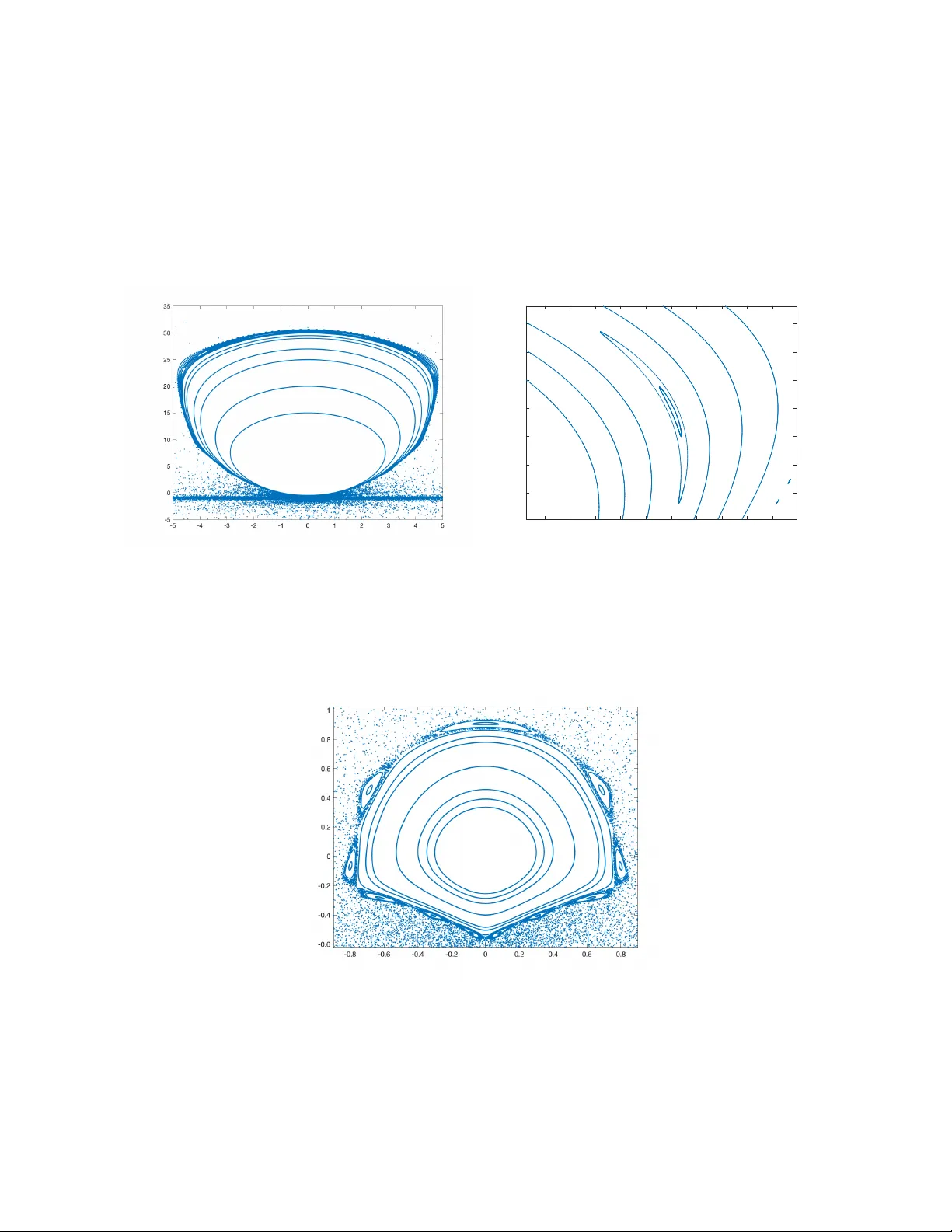
Dynamics of Kahan-Hirota-Kim ura maps with rational in v arian t fibrations. V ´ ıctor Ma ˜ nosa (1) and Chara P antazi (2) (1) Departamen t de Matem` atiques (MA T), Institut de Matem` atiques de la UPC-BarcelonaT ech (IMT ec h), Univ ersitat P olit` ecnica de Catalun ya-BarcelonaT ec h (UPC) Colom 11, 08222 T errassa, Spain victor.manosa@up c.edu (2) Departamen t de Matem` atiques (MA T), Univ ersitat P olit` ecnica de Catalun ya-BarcelonaT ec h (UPC) Do ctor Mara ˜ n´ on 44-50, 08028 Barcelona, Spain c hara.pantazi@upc.edu Marc h 25, 2026 Abstract W e present a simple metho d to study the dynamics of planar Kahan-Hirota-Kim ura (KHK) maps preserving rational fibrations. Using this approach, w e show that in tegrable KHK maps ma y exhibit complex dynamics, even when obtained from v ector fields with trivial b eha vior. As an application, we study the KHK map asso ciated with a quadratic planar v ector field with an iso c hronous cen ter. This map preserv es the original first integral and admits the vector field as a Lie symmetry . Moreo ver, for a dense set of v alues of the integration step, it is globally p eriodic and exhibits all possible perio ds except 2. W e also provide evidence of non-integrabilit y for KHK maps asso ciated with other quadratic v ector fields p ossessing iso chronous centers. T o ov ercome this issue, we introduce the notion of pseudo-KHK maps, as alternativ e in tegrable discretizations for v ector fields with iso c hronous cen ters. These maps are constructed to preserve the first in tegrals of the original vector field and to ensure that the vector field itself is a Lie symmetry of the map. The construction can be extended to iso c hronous cen ters of degree greater than tw o. 2010 Mathematics Sub ject Classification: 37E45, 37J70, 39A23, 39A36. Keyw ords: Global p erio dicit y; Iso c hronous centers; Kahan-Hirota-Kim ura maps; Linearizations; Rational curves; P erio dic orbits; Pseudo-Kahan-Hirota-Kim ura maps. 1 1 In tro duction The Kahan-Hirota-Kimura (KHK) maps arise from the discretization metho d developed indep en- den tly b y Kahan, Hirota, and Kimura [16, 18, 19, 21], aimed at numerically solving quadratic ODEs. These maps play a k ey role in the study of integrable systems, as they often admit first in tegrals when deriv ed from Hamiltonian v ector fields or systems possessing conserv ed quan tities. In recen t y ears, n umerous publications ha ve emphasized their ric h geometric properties. Significan t adv ances ha ve b een made in the case of planar KHK maps with a first integral whose level curves are elliptic (i.e., of gen us 1). These results hav e b een obtained, in particular, within the framew ork of the key result by Celledoni, McLachlan, Owren, and Quisp el [3], which shows that KHK maps arising from the discretization of cubic Hamiltonian v ector fields also admit a rational first in tegral with cubic lev el curves [3, 4, 6, 29, 30, 32]. In this setting, it is well known that the dynamics on eac h level curv e can b e described using the group structure of the curve [17], or equiv alently , as the comp osi- tion of the so-called Manin in volutions. In suc h cases, KHK maps exhibit a remark able geometric structure. References [5, 20] in v estigate scenarios in whic h the fibration preserv ed by in tegrable KHK maps is defined by quadratic curves, whic h generically hav e genus 0, that is, they are rational. In the examples studied in these works, it is shown that KHK maps can also be expressed as compositions of Manin in volutions. Within this framew ork, KHK maps asso ciated with v ector fields admitting a linear integrating factor hav e b een studied in [31]. In this paper, we highlight a simple metho dology that pro vides an alternativ e approach to the study of the dynamics of KHK maps preserving rational (gen us 0) fibrations. This approach w as also employ ed in [22]. In this setting, the restriction of the map to each curve is conjugate to a M¨ obius transformation, whic h yields a simple description of the global dynamics. Although the prop osed approach is general, we fo cus on particular cases where the KHK map arise from a planar v ector field with a cen ter. As sho wn in [22], when the maps admit a first in tegral whose level sets form a family of closed curves surrounding the equilibrium, the restriction of the map to each curve is conjugate to a rotation with an explicit rotation num b er (which, typically , dep ends on the energy lev el). When this rotation num b er is non-constan t on the differen t energy lev els, as is t ypically the case, there exist op en and dense sets of curves on which the KHK maps are p erio dic. In such cases, the set of possible p erio ds is un b ounded. One can also find curv es filled with dense orbits. On some other level curves, there may exist one or t wo attracting and/or rep elling fixed p oints. This allo ws us to show that inte gr able KHK maps can p ossess a significan tly ric her dynamics than the flo ws they are mean t to appro ximate. Of course, non-inte gr able KHK maps can exhibit a wide v ariety of dynamical behaviors, as shown, for example, in [24]. In Section 2, we briefly presen t the metho dology prop osed in this w ork and review some standard results, including the definition of a Lie symmetry of a map. A fully dev elop ed example of the metho dology is presented in Section 3, where we revisit a particular case among those studied in [31]. The main results of the section are Prop ositions 3, 6 and 7 whic h c haracterize the global 2 dynamics, the (infinite) set of p erio ds and the existence of Lie Symmetries and inv ariant measures for the KHK-maps considered in the example. W e b eliev e this is an example of ho w the dynamics of integrable KHK maps can b e v ery ric h, even when the dynamics of the original vector field is trivial. In Section 4, w e will fo cus on KHK maps asso ciated with quadratic vector fields with iso c hronous cen ters which, for simplicity , w e will call quadratic iso chr onous ve ctor fields . These fields were c haracterized in [23] (see also [35]), obtaining four differen t cases, namely S i with i = 1 , . . . , 4, follo wing the notation in [7]. Three of these systems hav e a first in tegral whose level curves are rational ones. In particular, w e study the dynamics of a one-parameter family of KHK maps whic h dep end on the integration step size, namely Φ 1 ,ϵ , asso ciated with S 1 . Using the metho dology in this pap er, we show that the maps in the family preserv e the first in tegral of the original v ector field whic h, in addition, is a Lie symmetry of the maps. F urthermore, on each level curv e of the first in tegral, the dynamics is conjugate to a rotation, and for each fixed step size, the rotation num ber is constan t. As a consequence, for a dense set of v alues of the step size parameter, the maps are globally p erio dic, realizing all p ossible p erio ds except p erio d 2. This offers a meaningful example in the study of global p erio dicit y , since global p erio dicity of rational maps is a rare phenomenon, [12, 13]. The main results are Prop ositions 8, 9 and 11 in Section 4.1, whic h characterize some general prop erties of the KHK maps asso ciated with this example, S 1 , describ e the global dynamics and the set of p erio ds, resp ectively . F or the other iso chronous quadratic vector fields, namely S 2 , S 3 and S 4 , w e hav e obtained n umerical evidence indicating that the asso ciated KHK maps are non-integrable. W e presen t these evidences in Section 4.2. T o find integrable maps associated with quadratic v ector fields that hav e iso c hronous centers, while staying within the framework of KHK maps, in Section 5 w e introduce a new class of integrable maps, that w e call pseudo-KHK maps . These maps are constructed b y using the fact that isochronous vector fields can b e linearized, and b y considering the KHK maps asso ciated with the corresp onding linearized systems. The main result is Prop osition 14, whic h establishes that pseudo-KHK maps preserv e the first integrals of the original v ector fields whic h, in fact, are Lie symmetries of these maps. Since pseudo-KHK maps arise inspired b y a n umerical integration metho d, it is particularly significant that they admit the original vector fields as Lie symmetries and map the orbits of these fields into themselves: this implies that the maps corresp ond to the flow of the vector field for a time that dep ends on the orbit [11]. F urthermore, on eac h in v arian t closed curve pseudo-KHK maps are conjugate to a rotation with constant rotation n umber on eac h curv e for an y fixed ϵ . In Corollary 15 w e establish the abov e t yp e of results for the pseudo-KHK maps of the quadratic iso c hronous v ector fields. In fact, despite b eing different maps, all of them are conjugate to Φ 1 ,ϵ . W e emphasize that pseudo-KHK maps can b e constructed for iso c hronous vector fields of degree greater than tw o, thereby providing a new class of integrable maps asso ciated with iso chronous v ector fields, see Section 5.4. Finally , Section 6 summarizes the main conclusions of this w ork. 3 2 Metho dology Giv en a quadratic planar v ector field X , we consider the associated KHK map given b y Φ ϵ ( x ) = x + 2 ϵ ( I − ϵ D X ( x )) − 1 X ( x ) , (1) where D X is the differen tial matrix of the field. W e sa y that the map is inte gr able if it admits a first inte gr al , that is, a function V such that V (Φ ϵ ) = V in certain open set. In this pap er, we assume that Φ ϵ admits a rational first integral V ( x, y ) = V 1 ( x, y ) /V 2 ( x, y ), b eing V 1 and V 2 coprime p olynomials. This means that it preserves the fibration defined b y the algebraic curv es C h := { V 1 ( x, y ) − hV 2 ( x, y ) = 0 } , (2) for h ∈ Im( V ). W e refer to C h as the ener gy level curves . Additionally , we assume that b oth Φ ϵ and V are defined on a common op en subset of R 2 . In this w ork, w e consider the case where the family forms a r ational fibr ation , meaning that, except p erhaps for finitely man y v alues of h , each curv e C h is irreducible and has genus 0 , or in other w ords, is r ational . A fundamen tal prop erty of gen us 0 curves is that they admit a pr op er bir ational p ar ametrization in R , [36, Lemma 4.13 and Theorem 4.63]. That is, for an y genus 0 curve C in R 2 there exist a rational map P ( t ) = ( P 1 ( t ) , P 2 ( t )) = P 11 ( t ) P 12 ( t ) , P 21 ( t ) P 22 ( t ) ! , (3) where P ij ( t ) ∈ R [ t ] and gcd( P 1 i , P 2 i ) = 1, and suc h that for almost all v alues of t ∈ R , we hav e ( P 1 ( t ) , P 2 ( t )) ∈ C . Conv ersely , for almost ev ery point ( x, y ) ∈ C , there exists t ∈ R such that ( x, y ) = ( P 1 ( t ) , P 2 ( t )). Moreov er, the inv erse map P − 1 is also rational. Such a parametrization is unique up to M¨ obius transformations. No w, using the steps in [22], the methodology is: Step 1: Given the rational fibration of energy lev el curv es (2), w e compute a proper parametrization o ver R of eac h curve C h , P h ( t ) of the form (3). There are several w ell-known standard metho ds for the computation of rational parametriza- tions, see [36, Chapter 4] for instance. In this pap er, we will use a direct metho d for the calculation of P − 1 h ( t ) based on [36, Thm. 4.37] (see also the App endix of [22]) which, in short, establishes that setting R 1 ( t, x ) := x P 12 ( t ) − P 11 ( t ) and R 2 ( t, y ) := y P 22 ( t ) − P 21 ( t ) , then the p olynomial R ( x, y , t ) := gcd R ( C )[ t ] ( R 1 , R 2 ) (where R ( C )[ t ] is the set of p olynomials with co efficien ts in the field of rational functions in C ) is linear in t . Moreo ver, setting R ( x, y , t ) = D 1 ( x, y ) t − D 0 ( x, y ) , then in verse of the parametrization P h is given b y P − 1 h ( t ) = D 0 ( x, y ) D 1 ( x, y ) . (4) 4 Step 2: Once the prop er parametrization has b een computed, we will use the well kno wn fact that any bir ational map r estricte d to a r ational curve is c onjugate to a M¨ obius tr ansformation on the extende d r e al line b R = R ∪ {∞} , to obtain that on each energy level curv e, Φ ϵ | C h is conjugated to a M¨ obius map via: M h ( t ) = P − 1 h ◦ Φ ϵ | C h ◦ P h ( t ) . (5) The dynamics of M¨ obius transformations is well known, and the maps M h can b e studied in a straightforw ard manner. F or the sake of completeness, w e state the following result, which summarizes this (see, for instance, [9]). Prop osition 1. Consider the map M ( t ) = ( at + b ) / ( ct + d ) , wher e a, b, c, d ∈ R , with c = 0 , define d for t ∈ b R = R ∪ {∞} . Set ∆ = ( d − a ) 2 + 4 bc and ξ = ( a + d + √ ∆) / ( a + d − √ ∆) . (a) If ∆ < 0 , then M is c onjugate d to a r otation in b R with r otation numb er ρ := 1 1 π arg( ξ ) ∈ [0 , 1) . In p articular, M is p erio dic with minimal p erio d p if and only if ξ is a primitive p -r o ot of the unity. (b) If ∆ = 0 , then ther e is a unique fixe d p oint t 0 which is a glob al attr actor in b R . (c) If ∆ > 0 and | ξ | = 1 , then ther e ar e two fixe d p oints t 0 and t 1 in b R , one of them say t j , is an attr actor of M in b R \ { t j +1 (mo d 2) } and the other a r ep el lor. If | ξ | = 1 , then ξ = − 1 and the map is an involution, i.e. M ◦ M ( t ) ≡ t . As a tec hnical issue, the following result allows us to study the rotation num b er function of KHK-maps via M¨ obius transformations, b y focusing only on the corresp onding in v arian t curv es for ϵ > 0. Lemma 2. L et C b e an invariant close d curve of a given KHK-map (1) . Supp ose that Φ ϵ | C is c onjugate to a r otation with r otation numb er ρ ϵ . Then, Φ − ϵ | C is c onjugate to a r otation with r otation numb er ρ − ϵ = 1 − ρ ϵ . Pr o of. The result follows directly from the fact that Φ − ϵ = Φ − 1 ϵ and from the prop erty that if f is a homeomorphism of the circle conjugate to a rotation by an angle θ ∈ [0 , 2 π ), that is, with rotation n umber ρ ( f ) = θ / 2 π , then f − 1 is conjugate to a rotation by an angle 2 π − θ ∈ [0 , 2 π ), which implies that ρ ( f − 1 ) = 1 − ρ ( f ). W e p oint out that KHK maps preserving gen us 0 fibrations alwa ys admit Lie symmetries and in v arian t measures, as follo ws from Theorem 2 and Corollary 5 in [22]. W e recall that a v ector field X in R n is said to b e a Lie symmetry of a map F if it satisfies the c omp atibility e quation X | F ( x ) = ( D F · X ) | x , (6) where DF denotes the Jacobian matrix of F and X | F ( x ) means X ev aluated at F ( x ), [11, 15]. The v ector field X is linked to the dynamics of the map b ecause F maps eac h orbit of the differen tial 5 system asso ciated with X to another orbit of the same system. When F maps the orbits of X in to themselves, the dynamics of F restricted to these orbits is conjugate to a linear action [11, Theorem 1]. In the integrable case, the presence of a Lie symmetry completely determines the system’s b ehavior, see again [11]. F urthermore, in the planar c ase , if F has a differen tiable first in tegral V on an open set U ⊆ R 2 , and there exists a function µ ∈ C m in an op en set of U such that X ( x, y ) = µ ( x, y ) − V y ( x, y ) ∂ ∂ x + V x ( x, y ) ∂ ∂ y is a Lie symmetry , then, the map preserves a measure that is absolutely contin uous with resp ect to the Leb esgue measure, with a non-zero density ν ∈ C m in U , giv en by ν ( x, y ) = 1 | µ ( x,y ) | . See Theorem 12(ii) in [11] or Corollary 5 in [22]. As already mentioned, it is particularly significant when KHK maps admit the original v ector fields as Lie symmetries, since these maps originate as numerical in tegration metho ds. F or this reason, we pa y special atten tion to this prop ert y whenev er it occurs. 3 V ector fields with quadratic first in tegrals F rom a dynamical p oin t of view, systems of the form ( ˙ x, ˙ y ) = ℓ ( x, y ) ∂ H ( x, y ) ∂ y , − ∂ H ( x, y ) ∂ x , (7) where ℓ ( x, y ) is a linear in tegrating factor and H ( x, y ) is a quadratic p olynomial, are trivial as they are orbitally equiv alen t to linear systems. How ever, their KHK-maps hav e a ric h dynamics. A study from a geometrical p erspective of some examples has been carried out in [6, 20] and [31], where they are described in terms of the comp osition of t w o Manin in volutions. In this section, we will study a sp ecific example from those considered by Celledoni, McLaren, Owren and Quisp el and Petrera and Suris [6, 30], which illustrates the t ypical situation that o ccurs whenever a planar KHK map has an elliptic fixed p oint and is not globally p erio dic. Although we only address a sp ecific case, the metho dology can be applied to study the dynamics of all the KHK maps discussed in the men tioned references. F or this example, we will show that there exists an op en set filled with a dense set of energy lev els for whic h the dynamics of the KHK maps are p erio dic. In fact this is the general case within the framew ork of birational maps preserving gen us 0 fibrations, [2, 22]. W e b eliev e that this fact is in teresting given that KHK maps w ere originally conceiv ed as a n umerical metho d, and therefore, the curves filled with p erio dic p oints do not prop erly represent the solutions of the differen tial equation asso ciated with the field. Ho w ever, this fact has no significant practical implications as these curv es filled with p erio dic p oints are not observ able in numerical exp eriments, as already noticed in [2] and [14, Section 2.6.2], b ecause despite these level curv es b eing dense in an open se t, they hav e measure zero. 3.1 KHK-map of a particular P etrera-Suris vector field with quadratic integral W e consider the KHK maps asso ciated with the vector field X of t yp e (7), with quadratic first in tegral (Hamiltonian) H ( x, y ) = x 2 + xy + y 2 / 2 − 3 x − 2 y and linear in tegrating factor ℓ ( x, y ) = x , 6 th us with asso ciated differential system ˙ x = x ( x + y − 2) , ˙ y = − x (2 x + y − 3) . (8) This example b elongs to the family studied in [31, Theorem 1.1] (see also [6]). A quick verification sho ws that the curv es { H = h } are ellipses for h > − 5 / 2, and the p oint (1 , 1) for h = − 5 / 2. Hence, the vector field X posses a center at the p oin t (1 , 1) and a line of singular p oin ts given b y x = 0, whic h w e call critic al line . The tra jectories in the ellipses that do not in tersect the line of singular p oin ts are closed orbits, while the tra jectories in the ellipses crossing x = 0 hav e the singular p oin ts in the critical line as α and ω -limit sets. The asso ciated KHK map is Φ ϵ ( x, y ) = ϵ ( ϵ + 1) x 2 + ϵxy + (1 − 2 ϵ ) x D ( x, y ) , ϵ (2 ϵ − 4) x 2 − ϵ ( ϵ + 3) xy + 6 ϵx − ϵ y 2 + (2 ϵ + 1) y D ( x, y ) . where D ( x, y ) = 2 ϵ 2 x 2 − ϵ ( ϵ + 1) x − ϵy + 2 ϵ + 1. It is w orth highlighting that the p oints on the line x = 0 are fixed points of Φ ϵ . Applying Theorem 1.1 from [31], w e obtain the follo wing first in tegral for Φ ϵ : V ( x, y ) = − 5 ϵ 2 − 2 x 2 − 2 xy − y 2 + 6 x + 4 y 2 ϵ 2 x 2 + 2 . Although the sign in the ab o ve expression is somewhat arbitrary , it allo ws the admissible energy lev els to corresp ond to h > − 5 / 2, facilitating an analogy with the energy lev els of the field’s in tegral. Therefore, the map Φ ϵ preserv es the fibration defined b y the follo wing p encil of conics: C h = { 2 − 5 ϵ 2 − 2 ϵ 2 h x 2 + 2 xy + y 2 − 6 x − 4 y − 2 h = 0 } . An straigh tforward analysis sho ws that the classification of the conics in this p encil is given in T able 1. h − 5 2 − 5 2 , − 5 2 + 1 2 ϵ 2 − 5 2 + 1 2 ϵ 2 T yp e P oint (1 , 1) Ellipse P arab ola h − 5 2 + 1 2 ϵ 2 , − 2 + 1 2 ϵ 2 − 2 + 1 2 ϵ 2 − 2 + 1 2 ϵ 2 , ∞ T yp e Hyp erb ola 2 lines Hyp erb ola T able 1: Classification of energy level curv es C h . A priori and according to the information summarized in T able 1, the maps Φ ϵ , view ed as a numerical metho d, repro duce the b ehavior of the original vector field within the energy range − 5 2 , − 5 2 + 1 2 ϵ 2 , where the energy level curves are closed. In this sense, a straigh t computation sho ws that the ellipses surrounding the p oin t (1 , 1), which is an elliptic p oint of Φ ϵ , do not cross the critical line { x = 0 } for h ∈ − 5 2 , − 2 . The dynamics of the maps Φ ϵ is explained in the following results: 7 Prop osition 3. Set ϵ = 0 , the fol lowing statement hold: (a) F or h = − 5 / 2 , C h is the el liptic fixe d p oint, (1 , 1) , of Φ ϵ . (b) F or − 5 / 2 < h < − 2 , the map Φ ϵ | C h is c onjugate d to a r otation with r otation numb er given by: ρ ϵ ( h ) = 1 2 π arg 1 + (4 + 2 h ) ϵ 2 − i 2 ϵ √ − 4 − 2 h 1 − (4 + 2 h ) ϵ 2 ! , which is a monotonic function in h . Mor e explicit expr essions of this function ar e given in Equations (9) – (12) . When ρ ϵ ( h ) = p/q ∈ Q al l the orbits of Φ ϵ | C h ar e q -p erio dic. When ρ ϵ ( h ) ∈ R \ Q al l the orbits fil l densely C h . (c) F or h = − 2 , the fixe d p oint (0 , 2) is a glob al attr actor in C − 2 . (d) F or − 2 < h , the p oints P ± = (0 , 2 ± √ 4 + 2 h ) ar e fixe d p oints of Φ ϵ | C h . F urthermor e for ϵ > 0 , P + is a r ep el lor and P − is an attr actor in C h \ P + , wher e as for ϵ < 0 , P + b e c omes an attr actor and P − a r ep el lor. R emark 4 . It is w orth noting that in the ab ov e result there is a goo d matc hing betw een the top ology of the curves presented in T able 1 and the dynamics of Φ ϵ | C h through the corresp onding M¨ obius maps. Indeed, on one hand, the range of energies for whic h C h is an ellipse is E := − 5 2 , − 5 2 + 1 2 ϵ 2 . On the other hand, the range of energies for which Φ ϵ | C h is conjugated to a rotation is R := − 5 2 , − 2 . When | ϵ | < 1, we ha ve R ⊂ E . F or the energy levels h ∈ E \ R , although the curves C h are still ellipses, the maps Φ ϵ | C h ha ve fixed points which reflect the presence of the singular p oin ts of the asso ciated differential system (8) (recall that for h > − 2, all curves C h in tersect the critical line { x = 0 } ). In contrast, when | ϵ | > 1, the range of energies for whic h Φ ϵ | C h is conjugate to a rotation exceeds the range of energies for which C h is an ellipse, that is, E ⊂ R . According to T able 1, the curves C h are either a parab ola or h yp erb olas. How ev er, Φ ϵ | ˜ C h is still conjugate to a rotation on ˜ C h = C h ∪ [1 : 0 : 0] ∈ R P 2 , the extension of those curves to the real pro jective space obtained b y adding them the p oint at infinit y [1 : 0 : 0]. The maps Φ ϵ | ˜ C h can b e studied through the conjugate M¨ obius transformation on the extended real line R ∪ {∞} . F rom statemen t (b) in the ab ov e prop osition, the rotation n um b er function is a nonconstant ana- lytic function for all ϵ = 0, hence there exists a nonempt y rotation interv al. As a direct consequence, w e obtain the following result: Corollary 5. The nonempty set P = C h with − 5 2 < h < − 2 and such that ρ ϵ ( h ) ∈ Q , wher e al l the orbits of Φ ϵ |P ar e p erio dic, is dense in the op en set In t( C − 2 ) . 8 The dense set of p erio dic orbits in the ab ov e result is, ho wev er, invisible to simulations since it has measure zero. In the follo wing result, w e c haracterize the set of p erio ds that can app ear at differen t energy lev els of Φ ϵ for a fixed v alue of ϵ . Prop osition 6. Consider a fixe d ϵ = 0 . F or any p ≥ ⌊ 1 / (1 − ρ c,ϵ ) ⌋ + 1 with ρ c,ϵ := lim h →− 5 / 2 ρ ϵ ( h ) , ther e exists h p ∈ ( − 5 / 2 , − 2) such that C h p is fil le d of p -p erio dic orbits. In the abov e result ⌊ ⌋ stands for the flo or function. W e now present a very simple example illustrating the application of the previous result. F or ϵ = 0 . 01 and h ∈ R = − 5 2 , − 2 , the rotation num b er ρ 0 . 01 ( h ) is a monotonic function betw een ρ c, 0 . 01 = 1 − arctan (200 / 9999) ≈ 0 . 996817 and 1. According to Prop osition 6, for ev ery integer p ≥ 315, there exists an energy level h p ∈ R suc h that C h p is filled with p -p erio dic orbits. In addition, w e stress that as a consequence of the the results in [22], w e also obtain: Prop osition 7. The map Φ ϵ admits an asso ciate d Lie symmetry and pr eserves a me asur e absolutely c ontinuous with r esp e ct to the L eb esgue me asur e. The expression of the Lie symmetry and the density of the inv ariant measure mentioned in the ab o ve result are given in (14) and (15), resp ectively . 3.2 Pro of of Prop ositions 3, 6 and 7 In order to pro ve the results in the previous section, first we apply the sc heme in Section 2. Step 1. W e use the metho d of p ar ametrization by lines to obtain the prop er parametrization, see [36, Section 4.6]. W e consider the base point ( x 0 , y 0 ) = (1 , m + 1) ∈ C h , where m 2 = ( ϵ 2 + 1)(2 h + 5) . W e in tro duce the parameter m to a void w orking with expressions in v olving radicals. By in tro ducing the new v ariables x = u + x 0 and y = v + y 0 , we shift this p oin t to the origin. In these new v ariables, eac h curv e is defined by the equation f 1 ( u, v ) + f 2 ( u, v ) = 0, where f k denotes the homogeneous comp onen t of degree k . In our case: f 1 ( u, v ) = − 2 m ( m − 1) ϵ 2 − 1 u + 2 m ϵ 2 + 1 v , f 2 ( u, v ) = (2 − m 2 ) ϵ 2 + 2 u 2 + 2 ϵ 2 + 1 uv + ϵ 2 + 1 v 2 W e compute the in tersection points of these curv es with the the lines v = t u , by solving ( v = tu, f 2 ( u, v ) + f 1 ( u, v ) = 0 , obtaining an affine parametrization ( u ( t ) , v ( t )), so that the parametrization of the corresp onding curv e C h is the one giv en b y P h ( t ) = ( P 1 ,h ( t ) , P 2 ,h ( t )) = ( u ( t ) + x 0 , v ( t ) + y 0 ) where P 1 ,h ( t ) = ϵ 2 + 1 t 2 − 2 ϵ 2 + 1 ( m − 1) t + ϵ 2 m 2 − 2 ϵ 2 m + 2 ϵ 2 − 2 m + 2 ( ϵ 2 + 1) t 2 + (2 ϵ 2 + 2) t − ϵ 2 m 2 + 2 ϵ 2 + 2 , 9 P 2 ,h ( t ) = − ϵ 2 + 1 ( m − 1) t 2 − 2 ( m 2 + 1) ϵ 2 + 1 t + ( m + 1) ϵ 2 m 2 − 2 ϵ 2 − 2 ( ϵ 2 + 1) t 2 + (2 ϵ 2 + 2) t − ϵ 2 m 2 + 2 ϵ 2 + 2 . T o verify that the parametrization is prop er, we can simply compute its inv erse and chec k that it results in a rational function. Using Equation (4), we obtain P h − 1 ( x, y ) = ϵ 2 ( m 2 − 2) − 2 x + ϵ 2 ( m − 1) − 1 y + ϵ 2 (3 − 2 m ) − m + 3 ( ϵ 2 ( m + 1) + 1) x + ( ϵ 2 + 1) y − 2 ϵ 2 + m − 2 Step 2. By using Equation (5) we get that on eac h curve C h the map Φ ϵ is conjugated to: M h,ϵ ( t ) = P − 1 h ◦ Φ ϵ | C h ◦ P h ( t ) = at + b t + d with a = ϵm − ϵ + 1 ϵ ; b = − ϵ 2 ( m 2 − 2 m + 2) − 2 m + 2 ϵ 2 + 1 , d = − ϵm − ϵ − 1 ϵ . No w, we can study the map M h,ϵ , thus obtaining the classification of the dynamics Φ ϵ | C h b y using Prop osition 1. Pr o of of Pr op osition 3. W e consider the map M h obtained in the previous paragraphs. F rom now on, we will w ork with the v alue of the energy h instead of the auxiliary parameter m . W e recall that the allo w ed energy levels are h ≥ − 5 / 2. A computation sho ws that, using the notation of Prop osition 1: ∆ = 8 ( h + 2) and ξ = 1 + (4 + 2 h ) ϵ 2 − i 2 ϵ √ − 4 − 2 h 1 − (4 + 2 h ) ϵ 2 . F or − 5 / 2 < h < − 2, ∆ < 0 and M h is conjugated to a rotation with rotation n um b er ρ ϵ ( h ) = arg( ξ ) / (2 π ) . In equations (9)–(12), we pro vide the explicit expressions for this function in terms of ϵ , and in (13), w e presen t its deriv ativ e. As a result, the monotonicit y of ρ ϵ ( h ) is established. F or h ≥ 2, the statemen ts are readily obtained b y applying Proposition 1. Determining which of the p oints P ± is attracting or rep elling can b e done through, relativ ely , simple calculations. W e can obtain a more explicit expression of the rotation num b er function. Set Θ ϵ ( h ) := arctan − 2 ϵ √ − 4 − 2 h 1 + (4 + 2 h ) ϵ 2 ! , where we use the standar d determination of the ar ctangent in [ − π / 2 , π / 2]. W e distinguish the follo wing cases cases: If 0 < ϵ ≤ 1, it is easy to verify that arg ( ξ ) is alwa ys an angle in the fourth quadran t. Thus w e obtain: ρ ϵ ( h ) = 1 + Θ ϵ ( h ) 2 π . (9) T o study the case ϵ > 1 (which migh t make little sense if w e think of Φ ϵ as a discretization of an ODE), we consider the function f ( ϵ ) = − 1 + 4 ϵ 2 2 ϵ 2 , 10 whose range for | ϵ | > 1 is ( − 5 / 2 , − 2). Then, a quic k verification sho ws that arg( ξ ) is an angle in the third quadran t if − 5 / 2 < h < f ( ϵ ); 3 π / 2 when h = f ( ϵ ); and an angle in the fourth quadran t when f ( ϵ ) < h < − 2, which giv es: ρ ϵ ( h ) = 1 2 + Θ ϵ ( h ) 2 π for − 5 2 < h < − 1+4 ϵ 2 2 ϵ 2 . 3 / 4 for h = − 1+4 ϵ 2 2 ϵ 2 , 1 + Θ ϵ ( h ) 2 π for − 1+4 ϵ 2 2 ϵ 2 < h < − 2 . (10) T aking into accoun t Lemma 2, or a direct computation, w e hav e that if − 1 ≤ ϵ < 0, then ρ ϵ ( h ) = Θ ϵ ( h ) 2 π , (11) and when ϵ < − 1, then ρ ϵ ( h ) = 1 2 + Θ ϵ ( h ) 2 π for − 5 2 < h < − 1+4 ϵ 2 2 ϵ 2 . 1 / 4 for h = − 1+4 ϵ 2 2 ϵ 2 , Θ ϵ ( h ) 2 π for − 1+4 ϵ 2 2 ϵ 2 < h < − 2 . (12) F or all the cases, a computation sho ws that Θ ′ ϵ ( h ) = ϵ π (1 − 2 ϵ 2 ( h + 2)) √ − 4 − 2 h . (13) Observ e that 1 − 2 ϵ 2 ( h + 2) > 0 for h ∈ ( − 5 / 2 , − 2). Consequently , ρ ϵ ( h ) is a monotonic function, increasing when ϵ > 0 and decreasing when ϵ < 0. Pr o of of Pr op osition 6. (a) F rom Prop osition 3 we ha ve that for − 5 / 2 < h < − 2, the map Φ ϵ | C h is conjugated to a rotation with an explicit rotation n umber given b y one of the formulas (9)– (12). The rotation num b er ρ ϵ ( h ) is a contin uous function of h ∈ ( − 5 / 2 , − 2). It is easy to c heck that lim h →− 2 ρ ϵ ( h ) = 1 and since for all ϵ = 0, ρ c,ϵ = lim h →− 5 / 2 ρ ϵ ( h ) = 1, the interv al I := ( ρ c,ϵ , 1) is a non-degenerate interv al. This implies that there exists p 0 ∈ N suc h that for all natural num b er p ≥ p 0 there is an energy level h p ∈ ( − 5 / 2 , − 2) and an irreducible fraction q /p ∈ I , suc h that ρ ϵ ( h p ) = q /p . F ollo wing the steps of the pro of of Prop osition 9 from [22], w e can give an explicit expression of suc h a b ound p 0 . Indeed, if q /p is an irreducible fraction in I , then ρ c,ϵ < q p ≤ p − 1 p < 1 . Hence p > 1 / (1 − ρ c,ϵ ), and therefore p ≥ p 0 := j 1 1 − ρ c,ϵ k + 1 . Pr o of of Pr op osition 7. According to [22, Lemma 3], for each energy level h , eac h map M h has the Lie symmetry Y h ( t ) = t 2 + 2 (1 − m ) t + 2 (1 − m ) + ϵ 2 m 2 ϵ 2 + 1 ∂ ∂ t . 11 Then, using Theorem 2 in that reference, there is a global Lie symmetry giv en b y ˜ X = ˜ X 1 ∂ /∂ x + ˜ X 2 ∂ /∂ y with ˜ X 1 ( x, y ) = P ′ 1 ,h ( P − 1 h ( x, y )) Y h ( P − 1 h ( x, y )) h = V ( x,y ) = X 11 /X 12 and ˜ X 2 ( x, y ) = P ′ 2 ,h ( P − 1 h ( x, y )) Y h ( P − 1 h ( x, y )) h = V ( x,y ) = X 21 /X 22 , (14) where a computation using a computer algebra softw are gives: X 11 = − 2 A ϵ 2 x 2 + 1 x ( x + y − 2) Aϵ 2 + ϵ 2 + 1 x + ϵ 2 + 1 y − 2 ϵ 2 + A − 2 , X 12 = ϵ 2 + 1 ϵ 2 ( A + 2) x 3 + ϵ 2 ( A + 2) x 2 y + 2 − 2 ( A + 3) ϵ 2 x 2 + ϵ 2 xy 2 + − 4 ϵ 2 + 2 xy + 5 ϵ 2 + A − 6 x + y 2 + ( A − 4) y − 2 A + 5 , and X 21 = − 2 x ϵ 2 x 2 y + ϵ 2 xy 2 − 3 ϵ 2 x 2 − 4 ϵ 2 xy + 5 ϵ 2 − 2 x − y + 3 , X 22 = ϵ 2 x 2 + 1 , with A = r ( ϵ 2 + 1) (2 x 2 + 2 xy + y 2 − 6 x − 4 y + 5) ϵ 2 x 2 + 1 . A computation, using a computer algebra softw are, gives that the ab ov e vector field satisfies the compatibilit y condition ˜ X | Φ ϵ = D Φ ϵ ˜ X . The field ˜ X preserv es the energy levels of the first in tegral V ; th us, it can b e written as ˜ X = ˜ X 1 ∂ ∂ x + ˜ X 2 ∂ ∂ y = µ ( x, y ) V y ( x, y ) ∂ ∂ x − V x ( x, y ) ∂ ∂ y . It follows that µ = − ¯ X 2 V x = − 2 x ϵ 2 x 2 + 1 . The factor µ is related to the existence of inv ariant measures that are absolutely contin uous with resp ect to the Leb esgue measure, with density ν = 1 / | µ | in R 2 \ { µ ( x, y ) = 0 } , see [11, 22]. Conse- quen tly , w e obtain the densit y ν = 1 2 | x | ( ϵ 2 x 2 + 1) (15) in R 2 \ { x = 0 } . 4 KHK maps asso ciate with iso chronous quadratic planar v ector fields An iso chr onous c enter of a planar vector field is a singular point surrounded by p erio dic orbits that ha ve the same p erio d. V ector fields in the plane with iso chronous cen ters are in teresting from the p ersp ectiv e of their geometric prop erties, whic h include, among others, the existence of commuting 12 v ector fields [33, 34], linearizations [27, 28], and of inv erse integrating factors [8] that allow finding their first in tegrals. The quadratic v ector fields with isochronous cen ters ha ve b een obtained b y Loud [23], and latter studied by Sabatini [35]. Their interesting prop erties are compiled in the surv ey pap er [7]. There are four suc h systems whic h, using the notation from this surv ey , are: System First integral Linearization S 1 : ( ˙ x = − y + x 2 − y 2 ˙ y = x (1 + 2 y ) H 1 = x 2 + y 2 1 + 2 y u = x 2 + y 2 + y ( y +1) 2 + x 2 v = − x ( y +1) 2 + x 2 S 2 : ( ˙ x = − y + x 2 ˙ y = x (1 + y ) H 2 = x 2 + y 2 (1 + y ) 2 u = x 1+ y v = − y 1+ y S 3 : ( ˙ x = − y − 4 3 x 2 ˙ y = x 1 − 16 3 y H 3 = 9( x 2 + y 2 ) − 24 x 2 y + 16 x 4 − 3 + 16 y u = 3 x 9 − 24 y +32 x 2 v = 3 y − 4 x 2 9 − 24 y +32 x 2 S 4 : ( ˙ x = − y + 16 3 x 2 − 4 3 y 2 ˙ y = x 1 + 8 3 y H 4 = 9( x 2 + y 2 ) + 24 y 3 + 16 y 4 (3 + 8 y ) 4 u = 3 x (3+8 y ) 2 v = 3 y +4 y 2 (3+8 y ) 2 T able 2: Planar quadratic isochronous fields with isochronous centers, [7]. In the con text of the present work, it was natural to study the KHK maps asso ciated with the vector fields S 1 , S 2 , and S 3 , whose in v arian t fibrations are giv en by the lev el sets of the first in tegrals H 1 , H 2 , and H 3 , respectively , since these fibrations are composed of gen us 0 curves. It is w orth noting that the fibration of inv ariant curves asso ciated with H 4 is generically of genus 1 and, therefore, a priori, this case lies outside the scop e of this article, although w e ha ve also taken this case into consideration. T o our surprise, the situation seems to b e com plex: while in the case of S 1 , the asso ciated KHK map exhibits remark able in tegrability prop erties, including the existence of t w o functionally indep enden t first in tegrals ( c omplete inte gr ability ) for an op en and dense set of v alues of the in tegra- tion step ϵ , for whic h the maps are globally p erio dic (Section 4.1), the evidences we hav e gathered suggest that, in the cases of S 2 , S 3 and even S 4 , the KHK maps are not in tegrable (Section 4.2). 4.1 Detailed analysis of the KHK map asso ciated to the quadratic v ector field S 1 W e provide a detailed analysis of the case S 1 . This case is particularly ric h: the KHK map associated to S 1 , namely Φ 1 ,ϵ , has the same first integral as the original v ector field, which, in turn, is a Lie symmetry of the map. F urthermore, the rotation n umber is constan t for all solutions in eac h cen tral 13 basin. Hence it dep ends only on the parameter ϵ , represen ting an analogue of the iso chronicit y of the field (Prop osition 9). Finally , the original iso c hronous vector field admits a commuting vector field, and the KHK map asso ciated with this comm uting v ector field commutes with the KHK map of the isochronous one. What is most remark able is that there exists an op en and dense set of v alues of ϵ in R for whic h Φ 1 ,ϵ is globally p erio dic (Prop osition 11). W e think that this fact is noteworth y in the con text of the study of global p erio dicity , because globally p erio dic nonlinear maps are rare. Global p erio dicit y occurs only for v ery sp ecial maps with as many functionally indep endent first in tegrals as the dimension of the phase space [10], which mak es them difficult to construct and therefore uncommon. In general, in the known cases, giv en a parametric family of maps F λ with λ ∈ R , global p erio dicity , when it o ccurs, typically app ears only for a finite set of parameter v alues and therefore yields a finite set of p ossible p erio ds [12, 13]. 4.1.1 Dynamics of the KHK map Φ 1 ,ϵ According to the terminology in [7], the S 1 iso c hronous v ector field is S 1 = − y + x 2 − y 2 ∂ ∂ x + x (1 + 2 y ) ∂ ∂ y . (16) With a sligh t abuse of notation, we use the same name, S 1 , to denote b oth the v ector field and the corresp onding differential system. The phase p ortrait is simple: S 1 has the asso ciated first integral H 1 , whose r ange is H = { h ≤ − 1 and h ≥ 0 } , and whose level curv es C h = { x 2 + y 2 − h (1 + 2 y ) = 0 } are circles, each of them cen tered at the point (0 , h ) with radius √ h 2 + h . These circles surround the iso c hronous center O 1 = (0 , 0) for h ≥ 0 and O 2 = (0 , − 1) for h ≤ − 1, forming the b asins of b oth cen ters. The separatrix b et ween these tw o central basins is the straight line C ∞ = { y = − 1 / 2 } , whic h is in v arian t under the flow of S 1 . See Figure 1. The KHK-map associated to (16) is Φ 1 ,ϵ ( x, y ) = − 2 ϵ x 2 + 1 − ϵ 2 x − 2 ϵ y 2 − 2 ϵy 4 ϵ 2 x 2 + 4 ϵ 2 y 2 + 4 ϵ 2 y + ϵ 2 − 4 ϵx + 1 , (17) − 2 ϵ 2 x 2 + 2 ϵx − 2 ϵ 2 y 2 + 1 − ϵ 2 y 4 ϵ 2 x 2 + 4 ϵ 2 y 2 + 4 ϵ 2 y + ϵ 2 − 4 ϵx + 1 ! . It is easy to c heck that H 1 , the first in tegral of system S 1 , is also a first in tegral of Φ 1 ,ϵ . One can also easily obtain that it also admits the follo wing family of first in tegrals: H α,β ,γ ,η ( x, y ) = α ( x 2 + y 2 ) + β (2 y + 1) γ ( x 2 + y 2 ) + η (2 y + 1) . 14 O 1 O 2 y = − 1 2 Figure 1: Scheme of the energy lev el curves C h surrounding the center O 1 = (0 , 0) for h ≥ 0 (in blue), and the cen ter O 2 = (0 , − 1) for h ≤ − 1 (in bro wn); The separatrix of the cen tral basins y = − 1 / 2 (in red). Note that H 1 , 0 , 0 , 1 ( x, y ) = H 1 ( x, y ). Also, a quick verification sho ws that it is satisfied S 1 | Φ 1 ,ϵ = D Φ 1 ,ϵ S 1 , whic h means that S 1 is a Lie symmetry of the map Φ 1 ,ϵ . As a consequence, the map Φ 1 ,ϵ has an in v arian t measure [11]. The vector field S 1 has the global orthogonal commuting field Y 1 = S ⊥ 1 = x (1 + 2 y ) ∂ ∂ x + ( y − x 2 + y 2 ) ∂ ∂ y . F urthermore, if Ψ 1 ,δ is the KHK map asso ciate to the commuting field Y 1 (w e omit the expression), then, a quick verification shows that, Ψ 1 ,δ ◦ Φ 1 ,ϵ = Φ 1 ,ϵ ◦ Ψ 1 ,δ . W e summarize all these prop erties of the map Φ 1 ,ϵ in the follo wing prop osition: Prop osition 8. Consider the quadr atic ve ctor field S 1 and its asso ciate d KHK map Φ 1 ,ϵ , the fol- lowing statements hold. (a) The first inte gr al H 1 of S 1 is also a first inte gr al of Φ 1 ,ϵ . (b) The ve ctor field S 1 is a Lie symmetry of the map Φ 1 ,ϵ . (c) The map Φ 1 ,ϵ has an invariant me asur e with density ν = 1 / (1 + 2 y ) 2 . (d) The KHK map of S 1 c ommutes with the KHK map of its c ommutator Y 1 . That is, for al l ϵ, δ ∈ R the maps Φ 1 ,ϵ and Ψ 1 ,δ c ommute. 15 The dynamics of Φ 1 ,ϵ is summarized in the following result: Prop osition 9. F or al l fixe d ϵ ∈ R and h ∈ H ∪ {∞} , the map Φ 1 ,ϵ | C h is c onjugate d to r otation with r otation numb er ρ ± ( ϵ ) = 1 2 π arg 1 − ϵ 2 1 + ϵ 2 ± i 2 ϵ 1 + ϵ 2 , (18) wher e ρ + holds for h ≥ 0 , that is the cir cles surr ounding the p oint O 1 = (0 , 0) and for the invariant extende d line C ∞ = { y = − 1 / 2 } ∪ {∞} ∼ = S 1 ; and ρ − for h ≤ − 1 , that is the cir cles surr ounding the p oint O 2 = (0 , − 1) . R emark 10 . This result shows that the rotation num b er dep ends not on the energy level, but on the sp ecific central basin in whic h it is computed. W e find this particularly remark able, and ev en b eautiful, as it reveals that the KHK-map inherits a property analogous to iso c hrony: as all perio dic orbits of the v ector field share the same p erio d, for an y fixed ϵ , all solutions of Φ 1 ,ϵ in the same cen tral basin ha ve the same rotation n umber. As a consequence of the ab ov e result, for those ϵ = 0 where the rotation n umber is rational, all orbits of Φ 1 ,ϵ across all energy levels are p erio dic with the same p erio d. This means that the family (17) pro vides a source of birational globally p erio dic maps of all p erio dic maps with all p erio ds, except p = 2, and that this happ ens, in particular, for arbitrarily small v alues of ϵ , whic h matters when viewing these KHK-maps as n umerical metho ds: Prop osition 11. F or al l p ∈ N \ { 2 } ther e exists ϵ = 0 such that Φ 1 ,ϵ in (17) is glob al ly p -p erio dic. F urthermor e, ther e exists an op en and dense set of values of ϵ ∈ R for which Φ 1 ,ϵ is glob al ly p erio dic. W e wan t to note that the existence of a dense subset of v alues of the parameter ϵ in R suc h that Φ 1 ,ϵ is globally p erio dic implies that for these v alues there exist first in tegrals of Φ 1 ,ϵ that are functionally indep enden t of H 1 , [10]. A particular simple case of global p erio dicit y o ccurs for ϵ = ± 1. In this case, the maps Φ ± 1 ,ϵ ( x, y ) = ∓ x 2 + y 2 + y 2 x 2 + 2 y 2 ∓ 2 x + 2 y + 1 , − x 2 − y 2 ± x 2 x 2 + 2 y 2 ∓ 2 x + 2 y + 1 ! are globally 4-p erio dic. As in all globally p eriodic cases, these maps possess an additional first in tegral that is functionally indep endent of H 1 . F or instance, by applying the metho d describ ed in [10], we w ere able to explicitly compute this additional in tegral: V ( x, y ) = − x 2 + y 2 + x x 2 y x 2 + y 2 + y 2 x 2 + y 2 − x 2 x 2 + 2 y 2 + y (4 x 2 + 4 y 2 + 4 y + 1) 2 (2 x 2 + 2 y 2 + 2 x + 2 y + 1) 2 (2 x 2 + 2 y 2 − 2 x + 2 y + 1) 2 . Indeed, a straightforw ard computation sho ws that V (Φ ± 1 ,ϵ ) = V , and that det( ∇ H 1 , ∇ V ) = 0 almost ev erywhere, which means that H 1 and V are functionally indep endent [25, Page 28 and Definition 2.3]. W e hav e also iden tified another rational first integral, functionally indep enden t of H 1 (though, of course, functionally dep endent on V ), whic h has degree 7, but with a more complicate expression. 16 It is also easy to identify the v alues of ϵ for which certain sp ecific p erio ds occur. F or example, b y imposing that ρ + ( ϵ ) = 1 5 , we obtain: ϵ = ± q tan 2 2 π 5 + 1 − 1 tan 2 π 5 . That is, for ϵ ∈ {± 0 . 7265425284 , ± 1 . 376381920 } , the corresp onding maps Φ 1 ,ϵ are globally 5- p erio dic. 4.1.2 Pro of of Prop ositions 9 and 11 Pr o of of Pr op osition 9. W e apply the metho dology in Section 2: Step 1. T o parametrize the curv es C h for h ≥ 0 that encircle the p oin t O 1 = (0 , 0), w e use the line parametrization metho d (explained in Section 3.2), with the base p oint ( x 0 , y 0 ) = ( √ h, 0), obtaining P O 1 ( t ) = √ h t 2 + 2 √ h t − 1 t 2 + 1 , 2 √ h t √ h t − 1 t 2 + 1 , and P − 1 O 1 ( x, y ) = x − y + h + √ h − x − √ h y + √ h (2 h + 1) . T o parametrize the curves C h for h ≤ 1 that encircle the p oin t O 2 = (0 , − 1), w e use the base p oin t ( x 0 , y 0 ) = ( √ − h − 1 , − 1), obtaining P O 2 ( t ) = √ − h − 1 t 2 + (2 h + 2) t − √ − h − 1 t 2 + 1 , (2 h + 1) t 2 − 2 √ − h − 1 t − 1 t 2 + 1 , and P − 1 O 2 ( x, y ) = x + y − h + √ − h − 1 x − √ − h − 1 y + 2 √ − h − 1 h . Step 2. W e compute the associated M¨ obius transformations: M O 1 ( t ) = P − 1 O 1 ◦ (Φ 1 ,ϵ | C h ) ◦ P O 1 ( t ) = at + b t + d with a = 2 ϵ √ h − 1 ϵ (4 h + 1) , b = − 1 4 h + 1 and c = − 2 ϵ √ h − 1 ϵ (4 h + 1) . Using the notation in Prop osition 1 w e ha v e: ∆ = − 4 (4 h + 1) 2 and ξ = 1 − ϵ 2 1 + ϵ 2 + i 2 ϵ 1 + ϵ 2 . Observ e that ∆ < 0 (and | ξ | = 1), hence M O 1 ( t ) is conjugated to rotation with the rotation num b er ρ + ( ϵ ) giv en in (18). W e stress that, for a giv en ϵ , the rotation n um b er do es not depend on the energy lev el h . A similar computation allow us to c heck that M O 2 ( t ) = P − 1 O 2 ◦ (Φ 1 ,ϵ | C h ) ◦ P O 2 ( t ) conjugated to rotation with the rotation n umber ρ − ( ϵ ). 17 On the curv e C ∞ = { y = − 1 / 2 } a trivial computation gives Φ 1 ,ϵ x, − 1 2 = − 2 x − ϵ 4 ϵx − 2 , − 1 2 . The result follo ws by studying the M¨ obius transformation M ( x ) = ( − 2 x − ϵ ) / (4 ϵx − 2). Pr o of of Pr op osition 11. Consider the rotation num b er function ρ + = arg( ξ + ) / (2 π ) asso ciated with the level curv es C h for h ∈ R + ∪ {∞} surrounding the p oin t O 1 = (0 , 0). W e hav e: ξ + = 1 − ϵ 2 1 + ϵ 2 + i 2 ϵ 1 + ϵ 2 . Observ e that | ξ + | = 1. F or 0 ≤ ϵ ≤ 1, ξ + lies in the first quadran t, while for ϵ > 1, it lies in the second quadrant. Its argument gro ws monotonically from 0 to π , so the rotation num b er increases monotonically , and its image for ϵ ≥ 0 is Image( ρ + ( ϵ )) = [0 , 1 / 2). F rom Lemma 2, for ϵ < 0, Image( ρ + ( ϵ )) = (1 / 2 , 1). Hence: Image ϵ ∈ R ( ρ + ( ϵ )) = [0 , 1) \ 1 2 . Since ρ + ( ϵ ) is a con tinuous function on R , for all p ∈ N \ { 2 } , there exists an irreducible fraction q /p ∈ Image ϵ ∈ R ( ρ + ( ϵ )) with q = 0. Therefore, there exists ϵ = 0 such that ρ + ( ϵ ) = q /p . In fact, ρ + ( ϵ ) is a monotonous analytic function (decreasing for ϵ < 0 and increasing for ϵ > 0). Hence, it is bijectiv e on eac h of the in terv als ( −∞ , 0) and (0 , ∞ ), resp ectively . Therefore, there is an op en and dense set of v alues ϵ = 0 suc h that ρ + ( ϵ ) is rational, and, consequently , Φ 1 ,ϵ is globally perio dic. Observ e that ρ − ( ϵ ) = 1 − ρ + ( ϵ ); hence, the same argumen t applies to ρ − ( ϵ ). The globally p erio dic b ehaviors predicted by ρ + ( ϵ ) coincide with those predicted b y ρ − ( ϵ ). 4.2 Evidences of non in tegrabilit y of the KHK maps asso ciated with the quadratic fields S 2 , S 3 and S 4 When w e started this w ork, w e b elieved that, due to the special geometric and integrabilit y prop- erties of systems with iso c hronous centers, they would pro vide a source of in teresting examples of in tegrable KHK maps. Ho w ever, despite the results obtained in the case of S 1 , in the remaining quadratic iso chronous cases w e hav e n umerical evidence suggesting the non-integrabilit y of their asso ciated KHK maps. W e first consider the system S 2 . The fibration asso ciated with the lev el curv es of the first in tegral H 2 has genus 0. Therefore, w e b elieved that S 2 w as a go o d candidate to hav e an asso ciated in tegrable KHK map. The KHK map asso ciated with S 2 is Φ 2 ,ϵ ( x, y ) = − ϵ x 2 + ϵ 2 xy + 1 − ϵ 2 x − 2 ϵy 2 ϵ 2 x 2 − 3 ϵx + ϵ 2 y + ϵ 2 + 1 , − 2 ϵ 2 x 2 − ϵxy − ϵ 2 y 2 + 2 ϵx + 1 − ϵ 2 y 2 ϵ 2 x 2 − 3 ϵx + ϵ 2 y + ϵ 2 + 1 ! . Unlik e what happ ens in the case of S 1 , in the case of system S 2 , the function H 2 is not a first in tegral of the asso ciated KHK maps Φ 2 ,ϵ , and the vector field X 2 asso ciated with the system S 2 18 is not a Lie symmetry of the map. Similarly , Ψ 2 ,δ , the KHK map of the comm utator field Y 2 , do es not commute with Φ 2 ,ϵ (in terestingly , Y 2 is a Lie symmetry of Ψ 2 ,δ ). F ollo wing the approac h of our inv estigation, we tried to find a rational first in tegral for Φ 2 ,ϵ . Ho wev er, we did not find any integrals of this t yp e. In fact, n umerical simulations of the KHK map for differen t v alues of ϵ show evidence of the typical non-integrable b ehavior found in maps close to p erturb ed twist maps, see, for instance, [1, Chapter 6]. The results of some of these sim ulations are given in Figures 2 and 3. 4.62 4.64 4.66 4.68 4.7 4.72 4.74 4.76 4.78 4.8 19.5 20 20.5 21 21.5 22 22.5 Figure 2: Some orbits of the KHK map Φ 2 ,ϵ asso ciated with the iso c hronous vector field S 2 for ϵ = 0 . 1 sho wing some of the typical c haracteristics of a non-in tegrable perturb ed twist maps (left). Detail of one island surrounding an elliptic orbit (righ t). Figure 3: Some orbits of the KHK map Φ 2 ,ϵ asso ciated with the iso c hronous vector field S 2 for ϵ = 1. 19 The KHK map asso ciated with the system S 3 is Φ 3 ,ϵ ( x, y ) = 48 ϵ x 2 − 48 ϵ 2 xy + 9(1 − ϵ 2 ) x − 18 ϵy 128 ϵ 2 x 2 + 72 ϵx − 48 ϵ 2 y + 9( ϵ 2 + 1) , 24 ϵ 2 x 2 − 24 ϵxy + 48 ϵ 2 y 2 + 18 ϵx + 9(1 − ϵ 2 ) y 128 ϵ 2 x 2 + 72 ϵx − 48 ϵ 2 y + 9( ϵ 2 + 1) . A computation shows that Φ 3 ,ϵ do es not preserve the energy level curves of H 3 and that the vector field asso cited with S 3 is not a Lie symmetry of it. Again we ha ve failed to find rational first in tegrals and the numerical exp eriments suggest the typical non-in tegrable b ehavior of p erturb ed t wist maps, see Figures 4 and 5. Figure 4: Some orbits of the KHK map Φ 3 ,ϵ asso ciated with the iso c hronous vector field S 3 for ϵ = 0 . 5. Figure 5: Detail of the orbits of the KHK map Φ 3 ,ϵ asso ciated with the iso chronous v ector field S 3 for ϵ = 0 . 5. Our n umerical studies of the KHK map Φ 4 ,ϵ asso ciated with the vector field S 4 also pro vide 20 evidence of non-in tegrabilit y . 5 Pseudo-KHK maps asso ciated with Iso c hronous v ector fields 5.1 Definition and main prop erties One of the most remark able prop erties of planar analytic vector fields with iso chronous cen ters is that they admit b oth first in tegrals and lo c al line arizations : that is, lo cally inv ertible maps that conjugate the flo w of the v ector field with the one of a linear v ector field. Indeed, let X b e an analytic planar v ector field with an iso chronous center. Then, there exists an analytic conjugation defined in a neigh b orho o d of the p oint ( u, v ) = L ( x, y ) with the v ector field X L = − ω v ∂ ∂ u + ω u ∂ ∂ v and ω > 0 . (19) that is, X L ( u, v ) = ( D L · X ) | L − 1 ( u,v ) . (20) See [27, Theorems 3.2 and 3.3], and also [7], for example. Before in tro ducing a class of integrable maps, that we call pseudo-KHK maps , we w ould like to p oin t out that the KHK map e Φ L,ϵ asso ciated with (19), is given b y: Φ L,ϵ ( u, v ) = 1 − ϵ 2 ω 2 u − 2 ϵω v ϵ 2 ω 2 + 1 , 2 ϵω u + 1 − ϵ 2 ω 2 v ϵ 2 ω 2 + 1 ! . (21) A straightforw ard calculation sho ws that H L (Φ L,ϵ ) = H L and X L | Φ L,ϵ = D Φ L,ϵ · X L , (22) where H L ( u, v ) = u 2 + v 2 . That is, b oth the vector field and the m ap admit the same first in tegral H L , and X L is a Lie symmetry of Φ L,ϵ . The existence of linearizations of iso c hronous centers allo ws us to construct new in tegrable maps asso ciated with vector fields having isochronous cen ters, b y using the linearization L as a conjugation with the KHK map asso ciated with the linear cen ter (19). W e call these maps pseudo-KHK maps . Definition 12. L et X b e a planar analytic ve ctor field with an iso chr onous c enter, and let L b e the line arization that c onjugates X and the line ar ve ctor field X L in (19) . We denote by Φ L,ϵ the KHK map asso ciate d with X L , given in Equation (21) . Then, we c al l e Φ ϵ the pseudo-KHK map asso ciate d with X , define d as the map e Φ ϵ ( x, y ) = L − 1 ◦ Φ L,ϵ ◦ L ( x, y ) . (23) W e emphasize that, in general, this construction is not restricted to quadratic v ector fields, but applies to an y vector field that admits a linearization, see Section 5.4. 21 R emark 13 . Observe that the map Φ L,ϵ is linear, and b oth L and L − 1 are lo cally analytic. Hence, b y construction, the pseudo-KHK map e Φ ϵ is lo cally analytic. In general, the linearizations L are not birational, see [26] for a study of cases in which the linearization is a Darb oux map. Ho wev er, if the linearization is birational, then e Φ ϵ is a birational map. This is the case of the families S i , with i = 1 , 2 and 3, of quadratic vector fields where the linearizations L are explicit birational maps. But, interestingly , this is not the case for the vector field S 4 , see Section 5.2. By construction, pseudo-KHK maps e Φ ϵ ha ve a first integral. Indeed, a straigh tforward compu- tation shows that it admits the integral e H ( x, y ) = H L ( L ( x, y )) . But, most imp ortantly , the pseudo-KHK maps preserve an y first integral of the original v ector field, and this v ector field is a Lie symmetry of the map: Prop osition 14. L et X b e an analytic planar ve ctor field having an iso chr onous c enter with a first inte gr al H , and such that ther e exists a differ entiable line arization L that c onjugates X with the line ar ve ctor field X L in a neighb orho o d of the c enter. L et e Φ ϵ b e its asso ciate d pseudo-KHK map. Then: (a) The ve ctor field X is a Lie symmetry of e Φ ϵ . (b) Both e Φ ϵ and X shar e the first inte gr al H . (c) On e ach close d curve C h = { H = h } of the invariant fibr ation asso ciate d with the first inte gr al H within the domain of definition of the line arization L , the r estriction e Φ ϵ | C h is c onjugate to a r otation. F or any fixe d ϵ , the r otation numb er ρ ϵ ( h ) is c onstant. (d) The map e Φ ϵ pr eserves an invariant me asur e absolutely c ontinuous with r esp e ct to the L eb esgue one. Pr o of. (a) Set x = ( x, y ), b y using the conjugation equation (20) and the second relation in Equation (22), we get: X | e Φ ϵ ( x ) = X | L − 1 ◦ Φ L,ϵ ◦ L ( x ) = D L − 1 · X L | Φ L,ϵ ◦ L ( x ) = D L − 1 | Φ L,ϵ ◦ L ( x ) · ( D Φ L,ϵ · X L ) | L ( x ) = D L − 1 | Φ L,ϵ ◦ L ( x ) · ( D Φ L,ϵ ) | L ( x ) · ( D L · X ) | x = ( D e Φ ε · X ) | x , hence the compatibilit y condition (6) is satisfied. (b) The pro of is based on the following t wo facts. First: the KHK map Φ L,ϵ sends p oints of the orbits of X L to points on the same orbit of X L . This is because the orbits of X L are the level curv es H L = c , which are preserved by Φ L,ϵ , see Equation (22). Second: L is a conjugation b etw een the flo ws of X and X L . This implies that the orbit of X L giv en b y the curve H L = c corresp onds, 22 via L − 1 , to a unique orbit of X . Therefore, the p oints ( x, y ) and L − 1 (Φ L ( L ( x, y ))) lie on the same orbit of X . Since the orbits of X lie on the lev el sets of H , it follo ws that H ( e Φ ϵ ( x, y )) = H ( x, y ). (c) By definition, see Equation (23), the maps e Φ ϵ are conjugate to the map Φ L in (21) for some ω > 0, which is a rotation. Consequently , they are themselv es rotations, and the asso ciated rotation n umber on eac h lev el curve C h is constant. The pro of of (d) is a direct corollary of statement (c), but also of statemen ts (a) and (b) by using [11, Theorem 12(ii)], see commen t the at the end of Section 2. 5.2 Pseudo-KHK maps of quadratic iso chronous vector fields F or the quadratic iso chronous v ector fields with associated differen tial system S i with i = 1 , . . . , 4, the explicit linearizations ( u, v ) = L i ( x, y ) are giv en in T able 2. All these linearizations conjugate the original v ector field with the linear cen ter given b y (19) with ω = 1. It is worth noticing that the pseudo-KHK map e Φ 1 ,ϵ asso ciated with S 1 is the KHK map Φ 1 ,ϵ giv en in (17). The pseudo-KHK maps e Φ i,ϵ asso ciated with the quadratic iso chronous vector fields S i with i = 2 , . . . , 4, are giv en b y e Φ 2 ,ϵ = ( ϵ 2 − 1) x + 2 ϵy 2 ϵx − 2 ϵ 2 y − ϵ 2 − 1 , − 2 ϵx + ( ϵ 2 − 1) y 2 ϵx − 2 ϵ 2 y − ϵ 2 − 1 e Φ 3 ,ϵ = 24 ϵ x 2 + 9(1 − ϵ 2 ) x − 18 ϵy 64 ϵ 2 x 2 + 48 ϵx − 48 ϵ 2 y + 9 ϵ 2 + 9 , 3 G 3 ( x, y ; ϵ ) (64 ϵ 2 x 2 + 48 ϵx − 48 ϵ 2 y + 9 ϵ 2 + 9) 2 e Φ 4 ,ϵ = − 24 ϵ y 2 + 9(1 − ϵ 2 ) x − 18 ϵy 128 ϵ 2 y 2 − 96 ϵx + 96 ϵ 2 y + 9 ϵ 2 + 9 , − 3 ( G 4 ( x, y ; ϵ ) − 1) 8 G 4 ( x, y ; ϵ ) . where G 3 ( x, y ; ϵ ) =256 ϵ 4 x 4 + 384 ϵ 3 x 3 − 384 ϵ 4 x 2 y + 72 ϵ 2 ϵ 2 + 3 x 2 − 288 ϵ 3 xy + 144 ϵ 4 y 2 + 54 ϵ ϵ 2 + 1 x + 27(1 − ϵ 4 ) y , and G 4 ( x, y ; ϵ ) = s 128 ϵ 2 y 2 − 96 ϵx + 96 ϵ 2 y + 9 ϵ 2 + 9 (3 + 8 y ) 2 ( ϵ 2 + 1) . Observ e that e Φ 4 ,ϵ is not a rational map since, in this case, the linearization is not birational. As a consequence of Prop osition 14, and the fact that all the pseudo-KHK maps e Φ i,ϵ are con- jugate with Φ L,ϵ with ω = 1, which is a rotation with rotation num ber ρ = 1 2 π arg 1 − ϵ 2 +2 iϵ 1+ ϵ 2 , we obtain the follo wing result: Corollary 15. (a) The pseudo-KHK map e Φ 1 ,ϵ asso ciate d with S 1 is the KHK map Φ 1 ,ϵ given in (17) . (b) The pseudo-KHK maps e Φ i,ϵ , with i = 1 , . . . , 4 , have the same inte gr al H i of the c orr esp onding ve ctor fields S i ; F urthermor e, the ve ctor fields S i ar e Lie Symmetries of the maps. 23 (c) On e ach invariant of curve C h of the c entr al b asin, the pseudo-KHK maps e Φ i,ϵ | C h , with i = 1 , . . . , 4 , ar e c onjugate to a r otation. F or e ach fixe d ϵ , the asso ciate d r otation numb er function is c onstant ρ ϵ = 1 2 π arg 1 − ϵ 2 +2 iϵ 1+ ϵ 2 . (d) A l l the pseudo-KHK maps e Φ i,ϵ pr eserve an invariant me asur e absolutely c ontinuous with r esp e ct the L eb esgue one. (e) A l l the pseudo-KHK maps e Φ i,ϵ , with i = 1 , . . . , 4 , ar e c onjugate. Statemen t (e) is a consequence of the fact that all the ab ov e KHK-maps are conjugate with Φ L in (21), with ω = 1. 5.3 Pseudo-KHK maps of quadratic iso chronous from the p ersp ectiv e of the metho dology in Section 2 Corollary 15(c) describ es the dynamics of e Φ i,ϵ for i = 1 , . . . , 4. The fact that the KHK map Φ 1 ,ϵ is actually a pseudo-KHK map implies that the analysis carried out in Section 4.1 is, strictly sp eaking, unnecessary . W e first studied the KHK map Φ 1 ,ϵ with the aim of providing a further example illustrating the metho dology . Our initial in tuition was that the KHK maps asso ciated with S 2 and S 3 w ould also b e integrable and preserving a rational fibration. Ho wev er, after noting the apparent non-in tegrability of the KHK maps associated with S 2 , S 3 (and S 4 ), we proceeded to construct pseudo-KHK maps. Nonetheless, we would like to p oint out, without going in to details, that since the in v arian t fibrations asso ciated with S 2 and S 3 ha ve genus 0 and that e Φ 2 ,ϵ and e Φ 3 ,ϵ are birational, they fall within the scop e of the methodology presen ted in this paper. The follo wing result summarizes the essen tial elemen ts for studying the dynamics of e Φ 2 ,ϵ using our approac h: Prop osition 16. The map e Φ 2 ,ϵ pr eserves the fibr ation define d by the fol lowing p encil of c onics C 2 ,h = { x 2 + y 2 − h (1 + y ) 2 = 0 } . A pr op er p ar ametrization of e ach curve C h is P 2 ,h ( t ) = − 2 h t − √ h − 1 + ( h − 1) t 2 + √ h, − 2 t h t − √ h − 1 + ( h − 1) t 2 and P − 1 2 ,h ( x, y ) = √ h x + ( h − 1) y + h ( h − 1) x + √ h ( h − 1) y + √ h ( h + 1) On e ach curve C h the map e Φ 2 ,ϵ | C h is c onjugate d with the M¨ obius map M 2 ,h ( t ) = 1 − ϵ √ h t + ϵ − ϵ ( h + 1) t + ϵ √ h + 1 . F or a fixe d value of ϵ , on e ach close d curve C h , the map is c onjugate d to a r otation with c onstant r otation numb er ρ ϵ = 1 2 π arg 1 − ϵ 2 + 2 iϵ 1 + ϵ 2 . 24 Pr o of. The pro of follows using the same the parametrization b y lines metho d already used in Sec- tions 3.2 and 4.1.2, taking the base p oint x 0 = √ h and y 0 = 0, and we omit the details. The M¨ obius map is computed using (5). F or this map M 2 ,h , we ha ve, ∆ = − 4 ϵ 2 and ξ = 1 − ϵ 2 +2 iϵ 1+ ϵ 2 . The pseudo-KHK map e Φ 3 ,ϵ preserv es the gen us 0 fibration given b y the curv es C 3 ,h = 9( x 2 + y 2 ) − 24 x 2 y + 16 x 4 − h (16 y − 3) = 0 . Ho wev er, these curves are not conics. T o obtain a prop er parametrization of this fibration we pro ceed as follo ws. First, we observe that we can rewrite C 3 ,h = 4 x 2 − 3 y 2 + 9 x 2 + 3 h − 16 hy . This allows us to consider the change w = 4 x 2 − 3 y , whic h transforms the fibration C h in to the fibration of conics e C 3 ,h := 9 − 64 h 3 x 2 + w 2 + 3 h + 16 hw 3 . Using the metho d of parametrization b y lines and taking, for example, the base p oin t x 0 = (3 p (64 h − 27) h ) / (64 h − 27) and w 0 = 0, we obtain a proper parametrization of e C 3 ,h . Undoing the c hange, w e obtain the prop er parametrization of C 3 ,h giv en b y: P 3 ,h ( t ) = ( p 3 , 1 ( t ) , p 3 , 2 ( t )) , where p 3 , 1 ( t ) = 2 (8 ht − 3 A ) − 3 t 2 + B + 3 A B and p 3 , 2 ( t ) = 44 h (256 h − 81) t 4 − 6 A (128 h − 27) t 3 + 216 B h t 2 − 54 AB t + 12 h B 2 A ( − 3 t 2 + B ) 2 and P − 1 3 ,h ( x, y ) = 12 B C x 3 + 180 AB x 2 + − 9 B C y + 1024 h 2 B x − 27 AB y + 48 AB h 1728 x 3 A + 3 B E x 2 + (18 AD − 1296 Ay ) x − 144 B hy + h (256 h − 27) B with A = p (64 h − 27) h , B = 64 h − 27, C = 64 h + 27, D = 128 h − 27 and E = 128 h + 27. Unfortunately , when w e compute the M¨ obius maps associated via (5) using a computer algebra soft ware, w e are unable to simplify the expressions sufficien tly . Nevertheless, b y fixing a v alue of the energy h , we can obtain them explicitly and recov er the rotation n umber, already predicted b y Prop osition 14 and Corollary 15. 5.4 Pseudo-KHK maps for non quadratic iso chronous v ector fields The Kahan-Hirota-Kimura discretization metho d is a sp ecific in tegration sc heme for quadratic v ec- tor fields, defined in the plane b y ˙ x = Q ( x ) + B x + C , with x ∈ R 2 , where Q is a quadratic form, B is a matrix in R 2 × 2 , and C ∈ R 2 . The method defines a map x 7→ x ′ with step size 2 ϵ given by ( x ′ − x ) / (2 ϵ ) = Q ( x , x ′ ) + B ( x + x ′ ) / 2 + C, where Q ( x , x ′ ) = ( Q ( x + x ′ ) − Q ( x ) − Q ( x ′ )) / 2 . F rom this expression, one obtains the form ula for the KHK map Φ ϵ defined in Equation (1). Of course, by abuse of notation, we can asso ciate a map Φ ϵ , defined as in Equation (1), to an y p olynomial v ector field X of arbitrary degree. Unfortunately , in general this map will not b e 25 birational. This is the case of the cubic iso chronous vector field S ∗ 2 that, using the terminology in [7], is S ∗ 2 = − y + x 3 − xy 2 ∂ ∂ x + x + x 2 y − y 3 ∂ ∂ y . This vector field has an iso c hronous center at the origin and it has a first in tegral H 2 ∗ = x 2 + y 2 1 + 2 xy . The energy lev el curves of this in tegral form a gen us-0 in v arian t fibration. F or this v ector field, b y using Equation (1), we obtain: Φ 2 ∗ ,ϵ ( x, y ) = ϵ 2 x 5 − 2 ϵ 2 x 3 y 2 + ϵ 2 x y 4 − 2 ϵ x 3 + 2 ϵx y 2 − 4 ϵ 2 y 3 − ϵ 2 x + x − 2 ϵy D ( x, y ) ϵ 2 x 4 y − 2 ϵ 2 x 2 y 3 + ϵ 2 y 5 − 4 ϵ 2 x 3 − 2 ϵ x 2 y + 2 ϵ y 3 + 2 ϵx − ϵ 2 y + y D ( x, y ) . with D ( x, y ) = 3 ϵ 2 x 4 − 6 ϵ 2 x 2 y 2 + 3 ϵ 2 y 4 − 4 ϵ x 2 + 4 ϵ 2 xy + 4 ϵ y 2 + ϵ 2 + 1. It is not difficult to chec k that H 2 ∗ (Φ 2 ∗ ,ϵ ) = H 2 ∗ , so it preserv es the first in tegral of the original v ector field S ∗ 2 . Ho wev er S ∗ 2 (Φ 2 ∗ ,ϵ ( x )) = ( D Φ 2 ∗ ,ϵ · S ∗ 2 ) | x , hence S ∗ 2 is not a Lie symmetry of Φ 2 ∗ ,ϵ . This can b e addressed b y using the pseudo-KHK map. Indeed, using the linearization ( u, v ) = L 2 ∗ ( x, y ) giv en b y u = x √ 1 + 2 xy , v = y √ 1 + 2 xy w e can compute its associated pseudo-KHK map e Φ 2 ∗ ,ϵ = − ( ϵ 2 − 1) x + 2 y ϵ G ∗ ( x, y ; ϵ ) ( ϵ 2 + 1) √ 2 y x + 1 , 2 ϵx + (1 − ϵ 2 ) y G ∗ ( x, y ; ϵ ) ( ϵ 2 + 1) √ 2 y x + 1 ! , with G ∗ ( x, y ; ϵ ) = s (2 y x + 1) ( ϵ 2 + 1) 2 4 ϵ ( ϵ 2 − 1) x 2 + 16 ϵ 2 xy − 4 ϵ ( ϵ 2 − 1) y 2 + ( ϵ 2 + 1) 2 . By Prop osition 14 w e ha v e that S ∗ 2 is a Lie symmetry of e Φ 2 ∗ ,ϵ . In summary: Prop osition 17. The fol lowing statements hold: (a) H 2 ∗ is a first inte gr al of the KHK map Φ 2 ∗ ,ϵ , but S ∗ 2 is not a Lie symmetry of it. (b) H 2 ∗ is a first inte gr al of the pseudo-KHK map e Φ 2 ∗ ,ϵ , and S ∗ 2 is a Lie symmetry of it. 6 Conclusions W e present a simple metho dology for studying the global dynamics of planar KHK maps preserving rational (genus 0) fibrations. This approac h complemen ts the more geometric metho ds developed in [6, 20, 30, 31], where KHK maps asso ciated with v ector fields with quadratic Hamiltonians are studied. 26 F ollo wing the previous work [22], we sho w that, on eac h inv ariant curv e, these maps are conjugate to a M¨ obius transformation. Our methodology relies on the use of prop er (birational) parameteri- zations inheren t to the inv ariant fibration curv es. T o illustrate the technique, w e revisit a particular example from those considered in the references, showing how KHK maps exhibit more complex dynamical b ehaviors than the contin uous flows they are in tended to appro ximate. T o broaden the range of examples, w e consider the KHK maps asso ciated with quadratic vector fields ha ving iso chronous centers, particularly for those cases where the first integral of the field induces a gen us 0 fibration. Iso c hronous centers are w ell known for their prop erties in the con text of in tegrability theory: existence of comm uting v ector fields, linearizations, first in tegrals, and in verse in tegrating factors, among others. Our analysis, th us, places sp ecial emphasis on the four cases of quadratic iso chronous vector fields, denoted by S i with i = 1 , . . . , 4, using the Cha v arriga-Sabatini classification [7]. In particular, we fo cus on the S 1 system. W e demonstrate that the resulting one-parameter family of KHK maps, which v aries with the in tegration step ϵ , p ossesses remark able geometric prop erties: it preserves the original first integral and admits the contin uous v ector field S 1 as a Lie symmetry . A key finding is that the map inherits a discrete v ersion of iso chronicit y: The dynamics on each energy lev el is conjugate to a rotation with an explicit rotation num ber function. This function dep ends only on the step size and not on the energy level which characterizes the in v arian t curv e in the rational fibration induced b y the first integral. Consequen tly , w e prov e that for a dense set of v alues of ϵ , these maps are globally p eriodic, cov ering all p ossible p erio ds with the exception of p erio d 2. In contrast, for the iso chronous vector fields S 2 , S 3 and S 4 , the n umerical inv estigations suggest that the standard KHK discretizations are non-in tegrable, exhibiting b eha viors typical of perturb ed t wist maps. T o address this, w e introduce the concept of pseudo-KHK maps. These alternativ e discretizations are constructed to ensure the preserv ation of first in tegrals and the fact that the original system is a Lie symmetry of the pseudo-KHK map. W e also remark that the notion of pseudo-KHK maps can b e generalized to iso chronous vector fields of degree greater than 2, giving rise to a new source of in tegrable maps asso ciated with in tegrable planar v ector fields. Ac kno wledgments The authors are supp orted by the Ministry of Science and Innov ation–State Research Agency of the Spanish Go vernmen t through grant PID2022-136613NB-I00. They also ackno wledge the 2021 SGR 01039 consolidated researc h groups recognition from Ag ` encia de Gesti´ o d’Ajuts Univ ersitaris i de Recerca, Generalitat de Catalun y a. References [1] D.K. Arrowsmith, C.M. Place. An introduction to dynamical systems. Cam bridge Univ ersity Press, Cambridge 1990. 27 [2] G. Bastien, M. Rogalski. On some algebraic difference equations u n +2 u n = ψ ( u n +1 ) in R + , related to families of conics or cubics: generalization of the Lyness’ sequences. J. Math. Anal. & Appl , 300 (2004), 303–333. [3] E. Celledoni, R. I. McLachlan, B. Owren, G. R. W. Quisp el. Geometric prop erties of Kahan’s metho d. J. Phys. A: Math. The or. , 46(2) (2013), 025201, 12. [4] E. Celledoni, R. I. McLac hlan, D. I. McLaren, B. Owren, G. R. W. Quisp el. In tegrability prop erties of Kahan’s metho d. J. Phys. A: Math. The or. , 47(36) (2014), 365202, 20. [5] E. Celledoni, R. I. McLac hlan, D. I. McLaren, B. Owren, G. R. W. Quisp el. Two classes of quadratic v ector fields for whic h the Kahan discretization is in tegrable. MI L e ctur e Notes , 74 (2017), 60–62. [6] E. Celledoni, D. I. McLaren, B. Owren, G. R. W. Quisp el. Geometric and integrabilit y prop- erties of Kahan’s metho d: the preserv ation of certain quadratic in tegrals. J. Phys. A: Math. The or. , 52(6) (2019), 065201, 9. [7] J. Chav arriga, M. Sabatini, A survey of iso chronous cen ters, Qual. The ory Dyn. Syst. 1 (1999), 1–70. [8] J. Cha v arriga, H. J. Giacomini, J. Gin´ e. The nul l diver genc e factor. Publ. Mat. 41 (1997), 41–56. [9] A. Cima, A. Gasull, V. Ma˜ nosa. Dynamics of some rational discrete dynamical systems via in v arian ts. Int. J. Bifur c ations and Chaos , 16 (2006), 631–645. [10] A. Cima, A. Gasull, V. Ma ˜ nosa. Global p erio dicit y and complete in tegrability of discrete dy- namical systems. J. Differ enc e Equ. Appl. 12 (2006), 697–716. [11] A. Cima, A. Gasull, V. Ma ˜ nosa. Studying discrete dynamical systems through differen tial equations. J. Differ ential Equations , 244(3) (2008), 630–648. [12] A. Cima, A. Gasull, F. Ma˜ nosas. On p erio dic rational difference equations of order k . J. Dif- fer enc e Equ. Appl. , 10(6) (2004), 549–559. [13] A. Cima, A. Gasull, V. Ma ˜ nosa, F. Ma ˜ nosas. Different approaches to the global p erio dicity problem, in Differ enc e e quations, discr ete dynamic al systems and applic ations . Springer Pro- ceedings in Mathematics & Statistics, V ol. 180. pp. 85–106. Springer, Berlin 2016. [14] I. G´ alvez-Carrillo, V. Ma ˜ nosa. P erio dic orbits of planar in tegrable birational maps. Nonline ar Maps and their Applic ations . Springer Pro ceedings in Mathematics & Statistics, V ol. 112. pp. 13–36. Springer, Berlin 2015. [15] F.A. Haggar, G.B. Byrnes, G.R.W. Quispel, H.W. Cap el. k -integrals and k -Lie symmetries in discrete dynamical systems. Physic a A 233 (1996), 379–394. 28 [16] R. Hirota, K. Kim ura. Discretization of the Euler top. J. Phys. So c. Jpn. , 69(3) (2000), 627–630. [17] D. Jogia, J. A. G. Rob erts, F. Viv aldi. An algebraic geometric approach to integrable maps of the plane. J. Phys. A: Math. Gen. , 39(5) (2006), 1133–1149. [18] W. Kahan. Unconv en tional n umerical metho ds for tra jectory calculations. L e ctur es notes, CS Division, Dep artment of EECS, University of California at Berkeley , 1:13 (1993). [19] W. Kahan, R.-C. Li. Unconv en tional schemes for a class of ordinary differen tial equations—with applications to the Kortew eg-de Vries equation. J. Comput. Phys. , 134(2) (1997), 316–331. [20] P . H. v an der Kamp, E. Celledoni, R. I. McLac hlan. D. I. McLaren, B. Owren, G. R. W. Quisp el. Three classes of quadratic v ector fields for which the Kahan discretization is the ro ot of a generalised Manin transformation J. Phys. A: Math. The or. 52 (2019), 045204. [21] K. Kimura, R. Hirota. Discretization of the Lagrange top. J. Phys. So c. Jap an. , 69(10) (2000), 3193–3199. [22] M. Llorens, V. Ma˜ nosa. Lie symmetries of birational maps preserving gen us 0 fibrations. J. Math. A nal. & Appl 432 (2015), 531–549. [23] W. S. Loud. Behavior of the p erio d of solutions of certain plane autonomous systems near cen ters, Contrib. Differ ential Equations 3 (1964), 21–36. [24] J-P . F ran¸ coise, D. F ournier-Prunaret. Discretization of the Lotk a-V olterra system and asymp- totic fo cal and prefo cal sets. Int. J. Bifur c ations and Chaos , 34 (2024), 2450112 (12 pages). [25] A. Goriely , Integrabilit y and nonintegrabilit y of dynamical systems, W orld Sci., River Edge NJ 2001. [26] P . Marde ˇ si ´ c, L. Moser-Jauslin, C. Rousseau, Darb oux Linearization and Iso c hronous Cen ters with a Rational First Integral. J. Differ ential Equations , 134 (1997), 216–268. [27] P . Marde ˇ si ´ c, C. Rousseau, B. T oni. Linearization of iso chronous cen ters. J. Differ ential Equa- tions 121 (1995), 67–108. [28] L. Mazzi, M. Sabatini. Comm utators and linearizations of iso chronous centers. Atti A c c ad. Naz. Linc ei Cl. Sci. Fis. Mat. Natur. R end. Linc ei (9) Mat. Appl. 11 (2000), 81–98. [29] M. Petrera, A. Pfadler, Y. B. Suris. On integrabilit y of Hirota-Kimura type discretizations. R e gul. Chaotic Dyn. , 16(3-4) (2011), 245–289. [30] M. P etrera, J. Smirin, Y. B. Suris. Geometry of the Kahan discretizations of planar quadratic Hamiltonian systems. Pr o c. R oyal So c. A , 475 (2019), 20180761. [31] M. Petrera, Y. B. Suris. Geometry of the Kahan discretizations of planar quadratic Hamiltonian systems. I I. Systems with a linear Poisson tensor. J. Comput. Dyn. , 6(2) (2019), 401–408. 29 [32] M. Petrera, Y. B. Suris. New results on integrabilit y of the Kahan-Hirota-Kimura discretiza- tions. In Nonline ar systems and their r emarkable mathematic al structur es. Vol. 1 , pp. 94–121. CR C Press, Bo ca Raton FL 2019. [33] M. Sabatini, Characterizing iso chronous centres b y Lie brac kets. Differ ential Equations Dynam. Systems , 5 (1997), 91–99. [34] M. Sabatini, Dynamics of commuting systems on t wo-dimensional manifolds. Ann. Mat. Pur a Appl. , 173 (1997), 213–232. [35] M. Sabatini, Quadratic isochronous cen ters commute. Appl. Math. (Warsaw) , 26 (1999), 357– 362. [36] J.R. Sendra, F. Winkler, S. P ´ erez-Diaz. Rational Algebraic Curv es. Springer, New Y ork 2008. 30
Original Paper
Loading high-quality paper...
Comments & Academic Discussion
Loading comments...
Leave a Comment