The Universe Fan
The wavefunction of the universe, as studied in perturbative quantum field theory, is a rational function whose singularities and factorization properties encode a rich underlying combinatorial structure. We define and study a broad generalization of…
Authors: Hadleigh Frost, Felix Lotter
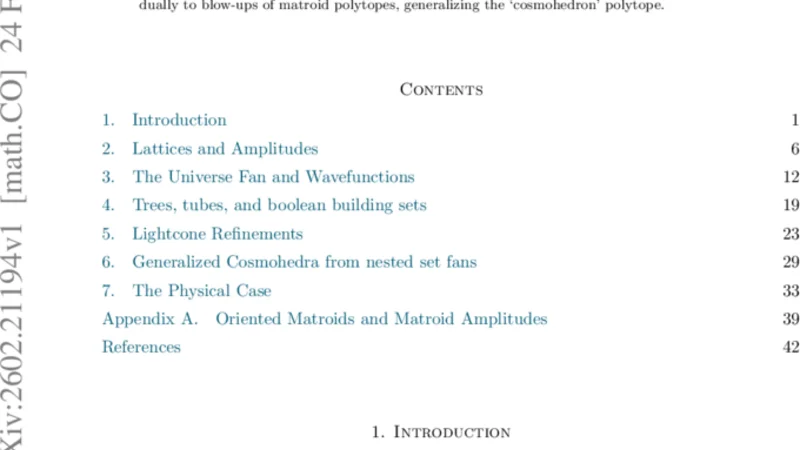
THE UNIVERSE F AN HADLEIGH FR OST AND FELIX LOTTER Abstract. The w a v efunction of the universe, as studied in perturbative quantum field theory , is a rational function whose singularities and factorization properties enco de a ric h underlying com binatorial structure. W e define and study a broad generalization of suc h w a v efunctions that can b e asso ciated to any lattice. W e obtain these wa v efunctions as the Laplace transform of a p olyhedral fan, the universe fan , whose cones are defined by positivity conditions reflecting a notion of causalit y in the lattice, and we describe its face lattice. In the matroid case, the univ erse fan pro jects to the nested set fan, and the wa v efunctions w e define reco v er the matroid amplitudes in troduced b y Lam as residues. Moreov er, in the case relev ant for physics, the p ositivity conditions giv e a nov el wa y to study the wa v efunction, and w e sho w ho w it is related to the cosmological polytop es of Ark ani-Hamed, Benincasa, P ostnik o v. Finally , we study refinements of the universe fan induced by piecewise linear (tropical) func- tions. The resulting sub divisions pro ject to refinements of the nested set fan and corresp ond dually to blo w-ups of matroid p olytopes, generalizing the ‘cosmohedron’ p olytop e. Contents 1. In tro duction 1 2. Lattices and Amplitudes 6 3. The Universe F an and W a v efunctions 12 4. T rees, tub es, and b o olean building sets 19 5. Ligh tcone Refinements 23 6. Generalized Cosmohedra from nested set fans 29 7. The Physical Case 33 App endix A. Oriented Matroids and Matroid Amplitudes 39 References 42 1. Introduction The Bergman fan (or tropical linear space) asso ciated to a matroid M enco des the combi- natorics of its flats via the tropicalization of a linear space [ FS04 ; Sp e08 ]. More prosaically , the Bergman fan of a matroid with ground set E is a fan in R E . Building sets in the lattice of flats define nested set fans, which are simplicial refinements of the Bergman fan [ Pos09 ; FM05 ]. The Bergman fan and its refinemen ts pla y an imp ortant role in tropical and discrete geometry . In this paper, we in troduce a new family of fans that realize higher-order com binatorial information in the complex of nested sets: the universe fan. Our motiv ation to study these fans is the cosmological wa v efunction from perturbative quan- tum field theory . The tree-lev el cosmological w a v efunction Ψ n is a rational function that de- scrib es the densit y fluctuations pro duced by quantum fields in the v ery early univ erse during the big bang [ AHBP17 ; AHB18 ]. F rom a com binatorial persp ective, the singularity structure of the wa v efunction is con trolled by partially ordered collections of subgraphs. These features place the cosmological wa v efunction naturally alongside ob jects from tropical and matroidal ge- ometry , including Bergman fans and their refinements. How ev er, while the relation of (tree-level 1 2 H. FROST AND F. LOTTER • • • • a b c (a) a b c ab b c ac ˆ 1 (b) Figure 1. The star graph (A), and the asso ciated building set (B) given by the graph’s connected subgraphs, where ˆ 1 = 1234 denotes the whole graph. ϕ 3 ) amplitudes to matroids and the com binatorics of nested sets has long b een understo o d (see [ AH+18 ] and more recen tly [ Lam24 ]), a similar description of the cosmological w a v efunction has still b een missing. This motiv ates our viewp oint in this pap er. Our results are also of interest for the original physical problem. W e iden tify a remark ably simple system of linear positivity conditions whose solution set cuts out the full wa v efunction. In particular, our results give partial answers to questions raised in [ AHBP17 , Section 8] and [ AHFV24 , Section 11]. 1.1. Nested sets, nestable sets, and causal regions. Fix some lattice L with maximal elemen t ˆ 1 and minimal element ˆ 0. W e consider sets G ⊆ L > ˆ 0 that satisfy G con tains ˆ 1 , and for incomparable f , g ∈ G , ( f ∨ g / ∈ G ) ⇒ ( f ∧ g = ˆ 0) . W e call G a nestable set , and study subsets N ⊂ G called neste d sets . These subsets form a simplicial complex, called the neste d set c omplex . W e are in terested in the cases where this complex (and its restrictions to interv als [ ˆ 0 , f ]) are pure. When this holds, we call the pair ( L, G ) a nestoid (Theorem 2.5 ). Nestoids are a relaxation of the notion of building sets. Building sets arose in the study of compactifications of subspace arrangements where they pro vide a combinatorial framework for organizing iterated blow-ups [ DCP95 ]. In a purely combinatorial form ulation due to F eic h tner and Y uzvinsky , a building set G ⊆ L ≥ ˆ 0 is defined for an arbitrary finite lattice L [ FY04 ]. Building sets give rise to nested set complexes and nested set fans, which refine Bergman fans in the case of matroid lattices and sometimes admit p olytopal realizations [ P os09 ; FM05 ]. Our main motiv ation for the introduction of nestoids is that, unlik e building sets, this class is ‘stable’ under taking links of the asso ciated nested set complexes, a prop erty made precise in Theorem 2.23 . In this pap er, we in troduce tw o rational functions for every nestoid: an amplitude and a c osmolo gic al wavefunction . These functions are obtained as the Laplace transform of unimodular p olyhedral fans: the fr e e neste d set fan and the universe fan . Lam [ Lam24 ] defined a class of amplitudes arising from orien ted matroids in a similar w a y , and this can b e viewed as a sp ecial case of our definition (Theorem 2.17 ). See also [ T el26 ]. The neste d sets N ⊂ G of a nestable set G are defined as for building sets. Namely , for any incomparable f 1 , f 2 , . . . ∈ N , one requires that their join is not in G : f 1 ∨ f 2 ∨ · · · ∈ G . Then the set of nested sets of G defines a simplicial complex called the neste d set c omplex . This complex is realized by the fr e e neste d set fan Σ G in R G , the fan with cones ⟨ f | f ∈ N ⟩ for each nested set N (Definition 2.9 ). These cones span unimo dular subspaces and so determine a rational function via a Laplace transform (as explained in e.g. [ Lam24 , Section 10.2]). W e define the amplitude A ( L, G ) asso ciated to L and G as the Laplace transform of Σ G / ⟨ ˆ 1 ⟩ . Example 1.1. Consider the star graph G (Figure 1a ) with three edges, a , b , and c . W e take the lattice L to b e the lattic e of flats of the associated matroid, whic h has one flat f for each subgraph of G (see Figure 1b ), with maximal element ˆ 1 for the whole graph. W rite G = L \ ˆ 0 for THE UNIVERSE F AN 3 (a) a b c ab b c ac ˆ 1 (b) Figure 2. A nested set { b, ab, ˆ 1 } of the building set G (B) corresp onds to a tubing of the graph (A). the maximal building set , con taining every non-empty flat. The 6 maximal nested sets of G take the form N = { f , g , ˆ 1 } , with f < g < ˆ 1. In fact, G is an example of a gr aphic al building set , and its nested sets are equiv alen tly tubings of G that do not use vertex tub es (Figure 2 ) 1 . The six maximal cones of Σ G are ⟨ a, ab, ˆ 1 ⟩ , ⟨ b, ab, ˆ 1 ⟩ , ⟨ b, bc, ˆ 1 ⟩ , ⟨ c, bc, ˆ 1 ⟩ , ⟨ c, ac, ˆ 1 ⟩ , ⟨ a, ac, ˆ 1 ⟩ , and the asso ciated amplitude is A ( L, G ) = 1 s a s ab + 1 s b s ab + 1 s b s bc + 1 s c s bc + 1 s c s ac + 1 s a s ac . This is a matroid amplitude in the sense of [ Lam24 ] under the substitution s f := P e ∈ f a e . This substitution corresp onds to a pro jection R G → R E whic h identifies Σ G with the nested set fan Σ G from [ FY04 ] (Theorem 2.17 ). In additional to the free nested set fan, each nestoid ( L, G ) defines a universe fan U G , which enco des more com binatorial data. Consider the v ector space R 2 G with t w o generators, f + and f − , for eac h f ∈ G . Then U G is a p olyhedral fan in R 2 G . In Section 3 , w e deriv e the generators and face lattice of U G , whic h can be taken as a definition of U G for the purp oses of this introduction. The generators of U G are giv en by nested sets R ⊂ G with one maximal elemen t and all other elemen ts incomparable. W e call suc h a nested set a c ausal r e gion . F or eac h causal region R = { r ∗ , r 1 , . . . , r k } , the vector w R := r + ∗ + X i r − i ∈ R 2 G is a generator of U G . Theorem 3.6 then shows that the maximal cones of U G are U N = Span R + w R | R ⊆ N a causal region , for each maximal nested set N . The face lattice of U G is given by Theorem 3.24 . The cones of U G span unimo dular subspaces (Theorem 5.15 ). By taking the Laplace transform w e obtain a rational function Ψ( L, G ) := L ( U G ), the wavefunction asso ciated to ( L, G ). Example 1.2. F or the star graph, as ab ov e, the univ erse fan U G in R 2 G has generators w f = f + for each flat f and w { f ,g } = f + + g − for each nested set { f , g } with g < f . The 6 maximal cones of U G are U N = ⟨ ˆ 1 + , f + , g + , ˆ 1 + + f − , ˆ 1 + + g − , g + + f − ⟩ for each nested set N = ( f < g < ˆ 1). The Laplace transform of U G defines the wavefunction Ψ( L, G ) = X f ˆ 0 is called a building set if for ev ery f / ∈ G , the in terv al [ ˆ 0 , f ] in L is the pro duct lattice [ ˆ 0 , g 1 ] × . . . × [ ˆ 0 , g k ], where g 1 , . . . , g k are the maximal elemen ts in G b elo w f . The elements g 1 , . . . , g k in the definition are also called the factors of f in G . The notion of building sets originated in the study of subspace arrangements [ DCP95 ]. It w as later generalized to arbitrary lattices [ FY04 ] and app ears in the study of matroids and B ergman fans [ FS04 ] and generalized p erm utahedra [ Pos09 ]. An element f of L is called irr e ducible if [ ˆ 0 , f ] is not a pro duct of t w o non-trivial subp osets. W rite I ( L ) for the set of irreducible elemen ts. Using this notion, building sets can equiv alen tly b e describ ed in the follo wing wa y: Prop osition 2.2 ([ BD24 , Prop osition 2.11]) . A subset G of L > ˆ 0 is a building set if and only if it c ontains ˆ 1 , I ( L ) ⊆ G and for f , g ∈ G , f ∨ g / ∈ G implies that f ∧ g = ˆ 0 . W e in tro duce the following terminology: Definition 2.3 (Nestable sets) . W e call a subset G ⊆ L > ˆ 0 nestable if it con tains ˆ 1, and if, for an y tw o incomparable f , g ∈ G , f ∨ g / ∈ G implies that f ∧ g = ˆ 0. By definition, a nestable set is a building set if and only if it contains the irreducible elements in L . One might think of a nestable set as an ‘incomplete’ building set. No w fix a pair ( L, G ) of a lattice together with a nestable set G ⊆ L > ˆ 0 . Definition 2.4 (Nested sets) . A subset N ⊆ G is neste d if, for any set of pairwise incomparable elemen ts f 1 , . . . , f k ∈ N , we ha v e f 1 ∨ . . . ∨ f k / ∈ G . W e denote the set of all nested sets in G b y N ( L, G ). An y subset of a nested set is nested, so that N ( L, G ) forms an abstract simplicial complex, the neste d set c omplex of ( L, G ). If G is a building set this complex is pure, see e.g. [ FM05 , Corollary 4.3]. This fails for a general nestable set and motiv ates the follo wing definition: Definition 2.5. A nestoid is a pair ( L, G ) of a lattice L and a nestable set G suc h that N ([ ˆ 0 , f ] , G ∩ [ ˆ 0 , f ]) is pure for all f ∈ G . Prop osition 2.6. Any building set defines a nestoid. THE UNIVERSE F AN 7 Pr o of. The nested set complex of a building set G is pure due to [ FM05 , Corollary 4.3]. The statemen t follows b ecause G ∩ [ ˆ 0 , f ] is a building set in [ ˆ 0 , f ], which can b e seen directly from the definition. □ R emark 2.7 . Our main motiv ation for the introduction of nestoids is that, as we will see, links of nested set complexes of nestoids factor into nested set complexes of nestoids. This will imply that the nestoid amplitudes defined b elow are ‘stable’ under taking residues, closely related to ‘unitarit y’ in physics. Example 2.8. Consider the follo wing lattice L : 1234 123 234 134 124 12 23 34 14 1 2 3 4 ˆ 0 Let G = { 4 , 12 , 123 , 124 , 1234 } . One c hec ks that ( L, G ) forms a nestoid (cf. also Theorem 2.23 b elo w). Note that G is not a building set in L as it do es not con tain all irreducible elements. Let ( L, G ) b e a nestoid. Its nested set complex can trivially b e realized as a unimodular simplicial p olyhedral fan in R G : Definition 2.9 (F ree nested set fan) . Let ( L, G ) b e a nestoid. F or N ∈ N ( L, G ), consider the cone Span R + N ⊆ R G . By definition, these cones assem ble into a fan Σ G in R G whic h we call the fr e e neste d set fan . R emark 2.10 . Note that the fan Σ G dep ends on the lattice L , even though w e omit it from the notation for simplicity . By definition, the face lattice of Σ G is the inclusion lattice of N ( L, G ). Let us remark on ho w the free nested set fan relates to the neste d set fan Σ G from [ FY04 , Section 5]. Indeed, in the case that L is an atomic lattice, Σ G is a lift of Σ G in a higher- dimensional space. Recall that the atoms of L are the minimal elements of L > ˆ 0 and that L is called atomic if ev ery f ∈ L is the join of the atoms e with e ≤ f . W e will sometimes identify f ∈ L with the set of atoms e ≤ f in the following. Note that f ∪ g ⊆ f ∨ g as sets but equality do es not hold in general. Definition 2.11. Assume L is an atomic lattice with set of atoms E . Then the nested set fan Σ G ⊆ R E asso ciated to G is the image of the free nested set fan Σ G ⊆ R G under the pro jection p : R G → R E , f 7→ X e ∈ f e. The image of Σ G under this map is indeed again a fan. This follo ws from the follo wing stronger result: Prop osition 2.12. The r estriction of p to Σ G is inje ctive. 8 H. FROST AND F. LOTTER Pr o of. W e construct a retract (of sets) r : p (Σ G ) → Σ G . W e do this b y induction on the cardinalit y of the supp ort of p ( x ). W rite x := P f ∈ N µ f f for some nested set N . Wlog. we assume that µ f > 0 for all f ∈ N . The supp ort F of p ( x ) is the set of e ∈ E that are contained in a maximal flat in N . W e claim that the set N max of maximal elemen ts of N is precisely the set F of maximal elemen ts in G that are contained in F (as sets). Indeed, take f ∈ F . F or every e ∈ f there is some g ∈ N max with e ∈ g . Let g 1 , . . . , g k b e the set of suc h g . In particular, f ≤ g 1 ∨ . . . ∨ g k . W e hav e f ∨ g i ∈ G for all i , since f ∧ g i = ˆ 0, whic h furthermore implies f ∨ g 1 ∨ . . . ∨ g k ∈ G . But f ∨ g 1 ∨ . . . ∨ g k = g 1 ∨ . . . ∨ g k whic h lies in G if and only if k = 1 since N is nested. This implies F = N max . Th us we can define the retract as follows: if the supp ort of p ( x ) is empt y , then we m ust ha v e x = 0 and so we map p ( x ) 7→ 0. Otherwise, let F ⊆ E b e the supp ort of p ( x ). Let F b e the set of maximal elements in G contained in F and let λ := min e ∈ F e ∗ ( p ( x )). Set r ( p ( x )) := λ P f ∈F f + r ( p ( x ) − λ P f ∈F P e ∈ f e ) whic h is well-defined by induction (note that for f = g ∈ F w e hav e f ∧ g = ˆ 0). W e claim that r ( p ( x )) = x . Indeed, note that we ha v e λ = min f ∈ N max µ f . Set y := x − λ P f ∈ N max f . By induction, w e ha v e r ( p ( y )) = y . But note that p ( y ) = p ( x ) − λ P f ∈N max P e ∈ f e and so since F = N max , we conclude. □ In [ Lam24 , Theorem 10.17], the matroid amplitude is written as the Laplace transform of a certain nested set fan. Similarly , w e define the amplitude of a nestoid as a Laplace transform of a free nested set fan: Definition 2.13 (Nestoid amplitudes) . Let ( L, G ) b e a nestoid. Then the nestoid amplitude A ( L, G ) is the Laplace transform of Σ G / ⟨ ˆ 1 ⟩ . Unra v elling the definitions, w e hav e A ( L, G ) = X N ∈N max ( L, G ) Y f ∈ N 1 s f where s f is the co ordinate function on R G asso ciated to f . Example 2.14. Consider the lattice L given b y ∅ 1 2 3 12 23 13 123 This is the b o olean lattice on { 1 , 2 , 3 } . Let G = L \{ ˆ 0 } . This defines a nestoid ( L, G ). The free nested set fan Σ G has six maximal cones: ⟨ 1 , 12 , 123 ⟩ , ⟨ 2 , 12 , 123 ⟩ , ⟨ 2 , 23 , 123 ⟩ , ⟨ 3 , 23 , 123 ⟩ , ⟨ 3 , 13 , 123 ⟩ , ⟨ 1 , 13 , 123 ⟩ . The Laplace transform of Σ G / ⟨ ˆ 1 ⟩ gives the amplitude A ( L, G ) = 1 s 1 s 12 + 1 s 2 s 12 + 1 s 2 s 23 + 1 s 3 s 23 + 1 s 3 s 13 + 1 s 1 s 13 . THE UNIVERSE F AN 9 Example 2.15. Let us consider the ‘b owtie’ graph c b a d f e Let us c ho ose the lattic e of flats of the asso ciated graphical matroid as our lattice L . This is simply the set of disjoin t unions of connected induced subgraphs. Let G b e the set of connected induced subgraphs. This is a building set in L . There are 38 maximal nested sets in N ( L, G ) ˆ 1 abcd abce adef bdef abc ad be ae bd def a b c d e f ˆ 0 Figure 4. The p oset G for the b owtie graph. and eac h maximal nested set has cardinalit y 4. Accordingly , the amplitude A ( L, G ) is a sum of 38 Lauren t monomials, each of degree − 3. The maximal nested sets are given b y maximal singleton-free tubings of the graph. 28 of these are simply c hains in the lattice. The 10 remaining sets are { a, abc, f , ˆ 1 } { b, abc, f , ˆ 1 } { d, def , c, ˆ 1 } { e, def , c, ˆ 1 } { c, abc, f , ˆ 1 } { c, def , f , ˆ 1 } { c, d, abcd, ˆ 1 } { c, e, abce, ˆ 1 } { f , a, adef , ˆ 1 } { f , b, bdef , ˆ 1 } 2.2. Matroid amplitudes. Let us now sp ell out the relation of nestoid amplitudes to the matroid amplitudes defined in [ Lam24 ]. F or the con v enience of the reader, w e give a short o v erview in Section A . Recall that the p ositive neste d set c omplex asso ciated to a top e P of an orien ted matroid M is the subset N ( L ( M ) , G ) P := { N ∈ N ( L ( M ) , G ) | N ⊆ L ( P ) } where L ( P ) ⊆ L ( M ) is the Las V ergnas face lattice of P . Lemma 2.16. The set G ∩ L ( P ) is a building set in L ( P ) and N ( L ( M ) , G ) P = N ( L ( P ) , G ∩ L ( P )) . Pr o of. If we ha v e f ∨ g / ∈ G ∩ L ( P ) for f , g ∈ L ( P ), then already f ∨ g / ∈ G , since L ( P ) is stable under joins in L ( M ). Th us, G ∩ L ( P ) is a nestable set. Since the irreducible elements in L ( P ) are still irreducible in L ( M ), G ∩ L ( P ) is a building set by Theorem 2.2 . The second assertion then follows again by stabilit y of L ( P ) under joins in L ( M ). □ The matroid amplitude A ( P ) is defined as the Laplace transform of the nested set fan asso- ciated to N ( L ( M ) , G ) P . See Section A.3 . 10 H. FROST AND F. LOTTER Prop osition 2.17. The matr oid amplitude A ( P ) is obtaine d fr om the nestoid amplitude A ( L ( P ) , G ∩ L ( P )) for an arbitr ary building set G in the lattic e L ( M ) by the substitution s f = P e ∈ f a e . Pr o of. Combine Theorem 2.12 and Theorem 2.16 . □ R emark 2.18 . The matroid amplitude do es not dep end on the choice of building set in L ( M ): b y [ FM05 , Theorem 4.2], different building sets induce different refinements of the nested set fan asso ciated to the minimal building set G min , and so the Laplace transform do es not change. Mean while, the asso ciated nestoid amplitudes clearly differ. Ho w ev er, it is implicit in the pro of of [ FM05 , Theorem 4.2] that every free nested set fan pr oje cts to a refinemen t of the free nested set fan asso ciated to G min . This means that after replacing s g for g ∈ G b y P g ′ ∈ F ( g ) s g ′ where F ( g ) is the set of factors of g in G min (see Theorem 2.1 ), the differen t nestoid amplitudes are iden tified. Example 2.19. Consider the p ositiv e top e P of the graphical oriented matroid x y w z Its Las V ergnas face lattice is isomorphic to the lattice in Theorem 2.14 . W e can c ho ose G = L ( M ) \{ ˆ 0 } , so that ( L ( P ) , G ∩ L ( P )) is the nestoid that we considered there. Accordingly , the nestoid amplitude is 1 s xw s xwz + 1 s wz s xwz + 1 s y w s y wz + 1 s wz s y wz + 1 s xw s xwy + 1 s y w s xwy . According to Theorem 2.17 w e obtain the matroid amplitude by substitution: 1 a xw ( a xw + a wz + a xz ) + 1 a z w ( a xw + a wz + a xz ) + 1 a y w ( a y w + a wz + a y z ) + 1 a z w ( a y w + a wz + a y z ) + 1 a xw ( a xw + a y w ) + 1 a y w ( a xw + a y w ) Note that the sum of the last tw o terms simplifies to 1 a xw a yw . This corresp onds to the fact that the minimal building set on L ( M ) do es not include the flat { xw , y w } : its factors in G min are { xw } and { y w } . On the level of nestoids, we can v erify Theorem 2.18 : replacing s xwy with s xw + s y w , A ( L ( P ) , G ∩ L ( P )) indeed simplifies to A ( L ( P ) , G min ∩ L ( P )) = 1 s xw s xwz + 1 s wz s xwz + 1 s y w s y wz + 1 s wz s y wz + 1 s xw s y w . 2.3. F actorization. Let ( L, G ) b e a nestoid, for example given b y a building set in the lattice. W e are in terested in the links of ra ys in Σ G as they correspond to residues of the asso ciated amplitude. W e will see that if the nestoid is sufficien tly nice, the links factor again as pro ducts of free nested set fans. Definition 2.20. W e call a nestoid ( L, G ) stable if for f , g 1 , . . . , g k ∈ G with f ∨ g i / ∈ G for all i w e hav e f ∨ g 1 ∨ . . . ∨ g k / ∈ G . R emark 2.21 . If L is a b o olean lattice and G a building set, then ( L, G ) is stable if and only if G is graphical, see [ Zel05 , Prop osition 7.3]. Ho w ev er, in a bo olean lattice factorization works without the stableness assumption, see [ Zel05 , Prop osition 3.2]. THE UNIVERSE F AN 11 W e first make a useful observ ation: Lemma 2.22. L et ( L, G ) b e a nestoid, x ∈ L and y ∈ G with x ∨ y / ∈ G . Then x ∨ z / ∈ G for al l z ∈ [ ˆ 0 , y ] . Pr o of. Assume x ∨ y / ∈ G and let z ≤ y . W e can not ha v e x ∨ z ≤ y , and y ≤ x ∨ z implies x ∨ z = x ∨ y / ∈ G . Otherwise, y and x ∨ z are incomparable and so if x ∨ z ∈ G , y ∨ ( x ∨ z ) = x ∨ y / ∈ G implies y ∧ ( x ∨ z ) = ˆ 0, since G is nestable. This is imp ossible since z ≤ y and z ≤ ( x ∨ z ). □ Using the lemma and the stableness assumption, we obtain a factorization property of nested set complexes: Lemma 2.23. L et ( L, G ) b e a stable nestoid and f ∈ G and c onsider the two sets G ⌈ f ⌉ := { g ∈ G | g ≤ f } and G ⌊ f ⌋ := { g ∈ G | g > f or g ∨ f / ∈ G } . Then b oth ([ ˆ 0 , f ] , G ⌈ f ⌉ ) and ( L, G ⌊ f ⌋ ) ar e stable nestoids and N ( L, G ) ∋ f ≃ N ([0 , f ] , G ⌈ f ⌉ ) ∋ f × N ( L, G ⌊ f ⌋ ) wher e N ( L, G ) ∋ f denotes the subset of neste d sets c ontaining f . Pr o of. Clearly G ⌈ f ⌉ is again nestable and stable since [ ˆ 0 , f ] is closed under taking joins. If b 1 , . . . , b k ∈ G ⌊ f ⌋ with b 1 ∨ . . . ∨ b k ∈ G then b y stableness also b 1 ∨ . . . ∨ b k ∈ G ⌊ f ⌋ . The con trap osition implies that G ⌊ f ⌋ is nestable and stable. The same reasoning sho ws that for ev ery nested set N ∈ N ( L, G ) ∋ f w e ha v e that N ∩ G ⌈ f ⌉ and N ∩ G ⌊ f ⌋ are again nested sets with resp ect to G ⌈ f ⌉ and G ⌊ f ⌋ , and clearly N = ( N ∩ G ⌈ f ⌉ ) ∪ ( N ∩ G ⌊ f ⌋ ). Conv ersely , take N 1 ∈ N ([0 , f ] , G ⌈ f ⌉ ) ∋ f and N 2 ∈ N ( L, G ⌊ f ⌋ ). W e claim that N 1 ∪ N 2 is again nested. Indeed, let g 1 , . . . , g k ∈ N 1 and h 1 ∨ . . . ∨ h l ∈ N 2 suc h that g 1 , . . . , g k , h 1 , . . . , h l are pairwise incomparable. In particular, g 1 ∨ . . . ∨ g k / ∈ G and h 1 ∨ . . . ∨ h l / ∈ G . Assume that k , l ≥ 1. Let us chec k that g 1 ∨ . . . ∨ g k ∨ h 1 ∨ . . . ∨ h l / ∈ G . F or this, note that b y incomparability we m ust hav e h i ∨ f / ∈ G for all i . No w w e can apply Theorem 2.22 with x = h 1 ∨ . . . ∨ h l and y = f . By the stableness assumption x ∨ y / ∈ G and th us x ∨ g 1 ∨ . . . ∨ g k / ∈ G . It remains to chec k the purit y condition in Theorem 2.5 . This is clear for ([ ˆ 0 , f ] , G ⌈ f ⌉ ). T o see this for G ⌊ f ⌋ , pick some g ∈ G ⌊ f ⌋ and note that G ⌊ f ⌋ , ⌈ g ⌉ = G ⌈ g ⌉ , ⌊ f ⌋ . Since b oth G ⌈ g ⌉ and G ⌈ f ⌉ are nestoids, the factorization we already prov ed ab ov e implies that the nested set complex of G ⌈ g ⌉ , ⌊ f ⌋ is again pure. □ R emark 2.24 . If G is a stable building set, then G ⌈ f ⌉ will again b e a building set for the sublattice [ ˆ 0 , f ] of L . How ev er, it is clear that G ⌊ f ⌋ will usually not b e a building set in L (see e.g. Theorem 2.8 ). Corollary 2.25 (F actorization of amplitudes) . L et ( L, G ) b e a stable nestoid and let f ∈ G . Then the link of f in Σ G is the pr o duct Σ G ⌈ f ⌉ / ⟨ f ⟩ × Σ G ⌊ f ⌋ . In p articular, we have Res s f =0 A ( L, G ) = A ([0 , f ] , G ⌈ f ⌉ ) · A ( L, G ⌊ f ⌋ ) . Pr o of. The first statement follows from the definitions and Theorem 2.23 . The residue of the Laplace transform of Σ G / ⟨ ˆ 1 ⟩ at s f = 0 is the Laplace transform of the link Σ G / ⟨ ˆ 1 , f ⟩ . By the first statement, this is the pro duct fan Σ G ⌈ f ⌉ / ⟨ f ⟩ × Σ G ⌊ f ⌋ / ⟨ ˆ 1 ⟩ . Note that f = ˆ 1 [0 ,f ] , so that this indeed Laplace transforms to the pro duct A ([0 , f ] , G ⌈ f ⌉ ) · A ( L, G ⌊ f ⌋ ). □ R emark 2.26 . This is an analogue of [ Lam24 , Theorem 17.4]: if G is a stable building set then the factorization is the one from lo c. cit. under the substitution in Theorem 2.17 . 12 H. FROST AND F. LOTTER Example 2.27. Recall the b owtie graph from Theorem 2.15 . Let us compute the residue of the asso ciated amplitude A ( L, G ) at s abc = 0. The p osets G ⌊ abc ⌋ and G ⌈ abc ⌉ are given by ˆ 1 abcd abce f and abc a b c . The maximal nested sets for G ⌊ abc ⌋ and G ⌈ abc ⌉ are thus {{ abcd, ˆ 1 } , { abce, ˆ 1 } , { f , ˆ 1 }} and {{ a, abc } , { b, abc } , { c, abc }} and so by Theorem 2.25 we hav e Res s abc =0 A ( L, G ) = 1 s abcd + 1 s abce + 1 s f · 1 s a + 1 s b + 1 s c . F or the residue at s ae = 0 we compute G ⌊ ae ⌋ = ˆ 1 abce adef and G ⌈ ae ⌉ = ae a e and thus Res s ae =0 A ( L, G ) = 1 s abce + 1 s adef · 1 s a + 1 s e . 3. The Universe F an and W a vefunctions In the previous section, w e asso ciated amplitudes to building sets (and more generally , nestoids) in a lattice, by taking the Laplace transform of the free nested set fan. Similarly , w e will no w define the cosmological wa v efunction of a nestoid as the Laplace transform of the universe fan , which w e introduce next. 3.1. The universe fan. Let ( L, G ) b e a nestoid, for example a lattice with a building set. F or f ∈ G we in tro duce symbols f + , f − . Let R 2 G denote the v ector space spanned by all f + , f − . F or a nested set N we will also write R 2 N ⊆ R 2 G for the subspace spanned b y f + , f − with f ∈ N . Definition 3.1. The double d fr e e neste d set fan is the fan Σ 2 G ⊆ R 2 G whose maximal cones are R 2 N + for N ∈ N ( L, G ). W e denote the vectors dual to f + , f − b y p f , m f . Definition 3.2 (The causal cone) . Let g ∈ G and define F g := p ˆ 1 + X g h>f ( p h − m h ) + p f + X h ∈G ⌈ R ⌉ m h − m f + X f >h>g ( p h − m h ) − m g and so F g ≥ 0 is already implied by F f ≥ 0. Finally , for g ≤ g i , F g is mapp ed to p ˆ 1 + X ˆ 1 >h>f ( p h − m h ) + p f − m f + X g i >h>g ( p h − m h ) − m g . Theorem 3.12 implies that the nested sets con taining R are exactly the unions N 1 ⊔ N 2 suc h that N 1 ∈ N ([0 , f ] , G ⌈ R ⌉ ) do es not contain f and N 2 ∈ N ( L, H ) con tains f , g 1 , . . . , g k . Moreov er, w e saw that the constraints on R 2 G b ecome indep endent constraints on R 2 G ⌈ R ⌉ / ⟨ f − , f + ⟩ and R 2 H / ⟨ u R ⟩ under the isomorphism σ × id. They are precisely the constrain ts for the cones in the doubled nested set fan Σ 2 G ⌈ R ⌉ / ⟨ f + , f − ⟩ and the universe fan U H / ⟨ u R ⟩ . □ Corollary 3.14. In the situation and notation of The or em 3.13 , set E R := E + f + E − g 1 + . . . + E − g k . Then we have 1 E R Res E R =0 Ψ( L, G ) = A sh E ([ ˆ 0 , f ] , G ⌈ R ⌉ ) · Ψ( L, H ) wher e A sh E ( G ⌈ R ⌉ ) is obtaine d fr om A E ( G ⌈ R ⌉ ) by substituting E + h 7→ E + h + X g i ≤ h E − g i , E − h 7→ E − h − X g i ≤ h E − g i . Pr o of. This follo ws b y applying the Laplace transform to Theorem 3.13 , noting that in U H ev ery maximal cone con tains w R and that in the quotient h − + f + + P g i ∨ h / ∈G g − i ≡ h − − P g i ≤ h g − i . □ 16 H. FROST AND F. LOTTER Example 3.15. Contin uing with the bowtie in Theorem 2.15 and Theorem 3.8 , let us compute some residues of Ψ( L, G ). First, consider the residue at E R = 0 for R = { ˆ 1 , abc } , i.e., E R = E + ˆ 1 + E − abc . According to Theorem 3.14 , w e first need to determine H = G ⌊ R ⌋ ∪ { ˆ 1 } and G ⌈ R ⌉ . W e ha v e H = ˆ 1 abc a b c and G ⌈ R ⌉ = ˆ 1 abcd abce f The amplitude A E ( L, G ⌈ R ⌉ ) is the function 1 E + abcd E − abcd E + f E − f + 1 E + abce E − abce E + f E − f . According to The- orem 3.14 we obtain A sh E ( L, G ⌈ R ⌉ ) by substitution: 1 ( E + abcd + E − abc )( E − abcd − E − abc ) E + f E − f + 1 ( E + abce + E − abc )( E − abce − E − abc ) E + f E − f Next, w e need to compute the wa vefunction Ψ( L, H ). The maximal nested sets are the three c hains in H . As in Theorem 3.7 we use the triangulation of the three maximal cones U N from Theorem 5.15 to obtain Ψ( L, H ) = 1 E + ˆ 1 ( E + ˆ 1 + E − abc )( E + abc + E − a ) E + a 1 E + abc + 1 E + ˆ 1 + E − a ! + 1 E + ˆ 1 ( E + ˆ 1 + E − abc )( E + abc + E − b ) E + b 1 E + abc + 1 E + ˆ 1 + E − b ! + 1 E + ˆ 1 ( E + ˆ 1 + E − abc )( E + abc + E − c ) E + c 1 E + abc + 1 E + ˆ 1 + E − c ! . Note that E + ˆ 1 + E − abc app ears indeed as a simple p ole in all three terms. As a second example, consider R = { adef , a } . Then H = ˆ 1 adef a and G ⌈ R ⌉ = adef ae ad f and thus A sh E ([ ˆ 0 , adef ] , G ⌈ R ⌉ ) is given by 1 ( E + ae + E − a )( E − ae − E − a ) E + f E − f + 1 ( E + ad + E − a )( E − ad − E − a ) E + f E − f and Ψ( L, H ) = 1 E + ˆ 1 ( E + ˆ 1 + E − adef )( E + adef + E − a ) E + a 1 E + adef + 1 E + ˆ 1 + E − a ! . 3.3. The maximal cones and cosmological p olytop es. Fix a maximal nested set N . By definition, the maximal cone U N in the universe fan is cut out b y p g , m g , F g ≥ 0 for g ∈ N and p g = m g = 0 for g / ∈ N . View U N as a full dimensional cone in the 2 | N | − 1 dimensional co ordinate hyperplane m ˆ 1 = 0 in R 2 N . Then p g , m g , F g (for g = ˆ 1) are the extremal rays of the dual c one U ∨ N . In particular, there are 3 | N | − 3 of them. On the other hand, for incomparable f , g ∈ N we ha v e f ∧ g = ˆ 0, and so the Hasse diagram of N is a ro oted tree T N with | N | v ertices and | N | − 1 edges. The vertices of T N , V ( T N ), are lab elled by the f ∈ N , with ˆ 1 the top vertex or ro ot. The edges of T N , E ( T N ), are lab elled b y f ∈ N with f = ˆ 1: i.e. eac h edge is lab elled b y the vertex at the b ottom of the edge. See Figure 6 . THE UNIVERSE F AN 17 ˆ 1 b a c d a c b d Figure 6. The tree T N for a nested set N = { a, b, c, d, ˆ 1 } with a < b , c < b , b < ˆ 1 and d < ˆ 1. Edges are lab elled by their lo w er vertices. The c osmolo gic al p olytop e of a graph is defined b y [ AHBP17 ]. In the case of a tree T N , in tro duce a v ector x f for every vertex in V ( T N ) and a v ector y f (with f = ˆ 1) for every edge in E ( T N ). These v ectors span a vector space R E ( T N ) ∪ V ( T N ) . Then, for an edge f < g of T N , consider the three vectors x f + x g − y f , x f − x g + y f , − x f + x g − y f . The c osmolo gic al p olytop e of T N is the conv ex h ull of these v ectors for all edges of T N . Prop osition 3.16. F or a maximal neste d set N , the c one dual to U N is the c one over the c osmolo gic al p olytop e of T N under a line ar isomorphism. The isomorphism is given by ( R 2 N ) ∨ / ⟨ m ˆ 1 ⟩ → R E ( T N ) ∪ V ( T N ) p ˆ 1 7→ 2 x ˆ 1 p g 7→ x g + y g − x f m g 7→ x f + y g − x g wher e g < ˆ 1 and f is the unique element c overing g in N . Pr o of. T o see that this maps defines an isomorphism, just note that p g + m g 7→ 2 y g and p g − m g 7→ 2( x g − x f ). Using that p ˆ 1 7→ 2 x ˆ 1 and that N defines a tree this shows that the map is a bijection. Finally , w e see that F g = p ˆ 1 + X f ∈ N g g . This implies that F g = − m g on C , and since C lies in the positive cone, F g = m g = 0, i.e., g / ∈ β − , β • . F or iii ), iv ) and v ), take f , g ∈ N such that f cov ers g . Note that F g = F f + p f − m g , obtained by comparing adjacent terms in the chain expression for F g . Th us, if m g = F g = 0 on C we must hav e p f = F f = 0. Similarly , if p f = F f = 0, we must ha v e F g = m g = 0. □ Con v ersely , a marking determines a cone of the univ erse fan by imposing p g = 0 for g / ∈ β + N , m g = 0 for g / ∈ β − N , and F g = 0 for g ∈ N \ β • N . T o see that the tw o constructions are in v erse to eac h other, let us determine the rays of the asso ciated cone. Recall from Theorem 3.6 that the rays of the universe fan are the vectors w R for causal regions R . Let us call a region R = { r ∗ , r 1 , . . . , r k } adapte d to β N if r ∗ ∈ β + N , r 1 , . . . , r k ∈ β − N and for every g ∈ N with g ≤ r ∗ , g ≤ r 1 , . . . , r k , we hav e g ∈ β • N . Prop osition 3.22. The c one C asso ciate d to a marke d neste d set ( N , β N ) is sp anne d by the r ays w R for al l c ausal r e gions R adapte d to β N . Pr o of. It suffices to chec k which rays are con tained in C . It is easy to see that a ra y w R is con tained in C if and only if R is adapted to ( N , β N ). □ Example 3.23. Consider the markings from Theorem 3.20 . Let us compute the cone associated to { 123 + , 12 + −• , 1 + −• } . The causal regions adapted to this marking are { 123 } , { 123 , 12 } , { 123 , 1 } , { 12 } , { 12 , 1 } and { 1 } . THE UNIVERSE F AN 19 Consequen tly , the asso ciated cone is ⟨ 123 + , 123 + + 12 − , 123 + + 1 − , 12 + , 12 + + 1 − , 1 + ⟩ . F or { 123 + , 12 + − , 1 •− } , we obtain the cone ⟨ 123 + + 12 − , 12 + , 12 + + 1 − ⟩ , and { 12 + , 1 − } corresp onds to the one-dimensional cone spanned by 12 + + 1 − . Theorem 3.24. The c ones of the universe fan ar e one-to-one with marke d neste d sets via The or em 3.21 . Pr o of. Starting with a cone C , it is clear that the cone of the marking asso ciated to C is C . Now let ( N , β N ) and C the asso ciated cone. Pick g ∈ β + N . Let R b e the union of all maximal chains of cov erings h 1 ≤ . . . ≤ h k ≤ g such that h 2 , . . . , h k / ∈ β − N . By definition of markings, for ev ery suc h chain w e must hav e h 2 , . . . , h k ∈ β • N and either h 1 ∈ β − N , or h 1 is minimal and h 1 ∈ β • N . Let R − b e the set of all h 1 with h 1 ∈ β − N . Then R := { g } ∪ R − is a causal re gion adapted to β N . By Theorem 3.22 , w R ∈ C , and since p g ( w R ) = 0, g ∈ β + ( C ). Analogous argumen ts sho w that β − N = β − ( C ) and β • N = β • ( C ). □ R emark 3.25 . Recall from Theorem 3.16 that the maximal cones of the univ erse fan are dual to cosmological p olytop es. In particular, w e recov er precisely the markings from [ AHBP17 ] after restricting to subsets of a fixed nested set N . The face lattice of the fan is the inclusion lattice of rays, and so we obtain a full description of the face lattice in terms of marked nested sets. Indeed, let us define a partial order on marked nested sets b y letting ( N , β N ) ≤ ( M , β M ) if N ⊆ M and every causal region adapted to β N is also adapted to β M . This is the case if and only if β + N ⊆ β + M , β − N ⊆ β − M , β • N ⊆ β • M and for ev ery causal region { r ∗ , r 1 , . . . , r k } adapted to β N and for ev ery g ∈ M \ N with g ≤ r ∗ , g ≤ r 1 , . . . , r k , w e hav e g ∈ β • M . Example 3.26. Consider the bo olean lattice L on the set { 1 , 2 } , with the maximal building set L \{ ˆ 0 } . Using mark ed nested sets, we can dra w the face lattice of the associated univ erse fan U G . { 12 + , 1 + −• } { 12 + , 2 + −• } { 12 + , 1 + − } { 12 + , 1 + • } { 12 + , 1 −• } { 12 + , 2 −• } { 12 + , 2 + • } { 12 + , 2 + − } { 1 + } { 12 + , 1 − } { 12 + } { 12 + , 2 − } { 2 + } ∅ 4. Trees, tubes, and boolean building sets The Universe F an was defined in Section 3 inside the double d vector space R 2 G , with tw o generators f + and f − for each f ∈ G . The goal of this section is to explain a simple graph in terpretation of these doubled generators after restricting to a fixed cone, i.e. to a fixed nested set N ⊆ G . Eac h f ± corresp onds to a subset of N obtained b y cutting a single edge in the Hasse diagram of N to produce t w o connected comp onen ts. This viewp oint leads us to study sub divisions of R N + defined by piecewise linear functions. The nested set fan is a sp ecial case. In Section 5 we pull back these sub divisions to obtain global refinemen ts of the universe fan. One suc h refinement is used to complete the pro of of Theorem 3.6 . Finally , these sub divisions also serv e as a com binatorial input to the results on p olytop es and normal fans in Section 6 . 4.1. Cuts of T N and the canonical pro jection. Fix a nested set N ⊆ G . Since f ∧ g = ˆ 0 for incomparable f , g ∈ N , the Hasse diagram of N is a forest. Let T N denote the connected ro oted tree obtained from the Hasse diagram of N b y adjoining a common ro ot v ertex ⋆ (Figure 7a ). W e regard the ro ot as the ‘top’ of the tree, and each edge of T N is uniquely lab elled by its 20 H. FROST AND F. LOTTER lo w er endp oint. In other words, w e identify its edge and vertex sets as E ( T N ) ∼ = N , V ( T N ) = N ∪ {∗} . 1 3 123 6 56 ⋆ 1 3 6 123 56 (a) 1 3 123 6 56 ⋆ (b) Figure 7. (A) The Hasse diagram for N = { 1 , 3 , 123 , 6 , 56 } (black) and the connected tree T N obtained by adding a ro ot ⋆ . Edge lab els are shown in blue. (B) The subtree 123 + (red) and the subtree 3 − (blue) intersect in a subtree with edge set E (123 + ) ∩ E (3 − ) = { 1 } . No w tak e any edge f ∈ N of T N . Removing this edge pro duces tw o connected trees: the tree b elow f , and the complementary comp onent. The edge sets of the tw o trees are E ( f + ) = { g ∈ N | g < f } , E ( f − ) = { g ∈ N | g > f or g ∧ f = ˆ 0 } . Also write V ( f ± ) ⊆ V ( T N ) for the vertex sets of these comp onen ts. As suggested b y the notation, we identify the generators f ± of R 2 N with these subtrees of T N . In fact, w e can view p ositiv e integer linear com binations of these generators as b eing subgraphs of T N and vice versa. Consider the edge sets E ( f + ) and E ( g − ) for some g < f in N , as the asso ciated subtrees. The union of these tw o subtrees is the whole tree, E ( f + ) ∪ E ( g − ) = N . Their in tersection of these t w o subtrees is the subtree b elo w f but not below g , E ( f + ) ∩ E ( g − ) = { h | h < f , h < g } (see Figure 7b ). Motiv ated by this, define a map ϕ : R 2 N − → R N / ⟨ u tot ⟩ , ϕ ( f ± ) := X g ∈ N f ± g , where u tot is the vector corresponding to the whole tree, u tot = P g ∈ N g . ϕ is a surjection. Moreo v er, if N has a unique maximal elemen t, f max , note that ϕ ( f − max ) = 0, so that ϕ is w ell defined on the quotient space R 2 N / ⟨ f − max ⟩ . In Section 5.1 , we will see that sub divisions of R N + pullbac k under ϕ to give sub divisions of R 2 N + . T o this end, we collect some simple statemen ts ab out sub divisions of R N + in Sections 4.2 and 4.3 , b elow. Example 4.1. F or a first example of how we use ϕ , take N = { g , f } with f > g . Then T N is the linear graph with t w o edges. The map ϕ acts on generators as ϕ : R 2 N / ⟨ f − ⟩ → R N / ⟨ f + g ⟩ , ϕ : f + 7→ g , g + 7→ 0 , g − 7→ f . Then consider the sub division of R N + in to the tw o cones ⟨ f , f + g ⟩ and ⟨ g , f + g ⟩ . These pullbac k under ϕ to giv e a sub division of R 2 N + / ⟨ f − ⟩ in to t w o simplicial cones: ⟨ g + , g − , g − + f + ⟩ and ⟨ g + , f + , g − + f + ⟩ . See Figure 8 . R emark 4.2 . The surjection ϕ factors through a natural isomorphism which records subtrees by b oth its edges and v ertices. Let R E ( T N ) and R V ( T N ) b e the vector spaces with bases the edges and vertices of T N , and define ˆ u tot := X e ∈ E ( T N ) e + X v ∈ V ( T N ) v . THE UNIVERSE F AN 21 g + g − f + ϕ f g • • Figure 8. Cartoon of the map ϕ for N = { f , g } ( f > g ) in Example 4.1 . The pullbac k of a sub division of R N + defines a sub division of R 2 N + (sho wn in red). Define (4) ψ : R 2 N − → R E ( T N ) ⊕ R V ( T N ) / ⟨ ˆ u tot ⟩ , ψ ( f ± ) := X e ∈ E ( f ± ) e + X v ∈ V ( f ± ) v . This is a linear isomorphism. The in v erse map ψ − 1 can b e describ ed explicitly: – If v ∈ V ( T N ) \ {∗} , let f b e the unique edge ab o v e v (tow ard the root) and let g 1 , . . . , g k b e the edges b elo w v . Then ψ − 1 ( v ) = f + + g − 1 + · · · + g − k . – F or an edge e ∈ E ( T N ), one has ψ − 1 ( e ) = − ( e + + e − ) . (W e view e and v as basis v ectors in R E ( T N ) and R V ( T N ) , and w e implicitly pass to the quotient.) W e emphasize that this isomorphism is not the same as the cut-related identification app earing in Section 3.3 ; the t w o maps enco de different data and pla y different roles in the pap er. 4.2. Sub divisions from Bo olean building sets. W e ha v e seen that (integer) p oints of R 2 N + are naturally asso ciated to subtrees of T N (via the map ϕ ). Since E ( T N ) = N , an y subtree determines a subset of N by its edge set. These hav e a natural p oset structure, ordered by inclusion in the Boolean lattice 2 N . The edge sets of connected subtrees of T N form a distin- guished family of subsets in 2 N . This is an example of a Bo ole an building set , which we now review. Bo olean building sets enco de the nesting prop erties of the subtrees of T N . It is this com binatorics of nested subtrees that allows us to define the fan refinements and p olytop es w e study in Sections 5 and 6 . A Bo olean building set on N is a collection of subsets B ⊆ 2 N con taining all singletons, and suc h that whenever S, S ′ ∈ B intersect, their union again lies in B : S ∩ S ′ = ∅ = ⇒ S ∪ S ′ ∈ B for all S, S ′ ∈ B . In other words, if t w o subgraphs in our collection share a common edge, then their union should also b e in our collection. An imp ortant sp ecial case is the gr aphic al building set of the tree T N , given by all the connected subgraphs: B ( T N ) := { S ⊆ N : S is the edge set of a connected subgraph of T N } . This choice will b e used in Section 5 to pro duce a simplicial refinement of the constructions of Section 3 , culminating in Prop osition 5.15 . No w tak e B an arbitrary Bo olean building set on N . Let x = ( x g ) g ∈ N denote coordinates on R N , and consider the p ositive orthant, x g ≥ 0. Consider the follo wing t w o piecewise linear functions on R N + : α max B ( x ) := X S ∈B max g ∈ S x g , α min B ( x ) := X S ∈B min g ∈ S x g . 22 H. FROST AND F. LOTTER The domains of linearity of α max B and α min B b oth define p olyhedral sub divisions of R N + . W e denote the corresp onding fans as Σ max / min B = the fan of domains of linearity of α max / min B . Adding a constan t to all coordinates shifts b oth max g ∈ S x g and min g ∈ S x g b y the same constan t, so the domains of linearity are inv arian t under translation by u t ot = ⟨ (1 , . . . , 1) ⟩ . Consequently , b oth of these fans descend to the quotien t and define sub divisions of R N + / ⟨ u t ot ⟩ . Example 4.3 (Barycentric sub division) . Let B = 2 N \∅ b e the building set consisting of al l subsets of N . Then eac h of the domains of linearity of α max B (and similarly of α min B ) is given by the cones cut out b y imp osing a total order on N : x g 1 ≥ x g 2 ≥ · · · ≥ x g n . In other words, Σ max B is the (cone ov er the) barycentric sub division of the simplex (also known as the braid or p erm utohedral fan). 4.3. Com binatorial mo del. A domain of linearity of α max B is given by a consistent choice of a maximal element for eac h S ∈ B . Such a choice defines a tree order on N that we write as a ro oted tree T , with v ertex set N . This is a directed tree, where the ro ot is the source (i.e. the greatest element). The ro oted trees that arise in this w a y are known as B -tr e es : Definition 4.4 ([ Pos09 , Def. 7.7]) . A B -tree is a ro oted tree T with vertex set N that satisfies: (i) F or eac h vertex i , the set T i = { j ∈ N | j ≤ T i } of vertices b elow i (with resp ect to the tree order) is an elemen t of B , and (ii) there are no subsets of pairwise incomparable v ertices i, j, . . . , k suc h that T i ∪ T j ∪ · · · ∪ T k ∈ B . F or an y ro oted tree T on N , write the asso ciated cones in R N + as C T = { x i ≥ x j for each edge i → j ∈ T } , C T = { x i ≤ x j for each edge i → j ∈ T } . Dually , the generators of C T are given by the subtrees of T that contain the ro ot, C T = * X i ∈ T ′ e i T ′ a ro oted subtree of T + . On the other hand, the generators of C T are C T = * X j ∈ T i e j i ∈ N + , where T i denotes the descendant set of i (including i itself ). W e summarize this discussion as: Prop osition 4.5. F or a Bo ole an building set B , the maximal c ones of Σ max B ar e given by the c ones C T and the maximal c ones of Σ min B ar e given by the c ones C T , for al l B -tr e es T . Example 4.6. Let B = { 1 , 2 , 3 , 12 , 123 } . The associated causal and co causal sub divisions of ∆ 3 are the domains of linearit y of max( x 1 , x 2 , x 3 ) + max( x 1 , x 2 ) , and min( x 1 , x 2 , x 3 ) + min( x 1 , x 2 ) , resp ectiv ely . In b oth cases, we can lab el the maximal cones by the following ro oted trees: T 1 = 1 2 3 , T 2 = 2 1 3 , T 3 = 3 1 2 , T 4 = 3 1 2 . These are precisely the B -trees for this B . F or the max-sub division we read an arrow i → j in one of these trees, T , as an inequalit y x i ≥ x j defining the cone C T . Whereas for the min- sub division we read an arrow i → j as x i ≤ x j , defining the cone C T . The t w o sub divisions are THE UNIVERSE F AN 23 1 2 3 1 2 3 2 1 3 3 1 2 3 1 2 1 2 3 1 2 3 2 1 3 3 1 2 3 1 2 Figure 9. The max-subdivision Σ max B (left) and min-sub division Σ min B (righ t) induced b y the building set B = { 1 , 2 , 3 , 12 , 123 } . In both cases, the cones are lab elled by B -trees. The min-sub division is simplicial, but the max-sub division is not. giv en in Figure 9 . In the max-sub division, the generators of each cone C T are given by ro oted subtrees of T that contain the ro ot. F or example, C T 1 = ⟨ e 1 , e 1 + e 2 , e 1 + e 3 , e 1 + e 2 + e 3 ⟩ . In the min-sub division, the generators of eac h cone C T are given b y descendan t sets T i . F or example, C T 1 = ⟨ e 2 , e 3 , e 1 + e 2 + e 3 ⟩ . Here T 2 = { 2 } , T 3 = { 3 } , and T 1 = { 1 , 2 , 3 } . Note that the min-sub division is simplicial , whereas the max-sub division is not. R emark 4.7 . The sets T i of a B -tree form a neste d set of B , and the min-sub division Σ min B is the nested set fan asso ciated to B (e.g. [ P os09 ]). More broadly , nested set complexes and their realizations as simplicial fans occur throughout combinatorics and tropical geometry; for context see e.g. [ FS04 ; AK06 ]. 5. Lightcone Refinements In this section we show ho w the considerations of the previous section lead to refinements of the doubled free nested set fan Σ 2 G , whic h we will call lightc one r efinements . W e will see that the universe fan U G arises naturally as a subfan of the minimal such refinemen t (Theorem 5.11 ); more generally , every lightcone refinemen t con tains a subfan that refines U G . In a sp ecial case, this yields a unimo dular triangulation of U G indexed by tubings of the Hasse diagrams of nested sets (Theorem 5.15 ). Recall that the cones of the doubled free nested set fan Σ 2 G are the simplices R 2 N + and their faces. W e start with introducing lightc one sub divisions of these simplices. 5.1. Ligh tcone sub divisions. Let us fix a nested set N and consider the asso ciated cone R 2 N + , spanned by f + , f − for f ∈ N . Let T N b e the tree asso ciated to N as defined in Section 4.1 , and let B N ⊆ N = E ( T N ) b e a b o olean building set on N . W e denote the associated nested set fan by Σ B N = Σ min B N . As explained in Section 4.1 w e can interpret the symbols f + , f − as cuts in the tree T N . Let ϕ : R 2 N → R N / ⟨ u tot ⟩ c 7→ X e ∈ E ( c ) e b e the map sending a cut to its edges. Here w e hav e again u tot := P e ∈ T N e = P f ∈ N f . 24 H. FROST AND F. LOTTER Definition 5.1. Let Γ denote the pullback of Σ B N /u tot under ϕ . W e call Γ ∩ R 2 N + the lightc one sub division asso ciated to B N . Let us explore these sub divisions in more detail. F or this, recall the isomorphism ( 4 ) ψ : R 2 N → ( R E ( T N ) ⊕ R V ( T N ) ) / ⟨ ˆ u tot ⟩ c 7→ X e ∈ E ( c ) e + X v ∈ V ( c ) v , that sends a cut to its edges and v ertices. W e can write ϕ = p E ◦ ψ where p E is the pro jection to R E ( T N ) /u tot . W e introduce the following terminology: a subgraph s of T N is sp anne d by a nested set M ⊆ B N if it is a v ertex or s = t 1 ∪ . . . ∪ t k for t i ∈ M such that there is some t i with at least as many connected comp onen ts as s . In other words, the t i form a chain of v ertex-o v erlapping subgraphs. F or a subgraph s that is spanned by M , let us set (5) w s := X e ∈ δ + ( s ) e + + X e ∈ δ − ( s ) e − where δ + ( s ) , δ − ( s ) are the sets of edges in T N en tering or leaving s , resp ectively . Note that w s = ψ − 1 P e ∈ s e + P v ∈ s v . Let us describ e the maximal cones of the ligh tcone sub division. Prop osition 5.2. L et Γ denote the lightc one sub division of R 2 N + asso ciate d to B N . (i) The maximal c ones of Γ ar e indexe d by maximal neste d sets M ⊆ B N . The c one asso ciate d to M is sp anne d by the ve ctors w s for sub gr aphs s = T N sp anne d by M . (ii) The maximal c ones of Γ ar e the domains of line arity of X t ∈B N min e ∈ t ( λ e ) on R 2 N + , wher e λ e := X f ∈ N e ∈ f + p f + X f ∈ N e ∈ f − m f . Pr o of. By definition, the lightcone sub division is the pullbac k of Σ B N / ⟨ u tot ⟩ under ϕ = p E ◦ ψ . Pulling back Σ B N along p E yields the complete fan (Σ B N × R V ( T N ) ) / ⟨ ˆ u tot ⟩ . A maximal cone is giv en b y ( D M × R V ( T N ) ) / ⟨ ˆ u tot ⟩ , where D M is the cone asso ciated to a maximal nested set M in B N . Its rays are the vectors P e ∈ E ( t ) e for t ∈ M , t = T N (Section 4 ) and the vectors v , − v for v ∈ V ( T N ). The image of the positive orthan t R 2 N + under ψ is the cone P cut out by all inequalities e ∗ ≤ v ∗ where v is a vertex of e . In particular, under the isomorphism, the maximal cones of the lightcone sub division are the intersections C M := ( D M × R V ( T N ) / ⟨ ˆ u tot ⟩ ) ∩ P . Th us, we need to prov e that its rays are the v ectors w ′ s := P e ∈ s e + P v ∈ s v for s spanned by M . Clearly , the w ′ s are con tained in C M . Let us pro v e that they are spanning. W e can write an y element of C M as x + y where x ∈ D M and y ∈ R V ( T N ) with v ∗ ( y ) ≥ e ∗ ( x ) whenever v is a v ertex of e . Certainly { 0 } × R V ( T N ) + is in the span. If there is some x + y ∈ D M whic h is not in the span of the v and w ′ s , we can c ho ose it suc h that the supp ort of x is minimal. As in the proof of Theorem 2.12 one argues that the support of x is given by a union of edge-disjoint flats t i ∈ M ; ho w ev er, they migh t ov erlap in vertices. Consider the connected comp onen ts of the graph with THE UNIVERSE F AN 25 v ertices t i and edges { t i , t j } whenever t i and t j o v erlap in a v ertex. F or every such connected comp onen t C , we obtain a subgraph s j of T N that is spanned b y M by taking the union of all t i con tained in C . Let λ := min e ∗ ( x ) > 0 e ∗ ( x ). Then the supp ort of x − λ P i P e ∈ s i e is strictly smaller than the supp ort of x . Moreo v er, by construction w e ha v e e ∗ ( P i w ′ s i ) = v ∗ ( P i w ′ s i ) for ev ery edge e in the supp ort and vertex v of e . Th us, x + y − λ P i w ′ s i ∈ D M . No w by assumption this implies that x + y is in the span of the v and w ′ s , contradicting the ch oice of x + y . Thus, D M is spanned b y the v and w ′ s , as desired. A similar argument shows that none of the w ′ s can b e expressed as a p ositive linear combi- nation of other w ′ s and v , and so w e conclude. F or ii ), just note that the fan Σ B N is given by the domains of linearity of X t ∈B N min e ∈ t ( e ∗ ) on the p ositiv e orthant (Section 4 ). W e conclude since λ e is b y definition just the image of e ∗ under the dual of ϕ . □ Tw o c hoices for the building set B N are of sp ecial in terest for us. The first one is the minimal building set , giv en by B N := { N } ∪ { f | f ∈ N } . W e call the asso ciated sub division the minimal lightc one sub division . Prop osition 5.3. U N is a c one of the minimal lightc one sub division of R 2 N + . Recall that U N denotes the intersection of R 2 N + with the causal cone (Theorem 3.2 ), and can b e identified with the dual of a cosmological p olytop e (see Theorem 3.16 ). Here, we view R 2 N ≥ 0 as the co ordinate subspace of R 2 G ≥ 0 with p f = m f = 0 for f / ∈ N . Pr o of. Let h 1 , . . . , h ℓ denote the maximal elemen ts of N . W e claim that U N is the domain of linearit y { x ∈ V ( p h 1 , . . . , p h ℓ ) ∩ R 2 N + | min( λ f ( x ) | f ∈ N ) = λ h 1 ( x ) } of α N on the b oundary of R 2 N + . Note that on this b oundary w e hav e λ h 1 = . . . = λ h ℓ . Indeed, w e ha v e λ f ≤ λ g for f ≥ g in N if and only if p f + P f >h>g ( p h − m h ) − m g ≥ 0. It follows that the constraints F g ≥ 0 in the definition of the causal cone are equiv alen t to the constrain ts λ h i ≤ λ g for g ≤ h i . Th us, the in tersection of the causal cone with R 2 N + is precisely the region in V ( p h 1 , . . . , p h ℓ ) ∩ R 2 N + where λ h 1 ≤ λ g for all g ∈ N . □ As any building set contains the minimal one, and con tainmen t of building sets corresp onds to refinement, we see that all lightcone sub divisions induce sub divisions of U N . Let us determine the ra ys of maximal cones in the minimal ligh tcone sub division. As a corollary , w e will obtain the rays of U N . Prop osition 5.4. The maximal c ones of the minimal lightc one sub division ar e indexe d by the elements of N . The c one asso ciate d to f ∈ N is sp anne d by the ve ctors w s fr om ( 5 ) for al l c onne cte d sub gr aphs s of T N that do not c ontain the e dge f . Pr o of. A maximal nested set in B N is of the form M := N \{ f } for some f ∈ N . According to Theorem 5.2 , there is one cone in the lightcone sub division of R 2 N + for each such set M . Its ra ys are the vectors w s for subgraphs s of T N spanned by M . These are precisely the connected subgraphs s of T N that do not contain the edge f . □ Corollary 5.5. The r ays of U N ar e the ve ctors w s for c onne cte d sub gr aphs s of the Hasse diagr am F N of N . 26 H. FROST AND F. LOTTER Pr o of. W e claim that the vectors w s for connected subgraphs of T N that do not con tain an y maximal elemen t of N are precisely those that lie in the causal cone, which implies the statement b y Theorem 5.3 and Theorem 5.4 . This is true b ecause there is an edge entering s in T N if and only if s do es not contain the edge g for a maximal element g ∈ N . □ Example 5.6. Recall the star graph from Theorem 3.7 . A maximal nested set N is a c hain a ⊂ b ⊂ ˆ 1. The tree T N is simply the linear graph • • • • ˆ 1 b a The asso ciated minimal ligh tcone sub division of R 2 N + has 3 cones, given b y C ˆ 1 = ⟨ ˆ 1 − , ˆ 1 + , ˆ 1 + + b − , ˆ 1 + + a − , b + , b + + a − , a + + b − , a + ⟩ C b = ⟨ ˆ 1 − , b − , ˆ 1 + + b − , b + , b + + a − , a + ⟩ C a = ⟨ ˆ 1 − , b − , a − , ˆ 1 + + b − , ˆ 1 + + a − , b + + a − , a + ⟩ In tersecting with the causal cone, we see that U N is indeed a face of C ˆ 1 : U N = ⟨ ˆ 1 + , ˆ 1 + + b − , ˆ 1 + + a − , b + , b + + a − , a + + b − , a + ⟩ The second in teresting sp ecial c hoice of B N is the gr aphic al building set , giv en by all tub es (that is, connected induced subgraphs) in T N . Prop osition 5.7. (i) The lightc one r efinement asso ciate d to the gr aphic al building set is a unimo dular trian- gulation of R 2 N + . Its simplic es ar e given by Sp an R + ( w s | s ∈ T ) for tubings T of T N that do not use the maximal tub e. (ii) The induc e d triangulation of U N is given by the simplic es Sp an R + ( w s | s ∈ T ) wher e T is a tubing of F N ⊆ T N , i.e., wher e no tub e in T c ontains the r o ot vertex. Pr o of. W e show i ), which implies ii ) b y Theorem 5.5 . Recall from Theorem 5.2 that if M is a maximal nested set in B N , then the asso ciated maximal cone in the lightcone subdivision of R 2 N is spanned b y the vectors w s for s = T N spanned by M . But since B N con tains precisely the connected subgraphs, s is spanned b y M if and only if s is a v ertex or s ∈ M . The nested sets for the graphical building set B N are precisely the vertex-free tubings of T N , and so the subgraphs spanned b y M are precisely the elemen ts of a maximal tubing T . The cardinality of T − T N is | E ( T N ) | + | V ( T N ) | − 1 = 2 | N | . Th us, Span R + ( w s | s ∈ T ) is a simplex. T o show unimodularity , we use that the isomorphism ψ from ( 4 ) is defined o v er Z , so it suffices to show unimo dularit y of the cone Span R + ( ψ ( w s ) | s ∈ T ). By definition, we hav e ψ w s = P e ∈ s e + P v ∈ s v . Since a maximal tubing T contains all vertices, it suffices to show that Span R + ( P e ∈ s e | s ∈ T ) is unimodular. But this is a cone of the nested set fan Σ B N whic h is unimo dular by [ FY04 , Prop osition 2]. □ R emark 5.8 . Due to Theorem 3.16 the triangulation from Theorem 5.7 corresp onds to a tri- angulation of the dual of the cosmological p olytop e. Indeed, this is precisely the triangulation from [ AHBP17 ] corresp onding to old fashioned p erturbation theory . Example 5.9. Contin uing with Theorem 5.6 , let us compute the asso ciated maximal ligh tcone sub division. The graph • • • • ˆ 1 b a THE UNIVERSE F AN 27 has 5 maximal tubings. The asso ciated simplices are D 1 = ⟨ a − , b − , ˆ 1 − , ˆ 1 + + b − , b + + a − , a + ⟩ D 2 = ⟨ a − , ˆ 1 + + a − , ˆ 1 − , ˆ 1 + + b − , b + + a − , a + ⟩ D 3 = ⟨ ˆ 1 + , ˆ 1 + + a − , ˆ 1 − , ˆ 1 + + b − , b + + a − , a + ⟩ D 4 = ⟨ ˆ 1 + , b + , ˆ 1 − , ˆ 1 + + b − , b + + a − , a + ⟩ D 5 = ⟨ b − , b + , ˆ 1 − , ˆ 1 + + b − , b + + a − , a + ⟩ Comparing with Theorem 5.6 we see that C ˆ 1 = D 3 ∪ D 4 , C b = D 5 and C a = D 1 ∪ D 2 . In particular we obtain the triangulation U N = ⟨ ˆ 1 + , ˆ 1 + + a − , ˆ 1 + + b − , b + + a − , a + ⟩ ∪ ⟨ ˆ 1 + , b + , ˆ 1 + + b − , b + + a − , a + ⟩ . 5.2. Ligh tcone refinements. A crucial question is when the ligh tcone sub divisions of simplices R 2 N + defined in the previous section are compatible in the doubled nested set fan Σ 2 G and th us the universe fan U G . The next result gives a sufficien t condition. Lemma 5.10. F or every neste d set, cho ose a b o ole an building set B N on N such that (i) e ach t ∈ B N is a c onne cte d sub gr aph of T N , and (ii) for N ′ ⊆ N we have B N ′ = { t ∩ N ′ | t ∈ B N } . Then the lightc one sub divisions of simplic es R 2 N asso ciate d to the c ol le ction ( B N ) N assemble into a fan in R 2 G . Pr o of. By Theorem 5.2 , the lightcone sub division on each cone R 2 N + is given by the domains of linearit y of α N := X t ∈B N min( λ e | e ∈ t ) . Let N and M b e tw o nested sets. Then R 2 N + and R 2 M + in tersect in R 2( N ∩ M ) + . Since N ∩ M is again nested, it suffices to show that for M ⊆ N the subdivision of R 2 M + is the restriction of the sub division of R 2 N + . Wlog. w e can assume that M = N \{ f } for some f ∈ N . W e claim that α N and α M agree on p f = m f = 0. Note that the linear forms λ e restrict correctly for e = f . Moreo v er we ha v e the iden tities λ f = λ a + a + − f − = λ b + b − − f + for the edge a ab o v e f or an edge b b elow f . By assumption i ), at least one of these is contained in every non-singleton t ∈ B N that con tains f . It follows that on the positive orthan t λ f ≥ λ a , λ b if p f = m f = 0. Th us, on R 2 M + the function α N simplifies to X t ∈B N min( λ e | e ∈ t ∩ M ) and by assumption ii ) this has the same domains of linearity as α M . □ W e call the resulting fan the lightc one r efinement of Σ 2 G asso ciated to the collection ( B N ) N . The tw o sp ecial cases of building sets B N discussed in the previous subsection are b oth examples of collections satisfying Theorem 5.10 ; in fact they are the minimal and maximal examples. Let us study the corresp onding refinemen ts. W e call the refinemen t obtained by choosing for eac h nested set the minimal building set B N := { N } ∪ { f | f ∈ N } on T N the minimal lightc one r efinement . Theorem 5.11. The universe fan U G is a subfan of the minimal lightc one r efinement of Σ 2 G . Pr o of. This follo ws from Theorem 5.3 . □ 28 H. FROST AND F. LOTTER In particular, there is a subfan of every ligh tcone refinement that refines U G . Next, let us describ e the rays of the minimal ligh tcone refinemen t. In particular, this yields the generators of cones in the universe fan. Definition 5.12. A lightc one r e gion in G is a pair ( R + , R − ) of disjoint subsets of G with | R + | ≤ 1 such that R := R + ∪ R − is nested, R + ⊆ max R and R − ⊆ min R . W e sa y that ( R + , R − ) c ontains f ∈ G if for a ∈ R + w e ha v e f < a (strictly) and for b ∈ R − w e ha v e f ≤ b . W e define w ( R + ,R − ) := X f ∈ R + f + + X f ∈ R − f − . Note that if | R + | = 1 then R + ∪ R − is a causal region. Corollary 5.13. (i) The maximal c ones of the minimal lightc one r efinement of Σ G ar e indexe d by p airs ( N , f ) of maximal neste d sets N and f ∈ N . The c one asso ciate d to ( N , f ) is sp anne d by the ve ctors w ( R + ,R − ) for al l lightc one r e gions ( R + , R − ) with R + , R − ⊆ N that do not c ontain f . (ii) The maximal c ones of the minimal lightc one r efinement of U G ar e indexe d by maximal neste d sets N . The c one asso ciate d to N is sp anne d by the ve ctors w R for c ausal r e gions R ⊆ N . Pr o of. F or a fixed nested set N , the cones in the sub division of R 2 N + corresp ond to f ∈ N , see Theorem 5.4 . More precisely , the associated cone is spanned b y the w s defined in ( 5 ) for connected subgraphs s of T N that do not contain the edge f . The lightcone regions ( R + , R − ) with R + , R − ⊆ N that do not con tain f are precisely the sets of edges that enter resp. leav e suc h a connected subgraph s . This implies i ) and b y Theorem 5.5 also ii ). □ Example 5.14. T ake again the star graph from Theorem 3.7 . If the edges are lab eled 1 , 2 , 3, then the p oset G is ∅ 1 2 3 12 23 13 123 Let us determine the cones indexed b y ( N , 12) for maximal nested sets N with 12 ∈ N . These are the t w o chains { 1 , 12 , ˆ 1 } and { 2 , 12 , ˆ 1 } . The asso ciated ligh tcone regions that do not con tain 12 are { ( ∅ , { ˆ 1 } ) , ( { ˆ 1 } , { 12 } ) , ( ∅ , { 12 } ) , ( { 12 } , ∅ ) , ( { 12 } , { 1 } ) , ( { 1 } , ∅ ) } and { ( ∅ , { ˆ 1 } ) , ( { ˆ 1 } , { 12 } ) , ( ∅ , { 12 } ) , ( { 12 } , ∅ ) , ( { 12 } , { 2 } ) , ( { 2 } , ∅ ) } They ha v e the ligh tcone regions { ( ∅ , { ˆ 1 } ) , ( { ˆ 1 } , { 12 } ) , ( ∅ , { 12 } ) , ( { 12 } , ∅ ) } in common. In par- ticular, the asso ciated maximal cones in the refinemen t intersect in ⟨ ˆ 1 − , ˆ 1 + + 12 − , 12 − , 12 + ⟩ . Our second spe cial c hoice of ( B N ) N is the set of graphical building sets on the trees T N . This is the maximal choice of building sets B N satisfying the assumptions of Theorem 5.10 , and we refer to it as the maximal lightc one r efinement . THE UNIVERSE F AN 29 ˆ 1 12 2 (a) ˆ 1 23 2 (b) ˆ 1 2 (c) Figure 10. T ubings of T N for different N . Prop osition 5.15. (i) The maximal lightc one r efinement of Σ 2 G is a unimo dular simplicial fan. Its simplic es ar e given by Sp an R + ( w t | t ∈ T ) wher e T is a tubing of T N for a neste d set N such that T do es not c ontain T N and cr osses e ach e dge of T N at le ast onc e. Her e, w t denotes again the ve ctors fr om ( 5 ) . (ii) The simplic es of the induc e d triangulation of U G c orr esp ond to those T in i ) that define tubings of the Hasse diagr am F N , i.e., that do not c ontain the r o ot of T N . Pr o of. Both i ) and ii ) follow from Theorem 5.7 . If C is a simplex in the refinement and N minimal with C ⊆ R 2 N + then C corresp onds to a tubing T of T N , and since N is minimal eac h edge of T N is crossed at least once by T . □ W e will also refer to this triangulation as the tubing r efinement of the univ erse fan. Example 5.16. Let us compute tw o simplices in the maximal lightcone refinement of Σ 2 N and their intersection, again for the star graph from Theorem 3.7 . Consider the tubings (A) and (B) in Figure 10 . They corresp ond to the simplices C 1 = ⟨ ˆ 1 + , ˆ 1 + + 2 − , ˆ 1 − , ˆ 1 + + 12 − , 12 + + 2 − , 2 + ⟩ and C 2 = ⟨ ˆ 1 + , ˆ 1 + + 2 − , ˆ 1 − , ˆ 1 + + 23 − , 23 + + 2 − , 2 + ⟩ whic h intersect in C 3 = ⟨ ˆ 1 + , ˆ 1 − , ˆ 1 + + 2 − , 2 + ⟩ , the simplex corresp onding to the third tubing (C) in Figure 10 . Accordingly , the faces ⟨ ˆ 1 + , ˆ 1 + + 2 − , ˆ 1 + + 12 − , 12 + + 2 − , 2 + ⟩ and ⟨ ˆ 1 + , ˆ 1 + + 2 − , ˆ 1 + + 23 − , 23 + + 2 − , 2 + ⟩ of C 1 and C 2 are maximal cones of the universe fan, intersecting in ⟨ ˆ 1 + , ˆ 1 + + 2 − , 2 + ⟩ . 6. Generalized Cosmohedra fr om nested set f ans It w as observ ed in [ AHFV24 ] that there is a ‘blo wup’ of the associahedron, the Cosmohe dr on , that has the same combinatorics as the ‘old-fashioned p erturbation theory’ of the cosmological w a v efunction. Dually , this ‘blowup’ corresp onds to a refinement of normal fans. In this section, w e explain ho w this and other refinemen ts are obtained from the ligh tcone refinemen ts of the univ erse fan. In fact, our construction works for a general atomic lattice L and building set G . W e denote the set of atoms b y E . 30 H. FROST AND F. LOTTER As in section 5 , our strategy is to consider first the doubled free nested set fan Σ 2 G and then restrict to the universe fan. Let Σ G denote the nested set fan that we recalled in Theorem 2.11 . W e will see that refinements of Σ 2 G induce refinements of Σ G , while subfans of these refinemen ts are induced b y restriction to U G , which follows from Theorem 5.11 . Of particular in terest is the link Σ G := Σ G / ⟨ u tot ⟩ (where again u tot = P e ∈ E e ) and its induced refinements. If L is a b o olean lattice, Σ G is the normal fan of a p olytop e (a gener alize d p ermutahe dr on , see [ P os09 ]). The heart of the construction is the following diagram: R G R 2 G R E p ∆ 0 Here, ∆ 0 is the embedding sending ˆ 1 to ˆ 1 + and ˆ 1 = g to g + + g − . The map p is the pro jection R G → R E , f 7→ P e ∈ f e from Theorem 2.12 . Let us write p : R G → R E / ⟨ u tot ⟩ for its comp osition with the quotient map R E → R E / ⟨ u tot ⟩ . Lemma 6.1. We have p (∆ − 1 0 (Σ 2 G )) = Σ G and p (∆ − 1 0 ( U G )) = Σ G := Σ G / ⟨ u tot ⟩ . In p articular, r efinements of Σ 2 G r esp. U G induc e r efinements of Σ G r esp. Σ G . Pr o of. The first statement holds b y definition and Theorem 2.12 . F or the second assertion, recall that U G is by definition the intersection of Σ 2 G with the causal cone (Theorem 3.2 ). Under ∆ 0 , the causal cone pulls bac k to the cone cut out in R G b y ˆ 1 ∗ ≥ g ∗ for all g < ˆ 1. Thus, the pro jection of ∆ − 1 ( U G ) to R G / ⟨ ˆ 1 ⟩ agrees with Σ G / ⟨ ˆ 1 ⟩ . Applying p , this shows the statement. Finally , the third statement follows since the pro jection R G → R E is injective on Σ G b y Theorem 2.12 . □ Definition 6.2. A lightc one r efinement of the nested set fan Σ G is the fan p (∆ − 1 0 Γ) for a ligh tcone refinement Γ of Σ 2 G (see Theorem 5.10 ). Note that the induced refinements of Σ G agree with p (∆ − 1 0 Γ ′ ) where Γ ′ is the subfan of Γ refining U G , cf. Theorem 5.11 . Let us study the lightcone refinemen ts of nested set fans. As a first observ ation, let us show that they are ‘go o d’ low er-dimensional representations of the lightcone refinements of Σ 2 G and U G . Prop osition 6.3. L et Γ denote a lightc one r efinement of Σ 2 G . Then p ◦ ∆ − 1 0 induc es a bije ction b etwe en the maximal c ones in Γ and the maximal c ones in p (∆ − 1 0 Γ) . The same is true if Γ is a lightc one r efinement of U G . Pr o of. It suffices to sho w this for the maximal lightcone refinement, since it refines every other one. By Theorem 5.15 , a maximal cone of Γ is spanned by w t for t ∈ T where T is a maximal tubing of the tree T N asso ciated to a maximal nested set N . It suffices to construct a vector in the in terior of the cone that lies on the diagonal ∆ 0 . F or this, we inductiv ely define subsets of T as follo ws: let T 0 denote the (inclusion-wise) minimal elemen ts of T and let T ′ 0 b e those elemen ts of T 0 that are contained in another tub e in T . F or i > 0 let T i b e the minimal elements in T \ S j 0 f ( x ) exp( − y · x )d x THE UNIVERSE F AN 41 where Γ ⊆ R n is the domain of conv ergence of the in tegral. W e are interested in the case where the function f is the c haracteristic function of a cone C in R n . Lemma A.13. L et C = Sp an R + ( x 1 , . . . , x n ) b e an n -dimensional simplicial c one in R n . The inte gr al Z C exp( − x · y )d x c onver ges absolutely for y in the interior of the dual c one { y ∈ R n | x · y ≥ 0 for al l x ∈ C } . It is given by the r ational function L ( C ) : R n → R y 7→ | det( x 1 , . . . , x n ) | · n Y i =1 1 x i · y which we c al l the L aplac e tr ansform of the c one C , ignoring the domain of c onver genc e. Pr o of. W e hav e Z C exp( − x ( y ))d x = | det( x 1 , . . . , x n ) | · Z R n + exp( − λ 1 x 1 ( y ) − . . . − λ n x n ( y ))d λ 1 . . . d λ n = n Y i =1 Z ∞ 0 exp( − λ i x i ( y )) dλ i = | det( x 1 , . . . , x n ) | · n Y i =1 1 x i ( y ) . □ More generally , the Laplace transform of a cone (that is, of its characteristic function) can b e computed by first triangulating the cone and then applying Theorem A.13 . Definition A.14. Let Σ b e a fan in R n suc h that ev ery of its cones C is unimo dular. In other w ords, if V is the vector space spanned b y C , then V ∩ Z n is spanned b y parts of a Z -basis of Z n . Define a measure on V ∩ Z n suc h that the unit cub e has volume 1. Then the Laplace transform of C ⊆ V is well-defined with resp ect to that measure. W e call the function L (Σ) := X C L ( C ) where the sum is o v er the maximal cones of Σ, the L aplac e tr ansform of Σ. Definition A.15. The matr oid amplitude A ( P ) of the top e P is the Laplace transform L (Σ G ,P ) of the p ositive nested set fan. Note that it do es not dep end on the choice of building set, G . Example A.16. Consider the orien ted matroid M asso ciated to the directed graph 1 2 3 e 12 e 23 e 13 Its lattice of flats L ( M ) is { e 12 , e 23 , e 13 } { e 12 } { e 23 } { e 13 } ∅ 42 H. FROST AND F. LOTTER W e choose the whole lattice as the building set G . The graph itself defines a top e P of M as it is acyclic. Let us compute the matroid amplitude asso ciated to that top e. The Las V ergnas face lattice of P is { e 12 , e 23 , e 13 } { e 12 } { e 23 } ∅ Th us the asso ciated p ositiv e nested set fan has tw o maximal cones, C 1 := Span R + ( e 12 , e 12 + e 23 + e 13 ) and C 2 := Span R + ( e 23 , e 12 + e 23 + e 13 ) . and thus the matroid amplitude of P is the rational function A ( P ) := L (Σ G ,P ) = 1 e ∗ 12 · ( e ∗ 12 + e ∗ 23 + e ∗ 13 ) + 1 e ∗ 23 · ( e ∗ 12 + e ∗ 23 + e ∗ 13 ) on R E . References [AH+18] Nima Ark ani-Hamed et al. “Scattering forms and the p ositiv e geometry of kinemat- ics, color and the worldsheet”. In: Journal of High Ener gy Physics 2018.5 (2018), pp. 1–78. [AHB18] Nima Ark ani-Hamed and Paolo Benincasa. “On the emergence of Loren tz in v ariance and unitarit y from the scattering facet of cosmological polytop es”. In: arXiv pr eprint arXiv:1811.01125 (2018). [AHBP17] Nima Ark ani-Hamed, Paolo Benincasa, and Alexander P ostnik o v. “Cosmological P olytop es and the W av efunction of the Univ erse”. In: arXiv: High Ener gy Physics - The ory (2017). url : https://api.semanticscholar.org/CorpusID:119158623 . [AHFV24] Nima Ark ani-Hamed, Carolina Figueiredo, and F rancisco V az˜ ao. “Cosmohedra”. In: arXiv pr eprint arXiv:2412.19881 (2024). [AK06] F ederico Ardila and Caroline J Kliv ans. “The Bergman complex of a matroid and ph ylogenetic trees”. In: Journal of Combinatorial The ory, Series B 96.1 (2006), pp. 38–49. [BD24] Sp encer Backman and Richard Danner. “Conv ex geometry of building sets”. In: arXiv pr eprint arXiv:2403.05514 (2024). [CD06] Mic hael Carr and Saty an L Dev adoss. “Coxeter complexes and graph-assoc iahedra”. In: T op olo gy and its Applic ations 153.12 (2006), pp. 2155–2168. [DCP95] C. De Concini and C. Pro cesi. “W onderful models of subspace arrangemen ts”. In: Sele cta Mathematic a 1.3 (1995), pp. 459–494. doi : 10 . 1007 / BF01589496 . url : https://doi.org/10.1007/BF01589496 . [F GK25] Stefan F orcey, Ross Glew, and Hyungrok Kim. “Acyclonesto-cosmohedra”. In: arXiv pr eprint arXiv:2507.09736 (2025). [FM05] Ev a F eich tner and Irene M ¨ uller. “On the top ology of nested set complexes”. In: Pr o c e e dings of the Americ an Mathematic al So ciety 133.4 (2005), pp. 999–1006. [FS04] Ev a Maria F eic h tner and Bernd Sturmfels. “Matroid p olytop es, nested sets and Bergman fans”. In: arXiv pr eprint math/0411260 (2004). [FY04] Ev a Maria F eic h tner and Sergey Y uzvinsky. “Chow rings of toric v arieties defined b y atomic lattices”. In: Inventiones mathematic ae 155.3 (2004), pp. 515–536. [GL25] Ross Glew and T omasz Luk o wski. “Amplitub es: graph cosmohedra”. In: Journal of High Ener gy Physics 2025 (2025). url : https : / / api . semanticscholar . org / CorpusID:276580182 . [Lam24] Thomas Lam. “Matroids and amplitudes”. In: arXiv pr eprint (2024). REFERENCES 43 [Mal03] Juan Maldacena. “Non-Gaussian features of primordial fluctuations in single field inflationary mo dels”. In: Journal of High Ener gy Physics 2003.05 (2003), pp. 013– 013. [P os09] Alexander P ostnik o v. “P erm utohedra, asso ciahedra, and beyond”. In: International Mathematics R ese ar ch Notic es 2009.6 (2009), pp. 1026–1106. [Sp e08] David E Sp ey er. “T ropical linear spaces”. In: SIAM Journal on Discr ete Mathemat- ics 22.4 (2008), pp. 1527–1558. [T el26] Simon T elen. “T oric amplitudes and universal adjoints”. In: Journal of the L ondon Mathematic al So ciety 113.2 (2026), e70468. [Zel05] Andrei Zelevinsky. “Nested complexes and their p olyhedral realizations”. In: arXiv pr eprint math/0507277 (2005). (Institute for Adv anced Study , Princeton, 08540 NJ, U.S.A.) H. Frost Email address : frost@ias.edu (Max Planc k Institute for Mathematics in the Sciences, Leipzig, Germany) F. Lotter Email address : felix.lotter@mis.mpg.de
Original Paper
Loading high-quality paper...
Comments & Academic Discussion
Loading comments...
Leave a Comment