Optimal QAM Constellation for Over-the-Air Computation in the Presence of Heavy-Tailed Channel Noise
Over-the-air computation (OAC) enables low-latency aggregation over multiple-access channels (MACs) by exploiting the superposition property of the wireless medium to compute functions efficiently in distributed networks. A critical but often overloo…
Authors: Saeed Razavikia, Deniz Gündüz, Carlo Fischione
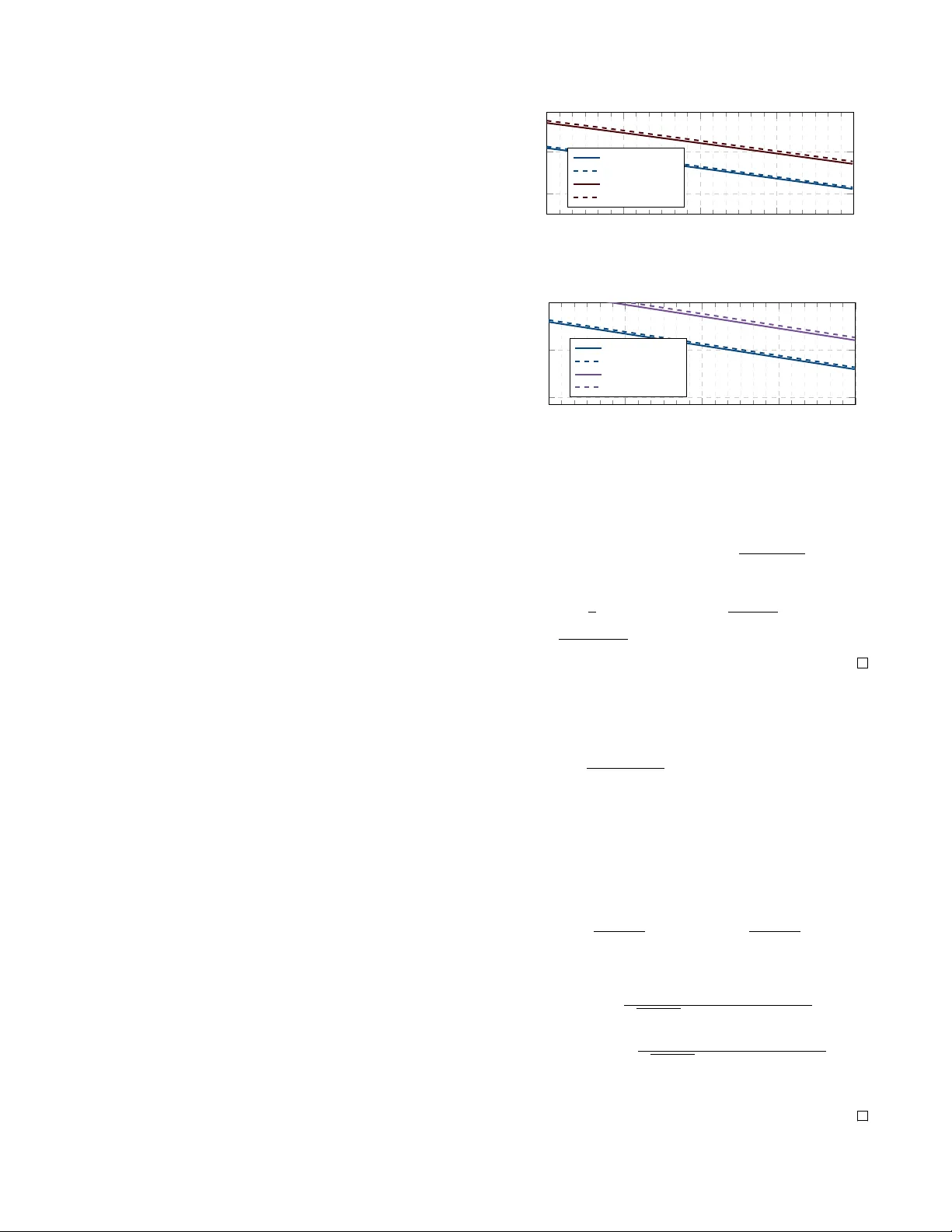
OPTIMAL QAM CONSTELLA TION FOR O VER-THE-AIR COMPUT A TION IN THE PRESENCE OF HEA VY -T AILED CHANNEL NOISE Saeed Razavikia † ⋆ , Deniz G ¨ und ¨ uz ⋆ , Carlo F ischione † † KTH Royal Institute of T echnology , Stockholm, Sweden ⋆ Imperial College London, London, UK ABSTRA CT Over -the-air computation (O A C) enables low-latency aggre- gation over multiple-access channels (MA Cs) by exploiting the superposition property of the wireless medium to com- pute functions efficiently in distributed networks. A critical but often ov erlooked challenge is that electromagnetic inter - ference in practical radio channels frequently e xhibits heavy- tailed behavior , causing strong impulsiv e noise that se verely degrades computation performance. This work studies dig- ital O A C with QAM-based signaling under heavy-tailed in- terference modeled by a Cauchy distrib ution (lacking a fi- nite second moment). W e seek QAM-like constellations that minimize the mean-squared error (MSE) of sum aggrega tion subject to an average-po wer constraint. The problem is for- mulated as a constrained optimization, whose solution yields unique optimality conditions. Numerical results confirm the effecti veness of the proposed design. Notably , the frame work extends naturally to nomographic functions, broader constel- lation families, and alternati ve noise models. Index T erms — Over -the-air computation, heavy-tailed noise, optimal constellation 1. INTR ODUCTION The upcoming 6G networks aim to enable edge intelligence for innov ative applications such as augmented reality and the meta verse [1]. As data v olumes grow while de vices re- main resource-limited, computation tasks are increasingly offloaded to edge servers over wireless links. This makes the communication layer , and in particular aggregation protocols, critical to av oid performance bottlenecks [2, 3]. Over -the-air computation (O A C) addresses this challenge by exploiting the superposition property of multiple-access channels (MA Cs). By employing simple precoding, concur- rent transmissions are superimposed at the receiv er to directly obtain the desired aggre gate (e.g., sum or mean), thereby low- ering both latency and energy consumption compared with con ventional transmit-then-aggre gate approaches [4]. In turn, Emails: { sraz, carlofi } @kth.se, d.gunduz@imperial.ac.uk S. Raza vikia was supported by the W allenber g AI, Autonomous Systems and Software Program. O AC narrows the communication–computation gap and fa- cilitates applications such as federated learning, distributed inference, and wireless control [5–7]. Despite its appeal, O A C is typically realized via analog amplitude modulation, which limits compatibility with ex- isting wireless stacks and makes the aggregate highly sen- sitiv e to channel noise and fading [8]. Specifically , in prac- tical MA Cs, electromagnetic and impulsi ve interference fur- ther induce non-Gaussian, heavy-tailed disturbances [9]: rare but large outliers dominate the analog superposition, causing sev ere distortion and bias in the computed function, and lead- ing to unstable updates, e.g., gradient e xplosion, in federated edge learning [10]. Consequently , pure analog O A C becomes a reliability bottleneck, motiv ating the de velopment of robust aggregation and modulation strategies to sustain performance under realistic MA C impairments. A growing line of w ork moves edge aggregation from analog O AC to digital modulation to alle viate noise sensi- tivity . Early approaches adopt simple constellations (e.g., BPSK/FSK) and recover functions via symbol-type his- tograms under the type-based multiple-access channel [11– 14]. Building on this direction, [15] proposed a general digital-modulation frame work for computing arbitrary finite functions. More recently , SumComp [16] w as introduced as a lo w-complexity scheme for sum computation, using a two-dimensional integer grid compatible with standard con- stellations such as multi-le vel and hexagonal QAM. Its reli- ability has been further enhanced by incorporating channel coding [17, 18]. Most existing studies adapt standard digital modulation schemes, e.g., P AM or QAM, leaving unresolved the funda- mental challenge of constellation design tailored for OA C. While constellation optimality has been extensiv ely studied in con ventional communications [19], systematic insights for OA C remain scarce, as the objective shifts from mes- sage decoding to function estimation. T o address this gap, we de velop QAM-like constellations optimized to minimize the mean-squared error (MSE) of sum computation under an av erage-power constraint and heavy-tailed (Cauchy) noise. The complex Cauch y model captures impulsive outliers and reflects interference-limited operation [20]. The resulting optimality conditions yield a coupled nonlinear system of equations, for which we characterize the optimality regions, and establish uniqueness in the large network. Finally , we validate our theoretical findings with numerical e xperiments. W e note that the proposed frame work naturally e xtends to the general class of nomographic functions and alternati ve noise models. 2. SYSTEM MODEL W e consider K transmitters, and a single recei ver , referred to as the computation point (CP). Each transmitter node owns an integer v alue s k ∈ { 0 , 1 , . . . , Q − 1 } , where Q denotes the size of the alphabet. Then, all the nodes transmit simul- taneously over a MA C to enable the CP to compute a desired function f ( s 1 , . . . , s K ) . Throughout the paper, we consider f to be the sum function, i.e., f ( s 1 , . . . , s K ) = X K k =1 s k , (1) which allows us to le verage wa veform superposition on the MA C. 2.1. Multiple Access Channel (MA C) The transmitter at node k employs the encoder E q ( · ) 1 with pa- rameter q ∈ Z + to map its input s k to a channel symbol x k , i.e., x k = E q ( s k ) ∈ C . The channel symbols are drawn from a discrete square constellation of size q × q , which requires Q = q 2 with q ∈ Z + . T o satisfy the av erage-power con- straint, the e xpected symbol energy must not e xceed P , i.e., E [ | x k | 2 ] ≤ P . Under equiprobable signaling, this condition reduces to 1 Q P Q m =1 | c m | 2 ≤ P , where { c 1 , . . . , c Q } ⊂ C denotes the constellation points. All nodes transmit their encoded symbols simultaneously ov er the shared channel 2 . After perfect channel in version, the CP observes r = X K k =1 x k + z , (2) where r denotes the received signal and z ∈ C is additiv e noise. In contrast to the con ventional Gaussian assump- tion, which may be optimistic in interference-limited scenar- ios [22], we model z as a complex Cauchy random v ariable with scale parameter γ > 0 , i.e., z ∼ C (0 , γ ) . Explicitly , z = z 1 + iz 2 , where z 1 and z 2 are independent and identi- cally distributed as Cauchy (0 , γ ) , thereby capturing impulsiv e heavy-tailed beha vior . Since the Cauchy distribution lacks a finite second moment, it effecti vely models strong outliers. The CP then reco vers the target function v alue via a decoding map D : C 7→ Y f , yielding the estimate ˆ f := D ( r ) , where Y f denotes the output alphabet of the desired function f . 2.2. Decoding Procedur e T o recov er the function estimate ˆ f from the received signal r , we first project r ∈ C onto the superimposed symbol grid, 1 Since the target function is symmetric with respect to its inputs, using an identical encoder across nodes suffices for computation [15]. 2 Residual synchronization errors at the receiver can be mitigat ed using phase-coded pilots [21]. Gray Code 0001 0000 0010 0011 0110 0111 0101 0100 1111 1011 1010 1110 1100 1000 1001 1101 SumComp Code 0 1 2 3 4 5 6 7 8 9 10 11 12 13 14 15 d 1 d 2 1 4 Fig. 1 . Gray code vs SumComp code for QAM Q = 16 mod- ulation. The right constellation diagram uses spacing param- eters ( d ∗ 1 , d ∗ 2 ) are determined by Theorem 1. which forms a two-dimensional square constellation of size N × N , where N = ( q − 1) K + 1 . Let Y denote the set of all induced constellation points with cardinality |Y | = N 2 . Then, the maximum-likelihood (ML) decoder is defined as D ( r ) = arg max y j ∈Y g ( r | y j ) , (3) where g ( r | y j ) is the conditional channel transition probabil- ity . Since the noise is Cauchy distrib uted, we have g ( r | y ) = γ π ( γ 2 + | r − y | 2 ) , γ > 0 . (4) Owing to the symmetry of the Cauchy distribution and the independence of the real and imaginary noise components, the two-dimensional ML decoder in (3) decouples into two one-dimensional estimators. Consequently , D ( · ) reduces to independently rounding the real and imaginary parts of r to the nearest grid points on the constellation. 2.3. Encoding Procedur e Since the target function is the sum, the encoder E q ( s ) must preserve the additi ve structure of the input symbols s (forming an additi ve group). Accordingly , for any s ∈ { 0 , 1 , . . . , Q − 1 } , we define E q ( · ) with parameter q ∈ Z + as E q ( s ) := s − q ⌊ s/q ⌋ d 1 + ⌊ s/q ⌋ d 2 i , d 1 , d 2 ∈ R + , (5) where i is the imaginary unit, and d 1 , d 2 specify the spacing along the in-phase and quadrature components, respectiv ely . Remark 1. The encoding rule in (5) can be vie wed as a spe- cial case of the SumComp scheme [16], since it restricts the constellation to a square grid structure. At the same time, it introduces additional flexibility by parameterizing the in- phase and quadrature spacings through ( d 1 , d 2 ) . Remark 2. For each symbol s k at node k , the pair ( s k , E q ( s k )) forms an additiv e group [16]. Consequently , the sum P K k =1 s k can be uniquely recovered from the encoded aggregate P K k =1 E q ( s k ) . By applying an isomorphic decoding map D , the aggregated codeword can be mapped back to the desired computation f = P K k =1 s k . The a verage symbol power of this two-dimensional grid is giv en by [23] E s | E q ( s ) | 2 = ( Q − 1)( d 2 1 + d 2 2 ) / 6 . An example of the resulting modulation diagram for q = 4 is shown in Fig. 1. 2.4. Problem Statement In (5), the encoder E q ( s ) maps each input symbol onto a two- dimensional QAM-like grid, whose geometry is determined by the spacings ( d 1 , d 2 ) along the in-phase and quadrature axes. Since the quadrature axis is scaled by the f actor q , symmetric noise in this direction causes proportionally larger computation errors compared to those along the in-phase axis. Thus, rob ustness requires a lar ger quadrature spacing, i.e., d 2 > d 1 . The key design question is therefore: By how muc h should d 2 exceed d 1 so that the overall computation err or at the CP is minimized? T o answer this, we define the MSE of the recovered function ˆ f as J q ( d 1 , d 2 ) = E | f − ˆ f | 2 , and aim to find the optimal parameters ( d 1 , d 2 ) that minimize this error subject to an av erage-power constraint, i.e., min d 1 ,d 2 J q ( d 1 , d 2 ) s.t. ( Q − 1)( d 2 1 + d 2 2 ) / 6 = P . (6) where P is the av ailable po wer b udget. Remark 3. Unlike Gaussian noise, the Cauchy distribution exhibits heavy tails and lacks a finite variance, which may suggest that MSE-based design is inapplicable. Ne vertheless, since symbols are digitally represented and hard decoded, the effecti ve function estimation error remains finite [24] 3. OPTIMAL CONSTELLA TION DESIGN This section aims to deri ve the optimal in-phase and quadra- ture spacings ( d 1 , d 2 ) of the proposed QAM-like constel- lation that minimize computation error under heavy-tailed Cauchy noise. The analysis proceeds in three steps: (i) we deriv e a closed-form e xpression for J q ( d 1 , d 2 ) that depends solely on ( d 1 , d 2 ) , thereby reducing the constellation de- sign task to a two-parameter optimization; (ii) we formulate the Lagrangian of the constrained problem and establish the Karush–Kuhn–T ucker (KKT) conditions, which characterize all stationary points of the Lagrangian; and (iii) we show that, for suf ficiently large number of transmitter K , the KKT system admits a unique feasible solution, which corresponds to the global minimizer of J q ( d 1 , d 2 ) . Lemma 1 presents J q ( d 1 , d 2 ) in terms of d 1 and d 2 . Lemma 1. F or a K -user MAC with encoder E q ( · ) in (5) , ML decoder D in (3) , and Cauchy noise z ∼ C (0 , γ ) , assume the induced constellation points of P k s k ar e uniformly dis- tributed over Y . Then, the MSE is J q ( d 1 , d 2 ) = µ ( d 1 ) + q 2 µ ( d 2 ) , (7) 0 5 10 15 20 10 0 10 2 γ − 1 (dB) MSE( ˆ f ) ( q = 4) - ( d ∗ 1 , d ∗ 2 ) ( q = 4) - ( d 1 = d 2 ) ( q = 8) - ( d ∗ 1 , d ∗ 2 ) ( q = 8) - ( d 1 = d 2 ) (a) K = 10 0 5 10 15 20 10 0 10 2 10 4 γ − 1 (dB) MSE( ˆ f ) ( q = 4) - ( d ∗ 1 , d ∗ 2 ) ( q = 4) - ( d 1 = d 2 ) ( q = 8) - ( d ∗ 1 , d ∗ 2 ) ( q = 8) - ( d 1 = d 2 ) (b) K = 100 Fig. 2 . Monte Carlo ev aluation of the MSE for the sum func- tion with 2(a) K = 10 and K = 100 transmitter ov er 5 × 10 4 independent trials: Solid curves denote the optimized distance parameters ( d ∗ 1 , d ∗ 2 ) obtained by , whereas dashed curves cor- respond to equal-distance d 1 = d 2 = p 6 / ( Q − 1) . wher e µ ( x ) = 2 π P N − 1 m =1 α m arctan γ (2 m − 1) x , with α m = 2 m − 1 + 3 m (1 − m ) − 1 N and N = K ( q − 1) + 1 . Pr oof. See Appendix A. Giv en the closed-form representation in (7), the constel- lation design problem in (6) reduces to min d 1 ,d 2 µ ( d 1 ) + q 2 µ ( d 2 ) , s.t. d 2 1 + d 2 2 = ρ 2 , (8) where ρ := p 6 P / ( Q − 1) . T o solve (8), we form the La- grangian L ( d 1 , d 2 , λ ) = µ ( d 1 ) + q 2 µ ( d 2 ) + λ ( d 2 1 + d 2 2 − ρ 2 ) , (9) where λ is the Lagrange multiplier enforcing the power con- straint. Applying the KKT conditions to (9), and using the bordered Hessian theorem [25], yields the following result. Theorem 1. The optimal constellation parameters of (6) are d ∗ 1 = γ ρ √ 0 . 5 − t ∗ , d ∗ 2 = γ ρ √ 0 . 5 + t ∗ , (10) where t ∗ is the unique single positiv e root of G N Q,γ ( t ) = X N − 1 m =1 θ 2 m √ 0 . 5 − t 1 + θ m ρ 2 (0 . 5 − t ) − X N − 1 m =1 Qθ 2 m √ 0 . 5 + t 1 + θ m ρ 2 (0 . 5 + t ) , (11) with θ m = 2 m − 1 for m ∈ [ M ] , G N Q,γ ( t ∗ ) = 0 for K ≫ 1 . Pr oof. See Appendix B. 4. NUMERICAL RESUL TS Here, we validate the proposed constellation design and il- lustrate its performance gains over standard QAM schemes under heavy-tailed noise. W e ev aluate the MSE of the cor - rupted function with respect to the SNR P /γ ( P = 1) , and compare with one archiv ed by the symmetric constellation, i.e., d 1 = d 2 = p 6 / ( Q − 1) ( P = 1 ) employed by the Sum- Comp [16]. Fig. 2 plots the resulting MSE as a function of 1 /γ ∈ { 0 , . . . , 20 } dB in two scenarios: 1) K = 100 nodes with q ∈ { 4 , 8 } to illustrate the ef fect of modulation order; 2) K = 10 nodes with q ∈ { 4 , 8 } to highlight the impact of con- stellation size. Across a broad SNR range, the optimized de- sign consistently yields lo wer MSE than the QAM-style grid. and the performance gap widens as either K or q increases. As γ decreases, all curves conv erge since the Cauchy distor- tion becomes negligible and both designs coincide. Overall, the optimized constellation achieves an improvement of ap- proximately 4 to 5 dB in MSE across a wide SNR range. Finally , when q = 4 , the optimized design deli vers the best performance due to its balanced parameterization. 5. CONCLUSIONS W e studied digital OA C over a MA C with QAM constella- tion family under heavy-tailed Cauchy noise. The constella- tion design was cast as an optimization problem aiming to minimize the MSE of sum aggregation subject to a po wer constraint. By analyzing the KKT conditions, we sho wed that the optimal constellation parameters correspond to the unique root of a nonlinear equation. The resulting design is inherently asymmetric, with d ∗ 2 > d ∗ 1 , thereby quantifying the imbalance between in-phase and quadrature spacings. Nu- merical results demonstrated up to 4 dB impro vement in MSE compared to con ventional SumComp constellations. The pro- posed framework can be readily extended to nomographic functions, pro viding a rob ust and ef ficient solution for O A C in practical wireless networks. A. PR OOF OF LEMMA 1 The proof follows similar arguments as in [16, Appendix B]. Let z 1 and z 2 denote the real and imaginary components of the channel noise z , i.e., z = z 1 + z 2 i . Since z 1 and z 2 are independent, the MSE decomposes as J q ( d 1 , d 2 ) = E h ∥ D ( z 1 ) | 2 i + q 2 E h | D ( z 2 ) | 2 i . (12) where the first and second terms denote the effecti ve deci- sion errors along the in-phase and quadrature axes, respec- tiv ely . Also, | D ( z 1 ) | and | D ( z 2 ) | are integer-v alued random variables representing symbol detection errors in each axis. The expectations µ ( d 1 ) and µ ( d 2 ) correspond to the average squared error of an N -ary P AM constellation, where N = K ( q − 1) + 1 is the number of superimposed constellation points. Their closed-form expressions can be obtained analo- gously to [16, Eq. 42], by replacing the Gaussian Q -function with the tail distribution of the Cauchy density . This yields the expression stated in Lemma 1 B. PR OOF SKETCH OF THEOREM 1 By applying the KKT conditions to the Lagrangian in (9), and after some algebraic manipulations, we obtain N − 1 X m =1 γ m d 1 1 + ( θ m d 1 ) 2 = N − 1 X m =1 q 2 γ m d 2 1 + ( θ m d 2 ) 2 , (13a) d 2 1 + d 2 2 = ρ 2 , (13b) where γ m = α m (2 m − 1) and θ m = (2 m − 1) /γ for all m ∈ [ N ] . The solutions to (13) correspond to the stationary points of the Lagrangian L ( d 1 , d 2 , λ ) . Since γ m may take negati ve values for m > ⌈ 2 N / 3 ⌉ , the system may in general admit multiple solutions. For a lar ge number of nodes K ≫ 1 , howev er, we can approximate γ m ≈ (2 m − 1) 2 > 0 . In this case, the system simplifies to N − 1 X m =1 θ 2 m d 1 1 + ( θ m d 1 ) 2 = N − 1 X m =1 q 2 θ 2 m d 2 1 + ( θ m d 2 ) 2 , (14a) d 2 1 + d 2 2 = ρ 2 . (14b) T o eliminate the constraint (14b), we define an auxiliary v ari- able t such that d 1 = ρ √ 0 . 5 − t and d 2 = ρ √ 0 . 5 + t with t ∈ ( − 0 . 5 , 0 . 5) . Substituting t into (14a), we obtain G N Q,γ ( t ) := X N − 1 m =1 θ 2 m √ 0 . 5 − t 1 + θ m ρ 2 (0 . 5 − t ) − X N − 1 m =1 q 2 θ 2 m √ 0 . 5 + t 1 + θ m ρ 2 (0 . 5 + t ) . (15) Thus, the optimal solution corresponds to the unique root t ∗ of G N Q,γ ( t ) , yielding d ∗ 1 = ρ √ 0 . 5 − t ∗ , d ∗ 2 = ρ √ 0 . 5 + t ∗ . It remains to show that t ∗ is unique. Dif ferentiating (15) with respect to t giv es ∂ G N Q,γ ( t ) ∂ t = N − 1 X m =1 θ 2 m 2(0 . 5 − t ) 3 / 2 · 1 + 3 θ m ρ 2 (0 . 5 − t ) 1 + θ m ρ 2 (0 . 5 − t ) 2 + N − 1 X m =1 q 2 θ 2 m 2(0 . 5 + t ) 3 / 2 · 1 + 3 θ m ρ 2 (0 . 5 + t ) 1 + θ m ρ 2 (0 . 5 + t ) 2 . The deriv ati ve is strictly positi ve for t ∈ (0 , 0 . 5) , imply- ing that G N Q,γ ( t ) is strictly increasing and hence injecti ve. By the intermediate value theorem, and using the fact that lim t → + ∞ G N Q,γ ( t ) = + ∞ while G N Q,γ ( t ) is continuous, the function is also surjective. Moreover , by the bordered Hes- sian (second–order sufficient) test [25], strictly positiv e im- plies that any feasible solution t ∗ of G N Q,γ ( t ) = 0 is therefore a strict local minimizer . Therefore, because the feasible set is the con ve x interv al (0 , 0 . 5) and the stationary point is unique, this local minimizer is in fact the global minimizer . C. REFERENCES [1] Q. He, J. Lin, H. Fang, X. W ang, M. Huang, X. Y i, and K. Y u, “Integrating IoT and 6G: Applications of edge intelligence, challenges, and future directions, ” IEEE T rans. on Services Computing , vol. 18, no. 4, pp. 2471– 2488, 2025. [2] D. G ¨ und ¨ uz, D. B. Kurka, M. Jankowski, M. M. Amiri, E. Ozfatura, and S. Sreekumar , “Communicate to learn at the edge, ” IEEE Commun. Mag. , vol. 58, no. 12, pp. 14–19, 2021. [3] A. P ´ erez-Neira, M. Martinez-Gost, A. S ¸ ahin, S. Raza- vikia, C. Fischione, and K. Huang, “W av eforms for computing over -the-air: A groundbreaking approach that redefines data aggregation, ” IEEE Sig. Pr oc. Mag. , vol. 42, no. 2, pp. 57–77, 2025. [4] B. Nazer and M. Gastpar, “Computation over multiple- access channels, ” IEEE T rans. Info. Theo. , vol. 53, no. 10, pp. 3498–3516, 2007. [5] M. M. Amiri and D. G ¨ und ¨ uz, “Federated learning over wireless fading channels, ” IEEE T rans. W ir eless Com- mun. , vol. 19, no. 5, pp. 3546–3557, 2020. [6] S. F . Y ilmaz, B. Hasırcıo, L. Qiao, D. G ¨ und ¨ uz, et al. , “Priv ate collaborative edge inference via ov er-the-ai r computation, ” IEEE T rans. on Machine Learning in Commun. and Net. , vol. 3, pp. 215–231, 2025. [7] P . Park, P . Di Marco, and C. Fischione, “Optimized over - the-air computation for wireless control systems, ” IEEE Commun. Letters , v ol. 26, no. 2, pp. 424–428, 2021. [8] A. S ¸ ahin and R. Y ang, “ A surve y on ov er-the-air com- putation, ” IEEE Commun. Surveys & T utorials , vol. 25, no. 3, pp. 1877–1908, 2023. [9] D. Middleton, “Statistical-ph ysical models of electro- magnetic interference, ” IEEE T rans. on Electroma gnetic Compatibility , no. 3, pp. 106–127, 2007. [10] Z. Chen, H. H. Y ang, and T . Q. Quek, “Edge intelli- gence o ver -the-air: T wo f aces of interference in feder - ated learning, ” IEEE Commun. Mag. , v ol. 61, no. 12, pp. 62–68, 2023. [11] G. Zhu, Y . Du, D. G ¨ und ¨ uz, and K. Huang, “One- bit o ver-the-air aggregation for communication-efficient federated edge learning: Design and conv ergence anal- ysis, ” IEEE T rans. W ireless Commun. , v ol. 20, no. 3, pp. 2120–2135, 2020. [12] A. S ¸ ahin, “Over-the-air computation based on balanced number systems for federated edge learning, ” IEEE T rans. W ir eless Commun. , vol. 23, no. 5, pp. 4564–4579, 2023. [13] L. Qiao, Z. Gao, M. B. Mashhadi, and D. G ¨ und ¨ uz, “Massiv e digital o ver-the-air computation for communication-efficient federated edge learning, ” IEEE J. Select. Ar eas Commun. , vol. 42, no. 11, pp. 3078–3094, 2024. [14] G. Mergen and L. T ong, “T ype based estimation over multiaccess channels, ” IEEE T rans. on Sig. Pr oc. , vol. 54, no. 2, pp. 613–626, 2006. [15] S. Raza vikia, J. M. B. Da Silva Jr ., and F . Carlo, “Chan- nelComp: A general method for computation by com- munications, ” IEEE T rans. on Commun. , vol. 72, no. 2, pp. 692–706, 2023. [16] S. Razavikia, J. M. B. Da Silva Jr ., and C. Fischione, “SumComp: Coding for digital over -the-air computa- tion via the ring of integers, ” IEEE T rans. on Commun. , vol. 73, no. 2, pp. 752–767, 2025. [17] J. Liu, Y . Gong, and K. Huang, “Digital over -the- air computation: Achie ving high reliability via bit- slicing, ” IEEE T rans. W ir eless Commun. , vol. 24, no. 5, pp. 4101–4114, 2025. [18] X. Y an, S. Razavikia, and C. Fischione, “ReMA C: Digital multiple access computing by repeated trans- missions, ” IEEE T rans. on Commun. , vol. 73, no. 10, pp. 8965–8979, 2025. [19] A. M. Mako wski, “On the optimality of uniform pulse amplitude modulation, ” IEEE T rans. Info. Theo. , vol. 52, no. 12, pp. 5546–5549, 2006. [20] H. H. Y ang, Z. Chen, T . Q. Quek, and H. V . Poor, “Revisiting analog o ver -the-air machine learning: The blessing and curse of interference, ” Journal. Sel. T op- ics in Sig. Proc. , v ol. 16, no. 3, pp. 406–419, 2021. [21] A. S ¸ ahin, “On the feasibility of distributed phase syn- chronization for coherent signal superposition, ” in Pr oc. IEEE PIMRC W orkshops , Sep 2025. [22] L. Clavier , T . Pedersen, I. Larrad, M. Lauridsen, and M. Egan, “Experimental evidence for heavy tailed in- terference in the IoT, ” IEEE Commun. Letters , vol. 25, no. 3, pp. 692–695, 2020. [23] A. Goldsmith, W ireless communications . Cambridge Univ ersity Press, 2005. [24] J. Chen, M. K. Ng, and D. W ang, “Quantizing heavy- tailed data in statistical estimation:(near) minimax rates, cov ariate quantization, and uniform recovery , ” IEEE T rans. Info. Theo. , vol. 70, no. 3, pp. 2003–2038, 2023. [25] J. P . D’Angelo, “Bordered comple x hessians, ” The J our- nal of Geometric Analysis , vol. 11, pp. 561–571, 2001.
Original Paper
Loading high-quality paper...
Comments & Academic Discussion
Loading comments...
Leave a Comment