Uncertainty-Aware Jamming Mitigation with Active RIS: A Robust Stackelberg Game Approach
Malicious jamming presents a pervasive threat to the secure communications, where the challenge becomes increasingly severe due to the growing capability of the jammer allowing the adaptation to legitimate transmissions. This paper investigates the j…
Authors: Xiao Tang, Zhen Ma, Limeng Dong
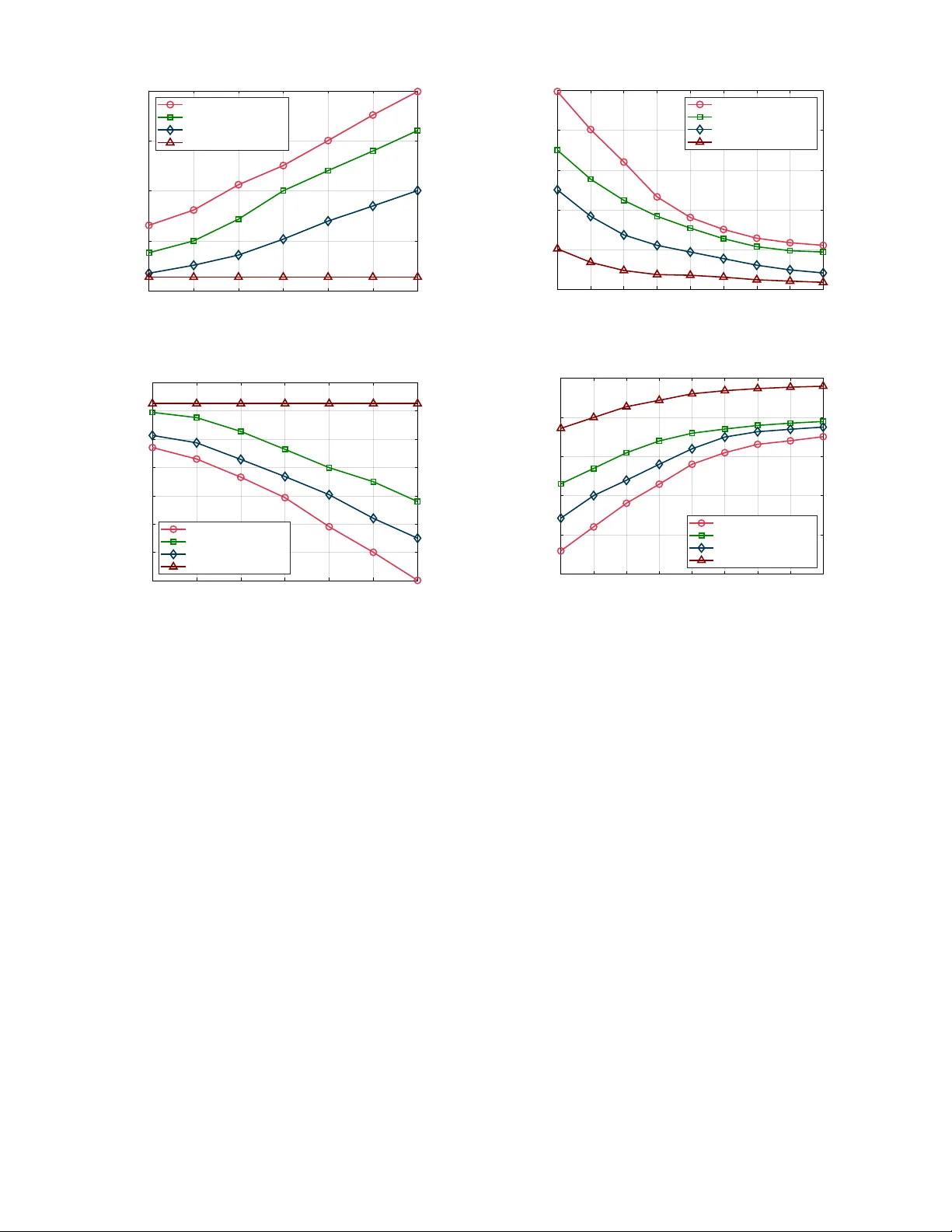
1 Uncertainty-A ware Jamming Mitigation with Acti v e RIS: A Robust Stackelber g Game Approach Xiao T ang, Zhen Ma, Limeng Dong, Y ichen W ang, Qinghe Du, Dusit Niyato, and Zhu Han Abstract —Malicious jamming presents a per vasiv e threat to the secure communications, where the challenge becomes increas- ingly severe due to the growing capability of the jammer allowing the adaptation to legitimate transmissions. This paper in vestigates the jamming mitigation by leveraging an active reconfigurable intelligent surface (ARIS), where the channel uncertainties are particularly addressed f or robust anti-jamming design. T owards this issue, we adopt the Stackelberg game f ormulation to model the strategic interaction between the legitimate side and the adversary , acting as the leader and follower , respectively . W e pro ve the existence of the game equilibrium and adopt the backward induction method for equilibrium analysis. W e first derive the optimal jamming policy as the follower’ s best response, which is then incorporated into the legitimate-side optimization for rob ust anti-jamming design. W e address the uncertainty issue and ref ormulate the legitimate-side problem by exploiting the error bounds to combat the worst-case jamming attacks. The problem is decomposed within a block successive upper bound minimization (BSUM) framework to tackle the power allocation, transceiving beamforming, and active reflection, respecti vely , which are iterated to wards the rob ust jamming mitigation scheme. Simulation results are pro vided to demonstrate the effectiveness of the proposed scheme in protecting the legitimate transmissions under uncertainties, and the superior performance in terms of jamming mitigation as compar ed with the baselines. Index T erms —Jamming mitigation, active RIS, Stack elberg game, BSUM, rob ustness I . I N T R O D U C T I O N Security and reliability are fundamental to wireless commu- nications, which are yet challenged by the jamming attacks giv en the open and shared nature of the wireless medium [1]. The jamming attacks widely exist in wireless networks and can be conducted in various manners, presenting a pervasi ve threat to information security [2]. W ith the rapid de velopment of wireless technologies and devices, the jamming equipment is also ev olving, e.g., enabled with multiple antennas and the capability of adaptation to legitimate transmissions, posing an increasingly concerning threat for wireless systems. In this X. T ang is with the School of Information and Communication Engineering, Xi’an Jiaotong Uni versity , Xi’an 710049, China, and also with Shenzhen Re- search Institute of Northwestern Polytechnical Univ ersity , Shenzhen 518057, China. (e-mail: tangxiao@xjtu.edu.cn) Z. Ma and L. Dong are with the School of Electronics and Information, Northwestern Polytechnical University , Xi’an 710072, China. Y . W ang and Q. Du are with the School of Information and Communication Engineering, Xi’an Jiaotong University , Xi’an 710049, China. D. Niyato is with the College of Computing and Data Science, Nanyang T echnological Univ ersity , Singapore. Z. Han is with the Department of Electrical and Computer Engineering, Univ ersity of Houston, Houston 77004, USA, and also with the Department of Computer Science and Engineering, Kyung Hee University , Seoul 446-701, South Korea. regard, the malicious jammer can also exploit spatial div ersity , beamforming gains, and power adaptation to launch more focused and efficient attacks, significantly degrading com- munication performance beyond conv entional simple constant jamming [3]. Therefore, ensuring secure transmissions against these e ver -ev olving and advanced jamming attacks is a critical yet challenging task, dri ving intensiv e research in wireless communication security [4]. Con ventionally , the jamming mitigation is achiev ed through resources diversity or adv anced signal computation [5]. De- spite the effecti veness, the anti-jamming performance of these approaches may still be bottlenecked by the limited net- work resources and device capabilities [6]. In this regard, the reconfigurable intelligent surface (RIS), as an emerging technology towards future 6G communications, has pav ed a new way to combat jamming attacks. W ith arrays of reflect- ing elements for on-demand radio en vironment manipulation, the RIS reflection allo ws a new dimension to enhance the legitimate transmissions [7]. Moreover , with the evolution of RIS technology , the reflecting elements are enabled with activ e amplification, noted as an acti ve RIS (ARIS), where the amplification capability overcomes the “double-fading” deficit suffered at the passive RISs. Accordingly , the ARIS allows joint reflection and amplification for more proacti ve and flexible wireless en vironment programming, and thus offers superior resilience performance [8]. Meanwhile, with the gro wing capability of jammers, the jamming attacks are able to adapt to the legitimate transmis- sion behaviors for more effecti ve attacks, no longer the simple constant jamming model [9]. In this re gard, the le gitimate transmissions and jamming attacks are mutually affected, which necessities the in vestigation of their interactive results, rather than the single-sided optimization [10]. Accordingly , the game-based analysis becomes instrumental with structured model of the strategic interactions between the legitimate system and adversary [11]. When further probing into the ARIS-assisted anti-jamming communications, the reflection and amplification need to be incorporated into the game frame- work, which induces more complicated interactions with the attacking and counter-attacking behaviors. Consequently , the game model becomes significantly more intricate with multi- party in volv ement and the anti-jamming strategy deserves thorough in vestigation and elaborate design [12]. Moreov er , the effecti ve jamming mitigation is challenged by the information uncertainty issue [13]. Due to the conflicting interest between the legitimate side and the adversary , it is rather difficult to obtain accurate channel state information in the system, particularly for the links associated with the 2 non-cooperativ e jammer , which further impedes anti-jamming decision making. When a RIS is additionally inv olved, the large array of reflecting elements induces a high-dimensional channel, which introduces a greater number of parameters to estimate and thus further aggrav ates this issue [14]. Conse- quently , it is essential to inv estigate jamming mitigation design while incorporating uncertainty treatment to guarantee robust anti-jamming performance against worst-case conditions [15]. This discrepancy also underscores the need to address the jamming interactions within a game framework, since the adversary is adaptiv e and the channel information is imperfect, a robust solution requires modeling the strategic decision- making on both sides in the presence of uncertainties [16]. Motiv ated by the requirement for information security under jamming attacks through an ARIS, in this paper , we employ the Stackelber g game-based formulation to in vestigate the anti- jamming interactions while considering the channel uncer- tainties. Particularly , the main contributions of this paper are summarized as follows: • W e consider the legitimate transmissions in the presence of a malicious jammer, where an ARIS is deployed for jamming mitigation. W e employ the two-stage Stackel- berg game formulation where the legitimate system first commits to its defense strate gy regarding transmission and ARIS configuration, and then the jammer adapts its attack beha vior after observing the transmissions. • For the formulated game, we confirm the existence of the Stackelberg equilibrium, follo w which we employ the backward induction method and derive the optimal jamming strategy . Meanwhile, we formulate the robust ARIS-assisted jamming mitigation by incorporating the jammer’ s best response and channel uncertainties into consideration. W e tackle the uncertainties with their bound information and reformulate the robust optimiza- tion to combat the worst-case jamming attacks. • W e decompose the legitimate-side problem within a block successiv e upper bound minimization (BSUM) frame- work to address the power allocation, transceiv e beam- forming, and activ e reflection optimization, respectiv ely . The subproblems are solved with their tight surrogate counterparts through successiv e con vex approximation (SCA), and the blocked updates are conducted iteratively to reach the robust anti-jamming solution. • W e provide comprehensiv e simulation results to ev aluate the performance of our proposed robust ARIS-assisted anti-jamming scheme. The results demonstrate that our proposed approach achie ves superior jamming mitigation under various conditions as compared with the baselines, highlighting its resilience and effecti veness in the pres- ence of channel uncertainties. The remainder of this paper is or ganized as follows. Sec. II revie ws the related work in the literature. Sec. III describes the anti-jamming communication system with uncertainty model. Sec. IV present the robust Stackelberg formulation along the equilibrium analysis. Sec. V details the proposed robust ARIS- assisted anti-jamming strate gy . Sec. VI provides simulation results, and finally , Sec. VII concludes this paper . I I . R E L AT E D W O R K A. RIS-Assisted Jamming Mitigation The anti-jamming communication keeps ev olving along- side advanced wireless techniques [1], [17], with v arious strategies designed based on sophisticated optimization [18] or learning [19]. While effecti ve to some certain degrees, these approaches are often limited by the av ailable network resources and hardware capabilities [20]. In this regard, the advent of RIS technology has introduced a new paradigm against jamming attacks. Accordingly , the existing studies hav e exploited RISs for anti-jamming designs with fairness guarantee [21], wirelessly po wered transmissions [22], and integrated communication and sensing [23]. Howe ver , the performance of these passive RIS-assisted proposals is fun- damentally limited by the ”double-fading” ef fect, which is likely to induce significant power loss in reflections [24]. The concept of ARIS is proposed to amplify the reflected signal for jamming mitigation. Thus, recent work resorts to ARIS for self-sustainable anti-jamming protections [25], proposes the joint use of activ e and passiv e RIS for security [26], and adopts the multi-functional RIS to defend against jamming attacks [27]. B. Jamming Games with Uncertainties Modeling the strategic conflict between a le gitimate system and an adversary is crucial for effecti ve countermeasures, especially for adapti ve and intelligent jammers [9], [11]. In this respect, game theory provides a powerful framework, for which the widely applied zero-sum game has captured the direct confrontation [28]. As the jamming scenario becomes more complex and inv olved, the Stackelber g game with a hierarchical structure appears more attractiv e [29], [30]. Re- cently , along with the application of RISs in anti-jamming communications, it is also considered within the game-based formulations, e.g., the slotted jamming mitigation with RIS assistance [12], the RIS selection and reflection within a jam- ming game [31], and the learning-aided jamming defense with RISs [32]. Furthermore, the channel uncertainties also presents a significant challenge for jamming mitigation d e sign, particu- larly in the game context [13], [15]. Accordingly , the channel uncertainty is in vestigated for the robust protection against the worst-case attacks, e.g., the robust Stackelber g equilibrium for beam-domain anti-jamming transmission [33], and the robust fictitious play-based spectrum access policy [34]. Moreover , with RIS further magnifying the difficulties with channel in- formation acquisition, the recent studies also address the RIS- in volved robust designs, e.g., the learning-based adaptation for reflection adaptation with uncertainties [35], and the robust RIS-assisted jamming mitigation strategy [36]. In a nutshell, the RIS-aided jamming mitigation is a promis- ing approach for wireless security . While anti-jamming inter- actions hav e been actively in vestigated, a unified treatment that simultaneously accounts for a reactive jammer in an ARIS communication scenarios with uncertainties remains under - explored. This motiv ates our study to bridge this gap by exploiting the robust Stackelberg game for ARIS-assisted anti- jamming communications in this work. 3 H SR H SD H JR H JD H RD Δ H JD Δ H JR Source Destination Jammer Active RIS Fig. 1. System model of an ARIS-assisted communications against a jammer . The legitimate signals and jamming attacks reach the destination through the direct links (shown as arrows) and reflection-based links (sho wn as tapered ribbons). I I I . S Y S T E M M O D E L A. System Setup W e consider a wireless communication system where a legitimate source node S transmits information to a destination node D . This transmission is subject to intentional disruption by a malicious jammer J . T o enhance the legitimate communi- cation link and mitigate the jamming attacks, an ARIS with the capability of signal amplification and reflection, is deployed in the system, denoted by R . The system configuration is illustrated in Fig. 1. The source node S , destination node D , and jammer J are equipped with N S , N D , and N J antennas, respectiv ely . The ARIS comprises N reflecting elements, index ed by the set N = { 1 , 2 , . . . , N } . Each element of the ARIS can independently adjust the amplitude and phase of the incident signal. Basically , the considered system adopts an equiv alent complex baseband MIMO model, and thus the formulation is not restricted to a specific communication stan- dard or a fixed carrier frequency band. Let H S D ∈ C N D × N S , H S R ∈ C N × N S , H RD ∈ C N D × N , H J D ∈ C N D × N J , and H J R ∈ C N × N J denote the channel matrices for the S → D , S → R , R → D , J → D , and J → R links, respectively . The ARIS employs a diagonal reflection matrix Θ = diag ( θ ) with θ = [ λ n e j ϑ n ] T n ∈N , where λ n and ϑ n are the reflection amplitude and phase shift induced by the n -th RIS element, re- spectiv ely , and satisfies λ n ≤ λ max and ϑ n ∈ [0 , 2 π ) , ∀ n ∈ N , with λ max being the maximum allowed amplification factor for each element. Note that compared with traditional relays, an ARIS performs element-wise amplification/reflection via a diagonal coefficient structure. This can be implemented with much lower hardware and processing overhead, and av oids the spectral ef ficiency loss in half-duplex relaying. Y et the active amplification of an ARIS also introduces additional noise and is subject to a surface power constraint, necessitating a careful tradeoff in the system design. B. Signal Model Let x S ∈ C be the unit-power transmit signal from S , and x J ∈ C be the unit-power jamming signal from J . The source S employs a transmit beamforming vector w S ∈ C N S × 1 sub- ject to a maximum transmit po wer constraint ∥ w S ∥ 2 ≤ P max S . Also, the jammer J utilizes a transmit beamforming vector w J ∈ C N J × 1 with a power constraint ∥ w J ∥ 2 ≤ P max J . The receiv ed signal y D ∈ C N D × 1 at the destination D is a superposition of signals through the direct and ARIS-reflected paths, and is giv en by y D = ( H RD Θ H S R + H S D ) w S x S | {z } Desired signal + ( H RD Θ H J R + H J D ) w J x J | {z } Jamming signal + H RD Θ n R | {z } Amplified RIS noise + n D |{z} Receiv er noise , (1) where n R ∼ C N ( 0 , σ 2 R I N ) is the noise introduced by the ARIS elements, and n D ∼ C N ( 0 , σ 2 D I N D ) is the additiv e white Gaussian noise at the receiv er . For notation simplicity , we define the ef fectiv e channels as the cascaded incident and reflection along with the direct transmission as H S RD ≜ H RD Θ H S R , H J RD ≜ H RD Θ H J R , (2) ˜ H S D ≜ H S RD + H S D , ˜ H J D ≜ H J RD + H J D . (3) While the destination D employs a receiv e beamforming vec- tor w D ∈ C N D × 1 with ∥ w D ∥ 2 = 1 , the signal-to-interference- plus-noise ratio (SINR) at the destination is obtained as Γ = | w † D ˜ H S D w S | 2 | w † D ˜ H J D w J | 2 + σ 2 R ∥ w † D H RD Θ ∥ 2 + σ 2 D . (4) The achiev ed SINR is a fundamental performance metric directly related to transmission data rate and communication reliability , which can be exploited as a suitable basis for the performance ev aluation for both legitimate and adversary sides in volved in the system. C. Uncertainty Model For practical communication scenarios, it can be rather challenging to obtain the perfect channel state information due to the random nature of propagation en vironment. This issue becomes more intricate with considering the anti-jamming communications due to the adversarial relationship between the legitimate side and jammer . In this paper , we consider the case that the jammer has perfect information while the legitimate side only has partial information. This corresponds to the disadvantaged and thus more challenging scenario for the jamming mitigation and also allo ws effecti ve margins for security provisioning. Particularly , we assume that the legitimate system has perfect knowledge of its own channels, i.e., H S D , H S R , H RD , but only imperfect estimates of the jamming channels H J R and H J D , i.e., the jammer-related channels. W e adopt the bounded error model, where the jamming channels from the legitimate-side perspectiv e are modeled as H J D = ˆ H J D + △ H J D , ∥△ H J D ∥ 2 F ≤ ϵ J D , (5) H J R = ˆ H J R + △ H J R , ∥△ H J R ∥ 2 F ≤ ϵ J R , (6) where ˆ H J R and ˆ H J D are the known estimated channel ma- trices, and △ H J R and △ H J D are the corresponding channel 4 estimation errors. These error matrices are measured by the Frobenius norms with bounds ϵ J R and ϵ J D , respectiv ely . The rationale for this uncertainty configuration includes two folds. First, the le gitimate links connect cooperativ e nodes where the standard pilot-based training can be employed to achieve high-precision channel estimation. In contrast, the jammer is non-cooperativ e, and its associated channels must be acquired through sensing or blind estimation, and thus more e vident errors are unav oidable. Second, we model the errors directly ov er each jamming link rather than a simplified cascaded aggregation. In this respect, it allo ws the robust design to strictly capture the interaction between the activ e reflection and the channel uncertainty , which also ensures that the ARIS ef- fectiv ely mitigates the worst-case jamming impact propagated through the reflection channels. In practice, the uncertainty radii ϵ J R and ϵ J D can be set based on the estimation quality , e.g., from the minimum mean square error estimator or from the empirical residual variance of repeated interference sensing snapshots under known reflection configurations. I V . G A M E F O R M U L AT I O N A N D E Q U I L I B R I U M Due to the natural conflicting interest between the le git- imate side and adversary , we model their interactions in a Stackelber g game framework, which captures the inherent hierarchical structure in the game playing. W e particularly consider the uncertainties from the perspective of legitimate side and formulate the rob ust Stackelberg game. Then, the equilibrium condition and properties are analyzed to facilitate the strategy design for the game players. A. Robust Stac kelber g Game For practical anti-jamming scenarios, the legitimate side usually initiates the transmissions, followed by the jamming attacks. The sequential decision-making process leads to the Stackelber g game model that the legitimate side takes action first as the leader in the game, and the jammer acts sequentially as the follower . In this reg ard, the leader/follower terminology characterizes the timing and information pattern in the sequen- tial interaction rather than any status hierarchy . For the game players, we introduce the utility functions that characterize their interest as follo ws. Particularly , for the jammer , as the follower in the game, intending to downgrade or ev en interrupt the le gitimate communications, we employ the ne gati ve of achiev ed SINR as its gain while incorporating the jamming power as the cost to be balanced. Accordingly , we hav e u J ( w J ; w S , w D , Θ ) = − Γ − c J ∥ w J ∥ 2 , (7) where c J > 0 is the jammer’ s power consumption cost co- efficient, and we explicitly incorporate the legitimate strategy as the function argument to show that the achiv ed utility is affected by both players. Here, we consider the exact SINR, in accordance with the assumption that the jammer has perfect information in the game. Then, the jammer as the follower maximizes its utility function by optimizing the jamming beamformer as max w J u J ( w J ; w S , w D , Θ ) (8a) s . t . ∥ w J ∥ 2 ≤ P max J . (8b) For the legitimate side as the leader in the game, it intends to achiev e secure and reliable transmissions, which is measured by the SINR. Howe ver , due to the channel uncertainties from the legitimate perspectiv e, it has no kno wledge of the exact SINR. As such, the worst-case estimate of the SINR is adopted to achiev e robust security . Also, the po wer consumption is considered as the cost ev aluation. Thus, the utility of the legitimate side is gi ven as u L ( w S , w D , Θ ; w J ) = min H J ∈H J Γ − c S ∥ w S ∥ 2 , (9) where c S is the power cost coefficient, H J = [ H J R , H J D ] collects the uncertain channel states and H J = ( H J ∥ H J R − ˆ H J R ∥ 2 F ≤ ϵ J R , ∥ H J D − ˆ H J D ∥ 2 F ≤ ϵ J D ) , (10) corresponds to the uncertainties defined in (5) and (6). Then, the goal of the legitimate side is to maximize its own utility , subject to the transmission and reflection constraints, while considering the uncertainties. Here, we can see that the worst case can be interpreted by two folds. First, for any legitimate strategy , the jammer selects its jamming beamformer and power aiming to maximally degrade the legitimate transmis- sions. Second, the legitimate side has imperfect kno wledge of the jammer-related channels, then the most detrimental channel realization within the uncertainty set needs to be ad- dressed for the legitimate strategy optimization. Accordingly , the legitimate-side problem formulation is giv en as max w S , w D , Θ u L ( w S , w D , Θ ; w J ) (11a) s . t . ∥ w S ∥ 2 ≤ P max S , ∥ w D ∥ 2 = 1 , (11b) ∥ Θ H S R w S ∥ 2 + max H J ∈H J ∥ Θ H J R w J ∥ 2 + σ 2 R ∥ Θ ∥ 2 F ≤ P max R , (11c) | Θ n,n | ≤ λ max , ∀ n ∈ N , (11d) w ⋆ J = arg max w J u J ( w J ; w S , w D , Θ ) . (11e) For the formulated problem, the objectiv e function in (11a), as noted before, corresponds to the worst-case legitimate transmission performance, the constraint in (11b) specifies the transceiving beamforming power limits, the constraint in (11c) denotes the ARIS po wer budget, which is also affected by the uncertain information, the constraint in (11e) indicates that the follower’ s best response needs to be considered to determine the legitimate strategy . Therefore, we hav e introduced the utility functions for the players in the formulated game, where the uncertainty treatment at the legitimate side leads to the robust Stackelberg game model towards robust anti-jamming performance. B. Equilibrium Analysis For a game model, the equilibrium is defined as the strategy profile that no player will unilaterally de viate if other players remain at the equilibrium. For the considered anti-jamming communication scenario, it represents the steady state that both the legitimate side and jammer keep their current actions. 5 Denote the equilibrium strategy profile as { w ⋆ S , w ⋆ D , Θ ⋆ , w ⋆ J } , then it holds that u J ( w ⋆ J ; w ⋆ S , w ⋆ D , Θ ⋆ ) ≥ u J ( w J ; w ⋆ S , w ⋆ D , Θ ⋆ ) , (12) u L ( w ⋆ S , w ⋆ D , Θ ⋆ , w ⋆ J ( w ⋆ S , w ⋆ D , Θ ⋆ )) ≥ u L ( w S , w D , Θ , w ⋆ J ( w S , w D , Θ )) , (13) for any other strategy profile { w S , w D , Θ , w J } that satisfies the constraints in (8) and (11), for the jammer and legitimate side, respectiv ely . In accordance with the sequential decision- making procedure of the Stackelberg game, the optimal jam- ming reaction in (12), explicitly represented as (11e), is also incorporated in the leader’ s optimality condition in (13). W e first analyze the existence of the game equilibrium. Based on the game theories [37], [38], a Stackelberg game admits the equilibrium if the follower’ s problem has a unique solution for any strategy of the leader . Follo wing this principle, we analyze the jamming strategy determination problem in (8) as follows. T o facilitate the analysis, we separate the jamming beamformer as the po wer and unit-norm direction, denoted by P J and ˆ w J with w J = √ P J ˆ w J . Hereinafter , we abuse the notation w J as the unit-norm beamformer while dropping ˆ w J for notation simplicity without ambiguity . In this regard, the jammer’ s optimization becomes max P J , w J u J ( P J , w J ) = − Γ − c J P J (14a) s . t . 0 ≤ P J ≤ P max J , ∥ w J ∥ 2 = 1 , (14b) where the SINR is re-organized as Γ = | w † D ˜ H S D w S | 2 P J | w † D ˜ H J D w J | 2 + σ 2 R ∥ w † D H RD Θ ∥ 2 + σ 2 D . (15) based on the separate treatment of the jamming power and beamforming direction. For the problem in (14), we in vestigate the optimization variables individually . For the beamforming direction by w J , it appears in the achiev ed SINR in (15), for which the maximization of the utility leads to the minimization of the SINR. Evidently , this problem corresponds to the maximum ratio combining within the denominator of the SINR, leading to the solution as w ⋆ J = ˜ H † J D w D ∥ ˜ H † J D w D ∥ . (16) Note the jamming beamforming in (16) is not af fected by the jamming power but only needs to align with the effecti ve jamming channel. Meanwhile, we can prov e that the jammer’ s utility is a concav e function with respect to the jamming power by analyzing the second-order deriv ativ e. Then, by nulling the first-order differential of the utility function, we can obtain the optimal jamming power as P ⋆ J = " | w † D ˜ H S D w S | √ c J ∥ w † D ˜ H J D ∥ − σ 2 R ∥ w † D H RD Θ ∥ 2 + σ 2 D ∥ w † D ˜ H J D ∥ 2 # P max J 0 , (17) for which we also substitute the optimal jamming beamform- ing in (16) and ( · ) P max J 0 = min { max { 0 , ·} , P max J } denotes projection onto the allowed power interval [0 , P max J ] . V . R O B U S T R I S - A S S I S T E D J A M M I N G M I T I G A T I O N Based on the equilibrium analysis abov e, we hav e arrived at the jammer’ s optimal strategy in (16) and (17), i.e., the ana- lytical results of e xpression in (12), as part of the equilibrium condition. Then, we solve the leader’ s problem to obtain the solution to (13) to further constitute the o verall equilibrium. T o address this issue, we need to jointly consider the legitimate transmission and receiving beamforming as well as the activ e reflection, in the presence of channel uncertainties to achie ve robust anti-jamming communications. A. Uncertainty T reatment and Pr oblem Decomposition T echnically , the Stackelberg equilibrium deriv ation follows the backward induction method, where the follower’ s best re- sponse is first obtained and substituted in the leader’ s problem to devise the optimality condition at the leader . Following this principle, we substitute the jamming policy in (16) and (17) to the leader’ s jamming mitigation problem. T o facilitate the discussions of the legitimate strategy , we also extract the legitimate transmit power and the unit-norm beamforming direction as P S and w S , respectively , with P S ≤ P max S and ∥ w S ∥ = 1 , where the notation w S is reused without loss of ambiguity . Accordingly , the leader’ s problem becomes max w S , w J , w D , P S ,P J , Θ √ c J P S | w † D ˜ H S D w S | max H J ∈H J ∥ w † D ˜ H J D ∥ − c S P S (18a) s . t . 0 ≤ P S ≤ P max S , 0 ≤ P J ≤ P max J , (18b) ∥ w D ∥ 2 = 1 , ∥ w S ∥ 2 = 1 , (18c) P S ∥ Θ H S R w S ∥ 2 + max H J ∈H J P J ∥ Θ H J R w J ∥ 2 + σ 2 R ∥ Θ ∥ 2 F ≤ P max R , (18d) | Θ n,n | ≤ λ max , ∀ n ∈ N , (18e) w ⋆ J = ˜ H † J D w D ∥ ˜ H † J D w D ∥ , (18f) P J ≥ √ P S | w † D ˜ H S D w S | min H J ∈H J √ c J ∥ w † D ˜ H J D ∥ − σ 2 R ∥ w † D H RD Θ ∥ 2 + σ 2 D max H J ∈H J ∥ w † D ˜ H J D ∥ 2 , (18g) where the follower’ s best response is employed to rewrite the objective function, and channel uncertainties are explicitly incorporated in (18a), (18d), and (18g). Particularly , we re write the follower’ s optimal po wer condition in (17) with newly introduced optimization variable P J such that P J ≥ P ⋆ J . In this regards, the relaxation relieves the difficulties in the original constraints in equality forms, and the allowed higher jamming power presents a more challenging jamming condi- tion. Notably , this relaxation is tight at the leader optimum, since a larger jamming power only makes the leader con- straints more restrictiv e and does not improv e the objectiv e, hence an optimal solution always exists with (18g) holding with equality . Moreov er , the uncertainties associated with the jamming-related channels are explicitly considered, and thus we arri ve at the constraint in (18g). 6 ψ J D I N J × N J ( w † D ˆ H J D + w † D H RD Θ ˆ H J R ) † w † D ˆ H J D + w † D H RD Θ ˆ H J R 1 ≽ Ξ J D + Ξ † J D + Ξ J R + Ξ † J R (23) ( ψ J D − ρ 1 − ρ 2 ) I N J × N J ( w † D ˆ H J D + w † D H RD Θ ˆ H J R ) † 0 N J × N D 0 N J × N w † D ˆ H J D + w † D H RD Θ ˆ H J R 1 √ ϵ J D w † D √ ϵ J R w † D H RD Θ 0 N D × N J √ ϵ J D w D ρ 1 I N D × N D 0 N D × N 0 N × N J √ ϵ J R ( w † D H RD Θ ) † 0 N × N D ρ 2 I N × N ≽ 0 ( N J + N + N D +1) × ( N J + N + N D +1) (26) For the problem in (18), we can see that the channel uncertainties appear in the objective function as well as the constraints, which significantly complicates the problem solv- ing. T owards this issue, we first tackle the uncertainties and re- formulate the robust conditions in explicit expressions. Partic- ularly , we introduce the auxiliary variables { ψ J D , ϕ J D , ψ J R } with the conditions max H J ∈H J ∥ w † D ( H J D + H RD Θ H J R ) ∥ 2 ≤ ψ J D , (19) min H J ∈H J ∥ w † D ( H J D + H RD Θ H J R ) ∥ 2 ≥ ϕ J D , (20) max H J ∈H J ∥ Θ H J R w J ∥ 2 ≤ ψ J R , (21) where the effecti ve channels associated with the jammer are extended to facilitate the uncertainty treatment at the direct and reflection channels. By using the conditions abov e, the problem in (18) is re written as max w S , w J , w D , P S ,P J , Θ , ψ J D ,ϕ J D ,ψ J R √ c J P S | w † D ˜ H S D w S | √ ψ J D − c S P S (22a) s . t . (18 b ) , (18 c ) , (18 e ) , (18 f ) P S ∥ Θ H S R w S ∥ 2 + P J ψ J R + σ 2 R ∥ Θ ∥ 2 F ≤ P max R , (22b) P J ≥ √ P S | w † D ˜ H S D w S | √ c J √ ϕ J D − σ 2 R ∥ w † D H RD Θ ∥ 2 + σ 2 D ψ J D , (22c) (19) , (20) , (21) , as a lower -bounded counterpart to the original problem with cleaner expressions. Meanwhile, the bounded uncertainty conditions in (19), (20), and (21) are tackled as follo ws. Particularly , for the constraint in (19), we extend the norm square operation and exploit the Schur complement equi valence with separated channel estimations and errors, and arriv e the condition in (23) with Ξ J D = − I N J × N J 0 1 × N J △ H † J D 0 N D × N J w D , (24) and Ξ J R = − I N J × N J 0 1 × N J △ H † J R 0 N × N J ( w † D H RD Θ ) † . (25) For the condition in (23), we can further apply the general sign-definiteness principle [39] by considering the bounded uncertainties in H and arrive at the condition in (26), where ρ 1 and ρ 2 are the introduced auxiliary variables due to the uncertainty bounds in (5) and (6), respectiv ely . T o facilitate the reformulation of condition in (20), we introduce b † ≜ w † D w † D H RD Θ , (27) and H † J ≜ H J D H J R = ˆ H J D ˆ H J R | {z } = ˆ H † J + △ H J D △ H J R | {z } = △ H † J , (28) and the condition in (20) is simplified as b † H † J H J b ≥ ϕ J D . By in voking the trace equality , we can further deri ve the equiv alences as T r ( H † J H J bb † ) − ϕ J D ≥ 0 ⇒ v ec † ( H J ) B v ec( H J ) − ϕ J D ≥ 0 , (29) with B = ( bb † ) T ⊗ I N J × N J . Then, by separating the chan- nel estimations and errors, we the inequality above can be extended as v ec † ( ˆ H J ) B v ec( ˆ H J ) + vec † ( ˆ H J ) B v ec( △ H J ) +v ec † ( △ H J ) B v ec( ˆ H J ) + vec † ( △ H J ) B v ec( △ H J ) − ϕ J D ≥ 0 . (30) Revisiting the error bounds in (5) and (6), we can vectorize the errors in the form of v ec † ( △ H J ) I N J N D × N J N D 0 N J N D × N J N 0 N J N × N J N D 0 N J N × N J N | {z } ≜ Υ J D v ec( △ H J ) − ϵ J D ≤ 0 , (31) and v ec † ( △ H J ) 0 N J N D × N J N D 0 N J N D × N J N 0 N J N × N J N D I N J N × N J N | {z } ≜ Υ J R v ec( △ H J ) − ϵ J R ≤ 0 . (32) By in voking the S-procedure [40] to incorporate the error bounds in (5) and (6), the inequality in (30) can be deriv ed in the form of (33), where η 1 and η 2 are introduced variables associated with (31) and (32), respecti vely . Finally , for the 7 B + η 1 Υ J D + η 2 Υ J R B v ec( ˆ H J ) v ec † ( ˆ H J ) B v ec † ( ˆ H J ) B v ec( ˆ H J ) − ϕ J D − η 1 ϵ J D − η 2 ϵ J R ≽ 0 ( N J ( N + N D )+1) × ( N J ( N + N D )+1) (33) constraint in (21), we can follo w the same procedure to tackle the constraint in (19) by employing the Schur complement and general sign-definiteness principle [39], and thus arri ve the error -bounded condition as ψ J R I N J × N J Θ ˆ H J R w J √ ϵ J R Θ w † J ˆ H † J R Θ † 1 − ρ 3 w † J w J 0 1 × N √ ϵ J R Θ † 0 N × 1 ρ 3 I N × N ≽ 0 (2 N +1) × (2 N +1) , (34) where ρ 3 is the auxiliary variable associated with the error constraint in (6). The detailed deriv ations follo w the same procedure as elaborated before and thus are omitted for bre vity . As the channel uncertainties hav e been tackled with the bound information, then leader’ s problem in (18) is reformu- lated as max w S , w J , w D , P S ,P J , Θ , ψ J D ,ϕ J D ,ψ J R , ρ 1 ,ρ 2 ,ρ 3 ,η 1 ,η 2 √ c J P S | w † D ˜ H S D w S | √ ψ J D − c S P S (35a) s . t . (18 b ) , (18 c ) , (18 e ) , (18 f ) , (22 b ) , (22 c ) , (26) , (33) , (34) , ρ 1 ≥ 0 , ρ 2 ≥ 0 , ρ 3 ≥ 0 , (35b) η 1 ≥ 0 , η 2 ≥ 0 . (35c) As compared with its original counterpart, the problem in (35) recast the robustness conditions with explicit expressions by employing the matrix inequalities with the additional auxiliary variables. T o solve the problem effecti vely , we decompose the problem within a BSUM framework 1 to tackle the transmit power , beamforming, and reflection, respectiv ely , and itera- tiv ely update blocked optimization variables to approximate the suboptimal solution to the legitimate-side strategy . B. P ower Allocation W e first consider the subproblem of legitimate transmit power and jamming po wer allocation while fixing the other optimization v ariables. In this regard, the subproblem is ob- tained as max P S ,P J √ c J P S | w † D ˜ H S D w S | √ ψ J D − c S P S (36a) s . t . (18 b ) , (22 b ) , (22 c ) , where the non-con vexity is due to the square root operation of the le gitimate transmit power . As such, we introduce a 1 The BSUM framework is generally used for minimization problem, while we consider a maximization problem, it is actually the block successive lo wer- bound maximization (BSLM). Y et for the consistency with the mainstream terminology , we still refer to it as BSUM. counterpart v ariable γ ≥ 0 such that γ 2 = P S , then the problem is reformulated as max γ ,P J √ c J γ | w † D ˜ H S D w S | √ ψ J D − c S γ 2 (37a) s . t . 0 ≤ P J ≤ P max J , (37b) γ ≥ 0 , γ 2 ≤ P max S , (37c) γ 2 ∥ Θ H S R w S ∥ 2 + P J ψ J R + σ 2 R ∥ Θ ∥ 2 F ≤ P max R , (37d) P J ≥ γ | w † D ˜ H S D w S | √ c J √ ϕ J D − σ 2 R ∥ w † D H RD Θ ∥ 2 + σ 2 D ψ J D . (37e) As we can con veniently verify , the problem in (37) is con vex and thus can be readily tackled with off-the-shelf solv ers. Denote the obtained solution as { γ ⋆ , P ⋆ J } , then the legitimate transmit power is determined as P ⋆ S = ( γ ⋆ ) 2 . The obtained power allocation of { P ⋆ S , P ⋆ J } are then used for the subproblem solving of other variables in the legitimate-side problem. C. Beamforming Determination For the legitimate side, it needs to determine the transmit and receive beamforming due to the multi-antenna capability . Meanwhile, the jamming beamforming is also considered since the legitimate side as the leader in the game needs to anticipate the jamming reaction at the follower to support the legitimate strategy deriv ation. W e then discuss each of the beamforming vector individually . The jamming beamforming is determined at the adver - sary , as explicitly specified in (18f) based on the best- response analysis. Meanwhile, for the transmit beamform- ing at the legitimate side, it reduces to the problem as max ∥ w S ∥ 2 =1 w † D ˜ H S D w S . W e can readily see that it is a maximum ratio transmission problem, and thus the optimal transmit beamforming needs to align with the ef fectiv e channel condition as w ⋆ S = ˜ H † S D w D ∥ ˜ H † S D w D ∥ . (38) Note here the legitimate side has the perfect information regarding the legitimate-side channels, which enables the beamforming calculation in (38). When considering the receiv e beamforming at the legitimate side, the problem becomes max ∥ w D ∥ =1 , ψ J D ,ϕ J D , ρ 1 ,ρ 2 ,η 1 ,η 2 | w † D ˜ H S D w S | √ ψ J D (39a) s . t . (22 c ) , (26) , (33) , (35 b ) , (35 c ) . (39b) 8 As can be easily verified, the non-conv exity lies in the ob- jectiv e function, the unit-norm nature of beamformer, and the constraints in (22c) and (33), while the constraints in (26) is a linear matrix inequality with respect to w D , and the rest constraints are linear . Then, the non-con ve xity treatments are conducted as follows. For the unit-norm constraint of the beamforming vector , we introduce W D = w D w † D , and the unit norm leads to the condition that T r ( W D ) = 1 . By rewriting the equality constraint as W D ≥ w D w † D and W D ≤ w D w † D , we deriv e the equi v alent condition for the unit-norm constraint as T r ( W D ) = 1 , (40a) W D w D w † D 1 ≽ 0 ( N D +1) × ( N D +1) , (40b) T r ( W D − w D w † D ) ⩽ 0 , (40c) in the form of linear matrix inequalities as the conv ex counter- part. For the constraint in (22c), we introduce a set of auxiliary variables { µ D , ν D , ξ D } such that µ 2 D ≥ | w † D ˜ H S D w S | , (41a) ν D ≤ p ϕ J D , (41b) ξ 2 D ≤ σ 2 R ∥ w † D H RD Θ ∥ 2 + σ 2 D , (41c) which leads to the lo wer-bound reformulation of (22c) as P J ≥ √ P S √ c J µ 2 D ν D − ξ 2 D ψ J D . (42) Here, the auxiliary-related constraints in (41a), (41c), and the induced constraint in (42) are non-con vex. In this respect, we can adopt the SCA technique to use the first-order approxi- mated counterpart for the non-con vex parts and thus obtain 2 µ ◦ D µ D − ( µ ◦ D ) 2 ≥ | w † D ˜ H S D w S | , (43) and ξ 2 D ≤ σ 2 R T r H RD ΘΘ † H † RD w D ( w ◦ D ) † w ◦ D w † D − w ◦ D ( w ◦ D ) † + σ 2 D , (44) along with P J ≥ √ P S √ c J µ 2 D ν D − 2 ξ ◦ D ξ D ψ ◦ J D − ( ξ ◦ D ) 2 ψ J D ( ψ ◦ J D ) 2 , (45) as the con vexified counterparts at the approximation points { w ◦ D , µ ◦ D , ξ ◦ D , ψ ◦ J D } . For the non-con ve xity in (26), it orig- inates from the definition in B with the square opera- tion ov er the receiv e beamformer w D . T o tackle this issue, we trace back to the initial introduction of B in (29), for which a lower -bounded approximation through SCA is deri ved as (46) at the point w ◦ D . Then, we define that B D ( w D ; w ◦ D ) = A D ( w D ; w ◦ D ) ⊗ I N J × N J to ap- proximate B , and the constraint in (29) is tightened by v ec † ( H J ) B D ( w D ; w ◦ D ) v ec( H J ) − ϕ J D ≥ 0 . By adopting the uncertainty treatment as extended before, we derive the condition in (47) as a replacement of the non-con vex constraint in (33), in the form of a linear matrix inequality against w D . Finally , for the non-con vex objecti ve function, we similarly introduce { ϕ D , ψ D } such that ( ϕ 2 D ≤ | w † D ˜ H S D w S | , (48a) ψ D ≥ p ψ J D , (48b) which leads the lower bound of the objective function that | w † D ˜ H S D w S | √ ψ J D ≥ ϕ 2 D ψ D . (49) Furthermore, for the reinterpretation of the objecti ve function and the inherent non-conv exity , we adopt the SCA technique and arri ve the con vexified version that ϕ 4 D ≤ w † S ˜ H † S D ( w D ( w ◦ D ) † + w ◦ D w † D − w ◦ D ( w ◦ D ) † ) ˜ H S D w S , (50a) 2 ψ D ψ ◦ D − ( ψ ◦ D ) 2 ≥ ψ J D , (50b) along with ϕ 2 D ψ D ≥ 2 ϕ D ϕ ◦ D ψ ◦ D − ( ϕ ◦ D ) 2 ψ D ( ψ ◦ D ) 2 , (51) as approximated at { w ◦ D , ψ ◦ D , ϕ ◦ D } . Therefore, by tackling the non-con vexity in the recei ve beamforming optimization in (39), we arri ve a lo wer-bounded surrogate problem in the form of max w D ,ψ J D ,ϕ J D , ρ 1 ,ρ 2 ,η 1 ,η 2 , µ D ,ν D ,ξ D ,ϕ D ,ψ D 2 ϕ D ϕ ◦ D ψ ◦ D − ( ϕ ◦ D ) 2 ψ D ( ψ ◦ D ) 2 (52a) s . t . (26) , (35 b ) , (35 c ) , (40) , (41 b ) , (43) , (44) , (45) , (47) , (50) , which is now a conv ex optimization approximated at { w ◦ D , µ ◦ D , ξ ◦ D , ψ ◦ J D , ψ ◦ D , ϕ ◦ D } . Then, we solve a series of prob- lems in the form of (52), and the use the obtained optimum to update the approximation points, where the conv ergence corresponds to the solution to the receiv e beamforming opti- mization in (39). D. Reflection Optimization The last subproblem through the BSUM decomposition addresses the reflection optimization at the ARIS, which deter- mines the amplification ratio and reflection phase, while fixing the transmit powers and beamforming vectors. Accordingly , the reflection optimization is in the form of max Θ , ψ J D ,ψ J R ,ϕ J D , ρ 1 ,ρ 2 ,ρ 3 ,η 1 ,η 2 | w † D ˜ H S D w S | √ ψ J D (53a) s . t . (18 e ) , (22 b ) , (22 c ) , (26) , (33) , (34) , (35 b ) , (35 c ) . Since the reflection matrix has a high dimension while only the diagonal elements are effecti ve, we extract the diagonal 9 bb † ≽ w D ( w ◦ D ) † + w ◦ D w † D − w ◦ D ( w ◦ D ) † w D ( w ◦ D ) † + w ◦ D w † D − w ◦ D ( w ◦ D ) † H RD Θ Θ † H † RD w D ( w ◦ D ) † + w ◦ D w † D − w ◦ D ( w ◦ D ) † Θ † H † RD w D ( w ◦ D ) † + w ◦ D w † D − w ◦ D ( w ◦ D ) † H RD Θ | {z } ≜ A D ( w D ; w ◦ D ) (46) B D ( w D ; w ◦ D ) + η 1 γ J D + η 2 γ J R B D ( w D ; w ◦ D ) v ec( ˆ H J ) v ec † ( ˆ H J ) B D ( w D ; w ◦ D ) v ec † ( ˆ H J ) B D ( w D ; w ◦ D ) v ec( ˆ H J ) − ϕ J D − η 1 ϵ J D − η 2 ϵ J R ≽ 0 ( N J ( N + N D )+1) × ( N J ( N + N D )+1) (47) vector to facilitate the analysis. T o this end, conduct the transformation that w † D ˜ H S D w S = w † D ( H RD Θ H S R + H S D ) w S = w † D H RD diag ( H S R w S ) | {z } ≜ α † θ + w † D H S D w S | {z } ≜ β = α † θ + β , (54) and w † D H RD Θ = θ † diag ( w † D H RD ) | {z } ≜ E = θ † E , (55) along with the equality that Θ H S R w S = diag ( H S R w S ) θ , (56a) Θ H J R = diag ( θ ) H J R , (56b) ∥ Θ ∥ 2 F = ∥ θ ∥ 2 . (56c) Then, the problem in (53) can be rewritten with the optimiza- tion of the reflection vector θ rather than the reflection matrix Θ , specified as max θ , ψ J D ,ψ J R ,ϕ J D , ρ 1 ,ρ 2 ,ρ 3 ,η 1 ,η 2 α † θ + β √ ψ J D (57a) s . t . | θ n | ≤ λ max , ∀ n ∈ N , (57b) P S ∥ diag ( H S R w S ) θ ∥ 2 + P J ψ J R + σ 2 R ∥ θ ∥ 2 ≤ P max R , (57c) P J ≥ √ P S α † θ + β √ c J √ ϕ J D − σ 2 R ∥ θ † E ∥ 2 + σ 2 D ψ J D , (57d) (26) , (33) , (34) , (35 b ) , (35 c ) , where for the constraints in (26), (33), (34), Θ is replaced by diag ( θ ) , and we omit the specified expressions and reuse the equation labels for space limitation. For the reformulated reflection optimization in (57), we can see that the reflection amplitude constraint in (57b) and po wer constraint at the ARIS in (57c) are conv ex. The uncertainty-induced constraints (26) and (34) are linear matrix inequalities with respect to the reflection coefficients. Meanwhile, the non-con vexity lies in the objecti ve function and the constraints in (57d) and (33). The problem solving is analyzed as follows. For the non-con vex constraint in (57d), we introduce the auxiliary v ariables { µ θ , ν θ , ξ θ , } such that µ 2 θ ≥ a † θ + β , (58a) ν θ ≤ p ϕ J D , (58b) ξ 2 θ ≤ σ 2 R ∥ θ † E ∥ 2 + σ 2 D , (58c) which allo ws the reformulation of (57d) as P J ≥ √ P S √ c J µ 2 θ ν θ − ξ 2 θ ψ J D . (59) Then, we adopt the SCA techniques to tackle the non- con vexity . Particularly , for (58a), by using the first-order lower bound of the left-hand side, we arrive at a tightened counterpart as 2 µ ◦ θ µ θ − ( µ ◦ θ ) 2 ≥ a † θ + β , (60) with approximation point µ ◦ θ . Similarly , for the non-conv ex constraint in (58c), we arri ve an approximation as ξ 2 θ ≤ σ 2 R T r ( E E † ( θ ( θ ◦ ) † + θ ◦ θ † − θ ◦ ( θ ◦ ) † )) + σ 2 D , (61) at the point θ ◦ . While for the reformulated jamming power constraint in (59), with SCA technique to tackle the non- con vex part, we deri ve that P J ≥ √ P S √ c J µ 2 θ ν θ − 2 ξ ◦ θ ξ θ ψ ◦ J D − ( ξ ◦ θ ) 2 ψ J D ( ψ ◦ J D ) 2 (62) as approximated at { ξ ◦ θ , ψ ◦ J D } . For the non-conv ex constraint in (33) in a matrix inequality form, we identify the non- con vexity is due to the square operation over the reflec- tion coefficient in B . T owards this issue, we rewrite b † = h w † D w † D H RD Θ i = h w † D θ † E i . By adopting the lower bound that θ θ † ≽ θ ( θ ◦ ) † + θ ◦ θ † − θ ◦ ( θ ◦ ) † approximated at θ ◦ , we arrive that bb † ≽ w D w † D w D θ † E E † θ w † D E † ( θ θ † 0 + θ 0 θ † − θ 0 θ † 0 ) E | {z } ≜ A θ ( θ ; θ ◦ ) . (63) Then, we define B θ ( θ ; θ ◦ ) = A θ ( θ ; θ ◦ ) ⊗ I N J × N J , and rewrite the uncertainty-induced condition in (29) as v ec † ( H J ) B θ ( θ ; θ ◦ ) v ec( H J ) − ϕ J D ≥ 0 . By following the similar procedure to handle the uncertainty with its bound information, we deriv e the condition in (64), which is a linear matrix inequality with respect to θ , as a conv ex replacement of the non-conv ex condition in (33). For the objectiv e function, 10 B θ ( θ ; θ ◦ ) + η 1 γ J D + η 2 γ J R B θ ( θ ; θ ◦ ) v ec( ˆ H J ) v ec † ( ˆ H J ) B θ ( θ ; θ ◦ ) v ec † ( ˆ H J ) B θ ( θ ; θ ◦ ) v ec( ˆ H J ) − ϕ J D − η 1 ϵ J D − η 2 ϵ J R ≽ 0 ( N J ( N + N D )+1) × ( N J ( N + N D )+1) (64) we also introduce the auxiliary v ariables { ϕ θ , ψ θ } such that ( ϕ 2 θ ≤ | a † θ + β | , (65a) ψ θ ≥ p ψ J D , (65b) followed by the lower-bounded reformulation of objecti ve function that | a † θ + β | √ ψ J D ≥ ϕ 2 θ ψ θ . (66) For the non-con vexity abov e, we adopt necessary square operation ov er the inequalities and employ the SCA-based approximation as ϕ 4 θ ≤ a † ( θ ( θ ◦ ) † + θ ◦ θ † − θ ◦ ( θ ◦ ) † ) a + 2 ℜ{ a † θ β } + | β | 2 , (67) and 2 ψ ◦ θ ψ θ − ( ψ ◦ θ ) 2 ≥ ψ J D , (68) along with the lower -bounded objectiv e function that ϕ 2 θ ψ θ ≥ 2 ϕ ◦ θ ϕ θ ψ ◦ θ − ( ϕ ◦ θ ) 2 ψ θ ( ψ ◦ θ ) 2 , (69) through the first-order approximation at the point { θ ◦ , ψ ◦ θ , ϕ ◦ θ } . Consequently , for the reflection optimization in (57) (or equiv alently in (53)), we derive the conv exified surrogate counterpart through the reformulations as max θ , ψ J D ,ψ J R ,ϕ J D , ρ 1 ,ρ 2 ,ρ 3 ,η 1 ,η 2 , µ θ ,ν θ ,ξ θ ,ϕ θ ,ψ θ 2 ϕ ◦ θ ϕ θ ψ ◦ θ − ( ϕ ◦ θ ) 2 ψ θ ( ψ ◦ θ ) 2 (70a) s . t . (35 b ) , (35 c ) , (57 b ) , (57 c ) , (58 b ) , (60) , (61) , (62) , (67) , (68) , (26) , (34) , (64) , approximated at { θ ◦ , µ ◦ θ , ξ ◦ θ , ψ ◦ J D , ψ ◦ θ , ϕ ◦ θ } . Following the idea of successive approximation, we then solve a series problem in (70) and iterati vely update the approximation point based on the obtain solution, and the solution to the original reflection problem in (57) can be approached upon the con vergence. E. Algorithm Design Follo wing the idea of BSUM frame work, we can then solve the decomposed subproblems, and update the grouped opti- mization v ariables of power allocation, beamforming vectors, and activ e reflection matrix, and the con vergence leads to the suboptimal solution to the legitimate-side anti-jamming strategy . The overall algorithm is summarized as Alg. 1, which adopts a Gauss-Seidel type cyclic updates. Each block is optimized while keeping the other blocks fixed, such that the interrelationship is preserved through the coefficients inherited from the current iterates. The optimization variables (power allocation, transceiving beamforming, and activ e reflection) are coupled in both the SINR expression and the ARIS power constraint; hence, the three strategies are not independent decisions. In the proposed BSUM/BSLM procedure, we adopt a Gauss–Seidel type cyclic update, where each block is optimized while keeping the other blocks fixed, such that the interrelationship is preserved through the coefficients inherited from the current iterates. The update order can be permuted without changing feasibility and the monotonic-improvement property , provided that each block is solved exactly or via a tight lower -bounded surrogate consistent at the current point. Nev ertheless, since the overall problem is nonconv ex, different update orders may lead to different stationary points and different con ver gence speeds; therefore, we use a fixed cyclic order for numerical stability and reproducibility . Under the proposed BSUM decomposition, each block update solves a con vex subproblem e xactly (e.g., power alloca- tion) or solves a lo wer-bounded con vex surrogate subproblem obtained via SCA (e.g., receiv e beamforming and reflection). Then, the objective sequence generated by the iterations is non-decreasing and con vergent. Moreover , the feasible set is compact due to the explicit power constraints and the ARIS power constraint, and hence the objecti ve is upper bounded. Accordingly , the legitimate-side problem is monotone and bounded, and thus the con vergence is guaranteed. The complexity of the proposed algorithm is analyzed as follows. The power allocation in (37) is a con ve x problem with fixed-number scalar v ariables, and the transmit beam- former update in (38) is in closed form. Hence, the overall computational burden is dominated by the con vex surrogate programs (52) and (70), with robust linear matrix inequality constraints. For these two optimization problems, the largest linear matrix inequality has dimension n ≜ N J ( N + N D ) + 1 . By using an interior-point method, the per-SCA-iteration com- plexity is approximated as O ( n 3 . 5 ) . Denote I D and I θ as the numbers of inner SCA iterations for solving (52) and (70), respectiv ely . Then, the overall complexity of Alg. 1 is arrived as O I out I D + I θ n 3 . 5 , where I out is the number of the required iteration for the outer BSUM loop. Regarding the game equilibrium, denoted the obtained optimum by solving (18) as { P ⋆ S , P ⋆ J , w ⋆ S , w ⋆ D , w ⋆ J , Θ ⋆ } , then the legitimate side will conduct robust ARIS-assisted transmissions based on this policy . Then, the jammer is aware of the legitimate transmission, and launch jamming attacks by solving (14). Following the principle of Stackelber g game, the obtained jamming policy by the jammer coincide with that anticipated at the legitimate side, and therefor the equilibrium of the robust Stackelberg game is exactly { P ⋆ S , P ⋆ J , w ⋆ S , w ⋆ D , w ⋆ J , Θ ⋆ } . V I . S I M U L AT I O N R E S U LT S The simulation results are presented to e valuate the perfor- mance of the proposed rob ust jamming mitigation scheme. The 11 Algorithm 1: Algorithm for Legitimate-Side Strategy Input: Channel matrices, noise v ariances, maximum transmit and jamming powers, cost coefficients, ARIS power and amplification threshold; Output: Legitimate-side strategy { P ∗ S , w ⋆ S , w ⋆ D , Θ ⋆ } . 1 Initialize P (0) S , w (0) S , w (0) D , Θ (0) , satisfying the constraints; 2 Calculate the jammer’ s anticipated strategy w (0) J and P (0) J using (16) and (17); 3 repeat 4 Calculate initial legitimate utility u (0) L ; ▷ Power Allocation 5 Solve the problem in (37), and get P ⋆ J and γ ⋆ , then obtain P ⋆ S ← ( γ ⋆ ) 2 ; 6 P (0) S ← P ⋆ S ; P (0) J ← P ⋆ J ; ▷ Transmit Beamforming Optimization 7 Gi ven P (0) S , P (0) J , w (0) J , w (0) D ,and Θ (0) , update w S by using (38); 8 w (0) S ← w ⋆ S ; ▷ Receive Beamforming Optimization 9 repeat 10 Calculate the objecti ve function in (39) as η (0) by using w (0) S , w (0) D , and Θ (0) ; 11 Solve the problem in (52) at the point { w ◦ D , µ ◦ D , ξ ◦ D , ψ ◦ J D , ψ ◦ D , ϕ ◦ D } and obtain the updated objecti ve as η ⋆ along with the solution w ⋆ D , ψ ⋆ J D , ϕ ⋆ J D , ρ ⋆ 1 , ρ ⋆ 2 , η ⋆ 1 , η ⋆ 2 , µ ⋆ D , ν ⋆ D , ξ ⋆ D , ϕ ⋆ D , ψ ⋆ D ; 12 w ◦ D ← w ⋆ D , µ ◦ D ← µ ⋆ D , ξ ◦ D ← ξ ⋆ D , ψ ◦ J D ← ψ ⋆ J D , ψ ◦ D ← ψ ⋆ D , ϕ ◦ D ← ϕ ⋆ D ; 13 until ∥ η (0) − η ⋆ ∥ ≤ ε ; 14 w (0) D ← w ⋆ D ; ▷ Jamming Beamforming Determination 15 update w J by using (16) and w ⋆ D ; 16 w (0) J ← w ⋆ J ; ▷ Reflection Optimization 17 repeat 18 Calculate the objecti ve function in (53) as ζ (0) by using w (0) S , w (0) D , and Θ (0) ; 19 Solve the problem in (70) at the point { θ ◦ , µ ◦ θ , ξ ◦ θ , ψ ◦ J D , ψ ◦ θ , ϕ ◦ θ } and obtain the updated objectiv e as ζ ⋆ along with the solution θ ⋆ , ψ ⋆ J D , ψ ⋆ J R , ϕ ⋆ J D , ρ ⋆ 1 , ρ ⋆ 2 , ρ ⋆ 3 , η ⋆ 1 , η ⋆ 2 , µ ⋆ θ , ν ⋆ θ , ξ ⋆ θ , ϕ ⋆ θ , ψ ⋆ θ ; 20 θ ⋆ ← θ ◦ , µ ⋆ θ ← µ ◦ θ , ξ ⋆ θ ← ξ ◦ θ , ψ ⋆ J D ← ψ ◦ J D , ψ ⋆ θ ← ψ ◦ θ , ϕ ⋆ θ ← ϕ ◦ θ ; 21 until ∥ ζ (0) − ζ ⋆ ∥ ≤ ε ; 22 Reconstruct Θ ⋆ from θ ⋆ , and Θ (0) ← Θ ⋆ ; ▷ Utility Update and Convergence 23 Recalculate the legitimate utility as u ⋆ L by using the updated strategies; 24 until | u (0) L − u ⋆ L | < ϵ ; following parameters are used as the default unless otherwise noted. W e consider an area that the le gitimate source, destina- tion, and jammer are located at the coordinates (0, 100), (400, 0), and (100, 400), respectiv ely (distances in meters). The ARIS is located at (200, 0) with a height of 200. The le gitimate transmitter and the jammer have 4 antennas, and the legitimate destination node has 2 antennas. The ARIS has 20 reflecting elements, and the maximum amplification amplitude of each element is 10 dB, and the power limit of the ARIS is 20 dBm. The maximum jamming power and the maximum legitimate power are 10 W and 5 W , respectiv ely . The channels on the ground suffer a path-loss exponent of 3.5 with Rayleigh fading while the channels related to the ARIS experience a path-loss exponent of 2.3 with Rician fading. The large-scale fading at a reference distance of 1 m is -20 dB and the background noise power is -140 dBW for both the receiv er and the ARIS. The power cost coefficients at the legitimate source node and the jammer are 2 and 3, respectiv ely . The channel uncertainties are defined with the uncertainty coefficient denoted by δ , specified as ϵ X = δ ∥△ H X ∥ , X ∈ { J R , J D } , and the uncertainty coefficient is assumed of 0.05. For performance comparison, we consider three baseline schemes. The first is the case without uncertainty , where the legitimate-side also has accurate channel information in the game. In this case, the jamming strate gy remains the same, and the legitimate side solves the reduced problem in (18) while removing the uncertainty-related terms and conditions, which can be similarly solved through the BSUM framework. The second is the case of non-robust scheme, where the legitimate side takes action based on the case without uncertainty but the scenario indeed incurs uncertainty . The third remains the robust game frame work but the ARIS assistance is absent. W e first sho w the achie ved utility against the jamming power price, and the results are shown in Figs. 2 and 3. In Fig. 2, the utility for the legitimate user is shown to increase for all schemes as the price becomes larger . This is as ex- pected, since a higher jamming cost imposes a greater penalty on the jammer , induces more conservati ve attacks. While dominated by the case without uncertainties, the proposed scheme consistently achiev es a higher utility than the other two baselines. The performance loss compared with the case of perfect information rev eals the price to ensure robustness, as additional resources are devoted to ensure the worst-case protection. Meanwhile, the non-robust case has do wngraded performance, because that the legitimate-side strategy targets at the case with perfect information and de viates from the actual scenario that is associated with uncertainties. For the case without ARIS, through the legitimate side still remains robust, but the wireless en vironment is much worsened, thus significantly degrading the performance. For the performance of the jammer , as shown in Fig. 3. Overall, it depicts an in verse trend as compared with the results in Fig. 2, as the higher jamming price affects the jamming utility negati vely . Among the considered schemes, the case without an ARIS leads to the highest jamming utility , which suggests the remarkable contribution in ARIS-assisted jamming mitigation. While for the case without uncertainty , the legitimate side has not only the advantageous position as leader in the game but also the perfect information to correctly determine the legitimate polic y , and thus achiev es the strongest jamming mitigation. The jamming utility under the non-robust scheme is still dominated by that under the robust scheme. This is because in this case, the legitimate-side strategy fails to match the actual scenario with uncertainties, which in return affects the jamming strategy and results in a lo wered utility . In Figs. 4 and 5, we show the achie ve utility in the game with respect to the legitimate transmit power price. Overall, they sho w the in verse trends as compared to their counterpart 12 2 4 6 8 10 12 14 Coefficient of jamming power price 0 5 10 15 20 25 30 35 Utility of the legitimate user w/o uncertainty Proposed robust scheme Non-robust scheme w/o ARIS Fig. 2. The utility of the legitimate user versus jamming power price. 2 4 6 8 10 12 14 Coefficient of jamming power price -100 -80 -60 -40 -20 0 Utility of the jammer w/o uncertainty Proposed robust scheme Non-robust scheme w/o ARIS Fig. 3. The utility of the jammer versus jamming power price. results in Figs. 2 and 3, since the higher legitimate power significantly confines the legitimate transmissions and thus is desired at the attacker . For the performance comparison, we can also see that the accurate information has great contribution to combat jamming attacks. While when uncer- tainty occurs, the proposed robust scheme ensures reliable protection of the legitimate transmissions. Also, the absence of the ARIS makes the legitimate communications significantly more vulnerable to attack. These observations underscore the efficienc y of our approach, which le verages the ARIS and a robust g ame-based algorithm to achiev e secure communication performance in the presence of attacks and uncertainties. For the preceding four results in Figs. 2, 5, 4, 5, we have an interesting observation, that the proposed robust scheme yields a higher utility for not only the legitimate user but also for the jammer when compared to the non-robust scheme, regardless of the power price at both sides. The seemingly counter- intuitiv e results are fully reasonable within the formulated Stackelber g game framework. The non-robust design induces a legitimate strategy based on fla wed channel estimates, com- mitting to a transmission plan that is mismatched to the true channel en vironment. The jammer, acting as a rational follo wer with perfect channel knowledge, observes this misconfigured strategy and is likely to be provok ed into an aggressiv ely high- power attack to exploit the legitimate-side vulnerability . This high jamming power results in a sev ere cost penalty for the 2 4 6 8 10 12 14 Coefficient of legitimate power price 0 2 4 6 8 10 12 Utility of the legitimate user w/o uncertainty Proposed robust scheme Non-robust scheme w/o ARIS Fig. 4. The utility of the legitimate user versus legitimate power price. 2 4 6 8 10 12 14 Coefficient of legitimate power price -40 -30 -20 -10 0 Utility of the jammer w/o uncertainty Proposed robust scheme Non-robust scheme w/o ARIS Fig. 5. The utility of the jammer versus legitimate power price. jammer and thus lowers its own utility . In a nutshell, the mismatched legitimate strategy also induces a mismatched jamming policy , following the sequential decision-making process in the Stackelberg game, and further downgrades the achiev able utility at both game players. In Figs. 6 and 7, we show the achieved utility of the game players with respect to the number of reflecting elements at the ARIS. In Fig. 6, the legitimate-side utility of all schemes employing an ARIS increases monotonically with an increasing number of reflecting elements. This is because a larger surface provides a higher degree of freedom for en vironment programming, leading to a superior beamforming gain that can be harnessed to enhance the legitimate signal while alle viating the malicious jamming. More importantly , the signal amplification at the ARIS can e ven strengthen such a desired effect. In contrast, the utility of the case without ARIS remains flat, as its performance is independent of the reflection. In this regard, the significant performance gap between the cases with and without ARIS clearly demonstrate the critical role of ARIS in anti-jamming communications, for which with more reflecting elements, i.e., higher capability of the ARIS, this contribution becomes more prominent. Moreov er , the proposed robust scheme effecti vely leverages the reflection to improve its utility , consistently outperforming the non-robust baseline approach and closing the gap to the case with perfect information as the ARIS grows larger . 13 10 15 20 25 30 35 40 Number of reflecting elements 0 5 10 15 20 Utility of the legitimate user w/o uncertainty Proposed robust scheme Non-robust scheme w/o ARIS Fig. 6. The utility of the legitimate user versus number of reflecting elements. 10 15 20 25 30 35 40 Number of reflecting elements -70 -60 -50 -40 -30 -20 -10 0 Utility of the jammer w/o uncertainty Proposed robust scheme Non-robust scheme w/o ARIS Fig. 7. The utility of the jammer versus number of reflecting elements. Fig. 7 presents the corresponding utility for the jammer as a function of the number of ARIS elements. Overall, the figure largely shows the inv erse trend as compared with Fig. 6, that for all ARIS-assisted schemes, the jammer’ s utility decreases as the ARIS becomes larger . A larger surface allows to more ef fectiv ely nullify the incoming jamming signals and thereby diminish the jammer’ s impact. As compared with our proposed scheme, the improved channel information accuracy (c.f., the case without uncertainty) and matched response to the environment (c.f., the non-robust) further improv e the performance gain deliv ered by the ARIS. This result is crucial as it demonstrates that our approach not only improves the legitimate-side performance but also makes the en vironment more hostile and challenging for the adversary . The anti-jamming performance considering the location of the jammer is shown in Figs. 8 and 9, for which as the jammer mov es from the left to the right, it de viates farther from the legitimate source and locates closer to the destination. As seen in Fig. 8, the utility of the legitimate user deteriorates as the jammer mov es to a more advantageous attack position. Despite this challenging scenario, our proposed robust scheme con- sistently maintains a significantly higher utility compared to both the baselines of non-robust scheme and without an ARIS across all tested locations. This demonstrates the resilience of our approach in defending against a spatially optimized adver- sary . Also, we notice that facing a more challenging attacker , 0 50 100 150 200 250 300 350 400 Location of the jammer 0 3 6 9 12 15 Utility of the legitimate user w/o uncertainty Proposed robust scheme Non-robust scheme w/o ARIS Fig. 8. The utility of the legitimate user versus location of the jammer . 0 50 100 150 200 250 300 350 400 Location of the jammer -50 -40 -30 -20 -10 0 Utility of the jammer w/o uncertainty Proposed robust scheme Non-robust scheme w/o ARIS Fig. 9. The utility of the jammer versus its location. the adv antage due to perfect information is compromised as the gap between the case without uncertainty and our proposal becomes narrowed. In contrast, the performance superiority of our approach as compared with the non-robust case remains evident, implying the strong resilience of the proposed method to defend against jamming in uncertain jamming environment. Fig. 9 shows the utility of the jammer as a function of its location. As a mirror to the pre vious results, the jammer’ s utility increases as it moves closer to the destination, as its transmissions become more ef fectiv e at disrupting the legitimate reception. Ne vertheless, the proposed robust scheme implements effecti ve defense and consistently suppresses the jammer’ s utility , regardless of the jammer’ s position. In con- trast, the case without an ARIS allows a highly effecti ve jamming attacks. This particularly reveals that the proposed approach with a combination of the ARIS and robust design provides a comprehensi ve security solution that is not easily defeated by the spatial mov ement of the adversary . V I I . C O N C L U S I O N In this paper, we hav e dev eloped a robust anti-jamming framew ork for an ARIS-assisted system facing an adaptive jammer in the presence of channel uncertainties, by modeling the strategic conflict as a robust Stackelber g game. Following the principle of backward induction, we have proposed an iter- ativ e algorithm to find the optimal strategies for the legitimate 14 side as well as the jammer . The numerical results have vali- dated the superiority of the proposed approach, demonstrating that it has effecti vely mitigated the jamming attacks under varying power prices, reflecting sizes, and attacking locations, and has reliably combated the uncertainties to achiev e robust protection of the legitimate transmissions. R E F E R E N C E S [1] H. Pirayesh and H. Zeng, “Jamming attacks and anti-jamming strategies in wireless networks: A comprehensive surve y , ” IEEE Commun. Surveys T uts. , vol. 24, no. 2, pp. 767–809, 2022. [2] G. Li, P . Staat, H. Li, M. Heinrichs, C. Zenger, R. Kronberger , H. Elders- Boll, C. Paar , and A. Hu, “RIS-jamming: Breaking key consistency in channel reciprocity-based key generation, ” IEEE T rans. Inf. F orensics Sec. , vol. 19, pp. 5090–5105, 2024. [3] P . Zhang, J. Dong, J. He, J. Liu, and F . Xiao, “ Adaptive jamming attack detection under noise uncertainty in mmwav e massive MIMO systems, ” IEEE Tr ans. V eh. T echnol. , vol. 72, no. 7, pp. 9002–9016, 2023. [4] C. Han, K. An, Z. Lin, S. Chatzinotas, and J. W ang, “Endogenous anti- jamming communications for SAGIN: A network perspective, ” IEEE Netw . , 2025, to appear . [5] M. A ygur , S. Kandeepan, A. Giorgetti, A. Al-Hourani, E. Arbon, and M. Bowyer , “Narrowband interference mitigation techniques: A survey , ” IEEE Commun. Surveys T uts. , 2025, to appear. [6] W . Li, J. Chen, X. Liu, X. W ang, Y . Li, D. Liu, and Y . Xu, “Intelligent dynamic spectrum anti-jamming communications: A deep reinforcement learning perspecti ve, ” IEEE W ir eless Commun. , v ol. 29, no. 5, pp. 60–67, 2022. [7] L. Dong, Y . Huo, W . Y an, X. T ang, Y . Li, and W . Cheng, “Joint secure transmission enhancement of primary and secondary users in RIS aided spectrum sharing cognitiv e radio networks, ” IEEE T rans. Cog. Commun. Netw . , vol. 11, no. 6, pp. 3744–3760, 2025. [8] X. T ang, Z. Ma, B. Li, C. Li, Q. Du, D. Niyato, and Z. Han, “ Activ e RIS-aided anti-jamming wireless communications: A stackelberg game perspectiv e, ” IEEE Tr ans. Commun. , vol. 74, pp. 2612–2625, 2026. [9] N. V an Huynh, D. N. Nguyen, D. T . Hoang, T . X. V u, E. Dutkiewicz, and S. Chatzinotas, “Defeating super -reactive jammers with deception strategy: Modeling, signal detection, and performance analysis, ” IEEE T rans. W ireless Commun. , vol. 21, no. 9, pp. 7374–7390, 2022. [10] Y . Xu, Y . Xu, G. Ren, J. Chen, C. Y ao, L. Jia, D. Liu, and X. W ang, “Play it by ear: Context-aw are distributed coordinated anti-jamming channel access, ” IEEE Tr ans. Inf. F or ensics Sec. , vol. 16, pp. 5279–5293, 2021. [11] L. Jia, N. Qi, F . Chu, S. Fang, X. W ang, S. Ma, and S. Feng, “Game- theoretic learning anti-jamming approaches in wireless networks, ” IEEE Commun. Mag. , vol. 60, no. 5, pp. 60–66, 2022. [12] Y . Xu, W . W ang, and T . Li, “ A communication confrontation based on the Stackelberg game: IRS aids for improving anti-jamming capability , ” IEEE Tr ans. Green Commun. Netw . , 2024, to appear . [13] Y . Liu, J. W ang, X. Zhang, G. Li, and Y . Xu, “Spatial anti-jamming based on low comple xity robust beamforming via orthogonal projection, ” IEEE T rans. V eh. T echnol. , 2025, to appear . [14] R. Y e, Y . Peng, F . Al-Hazemi, and R. Boutaba, “ A robust cooperative jamming scheme for secure UA V communication via intelligent reflect- ing surface, ” IEEE T rans. Commun. , vol. 72, no. 2, pp. 1005–1019, 2024. [15] X. Qi, M. Peng, H. Zhang, and X. K ong, “ Anti-jamming hybrid beam- forming design for millimeter-wav e massiv e MIMO systems, ” IEEE T rans. W ireless Commun. , vol. 23, no. 8, pp. 9160–9172, 2024. [16] Y . Sun, K. An, M. Y u, Y . Hu, Y . Zhu, Z. Lin, M. Xiao, N. Al-Dhahir, D. Niyato, and J. W ang, “Dual-polarized stacked metasurface transceiv er design with rate splitting for next-generation wireless networks, ” IEEE J. Sel. Ar eas Commun. , vol. 43, no. 3, pp. 811–833, 2025. [17] Y . Sun, K. An, Y . Zhu, K. Guo, Z. Lin, A. Nauman, and M. A. Jamshed, “Unlocking potentials of RIS for endogenous anti-jamming communications in internet of energy: From passive defense to activ e immunity , ” IEEE Netw . , 2025, to appear . [18] Y . Y ang, S. Dang, M. W en, B. Ai, and R. Q. Hu, “Blockage-aware robust beamforming in RIS-aided mobile millimeter wave MIMO systems, ” IEEE T rans. W ireless Commun. , vol. 23, no. 11, pp. 16 906–16 921, 2024. [19] X. T ang, K. Zhao, C. Shen, C. Lin, S. Liu, B. W ang, D. Niyato, and Z. Han, “Graph attention network-driven hierarchical learning for anti-jamming U A V communications, ” IEEE T rans. W ir eless Commun. , vol. 25, pp. 5432–5445, 2026. [20] J. Ma, Q. Li, Z. Liu, L. Du, H. Chen, and N. Ansari, “Jamming modulation: An activ e anti-jamming scheme, ” IEEE Tr ans. W ir eless Commun. , vol. 22, no. 4, pp. 2730–2743, April 2023. [21] J. Liu, G. Y ang, Y .-C. Liang, and C. Y uen, “Max-min fairness in RIS-assisted anti-jamming communications: Optimization versus deep reinforcement learning approaches, ” IEEE T rans. Commun. , vol. 72, no. 7, pp. 4476–4492, 2024. [22] Z. Chu, D. Chieng, C. Foong Kwong, H. Jin, Z. Zhu, C. Huang, and C. Y uen, “Throughput improvement for RIS-empowered wireless powered anti-jamming communication networks (WP AJCN), ” IEEE T rans. Inf. F orensics Sec. , vol. 20, pp. 4622–4637, 2025. [23] J. Xu, D. Li, Z. Zhu, Z. Y ang, N. Zhao, and D. Niyato, “ Anti-jamming design for integrated sensing and communication via aerial IRS, ” IEEE T rans. Commun. , vol. 72, no. 8, pp. 4607–4619, 2024. [24] L. Dong, Y . Li, W . Cheng, and Y . Huo, “Robust and secure transmission over activ e reconfigurable intelligent surface aided multi-user system, ” IEEE Tr ans. V eh. T echnol. , vol. 72, no. 9, pp. 11 515–11 531, 2023. [25] Y . Cao, W . Cheng, J. W ang, and W . Zhang, “Self-sustainable activ e reconfigurable intelligent surfaces for antijamming in wireless commu- nications, ” IEEE Systems J. , vol. 18, no. 4, pp. 2133–2144, 2024. [26] X. T ang, Z. Xiong, L. Dong, R. Zhang, and Q. Du, “UA V-enabled aerial activ e RIS with learning deployment for secured wireless communica- tions, ” Chin. J. Aer onaut. , vol. 38, p. 103383, 2025. [27] Y . Sun, Z. Lin, K. An, D. Li, C. Li, Y . Zhu, D. Wing Kwan Ng, N. Al-Dhahir , and J. W ang, “Multi-functional RIS-assisted semantic anti-jamming communication and computing in integrated aerial-ground networks, ” IEEE J. Sel. Areas Commun. , vol. 42, no. 12, pp. 3597–3617, 2024. [28] B. Shi, H. Shao, J. Lin, S. Zhao, and S. W ang, “Jamming the relay- assisted multi-user wireless communication system: A zero-sum game approach, ” IEEE Tr ans. Inf. F orensics Sec. , vol. 18, pp. 3198–3211, 2023. [29] Z. Lin, L. Xiao, H. Chen, Z. Lv , Y . Zhu, Y . Zhang, and Y .-J. Liu, “Edge- assisted collaborative perception against jamming and interference in vehicular networks, ” IEEE T rans. W ir eless Commun. , vol. 24, no. 1, pp. 860–874, 2025. [30] J. Liu, X. W ang, S. Shen, Z. Fang, S. Y u, G. Y ue, and M. Li, “Intelligent jamming defense using DNN Stackelberg game in sensor edge cloud, ” IEEE Internet Things J. , vol. 9, no. 6, pp. 4356–4370, 2022. [31] Z. Hou, Y . Huang, J. Chen, G. Li, X. Guan, Y . Xu, R. Chen, and Y . Xu, “Joint IRS selection and passive beamforming in multiple IRS-UA V- enhanced anti-jamming D2D communication networks, ” IEEE Internet Things J. , vol. 10, no. 22, pp. 19 558–19 569, 2023. [32] B. Li, T . Shi, W . Zhao, and N. W ang, “Reinforcement learning-based intelligent reflecting surface assisted communications against smart attackers, ” IEEE T rans. Commun. , vol. 70, no. 7, pp. 4771–4779, 2022. [33] Z. Shen, K. Xu, and X. Xia, “Beam-domain anti-jamming transmission for downlink massiv e MIMO systems: A Stackelberg game perspective, ” IEEE Tr ans. Inf. F orensics Sec. , vol. 16, pp. 2727–2742, 2021. [34] H. Han, Y . Xu, W . Li, X. W ang, Y . Xu, X. Zhang, and Y . Gao, “Robust spectrum access scheme against diverse jamming policies: A prioritized fictitious riv al-play-based approach, ” IEEE Internet Things J. , vol. 12, no. 1, pp. 1–17, 2025. [35] C. Zou, K. An, Z. Lin, Y . He, X. Zhong, G. Zheng, and N. Al-Dhahir , “Multi-layer RIS-assisted anti-jamming communications: A hierarchical game learning approach, ” IEEE Commun. Lett. , vol. 27, no. 11, pp. 2998–3002, 2023. [36] Y . Sun, Y . Zhu, K. An, G. Zheng, S. Chatzinotas, K.-K. W ong, and P . Liu, “Robust design for RIS-assisted anti-jamming communications with imperfect angular information: A game-theoretic perspecti ve, ” IEEE Tr ans. V eh. T echnol. , vol. 71, no. 7, pp. 7967–7972, 2022. [37] R. Lucchetti, F . Mignanego, and G. Pieri, “Existence theorems of equilibrium points in Stackelberg, ” Optimization , vol. 18, no. 6, pp. 857– 866, 1987. [38] Z. Han, D. Niyato, W . Saad, and T . Bas ¸ar, Game Theory for Next- Generation W ireless and Communication Networks: Modeling, Analysis, and Design . Cambridge, UK: Cambridge University Press, 2019. [39] E. A. Gharav ol and E. G. Larsson, “The sign-definiteness lemma and its applications to robust transceiv er optimization for multiuser MIMO systems, ” IEEE T rans. Signal Pr ocess. , vol. 61, no. 2, pp. 238–252, 2013. [40] A. Beck and Y . C. Eldar, “Strong duality in nonconv ex quadratic optimization with two quadratic constraints, ” SIAM J. Optim. , vol. 17, no. 3, pp. 844–860, 2006.
Original Paper
Loading high-quality paper...
Comments & Academic Discussion
Loading comments...
Leave a Comment