On Large Induced Outerplanar Subgraphs in $2$-Outerplanar Graphs
Borradaile, Le and Sherman-Bennett [Graphs and Combinatorics, 2017] proved that every $n$-vertex $2$-outerplane graph has a set of at least $2n/3$ vertices that induces an outerplane graph. We identify a major flaw in their proof and recover their re…
Authors: Marco D'Elia, Fabrizio Frati
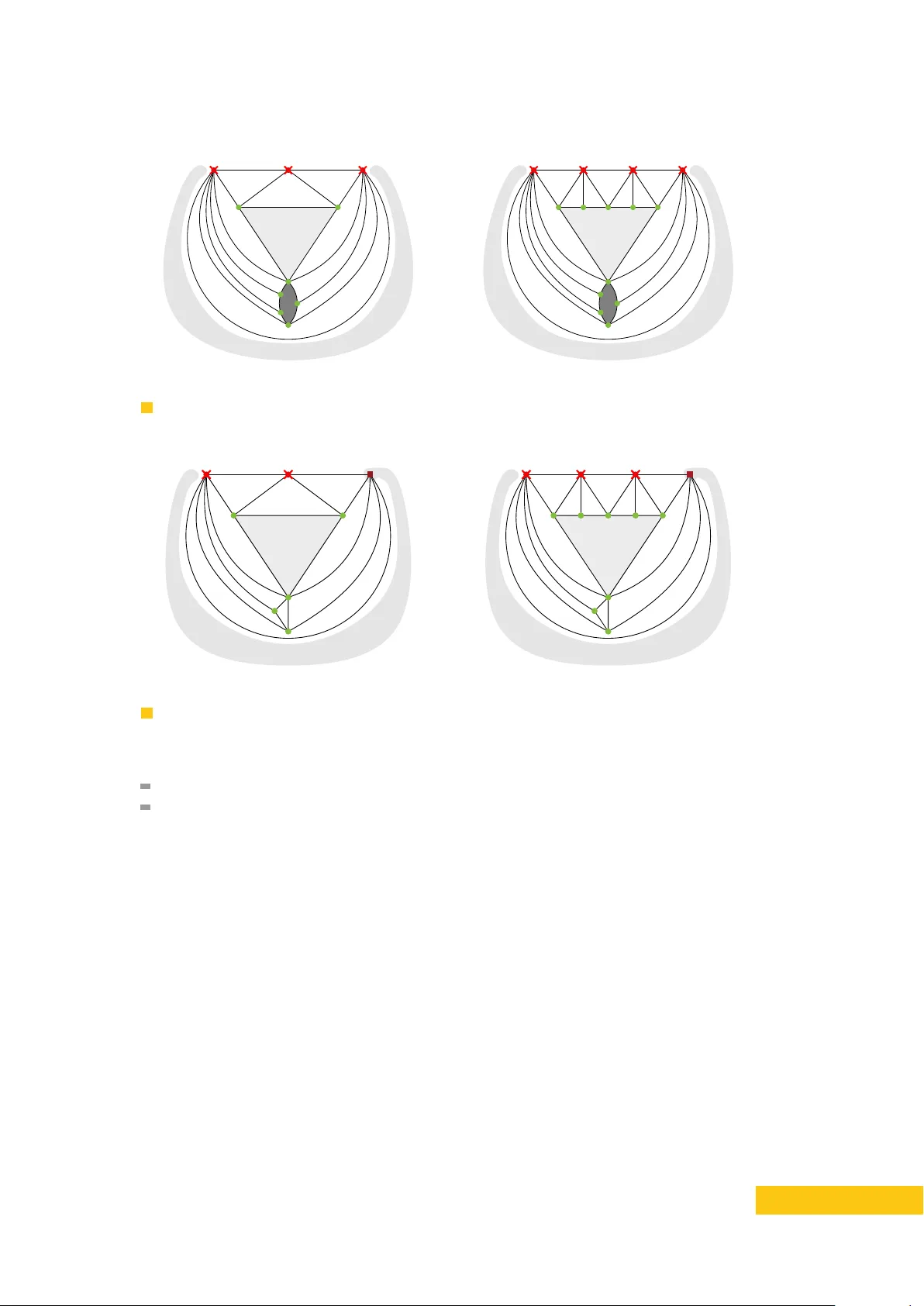
On La rge Induced Outerplana r Subgraphs in 2 -Outerplana r Graphs Marco D’Elia # Roma T re Univ ersity , Rome, Italy F abrizio F rati # Roma T re Universit y , Rome, Italy Abstract Borradaile, Le and Sherman-Bennett [ Gr aphs and Combinatorics , 2017] prov ed that every n -v ertex 2 - outerplane graph has a set of at least 2 n/ 3 vertices that induces an outerplane graph. W e identify a ma jor flaw in their pro of and recov er their result with a different, and unfortunately muc h more complex, pro of. 2012 A CM Subject Classification Theory of computation → Design and analysis of algorithms; Mathematics of computing → Com binatorics; Mathematics of computing → Graph theory Keyw o rds and phrases Induced graphs, planar graphs, outerplanar graphs 1 Intro duction A famous conjecture of Alb ertson and Berman [ 2 ] states that every n -v ertex planar graph has a set with at least n/ 2 vertices that induces a forest. The conjecture is the strongest p ossible, as there exist n -v ertex planar graphs that ha v e no set with more than n/ 2 vertices inducing a forest (for example, a planar graph comp osed of n/ 4 vertex-disjoin t K 4 ’s). The conjecture has b een pro v ed for many classes of planar graphs, including outerplanar graphs [ 16 ], cubic planar graphs [ 5 ], planar graphs with girth larger than 3 [ 11 , 14 , 18 , 20 , 21 , 25 ], n -v ertex planar graphs with at most ⌊ 7 n/ 4 ⌋ edges [ 26 ], bipartite planar graphs [ 1 , 27 ], and 2 -outerplanar graphs [ 7 ], often with b ounds that are even stronger than n/ 2 . A p ositive solution to Alb ertson and Berman’s conjecture would imply , without using the 4 -color theorem, the existence of an indep enden t set with n/ 4 v ertices in an y n -v ertex planar graph. Over the years, the conjecture has gained a prominent place in graph theory , man y related conjectures hav e b een stated, and man y related results hav e b een discov ered, see, e.g., [ 1 , 4 , 7 , 9 , 12 , 13 , 15 , 17 , 19 , 22 , 23 , 24 ]. The b est kno wn lo wer b ound for the size of a set of vertices that induces a forest in an y n -v ertex planar graph is 2 n/ 5 . This is a consequence of a result of Boro din [ 6 ], which asserts that every n -v ertex planar graph has an acyclic 5 -coloring; in such a coloring, the t w o largest color classes induce a forest with at least 2 n/ 5 vertices. Since there exist planar graphs with no acyclic 4 -coloring, this line of attack to the Alb ertson and Berman’s conjecture cannot yield b ounds b etter than 2 n/ 5 . A promising alternative direction is the one of finding, in any n -v ertex planar graph G , a large induced subgraph which belongs to a restricted planar graph class, for which it is known that a large induced forest can alwa ys b e found. In particular, it is known that every n -v ertex outerplanar graph has an induced forest with at least 2 n/ 3 vertices [ 16 ]. Th us, every n -v ertex planar graph has an induced forest with at least 2 cn/ 3 vertices, where c is the maximum constan t such that every n -v ertex planar graph has an induced outerplanar graph with at least cn v ertices. Hence, any b ound for c larger than 3 / 5 would improv e the currently b est known b ound of 2 n/ 5 for the Alb ertson and Berman’s conjecture. It is not hard to observe that c ≤ 2 / 3 (as one of the tw o 6 -vertex maximal planar graphs has a largest induced outerplanar graph with 4 v ertices only) and that c ≥ 1 / 2 (this comes from a decomp osition in outerplanar layers of the giv en graph). The b est known low er b ound for c is 11 / 21 , due to Bose, Dujmović, Houdrouge, Morin, and 2 On Large Induced Outerplana r Subgraphs in 2 -Outerplana r Graphs Odak [ 8 ]. In fact, the 11 n/ 21 low er b ound [ 8 ], as well as the previous n/ 2 low er b ound [ 3 , 4 ] holds for the size of an outerplane gr aph that one is guaran teed to find in an n -v ertex planar graph. That is, fix a plane embedding of the n -v ertex planar graph; then the found subset induces an embedded planar graph in which every vertex is incident to the outer face. This prop ert y allo ws the result to b e used for graph drawing applications, see [ 4 , 8 , 13 ]. A 2 -outerplanar gr aph is a planar graph that admits a plane embedding such that, by remo ving the v ertices incident to the outer face, one gets an outerplanar graph; the 2 - outerplanar graph, equipp ed with suc h an embedding, is called 2 -outerplane gr aph . The class of 2 -outerplanar graphs has b een studied b y Borradaile, Le and Sherman-Bennett [ 7 ] as an interesting b enchmark for the maximum size of an induced forest or induced outerplane graph that one is guaranteed to find in a planar graph. They prov ed the b est p ossible results for b oth problems: Every n -v ertex 2 -outerplane graph has a set of n/ 2 v ertices that induces a forest (thus proving Alb ertson and Berman’s conjecture for the 2 -outerplanar graphs) and has a set of 2 n/ 3 vertices that induces an outerplane graph. Unfortunately , we p oint out a ma jor flaw in their pro of of the second result. What makes the fla w ma jor is that the general strategy they use, that is, the set of vertices inducing an outerplane graph should contain all the vertices that are not incident to the outer face of the given 2 -outerplane graph, plus, p ossibly , some additional vertic es, cannot yield the desired b ound. Indeed, we show that, for arbitrarily large v alues of n , there exists an n -v ertex 2 -outerplane graph such that any set of v ertices that contains all the vertices that are not incident to the outer face and induces an outerplanar graph has at most 7 n/ 11 vertices. The aim of this pap er is to recov er the following result. ▶ Theo rem 1. L et G b e an n -vertex 2 -outerplane gr aph. Ther e exists a set I ⊆ V ( G ) with |I | ≥ 2 n/ 3 , such that the sub gr aph of G induc e d by I is an outerplane gr aph. The rest of the pap er is organized as follows. In Section 2 we present some definitions and preliminaries. In Section 3 we discuss more in detail the flaw in the algorithm by Borradaile, Le and Sherman-Bennett [ 7 ]. In Section 4 we show a new pro of for Theorem 1 . Finally , in Section 5 we conclude and present some op en problems. 2 Prelimina ries W e consider simple and finite graphs, and we use standard terminology from Graph The- ory [ 10 ]. W e denote b y V ( G ) the vertex set of a graph G . Given a set I ⊆ V ( G ) , we denote b y G [ I ] the subgraph of G induc e d by I , that is, the graph whose vertex set is I and whose edge set consists of all edges uv in G suc h that u, v ∈ I . W e denote b y δ G ( v ) the de gr e e of a v ertex v in G , that is, the num b er of edges incident to v . A dr awing of a graph maps each vertex to a p oint in the plane and each edge to a Jordan curv e connecting its endp oints. A dra wing is planar if no tw o edges cross, except p ossibly at common endp oints. A planar drawing partitions the plane in to connected regions, called fac es . The un bounded face is called the outer fac e , while the other faces are internal . A planar drawing is outerplanar if every vertex is incident to the outer face. An outerplanar gr aph is a graph that admits an outerplanar drawing. W e call outerplane emb e dding the top ological information asso ciated with such a dra wing, and we call outerplane gr aph a graph together with an outerplane embedding. A planar drawing is 2 -outerplanar if removing all v ertices incident to the outer face results in an outerplanar drawing. A 2 -outerplanar gr aph is a graph that admits a 2 -outerplanar drawing. W e call 2 -outerplane emb e dding the top ological information asso ciated with such a dra wing, and w e call 2 -outerplane gr aph a graph together M. D’Elia and F. Frati 3 with a 2 -outerplane embedding. An induced subgraph G [ I ] of a 2 -outerplane graph G inherits the embedding of G , thus we say that G [ I ] is outerplane if restricting the embedding of G to the vertices and edges of G [ I ] results in an outerplane graph. A 2 -outerplane graph is internal ly-triangulate d if all its internal faces are 3 -cycles. Giv en a 2 -outerplane graph G , w e denote by L 1 the set of v ertices of G that lie on the outer face, and by L 2 the set of v ertices of G that do not lie on the outer face, i.e., L 2 = V ( G ) − L 1 . In our pro ofs we will exploit several times the follo wing observ ation. W e say that t wo outerplane subgraphs of a 2 -outerplane graph are e ach in the outer fac e of the other one if every vertex and edge of eac h graph is in the outer face or on the b oundary of the outer face of the other graph. ▶ Observation 2. L et G 1 and G 2 b e two outerplane sub gr aphs of a 2 -outerplane gr aph such that: (i) e ach of G 1 and G 2 is in the outer fac e of the other one; and (ii) G 1 and G 2 do not shar e any vertex, or shar e a single vertex, or shar e a single e dge. Then the sub gr aph of G c omp ose d of G 1 and G 2 is outerplane. A cutvertex of a connected graph G is a vertex whose remov al disconnects G . A connected graph is bic onne cte d if it contains no cutvertex. A bic onne cte d c omp onent (or blo ck ) of a graph G is a maximal (in terms of vertices and edges) biconnected subgraph of G . A biconnected graph or a blo ck is trivial if it is a single edge, and non-trivial otherwise. F or a connected graph G , the blo ck-cutvertex tr e e T G is a tree that describ es the arrangemen t of biconnected comp onents of G . It contains a B-no de for each blo ck of G and a C-no de for each cutvertex of G . A B-no de B and a C-no de c are adjacent in T G if the cutvertex corresp onding to c is a vertex of the blo ck corresp onding to B . Note that the leav es of T G are all B-no des. W e often identify a cutvertex with its corresp onding C-no de and a blo ck with its corresp onding B-no de. W e are going to exploit the following lemma. ▶ Lemma 3. L et G b e a 2 -outerplane gr aph with n ≥ 3 vertic es. It is p ossible to add e dges to G so that it b e c omes an internal ly-triangulate d 2 -outerplane non-trivial bic onne cte d gr aph. Pro of. Throughout the pro of, let f G denote the outer face of G and W G the b oundary of f G . W e add edges to G in 4 steps. (Step 1) First, we augment G so that W G is connected. This is done as follows. While there exist tw o connected comp onents C 1 and C 2 that contain vertices v 1 and v 2 in L 1 , resp ectiv ely , w e add the edge v 1 v 2 to G and em b ed it in f G . This augmentation maintains the em b edding 2 -outerplane, since the edge v 1 v 2 do es not preven t an y vertex from b eing incident to f G and is incident to tw o vertices in L 1 . Once Step 1 is concluded, W G is connected. (Step 2) Second, we augment G so that W G is a cycle. This is done as follows. W e tra v erse W G in clo ckwise direction. Whenever we encounter tw o consecutive edges v 1 u and uv 2 that b elong to distinct blo cks B 1 and B 2 of G , resp ectively , we add the edge v 1 v 2 to G and embed it in f G , so that the path v 1 uv 2 is replaced by the edge v 1 v 2 in W G . This augmen tation maintains the embedding 2 -outerplane, since the edge v 1 v 2 do es not preven t an y v ertex from b eing incident to f G and is incident to tw o vertices in L 1 . In particular, an incidence of u on f G is turned into an incidence of u on the internal face delimited by the cycle v 1 uv 2 ; how ever, since the edges v 1 u and uv 2 are incident to f G , the edges uw 1 and uw 2 that resp ectively follow and precede v 1 u and uv 2 in clo ckwise direction along the b oundaries of B 1 and B 2 (suc h edges are again uw 1 and/or uw 2 if B 1 and/or B 2 are trivial), are also inciden t to f G , hence u remains incident to f G . Once Step 2 is concluded, W G is a cycle. (Step 3) Third, while G con tains an in ternal face f whose b oundary con tains t w o v ertices v 1 and v 2 suc h that at least one of them is in L 1 and such that the edge v 1 v 2 do es 4 On Large Induced Outerplana r Subgraphs in 2 -Outerplana r Graphs C v 1 v v 2 P O P I Figure 1 Illustration for the correctness of Step 4 in the pro of of Lemma 3 . The cycle C is represen ted b y a thic k line and the face f is shaded orange. not b elong to G , we add to G the edge v 1 v 2 and embed it inside f . This augmentation main tains the embedding 2 -outerplane, since the edge v 1 v 2 do es not preven t any vertex from b eing incident to f G , given that it is em b edded inside an internal face of G , and since it is inciden t to at least one vertex in L 1 . Once Step 3 is concluded, every vertex in L 1 that is on the b oundary of an internal face f of G is adjacen t to all the v ertices on the b oundary of f . (Step 4) Finally , for every internal face f whose b oundary contains at least 4 distinct v ertices, we add an edge b etw een tw o vertices v 1 and v 2 that are incident to f and that are not already adjacent in G (note that v 1 and v 2 are in L 2 , as otherwise Step 3 w ould not be concluded). The existence of such a pair of vertices is a standard argument: The v ertices inciden t to f cannot induce a clique, since they are at least 4 and since they induce an outerplanar subgraph of G . W e prov e that this augmen t ation maintains the embedding 2 - outerplane. Supp ose, for a contradiction, that this is not the case; refer to Figure 1 . The edge v 1 v 2 do es not preven t an y vertex from b eing incident to f G , since it is em b edded inside an internal face of G . Hence, if the em b edding is not 2 -outerplane, there exists a cycle C in G [ L 2 ] such that the b ounded region R delimited by C con tains a vertex v in its interior. Supp ose that C is minimal , i.e., no cycle C ′ = C is such that the b ounded region delimited b y C ′ con tains v in its interior and all the edges of C ′ are in the closure of R . Indeed, if such a cycle C ′ exists, we can use it in place of C ; the rep etition of this argument ev entually leads to a minimal cycle C . Note that v 1 v 2 is an edge of C , as otherwise G w ould not b e 2 -outerplane ev en b efore the augmen tation. Also, f is externally delimited b y a cycle whic h consists of t w o paths b etw een v 1 and v 2 , one, say P I , whose vertices and edges are all in the closure of R and one, say P O , whose vertices and edges are all in the closure of the complement of R . W e hav e that v is a vertex of P I , as otherwise P I , together with the edge v 1 v 2 or with the path P obtained from C b y removing the edge v 1 v 2 , would create a cycle C ′ suc h that the b ounded region delimited by C ′ con tains v in its interior and all the edges of C ′ are in the closure of R , contradicting the minimalit y of C . This implies that P O consists only of v ertices in L 2 , as if it contained a vertex u in L 1 , then the edge uv w ould not b elong to G , since v and u are one inside and one outside C , hence we would b e in Step 3 and the edge uv , rather than v 1 v 2 , would b e added to G . Then the paths P and P O define a walk in G [ L 2 ] whic h b ounds a region which contains v in its interior. Hence, G is not 2 -outerplane b efore the augmentation, a contradiction. Once Step 4 is concluded, G is internally-triangulated. Since n ≥ 3 and W G is a cycle, w e hav e that G is a non-trivial biconnected graph and concludes the pro of of the lemma. ◀ 3 On the Pro of of Theorem 1 b y Bo rradaile, Le and Sherman-Bennett In this section, we discuss the flaw in the pro of of Theorem 1 presented by Borradaile, Le and Sherman-Bennett [ 7 ]. There are three distinct levels for this discussion. M. D’Elia and F. Frati 5 First, at the highest level, their general strategy , which they describ e as “ T o find the vertic es inducing a lar ge outerplanar gr aph in G , we delete vertic es in L 1 until al l vertic es in L 2 ar e “exp ose d” to the external fac e ” do es not, unfortunately , allo w one to find a set of 2 n/ 3 vertices that induces an outerplane graph. Indeed, consider the 2 -outerplane graph G in Figure 2a . Each vertex in L 1 prev en ts a distinct vertex in L 2 from b eing incident to the outer face. Thus, if a set of vertices in G induces an outerplane graph and contains all the v ertices in L 2 , it do es not con tain any of the vertices in L 1 , and thus it contains at most 7 of the 11 vertices of G . Note that 7 / 11 < 2 / 3 . F urthermore, this counter-example holds even if one wan ts to find an induced outerplanar , rather than outerplane , graph in G . In fact, an y vertex of L 1 induces, together with 4 vertices in L 2 , a subgraph of G con taining K 2 , 3 . Replicating this example as shown in Figure 2b allows us to state the follo wing. ▶ Theo rem 4. F or every p ositive n multiple of 11 , ther e exists an n -vertex 2 -outerplane gr aph G such that every set of vertic es in G which induc es an outerplanar gr aph and includes al l the vertic es not incident to the outer fac e of G c ontains at most 7 n 11 vertic es. t 1 ,l t 1 ,r b 1 ,l b 1 ,r (a) t 1 ,l t 1 ,r b 1 ,l b 1 ,r t 2 ,l b 2 ,l G 1 t h,l t h,r b h,l b h,r G 2 G h (b) Figure 2 An n -v ertex 2 -outerplane graph on whic h the algorithm by Borradaile et al. fails to find a set of 2 n/ 3 v ertices that induces an outerplanar graph. In this and the following figures, vertices depicted in red and green belong to L 1 and L 2 , resp ectiv ely . Second, at an intermediate level, the algorithm b y Borradaile et al. relies on defining triples of vertices, so that each v ertex in L 2 o ccurs in exactly one triple; eac h triple contains either a single vertex in L 2 and tw o of its neigh b ors in L 1 , or tw o vertices in L 2 and a common neigh b or in L 1 . Once a vertex in L 1 is deleted, the vertices in L 2 in the same triple as that vertex are exp osed on the outer face. In order to find these triples, they rely on a structural lemma ([ 7 , Lemma 3]), which asserts that there exists a matching on the b oundary of G [ L 2 ] which spans every v ertex of L 2 that has a unique neigh b or in L 1 . The graph G sho wn in Figure 2a is a coun ter-example to this statement. Indeed, L 2 consists of 7 v ertices; also, 4 of such vertices hav e a unique neighbor in L 1 and no tw o of such 4 vertices are adjacent on the b oundary of G [ L 2 ] . Hence, no matching exists on the b oundary of G [ L 2 ] whic h spans all such 4 vertices. Third, at a low est level, their pro of of [ 7 , Lemma 3] works by induction on the num b er of vertices with a unique neighbor in L 1 . If there is at least one of such v ertices, then its neigh b ors on the b oundary of G [ L 2 ] can b e contracted into it, resulting in a graph with one less vertex with a unique neighbor in L 1 . The contraction might result in parallel edges and lo ops, which the authors remov e from the graph. How ever, such a remov al might result in a 2 -outerplane graph which is not internally-triangulated any longer. Hence, the to ols they use to find the next vertices to b e con tracted [ 7 , Observ ation 16, Lemma 1, Lemma 2] are not applicable to the obtained graph and the induction breaks down. Remark. The describ ed fla w in the pro of of [ 7 , Lemma 3] do es not o ccur if G [ L 2 ] is biconnected or, more in general, a set of pairwise-disjoint biconnected comp onents, since 6 On Large Induced Outerplana r Subgraphs in 2 -Outerplana r Graphs e ∗ (a) e ∗ r ∗ (b) B 1 c 1 c 2 B 2 B 3 B 4 B 1 c 1 c 2 B 2 B 3 B 4 (c) c 3 c 4 B 5 B 6 B 7 B 8 c 3 B 7 B 5 B 6 B 8 c 4 (d) Figure 3 (a) An internally-triangulated 2 -outerplane graph G with a distinguished edge e ∗ along its outer face. (b) The outerplane graph G [ L 1 ] , together with its ro oted weak dual tree T ∗ , whose no des are empty squares and whose edges are thick and red. (c)-(d) T w o terminal components, sa y K c and K d , of G [ L 2 ] , together with their ro oted blo ck-cutv ertex trees T K c and T K d , resp ectively . The extremal lea v es of T K c are B 2 , B 3 , and B 4 , while B 8 is the only extremal leaf of T K d . in this case the contractions they use preserve the prop erty that the graph is internally- triangulated. Thus, the algorithm by Borradaile et al. successfully finds a set of 2 n/ 3 v ertices that induces an outerplane graph if the input n -v ertex graph G is such that G [ L 2 ] is a set of pairwise-disjoint biconnected comp onents. Unfortunately , we cannot use this result as a black b ox in our algorithm for general 2 -outerplane graphs, since our induction needs to ensure stronger prop erties on the large set of vertices inducing an outerplane graph. 4 A New Pro of of Theo rem 1 In this section, we sho w an algorithm that, giv en an n -v ertex 2 -outerplane graph G , computes a set I ⊆ V ( G ) with |I | ≥ 2 n/ 3 , such that G [ I ] is an outerplane graph. This pro v es Theorem 1 . W e will not explicitly discuss the running time of our algorithm, how ever, it is easy to see that it can b e implemented to run in p olynomial time. The section is organized as follows. In Section 4.1 , we introduce some definitions. In Section 4.2 , we present the case distinction used by our inductive algorithm. Finally , in Section 4.3 , we discuss the inductive cases of our algorithm. 4.1 Definitions Our algorithm w orks by induction on n . In the base case, we ha v e n ≤ 2 and then the en tire v ertex set of G induces an outerplane graph. If n ≥ 3 , b y Lemma 3 we can assume that G is an internally-triangulated non-trivial biconnected graph. Giv en a set of vertices I ⊆ V ( G ) , w e say that I is a go o d set if |I | ≥ 2 3 n and if G [ I ] is outerplane. W e introduce some definitions. Let G b e an internally-triangulated 2 -outerplane graph with a distinguished edge e ∗ inciden t to its outer face, as the one in Figure 3a . The we ak dual T of G [ L 1 ] is the tree that has a no de for each internal face of G [ L 1 ] and an edge b etw een t w o no des if the corresp onding faces share an edge on their b oundaries; see Figure 3b . W e M. D’Elia and F. Frati 7 ro ot T at the no de r ∗ corresp onding to the unique internal face of G [ L 1 ] that has e ∗ on its b oundary; we denote b y T ∗ the tree T once ro oted at r ∗ . Consider a leaf l of T ∗ , which corresp onds to a face f of G [ L 1 ] . The face f migh t b e also a face of G , or it might contain a connected comp onen t K of G [ L 2 ] . In the latter case, we say that K is a terminal c omp onent of G [ L 2 ] . Consider a terminal comp onent K of G [ L 2 ] em b edded in G inside a face f of G [ L 1 ] corresp onding to a leaf l of T ∗ ; see the examples in Figures 3c and 3d . The ro oting of T ∗ induces a ro oting of the blo c k-cutv ertex tree T K of K as follo ws. Let xy b e the edge of G [ L 1 ] dual to the edge of T ∗ from l to its parent (or let e ∗ = xy if l is the ro ot of T ∗ ), and let z b e the vertex of K suc h that the 3 -cycle xy z b ounds an internal face of G . If z is a cutvertex of K , then T K is ro oted at the corresp onding C-no de, otherwise T K is ro oted at the unique B-no de containing z . A leaf B in the ro oted tree T K is extr emal if it has maximum depth (i.e., distance from the ro ot) among the leav es of T K . Note that the children of the parent of an extremal leaf are also extremal leav es. Consider a terminal comp onent K of G [ L 2 ] and supp ose that K is not biconnected. Let B b e an extremal leaf of the ro oted blo ck-cutv ertex tree T K of K . The unique neighbor of B in T K is called link-vertex of B and denoted b y c B . If B is a trivial blo ck, it corresp onds to an edge c B d B . If B is a non-trivial blo ck, the neighbors of c B on the b oundary of the outer face of B are called leftmost and rightmost neighbors of c B in B and denoted by u B and v B , where u B , v B , and c B app ear in this clo ckwise order along the outer face of B . Let u ′ B b e the vertex that follo ws u B in clo ckwise order along the outer face of B and let v ′ B b e the v ertex that follows v B in counter-clockwise order along the outer face of B . If B is a trivial (non-trivial) block, let c B ℓ B b e the edge of G that precedes c B d B (resp. c B u B ) in clo c kwise direction around c B and note that ℓ B ∈ L 1 . W e call ℓ B the left c age vertex of B . Symmetrically , let c B r B b e the edge of G that follows c B d B (resp. c B v B ) in clo ckwise direction around c B and note that r B ∈ L 1 . W e call r B the right c age vertex of B . The path obtained b y trav ersing in clo ckwise direction the outer face of G from ℓ B to r B is called the c age p ath of B and denoted b y P B . Let ℓ ′ B b e the vertex that precedes ℓ B in clo ckwise order along the outer face of G , and let r ′ B b e the vertex that follows r B in clo c kwise order along the outer face of G . Finally , the subgraph of G whose vertices and edges are inside or on the b o undary of the cycle P B ∪ r B c B ℓ B is called the c age gr aph of B and denoted by G B . The fact that K is a terminal comp onent of G [ L 2 ] and that B is a leaf of T K implies that G B do es not contain edges b etw een tw o non-consecutiv e vertices of P B ; hence, every internal face of G that has an edge of P B on its b oundary has a vertex of B as its third incident vertex. If B is non-trivial, then we say that B is p esky (see Figure 4 ) if it satisfies the following prop erties (the first tw o prop erties actually imply the other tw o, but w e state all four of them, so to b etter describ e the structure of G B ): first, δ G B ( ℓ B ) = δ G B ( r B ) = 4 ; second, for each internal vertex w of P B , we hav e δ G B ( w ) = 5 ; third, u B and v B ha v e only ℓ B and r B , resp ectiv ely , as neighbors in L 1 ; and finally , trav ersing the b oundary of the outer face of B in clockwise direction from u B to v B , the encountered vertices hav e alternately 1 and 2 neighbors in L 1 . W e observe the following. ▶ Observation 5. If B is p esky, the numb er of vertic es of B is exactly twic e the numb er of vertic es of P B . If B is non-trivial and not p esky , then we sa y that it is cushy . 8 On Large Induced Outerplana r Subgraphs in 2 -Outerplana r Graphs ℓ B r B u B v B c B B ℓ ′ B r ′ B u ′ B = v ′ B (a) ℓ B r B u B v B c B u ′ B v ′ B B ℓ ′ B r ′ B (b) Figure 4 T w o p esky blo cks. 4.2 Case distinction W e now discuss the case distinction employ ed by our inductive algorithm. Supp ose that G is a non-trivial biconnected graph. In all the inductive cases, the basic strategy is the one of remo ving some v ertices of the input 2 -outerplane graph G , obtaining a smaller 2 -outerplane graph H , of then applying induction on H , so to get a go o d set I H for H , and of then defining a go o d set I for G b y adding to I H some of the initially remo v ed vertices. T w o initial inductiv e cases are used to deal with the situation in which G con tains a vertex v ∈ L 1 whose degree in G is 2 ( Case 1 ) or 3 ( Case 2 ). This allows us to assume that every vertex of L 1 has degree at least 4 in G . Next, consider a leaf l of the ro oted weak dual tree T ∗ of G [ L 1 ] , and let f b e the face of G [ L 1 ] corresp onding to l . Since no vertex of L 1 has degree 2 in G , it follows that f con tains a terminal comp onent K . Let xy b e the edge of G [ L 1 ] dual to the edge of T ∗ from the no de corresp onding to f to its parent (or let xy b e the edge e ∗ if the no de corresp onding to f is the ro ot of T ∗ ). Note that K is not a single vertex, otherwise all its neighbors in L 1 differen t from x and y (there exists at least one such a neighbor) would hav e degree 3 in G , whic h is excluded. If K is a single edge uv ( Case 3 ), then f is delimited by a 3 -cycle xy z suc h that z is adjacent to b oth u and v , or b y a 4 -cycle xy tz , suc h that each of t and z is adjacen t to b oth u and v . Indeed, if f w as delimited b y a cycle with more than 4 vertices, at least one of them would hav e degree 3 in G ; lik ewise, if one of the vertices on the b oundary of f was not adjacent to u or v , then it would hav e degree 3 in G . Ha ving ruled out that K is a v ertex or an edge, it might b e that K is a non-trivial biconnected graph ( Case 4 ). Unfortunately , we cannot handle this case via the algorithm by Borradaile et al. [ 7 ]. Indeed, the natural choice for the graph H on which induction should b e applied is the following: Remov e K and the v ertices in the cycle C f delimiting f , except for x and y , from G , and let the resulting graph b e H . Ho wev er, with this approach, the induction w ould tell us whether x and y b elong to the set of vertices inducing an outerplane graph, and the algorithm b y Borradaile et al. do es not guarantee this freedom of c hoice when applied to the 2 -outerplane graph induced by the vertices inside or on the b oundary of C f . Hence, we need to come up with a new algorithm providing guarantees on x and y . In the remaining cases, K is not biconnected. Then recall that T K denotes the ro oted blo c k-cutv ertex tree of K . Let B b e an extremal leaf of K . Supp ose first that B is non-trivial. If B is cushy ( Case 5 ), then w e can apply a natural strategy for defining H : W e remov e from G all the cage graph G B of B , except for the link-vertex c B and, p ossibly , for the left and/or righ t cage vertices ℓ B and r B . If, on the other hand, B is p esky , then this simple strategy do es not work (which justifies the attribute p esky ) and we need to explore the structure of G in further depth. In particular, the next cases handle the situations in whic h: The edge c B ℓ ′ B exists and the 3 -cycle c B ℓ B ℓ ′ B b ounds an internal face of G ( Case 6 ); M. D’Elia and F. Frati 9 the edge c B r ′ B exists and the 3 -cycle c B r B r ′ B b ounds an internal face of G ( Case 6’ ); the edge c B ℓ ′ B exists and the 3 -cycle c B ℓ B ℓ ′ B con tains in its interior a unique vertex ( Case 7 ); and the edge c B r ′ B exists and the 3 -cycle c B r B r ′ B con tains in its interior a unique vertex ( Case 7’ ). Having ruled out that there is a face (Cases 6 and 6’) or a K 4 (Cases 7 and 7’) next to G B , we next handle the situation in which there is a different p esky blo ck B ∗ next to G B . F ormally , this happ ens if there exists a p esky non-trivial extremal leaf B ∗ = B in K suc h that the link-v ertex c B ∗ of B ∗ is c B and the right cage vertex r B ∗ of B ∗ is ℓ B ( Case 8 ) or if there exists a p esky non-trivial extremal leaf B ∗ = B in K suc h that the link-vertex c B ∗ of B ∗ is c B and the left cage vertex ℓ B ∗ of B ∗ is r B ( Case 8’ ). The next cases assume that B is trivial. Indeed, similarly to the case in which B is non- trivial, we can successfully apply induction if: The edge c B ℓ ′ B exists and the 3 -cycle c B ℓ B ℓ ′ B b ounds an internal face of G ( Case 9 ); the edge c B r ′ B exists and the 3 -cycle c B r B r ′ B b ounds an in ternal face of G ( Case 9’ ); the edge c B ℓ ′ B exists and the 3 -cycle c B ℓ B ℓ ′ B con tains in its interior a unique v ertex ( Case 10 ); and the edge c B r ′ B exists and the 3 -cycle c B r B r ′ B con tains in its interior a unique vertex ( Case 10’ ). The describ ed case distinction greatly simplifies the structure of G that can b e assumed in the proximit y of an extremal leaf B of the ro oted blo ck-cutv ertex tree T K of a terminal comp onen t K of G [ L 2 ] , as stated in the following. ▶ Lemma 6. If neither of Cases 5, 6, 6’, 7, 7’, 8, 8’, 9, 9’ 10, and 10’ applies, then B is the only child of the cutvertex c B in T K . Pro of. Supp ose, for a con tradiction, that c B has a child B ′ = B in T K . Since B is an extremal leaf of T K , then so is B ′ . The edges incident to c B that b elong to the cage graph G B of B app ear consecutively in the circular order around c B , b et w een the edges c B ℓ B and c B r B , and likewise for the edges incident to c B that b elong to the cage graph G B ′ of B ′ . W e define a linear order σ of the edges that are incident to c B and that belong to blo cks of K that are c hildren of c B in T K , as follows. Start from any edge inciden t to c B in the paren t blo ck of c B in T K (or start from the edge c B x if c B is the ro ot of T K ). Then visit in clo c kwise order the edges incident to c B in G and app end to σ those that b elong to blo cks of K that are children of c B in T K . W e can assume that, in σ , the edges that b elong to B come right after the edges that b elong to B ′ , as otherwise a different choice for B and B ′ can b e made, so to guaran tee this prop ert y . If B or B ′ is non-trivial and cushy , then Case 5 applies, a contradiction. Otherwise, consider the face incident to the edge c B ℓ B and outside the cage graph G B ; let z b e the third vertex incident to the face. If z ∈ L 1 , then z = ℓ ′ B , as otherwise K w ould not b e a terminal comp onent of G [ L 2 ] , hence we would b e in Case 6 or Case 9, dep ending on whether B is non-trivial or trivial, resp ectively , a contradiction. Hence, we hav e z ∈ L 2 , which implies that z ∈ V ( B ′ ) . If B ′ is trivial, then Case 7 or Case 10 applies, dep ending on whether B is non-trivial or trivial, resp ectively , a contradiction. If B ′ is non-trivial and p esky , and B is trivial, then Case 7’ applies, a contradiction. Finally , if b oth B and B ′ are non-trivial and p esky , then Case 8 applies, a contradiction. Since in every case we get a contradiction, the lemma follows. ◀ By Lemma 6 and since K is not biconnected, c B has a parent B-no de B P in T K . W e can handle directly the case in which B P is a trivial blo ck, b oth if B is non-trivial ( Case 11 ) and if it is trivial ( Case 12 ). In order to discuss Case 11 and Case 12, it will b e useful to exploit the following prop erty . ▶ Lemma 7. Supp ose that B P is a trivial blo ck, c orr esp onding to an e dge c B p . Then the e dges pℓ B and pr B b elong to G , and the cycles pℓ B c B and pr B c B delimit fac es of G . 10 On Large Induced Outerplana r Subgraphs in 2 -Outerplana r Graphs Pro of. Consider the face incident to the edge c B ℓ B and outside the cage graph G B ; let z b e the third vertex incident to the face. W e prov e that z ∈ L 2 . Supp ose, for a contradiction, that z ∈ L 1 . If z = ℓ ′ B , then Case 6 or Case 9 applies, dep ending on whether B is non-trivial or trivial, resp ectively , a con tradiction. If z = ℓ ′ B , then ℓ b ℓ ′ B is an in ternal edge of G [ L 1 ] , hence it is dual to an edge e of T ∗ ; one of the end-vertices of e is the no de l of T ∗ corresp onding to the face f of G [ L 1 ] containing K . If l is the parent of the other end-vertex of e in T ∗ , then K is not a terminal comp onent of G [ L 2 ] , a con tradiction. If l is a child of the other end-v ertex of e in T ∗ , then ℓ b ℓ ′ B is the edge xy . How ever, this implies that T K is ro oted at c B , a contradiction to the fact that c B has a parent B P in T K . This prov es that z ∈ L 2 . It follows that z = p , as otherwise the edge c B z w ould b e an edge b etw een tw o vertices of differen t connected comp onents of G [ L 2 ] or an edge b etw een tw o different blo cks of K , which is a contradiction in b oth cases. It can b e symmetrically pro v ed that the edge pr B b elongs to G and the cycle pr B c B delimits an internal face of G . ◀ W e are now ready to discuss the final inductive case ( Case 13 ), which o ccurs when neither of Cases 1-12 applies in the entire graph G (in particular, Cases 5-12 do not apply to any extremal leaf in any terminal comp onent of G [ L 2 ] ). The next lemma describ es the structure that we are guaranteed to encounter in Case 13. ▶ Lemma 8. If neither of Cases 1–12 applies, then ther e exists a terminal c omp onent K of G [ L 2 ] that c ontains a bic onne cte d c omp onent B P that satisfies the fol lowing pr op erties. First, B P is non-trivial and is not a le af of T K . Se c ond, e ach child c B of B P in T K has a unique child B , which is an extr emal le af of T K and is either a trivial blo ck or a non-trivial p esky blo ck. Thir d, for e ach child B of a child c B of B P , let c l B and c r B b e the vertic es that pr e c e de and fol low c B in clo ckwise or der along the b oundary of B P ; then the e dges c l B ℓ B and c r B r B b elong to G , and the cycles c l B ℓ B c B and c r B r B c B delimit internal fac es of G . Pro of. Since Case 1 do es not apply , we ha v e that G [ L 2 ] contains a terminal comp onent. Let then K b e any terminal comp onent of G [ L 2 ] . Since Cases 2, 3, and 4 do not apply to K , it follo ws that K is not biconnected. Let then B b e an extremal leaf of T K . Since Case 5 do es not apply , B is either a trivial blo c k or a non-trivial p esky blo c k. Since Cases 5, 6, 6’, 7, 7’, 8, 8’, 9, 9’, 10, and 10’ do not apply , b y Lemma 6 , we hav e that B is the only child of its paren t c B in T K . W e can now define B P as the parent of c B in T K . By construction, B P is not a leaf of T K . Also, since Cases 11 and 12 do not apply , B P is non-trivial. Since B is an extremal leaf, ev ery child of a child of B P is also an extremal leaf, and then b y the same argumen ts as for B , it is either a trivial blo ck or a non-trivial pesky blo c k and it is the only c hild of its paren t in T K . It remains to prov e the third item. This pro of is very similar to the pro of of Lemma 7 . Consider any child B of a child c B of B P , and let c l B b e the vertex that precedes c B in clo c kwise order along the b oundary of B P . Consider the face incident to the edge c B ℓ B and outside the cage graph G B ; let z b e the third vertex incident to the face. W e prov e that z ∈ L 2 . Supp ose, for a contradiction, that z ∈ L 1 . If z = ℓ ′ B , then Case 6 or Case 9 applies, dep ending on whether B is non-trivial or trivial, resp ectively , a contradiction. If z = ℓ ′ B , then ℓ b ℓ ′ B is an in ternal edge of G [ L 1 ] , hence it is dual to an edge e of T ∗ ; one of the end-vertices of e is the no de l of T ∗ corresp onding to the face f of G [ L 1 ] containing K . If l is the parent of the other end-vertex of e in T ∗ , then K is not a terminal comp onent of G [ L 2 ] , a contradiction. If l is a child of the other end-vertex of e in T ∗ , then ℓ b ℓ ′ B is the edge xy . How ev er, this implies that T K is ro oted at c B , a contradiction to the fact that c B has a parent B P in T K . This prov es that z ∈ L 2 . It follows that z = c l B , as otherwise the edge c B z w ould b e an edge b etw een tw o vertices of different connected comp onents M. D’Elia and F. Frati 11 of G [ L 2 ] , or an edge b etw een tw o differen t blo cks of K , or an edge b etw een tw o v ertices of the same blo ck B of K not b elonging to B , which is a contradiction in every case. It can b e symmetrically prov ed that the edge c r B r B b elongs to G and the cycle c r B r B c B delimits an internal face of G , where c r B is the v ertex that follows c B in clo ckwise order along the b oundary of B P . ◀ Finally , it remains to observe that one of the inductiv e cases alwa ys applies; indeed, if neither of Cases 1–12 applies, then Case 13 do es. Note that the graph H constructed in order to apply induction might b e not biconnected, how ever by Lemma 3 it can b e augmented to a non-trivial biconnected graph by only adding edges to it, as long as it has at least three v ertices (while it encounters the base case if it has at most tw o v ertices). 4.3 Inductive cases W e now discuss the inductive cases. Each inductive case assumes that neither of the previous cases applies. Case 1: There exists a vertex v ∈ L 1 such that δ G ( v ) = 2 Let u and z b e the neighbors of v in G , and observ e that they b elong to L 1 (see Figure 5a ). W e construct an ( n − 1) -v ertex 2 -outerplane graph H from G b y removing v and its incident edges. W e apply induction on H , so to find a go o d set I H for H . W e define I = I H ∪ { v } . W e pro v e that I is a go o d set. First, we hav e |I | = |I H | + 1 ≥ 2( n − 1) / 3 + 1 > 2 n/ 3 . Also, G [ I ] is outerplane by Observ ation 2 , since G [ I H ] and G [ v ∪ ( { u, z } ∩ I H )] are outerplane, are each in the outer face of the other one, and share either no vertex, or a single v ertex, or a single edge. Case 2: There exists a vertex v ∈ L 1 such that δ G ( v ) = 3 Let u and z b e the neighbors of v along the outer face of G ; hence, u and z b elong to L 1 . The third neighbor, v ′ , of v migh t b elong to L 1 or L 2 . W e further distinguish three cases. Case 2.1: The edge uz do es not b elong to G (see Figure 5b ). W e construct an ( n − 1) - v ertex 2 -outerplane graph H from G b y removing v and its incident edges, and by adding the edge uz in the outer face of H in place of the path uv z . W e apply induction on H , so to find a go o d set I H for H . W e define I = I H ∪ { v } . W e prov e that I is a go o d set. First, w e ha v e |I | = |I H | + 1 ≥ 2( n − 1) / 3 + 1 > 2 n/ 3 . Supp ose, for a contradiction, that G [ I ] contains a cycle C whic h contains a vertex w ∈ I in its interior. Note that w = v , since v is incident to the outer face of G , hence w ∈ I H . Also, v is one of the vertices of C , as otherwise G [ I H ] w ould also contain C , and I H w ould not b e a go o d set. The neighbors of v in C are tw o v ertices among u , z , and v ′ . Note that H con tains all three edges uz , uv ′ , and v ′ z , the first one by construction and the other t wo since G is internally-triangulated. Hence, the length- 2 path in C that has v as middle vertex can b e replaced by the edge b etw een its end-vertices, resulting in a cycle which also contains w in its interior and whose vertices all belong to I H , whic h implies that I H is not a go o d set, a contradiction. Case 2.2: The edge uz b elongs to G and the subgraph G uv z of G induced by the v ertices inside or on the b oundary of the 3 -cycle uv z has at least 6 vertices (see Figure 5c ). Note that the assumption that uz b elongs to G implies that v ′ ∈ L 2 . Let H b e the subgraph of G induced b y V ( G ) − V ( G uv z ) . W e apply induction on H , so to find a go o d set I H for H . W e define I as I H plus all the vertices of G uv z differen t from u and z . W e prov e that I is a go o d set. First, we hav e |I | = |I H | + | V ( G uv z ) | − 2 . Note 12 On Large Induced Outerplana r Subgraphs in 2 -Outerplana r Graphs v u z H (a) v u z H v ′ (b) v u z H v ′ (c) v u z H v ′ (d) Figure 5 Illustrations for (a) Case 1, (b) Case 2.1, (c) Case 2.2, and (d) Case 2.3. In this and the follo wing figures, squared vertices b elong to the graph H (sho wn with gray edges and a shaded area whic h hides most of its vertices and edges) on which induction is applied, while rounded vertices do not belong to H . A cross on a v ertex not b elonging to H indicates that it is not selected to b e in the set I inducing an outerplane graph. In (b), the dotted curv e represents an edge added to H for the induction and the v ertex v ′ migh t b elong to L 1 or L 2 . that | V ( H ) | = n − | V ( G uv z ) | , hence, by induction, we hav e |I H | ≥ 2( n − | V ( G uv z ) | ) / 3 . It follo ws that |I | ≥ 2( n − | V ( G uv z ) | ) / 3 + | V ( G uv z ) | − 2 = 2 n/ 3 + | V ( G uv z ) | / 3 − 2 ≥ 2 n/ 3 , where the last inequalit y comes from the fact that | V ( G uv z ) | ≥ 6 . By Observ ation 5 , we ha v e that G [ I ] is an outerplane graph, since it is comp osed of the outerplane graphs G [ I H ] and G uv z − { u, z } , which are eac h in the outer face of the other one and do not share any v ertex. Note that G uv z − { u, z } is indeed an outerplane graph since it is comp osed of the outerplane graph G [ V ( G uv z ) ∩ L 2 ] augmented with the edge v v ′ in its outer face. Case 2.3: The edge uz b elongs to G and G uv z has at most 5 vertices (see Figure 5d ). Let H b e the subgraph of G induced by { u } ∪ ( V ( G ) − V ( G uv z )) . W e apply induction on H , so to find a go o d set I H for H . W e define I as I H plus all the vertices of G uv z differen t from u and z . Note that u is in I if and only if it b elongs to I H , while z is not in I . W e prov e that I is a go o d set. First, we hav e |I | = |I H | + | V ( G uv z ) | − 2 . Note that | V ( H ) | = n − | V ( G uv z ) | + 1 , hence, by induction, we hav e |I H | ≥ 2( n − | V ( G uv z ) | + 1) / 3 . It follows that |I | ≥ 2( n − | V ( G uv z ) | + 1) / 3 + | V ( G uv z ) | − 2 = 2 n/ 3 + | V ( G uv z ) | / 3 − 4 / 3 ≥ 2 n/ 3 , where the last inequality comes from the fact that | V ( G uv z ) | ≥ 4 , giv en that v has degree 3 . Note that G [ I H ] is outerplane by induction and that the subgraph of G uv z induced by the vertices in I is either a path in the outer face of G [ I H ] , if u / ∈ I , or a biconnected outerplane graph whose vertex set intersects with the one of G [ I H ] only at u , if u ∈ I . Hence, b y Observ ation 2 , we hav e that G [ I ] is an outerplane graph. In the remaining cases, l denotes a leaf of the ro oted weak dual tree T ∗ of G [ L 1 ] , where l corresp onds to a face f of G [ L 1 ] and contains a terminal comp onent K of G [ L 2 ] . Let xy b e the edge of G [ L 1 ] dual to the edge of T ∗ from the no de corresp onding to f to its parent (or let xy b e the edge e ∗ if the no de corresp onding to f is the ro ot of T ∗ ). M. D’Elia and F. Frati 13 z x y H u v (a) v u z H v ′ (b) Figure 6 Illustrations for (a) Case 3.1 and (b) Case 3.2. Case 3: K is a single edge uv Recall that f is delimited by a 3 -cycle xy z suc h that z is adjacent to b oth u and v , or by a 4 - cycle xy tz , such that each of t and z is adjacent to b oth u and v . W e distinguish these cases. Case 3.1: The face f of G [ L 1 ] is delimited by a 3 -cycle xy z suc h that z is adjacent to b oth u and v (see Figure 6a ). Let H b e the subgraph of G induced by V ( G ) − { u, v , z } . W e apply induction on H , so to find a go o d set I H for H . W e define I = I H ∪ { u, v } . W e prov e that I is a go o d set. First, we hav e |I | = |I H | + 2 . Note that | V ( H ) | = n − 3 , hence, by induction, we hav e |I H | ≥ 2( n − 3) / 3 . It follows that |I | ≥ 2( n − 3) / 3 + 2 = 2 n/ 3 . Also, G [ I H ] is outerplane by induction and the subgraph of G induced by u , v , and b y { x, y } ∩ I H is outerplane, as w ell, given that z is a neigh b or of all of u, v , x, y . Since G [ I H ] and G [ { u, v } ∪ ( { x, y } ∩ I H )] are each in the outer face of the other one, and share either no vertex, or a single vertex, or a single edge, by Observ ation 2 , we ha v e that G [ I ] is an outerplane graph. Case 3.2: The face f of G [ L 1 ] is delimited by a 4 -cycle xy tz , such that each of t and z is adjacen t to b oth u and v (see Figure 6b ). Let H b e the subgraph of G induced b y V ( G ) − { u, v , t, z } . W e apply induction on H , so to find a go o d set I H for H . W e define I = I H ∪ { u, v , t } . W e prov e that I is a go o d set. First, we ha v e |I | = |I H | + 3 . Note that | V ( H ) | = n − 4 , hence, b y induction, we ha v e |I H | ≥ 2( n − 4) / 3 . It follows that |I | ≥ 2( n − 4) / 3 + 3 > 2 n/ 3 . Also, G [ I H ] is outerplane b y induction; also, the subgraph of G induced by u , v , t , and by { x, y } ∩ I H is outerplane, as well, given that z is adjacent to all of u, v , t , and x , and given that y b elong to L 1 . Since G [ I H ] and G [ { u, v , t } ∪ ( { x, y } ∩ I H )] are eac h in the outer face of the other one, and share either no vertex, or a single vertex, or a single edge, by Observ ation 2 , we hav e that G [ I ] is an outerplane graph. Case 4: K is a non-trivial biconnected graph Recall that C f denotes the cycle delimiting the b oundary of the face f of G [ L 1 ] con taining K . Since K is a terminal comp onent, all the edges of C f , except p ossibly for xy , are incident to the outer face of G . Denote by L the graph G [ V ( C f ) ∪ V ( K )] and let n L = | V ( L ) | . Before describing how to apply induction, we need to prov e the following lemma. ▶ Lemma 9. Ther e exists a set I L ⊂ V ( L ) such that { x, y } ∩ I L = ∅ and such that (at le ast) one of the fol lowing pr op erties is satisfie d: Prop ert y A: |I L | ≥ 2 n L / 3 and G [ I L ] is an outerplane gr aph; Prop ert y B: |I L | ≥ 2( n L − 1) / 3 and G [ I L ∪ { x } ] is an outerplane gr aph; Prop ert y C: |I L | ≥ 2( n L − 1) / 3 and G [ I L ∪ { y } ] is an outerplane gr aph; and Prop ert y D: |I L | ≥ 2( n L − 2) / 3 and G [ I L ∪ { x, y } ] is an outerplane gr aph. 14 On Large Induced Outerplana r Subgraphs in 2 -Outerplana r Graphs x y x 1 = w = y 1 z 1 x 2 y d ( y ) = w s x d ( x ) = w 1 z k w s − 1 w 2 z 2 = z f (1) z f (2) z f ( m ) K y 2 Figure 7 Illustration for Case 4. The result of applying the basic algorithm to L to compute I L . In this and the following figures, orange arrows indicate the charging of vertices that are not in I L . Pro of. Refer to Figure 7 . Supp ose, w.l.o.g., that x comes right after y in clo ckwise order along the b oundary of the outer face of L . Then let y , x, z 1 , . . . , z k b e the clo ckwise order of the vertices along the outer face of L . The internal de gr e e d ( z ) of a vertex z on the b oundary of L is the num b er of its neighbors in K . Note that, since Cases 1 and 2 do not apply , the in ternal degree of every vertex among z 1 , . . . , z k is at least tw o. Let also z f (1) , z f (2) , . . . , z f ( m ) b e the sequence z 1 , . . . , z k restricted to the m ≥ 0 vertices with internal degree 2 . Let xy w b e the internal face of L inciden t to the edge xy , and let x 1 = y 1 = w , x 2 , . . . , x d ( x ) = w 1 , w 2 , . . . , w s = y d ( y ) , y d ( y ) − 1 , . . . , y 2 b e the clo ckwise order of the vertices along the outer face of K , where x 1 , x 2 , . . . , x d ( x ) are the neighbors of x and y d ( y ) , y d ( y ) − 1 , . . . , y 1 are the neigh b ors of y . W e start by defining a b asic algorithm for the construction of the required set I L . The algorithm is as follows. First, all the vertices of K are in I L . Second, x and y are not in I L . Third, each vertex z j with d ( z j ) ≥ 3 is not in I L . Finally , a vertex z f ( j ) with internal degree 2 is in I L if j is o dd and not in I L if j is even. Note that { x, y } ∩ I L = ∅ , as required. Our actual algorithm for the definition of I L starts from the set constructed by the basic algorithm and then it might remov e z f ( m ) from it. W e distinguish several cases, based on the v alues of d ( x ) and d ( y ) , ho wev er it is conv enient to first factor out some parts of the pro of that are common to the distinct cases. First, in order to prov e that I L satisfies Prop erty A, B, C, or D, we need to sho w that G [ I L ] , or G [ I L ∪ { x } ] , or G [ I L ∪ { y } ] , or G [ I L ∪ { x, z } ] is outerplane, resp ectively . F or that, it suffices to show that, for each v ertex in K , there exists a neighbor among y , x, z 1 , . . . , z k whic h is not in I L , or not in I L ∪ { x } , or not in I L ∪ { y } , or not in I L ∪ { x, y } , resp ectively . This pro of strategy is reminiscent of [ 7 ]. Consider a vertex w i , for some 2 ≤ i ≤ s − 1 . If w i is a neigh b or of a vertex z j with d ( z j ) ≥ 3 , then b y the construction of the basic algorithm z j is not in I L , hence it is the desired neighbor of w i . Each remaining vertex w i with 2 ≤ i ≤ s − 1 is only neighbor of vertices z j with d ( z j ) = 2 . Since L is internally-triangulated, it follo ws that w i is a neighbor of tw o v ertices z f ( j ) and z f ( j +1) with d ( z f ( j ) ) = d ( z f ( j +1) ) = 2 that are consecutive along the b oundary of L . By the construction of the basic algorithm, one of them is not in I L , hence it is the desired neighbor of w i . The pro of that the vertices x i and y i ha v e a neighbor among y , x, z 1 , . . . , z k whic h is not in I L , or not in I L ∪ { x } , or not in I L ∪ { y } , or not in I L ∪ { x, y } will b e slightly differen t on a case-by-case basis. Second, in order to prov e that I L satisfies Prop erty A, B, C, or D, we need to show that |I L | ≥ 2 n L / 3 , or |I L | ≥ 2( n L − 1) / 3 , or |I L | ≥ 2( n L − 1) / 3 , or |I L | ≥ 2( n L − 2) / 3 , resp ectiv ely . This is done by char ging each vertex of L not in I L , or each v ertex of L not in I L M. D’Elia and F. Frati 15 x y K x 1 = w = y 1 y 3 x 4 x 3 y 2 z 1 z 3 z 2 = z f (1) x 2 H (a) x y K x 1 = w = y 1 z 1 z 3 z 2 = z f (1) y 2 x 3 x 2 H (b) Figure 8 Illustrations for Case 4 (a) if d ( x ) + d ( y ) ≥ 6 and (b) if d ( x ) + d ( y ) = 5 . and differen t from x , or each vertex of L not in I L and differen t from y , or each vertex of L not in I L and differen t from x and y , resp ectively , to tw o vertices in I L , so that each vertex in I L is charged with at most one vertex. W e charge each vertex z j with d ( z j ) ≥ 3 to its first t w o neighbors in the sequence w 1 , w 2 , . . . , w s . W e charge each vertex z f ( j ) with d ( z f ( j ) ) = 2 and with j ev en to z f ( j − 1) and to its first neighbor in the sequence w 1 , w 2 , . . . , w s ; note that z f ( j − 1) ∈ I L . The charge of x and y will b e sligh tly differen t on a case-b y-case basis; also, whenever the algorithm remov es z f ( m ) from I L , we need to charge that v ertex to tw o v ertices in I L , as w ell. Note that each vertex z f ( j ) ∈ I L is c harged with at most one vertex, namely z f ( j +1) , if such a vertex exists. Also, if a vertex w i is charged as the second neigh b or in the sequence w 1 , w 2 , . . . , w s of a vertex z j with d ( z j ) ≥ 3 , then it is not charged with an y other vertex, since z j is its only neighbor in z 1 , . . . , z k . F urthermore, if a vertex w i is c harged as the first neighbor in the sequence w 1 , w 2 , . . . , w s of a v ertex z j , then it is not charged as the first neighbor in the sequence w 1 , w 2 , . . . , w s of a different vertex z j ′ . Indeed, if w i w ere charged as the first neighbor in the sequence w 1 , w 2 , . . . , w s of tw o distinct v ertices z j and z j ′ with j < j ′ , it would b e the only neigh b or of z j in K , hence the degree of z j in G w ould b e 3 , contradicting the fact that Case 2 do es not apply . Hence, each v ertex in the sequence w 1 , w 2 , . . . , w s is c harged with at most one vertex. Finally , observ e that the v ertices x d ( x ) − 1 , x d ( x ) − 2 , . . . , x 1 = y 1 , y 2 , . . . , w s = y d ( y ) ha v e not yet b een charged with any v ertex, while w 1 = x d ( x ) migh t hav e b een charged with z 1 , if d ( z 1 ) ≥ 3 ; also, for each j o dd with 1 ≤ j ≤ m , the first neighbor in the sequence w 1 , w 2 , . . . , w s of z f ( j ) has not yet b een c harged with any vertex. W e now present our case distinction. Supp ose first that d ( x ) + d ( y ) ≥ 6 (see Figure 8a ). This implies that x and y ha v e a total of at least 5 distinct neighbors in K . Indeed, w con tributes to b oth d ( x ) and d ( y ) ; also, x and y do not ha v e an y common neigh b or w ′ other than w , as otherwise, by planarity , K w ould lie inside the cycle xw y w ′ , thus z 1 , . . . , z k w ould not hav e an y neighbor in K other than w ′ , and hence they w ould hav e degree 3 in G , contradicting the fact that Case 2 do es not apply . W e define a set I L b y means of the basic algorithm and prov e that it satisfies Prop ert y A. In order to pro ve that G [ I L ] is outerplane, it suffices to observe that the neigh b or x of the vertices x i is not in I L and the neighbor y of the vertices y i is not in I L . In order to prov e that |I L | ≥ 2 n L / 3 , we charge x and y to the first and to the last tw o v ertices in the sequence x d ( x ) − 1 , x d ( x ) − 2 , . . . , x 1 = y 1 , y 2 , . . . , y d ( y ) , resp ectiv ely . Since such sequence contains at least 4 vertices, each of x d ( x ) − 1 , x d ( x ) − 2 , . . . , x 1 = y 1 , y 2 , . . . , y d ( y ) is c harged with at most one of x and y . Supp ose next that d ( x ) + d ( y ) = 5 (see Figure 8b ). Assume that d ( x ) > d ( y ) , as the 16 On Large Induced Outerplana r Subgraphs in 2 -Outerplana r Graphs case d ( x ) < d ( y ) can b e handled symmetrically by mirroring the embedding of G . W e define a set I L b y means of the basic algorithm, how ever if m is o dd, we remov e z f ( m ) from I L . W e prov e that I L satisfies Prop erty C (if d ( x ) < d ( y ) , rather than d ( x ) > d ( y ) , w e can define a set I L that satisfies Prop erty B). In order to pro ve that G [ I L ∪ { y } ] is outerplane, w e observ e that the neigh b or x of the v ertices x i is not in I L ∪ { y } . F or the v ertices y i , we cannot rely on y , which is in I L ∪ { y } . Ho wev er, y 1 is also a neighbor of x , whic h is not in I L ∪ { y } . F urthermore, y 2 , if it exists, is also a neighbor of z k , which is not in I L ∪ { y } ; this is ob vious if d ( z k ) ≥ 3 and it comes from the choice of excluding from I L the vertex z f ( m ) if d ( z k ) = 2 . In order to prov e that |I L | ≥ 2( n L − 1) / 3 , we charge x to the 2 vertices in the sequence x d ( x ) − 1 , x d ( x ) − 2 , . . . , x 1 = y 1 , y 2 , . . . , y d ( y ) − 1 (more precisely , this sequence is x 3 , x 2 if d ( x ) = 4 and d ( y ) = 1 , and it is x 2 , x 1 = y 1 if d ( x ) = 3 and d ( y ) = 2 ). Also, we charge z f ( m ) to its first neigh b or in the sequence w 1 , w 2 , . . . , w s and to y d ( y ) . Note that b oth such vertices were previously uncharged. Supp ose next that d ( x ) + d ( y ) = 4 . Assume that d ( x ) ≥ d ( y ) , as the case d ( x ) < d ( y ) can b e handled symmetrically by mirroring the embedding of G . W e need to further brake do wn this case into three sub cases. First, supp ose that d ( x ) = 3 (see Figure 9a ). W e define a set I L b y means of the basic algorithm and prov e that it satisfies Prop erty C (if d ( y ) = 3 , rather than d ( x ) = 3 , w e can define a set I L that satisfies Prop erty B). In order to prov e that G [ I L ∪ { y } ] is outerplane, w e observe that the neighbor x of the vertices x 1 = y 1 , x 2 , x 3 is not in I L ∪ { y } . In order to prov e that |I L | ≥ 2( n L − 1) / 3 , w e charge x to x 1 and x 2 . Note that b oth such vertices were previously uncharged. Se c ond, supp ose that d ( x ) = 2 and m is even (see Figure 9b ). W e define a set I L b y means of the basic algorithm and prov e that it satisfies Prop erty C (we can similarly define a set I L that satisfies Prop erty B). In order to pro ve that G [ I L ∪ { y } ] is outerplane, we observe that the neighbor x of the vertices x 1 = y 1 , x 2 is not in I L ∪ { y } . Also, the neighbor z k of y 2 is not in I L ∪ { y } ; this is true either b ecause d ( z k ) ≥ 3 , or b ecause z k coincides with z f ( m ) and m is even, by assumption. In order to prov e that |I L | ≥ 2( n L − 1) / 3 , we charge x to y 1 and y 2 . Note that b oth such vertices were previously uncharged. Thir d, supp ose that d ( x ) = 2 and m is o dd (see Figure 9c ). W e define a set I L b y means of the basic algorithm and prov e that it satisfies Prop erty A. In order to prov e that G [ I L ] is outerplane, we observe that the neigh b or x of the vertices x 1 , x 2 is not in I L and the neighbor y of the vertices y 1 , y 2 is not in I L . In order to prov e that |I L | ≥ 2 n L / 3 , w e charge x to y 1 and y 2 and y to z f ( m ) and to the first neighbor of z f ( m ) in the sequence w 1 , w 2 , . . . , w s . Note that all four c harged vertices were previously uncharged. Supp ose next that d ( x ) + d ( y ) = 3 . Assume that d ( x ) > d ( y ) , as the case d ( x ) < d ( y ) can b e handled symmetrically by mirroring the embedding of G . W e need to further brake do wn this case into three sub cases. First, supp ose that d ( z 1 ) = 2 (see Figure 10a ). W e define a set I L b y means of the basic algorithm. W e prov e that I L satisfies Prop erty C (if d ( x ) < d ( y ) and d ( z k ) = 2 , rather than d ( x ) > d ( y ) and d ( z 1 ) = 2 , we can define a set I L that satisfies Prop ert y B). In order to prov e that G [ I L ∪ { y } ] is outerplane, we observe that the neighbor x of the vertices x 1 = y 1 , x 2 is not in I L . In order to prov e that |I L | ≥ 2( n L − 1) / 3 , we M. D’Elia and F. Frati 17 x y K x 1 = w = y 1 z 1 z 3 z 2 = z f (1) x 3 x 2 H (a) x y K x 1 = w = y 1 z 1 z 2 = z f (1) y 2 x 2 H z 3 = z f (2) (b) x y K x 1 = w = y 1 z 1 z 3 z 2= z f (1) y 2 x 2 H (c) Figure 9 Illustrations for Case 4 when d ( x ) + d ( y ) = 4 (a) if d ( x ) = 3 , (b) if d ( x ) = 2 and m is ev en, and (c) if d ( x ) = 2 and m is o dd. x y K x 1 = w = y 1 z 1 = z f (1) z 3 z 2 = z f (2) x 2 H (a) x y K x 1 = w = y 1 z 1 z 2 = z f (1) x 2 H z 3 = z f (2) (b) x y x 1 = w = y 1 z 1 z 2 = z f (1) x 2 H z 3 K (c) Figure 10 Illustrations for Case 4 when d ( x ) + d ( y ) = 3 (a) if d ( z 1 ) = 2 , (b) if d ( z 1 ) ≥ 3 and m is ev en, and (c) if d ( z 1 ) ≥ 3 and m is o dd. c harge x to x 1 = y 1 = y d ( y ) and to x 2 = x d ( x ) . Note that, while the basic algorithm alw a ys guarantees that y d ( y ) is not charged with an y vertex z j , the fact that x d ( x ) is not charged with any vertex z j relies on the assumption d ( z 1 ) = 2 . Se c ond, supp ose that d ( z 1 ) ≥ 3 and m is even (see Figure 10b ). W e define a set I L b y means of the basic algorithm. W e pro v e that I L satisfies Prop erty D. In order to pro v e that G [ I L ∪ { x, y } ] is outerplane, we observe that the neighbor z 1 of the vertex x 2 is not in I L , given that d ( z 1 ) ≥ 3 . Also, the neighbor z k of the vertex x 1 = y 1 is not in I L ∪ { x, y } ; this is true either b ecause d ( z k ) ≥ 3 , or b ecause z k coincides with z f ( m ) and m is even, by assumption. Since in this case we do not need to charge x and y , the b ound |I L | ≥ 2( n L − 2) / 3 directly follows. Thir d, supp ose that d ( z 1 ) ≥ 3 and m is o dd (see Figure 10c ). W e define a set I L b y means of the basic algorithm. W e prov e that I L satisfies Prop ert y B (if d ( x ) = 1 < d ( y ) , d ( z k ) ≥ 3 , and m is o dd, rather than d ( x ) > d ( y ) , d ( z 1 ) ≥ 3 , and m is o dd, w e can define a set I L that satisfies Prop erty C). In order to prov e that G [ I L ∪ { x } ] is outerplane, we observe that the neigh b or z 1 of the vertex x 2 is not in I L , given that d ( z 1 ) ≥ 3 , and that the neighbor y of the vertex x 1 = y 1 is not in I L ∪ { x } . In order to prov e that |I L | ≥ 2( n L − 1) / 3 , we charge y to x 1 = y 1 = y d ( y ) and to z f ( m ) . Note that b oth such vertices were previously uncharged. Supp ose final ly that d ( x ) + d ( y ) = 2 (see Figure 11 ). Hence, x and y are neighbors of w and of no other vertex of K . W e define a set I L b y means of the basic algorithm, how ever if m is o dd and greater than 1 , we remov e z f ( m ) from I L . W e prov e that I L satisfies 18 On Large Induced Outerplana r Subgraphs in 2 -Outerplana r Graphs Prop ert y D. In order to pro v e that G [ I L ∪ { x, y } ] is outerplane, we need to show that there exists a neighbor of x 1 = y 1 = w among y , x, z 1 , . . . , z k that is not in I L ∪ { x, y } . Clearly , such a neighbor cannot b e x or y , since these vertices are in I L ∪ { x, y } . Note that z 1 and z k are neigh b ors of w and in this case they are guaranteed to b e distinct v ertices, given that L is in ternally-triangulated, that d ( x ) = d ( y ) = 1 , and that K is not a single vertex. If z 1 or z k has internal degree at least 3 , then that vertex is the desired neigh b or of w not in I L . Otherwise, z 1 and z k ha v e b oth internal degree 2 , thus m ≥ 2 , and then z k = z f ( m ) is not in I L . In order to prov e that |I L | ≥ 2( n L − 2) / 3 , we do not need to charge x and y ; how ever, if m is o dd and greater than 1 , then w e need to c harge z f ( m ) . W e charge it to its first neighbor in the sequence w 1 , w 2 , . . . , w s and to the first neighbor of z f (1) in the sequence w 1 , w 2 , . . . , w s . Note that b oth such vertices were previously uncharged. This completes the pro of of the lemma. ◀ x y K x 1 = w = y 1 z 2 = z f (2) H z 3 = z f (3) z 1 = z f (1) Figure 11 Illustration for Case 4 when d ( x ) + d ( y ) = 2 . W e can now apply induction as follo ws. Let I L b e a set as in Lemma 9 . If I L satisfies Prop ert y A, let H b e the subgraph of G induced by V ( G ) − V ( L ) ; otherwise, if it satisfies Prop ert y B, let H b e the subgraph of G induced by V ( G ) − ( V ( L ) − { x } ) ; otherwise, if it satisfies Prop erty C, let H b e the subgraph of G induced b y V ( G ) − ( V ( L ) − { y } ) ; otherwise, if it satisfies Prop erty D, let H b e the subgraph of G induced by V ( G ) − ( V ( L ) − { x, y } ) . W e apply induction on H , so to find a go o d set I H for H . W e define I = I H ∪ I L . W e prov e that I is a go o d set. Note that |I | = |I H | + |I L | . If I L satisfies Prop erty A, then | V ( H ) | = n − n L , hence, by induction, we hav e |I H | ≥ 2( n − n L ) / 3 and, by Lemma 9 , we hav e |I L | ≥ 2 n L / 3 , th us |I | ≥ 2 n/ 3 . If I L satisfies Prop erty B or Prop erty C, then | V ( H ) | = n − n L + 1 , hence, b y induction, we hav e |I H | ≥ 2( n − n L + 1) / 3 and, by Lemma 9 , we hav e |I L | ≥ 2( n L − 1) / 3 , th us |I | ≥ 2 n/ 3 . Finally , if I L satisfies Prop erty D, then | V ( H ) | = n − n L + 2 , hence, by induction, we hav e |I H | ≥ 2( n − n L + 2) / 3 and, by Lemma 9 , we hav e |I L | ≥ 2( n L − 2) / 3 , th us |I | ≥ 2 n/ 3 . In order to prov e that G [ I ] is outerplane, note that G [ I H ] is outerplane by induction. If I L satisfies Prop erty A, then G [ I L ] is outerplane by Lemma 9 . Since G [ I H ] and G [ I L ] are each in the outer face of the other one and share no v ertex, by Observ ation 2 we ha v e that G [ I ] is an outerplane graph. If I L satisfies Prop erty B, then G [ I L ∪ ( { x } ∩ I H )] is outerplane by Lemma 9 . Since G [ I H ] and G [ I L ∪ ( { x } ∩ I H )] are each in the outer face of the other one and share either no vertex or a single vertex, by Observ ation 2 we hav e that G [ I ] is an outerplane graph. Similarly , if I L satisfies Prop ert y C, then G [ I L ∪ ( { y } ∩ I H )] is outerplane by Lemma 9 . Since G [ I H ] and G [ I L ∪ ( { y } ∩ I H )] are each in the outer face of the other one and share either no vertex or a single vertex, by Observ ation 2 we hav e that G [ I ] M. D’Elia and F. Frati 19 B ℓ B = z 1 z 2 r B = z 3 w 1 w 2 c B H (a) B ℓ B = z 1 z 2 r B = z 4 w 1 w 5 c B H z 3 (b) Figure 12 Illustrations for Case 5.1 when the edge ℓ B r B do es not b elong to G (a) if k = 3 and d ( z 2 ) = 2 , and (b) if k ≥ 3 and d ( z j ) = 3 , for j = 2 , . . . , k − 1 . is an outerplane graph. Finally , if I L satisfies Prop erty D, then G [ I L ∪ ( { x, y } ∩ I H )] is outerplane by Lemma 9 . Since G [ I H ] and G [ I L ∪ ( { x, y } ∩ I H )] are each in the outer face of the other one and share either no vertex, or a single v ertex, or a single edge, by Observ ation 2 w e hav e that G [ I ] is an outerplane graph. In the remaining cases, K is not biconnected. Let B b e an extremal leaf of K . Supp ose first that B is a non-trivial blo ck. Case 5: B is non-trivial and cushy Let n B = | V ( G B ) | , where G B is the cage graph of B . Let c B , w 1 = u B , w 2 , . . . , w s − 1 , w s = v B b e the clo ckwise order of the v ertices along the outer face of B , and let c B , z 1 = ℓ B , z 2 , . . . , z k − 1 , z k = r B b e the clo ckwise order of the v ertices along the outer face of G B . The internal de gr e e d ( z i ) of a v ertex z i = c B on the b oundary of G B is the num b er of its neigh b ors in B . Note that, since Cases 1 and 2 do not apply , the internal degree of every v ertex among z 2 , . . . , z k − 1 is at least tw o. The internal degree of z 1 and z k is also at least tw o. Indeed, z 1 and z k are b oth neighbors of c B . Also, c B ℓ B is the edge of G that precedes c B u B in clo c kwise direction, hence the edge ℓ B u B exists, since G is internally-triangulated. Likewise, the edge r B v B exists. W e further distinguish tw o cases. In Case 5.1 , d ( z 1 ) = d ( z k ) = 2 and either (i) k = 3 and d ( z 2 ) = 2 (see Figure 12a ), or (ii) k ≥ 3 and d ( z j ) = 3 , for j = 2 , . . . , k − 1 (see Figure 12b ). Note that, if (i) holds, then k = 3 , s = 2 , and n B = 6 , while if (ii) holds, then s = 2( k − 2) + 1 = 2 k − 3 and n B = 3( k − 2) + 4 = 3 k − 2 . Supp ose first that the edge ℓ B r B do es not b elong to G (refer to Figure 12 ). W e construct a 2 -outerplane graph H from G b y remo ving the vertices in V ( G B ) − { c B , ℓ B , r B } and their inciden t edges, and by adding the edge ℓ B r B in the outer face. W e apply induction on H , so to find a go o d set I H for H . W e define I = I H ∪ ( V ( B ) − { c B } ) . Note that c B , ℓ B , and r B b elong to I if and only if they b elong to I H . W e prov e that I is a go o d set. First, we ha v e |I | = |I H | + s and | V ( H ) | = n − n B + 3 . If (i) holds, then |I | = |I H | + 2 ≥ 2( n − 3) / 3 + 2 = 2 n/ 3 . If (ii) holds, then |I | = |I H | + 2( k − 2) + 1 ≥ 2( n − 3( k − 2) − 1) / 3 + 2( k − 2) + 1 > 2 n/ 3 . Supp ose, for a con tradiction, that G [ I ] contains a cycle C whic h contains a vertex w ∈ I in its interior. Note that w / ∈ { w 1 , . . . , w s } , since w 1 , . . . , w s are inciden t to the outer face of G [ I ] , hence w ∈ I H . Also, C uses vertices among w 1 , . . . , w s , as otherwise G [ I H ] w ould also contain C , and I H w ould not b e a go o d set. Since any cycle in G on the v ertices V ( B ) ∪ { ℓ B , r B } do es not include any v ertex in its interior, it follows that C also 20 On Large Induced Outerplana r Subgraphs in 2 -Outerplana r Graphs con tains vertices of V ( H ) − { ℓ B , r B } . Let then P b e the maximal path in C on the v ertices in V ( B ) ∪ { ℓ B , r B } and note that the end-vertices of P are t wo among c B , ℓ B , r B . Th us, P can b e replaced by the edge b etw een its end-vertices, resulting in a cycle of H whic h also con tains w in its interior and whose vertices all b elong to I H , which implies that I H is not a go o d set, a con tradiction. Supp ose next that the edge ℓ B r B b elongs to G . Let b b e the num b er of vertices inside the cycle c B ℓ B r B . Note that b ≥ 1 , given that K is not biconnected. Let G ′ B b e the subgraph of G induced by the vertices inside or on the b oundary of the cycle C ′ B := z 1 , z 2 , . . . , z k − 1 , z k . Observ e that G ′ B consists of C ′ B and of K , which is inside C ′ B . Hence, | V ( G ′ B ) | = n B + b . If b ≥ 3 (refer to Figure 13 ), let H b e the subgraph of G induced b y V ( G ) − V ( G ′ B ) . W e apply induction on H , so to find a go o d set I H for H . W e define I = I H ∪ V ( K ) . W e pro v e that I is a go o d set. First, w e ha ve |I | = |I H | + | V ( K ) | and | V ( H ) | = n − | V ( G ′ B ) | . If (i) holds (see Figure 13a ), then we hav e n B = 6 and, by the assumption b ≥ 3 , we ha v e | V ( G ′ B ) | ≥ 9 . It follows that |I | = |I H | + | V ( G ′ B ) | − 3 ≥ 2( n − | V ( G ′ B ) | ) / 3 + | V ( G ′ B )) | − 3 = 2 n/ 3 + | V ( G ′ B ) | / 3 − 3 ≥ 2 n/ 3 . If (ii) holds (see Figure 13b ), then, by the assumption b ≥ 3 , we hav e | V ( G ′ B ) | ≥ 3 k + 1 . It follows that |I | = |I H | + | V ( G ′ B ) | − k ≥ 2( n − | V ( G ′ B ) | ) / 3 + | V ( G ′ B )) | − k = 2 n/ 3 + | V ( G ′ B ) | / 3 − k > 2 n/ 3 . Also, G [ I H ] is outerplane by induction and K = G [ V ( K )] is outerplane since it is a comp onent of G [ L 2 ] . Since G [ I H ] and K are eac h in the outer face of the other one, and share no vertex, b y Observ ation 2 , we hav e that G [ I ] is an outerplane graph. If b = 1 or b = 2 (refer to Figure 14 ), let U b e the set of vertices inside c B ℓ B r B ; we ha v e U = { u 1 } if b = 1 and U = { u 1 , u 2 } if b = 2 . Since G is in ternally-triangulated, there exists one of ℓ B and r B , p ossibly b oth, that is adjacent to all the v ertices in U . Assume that ℓ B is adjacent to all the vertices in U , as the other case is similar. Let H b e the subgraph of G induced b y V ( G ) − ( V ( G ′ B ) − { r B } ) . W e apply induction on H , so to find a go o d set I H for H . W e define I = I H ∪ V ( K ) . W e prov e that I is a go o d set. First, w e hav e |I | = |I H | + | V ( K ) | and | V ( H ) | = n − | V ( G ′ B ) | + 1 . If (i) holds (see Figure 14a ), then we hav e n B = 6 and | V ( G ′ B ) | ≥ 7 . It follows that |I | = |I H | + | V ( G ′ B ) | − 3 ≥ 2( n − | V ( G ′ B ) | + 1) / 3 + | V ( G ′ B )) | − 3 = 2 n/ 3 + | V ( G ′ B ) | / 3 − 7 / 3 ≥ 2 n/ 3 . If (ii) holds (see Figure 14b ), then we hav e | V ( G ′ B ) | ≥ 3 k − 1 . It follows that |I | = |I H | + | V ( G ′ B ) | − k ≥ 2( n − | V ( G ′ B ) | + 1) / 3 + | V ( G ′ B )) | − k = 2 n/ 3 + | V ( G ′ B ) | / 3 − k + 2 / 3 > 2 n/ 3 . Also, G [ I H ] is outerplane by induction and G [ V ( K ) ∪ ( I H ∩ { r B } )] is outerplane since each vertex of K is adjacent to a vertex among z 1 = ℓ B , z 2 , . . . , z k − 1 ; note that all suc h vertices do not b elong to I . Since G [ I H ] and G [ V ( K ) ∪ ( I H ∩ { r B } )] are each in the outer face of the other one, and share either no vertex or a single vertex, b y Observ ation 2 , we ha ve that G [ I ] is an outerplane graph. In Case 5.2 , we ha ve that Case 5.1 do es not apply . Although the setting is different, the general strategy we employ to handle this case is similar to the one of Case 4. W e find a set I B of vertices in G B so that excluding or disregarding the vertices that G B shares with the rest of the graph (these vertices are c B , ℓ B , and r B , which play a role similar to the one that in Case 4 is play ed by x and y ) we can ensure, on one hand, that the num b er of vertices in I B is at least twice the num b er of vertices of G B that are excluded from I B and, on the other hand, that I B , together with the set of vertices that are inductively selected in the rest of the graph, induces an outerplane graph. F ormally , we prov e the following. ▶ Lemma 10. Ther e exists a set I B ⊂ V ( G B ) such that { c B , ℓ B , r B } ∩ I B = ∅ and such that (at le ast) one of the fol lowing pr op erties is satisfie d: Prop ert y A: |I B | ≥ 2( n B − 1) / 3 and G [ I B ∪ { c B } ] is an outerplane gr aph; M. D’Elia and F. Frati 21 B ℓ B = z 1 z 2 r B = z 3 w 1 w 2 c B H (a) H B ℓ B = z 1 z 2 r B = z 4 w 1 w 5 z 3 c B (b) Figure 13 Illustrations for Case 5.1 when the edge ℓ B r B b elongs to G and b ≥ 3 (a) if k = 3 and d ( z 2 ) = 2 , and (b) if k ≥ 3 and d ( z j ) = 3 , for j = 2 , . . . , k − 1 . B ℓ B = z 1 z 2 r B = z 3 w 1 w 2 c B H u 2 u 1 (a) c B H B ℓ B = z 1 z 2 r B = z 4 w 1 w 5 z 3 u 2 u 1 (b) Figure 14 Illustrations for Case 5.1 when the edge ℓ B r B b elongs to G and b = 1 or b = 2 (a) if k = 3 and d ( z 2 ) = 2 , and (b) if k ≥ 3 and d ( z j ) = 3 , for j = 2 , . . . , k − 1 . Prop ert y B: |I B | ≥ 2( n B − 2) / 3 and G [ I B ∪ { c B , ℓ B } ] is an outerplane gr aph; and Prop ert y C: |I B | ≥ 2( n B − 2) / 3 and G [ I B ∪ { c B , r B } ] is an outerplane gr aph. Pro of. Let z f (1) , z f (2) , . . . , z f ( m ) b e the sequence z 2 , . . . , z k − 1 restricted to the m ≥ 0 vertices with internal degree 2 ; observe that, differently from the pro of of Lemma 9 , the vertices z 1 and z k are not in the sequence z f (1) , z f (2) , . . . , z f ( m ) . The set I B is defined according to the following rules. First, all the vertices of B , except for c B , are in I B . Second, ℓ B and r B are not in I B . Third, eac h v ertex z j with d ( z j ) ≥ 3 is not in I B . Finally , a vertex z f ( j ) with in ternal degree 2 is in I B if j is o dd and not in I B if j is even. Note that { c B , ℓ B , r B } ∩ I B = ∅ , as required. W e now distinguish three cases. In Case 5.2.1 , we hav e d ( z k ) = 2 and at least one of the following conditions is satisfied: (i) 3 ≤ d ( z 1 ) ≤ 4 and d ( z 2 ) = d ( z 3 ) = · · · = d ( z k − 1 ) = 3 (see Figure 15a ); (ii) d ( z 1 ) ≤ 3 , d ( z i ) = 4 , and d ( z j ) = 3 , for some i ∈ { 2 , . . . , k − 1 } and for j = 2 , . . . , k − 1 with j = i (see Figure 15b ); (iii) d ( z 1 ) = 2 , d ( z i ) = 5 , and d ( z j ) = 3 , for some i ∈ { 2 , . . . , k − 1 } and for j = 2 , . . . , k − 1 with j = i (see Figure 15c ); (iv) d ( z 1 ) = 2 , d ( z i ) = 4 , d ( z i ′ ) = 4 , and d ( z j ) = 3 , for some distinct i, i ′ ∈ { 2 , . . . , k − 1 } and for j = 2 , . . . , k − 1 with j = i and j = i ′ (see Figure 16a ); 22 On Large Induced Outerplana r Subgraphs in 2 -Outerplana r Graphs B w 1 w 7 c B H ℓ B = z 1 r B = z 4 (a) B w 1 w 7 c B H ℓ B = z 1 r B = z 4 (b) B w 1 w 7 c B H ℓ B = z 1 r B = z 4 (c) Figure 15 Illustrations for Case 5.2.1 (a) if (i) holds, (b) if (ii) holds, and (c) if (iii) holds. B w 1 w 9 c B H ℓ B = z 1 r B = z 5 (a) B w 1 w 5 c B H z 2 = z f (1) z 3 = z f (2) ℓ B = z 1 r B = z 5 (b) Figure 16 Illustrations for Case 5.2.1 (a) if (iv) holds and (b) if (v) holds. (v) m = 2 and d ( z j ) ≤ 3 for j = 1 , . . . , k − 1 , or m = 4 , d ( z 1 ) = 2 , and d ( z j ) ≤ 3 for j = 2 , . . . , k − 1 (see Figure 16b ); (vi) m = 1 , d ( z 1 ) = 2 , d ( z k − 1 ) = 3 , and d ( z j ) ≤ 3 for j = 2 , . . . , k − 2 (see Figure 17a ); or (vii) d ( z 1 ) = 2 , m = 2 , d ( z i ) = 4 , and d ( z j ) ≤ 3 , for some i ∈ { 2 , . . . , k − 1 } and for j = 2 , . . . , k − 1 with j = i (see Figure 17b ). In this case, we hav e that I B satisfies Prop ert y C. In order to prov e that G [ I B ∪ { c B , r B } ] is an outerplane graph, it suffices to show that, for eac h v ertex in V ( B ) − { c B } , there exists a neighbor among z 1 , . . . , z k whic h is not in I B ∪ { c B , r B } . This is done similarly to the pro of of Lemma 9 . Namely , consider a v ertex w i , for some 2 ≤ i ≤ s − 1 . If w i is a neighbor of a vertex z j with d ( z j ) ≥ 3 , then z j is not in I B ∪ { c B , r B } , hence it is the desired neighbor of w i . Each remaining vertex w i with 2 ≤ i ≤ s − 1 is only neigh b or of vertices z j with d ( z j ) = 2 and with 2 ≤ j ≤ k − 1 ; indeed, w i is not a neighbor of z k , given that d ( z k ) = 2 and i ≤ s − 1 , and if w i w ere a neigh b or of z 1 , then d ( z 1 ) ≥ 3 , given that i ≥ 2 . Since G B is internally-triangulated, it follo ws that w i is a neighbor of tw o vertices z f ( j ) and z f ( j +1) with d ( z f ( j ) ) = d ( z f ( j +1) ) = 2 that are consecutive along the b oundary of G B . By construction, one of them is not in I B , hence it is the desired neigh bor of w i . F urthermore, w 1 is adjacent to z 1 = ℓ B , which is not in I B ∪ { c B , r B } . Finally , w s is adjacen t to z k − 1 , since d ( z k ) = 2 , and z k − 1 is not in I B ∪ { c B , r B } . Indeed, if k = 2 , then z k − 1 = z 1 is not in I B ∪ { c B , r B } b y construction. If k ≥ 3 and d ( z k − 1 ) ≥ 3 , then z k − 1 is not in I B b y construction. That d ( z k − 1 ) = 2 can only happ en in cases (v) or (vii), where w e hav e m = 2 or m = 4 . Then z k − 1 is not in I B since a v ertex z f ( j ) with j even and with d ( z f ( j ) ) = 2 is not in I B . W e now prov e that |I B | ≥ 2( n B − 2) / 3 . M. D’Elia and F. Frati 23 B w 1 w 6 c B H z 3 = z f (1) ℓ B = z 1 r B = z 5 (a) B w 1 w 8 c B H ℓ B = z 1 r B = z 6 z 3 = z f (1) z 5 = z f (2) (b) Figure 17 Illustrations for Case 5.2.1 (a) if (vi) holds and (b) if (vii) holds. (i) If d ( z 1 ) = d ( z 2 ) = d ( z 3 ) = · · · = d ( z k − 1 ) = 3 , then |I B | = s = 2 k − 2 and n B = 3 k − 1 . Hence, w e hav e that |I B | = 2 k − 2 = 2((3 k − 1) − 2) / 3 = 2( n B − 2) / 3 . If d ( z 1 ) = 4 and d ( z 2 ) = d ( z 3 ) = · · · = d ( z k − 1 ) = 3 , then |I B | = s = 2 k − 1 and n B = 3 k . Hence, w e hav e that |I B | = 2 k − 1 > 2(3 k − 2) / 3 = 2( n B − 2) / 3 . (ii) If d ( z 1 ) = 2 , d ( z i ) = 4 , and d ( z j ) = 3 , for some i ∈ { 2 , . . . , k − 1 } and for j = 2 , . . . , k − 1 with j = i , then |I B | = s = 2 k − 2 and n B = 3 k − 1 . Hence, w e hav e that |I B | = 2 k − 2 = 2((3 k − 1) − 2) / 3 = 2( n B − 2) / 3 . If d ( z 1 ) = 3 , d ( z i ) = 4 , and d ( z j ) = 3 , for some i ∈ { 2 , . . . , k − 1 } and for j = 2 , . . . , k − 1 with j = i , then |I B | = s = 2 k − 1 and n B = 3 k . Hence, we hav e that |I B | = 2 k − 1 > 2(3 k − 2) / 3 = 2( n B − 2) / 3 . (iii) If d ( z 1 ) = 2 , d ( z i ) = 5 , and d ( z j ) = 3 , for some i ∈ { 2 , . . . , k − 1 } and for j = 2 , . . . , k − 1 with j = i , then |I B | = s = 2 k − 1 and n B = 3 k . Hence, we hav e that |I B | = 2 k − 1 > 2(3 k − 2) / 3 = 2( n B − 2) / 3 . (iv) If d ( z 1 ) = 2 , d ( z i ) = 4 , d ( z i ′ ) = 4 , and d ( z j ) = 3 , for some distinct i, i ′ ∈ { 2 , . . . , k − 1 } and for j = 2 , . . . , k − 1 with j = i and j = i ′ , then |I B | = s = 2 k − 1 and n B = 3 k . Hence, we hav e that |I B | = 2 k − 1 > 2(3 k − 2) / 3 = 2( n B − 2) / 3 . (v) If m = 2 , d ( z 1 ) = 2 , and d ( z j ) ≤ 3 for j = 2 . . . , k − 1 , then |I B | = s + 1 = 2 k − 4 and n B = 3 k − 4 . Hence, w e hav e that |I B | = 2 k − 4 = 2((3 k − 4) − 2) / 3 = 2( n B − 2) / 3 . If m = 2 , d ( z 1 ) = 3 , and d ( z j ) ≤ 3 for j = 2 , . . . , k − 1 , then |I B | = s + 1 = 2 k − 3 and n B = 3 k − 3 . Hence, w e hav e that |I B | = 2 k − 3 > 2((3 k − 3) − 2) / 3 = 2( n B − 2) / 3 . If m = 4 , d ( z 1 ) = 2 , and d ( z j ) ≤ 3 for j = 2 , . . . , k − 1 , then |I B | = s + 2 = 2 k − 5 and n B = 3 k − 6 . Hence, w e hav e that |I B | = 2 k − 5 > 2((3 k − 6) − 2) / 3 = 2( n B − 2) / 3 . (vi) If m = 1 , d ( z 1 ) = 2 , d ( z k − 1 ) = 3 , and d ( z j ) ≤ 3 for j = 2 , . . . , k − 2 , then |I B | = s + 1 = 2 k − 3 and n B = 3 k − 3 . Hence, we hav e that |I B | = 2 k − 3 > 2((3 k − 3) − 2) / 3 = 2( n B − 2) / 3 . (vii) If d ( z 1 ) = 2 , m = 2 , d ( z i ) = 4 , and d ( z j ) ≤ 3 , for some i ∈ { 2 , . . . , k − 1 } and for j = 2 , . . . , k − 1 with j = i , then |I B | = s + 1 = 2 k − 3 and n B = 3 k − 3 . Hence, we ha v e that |I B | = 2 k − 3 > 2((3 k − 3) − 2) / 3 = 2( n B − 2) / 3 . In Case 5.2.2 , we hav e d ( z 1 ) = 2 and at least one of the following conditions is satisfied: (i) 3 ≤ d ( z k ) ≤ 4 and d ( z 2 ) = d ( z 3 ) = · · · = d ( z k − 1 ) = 3 ; (ii) d ( z k ) ≤ 3 , d ( z i ) = 4 , and d ( z j ) = 3 , for some i ∈ { 2 , . . . , k − 1 } and for j = 2 , . . . , k − 1 with j = i ; (iii) d ( z k ) = 2 , d ( z i ) = 5 , and d ( z j ) = 3 , for some i ∈ { 2 , . . . , k − 1 } and for j = 2 , . . . , k − 1 with j = i ; 24 On Large Induced Outerplana r Subgraphs in 2 -Outerplana r Graphs (iv) d ( z k ) = 2 , d ( z i ) = 4 , d ( z i ′ ) = 4 , and d ( z j ) = 3 , for some distinct i, i ′ ∈ { 2 , . . . , k − 1 } and for j = 2 , . . . , k − 1 with j = i and j = i ′ ; (v) m = 2 and d ( z j ) ≤ 3 for j = 2 , . . . , k , or m = 4 , d ( z k ) = 2 , and d ( z j ) ≤ 3 for j = 2 , . . . , k − 1 ; (vi) m = 1 , d ( z k ) = 2 , d ( z 2 ) = 3 , and d ( z j ) ≤ 3 for j = 3 , . . . , k − 1 ; or (vii) d ( z k ) = 2 , m = 2 , d ( z i ) = 4 , and d ( z j ) ≤ 3 , for some i ∈ { 2 , . . . , k − 1 } and for j = 2 , . . . , k − 1 with j = i . In this case, we hav e that I B satisfies Prop erty B. The pro of of this statemen t is symmetric to Case 5.2.1. Note that Cases 5.2.1 and 5.2.2 might hold b oth true for G . If we are neither in Case 5.2.1 nor in Case 5.2.2, then we are in Case 5.2.3 and we hav e that I B satisfies Prop erty A. The pro of that G [ I B ∪ { c B } ] is an outerplane graph is similar, and actually simpler, to Case 5.2.1, since the neighbors z 1 and z k of w 1 and w s , resp ectively , are now not in I B ∪ { c B } . The pro of that |I B | ≥ 2( n B − 1) / 3 is similar in spirit to, how ever more complex than, the pro of of Lemma 9 . W e charge each vertex of G B not in I B and different from c B to tw o v ertices in I B , so that each vertex in I B is charged with at most one vertex. The charging scheme is defined iterativ ely on the vertices z 1 , . . . , z k that do not b elong to I B . Initially , we charge z 1 as follows. If d ( z 1 ) ≥ 3 , then z 1 is charged to w 1 , w 2 , while if d ( z 1 ) = 2 , then z 1 is c harged to w 1 (and one more charged vertex will b e defined later). F or any j = 1 , . . . , k , let I j B denote the subset of I B whic h comprises all the v ertices z i ∈ I B with i ≤ j and all the vertices w 1 , w 2 , . . . , w g ( j ) , where w g ( j ) is the last neighbor of z j in the sequence w 1 , w 2 , . . . , w s . After having charged the vertices among z 1 , z 2 , . . . , z j that are not in I j B to vertices in I j B , we hav e a sto ck of char ge γ j , which is an integer that represents the n um b er of vertices in I j B that hav e not b een charged with any v ertex among z 1 , z 2 , . . . , z j . Initially , this is defined as γ 1 = d ( z 1 ) − 3 . Indeed, I 1 B = { w 1 , . . . , w d ( z 1 ) − 1 } (note that c B con tributes to d ( z 1 ) , how ev er it is not among w 1 , w 2 , . . . , w s ). Hence, if d ( z 1 ) ≥ 3 , then γ j cor- rectly represen ts the fact that z 1 has b een charged to w 1 , w 2 and the v ertices w 3 , w 4 , . . . , w g ( j ) ha v e not b een charged with z 1 . If d ( z 1 ) = 2 , then γ j = − 1 , which represents the fact that z 1 needs to b e charged to one additional vertex. W e now prov e that, for any j ∈ { 1 , . . . , k − 1 } , we can design a charging scheme that satisfies the follo wing prop erties. First, the vertices z 1 , . . . , z j ha v e b een c harged to tw o v ertices in I j B , with the p ossible exception of z 1 whic h migh t hav e b een c harged to w 1 only , so that each vertex in I j B has b een charged with at most one v ertex. Second, if d ( z 1 ) ≥ 3 or if d ( z i ) = 3 , for some 2 ≤ i ≤ j , then z 1 has also b een c harged to tw o vertices in I j B . Third, let m j b e equal to the num b er of vertices z i among z 2 , z 3 , . . . , z j suc h that d ( z i ) = 2 . Then the sto c k of charge γ j is equal to the sum S j of the following terms: d ( z 1 ) − 3 ; d ( z i ) − 3 , for each vertex z i with d ( z i ) ≥ 3 and with 2 ≤ i ≤ j ; ⌊ m j / 2 ⌋ ; and 2 , if m j is o dd. Observ e that S j ≥ − 1 , and that S j = − 1 if and only if d ( z 1 ) = 2 and d ( z i ) = 3 , for i = 2 , . . . , j . The initial charge of z 1 trivially satisfies these prop erties; note that m 1 = 0 . Suppose now that the charging scheme for z 1 , . . . , z j satisfies these prop erties, for some j ∈ { 1 , . . . , k − 2 } . W e prov e that the same prop erties are satisfied after considering z j +1 . Supp ose first that d ( z j +1 ) = 3 . Then |I j +1 B | = |I j B | + 2 , since w g ( j +1) − 1 and w g ( j +1) b elong to I j +1 B and not to I j B ; note that w g ( j +1) − 2 is also a neighbor of z j , hence it is already in I j B . Hence, we can charge z j +1 to t wo uncharged vertices in I j +1 B and all the M. D’Elia and F. Frati 25 required prop erties remain satisfied. In particular, z 1 has b een charged to tw o vertices in I j +1 B if and only if it has b een charged to tw o vertices in I j B , given that d ( z i ) = 3 for some 2 ≤ i ≤ j + 1 if and only if d ( z i ) = 3 for some 2 ≤ i ≤ j . Also, γ j +1 = γ j , giv en that I j +1 B con tains tw o vertices more than I j B and that z j +1 is c harged to tw o v ertices in I j +1 B . Note that S j +1 = S j , given that m j +1 = m j and that d ( z j +1 ) − 3 = 0 . Since γ j = S j , by hypothesis, we hav e that γ j +1 = S j +1 . Supp ose next that d ( z j +1 ) > 3 . Then |I j +1 B | = |I j B | + d ( z j +1 ) − 1 > |I j B | + 2 . Hence, after c harging z j +1 to tw o uncharged vertices in I j +1 B , there is at least one more uncharged v ertex in I j +1 B than in I j B . If γ j = − 1 , then w e also charge z 1 to an uncharged vertex in I j +1 B , and all the required prop erties remain satisfied. In particular, z 1 has now b een charged to tw o vertices in I j +1 B . Also, γ j +1 = γ j + d ( z j +1 ) − 3 , given that I j +1 B con tains d ( z j +1 ) − 1 vertices more than I j B and that z j +1 is charged to tw o vertices in I j +1 B ; the fact that γ j = − 1 if z 1 has only b een c harged to one v ertex of I j B mak es the equation γ j +1 = γ j + d ( z j +1 ) − 3 v alid even if we require a third vertex of I j +1 B to b e c harged with z 1 . Note that S j +1 = S j + d ( z j +1 ) − 3 , given that m j +1 = m j . Since γ j = S j , b y hypothesis, we hav e that γ j +1 = S j +1 . Supp ose next that d ( z j +1 ) = 2 and that m j +1 is o dd. Then |I j +1 B | = |I j B | + 2 , since z j +1 and w g ( j +1) b elong to I j +1 B and not to I j B . Note that, in this case, we do not need to c harge z j +1 to any vertex, since z j +1 b elongs to I B . How ever, if γ j = − 1 , then we also c harge z 1 to an uncharged v ertex in I j +1 B , and all the required prop erties remain satisfied. In particular, z 1 has now b een charged to tw o vertices in I j +1 B . Also, γ j +1 = γ j + 2 , giv en that I j +1 B con tains 2 vertices more than I j B ; the fact that γ j = − 1 if z 1 has only b een charged to one vertex of I j B mak es the equation γ j +1 = γ j + 2 v alid even if w e require a vertex of I j +1 B to b e charged with z 1 . Note that S j +1 = S j + 2 , given that ⌊ m j +1 / 2 ⌋ = ⌊ m j / 2 ⌋ and the 2 additive term is present for S j +1 , given that m j +1 is o dd, but not for S j , given that m j is even. Since γ j = S j , by hypothesis, w e hav e that γ j +1 = S j +1 . Supp ose finally that d ( z j +1 ) = 2 and that m j +1 is even. Then |I j +1 B | = |I j B | + 1 , since w g ( j +1) + 1 b elongs to I j +1 B and not to I j B . Since m j +1 is even, m j is o dd, hence the 2 additive term is presen t for S j , and th us γ j ≥ 1 . W e can thus c harge z j +1 to w g ( j +1) + 1 and to an uncharged vertex in I j B , and all the required prop erties remain satisfied. In particular, z 1 w as already charged to tw o vertices in I j B , given that γ j ≥ 1 . Also, γ j +1 = γ j − 1 , given that I j +1 B con tains 1 v ertex more than I j B and that z j +1 is c harged to tw o vertices in I j +1 B . Also note that S j +1 = S j − 1 , given that ⌊ m j +1 / 2 ⌋ = ⌊ m j / 2 ⌋ + 1 and the 2 additive term is presen t for S j , given that m j is o dd, but not for S j +1 , giv en that m j +1 is even. Since γ j = S j , by hypothesis, we hav e that γ j +1 = S j +1 . This completes the pro of that the describ ed charging sc heme satisfies the required prop erties. It remains to charge z k , though. In order to do that, it suffices to prov e that at least one of the following three holds true: (a) γ k − 1 ≥ 2 , (b) γ k − 1 = 1 and d ( z k ) ≥ 3 , or (c) d ( z k ) ≥ 4 . Indeed, if (a) holds then z k can b e charged to t w o uncharged vertices in I k − 1 B , if (b) holds then z k can b e charged to an uncharged vertex in I k − 1 B and to w s , and if (c) holds then z k can b e charged to w s − 1 and to w s . W e distinguish three cases. Supp ose first that d ( z k ) = 2 . If d ( z 1 ) ≥ 5 , then γ k − 1 ≥ 2 , as all the other additive terms in the definition of S k − 1 are non-negative, and th us (a) holds. W e can hence assume that d ( z 1 ) ≤ 4 . W e distinguish three further cases. In each case, we prov e that γ k − 1 ≥ 2 , whic h implies that (a) holds. Supp ose that d ( z 1 ) = 4 , hence γ k − 1 gets a contribution of 1 from the first additive term in the definition of S k − 1 . If there exists a v ertex z i with i ∈ { 2 , . . . , k − 1 } 26 On Large Induced Outerplana r Subgraphs in 2 -Outerplana r Graphs and d ( z i ) ≥ 4 , then γ k − 1 gets a contribution of at least 1 from the second additive term in the definition of S k − 1 ; since the third and fourth terms are non-negativ e, we ha v e γ k − 1 ≥ 2 . W e can th us assume that d ( z i ) ≤ 3 , for i = 2 , . . . , k − 1 . W e cannot ha v e d ( z 2 ) = d ( z 3 ) = · · · = d ( z k − 1 ) = 3 , as otherwise we would b e Case 5.2.1(i), thus w e hav e m ≥ 1 . If m is o dd, then γ k − 1 gets a contribution of 2 from the fourth additiv e term in the definition of S k − 1 , hence γ k − 1 ≥ 3 . If m ≥ 2 , then γ k − 1 gets a con tribution of at least 1 from the third additive term in the definition of S k − 1 , hence γ k − 1 ≥ 2 . Supp ose next that d ( z 1 ) = 3 , hence the first additive term in the definition of S k − 1 is equal to 0 . If there exists a vertex z i with i ∈ { 2 , . . . , k − 1 } and d ( z i ) ≥ 5 , then γ k − 1 gets a contribution of at least 2 from the second additive term in the definition of S k − 1 ; since the third and fourth terms are non-negative, we hav e γ k − 1 ≥ 2 . W e can thus assume that d ( z i ) ≤ 4 , for i = 2 , . . . , k − 1 . If w e hav e tw o distinct vertices z i and z i ′ with i, i ′ ∈ { 2 , . . . , k − 1 } and d ( z i ) = 4 and d ( z i ′ ) = 4 , then again γ k − 1 gets a con tribution of at least 2 from the second additive term in the definition of S k − 1 and we ha v e γ k − 1 ≥ 2 . W e cannot hav e d ( z 2 ) = d ( z 3 ) = · · · = d ( z k − 1 ) = 3 , as otherwise we would b e in Case 5.2.1(i), and we cannot hav e d ( z i ) = 4 and d ( z j ) = 3 , for some i ∈ { 2 , . . . , k − 1 } and for j = 2 , . . . , k − 1 with j = i , as otherwise we would b e in Case 5.2.1(ii), thus we hav e m ≥ 1 . If m is o dd, then γ k − 1 gets a contribution of 2 from the fourth additive term in the definition of S k − 1 , hence γ k − 1 ≥ 2 . If m ≥ 4 , then γ k − 1 gets a contribution of at least 2 from the third additive term in the definition of S k − 1 , hence γ k − 1 ≥ 2 . W e are left with the case m = 2 , in whic h γ k − 1 gets a con tribution of 1 from the third additive term in the definition of S k − 1 and of 0 from the fourth term. W e cannot hav e d ( z j ) ≤ 3 for j = 2 , . . . , k − 1 , as otherwise w e would b e in Case 5.2.1(v), thus w e hav e d ( z i ) = 4 , for some i ∈ { 2 , . . . , k − 1 } , hence γ k − 1 gets a con tribution of 1 from the second additive term in the definition of S k − 1 , thus γ k − 1 ≥ 2 . Supp ose next that d ( z 1 ) = 2 , hence the first additive term in the definition of S k − 1 is equal to − 1 . ∗ If there exists a vertex z i with i ∈ { 2 , . . . , k − 1 } and d ( z i ) ≥ 6 , then γ k − 1 gets a con tribution of at least 3 from the second additive term in the definition of S k − 1 ; since the third and fourth terms are non-negative, we hav e γ k − 1 ≥ 2 . W e can thus assume that d ( z i ) ≤ 5 , for i = 2 , . . . , k − 1 . ∗ Supp ose that there exists a vertex z i with i ∈ { 2 , . . . , k − 1 } and d ( z i ) = 5 , hence γ k − 1 gets a contribution of at least 2 from the second additiv e term in the definition of S k − 1 . If m ≥ 1 , then γ k − 1 gets a con tribution of at least 1 from the third or fourth additiv e term in the definition of S k − 1 , hence γ k − 1 ≥ 2 . W e cannot hav e d ( z j ) = 3 , for j = 2 , . . . , k − 1 with j = i , as otherwise we would b e in Case 5.2.1(iii). If there exists a vertex z i ′ with i ′ ∈ { 2 , . . . , k − 1 } , i ′ = i , and d ( z i ′ ) ≥ 4 , then γ k − 1 gets a con tribution of at least 3 from the second additive term in the definition of S k − 1 , th us we hav e γ k − 1 ≥ 2 . W e can thus assume that d ( z i ) ≤ 4 , for i = 2 , . . . , k − 1 . ∗ Supp ose that there exists a vertex z i with i ∈ { 2 , . . . , k − 1 } and d ( z i ) = 4 , hence γ k − 1 gets a contribution of at least 1 from the second additiv e term in the definition of S k − 1 . If m is o dd, then γ k − 1 gets a contribution of 2 from the fourth additive term in the definition of S k − 1 , hence γ k − 1 ≥ 2 . If m ≥ 4 , then γ k − 1 gets a contribution of at least 2 from the third additiv e term in the definition of S k − 1 , hence γ k − 1 ≥ 2 . W e cannot hav e m = 2 and d ( z j ) ≤ 3 , for j = 2 , . . . , k − 1 with j = i , as otherwise w e would b e in Case 5.2.1(vii). If m = 2 and d ( z i ′ ) = 4 , for some i ′ ∈ { 2 , . . . , k − 1 } with i ′ = i , then γ k − 1 gets a con tribution of at least 2 from the second additive M. D’Elia and F. Frati 27 term in the definition of S k − 1 and a contribution of 1 from the third additive term in the definition of S k − 1 , hence γ k − 1 ≥ 2 . This leav es us with the case m = 0 . W e cannot ha v e d ( z j ) = 3 , for j = 2 , . . . , k − 1 with j = i , as otherwise w e w ould b e in Case 5.2.1(ii). Also, we cannot hav e d ( z i ′ ) = 4 and d ( z j ) = 3 , for some i ′ ∈ { 2 , . . . , k − 1 } with i ′ = i and for j = 2 , . . . , k − 1 with j = i and j = i ′ , as otherwise we would b e in Case 5.2.1(iv). It follows that we hav e d ( z i ′ ) = 4 and d ( z i ′′ ) = 4 , for some i ′ , i ′′ ∈ { 2 , . . . , k − 1 } with i ′ = i , i ′′ = i and i ′′ = i ′ . Hence, γ k − 1 gets a contribution of at least 3 from the second additive term in the definition of S k − 1 , th us we hav e γ k − 1 ≥ 2 . W e can thus assume that d ( z i ) ≤ 3 , for i = 2 , . . . , k − 1 . ∗ W e cannot hav e m = 0 , as otherwise w e would b e in Case 5.1 (note that we would ha v e k ≥ 3 , since G is internally-triangulated). Also, w e cannot ha ve m = 2 or m = 4 , as otherwise w e w ould b e in Case 5.2.1(v). F urthermore, we cannot ha v e m = 1 . Indeed, if k = 3 , w e would b e in Case 5.1, if k ≥ 4 and d ( z k − 1 ) = 3 w e w ould b e in Case 5.2.1(vi), and if k ≥ 4 and d ( z 2 ) = 3 w e would b e in Case 5.2.2(vi); note that d ( z k − 1 ) = 2 and d ( z 2 ) = 2 cannot hold simultaneously , giv en that m = 1 . If m ≥ 3 and m is o dd, then γ k − 1 gets a contribution of 2 from the fourth additive term in the definition of S k − 1 , and of at least 1 from the third additive term in the definition of S k − 1 , hence γ k − 1 ≥ 2 . Finally , if m ≥ 6 , then γ k − 1 gets a con tribution of at least 3 from the third additive term in the definition of S k − 1 , hence γ k − 1 ≥ 1 . Supp ose next that d ( z k ) = 3 . If d ( z 1 ) ≥ 4 , then γ k − 1 ≥ 1 , as all the other additive terms in the definition of S k − 1 are non-negative, and thus (b) holds. W e can hence assume that d ( z 1 ) ≤ 3 . W e distinguish tw o further cases. In each case, w e prov e that γ k − 1 ≥ 1 , whic h implies that (b) holds. Supp ose first that d ( z 1 ) = 3 , hence the first additiv e term in the definition of S k − 1 is equal to 0 . If there exists a vertex z i with i ∈ { 2 , . . . , k − 1 } and d ( z i ) ≥ 4 , then γ k − 1 gets a contribution of at least 1 from the second additive term in the definition of S k − 1 ; since the third and fourth terms are non-negative, we hav e γ k − 1 ≥ 1 . W e can thus assume that d ( z i ) ≤ 3 , for i = 2 , . . . , k − 1 . W e cannot hav e d ( z 2 ) = d ( z 3 ) = · · · = d ( z k − 1 ) = 3 , as otherwise B w ould be a p esky comp onent, th us we hav e d ( z i ) = 2 , for some i ∈ { 2 , . . . , k − 1 } . How ever, this implies that γ k − 1 gets a contribution of at least 1 from the third or fourth additive term in the definition of S k − 1 , thus w e ha v e γ k − 1 ≥ 1 . Supp ose finally that d ( z 1 ) = 2 , hence the first additive term in the definition of S k − 1 is equal to − 1 . ∗ If there exists a vertex z i with i ∈ { 2 , . . . , k − 1 } and d ( z i ) ≥ 5 , then γ k − 1 gets a con tribution of at least 2 from the second additive term in the definition of S k − 1 ; since the third and fourth terms are non-negative, we hav e γ k − 1 ≥ 1 . W e can thus assume that d ( z i ) ≤ 4 , for i = 2 , . . . , k − 1 . ∗ Supp ose that there exists a vertex z i with i ∈ { 2 , . . . , k − 1 } and d ( z i ) = 4 , hence γ k − 1 gets a contribution of at least 1 from the second additiv e term in the definition of S k − 1 . If m ≥ 1 , then γ k − 1 gets a con tribution of at least 1 from the third or fourth additiv e term in the definition of S k − 1 , hence γ k − 1 ≥ 1 . W e cannot hav e d ( z j ) = 3 , for j = 2 , . . . , k − 1 with j = i , as otherwise w e would b e in Case 5.2.2(ii). If there exists a vertex z i ′ with i ′ ∈ { 2 , . . . , k − 1 } , i ′ = i , and d ( z i ′ ) ≥ 4 , then γ k − 1 gets a con tribution of at least 2 from the second additive term in the definition of S k − 1 , th us we hav e γ k − 1 ≥ 1 . W e can thus assume that d ( z i ) ≤ 3 , for i = 2 , . . . , k − 1 . ∗ W e cannot hav e m = 0 , as otherwise we would b e in Case 5.2.2(i). Also, we cannot 28 On Large Induced Outerplana r Subgraphs in 2 -Outerplana r Graphs ℓ B r B u B v B c B B ℓ ′ B H (a) ℓ B r B u B v B c B B ℓ ′ B ℓ ′′ B H (b) Figure 18 Illustrations for (a) Case 6 and (b) Case 7. ha v e m = 2 , as otherwise we would b e in Case 5.2.2(v). If m is o dd, then γ k − 1 gets a contribution of 2 from the fourth additive term in the definition of S k − 1 , hence γ k − 1 ≥ 1 . Finally , if m ≥ 4 , then γ k − 1 gets a con tribution of at least 2 from the third additive term in the definition of S k − 1 , hence γ k − 1 ≥ 2 . Supp ose finally that d ( z k ) ≥ 4 . Then (c) holds. This concludes the pro of that I B satisfies Prop erty A and thus the pro of of the lemma. ◀ W e can now apply induction as follo ws. Let I B b e a set as in Lemma 10 . If I B satisfies Prop erty A, let H b e the subgraph of G induced by V ( G ) − ( V ( G B ) − { c B } ) ; otherwise, if it satisfies Property B, let H b e the subgraph of G induced b y V ( G ) − ( V ( G B ) − { c B , ℓ B } ) ; otherwise, it satisfies Prop erty C and then let H b e the subgraph of G induced b y V ( G ) − ( V ( G B ) − { c B , r B } ) . W e apply induction on H , so to find a go o d set I H for H . W e define I = I H ∪ I B . W e pro ve that I is a goo d set. Note that |I | = |I H | + |I B | . If I B satisfies Prop erty A, then | V ( H ) | = n − n B + 1 , hence, by induction, we hav e |I H | ≥ 2( n − n B + 1) / 3 and, by Lemma 10 , we ha ve |I B | ≥ 2( n B − 1) / 3 , th us |I | ≥ 2 n/ 3 . If I B satisfies Prop ert y B or Prop erty C, then | V ( H ) | = n − n B + 2 , hence, b y induction, we hav e |I H | ≥ 2( n − n B + 2) / 3 and, by Lemma 10 , we hav e |I B | ≥ 2( n B − 2) / 3 , th us |I | ≥ 2 n/ 3 . In order to prov e that G [ I ] is outerplane, note that G [ I H ] is outerplane by induction. If I B satisfies Prop erty A, then G [ I B ∪ ( { c B } ∩ I H )] is outerplane by Lemma 10 . Since G [ I H ] and G [ I B ∪ ( { c B } ∩ I H )] are each in the outer face of the other one and share either no vertex or one vertex, by Observ ation 2 we ha v e that G [ I ] is an outerplane graph. If I B satisfies Prop erty B, then G [ I B ∪ ( { c B , ℓ B } ∩ I H )] is outerplane by Lemma 10 . Since G [ I H ] and G [ I B ∪ ( { c B , ℓ B } ∩ I H )] are eac h in the outer face of the other one and share either no v ertex, or a single vertex, or a single edge, by Observ ation 2 we hav e that G [ I ] is an outerplane graph. Similarly , if I B satisfies Prop erty C, then G [ I B ∪ ( { c B , r B } ∩ I H )] is outerplane b y Lemma 10 . Since G [ I H ] and G [ I B ∪ ( { c B , r B } ∩ I H )] are eac h in the outer face of the other one and share either no vertex, or a single vertex, or a single edge, b y Observ ation 2 we hav e that G [ I ] is an outerplane graph. As long as B is a non-trivial blo ck, we can no w assume that B is p esky . Case 6: B is non-trivial and p esky , the edge c B ℓ ′ B exists, and the cycle c B ℓ B ℓ ′ B b ounds an internal face of G Refer to Figure 18a . Let H b e the subgraph of G induced b y V ( G ) − V ( G B ) . W e apply induction on H , so to find a go o d set I H for H . Let I B = { ℓ B } ∪ ( V ( B ) − { c B } ) . W e define I = I H ∪ I B . Note that c B and r B do not b elong to I , that ℓ B b elongs to I , M. D’Elia and F. Frati 29 and that ℓ ′ B migh t or migh t not b elong to I . W e prov e that I is a go o d set. First, we ha v e |I | = |I H | + | V ( B ) | . By induction, |I H | ≥ 2 | V ( H ) | / 3 ; also, b y Observ ation 5 , | V ( B ) | = 2 | V ( G B ) | / 3 . Hence, |I | ≥ 2( | V ( H ) | + | V ( G B ) | ) / 3 = 2 n/ 3 . Also, G [ I H ] is outerplane by induction and G [ I B ∪ ( { ℓ ′ B } ∩ I H )] is outerplane, as w ell, given that B is an outerplane graph, giv en that ℓ B is outside B , where ℓ B u B u ′ B b ounds a face of G and ℓ B is not adjacen t to an y v ertex of I B differen t from u B and u ′ B , and given that ℓ ′ B is outside G [ I B ] and not adjacent to any vertex of I B differen t from ℓ B . Since G [ I H ] and G [ I B ∪ ( { ℓ ′ B } ∩ I H )] are each in the outer face of the other one, and share either no vertex or a single vertex, by Observ ation 2 , w e hav e that G [ I ] is an outerplane graph. Case 6’: B is non-trivial and p esky , the edge c B r ′ B exists, and the cycle c B r B r ′ B b ounds an internal face of G This case can b e discussed symmetrically to Case 6. Case 7: B is non-trivial and p esky , the edge c B ℓ ′ B exists, and the cycle c B ℓ B ℓ ′ B contains in its interio r a unique vertex Refer to Figure 18b . Let ℓ ′′ B b e the vertex contained in the cycle c B ℓ B ℓ ′ B . Let H b e the subgraph of G induced b y V ( G ) − ( V ( G B ) − { r B } ∪ { ℓ ′′ B } ) . W e apply induction on H , so to find a go o d set I H for H . Let I B = { ℓ ′′ B } ∪ ( V ( B ) − { c B } ) . W e define I = I H ∪ I B . Note that c B and ℓ B do not b elong to I , while eac h of ℓ ′ B and r B migh t or might not b elong to I . W e prov e that I is a go o d set. First, we hav e |I | = |I H | + | V ( B ) | , hence |I | ≥ 2 n/ 3 follo ws as in Case 6. Also, G [ I H ] is outerplane by induction and G [ V ( B ) − { c B } ∪ ( { r B } ∩ I H )] is outerplane, as well, given that B is an outerplane graph and given that r B is outside B , where r B v B v ′ B b ounds a face of G and r B is not adjacent to any vertex of V ( B ) − { c B } differen t from v B and v ′ B . Since G [ I H ] and G [ V ( B ) − { c B } ∪ ( { r B } ∩ I H )] are each in the outer face of the other one, and share either no vertex or a single vertex, by Observ ation 2 , w e hav e that G [ I − { ℓ ′′ B } ] is an outerplane graph. F urthermore, ℓ ′ B and ℓ ′′ B induce an edge, hence an outerplane graph. Since G [ I − { ℓ ′′ B } ] and G [ { ℓ ′′ B } ∪ ( I H ∩ { ℓ ′ B } )] are each in the outer face of the other one and share either no v ertex or a single vertex, b y Observ ation 2 , w e hav e that G [ I ] is an outerplane graph. Case 7’: B is non-trivial and p esky , the edge c B r ′ B exists, and the cycle c B r B r ′ B contains in its interio r a unique vertex r ′′ B This case can b e discussed symmetrically to Case 7. Case 8: B is non-trivial and p esky , and there exists a non-trivial p esky extremal leaf B ∗ = B in K such that the link-vertex c B ∗ of B ∗ is c B and the right cage vertex r B ∗ of B ∗ is ℓ B Refer to Figure 19a . Let H b e the subgraph of G induced by V ( G ) − ( V ( G B ) − { r B } ) − ( V ( G B ∗ ) − { ℓ B ∗ } ) . W e apply induction on H , so to find a go o d set I H for H . Let I B = ( V ( B ) ∪ V ( B ∗ )) − { c B } . W e define I = I H ∪ I B . Note that c B = c B ∗ and r B ∗ = ℓ B do not b elong to I , while each of ℓ B ∗ and r B migh t or might not b elong to I . W e prov e that I is a go o d set. First, we hav e |I | = |I H | + | V ( B ) | . By induction, |I H | ≥ 2 | V ( H ) | / 3 ; also, b y Observ ation 5 , | V ( B ) | = 2 | V ( G B ) | / 3 and | V ( B ∗ ) | = 2 | V ( G B ∗ ) | / 3 . The num b er of vertices of H is n − ( | V ( G B ) | + | V ( G B ∗ ) | − 4) , since the vertices of G that do not b elong to H are those of G B and G B ∗ , except for ℓ B ∗ and r B , and since G B and G B ∗ share the v ertices r B ∗ = ℓ B 30 On Large Induced Outerplana r Subgraphs in 2 -Outerplana r Graphs B ∗ c B ∗ = c B ℓ B ∗ r B ∗ = ℓ B r B B H (a) ℓ B r B u B v B c B B p H (b) Figure 19 Illustrations for (a) Case 8 and (b) Case 11. ℓ B r B c B ℓ ′ B H d B (a) ℓ B r B c B ℓ ′ B H d B d ′ B (b) ℓ B r B c B H d B p (c) Figure 20 Illustrations for (a) Case 9, (b) Case 10, and (c) Case 12. and c B = c B ∗ . Also note that |I B | = | V ( B ) | + | V ( B ∗ ) | − 2 , as c B b elongs b oth to B and B ∗ and is not part of I B . It follows that |I | ≥ 2( n − | V ( G B ) | − | V ( G B ∗ ) | + 4) / 3 + | V ( B ) | + | V ( B ∗ ) | − 2 = 2( n − | V ( G B ) | − | V ( G B ∗ ) | ) / 3 + 2( | V ( G B ) | + | V ( G B ∗ ) | ) / 3 + 8 / 3 − 2 = 2 n/ 3 + 2 / 3 > 2 n/ 3 . Also, G [ I H ] is outerplane by induction and G [( V ( B ) − { c B } ) ∪ ( { r B } ∩ I H )] is outerplane, as well, given that r B is outside B , that r B v B v ′ B b ounds a face of G , and that r B is not adjacent to any vertex of V ( B ) − { c B } differen t from v B and v ′ B . Since G [ I H ] and G [( V ( B ) − { c B } ) ∪ ( { r B } ∩ I H )] are each in the outer face of the other one, and share either no vertex or a single vertex, by Observ ation 2 , we hav e that G [ I H ∪ ( V ( B ) − { c B } )] is an outerplane graph. Similarly , G [( V ( B ∗ ) − { c B } ) ∪ ( { ℓ B ∗ } ∩ I H )] is outerplane, and since G [ I H ∪ ( V ( B ) − { c B } )] and G [( V ( B ∗ ) − { c B } ) ∪ ( { ℓ B ∗ } ∩ I H )] are each in the outer face of the other one, and share either no vertex or a single vertex, by Observ ation 2 , w e ha v e that G [ I ] is an outerplane graph. Case 8’: B is non-trivial and p esky , and there exists a non-trivial p esky extremal leaf B ∗ = B in K such that the link-vertex c B ∗ of B ∗ is c B and the left cage vertex ℓ B ∗ of B ∗ is r B This case can b e discussed symmetrically to Case 8. Supp ose next that B is a trivial blo ck ; recall that, in this case, B is an edge c B d B , where c B is a cutvertex of K . M. D’Elia and F. Frati 31 Case 9: B is trivial, the edge c B ℓ ′ B exists, and the cycle c B ℓ B ℓ ′ B b ounds an internal face of G Refer to Figure 20a . Let H b e the subgraph of G induced b y V ( G ) − { ℓ B , r B , d B } . W e apply induction on H , so to find a go o d set I H for H . W e define I = I H ∪ { ℓ B , d B } . Note that r B do es not b elong to I , while c B and ℓ ′ B migh t or might not b elong to I . W e prov e that I is a go o d set. First, we hav e |I | = |I H | + 2 . Note that | V ( H ) | = n − 3 , hence, b y induction, w e hav e |I H | ≥ 2( n − 3) / 3 . It follows that |I | ≥ 2( n − 3) / 3 + 2 = 2 n/ 3 . Also, G [ I H ] is outerplane by induction and the subgraph of G induced by c B , ℓ ′ B , ℓ B , and d B is outerplane, as well, since it is comp osed of the cycles c B ℓ B ℓ ′ B and c B d B ℓ B , with d B outside the former cycle. Since G [ I H ] and G [ { c B , ℓ ′ B , ℓ B , d B } ∩ I H ] are eac h in the outer face of the other one, and share either no vertex, or a single vertex, or a single edge, by Observ ation 2 , we hav e that G [ I ] is an outerplane graph. Case 9’: B is trivial, the edge c B r ′ B exists and the cycle c B r B r ′ B b ounds an internal face of G This case can b e discussed symmetrically to Case 9. Case 10: B is trivial, the edge c B ℓ ′ B exists and the cycle c B ℓ B ℓ ′ B contains in its interio r a unique vertex Refer to Figure 20b . Let d ′ B b e the vertex contained in the cycle c B ℓ B ℓ ′ B . Let H b e the subgraph of G induced by V ( G ) − { ℓ B , d B , d ′ B } . W e apply induction on H , so to find a go o d set I H for H . W e define I = I H ∪ { d B , d ′ B } . Note that ℓ B do es not b elong to I , while c B , r B , and ℓ ′ B migh t or might not b elong to I . W e prov e that I is a go o d set. First, we hav e |I | = |I H | + 2 and | V ( H ) | = n − 3 , hence |I | ≥ 2 n/ 3 follows as in Case 6. Also, G [ I H ] is outerplane by induction, and G [ { c B , ℓ ′ B , d ′ B } ] and G [ { c B , r B , d B } ] are outerplane graphs, as well, since they are cycles. Since G [ I H ] and G [ { c B , ℓ ′ B , d ′ B } ∩ I H ] are eac h in the outer face of the other one, and share either no vertex, or a single vertex, or a single edge, by Observ ation 2 , we hav e that G [ I H ∪ { d ′ B } ] is an outerplane graph. Also, since G [ I H ∪ { d ′ B } ] and G [ { c B , r B , d B } ∩ I H ] are each in the outer face of the other one, and share either no vertex, or a single vertex, or a single edge, by Observ ation 2 , we hav e that G [ I ] is an outerplane graph. Case 10’: B is trivial, the edge c B r ′ B exists, and the cycle c B r B r ′ B contains in its interio r a unique vertex This case can b e discussed symmetrically to Case 10. By Lemma 6 , w e can now assume that B is the only child of c B in T K . The next tw o cases deal with the situation in which the parent B P of c B in T K is a trivial blo ck and B is non-trivial or trivial, resp ectively . Case 11: B is non-trivial and p esky , and the pa rent B P of c B in T K is a trivial blo ck Refer to Figure 19b . Let pc B b e the edge corresp onding to B P . By Lemma 7 , the edges pℓ B and pr B b elong to G and the cycles pℓ B c B and pr B c B delimit faces of G . Let H b e the subgraph of G induced by V ( G ) − V ( G B ) . W e apply induction on H , so to find a go o d set I H for H . Let I B = V ( B ) . W e define I = I H ∪ I B . Note that ℓ B and r B do not b elong to I , that c B b elongs to I , and that p migh t or might not b elong to I . W e prov e that I is a go o d set. First, we ha v e |I | = |I H | + | V ( B ) | , hence |I | ≥ 2 n/ 3 follows as in 32 On Large Induced Outerplana r Subgraphs in 2 -Outerplana r Graphs Case 6. Also, G [ I H ] is outerplane by induction and G [ I B ∪ ( { p } ∩ I H )] is outerplane, as well, giv en that B is an outerplane graph and given that the edge pc B is outside B . Since G [ I H ] and G [ I B ∪ ( { p } ∩ I H )] are eac h in the outer face of the other one, and share either no vertex or a single vertex, by Observ ation 2 , we hav e that G [ I ] is an outerplane graph. Case 12: B is trivial and the parent B P of c B in T K is a trivial blo ck Refer to Figure 20c . Let pc B b e the edge corresp onding to the parent of c B in T K . By Lemma 7 , the edges pℓ B and pr B b elong to G and the cycles pℓ B c B and pr B c B de- limit faces of G . Let H b e the subgraph of G induced by V ( G ) − { c B , d B , r B } . W e apply induction on H , so to find a go o d set I H for H . W e define I = I H ∪ { c B , d B } . Note that r B do es not b elong to I , while p and ℓ B migh t or might not b elong to I . W e prov e that I is a go o d set. First, we hav e |I | = |I H | + 2 and | V ( H ) | = n − 3 , hence |I | ≥ 2 n/ 3 follows as in Case 6. Also, G [ I H ] is outerplane by induction and G [ { p, c B , d B , ℓ B } ] is outerplane, as well, since it is comp osed of the cycles pc B ℓ B and c B d B ℓ B , with d B outside the former cycle. Since G [ I H ] and G [ { p, c B , ℓ B , d B } ∩ I H ] are each in the outer face of the other one, and share either no vertex, or a single vertex, or a single edge, by Observ ation 2 , we hav e that G [ I ] is an outerplane graph. Case 13: Neither of Cases 1–12 applies Let K b e a terminal comp onent of G [ L 2 ] and B P b e a biconnected comp onent of K as in Lemma 8 . If B P is not the ro ot of T K , then let c P b e the parent of B P in T K . Otherwise, let l b e the leaf of T ∗ corresp onding to the face of G [ L 1 ] in which K lies, and let xy b e the edge of G [ L 1 ] dual to the edge of T ∗ from l to its paren t (or let e ∗ = xy if l is the ro ot of T ∗ ). Then c P is the vertex of K such that the 3 -cycle xy c P b ounds an in ternal face of G . Let u P and v P b e the neighbors of c P on the b oundary of the outer face of B P , where u P , c P , and v P app ear in this coun ter-clo c kwise order along the outer face of B P . Let c P ℓ P b e the edge of G that precedes c P u P in clo ckwise direction around c P and note that ℓ P ∈ L 1 . Symmetrically , let c P r P b e the edge of G that follows c P v P in clo ckwise direction around c P and note that r P ∈ L 1 . Note that, since G is in ternally-triangulated, the edges ℓ P u P and r P v P exist and the cycles c P ℓ P u P and c P r P v P b ound in ternal faces of G . Let G P b e the subgraph of G whose v ertices and edges are inside or on the b oundary of the cycle comp osed of the path ℓ P c P r P and of the path obtained b y tra v ersing in clo c kwise direction the outer face of G from ℓ P to r P . Let n P = | V ( G P ) | . Although the setting is differen t, the general strategy w e employ to handle this final case is similar to the one of Cases 4 and 5.2 and supp orted by the following lemma. ▶ Lemma 11. Ther e exists a set I P ⊂ V ( G P ) such that { c P , ℓ P , r P } ∩ I P = ∅ and such that (at le ast) one of the fol lowing pr op erties is satisfie d: Prop ert y A: |I P | ≥ 2( n P − 1) / 3 and G [ I P ∪ { c P } ] is an outerplane gr aph; Prop ert y B: |I P | ≥ 2( n P − 2) / 3 and G [ I P ∪ { c P , ℓ P } ] is an outerplane gr aph; and Prop ert y C: |I P | ≥ 2( n P − 2) / 3 and G [ I P ∪ { c P , r P } ] is an outerplane gr aph. Pro of. Refer to Figure 21 . Let c P , w 1 = u P , w 2 , . . . , w s − 1 , w s = v P b e the clo ckwise order of the vertices along the outer face of B P , and let c P , z 1 = ℓ P , z 2 , . . . , z k − 1 , z k = r P b e the clo c kwise order of the vertices along the outer face of G P . Let K P b e the subgraph of K comp osed of B P and of all the blo cks that are descendants of B P ; that is, K P is obtained from G P b y removing the vertices z 1 , z 2 , . . . , z k and their incident edges. Note that every v ertex among z 1 , z 2 , . . . , z k has at least tw o neighbors in K P . Indeed, z 1 is adjacent to c P M. D’Elia and F. Frati 33 and u P , z k is adjacent to c P and v P , and, for any i ∈ { 2 , . . . , k − 1 } , vertex z i has at least t w o neighbors in K P , as otherwise Case 1 or Case 2 would apply . B P c P ℓ P = z 1 r P = z k u P = w 1 w 2 v P = w s z 2 z k − 1 Figure 21 Illustration for Case 13. The figure depicts G P , plus part of edges incident to ℓ P , c P , and r P outside G P . The b oundary of K P is represen ted b y thic k lines. W e say that a v ertex z j is tr ansp ar ent if either: (i) z j has exactly tw o neighbors in K P ; or (ii) z j has exactly three neighbors in K P , one of whic h is a vertex d B that has degree 1 in K P . Note that, if (i) holds true, as for z 1 and z k − 1 in Figure 21 , then the tw o neighbors of z j in K P b elong to B P . Indeed, every non-trivial blo c k B that is a descendan t of B P in T K is p esky , hence if z j has a neighbor in B it actually has three neighbors in B . Also, if z j has a neigh b or d B that do es not b elong to B P and b elongs to a trivial blo ck B , then z j = ℓ B or z j = r B , hence z j is also a neighbor of the parent c B of B in T K and of c l B or c r B , resp ectiv ely , by Lemma 8 . If (ii) holds true, as for z 3 in Figure 21 , then d B is a vertex of a trivial blo ck B that is c hild of a c hild c B of B P , with d B = c B , and z j is neigh b or of d B , c B , and of either c l B or c r B . W e say that z j is op aque if it is not transparent. Observ e that k ≥ 2 . Namely , b y Lemma 8 , we ha v e that B P has at least one child c B in T K , and c B has one child B ; then, if k = 1 , the edges c B ℓ B and c B r B , which exist since G is internally-triangulated, would connect the same pair of vertices. W e start by considering the case k = 2 . In this case, we can define I P = V ( K P ) − { c P } and observ e that { c P , ℓ P , r P } ∩ I P = ∅ . If | V ( K P ) | ≥ 5 (see Figure 22a ), then I P satisfies Prop ert y A. Namely , G [ I P ∪ { c P } ] is an outerplane graph, b ecause it coincides with K P . Since n P = | V ( K P ) | + 2 ≥ 7 , it follows that |I P | = | V ( K P ) | − 1 = n P − 3 ≥ 2( n P − 1) / 3 , as required. If | V ( K P ) | ≤ 4 (see Figure 22b ), then, since B P is a non-trivial blo ck that is not a leaf in T K , w e hav e that | V ( K P ) | = 4 , that | V ( B P ) | = 3 , and that B P has exactly one descendant blo c k B in T K , where B is a trivial blo ck. Suppose that the cutvertex parent of B is u P , as the case in which it is v P is symmetric. By Lemma 8 , we ha v e that G P con tains the edges ℓ P u P , r P u P , and r P v P . Then I P satisfies Prop erty B (if the cutvertex parent of B is v P , then I P satisfies Prop erty C). Namely , we hav e that G [ I P ∪ { c P , ℓ P } ] is an outerplane graph, since all its vertices are adjacent to r P , whic h is in L 1 and not in I P ∪ { c P , ℓ P } . Also, |I P | = 3 > 2( n P − 2) / 3 = 8 / 3 , as required. W e can now assume that k ≥ 3 . In this case, the construction of I P is similar to Cases 4 and 5.2. First, all the v ertices of B P , except for c P , are in I P . Second, ℓ P and r P are not in I P , hence { c P , ℓ P , r P } ∩ I P = ∅ . Third, each opaque vertex z j is not in I P . Finally , whether a transparent vertex is in I P or not is decided according to five different cases. In Case 13.1 , z 1 is transparent and z 2 is opaque. Then, for j = 3 , . . . , k − 1 , if z j is a transparen t vertex, it is in I P if z j − 1 / ∈ I P , and it is not in I P if z j − 1 ∈ I P . W e prov e that I P satisfies Prop erty B. In order to prov e that G [ I P ∪ { c P , ℓ P } ] is an outerplane graph, it suffices to show that, for each vertex in V ( K P ) − { c P } , there exists a 34 On Large Induced Outerplana r Subgraphs in 2 -Outerplana r Graphs B P c P ℓ P = z 1 r P = z 2 H (a) B P c P ℓ P = z 1 r P = z 2 H (b) Figure 22 Illustrations for Case 13 when k = 2 (a) if | V ( K P ) | ≥ 5 and (b) if | V ( K P ) | ≤ 4 . neigh b or among z 1 , . . . , z k whic h is not in I P ∪ { c P , ℓ P } . This is done similarly to the pro ofs of Lemmas 9 and 10 . Namely , consider a vertex w in V ( K P ) − { c P } . If w is a neighbor of an opaque vertex z j , then z j is not in I P ∪ { c P , ℓ P } , hence it is the desired neighbor of w ; this includes all vertices w that b elong to non-trivial (p esky) blo cks which are descendants of B P in T K . Each remaining vertex w is only neighbor of transparent v ertices. Note that, for an y t w o transparen t v ertices z j and z j +1 that are consecutive in the sequence z 1 , . . . , z k , w e hav e that at most one of them b elongs to I P ∪ { c P , ℓ P } . This comes from the algorithm’s construction if 3 ≤ j ≤ k − 2 , from the fact that r P is not in I P ∪ { c P , ℓ P } if j = k − 1 and from the assumption that z 2 is opaque if j = 1 or j = 2 . If w b elongs to a trivial blo ck B , then its neighbors ℓ B and r B are consecutive in the sequence z 1 , . . . , z k , hence one of them do es not b elong to I P ∪ { c P , ℓ P } . Also, if w is a v ertex w i of B P and do es not b elong to an y blo c k that is a descendant of B P in T K , then again its neigh b ors are consecutiv e in the sequence z 1 , . . . , z k , hence one of them do es not b elong to I P ∪ { c P , ℓ P } . W e prov e that |I P | ≥ 2( n P − 2) / 3 . W e charge each vertex of G P not in I P and different from c P and ℓ P to t wo v ertices in I P , so that each vertex in I P is c harged with at most one v ertex. The charging scheme is defined iteratively on the vertices z 2 , . . . , z k that do not b elong to I P . Throughout the algorithm that defines the charging sc heme, we maintain an active e dge w i z j , with the following meaning. Let C i,j b e the cycle c P w 1 w 2 . . . w i z j z j − 1 . . . z 1 and let I i,j P b e the subset of I P comp osed of those v ertices that are inside or on the b oundary of C i,j . Then the following prop erties are satisfied: (X1) All the vertices among z 2 , . . . , z j that are not in I i,j P ha v e b een charged to tw o vertices in I i,j P , so that each vertex in I i,j P has b een charged with at most one vertex. (X2) If j < k , then the set I i,j P con tains a first fr e e vertex ϕ 1 , that is, a v ertex that has not b een c harged with any vertex among z 2 , . . . , z j . (X3) If j < k and if all the vertices of a blo c k B that is a descendant of B P are inside or on the b oundary of C i,j , then I i,j P con tains a se c ond fr e e vertex ϕ 2 , that is, a vertex that has not b een charged with any vertex among z 2 , . . . , z j and is different from ϕ 1 . (X4) W e hav e that j = 1 or that z j is not in I i,j P . Observ e that, once j = k , Prop erty (X1) implies that |I P | ≥ 2( n P − 2) / 3 . The first active edge is w 1 z 1 . Recall that the edge w 1 z 1 = u P ℓ P exists and that the cycle c P w 1 z 1 b ounds an internal face of G . Hence, Prop erty (X3) is v acuously satisfied, since no blo ck B that is a descendan t of B P has all its v ertices inside or on the b oundary of C 1 , 1 . Prop erties (X1) and (X4) are also trivially satisfied, since j = 1 . Note that z 1 = ℓ P do es not need to b e charged to any vertex. Finally , Prop erty (X2) is satisfied b y setting ϕ 1 = w 1 ; observ e that I 1 , 1 P = { w 1 } . M. D’Elia and F. Frati 35 w i z j v ∗ = w i +1 (a) w i z j v ∗ = z k ϕ 1 ϕ 2 (b) Figure 23 Illustrations for Case 13.1 (a) when v ∗ = w i +1 and (b) when v ∗ = z k . In this and the follo wing figures, the thic k blue edge denotes the new activ e edge. w i z j w i +1 v ∗ = z j +1 v ◦ = w i +2 (a) w i z j w i +1 v ∗ = z j +1 v ◦ B w i +2 z j +2 (b) Figure 24 Illustrations for Case 13.1 when v ∗ = z j +1 , with j + 1 < k , and z j +1 / ∈ I P (a) if v ◦ = w i +2 and (b) if v ◦ b elongs to a non-trivial p esky blo ck B that is a descendant of B P and whose paren t is w i +1 . Supp ose no w that our charging scheme has defined an active edge w i z j , for some 1 ≤ i ≤ s and 1 ≤ j ≤ k − 1 , so that Prop erties (X1)–(X4) are satisfied. Let w i z j v ∗ b e the cycle delimiting an internal face of G that do es not lie inside C i,j . W e cannot hav e v ∗ = c P , since this would imply that i = s and j = k , given that the edge c P z k follo ws c P w s in clo ckwise order around c P in G , by construction. W e distinguish some cases. (I) First, if v ∗ = w i +1 (see Figure 23a ), we pro ceed with w i +1 z j as an active edge. Prop erties (X1)–(X4) are satisfied by w i +1 z j since they are satisfied by w i z j . (I I) Second, supp ose that v ∗ = z k (see Figure 23b ). Then we conclude the algorithm by c harging z k to ϕ 1 and ϕ 2 . Observe that C i,j con tains inside or on its b oundary all the vertices of a blo ck B that is a descendan t of B P , hence I i,j P con tains a second free vertex ϕ 2 . Indeed, b y Lemma 8 , w e hav e that a blo ck B that is a descendant of B P exists. F urthermore, B cannot b e contained inside the cycle w i w i +1 . . . w s z k , as otherwise we would hav e ℓ B = r B = z k . (I I I) Third, supp ose that v ∗ = z j +1 , with j + 1 < k , and that z j +1 / ∈ I P (see Figure 24 ). Then z j +1 is opaque. Indeed, we hav e that j = 1 or that z j is not in I i,j P . In the former case, z j +1 is opaque b y assumption. In the latter case, if z j +1 w ere transparen t, then it w ould b elong to I P , by the algorithm’s construction, whereas it do es not. Note that there is no blo ck B that is descendant of B P , whose parent is w i , and such that ℓ B = z j +1 ; indeed, if suc h a blo ck existed, then the edge ℓ B c l B w ould not b elong to G , contradicting Lemma 8 . It follows that i < s , that the edge w i +1 z j +1 exists, and that the cycle w i w i +1 z j +1 delimits an internal face of G . Let v ◦ b e the vertex whic h is different from w i and such that the cycle w i +1 z j +1 v ◦ delimits an internal face of G . W e hav e v ◦ = z j +2 , as otherwise z j +1 w ould b e transparen t, while it is opaque. Also, v ◦ do es not b elong to a trivial blo ck B that is descendan t of B P , whose paren t is w i +1 , and such that ℓ B = z j +1 , as otherwise z j +1 w ould b e transparent, while it is 36 On Large Induced Outerplana r Subgraphs in 2 -Outerplana r Graphs w i z j w i +1 v ∗ = z j +1 v ◦ = z k (a) w i z j w i +1 v ∗ = z j +1 v ◦ = z j +2 (b) w i z j w i +1 v ∗ = z j +1 v ◦ z j +2 (c) Figure 25 Illustrations for Case 13.1 when v ∗ = z j +1 , with j + 1 < k , and z j +1 ∈ I P (a) if v ◦ = z j +2 and j + 2 = k , (b) if v ◦ = z j +2 and j + 2 < k , and (c) if v ◦ b elongs to a trivial blo ck B that is a descendan t of B P and whose paren t is w i +1 . opaque. Also, v ◦ = c P , since v ◦ = c P w ould imply j + 1 = k , given that the edge c P z k follo ws c P w s in clo ckwise order around c P in G , by construction. Hence, tw o cases are p ossible. If v ◦ = w i +2 (see Figure 24a ), then w e charge z j +1 to w i +1 and w i +2 and we pro ceed with w i +2 z j +1 as an active edge. Property (X1) is satisfied since it is satisfied b y w i z j and since z j +1 has b een c harged to w i +1 and w i +2 , whic h b elong to I i +2 ,j +1 P and do not b elong to I i,j P . Prop erties (X2) and (X3) are satisfied since they are satisfied b y w i z j and since C i +2 ,j +1 con tains the same blo cks inside or on its b oundary as C i,j . Finally , Prop erty (X4) is satisfied since z j +1 is not in I i +2 ,j +1 P . Otherwise, v ◦ b elongs to a non-trivial p esky blo ck B that is a descendant of B P , whose parent is w i +1 , and suc h that ℓ B = z j +1 (see Figure 24b ). Let ℓ B = z j +1 , z j +2 , . . . , z j + h = r B b e the cage path of B . By Observ ation 5 , we can c harge z j +1 , z j +2 , . . . , z j + h to the 2 h v ertices of B (including w i +1 ). By Lemma 8 , the edge w i +2 z j + h exists and the cycle w i +1 w i +2 z j + h delimits an in ternal face of G . If j + h = k , we are done. Otherwise, we pro ceed with w i +2 z j + h as an activ e edge. Prop erty (X1) is satisfied since it is satisfied by w i z j and since each of z j +1 , z j +2 , . . . , z j + h has b een charged to tw o distinct vertices in B , whic h b elong to I i +2 ,j + h P and do not b elong to I i,j P . Prop erty (X2) is satisfied since it is satisfied b y w i z j . Prop ert y (X3) is satisfied by setting ϕ 2 = w i +2 . Finally , Prop erty (X4) is satisfied since z j + h is not in I i +2 ,j + h P . (IV) F ourth, supp ose that v ∗ = z j +1 , with j + 1 < k , and that z j +1 ∈ I P (see Figure 25 ). Then z j +1 is transparent and the cycle w i w i +1 z j +1 delimits an internal face of G . Let v ◦ b e the vertex which is differen t from w i and such that the cycle w i +1 z j +1 v ◦ delimits an in ternal face of G . Since z j +1 is transparen t, w e ha ve that z j +2 / ∈ I P and three cases are p ossible. If v ◦ = z j +2 and j + 2 = k (see Figure 25a ), we conclude the algorithm by charging z k to w i +1 and z j +1 (note that ϕ 1 and ϕ 2 remain uncharged). If v ◦ = z j +2 and j + 2 < k (see Figure 25b ), then w e c harge z j +2 to w i +1 and z j +1 , and we pro ceed with w i +1 z j +2 as an active edge. Prop erty (X1) is satisfied since it is satisfied by w i z j and since z j +2 has b een charged to w i +1 and z j +1 , whic h b elong to I i +1 ,j +2 P and not I i,j P . Prop erties (X2) and (X3) are satisfied since they are satisfied by w i z j and since C i +1 ,j +2 con tains the same blo cks inside or on its b oundary as C i,j . Finally , Prop erty (X4) is satisfied since z j +2 is not in I i +1 ,j +2 P . Otherwise, v ◦ b elongs to a trivial blo ck B that is a descendant of B P , whose parent is w i +1 , and such that ℓ B = z j +1 and r B = z j +2 (see Figure 25c ). W e charge z j +2 to v ◦ and z j +1 and we pro ceed with w i +1 z j +2 as an active edge. Property (X1) M. D’Elia and F. Frati 37 w i z j w i +1 v ∗ B z j + h z j +1 Figure 26 Illustration for Case 13.1 when v ∗ b elongs to a non-trivial p esky blo ck B that is a descendan t of B P and whose paren t is w i . is satisfied since it is satisfied by w i z j and since z j +2 has b een charged to v ◦ and z j +1 , whic h b elong to I i +1 ,j +2 P and not to I i,j P . Prop erty (X2) is satisfied since it is satisfied by w i z j . Prop ert y (X3) is satisfied by setting ϕ 2 = w i +1 . Finally , Prop ert y (X4) is satisfied since z j +2 is not in I i +1 ,j +2 P . (V) Fifth, supp ose that v ∗ b elongs to a non-trivial p esky blo ck B that is a descendant of B P , whose paren t is w i , and suc h that ℓ B = z j (see Figure 26 ). Let ℓ B = z j , z j +1 , . . . , z j + h = r B b e the cage path of B . By Observ ation 5 , w e can charge z j +1 , z j +2 , . . . , z j + h to 2 h v ertices among the 2 h + 1 vertices of B differen t from w i . By Lemma 8 , the edge w i +1 z j + h exists and the cycle w i w i +1 z j + h delimits an in ternal face of G . If j + h = k , we are done; note that this is alwa ys the case if w i +1 is actually c P , given that the edge c P z k follo ws c P w s in clo ckwise order around c P in G , by construction. Otherwise, w e pro ceed with w i +1 z j + h as an active edge. Prop ert y (X1) is satisfied since it is satisfied by w i z j and since each of z j +1 , z j +2 , . . . , z j + h has b een charged to tw o distinct vertices in B differen t from w i ; these vertices b elong to I i +1 ,j + h P and do not b elong to I i,j P . Prop erty (X2) is satisfied since it is satisfied by w i z j . Also, Prop ert y (X3) is satisfied b y setting ϕ 2 = w i +1 ; note that there is even one more v ertex of B whic h has not b een c harged with any vertex. Finally , Prop erty (X4) is satisfied since z j + h is not in I i +1 ,j + h P . (VI) Sixth, suppose that v ∗ b elongs to a trivial block B that is a descendant of B P , whose parent is w i , and such that ℓ B = z j . Let h b e the maximal index such that, for l = 0 , 1 . . . , h , there exists a trivial blo ck B i + l that is a descendant of B P , whose paren t is w i + l , and such that ℓ B i + l = z j + l . Note that h ≥ 0 , since B i = B satisfies the required prop erties. Also, for l = 0 , 1 . . . , h − 1 , we hav e r B i + l = z j + l +1 = ℓ B i + l +1 and suc h a vertex is opaque. Moreov er, we hav e that r B i + h = z j + h +1 ; such a vertex might b e opaque or transparent (see Figure 27 for an example with h = 2 ). F or l = 0 , . . . , h , let d i + l b e the vertex of B i + l differen t from w i + l . F or l = 1 , . . . , h , we c harge z j + l to w i + l and to d i + l − 1 . If j + h + 1 = k (see Figure 28a ), then we conclude the algorithm w i z j v ∗ = d i z j +3 w i +3 Figure 27 Illustration for Case 13.1 when v ∗ b elongs to a trivial blo ck B that is a descendant of B P , whose parent is w i , and assuming h = 2 . The figure only shows the charging of z j +1 and z j +2 . 38 On Large Induced Outerplana r Subgraphs in 2 -Outerplana r Graphs w i + h z j + h w i + h +1 ϕ 1 z j + h +1 = z k or c P (a) w i + h z j + h z j + h +1 u ∗ w i + h +1 (b) w i + h z j + h w i + h +1 z j + h +1 u ∗ = z k (c) Figure 28 Illustrations for Case 13.1 when v ∗ b elongs to a trivial blo ck B that is a descendant of B P and whose parent is w i (a) if j + h + 1 = k , (b) if j + h + 1 < k and u ∗ = w i + h +2 , and (c) if u ∗ = z j + h +2 = z k . b y charging z k to ϕ 1 and to d i + h . Thus we can assume that j + h + 1 < k . This implies that i + h < s , giv en that the edge c P z k follo ws c P w s in clo ckwise order around c P in G , by construction. By Lemma 8 , the edge w i + h +1 z j + h +1 exists and the cycle w i + h w i + h +1 z j + h +1 delimits an internal face of G . Note that z j + h +1 still needs to b e charged, if it is opaque, and that d i + h and w i + h +1 ha v e not yet b een c harged with an y v ertex. W e cannot simply pro ceed with w i + h +1 z j + h +1 as the active edge, even if z j + h +1 is opaque, as Prop ert y (X3) would not b e satisfied. Indeed, we encoun tered a blo ck B descendan t of B P but we could not set ϕ 2 to any uncharged v ertex. F or this reason, we need to p erform a case distinction very similar to the one w e just presented, but with one more guarantee: Let w i + h +1 z j + h +1 u ∗ b e the cycle delimiting an internal face of G with u ∗ = w i + h ; then, by the maximality of h , we ha v e that u ∗ do es not b elong to a trivial blo ck that is a descendant of B P , whose paren t is w i + h +1 , and such that ℓ B = z j + h +1 . Note that u ∗ = c P , as u ∗ = c P w ould imply that j + h + 1 = k , given that the edge c P z k follo ws c P w s in clo ckwise order around c P in G , by construction. Thus, the following cases arise. 1. First, if u ∗ = w i + h +2 (see Figure 28b ), then z j + h +1 is opaque. W e charge z j + h +1 to w i + h +1 and to d i + h , and we pro ceed with w i + h +2 z j + h +1 as an active edge. Prop- ert y (X1) is satisfied since it is satisfied by w i z j and since each of z j +1 , z j +2 , . . . , z j + h +1 has b een charged to tw o distinct vertices that b elong to I i + h +2 ,j + h +1 P and do not b elong to I i,j P . Prop erty (X2) is satisfied since it is satisfied by w i z j . Also, Prop- ert y (X3) is satisfied by setting ϕ 2 = w i + h +2 . Finally , Prop erty (X4) is satisfied since z j + h +1 is opaque and hence it is not in I i + h +2 ,j + h +1 P . 2. Second, if u ∗ = z j + h +2 = z k (see Figure 28c ), then z j + h +1 is transparen t and b elongs to I P . W e conclude the algorithm by charging z k to w i + h +1 and z j + h +1 (note that ϕ 1 and d i + h remain uncharged). 3. Third, supp ose that u ∗ = z j + h +2 , with j + h + 2 < k (see Figure 29a ). Then z j + h +1 is transparen t and b elongs to I P , while z j + h +2 do es not b elong to I P . W e c harge z j + h +2 to d i + h and to z j + h +1 , and we pro ceed with w i + h +1 z j + h +2 as an activ e edge. Prop erty (X1) is satisfied since it is satisfied by w i z j and since each of z j +1 , z j +2 , . . . , z j + h , z j + h +2 has b een c harged to tw o distinct vertices that b elong to I i + h +1 ,j + h +2 P and do not b elong to I i,j P . Prop erty (X2) is satisfied since it is satisfied by w i z j . Also, Prop erty (X3) is satisfied by setting ϕ 2 = w i + h +1 . Finally , Prop ert y (X4) is satisfied since z j + h +2 is not in I i + h +1 ,j + h +2 P . M. D’Elia and F. Frati 39 w i + h z j + h w i + h +1 z j + h +1 u ∗ (a) u ∗ B ′ z j + h +2 z j + h z j + h +1 w i + h w i + h +1 (b) Figure 29 Illustrations for Case 13.1 when v ∗ b elongs to a trivial blo ck B that is a descendant of B P and whose parent is w i (a) if u ∗ = z j + h +2 , with j + h + 2 < k and (b) if u ∗ b elongs to a non-trivial p esky blo c k B ′ that is a descendan t of B P and whose paren t is w i + h +1 . 4. Finally , supp ose that u ∗ b elongs to a non-trivial pesky blo c k B ′ that is a des- cendan t of B P , whose parent is w i + h +1 , and such that ℓ B ′ = z j + h +1 (see Fig- ure 29b ). Let ℓ B ′ = z j + h +1 , z j + h +2 , . . . , z j + h + h ′ = r B ′ b e the cage path of B ′ . By Observ ation 5 , we can charge z j + h +1 , z j + h +2 , . . . , z j + h + h ′ to the 2 h ′ v ertices of B ′ , including w i + h +1 . If j + h + h ′ = k , w e are done. Otherwise, we pro ceed with w i + h +1 z j + h + h ′ as an active edge. Property (X1) is satisfied since it is sat- isfied by w i z j and since each of z j +1 , z j +2 , . . . , z j + h + h ′ has b een charged to tw o distinct vertices that b elong to I i + h +1 ,j + h + h ′ P and do not b elong to I i,j P . Prop- ert y (X2) is satisfied since it is satisfied by w i z j . Also, Prop erty (X3) is satisfied b y setting ϕ 2 = d i + h . Finally , Prop erty (X4) is satisfied since z j + h + h ′ is not in I i + h +1 ,j + h + h ′ P . This concludes the discussion of Case 13.1. In Case 13.2 , z k is transparent and z k − 1 is opaque. Then, for j = k − 2 , k − 1 , . . . , 2 , if z j is a transparent vertex, it is in I P if z j +1 / ∈ I P , and it is not in I P if z j +1 ∈ I P . W e ha v e that I P satisfies Prop ert y C. The pro of is symmetric to the one of Case 13.1. In Case 13.3 , w e hav e that Cases 13.1 and 13.2 do not apply , and that z k is opaque. Then, for j = 2 , . . . , k − 1 , if z j is a transparen t v ertex, it is in I P if z j − 1 / ∈ I P , and it is not in I P if z j − 1 ∈ I P . W e prov e that I P satisfies Prop erty A. The pro of that G [ I P ∪ { c P } ] is an outerplane graph is very similar to the one of Case 13.1, with the only difference in the argumen t which pro v es that, for any tw o transparent vertices z j and z j +1 , at most one of them b elongs to I P ∪ { c P } . This comes from the algorithm’s construction if 2 ≤ j ≤ k − 2 and from the fact that ℓ P and r P are not in I P ∪ { c P } if j = 1 or j = k − 1 , resp ectively . W e prov e that |I P | ≥ 2( n P − 1) / 3 . As in Case 13.1, we iteratively charge the v er- tices z 1 , . . . , z k that do not b elong to I P to tw o vertices in I P , so that each vertex in I P is charged with at most one vertex. W e again maintain an active edge w i z j , for which C i,j and I i,j P are defined as in Case 13.1, so that the following prop erties are satisfied: (Y1) All the vertices among z 1 , . . . , z j that are not in I i,j P ha v e b een charged to tw o vertices in I i,j P , so that each vertex in I i,j P has b een charged with at most one vertex. (Y2) If j < k and if all the vertices of a blo c k B that is a descendant of B P are inside or on the b oundary of C i,j , then I i,j P con tains a first fr e e vertex ϕ 1 , that is, a vertex that has not b een charged with any vertex among z 1 , . . . , z j . (Y3) W e hav e that z j is not in I i,j P . Observ e that, once j = k , Prop erty (Y1) implies that |I P | ≥ 2( n P − 1) / 3 . 40 On Large Induced Outerplana r Subgraphs in 2 -Outerplana r Graphs w 1 z 1 c P v ∗ 1 = w 2 (a) B z 1 w 1 v ∗ 1 w 2 z 2 c P (b) w 1 z 1 w 2 v ∗ 1 z 3 z 2 y ∗ 1 c P (c) Figure 30 Illustrations for Case 13.3 (a) if v ∗ 1 = w 2 , (b) if v ∗ 1 b elongs to a non-trivial p esky blo c k B that is a descendant of B P and whose parent is w 1 , and (c) if v ∗ 1 b elongs to a trivial blo ck B that is a descendan t of B P and whose paren t is w 1 . While the iteration in the charging scheme is extremely similar to the one in Case 13.1, the initialization is muc h more complicated and distinguishes several cases. Let w 1 z 1 v ∗ 1 b e the cycle delimiting an internal face of G with v ∗ = c P . First, supp ose that v ∗ 1 = w 2 (see Figure 30a ). Then z 1 is opaque. W e charge z 1 to w 1 and w 2 and pro ceed with w 2 z 1 as an activ e edge. Prop erty (Y1) is satisfied since z 1 has b een c harged to t w o v ertices in I 2 , 1 P and eac h of them has b een c harged with z 1 only . Also, Prop erty (Y2) is v acuously satisfied since C 2 , 1 do es not contain inside or on its b oundary any blo ck B that is a descendant of B P . Finally , Prop erty (Y3) is satisfied since z 1 is not in I 2 , 1 P , by construction. Second, supp ose that v ∗ 1 b elongs to a non-trivial p esky blo c k B that is a descendant of B P , whose parent is w 1 , and such that ℓ B = z 1 (see Figure 30b ). Let ℓ B = z 1 , z 2 , . . . , z h = r B b e the cage path of B . Note that all of z 1 , z 2 , . . . , z h are opaque. By Observ ation 5 , w e can charge z 1 , z 2 , . . . , z h to the 2 h v ertices of B , including w 1 . By Lemma 8 , the edge w 2 z h exists and the cycle w 1 w 2 z h delimits an internal face of G . If h = k , we are done. Otherwise, we pro ceed with w 2 z h as an active edge. Property (Y1) is satisfied since each of z 1 , z 2 , . . . , z h has b een c harged to tw o distinct vertices which b elong to I 2 ,h P . Prop ert y (Y2) is satisfied by setting ϕ 1 = w 2 . Also, Prop erty (Y3) is satisfied since z h is not in I 2 ,h P . Third, supp ose that v ∗ 1 = z 2 (see Figure 31 ). It follows that z 1 is transparent. Since w e are not in Case 13.1, we hav e that z 2 is transparent, as well. This implies that the edge w 2 z 2 exists and that the cycle w 1 w 2 z 2 delimits an internal face of G . Note that z 2 ∈ I P , by construction, and hence z 3 / ∈ I P . Let w 2 z 2 u ∗ 1 b e the cycle delimiting an internal face of G with u ∗ 1 = w 1 . Since z 2 is transparen t, w e ha v e that either u ∗ 1 = z 3 or that u ∗ 1 b elongs to a trivial blo ck B that is a descendan t of B P , whose paren t is w 2 , and suc h that ℓ B = z 2 . W e discuss these tw o cases. Supp ose first that u ∗ 1 = z 3 and let w 2 z 3 y ∗ 1 b e the cycle delimiting an internal face of G with y ∗ 1 = z 2 (see Figure 31a ). By Lemma 8 , we hav e that y ∗ 1 do es not b elong to a blo ck B ′ that is a descendan t of B P , whose parent is w 2 , and such that ℓ B ′ = z 3 . Also, y ∗ 1 = z 4 , as otherwise z 3 w ould ha ve degree 3 in G . Hence, w e ha ve that y ∗ 1 = w 3 , then w e c harge z 1 to w 1 and z 2 , we charge z 3 to w 2 and w 3 , and we pro ceed with w 3 z 3 as an active edge. Note that k > 3 , since C 3 , 3 do es not contain inside or on its b oundary all the vertices of an y blo ck that is a descendant of B P . F or the same reason, (Y2) is v acuously satisfied. Prop ert y (Y1) is satisfied since z 1 and z 3 ha v e eac h b een c harged to t wo vertices in I 3 , 3 P and each vertex in I 3 , 3 P has b een charged with one vertex only . Also, Prop erty (Y3) is satisfied since z 3 is not in I 3 , 3 P , by construction. M. D’Elia and F. Frati 41 w 1 z 1 w 2 y ∗ 1 c P v ∗ 1 = z 2 u ∗ 1 = z 3 (a) w 3 w 1 z 1 w 2 z 3 u ∗ 1 v ∗ 1 = z 2 c P (b) Figure 31 Illustrations for Case 13.3 when v ∗ 1 = z 2 (a) if u ∗ 1 = z 3 , and (b) if u ∗ 1 b elongs to a trivial blo c k B that is a descendant of B P and whose paren t is w 2 . Supp ose next that u ∗ 1 b elongs to a trivial blo ck B that is a descendant of B P , whose paren t is w 2 , and such that ℓ B = z 2 (see Figure 31b ). Then r B = z 3 and, by Lemma 8 , the edge w 3 z 3 exists and the cycle w 2 w 3 z 3 delimits an internal face of G . W e charge z 1 to w 1 and z 2 and we charge z 3 to w 2 and to u ∗ 1 . If k = 3 , w e are done. Otherwise, we pro ceed with w 3 z 3 as an active edge. Prop erty (Y1) is satisfied since z 1 and z 3 ha v e eac h b een c harged to tw o vertices in I 3 , 3 P and eac h vertex in I 3 , 3 P has b een c harged with one vertex only . Property (Y2) is satisfied by setting ϕ 1 = w 3 . Also, Prop erty (Y3) is satisfied since z 3 is not in I 3 , 3 P . Finally , supp ose that v ∗ 1 b elongs to a trivial blo ck B that is a descendant of B P , whose paren t is w 1 , and such that ℓ B = z 1 (see Figure 30c ). Note that r B = z 2 and that z 1 is transparent. Since w e are not in Case 13.1, z 2 is transparent, as well. By Lemma 8 , the edge w 2 z 2 exists and the cycle w 1 w 2 z 2 delimits an internal face of G . Since z 2 is transparen t, the edge w 2 z 3 exists and the cycle w 2 w 3 z 3 delimits an in ternal face of G . Let w 2 z 3 y ∗ 1 b e the cycle delimiting an internal face of G with y ∗ 1 = z 2 . By Lemma 8 , w e hav e that y ∗ 1 do es not b elong to a blo ck B that is a descendant of B P , whose paren t is w 2 , and such that ℓ B = z 3 . Also, y ∗ 1 = z 4 , as otherwise z 3 w ould hav e degree 3 in G . Hence, y ∗ 1 = w 3 . W e c harge z 1 to w 1 and v ∗ 1 , and we charge z 3 to z 2 and w 2 . If k = 3 , we are done. Otherwise, w e pro ceed with w 3 z 3 as an active edge. Prop erty (Y1) is satisfied since z 1 and z 3 ha v e eac h b een charged to t w o vertices in I 3 , 3 P and each vertex in I 3 , 3 P has b een charged with one vertex only . Prop erty (Y2) is satisfied by setting ϕ 1 = w 3 . Also, Prop ert y (Y3) is satisfied since z 3 is not in I 3 , 3 P . This concludes the initialization. The algorithm now pro ceeds iteratively , by means of a case distinction which is the same as in Case 13.1, except for three differences. First, whenever in Case 13.1 we set the second free vertex ϕ 2 after encountering a blo ck B descendan t of B P , here w e set the first free vertex ϕ 1 (whic h in Case 13.1 was already set in the initialization). This guarantees the satisfaction of Prop erty (Y2) throughout the algorithm. Second, in Case 13.1(I I), in which v ∗ = z k , we conclude the algorithm b y c harging z k to ϕ 1 and ϕ 2 . Here, w e do not hav e the second free vertex ϕ 2 , ho w ev er w e can exploit the fact that z k is opaque. Indeed, this implies that i < s and thus we can conclude the algorithm by charging z k to ϕ 1 and w s . Third, in Case 13.1(VI), if j + h + 1 = k w e conclude the algorithm by charging z k to ϕ 1 and to d i + h . Here, w e hav e not necessarily set the first free vertex ϕ 1 , how ever we can exploit the fact that z k is opaque. Indeed, this implies that i + h < s and thus we can conclude the algorithm by charging z k to w s and to d i + h . In Case 13.4 , we hav e that Cases 13.1 and 13.2 do not apply , and that z 1 is opaque. Then, for j = k − 1 , . . . , 2 , if z j is a transparen t vertex, it is in I P if z j +1 / ∈ I P , and it is not in I P if z j +1 ∈ I P . W e ha v e that I P satisfies Prop erty A. The pro of is symmetric to the one 42 On Large Induced Outerplana r Subgraphs in 2 -Outerplana r Graphs of Case 13.3. If we are in neither of Cases 13.1, 13.2, 13.3, and 13.4, then we are in Case 13.5 , and z 1 , z 2 , z k − 1 , and z k are all transparen t. Let a and b b e the maxim um and minim um indices, resp ectively , such that z 1 , . . . , z a and z b , . . . , z k are all transparent. Note that a ≥ 2 and b ≤ k − 1 ; also, a = k (and b = 1 ) is p ossible. W e first get rid of the sp ecial case a = k (and b = 1 ). If k is o dd, we insert in I P all the v ertices z j with j ev en. Then I P satisfies Prop erty A. The pro of that G [ I P ∪ { c P } ] is an outerplane graph is very similar to the one of Case 13.1. In particular, that at most one of any t w o consecutive transparent vertices z j and z j +1 b elongs to I P ∪ { c P } is true by construction. Also, the num b er of vertices in I P is equal to k − 1 2 (the num b er of vertices z 2 , z 4 , . . . , z k − 1 ), plus k − 1 (the num b er of vertices in B P differen t from c P ), plus n P − 2 k (the n um b er of v ertices not in B P in blo cks descendant of B P ); note that n P − 2 k ≥ 1 , since a (trivial) blo c k that is descendant of B P exists. Hence, w e ha ve |I P | = k − 1 2 + ( k − 1) + ( n P − 2 k ) ≥ 2 3 ( n P − 1) , where the inequality is satisfied b ecause n P ≥ 2 k + 1 and k ≥ 3 . If k is even, we insert in I P all the vertices z j with j ev en, except for z k . Then I P satisfies Prop erty B. The pro of that G [ I P ∪ { c P , ℓ P } ] is an outerplane graph is again v ery similar to the one of Case 13.1. Also, |I P | = ( k 2 − 1) + ( k − 1) + n P − 2 k , where the first term accounts for the num b er of v ertices z 2 , z 4 , . . . , z k − 2 . Hence, we hav e |I P | ≥ 2 3 ( n P − 2) , giv en that n P ≥ 2 k + 1 and k ≥ 2 . W e can now assume a = k , which implies that a < b − 1 . W e distinguish three cases. In Case 13.5.1 , the length of the sequence z b , . . . , z k is even. Then we decide which transparen t vertices are in I P as follows: z 2 is not in I P and, for j = 3 , . . . , k − 1 , if z j is a transparent vertex, it is in I P if z j − 1 / ∈ I P , and it is not in I P if z j − 1 ∈ I P . W e hav e that I P satisfies Prop erty B. The pro of that G [ I P ∪ { c P , ℓ P } ] is an outerplane graph is v ery similar to the one of Case 13.1; while there we hav e z 2 / ∈ I P b ecause z 2 is opaque, here we ha v e z 2 / ∈ I P b y construction. In order to prov e that |I P | ≥ 2( n P − 2) / 3 we again charge eac h vertex of G P not in I P and different from c P and ℓ P to tw o vertices in I P , so that each v ertex in I P is charged with at most one vertex, and w e again main tain an active edge w i z j , for which C i,j and I i,j P are defined as in Case 13.1, which satisfies the following prop erties: (Z1) All the vertices among z 2 , . . . , z j that are not in I i,j P ha v e b een charged to tw o vertices in I i,j P , so that each vertex in I i,j P has b een charged with at most one vertex. (Z2) W e hav e that z j is not in I i,j P . Note that here we do not even need to maintain a first free v ertex ϕ 1 . Since z 1 is transparen t, the edge w 1 z 2 exists and the cycle w 1 z 1 z 2 either delimits an in ternal face of G , or contains inside a trivial blo ck B that is a descendant of B P , whose paren t is w 1 , and such that ℓ B = z 1 and r B = z 2 . Also, the edge w 2 z 2 exists and the cycle w 1 w 2 z 2 delimits an internal face of G ; this comes from Lemma 8 if w 1 z 1 z 2 con tains inside a trivial blo ck B as ab ov e, and it comes from Lemma 8 and from the fact that we are not in Case 2 if w 1 z 1 z 2 delimits an internal face of G . Indeed, if w 1 z 1 z 2 delimits an internal face of G , let w 1 z 2 v ∗ 1 denote the cycle delimiting an internal face of G with v ∗ 1 = z 1 . Then Lemma 8 excludes that v ∗ 1 b elongs to a blo ck descendan t of B P , and the fact that w e are not in Case 2 excludes that v ∗ 1 = z 3 , as z 2 w ould hav e degree 3 in G . Th us, we can charge z 2 to w 1 and w 2 and initialize the algorithm for the charging scheme with w 2 z 2 as an active edge. Properties (Z1) and (Z2) are obviously satisfied. Note that, if a trivial blo ck B inside the cycle w 1 z 1 z 2 exists, then its vertex different from w 1 remains uncharged. The main iteration of the charging algorithm then pro ceeds as in Case 13.1, with cases that w e denote as 13.5(I)–13.5(VI) and that corresp ond to Cases 13.1(I)–13.1(VI), resp ectively . Ho w ever, when the algorithm encounters z b − 1 , it stops and concludes the c harging as describ ed in the following. Let w m and w m +1 b e the tw o neighbors in B P of z b . Since b is the smallest M. D’Elia and F. Frati 43 index suc h that z b , . . . , z k are all transparen t and since a < b − 1 , we hav e that z b − 1 exists and is opaque. Consider the step of the algorithm’s execution in which z b − 1 is first encoun tered. Let w i z j b e the active edge b efore that step. Hence, z b − 1 is not inside or on the b oundary of C i,j , but it is inside or on the b oundary of C i ′ ,j ′ if w i ′ z j ′ denotes the activ e edge after w i z j . Let w i z j v ∗ b e the cycle delimiting an internal face of G that do es not lie inside C i,j . The algorithm cannot b e in Case 13.5(I), as in this case a vertex v ∗ = w i +1 is encountered. The algorithm cannot b e in Case 13.5(I I), as in this case the vertex v ∗ = z k is encountered, and we hav e b − 1 < k . The algorithm might b e in Case 13.5(I I I). Indeed, we might hav e v ∗ = z j +1 = z b − 1 , where z j +1 w i w i +1 and z j +1 w i +1 w i +2 are cycles delimiting internal faces of G , as in Figure 24a , and i + 2 ≤ m . Then we conclude the algorithm b y c harging z b − 1 to w i +1 and w i +2 , and by c harging z b + j to z b + j − 1 and w m + j , for j = 1 , 3 , 5 , . . . , k − b . It is also p ossible that the algorithm first encounters z b − 1 in Case 13.5(I I I) if z j +1 w i w i +1 is a cycle delimiting an in ternal face of G , and if the vertex v ◦ = w i suc h that the cycle w i +1 z j +1 v ◦ delimits an internal face of G b elongs to a non-trivial p esky blo ck B , as in Figure 24b . In this case, since z b is transparent and all the vertices of the cage path of B are opaque, z b − 1 migh t b e the right cage vertex r B of B . Then the vertices of the cage path of B , including z b − 1 , can b e charged to the vertices of B and w e conclude the algorithm by charging z b + j to z b + j − 1 and w m + j , for j = 1 , 3 , 5 , . . . , k − b . The algorithm might b e in Case 13.5(IV). Indeed, we migh t hav e v ∗ = z j +1 and z j +2 = z b − 1 , where z j +1 ∈ I P , where z j +1 w i w i +1 and z j +1 z j +2 w i +1 are cycles of G , as in Figures 25b and 25c , with i + 1 ≤ m . Then we conclude the algorithm by charging z j +2 to w i +1 and z j +1 , and by charging z b + j to z b + j − 1 and w m + j , for j = 1 , 3 , 5 , . . . , k − b . The algorithm might b e in Case 13.5(V). Indeed, v ∗ migh t b elong to a non-trivial p esky blo c k B , as in Figure 26 , with z b − 1 = r B . Then the vertices of the cage path of B , including z b − 1 and excluding ℓ B , can b e charged to the v ertices of B differen t from w i and w e conclude the algorithm by charging z b + j to z b + j − 1 and w m + j , for j = 1 , 3 , 5 , . . . , k − b . Finally , the algorithm might b e in Case 13.5(VI). Recall that, in this case, v ∗ b elongs to a trivial blo c k B that is a descendant of B P , whose parent is w i , and such that ℓ B = z j , as in Figure 27 . This results in a sequence B i , . . . , B i + h of trivial blo cks descendants of B P suc h that, for l = 0 , 1 . . . , h , the blo ck B i + l has w i + l as parent, has d i + l as vertex differen t from w i + l , has ℓ B i + l = z j + l , and has r B i + l = z j + l +1 . Since the vertices z j +1 , . . . , z j + h are opaque, we might ha v e z b − 1 = z j + h or z b − 1 = z j + h +1 . In the former (latter) case, for l = 1 , . . . , h (resp. for l = 1 , . . . , h + 1 ), we charge z j + l to w i + l and to d i + l − 1 , and we conclude the algorithm b y c harging z b + j to z b + j − 1 and w m + j , for j = 1 , 3 , 5 , . . . , k − b . The algorithm might also first encounter z b − 1 in Case 13.5(VI) if the cycle w i + h w i + h +1 z j + h +1 delimits an internal face of G and the cycle w i + h +1 z j + h +1 u ∗ delimiting an internal face of G with u ∗ = w i + h has u ∗ in a non-trivial p esky blo ck B ′ that is a descendant of B P , whose paren t is w i + h +1 , such that ℓ B ′ = z j + h +1 , as in Figure 29b , and such that r B ′ = z b − 1 . Then the v ertices of the cage path of B ′ can b e c harged to the v ertices of B ′ , and w e conclude the algorithm by charging z b + j to z b + j − 1 and w m + j , for j = 1 , 3 , 5 , . . . , k − b . In Case 13.5.2 , the length of the sequence z 1 , . . . , z a is even. This case can b e handled symmetrically to Case 13.5.1. Finally , in Case 13.5.3 , we hav e that a and k − b + 1 are b oth o dd. W e let z 2 , z 4 , . . . , z a − 1 b e in I P (and z 3 , z 5 , . . . , z a not b e in I P ). Then, for j = a + 2 , . . . , k − 1 , if z j is a transparent v ertex, it is in I P if z j − 1 / ∈ I P , and it is not in I P if z j − 1 ∈ I P . W e hav e that I P satisfies Prop ert y C. The pro of that G [ I P ∪ { c P , r P } ] is an outerplane graph is again very similar to 44 On Large Induced Outerplana r Subgraphs in 2 -Outerplana r Graphs the one of the previous cases. Note that z k − 1 / ∈ I P , giv en that k − b + 1 is odd. In order to pro v e that |I P | ≥ 2( n P − 2) / 3 we again charge each vertex of G P not in I P and different from c P and r P to t wo vertices in I P , so that eac h vertex in I P is c harged with at most one vertex, and we main tain an active edge w i z j , which satisfies Prop erties (Z1) and (Z2). Note that, since a ≥ 2 and a is o dd, we ha v e a ≥ 3 . Since z 1 , z 2 , and z 3 are transparent, the cycles w 1 z 1 z 2 , w 1 w 2 z 2 , w 2 z 2 z 3 , and w 2 w 3 z 3 exist; the second and fourth cycles delimit in ternal faces of G , while each of the first and third cycles either delimits an internal face of G or contains inside a trivial blo c k descendan t of B P . Regardless, we can charge z 1 to w 1 and z 2 , and z 3 to w 2 and w 3 , and initialize the algorithm for the charging sc heme with w 3 z 3 as an active edge. Prop erties (Z1) and (Z2) are obviously satisfied. The algorithm then pro ceeds exactly as in Case 13.5.1, except for the fact that, when it encoun ters and charges z b − 1 to t wo vertices in I P , it terminates by charging z b + j to z b + j − 1 and w i + j , for j = 1 , 3 , 5 , . . . , k − b − 1 , rather than for j = 1 , 3 , 5 , . . . , k − b ; note that z k = r P do es not need to b e charged. ◀ By employing Lemma 11 , we can now apply induction in the same wa y as describ ed after the pro of of Lemma 10 , with I P , c P , ℓ P , r P , G P in place of I B , c B , ℓ B , r B , G B , resp ectively , so to find a go o d set for G . This concludes the pro of of Theorem 1 . 5 Conclusions In this pap er, we pro ved that every n -v ertex 2 -outerplane graph has a set with at least 2 n/ 3 v ertices that induces an outerplane graph. A natural goal for future research is to prov e analogous results for graph classes broader than the one of the 2 -outerplane graphs. In particular, our techniques could b e useful for proving that every n -v ertex k -outerplane graph has a set with at least cn v ertices that induces an outerplane graph, for some (small) k ≥ 3 and some constant c > 11 / 21 . W e recall that proving that ev ery n -v ertex plane graph has a set with at least cn v ertices that induces an outerplane graph, for some c > 3 / 5 , would impro v e the b est known low er b ound for the notorious Alb ertson and Berman’s conjecture on the size of an induced forest that one is guaranteed to find in a planar graph [ 2 ]. References 1 Jin Akiyama and Mamoru W atanabe. Maxim um induced forests of planar graphs. Gr aphs Comb. , 3(1):201–202, 1987. doi:10.1007/BF01788541 . 2 Mic hael O. Alb ertson and David M Berman. A conjecture on planar graphs. Gr aph theory and r elate d topics , page 357, 1979. 3 Mic hael O. Alb ertson, David M. Berman, Joan P . Hutchinson, and Carsten Thomassen. Graphs with homeomorphically irreducible spanning trees. J. Gr aph Theory , 14(2):247–258, 1990. doi:10.1002/JGT.3190140212 . 4 P atrizio Angelini, William S. Ev ans, F abrizio F rati, and Joachim Gudmundsson. SEFE without mapping via large induced outerplane graphs in plane graphs. J. Gr aph The ory , 82(1):45–64, 2016. doi:10.1002/JGT.21884 . 5 J. Adrian Bondy , Glenn Hopkins, and William Staton. Low er b ounds for induced forests in cubic graphs. Canad. Math. Bul l. , 30(2):175–178, 1987. 6 Oleg V eniaminovic h Boro din. A pro of of Grünbaum’s conjecture on the acyclic 5-colorability of planar graphs. In Doklady Akademii Nauk , volume 231, pages 18–20. Russian Academ y of Sciences, 1976. 7 Glencora Borradaile, Hung Le, and Melissa Sherman-Bennett. Large induced acyclic and outerplanar subgraphs of 2-outerplanar graph. Gr aphs Comb. , 33(6):1621–1634, 2017. doi: 10.1007/S00373- 017- 1859- 3 . M. D’Elia and F. Frati 45 8 Prosenjit Bose, Vida Dujmovic, Hussein Houdrouge, Pat Morin, and Saeed Odak. Connected dominating sets in triangulations. CoRR , abs/2312.03399, 2023. doi:10.48550/ARXIV.2312. 03399 . 9 Glenn G. Chappell and Michael J. Pelsmajer. Maximum induced forests in graphs of bounded treewidth. Ele ctron. J. Comb. , 20(4):8, 2013. doi:10.37236/3826 . 10 Reinhard Diestel. Gr aph The ory, 4th Edition , volume 173 of Gr aduate texts in mathematics . Springer, 2012. 11 F rançois Dross, Mickaël Montassier, and Alexandre Pinlou. Large induced forests in planar graphs with girth 4. Discr et. Appl. Math. , 254:96–106, 2019. doi:10.1016/J.DAM.2018.06.029 . 12 F rançois Dross, Mickaël Montassier, and Alexandre Pinlou. A low er b ound on the order of the largest induced linear forest in triangle-free planar graphs. Discr et. Math. , 342(4):943–950, 2019. doi:10.1016/J.DISC.2018.11.023 . 13 Kengo Enami, Naoki Matsumoto, and T akamasa Y ashima. Contributions to conjectures in planar graphs: Induced substructures, treewidth, and dominating sets. CoRR , abs/2506.10471, 2025. doi:10.48550/ARXIV.2506.10471 . 14 Guillaume F ertin, Emman uel Go dard, and André Raspaud. Minimum feedbac k vertex set and acyclic coloring. Inf. Pr o cess. L ett. , 84(3):131–139, 2002. doi:10.1016/S0020- 0190(02) 00265- X . 15 Y angyan Gu, Hal A. Kierstead, Sang-il Oum, Hao Qi, and Xuding Zhu. 3-degenerate induced subgraph of a planar graph. J. Gr aph The ory , 99(2):251–277, 2022. doi:10.1002/JGT.22740 . 16 Kiy oshi Hosono. Induced forests in trees and outerplanar graphs. Pr oc e e dings of the F aculty of Scienc e of T okai University , 25:27–29, 1990. 17 Ross J. Kang, Matthias Mnich, and T obias Müller. Induced matchings in sub cubic planar graphs. SIAM J. Discr et. Math. , 26(3):1383–1411, 2012. doi:10.1137/100808824 . 18 T om Kelly and Chun-Hung Liu. Size of the largest induced forest in sub cubic graphs of girth at least four and fiv e. J. Gr aph The ory , 89(4):457–478, 2018. doi:10.1002/JGT.22361 . 19 K olja Knauer and T orsten Ueck erdt. Clustered indep endence and b ounded treewidth. CoRR , abs/2303.13655, 2023. doi:10.48550/ARXIV.2303.13655 . 20 Lukasz Ko walik, Borut Luzar, and Riste Skreko vski. An improv ed b ound on the largest induced forests for triangle-free planar graphs. Discr et. Math. Theor. Comput. Sci. , 12(1):87–100, 2010. doi:10.46298/DMTCS.487 . 21 Hung Le. A b etter b ound on the largest induced forests in triangle-free planar graph. Gr aphs Comb. , 34(6):1217–1246, 2018. doi:10.1007/S00373- 018- 1944- 2 . 22 Rob ert Lukot’ka, Ján Mazák, and Xuding Zhu. Maximum 4-degenerate subgraph of a planar graph. Ele ctron. J. Comb. , 22(1):1, 2015. doi:10.37236/4265 . 23 Mic hael J. Pelsmajer. Maximum induced linear forests in outerplanar graphs. Graphs Comb. , 20(1):121–129, 2004. doi:10.1007/S00373- 003- 0528- X . 24 K. S. Poh. On the linear vertex-arboricity of a planar graph. J. Gr aph The ory , 14(1):73–75, 1990. doi:10.1002/JGT.3190140108 . 25 Mohammad R. Salav atipour. Large induced forests in triangle-free planar graphs. Gr aphs Comb. , 22(1):113–126, 2006. doi:10.1007/S00373- 006- 0642- 7 . 26 Lingsheng Shi and Hongyu Xu. Large induced forests in graphs. J. Gr aph The ory , 85(4):759– 779, 2017. doi:10.1002/JGT.22104 . 27 Y an W ang, Qiqin Xie, and Xingxing Y u. Induced forests in bipartite planar graphs. Journal of Combinatorics , 8(1):93–166, 2017.
Original Paper
Loading high-quality paper...
Comments & Academic Discussion
Loading comments...
Leave a Comment