A type theory for invertibility in weak $ω$-categories
We present a conservative extension ICaTT of the dependent type theory CaTT for weak $ω$-categories with a type witnessing coinductive invertibility of cells. This extension allows for a concise description of the "walking equivalence" as a context, …
Authors: ** Finster, Samuel; Mimram, Samuel; (논문에 명시된 다른 공동 저자들
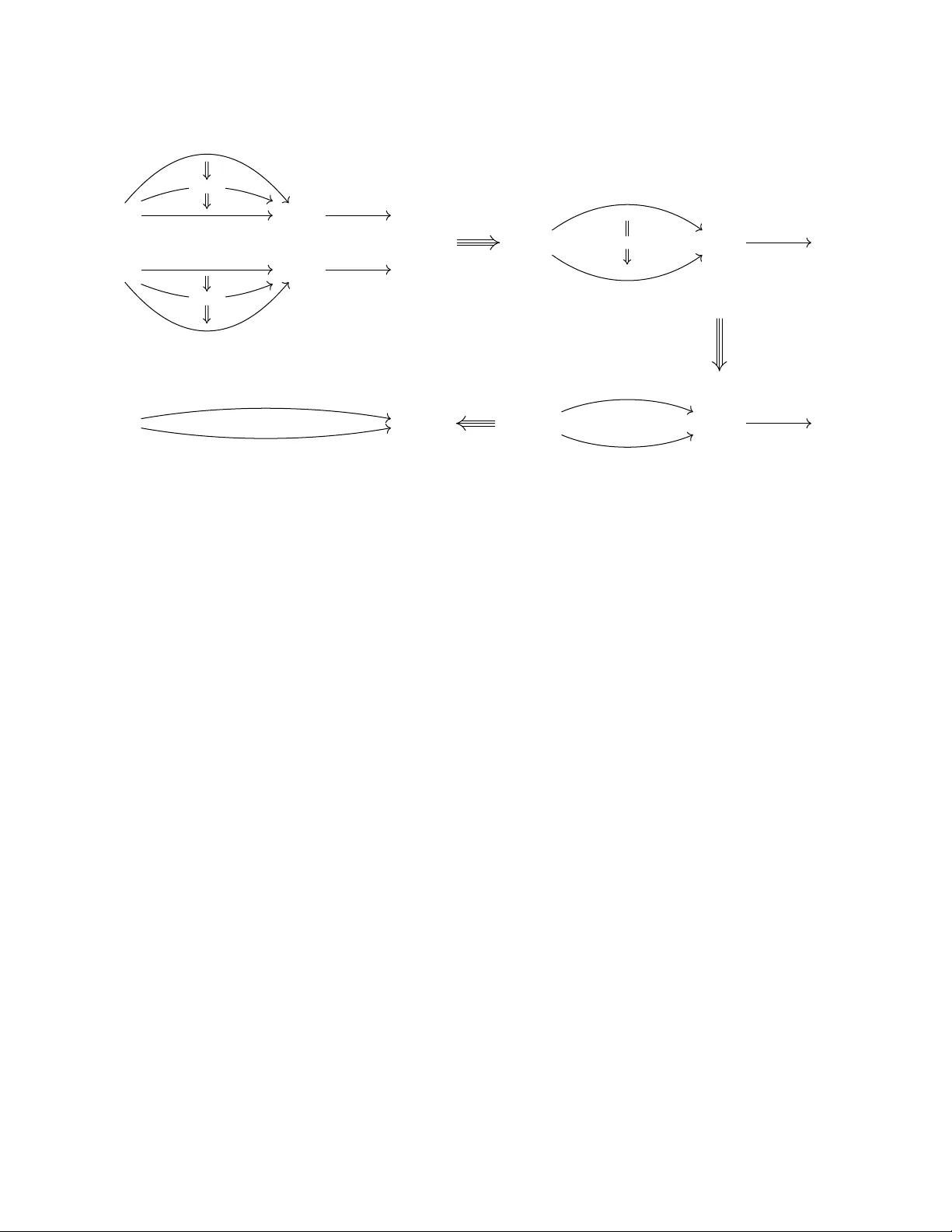
A type theor y for invertibility in w eak 𝜔 -categories Thibaut Benjamin thibaut.benjamin@universite- paris- saclay .fr Université Paris-Saclay , CNRS, ENS Paris-Saclay , LMF Gif-sur- Y vette, France Camil Champin camil.champin@ens- lyon.fr ENS de Lyon Lyon, France Ioannis Markakis ioannis.markakis@cl.cam.ac.uk University of Cambridge Cambridge, UK Abstract W e present a conservative extension ICaT T of the dependent type theory CaT T for weak 𝜔 -categories with a typ e witnessing coin- ductive invertibility of cells. This extension allows for a concise description of the “walking equivalence” as a conte xt, and of a set of maps characterising 𝜔 -equibrations as substitutions. W e pro- vide an implementation of our theory , which we use to formalise basic properties of invertible cells. These properties allow us to give semantics of ICaT T in marked weak 𝜔 -categories, building a brant marked 𝜔 -category out of every model of ICaT T . 1 Introduction Homotopy type theory endows every type with the structure of a weak higher groupoid, arising from its tower of iterated identity types [ 1 , 30 , 39 ]. Building on this observation, Brunerie developed a type - theoretic presentation of weak 𝜔 -groupoids [ 10 ], and Finster and Mimram [15] introduced the directe d variant CaT T , a type theory for weak 𝜔 -categories. In this paper , we introduce ICaT T , an extension of CaT T internalising invertibility . The notion of invertibility in higher categories is in general subtle. In an ordinary category , a morphism 𝑓 is invertible if it has an inverse 𝑓 − 1 such that 𝑓 ◦ 𝑓 − 1 = id 𝑓 − 1 ◦ 𝑓 = id In a bicategory , these equalities are replaced by the existence of invertible 2 -cells. Replacing inductively equalities with higher- dimensional invertible cells can be used to describe invertibility for nite-dimensional categories. For 𝜔 -categories, which are innite- dimensional, this process is to be understo od coinductively , so showing that a cell is inv ertible amounts to producing an innite amount of data. The theory ICaT T is a syntactic method for reason- ing about such innite structures. Invertibility plays a crucial role in the homotopy theor y of higher categories, in particular , in dening weak equivalences be- tween them: functors that are surjective up to invertibility and weak equivalences on hom higher categories. In the case of strict 𝜔 -categories, where the composition operations are associative and unital on the nose, these weak equivalences are part of a model structure [ 26 ]. The analogous statement for weak 𝜔 -categories, or even 𝜔 -groupoids, still remains open, while it has been proven for other mo dels [ 12 , 29 ]. The case of groupoids has b een solved up to dimension 3 by Henry and Lanari [21] who construct a model structure e quivalent to 3 -truncated homotopy types. In the directed setting, there has been signicant work by Fujii et al . [18] , who show that weak equivalences satisfy the 2-of-6 property . The same authors [ 17 ] also show that the class of equibrations , an analogue of the brations of strict 𝜔 -categories, are characterised by a right lifting property . Independently , Benjamin et al . [6] have given a partial construction of directed cylinders in the type theor y CaT T . Adapting their naturality construction to the theor y ICaT T may be used for producing undirected analogues of their cylinders, a requirement for the model structure. Contributions. W e propose an extension ICaT T of the type the ory CaT T for weak 𝜔 -categories, with a type Inv ( 𝑡 ) of invertibility structures over a term 𝑡 . This type is equipped with destructors that provide inv ertibility data for 𝑡 , as well as constructors internalising closure properties of invertible cells. W e also postulate the usual 𝛽 / 𝜂 -rules and show that the resulting theor y is normalising for an important class of terms. W e provide an implementation 1 for ICaT T and we use it to formalise with minimal eort, previous r esults about invertibility structure, that are not expressible in the the ory CaT T . W e take this as evidence that this theor y is well suited to working in the presence of invertibility structure , and may be a valuable asset for further inv estigating the construction of a model structur e on weak 𝜔 -categories. W e show that ICaT T is a conservative extension of CaT T , and that the inclusion between their respective syntactic categories is fully faithful. This inclusion allows us to induce an 𝜔 -category from a model of ICaT T , providing semantics of ICaT T into 𝜔 -categories. Using these semantics, we are able to reconstruct the walking e quiv- alence of Ozornova and Rov elli [34] , which is used in the character- isation of equibrations by Fujii et al . [17] . Finally , we generalise the denition of marked 𝜔 -categories of Henry and Loubaton [22] to the weak case, and we pr omote our semantics to land in brant marked 𝜔 -categories. Related W orks. Several denitions have be en proposed throughout the years for algebraic globular weak 𝜔 -categories. They were rst studied by Batanin [3] and Leinster [28] . Independently , Maltsiniotis [31] proposed a model of weak 𝜔 -categories inspired from the denition of weak 𝜔 -groupoids due to Grothendieck [19] . Ara [2] and Bourke [9] show the equivalence between these denitions. The theory CaT T was introduced by Finster and Mimram [15] , taking inspiration from Maltsiniotis and from Brunerie [10] . Ben- jamin et al . [8] then showed that the mo dels of CaT T correspond ex- actly to the Grothendieck-Maltsiniotis appr oach. Finally , Dean et al . [14] proposed another description using computads, and sho wed its equivalence to the Batanin-Leinster denition. Finally , the whole correspondence was completed by Benjamin et al . [7] who showed that CaT T contexts correspond to the nite computads. Invertibility in weak 𝜔 -categories has be en studied in various models, rst in a model-independent way by Cheng [13] and Rice 1 available at https://zenodo.org/records/18343317 1 [35] , and more recently for weak 𝜔 -categories by Hoshino et al . [23] and Benjamin and Markakis [4] . The walking equivalence for 𝜔 -categories was introduced by Ozornova and Rovelli [34] and shown to be contractible in the strict case by Hadzihasanovic et al . [20] . In the weak case, it was used to characterise equibrations by Fujii et al. [17]. Plan of the paper . In Se ction 2, we present the dependent type theory CaT T . In Section 3, we present the notion of models of a theory and we use it to dene weak 𝜔 -categories. W e introduce the theory ICaT T in Section 4, before formalising some constructions of invertibility in Se ction 5. In Section 6, we show that ICaT T is conservative over CaT T and prove that we can recover the walking equivalence as a context in ICaT T . Finally , in Section 7, we introduce marked weak 𝜔 -categories and construct a semantics of ICaT T in brant marked 𝜔 -categories. 2 The typ e theor y CaT T W e start with a brief presentation of the type theory CaT T of Finster and Mimram [15] , whose models are weak 𝜔 -categories, and then recall the suspension meta-operation on it. The raw syntax of CaT T is dened by the grammar b elo w , where V is a countable set of variable names: V ariable 𝑥 F 𝑥 ∈ V T ype 𝐴, 𝐵 F ★ | 𝑡 → 𝐴 𝑢 T erm 𝑡 , 𝑢 F 𝑥 | coh Γ ,𝐴 [ 𝛾 ] Context Γ , Δ F ∅ | Γ ⊲ ( 𝑥 : 𝐴 ) Substitution 𝛾 , 𝛿 F ⋄ | 𝛾 ⊲ ( 𝑥 ↦→ 𝑡 ) The action of substitution on terms and typ es, and composition of substitutions are dened mutually recursively by the following formulas: ★ [ 𝛾 ] = ★ ( 𝑢 → 𝐴 𝑣 ) [ 𝛾 ] = 𝑢 [ 𝛾 ] → 𝐴 [ 𝛾 ] 𝑣 [ 𝛾 ] 𝑥 [⋄] = 𝑥 𝑥 [ 𝛾 ⊲ ( 𝑦 ↦→ 𝑡 ) ] = ( 𝑡 if 𝑦 = 𝑥 𝑥 [ 𝛾 ] other wise coh Γ ,𝐴 [ 𝛿 ] [ 𝛾 ] = coh Γ ,𝐴 [ 𝛿 ◦ 𝛾 ] ⋄ ◦ 𝛾 = ⋄ ( 𝛿 ⊲ ( 𝑥 ↦→ 𝑡 ) ) ◦ 𝛾 = ( 𝛿 ◦ 𝛾 ) ⊲ ( 𝑥 ↦→ 𝑡 [ 𝛾 ] ) The dimension of typ es and conte xts are given recursively by: dim ( ★ ) = − 1 dim ( 𝑢 → 𝐴 𝑣 ) = dim 𝐴 + 1 dim ( ∅ ) = − 1 dim ( Γ ⊲ ( 𝑥 : 𝐴 )) = max ( dim Γ , dim 𝐴 + 1 ) As is common with dependent type theories, CaT T is expressed in terms of the following judgements, dened inductively in terms of a set of derivation rules. Γ ⊢ Γ is a valid context Γ ⊢ 𝐴 𝐴 is a valid type in Γ Γ ⊢ 𝑡 : 𝐴 𝑡 is a term of type 𝐴 in Γ Γ ⊢ 𝛾 : Δ 𝛾 is a valid substitution of Δ into Γ . W e require rst the usual structural rules for variables, contexts and substitutions, where 𝑥 ∈ V ar Γ and ( 𝑥 : 𝐴 ) ∈ Γ are relations dened recursively in the obvious way . ∅ ⊢ Γ ⊢ 𝐴 Γ ⊲ ( 𝑥 : 𝐴 ) ⊢ ( 𝑥 ∉ V ar Γ ) Γ ⊢ Γ ⊢ 𝑥 : 𝐴 ( 𝑥 : 𝐴 ) ∈ Γ Γ ⊢ Γ ⊢ ⋄ : ∅ Δ ⊢ 𝛾 : Γ Γ ⊢ 𝐴 Δ ⊢ 𝑡 : 𝐴 [ 𝛾 ] Δ ⊢ 𝛾 ⊲ ( 𝑥 ↦→ 𝑡 ) : Γ ⊲ ( 𝑥 : 𝐴 ) A consequence of these rules is the existence of an identity substi- tution Γ ⊢ id Γ : Γ sending each variable to itself. The type formation rules of CaT T are the following ones, wher e the last two are merged into one in earlier presentations: ★ -intro Γ ⊢ Γ ⊢ ★ → -intro 0 Γ ⊢ 𝑢 : ★ Γ ⊢ 𝑣 : ★ Γ ⊢ 𝑢 → ★ 𝑣 → -intro + Γ ⊢ 𝑢 : 𝑣 → 𝐴 𝑤 Γ ⊢ 𝑢 ′ : 𝑣 → 𝐴 𝑤 Γ ⊢ 𝑢 → 𝑣 → 𝐴 𝑤 𝑢 ′ For the sake of readability , we sometimes omit the index 𝐴 in the expression 𝑢 → 𝐴 𝑣 , when it can be inferred. W e note that we have used name d variables for the sake of readability , but we identify contexts up to 𝛼 -renaming. In particular , we could have instead presented equivalently the the ory using De Bruijn indices. W e dene the dimension of a term Γ ⊢ 𝑡 : 𝐴 to be dim 𝐴 + 1 . When 𝐴 = 𝑢 → 𝑣 we call 𝑢 and 𝑣 the source and target of 𝑡 respectively . T o state the term formation rule of CaT T , we introduce two auxiliary judgements Γ ⊢ ps and Γ ⊢ ps 𝑥 : 𝐴 parametrising a set of contexts corresponding to pasting diagrams , the arities of the operations of globular 𝜔 -categories. The rules for these judgements are given below: PSS ( 𝑥 : ★ ) ⊢ ps 𝑥 : ★ PSD Γ ⊢ ps 𝑓 : 𝑥 → 𝐴 𝑦 Γ ⊢ ps 𝑦 : 𝐴 PSE Γ ⊢ ps 𝑥 : 𝐴 Γ ⊲ ( 𝑦 : 𝐴 ) ⊲ ( 𝑓 : 𝑥 → 𝐴 𝑦 ) ⊢ ps 𝑓 : 𝑥 → 𝐴 𝑦 PS Γ ⊢ ps 𝑥 : ★ Γ ⊢ ps A source (resp. target ) variable of Γ ⊢ ps is one that is not the target (resp. source) of another variable. W e will write Γ ⊢ full 𝑢 → 𝐴 𝑣 and say that 𝑢 → 𝐴 𝑣 is a full typ e of a pasting diagram Γ of dimension 𝑛 when either of the two following conditions is satised: • b oth 𝑢 and 𝑣 use all variables of Γ , • dim 𝑢 = dim 𝑣 = 𝑛 − 1 , and 𝑢 and 𝑣 respectively use all source and target variables of Γ of dimension at most 𝑛 − 1 . This denition of full type is equivalent to the original one by the work of Dean et al . [14 , Proposition 2.10 ] . The nal rule of the typ e theory CaT T then takes the form: coh -intro Γ ⊢ ps Γ ⊢ full 𝐴 Δ ⊢ 𝛾 : Γ Δ ⊢ coh Γ ,𝐴 [ 𝛾 ] : 𝐴 [ 𝛾 ] Example 2.1. The following is a valid context of CaT T . W e visu- alise contexts by drawing variables of typ e ★ as points, and variables of type 𝑢 → 𝑣 as arrows from 𝑢 to 𝑣 . ( 𝑥 : ★ ) ⊲ ( 𝑦 : ★ ) ⊲ ( 𝑓 : 𝑥 → 𝑦 ) ⊲ ( 𝑔 : 𝑥 → 𝑦 ) ⊲ ( 𝑎 : 𝑓 → 𝑔 ) ⊲ ( ℎ : 𝑥 → 𝑥 ) 𝑥 𝑦 𝑓 𝑔 ℎ 𝑎 2 Example 2.2. The following is a valid context corr esponding to a pasting diagram ( 𝑥 : ★ ) ⊲ ( 𝑦 : ★ ) ⊲ ( 𝑓 : 𝑥 → 𝑦 ) ⊲ ( 𝑔 : 𝑥 → 𝑦 ) ⊲ ( 𝑎 : 𝑓 → 𝑔 ) ⊲ ( 𝑧 : ★ ) ⊲ ( ℎ : 𝑦 → 𝑧 ) 𝑥 𝑦 𝑧 𝑓 𝑔 𝑎 ℎ The source variables of this context are 𝑓 , 𝑎 and ℎ , while the target variables are 𝑔 , 𝑎 and ℎ . Example 2.3. W e will derive terms corresponding to identity and composition operations. For the former , we consider the term: ( 𝑥 : ★ ) ⊢ coh ( 𝑥 : ★ ) ,𝑥 → 𝑥 [ id ] : 𝑥 → 𝑥 which we will denote by id 𝑥 . For the latter , consider the context Γ : ( 𝑥 : ★ ) ⊲ ( 𝑦 : ★ ) ⊲ ( 𝑓 : 𝑥 → 𝑦 ) ⊲ ( 𝑧 : ★ ) ⊲ ( 𝑔 : 𝑦 → 𝑧 ) 𝑥 𝑦 𝑧 𝑓 𝑔 The type 𝑥 → ★ 𝑧 is full, so we can derive the validity of the term: Γ ⊢ coh Γ ,𝑥 → 𝑧 [ id ] : 𝑥 → 𝑧 which we will denote by 𝑓 ∗ 𝑔 . Example 2.4. The following is a valid context which cannot be obtained as a pasting diagram, since the source of 𝛼 is a term that is not a variable: ( 𝑥 : ★ ) ⊲ ( 𝑦 : ★ ) ⊲ ( 𝑓 : 𝑥 → 𝑦 ) ⊲ ( 𝑧 : ★ ) ⊲ ( 𝑔 : 𝑦 → 𝑧 ) ⊲ ( ℎ : 𝑥 → 𝑧 ) ⊲ ( 𝛼 : 𝑓 ∗ 𝑔 → ℎ ) 𝑦 𝑥 𝑧 𝑔 𝑓 ℎ Suspension is a meta-operation corresponding semantically to the formation of hom 𝜔 -categories of Benjamin and Markakis [5] . Homotopy type the orists may recognise it as the fact that every construction on identity typ es may be interpr eted in higher identity types by changing the base type. The suspension is dened mutually recursively on valid contexts, types, terms and substitutions by: Σ ( ∅ ) = ( 𝑣 − : ★ ) ⊲ ( 𝑣 + : ★ ) Σ ( Γ ⊲ ( 𝑥 : 𝐴 ) ) = ( ΣΓ ) ⊲ ( Σ 𝑥 : Σ 𝐴 ) Σ ( ★ ) = 𝑣 − → 𝐴 𝑣 + Σ ( 𝑢 → 𝐴 𝑣 ) = Σ 𝑢 → Σ 𝐴 Σ 𝑣 Σ ( 𝑥 ) = 𝑥 Σ ( coh Γ ,𝐴 [ 𝛾 ] ) = coh ΣΓ , Σ 𝐴 [ Σ 𝛾 ] Σ ( ⋄ ) = ( 𝑣 − ↦→ 𝑣 − ) ⊲ ( 𝑣 + ↦→ 𝑣 + ) Σ ( 𝛾 ⊲ ( 𝑥 ↦→ 𝑡 ) ) = ( Σ 𝛾 ) ⊲ ( Σ 𝑥 ↦→ Σ 𝑡 ) Here the variables 𝑣 − and 𝑣 + are assumed to be fresh in Γ ; this can be easily implemente d using De Bruijn indices. This operation preserves all judgements of CaT T including the auxiliary ones regarding pasting diagrams. Example 2.5. Iteratively applying the suspension on the identity and comp osition terms of Example 2.3, we obtain terms correspond- ing to identities and composition of higher dimensional terms as well. More precisely , we may derive terms: Σ 𝑛 ( 𝑥 : ★ ) ⊢ Σ 𝑛 ( id 𝑥 ) : 𝑥 → 𝑥 Σ 𝑛 Γ ⊢ Σ 𝑛 ( 𝑓 ∗ 𝑔 ) : 𝑥 → 𝑧 which we will again simply denote by id 𝑥 and 𝑓 ∗ 𝑔 . W e illustrate the contexts Γ , Σ Γ and Σ 2 Γ below . Both the identity and composition terms use all variables of the context they are dened ov er . • • • • • • • The disks and spheres are two families of contexts that classify terms and types respectively . They are dened recursively by: D 0 = ( d 0 : ★ ) D 𝑛 + 1 = Σ D 𝑛 S − 1 = ∅ S 𝑛 + 1 = Σ S 𝑛 W e will denote the top-dimensional variable of D 𝑛 by d 𝑛 . W e get a substitution D 𝑛 ⊢ 𝜄 𝑛 : S 𝑛 − 1 for every 𝑛 by suspending the empty substitution D 0 ⊢ ⋄ : S − 1 . The universal properties of these syntactic objects are given by the following lemma of Benjamin et al . [8 , Lemma 2.3.8]: Lemma 2.6. There exists a natural bijection between types Γ ⊢ 𝐴 of CaT T of dimension 𝑛 and substitutions Γ ⊢ 𝜒 𝐴 : S 𝑛 , and a natural bijection between terms Γ ⊢ 𝑡 : 𝐴 of dimension 𝑛 and substitutions Γ ⊢ 𝜒 𝑡 : D 𝑛 . Under these bije ctions, composition with 𝜄 𝑛 sends a term to its type. 3 W eak 𝜔 -categories In this section, we recall clans as a way to describe mo dels of a type theory . W e then dene weak 𝜔 -categories to be models of CaT T , and discuss equivalences and equibrations between weak 𝜔 -categories. 3.1 Models of clans W e view CaT T as a generalised algebraic the ory in the sense of Cartmell [11] and we use the framework of clans of Joyal [25] – a variant of the categories with display maps of T aylor [37] – to describe its models. This notion of model of CaT T coincides with the one previously used thanks to Benjamin et al . [8 , Lemma 1.1.3 ] . Denition 3.1. A clan is a category 𝐶 with a terminal object, equipped with a class of arrows containing every isomorphism and every morphism to a terminal obje ct, and it is stable under composition and base change. W e will call the arrows in this class display maps and denote them by _ . By stability under base change, we mean that for e very display map 𝑝 : 𝐴 _ 𝐵 and every morphism 𝑓 : 𝐶 → 𝐵 the following pullback square exists: 𝐷 𝐴 𝐶 𝐵 𝑝 ∗ 𝑓 𝑓 ∗ 𝑝 ⌟ 𝑝 𝑓 (1) and 𝑓 ∗ 𝑝 is again a display map. Denition 3.2. A morphism of clans 𝐶 → 𝐷 is a functor preserv- ing the terminal objects, the class of display maps and pullbacks along display maps. A transformation between morphisms of clans is simply a natural transformation of functors. W e will denote the strict 2 -category of clans by Clan . Example 3.3. The syntactic categor y S T of a dep endent typ e theory T has as objects contexts up to judgemental equality , and as morphisms Γ → Δ substitutions Δ ⊢ 𝛾 : Γ up to judgemental equality . It admits the structure of a clan with display maps the closure under composition and isomorphisms of the weakening substitutions of the form Γ ⊲ ( 𝑥 : 𝐴 ) ⊢ p Γ ,𝐴 : Γ sending each vari- able of Γ to itself. This class is stable under base change, since for 3 every Δ ⊢ 𝛾 : Γ , the following square is a pullback in the syntactic category: Δ ⊲ ( 𝑥 : 𝐴 [ 𝛾 ] ) Γ ⊲ ( 𝑥 : 𝐴 ) Δ Γ ( 𝛾 ◦ p Δ ,𝐴 [ 𝛾 ] ) ⊲ ( 𝑥 ↦→ 𝑥 ) p Δ ,𝐴 [ 𝛾 ] ⌟ p Γ ,𝐴 𝛾 (2) as shown for instance by Benjamin et al. [8, Lemma 1.1.1]. Denition 3.4. A nitely complete category 𝐶 is a clan with every morphism a display map. W e dene the categor y of models of a type theor y T to be Mod ( T ) = Clan ( S T , Set ) . Since every morphism in Set is a display map and pullback squares may b e pasted together , a model of a type theor y T is precisely a functor 𝐹 : S T → Set that preserves the terminal object and pullback squar es of the form (2) for every type Γ ⊢ 𝐴 and substi- tution Δ ⊢ 𝛾 : Γ . As covariant representable functors are continuous, there is a fully faithful embedding: ⟦−⟧ : S op T → Mod ( T ) ⟦ Γ ⟧ ( Δ ) = S T ( Γ , Δ ) W e note that the categor y of models is a reective subcategor y of the category of functors from S T to Set closed under ltered colimits, so in particular , it is locally nitely presentable, as explained by Frey [16, Remark 2.9]. 3.2 Models of CaT T Benjamin et al . [7] and Benjamin et al . [8] give a precise description of the syntactic category and the models of CaT T respectively , iden- tifying the former with the category of nite computads of Dean et al . [14] and the latter with the category of weak 𝜔 -categories and strict 𝜔 -functors of Leinster [28] . These weak 𝜔 -categories are a variant of these by Batanin [3] and they ar e models of a coherator in the sense of Grothendieck [19] and Maltsiniotis [31] , as shown by Ara [2] and Bourke [9]. Denition 3.5. The category 𝜔 Cat of weak 𝜔 -categories and strict 𝜔 -functors is the categor y Mod ( CaT T ) of models of CaT T . W e dene the 𝑛 -cells of an 𝜔 -category 𝑋 to b e the elements of 𝑋 𝑛 = 𝑋 ( D 𝑛 ) . By the Y oneda lemma, these are in natural bi- jection to morphisms ⟦ D 𝑛 ⟧ → 𝑋 . The source and target functions src , tgt : 𝑋 𝑛 + 1 → 𝑋 𝑛 are those given by composition with the substi- tutions D 𝑛 + 1 → D 𝑛 corresponding under Lemma 2.6 to the source and target of the top-dimensional variable d 𝑛 + 1 of D 𝑛 + 1 respectively . W e write 𝑥 : ★ to denote that 𝑥 ∈ 𝑋 0 and 𝑥 : 𝑦 → 𝑧 to denote that 𝑥 is a positive-dimensional cell with source 𝑦 and target 𝑧 . Instantiating (2) to the substitutions given by Lemma 2.6, we get that every w eakening substitution is a pullback of the substitutions D 𝑛 ⊢ 𝜄 𝑛 : S 𝑛 − 1 , which are by construction weakening substitutions as well: Γ ⊲ ( 𝑥 : 𝐴 ) D 𝑛 Γ S 𝑛 − 1 𝜒 𝑥 p Γ ,𝐴 ⌟ 𝜄 𝑛 𝜒 𝐴 (3) It follows from the pasting lemma for pullbacks that a functor 𝑋 : S CaT T → Set is a model exactly when 𝑋 ( ∅ ) is terminal and it preserves pullback squares of the form (3) . Moreover , it follows by induction on the length of a context that a morphism of mo dels 𝑓 : 𝑋 → 𝑌 is completely determine d by its values on cells of 𝑋 , and that it is invertible if and only if it is bijective on cells. Denition 3.6. Every term Γ ⊢ 𝑡 : 𝐴 of dimension 𝑛 gives rise to an operation : ⟦ 𝑡 ⟧ : 𝜔 Cat ( ⟦ Γ ⟧ , 𝑋 ) → 𝑋 𝑛 ⟦ 𝑡 ⟧ ( 𝑓 ) = 𝑓 ◦ ⟦ 𝜒 𝑡 ⟧ In particular , the terms of Example 2.5 give rise to operations id : 𝑋 𝑛 → 𝑋 𝑛 + 1 − ∗ − : 𝑋 𝑛 × 𝑋 𝑛 − 1 𝑋 𝑛 → 𝑋 𝑛 since morphisms out of their dening contexts correspond to an 𝑛 -cell, and a pair of composable 𝑛 -cells respectively . The source and target of these operations are given by: src ( id 𝑥 ) = tgt ( id 𝑥 ) = 𝑥 src ( 𝑓 ∗ 𝑔 ) = src 𝑓 tgt ( 𝑓 ∗ 𝑔 ) = tgt 𝑔 3.3 Invertible cells W e close this section by studying invertible cells in 𝜔 -categories. These cells allow us to describe w eak equivalences and equibrations between 𝜔 -categories, two classes of maps that play an important role in the homotopy theor y of strict 𝜔 -categories, as shown by Lafont et al . [26] , and are expected to play an analogous role in the weak case. Denition 3.7. An invertibility structur e on a cell 𝑓 : 𝑥 → 𝑦 in an 𝜔 -categor y 𝑋 is coinductively dened to consist of cells: 𝑓 linv : 𝑦 → 𝑥 𝑓 rinv : 𝑦 → 𝑥 𝑓 lunit : 𝑓 linv ∗ 𝑓 → id 𝑦 𝑓 runit : 𝑓 ∗ 𝑓 rinv → id 𝑥 and invertibility structures on 𝑓 lunit and 𝑓 runit . W e say that 𝑓 is invertible if it admits an invertibility structur e. W e note that this notion of invertible cells is a priori weaker than the usual one where the left inverse 𝑓 linv is strictly equal to the right inverse 𝑓 rinv . Nonetheless, it has been shown independently by Rice [35] and by Fujii et al . [17 , Proposition 3.3.1 ] that the two notions coincide . Our use of this denition of invertibility structure is inspired by work of Hadzihasanovic et al . [20] and of Fujii et al . [18] on the walking equivalence and e quibrations respectively . In analogy with homotopy type theory [ 38 , Theorem 4.3.2], we expect that requiring separate left and right inverses ought to make invertibility structures on a cell 𝑓 unique. Benjamin and Markakis [4] and Hoshino et al . [23] indepen- dently show that invertible cells are closed under the operations of weak 𝜔 -categories. More precisely , any 𝑛 -dimensional cell con- structed from invertible 𝑛 -cells is again invertible. This accounts for composites of inv ertible cells, as well as for all identity cells and higher coherences like associators and unitors. Theorem 3.8. Let 𝛾 : ⟦ Γ ⟧ → 𝑋 a morphism of 𝜔 -categories out of a pasting diagram and let Γ ⊢ full 𝑢 → 𝑣 be a full typ e of dimension 𝑛 . The cell ⟦ coh Γ , 𝑢 → 𝑣 ⟧ ( 𝛾 ) is inv ertible when ⟦ 𝑥 ⟧ ( 𝛾 ) is inv ertible for every ( 𝑛 + 1 ) -dimensional variable 𝑥 ∈ V ar ( Γ ) . The proof of the theorem coinductively constructs an invertibil- ity structure on cells of that form with left inverse equal to the 4 𝛾 ( 𝑥 ) 𝛾 ( 𝑦 ) 𝛾 ( 𝑧 ) ∗ 𝛾 ( 𝑥 ) 𝛾 ( 𝑦 ) 𝛾 ( 𝑧 ) 𝛾 ( 𝑥 ) 𝛾 ( 𝑧 ) 𝛾 ( 𝑥 ) 𝛾 ( 𝑦 ) 𝛾 ( 𝑧 ) 𝛾 ( ℎ ) 𝛾 ( 𝑓 ) 𝛾 ( 𝑔 ) 𝛾 ( 𝑘 ) 𝛾 ( 𝑓 ) 𝛾 ( ℎ ) 𝛾 ( 𝑔 ) 𝛾 ( 𝑘 ) 𝛾 ( ℎ ) 𝛾 ( ℎ ) 𝛾 ( 𝑘 ) 𝛾 ( ℎ ) ∗ 𝛾 ( 𝑘 ) 𝛾 ( ℎ ) ∗ 𝛾 ( 𝑘 ) 𝛾 ( 𝑎 ) linv 𝛾 ( 𝑏 ) linv 𝛾 ( 𝑎 ) 𝛾 ( 𝑏 ) 𝐶 id ( 𝛾 ( ℎ ) ∗ 𝛾 ( 𝑘 ) ) Figure 1: Left cancellator of a composite of inv ertible cells 𝐶 = 𝛾 ( 𝑏 ) linv ∗ ( 𝛾 ( 𝑎 ) linv ∗ 𝛾 ( 𝑎 ) ) ∗ 𝛾 ( 𝑏 ) . right inverse . In the case that dim Γ ≤ 𝑛 , the condition on Γ is vacu- ous, the inverses are given by ⟦ coh Γ ,𝑣 → 𝑢 ⟧ ( 𝛾 ) and the cancellators are again of the form ⟦ coh Γ ,𝐴 ⟧ ( 𝛾 ) . The case dim Γ = 𝑛 + 1 corre- sponds to composites of invertible cells and is partially illustrated in Figure 1 wher e the rst 3 -cell is a generalised associator , and the second is a comp osition of cancellators and unitors. A more detailed explanation of this construction can be found in Se ction B. More- over , Benjamin and Markakis [4 , Proposition 37 ] show a converse of Theorem 3.8 when 𝑋 is a CaT T context: Proposition 3.9. A term Δ ⊢ 𝑡 : 𝐴 of dimension 𝑛 is invertible in ⟦ Δ ⟧ if and only if it is of the form 𝑡 = coh Γ ,𝐴 [ 𝛾 ] with 𝑥 [ 𝛾 ] invertible for every 𝑛 -dimensional 𝑥 ∈ V ar ( Γ ) . Invertibility plays a crucial role in the denition of w eak equiva- lences of 𝜔 -categories, that is 𝜔 -functors that are essentially sur- jective on objects and iterated hom-sets. These equivalences are conjectured to be part of a model structure with cobrations gener- ated by the inclusions of spher es into disks. Invertibility is also used in the denition of equibrations of Fujii et al . [18] , an analogue of isobrations of categories, that is expecte d to play an important role in the conjectured model structure in analogy to the strict case [26]. Denition 3.10. An 𝜔 -functor 𝑓 : 𝑋 → 𝑌 is an 𝜔 -equibration between 𝜔 -categories when for every 𝑛 -cell 𝑥 of 𝑋 together with an invertible cell 𝑒 : 𝑦 → 𝑓 ( 𝑥 ) in 𝑌 , there exists an invertible 𝑛 -cell ¯ 𝑒 : ¯ 𝑦 → 𝑥 in 𝑋 such that 𝑓 ¯ 𝑒 = 𝑒 . 4 The typ e theor y ICaT T In this section, we dene the dependent type theory ICaT T as an extension of CaT T that allows equipping terms with invertibility structures. 4.1 The raw syntax W e extend rst the raw syntax of CaT T with a single type con- structor Inv 𝐴 ( 𝑢 ) where 𝐴 is a type and 𝑢 is a term and nine term constructors: can ( 𝑡 , { 𝑒 𝑥 }) inv ( 𝑡 , 𝑡 𝑙 , 𝑡 𝑟 , 𝑡 𝑙𝑢 , 𝑡 𝑟 𝑢 , 𝑡 𝑖𝑙 𝑢 , 𝑡 𝑖𝑟 𝑢 ) rec ( 𝑡 , 𝑡 𝑙 , 𝑡 𝑟 , 𝑡 𝑙𝑢 , 𝑡 𝑟 𝑢 , 𝑡 𝑖𝑙 𝑢 , 𝑡 𝑖𝑟 𝑢 , 𝛾 ) linv ( 𝑡 ) rinv ( 𝑡 ) lunit ( 𝑡 ) runit ( 𝑡 ) ilunit ( 𝑡 ) irunit ( 𝑡 ) where 𝛾 is a substitution, { 𝑒 𝑥 } is a family of terms indexed by a set of variables, and the remaining arguments are terms. W e extend the action of raw substitutions on these new types and terms by letting: can ( 𝑡 , { 𝑒 𝑥 }) [ 𝜎 ] = can ( 𝑡 [ 𝜎 ] , { 𝑒 𝑥 [ 𝜎 ] } ) rec ( 𝑡 , 𝑡 𝑙 , 𝑡 𝑟 , 𝑡 𝑙𝑢 , 𝑡 𝑟 𝑢 , 𝑡 𝑖𝑙 𝑢 , 𝑡 𝑖𝑟 𝑢 , 𝛾 ) [ 𝜎 ] = rec ( 𝑡 , 𝑡 𝑙 , 𝑡 𝑟 , 𝑡 𝑙𝑢 , 𝑡 𝑟 𝑢 , 𝑡 𝑖𝑙 𝑢 , 𝑡 𝑖𝑟 𝑢 , 𝛾 ◦ 𝜎 ) and making substitutions compute under every other type and term constructor , as presented in Section C. W e extend furthermore the action of the suspension operation on the raw syntax by letting: Σ inv ( 𝑡 , 𝑡 𝑙 , 𝑡 𝑟 , 𝑡 𝑙𝑢 , 𝑡 𝑟 𝑢 , 𝑡 𝑖𝑙 𝑢 , 𝑡 𝑖𝑟 𝑢 ) = inv ( Σ 𝑡 , Σ 𝑡 𝑙 , Σ 𝑡 𝑟 , Σ 𝑡 𝑙𝑢 , Σ 𝑡 𝑟 𝑢 , Σ 𝑡 𝑖𝑙 𝑢 , Σ 𝑡 𝑖𝑟 𝑢 ) Σ rec ( 𝑡 , 𝑡 𝑙 , 𝑡 𝑟 , 𝑡 𝑙𝑢 , 𝑡 𝑟 𝑢 , 𝑡 𝑖𝑙 𝑢 , 𝑡 𝑖𝑟 𝑢 , 𝛾 ) = rec ( Σ 𝑡 , Σ 𝑡 𝑙 , Σ 𝑡 𝑟 , Σ 𝑡 𝑙𝑢 , Σ 𝑡 𝑟 𝑢 , Σ 𝑡 𝑖𝑙 𝑢 , Σ 𝑡 𝑖𝑟 𝑢 , Σ 𝛾 ) Σ ( Inv 𝐴 ( 𝑡 ) ) = Inv Σ 𝐴 ( Σ 𝑡 ) Σ ( can ( 𝑡 , { 𝑒 𝑥 }) ) = can ( Σ 𝑡 , { Σ 𝑒 𝑥 }) Σ ( linv ( 𝑒 ) ) = linv ( Σ 𝑒 ) Σ ( rinv ( 𝑒 ) ) = rinv ( Σ 𝑒 ) Σ ( lunit ( 𝑒 ) ) = lunit ( Σ 𝑒 ) Σ ( runit ( 𝑒 ) ) = runit ( Σ 𝑒 ) Σ ( ilunit ( 𝑒 ) ) = ilunit ( Σ 𝑒 ) Σ ( irunit ( 𝑒 ) ) = irunit ( Σ 𝑒 ) 4.2 The typ e of invertibility structures Having describe d the raw syntax, we proce ed to give the rules of ICaT T . W e assume rst that every rule of CaT T is inherite d by ICaT T . The introduction rule for the type Inv of invertibility structures is given by: Inv -intro Γ ⊢ 𝑡 : 𝑢 → 𝐴 𝑣 Γ ⊢ Inv 𝑢 → 𝐴 𝑣 ( 𝑡 ) For the sake of readability , we sometimes omit the index 𝐴 when it can be inferred. In order for terms Γ ⊢ 𝑒 : Inv ( 𝑡 ) to equip 𝑡 with an invertibility structure, we provide six destructors and a dual constructor: Γ ⊢ 𝑒 : Inv 𝑢 → 𝑣 ( 𝑡 ) Γ ⊢ linv ( 𝑒 ) : 𝑣 → 𝑢 Γ ⊢ 𝑒 : Inv 𝑢 → 𝑣 ( 𝑡 ) Γ ⊢ rinv ( 𝑒 ) : 𝑣 → 𝑢 Γ ⊢ 𝑒 : Inv 𝑢 → 𝑣 ( 𝑡 ) Γ ⊢ lunit ( 𝑒 ) : linv ( 𝑒 ) ∗ 𝑡 → id 𝑣 Γ ⊢ 𝑒 : Inv 𝑢 → 𝑣 ( 𝑡 ) Γ ⊢ runit ( 𝑒 ) : 𝑡 ∗ rinv ( 𝑒 ) → id 𝑢 5 Γ ⊢ 𝑒 : Inv 𝑢 → 𝑣 ( 𝑡 ) Γ ⊢ ilunit ( 𝑒 ) : Inv ( lunit ( 𝑒 ) ) Γ ⊢ 𝑒 : Inv 𝑢 → 𝑣 ( 𝑡 ) Γ ⊢ irunit ( 𝑒 ) : Inv ( runit ( 𝑒 ) ) inv -intro Γ ⊢ 𝑡 : 𝑥 → 𝑦 Γ ⊢ 𝑡 𝑙 : 𝑦 → 𝑥 Γ ⊢ 𝑡 𝑟 : 𝑦 → 𝑥 Γ ⊢ 𝑡 𝑙𝑢 : 𝑡 𝑙 ∗ 𝑡 → id 𝑦 Γ ⊢ 𝑡 𝑟 𝑢 : 𝑡 ∗ 𝑡 𝑟 → id 𝑥 Γ ⊢ 𝑡 𝑖𝑙 𝑢 : Inv ( 𝑡 𝑙𝑢 ) Γ ⊢ 𝑡 𝑖𝑟 𝑢 : Inv ( 𝑡 𝑟 𝑢 ) Γ ⊢ inv ( 𝑡 , 𝑡 𝑙 , 𝑡 𝑟 , 𝑡 𝑙𝑢 , 𝑡 𝑟 𝑢 , 𝑡 𝑖𝑙 𝑢 , 𝑡 𝑖𝑟 𝑢 ) : Inv ( 𝑡 ) Additionally , we require the usual 𝛽 -reduction and 𝜂 -expansion rules for these constructors, presented fully in Figure 4d. For in- stance, we require the follo wing 𝜂 - and 𝛽 -rules: 𝑒 ≡ inv ( 𝑡 , linv ( 𝑒 ) , rinv ( 𝑒 ) , lunit ( 𝑒 ) , runit ( 𝑒 ) , ilunit ( 𝑒 ) , irunit ( 𝑒 ) ) linv ( inv ( 𝑡 , 𝑡 𝑙 , 𝑡 𝑟 , 𝑡 𝑙𝑢 , 𝑡 𝑟 𝑢 , 𝑡 𝑖𝑙 𝑢 , 𝑡 𝑖𝑟 𝑢 ) ) ≡ 𝑡 𝑙 4.3 Invertibility of coherence terms Theorem 3.8 provides a way to construct invertibility structur es for coherence cells. The term constructor can allows us to internalise this theorem in ICaT T . Its introduction rule is given by: can -intro Δ ⊢ coh Γ ,𝐴 [ 𝛾 ] : 𝐴 [ 𝛾 ] { Δ ⊢ 𝑒 𝑥 : Inv ( 𝑥 [ 𝛾 ] ) } 𝑥 ∈ V ar dim 𝐴 + 1 ( Γ ) Δ ⊢ can ( coh Γ ,𝐴 [ 𝛾 ] , { 𝑒 𝑥 }) : Inv ( coh Γ ,𝐴 [ 𝛾 ] ) where V ar 𝑛 ( Γ ) denotes the set of variables of Γ of dimension 𝑛 . Furthermore, we require the following computation rules identi- fying the invertibility structure obtained by the rule with the one obtained by the theorem: linv ( can ( 𝑡 , { 𝑒 𝑥 }) ) ≡ 𝑡 linv rinv ( can ( 𝑡 , { 𝑒 𝑥 }) ) ≡ 𝑡 rinv lunit ( can ( 𝑡 , { 𝑒 𝑥 }) ) ≡ 𝑡 lunit runit ( can ( 𝑡 , { 𝑒 𝑥 }) ) ≡ 𝑡 runit ilunit ( can ( 𝑡 , { 𝑒 𝑥 }) ) ≡ can ( 𝑡 lunit , { −} ) irunit ( can ( 𝑡 , { 𝑒 𝑥 }) ) ≡ can ( 𝑡 runit , { −} ) The last two rules correspond to the fact that the left and right units are coinductively equipped with the structur e required by the premises of the rule. A more detailed description can be found in Section B. 4.4 The walking equivalence Before stating the last rule of ICaT T , we introduce the walking equivalence, a context classifying invertibility structur es, as well as the classifying substitution of a term and a type. Denition 4.1. The walking equivalence for 𝑛 ∈ N is the context: E 𝑛 + 1 = D 𝑛 + 1 ⊲ ( e 𝑛 + 1 : Inv ( d 𝑛 + 1 ) ) W e will denote its weakening substitution by E 𝑛 + 1 ⊢ 𝜇 𝑛 + 1 : D 𝑛 + 1 . An analogue of Lemma 2.6 holds for ICaT T , namely typ es are classied by spheres and disks, and terms are classied by disks and the walking equivalences: we can assign by induction on the syntax to every type 𝐴 a substitution 𝜒 𝐴 by: 𝜒 ★ = ⋄ 𝜒 Inv 𝐴 ( 𝑡 ) = 𝜒 𝐴 ⊲ ( d 𝑛 + 1 ↦→ 𝑡 ) 𝜒 𝑢 → 𝐴 𝑣 = 𝜒 𝐴 ⊲ ( d − 𝑛 ↦→ 𝑢 ) ⊲ ( d + 𝑛 ↦→ 𝑣 ) where 𝑛 = dim 𝐴 + 1 and d ± 𝑛 are the last two variables of S 𝑛 . W e can also assign to each pair of a term 𝑡 and a type 𝐴 a substitution 𝜒 𝑡 ,𝐴 by letting 𝜒 𝑡 ,𝐴 = ( 𝜒 𝐴 ⊲ ( d 𝑛 + 1 ↦→ 𝑡 ) when 𝐴 = ★ or 𝐴 = 𝑢 → 𝑣 𝜒 𝐴 ⊲ ( e 𝑛 + 1 ↦→ 𝑡 ) when 𝐴 = Inv ( 𝑢 ) (4) where again 𝑛 = dim 𝐴 + 1 . W e will see that when Γ ⊢ 𝐴 is a type, either Γ ⊢ 𝜒 𝐴 : S 𝑛 or Γ ⊢ 𝜒 𝐴 : D 𝑛 + 1 depending on whether it is an Inv type or not. Similarly for Γ ⊢ 𝑡 : 𝐴 , we will hav e that Γ ⊢ 𝜒 𝑡 ,𝐴 : D 𝑛 or Γ ⊢ 𝜒 𝑡 ,𝐴 : E 𝑛 + 1 , in which case we will denote 𝜒 𝑡 = 𝜒 𝑡 ,𝐴 . The importance of these substitutions comes from Lemma 4.4 4.5 Recursor for invertibility structures W e conclude the presentation of the rules of ICaT T with the rule for the term constructor rec that allows constructing terms of type Inv recursively . T o describe recursion in dependent typ e the ory , one traditionally requires the e xistence of function types. How ever , equipping CaT T with function types is not straightforward, since its category of models is not cartesian closed – the same obstruction appears in directed homotopy type theory as well and several ap- proaches have been developed to circumvent it [ 27 , 32 , 33 , 36 ]. For that reason, we model r ecursive calls in our theory by extending the context with the inductive hypothesis. More precisely , given a term E 𝑛 + 1 ⊢ 𝑡 : 𝑢 → 𝑣 we dene the extended context IH 𝑛 + 1 𝑡 = E 𝑛 + 1 ⊲ ( ℎ − : Inv ( Σ 𝑡 ) [ 𝜒 ilunit ( e 𝑛 + 1 ) ] ) ⊲ ( ℎ + : Inv ( Σ 𝑡 ) [ 𝜒 irunit ( e 𝑛 + 1 ) ] ) containing two new variables pr oviding the inductive hypotheses. The introduction rule for rec is similar to the one for inv except that the context in the last two premises has been extended by the inductive hypotheses: rec -intro E 𝑛 + 1 ⊢ 𝑡 : 𝑥 → 𝑦 Γ ⊢ 𝛾 : E 𝑛 + 1 E 𝑛 + 1 ⊢ 𝑡 𝑙 : 𝑦 → 𝑥 E 𝑛 + 1 ⊢ 𝑡 𝑟 : 𝑦 → 𝑥 E 𝑛 + 1 ⊢ 𝑡 𝑙𝑢 : 𝑡 𝑙 ∗ 𝑡 → id 𝑦 E 𝑛 + 1 ⊢ 𝑡 𝑟 𝑢 : 𝑡 ∗ 𝑡 𝑟 → id 𝑥 IH 𝑛 + 1 𝑡 ⊢ 𝑡 𝑖𝑙 𝑢 : Inv ( 𝑡 𝑙𝑢 ) IH 𝑛 + 1 𝑡 ⊢ 𝑡 𝑖𝑟 𝑢 : Inv ( 𝑡 𝑟 𝑢 ) Γ ⊢ rec ( 𝑡 , 𝑡 𝑙 , 𝑡 𝑟 , 𝑡 𝑙𝑢 , 𝑡 𝑟 𝑢 , 𝑡 𝑖𝑙 𝑢 , 𝑡 𝑖𝑟 𝑢 , 𝛾 ) : Inv ( 𝑡 [ 𝛾 ] ) W e additionally require computation rules for this constructor , in which we substitute the extra variables of the context IH 𝑛 + 1 𝑡 for actual recursive calls. T o this end, given a term E 𝑛 + 1 ⊢ 𝑟 : Inv ( 𝑡 ) , we dene a substitution E 𝑛 + 1 ⊢ inst 𝑟 : IH 𝑛 + 1 𝑡 which instantiates the variables of IH 𝑛 + 1 𝑡 with recursive calls to the construction as follows: inst 𝑟 = id E 𝑛 + 1 ⊲ ( ℎ − ↦→ Σ ( 𝑟 ) [ 𝜒 ilunit ( e 𝑛 + 1 ) ] ) ⊲ ( ℎ + ↦→ Σ ( 𝑟 ) [ 𝜒 irunit ( e 𝑛 + 1 ) ] ) The full 𝛽 -rules are given in Figur e 4h. The cases of the destructors producing arrows are similar to the 𝛽 -rules for inv . The remaining ones for 𝑒 = rec ( 𝑡 , 𝑡 𝑙 , 𝑡 𝑟 , 𝑡 𝑙𝑢 , 𝑡 𝑟 𝑢 , 𝑡 𝑖𝑙 𝑢 , 𝑡 𝑖𝑟 𝑢 , 𝛾 ) are given by ilunit 𝑒 = 𝑡 𝑖𝑙 𝑢 [ inst 𝑒 ◦ 𝛾 ] irunit 𝑒 = 𝑡 𝑖𝑟 𝑢 [ inst 𝑒 ◦ 𝛾 ] This concludes the denition of the theory ICaT T . A complete account of this theory can b e found in Section C. 6 4.6 Meta-theoretic considerations W e conclude this section by recording some simple consequences of the denition, and discussing normalisation for the theory ICaT T . Lemma 4.2. Substitution preserves typing in ICaT T , in that the following rules are admissible: Δ ⊢ 𝛾 : Γ Γ ⊢ 𝐴 Δ ⊢ 𝐴 [ 𝛾 ] Δ ⊢ 𝛾 : Γ Γ ⊢ 𝑡 : 𝐴 Δ ⊢ 𝑡 [ 𝛾 ] : 𝐴 [ 𝛾 ] Δ ⊢ 𝛾 : Γ Γ ⊢ 𝛾 ′ : Γ ′ Δ ⊢ 𝛾 ′ ◦ 𝛾 : Γ ′ Lemma 4.3. Suspension preser v es typing in ICaT T , in that the following rules are admissible: Γ ⊢ Σ Γ ⊢ Γ ⊢ 𝐴 Σ Γ ⊢ Σ 𝐴 Γ ⊢ 𝑡 : 𝐴 Σ Γ ⊢ Σ 𝑡 : Σ 𝐴 Γ ⊢ 𝛾 : Δ Σ Γ ⊢ Σ 𝛾 : Σ Δ Proof. Both are proven by induction on the syntax, using that all the given rules, including the computation rules are stable under substitution and suspension. □ Lemma 4.4. There exists a natural bijection between types Γ ⊢ 𝐴 of ICaT T and substitutions Γ ⊢ 𝜒 𝐴 : S 𝑛 or Γ ⊢ 𝜒 𝐴 : D 𝑛 + 1 up to judgemen- tal e quality . There exists a natural bijection between terms Γ ⊢ 𝑡 : 𝐴 and substitutions Γ ⊢ 𝜒 𝑡 : D 𝑛 or Γ ⊢ 𝜒 𝑡 : E 𝑛 + 1 . Under these bije ctions, composition with 𝜄 𝑛 or 𝜇 𝑛 + 1 respectively sends a term to its type. Proof. The proof of the lemma is analogous to that of Lemma 2.6 requiring only that every rule of ICaT T is stable under substitution. W e note that substitutions of the form Γ ⊢ 𝜒 𝐴 : S 𝑛 correspond to the case where 𝐴 is of the form ★ or 𝑢 → 𝑣 , while those of the form Γ ⊢ 𝜒 𝐴 : D 𝑛 + 1 correspond to the case Inv ( 𝑡 ) . □ Contrary to CaT T , the the ory ICaT T has non-trivial computation rules. In order for the rewriting system of ICaT T to b e locally conuent, we orient in the direction of 𝛽 -reduction and 𝜂 -expansion. This is forced by the following example: W e consider a term 𝑡 : Δ ⊢ coh Γ ,𝐴 [ 𝛾 ] : 𝐴 [ 𝛾 ] and we assume that it is of dimension strictly larger than the context Γ , so we hav e the following invertibility structure on it: Δ ⊢ can ( 𝑡 , { } ) : Inv ( 𝑡 ) Denoting 𝑒 this invertibility structure, we note that we have the following conversions starting from this term: 𝑒 inv ( 𝑡 , linv ( 𝑒 ) , rinv ( 𝑒 ) , lunit ( 𝑒 ) , runit ( 𝑒 ) , ilunit ( 𝑒 ) , irunit ( 𝑒 ) ) inv ( 𝑡 , 𝑡 linv , 𝑡 rinv , 𝑡 lunit , 𝑡 runit , can ( 𝑡 lunit , { } ) , can ( 𝑡 runit , { } )) 𝜂 𝛽 where the components of inv are those described in Section 4.3. Orienting 𝜂 in the opposite direction would make this a counterex- ample to local conuence. Proposition 4.5. The 𝛽 -reduction 𝜂 -expansion re writing system is lo cally conuent, but non-terminating Proof. First we show that this system is non-terminating by considering the same example as above. The last tw o components of the inv term above are themselves of the same form, and thus may be expanded once again. This process does not terminate. Local conuence is shown by considering all critical pairs. W e give one example of such a critical pair here, considering an invert- ibility structure 𝑒 = can ( 𝑡 , { 𝑒 𝑥 }) and omitting the parts of the terms that are irrelevant to the argument. linv ( 𝑒 ) 𝑡 linv linv ( inv ( 𝑡 , linv ( 𝑒 ) , . . . ) 𝑡 linv linv ( 𝑒 ) 𝛽 𝜂 𝛽 𝛽 The other critical pairs are similar to this one. □ Non-termination is not surprising. In fact, it is the raison d’être of the constructors rec and can to syntactically capture innite applications of the inv constructor . W e argue that this is not an issue for our theor y , since no rule of ICaT T requires che cking equality of terms of type Inv , and the theory is normalising on other terms. W e call types of the form ★ or 𝑢 → 𝑣 categorical types and their inhabitants categorical terms . Proposition 4.6. The re write system dened by 𝛽 -reduction and 𝜂 -expansion is normalising on categorical types and terms, in the sense that there is a pr ocedure nf to cho ose a distinguished representativ e out of each 𝛽𝜂 -equivalence class. Proof. W e prove this by dening a normalisation strategy . T o this end, we introduce an intermediate re write system, where we guard 𝜂 -expansion by the dimension. W e call 𝑛 -dimensional 𝜂 - expansion the rewrite system where we only 𝜂 -expand invertibility structures of dimension at most 𝑛 . W e also restrict 𝜂 -expansion to not apply under any destructor , as done by Jay and Ghani [24] . The restricted system is terminating, and is still locally conuent by the same proof as Proposition 4.5. T wo 𝑛 -dimensional categorical terms are 𝛽 𝜂 -equivalent exactly when they have the same 𝑛 -dimensional normal form. Indeed, no invertibility structure of dimension above 𝑛 may appear in a 𝛽 - reduced form, thus 𝜂 -expansion of invertibility structures of di- mension more than 𝑛 is irrelevant. Thus, our strategy consists in computing the normal form for the 𝑛 -dimensional restricted system of 𝑛 -dimensional categorical terms. □ For the rest of this article , it is useful to notice that categorical types and terms in normal form may not use the constructors can , rec or inv , as those are eliminated by the normalisation procedure. Thus, the invertibility structures that may appear in such a term are variables, or iterated applications of the destructors ilunit and irunit on those. 5 Internal proofs using invertibility W e have developed a prototype implementation of the type the ory ICaT T in the form of a proof assistant allowing to reason about 7 𝜔 -categories and their invertibility structures. In this section, we for- malise several recent results of the literature in our proof-assistant. The main novelty does not lie in the results that we prove , but in the formal approach within the theory ICaT T , eliminating the need for intricate meta-theoretic reasoning. 5.1 Implementation and additional features W e have written our implementation on top of an existing imple- mentation of CaT T , allowing us to leverage and extend several features already pr esent in said implementation. In particular , we have implemented a unication algorithm for ICaT T , allowing to resolve implicit arguments. The unication follows a best-eort principle and is incomplete, but it is enough to signicantly reduce the size of the terms one needs to write in practice. Additionally one may always write full terms manually if unication fails. In practice, the implementation infers automatically which arguments can be made explicit, and one may also use the wildcar d _ for an argument which, despite explicit in general, can b e inferred in a particular instance. The existing implementation of CaT T has tw o keywords for declaring names coh [name] [ctx] : [ty] let [name] [ctx] : [ty] = [tm] The keyword coh declares “coher ences” , which are a pair of a past- ing diagram and a full type in it. In our concrete syntax, these are not terms, as they require a substitution to become one, rather they are schemas of denitions corr esponding to a particular form of cut. The ke yword let declares arbitrary terms, obtained as variables, or coherence or terms applied to a substitution. In our implementation of ICaT T , we add the type constructor Inv , together with two new keywords inv [name] [ctx]={[tm],[tm],[tm],[tm],[tm],[tm],[tm]} rec [name] [ctx]={[tm],[tm],[tm],[tm],[tm],[tm],[tm]} The keyword inv declares terms built with the inv constructor , while the keyword rec declares recursive denitions: It is required in the latter that the context is of the form E 𝑛 + 1 , and we provide the keywords IHleft and IHright to access the inductive hypotheses within the last two arguments of recursive denitions. The keyword rec is similar to coh as it does not correspond directly to a term constructed with the constructor of the same name, but rather to an application of cut which needs a substitution to produce a term. Finally , we also provide term constructor can , which takes as argument a term and a list of invertibility structures, written as comma-separated terms delineated by curly braces. The suspension operation of CaT T and ICaT T is left implicit, which means that every denition we write is thought of as a family of constructions generated by suspension. W e also use the built- in keywords id which denotes the identity coherence, and comp which computes the compositions along codimension 1 faces. The keyword comp is particular in the sense that it is multi-ary: it can be used with any number of arguments and will generate the unbiased composite of said arguments. 5.2 Formal results about invertibility structures The aim of this se ction is to present a few results that we have formally proven in ICaT T . All of these results are given in the le proofs/invertibility.catt of the supplementary material 2 , which we also reproduce in Section D for completeness. T o help with the presentation, we give statements in pr oposition environ- ments, and present selected parts of the construction as the proof. The rst result we prov e is a special case of The or em 3.8 to demon- strate how our theory may be use d. Proposition 5.1. The comp osite of two invertible cells is invertible. Proof. This is a straightforward application of Rule can -intro . Note that we state the result in dimension 1 , but suspension allows us to derive it in any dimension. let compinv (x : *) (y : *) (z : *) (f : x -> y) (g : y -> z) (e : Inv (f)) (e ' : Inv (g)) : Inv (comp f g) = can ( comp f g { e , e ' }) □ Proposition 5.2. The left and right inverses of any invertibility structure are inv ertible. Proof. W e only present the construction for the left inverse, the construction for the right inverse is symmetric and can be found in Section D or in the le proofs/invertibility.catt of the supplementary material. W e rst dene a cell relating the left and right inverse. let lri (x : *) (y : *) (f : x -> y) (e : Inv(f)) : linv (e) -> rinv (e) W e refer to Section D for the formal denition, which we illus- trate here in Figure 2. W e then construct the witness that provided that the left inverse of ilunit ( 𝑒 ) is invertible, the above cell is also invertible: let lriU-aux (x : *) (y : *) (f : x -> y) (e : Inv(f)) (e ' : Inv (linv (irunit (e)))) : Inv (lri e) The invertibility structure on the left inv erse is then obtained as a recursive denition as follows: rec linv-inv (x : *) (y : *) (f : x -> y) (e : Inv(f)) = { linv(e) , f , f , comp (whiskl f (lri e)) (runit (e)) , lunit (e) , can (_ {can (_ { lriU-aux IHright }) , (irunit (e))}), ilunit (e) } □ Proposition 5.3. If 𝑡 is invertible , ther e is an invertible cell be- tween its left and right inverse. Proposition 5.4. Given an invertible cell 𝑓 : 𝑢 → 𝑣 , if 𝑢 is invert- ible, then so is 𝑣 . Proposition 5.5. Invertible cells satisfy the 2-of-6 property: given three composable cells 𝑓 , 𝑔 and ℎ such that 𝑓 ∗ 𝑔 and 𝑔 ∗ ℎ are invertible, then so are 𝑓 , 𝑔 and ℎ . W e refer the reader to the le proofs/invertibility.catt of the supplementary material or Section D for the explicit construc- tions corresponding to each proposition. 2 available at https://zenodo.org/records/18343317 8 linv ( 𝑒 ) linv ( 𝑒 ) ∗ id linv ( 𝑒 ) ∗ ( 𝑓 ∗ rinv ( 𝑒 ) ) ( linv ( 𝑒 ) ∗ 𝑓 ) ∗ rinv ( 𝑒 ) id ∗ rinv ( 𝑒 ) rinv ( 𝑒 ) Figure 2: Relating left inverse to right inverse 6 Applications to 𝜔 -categories Since ICaT T is an extension of the type theory CaT T , there exists a morphism of clans J : S CaT T → S ICaT T , giving rise to an adjunction J ∗ : Mod ( ICaT T ) 𝜔 Cat : J ! ⊣ where J ∗ is given by precomposition with J , as shown by Frey [16 , Section 4 ] . T o avoid clash of notation, w e will denote representable models of ICaT T instead by: L − M : S op ICaT T → Mod ( ICaT T ) L Γ M ( Δ ) = S ICaT T ( Γ , Δ ) W e will show that J is fully faithful, and in particular , ICaT T is a conservative extension of CaT T . Furthermore, w e will show that J ∗ L E 1 M is the walking equivalence of Ozornova and Rovelli [34] , used by Fujii et al. [17] to classify equibrations. 6.1 Conservativity T o show that ICaT T is conservative over CaT T , we will use the normalisation strategy described in Section 4.6. Lemma 6.1. Given a context Γ of CaT T , and a categorical type Γ ⊢ 𝐴 in ICaT T , then Γ ⊢ nf ( 𝐴 ) in CaT T . Moreover , for any categorical term Γ ⊢ 𝑡 : 𝐴 in ICaT T , then Γ ⊢ nf ( 𝑡 ) : nf ( 𝐴 ) in CaT T . Proof. W e recall that the only invertibility structures that may appear in nf ( 𝐴 ) and nf ( 𝑡 ) are either variables or iterated applica- tions of destructors ilunit and irunit on those. Since Γ is a context of CaT T , it contains no variables that are invertibility structures. Thus neither nf ( 𝐴 ) nor nf ( 𝑡 ) may contain invertibility structures, and therefore, the y are valid types and terms in CaT T . □ Theorem 6.2. The the ory ICaT T is conservative over CaT T . Proof. Consider a context Γ in CaT T , a type Γ ⊢ 𝐴 in CaT T , and a term Γ ⊢ 𝑢 : 𝐴 in ICaT T . By Lemma 6.1, this gives a derivation of Γ ⊢ nf ( 𝑢 ) : nf ( 𝐴 ) in CaT T . Since 𝐴 is a CaT T type, it is in normal form, nf ( 𝐴 ) = 𝐴 , thereby showing that 𝐴 was already inhabited in CaT T . □ Proposition 6.3. The functor J : S CaT T → S ICaT T is fully faithful. Proof. W e consider two contexts Γ and Δ in CaT T and show by induction on Δ that the function J : S CaT T ( Γ , Δ ) → S ICaT T ( J Γ , J Δ ) is a bijection. The base case is given by the fact that J preserves the terminal obje ct in both theories. For the inductive case, we consider a type Δ ⊢ 𝐴 in CaT T . W e rst prove injectivity: Consider two substitutions whose images by J are equal: Γ ⊢ 𝛾 ⊲ ( 𝑥 ↦→ 𝑢 ) : Δ ⊲ ( 𝑋 : 𝐴 ) Γ ⊢ 𝛾 ′ ⊲ ( 𝑥 ↦→ 𝑢 ′ ) : Δ ⊲ ( 𝑋 : 𝐴 ) Then by induction 𝛾 = 𝛾 ′ , and 𝑢 = nf ( 𝑢 ) = nf ( 𝑢 ′ ) = 𝑢 ′ , proving injectivity . W e then prove surjectivity by assuming a substitution J Γ ⊢ 𝛾 ⊲ ( 𝑥 ↦→ 𝑢 ) : J ( Δ ⊲ ( 𝑥 : 𝐴 ) ) . By induction we get a substitution Γ ⊢ ¯ 𝛾 : Δ such that J ¯ 𝛾 = 𝛾 , and by Lemma 6.1, we get a term Γ ⊢ nf ( 𝑢 ) : nf ( ( J 𝐴 ) [ 𝛾 ] ) . W e then note that J ( 𝐴 [ ¯ 𝛾 ] ) is a type in normal form equal to ( J 𝐴 ) [ 𝛾 ] , thus nf ( 𝑢 ) is of type 𝐴 [ ¯ 𝛾 ] , allowing us to build the substitution Γ ⊢ ¯ 𝛾 ⊲ ( 𝑥 ↦→ nf ( 𝑢 ) ) : Δ ⊲ ( 𝑥 : 𝐴 ) which gives a preimage of 𝛾 ⊲ ( 𝑥 ↦→ 𝑢 ) . □ Corollary 6.4. Given a CaT T context Γ , we have J ∗ L Γ M = ⟦ Γ ⟧ 6.2 W alking equivalences W e show that J ∗ L E 1 M is the walking equivalence E 1 OR of Ozornova and Rovelli [34] . W e rst recall the denition of the latter using the equivalence b etw een CaT T contexts and nite computads of Benjamin et al . [7] . For that, we dene a sequence of contexts E 1 , 𝑛 by induction, together with, for 𝑛 ≥ 1 , three substitutions E 1 , 𝑛 ⊢ 𝑖 𝑛 : E 1 , 𝑛 − 1 E 1 , 𝑛 ⊢ 𝑓 𝑛 : Σ E 1 , 𝑛 − 1 E 1 , 𝑛 ⊢ 𝑔 𝑛 : Σ E 1 , 𝑛 − 1 where 𝑖 𝑛 is a display map. In the base case 𝑛 = 0 , we dene: E 1 , 0 = S 0 = ( 𝑥 : ★ ) ⊲ ( 𝑦 : ★ ) Then, for 𝑛 = 1 , we dene E 1 , 1 = E 1 , 0 ⊲ ( 𝑢 : 𝑥 → 𝑦 ) ⊲ ( 𝑣 : 𝑦 → 𝑥 ) ⊲ ( 𝑤 : 𝑦 → 𝑥 ) 𝑖 1 = ( 𝑥 ↦→ 𝑥 ) ⊲ ( 𝑦 ↦→ 𝑦 ) 𝑓 1 = ( 𝑣 − ↦→ 𝑥 ) ⊲ ( 𝑣 + ↦→ 𝑥 ) ⊲ ( 𝑥 ↦→ 𝑣 ∗ 𝑢 ) ⊲ ( 𝑦 ↦→ id 𝑦 ) 𝑔 1 = ( 𝑣 − ↦→ 𝑦 ) ⊲ ( 𝑣 + ↦→ 𝑦 ) ⊲ ( 𝑥 ↦→ 𝑢 ∗ 𝑤 ) ⊲ ( 𝑦 ↦→ id 𝑥 ) where 𝑣 ± are the new variables introduced by the suspension. The substitution 𝑖 1 is a display map, since it is the composite of three weakening substitutions. W e then dene the context E 1 , 𝑛 + 1 together with the three substitutions as the following limit in S ICaT T indi- cated with the solid part of the diagram: Σ E 1 , 𝑛 E 1 , 𝑛 + 1 Σ E 1 , 𝑛 Σ E 1 , 𝑛 − 1 E 1 , 𝑛 Σ E 1 , 𝑛 − 1 Σ 𝑖 𝑛 𝑖 𝑛 + 1 𝑓 𝑛 + 1 𝑔 𝑛 + 1 Σ 𝑖 𝑛 𝑓 𝑛 𝑔 𝑛 (5) Since Σ preserves display maps, Σ 𝑖 𝑛 is a display map, and this limit can be computed as a sequence of two pullbacks along Σ 𝑖 𝑛 , showing existence. This also realises 𝑖 𝑛 + 1 as a comp osite of two display maps, showing that it is also a display map . Intuitively , the context E 1 , 𝑛 is the 𝑛 -truncation of the walking equivalence. The context E 1 , 2 can be explicitly computed to be: E 1 , 2 = E 1 , 1 ⊲ ( 𝑢 𝑣 : 𝑣 ∗ 𝑢 → id 𝑦 ) ⊲ ( 𝑣 𝑣 : id 𝑦 → 𝑣 ∗ 𝑢 ) ⊲ ( 𝑤 𝑣 : id 𝑦 → 𝑣 ∗ 𝑢 ) ⊲ ( 𝑢 𝑤 : 𝑢 ∗ 𝑤 → id 𝑥 ) ⊲ ( 𝑣 𝑤 : id 𝑥 → 𝑢 ∗ 𝑤 ) ⊲ ( 𝑤 𝑤 : id 𝑥 → 𝑢 ∗ 𝑤 ) 9 W e note that the size of these contexts increases exponentially . The walking equivalence E 1 OR is then the colimit of the 𝜔 -categories presented by these contexts: E 1 OR = colim ⟦E 1 , 0 ⟧ ⟦E 1 , 1 ⟧ ⟦E 1 , 2 ⟧ . . . ⟦ 𝑖 1 ⟧ ⟦ 𝑖 2 ⟧ ⟦ 𝑖 3 ⟧ This colimit is a computad, but it cannot be describ ed as a context of CaT T , since it has innitely many generators. Nonetheless, it can be presented by a context of ICaT T . Theorem 6.5. There is an isomorphism of 𝜔 -categories: J ∗ L E 1 M E 1 OR Proof. W e recall that E 1 is the following context of ICaT T : E 1 = ( d − 0 : ★ ) ⊲ ( d + 0 : ★ ) ⊲ ( d 1 : d − 0 → d + 0 ) ⊲ ( e 1 : Inv ( d 1 ) ) and we dene a cone in S ICaT T consisting of substitutions E 1 ⊢ 𝛾 𝑛 : E 1 , 𝑛 satisfying the following compatibility conditions 𝑖 𝑛 ◦ 𝛾 𝑛 = 𝛾 𝑛 − 1 𝑓 𝑛 ◦ 𝛾 𝑛 = Σ 𝛾 𝑛 − 1 ◦ 𝜒 ilunit ( e 1 ) 𝑔 𝑛 ◦ 𝛾 𝑛 = Σ 𝛾 𝑛 − 1 ◦ 𝜒 irunit ( e 1 ) where E 1 ⊢ 𝜒 ilunit ( e 1 ) : Σ E 1 and E 1 ⊢ 𝜒 irunit ( e 1 ) : Σ E 1 are obtained by Lemma 4.4 using that Σ E 1 = E 2 . In the base cases, we let: 𝛾 0 = ( 𝑥 ↦→ d − 0 ) ⊲ ( 𝑦 ↦→ d + 0 ) 𝛾 1 = 𝛾 0 ⊲ ( 𝑢 ↦→ d 1 ) ⊲ ( 𝑣 ↦→ linv ( e 1 ) ) ⊲ ( 𝑤 ↦→ rinv ( e 1 ) ) It is straightforward from the denition of the involved substitu- tions that 𝛾 1 satises all thr ee required equations. For the inductive case, we use that J preserves pullbacks along display maps, hence in particular the limit of the diagram (5) . By the universal property of this limit, we get unique substitution 𝛾 𝑛 + 1 tting in the following diagram: Σ E 1 E 1 Σ E 1 Σ E 1 , 𝑛 E 1 , 𝑛 + 1 Σ E 1 , 𝑛 Σ E 1 , 𝑛 − 1 E 1 , 𝑛 Σ E 1 , 𝑛 − 1 Σ 𝛾 𝑛 𝜒 ilunit ( e 1 ) 𝜒 irunit ( e 1 ) 𝛾 𝑛 + 1 Σ 𝛾 𝑛 Σ 𝑖 𝑛 𝑖 𝑛 + 1 𝑓 𝑛 + 1 𝑔 𝑛 + 1 Σ 𝑖 𝑛 𝑓 𝑛 𝑔 𝑛 Claim. The substitution 𝛾 𝑛 induces a bijection b etw een variables of E 1 , 𝑛 and neutral categorical terms of E 1 of dimension at most 𝑛 . Proof of the claim. W e proceed by induction on 𝑛 . The only neutrals of dimension 𝑛 = 0 are the variables d ± 0 from which the base case follows. The categorical neutrals of dimension 𝑛 = 1 are precisely the variable d 1 and its inverses linv ( e 1 ) and rinv ( e 1 ) proving the claim for 𝑛 = 1 . Suppose then that 𝑛 ≥ 2 . By induction, we can show that ther e exist exactly 2 𝑛 − 1 neutrals of type Inv in dimension 𝑛 , since they are of the form ilunit ( 𝑒 ) and irunit ( 𝑒 ) for 𝑒 a neutral invertibility structure one dimension lower . Hence, there are 3 · 2 𝑛 − 1 categorical neutrals of dimension 𝑛 obtained either by linv ( 𝑒 ) and rinv ( 𝑒 ) for 𝑒 a neutral of dimension 𝑛 , or by lunit ( 𝑒 ′ ) and runit ( 𝑒 ′ ) for 𝑒 ′ neutral of dimension ( 𝑛 − 1 ) . The top-dimensional variables of E 1 , 𝑛 are the disjoint union of two copies of these of Σ E 1 , 𝑛 − 1 . By induction, it follows that there exist exactly 3 · 2 𝑛 − 1 of them. These are sent injectively to disjoint sets of neutrals by the substitutions 𝜒 ilunit ( e 1 ) ◦ Σ 𝛾 𝑛 − 1 and 𝜒 irunit ( e 1 ) ◦ Σ 𝛾 𝑛 − 1 due to the inductive hypothesis and preservation of neutrals by the suspension. It follows that 𝛾 𝑛 injectively maps variables to neutrals, and hence bijectively . □ Applying the functor J ∗ L − M to the family of substitutions { 𝛾 𝑛 } , we get a cocone by which we obtain a universal morphism out of the colimit: 𝛾 : E 1 OR → J ∗ L E 1 M It remains to show that 𝛾 is a natural isomorphism of models. Since ltered colimits of models are computed pointwise [ 16 ], it suces to show that for every context Γ , the following is a bijection: 𝛾 Γ : colim 𝑛 ( ⟦E 1 , 𝑛 ⟧ ( Γ ) ) → J ∗ L E 1 M ( Γ ) Since 𝑖 𝑛 is a display map adding only variables of dimension 𝑛 , it is bijective on terms of dimension at most ( 𝑛 − 1 ) . Hence, it is also bijective on substitutions to contexts of that dimension by structural induction. W e have thus reduced the problem to: L 𝛾 𝑛 M ( Γ ) : S ICaT T ( E 1 , 𝑛 , Γ ) → S ICaT T ( E 1 , Γ ) being bijective for every CaT T context Γ of dimension at most 𝑛 . W e will do this by strong induction on ( 𝑛, dim Γ ) . For xed 𝑛 , the case where dim Γ < 𝑛 follows by: L 𝑖 𝑛 M ( Γ ) : S ICaT T ( E 1 , 𝑛 , Γ ) → S ICaT T ( E 1 , 𝑛 − 1 , Γ ) being bijective and the inductive hypothesis for 𝑛 − 1 . Suppose then that dim Γ = 𝑛 and proceed by structural induction. Suppose rst that Γ = D 𝑛 and let E 1 ⊢ 𝜒 𝑡 : Γ a substitution. If the normal form of 𝑡 is a neutral, then there exists a unique variable of E 1 , 𝑛 mapping onto it by the claim. If the normal form of 𝑡 is coh Δ , 𝐴 [ 𝛿 ] , then by structural induction, there exists unique map 𝛿 ′ such that 𝛿 = 𝛿 ′ ◦ 𝛾 𝑛 . Hence coh Δ , 𝐴 [ 𝛿 ′ ] is the unique preimage of 𝑡 under 𝛾 𝑛 , since no variable is sent to a coherence by 𝛾 𝑛 . Suppose then that Γ = Γ ′ ⊲ ( 𝑥 : 𝐴 ) is an arbitrar y context of dimension 𝑛 ≥ 0 , and let E 1 ⊢ 𝜎 ⊲ ( 𝑥 ↦→ 𝑡 ) : Γ be a substitution. By structural induction, w e may assume that there exist unique 𝜎 ′ and 𝑡 ′ such that 𝜎 = 𝜎 ′ ◦ 𝛾 𝑛 𝑡 = 𝑡 ′ [ 𝛾 𝑛 ] By uniqueness of morphisms out of S 𝑘 for 𝑘 < 𝑛 , we have that E 1 , 𝑛 ⊢ 𝑡 ′ : 𝐴 [ 𝜎 ′ ] . Therefore , E 1 , 𝑛 𝜎 ′ ⊲ ( 𝑥 ↦→ 𝑡 ′ ) [ Γ ] is the unique preimage of 𝜎 ⊲ ( 𝑥 ↦→ 𝑡 ) under L 𝛾 𝑛 M ( Γ ) . □ Corollary 6.6. The equibrations are exactly the morphisms with the right lifting property against the family of morphisms: J ∗ L 𝜒 src d 𝑛 M : ⟦ D 𝑛 ⟧ → J ∗ L E 𝑛 + 1 M | 𝑛 ∈ N Proof. This is a consequence of Theorem 6.5 and the work of Fujii et al. [17, Theorems 4.3.1, 5.4.9]. □ 10 7 Models of ICaT T and marked 𝜔 -categories In Section 6, we have studied the 𝜔 -categories that one may describe in ICaT T . One may note that the results of this section do not rely on the term constructors inv , can or rec , but only on the presence of the six destructors. In this section, we show that the ab o ve term constructors are precisely what is neede d to construct a semantics in brant marked 𝜔 -categories. 7.1 Marked 𝜔 -categories Marked 𝜔 -categories have been considered in several recent works on higher categories. Marking certain cells allows for dening ner notions of invertibility as explained by Henr y and Louba- ton [22] . These authors have introduce d a family of model struc- tures on marked strict 𝜔 -categories with brant objects the marked 𝜔 -categories in which marked cells are precisely these which have marked inverses [ 22 , Lemma 3.30]. In the weak case, marked 𝜔 - categories were recently use d by Fujii et al . [17] to characterise equibrations of weak 𝜔 -categories. Denition 7.1. A marked 𝜔 -category is an 𝜔 -category ( 𝑋 , 𝑡 𝑋 ) with a distinguished set of positive-dimensional cells satisfying the following saturation condition: for e very morphism 𝛾 : ⟦ Γ ⟧ → 𝑋 out of a pasting diagram and every full type Γ ⊢ full 𝐴 of dimension 𝑛 such that ⟦ 𝑥 ⟧ ( 𝛾 ) is marked for every variable 𝑥 ∈ V ar 𝑛 + 1 ( Γ ) , the cell ⟦ coh Γ ,𝐴 ⟧ ( 𝛾 ) is marked. W e denote by 𝜔 Cat + the categor y of marked 𝜔 -categories and marking-preserving strict 𝜔 -functors. W e note that Fujii et al . [17] do not require our saturation con- dition, which is an analogue of the one imposed by Henry and Loubaton [22] . Of course, an arbitrar y collection of cells may b e closed under this saturation condition: given an 𝜔 -category 𝑋 and a set of cells 𝑆 , we dene an increasing sequence of sets by 𝑆 0 = 𝑆 and 𝑆 𝑛 + 1 = 𝑆 𝑛 ∪ ⟦ coh Γ ,𝐴 ⟧ ( 𝛾 ) Γ ⊢ ps , Γ ⊢ full 𝐴 of dimension 𝑛, 𝛾 : ⟦ Γ ⟧ → 𝑋 , ∀ 𝑥 ∈ V ar 𝑛 + 1 Γ , 𝑓 ( 𝑥 ) ∈ 𝑆 𝑛 and we dene Sat ( 𝑆 ) to b e the union of this sequence. Since the operations of 𝜔 -categories are nitary , this set provides the least marking on 𝑋 containing 𝑆 . Proposition 7.2. The functor U : 𝜔 Cat + → 𝜔 Cat forgetting the marking has a left adjoint ( −) ♭ such that U ◦ ( −) ♭ = id . Proof. W e dene 𝑋 ♭ = ( 𝑋 , Sat ( ∅) ) for every 𝜔 -category 𝑋 , and we dene 𝑓 ♭ = 𝑓 : 𝑋 ♭ → 𝑌 ♭ for every morphism of 𝜔 -categories 𝑓 : 𝑋 → 𝑌 . W e can show by induction on the denition of sat- uration and by functoriality of 𝑓 that 𝑓 ♭ is marking-preserving. Moreover , it satises U ◦ ( −) ♭ = id by denition. W e take as unit of this adjunction the identity strict 𝜔 -functor 𝑋 → U 𝑋 ♭ and as counit ( U 𝑋 ) ♭ → 𝑋 the identity of U 𝑋 . The counit preserves the marking by minimality of the saturation. The triangle identities ar e both satised, since b oth the unit and counit are giv en by identity functors. □ Proposition 7.3. The categor y of marked 𝜔 -categories is complete and co complete . Proof. Limits and ltered colimits of marked 𝜔 -categories are computed by forming the limits and ltered colimits of the underly- ing 𝜔 -categories and sets of marked cells. These classes of marked cells can be shown to be saturated using that limits and ltered colimits of 𝜔 -categories are computed p oint-wise in the category of functors S CaT T → Set . General colimits are computed by forming the colimit of the underlying 𝜔 -categories and the saturation of the colimit of the marked cells. □ Cheng [13] shows that an 𝜔 -category where e very cell has a dual must be an 𝜔 -groupoid. Hence, that would for ce any denition of 𝜔 -category of cobordisms to produce an 𝜔 -groupoid. This short- coming may be resolved by working with marked 𝜔 -categories, which provide an alternative notion of invertibility , as discussed by Henry and Loubaton [22]. Denition 7.4. A cell 𝑓 : 𝑥 → 𝑦 is called invertible up to marking when there exist inverses: 𝑓 linv : 𝑦 → 𝑥 𝑓 rinv : 𝑦 → 𝑥 and a pair of marked cancellators: 𝑓 lunit : 𝑓 linv ∗ 𝑓 → id 𝑦 𝑓 runit : 𝑓 ∗ 𝑓 rinv → id 𝑥 In general, there need not b e any relation between marked cells and invertible cells up to marking. W e thus restrict our attention to brant marked 𝜔 -categories, dened in analogy to the brant objects of the saturated inductive model structure of Henry and Loubaton [22 , Theorem 3.31 ] . Checking whether these are the - brant objects for some model structure would probably require constructing a model structure on ordinary 𝜔 -categories as well. Denition 7.5. A marked 𝜔 -category is brant when: • every marke d cell is inv ertible up to marking, • all inverses of a marked cell are marked, • given a marked cell 𝑒 : 𝑥 → 𝑦 , if 𝑥 is marked, so is 𝑦 , • for e very composable triple of cells 𝑓 , 𝑔, ℎ such that 𝑓 ∗ 𝑔 and 𝑔 ∗ ℎ are marked, 𝑓 , 𝑔 and ℎ are marked. Every cell that is invertible up to marking is also coinductiv ely invertible in brant marked 𝜔 -categories. For CaT T contexts the converse also holds: Proposition 7.6. A cell in ⟦ Γ ⟧ ♭ is marked if and only if it is invertible up to marking if and only if it is coinductively invertible. Hence, ⟦ Γ ⟧ ♭ is brant. Proof. This is an imme diate cor ollary of Proposition 3.9. □ 7.2 Models of ICaT T and marked 𝜔 -categories W e now provide semantics of ICaT T in marke d 𝜔 -categories. It takes the form of a functor L : Mod ( ICaT T ) → 𝜔 Cat + , landing in brant marked 𝜔 -categories. W e dene L 𝑋 = ( J ∗ 𝑋 , 𝑡 L 𝑋 ) to consist of the underlying category of 𝑋 , in which a cell 𝑢 is marked precisely when it is in the image of 𝑋 ( 𝜇 𝑛 + 1 ) : 𝑋 ( E 𝑛 + 1 ) → 𝑋 ( D 𝑛 + 1 ) . Under the Y one da lemma, 𝑢 is marked whenever it factors as: L D 𝑛 + 1 M 𝑋 L E 𝑛 + 1 M 𝑢 L 𝜇 𝑛 + 1 M 11 W e dene L 𝑓 = J ∗ 𝑓 : L 𝑋 → L 𝑌 , for a morphism of models 𝑓 : 𝑋 → 𝑌 . Given a marked cell 𝑢 of L 𝑋 , the following commutative diagram shows that the image of 𝑢 by L 𝑓 is marked: L D 𝑛 + 1 M 𝑋 𝑌 ′ L E 𝑛 + 1 M 𝑢 L 𝜇 𝑛 + 1 M 𝑓 The following lemma shows that this construction denes a functor L : Mod ( ICaT T ) → 𝜔 Cat + . Lemma 7.7. The marke d 𝜔 -category L 𝑋 is well-dened. Proof. W e need to show that its set of marke d cells is saturated. This is given by the constructor can : given a cell 𝑢 = ⟦ coh Γ ,𝐴 ⟧ ( 𝛾 ) in 𝑋 with 𝑛 = dim 𝐴 , and such that for every 𝑥 ∈ V ar 𝑛 + 1 ( Γ ) the cell ⟦ 𝑥 ⟧ ( 𝛾 ) is marked. By denition, this gives us, for every such 𝑥 , a commutative diagram L D 𝑛 + 1 M L Γ M L E 𝑛 + 1 M 𝑋 ⟦ 𝑥 ⟧ ( 𝛾 ) L 𝜇 𝑛 + 1 M L 𝜒 𝑥 M 𝛾 𝑒 𝑥 By denition, 𝜇 𝑛 + 1 is a display map, and those are stable under product in every clan, thus w e can dene the follo wing pullback, which can be concretely described as the context obtained from Γ by adjoining for every variable 𝑥 of dimension 𝑛 + 1 , a variable ¯ 𝑒 𝑥 of type Inv ( 𝑥 ) : Γ ′ Î 𝑥 ∈ V ar 𝑛 + 1 ( Γ ) E 𝑛 + 1 Γ Î 𝑥 ∈ V ar 𝑛 + 1 ( Γ ) D 𝑛 + 1 ( 𝜒 ¯ 𝑒 𝑥 ) 𝑖 ⌟ ( 𝜇 𝑛 + 1 ) ( 𝜒 𝑥 ) Noticing that L − M sends pullbacks along display maps to pushouts, the above family of commutative diagrams precisely shows that 𝛾 factors through the pushout: Î L D 𝑛 + 1 M L Γ M Î L E 𝑛 + 1 M L Γ ′ M 𝑋 L 𝜇 𝑛 + 1 M L 𝜒 𝑥 M ⌜ 𝛾 L 𝑖 M 𝑒 𝑥 L 𝜒 ¯ 𝑒 𝑥 M ¯ 𝛾 W e dene the term 𝑡 as Γ ′ ⊢ can ( coh Γ ,𝐴 [ 𝑖 ] { ¯ 𝑒 𝑥 }) : Inv ( coh Γ ,𝐴 [ 𝑖 ] ) , which lets us construct the following commutative diagram show- ing that 𝑢 is marked: L D 𝑛 + 1 M L Γ M L Γ ′ M 𝑋 L E 𝑛 + 1 M L 𝜒 coh Γ ,𝐴 [ id ] M L 𝜇 𝑛 + 1 M 𝑢 L 𝑖 M ¯ 𝛾 L 𝜒 𝑡 M □ W e now show that L lands in brant marked 𝜔 -categories using the internal proofs of Se ction 5. Since in brant marked 𝜔 -categories, the marke d cells are invertible, this substantiates the claim that terms of Inv typ es witness inv ertibility . Proposition 7.8. The marke d 𝜔 -category L 𝑋 is brant. Proof. Consider a marked cell 𝑢 in L 𝑋 . There exists a commu- tative triangle L D 𝑛 + 1 M 𝑋 L E 𝑛 + 1 M 𝑢 L 𝜇 𝑛 + 1 M 𝑒 Precomposing 𝑒 with the following six morphisms obtained by the destructors shows that the cell 𝑢 is invertible up to marking: L 𝜒 linv ( e 𝑛 + 1 ) M : L D 𝑛 + 1 M → L E 𝑛 + 1 M L 𝜒 rinv ( e 𝑛 + 1 ) M : L D 𝑛 + 1 M → L E 𝑛 + 1 M L 𝜒 lunit ( e 𝑛 + 1 ) M : L D 𝑛 + 2 M → L E 𝑛 + 1 M L 𝜒 runit ( e 𝑛 + 1 ) M : L D 𝑛 + 2 M → L E 𝑛 + 1 M L 𝜒 ilunit ( e 𝑛 + 1 ) M : L E 𝑛 + 2 M → L E 𝑛 + 1 M L 𝜒 irunit ( e 𝑛 + 1 ) M : L E 𝑛 + 2 M → L E 𝑛 + 1 M If we denote the terms constructed in Proposition 5.2 by: E 1 ⊢ 𝑙 : Inv ( linv ( e 1 ) ) E 1 ⊢ 𝑟 : Inv ( rinv ( e 1 ) ) then precomp osition with the following two morphisms shows that left and right inverses of 𝑢 are marked: L 𝜒 Σ 𝑛 𝑙 M : L E 𝑛 + 1 M → L E 𝑛 + 1 M L 𝜒 Σ 𝑛 𝑟 M : L E 𝑛 + 1 M → L E 𝑛 + 1 M The two remaining brancy conditions are obtained similarly by precomposition with the morphisms classifying the suspensions of the terms constructed in Propositions 5.4 and 5.5. □ Corollary 7.9. For a context Γ of CaT T , we have L L Γ M = ⟦ Γ ⟧ ♭ Proof. Corollary 6.4 shows that the underlying 𝜔 -categories of L L Γ M and of ⟦ Γ ⟧ ♭ coincide. By brancy , every marked cell in L L Γ M is coinductively invertible, hence it is marked in ⟦ Γ ⟧ ♭ by Proposition 7.6. Since ( −) ♭ is minimally marked, the two markings must coincide. □ For his duality theorem, Frey [16 , Theorem 3.3(ii) ] identies cocontinuous functors Mod ( T ) → 𝐶 to a cocomplete categor y 𝐶 with morphisms S op T → 𝐶 preserving initial objects and pushouts along display maps. This leads us to conjecture: Conjecture 7.10. The functor L admits a right adjoint, given by: R : 𝜔 Cat + → Mod ( ICaT T ) ( R 𝑋 ) ( Γ ) = 𝜔 Cat + ( L L Γ M , 𝑋 ) Proving this conjecture would require showing that L ◦ L − M pre- serves pushouts along display maps, and identifying L with the Y one da extension of its restriction L ◦ L − M . Equivalently this amounts to L b eing cocontinous. 12 References [1] Thorsten Altenkirch and Ondrej Rypacek. 2012. A Syntactical Approach to W eak omega-Groupoids. In Computer Science Logic (CSL’12) - 26th International W orkshop/21st A nnual Conference of the EACSL (CSL 2012) . Schloss Dagstuhl - Leibniz-Zentrum fuer Informatik GmbH, W adern/Saarbruecken, Germany , 15 pages. doi:10.4230/LIPICS.CSL.2012.16 [2] Dimitri Ara. 2010. Ph. D. Dissertation. Université Paris Diderot. https://www. normalesup.org/~ara/les/these.pdf [3] Michael A. Batanin. 1998. Monoidal Globular Categories As a Natural Environ- ment for the The ory of W eak 𝑛 -Categories. Advances in Mathematics 136, 1 (1998), 39–103. doi:10.1006/aima.1998.1724 [4] Thibaut Benjamin and Ioannis Markakis. 2024. Invertible cells in 𝜔 -categories. [5] Thibaut Benjamin and Ioannis Markakis. 2025. Hom 𝜔 -categories of a computad are free. Journal of the London Mathematical Society 112, 6 (2025). doi:10.1112/ jlms.70367 [6] Thibaut Benjamin, Ioannis Markakis, Wilfred Oord, Chiara Sarti, and Jamie Vicary . 2025. Naturality for higher-dimensional path types. In 40th A nnual ACM/IEEE Symposium on Logic in Computer Science, LICS 2025, Singapore, June 23-26, 2025 . IEEE, 275–288. doi:10.1109/LICS65433.2025.00028 [7] Thibaut Benjamin, Ioannis Markakis, and Chiara Sarti. 2024. CaT T contexts are nite computads. In Proceedings of the 40th Conference on Mathematical Foundations of Programming Semantics . doi:10.48550/arxiv .2405.00398 [8] Thibaut Benjamin, Samuel Mimram, and Eric Finster . 2024. Globular W eak 𝜔 -Categories as Mo dels of a Type Theory . Higher Structures 8, 2 (2024), 1–69. doi:10.21136/HS.2024.07 [9] John Bourke. 2020. Iterated algebraic injectivity and the faithfulness conjecture. Higher Structures 4, 2 (2020), 183–210. doi:10.21136/HS.2020.13 [10] Guillaume Brunerie. 2016. On the homotopy groups of spheres in homotopy type theory . P h. D. Dissertation. Université de Nice Sophia Antipolis. doi:10.48550/ arXiv .1606.05916 [11] John Cartmell. 1986. Generalised Algebraic Theories and Contextual Categories. A nnals of Pure and Applied Logic 32 (1986), 209–243. doi:10.1016/0168- 0072(86) 90053- 9 [12] Clémence Chanavat and Amar Hadzihasanovic. 2024. Model structures for diagrammatic (∞ , 𝑛 ) -categories. [13] Eugenia Cheng. 2007. An 𝜔 -category with all duals is an 𝜔 -groupoid. A pplie d Categorical Structures 15, 4 (2007), 439–453. doi:10.1007/s10485- 007- 9081- 8 [14] Christopher J. Dean, Eric Finster , Ioannis Markakis, David Reutter , and Jamie Vicary . 2024. Computads for weak 𝜔 -categories as an inductive type. Advances in Mathematics 450 (2024). doi:10.1016/j.aim.2024.109739 [15] Eric Finster and Samuel Mimram. 2017. A type-the or etical denition of weak 𝜔 -categories. In Proceedings of the 32nd A nnual A CM/IEEE Symposium on Logic in Computer Science . ACM, 1–12. doi:10.5555/3329995.3330059 [16] Jonas Frey . 2025. Duality for clans: an extension of Gabriel-Ulmer duality . The Journal of Symbolic Logic (2025), 1–38. doi:10.1017/jsl.2024.79 [17] Soichiro Fujii, K eisuke Hoshino, and Yuki Maehara. 2025. 𝜔 -Equibrations between Strict and W eak 𝜔 -Categories. [18] Soichiro Fujii, Keisuke Hoshino, and Y uki Maehara. 2025. 𝜔 -weak equivalences between weak 𝜔 -categories. Advances in Mathematics 480 (2025). doi:10.1016/j. aim.2025.110490 [19] Alexander Grothendieck. 1983. Pursuing Stacks. [20] Amar Hadzihasanovic, Félix Loubaton, Viktoriya Ozornova, and Martina Rovelli. 2025. A model for the coherent walking 𝜔 -equivalence. Proc. A mer . Math. Soc. 153, 7 (2025), 2813–2827. doi:10.1090/proc/17197 [21] Simon Henry and Edoardo Lanari. 2023. On the homotopy hypothesis for 3 - groupoids. Theory and Applications of Categories 39, 26 (2023), 735–768. [22] Simon Henr y and Félix Loubaton. 2025. An inductiv e model structure for strict ∞ -categories. Journal of Pure and Applied Algebra 229, 1 (2025). doi:10.1016/j. jpaa.2024.107859 [23] Keisuke Hoshino, Soichir o Fujii, and Y uki Maehara. 2024. W eakly invertible cells in a weak 𝜔 -category . Higher Structures 8, 2 (2024), 386–415. doi:10.21136/hs. 2024.14 [24] C. Barry Jay and Neil Ghani. 1995. The virtues of eta-expansion. Journal of Functional Programming 5, 2 (1995), 135–154. doi:10.1017/S0956796800001301 [25] Andre Joyal. 2017. Notes on Clans and Tribes. [26] Y ves Lafont, François Métayer , and Krzysztof W or ytkiewicz. 2010. A folk model structure on 𝜔 -cat. Advances in Mathematics 224, 3 (2010), 1183–1231. arXiv:0712.0617 doi:10.1016/j.aim.2010.01.007 [27] Andrea Laretto, Fosco Loregian, and Niccolò V eltri. 2026. Di-is for Directed: First-Order Directed T ype Theor y via Dinaturality . Proceedings of the A CM on Programming Languages 10, 1759–1789. Issue POPL. doi:10.1145/3776703 [28] T om Leinster. 2004. Higher Operads, Higher Categories . Cambridge University Press. doi:10.1017/cbo9780511525896 [29] Félix Loubaton. 2024. Categorical Theor y of ( ∞ , 𝜔 ) -Categories. [30] Peter LeFanu Lumsdaine. 2009. W eak 𝜔 -Categories from Intensional T ype Theor y . In T yp ed Lambda Calculi and Applications , Pierre-Louis Curien (Ed.). V ol. 5608. Springer Berlin Heidelberg, Berlin, Heidelberg, 172–187. doi:10.1007/978- 3- 642- 02273- 9_14 [31] Georges Maltsiniotis. 2010. Grothendieck ∞ -Groupoids, and Still Another De- nition of ∞ -Categories. [32] Jacob Neumann and Thorsten Altenkirch. 2025. Synthetic 1-Categories in Di- rected T ype Theory . In 30th International Conference on Types for Proofs and Programs (TYPES 2024) (Leibniz International Proceedings in Informatics (LIPIcs), V ol. 336) , Rasmus Ejlers Møgelberg and Benno van den Berg (Eds.). Schloss Dagstuhl – Leibniz-Zentrum für Informatik, 7:1–7:23. doi:10.4230/LIPIcs.T YPES. 2024.7 [33] Paige Randall North. 2019. T owards a Dir ected Homotopy Type Theory. Electronic Notes in Theoretical Computer Science 347, 223–239. doi:10.1016/j.entcs.2019.09. 012 Procee dings of the Thirty-Fifth Conference on the Mathematical Foundations of Programming Semantics. [34] Viktoriya Ozornova and Martina Rovelli. 2024. What Is an Equivalence in a Higher Category? Bulletin of the London Mathematical Society 56, 1 (2024), 1–58. doi:10.1112/blms.12947 [35] Alex Rice. 2020. Coinductiv e Invertibility in Higher Categories. [36] Emily Riehl and Michael Shulman. 2017. A type theory for synthetic ∞ -categories. Higher Structures 1, 1 (2017), 147–224. doi:10.21136/hs.2017.06 [37] Paul T aylor . 1987. Recursive Domains, Indexed Categor y Theor y and Polymorphism. Ph. D. Dissertation. University of Cambridge. [38] Institute of Advanced Study The Univalent Foundations Program. 2013. Homotopy T yp e Theor y . [39] Benno van den Berg and Richard Garner . 2011. Types are weak 𝜔 -groupoids. Proceedings of the London Mathematical Society 102, 2 (2011), 370–394. doi:10. 1112/plms/pdq026 13 A Rules of CaT T In this appendix, we give a full account of the rules of CaT T . W e give all the rules with named variables for the sake of readability , but a name-free presentation is also possible, and it is commonly achieved with de Bruijn indices. ∅ ⊢ Γ ⊢ 𝐴 Γ ⊲ ( 𝑥 : 𝐴 ) ⊢ ( 𝑥 ∉ V ar Γ ) Γ ⊢ Γ ⊢ 𝑥 : 𝐴 ( 𝑥 : 𝐴 ) ∈ Γ Γ ⊢ Γ ⊢ ⋄ : ∅ Δ ⊢ 𝛾 : Γ Γ ⊢ 𝐴 Δ ⊢ 𝑡 : 𝐴 [ 𝛾 ] Δ ⊢ 𝛾 ⊲ ( 𝑥 ↦→ 𝑡 ) : Γ ⊲ ( 𝑥 : 𝐴 ) ★ -intro Γ ⊢ Γ ⊢ ★ → -intro 0 Γ ⊢ 𝑢 : ★ Γ ⊢ 𝑣 : ★ Γ ⊢ 𝑢 → ★ 𝑣 → -intro + Γ ⊢ 𝑢 : 𝑣 → 𝐴 𝑤 Γ ⊢ 𝑢 ′ : 𝑣 → 𝐴 𝑤 Γ ⊢ 𝑢 → 𝑣 → 𝐴 𝑤 𝑢 ′ PSS ( 𝑥 : ★ ) ⊢ ps 𝑥 : ★ PSD Γ ⊢ ps 𝑓 : 𝑥 → 𝐴 𝑦 Γ ⊢ ps 𝑦 : 𝐴 PSE Γ ⊢ ps 𝑥 : 𝐴 Γ ⊲ ( 𝑦 : 𝐴 ) ⊲ ( 𝑓 : 𝑥 → 𝐴 𝑦 ) ⊢ ps 𝑓 : 𝑥 → 𝐴 𝑦 PS Γ ⊢ ps 𝑥 : ★ Γ ⊢ ps coh -intro Γ ⊢ ps Γ ⊢ full 𝐴 Δ ⊢ 𝛾 : Γ Δ ⊢ coh Γ ,𝐴 [ 𝛾 ] : 𝐴 [ 𝛾 ] B Invertibility in CaT T This appendix is dedicated to a more detailed presentation of the construction of Theorem 3.8 of Benjamin and Markakis [4] , on which the 𝛽 -reduction rules for the can constructor of ICaT T de- pend. In addition to suspension, the construction of inverses relies also on an additional meta-operation of CaT T , dene d by Benjamin and Markakis [5 , Se ction 5 ] , namely the formation of opposites . Given a positive natural number 𝑛 ∈ N > 0 , the operation op 𝑛 swaps the source and target of 𝑛 -dimensional terms. It is dened recur- sively on valid contexts, types, terms and substitutions as follows: op 𝑛 ∅ = ∅ op 𝑛 Γ ⊲ ( 𝑥 : 𝐴 ) = ( op 𝑛 Γ ) ⊲ ( 𝑥 : op 𝑛 𝐴 ) op 𝑛 ★ = ★ op 𝑛 ( 𝑢 → 𝐴 𝑣 ) = ( op 𝑛 𝑢 → op 𝑛 𝑣 ( dim 𝐴 + 2 ≠ 𝑛 ) op 𝑛 𝑣 → op 𝑛 𝑢 ( dim 𝐴 + 2 = 𝑛 ) op 𝑛 𝑥 = 𝑥 op 𝑛 coh Γ ,𝐴 [ 𝛾 ] = coh op 𝑛 Γ , ( op 𝑛 𝐴 ) [ op Γ , − 1 𝑛 ] [ op Γ 𝑛 ◦ op 𝑛 𝛾 ] op 𝑛 ⋄ = ⋄ op 𝑛 𝛾 ⊲ ( 𝑥 ↦→ 𝑡 ) = ( op 𝑛 𝛾 ) ⊲ ( 𝑥 ↦→ op 𝑛 𝑡 ) where op 𝑛 Γ ⊢ op Γ 𝑛 : op 𝑛 Γ is the unique isomorphism between op 𝑛 Γ and a pasting diagram. This meta-operation preserves valid contexts, terms, types and substitutions, and it preser v es pasting diagram and fullness up to unique isomorphism. This lets us present the construction of The or em 3.8 in more detail. W e start with the following intermediate result of Benjamin and Markakis [4 , Lemma 31 ] that allows us to construct inverses of composites. Proposition B.1. Consider a pasting diagram Γ of dimension at most 𝑛 , and an 𝜔 -functor 𝛾 : ⟦ Γ ⟧ → 𝑋 , together with, for ev- ery 𝑛 -dimensional variable 𝑥 ∈ V ar Γ , an invertibility structure ( 𝑥 linv , 𝑥 rinv , 𝑥 lunit , 𝑥 runit , 𝑥 ilunit , 𝑥 irunit ) on ⟦ 𝑥 ⟧ ( 𝛾 ) . Then op 𝑛 Γ = Γ and there exist two 𝜔 -functors 𝛾 linv : ⟦ Γ ⟧ → 𝑋 𝛾 rinv : ⟦ Γ ⟧ → 𝑋 that agree with 𝛾 on cells of dimension less than 𝑛 , and they send 𝑛 -dimensional variable 𝑥 ∈ V ar 𝑛 ( Γ ) to ⟦ 𝑥 ⟧ ( 𝛾 linv ) = ( 𝑥 [ op Γ 𝑛 ] ) linv ⟦ 𝑥 ⟧ ( 𝛾 rinv ) = ( 𝑥 [ op Γ 𝑛 ] ) rinv W e illustrate the construction on a few examples. First, we remark that if Γ is of dimension strictly less than 𝑛 , the construction is trivial as the isomorphism op Γ 𝑛 is the identity , and we have 𝛾 linv = 𝛾 rinv = 𝛾 . Consider the following 1 -dimensional pasting diagram Γ = 𝑥 𝑦 𝑧 𝑓 𝑔 together with a morphism 𝛾 : ⟦ Γ ⟧ → 𝑋 and invertibility structures on the images of 𝑓 and 𝑔 . he substitutions 𝛾 linv and 𝛾 rinv can be represented graphically as follows: 𝛾 linv = ⟦ 𝑧 ⟧ ( 𝛾 ) ⟦ 𝑦 ⟧ ( 𝛾 ) ⟦ 𝑥 ⟧ ( 𝛾 ) 𝑔 linv 𝑓 linv 𝛾 rinv = ⟦ 𝑧 ⟧ ( 𝛾 ) ⟦ 𝑦 ⟧ ( 𝛾 ) ⟦ 𝑥 ⟧ ( 𝛾 ) 𝑔 rinv 𝑓 rinv Considering now the 2 -dimensional pasting diagram Γ = 𝑥 𝑦 𝑧 𝑓 ℎ 𝑔 𝑘 𝑎 𝑏 together with a morphism 𝛾 : ⟦ Γ ⟧ → 𝑋 and invertibility structures on the images of 𝑎 and 𝑏 . The substitutions 𝛾 linv and 𝛾 rinv can b e represented graphically as follows: 𝛾 linv = ⟦ 𝑥 ⟧ ( 𝛾 ) ⟦ 𝑦 ⟧ ( 𝛾 ) ⟦ 𝑧 ⟧( 𝛾 ) ⟦ ℎ ⟧ ( 𝛾 ) ⟦ 𝑓 ⟧ ( 𝛾 ) ⟦ 𝑔 ⟧ ( 𝛾 ) ⟦ 𝑘 ⟧ ( 𝛾 ) 𝑏 linv 𝑎 linv 𝛾 rinv = ⟦ 𝑥 ⟧ ( 𝛾 ) ⟦ 𝑦 ⟧ ( 𝛾 ) ⟦ 𝑧 ⟧( 𝛾 ) ⟦ ℎ ⟧ ( 𝛾 ) ⟦ 𝑓 ⟧ ( 𝛾 ) ⟦ 𝑔 ⟧ ( 𝛾 ) ⟦ 𝑘 ⟧ ( 𝛾 ) 𝑏 rinv 𝑎 rinv In general, this construction replaces the 𝑛 -dimensional arguments by their left of right inverses, and reverses the order of the comp osi- tions. This lets us pr esent the construction that pro ves the theorem on which ICaT T relies: 14 ⟦ 𝑥 ⟧ [ 𝛾 ] ⟦ 𝑦 ⟧ [ 𝛾 ] ⟦ 𝑧 ⟧ [ 𝛾 ] ∗ ⟦ 𝑥 ⟧ [ 𝛾 ] ⟦ 𝑦 ⟧ [ 𝛾 ] ⟦ 𝑧 ⟧ [ 𝛾 ] ⟦ 𝑥 ⟧ [ 𝛾 ] ⟦ 𝑦 ⟧ [ 𝛾 ] ⟦ 𝑧 ⟧ [ 𝛾 ] ⟦ 𝑥 ⟧ [ 𝛾 ] ⟦ 𝑧 ⟧ [ 𝛾 ] ⟦ 𝑥 ⟧ [ 𝛾 ] ⟦ 𝑦 ⟧ [ 𝛾 ] ⟦ 𝑧 ⟧ [ 𝛾 ] ⟦ ℎ ⟧ [ 𝛾 ] ⟦ 𝑓 ⟧ [ 𝛾 ] ⟦ 𝑔 ⟧ [ 𝛾 ] ⟦ 𝑘 ⟧ [ 𝛾 ] ⟦ 𝑓 ⟧ [ 𝛾 ] ⟦ ℎ ⟧ [ 𝛾 ] ⟦ 𝑔 ⟧ [ 𝛾 ] ⟦ 𝑘 ⟧ [ 𝛾 ] ⟦ ℎ ⟧ [ 𝛾 ] ⟦ ℎ ⟧ [ 𝛾 ] ⟦ 𝑘 ⟧ [ 𝛾 ] ⟦ ℎ ⟧ [ 𝛾 ] ⟦ ℎ ⟧ [ 𝛾 ] ⟦ 𝑘 ⟧ [ 𝛾 ] ⟦ ℎ ⟧ [ 𝛾 ] ⟦ ℎ ⟧ [ 𝛾 ] 𝑎 linv 𝑏 linv ⟦ 𝑎 ⟧ [ 𝛾 ] ⟦ 𝑏 ⟧ [ 𝛾 ] 𝐶 id ( ⟦ ℎ ⟧ [ 𝛾 ] ) id ( ⟦ ℎ ⟧ [ 𝛾 ] ) Figure 3: Left cancellator of a composite of inv ertible cells. Here 𝐶 = ( 𝑏 linv ∗ 𝑎 linv ) ∗ (⟦ 𝑎 ⟧ [ 𝛾 ] ∗ ⟦ 𝑏 ⟧ [ 𝛾 ] ) . Theorem 3.8. Let 𝛾 : ⟦ Γ ⟧ → 𝑋 a morphism of 𝜔 -categories out of a pasting diagram and let Γ ⊢ full 𝑢 → 𝑣 be a full typ e of dimension 𝑛 . The cell ⟦ coh Γ , 𝑢 → 𝑣 ⟧ ( 𝛾 ) is inv ertible when ⟦ 𝑥 ⟧ ( 𝛾 ) is inv ertible for every ( 𝑛 + 1 ) -dimensional variable 𝑥 ∈ V ar ( Γ ) . Proof sketch. This theorem is proven by coinduction, pr ovid- ing an explicit left and right inv erses, and left and right units. By construction, the left and right unit satisfy the hyp othesis of the theorem, allowing us to produce an invertibility structure on them. Denote 𝑡 = ⟦ coh Γ , 𝑢 → 𝑣 ⟧ ( 𝛾 ) the cell on which we must construct the invertibility structure. W e rst dene the left and right inverses as follows: 𝑡 linv = ⟦ op 𝑛 + 1 coh Γ ,𝐴 ⟧ ( 𝛾 linv ) 𝑡 rinv = ⟦ op 𝑛 + 1 coh Γ ,𝐴 ⟧ ( 𝛾 rinv ) The left cancellation witness is then dened in three steps. The rst step is an associator that reassociates 𝑡 linv ∗ 𝑡 in order to group together chains of 𝑛 -cells with their corresponding inverses. The second step consists in cancelling these chains of cells into identities, and the nal step consists in a generalise d unitor that relates a composite of identities to an identity . W e illustrate the three steps of the left cancellation witness in Figure 3. The case of the right cancellation witness is symmetric. □ C Rules of ICaT T The aim of this se ction is to collect and present all the rules of ICaT T at the same place. First, we collect the rules on the action of substitutions on types and terms in the raw syntax, as well as the action of the suspension on the raw syntax. Inv 𝐴 ( 𝑢 ) [ 𝜎 ] = Inv 𝐴 [ 𝜎 ] ( 𝑢 [ 𝜎 ] ) can ( 𝑡 , { 𝑒 𝑥 }) [ 𝜎 ] = can ( 𝑡 [ 𝜎 ] , { 𝑒 𝑥 [ 𝜎 ] } ) inv ( 𝑡 , 𝑡 𝑙 , 𝑡 𝑟 ,𝑡 𝑙𝑢 , 𝑡 𝑟 𝑢 , 𝑡 𝑖𝑙 𝑢 , 𝑡 𝑖𝑟 𝑢 ) [ 𝜎 ] = inv ( 𝑡 [ 𝜎 ] , 𝑡 𝑙 [ 𝜎 ] , 𝑡 𝑟 [ 𝜎 ] , 𝑡 𝑙𝑢 [ 𝜎 ] , 𝑡 𝑟 𝑢 [ 𝜎 ] , 𝑡 𝑖𝑙 𝑢 [ 𝜎 ] , 𝑡 𝑖 𝑟 𝑢 [ 𝜎 ] ) rec ( 𝑡 , 𝑡 𝑙 , 𝑡 𝑟 ,𝑡 𝑙𝑢 , 𝑡 𝑟 𝑢 , 𝑡 𝑖𝑙 𝑢 , 𝑡 𝑖𝑟 𝑢 , 𝛾 ) [ 𝜎 ] = rec ( 𝑡 , 𝑡 𝑙 , 𝑡 𝑟 , 𝑡 𝑙𝑢 , 𝑡 𝑟 𝑢 , 𝑡 𝑖𝑙 𝑢 , 𝑡 𝑖𝑟 𝑢 , 𝛾 ◦ 𝜎 ) linv ( 𝑡 ) [ 𝜎 ] = linv ( 𝑡 [ 𝜎 ] ) rinv ( 𝑡 ) [ 𝜎 ] = rinv ( 𝑡 [ 𝜎 ] ) lunit ( 𝑡 ) [ 𝜎 ] = lunit ( 𝑡 [ 𝜎 ] ) runit ( 𝑡 ) [ 𝜎 ] = runit ( 𝑡 [ 𝜎 ] ) ilunit ( 𝑡 ) [ 𝜎 ] = ilunit ( 𝑡 [ 𝜎 ] ) irunit ( 𝑡 ) [ 𝜎 ] = irunit ( 𝑡 [ 𝜎 ] ) Σ ( Inv 𝐴 ( 𝑡 ) ) = Inv Σ 𝐴 ( Σ 𝑡 ) Σ ( can ( 𝑡 , { 𝑒 𝑥 }) ) = can ( Σ 𝑡 , { Σ 𝑒 𝑥 }) Σ inv ( 𝑡 , 𝑡 𝑙 , 𝑡 𝑟 ,𝑡 𝑙𝑢 , 𝑡 𝑟 𝑢 , 𝑡 𝑖𝑙 𝑢 , 𝑡 𝑖𝑟 𝑢 ) = inv ( Σ 𝑡 , Σ 𝑡 𝑙 , Σ 𝑡 𝑟 , Σ 𝑡 𝑙𝑢 , Σ 𝑡 𝑟 𝑢 , Σ 𝑡 𝑖𝑙 𝑢 , Σ 𝑡 𝑖𝑟 𝑢 ) Σ rec ( 𝑡 , 𝑡 𝑙 , 𝑡 𝑟 ,𝑡 𝑙𝑢 , 𝑡 𝑟 𝑢 , 𝑡 𝑖𝑙 𝑢 , 𝑡 𝑖𝑟 𝑢 , 𝛾 ) = rec ( Σ 𝑡 , Σ 𝑡 𝑙 , Σ 𝑡 𝑟 , Σ 𝑡 𝑙𝑢 , Σ 𝑡 𝑟 𝑢 , Σ 𝑡 𝑖𝑙 𝑢 , Σ 𝑡 𝑖𝑟 𝑢 , Σ 𝛾 ) Σ ( linv ( 𝑒 ) ) = linv ( Σ 𝑒 ) Σ ( rinv ( 𝑒 ) ) = rinv ( Σ 𝑒 ) Σ ( lunit ( 𝑒 ) ) = lunit ( Σ 𝑒 ) Σ ( runit ( 𝑒 ) ) = runit ( Σ 𝑒 ) Σ ( ilunit ( 𝑒 ) ) = ilunit ( Σ 𝑒 ) Σ ( irunit ( 𝑒 ) ) = irunit ( Σ 𝑒 ) Finally , Figure 4 collects the rules of ICaT T regarding the new type and term constructors. These rules are to be taken in congjunction to these of Section A. 15 Inv -intro Γ ⊢ 𝑡 : 𝑢 → 𝐴 𝑣 Γ ⊢ Inv 𝑢 → 𝐴 𝑣 ( 𝑡 ) (a) Introduction of the type of invertibility structures Γ ⊢ 𝑡 : 𝑢 → 𝐴 𝑣 Γ ⊢ 𝑒 : Inv ( 𝑡 ) Γ ⊢ linv ( 𝑒 ) : 𝑣 → 𝐴 𝑢 Γ ⊢ 𝑡 : 𝑢 → 𝐴 𝑣 Γ ⊢ 𝑒 : Inv ( 𝑡 ) Γ ⊢ rinv ( 𝑒 ) : 𝑣 → 𝐴 𝑢 Γ ⊢ 𝑡 : 𝑢 → 𝐴 𝑣 Γ ⊢ 𝑒 : Inv ( 𝑡 ) Γ ⊢ lunit ( 𝑒 ) : linv ( 𝑒 ) ∗ 𝑡 → id 𝑣 Γ ⊢ 𝑡 : 𝑢 → 𝐴 𝑣 Γ ⊢ 𝑒 : Inv ( 𝑡 ) Γ ⊢ runit ( 𝑒 ) : 𝑡 ∗ rinv ( 𝑒 ) → id 𝑢 Γ ⊢ 𝑡 : 𝑢 → 𝐴 𝑣 Γ ⊢ 𝑒 : Inv ( 𝑡 ) Γ ⊢ ilunit ( 𝑒 ) : Inv ( lunit ( 𝑒 ) ) Γ ⊢ 𝑡 : 𝑢 → 𝐴 𝑣 Γ ⊢ 𝑒 : Inv ( 𝑡 ) Γ ⊢ irunit ( 𝑒 ) : Inv ( runit ( 𝑒 ) ) (b) Destructors for invertibility structures inv -intro Γ ⊢ 𝑡 : 𝑢 → 𝐴 𝑣 Γ ⊢ 𝑡 𝑙 : 𝑣 → 𝐴 𝑢 Γ ⊢ 𝑡 𝑟 : 𝑣 → 𝐴 𝑢 Γ ⊢ 𝑡 𝑙𝑢 : 𝑡 𝑙 ∗ 𝑡 → id 𝑣 Γ ⊢ 𝑡 𝑟 𝑢 : 𝑡 ∗ 𝑡 𝑟 → id 𝑢 Γ ⊢ 𝑡 𝑖𝑙 𝑢 : Inv ( 𝑡 𝑙𝑢 ) Γ ⊢ 𝑡 𝑖𝑟 𝑢 : Inv ( 𝑡 𝑟 𝑢 ) Γ ⊢ inv ( 𝑡 , 𝑡 𝑙 , 𝑡 𝑟 , 𝑡 𝑙𝑢 , 𝑡 𝑟 𝑢 , 𝑡 𝑖𝑙 𝑢 , 𝑡 𝑖𝑟 𝑢 ) : Inv ( 𝑡 ) (c) Introduction of coinductive invertibility structures 𝛽 - linv Γ ⊢ inv ( 𝑡 , 𝑡 𝑙 , 𝑡 𝑟 , 𝑡 𝑙𝑢 , 𝑡 𝑟 𝑢 , 𝑡 𝑖𝑙 𝑢 , 𝑡 𝑖𝑟 𝑢 ) : Inv 𝑢 → 𝐴 𝑣 ( 𝑡 ) Γ ⊢ linv ( inv ( 𝑡 , 𝑡 𝑙 , 𝑡 𝑟 , 𝑡 𝑙𝑢 , 𝑡 𝑟 𝑢 , 𝑡 𝑖𝑙 𝑢 , 𝑡 𝑖𝑟 𝑢 ) ) ≡ 𝑡 𝑙 : 𝑣 → 𝐴 𝑢 𝛽 - rinv Γ ⊢ inv ( 𝑡 , 𝑡 𝑙 , 𝑡 𝑟 , 𝑡 𝑙𝑢 , 𝑡 𝑟 𝑢 , 𝑡 𝑖𝑙 𝑢 , 𝑡 𝑖𝑟 𝑢 ) : Inv 𝑢 → 𝐴 𝑣 ( 𝑡 ) Γ ⊢ rinv ( inv ( 𝑡 , 𝑡 𝑙 , 𝑡 𝑟 , 𝑡 𝑙𝑢 , 𝑡 𝑟 𝑢 , 𝑡 𝑖𝑙 𝑢 , 𝑡 𝑖𝑟 𝑢 ) ) ≡ 𝑡 𝑟 : 𝑣 → 𝐴 𝑢 𝛽 - lunit Γ ⊢ inv ( 𝑡 , 𝑡 𝑙 , 𝑡 𝑟 , 𝑡 𝑙𝑢 , 𝑡 𝑟 𝑢 , 𝑡 𝑖𝑙 𝑢 , 𝑡 𝑖𝑟 𝑢 ) : Inv 𝑢 → 𝐴 𝑣 ( 𝑡 ) Γ ⊢ lunit ( inv ( 𝑡 , 𝑡 𝑙 , 𝑡 𝑟 , 𝑡 𝑙𝑢 , 𝑡 𝑟 𝑢 , 𝑡 𝑖𝑙 𝑢 , 𝑡 𝑖𝑟 𝑢 ) ) ≡ 𝑡 𝑙𝑢 : 𝑡 𝑙 ∗ 𝑡 → id 𝑣 𝛽 - runit Γ ⊢ inv ( 𝑡 , 𝑡 𝑙 , 𝑡 𝑟 , 𝑡 𝑙𝑢 , 𝑡 𝑟 𝑢 , 𝑡 𝑖𝑙 𝑢 , 𝑡 𝑖𝑟 𝑢 ) : Inv 𝑢 → 𝐴 𝑣 ( 𝑡 ) Γ ⊢ runit ( inv ( 𝑡 , 𝑡 𝑙 , 𝑡 𝑟 , 𝑡 𝑙𝑢 , 𝑡 𝑟 𝑢 , 𝑡 𝑖𝑙 𝑢 , 𝑡 𝑖𝑟 𝑢 ) ) ≡ 𝑡 𝑟 𝑢 : 𝑡 ∗ 𝑡 𝑟 → id 𝑢 𝛽 - ilunit Γ ⊢ inv ( 𝑡 , 𝑡 𝑙 , 𝑡 𝑟 , 𝑡 𝑙𝑢 , 𝑡 𝑟 𝑢 , 𝑡 𝑖𝑙 𝑢 , 𝑡 𝑖𝑟 𝑢 ) : Inv 𝑢 → 𝐴 𝑣 ( 𝑡 ) Γ ⊢ ilunit ( inv ( 𝑡 , 𝑡 𝑙 , 𝑡 𝑟 , 𝑡 𝑙𝑢 , 𝑡 𝑟 𝑢 , 𝑡 𝑖𝑙 𝑢 , 𝑡 𝑖𝑟 𝑢 ) ) ≡ 𝑡 𝑖𝑙 𝑢 : Inv ( 𝑡 𝑙𝑢 ) 𝛽 - irunit Γ ⊢ inv ( 𝑡 , 𝑡 𝑙 , 𝑡 𝑟 , 𝑡 𝑙𝑢 , 𝑡 𝑟 𝑢 , 𝑡 𝑖𝑙 𝑢 , 𝑡 𝑖𝑟 𝑢 ) : Inv 𝑢 → 𝐴 𝑣 ( 𝑡 ) Γ ⊢ irunit ( inv ( 𝑡 , 𝑡 𝑙 , 𝑡 𝑟 , 𝑡 𝑙𝑢 , 𝑡 𝑟 𝑢 , 𝑡 𝑖𝑙 𝑢 , 𝑡 𝑖𝑟 𝑢 ) ) ≡ 𝑡 𝑖𝑟 𝑢 : Inv ( 𝑡 𝑟 𝑢 ) 𝜂 - Inv Γ ⊢ 𝑒 : Inv ( 𝑡 ) Γ ⊢ 𝑒 ≡ inv ( 𝑡 , linv ( 𝑒 ) , rinv ( 𝑒 ) , lunit ( 𝑒 ) , runit ( 𝑒 ) , ilunit ( 𝑒 ) , irunit ( 𝑒 ) ) : Inv ( 𝑡 ) (d) 𝛽 and 𝜂 rules for coinductive invertibility structures can -intro Δ ⊢ coh Γ ,𝐴 [ 𝛾 ] : 𝐴 [ 𝛾 ] { Δ ⊢ 𝑒 𝑥 : Inv ( 𝑥 [ 𝛾 ] ) } 𝑥 ∈ V ar dim 𝐴 + 1 ( Γ ) Δ ⊢ can ( coh Γ ,𝐴 [ 𝛾 ] , { 𝑒 𝑥 }) : Inv ( coh Γ ,𝐴 [ 𝛾 ] ) (e) Introduction rules for canonical invertibility structures 𝛽 can - linv Δ ⊢ can ( 𝑡 , { 𝑒 𝑥 } 𝑥 ∈ 𝑋 ) : Inv 𝑢 → 𝑣 ( 𝑡 ) Δ ⊢ linv ( can ( 𝑡 , { 𝑒 𝑥 }) ) ≡ 𝑡 linv : 𝑣 → 𝑢 𝛽 can - rinv Δ ⊢ can ( 𝑡 , { 𝑒 𝑥 } 𝑥 ∈ 𝑋 ) : Inv 𝑢 → 𝑣 ( 𝑡 ) Δ ⊢ rinv ( can ( 𝑡 , { 𝑒 𝑥 }) ) ≡ 𝑡 rinv : 𝑣 → 𝑢 𝛽 can - lunit Δ ⊢ can ( 𝑡 , { 𝑒 𝑥 } 𝑥 ∈ 𝑋 ) : Inv 𝑢 → 𝑣 ( 𝑡 ) Δ ⊢ lunit ( can ( 𝑡 , { 𝑒 𝑥 }) ) ≡ 𝑡 lunit : 𝑡 linv ∗ 𝑡 → id 𝑣 𝛽 can - runit Δ ⊢ can ( 𝑡 , { 𝑒 𝑥 } 𝑥 ∈ 𝑋 ) : Inv 𝑢 → 𝑣 ( 𝑡 ) Δ ⊢ runit ( can ( 𝑡 , { 𝑒 𝑥 }) ) ≡ 𝑡 runit : 𝑡 ∗ 𝑡 rinv → id 𝑢 𝛽 can - ilunit Δ ⊢ can ( 𝑡 , { 𝑒 𝑥 } 𝑥 ∈ 𝑋 ) : Inv 𝑢 → 𝑣 ( 𝑡 ) Δ ⊢ ilunit ( can ( 𝑡 , { 𝑒 𝑥 }) ) ≡ can ( 𝑡 lunit , { −} ) : Inv ( 𝑡 lunit ) 𝛽 can - irunit Δ ⊢ can ( 𝑡 , { 𝑒 𝑥 } 𝑥 ∈ 𝑋 ) : Inv 𝑢 → 𝑣 ( 𝑡 ) Δ ⊢ irunit ( can ( 𝑡 , { 𝑒 𝑥 }) ) ≡ can ( 𝑡 runit , { −} ) : Inv ( 𝑡 runit ) (f ) 𝛽 rules for canonical invertibility structures 16 rec -intro E 𝑛 + 1 ⊢ 𝑡 : 𝑥 → 𝐴 𝑦 E 𝑛 + 1 ⊢ 𝑡 𝑙 : 𝑦 → 𝐴 𝑥 E 𝑛 + 1 ⊢ 𝑡 𝑟 : 𝑦 → 𝐴 𝑥 E 𝑛 + 1 ⊢ 𝑡 𝑙𝑢 : 𝑡 𝑙 ∗ 𝑡 → id 𝑦 E 𝑛 + 1 ⊢ 𝑡 𝑟 𝑢 : 𝑡 ∗ 𝑡 𝑟 → id 𝑥 IH 𝑛 + 1 𝑡 ⊢ 𝑡 𝑖𝑙 𝑢 : Inv ( 𝑡 𝑙𝑢 ) IH 𝑛 + 1 𝑡 ⊢ 𝑡 𝑖𝑟 𝑢 : Inv ( 𝑡 𝑟 𝑢 ) Γ ⊢ 𝛾 : E 𝑛 + 1 Γ ⊢ rec ( 𝑡 , 𝑡 𝑙 , 𝑡 𝑟 , 𝑡 𝑙𝑢 , 𝑡 𝑟 𝑢 , 𝑡 𝑖𝑙 𝑢 , 𝑡 𝑖𝑟 𝑢 , 𝛾 ) : Inv ( 𝑡 [ 𝛾 ] ) (g) Introduction rule for recursive denitions 𝛽 rec - linv Γ ⊢ rec ( 𝑡 , 𝑡 𝑙 , 𝑡 𝑟 , 𝑡 𝑙𝑢 , 𝑡 𝑟 𝑢 , 𝑡 𝑖𝑙 𝑢 , 𝑡 𝑖𝑟 𝑢 , 𝛾 ) : Inv 𝑢 → 𝐴 𝑣 ( 𝑡 [ 𝛾 ] ) Γ ⊢ linv ( r ec ( 𝑡 , 𝑡 𝑙 , 𝑡 𝑟 , 𝑡 𝑙𝑢 , 𝑡 𝑟 𝑢 , 𝑡 𝑖𝑙 𝑢 , 𝑡 𝑖𝑟 𝑢 , 𝛾 ) ) ≡ 𝑡 𝑙 [ 𝛾 ] : ( 𝑣 → 𝐴 𝑢 ) 𝛽 rec - rinv Γ ⊢ rec ( 𝑡 , 𝑡 𝑙 , 𝑡 𝑟 , 𝑡 𝑙𝑢 , 𝑡 𝑟 𝑢 , 𝑡 𝑖𝑙 𝑢 , 𝑡 𝑖𝑟 𝑢 , 𝛾 ) : Inv 𝑢 → 𝐴 𝑣 ( 𝑡 [ 𝛾 ] ) Γ ⊢ rinv ( r ec ( 𝑡 , 𝑡 𝑙 , 𝑡 𝑟 , 𝑡 𝑙𝑢 , 𝑡 𝑟 𝑢 , 𝑡 𝑖𝑙 𝑢 , 𝑡 𝑖𝑟 𝑢 , 𝛾 ) ) ≡ 𝑡 𝑟 [ 𝛾 ] : ( 𝑣 → 𝐴 𝑢 ) 𝛽 rec - lunit Γ ⊢ rec ( 𝑡 , 𝑡 𝑙 , 𝑡 𝑟 , 𝑡 𝑙𝑢 , 𝑡 𝑟 𝑢 , 𝑡 𝑖𝑙 𝑢 , 𝑡 𝑖𝑟 𝑢 , 𝛾 ) : Inv 𝑢 → 𝐴 𝑣 ( 𝑡 [ 𝛾 ] ) Γ ⊢ lunit ( r ec ( 𝑡 , 𝑡 𝑙 , 𝑡 𝑟 , 𝑡 𝑙𝑢 , 𝑡 𝑟 𝑢 , 𝑡 𝑖𝑙 𝑢 , 𝑡 𝑖𝑟 𝑢 , 𝛾 ) ) ≡ 𝑡 𝑙𝑢 [ 𝛾 ] : 𝑡 𝑙 [ 𝛾 ] ∗ 𝑡 [ 𝛾 ] → id 𝑣 𝛽 rec - runit Γ ⊢ rec ( 𝑡 , 𝑡 𝑙 , 𝑡 𝑟 , 𝑡 𝑙𝑢 , 𝑡 𝑟 𝑢 , 𝑡 𝑖𝑙 𝑢 , 𝑡 𝑖𝑟 𝑢 , 𝛾 ) : Inv 𝑢 → 𝐴 𝑣 ( 𝑡 [ 𝛾 ] ) Γ ⊢ runit ( r ec ( 𝑡 , 𝑡 𝑙 , 𝑡 𝑟 , 𝑡 𝑙𝑢 , 𝑡 𝑟 𝑢 , 𝑡 𝑖𝑙 𝑢 , 𝑡 𝑖𝑟 𝑢 , 𝛾 ) ) ≡ 𝑡 𝑟 𝑢 [ 𝛾 ] : 𝑡 [ 𝛾 ] ∗ 𝑡 𝑟 [ 𝛾 ] → id 𝑢 𝛽 rec - ilunit Γ ⊢ rec ( 𝑡 , 𝑡 𝑙 , 𝑡 𝑟 , 𝑡 𝑙𝑢 , 𝑡 𝑟 𝑢 , 𝑡 𝑖𝑙 𝑢 , 𝑡 𝑖𝑟 𝑢 , 𝛾 ) : Inv 𝑢 → 𝐴 𝑣 ( 𝑡 [ 𝛾 ] ) Γ ⊢ ilunit ( r ec ( 𝑡 , 𝑡 𝑙 , 𝑡 𝑟 , 𝑡 𝑙𝑢 , 𝑡 𝑟 𝑢 , 𝑡 𝑖𝑙 𝑢 , 𝑡 𝑖𝑟 𝑢 , 𝛾 ) ) ≡ 𝑡 𝑖𝑙 𝑢 [ inst rec ( 𝑡 ,𝑡 𝑙 ,𝑡 𝑟 ,𝑡 𝑙𝑢 ,𝑡 𝑟 𝑢 ,𝑡 𝑖𝑙 𝑢 ,𝑡 𝑖𝑟 𝑢 , 𝛾 ) ◦ 𝛾 ] : Inv ( 𝑡 𝑙𝑢 [ 𝛾 ] ) 𝛽 rec - irunit Γ ⊢ rec ( 𝑡 , 𝑡 𝑙 , 𝑡 𝑟 , 𝑡 𝑙𝑢 , 𝑡 𝑟 𝑢 , 𝑡 𝑖𝑙 𝑢 , 𝑡 𝑖𝑟 𝑢 , 𝛾 ) : Inv 𝑢 → 𝐴 𝑣 ( 𝑡 [ 𝛾 ] ) Γ ⊢ irunit ( r ec ( 𝑡 , 𝑡 𝑙 , 𝑡 𝑟 , 𝑡 𝑙𝑢 , 𝑡 𝑟 𝑢 , 𝑡 𝑖𝑙 𝑢 , 𝑡 𝑖𝑟 𝑢 , 𝛾 ) ) ≡ 𝑡 𝑖𝑟 𝑢 [ inst rec ( 𝑡 ,𝑡 𝑙 ,𝑡 𝑟 ,𝑡 𝑙𝑢 ,𝑡 𝑟 𝑢 ,𝑡 𝑖𝑙 𝑢 ,𝑡 𝑖𝑟 𝑢 , 𝛾 ) ◦ 𝛾 ] : Inv ( 𝑡 𝑟 𝑢 [ 𝛾 ] ) (h) 𝛽 rules for recursive denition of coinductive invertibility structures Figure 4: Rules of the theor y ICaT T 17 D Internal proofs in ICaT T This section is dedicated to presenting the formal proofs of results that we have veried in ICaT T . Belo w is a copy of the le that we have veried in our prototype implementation of the ICaT T type theory , also pro vided as le proofs/invertibility.catt in the supplementary material (available at https://zenodo.org/records/ 18343317). ### USEFUL COHERENCES coh unitr- (x(f)y) : f -> comp f (id _) coh unitl (x(f)y) : comp (id _) f -> f coh unitl- (x(f)y) : f -> comp (id _) f coh assoc (x(f)y(g)z(h)w) : comp f (comp g h) -> comp (comp f g) h coh assoc- (x(f)y(g)z(h)w) : comp (comp f g) h -> comp f (comp g h) coh unit3 (x(f)y(g)z) : comp f (id _) g -> comp f g coh whiskl (x(f)y(g(a)h)z) : comp f g -> comp f h coh whiskr (x(f(a)g)y(h)z) : comp f h -> comp g h coh whisk3 (x(f)y(g(a)h)z(k)w) : comp f g k -> comp f h k coh assoc-le (x(f)y(g)z(h)w(k)v(l)u) : comp (comp (comp f g) h) (comp k l) -> comp f (comp g (comp h k)) l coh assoc-re (x(f)y(g)z(h)w(k)v(l)u) : comp (comp f g) (comp h (comp k l)) -> comp f (comp (comp g h) k) l ### PROPOSITION 5.1 ### let compinv (x : *) (y : *) (z : *) (f : x -> y) (g : y -> z) (e : Inv (f)) (e ' : Inv (g)) : Inv (comp f g) = can ( comp f g { e , e ' }) ### PROPOSITION 5.2 let lri (x : *) (y : *) (f : x -> y) (e : Inv(f)) : linv (e) -> rinv (e) = comp (unitr- (linv (e))) (whiskl (linv (e)) (linv (irunit (e)))) (assoc _ _ _) (whiskr (lunit (e)) (rinv (e)) ) (unitl (rinv(e))) let lriU-aux (x : *) (y : *) (f : x -> y) (e : Inv(f)) (e ' : Inv (linv (irunit (e)))) : Inv (lri e) = can (lri e { can (_ {}) , can (_ { e ' }) , can (_ {}) , can (_ { ilunit (e) }) , can (_ {}) }) rec linv-inv (x : *) (y : *) (f : x -> y) (e : Inv(f)) = { linv(e) , f , f , comp (whiskl f (lri e)) (runit (e)) , lunit (e) , can (_ {can (_ { lriU-aux IHright }) , (irunit (e))}), ilunit (e) } ### PROPOSITION 5.3 ### let lriU (x : *) (y : *) (f : x -> y) (e : Inv(f)) : Inv (lri e) = lriU-aux (linv-inv irunit (e)) ### PROPOSITION 5.4 ### inv rinv-inv (x : *) (y : *) (f : x -> y) (e : Inv(f)) = { rinv(e) , f , f , runit (e) , comp (whiskr (linv (lriU e)) f) (lunit (e)) , irunit (e) , can (_ {can (_ { linv-inv (lriU e) }) , (ilunit (e))}) } ### PROPOSITION 5.5 ### inv transport (x : *) (y : *) (f : x -> y) (e : Inv (f)) (g : x -> y) (a : f -> g) (e ' : Inv (a)) = {g , linv (e) , rinv (e) , comp (whiskl (linv (e)) (linv (e ' ))) (lunit (e)) , comp (whiskr (linv (e ' )) (rinv (e))) (runit (e)) , can (_ {can (_ { linv-inv e ' }) , ilunit (e)}) , can (_ {can (_ { linv-inv e ' }) , irunit (e)}) } ### PROPOSITION 5.6 ### inv 2of6-g (x : *) (y : *) (z : *) (w : *) (f : x -> y) (g : y -> z) (h : z -> w) (e : Inv(comp f g)) (e ' : Inv(comp g h)) = { g , comp (linv (e)) f, comp h (rinv (e ' )) , comp (assoc- (linv (e)) f g) (lunit (e)) , comp (assoc g h (rinv (e ' ))) (runit (e ' )) , can (_ { can (_ {}) , ilunit (e) } ) , can (_ { can (_ {}) , irunit (e ' ) } ) } let 2of6-f-runit (x : *) (y : *) (z : *) (w : *) (f : x -> y) (g : y -> z) (h : z -> w) (e : Inv(comp f g)) (e ' : Inv(comp g h)) 18 : comp f (comp g (rinv (e))) -> id x = comp (assoc f g rinv(e)) (runit (e)) let 2of6-f-rwit (x : *) (y : *) (z : *) (w : *) (f : x -> y) (g : y -> z) (h : z -> w) (e : Inv(comp f g)) (e ' : Inv(comp g h)) : Inv(2of6-f-runit e e ' ) = can (2of6-f-runit e e ' { can (_ {}) , irunit (e)}) let 2of6-f-lunit (x : *) (y : *) (z : *) (w : *) (f : x -> y) (g : y -> z) (h : z -> w) (e : Inv(comp f g)) (e ' : Inv(comp g h)) : comp (comp g (linv (e))) f -> id y = comp (unitr- (comp (comp g (linv (e))) f)) (whiskl _ (linv (irunit (2of6-g e e ' )))) (assoc-le _ _ _ _ _) (whisk3 _ (lunit (e)) _) (unit3 _ _) (runit (2of6-g e e ' )) let 2of6-f-lwit (x : *) (y : *) (z : *) (w : *) (f : x -> y) (g : y -> z) (h : z -> w) (e : Inv(comp f g)) (e ' : Inv(comp g h)) : Inv (2of6-f-lunit e e ' ) = can (2of6-f-lunit e e ' { can(_ {}) , can(_ {linv-inv (irunit (2of6-g e e ' ))}) , can(_ {}) , can(_ { ilunit (e) }) , can(_ {}) , (irunit (2of6-g e e ' )) }) inv 2of6-f (x : *) (y : *) (z : *) (w : *) (f : x -> y) (g : y -> z) (h : z -> w) (e : Inv(comp f g)) (e ' : Inv(comp g h)) = { f , comp g (linv (e)) , comp g (rinv (e)) , 2of6-f-lunit e e ' , 2of6-f-runit e e ' , 2of6-f-lwit e e ' , 2of6-f-rwit e e ' } let 2of6-h-lunit (x : *) (y : *) (z : *) (w : *) (f : x -> y) (g : y -> z) (h : z -> w) (e : Inv(comp f g)) (e ' : Inv(comp g h)) : comp (comp (linv (e ' )) g) h -> id w = comp (assoc- (linv (e ' )) g h) (lunit (e ' )) let 2of6-h-lwit (x : *) (y : *) (z : *) (w : *) (f : x -> y) (g : y -> z) (h : z -> w) (e : Inv(comp f g)) (e ' : Inv(comp g h)) : Inv (2of6-h-lunit e e ' ) = can (2of6-h-lunit e e ' { can(_ {}) , ilunit (e ' )}) let 2of6-h-runit (x : *) (y : *) (z : *) (w : *) (f : x -> y) (g : y -> z) (h : z -> w) (e : Inv(comp f g)) (e ' : Inv(comp g h)) : comp h (comp (rinv (e ' )) g) -> id z = comp (unitl- (comp h (comp (rinv (e ' )) g))) (whiskr (rinv (ilunit (2of6-g e e ' ))) _) (assoc-re (linv (2of6-g e e ' )) g _ _ _) (whisk3 _ (runit (e ' )) _) (unit3 _ _) (lunit (2of6-g e e ' )) let 2of6-h-rwit (x : *) (y : *) (z : *) (w : *) (f : x -> y) (g : y -> z) (h : z -> w) (e : Inv(comp f g)) (e ' : Inv(comp g h)) : Inv(2of6-h-runit e e ' ) = can (2of6-h-runit e e ' { can(_ {}) , can(_ {rinv-inv (ilunit (2of6-g e e ' ))}) , can(_ {}) , can(_ { irunit (e ' ) }) , can(_ {}) , (ilunit (2of6-g e e ' )) }) inv 2of6-h (x : *) (y : *) (z : *) (w : *) (f : x -> y) (g : y -> z) (h : z -> w) (e : Inv(comp f g)) (e ' : Inv(comp g h)) = { h , comp (linv (e ' )) g , comp (rinv (e ' )) g , 2of6-h-lunit e e ' , 2of6-h-runit e e ' , 2of6-h-lwit e e ' , 2of6-h-rwit e e ' } 19
Original Paper
Loading high-quality paper...
Comments & Academic Discussion
Loading comments...
Leave a Comment