A Negotiation-based Right-of-way Assignment Strategy to Ensure Traffic Safety and Efficiency in Lane Change
It is widely acknowledged that verifying the safety of autonomous driving strategies requires a substantial body of simulation testing and road testing. In recent years, the formal safety methods represented by Responsibility-Sensitive Safety (RSS) h…
Authors: Can Zhao, Zhiheng Li, Li Li
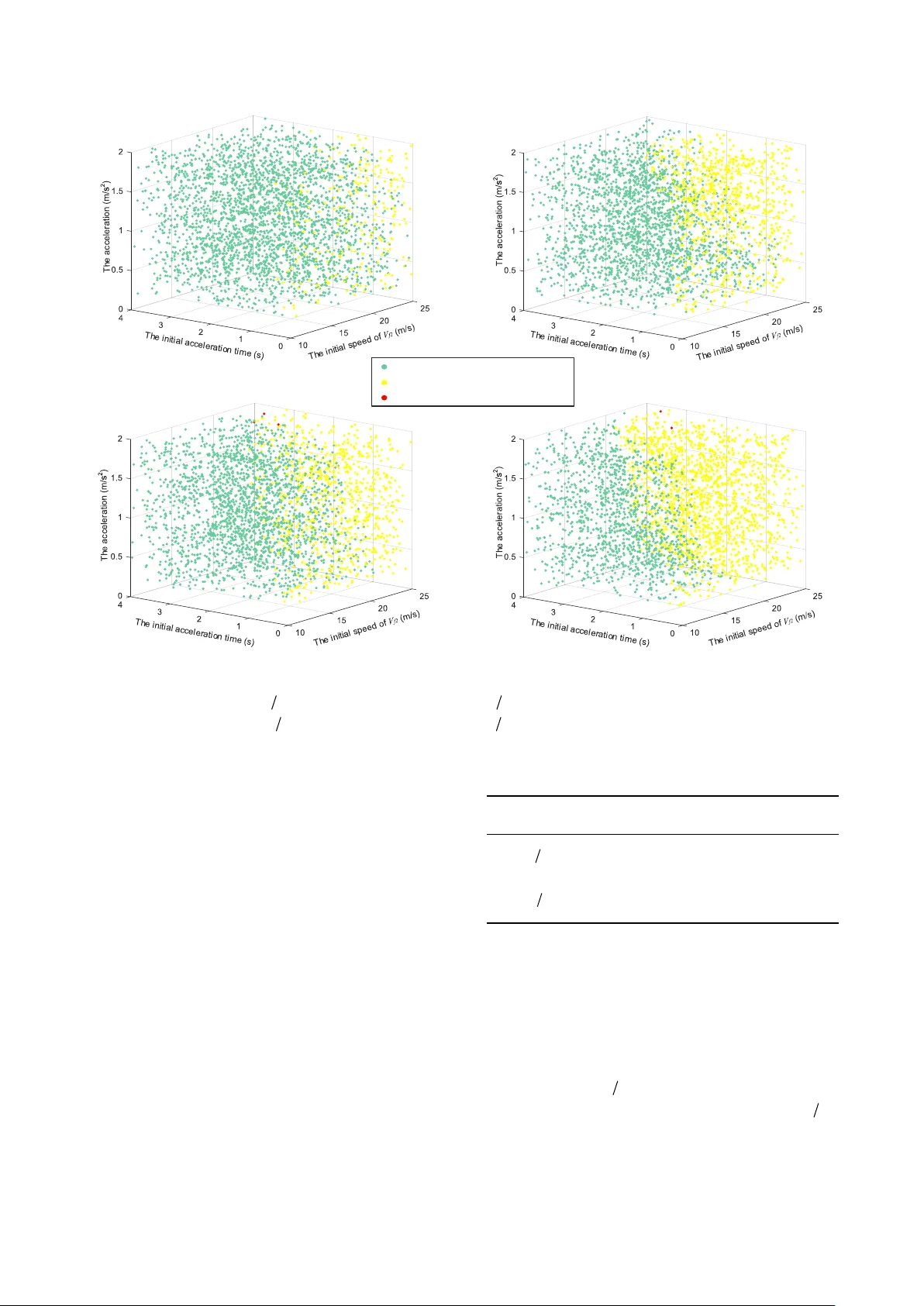
1 A Negotiation-based Right- of -way Assignment Strategy to Ens ure Traff ic S afety and Efficiency in Lane Changes Can Zhao 1 , Zhiheng Li 2 , Li Li *1 , Xiangbin W u 3 , Fei-Yue Wang 4 1 Department of Au tomation, Tsinghua Un iversity, Beijing, China 2 Tsinghua Shenzh en International Gradu ate School, Tsinghua University, Shenzhen, China 3 Intel Labs China, Intel Corporation, Beijing, China 4 The State Key Lab oratory for Manag ement and Control of Com plex Sy stems, Institute of Autom ation, Chinese Academy of Sciences, Beijing, China * li -li@tsinghua. edu.cn Abstract: It is widely acknowledged that verifying the safety of auto nomous driving strategies r equires a substantial body of simulation testing and road testing. In recent years, the formal safety methods repr esented by Responsibili ty- Sensitive Safety (RSS) have encou raged low-c ost autonom ous driving safety research , ben efitting from its accurate assessment of safety and clear d ivision of responsibilities. However, h ow to maintain traffic efficiency whi le ens uring safety remains a challe nge. To address this problem, th is pap er propose s a form ulized negotiation -based l ane-changing str ategy that makes a trade -off between safety and eff iciency. Both theor etical analysis and numer ical exper imental results shows that co mpared to RSS, our strategy can noticeably improve the success rate of changing lanes on the pr emise of safety . 1. Introduction Safety is th e first criter ion for auto nomous vehicles (AVs). The origin al intention of this techn ology is to bring more certainty and reliability to road traffic and reduce the damage caused by accidents, i.e., fewer cr ashes and injuries. Generally, verifying the safety of au tonomous driving strategies requir es a substan tial body of simulation testing and road testing. However, how to ensure that the test ing environment faithf ully describes actual road conditions (including many corner cases) remains difficu lty. In recent years, resear chers have tr ied to verify the safety of AVs by formulating a set of standardized maneuvers. The proposal of formulized verification methods has encouraged low-cost autonomous driving safety research [1 ]. Specifically , for mulized safety m ethods can determine when to mak e dedicated actions within the given scenario s and verify the feasibility and correctness based on uncomplicated mathematical calcu lations. For example, based on the principle of "absolute safety," the Respo nsibility-Sen sitive Safety (RSS) strategy proposed by Mobileye is a typical formulized safety model. Mobileye positions RSS as an instructive and scalable autonomous driving strateg y system, aimin g to ca ll on th e autonomous driving industry (technology providers, researchers and lawmaking agencies) to stan dardize d riving rules and responsibilities [2]. To date , RSS has been tested in 37 ty pical accident scen arios co vering 99 .4% of Natio nal Highway Safety Administration ( NHTSA) accid ent scenario data, an d the results have shown that its security has reached a sou nd available state [3 ]. Wheth er these f ormulized safety methods can be applied in more complex d riving scenarios has attracted increasing atten tion. This paper focuses on the per formance and improvem ents of fo rmulized strategies in lane -changing scenarios [4 -6]. According to data f rom th e NHTSA, traffic accidents caused by lane changes account for up to 27% of all [7], which has bec ome an enormous challen ge for both human drivers and AVs. In this paper , we propose a com munication-based formulized lane-chang ing strategy that addresses the assignment of right- of -way to ensure traf fic safety and efficiency simultaneously. Based on our previous study [8], it is apparen t that via correct co mmunicatio ns, the whole decision problem can be easily decom posed into sever al much simpler subproblems based on the transferring time points of right- of -way. We call this method a situation-aware strategy for specified tasks within particular driving scenari os [9 - 11 ]. Based on the original RSS strategy, this paper divides the lane-changing maneuver p rocess into three stages clearly, and formulates the safety conditions in each time interval during each stage. The simulation results indicate that our strategy no ticeably improv es the success rate of chang ing lanes on the premise o f safety. The contribution s can be summarized as f ollows: (1) This work defines t he concept and basic pri nciples of the right - of -way and verifies its feasibility in lane - changing scenarios with a rule-based for mulized method. Furthermor e, this method can identify the parties respo nsible for potential accid ents quickly and accurately . (2) This wor k coordinates the driving inten tions of all participants by introducing a n inter active negotiation mechanism . I n addition to lane-chan ging scenarios, this idea also has prospec ts for application to other traffic scenar ios. (3) This work not on ly embod ies th e req uirements o f traffic efficien cy but also gives en ough consideration to driving safety . We take bo th m ultivehicle lane -changing cases and neg otiation failure cases into accou nt. To b etter present our findings, the r est of this paper is arranged as fo llows. Section 2 systematically r eviews studies on formal lane- changing strategies and highlights their lack of atten tion to n egotiation. Section 3 defines th e con cept and principles o f the right- of - way , and introdu ces the scenarios we focu sed on . Section 4 provides numerical experimental results to verify the superiority of our new strateg y over RSS 2 on traffic eff iciency. Section 5 prov ides an add itional discussion on multiveh icle lan e-chang ing cases and negotiation failure cases and perf orms simulation s to verify the secur ity of the new strategy. Finally, Sec tion 6 concludes the paper and briefly describes the next steps of our research. 2. Literature Review 2.1 Correlatio nal Research The dec ision-making process answers the question "under what circ umstances shou ld an AV make a lane - changing dec ision." Most of this kin d of research originates from the mod eling of human behaviors [ 12 - 15 ]. The MIT SIM model [ 12 ] was proposed in 2002 and h as since bee n amended several times. Most studies b ased o n it [16- 17] divided the lane-chan ging process into three cr itical stages: i) determ ine whether th ere is a need to change; ii) judge the accep tan ce gaps, and iii) make the lane change. The lane change decision can also be regarded as a game process b etween m erging vehicles and straight- going vehicles [18-20], and traffic rules are g enerally considered imp licit in th e respec tive dec ision models. Other typical methods include logical r easons [ 21 ] and d ata-driven ensemble learning [ 22 ]. Nev ertheless, these models did not clearly define how to avoid collision s altogether [ 23 ]. The safety verification pro cess an swers the qu estion "how to ensure that the lane-chan ging decision is safe." Methods such as Multi-Lane S patial Logic ( MLSL), Inevitable Collision States (ICS), and Reachability Analysis ( RA ) ar e widely used in this field. In Reference [ 24 ], researchers have used MLSL to verify the safety of lane changes. This method assesses safety by mon itoring whether the space occupied by the vehicle s (inclu ding the v ehicle itself and the r eserved space) in tersects. ICS p ackages all the unsafe states of AVs into a set and considers all driving behavior s avoid ing them as safe states [25-26 ]. RA focuses on the intersection of the fea sible trajector y from all traffic participants [27] , which provides a testability criterio n for a driving strategy. However, these methods rely on an accurate perception system and an enormous amount of computation, leading to poo r performance in applicability and timeliness. Reference [6] verifies the feasibility of lane change s by formalizing traffic rules and maneuver ing processes, coincidin g with the id ea of RSS. In addition to the reduction in computation, an other advantage of this kind of method is the explicit division o f collision r esponsibility [1]. Plainly speaking, if all participants co mply with the driving principles of model mak ing, traffic accidents will b e avoided entirely. When an accident occurs, the first rule violator shall bear the whole r esponsibi lity for all consequences. 2.2 Weaknesses and Improvements However, we have noted r oom for improvemen t in the lane-chan ging strategies of both RSS and the work in [6]. First , both strategies recognize that the essence of safe driving is assigning right- of -way properly for all traffic participants, but they do n ot clea rly define the concept of right- of - way and the principle of assign ment. Obviously, if every v ehicle is connected and autonomous (CAV), we can utilize explicit communication techniqu es (e.g., V2V) [28-30] to arrange their right- of - way effortless ly . While in the foreseeable future, traditional human -driv en vehicles and AVs will coexist for a long time. Therefore, the assignment of ri ght - of -way under mixed tr affic flows must be co mpatible with the existing rules and habits of human drivers. The m ost important principle am ong is the First Come Fi rst Served (FCFS) [31-3 3]. Second , both strategies consider the v ehicle simply as an isolated individual and igno re the interactions among vehicles . However , the efficient completion of the right - of - way assignment process can never be div orced from communication and neg otiation [ 34]. In ro ad traffic, the exchang e of in formation is ubiquitous. In h uman driving, there has always existed primitive information transmission (e.g., horns, gestures, lights, and speed changes) not relying on s pecific communication equipment, which we call implicit communica tion [38]. Restricted by th is information transfer channel , the co mmunication efficiency m ay be low, but it is still essential for d riving safety [ 35 - 37 ]. For example, in lane- changing scenarios, th e acce leration or deceleration of the following ve hicle in the target lane may reflect reverse intentions. In recent y ears, i dentify ing the human driving intention from implicit communication has become a research topic of interest [ 39 - 41 ]. Although this paper does not focus on intention recognition, we believe that the efficiency and success rate of n egotiation will continue to improve as research in th is area progresses. Moreover, d ue to a lack of communication, ex isting defensive driving strategi es tend to beh ave qu ite conservative ly, which may indirectly affect traffic efficiency [38]. For examp le, [8] demonstrated that safety and efficien cy can b e b etter balance d in vehicle-followin g scenar ios by slightly mod ifying the original RSS strateg y. Similarly, the lane-chan ging oppor tunities calcu lated by th e RSS also tend to be overly conservative, which mak es lan e chang es a luxury in man y cases. As a compariso n, hum an drivers always use turn signals to give early warning s to the following vehicle, promoting awareness and position adjustment. Thus, we are interested in studyin g whether we can improve the lane- changing per formance of AVs by in troducing a negotiation process [38] . 3. Problem Present ation 3.1 Assumptions The major assumption s involved in the fo llowing sections are listed b elow: A1) We assume that the lane-changing maneuv ers implemented in th is p aper belong to discretionary lane changes (DLCs), and mandatory lane changes (MLCs) can be addressed via a similar appro ach [ 5, 4 2]. Unlike MLCs (e.g., entering and exiting ramp junctions [ 43 -44], multilane merging , etc.), DLCs do not have strict requirem ents for lane- changing times and locations; they occur to earn better driving ben efits (e.g., visibility, ex pected speed, etc. ). A2) Only one -way scenarios are consider ed . Meanwhile , ego V is in a safe state and has determined the target lane at the beginning. A3) ego V can ac quire th e state (position , speed, and acceleration) of surrounding vehicles via sensors. In addition , 3 we assume that th e outside size and the d ynam ic performance of all studied vehicles are the same. A4) At the same moment, the full width of a lan e should be occupied by only one vehicle in the lane, which is a co mmon conservative setting in lan e- changing dec ision- making studies [6, 24 ]. Of course, further division s of the lateral area are necessary when generating specific maneuver ing schemes [ 45 - 46 ]. A5) We assume ego V is the only m erging v ehicle during the en tire lane-chang ing process. A6) We assume that all vehicle s are rational, meaning that they are all aware of the same right- of -way p rinciples an d willing to coo perate in negotiations. Among these assumptions, A1 -A4 simplify the scenarios and elim inate n oncritical inform ation, and A5 -A6 reduce th e calculation of co llision conditions. To assure the integrity and scientific nature of this work, we sp ecifically discuss the failure cases of A5 and A6 in Section 5. 3.2 The Definition and Princ iples of Right- of - way The righ t- of -way is a central concept in tr aditional traffic regulations, but only has lim ited g uidance for autonomous driving strategy g eneratio n. First, this is because the right- of -way concept is polysemous in different countries [47-49] and lacks uniform standards. As a result, many safety driving fram eworks, represented by RSS, were originally introduced to facilitate cross-indu stry discu ssions and consensus amo ng industry or ganizations, manu facturers, and regulators [2]. Second, the primar y purpose o f traditional traffic regulations is to determine and assign responsibility after a traffic violation rather than to provide predictive driving g uidance. Th erefore, the ru les of rig ht - of -way transfer are no t clearly defined, and only liability dec isions such as "the m erging v ehicle is responsible for not tou ching the vehicle straight goin g " and "the fo llowing vehicle is responsible for a rear-end accident" are made. For human drivers, such "posteriori" traf fic regulations can provide an implicit behav ioral boundary; howev er, for rule -based AVs with high er safety r equirements, a mo re specific, calculable, and interpretab le right- of -way model is requ ired. R SS highlig hts the role of th e right- of -way playing in road safety. However, it did not explicitly answer two crucial questions: "what is the right - of -way" and "when to transfer the right- of -way." A thorough rethinking of human driving behavior s shows th at if there are no more specific criteria (e.g., traffic rules or threat of d anger) , most hum an driv ers will determine the right - of - way ownership of a certain conflict area based on who can occupy it faster and easier . This is known as the FCFS principle, whi ch has bee n p roven also helpful for AVs in improving driv ing safety and efficiency because o f the lo w fuzziness and clear ca lculation process [28]. Therefore, referring to the prevailing academic definition [ 50 - 51 ], we finally d efine the right- of -way as the preferential right to occupy/use a certa in temporal -spatial area [52]. Fu rthermore, based on FCFS and safety requirements, we summarize the following four basic principles of the right- of -way that should be respected : 1) The ex istence of the right- of -way is relativ e. Only when there is a p otential co nflict between two traffic participants do es the right of way assignmen t arise. 2) Within the right- of -way area, there is o nly one owner at every m oment. The nonowner shall tak e the initiative to keep out o f this area unless permission is obtained from the owner . 3) When there is a conflict between owner and nonown er in a certain area, no nowner are respo nsible for potential accid ents. 4) Depending on whether the owner can transfer, the right- of - way areas can be classified as forbidd en areas and negotiab le area s . The fo rmer is inviolab le, and the latter can be transferr ed to another owner after negotiation. Taking the vehicle-following scenario shown in F ig . 1 as an ex ample, l V (the lead ing vehicle) natu rally possesses the right- of -way of the certain area behind it, which means that f V (the following vehicle) has respo nsibility for keeping away from this area to ensure safety . Accord ing to our own work [8 ], the length of th is forbidd en area ( , ) lf VV F can be calculated based on the speed of the two vehicles: 2 2 ( , ) , brake max,brake 22 lf f l V V f f v v Fv aa + = + − (1 - 1) where ( ) , bra ke min,brak e m ax,brake min,brak e ma x f f v a a a a v = + − (1 - 2) where f v denotes th e speed of f V , l v denotes th e speed of l V , m a x v denotes the maximum speed limit o f the lane, and denotes the reaction time lag. ( , ) lf VV F can be interpreted as follows : if the leading vehicle suddenly brakes with maximum deceleration, this distan ce accommo dates the following vehicle to safely stop with , brake f a after the reactio n time. 3.3 Scenario Presentation The n omenclatures u sed in this pap er are given i n Table 1. We mod el the DLC scenario in Fig. 2 and denote the merging autonomous v ehicle as ego V , wh ich aims to switch from 1 L (the original lane) to 2 L (the target lane). ego V may interact with the sur rounding four v ehicles on the right of way , including 1 l V (the leading vehicle o f 1 L ), 1 f V (the following vehicle of 1 L ), 2 l V (the leading vehicle of 2 L ), an d 2 f V (the following vehicle of 2 L ). The for bi dden area bel ongs to Fig. 1. The assignment of right- of -way in vehicle-following scenarios 4 Similar to the vehicle-following scenario, 1 l V and 2 l V have a natural advantage over ego V , so it n eeds to avoid the forbidden ar ea behind them. According to the FCFS principle, 2 f V have the right- of -way for th e cer tain area ahead. The area that poses severe threats to safety sho uld b ecame th e fo rbidden area of 2 f V , and the area that affects driving in terests should became the negotiable area. In Fig. 2, w e refer to the d irection parallel t o th e lane as lo ngitudina l and the dir ection p erpendicular to it as lateral . Given that the considerable speed dif ference in the two directions, it is sensible to regard a lane -changing maneuver as two indepen dent decoupled unifo rm motion s. 3.4 The Human Stra tegy and the R SS Strategy Obviously, the ownership of the right- of -way does n ot need to be updated at every time interval. Instead, a vehicle may hold the right- of -way of a certain area for a lo ng time until another vehicle takes over after obtaining its permission. This pro perty helps us deco mpose th e negotiation and decision process into stages to red uce the complexity of the calculation. To exhibit th e DLCs process visually , we take the human s trategy a nd the original RSS strategy as comp arisons, as shown in Fig. 3. The k ey diff erences are highlight ed in bold. Experienced human drivers always consider multivehicle r ight- of - way assignment problems as multiple one - to -one right- of - way assignment problems and solve them in turn . S ome researchers divide the human DLCs proce ss into th ree crucial stages — the longitudinal spacing adjustment stag e , th e negotiation stag e , and the action stage [ 18 ]. In the first stage, ego V adjusts th e relative position to find a good merging opportun ity. In seco nd stage, the human driver will im plement co urtesy merging under n ormal conditions, meaning to notify the surrounding v ehicles and request permission. However, such estimates of th e acceptable gap are subjective and rough, which can tr igger disastrous co nsequences. Mo reover, som e aggressive dr ivers may engage in forced merging without negotiatio n, even in a small headway. This risky behavior is b elieved to be on e of the culprits of accidents. Conversely, the RSS str ategy formulizes all determination rules to ensure strict collision -free conditions. This strategy requires ego V to change lanes only when the change not cause an y impac t on surrounding vehicles, but it does n ot spec ify how to make this deter mination. Furthermor e, because of absolute confidence in the safety of lane changing, RSS omits the negotiation proce ss and believes that other vehicle will yield in a timely and initiative fashion. However , th is strategic o mission introduces several problems. First, to find the right oppor tunity to change lanes , the expec ted time for position adjustmen t will inevitably be extended (proved in Section 5 ). Second, this strategy requires vehicles to yield unconditionally wh en encoun ter a lane- changing request. This is of course f or safety, but in some cases, it will conf lict with drivin g s elf-inter ests, such as being Table 1 . The Nomenclature List Symbol Definition v l The length of a vehicle ( , ) ij F The length of the forbidden area between i and j ; the right- of -way belongs to i ( , ) ij N The length of the negotiable area between i an d j ; the right - of -way belongs to i ( , ) ij d The longitudin al distance between i and j The reaction time lag of AV hu m an The reaction time lag of human d river i v The longitudin al speed of Vi i a The longitudin al acceleration of Vi max,brake a The maximum d eceleration max,accel a The maximum acceleration m a x v The maximum sp eed limit of the lane The traffic f low of the lane h The headway o f the lane the log- normal location parameter the log- normal scale parameter The free are a fo r changi ng l ane saf el y L 2 L 1 The forb id den area bel ongs to The negot ia ble are a bel ongs to The forb id den area bel ongs to The forb id den area bel ongs to The l ength of a vehi cl e longitu dinal lateral Fig. 2. An illustration of DLC scenarios. 5 blocked multiple times continuou s ly . Third, the surrounding vehicles can o nly perceive the intentio n to change lan es after the merging maneu ver b egins. In th e long r un, this may lead to poten tial risks, such as multiple vehicles mer ging into the same lane simultan eously. 3.5 Three Stages of the New Strat egy We aim to combine the superiorities of the three- stage model and collision avoidance co nditions. An ideal lane- changing strateg y should be sequential, specific, and easy to calcula te . Under ideal conditions, all traffic participants should be allowed to strive for their reaso nable driving interests. Modeled after human driving, the whole merging process is divided into three stages as Fig. 4. We list the state transition conditions of th e strategy in this section, and more calculation de tails are provided in S ection 4 . 3.5.1 The Longitudina l Position Adjustment Stag e . In this stage, ego V should o bserve th e state of surround ing vehicles and adjust its position. If it can change lanes without invading the forbidden area of 1 l V and 2 l V , as well a s the right- of -way area of 2 f V , we call this situatio n d irect merging gap acc eptance . Equation (2 ) of Fig. 4 can b e expressed as: 11 22 2 2 2 ( , ) ( , ) ( , ) ( , ) ( , ) ( , ) ( , ) 2 1 2 0, 0, 0 ego l l ego ego l l ego ego f f ego f ego V V V V V V V V V V V V V V f l l d d d aa F a F F N + (2) where the variable ( , ) ij d denotes the longitudinal distance between i and j . ( , ) ij F denotes the length of the forbidden area between i (the owner) and j (the nonowner). Similar ly, the variable ( , ) ij N represents th e length of the negotia tion area . If ego V will only enter the nego tiable area, we call this situation negotiated merging gap acceptance . Equation (3) o f Fig. 3 can be ex pressed as: 11 22 2 2 2 2 ( , ) ( , ) ( , ) ( , ) ( , ) ( , ) ( , ) ( , ) 2 1 2 0, 0, 0 ego l l ego ego l l ego f ego ego f f ego f ego V V V V V V V V V V V V V V V V f l l F F F d d d aa F a N + (3) ( b ) ( a ) The L on gitudinal Po sition A djustme nt Stage The Negotiat ion Stage The Action Stage Start Longitudinal Position Adj ustment Direct Mergin g Gap A cceptance Courtesy Merging Gap A cceptance Send Courtesy Merging Re quest Acquire Permi ssion Begin Merging End Next Headw ay Forced Merging Lack of necessary negotiation proc ess The Action Stage Start Longitudinal Position Adj ustmen t Direct Mergin g Gap A cceptance Safe Merging Gap Acceptance Begin Merging End Decide to Merge Believ e will yie ld timel y and initiativ ely Sourc e of danger Y Y N N N N N N Y Y Y Y Next Headw ay The L on gitudinal Po sition A djustment Stage Fig. 3. The flow charts of two existing DLC strategies: ( a ) the human strategy [19]; ( b ) the RSS strategy [2] The Lo ngitudinal Po sitio n Adjustm ent Stage The Action Stage Start Longitudinal Position Adjustment Dire ct M erging Gap A cceptance Negotiated M erging Gap A cceptance Begin Merging End Next Headw ay Y N N Y The Negotiat ion Stage Send Negotiation Merging Re quest N Y Acquire Permi ssion Stop Merging L 2 L 1 The ri ght of way assig nment betwee n and Section 3.1 The rig ht of way a ssi gnm ent between and Section 3.2 The ri ght of way assig nment bet ween and Section 3.3 Di rect Merg ing Eq . (2) Eq . (3) The ri ght of way assig nment betwee n and Section 3.4 The Free Area The Forbidden Area bel ongi ng to The Forbidden Area belo ngi ng to ot her v ehicles The N eg ot iable Area bel ongi ng to ot her v ehicles L 2 L 1 Request Consent Reject Fig. 4. The flow chart and stages of the new DLCs strategy. 6 3.5.2 The Rig ht- of -way Negotiation Stage. Obviously, the negotiation process only occur s between ego V and 2 f V . After ego V has g enerated the intention to enter the rig ht- of -way ar ea of 2 f V , the issuance of th e merge request is necessary. This signal may be delivered by explicit commun ication or implicit commu nication (e.g., the turn signal). To ensure that 2 f V can hav e sufficient time to respond after receiving the request, we set the feedback waiting time as 3 s af ter reviewing the literature [ 54 -55]. Af ter this period , th ere are three po ssible results for 2 f V : • Reject . I f the request is explicit ly rejecte d by 2 f V (through V2V, accelerat ion, horn blari ng , etc.) , ego V should immediatel y consider the neg otiable area as the for bidden area and w ait for th e next app ropriate headway. • Consent . If 2 f V decele rates o r makes no response to acquiesce nce, the right- of -way ownership of the negotiati on area will transfer to ego V . • Failure . Because of t he ex ternal similarity betw een acquiesce nce and negoti ation failure , the potentia l risks caused by misjudgme nts cannot be ignor ed. Hence, the suppleme ntary discussi on of S ectio n 5 focuses on the safety iss ues of t hese excep tional cases . 3.5.3 The Action Stage. During t his sta ge, ego V should complete lane change smoothly to reduce the impact on traffi c flow. 4. Detailed Calculations of the New DLCs Strategy In this section , w e list the distance calculations successively acco rding to th e interaction order . 4.1 Interaction between eg o V and 1 f V The relation ship between eg o V and 1 f V in Fig. 5 is equivalent to the vehicle -following scenario. Keeping away from the forbidden area of ego V is the responsibility of 1 f V . 4.2 Interaction between eg o V and 1 l V Similar to the above, this relation can be regarded as another vehicle -following scenario, as shown in Fig. 6. The length of the forbidden area 1 ego ( , ) l VV F can be expressed as 1 ego 2 2 ego 1 ( , ) ego ego, brak e ma x, brake 22 l l VV v v Fv aa + = + − (4 - 1) ( ) ego ego, brake min,brake max , brake min,brake max v a a a a v = + − (4 - 2) 4.3 Interaction between eg o V and 2 l V From the p erspective of eg o V , 2 l V has a right- of -way advantage similar to 1 l V , as sho wn in Fig. 7. T herefore, 2 ego ( , ) l VV F can be expressed as 2 ego 2 2 ego 2 ( , ) ego ego, brake ma x, brake 22 l l VV v v Fv aa + = + − (5 - 1) ( ) ego ego, brake min,brake max , brake min,brake max v a a a a v = + − (5 - 2) 4.4 Interaction between eg o V and 2 f V Different from the above three parts, the rig ht- of - way assignment between eg o V and 2 f V is more complicated because it m ay involve a request and r esponse process. The front area of 2 f V can be divided in to three areas, as shown in Fig. 8. The length of 2 ego ( , ) f VV F can be calculated by 2 ego 22 2 ego ( , ) 2 human 2, brake m ax,brake 22 f f V V f f vv Fv aa + = + − (6 - 1) L 2 L 1 The forb id den area bel ongs to Fig. 5. The assignment of right- of -way between eg o V and 1 f V . L 2 L 1 The forb id den area bel ongs to Fig. 6. The assignment of right- of -way between eg o V and 1 l V . L 2 L 1 The forb id den area bel ongs to Fig. 7. The assignment of right- of -way between eg o V and 2 l V . 7 ( ) 2 2, brak e min , brake max,brake min , brak e ma x f f v a a a a v = + − (6 - 2) Since the reactive side of emergency braking is 2 f V , it should be co nservatively assum ed to be a human dr iving vehicle with a longer reaction time hu m an . The o wnership of th e negotiab le area will tran sfer with the different responses of 2 f V , as shown in Fig. 8 . T he boundary of th is area can be calculated as ( ) 2 ego 2 ego 2 2 max,accel human ( , ) ( , ) 2 human + 2 2 max,accel human ego min,brake max,brake + 2 22 ff f V V V V f a F N v va v aa =+ + +− (7) T he meaning of this leng th is that e ven when using minimum acceleratio n to brake, the following vehicle of the target lane can also avoid any impact ca used by the merging vehicle . Therefore, we use this as the criter ion for th e d irect merging gap. 5. Results and Discussion on Efficiency When assumption s A5 and A6 h old , both the RSS strategy and the new strateg y can preven t collisions within the whole lane- changing process. Ther efore, this section focuses on the comparison of their impact on traffic efficiency . We design two s imulation experiments to observe the averag e time cost of DL C and the success rate of DLC in constant time u nder different strategies. 5.1 Simulation Settings To closely ap proximate r eal traffic, the lane-ch anging scenario in the simulatio n system is con structed as shown in Fig. 2. We d enote the speed of the ego as eg o v , and it plan s to merge into the adjacent lane occupied by the fleet with average spee d 2 L v . In reference [56], the researchers tried all the proposed distribution models to fit the empirical h eadway data and found that the log-normal model yielded th e best f itting to real road conditions. T hus, we used the log-normal mod el to describe the h eadway of lane 2 L , which is written as: 2 2 1 [ln ] exp ( 22 ) h fh h − =− (8) where variable h denotes the possible value of the h eadway, is the locatio n parameter an d is the scale parameter. T he mathematical ex pectation of h is : 2 ex 360 p( / ) 2) 0 ( E h + = = ( 9) where denotes the value of traffic flow. According to [ 56], we assume = 0.8 in th is part and use Equation (9) to calculate param eter under different . According to the SAE [57] and FMVSS135 [58] standards, we set the other major parameters required for the simulation as follows: v eh ic l e 5m l = , 2 m ax ,acc el 2 m s a = , 2 m in,bra ke = 2 m s a , 2 m ax ,bra ke = 6 m s a , = 0. 1s , hu m an = 1 s , m a x = 3 0 m s v , ego = 20 m s v and 2 = 20 m s L v . Based on the above settings, we ca rried out the following two representative simulation experiments. It should be noted that we also tried other p arameter settings , but these only caused insignificant n umerical differences, which did not affect the conclusion s in this pap er. 5.2 The Avera ge Time Cost of DLC In the first experiment, we recorded the time cost for lane chan ges under d ifferent traffic f lows ranging from 200 veh/h to 1600 veh /h. T o reduce any errors caused by ch ance, we carried out 1 0000 tests and took th e average. The simulation results are shown in Fig. 9 . We highlight the d ifferent time periods with three co lors. The results illustrated that with the increase in , the required time of the RSS strateg y increases r apidly. When 1 16 0 v e h h , the time co st of more than 2 minutes becomes unbearab le. Conversely , the new strategy is not significantly affected by the increase in . This is partly because the new strategy has a shorter min-acceptable gap; more impor tantly, the ex istence of negotiation mak es it easy for ego V to find an oppo rtunity to change lanes. Based o n the new strategy, the merging maneuvers can be completed in 1 minute if more than 25 % of vehicles con sent to the request. More importan tly, the existence o f neg otiation m akes it eas y for ego V to find an oppo rtunity to change lanes. Based o n the new strategy, the merging maneuvers can be completed in 1 minute if more th an 25% of vehicles consent to the request. L 2 L 1 Consent Reje ct The forbidde n area belon gs to The f orbidde n area belon gs to T ransfer the right- of -way , begin to mer ge. Keep the right- of -w ay , stop mer ging. The fo rbidden area belo ngs to The nego tiable area belo ngs to Reques t The fr ee a rea Fig. 8. The assignment of right- of -way between eg o V and 2 f V . 8 5.3 The Succ ess Rates of DLC In the second ex periment, we ch ecked the success rates for lane ch anges at constant times rangin g from 20 s to 180 s. In ad dition, we carried out exp eriments und er = 60 0 v e h h and = 120 0 ve h h . Similar to the fi rst experimen t, we carried out 10000 tests and to ok the average. The results ar e sho wn in Fig. 10 . Similar to the conclusion of the above experiment, it can be seen that the effect of the RSS strategy is not ideal under h igh traffic flows . As a comparison , the success rate of the new strategy under the sam e con ditions is stable ab ove 69%. Furthermore, the success rate of the new strategy is sign ificantly affected by the inten tion of th e vehicles from the target lan e, whose high tolerance of r equests can effectively reduce th e waiting time of ego V . Overall, the success rate of the new strategy is greatly improved co mpared with RSS, which benefits from the negotiatio n mechanism and shorter m in-accep table gap. 6. Results and Dis cussion on Safety I n above section, the efficiency comparison results are built on the basis that assumptions A5 and A6 (from Chapter 3.1 ) hold. Since the u ncertainty is removed, the whole simulation experiment is controllable. Therefore, to valid ate the model safety, it is also ne cessary to discuss situation s when these two assumptions fail. In this section, we discuss multivehicle lane-changing scenarios and negotiation failure scenarios and perform a safety testing experimen t u nder the se extreme cases in Chapter 6.3 . 6.1 Multivehicle Lane-changing Sce narios The above con tent focuses on the two -lane scenario s introduced in Chapter 2.2 , where ego V is the only vehicle with the intentio n to change lanes. However, this assump tion does not always hold on real roads. Dur ing the longitudin al position adjustment s tage, t he merging vehicle s ometimes ha s to face interference caused by merging maneuvers from other vehicles. When two vehicles are planning to merg e simultaneously, rational human drivers usually determine the right- of -way according to the FCFS prin ciple. I n more extreme cases, such as when three or more vehicles are merging together, giving u p m erging temporarily f or safety is a more commo n choice. Therefore, it is necessary to determ ine how AVs should react when two vehicles show a d esire to change lanes. We exp and the original scenario to the four lanes sho wn in Fig. 11 and add two veh icles a V (in 0 L ) and b V (in 3 L ) as new research objects. Moreover, we summ arize the merging behavior s that may cross the trajector y of ego V into seven types, mar ked ① to ⑦ in Fig. 11. When ad dressing these scenarios, the right- of -way rules can be intr oduced similarly to clarify the relatio nship b etween the merging initiators and ego V . Accordin g to the relative strength of the right of way, we can categorize th ese seven ty pes into th e following three situations: 6.1.1 Ego v ehicle has a higher r ight- of -way : from ① to ⑤ . In th is ca se, ego V has the right to choose between continuing th e m erge or giving up, and the surrounding vehicles have obligation s to cooperate with this choice. Among them, the initiators of maneuvers ①② and ③ should The RS S mo del The n ew mod el ( 0% v ehicl es cons ent to th e re quest o f mer ging) The n ew mo del ( 25 % vehic les cons ent to th e reque st of me rging ) The n ew mo del ( 50 % vehic les cons ent to th e reque st of me rging ) The n ew mod el (1 00 % vehicl es cons ent to th e request o f mer ging ) ≤ 1 min 1~2 mins ≥ 2 mins Fig. 9. The average time cost under different traffic flows. 95 .65% 79 .02% 96 .84% The RS S model The n ew mod el ( 0% v ehicl es cons ent to th e reque st of mer ging) The n ew mo del ( 25 % vehic les cons ent to th e reque st of me rging ) The n ew mod el ( 50 % vehic les cons ent to th e request o f mer ging ) The n ew mod el (1 00 % vehicl es consent to the re quest o f mer ging ) ≤ 1 mi n 1~2 mi ns ≥ 2 mi ns ( a ) ≤ 1 mi n ≥ 2 mi ns 35 .93 % 69 .19 % 79 .50 % 87 .06 % 95 .27% 59 .32% 90 .40% 95 .70% 98 .23% 1~2 mi ns The RS S model The n ew mod el ( 0% v ehicl es cons ent to th e reque st of mer ging) The n ew mo del ( 25 % vehic les cons ent to th e reque st of me rging ) The n ew mod el ( 50 % vehic les cons ent to th e request o f mer ging ) The n ew mod el (1 00 % vehicl es consent to the re quest o f mer ging ) ( b ) Fig. 10 . The success rate of lane changes in constant time. ( a ) = 60 0ve h h ; ( b ) = 12 00v eh h . 9 respect the righ t- of -way area behind ego V or bear responsibility fo r po ssible accidents. Unlike ①② and ③ , maneuver s ④ and ⑤ may invade the negotiable area of ego V , so those maneuvers can only b e executed af ter acqu iring the consent of ego V . 6.1.2 Ego vehicl e has a lo wer right- of -w ay: ⑥ . In this case, ego V should actively yield to avoid entering the forbidden area of 1 l V . After the a ction of 1 l V , if the remaining distance ahead is insufficient to accommod ate an other merge , ego V should quickly abandon and readjust its lon gitudinal position to find a new opportunity. 6.1.3 Th e right- of -way relationship ca nnot b e determined: ⑦ . This mean s both b V and ego V plan to enter the same area of 2 L , bu t neither has an obvious advantage in terms of right of way. According to the FCFS principle, the vehicle first sho wing a merging intention ought t o acquire the right- of -way advantag e, an d th e other vehicle should respect this assignm ent resu lt. To increase reliability and integrity, the failure cases against this rule are discussed indi vidually in the next section . 6.2 Negotiation F ailure Scenarios In a mixed traf fic flo w, u nderstanding errors (of human -driving vehicles) or algor ithm errors (of AVs) may cause the vehicles surrou nding ego V to refuse to negotiate or refuse to accept th e nego tiated results. We call this situation the "n egotiation f ailure," which is spec ifically manif ested as a vehicle suddenly entering the forbidden area of ego V without warning during its lane-ch anging action stage. Because this man euver is unexpected, it is necessary to develop targeted measures; o therwise, the risk of accidents will incr ease grea tly. Fig. 1 2 sh ows two typical negotiation failure scenario s. 6.2.1 Wrong acce leration of 2 f V . i) I f wh en th e acce leration of 2 f V is d etected, ego V does not en ter 2 L . It should stop merging immediately. ii) If when the acceleration of 2 f V is detected, ego V ha s partiall y en ter ed 2 L and space ah ead is sufficient. It ca n accelerate like 2 f V and complete merg ing. iii) If when the acceleratio n of 2 f V is detected, ego V ha s partially e nter ed 2 L and space ahead is not sufficient. eg o should stop merging and return to 1 L immediately. Assuming that 2 f V accelerates after ego V starts mer gi ng mer ging t , th e time el ude t left for ego V to avoid collision and return to 2 L can be calcu lated as follows: 2 ego elu de ego 2 m erging ( , ) accel = ( ) + f f V V t V V t F a −− (10) After bringing in co mmon parameters, elu de m erging tt > can b e obtain ed by simulation calcu lation, wh ich pr oves that el ude t is sufficient fo r ego V to perform a reverse m aneuver. 6.2.2 Wrong merging of b V . i) If when the merging of b V is detected , ego V has not yet enter ed 2 L . ego V should stop merging immediately. ii) If when th e merging of b V is detected , ego V has partially enter ed 2 L . ego V should g ive up merging and return to 1 L with the largest possible lateral acceleration . I f the lateral speed of b V is excessive or the origin al space of 1 L is occupied, b V obviou sly needs to bear full responsibility for the potential c ollision. L 2 L 1 L 3 Fig. 12. Two typical negotiation failure scenarios. L 2 L 1 L 0 L 3 ⑦ ① ② ③ ④ ⑥ ⑤ Fig. 11. Seven multivehicle merging scenarios that may affect ego V . 10 6.3 Numerical Tes ting Results To ve rify the safety in extr eme cases, we perform multiple simulation experiments for negotiation failure. Similar to the last simulation, we use the same traf fic scenarios and traffic flow models as in Section 5 . On this basis, we assume that ego V request for merging to the negotiation area of 2 f V and receive a acquiescen ce , but the n egotiation failure will occur in each DLC ex periment, i.e., 2 f V will suddenly accelerate to interrupt the merging proce ss until reaching th e maximum lane speed limit (3 0 m/s). In th e experiment, we repeat the lane c hang e experimen t 10 ,000 times at differ ent initial speed s of 2 f V (from 10 m/s to 25 m/s), different initial acceler ation tim es (from 0 s to 4 s), dif ferent accelerations (fro m 0 to 2 m/s 2 ), and different traf fic d ensities (6 00 veh/h and 1200 v eh/h) to observe the saf ety p erformance o f the new strategy and the RSS strategy. According to Cha pter 6.2.1 , when this unexpected ac celeration b ehavior is detected, th e AV faces three possibilities. State 1: Complete the m erging safely if t he distance ahead is sufficient. State 2: Drive back to the or iginal lane if it has not yet entered 2 L or the distance is insufficien t. State 3: a collision will occu r if safe avo idance is not available. Finally, the experimental results are displayed in Fig. 1 3, and the distribution of the results is summarized in Table 2. From the results, we can see th at the AVs wi th the RSS strategy returns to the original lane in more ca ses becau se it has a longer safety distance an d thus a stricter determination of potential dangers. While AVs with the new s trategy would choose to co mplete lane changes in mo re cases, their difference in safety performance is not significan t. At = 60 0 v e h h , both strategies can ensure 100% safety. Focusing o n the collision cases at = 120 0 ve h h , we find that there was a small chance for ego V of fa ll ing into inescapable safety dilemmas under both strategies, which leads to all the crashes in the results. As sho wn in Fig. 14, if 2 f V incorrectly accelerates and 1 f V mistakenly believes that Table 2. The distribution of experimental results in the extreme cases of neg otiation failure. Traffic flow Merging strategies The propor tion of results State 1 State 2 State 3 60 0v eh h N ew 92.28 % 7.72% 0 RSS 72.14 % 27.86 % 0 12 00v eh h N ew 73.38 % 26.58% 0.04% RSS 54.32 % 45.62 % 0.06 % State 1 : Complete merging sa f ely State 2 : Back to t h e ori g in al lane safely State 3 : Collision acci de nts happene d ( a ) ( b ) ( c ) ( d ) Fig. 13. The experimental results of safety simulation for two strategies in the extre me cases of negotiation failure. ( a ) The new strategy , = 60 0 v e h h ; ( b ) The RSS strategy, = 60 0 v e h h ; ( c ) The new strategy, = 120 0 ve h h ; ( d ) The RSS strategy , = 120 0 ve h h . 11 ego V has alr eady ch anged lanes an d acceler ates early, th e collision will be inevitable. Under this cir cumstance, the appropriate action is to minimize damage by choo sing the correct co llision object. Undoubted ly, th e vehicle violating the right- of -way rules first should be primarily responsible. However, in ac tual traffic, the division of responsibilities for those cases still r equires further and careful discussion between relevant traffic lawm aking agen cies and autonomous driving techno logy providers. The primary purpose of this work is to develop a communication -based lane-changing strategy under the framework of rational behaviors. Th us, the n ew strategy achieves better traf fic efficiency performance with an approximate safety of RSS, which is sufficient to prove its superiority and practical value. 7. Conclusions In this p aper , we propose a com munication-b ased right- of -way assignment strateg y to improve the la ne - changing per formance of the RSS. Our main work is decomposing th e DLC process into three stages an d translating the co llision avoidance conditions o f each stag e into a formulized ex pression. Unco mplicated calculations and simulations show that the introduction of negotiation can improve the utilization of limited road resources, thus ensuring th at the right- of -way assignment is mor e eff icient and reason able. We believe the se proposed right-o f-way p rinciples are universal and applicab le, which mean s th at more verifications and improvements are needed [ 59]. Cu rrently, we are applyin g this communication-based formulized method to more scen arios, such as ramp scenar ios and non-sign al intersections [53]. We b elieve th at und er the premise of ensuring safety, negotiated driving in a human- understand able manner will be an essential task for encouraging the use of A Vs in mixed traffic [38]. Acknowledgments This work was suppo rted by the Nationa l Natural Science Founda tion of China (61790565 ) References [1] Rizald i, A., Althoff, M.: 'Form alising traff ic rules for accountab ility o f autonomous veh icles', Proc . IEEE Int. Conf. on Intelligen t Transportation Systems, 2015 , pp. 1658 – 1665 [2] 'On a formal model of safe and scalable self-dr iving cars', https://arxiv.or g/abs/1708.06374, acce ssed 4 August 2020 [3] Mobiley e.: 'Implementing the RSS Mod el on NHTSA Pre- Cr ash Scen arios', 2018 [4] Finneg an, P., Green, P.: 'The time to chang e lanes: A literature review', Univ ersity of Mich igan, T ransportation Research Institute, 1 990 [5] Toledo, T.: 'Driving behaviour: models and challenges', Transport Rev iews, 2007, 27, ( 1), pp. 65- 84 [6] Pek, C., Zahn, P., Althoff, M. : 'Verifyin g the safety o f lane change man euvers of self -driving vehicles based on formulized traffic rules', Proc. IEEE Int. Conf. on Intelligen t Vehicles Sympo sium, June 2017, pp. 147 7-1483 [7] Yim, S., Park, Y.: 'Design of rollover prevention controller with linear matrix inequality-b ased trajectory sensitivity minimisation', Vehicle system dynamics, 2011, 49, (8), pp. 1225 – 1244 [8 ] Li, L., Peng, X., Wang, F.-Y., Cao, D.: 'A s ituation -aware collision avoidan ce strategy for veh icle fo llowing', IEEE/CAA Jo urnal of Au tomatica Sinica, 2018, 5 , (5), pp. 1012 – 1016 [9] Li, L., Huang, W., Liu , Y., Zheng, N. - N., Wang, F.-Y.: 'Intelligence testing for autonomous vehicles: A new approach', IEEE Tr ansactions on Au to nomous vehicles, 2016, 1, (2), pp. 158 – 166 [ 10 ] Li, L., Lin, Y.-L., Zheng, N. -N., Wang , F.-Y., Liu , Y., Cao, D., Wang, K. Huang, W.-L.: 'Artificial intelligence test: a case study of autonomous vehicles', Artificial Intellig ence Review, 2018 , 50, (3), pp . 441 – 465 [ 11 ] Li, L., Wang, X., Wang, K. -F., Lin, Y.-L., Xin, J.-M., Chen, L., Xu , L.-H. , Tian, B ., Ai, Y. -F., Wang, J., Cao, D.-P. , Liu, Y. -H., Wan g, C.-H., Zheng, N.- N., Wang, F.-Y.: 'Parallel testing of vehicle intelligence via virtual -real interaction ', Science Robotics, 2 019, 4, pp. 4106 [12] Yan g, Q. , Koutsopoulos, H. N.: 'A microscop ic traffic simulator for evaluation of d ynamic traffic management systems', Transpor tation Research Part C: Em erging Technologies, 19 96, 4, (3), pp. 113 – 129 [13] Lee, S., Oh, C., Hon g, S. : 'Exploring lane change safety issues for m anually driven vehicles in vehicle p latooning environments'. IET In telligent Transport Systems,2018 , 12 , (9), pp. 1142-1147 [14] Ji n, I. G., Mu rray, R. M. : 'Voluntar y lane -change po licy synthesis with co ntrol im provisation'. Proc. Int. Conf. Decision and Con trol, 2018, pp. 3640-3647 [15] Li, G., Pan, Y., Yang , Z., Ma, J.: ' Modelin g v ehicle merging position selection behav iors based on a finite mixture of linear regression models '. I EEE Access, 2019, 7 , pp. 158445 -158458 Fig. 14. A dilemma caused by the refusal of multiple vehicles to implement the consensus results. 12 [16] Sun, D., Elefter iadou, L.: 'A driver behavior- based lane- changing model for u rban arterial streets'. Transportatio n science, 20 14, 48 , (2), pp. 184 - 205 [17] Wan, X., Jin, P. J., Gu, H., Chen, X., R an, B.: 'Modeling freeway merging in a weaving section as a sequential decision-m aking process'. Jour nal of Tran sportation Engineering, Par t A: Systems, 2 017, 143, (5), 05017002 [1 8] Toledo, T., Zohar , D.: 'Modeling duration of lane changes', Tran sportation Research Reco rd: Journal of the Transportatio n Research Board, 2007 , 1999, (1), pp. 71 – 78 [ 19 ] Ram anujam, V., Choudhur y, C. F., Ben -Akiva, M. : 'Extended lane -changing model to capture lane- change duration', 08 -3041, 2008 [ 20 ] Vlahogianni, E . I.: 'Modeling duration of overtaking in two lane highways', Transportation Research Part F Psychology Behaviour, 2013, 20, (3), pp. 135 – 146 [ 21 ] Damm, W., Peter, H. J., Rakow, J., Westphal, B.: 'Can we build it: formal synthesis of contr ol strategies f or cooperativ e driver assistance systems ', Mathematical Structures in Com puter Science, 20 13, 23, (4), pp. 676 – 725 [ 22 ] Yi, H., Edara, P., Sun, C.: 'Situation assessmen t and decision making for lan e change assistance using en semble learning methods', Expe rt Systems with Application s, 2015, 42, (8), pp. 3875 – 3882. [ 23 ] Xing, Y. , Lv, C., Wang , H., Wang, H., Ai, Y., Cao, D., Velenis, E., Wan g, F.-Y.: 'Driver lan e c hang e inten tion inference for autonomous vehicles: Fram ework, survey, and challenges', IEEE Tr ansactions on Vehicu lar Technology, 2019, 68, (5), pp. 4 377-43 90 [ 24 ] Hilscher, M., Linker , S., Olderog, E., Ravn, A.: ' An abstract mod el for prov ing safety of multi -lan e traffic manoeuvres', Proc. Int. Conf. Form al Engineering Methods, Springer, Berlin , Heidelberg , 2011, pp. 404 -419 [ 25 ] Fraichard, T., Asama, H.: 'Inevitable co llision states. A step towards safer robots?', Advan ced Robotics, 20 04, pp. 388 – 393 [ 26 ] Martinez -Gomez, L., Fraichard, T .: 'An ef ficient and generic 2D Inevitable Collision State- checker', Proc. IEEE Int. Conf. Intelligen t Robots and Systems, 2008 , pp. 234 – 241 [2 7] Altho ff, M. , Stursberg, O., Buss, M.: 'Reachability analysis o f nonlinear systems with unce rtain parameter s using conservative linearization', Proc. IEEE Int. Conf. De cision and Contro l, December 2008, pp. 4042 -4048 [ 28 ] Li, L., Wang, F.-Y.: 'Cooperative driving at blind crossings using intervehicle commun ication', IEEE Transactions on Vehicular Techno logy, 2006, 55, (6 ), pp. 1712 – 1724 [ 29 ] Xu, H., Zhang, Y., Li, L., Li, W.: ' Cooperativ e driving at unsignalized intersections using tr ee search', IEEE Transactions on Intelligent Transportatio n Systems, 2019 [ 30 ] Meng, Y., Li, L., Wang, F.- Y. Li, K., Li, Z.: ' Analysi s of cooperativ e driving strategies fo r nonsignaliz ed intersections', IEEE Transactions on Vehicular Technology, 2018, 67, (4), pp. 2900 – 2911 [ 31 ] Dresner, K., Stone, P.: 'A multiagent appro ach to autonomous intersection management', Jou rnal of Artificial Intelligence Research , 2008, 31(3), pp. 591 -6 56 [ 32 ] Li, L., Wen, D. , Yao, D.: 'A s urvey o f traffic control with vehicular comm unications', IEEE Transactions on Intelligent Transportatio n Systems, 2014, 15(1), pp. 425 - 432 [33] Gaciarz, M., Aknine, S., Bhouri, N.: 'A co ntinuous negotiation based m odel for traffic regulation at an intersection', Proc. IEEE Int. Conf. Au tonomous Agents an d Multiagent System s, 2015, pp . 17 91-1792 [ 34 ] 'On the right side of the road', https://www.fhwa.do t.gov/infrastructure/rig ht.cfm, accessed 27 November 2019 [ 35 ] Wei, J., Dolan, J . M., Litk ouhi, B.: ' Autonom ous vehicle social behavior for highway entrance ramp management', Proc. IEEE Int. Conf. Autonomous Vehicles Sympo sium, 2013, pp. 201 -207 [ 36 ] Mü ller, L., Risto, M., E mmenegger, C.: 'The so cial behavior of autonomou s v ehicles. Proc. ACM Int. Conf. Pervasive and Ubiquitous Com puting: Adjunct, 2016, pp. 686 - 689 [3 7] Yang, G. Z., Bellingh am, J., Dupont, P. E., Fischer, P., Floridi, L., Full, R., Nelson, B. J.: 'The grand challenges of Science Robotics', Science r obotics, 2 018, 3, (14), pp. 7650 [ 38 ] Zhao, C., Li, L., Pei, X., Li, Z. , Wu, X. : 'A comparativ e study o f state- of -the- art driving strategies for autonomous vehicles'. Acciden t Analysi s & Prevention, 202 1, 150 , (1), 105937 [39] Mü ller, L. , Risto, M., E mmenegger, C. : 'The socia l behavior o f au tonomous vehicles'. Pro . ACM In t. Conf. Pervasive and Ubiquitous Com puting: Adjunct, 2016, pp. 686 - 689 [ 40] Schwarting , W., Pierson, A., Alonso -Mora, J., Karaman, S., Rus, D.: 'Social b ehavior for autonomous vehicles'. Pro c. National Academy of Sciences, 2019, 116, (50), pp. 24972 - 24978 [ 41] Bonn efon, J. F., Shariff, A., Rahwan, I. : 'The social dilemma of autonomous vehicles'. Science, 2016, 352 , (6293), pp. 1573-1 576 [ 42 ] Wang, Q., Li, Z., Li, L.: 'Investigation of discretionary lane-chan ge characteristics u sing n ext-g eneration simulation data sets', Jou rnal of Intelligent Tran sportation Systems, 2014, 18, (3), pp. 246 – 253 [ 43] L i, G., Fang, S., Ma, J., Cheng, J.: ' Mod eling merg ing acceleration and deceleration behavior based on gradient - 13 boosting decision tree ' . Journ al of Transportation Engineering, Par t A: Systems, 2020, 146, (7), 05020005 [ 44] Li, G.: 'Application of finite mixture of logistic regression for heter ogeneous m erging behavior analysis'. Journal of Adv anced Transportation, 2018 [45] Mullakkal-Babu, F. A., Wang, M., He, X., v an Arem, B., Happee, R.: 'Probabilistic field ap proach f or mo torway driving risk as sessment'. T ranspor tation research part C: emerging technologies,2020, 11 8, 102716 [ 46] Zhao, J., Knoop, V. L., Wang, M. : 'Two-dimensio nal vehicular movemen t modellin g at inter sections based on optimal contro l'. Transportation Research Part B: Methodological, 2020, 138 , pp. 1- 22 [47] Black , H. C.: 'A Law Dictionary Containing Defin itions of th e Terms and Phrases of American and English Jurispruden ce, Ancient and Mo dern... '. The Lawboo k Exchang e, Ltd, 1995 [ 48] 'Rights of Way Def initive Maps'. https://naturenet. net/row/definitivemaps.html [ 49] Curtis, S., Zafar, B., Gu tub, A., Manocha, D.: 'Right of way '. The Visual Compu ter, 2013, 29, (12 ), p p. 1277-1292 [50] Lay, M. G., Volti, R.: 'Ways of the World: A History of the Wor ld's Roads and of the Veh icles That Used Them ' . Technology and Culture, 1994, 35, (3), pp. 608 -609 [51] Weingroff, R. F.: 'On the right side of the road'. US Department of Transportation Federal Highway Administration web site, https://www. fhwa. d ot. gov/infrastructur e/right, 2017 [ 52 ] Li, L., Wang, F.-Y.: 'Ground traff ic control in the past century and its f uture per spective', Acta Au tomatica Sinica, 2018, 44, (4), pp. 5 77 – 583 [53] Xing, Y. , Zh ao, C., Li, Z., et al.: 'A right - of -way based strategy to implemen t safe and efficient driving at non - signalized intersections for automated vehicles', Proc. Con f. on Chinese Auto mation Congress, Octo ber 2019 [54] Ponziani, R.: 'Turn s ignal u sage r ate results: A compreh ensive field study of 12,000 observed turning vehicles'. SAE Technical Paper, 2012 [55] Chen, R ., Kusano, K. D., Gabler, H. C.: 'Driver behavior during ov ertaking maneuver s fro m th e 10 0-car naturalistic driving study '. Tr affic Injury Preven tion, 2015, 16, pp. 176- 181. [ 56 ] Yin, S., Li, Z. Zhang, Y., Yao, D., Su, Y., Li, L.: 'Headway distribution modeling with regard to traff ic status', Proc. IEEE Int. Conf. Au tonomous veh icles Symposium, 2009, pp. 1057 – 1062 [ 57 ] SAE Standard: SAE J299_20 0901, 2009. pp. 1 -3 [ 58 ] NHTSA2009 -0093: 'FMVSS 315: Final ruling', 2009 [59] Xu, H., Zhang, Y., Cassandras, C. G., Li, L., Feng, S.: ' A bi -level cooperative driving strateg y allo wing lane changes '. Transportatio n Research Part C: Em erging Technologies, 2020, 120, 102773
Original Paper
Loading high-quality paper...
Comments & Academic Discussion
Loading comments...
Leave a Comment