Robust and high-resolution seismic complex trace analysis
Seismic attributes calculated by conventional methods are susceptible to noise. Conventional filtering reduces the noise in the cost of losing the spectral bandwidth. The challenge of having a high-resolution and robust signal processing tool motivat…
Authors: M. Kazemnia Kakhki (federal university of rio de janeiro), W. J. Mansur (federal university of rio de janeiro), K. Aghazadeh (tehran university)
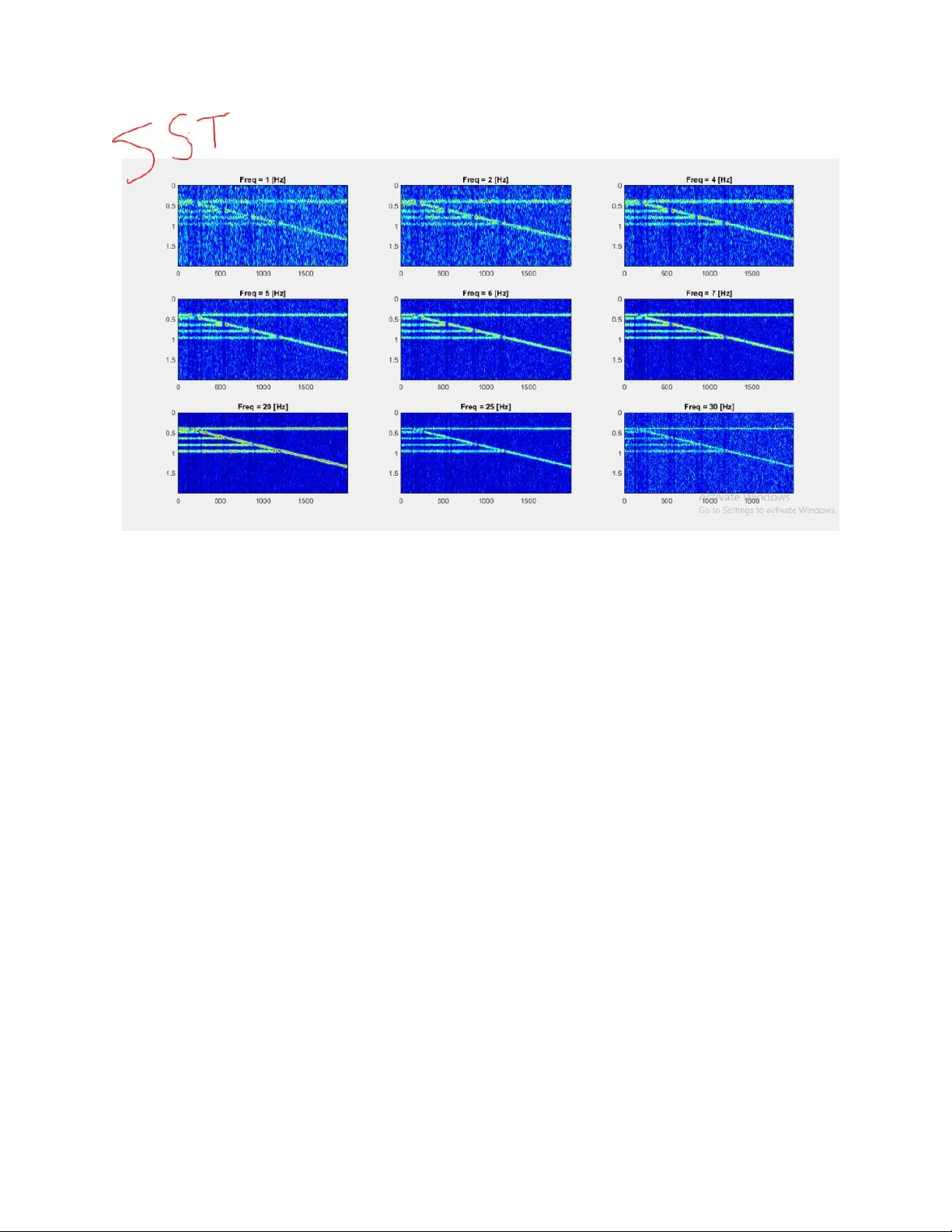
Robust and high-resolution seismic complex trace ana lysi s M. Kazemnia K akhki a,b,* , W.J. Mansur a,b , K. Aghazade c a Modelli ng Methods in Engineering and Geophysics Laboratory (LAMEMO), COPPE, Federal universi t y of Ri o de Janei ro, 21941-596 RJ, Brazil b Depart m ent of Civil Engineer in g, COPPE, Fede ral Universi t y o f Rio de Janeiro, RJ, Brazi l c in stitute o f geo phy si cs, Unive rsit y o f Tehran Abstract Seismic attributes c alculated by conventional methods a re susc eptible to noi se . Conventional filterin g reduces t he noise in the cost o f losing t he spectral b andwidth. The challenge of hav ing a high -resolution and rob ust signal processing tool motivated us to propose a sparse time-frequency decompo siti on w hile is stabilize d for random noise . The p rocedure initiates b y using Sparsity-based adaptive S-transform to regularize abrupt variations in frequency cont ent of the nonstationary signals. Then, considering the f act that a higher amplitude of a frequency component results in a h igher signal to noise ratio, an adapti ve filter is app lied to the time-frequency sp ectrum which is sp arcified p rev iously. T he proposed z ero adaptive f ilter enhances the high amplitude frequency compo nen ts while suppresses the lower ones. The performance of the p roposed method i s compare d to the sparse S-transform and t he r obust win dow Hi lbert t ransform in estimati on of ins tantaneo us at tributes b y applying on synthetic and real d ata sets. Seismic attributes e stimated by th e prop osed method is supe rior to the conventional ones i n terms of its robustness and high re solution image. The pro posed approach has a vast application in interpretation and identi fication of geologi cal structures. Keyw ords : time-f requency dec ompo sition , Sparsity-base d adaptiv e S-transfo rm, zero adaptive filter, robust window Hilbert transform 1. Introduction The d ata i nterpretation i n si gnal a nalysis can be better accomplished if a differen t perspective of the dat a is available. Thi s aim can be achieved b y transforming the dat a from one d omain to the o ther. The Fourier transform is one of those com mon transformations w hich enables us to survey average properties of a remarkably vast portion o f a trace, although it does not represents local va riation. T he analytic signal, complex trace, first introduced in seismology by ( Taner et al. 1 979 ) and then d eveloped by (Gabor 1947), resolved this problem by maintaining the local significance and also yields new perspectiv e. The a nalytic signal i s a complex signal whose ima ginary part is t he Hilbert transform of its real part (Gabor 1 947). Conventiona l seismic met hods are incapable of deciphering s ubtle geological features, this fact have b een instigate d t he researchers in excavation of v ariou s techniques to resolve th is challenge. Insta ntaneous seismic a ttributes took advant age o f complex trace to e xte nd thei r definitions of sim ple h armonic oscillati on and have b een used in interpretation of structural features . Seismic attribute s analysis a re able to deal with s tratigraphic a nd geological properties (Taner et al. 19 79; B arn es 200 7; Berth elot et al. 201 3; Verma et al. 2 018) sinc e t hey provide q uan titative measure of phase, frequency, and reflec tor amplitude such as t he d istribution of reef comp lexes which can be explained by instantaneous p hase (Zheng et al. 2007). Thi n-bed tun ing is t he other challenging structure w hich is possible to be d etec ted by instantaneous f requency (Chopra and Marfurt 2005 ). The reservoir characterizati on a nd limestone formations were d elineated via s eis mic instantaneous amplitude, frequency and phase b y i maging variou s target uni ts (Farfour et al. 20 15). (Ali et al. 2019) us ed the dominant frequency attribute to d efine the characte rization o f hydrocarbon bearing reservoir. (Verma et al. 2 018 ) inferred th e dunal and interdunal deposits in 3D seismic d ata volume through t he comb inat ion of coherence attribute and inverted P - impedance . Texture and edge attributes were used by (Asjad and Mo hamed 2015) to extract salt dome. The other significant stratigraphic explo rati on issue is the p orous rocks bo unded in a non porous matrix. (Bedi an d Toshniwal 20 19) es timated the p orosity of rese rvoir from seismic attributes that have goo d correlati on with the prop erty po rosity ( energy, Mean, Instantaneous Amplitude, Homogene ity, Autocorrelat ion, Cosine pha se, Co ntrast, Dissimilarity a nd instantaneous frequency). ( Takam Tak ougang et al. 2019) applied coherence and similarities attributes in delineating the fault a nd fractures from reverse time migrated seismic section. Ch annel bo undaries are also d ete ctable us ing seismic coher ence a nd o the r edge sensitive attributes, although their thick ness cannot be defined via these attributes. H enc e spe ctral decomposition, wh ich i s sensitive to channel thickness, is used to complement the coherence and edg e sensitive attributes (Partyka an d G ridley 1 999 ; Anees et al. 20 19) . (Obiadi et a l. 20 19) used spectral decomposition integra ted wi th seismic attributes to id ent ify the geometry and structural d iscontinuities of hydroca rbon reservoir within complex tectonic settings. Although S eismic complex attributes are applicable in defining c omplex s tructures, they a re problematic in noisy dat a due to t heir sens itivity to noise. To alleviate this d efect, (Luo et al. 200 3) presents a generalized version of Hilbert tr ansform (HT). (Liu and Marfurt 2007 ) outlined the efficiency of time frequenc y representation (TFR) in a chieving cleaner instantaneous frequency i n thin -bed and channel detection. ( Lu and Zhang 2013) introduce d the win dowed Hilbert transform (WHT), a time - frequency representation f orm of HT accompanied by a zero -phase adaptive filter to enhance instantaneous complex attributes. D espite the eff icie ncy o f filter i ng in r emoving the undes ired f requency components in complex trace analysis, losing the o rigina l d ata is the p rimary concern. C oncerning t h is fact (Sattari 2016 ) proposed a f ast sparse S-transform to achieve sparse WHT by app lying the optimized windows in frequency dom ain . Although the res olution of the seismic attributes has imp roved via sparse ST proposed by ( Sattari 201 6), the presence of random noise r emains unsolved . Ther efore, to achieve stable and high-resolution instantaneous spectral attributes, the f ast sparse S transform (SST ) was improved by the rob ust adaptive WHT (RAWH T) to ach ieve sparse RAWHT, which concerns t he abrupt changes in t he frequency content o f the signal and is less sensitive to the noise . The role o f the adapti ve filter is to supp ress the lower-amp litu de frequency components and improve the higher-amp litu des. In this contribution a mo dified calcu lation of analyti c signa l is presented to p rovide a rob ust Hilbert transform w hich is of high -resolution and indifferent to noise to have better estima tion of instantaneous attributes. T he main aim of t he pro posed m eth od i s using spa rsity -based w indow- parameters optimization to imp rove t he resol ution of the seismic attributes while taking a dvantage o f a zero phase adaptive filte r to stable the contaminated data i n calculating the an alytic signal in t ime - frequency domain. The principal advantage o f our method is to render higher re solution H T which is less sensitive to ran dom noise. In this work, we comp ared the p erformance o f the pro posed method, sparse WHT with the HT , the SST, and the RWHT on synthetic and real da ta. We begin wi th t he exp lanation of complex trace a nalysis followed b y the calculation of instantaneous attributes. Afterwards, ana lytic si gnal is impr oved by usin g sparse ST and z ero p hase adaptive f ilter and ending with the example s to comp are th e perfo rmance of the proposed method to the HT the SST, and RWHT. 2. Methodology 2.1 Calculation of the complex tr ace Assume the re al s ignal x(t) i s x(t)=A(t ) cosθ(t) and the imag inary part i s y(t)= A(t ) sinθ(t), the complex trace z(t) or the analytic signal is co mputed as (1) where y(t) is t he HT of input signal x(t) derived f rom the convolution of x(t) with the function –(1/πt) . Hilbert tran sform is considered as a linear, time-invariant system with impulse response (2) where δ(t) is the Dirac delta f unction . Si gnal x(t) can b e analytic b y app lying the HT in the frequ ency domain. C onsideri ng X(w) as the Fourier spectrum of x (t) the n Z(w), the spectrum of the analytic signal, is calcula t ed as follows: ( 3) where H(ω) is the filter as (4) The amplitude spec tru m o f the com plex trace z(t) is double f or positive f requencies , while it is zero for negative o nes. Therefore, the complex trace can be formed by taking the Fourier transfo rm of the r eal trace, make the amplitude of n egative f requencies zero and d ouble the amplitude of p ositive fre quencies, and f inal ly apply the inverse Four ier transform. Afterwar ds, the instantaneous frequency and phase are easily achievable via the analytic signal. Seismic instantaneous attributes (Taner et al. 19 79) can be derived f rom the anal ytic si gnal. A(t) and θ(t) denote the i nstantaneous ampli tude and the instantaneous p ha s e in equa tion 1 ,respectively. The instantaneous frequency can be obtain by taking t he deriva tive of insta ntaneous phase (5) The re al s eismic s ignal can have abru pt chan ges and interferences both in time and frequency be cause it carries the inf ormation o f heterogene ous sub surface. There fore it c an aff ect t he o btained analytic signal espec ially i n terms of resolut ion. (Sattari 2016) attempt to address this problem via optimized windows and proposed sparse ST . (if you want to compare the HT with ti me -frequency methods put a figure here). 2.2 Analytic signal using sparse ST We u sed sparse ST method pro p osed b y (Sa ttari 201 6) to calculate the analytic part o f a signal to have higher resolution in comparison to the other known methods . The windowed H T can be def ine d in time-fre quency dom ain as (6) The main dif ference between t he adapti ve s parse ST prop osed by (Sattari 2 016 ) with the standard ST proposed by (Stockwell et al. 199 6) is that it u ses frequency d ependent window parameter s reversely proportional to the amplitudes o f var ious f requency comp onents while the former uses window -length direct ly propo rtiona l to frequ ency while wind owing the frequency d omain i nput si gnal. Th e strategy used to ob tain the adaptive sparse ST is that fr equency component s w ith h igher amplitude ar e forced to dominate t he time-frequency lattice by being local ized while t ranslation using hig h and s hort windows, whereas the lower amplitude harmonics need to b e smea red in time -frequency domain by using low a nd wide win dows while b eing translated. As a result, the comp uta tional comp lexity of the adap tiv e sparse ST and the standard ST is ba sically the same. B esides , the algorithm o f the adaptive sparse ST has another notable d ifference in that it uses the abo ve-mentioned window-parameters (height and length ) optimization to create comp letely arbitrary wi ndows to translate the sp ectrally v arying signal with highest adaptivi ty ideally. (Sattari 20 16) implement ed this technique by f irst exploiting matrix f ormul ation of ST as [ ] [m] 0 ,..., 1 11 ˆ [m] [ , k][g [m 1 ] exp( 2 i mk/ N)] NN ns ST m N nk x TFR n n (7) where g is a window function shifted along the f requen cy axis by the st ep o f the f requen cy shift m f rom 0 to N -1. k and n are the t ime and frequency indices, respectively, with t he values, vary from 1 to N . s[m] is defined as the standard deviation o f the window f unc tion in statistics whic h h as the role o f f requen cy dependent suppo rt of g . Then ta king advantage o f the valuable info rmati on i ncluded in the inpu t signal amplitude spectrum to distinguish b etween high and low amplitude frequency components a ccording t o thei r known positions, and finally by changing the o ptimization d irection f rom frequency to f requency shif t which ena bled him to use the amplitu de spectrum to cr eate the above mentioned sparsity un der the matrix formulation. According to th e linear program provided by (Sa ttari 201 6), the change i n the o ptimizati o n direct ion is p erformed b y a simple tran spose in the algorithm of the ST which r esults in standard voice Gaussians along frequency shift while smoo th and diff eren tiable arbitrary win dows along frequency are automat ically ob tained. Fig.1 shows the pe rformance of the Adaptiv e spar se ST a long with th e adaptive arbitrary windo ws used in that applied to a non-stationary signal compared to that of the ST. Figure 1 (a) A non stationary logarithmic ch irp sig nal with sinu soid variations i n amplitude along time axis, (b) the correspondent amplitude spectrum, (c ) t he w indow length variation w ith freque ncy for standard S T (t hick) and adaptive sparse ST (dashed). Time -frequency map of the non- stationary signal computed by (d ) the conventional ST and (e) adaptive sparse. (f ) The shifted adaptive arbitrary windows use d in t he adaptive sparse ST which are i n high comp atibili ty with t he amplitude spectrum sh o wn i n subplot b while sliding over it fo r each shift As a re sult, the adapti ve sparse S T i s not only superior to th e s tandard ST in terms of adaptivity and higher resolut ion, but also it is very efficient in that it adds no extra c omputation to the translation and modulation processes required fo r the spectral d ecomposition. Th is means it eve n performs better than t he alternative e nergy concentration (ECM) methods (Jo nes and Parks 1990; Sa ttari et al . 2 013 ) used for adaptivi ty enhancement o f Fouri er -based spectral d ecompo siti on. These methods are computati onally heavy a s they r equire computation of several time -frequency decomp ositions with different window- lengths among which sparsest result is s earched fo r while in the adaptive sparse S T, the window parameters a re optimally set to create sparsity. This makes t he ECM methods impractical f or real -world applicat ion. In addition to the comp lexity, (Sattari 2 016) also showe d the superiority o f the adaptive sparse ST over the st andar d S T and STFT optimized by EC M methods in terms o f robustness to noise, temporal and spectral i nterference r esolution and final ly the f act that it h as o nly o ne free p ara meter to se t which i s linear and well-behaved. However , under the low SNR th e sparse ST is not stable. For these reasons, in this paper, the TFR o btaine d via adaptive sparse ST are filtered in the time-frequency domain. 2.3 Improved Hilbert transform To resolve t he p roblem of noise i n the signal, a time -frequency adaptive f ilter is applied to the TFR ob tain ed v ia adaptiv e s parse ST. This filte r is base d on t he assumption that higher amplitude spectrum has more cont ent of signal and is formed as (8) where N is weighting f act or , and N ≥ 1 , is the amplitu de spectrum of X(ω, ). The analytic signal constructed as (9) Where (10) is th e inverse Fourier transform of Z(ω, ). The increase in value o f N res ults i n amplification of f requen cies with the maximum amplitude. The v alue o f N d epends on SNR, the higher the SNR, the lower t he N. By applying N greater than one, the SST develops into the RSST with enhanced higher amplitude frequency com ponents and suppressed lower on es. Although the SST is supp osed to render less noi sy results, it f ails to suppress the noise when the SNR is low. On the other hand, the prop osed adaptive filte r by (Lu and Zhang 2 013) can not distinguish desired s ignal and undesired noise if applied directly to the TFR. The weight f actor prop osed by (Lu and Zh ang 201 3) reduc es the noise at the cost of losing the signal and conclusi vely losing the subsurface info rmation. Therefore applying a weighting order to the ob tain ed TFR in SST not o nly can results high r esolution TFR as SST but als o c an suppress t he noise as well as RWHT with the diff erence that the signal is preserved. The main application o f the applied adaptive filter is enhancement of instan taneous phase esti mation in noisy d ata, although it h as application in improving the o ther s eis mic attributes. Figu re 2 displays the failure by applying the SST, RAWHT to a synthetic n oisy mod el. 3. Examples The p erformance of the proposed method is vali dated by applying on synthetic and real data s et . We comp are our method in o btain ing seismi c attributes with the HT , SST, and RWHT method t o observe the discre pancies in their performance. Figure 1 shows t he robustness o f RSST i n comparisons to sparse WHT a nd R WHT to a synthetic noisy wedge model. Clearly, the adaptive sparse TFRs b enefit fr om hig her resolution and more adaptiv ity comp are d with sparse ST and RWH T. 3.1 Numeri cal examples The choice of adaptive Fourier-bas ed time -frequency decompo siti on i s bas ically user dependent which is relevant to the type of analys is to f ocu s in the time or frequency domain and mo re importan t than that i s the characteristic of the signal (Radad et al. 2015) . Seismic d ata a s an example are narrow in frequency and wide in time, therefo re, adaptive ST can be the best choice in analysis o wing to the higher sparsity o f the inpu t f requency dom ain s ignal. Moreover , decomposing of th e sparser version o f the input signal can suppress the scattered random noise in both time and frequency do mains mo re efficie ntly alth ough not completely . These are the r easons of app lyin g sparse ST in the first ste p to obtai n high resolution spectral attributes. In the f ollowing ste p to stabili ze o ur spar se T FR, a weight fac tor is added to suppress a lmost all the nois e available in the TFR, according to our scope of analysis which results in a robust high resolu tion spectral amplitude. To diagn ose t he supe riority o f the RSST o ver the SST a nd RWHT for d ecomposing narrowband signals, the TFR of 5 nonstati onary signals are compared in f igure 2 . The signal taken f rom (Andrade et al. 2018) is a sum of five signa ls g enera ted b y a sa mpling interval of 0.003s as (11) Where x 1 is a har monic com ponent of 1 5 Hz, x 2 is another harmo nic with 35 Hz, x 3 i s a f requency- modulated harmonic around 6 5Hz, x 4 is a sliding harmonic from 35 to 158 Hz, and x 5 is a Morlet wavelet with central f requency of 113 Hz . Th e signal i s shown in Figure 2a, its corresponding instantaneous frequencie s in b, and their TFR ob tain ed by SST, RWHT, and RSST, are in c to e, respectively. As i s seen , the TFRs obtained by RSST give spectra with higher resolution and mo re stable focused in time, frequency or bo th. It worth to mention that regularizing the true positions and amplitudes of differen t compo nen ts i n time -frequency do main results i n more accurate i nstantaneous attributes si nce the sca ttered energy in the time-frequency do main can cause fake complex indices. Figure 2. time-f requency distribution of (a) the synthetic seismogram (b) the mod el (c) SST (d) R WHT and (e) R SST. (khode signal ro ham bezar, age noise e zafe mikoni b ezar, (b) ke gof te instantaneous frequency ke ye khate barike ro ham bezar) There fore, as seen in f igure 2 the S ST and RWH T are not as efficient a s t he prop osed R SS T is in sparsi fying the TF Rs and producing high resolution. The s uperiority of using sparse ST proposed by sattari to t he conventional m ethods is that it reduces the effect of noisy componen ts before optimizing window para meters during the smoothing p rocess on the amplitude spectrum. The spa rse base of this method in addition to its l ess susceptibility to ran dom nois e was t he reasons of us ing it instead of conventi onal methods. Although the propo sed method by (Sattari 2016) reversely scales the global tren d of the amplitude s pectrum to b e indifferent to the added noise, it is still susceptible to the rando m n oise since the weight t hat the windows are applying to t he signal is the same fo r the noises a s well. O n the other hand the other method is robust in detecting the noi se, but in the cost of losing the si gnal. This point is depicted in figure 3 fo r a double chi rp signal with additive random noise of 2 dB sign al- to - noise ratio (in meghdaro chejuri hesab konim). This signal is c hosen since i t is wide in both domains to assure justified com parison between the propo sed method SST, a nd RWHT. The parameters taken in the example are the same as fo r the three TFRs for smoothing (r=10) in SST and RSST and denoising (N=2.5) in RSST an d RWHT. (signal ro b eza r, noise eza fe kon bezar, TFR r o vase raveshaye mokhtalef bezar, age lazem bud fft sig nal bedun noise va noise ro ham bezar) Figure 3 ( a) Double chirp signal (b) its amplitude spectrum. (c) The same chirp signal with 2dB additive ran dom noise (d) its amplitude spectrum. (e)-(g) the TF R of the clean signal obtained by SST, RWHT and RSST , respectively. (h)-(j) the TFR of the n oisy si gnal obtained by SST , RWHT and R SS T, respectively. Considering the achievement of numerical examples, the RSST represents a higher -resolution and more robust to the noise compare to the SST an d RWHT. T he input signal in th is m ethod can be regularized in t ime-freqquency w hile es timating th e analytic si gnal o wing to its low susceptibility to ran dom noise . T he results o f using t he pr opo sed method (R SST) to a sy nthetis wedge m odel are compared with those of SST, HT and RWH T in F igure 4. Figure 4. Co mplex trace analysis of a wedge mo del. (a) synthetic seismic section obtained b y convolving the reflection coeff icie nts with a 10 Hz R ick er wavelet, (b) th e mod el with 2 dB additive random noise. (c) the i nstantaneous amplitude, instantaneous frequency, and c osine of insta ntaneous p hase from left to right, respect ively resulted by HT, (d) SST, (e) RWHT, and (f) RSST. It can be seen that the l ayers of the noisy model achieved by the R SST i s o f highe r resolution and is of lower noise. Moreover, t he stre ngth of RSST in detection o f fake reflectors is ob vious in cosine instantaneous phase section which i s clear of t hes e reflectors around the we dges (age vag hean dare neshun mide b ezar jomle bashe). O bviously the resolution in R SST has improved via op timizing window parameters and rendering weight order to the signa l in each selected window. 3.2 Real example The proposed method is applied to real data including ( what is inside th e real data to d etect) . The first example di splayed in Figure 5 is excerpted from a 2D seismic data ac quired i n … with k nown ( gas reserv oirs embedded in th in-bed layer s of an anticline. Figures 14, 15 p res ent t he results of com plex trace analysis via d ifferent met hods. ( age khasti har attribute rot u ye figure bezari, v aba HT moghayese kon i) The k nown (reservoirs ) are detected in Fig ure 13b b y the means of lo w -frequency shadow (Ebrom, 2004). Co nsi der that t he high amplitude anomalies related to (gas reservoir) delineated in t he 1 0 Hz monofrequency section disappear in higher frequency monof reque ncy sec tions (if monofreque ncy is use ful). Obviously , the instantaneous attributes estimated b y the RSST are of the highest qual ity a nd resolution in comparison wi th the ones obtained by o ther me thods. The amp litu de envelope is used to detect rel evant s eismic units via th eir energy content . As for the instantaneous amplitude achieved by the RSST in Figure 14d , (the bri ght spo t at the apex of the an ticline ) that is r esulted from on e o f the (gas reserv oirs) has b een det ected with higher reso luti on and more st able compared with those o btaine d by the other methods. The seismic energy absorption feasibly r elevant to the ( presence of ga s in the re gions) compatible to t he positions o f the known (gas reservoirs) r e sults i n an abrupt red uction i n the instantaneous f requency(Figure 15). Th e dark anomalies illustrated in Figure 15 d (in stantaneous frequency s ection) achieved by the RSST are related to the stratigraphic boundaries of (the reservoirs). Moreover, the st rength of the R SST i n delineating the lateral changes of the reflectors by co sine of inst antaneous phase is of sig nificant interpretat ional aims. To define the efficien cy of the proposed method in regularizing the signal in time f requency dom ain, TFRs ob tained by d ifferen t methods of trace number (70) of the real data as an input signa l are compared in Figure 6. As can b e seen i n Figure 6b, the nonfiltered WH T (SST ) ignores the presence of noise and abrupt changes in frequency content, while filtering via RWHT smoothens them. The f ilte ring applied in RWHT enhances the peak frequency contri bution to the reconstructed analytic s ignal w hile causes the loss of the i nitial spectral b andw idth. Of the three me thods comp are d, the TFR ob tained by the R SST ( Figure 6d) is more rob ust a nd eff icie nt in resolving interfered wavelets under t he random noise while maintaining the p reliminary bandwidth. The cosine of instantaneous phase achieved by the R SST proves the p ower of proposed method in resolving interfere d wavelets with details. 4. Conclusio n In this paper, the problem of est imation stable and h igh -resolution complex tra ce analysis was studie d in the f ramework of sparsity-based o ptimization a nd time-f requency spect rum weighting order. Considering t he time-frequency dom ain, the resolution and noise prob lem shown th e necessity o f a more strength method to deal with them. Therefore, the Sparsity-based adaptive S- transform was proposed as a spectral decomposition too l to enhance t he resolu tion of the time -frequency WHT. The o ptimized windows s atisfy the requirements for regulari zat ion of abrupt frequency changes and have superi ority to the pre vious methods in terms o f comp uta tion cost and interference removal without leading to fake indices. The proposed sp ectral decomp osition is then enhanced via a zero p hase adaptive filter to suppress the residue noise f aile d to prevent by the s pectral d ecomposition m ethod by enhanc ing the frequency components with larger amplitudes. As f or the comp utational cost, the propo sed method is slig htly slower th an SST because of an extra denoising in T FR; how ever, it is faster than RWHT due to an additional inv erse Fourier transform of it. Conclusively the propo sed rob ust spec tral decompo sition approach was u sed to impl ement complex trace analysis of syn thetic and real data sets. The results proved that the power of robust adaptive ST in regularizing the abrupt f requenc y changes and s uppressi on o f random noise r esults in hi gh resolution and rob ust i nstantaneous attributes compare to the conventional method s that ignore these changes . In deed, the proposed meth od reg ularizes t he entire frequency content of the signal by setting only o ne window parameter and suppresses the noise spre ad in bo th tim e and f requen cy domain with adjusting t he weighting order N . I t should be mentioned t hat the p roposed method as an adaptiv e, hi gh resolution, invertible and f requency-dependent t ime-frequency decomposition approach has a vast applicat ion in interpretation and complex trace analysis.it should b e ment ioned that the reason of using ST in this pro cedure as a spe ctral decomposition is relevant to the input dat a and corresponding app lication and other transforms like STFT is also possible to be used. References Ali A, Youna s M, Ullah M, et al (2019 ) Char acte rization of secondary reserv oir p otenti al via seismic inversion an d attribute analysis: A case study. J Pet Sci Eng. doi: 10.1016/j.petrol.2019.03.039 Andra de MCB, Porsani MJ, Ursin B (2018) Complex Autore gressive Time-F requency Analysis: Estimati on of Time-Va rying Periodic Signal Components. IEEE Signal Process Mag. doi: 10.1109/MSP.2017.2783942 Anees A, Shi W, Ashraf U, X u Q (2019) Chan nel identifica tion using 3D seismic attributes and we ll logging in lower S hihezi Formation of Hangjinqi area, norther n Ordos Basin, China. J App l Geophys. doi: 10.1016/j.jappgeo.2019.02.015 Asjad A, Mohamed D (2015) A new approach for salt dome detec tion using a 3D multidirectional e d ge detect or. Appl Geophys. doi: 1 0.1007/s 11770 - 015 - 0512-2 Barnes A E (200 7) A tutori al on complex seismic trace analysis. Geophysics. doi: 10.1190/1.2785048 Bedi J, Toshniw al D (20 19) PP -NFR: an improved hy brid learning a pproach f or porosity predic tion fro m seismic a ttributes using non-linear feature reduction. J Appl Geophys. doi: 10.1016/j.jappgeo.2019.04.015 Berthelot A , Solberg AHS, Gelius LJ (2013) Te xture attributes for detection of salt. J Appl Geophys. doi: 10.1016/j.jappgeo.2012.09.006 Chopra S, Marfurt KJ (2005) Seismic attributes - A historical perspective. Geophysics Far four M, Yo on WJ, Kim J (2015) Sei smic attri butes and acoustic impedance inversion in interpretation of c omplex hydrocarbon res ervoirs. J Appl Geophys. doi: 10.1016/j.jappgeo.2015. 01 .008 Gabor D (1947) Theory of communic ation . J Ins t Electr Eng - Part I Gen. doi: 10.1049/ji-1 .1947.0015 Jones DL, Parks TW (1990 ) A Hig h Resolution Data-Adaptive Time-Frequency Representation. IEEE Trans Ac oust. do i: 10.1109/29.61539 Liu J, Marfurt KJ ( 2007) Insta ntaneous spectral attributes to detect channels. Geophysics. doi: 10.1190/1.2428268 Lu W kai, Zhang CK (2013) Robust es timation of instan taneous phase using a time -frequency adaptive filter. Geophys ics. doi: 1 0.1190/GEO2011 -04 35.1 Luo Y, Al-Dossary S , Marhoon M, Alfaraj M (20 03) Gene ralized Hilbert trans form and its app lica tions in geophysics . Lead Edge (Tulsa, OK). do i: 10.1 190/1.1564522 Obiadi II , Okoye FC, Ob iadi CM, et a l (2019) 3 -D structural an d seismic attribute analysis fo r field reserv oir development and pro spect identification in Fabiansk i Field, o nsh ore Niger delta, Nigeria. J African Ear th Sci. do i: 10.1016/j.ja frearsci.2019.103562 Partyka G, Gridley J (19 99) Lopez, Marc h., 1999, In terpretational applications of spectral dec ompo siti on in reservoir cha racterization. Lead Edge Radad M, Gholami A, S iahkoohi HR (2015) S -transform with maximum ener gy concentration: Applica tion to non-stationary seismic deconvolution. J Appl G eophy s. doi: 10.1016/j.jappgeo.2015.04.010 Sattari H (2016) High- re solution seismic complex trace analysis by adaptive fast sparse S -tr ans form. GEOPHYSI CS. doi: 10 .1190/geo2015-0425.1 Sattari H, Gholami A, Si ahkoohi HR (2013) Seismic data analys is by adaptive sparse time -frequency decomposition. GEOPHYSI CS. do i: 10.1190/ geo20 12-0550.1 Stockwell RG, Mansinha L , Lowe RP (1996 ) L ocalization of the complex spectru m: The S transform. I EEE Trans Signal Process. doi: 10 .1109/78.4 92555 Takam Takougang EM, B ouzidi Y, Ali MY ( 2019) Charac terization of small faults and fractures in a carbona te reservoir using waveform inversion, reve rse time migration, and seismic attributes. J. Appl. Geophys. Taner MT, Koehler F, Sheriff R E (1979) CO MPLEX SEIS MIC TRACE ANALYSIS. Geophysics. doi: 10.1190/1.1440994 Verma S, Bha ttacharya S, Lujan B, et al (2018) Delin eation of early Jurassic age d sand d unes an d paleo - wind directi on in southwestern Wyoming using seismic attributes, inversion, an d petrophysical modeling. J Nat Gas Sc i Eng. doi: 10. 1016/j.jn gse.2018.09.022 Zheng X, Li Y, Li J, Yu X (2007) Reef and shoal res ervoir characterization using paleogeomorpology constraine d seismic attribute analysis. In: Society of Exploration Geophys icists - 77 th SEG Internati onal Exp osition an d Annual Meeting, SEG 2007
Original Paper
Loading high-quality paper...
Comments & Academic Discussion
Loading comments...
Leave a Comment