Compressive optical imaging with a photonic lantern
The thin and flexible nature of optical fibres often makes them the ideal technology to view biological processes in-vivo, but current microendoscopic approaches are limited in spatial resolution. Here, we demonstrate a new route to high resolution m…
Authors: Debaditya Choudhury, Duncan K. McNicholl, Audrey RepettI
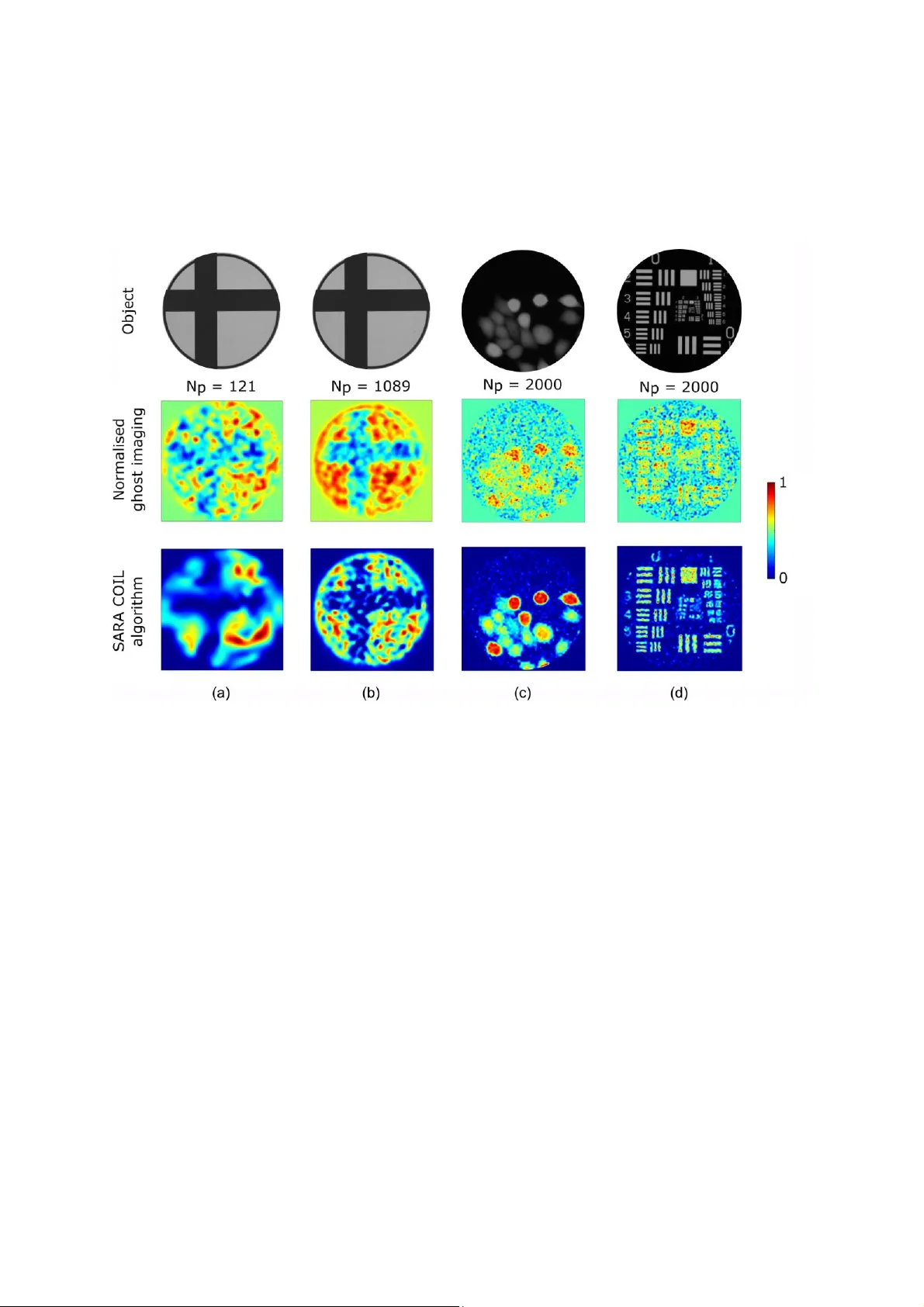
1 Compressive o ptical imaging with a photonic lantern De badit ya Choudh ury 1, 2 , † , Duncan K. M cN icholl 1, 2 , † , Audrey Repetti 3 , † , I tan dehui Gris-S nchez 4, 5 , T im A. Birks 4 , Y ves W iaux 3 and Ro bert R. T homson 1, 2 , * 1 I nstitute of Photonics and Quan tum Sci ences, Heriot -Watt Unive rsit y, Edinbu rgh EH14 4AS, UK 2 EPSRC I RC Hub , M RC Centre for Inflammation Rese arch, Q ueen ’s M edical Resea rch I nstitute (Q MRI), University of Edinburgh , Edi nburg h, UK 3 I nstitute of Senso rs, Signals and System, Heriot -Wa tt Unive rsity , Edinbu rgh EH14 4AS, UK 4 Department of Phy sics, University of Bath, Cl a v erton Dow n, Bath BA2 7A Y , UK 5 Currently wi th ITEAM Research I nstitute, Universitat Poli t cnica de Val ncia, Valencia, 46022, Spain † T hese au thors contributed equall y to t h is w ork. *R.R.T homson @hw .ac.uk Ab stra ct T he thin and fl ex ibl e nature of optical fibres often make s them the ideal t echno logy to view b iologi cal pro cesses in -vivo , but current m icroen doscopic approaches are li m ited in spatial resolution. Here, w e demonstrate a ne w route to high re soluti on microendosco py using a multicore fi bre ( MCF) w ith an adiabatic mu ltimode- to -single- mode “ p hotonic lantern ” transition formed at the distal en d by tapering . W e show t h at disti n ct multimode patterns of light ca n b e projected from t he output of the lantern by individually exciting the si ngle-mod e M CF cores, and that these patterns are highly 2 stable to fibre mov ement. This cap ability is then exp loit ed to d emonstrate a form of single-pixel imaging, where a si n gle p ixel detect or is use d to detect the fracti on of l ight transmitt ed through t he obj ect for each multimode pattern . A custom compressive imaging a lgorithm w e call SARA-COIL i s used to re construct the object using on ly the pre-me asured multi mod e patterns themselves and the detector si gnals. Introd uction Endoscopes that use bundles of op tical fibres t o t ransmit light in a spa ti ally-select ive manne r have had a profound impact on minimal ly-inv asive medical proce dures. To reduc e device size and increase imaging resolution, th is con cept h as been e xtended to individual fi bres containing thousa nds of ligh t-guiding cores. These single-fi bre coherent fi bre bun dles (SF-CFBs) can prov ide resoluti o ns of a few microns in the visible [ W o od 2 0 18] . W h e n combined with fluor escent contrast agents, they facilitate observa ti on of disease processes at the cell u lar leve l [Akram 2018 ]. SF -CFBs are n ot without dra w backs. T o mai ntain spat ially-selective transmissi on of light, the fibre cores must be su fficiently sp aced to ke ep core- to -core crosstalk at a n a cceptable lev el , intri n s ically limiting imaging resolution and throughput. T h is ha s l e d to a n expl osion of interest in multi mode fibre ( MMF) imagi ng , w he re image information is carried b y multiple ove rlapping spatial modes gu ided by one multimode core, rather than the many spatially sep arated co res of the SF-CFB . MMF imag ing ca n deliver an orde r o f magn it ude higher spati al reso lution, bu t it is far from tr ivial to implement be cause the a mpli tud es and phases o f the MMF mo des become scrambled along the fi bre . This can be a ddressed by ch aracterising the MMF 's tran smissi o n matr ix and co ntrolling a spatial light mod ulator to “un do” the scrambling [ Papad opou los 2012 , Čižmr 2012 ] , but an y mov eme nt of the f ibre 3 changes its tran smissi o n ma trix, and access to the in -v ivo dis tal end is requ ired for recalibrati on un less t he ne w path is precisely known [Plöschner 20 15]. Here w e d emon strate a n e w route to h igh resolution single -fibre microendosco py using a mu lticore fibre ( MCF) “p hotonic - lantern” (PL) [Birks 20 15 ]. PLs are g uided- wave transitions that ef ficient ly c ouple light from N s single mode core s (the M CF) to a multi mode w av egu ide like an MM F . PL s can be made by tapering (heating and st retching i n a small f lame) a single MCF [Birks 201 2], such that the entire reduced-diameter M C F acts as the multi mo de e nd of the PL, Fig. 1 (a). N p = N s d isti n ct multi mo de patterns of li g ht are g enera ted at the multi mode ou tput by coup li n g l ight into ea ch core at t he M C F i n put, one at a t ime . I f t he M CF exhibits ne gli g ible cro sstalk betw e en the co res a long the length of the M CF, such that the light p ropag ates a long just one core , these patterns do n ot change w he n bending the fi bre, Fig. 1(d-f), unlike those of an ordinary MM F, Fig. 1(g- i) . Thi s i s be cause deformati on of the MCF merely changes t he o v e rall phase o f the o utput pattern. Unli ke t he spati ally-sepa rated mod es of a SF -CFB (b ut l ike an ord inary MM F) , t he P L allows the full a rea of the fibre end - facet to b e sa mpled, and the si ze o f the pattern s ca n b e re duced to the minimum all o w e d b y the numerical ape rture (N A) of the mul timode end. W e d emonstrate the f easibility of PL based mic roen doscopy b y using a PL t o impl ement a form of "single-p ixel " imaging [Ed ga r 2019] that w e cal l Compressive Opti cal Imaging us ing a L antern ( COIL) . L ight patterns ge nerated by the PL are projected o nto an obj ect (e.g. tissue) . Light return ed from the object (e .g. fl uore scence) is detected by a singl e-pixel detector, w hich for the microendoscopy applicati on could be placed at the pro ximal end of the M CF. The known patterns and measu red return signals provide informati o n abou t the object, from w h ich an image can be formed [Edgar 201 9]. W e show that the quality and detail o f the computed image can be 4 greatly improv ed by exploiting an adva nced i mage formation algorithm t hat combines the measure ment data w it h a gene ric prior postulati ng that the spa ti al structure of the image is und erpinned by a smal l numbe r o f d egrees o f free dom. W e demonstrate that COI L opens a promising new route to effi cient and practical high -resolution microendosco py. Results Compress iv e imaging algorith m T h e starting point for our image reconstruction algorithm i s to approach PL based imaging in the context of the theory of comp r essive sampli ng . In this context, one assumes that the image under scrutiny is sparse in some transform domain linearly related to the p i xe l domain (e.g. the domain of a w av elet transform [M a llat 09]), t hat is to say that its spatial structure is u nde rpi nned by a sma l l numbe r of degre es of freedom . T he sparsit y prior information is lev erag ed to en able image recove ry from incomplete data. Co mpressive samp li ng appro aches hav e b een developed in a wi d e va riety of imaging applications ranging from mag netic resonan ce imaging [ Lustig07, Davies14], an d astron omical imaging [ W iaux 20 09 , Carill o 20 1 2], to g host imaging [Katz 20 09, Sun 2012] and speckle imaging [Kim 201 5]. Optimisation algorithms represent the dominan t class to solve inverse prob lems for image re cov ery from incomplete data. The image estimate is defi ned a s a minimiser of an objective function, consisti ng of the sum of a da ta-fideli ty t erm a nd a sp arsity -promo ting prior term. T h e resulti ng minimisat ion problem is so lv ed through iterativ e algorit hms progressiv ely mini m isi n g the objectiv e function. W e work in a highly compre ssive sampli n g regime, i. e. for very l o w ratios o f the numbe r of d a ta points (e.g. N p = 121) to the si ze of the i mage formed (e.g. n = 125 5 125 pixels). For CO IL, th is h igh ly under -sampl ed re gime is of particular interest, a s it all o w s t he recon structi on of h igh resolution imag es w ithout un realist ic de mand s o n the numbe r of MCF core s. T he i n v e rse p roblem therefore become s h ea v ily i ll-posed an d image formation re quires stron g prior informati o n . W ith tha t aim w e re sort to a n advan ced “ave rage sp arsity” mode l firstly i ntrod uce d in astron omical imaging [Carri llo 2012 ], where multiple wav elet trans forms a re i ntroduced simultaneousl y to promote sparsity. T o solv e the resul ting m inimisation p roblem, we re ly on modern “proximal spli tting” op timisation a lgorithms [Combettes 20 11, Komo dakis 2015 ] w hose main features are a gua ranteed fast conve rgence and low co mputational co mplexity. T hese algorithms hav e b een use d i n computational imaging i n a variety of fields (see [Combettes 2011 ] and references therein). Buil d ing on the “ avera ge sparsit y ” approach w e dev eloped a proximal a lgorithm f or COIL , du bbed SARA-COIL (or Sparsity Ave raging Rew eighted An alysis for C OIL). Details of o ur op timisation approach are prov ided in the Methods section, tog ether w ith a description o f the associated MAT LAB toolbox. Experimenta l techni ques and res ults Fi g. 1 (a) is a sch ematic of a n MCF ( w i th N s = 25 for clarity) wit h a PL at one en d . For th e w ork reported here, the PL w as fabricated at one end of ~3 m of MCF w i th N s = 121 single-mode cores in a 11 11 sq uare array (Fig. 1 (b)) with neg li g ible co re- to - core crosstalk at 514 nm . T he multimode outpu t end of t h e PL had a core diameter of ~35 m and an NA of ~0.22 (Fig. 1 (c)) . See Method s for fabrication details of the PL . Using computer -control led ali g nment, ea ch MCF core could be i n dividually excited using co herent 514 nm laser li ght, gen erating N p = N s = 121 d iff e rent mu ltimode 6 patterns of li g ht at the output . Each outpu t pattern was hi g hly stable rega rdless of t he conformation of the MCF, Fi g . 1(d- f) . T his is due to the short l ength (~ 4 cm) of the PL transiti o n itself an d the minimal crosstalk between the M CF cores. In contrast, si mi lar be nding of an ordinary MM F change s the outpu t pattern, Fi g. 1(g -i). Our exp erimental i ma ging setup is si mi lar to the co mputational gh ost imaging sy stem pre sented i n [Su n 2 012 ], w here a spatial light mo dulator project ed random patterns o f light onto a test object and detectors me asure d the fracti on o f power transmitt ed throu gh the o bject. I n our exp eriment the sp atial light modulator was replaced w i th the PL , allowing N p = N s = 121 d ifferent pa tterns to be projected onto the o bject b y exciting each core of the MCF in dividua ll y. Initially, we u sed a simp le “knife - edge” a s the object. As sho w n in the objec t images of Fig. 2 , the kn i fe- edge w as orientated either horizontall y (H) or v ertically (V) and positi o ned to block ~25% , ~5 0 % or ~75% o f the pattern project ed onto it . As show n in the image pane ls in Fig. 2, COIL successfully reconstruct s images of 125 125 pixels us ing onl y N p = 121 p atterns. A ll reconstructions w e report using experimental data repre sent a 0 .9 mm 0.9 mm fie ld of view at the object plane, where the lantern output is imaged wi th a magnification of ~26 for the purposes of this demonstration. Since the i lluminati on light o riginates f rom the lantern itsel f, the reso luti on of a nea r -fiel d imaging modali t y without the imaging optics w ould sca le by t he inverse of t he same magnifi cation. T o confirm that COIL i s ap plicable to more complex objects, w e rep eated the experiment u sing the objects sho w n in Fig. 3 : an “ off-centre cross ” and “ 4 d ots” positi oned a sy mmetrically. SAR A-COIL can clearly re construct the off-centre cross, further confirmi ng the gen eralit y of the app roach, but cannot reconstruct the small features in the “ 4- dot s ” obj ect . To demon strate how i maging qual ity might improv e by using an MCF PL w ith mo re co res, w e rep eated the data acqu isiti o n nine t imes w ith 7 the object rotated by 40 betw e en each , acqui r ing transmissi o n data for each object using e ffecti ve ly N p = N s 9 = 1089 different pa tterns. As e xpected, increasing the numbe r of patterns significantly i n crease s imag e quali ty f or the of f-centre cross, F ig. 3 . It a lso recon structs some fea tures of the “ 4 dot s ” object, b ut falls short o f full y resolving them . T o establi sh tha t our e xperimental re sults a re in line w ith tho se e xpected from theory, we also performe d reco nstructi ons using simulated data . To simu late the intensity pa tterns from an i deal N s = 121 PL, we first calculated the field distribut ions of the 121 low est-orde r spatial modes of a circular ideal-m irror w av egu ide. W e the n gene rat ed a se t of 12 1 mutually-orthono rmal bu t other w ise random coheren t superpositi ons of the modes, and formed inte nsity pa tterns b y taking the squa re modulus. The imaging expe riment w as simulat ed by computing t he ov erlap integral betw e en ea ch i n tensity pa ttern a nd the ob ject. T he intensity pa tterns a nd ov e rlap data w ere then processed u sing SAR A-COI L to r econstruct an i ma ge . T he simulated reconstructions for both objects, using either N p = 121 (not rotated) or N p = 1089 (9 rotations), are shown in Fig. 3 alongside the recon structions ba sed on expe rimental data f or comparison . As expe cted, images o btained using bo th measure d and simul ated data improved consi derab ly as the nu mber of patt erns is increased . Furthermore, i f w e consider that the multimode p ort of the PL u sed i n our experiments has a diameter of 35 m, our N p = 108 9 simu lations sug gest that sub -micron resolution w ou l d be a chievable u sing a PL generating onl y a thou sand pa tterns. (The NA of the port w ould have to be ~0.3 to su pport t his number o f modes , rather than t he 0.22 of the PL used here .) Clearly, ho w ev er, there is a significant difference betw ee n the experimental and simul ated resu lts. As w e disc uss later, w e bel ieve this is primarily due to li mitations wi th the current expe rimental set up. 8 T o further h ighlight the po tential of COIL for th e high -resol ution imaging of structures in -vivo , we s imulated ( as ab ov e) the resu lts that m ight be expected usi n g a N s = 2 000 PL to p roject N p = 2 000 pa tterns . T he tw o objects u sed f or this simu lati o n w ere an i mage of the 1951 USAF resoluti o n target and a confocal microscope fl uore scence image o f fixed calcein -stained aden ocarcinomic huma n a l v eo lar basal epitheli al (A54 9) cell s . O ur images, shown i n Fig . 4, are hi gh-q uality reconstructions of b oth objects. F ig. 4 also sho ws that our i ma ge reconstructi on technique is robust t o the prese nce of a ddit ive Gaussian no ise in the ov erlap data. For example, both contrast and resoluti on are on ly mini mally a ffected by the noise, and f ea tures such as the horizontal and ve rtical bars in the top ri gh t of the USAF target are still cl early resolvable. For completen ess, Fig. 5 co mpares SARA-C OIL to a simpler, mo re intuitive, reconstruction algorit hm u sed for classical ghost imaging - see Equ ation 5 in [Sun 2012 ] . This algorithm uses only the fractional tra nsmission of the pro jected pa ttern to w e ight its contr ibution to the image re construction. N o attempt is mad e to opt imi se this towards a realistic object us ing a prior . T he c ompa rison con fi rms th at SAR A-CO I L significant ly improv es both res o luti o n and contrast, reve aling f eatures that are otherwise barely or not visible . T hese resu lts pr ov ide a compelli n g justification for the advan ced al gorithmic appro ach w e ad opted . Discussion T h e reco nstructions prese nted in Fig. 3 using 1,08 9 pa tterns clearly indicate that although our exp erimental results broad ly agree with simulations from ideal d ata, there is con siderable po tential for more accura te re co nstructions. We h ighli ght that the quality of the reconstructions using experimental data is degrad ed by t he fact that the 9 re -centring of the object on to the pattern after each rotation was o nly performed by eye, usi ng a thin ring a round the object to guide al ignment. In fact, both re constructions in Fig. 3 sho w h i nts o f resolving this ring. Th is p ractical limitati on can be readil y resolved by adopting M CFs wi th more cores and not rotating th em . Remarkably , Fi g . 4 demonstrates t hat, even in the pre s ence of n oise , an N s = N p = 200 0 COIL system could resolv e objects sepa rated by just ~1.6% of the multi mo de core d iameter (see the three-b ar pa tt ern at the top right of the U SA F targe t) . T o put this into co ntext, if a CO IL system is c onstructed to operate u sing 488 n m excitati o n li g ht and an N s = 2 000 MCF, the multimode output o f the PL could h ave a 63 m diameter core wit h an NA of 0.22 , assumin g est ablished fabricati on t echn iques [Bi rks 201 2] wi th an F-doped sili ca cl adding – see M ethods . Su ch a system could resolv e objects separa ted b y just ~1 .25 m. This is close to the 1. 35 m e xpected from Ra yl e igh’s criterion (0.61 / N A), a strong indicati o n that CO IL can deliver at least di ffraction-lim ited imaging across the fi eld of v iew of the core. T h e N s = N p pattern projection is only the simplest imaging moda lity one m ight consider u sing PLs for. In fact, PL s cou ld enable s ignificantly more ad va nced a nd pow erful mod alities, some driven by compressive sampli ng principl es , but these require the co ntrolled simultaneou s excitation of multiple MCF cores to ge nerate coherent combinations o f t he multimode states a t the output. To d o this in a controlled manne r, the key information to be ob tained are the relative pha ses and amplit udes o f the individual basis patterns at the multimode output . W e envisage future COIL imaging syst ems exploiting polar isati o n ma intaining MCFs, w he re the PL 's output is coated to p artially ref lect so me pu mp li ght back along the MCF. S ince each multimode pattern gen erates a specific non -binary phase and amplit ude distribut ion across the M CF cores after reflect ion, and since there is negligi b le crosstalk be tw een the MCF's 10 cores, the d istri b ution of ref lected light across the cores at the pro ximal end will encod e the relati v e phase s and amplitudes of the multimode patterns at the output . I n principl e, this could facilitate the coherent sy n thesis of arbitrary exc itation fi elds at t he output of the lantern for both near - and far-field spot-scan ning modalit ies, and a lso enab le t he pro jecti on of many more than N s different know n multimode patterns . A s detailed by Mahalati et al [ Mahalati 2013 ] , th e number of p ossible "intensit y modes” , and therefore the number of resol v ab le feature s across the o utput core, could reach a maximum of 4N s . For the case of a n N s = 200 0 PL wit h a 63 m diameter 0.22 NA multi mo de core o perating a t 488 nm , such an approach cou ld deliver a resolution of ~626 nm – si g nifi cant ly smaller t han the Rayleigh limit a nd opening a po tential rou te to sup er-reso luti o n microe ndoscopy. T h e N A of the PL's mu lti mod e outpu t can also be pu shed well be yond 0.22 by exp loiting m o re adva nced fi bre app roaches. For example, w e foresee the creation of PL’s usi ng a polarisation maint aining M CF with a doub le-cladding geometry , such as those commonly use d in fi bre lasers for effici en t cladding pumping. In this case, the M CF core s and their glass cladding w ou ld be surrounded by an air c ladding tha t could faci litate a PL multimode port a t the d istal end w it h an in -v ivo NA of u p to ~ 0.65 at 488 nm [ W adsw orth 2004 ]. T h is m ight d elive r a spatial resolution of ~ 212 nm, a lthough stabi lity issue s during in -vivo e xposure w ill obviously pla y a role in determining this. W e resorted to a po w erful frame w ork of optimisation to d ev elop the SARA - COI L algorithm, but further dev elopments may s i gnifi cant ly improve image estimati on . Fi rstl y , regularisation p riors sp ecifically d eveloped for images of interest in microendosco py can i mprove qual ity o v er our st ate - of -the- art “av erage sparsity” prior. Second ly , pa rallelised “pro ximal a lgorithms” [P esqu et 2015, C hamboll e 20 18] ca n improve scalability to high-re solution imagi ng, ultimate ly to prov ide re al-time 11 microendosco pic imaging. F inal ly, appro ximation in the measurement mode l can severely affect imaging qua li t y in computational imaging ( e.g. the a lignment bet w ee n object and pa tterns). Jo int ca libration an d imag ing algorithms ca n b e d efined in the theory o f opti m isation, t hat can simultaneously so lve for unknow n para meters in the measure ment model and form the image [Bolte 20 14, Chouzenoux 2016]. Conclusio ns W e have e xperimentally demonstrated a new form of single-p ixel imaging using a multi co re fibre and pho tonic lantern to gen erate distinct multimode light pa tterns. W e have provided compelli ng ev idence th at this, unde rpinned b y the po w erful SARA -CO I L optimi sat ion algorithm, can de liv er at least d iffraction-limited imaging a cross the full area of a mul timode fi b re core, wi thout sensiti v ity to bend ing or any need to c on trol or compen sat e for modal phases. T h is meets the w or ld- wi de need to develop new fibre - optic imaging technique s to de li v e r high -resolut ion images of cellular a nd molecular mechan isms in vivo . W e hav e a lso discussed h ow it open s a route to more complex imaging modalit ies, such as supe r-resolut ion microendoscopy with sub-micron resolution. W e a lso antici pate tha t CO I L cou ld also be useful in applications tha t bene fit from a redu ced number of measurements, such as fi bre-o ptic epifluoresce nce or confoca l microend oscopy, w h ich are v ulnerable to d etrimental effects su ch as photob leaching and ph ototoxici ty [Flusberg 2005 ]. Me thods The multicore fibre T h e N s = 121 squ are-array mu lti co re f ibre w as original ly fabricated for a study of w av e length- to -time mapp ing [Chandrase kharan 2016 ]. The cores were po sition ed on 12 a sq uare grid with a co re - to -co re sp acing o f ~1 0.5 3 µm. The mod e fie ld diameters of the MCF cores w e re measu red at 5 14 nm u sing cali brated n ear -fiel d imaging. The 1/e 2 mode field di ameter w as ~2 .1 ± 0.2 m. Photo nic lantern fabrication T o fab ricate the PL [Ch andra sekharan 2 016], th e MCF w as threaded into a fluorine - doped silica capillary, the refractive index o f whi ch is l o w e r than the pure sil ica cladding of the M C F. The capillary w a s collapsed, by surfa ce tension, on top of t he MCF using an oxybutane flame. Using a sim il ar flame, the cladded structure w as then softened and stretched b y a t a pering ri g, forming a biconical fibre -l ike structure. The mu ltimode port o f the PL w as finally rev ealed by cleaving the centre of the tapered w aist. T he resultant mul ticore- to -mu ltimode taper w as ~4 cm l o ng, wit h an approximately l inear profil e. The multimode port ’ s co re d iameter w a s ~ 35 µ m and its nume rical ap erture w as 0.22. SARA-COIL algorith m T h e observe d d ata, denoted by (there is o ne data point pe r pa ttern), consist of a linear transform of the i mage of i n terest with a li n ear operator w h ose li nes consist of the projection patterns. T h e measure ment model thus reads: w he re represen ts the meas urement operator and the acq uisi ti on noise. 13 T h e SARA- C OIL a lgorithm results from an a daptation of the “Sparsity Av e raging Rew eighted Analysis” ap proa ch developed by Ca rrill o et al . [Ca rril lo 20 12]. On the one hand , the mi nimisation problem solved reads as T h e first element in this e xpression is the sp arsity-promoting prior term to be mini m ised. denotes the non-differentiable norm, traditionally invoked in the context o f compre ssi v e sa mpl ing. i s the lin ear operator defi n ing the sparsity t ransform, built as the concatenation of 9 wavelet transforms ( ) as in Carrill o et al. [Carrillo 2012 ]. i s a diagona l w e i g hting ma trix computed using a re - w e ighti ng proce dure introduced by Can dès et al . [ Candès 2008b ]. T he second element of the e xpression “ ” is a prior ter m imposing the physi cal constraint of positivity of the i n tensity image to be f ormed. The th ird e lement “ ” is the da ta -fidelity term imposing tha t the discrep ancy betw een data and model i s bound ed by t he noise energ y . T o solve this mi n i misat ion problem, w e de veloped an i terative al gorithm based on the primal-dual forw a rd- ba ck w ard “proximal a lgorithm” [Condat 2013 , Vu 2013 ]. Data A vailability Raw data will be made ava il a ble through the Heriot- W att University PURE research data mana gement sy stem . 14 Code A vailability A M A TLAB toolbox gathering the algorithm impleme ntation as w e ll as the data necessa ry to re produ ce o ur simulations results using the USAF re solution targ et is available on Git Hub at https://basp-gro up.github.i o /SARA-CO I L/ 15 References Akram A. R ., C hanke s hw ara S. V., Scho lefield E., Aslam T., McDonald N., Megia - Fernandez A., M arshall A., Mill s B., Avlonitis N., Crav en T . H., Sm yt h A. M., Collie D. S., Gra y C., Hi rani N., Hill A. T., G ov an J. R., W a ls h T . , Haslet t C., Bradley M., a nd Dhaliw al K., "In situ identification of Gram -negative bacteria in human lungs using a topical fluoresce nt peptide targeting l ipid A," Sci. Transl. Med. 10 , eaal0033 (2018). Birks, T. A., Mangan, B. J., Díez, A., Cruz, J. L. & M u rph y, D. F. , “‘Photonic l antern’ spectral fil ters in multi- core Fiber,” Opt. Express 20 , 1399 6 – 14008 (2012). Birks, T. A ., Gris-Sánchez, I., Yerolat s itis, S ., L eon -Sa va l, S. G. & Thomson, R . R. , "T h e photon ic lantern", Adv. Opt. Photon . 7 , 107 - 167 (2015). Bolte, J., Sab ach, S. & T ebou ll e, M., “Proximal a lt ernating linearized mini m ization for nonconvex an d nonsmooth problems,” M a th. Progra m . 146 459 – 494 (2014). Candès, E. J . & W a kin, M . B. & Bo yd S. “ Enh ancing Spa rsity b y Re wei ghte d l 1 Mi n imi zat ion ,” J. Fourier Anal . App l. 14 , 877 – 905 (2008). Carrill o , R. E., McEw en, J. D. & W iaux, Y. “ Sparsity Avera ging Re w eighted Anal ysi s (SARA): a no ve l algorit hm fo r radio- interferometric imaging,” Mon. Not. R. As tron. Soc. 426 , 1223 – 1234 (2012). 16 Chambolle, A., Eh rhardt, M. J., R ichtárik, P. & Sch nlieb, C.-B., “ Stochastic prima l- dual hybrid gra dient a lgorithm wi th arbitrary sa mpling a nd imaging applicati on s ,” SIA M J. O pt im. 28 2783 -2808 (2018). Chou zenoux, E., Pesq uet, J.-C . & Repetti, A., “A block co ordinate variable metric forward- backw ard algorithm,” J. Global Optim. 66 457 – 485 (2016). Čižmr, T . & Dho laki a, K ., "Exp loiting mu ltimode wavegu i des for pu re fi b re-b ased imaging", Nat. Co mms. 3 , 1027 (20 12). Combe ttes, P. L. & Pesq uet, J.- C. , “Proximal sp li tting metho ds in signa l p rocessing”, in F ixed-Point Algo rithm s f or Inve rse Pro blems in Science and Engineering , Sp ringer 2011 . Condat, L., “ A Prima l – Dual Spl it ting M ethod for Con ve x Optimization I nv olving Lipschitzi a n, Proximable and Linear Composite T erms. ” J . O pt im. Theo ry Appl. 158, 460 – 479 (2013). Davies, M., Pu y, G., Van dergh eynst, P. & W iaux, Y . A Compressed Sensing Framew o rk for Magnetic Re sonan ce Fingerprinting. SIA M J. I magi ng Sci. 7 , 262 3 – 2656 (2014). Edgar, M . P., Gibson G. M ., & Padge tt M. J ., “Pri nciples an d prospe cts for si n gle -pixel imaging ,” Nat. Phot. 13 , 13 – 20 (2019) 17 Fl usbe rg, B. A., C ocker, E. D., P iyaw attanamet ha, W ., Jung, J. C., Ch eung , E. L. M ., & Schnitzer, M . J., “ F iber-optic fluorescence i maging ,” Nat. Meth. 2 , 941 – 950 (2005). Katz, O., Brombe rg, Y . & S ilberberg, Y. “Compressiv e ghost imaging,” Appl. Phys. Lett . 95 , 131110 (2009). Kim, M., Park, C., Rodriguez, C., Park, Y . & Cho, Y . -H. “ Superreso luti o n imaging wit h optical fluctuat ion usin g speckle patterns ill um ination,” Sci. Rep. 5 , 16525 (2015) Komoda kis, N. & Pesq uet, J.- C. , “ Pla y ing with Du ality : An ov erview of recent prima l dual appro aches for so lving large -scale optimizati o n problems ,” IEEE Signal Proc. M ag. 32 , 31 – 54 (2015). Lustig, M ., D onoh o, D. & Pau ly, J. M. “ Sp arse MRI : T he application o f compre ssed sensing for rapid M R imaging ,” Magn. Reson. Med. 58 , 1182 – 1195 (2007). M aha lati R. N., Y u Gu R ., and Kahn J. M. , "Reso luti on li mits for i maging throug h multi - mode fiber," Opt. Express 21 , 1656-1668 (2013) M allat, S. , “ A W a velet T o ur of Signal Processing,” Academic Press, Burli ngton, MA, 2nd Ed., (2009) Papadopo ulos, I . N., Farahi, S., Moser, C. & Psalti s, D., "Focusing and scanning li ght through a mul timode optical fiber using digital p hase con jugation", Opt. E xpress 20 , 10583-10 590 (2012). 18 Pesque t, J.- C . & Rep etti , A., “ A Class of Rand omized Primal-Du al Algorithms for Distri b uted Optimization ”, J . Nonlinear Con vex Anal . 16 2353-2490 (2015 ). Plschner, M ., Tyc, T. & Či žmr, T., "Seeing throug h chaos i n multi mo de fibres", N at. Phot. 9 , 529 – 53 5 (2015). Sun, B., W elsh, S. S ., Edg ar, M. P., Sha piro, J. H . & Padg ett, M . J. , “ Normal ized ghost imaging ,” Opt. Express 20 , 16892 – 16901 (2012 ). Vu , B. C., “ A sp litting algorithm for dual monotone inclusi ons involving cocoercive opera tors,” Adv. Com p . Math. , 38 667 – 681 (2013). W adsw o rth, W . J. , Pe rcival, R. M. , Bo u w man s, G., Knight, J . C . , B irks, T. A. , Hedle y, T. D., and Ru ssell , P. S. J. , “Ve ry high nu merical aperture f ibers,” Ph oton. Tech nol . Lett. 16 , 8 43- 845 (2004). W iaux, Y ., Pu y, G., Sca ife , A. M. M., & Vande rgheynst, P., “Compresse d sensing imaging tech niques in radio interferometry ,” Mon . Not . R. Astron. Soc. 395 , 1 733-1742 (2009 ) W ood H. A. C., Harrington K. , Birks T. A., K night J. C., an d Stone J. M., "High- resolution air-cl a d imaging fibers," Opt. Lett. 43 , 5311-5314 (2018) 19 A ck now ledgeme nts T h i s w o rk w as funded thro ugh the “Proteus” Eng ineering and Ph y sical Science s Resea rch Coun cil (EPSRC ) I n terdiscipli na ry Research Collaboration ( I R C) (EP/K03197 X /1), and by the Science a nd Technology Facili ties Co uncil (STF C) through ST FC-C LASP grants S T/K006509 /1 and ST/ K0064 60/1, and throug h ST FC Conso rtium grants ST/ N000 625/1 and ST /N000544/1. The a uthors thank Phil ip Emanue l f o r the use of his confo cal image of A549 cells and Eckhardt Opti cs for t he ir image of the USAF 195 1 target. 20 Fig . 1 (a) Schematic N s = 25 square-a rr ay multicore fibre wit h a ph otonic lantern at one end. (in green) Light in o ne core excites a fi xed light pa ttern at the lantern's output. (b) Opti cal micrograph of the facet of the N s = 121 mult icore fi bre used in this w ork . Scale ba r: 50 m. (c) Opti cal micrograph of the mu lt imode ou tput o f the pho to nic lantern. Scale b ar: 10 m. (d - f) Nea r field intensity patterns at the outpu t of the photon ic lantern w he n one core o f t he multi co r e fi bre is exci ted wit h monoch romati c li g ht ( = 514 nm). The pa tterns are insensitive to fibre bend ing as sho w n by the micrographs obtained for thre e arbitrary conformations of the fibre. Scale bars: 10 m (g - i) Corre spond ing near fiel d intensity patterns a t the o utput of a 105 m core multi mo de fibre w hen excited w ith monochromati c l ight ( = 514 nm). As shown i n the micrographs ob tained for three arbitrary con formations of the f ibre, the pa tterns are highly sensitive to bend ing of t he fibre. Scale bars: 20 m. 21 Fig . 2 : SARA- COIL resu lts obtained using N p = 12 1 p atterns. Micrograp hs of the objects a re shown in the left of each panel. H i & V i respectively de note objects formed by h orizontally and vertically overlaying a knife ed ge over ~25% (i = 1 ), ~50% (i = 2 ) and ~75% (i = 3 ) of the intensity pa ttern. Each recon structed image h a s 125 125 pixels, wit h a field of v iew in the object plane of 0 .9 mm 0.9 mm . 22 Fig . 3 : SARA-COI L recon structions u sing N p = 1 21 an d N p = 1089 patterns, and either measured or simulated patt erns and ov erlap data. T he objects a re an off-centre cross and 4 asymmetri cally-po sitioned ellipti ca l dots, micrograp hs of w h ich are presented . For N p = 1 089 , the object w as ro tated ab out th e optic al axis by 320 o in s teps of 4 0 o , effecti v ely creati ng a total of 121 9 patterns. The simulated reconstructions (125 125 pixels) for N p = 1 21 us ed pa tterns gen erated from ra ndom orthon ormal superpositi ons of the 121 low e st-order mo des of a circular ideal-mirror waveg uide. For N p = 1 089 (377 377 p ixel s) the ob ject was rota ted a bout the o ptical axis by 32 0 o in steps o f 40 o . T he field o f v iew o f a ll recon structions is 0.9 mm 0.9 mm in the object plane. 23 Fig . 4 Si mu lated recon struction results (511 511 pixels) obtai ned using N p = 2000 intensity patterns genera ted from ra ndom orthono rmal superpositi ons o f the 2000 low est-orde r modes of a ci rcular i d eal-mirror waveguide. T he objects were the 1951 USAF reso luti on targe t an d a co nfocal m icroscope image of fixed calcein stained adenocarcinomic hu man alveolar basa l e pithelial (A549) cell s. For each o bject, the reconstructed image w i th ad ditive Gaussian noise (inpu t signal- to -no ise ratio iSNR=50) is sho w n a longside that with no add ed noise. W e highli ght the fact that there is d eliberately no spa tial scale for the recon structi on s, since the si ze of a waveg uide suppo rting N p = 2000 mod es v aries depending on its co re -cladding re fractive index contrast. The reader is referred to the discussi o n secti on for more i nformat ion. 24 Fig . 5 Reco nstructions of v arious o bjects using expe rimental or simulated da ta and either an estab li sh ed gh ost imaging algorithm ( Eq. 5 in [Sun 2 012 ]) (middle ro w ) or SARA-COIL (bo ttom ro w). (Column a ) 125 125 pixel recon structions o f a n o ff-centre cross for N p = 1 21 using exp erimental data. (Co lumn b) 3 77 377 pixel reconstructions o f an off set cross for N p = 1 089 using experimental d ata (Columns c and d) 511 511 pi xel reco nstructions of t he A5 4 9 cells (c) and the USAF targe t (d) for N p = 2000 using simulated patterns and ove rlap data . N ote that regions with no available inf ormation are treated differen tly b y the two a lgorit hms. A s se en in the corners o f a ll image s, the gho st imaging a lgorithm assigns a mid-scale v alue, w herea s SARA-COIL assigns a v alue of 0. In images re constructed from e xperimental da ta, 1 represents the regions of highest t ransmission, and in t hose ba s ed on simulated data 1 represe nts regions of hi ghest intensity. The field of view of all reconstructi ons us ing experimental data is 0 .9 mm 0.9 mm in the obje ct pl ane.
Original Paper
Loading high-quality paper...
Comments & Academic Discussion
Loading comments...
Leave a Comment