A Data-driven Dynamic Rating Forecast Method and Application for Power Transformer Long-term Planning
This paper presents a data-driven method for producing annual continuous dynamic rating of power transformers to serve the long-term planning purpose. Historically, research works on dynamic rating have been focused on real-time/near-future system op…
Authors: ** - M. Dong – Department of System Planning, Asset Management, ENMAX Power Corporation
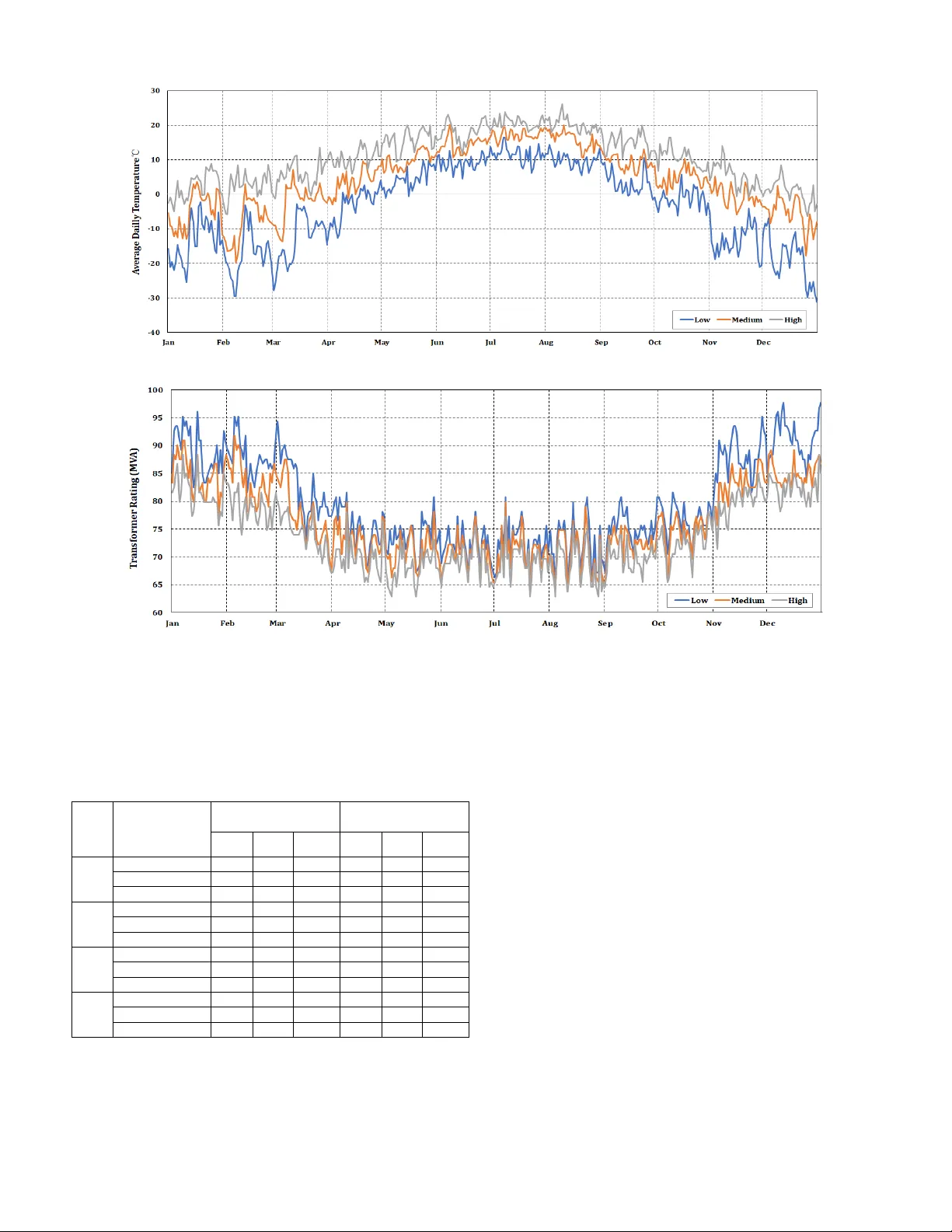
Abstract — This paper presen ts a data-driven method for estimating annual continuous dynam ic rating of pow er transformers to serve t he long-term planning purpose . Historically, research w orks on dynamic rating ha ve been focused on rea l-ti me/near-future system operations. There has been a lack of research for long-term planni ng oriented applications. Currently, most utility companies still rely on static rating numbers w hen planning pow er transformers for the next few years. In response, this paper pro poses a novel and comprehensive method to anal yze the past 5-year temperature, loading and load co mposition data of existing power transformers in a planning region. B ased on such data a nd the forecasted area load composition , a fut ure power transformer’s load shape profile can be constructed by using Gaussian M ixture Model. Then according to IEEE std. C57 .91-2011, a power transformer thermal aging m odel can be established to incorporate future loading and temperature profiles. As a result, annual continuous dynamic rating profile s un der different temperature sce narios can be determined. The profiles can reflect the long-ter m thermal overloading risk in a much more realistic and granular way, w hich c an significantly i mprov e the accuracy of power transform er planning. A real utility application ex ample in Canada has been p resented to validate and demonstrate the practicality and usefulness of t his method. Index Terms — Dynamic Rating , Long-term Syste m Planning, Gaussian Mixture Model, Transformer Thermal Aging I. I NTRODUCTI ON CCURATE lo ng-term planning is the key to ensure balanced cost and reliability of power system i n the next 5-10 years. As a critical and costly co mponent, power transformer pla nning is an im portant part of long -term syst em planning process, in which the forecasted area load to b e supplied by the transfor mer is compared w ith transfor mer’s rating to determine the pr oper transfor mer sizing. However, most utilit y co mpanies current ly use static p ower transformer r ating assumption, in many ca ses t he nameplate ratings fo r long-ter m system planning [1-4].T hese assumptions can b e overly conser vative or inaccurate as the y do not reflect the dynamic te mperature co nditions in the p lanning re gion throughout a year. This is especially true for relatively co ld areas such as Canada w here the a mbie nt te mpera ture s are re la ti v el y lo w . Acc o rd i ng to IEE E std. C57 . 9 1 - 20 1 1, t h e insulation deter ioration of p ower trans formers is a function of M. Dong i s with Department of System Planning and Asset M anagement, ENMAX Po wer Corporation, Calgary , AB, Canada, T2G 4S7 (e -mail: mingdong@iee e.org) dynamic loading and ambient temperature. P roper combinations o f d ynamic loading and ambient temperature could safely allo w trans former loading to exceed the nameplate rating without ca using an y damage. T herefore, to improve the co st-e ffectiveness of planning decisio ns, a scientific a nd r ealistic way to establish annual continuo us dynamic rating for p ower transformers is required. Previously, research w orks o n dynamic ratin g mainly focused on real-time or near-future operations of s ystem equipment [5-9]. Based on t he monitoring of e lectrical and environmental co nditions, real-time or near -future equipment ratings can be estimated or predicted and flexible loading operations o r asset management decisions can be o ptimized accordingly to capitalize on such varying ratings. The research on establishing typical annual d ynamic rat ings to serve the long-term planning purpose has not been found. For such applications, there are t wo unique challenge s: 1) No m onitoring data is a vailable for lo ng-ter m future . Since the purpose o f p lanning is to study the fut ure lo ad growth of a n area, both lon g-ter m load ing and temperature profiles are currently unkno wn and have to be esti mated. Also, due to the h igh uncertainties over a long-ter m planning horizon, different sce narios ma y need to be studied. 2) Unlike operatio nal d ynamic ratin g whic h usuall y focuses on a short period of time such as a few ho urs or a fe w da ys, dynamic rating for long-term plannin g should be established on an annual basis to co ver different sea sons. To tackle the above challenges, this paper pro poses a novel and comprehensive data analytics method as shown in Fi g.1. Each step in the flo wchart is explained as follo ws: Step 1 : T he past 5 -year hourl y temperature data in the planning region is analyzed to establish three long -term annual temperature pr ofiles under three scenarios; Step 2: F or each future day in the 365-da y profile, 5 historical da ys that have clo sest te mperature and calendar characteristics are found; Step 3: Within t hese 5 days, the relatio nships between the e xisting transfor mers’ l oad composition s and the future tran sformer’s forecasted load composition ar e analyzed by using Gauss ian Mixture Mo del and Silhouette analysis in a p robabilistic way; Step 4: By incor porating 24 -hr loading pro files of existing tra nsformers a nd the p robabilistic relationships established in Step 3, the future transformer’s normalized load shape p rofile can be constructed; A Data -driven Long-term Dynamic Rating Estimating Method for Power T ransformers Ming Dong, Senio r Member, IEEE A This is the author's version of an article that has been published in this journal. Changes were made to this version by the publisher prior to publication. The final version of record is available at http://dx.doi.org/10.1109/TPWRD.2020.2988921 Copyright (c) 2020 IEEE. Personal use is permitted. For any other purposes, permission must be obtained from the IEEE by emailing pubs-permissions@ieee.org. Step 5: In the last step, the load shape profile along with th e es tablished 24 -hr ambient temperature profile are fed into the tr ansfor mer ther mal aging model established according to IEEE std. C57.91 -20 11. The normalized load shape pro file is proportionally scaled up until accelerated transfor mer aging starts to app ear. At this point, the power transformer’s dynamic rating for this particular profile day is det ermined si nce accelerated aging should be avoided for long -term power asset investment. Fig. 1. Flow chart of the pro posed data anal ytics metho d Repeat steps 2-5 u ntil the rati ngs for all 365 days under the three temperature scenarios established in Step 1 a re determined. The established annual dyna mic rating profiles can reflect the lon g-ter m thermal overloading ris k in a much more rea listic and granular way, which can significantly improve the cost-e ffectiveness of po wer transformer planning. In the following sections, t his p aper explains each step above in d etail. In the end, a real applicatio n example in a utility company in West Canada is gi ven to p resent t he established an nual dynamic rating profiles. A sensiti vity stud y is also given to demonstrate h ow the results vary with the forecasted composition of area load s to be supplied by the future transfor mer. In sum mary, this pap er presents a unique method o f establishing a nnual continuous dynamic ratin g, for long-term power tran sformer planning p urpose. II. L ONG - TERM A NNUAL T EMPERAT URE P ROFILING AND S IMILA R HISTORI CAL DA YS This section explai ns the details of step 1 and 2 in the flowchart o f Fi g.1. First, the process of establishing long-ter m temperature profiles under different scenarios is di scussed ; second, the method of finding 5 closest historical d ays b ased on temperature and calendar features is given. A. Establishing Lo ng-term Annu al Temperature P rofil es It is a bas ic fact t hat long -term hourly temperature p rofiles cannot be ac curately forecasted [ 10 ]. Ho wever, given the past 5-year temperature data in a pl anning region suc h as a city o r a town, the statistically representati ve long-term temperat ure profiles ca n be established. Three temperat ure scenarios high, medi um and low are conside red for planning purpose. In the high temper ature sce nario, for ea ch day i n t he 3 65 days, the average daily te mperat ures in the p ast 5 years are co mpared and the day un der the year w ith the highest average dail y temperature is selected. For example, to create a profile for January 1 st , January 1 st s in the past 5 years ar e co mpared by average d aily temperature and it is found that 20 16 Januar y 1 st has the highest dail y temperat ure. T hen the 24 -hr te mperature profile of 2 016 January 1 st is selected under the high est temperature sce nario. T his process conti nues until all 365 days’ profiles ar e selected from his tory a nd concatenated. Medi um and lo w te mperature sce narios use the same pro cess excep t that when co mparing among 5 years, in stead of selecting the highest daily temperat ure day, the days with me dian and lowest daily temperatures are selected. In ad dition to the abov e selection and concatenation p rocess, a safety margin or global warming adj ustment such as 1 can be artificially added to all profiles. In this case, ever y hour under the three scenarios will be increased by 1 . The above method is unique in the sense th at on the one hand, it reflects the future temperatures at three level s; o n the other hand, it keeps the authentic temperature pattern within each day: eac h profile day has a corresponding historical da y in the past 5 years and hence has a high creditab ility. B. Locating Similar Historica l Days thro ugh Compa rison The next step is to find 5 similar h istorical da ys for each profile da y established i n sub section A. T he purpose o f this step is to find proper days based on which advanced data analytics ca n be further applied to construct the transfor mer’s load shape profile, as to b e discussed in Section II I. T o find similar days, two gro ups of features ar e considered: temperature and calendar features. 1) Temperature features: as [ 11 -15] suggest, temperature can significantly affect the load ing beha viour. For exa mple, air co nditioning is m ore frequently used in hot d ays a nd the consumed po wer demand has a po sitive correlation with the ambient temperature. Am bient te mperature may al so aff ect customer behaviours since custo mers tend to stay indoo r when it is very cold or hot outside and this b ehaviour often lead to increased po wer usage. T o characterize daily te mperatures, maximum, average and minimum temperatures in a day are chosen as features. For a 2 4 -hr temperature profile, they are: where to are the hourly tem peratures in a da y. 2) Calendar features: as [14-15] suggest, workda ys and holidays includin g weekends could have significantly di fferent loading patterns. For exa mple, in general, residential customers cons ume more po wer on weekends and i ndustrial customers consu me more p ower o n weekdays. Therefore, it is important to separate workdays and holida ys into two groups and search for similar d ays within the two groups respectively . Another introduced calendar feature is to reflect t he positio n This is the author's version of an article that has been published in this journal. Changes were made to this version by the publisher prior to publication. The final version of record is available at http://dx.doi.org/10.1109/TPWRD.2020.2988921 Copyright (c) 2020 IEEE. Personal use is permitted. For any other purposes, permission must be obtained from the IEEE by emailing pubs-permissions@ieee.org. of a da y in the annual cycle, i.e. day of the year. T his feature could also imply d ifferent load ing patterns. For example, although a major industrial lo ad on two workdays i n the Fall and Spring have similar temperat ures, it has signi ficantly different lo ading patter ns at t wo very different t imes of a year . By using da y o f the year feature, the numerical di fference on the yearly calendar can be re flected. According to [16 ], the day of the year feature can be mathematically defined as: where D is the day i n 36 5 d ays. For example, D for Januar y 1 st is 1 and D for December 31 st is 365 . Sine f unction is used is to reflect the cyclic characterist ic and avoid o ne- way increase of the numerical value D . To locate 5 historical days with similar temperature and calendar features, at the begin ning workdays and holidays a re separated into tw o different gro ups due to significant distinctions bet ween the m. T hen within eac h group, similar to many cl ustering a nalysis methods that rel y o n Eucl idean distance to measure the d ifferences between d ata p oints [ 17], this paper pro poses to use the follo wing Euclidea n d istance formula to measure the dista nces bet ween a historical day D and the targeted profile day . where , and are the tem perature and day of the year feat ures o f the historica l day D ; , and and are the te mperature and day o f the year features o f the profile day . It should be noted that before appl ying (3), the features are all norm alized to [0,1] by using (4) to eliminate magnitude and unit dif ferences. T he follo wing equation can be used for normalization [ 17] : where m ( ) is the maxi mum va lue observed in t he feature f and ( is the minimum value ob served in feature f ; is the raw value of the te mperature or calendar feature. In the end, 5 histor ical similar days with mini mum distances measured by (3 ) are selected out of the past 5 years and for m the data windows for further anal ytics to be applied as discussed in the follo wing sections. III. F UTURE T RANSFORME R L OAD S HAPE P ROFILI NG This section explains the details of Step 3 and 4 in th e flowchart of Fig.1 . The ulti mate goal is to create t he normalized 24-hr load shape profile for the future transformer for a specific p rofile day in 3 65 days. An important concept called “T ransformer Load Composition” i s i ntroduced and quantified. T his is because the transfor mer total lo ad is composed of residential, commercial and industrial loads supplied b y the transfor mer. Different types of load s have different load shapes throughout a day and can respond to ambient temperatures in di fferent ways. In this section, an importa nt pr obabilistic clustering method Gaussian Mixt ure Mod eling and an efficient clu stering qual ity evaluation method Sil houette analysis are explained. T hey are used together to quantify the probab ilistic relationship between the future trans former and existing tran sformers based on transformer lo ad com position. Based o n the probabilistic cluster ing result, the nor malized load shape profile for the future transfor mer can b e constructed b ased on weighted average. A. Transformer Load Comp osition In general, most power tra nsformers supply m ore than o ne type of loads. Approximately, the load s can be categorized into three types: residential, commercial and industrial l oad s. Transformer load co mposition can be described b y t he percentages o f e very load type. Residential load perce ntage R , commercial load percentage C and industrial load percentage I should co mply with: When a customer load is connected or plan ned to be connected to a utility grid, it is a common practice for utilit y companies to assign the load to th e above three categories with different elec tricity rates. T herefore, R, C and I ca n be easily deter mined. If need ed, s ub -categories of commercial and industrial load s can be determined on an indi vidual lo ad basis.However, t his would require hea vy manual classificatio n work by human experts. In su ch a case, (5) b ecomes: where there are pre-determined co mmercial load subcategories and pre-deter mined industrial load subcategories. For a histo ri cal da y, R can be calculated as : where is the tr ansformer p eak loading in the da y ; is the total number o f residential lo ads supplied b y the trans former; is th e load ing of eac h residential load at the transformer peaking time of the da y. Similarly to residential load , transformer co mmercial load percentage is calculated as : where is the load ing o f ea ch co mmercial load at the transformer peaking ti me of the day ; is the total number of commercial loads s upplied b y the transformer . It should be noted for historical days, the loading values of existing customers i n a da y can be o btained from inter val metering data and R and C ca n be calcu la ted using (7) and (8) ; f or a ne w area i n a future da y , R and C are estimated based on the expected numbers of residential, co mmercial and industr ial customers alo ng with their typical coincidental unit loading. When (5) is used to characterize transformer loading, only two percentage nu mbers out of the three are required to characterize the load composition. This means the clustering dimensionality can be reduced to 2 . For example, if R and C are selected , a p ower tra nsformer can be characterized s imply as a vector ; ho wever when (6 ) is used, the tra nsformer will need to be char acterized with multiple di mensions and the clustering perfor mance may be affected. This is the author's version of an article that has been published in this journal. Changes were made to this version by the publisher prior to publication. The final version of record is available at http://dx.doi.org/10.1109/TPWRD.2020.2988921 Copyright (c) 2020 IEEE. Personal use is permitted. For any other purposes, permission must be obtained from the IEEE by emailing pubs-permissions@ieee.org. B . Gaussian Mixture Mo deling Unlike deter ministic clustering methods such as K -Means and Mean- shift which requires each data point to belong to a single cluster, Gaussian Mixture Model ( GMM) is a po werful probabilistic clustering method [1 8- 20 ]. W hen using GMM , a data point can b elong to all clusters with cer tain membership probabilities . In statistics, a Gaussian mixture model is a mixture distribution that assumes all the data points are generated from a mixture of a finite number of Gaussian distributions with certain para meters to be determined. Fo r clustering anal ysis, a Gaussian mixture function is comprised of several Gaussia n co mponents i.e. cl usters, eac h identified by k ∈ {1 , … , K} , where K is the e xpected number o f cl usters in t he d ataset . Each clust er k in the mi xture has th e following three para meters: Mean which defines t he cen troid of cluster k ; Mixture weight which describes how cl uster k gets mixed into the global mixture function ; Covariance matrix Ʃ of cluste r k . In a n -dimensional case, cluster k can be written as a column vector: In the covariance matrix Ʃ shown belo w: each matrix element is defined as: where E is the expec ted val ue of its d ata ar ray ar gument. In a one-di mensional case, Ʃ has only one element and it is equivalent to the variance o f the data p oints i n cluster k . The standard multivariate Gaus sian probab ility d ensity function is mat hematically given as b elow: Ga ussian mixture model t hat consists o f K Ga ussian components is defined as: where is the weight of Gaussian co mponent and it complies with: For illustration purpo se, a o ne-dimensional Gaussia n mixture pro bability de nsity function t hat co nsists of 3 Gaussian distributions and with equal mixing wei ght 1/3 is plotted in Fig.2. Fig. 2. An example of one-dimensional Gaussian mixture model probability density functio n The GM M clusteri ng can b e determined b y using EM (Expectation-Maximiza tion) algorithm. T he EM algor ithm consists of the E-step and the M-step: in th e beginning, K Gaussian d istributions are r andomly par ameterized and t hen in the E- step, for each data po int, the probab ility of it belo nging to the K Gaussian distributions are calculated b y using Bayers’ theorem. In the subseq uent M -step, t he para meters of t he Gaussian d istributions get updated with the p robabilistical ly associated data points. T he E-step and M-step rep eat iteratively until convergence is reached. Details of EM algorithm can b e fo und in [ 21 ]. After the Gaussian distributio n parameters are deter mined, for a data po int in the dataset , it can simultaneously belo ng to all K clusters (distributions) with the membership pr obability for each cluster k : is the key par ameter used to estimate future transfor mer ’s load shape p rofile and will be further used in subsection D. C. Clustering Qua lity Evalua tion using Silhouette Analysis Although GMM provides a mathematically sound way for probabilistic cl ustering ana lysis, t he e xpected n umber o f clusters is unknown. One w ay to determine is evaluating t he clustering q uality u nder different values and selecting which yields t he best clu stering quality. In ord er to evaluate clustering quality , Silhouette anal ysis is adopted [ 22 ]. In this analysis, an inde x ca lled Silhouette coefficie nt is used to evaluate cl ustering quality. Fo r a given data po int ( cluster ), its can be mathematically calculated using the equations belo w: where is the number of members in cluster ; is any other cluster in the d ataset; d ata point is data point in ; is the Euclidean d istance between two data points. This is the author's version of an article that has been published in this journal. Changes were made to this version by the publisher prior to publication. The final version of record is available at http://dx.doi.org/10.1109/TPWRD.2020.2988921 Copyright (c) 2020 IEEE. Personal use is permitted. For any other purposes, permission must be obtained from the IEEE by emailing pubs-permissions@ieee.org. To evaluate the clustering quality, ( 16 ) calculates b oth the compactness and sep aration of p roduced clusters by GMM : reflects the i ntra-cluster co mpactness. It is t he average distance of d ata po int to all o ther points i n t he same cluster ; reflects t he separatio n bet ween other cluster s and po int . It is the smallest average d istance of to all points in every o ther cluster that does not contain in the dataset; is the final index that combine s and A good intra-cluster compactness and inter-clus ter separation together will lead to a lar ge value . ( 16 ) is the calculation for a single data p oint . T o evaluate the clustering quality of the entire dataset, average Silhouette coefficient is used and is given as belo w: where is total number of dat a points in this data set . for an initial range of values is tested and then t he value resultin g in the highest is selected as t he optimal and used in GMM. D . Constructing Normalized L oad Shape Profile for the Future Transformer By using GMM, ex i sting transformers within the 5 days identified in Section II alo ng w it h t he future transformer are clustered toge ther based on their load co mposition features. An example o f clusteri ng r esult based on residential l oad percentage R and commercial load percentage C features for 80 transfor mers i n 5 d ays with 6 clusters is shown i n Fig. 3. R and C have bee n nor malized by using (4). Fig. 3. An example of transformer GMM clustering re su lt As previously discussed, (15) can be used to calculate the membership pro bability of t he future transformer to each cluster. The future transformer ’ s nor malized load ing at hour can be calculated as b elo w: where is the lo ading of cluster centroid k at hour; is the peak loading of cl uster centroid k in that da y. (18) is based o n the p rinciple that if the future trans former’s load composition on the profile da y is similar to a group of existing tra nsformers ’ load composition s on similar historical days, its load shape (reflected as nor malized profile) should also be similar to the load shape o f such existing tran sformer s . An exa mple of a construc ted load shape pro file versus normalized load ing profiles of 6 cluster centroid s is plo tted in Fig. 4. Fig. 4. An example of constructing transforme r load shape profile IV. P OWER T RANSF ORMER T HERMAL A GING M ODEL This section explai ns the detai ls of step 5 i n the flo wchart o f Fig.1. IEEE st d. C57.9 1-2011 explains the quantitati ve relationship bet ween transformer ther mal aging and influencing factors s uch as tr ansformer lo ading and a mbient temperature [ 22 - 23 ]. This section first explains the method to calculate equivalent a ging factor and then e xplains the met hod to derive transfor mer dynamic lo ad rating. A. Calculate E quivalent Aging Facto r According to IEEE st d. C57.91 - 2011 , Fig.5 summarizes the steps to calculate transformer equivalent aging factor: first, tr ansformer top -oil te mperature rise o ver ambient te mperature is calculated ; second, transfor mer hot test- spot temperature rise over top-oil temperature is calculated ; third, the end o f h our hottest-spot temperat ure is calculated; th en th e end of hour hottest-spot te mperature is converted to transfor mer hourly aging acceleration factor ; in the end, the transformer 24-hr equivalent aging factor is calculated. Fig. 5. Flow ch art of calcula ting transfo rmer equivalent aging factor This is the author's version of an article that has been published in this journal. Changes were made to this version by the publisher prior to publication. The final version of record is available at http://dx.doi.org/10.1109/TPWRD.2020.2988921 Copyright (c) 2020 IEEE. Personal use is permitted. For any other purposes, permission must be obtained from the IEEE by emailing pubs-permissions@ieee.org. In the f ir st step, the transformer top -oil temperature rise over ambient temperature is calculated using equations belo w: where is the end of hour top-oil rise over a mbient temperature in ; is the initial top-oil rise over ambient temperature in is the ulti mate top -oil rise over ambient temperature in ; is the ratio of current- hour loading to rated loading; is the transfor mer oil ti me constant for te mperature differential between the ultimate top-oil rise and initial top -oil r ise and can be provided by t he transformer manufacturer; is a constant representing the top-oil rise over ambie nt te mperature at rated loading o n the tap position to be stu d ied and can be provided by the transformer manufacturer; R is a con stant representing the ratio of load lo ss at rated loading to no -load loss and ca n b e provided b y the transformer manufacturer; n is an empirica l exponent. It is 0.8 for p ower tra nsformers with natural convection flow of oil and natural convection flow o f air ov er radiators (ONAN t ype). It is 0.9 for power tr ansfor mers with natural convection flow of oil and forced convection flow of air over rad iators by fans (ONAF t ype) [23] . It should be noted that when ap plying (19), the initial top-oil rise over ambient te mperature for each hour is unknown. A loop-based iterative calculation process is often used to solve this prob lem: in the first hour of the day is initialized to a lo w temperature number such as 0 . T hen in the first hour is calc ulated and also used as the input for the second hour. This process continues until values in all 24 hours get calculated. T hen in the last hour is used as input for the first hour. The loop calculation continues until no hourly val ues get updated and this typically happens after a fe w iterations. In the second step , the winding hottest -sp ot rise over top -oil temperature is calc ulated by using: where is the end of hour winding hottest -spot rise o ver top-oil temperature in is the initial windi ng hottest- sp ot rise over top-oil te mperature in is the ultimate winding hottest -spot rise over top -oil temperature in is the ratio o f last -hour loading to rated loading; is the winding time constant at hot spot location and can be provided by the tr ansformer manufacturer; is a constant rep resenting transfor mer hotspot differential and can be provided by the trans former manufacturer; m is an empirical factor. It is 0.8 for most power transformers and 1.0 for the o nes that direct oil fro m the radiators or he at exchangers into the windings and force air over the radiators or heat exchanger by fans (O DAF type) [23 ]. In the third step, the end of hour hot test-spot temperature is calculated b y using: where is the hourly ambie nt te mperature in . In the fourt h step, according to Arr henius reactio n rate theory, the hourly aging accel eration factor is calculated by using: In the fifth step, the tr ansfor mer 24-hr equivalent ag ing factor is calculated b y using: where is the hour in a day. B . Determine Transforme r Daily Dyn amic Rating From the long -term planning perspective, it is desired that the 24 -hr equivale nt aging factor is 1.0. This is because when is less tha n 1.0 , the po wer transformer is underutilized against i ts normal i nsulation life (underlo ading situation); when is greater than 1.0, the po wer transformer is o ver -utilized against i ts nor mal insulation life and the overall life will be shortened (overload ing situation). Therefore, keeping as one is u sed as the criterion to de termine the daily transfor mer load rating. In Section III, the transfor mer load shape p rofile has bee n constructed based on load co mposition. Since it is normalized, it o nly captures t he lo ad shape and does not reflect the load ing magnitude. In this step, th e normalized profile is proportionally scaled up with a small step cha nge a nd at each step, the corresp onding gets calculated until is reached. An example o f a 50 MVA power trans former ’ s 24 -hr thermal a ging simulation during a da y is sho wn in Fig .6 . In this e xample, = 1 and as can be see n, a significant portion of the trans former load is greater tha n rated loading 1 .0 p.u. The maximum tra nsformer load during the day i s actuall y 1.55 p.u. This m ea ns the transformer dynamic rating for the day is 77.5MVA, for the particular load composition and te mperature profile in this e xample. Fig. 6. An exampl e of pow er t ransformer 24 - hr thermal aging simulat i on V. V ER IFI CATION A ND A PPLICATION The proposed method has b een applied to a m ajo r utility company in West Canada for one of its planning re gions in the Alberta P rovince. T he results of verification and applicatio n are presented and d iscussed in detail in this sectio n. This is the author's version of an article that has been published in this journal. Changes were made to this version by the publisher prior to publication. The final version of record is available at http://dx.doi.org/10.1109/TPWRD.2020.2988921 Copyright (c) 2020 IEEE. Personal use is permitted. For any other purposes, permission must be obtained from the IEEE by emailing pubs-permissions@ieee.org. Fig. 7. T1’s 2018 A ctual Dynamic Rating v s. Estimated Dy namic Rating ( with actual temper ature profile) A . Verification with Actual Temperatu re Profile To better observe and analyz e the details o f the prop osed power transformer long-term dynamic rating estimating method, this pap er adopts a two-step verificat ion for the proposed comprehensive meth od. In the first step, t he foc us of verification is th e loa d shape profiling m ethod d iscussed in Section III : 5 representative po wer transfor mers (T1 to T5) out of the total 80 po wer trans formers in the planning region were chosen and used for verification. Data from 2013 to 2018 were used. T he 5 -year data from year 20 13 to 2017 is used to estimate the annual d ynamic rating in 2 018 . The 2018 dail y temperature data is treated as known data. The 5 transfor mers ’ normalized load shape p rofiles are constructed b y using the proposed method. The y are then taken into t he IEEE power transformer ther mal aging mo del and scaled up grad ually to determine their estimated daily d ynamic rati ng value s. In comparison, the actual 2018 daily load ing profile s of the 5 transformers ar e scaled in the s a me way to d etermine their actual daily dynamic rati ng values. The 2018 actual and estimated dy na mic rating v alues of transformer T 1 are plo tted in Figure 7. As can be seen, although t here ar e gaps between t he t wo rati ng curve s o n individual da ys, the t wo curves follow a quite consiste nt pattern and stay around the same level. T hree error metrics ar e used to quantify t he estimation accurac y: 1) For daily error, Mean Absolute P ercentage Error ( ME ) is used and it is mathe matically given as b elow [26] : where N is the total number of da ys in a forecasting p eriod ; is the act ual d ynamic rati ng of the day and is the estimated d ynamic rating of the day. 2) Since the ta sk di scussed in this p aper is for the purpose o f lo n g - te r m ec o n o mi c tr a ns fo r me r si z i ng , wh a t i s mor e important tha n the daily accurac y is the s tatistical accurac y during a forecasting period such as sum mer forecasting season (May to Sep.) and winter forecasting seaso n (Oct. to Apr.) in one year. T herefore, i n addition to using ME , two statistical metrics are propos ed in o rder to descr ibe t he error o f the estimation for a spec ific forecasting p eriod: Average Rating Percentage Err or ( AE ) and Valle y Rating P ercentage Error ( PE ). Mathematically, AE and PE ar e defined as belo w: where and are the a verage values of act ual and estimated daily d ynamic ratings i n the forecasting period ; and ar e the minimum values of actual and estimated daily dynamic ratings i n the forecasting p eriod . AE describes the error of the av er age daily ra ting and V E describes the er ror o f the minimum dail y rati ng. Compared to the peak point, the valley point VE is more useful because it reflects the minimum ratin g required for the trans former. The d aily dynamic rati ngs of t he p re-selected f ive transformers in 2018 are estimated and the err ors are further calculated b y usi ng eq uation (24)-(26). The r esults are summarized into T able I . Furthermore, to facilitate the res ult analysis, the average load co mposition forecasted for 2 018 and the average membership probability for each tran sformer are also included in the tab le. In Sectio n II I, it has b een discussed that for each profile da y, a few historical s imilar da ys can be found and the n GM M based prob abilistic clustering i s applied to these si milar days. For each profile day, the o utcome of this step is that the target tr ansfor mer can b e associated to K clusters of e xisting transformers and the a ssociation can be quantified b y a set of membership p robability numbers ( k =1 to K ) The average m e mbership pr obabilit y listed in Table I is the annual aver age of every day’s m a ximum membership probab ility amon g the K prob ability numbers . As s ho wn i n T ab le I, 5 repr es ent ati ve tran sfo rmer s a r e selected for discu ssion purpose. T hese transformers co ver the typical ran ge o f load compositions in the planning region: T1 is co mmercial heavy; T 2 is r esidential and co mmercial heavy; T 3 i s mor e ba l a nc ed a mo n g r e si d e nt i a l , c o m me r c i a l an d industrial types of loads; T4 is d ominated by industrial load and is less o ften encou ntered in the studied planning r egion ; T5 is a very unco mmon case as it has a rarely seen load composition ( high residential and industrial). Furthermore, 20 This is the author's version of an article that has been published in this journal. Changes were made to this version by the publisher prior to publication. The final version of record is available at http://dx.doi.org/10.1109/TPWRD.2020.2988921 Copyright (c) 2020 IEEE. Personal use is permitted. For any other purposes, permission must be obtained from the IEEE by emailing pubs-permissions@ieee.org. Fig. 8. T1’s 2 0 18 Actual Dy namic Rating vs. Estimated Dynamic R a ting ( with three produced tempe rature scenarios in 2018) transformers were r andomly selected to for m up a test set T X (25% of dataset) and t heir average results are inc luded in Table I . T ABLE I: V E RIFICATION R ESULTS W ITH A CTUAL T EMPERATURE P ROF ILE ID Area Lo ad Composition Average Membership Probability Winter Erro r (%) Summer Error (%) ME ME T1 (3%,88%) 91% 5.6 2.0 4.9 5.7 2.3 4.8 T2 (57%,43 %) 95% 5.1 3.2 6.6 4.6 3.5 5.7 T3 (24%,34%) 88% 4 .0 2.2 3.5 5.3 1.8 6.4 T4 (0%,12%) 81% 10.1 5.4 11.3 9.5 6.2 7 .9 T5 (36%,4%) 42% 8.1 5.9 6.2 9.4 4 .0 8.8 TX (33 %, 49 %) 92% 4.8 2.5 5.0 5.4 3.1 5.2 A nu mber of observations can b e made fro m Fig ure 7 and Table I: In general, dail y error ME is much higher than statistical error AE . T his is expec ted as there is more fluctuation on a dail y basis. This res ult is positive b ecause AE is more important than ME f o r long-ter m planning application. VE as the minimum rating is usually recorded on the days with high te mperature or long-lastin g high po wer consumption . It can be either higher or lower than ME. Transformers T1 to T3 show ver y good estimation accuracy. The y have low indu strial lo ad component s a nd high average membership p robabilit ies. They are all common types of transfor mers in the plannin g region. Transfor mer T 4 shows a relat ively lo wer acc uracy. After further investigation, it is found that the major load on T4 is a steel factor y that not only operates during the night (by night shi ft op eration) b ut also often op erates o ver the weekend ti me . This explains th e reason o f T 4’s lo wer accuracy: its abnormal t ype of op eration ma kes the load shape pro file be come very unique. T he load shape profile cannot be co nstructed as accurately as common transformers b y co llaborativel y leveragi ng t he data of other existing transfor mers in the planni ng region. Transfor mer T 5 sho ws a relatively lower accuracy. It has a q u i t e lo w A v e r a ge M e m b e r s hi p P r o b a b i l i t y . T h i s me a n s t ha t t h i s tr a n s f o r me r ha s a r a r e l y se e n lo a d composi tion ( hi gh reside ntia l and i ndustr ial) . I n ot her words, during cl ustering, this transformer data p oint is far a way fro m a ny cl usters o f existing transformers . This explains the rea son of T 5’s lo wer accuracy: no existing transformer profile can do minantl y appro ximate T5’s load shape profile. T herefore, larger errors could o ccur when constructin g T5’s load shape profile and i n the subsequent process. The average p erformance of the test set TX is clo ser to T1 to T3 because they are co mmon t ypes of transformer s in the planning region . The abo ve o bservations disco vered an i mportant caveat for the applicatio n of t he pro posed approach: d irectly applying the proposed ap proach to a particular tra nsfor mer that mai nly supplies an irregular type of industrial load o r has a unique load composition with respect to other transformers in t he same planning region may l ead to less accurate estimation. This is b ecause the concept of the pr oposed GMM based load shape p rofiling method is similar to the co llaborative filtering algorithms used widel y today in machine learning for the development of recommendat ion systems [ 25 ]. It works well when similar members present and works less accuratel y when no si milar member presen ts. As a data-driven ap proach, this is a limitation to the discussed ap plication. However, the res ults are still much more accurate t han the c urrent nameplate b ased rating methods which completely disregard the use o f any long-term historical information in the planning region . Some practical suggestions are further discussed in Sectio n VI to account for this limitation. When applying to common transformers, the accuracy is quite satisfactor y as indicated by the results of T1 to T3. B . Verification with Produced Temperature Profiles The second step of verification focuses on the estab lish ed lo ng-t er m temp er at ure prof iles a s disc us sed in S ect io n I I. Please note that we should respect a basic fact that practically it is i mpossible to forecast long-term temperatures accuratel y o n a da i l y ba si s [ 10 ] . Th e tr u e p ur p o s e o f e s t a b l i s hi n g long-term te mperature pro files is to determine a statistical l y r e p r e s e n t a t i v e b a n d f o r t h e e s t i m a t i o n , w i t h a c e r t a i n ad j u s t me n t to re f l e c t t h e l on g - t e r m tr e n d suc h as g l o b a l wa r m i n g . F r o m t h e b a n d d e f i n e d b y t h e b e s t s c e n a r i o (low-temperature) , the worst scenario (hi gh-temperature) a nd the medium sce nario (medium -temperature) , utility plan ning engineers ca n refer to the res ults and understa nd the flexibili ty This is the author's version of an article that has been published in this journal. Changes were made to this version by the publisher prior to publication. The final version of record is available at http://dx.doi.org/10.1109/TPWRD.2020.2988921 Copyright (c) 2020 IEEE. Personal use is permitted. For any other purposes, permission must be obtained from the IEEE by emailing pubs-permissions@ieee.org. Fig. 9. Establishe d long-term annual temperature profile s based on 2014-2018 dat a Fig. 10 . F orecasted annual dynamic ra ting profiles in 2023 for a hypotheti c al transforme r and constraint s the y have when sizi ng the transfor mer. T he 2018 actual and estimated dynamic r ating values of transformer T1 under three te mperature scenarios prod uced as per Section I I-A are plo tted in Figure 8. T he results o f common type tra nsformers T1 to T3 as w ell a s t he avera ge results of the test set T X are summarized into T able II . T ABLE I I: V ERIFICATION R ESULTS WITH P RODUCED T EMPER ATURE P ROFILES ID Hypothetical Temper at ure Senario Winter Erro r (%) Summer Error (%) ME ME T1 High 8 .0 7.1 9 .2 9 .4 6.6 10.7 Medium 6.1 4.5 5. 3 6.3 3 .0 5 .2 Low 8. 5 5 .6 7 .5 8.2 5 .3 6.9 T2 High 8.6 5 .9 11.3 9.4 7 .5 10.8 Medium 6.4 4.6 7.7 6.8 6 .1 7.8 Low 9.5 6.4 9.2 8 .9 4.8 8. 0 T3 High 7 .4 3.7 5 .7 8.0 4 .6 6 .2 Medium 4.7 3.1 4.3 5.6 3 .3 7 .0 Low 5 .9 3.5 4.7 7.1 5 .1 4 .8 TX High 8.2 5.3 8.6 9.0 6.0 9.5 Medium 5.4 3.9 5.8 6.5 4.3 6. 4 Low 7.7 4.9 6.9 8.1 5.1 6.6 As can be seen from Figure 8 and Table II, in general, the acc urac y is qu ite sa tisfac tory, es pec ial ly wit h t he me di um temperature scenarios. However, this does not mean the high and lo w temperature scenarios are not useful and should not be co nsidered in certain cases: first of all, their results are s till much more ac curate than using nameplate ratings and are within an acceptable ran ge; second, utility engineers may intentionally choose the hi gh-te mperature scenario to account for future uncertaintie s and risks such as glob al war ming or underestimated load growth. Using high-te mperature scena rio will guaran tee a reasonabl y co nservative result a nd the conservativeness is much lo wer t han rel ying on nameplate rating. On the other hand, ut ility engineers may also cho ose the low-temperature sce nario when other operational flexibilities such as feeder ties, load shedding and demand response are available. These measures can allow temporar y load transfer to other transformers or lo ading alleviation during e mergency conditions. It can also be considered when load growth in the pla nning region has b een trad itionally overestimated. C. Future Ann ual Temperature Profiles By using t he met hod disc ussed in Section II and the 5 -year historical w eat her data fro m 2014 to 2018 , three long- te rm annual te mperature p rofiles for the planning regio n are established as shown in Fig.9. The historical weather data was obtained from [2 6 ]. D . Future An nual Dynamic Rating Profiles By using the met hod d iscussed in Section III and IV and the 5-y ear histo rical weather and loading d ata from 2 014 to 2018 , This is the author's version of an article that has been published in this journal. Changes were made to this version by the publisher prior to publication. The final version of record is available at http://dx.doi.org/10.1109/TPWRD.2020.2988921 Copyright (c) 2020 IEEE. Personal use is permitted. For any other purposes, permission must be obtained from the IEEE by emailing pubs-permissions@ieee.org. three annual d ynamic rating p rofiles in 2023 with an ass umed future load composition (60%, 30%) for a 50MVA ONA F power transformer typicall y used by the utility is given in Fig. 10 . As can b e seen, the s u mmer months (Ma y to Sep.) have lo wer rating than winter months (Oct. to Apr.) and this is because s ummer has higher ambient temperat ures . Also, the high te mperature scenario yields lo w dynamic rating and vi ce versa. E . Sensitivity Ana lysis by Load Comp osition Sensitivity analysis was also applied to anal yze transformer ratings for different area lo ad compositions. 4 area load ty p es- r esidential heavy, co mmercial hea vy, indu strial heavy and b alanced were considered. Load compositio ns for each area load type in 2023 were assumed and listed in T able I. A typically used 50 MVA O NAF t ype po wer transfor mer is considered. I t is discovered that residential heav y a nd commercial heavy load types h ave relatively higher rati ngs while industrial heavy and balanced load types have lower ratings. T his is because the industrial load s i n the planning region d o not fluctuate dramatically as residential and commercial loads i n a da y and often oper ate constantly at a high leve l. This kind of lo ad behavior affects the cooling of transformer temperature. T ABLE III: S ENSITIVITY A NALYSIS B Y L OAD C OMPOSITION Area Lo ad Type Area Lo ad Composition Temper at ure Scenario Summer Average Rating (MVA) Winter Average Rating (MVA) Residential Heavy (80%,10%) High 68 78 Commercial Heavy (10%,80%) High 67 72 Industrial Heavy (10%,10%) High 64 68 Balanced (33.3%, 33.3%) High 65 71 Residential Heavy (80%, 10%) Medium 71 81 Commercial Heavy (10%, 80%) Medium 70 76 Industrial Heavy (10%, 10%) Medium 66 71 Balanced (33.3%, 33.3%) Medium 67 74 Residential Heavy (80%, 10%) Low 72 85 Commercial Heavy (10%, 80%) Low 72 79 Industrial Heavy (10%, 10%) Low 67 75 Balanced (33.3%, 33.3%) Low 68 78 F . Implication s for Utility Long -term Plann ing The above results showed th e great value of the pro posed method for utility lo ng-term plannin g. To determine the proper size of a new po wer trans former, planning engi neers first need to forecast t he load co mpositions or t he chan ge of lo ad compositions in t he area to b e supplied by the transformer over the next few years. This can be typically do ne by analyzing ar ea development p lan and area land charac teristics [1] . If facing uncertai nty, it is also reasonable to assume different lo ad composition scenarios . Then the annual dynamic ratings of the transfo rmer can b e estimated usin g the proposed method for the next fe w years . In parallel with th e above process , planning engineers will forecast t he loading growth for the next few years (o ften split to summer /winter or quarterly forecasting seaso ns). The forecasted load ing can be compared with the estimated po wer tra nsformer dynamic rating to deter mine: the pr oper siz e of a new tra nsformer, the need of upgrading a n existing tr ansformer to a larger size or the timing of such installation or upgrade. In this a nalysis process, accord ing to the utilit y co mpany’s ris k tolerance level and planning practice, p lanning engineers can al so assume proper global temperature adj ustment, select a certain temperature sce nario o ut of the three or pro duce results u nder all three scenarios for furt her co st-risk co mparison and sensitivity evaluation. Although t he utilit y long-ter m p lanning process can never be 1 00% accurate, the p roposed method ca n provide in-depth information required to suppo rt m o re scientific a nd r ealistic planning decision m a king. I t sho uld also be noted that the proposed method is based o n the theoretical transformer thermal model defined in IEEE std. C57.91- 2011 wh ic h onl y co nsiders load pro file, ambient temperature and t ypical manufacturing para meters as model inputs. This is a practical stan dard that has bee n used in numerous studies a nd are therefore adopted in here for long-term p lanning purpose. In reality, if the utility co mpany is concerned abo ut other factors such as manufacturing differences, additio nal safety m argin can be ap plied to the obtained rating result s to account for such uncertaintie s. VI. C ONCLUSIO NS AND D ISCUSSI O NS This p aper addresses an important p roble m in utility companies that ha s not bee n researched be fore – how to produce annual contin uous dynamic rating of po wer transformers for long-term p lanning purpo se. To resp ond to this need, this pap er p roposes a novel and co mprehensive da ta analytics method to process the past 5 -year temperature, loading and load composition d ata of existing p ower transformers in a planning r egion. The outcomes of the proposed method include : Three long-term annual temperat ure pro files for the planning region can be estab lished; For any da y in a year, a futur e power transfor mer’s load shape p rofile ca n be constr ucted by usin g Ga ussian Mixture Model and Silhouette analysis; A po wer transfor mer ther mal aging model can be established with respect to IEE E std. C57 .91 -201 1. Future load shape an d tem p erature profiles under different sce narios ca n b e inc orporated into such model and the co rresponding trans former rating can be determined; Three annual contin uous d ynamic rating profiles of t he future transfor mer can be produced under three long -term temperature scenarios. The novelties a nd significances of th is pap er can b e summarized into two main points as follows : 1) T his paper introduce s the concep t o f d ynamic rating into the lo ng-term planning p rocess. Previously, there has been a lack of research attentio n on this subj ect. The current rating method used for long-term p lanning is too conservative and often leads to over investment. This paper aims to d raw research and application atte ntion to t his problem and has a This is the author's version of an article that has been published in this journal. Changes were made to this version by the publisher prior to publication. The final version of record is available at http://dx.doi.org/10.1109/TPWRD.2020.2988921 Copyright (c) 2020 IEEE. Personal use is permitted. For any other purposes, permission must be obtained from the IEEE by emailing pubs-permissions@ieee.org. significant ec onomic i mplication to utility co mpanies (po wer transformers are ver y costly components). 2) The paper presents a novel big data appro ach with sophisticated data analytics techniques to solve the problem. This whole analytics p rocess ( establishing lon g- ter m temperature p rofile, findi ng similar historical days and using pr obabilistic cl ustering and Silhouette anal ysis) is co mpletely novel and unique. This p aper also presents the d etails of an ap plication example for a major utility compan y in Canada . It analyzes the validity of the propo sed method and explains ho w such results can help utility planning e ngineers with long-term s ystem planning. Overall, it d emonstrates great practical value and feasibility of the propo sed method in real world. The results show tha t the estimation acc uracy for majority of transfor mers is satis factory. However, t he accurac y ca n be affected when dealing with special trans formers with unique load composition or load shape that is rarely encounter ed before in the p lanning region . Since the method is based on collaborativel y leveragi ng existing po wer tra nsformer data, it is s uggested to app ly the pr oposed method to p lanning regions with sufficient number of existing power transformers . For example, i t is pro bably not a great idea to apply the method to a small town system with only 4 to 5 power transfor mers. Finally, when dealing with special transformers with unique load co mposition o r load shape in real application , there are a few practical s uggestions which can potentially reduce the impact and impro ve the estimating accurac y: 1) Apply a high er safet y factor and more conservati ve temperature assumptions when c hoosing the size of the transformer; 2 ) Increase operational flexibility to account for unexpec ted transformer undersizing in the future. Oftenti mes this can be more econo mical than i ncreasing t he size o f a p ower transformer . Oper ational measures s uch as ad ding feeder t ies to the feeders s upplied b y the transfor mer, lo ad shedding a nd demand response ca n be ado pted; 3 ) Selec t the transfor mer model that has better heat dissipation a nd oil flo w convection ca pability such as oil- directed air -forced transformers. T his can increase transformer’s overload ing cap ability in unexpected lo ading conditions; 4 ) Large utility co mpanies can con sider establishing a database to store transformer profiles with special industr ial loads so that t hey can be referenced in future planning work for a different plan ning region to co rrect the lo ad sha pe estimation. Future res ea rch on thi s subj ect could expand to medium or low voltage service tran sformers that are widely used in distribution syste ms. With the use of long-term smart metering data, weather data and data analytics , pr oper transformer fleet asset management strategie s can be studied acco rdingly. Other statistical and modellin g methods can also b e explored. R EFERENCES [1] H. Seifi and M. S. Sepasia n , Electric Power System Planning: Issues , Algorithms and Solutions , Springe r Science & B usiness Media, 2 011. [2] T.Zhang and P.Vohra, “AESO Planning Stud i es”, Alberta Electric Syste m Op erator, Calgary , AB, Canada, [Online].A vailable: https://www .aeso.ca/assets/Uploads/Appen dix -A-AESO-Pl an ning-Studi es -807L.pdf. Accessed on: Aug. 1, 2019. [3] ISO N ew England, “Transmiss i on Planning Technical Guide”, ISO New England, Holy oke, MA , USA, [Online ] .Available : https://www .i so-ne.com/static-assets /documents/2017/11/transm ission_p lanning_technic al_guide_rev2.pdf. Accessed on: Aug. 1, 2019. [4] Midwest ISO, “MI SO Transmission Expansion Plan”, Midwe st I SO, Carmel, I N, US A. [Online].A vailab le: https://www .misoenergy.org/api/docume nt s/getbyme d iaid/105616. Accesse d on: Aug. 1, 2019. [5] M. Djam a li, S. Tenbohlen, E. Junge and M. Konermann, "Real -Time Evaluation of the Dy na mic L oadin g Capability of I n door Distribution Transforme rs," IEEE Trans. on Power Delivery , vol. 33, no. 3, pp. 1134-1142, June 2 018. [6] A. Bracale, G. Carpi nelli, M . Pagano and P. De Falco, "A probabilistic approach for forecasting the allow able current of oil -immersed transformers," IEEE Trans. on Power Delivery , vol. 33, no. 4, pp. 1825-1834, A u g. 2018. [7] S. D. Kim a nd M. M. Morcos, "An application of dynamic thermal line rating control s ystem to u p-rate the ampacity of overhead transmission lines," IEEE Trans. on Power Deliv e ry , vol. 28, no. 2, pp. 1231-1232, Apr . 2013. [8] M. Dong, A. B. Nassif and B. Li, "A data-driven residential transformer overlo ading risk assessment method, " IEEE Trans. on Power Delivery , vol. 34, no. 1, pp. 387 -396, Fe b . 2019. [9] T. S. Jalal, N. Rashi d and B. van Vliet, " Impl ementation of dynamic transformer rating in a distribution netwo rk, " 2012 IEEE Internationa l Conference on Power System Tech n ology (POWERCON) , Aucklan d , 2012, pp. 1- 5. [10] T.Vasquez, Weather An al ys i s and Forecasting Handbook, Weather Graphics Te ch nologies, G a rland,TX, 2011 [11] J.V.Paatero and P.D.L u nd, “A model for generating household electricity load p rofile s”, I nternational Journal of Energy Research, vol.30(6), pp:2 7 3-290, Apr.2006 [12] I. C . Schick, P. B . Usoro, M . F. Ruane and F. C. Schweppe, "Modeling and weather-normalizatio n of whol e -house metered data for residential end-use load shape estimation," IEEE Trans. on Power Systems , vol. 3 , no. 1, pp. 213-219, F eb. 1988. [13] N. Lu, T. Tayl or, W. Jiang, J. Correia, L. R. Leung and P. C. Wong, "The temperature sensitivity of the residential load and commercial building load," IEEE Power & Energy Society General Meeting , Calgary , AB, 2009, pp. 1-7. [14] A. Capasso, W. Grattieri, R. Lamedica and A. Prudenzi, "A bottom- up approach t o residential load modeling," IEEE Transactions on Power Systems , vol. 9, no. 2 , pp. 957-964, May 1994. [15] Y. Chen et al., "Short-Term Load F or ecasting: Similar Day-Based Wavelet Neural Net wor k s," IEEE Trans. o n Power Systems , vol. 25 , no. 1, pp. 322-330, F eb. 2010. [16] K.Nagbe, J. Cu gliari and J. Jacques , “Short -term electricity demand forecasting using a funct i onal state space mode l”, Ene rgies . vol.1 1, no.5, p.1120, May. 20 1 8 [17] T.Hastie, R. Tibshirani , J.Friedman, The Elements of Statistical Leaning , Springer, NY , 2009, pp.485-585 [18] A.Ahmad and L.Dey , “A k -mean clustering algorithm for mixed numeric and categorical data,” Data & Knowledge Engineering , Vol.63(2), pp.5 0 3-527, Apr.2007 [19] D. Comaniciu and P. Meer, "Mean shift: a robust approach toward feature space ana ly sis," IEEE Trans. on Pattern Analysis and Machine Intelligence , vol . 24, no. 5, pp. 6 03-619, May 2002. [20] K. P. Murphy, Machine Le arni ng: A Probabilistic Pe rspective, MIT Press, Cam bridge , M A, 2012 [21] T.K. Moon, “The expe ctation - maximization algo rithm”, IEEE Signal Processing Magazi n e , vol.13, no.6 , pp.47-60, 19 96. [22] Peter J. Rousseeuw, "Silhouettes: a graphical aid to the interpretation and validation of cluster analysis," Journal of Computational and Applied Mathema tics , no. 20, p p .53-65,1987 [23] IEEE Guide for Loading Mineral-Oil-Immersed Transformers and Step-Voltage Reg ulators , I EEE Standard C57.91-20 1 1 [24] W. J. McN u tt, "Insulation thermal life considerations for transforme r loading g u ides," IEEE Tr ans. on Power Delivery , vol. 7, no . 1, pp. 392-401, Jan. 1 9 92. [25] J. L. Herlocker, J. A. Konstan and J. Riedl, “ Explaini ng collaborative filtering recommendations ,” Proc e edings of 2000 ACM conference on Computer Supporte d Cooperative Work , pp. 241- 250, Dec. 2000. This is the author's version of an article that has been published in this journal. Changes were made to this version by the publisher prior to publication. The final version of record is available at http://dx.doi.org/10.1109/TPWRD.2020.2988921 Copyright (c) 2020 IEEE. Personal use is permitted. For any other purposes, permission must be obtained from the IEEE by emailing pubs-permissions@ieee.org. [26] Gover nm ent of Canad a, “Hi st orica l Cl imat e Dat a,” Gover nm ent of Ca na d a, C a na da . [ On li n e ] . Ava i la bl e : h tt p :// c li m at e. wea t he r. gc .c a /. Accesse d on: Aug. 1, 2019. [27] M.Dong and L.S.G rumbach , “A Hy br id Distribution F eeder Long -Term Load Fo r ecasting Method Base d on Se qu ence Predict i on”, IEEE Trans. on Smart Grid , vol . 11, no. 1, pp. 470-482, Ja n. 2020. Ming Dong (S ’ 08, M ’ 13, SM’18) received his Ph.D degree from D epartment of Electrical and Com p uter Engineering, University of Alberta. Since graduation, h e has be en working in various roles at major electric utility companies in West Canada as a Se ni or Engineer for 7 y ears. He wa s the recipient of the Certificate of Data Sci ence and Big D a ta A n alytics fr om Massachusetts I nstitute of T echn ology . He is an associate editor of CSEE Journal of Pow er and Energy Systems and an editor of I EEE Open Access Journal of Pow er and Energy. His re search interests include applications of artificial intellige n ce and big data technolog ies to power system planning, operation and asset manageme n t, p ower quality and smart energy manageme n t. This is the author's version of an article that has been published in this journal. Changes were made to this version by the publisher prior to publication. The final version of record is available at http://dx.doi.org/10.1109/TPWRD.2020.2988921 Copyright (c) 2020 IEEE. Personal use is permitted. For any other purposes, permission must be obtained from the IEEE by emailing pubs-permissions@ieee.org.
Original Paper
Loading high-quality paper...
Comments & Academic Discussion
Loading comments...
Leave a Comment