Finite time anti-synchronization of complex-valued neural networks with bounded asynchronous time-varying delays
In this paper, we studied the finite time anti-synchronization of master-slave coupled complex-valued neural networks (CVNNs) with bounded asynchronous time-varying delays. With the decomposing technique and the generalized $\{\xi,\infty\}$-norm, sev…
Authors: Xiwei Liu, Zihan Li
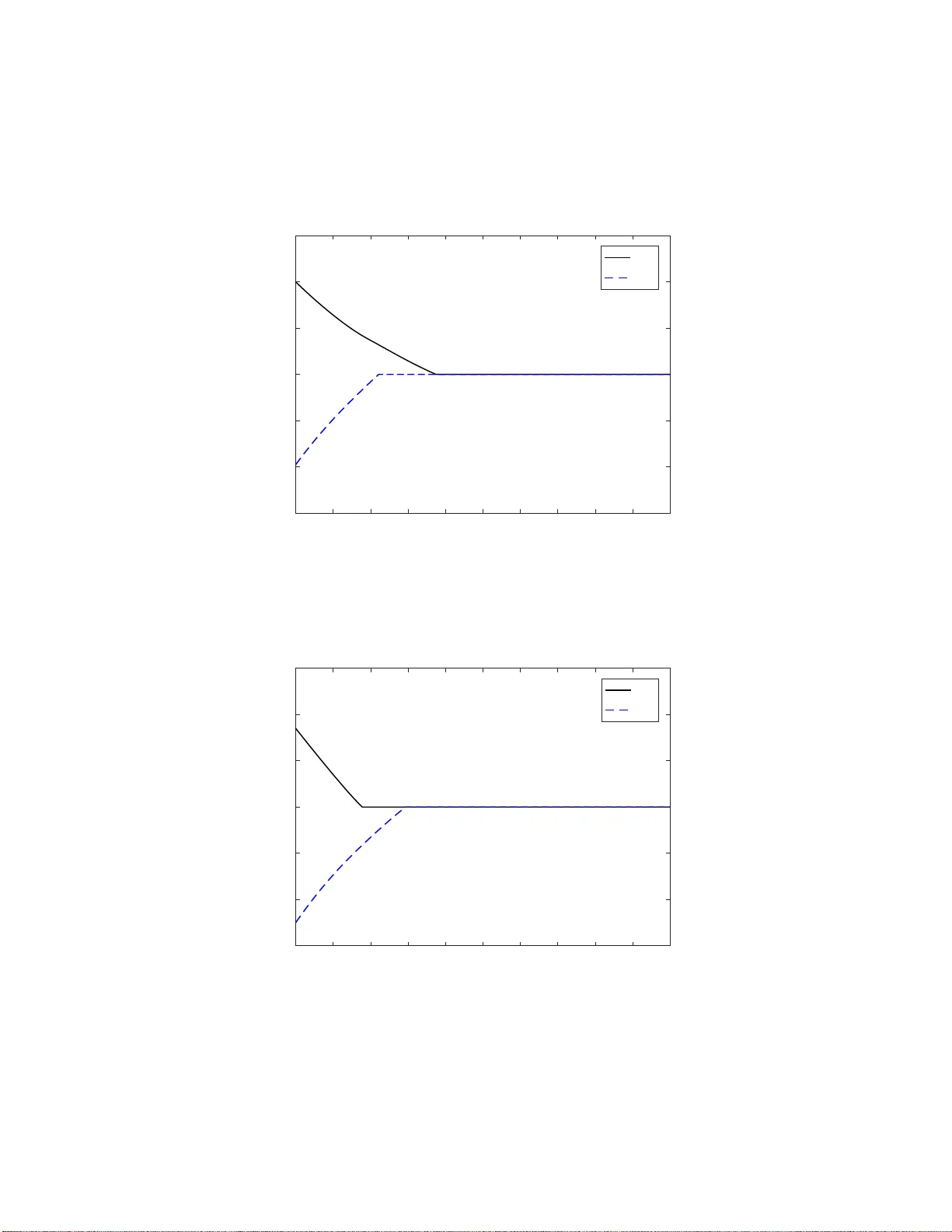
Finite time an ti-sync hronizati on of complex-v alued neural net w ork s with bo unded async hronous time-v aryi ng dela ys ✩ Xiw ei Liu ∗ , Zihan Li Dep artment of Computer Scienc e and T e chnolo gy, T ongji U niversity, and with the Key L ab or atory of Emb e dde d System and Servic e Computing, Ministry of Educ ation, Shanghai 201804, China Abstract In this pap er, w e studied the finite time anti-sync hronization of master- sla v e coupled c omplex-v alued neural net w orks (CVNNs) with b ounded asyn- c hronous time-v arying dela ys. With the decomp osing tec hnique and the generalized { ξ , ∞} -norm, se veral criteria for ensuring the finite-time anti- sync hronization are obtained. The whole an ti-sync hronization pro cess can b e divided into tw o parts: first, the no r m o f eac h error state comp onen t will c hange f rom initial v alues to 1 in finite time, then from 1 t o 0 in fixed time. Therefore, the whole time is finite. Finally , o ne typical numeric al example is presen ted to demonstrate the correctness of our obtained results. Key wor ds: An ti-sync hronization, async hronous, complex-v alued neural net w o rk, finite time, time-v arying delay ✩ This work was supp orted by the National Science F oundation of China under Gr ant No. 61673 298, 61 2 0314 9 ; Shang hai Rising- Star Pro gram of China under Gr ant No. 17QA14 04500 ; Natura l Science F oundation of Shanghai under Gr ant No. 17 Z R14457 00; the F undament al Research F unds for the Central Universities of T o ng ji University . ∗ Corresp o nding author. E-ma il addr ess: xwliu@to ng ji.edu.cn Pr eprint submitte d to Elsevier Octob er 2, 2019 1. In t ro duction Neural netw orks ha ve b een widely studied in the last thirty y ears and found a la r ge nu m b er of applications tigh tly a sso ciated with their dynami- cal b ehaviors in man y fields, suc h a s signal pro cessing, pattern recognition, optimization problems, and asso ciativ e memories [1]-[4]. How ev er, although real-v alued neural netw orks(R VNNs) ha v e ac hiev ed great success in man y ar- eas, they lik ely p erform w o rse in some ph ysical related applications, suc h as 2D affine transformatio n. As an extension of R VNNs, complex-v alued neural net w o rks(CVNNs) ha ve complex-v alued states, complex-v alued connection w eigh ts, and complex-v alued a ctiv ation functions, whic h mak e them more complicated. By virtue of the characteristic of complex nu m b er, CVNNs can b e applied t o many ph ysical systems related with electromagnetic, quan tum w av es, ultrasonic, light and so on. Moreo v er, CVNNs mak e it p o ssible to deal with the problems whic h simple R VNNs cannot solv e. F or example, as far as w e kno w, it is infeasible to solv e the X OR problem with only one signle real- v alued neuron, but it can b e solv ed with the complex-v alued one[5]. Besides, it is natural to deduce CVNNs to more complicated quaternion-v alued neu- ral netw or ks (QVNNs). Therefore, man y sc holars are attra cted to study the dynamical b eha viors and pro p erties of CVNNs, see [11],[22]- [2 7],[29, 3 0, 33]. Sync hronization (SYN), whic h is a sp ecial case of dynamical behav io r s, has b een extensiv ely studied in the recen t past b ecause of its significan t role in com binatorial optimization, image pro cessing, secure comm unication [6] and many other fields since it was prop osed b y Pe cor a and Carroll [7]. Under the concept o f “drive-response”, v arious kinds of SYN hav e b een put forw ar d so far, suc h as generalized SYN [8], phase SYN [9 ], lag SYN [10] and so 2 on. In fact, there is another inte resting phenomen on in chaotic oscillators, an ti- sync hronization (A-SYN), when A -SYN happ ens, the sum of t wo cor- resp ond state v ectors can con v erge to zero. It can b e used in many fields. F or example, in communic a tion system, the system’s securit y and secrecy can b e deeply strengthened b y transforming from SYN and A-SYN p erio di- cally in the pro cess of digita l signal transmission [12]. Hence, further study of A-SYN for dynamical syste ms is of high significance in b oth theory and practice [13, 1 4, 15]. On the other hand, in phy sical realization, time dela y is inevitable o wing to the time cost on amplifier switc hing and information transmission b etw een differen t no des, and it can cause undesirable impact theoretically . Th us, syn- c hronization pr o blem under time delay is also a hot researc h topic [16]-[21]. In [1 6 , 1 7], the authors prop ose a new w ay to in ve stigate t he SYN of a class of linearly coupled ordinary differen tial systems. In [18], the global exp onen- tial SYN of linearly coupled neural netw or ks with impulsiv e disturbances is solv ed b y using differen tial inequalit y metho d. In [19], the exp onen tial SYN of memristor neural netw orks (MNN) with time-v a r ying delay s is prov ed based on fuzzy theory , while [20] solv es the exp onen tial A-SYN of MRNN with b o unded dela ys b y using differe n tial inclusions and ine quality tec hnique. F or CVNN, the SYN proble m is m uc h more difficult to solv e than that of R VNN, and the biggest c hallenge is how to c ho ose an appropriate activ a t io n function [22]. According to Liouville ’s theorem, an y regular analytic func- tion cannot b e b ounded unless it reduces to a constan t. Th us, activ ation functions in CVNNs cannot b e b o unded and a na lytic sim ultaneously . One common tec hnique is to decomp ose the complex-v alued activ ation functions 3 to its real and imaginary parts, as a result, the original CVNNs are s epa- rated in to do uble R VNNs, man y results ha v e b een obtained by applying this metho d, see [22]-[30]. In [24, 27], the authors in v estigate the µ - stability of CVNNs with un b ounded time-v arying delays when f ( z ) can b e expressed as f ( z ) = f R ( x, y ) + if I ( x, y ), where z = x + iy . [26] considers the ex- p onen tia l stability problem for CVNN with time-v arying dela ys, sufficien t criteria are obtained based on the matrix measure metho d a nd Halana y in- equalit y metho d, a nd in [28], the exp onen t ia l SYN and A-SYN problems of complex-v alued MNN with b ounded dela ys are also solv ed with these tw o mathematical t o ols. [29 ] in v estigates the exp onen tial stabilit y for CVNNs with async hronous t ime delays by decomp osing and recasting an equiv alent R VNN, some s ufficien t conditions are giv en under three gene r a lized norms. [30] studies the A-SYN o f complex-v alued MNN with b ounded and deriv able time dela ys. It should b e no t ed that , the SYN problems presen t ed ab o ve are under the concept of classic asymptotic SYN. In fact, based on the con v ergence time, sync hronizatio n can b e divided in to a nother three t yp es: finite time SYN, fixed time SYN [31]. Compared with asymptotic SYN, they are more imp ortant and easier to b e realized and ve rified in real situations. In [32], t he authors reve al the essence of finite time and fixed time con vergenc e b y dis- cussing the typical function ˙ t ( V ) = µ − 1 ( V ). In [33], the authors inv estigate the problem of finite time SYN for CVNNs with mixed dela ys and uncer- tain p erturbations. In [34], the finite time A-SYN of MNN with sto c hastic p erturbations is addressed by using differen tia l inclusions and linear matrix inequalities ( L MI). In [12, 35], the authors inv estigate the finite time A-SYN 4 of R VNNs with b ounded and unbounded time-v a rying dela ys b y dividing the whole pro cess into tw o procedures. In [36], the finite time A-SYN problem for the master-sla ve neural net w orks with b ounded time dela ys is considered b y com bining t wo ineq ua lities with in tegral inequalit y skills . As far as w e kno w, there ar e few w orks dev oted to the finite time A-SYN problem for CVNNs with time delays. Motiv ated b y the aforemen tioned discussions, in this pap er, w e aim to solv e t he finite time A- SYN of CVNNs with async hronous time-v arying de- la ys with generalized { ξ , ∞ } -norm, Lyapuno v functional, and inequalit y tec h- nique. The considered master-sla v e CVNN s are decomp osed into their real and imaginary par t s respectiv ely . By designing a prop er con trol la w, some criteria are give n for the finite time A-SYN pro cess. In the follwing, w e giv e the orga nization structure of the rest part of this pap er. In Section 2, w e giv e the mo del description and decomp o sition, apart from this, s o me definitions , a ssumptions, and notations used later a re also presen ted. In Section 3, w e giv e some criteria for the finite time A-SYN for our mo del, and the pro of . In Section 4, one detailed n umerical s im ulation is give n to demonstrate the correctness of our obtained results. Finally , we summarize this pap er and discuss ab out our future w orks in Section 5. Notations Throughout this pap er, R m × n and C m × n denote an y m × n dimensional real-v alued and complex-v alued matrices, where C is the set of complex n umbers. F or any v ector α = ( α j ) 1 × n , j = 1 , · · · , n , d enote α T as the transp osition of α , and denote | α | = ( | α j | ) 1 × n . 5 2. Mo del description A t first, w e presen t some matrices to show the prop ert y of the dot pro duct op eration b etw een an y tw o complex-v alued n umbers a and b , where a = a R + ia I , b = b R + ib I . Define a 2 -dimensional matrix M = 1 i i − 1 = M R + iM I , (1) where M R = 1 0 0 − 1 , M I = 0 1 1 0 . Definition 1. F o r any two c omp lex numb ers a and b , denote b a = ( a R , a I ) T , b b = ( b R , b I ) T , (2) then a · b = b a T M b b = b a T M R b b + i b a T M I b b (3) i.e., b ab = ( b a T M R b b, b a T M I b b ) T = ( a R b R − a I b I , a R b I + a I b R ) T (4) In t he following pap er, this prop erty is utilized to reduce the redundancy of the calculation and represen tation. Consider the fo llo wing CVNN with async hro nous time-v arying delays : ˙ x j ( t ) = − d j x j ( t ) + n X k =1 a j k f k ( x k ( t )) + n X k =1 b j k g k ( x k ( t − τ j k ( t ))) + H j (5) 6 where x j = x R j + ix I j ∈ C is the state of j -th neuron, j = 1 , · · · , n ; D = diag( d 1 , · · · , d n ) ∈ R n × n with d j > 0 is t he feedbac k self-connection w eigh t matrix; f j ( · ) : C → C and g j ( · ) : C → C are complex-v alued activ a t ion functions without and with time delays ; matrices A = ( a j k ) ∈ C n × n and B = ( b j k ) ∈ C n × n represen t the complex-v alued connection w eight matrices without and with time delays ; τ j k ( t ) is b ounded, async hronous, and time- v arying with 0 ≤ τ j k ( t ) ≤ τ ; H j ∈ C is t he j -th external input. The initial functions of (5) are giv en b y x j ( θ ) = Φ j ( θ ) = Φ R j ( θ ) + i Φ I j ( θ ) , for θ ∈ [ − τ , 0] , j = 1 , · · · , n F or con v enience, we denote f ℓ k ( x ; t ) = f ℓ k ( x k ( t )) , g ℓ k τ j k ( x ; t ) = g ℓ k ( x k ( t − τ j k ( t ))) , (6) then according to rule (3), CVNN (5) can b e decompo sed into t w o equiv alent R VNNs : ˙ x R j ( t ) = − d j x R j ( t ) + n X k =1 b a T j k M R b f k ( x ; t ) + n X k =1 b b T j k M R b g k τ j k ( x ; t ) + H R j , (7) ˙ x I j ( t ) = − d j x I j ( t ) + n X k =1 b a T j k M I b f k ( x ; t ) + n X k =1 b b T j k M I b g k τ j k ( x ; t ) + H I j . (8) Let (5) b e the master system, then the slav e system is defined as ˙ y j ( t ) = − d j y j ( t ) + n X k =1 a j k f k ( y k ( t )) + n X k =1 b j k g k ( y k ( t − τ j k ( t ))) + H j + u j ( t ) (9) with the initial state y j ( θ ) = Ψ j ( θ ) = Ψ R j ( θ ) + i Ψ I j ( θ ) , for θ ∈ [ − τ , 0] , j = 1 , · · · , n 7 The con trol sc heme u j ( t ) ∈ C , j = 1 , · · · , n is designed to b e only de- p ending on the system state at the presen t time a nd will b e defined later. Similarly , CVNN (9) can b e decomp osed in to t wo equiv alen t R VNNs: ˙ y R j ( t ) = − d j y R j ( t ) + n X k =1 b a T j k M R b f k ( y ; t ) + n X k =1 b b T j k M R b g k τ j k ( y ; t ) + H R j + u R j ( t ) , (10) ˙ y I j ( t ) = − d j y I j ( t ) + n X k =1 b a T j k M I b f k ( y ; t ) + n X k =1 b b T j k M I b g k τ j k ( y ; t ) + H I j + u I j ( t ) . (11) Denote e j ( t ) = x j ( t ) + y j ( t ) b e the j - th comp onent of A- SYN error b e- t we en netw or ks (5 ) and (9), then o ne can get ˙ e j ( t ) = − d j e j ( t ) + n X k =1 a j k f k ( x ; t ) + f k ( y ; t ) + n X k =1 b j k g k τ j k ( x ; t ) + g k τ j k ( y ; t )) + 2 H j + u j ( t ) , j = 1 , · · · , n (12) Similarly , denote e R j ( t ) = x R j ( t ) + y R j ( t ) and e I j ( t ) = x I j ( t ) + y I j ( t ), then system (12) can a lso b e decomp o sed as ˙ e R j ( t ) = − d j e R j ( t ) + n X k =1 b a T j k M R b f k ( x ; t ) + b f k ( y ; t ) + n X k =1 b b T j k M R b g k τ j k ( x ; t ) + b g k τ j k ( y ; t ) + 2 H R j + u R j ( t ) , (13) ˙ e I j ( t ) = − d j e I j ( t ) + n X k =1 b a T j k M I b f k ( x ; t ) + b f k ( y ; t ) + n X k =1 b b T j k M I b g k τ j k ( x ; t ) + b g k τ j k ( y ; t ) + 2 H I j + u I j ( t ) . (14) 8 As for the measuremen t o f the A-SYN error, we choose the following generalized { ξ , ∞} -no rm in this pap er. Definition 2. ([37]) F or any ve ctor v ( t ) = ( v 1 ( t ) , v 2 ( t ) , · · · , v n ( t )) T ∈ R n × 1 , its { ξ , ∞} -norm is define d as: k v ( t ) k { ξ , ∞} = max {| ξ − 1 j v j ( t ) |} , (15) wher e ξ = ( ξ 1 , · · · , ξ n ) T with ξ j > 0 , j = 1 , · · · , n . Obviously, when ξ = (1 , · · · , 1) T , this { ξ , ∞} -no rm is the c onventional ∞ -norm. No w, w e giv e some assumptions on the activ ation functions. Assumption 1. Assume f k ( x k ) and g k ( x k ) c an b e de c omp ose d in to r e al an d imaginary p art as f k ( x k ) = f R k ( x R k , x I k )+ if I k ( x R k , x I k ) and g k ( x k ) = g R k ( x R k , x I k )+ ig I k ( x R k , x I k ) , f ℓ k and g ℓ k ar e al l o dd functions, for ℓ = R, I , i.e., f ℓ k ( x R k , x I k ) = − f ℓ k ( − x R k , − x I k ) , g ℓ k ( x R k , x I k ) = − g ℓ k ( − x R k , − x I k ) . (16) Assumption 2. Supp ose that f ℓ k and g ℓ k ar e Lipschitz-c ontinuous with r es p e ct to (w.r.t.) e ach c omp onent, i.e., ther e exist p ositive c onstants λ ℓ 1 ℓ 2 k , γ ℓ 1 ℓ 2 k , ℓ 1 , ℓ 2 = R , I , such that 0 ≤ ∂ f ℓ 1 k ( x R k , x I k ) ∂ x ℓ 2 k ≤ λ ℓ 1 ℓ 2 k , ∂ g ℓ 1 k ( x R k , x I k ) ∂ x ℓ 2 k ≤ γ ℓ 1 ℓ 2 k (17) Using these constan ts λ ℓ 1 ℓ 2 k , κ ℓ 1 ℓ 2 k , we can define four matrices which will b e used in the follow ing analysis: Λ k = λ RR k λ RI k λ I R k λ I I k , Γ k = γ RR k γ RI k γ I R k γ I I k e Λ k = λ I R k λ I I k λ RR k λ RI k , e Γ k = γ I R k γ I I k γ RR k γ RI k (18) 9 3. Main results In this section, w e prov e t ha t the error systems (1 3) and ( 1 4) can a chiev e A-SYN in finite time. A t first, let us define the external con troller u j ( t ) = u R j ( t ) + iu I j ( t ) as u R j ( t ) = − sign( e R j ( t )) µ j | e R j ( t ) | + ρ j | e R j ( t ) | β + η j (19) u I j ( t ) = − sign( e I j ( t )) e µ j | e I j ( t ) | + e ρ j | e I j ( t ) | β + e η j (20) where 0 < β < 1, µ j , ρ j , η j , e µ j , e ρ j , e η j will b e defined in the next theorem. Theorem 1. Assume Assumptions 1 an d 2 hold, err or systems (13) and (14) wil l a c h ieve A-SYN in finite time if ther e exists a ve ctor ξ = ( ξ 1 , ξ 2 , · · · , ξ n , φ 1 , φ 2 , · · · , φ n ) T > 0 (21) such that for any j = 1 , 2 , · · · , n , the fol lowing ine qualities hold: µ j > − d j + ( { a R j j } + , {− a I j j } + )( λ RR j , λ I R j ) T + ξ − 1 j φ j ( | a R j j | , | a I j j | )( λ RI j , λ I I j ) T + ξ − 1 j X k 6 = j | b a T j k | Λ k ( ξ k , φ k ) T + ξ − 1 j n X k =1 | b b T j k | Γ k ( ξ k , φ k ) T , (22) e µ j > − d j + φ − 1 j ξ j ( | a I j j | , | a R j j | )( λ RR j , λ I R j ) T + ( { a I j j } + , { a R j j } + )( λ RI j , λ I I j ) T + φ − 1 j X k 6 = j | b a T j k | e Λ k ( ξ k , φ k ) T + φ − 1 j n X k =1 | b b T j k | e Γ k ( ξ k , φ k ) T , (23) ρ j > − d j + ( { a R j j } + , {− a I j j } + )( λ RR j , λ I R j ) T + ( φ − 1 j ξ j ) 1 β − 1 ( | a R j j | , | a I j j | )( λ RI j , λ I I j ) T + ξ 1 β − 1 j X k 6 = j | b a T j k | Λ k ( ξ 1 1 − β k , φ 1 1 − β k ) T − µ j + , (24) 10 e ρ j > − d j + ( { a I j j } + , { a R j j } + )( λ RI j , λ I I j ) T + ( ξ − 1 j φ j ) 1 β − 1 ( | a I j j | , | a R j j | )( λ RR j , λ I R j ) T + φ 1 β − 1 j X k 6 = j | b a T j k | e Λ k ( ξ 1 1 − β k , φ 1 1 − β k ) T − e µ j + , (25) η j ≥ n X k =1 | b b T j k | Γ k (1 , 1) T + 2 | H R j | , (26) e η j ≥ n X k =1 | b b T j k | e Γ k (1 , 1) T + 2 | H I j | , (27) wher e a + = max( 0 , a ) . Ther e ar e two imp ortant time p oints, wh e r e T 1 de- notes the first time the { ξ , ∞} -norm of the err ors in (13) and (14) have al l cr o sse d o ver 1 , T 2 denotes the first time the err or va lues al l b e c om e 0 . Exact values of T 1 and T 2 wil l b e g i v en in the pr o of. Pro of: F or real-v alued systems (1 3) and (14), if sup − τ ≤ s ≤ 0 max j =1 , ··· ,n | e R j ( s ) | ≤ 1 and sup − τ ≤ s ≤ 0 max j =1 , ··· , n | e I j ( s ) | ≤ 1, then w e can deduce that T 1 = 0. Ot herwise, b y conditio ns (22) and (23 ), w e can c ho ose a constan t ǫ > 0 small enoug h so that ( ǫ − d j − µ j ) + ( { a R j j } + , {− a I j j } + )( λ RR j , λ I R j ) T + ξ − 1 j φ j ( | a R j j | , | a I j j | )( λ RI j , λ I I j ) T + ξ − 1 j X k 6 = j | b a T j k | Λ k ( ξ k , φ k ) T + ξ − 1 j e ǫτ n X k =1 | b b T j k | Γ k ( ξ k , φ k ) T < 0 , (28) ( ǫ − d j − e µ j ) + φ − 1 j ξ j ( | a I j j | , | a R j j | )( λ RR j , λ I R j ) T + ( { a I j j } + , { a R j j } + )( λ RI j , λ I I j ) T + φ − 1 j X k 6 = j | b a T j k | e Λ k ( ξ k , φ k ) T + φ − 1 j e ǫτ n X k =1 | b b T j k | e Γ k ( ξ k , φ k ) T < 0 . (29) F or all t ≥ 0, denote E 1 ( t ) = ( e R 1 , e R 2 , · · · , e R n , e I 1 , e I 2 , · · · , e I n ) T 11 with k E 1 ( t ) k { ξ , ∞} = max n max j =1 , ··· ,n | ξ − 1 j e R j ( t ) | , max j =1 , ··· ,n | φ − 1 j e I j ( t ) | o , (30) and M ( E 1 ( t )) = sup t − τ ≤ s ≤ t e ǫs k E 1 ( s ) k { ξ , ∞} . (31) Ob viously , e ǫt | ξ − 1 j e R j ( t ) | ≤ M ( E 1 ( t )), and e ǫt | φ − 1 j e I j ( t ) | ≤ M ( E 1 ( t )). In the follo wing, w e only discuss the conditio n e ǫt | ξ − 1 j e R j ( t ) | ≤ M ( E 1 ( t )). The other case can also b e discuss ed with the same pro cess. ( I ) If e ǫt | ξ − 1 j e R j ( t ) | < M ( E 1 ( t )) fo r all j = 1 , · · · , n , w e kno w that there m ust be a constant δ 1 > 0 with whic h e ǫs | ξ − 1 j e R j ( s ) | < M ( E 1 ( t )) and M ( E 1 ( s ) ≤ M ( E 1 ( t )) for s ∈ ( t, t + δ 1 ). ( I I ) If there exist a n index j 0 and a time p oin t t 0 ≥ 0 suc h that e ǫ t 0 | ξ − 1 j 0 e R j 0 ( t 0 ) | = M ( E 1 ( t 0 )) , (32) then one gets ξ j 0 dM ( E 1 ( t )) dt t = t 0 = de ǫt | e R j 0 ( t ) | dt t = t 0 = ǫe ǫ t 0 | e R j 0 | + e ǫ t 0 sign( e R j 0 ) · − d j 0 e R j 0 + n X k =1 b a T j 0 k M R b f k ( x ; t 0 ) + b f k ( y ; t 0 ) + n X k =1 b b T j 0 k M R b g k τ j 0 k ( x ; t 0 ) + b g k τ j 0 k ( y ; t 0 ) + 2 H R j 0 − sign( e R j 0 ) µ j 0 | e R j 0 | + ρ j 0 | e R j 0 | β + η j 0 ≤ e ǫ t 0 ( ǫ − d j 0 ) | e R j 0 ( t 0 ) | + sign ( e R j 0 ) b a T j 0 j 0 M R b f j 0 ( x ; t 0 ) + b f j 0 ( y ; t 0 ) + X k 6 = j 0 | b a j 0 k | T | b f k ( x ; t 0 ) + b f k ( y ; t 0 ) | 12 + n X k =1 | b b j 0 k | T | b g k τ j 0 k ( x ; t 0 ) + b g k τ j 0 k ( y ; t 0 ) | + 2 | H R j 0 | − µ j 0 | e R j 0 ( t 0 ) | − ρ j 0 | e R j 0 ( t 0 ) | β − η j 0 ≤ e ǫ t 0 ( ǫ − d j 0 ) | e R j 0 ( t 0 ) | + ( { a R j 0 j 0 } + , {− a I j 0 j 0 } + )( λ RR j 0 , λ I R j 0 ) T | e R j 0 ( t 0 ) | + ( | a R j 0 j 0 | , | a I j 0 j 0 | )( λ RI j 0 , λ I I j 0 ) T | e I j 0 ( t 0 ) | + X k 6 = j 0 | b a T j 0 k | Λ k | b e k ( t 0 ) | + n X k =1 | b b T j 0 k | Γ k | b e k τ j 0 k ( t 0 ) | − µ j 0 | e R j 0 ( t 0 ) | = ξ j 0 ( ǫ − d j 0 ) e ǫ t 0 ξ − 1 j 0 | e R j 0 ( t 0 ) | + ξ j 0 ( { a R j 0 j 0 } + , {− a I j 0 j 0 } + )( λ RR j 0 , λ I R j 0 ) T e ǫt 0 ξ − 1 j 0 | e R j 0 ( t 0 ) | + φ j 0 ( | a R j 0 j 0 | , | a I j 0 j 0 | )( λ RI j 0 , λ I I j 0 ) T e ǫt 0 φ − 1 j 0 | e I j 0 ( t 0 ) | + X k 6 = j 0 | b a T j 0 k | Λ k diag( ξ k , φ k ) e ǫ t 0 ( ξ − 1 k | b e R k ( t 0 ) | , φ − 1 k | b e I k ( t 0 ) | ) T + e ǫτ j 0 k ( t 0 ) n X k =1 | b b T j 0 k | Γ k diag( ξ k , φ k ) e ǫ ( t 0 − τ j 0 k ( t 0 )) · ( ξ − 1 k | b e R k τ j 0 k ( t 0 ) | , φ − 1 k | b e I k τ j 0 k ( t 0 ) | ) T − ξ j 0 µ j 0 e ǫ t 0 ξ − 1 j 0 | e R j 0 ( t 0 ) | ≤ ξ j 0 ( ǫ − d j 0 − µ j 0 ) + ( { a R j 0 j 0 } + , {− a I j 0 j 0 } + )( λ RR j 0 , λ I R j 0 ) T + ξ − 1 j 0 φ j 0 ( | a R j 0 j 0 | , | a I j 0 j 0 | )( λ RI j 0 , λ I I j 0 ) T + ξ − 1 j 0 X k 6 = j 0 | b a T j 0 k | Λ k ( ξ k , φ k ) T + ξ − 1 j 0 e ǫτ n X k =1 | b b T j 0 k | Γ k ( ξ k , φ k ) T k e ǫ t 0 E 1 ( t 0 ) k { ξ , + ∞} ≤ 0 Otherwise, e ǫt | φ − 1 j e I j ( t ) | ≤ M ( E 1 ( t )), there also exists t wo cases, and the deriv ation pro cedure is similar to the con ten t a b o v e, so it is omitt ed here. 13 Therefore, for all t ≥ 0, M ( E 1 ( t )) is non-increasing and M ( E 1 ( t )) ≤ M ( E 1 (0)), whic h means tha t min j =1 , ··· , n { ξ − 1 j } e ǫ ( t − τ ) sup t − τ ≤ s ≤ t max j =1 , ··· ,n | e R j ( s ) | ≤ M ( E 1 ( t )) ≤ M ( E 1 (0)) i.e., sup t − τ ≤ s ≤ t max j =1 , ··· , n | e R j ( s ) | ≤ max j =1 , ··· ,n { ξ j } M ( E 1 (0)) e ǫ ( t − τ ) Th us, as time t increases, sup t − τ ≤ s ≤ t max j =1 , ··· , n | e R j ( s ) | w ould be less t ha n 1. W e denote T R 1 as t he first time p oint suc h that max j =1 , ··· ,n { ξ j } M ( E 1 (0)) e ǫ ( T R 1 − τ ) = 1, and sup t − τ ≤ s ≤ t max j =1 , ··· , n | e R j ( s ) | ≤ 1 for t ≥ T R 1 , here T R 1 = ǫ − 1 ln max j =1 , ··· , n { ξ j } M ( E 1 (0)) + τ . (33) Similarly , w e denote the first time p oin t that max j =1 , ··· ,n { φ j } M ( E 1 (0)) e ǫ ( T I 1 − τ ) = 1 as T I 1 , and sup t − τ ≤ s ≤ t max j =1 , ··· ,n | e I j ( s ) | ≤ 1 for t ≥ T I 1 , here T I 1 = ǫ − 1 ln max j =1 , ··· , n { φ j } M ( E 1 (0)) + τ . (34) Denote T 1 = max( T R 1 , T I 1 ), the absolute v alues of r eal- v alued error sys - tems (13) and (14) are a ll no more than than 1 for t ≥ T 1 . It completes the first part of the pro of. In the fol lowing, we pr ove the values of err or systems wil l flow fr om 1 to 0 no mor e than time T 2 . Pic k t w o small constan ts ρ ∗ , ρ ⋆ > 0 such that for all j = 1 , · · · , n , 0 < ρ ∗ < ξ − 1 j ρ j − − d j + ( { a R j j } + , {− a I j j } + )( λ RR j , λ I R j ) T 14 + ( φ − 1 j ξ j ) 1 β − 1 ( | a R j j | , | a I j j | )( λ RI j , λ I I j ) T (35) + ξ 1 β − 1 j X k 6 = j | b a T j k | Λ k ( ξ 1 1 − β k , φ 1 1 − β k ) T − µ j + (36) and 0 < ρ ⋆ < φ − 1 j e ρ j − − d j + ( { a I j j } + , { a R j j } + )( λ RI j , λ I I j ) T + ( ξ − 1 j φ j ) 1 β − 1 ( | a I j j | , | a R j j | )( λ RR j , λ I R j ) T (37) + φ 1 β − 1 j X k 6 = j | b a T j k | e Λ k ( ξ 1 1 − β k , φ 1 1 − β k ) T − e µ j + (38) Denote ρ = min ( ρ ∗ , ρ ⋆ ) . (39) F or all t ≥ T 1 , denote E 2 ( t ) = e R 1 ( t ) 1 − β 1 − β , · · · , e R n ( t ) 1 − β 1 − β , e I 1 ( t ) 1 − β 1 − β , · · · , e I n ( t ) 1 − β 1 − β T with k E 2 ( t ) k { ξ , ∞} = max n max j =1 , ··· ,n ξ − 1 j | e R j ( t ) | 1 − β 1 − β , max j =1 , ··· ,n φ − 1 j | e I j ( t ) | 1 − β 1 − β o (40) and V ( E 2 ( t )) = sup t − τ ≤ s ≤ t k E 2 ( s ) k { ξ , ∞} + ρs (41) Ob viously , ξ − 1 j | e R j ( t ) | 1 − β 1 − β + ρt ≤ V ( E 2 ( t )) and φ − 1 j | e I j ( t ) | 1 − β 1 − β + ρt ≤ V ( E 2 ( t )). Similar to the pro cedure in the first part, w e will first discuss the cas e that ξ − 1 j | e R j ( t ) | 1 − β 1 − β + ρt ≤ V ( E 2 ( t )) , j = 1 , 2 , · · · , n . 15 ( I ) If ξ − 1 j | e R j ( t ) | 1 − β 1 − β + ρt < V ( E 2 ( t )), there m ust b e a constant δ 2 > 0 such that ξ − 1 j | e R j ( s ) | 1 − β 1 − β + ρs < V ( E 2 ( t )), and V ( E 2 ( s )) ≤ V ( E 2 ( t )) for s ∈ ( t, t + δ 2 ). ( I I ) If there exist an index j 1 and a time po int t 1 ≥ T 1 suc h that ξ − 1 j 1 | e R j 1 ( t 1 ) | 1 − β 1 − β + ρt 1 = V ( E 2 ( t 1 )), then w e hav e ξ j 1 dV ( E 2 ( t )) dt t = t 1 = d dt | e R j 1 ( t ) | 1 − β 1 − β + ξ j 1 ρt t = t 1 ≤| e R j 1 ( t 1 ) | − β − d j 1 | e R j 1 ( t 1 ) | + ( { a R j 1 j 1 } + , {− a I j 1 j 1 } + )( λ RR j 1 , λ I R j 1 ) T | e R j 1 ( t 1 ) | + ( | a R j 1 j 1 | , | a I j 1 j 1 | )( λ RI j 1 , λ I I j 1 ) T | e I j 1 ( t 1 ) | + X k 6 = j 1 | b a T j 1 k | Λ k | b e k ( t 1 ) | + n X k =1 | b b T j 1 k | Γ k | b e k τ j 1 k ( t 1 ) | + 2 | H R j 1 | − µ j 1 | e R j 1 ( t 1 ) | − ρ j 1 | e R j 1 ( t 1 ) | β − η R j 1 + ξ j 1 ρ (42) F ro m (4 0), w e ha ve ξ − 1 k | e R k ( t 1 ) | 1 − β 1 − β ≤ ξ − 1 j 1 | e R j 1 ( t 1 ) | 1 − β 1 − β , i.e., ξ 1 β − 1 k | e R k ( t 1 ) | ≤ ξ 1 β − 1 j 1 | e R j 1 ( t 1 ) | , k = 1 , · · · , n (43) Moreo ve r , note that sup T 1 − τ ≤ s ≤ T 1 max j =1 , ··· , n | e R j ( s ) | ≤ 1, and as lo ng as sup t − τ ≤ s ≤ t max j =1 , ··· , n | e R j ( s ) | ≤ 1, then | e R j ( t − τ j k ( t )) | ≤ 1 , j, k = 1 , · · · , n (44) Similarly , w e can also get tha t φ 1 β − 1 k | e I k ( t 1 ) | ≤ ξ 1 β − 1 j 1 | e R j 1 ( t 1 ) | . (45) 16 Therefore, comb ining with (42)-(45), one can get ξ j 1 dV ( E 2 ( t )) dt t = t 1 ≤| e R j 1 ( t 1 ) | − β − d j 1 | e R j 1 ( t 1 ) | + ( { a R j 1 j 1 } + , {− a I j 1 j 1 } + )( λ RR j 1 , λ I R j 1 ) T | e R j 1 ( t 1 ) | + ( | a R j 1 j 1 | , | a I j 1 j 1 | )( λ RI j 1 , λ I I j 1 ) T ( φ − 1 j 1 ξ j 1 ) 1 β − 1 | e R j 1 ( t 1 ) | + X k 6 = j 1 | b a T j 1 k | Λ k diag( ξ 1 1 − β k , φ 1 1 − β k ) ξ 1 β − 1 k | e R k ( t 1 ) | , φ 1 β − 1 k | e I k ( t 1 ) | T + n X k =1 | b b T j 1 k | Γ k (1 , 1) T + 2 | H R j 1 | − µ j 1 | e R j 1 ( t 1 ) | − ρ j 1 | e R j 1 ( t 1 ) | β − η R j 1 + ξ j 1 ρ ≤| e R j 1 ( t 1 ) | − β − d j 1 + ( { a R j 1 j 1 } + , {− a I j 1 j 1 } + )( λ RR j 1 , λ I R j 1 ) T + ( φ − 1 j 1 ξ j 1 ) 1 β − 1 ( | a R j 1 j 1 | , | a I j 1 j 1 | )( λ RI j 1 , λ I I j 1 ) T + ξ 1 β − 1 j 1 X k 6 = j 1 | b a T j 1 k | Λ k ( ξ 1 1 − β k , φ 1 1 − β k ) T − µ j 1 | e R j 1 ( t 1 ) | + n X k =1 | b b T j 1 k | Γ k (1 , 1) T + 2 | H R j 1 | − η R j 1 + − ρ j 1 + ξ j 1 ρ ≤ − d j 1 + ( { a R j 1 j 1 } + , {− a I j 1 j 1 } + )( λ RR j 1 , λ I R j 1 ) T + ( φ − 1 j 1 ξ j 1 ) 1 β − 1 ( | a R j 1 j 1 | , | a I j 1 j 1 | )( λ RI j 1 , λ I I j 1 ) T + ξ 1 β − 1 j 1 X k 6 = j 1 | b a T j 1 k | Λ k ( ξ 1 1 − β k , φ 1 1 − β k ) T − µ j 1 + + − ρ j 1 + ξ j 1 ρ < 0 whic h implies that there m ust exist σ 2 > 0 suc h that ξ − 1 j | e R j ( s ) | 1 − β 1 − β + ρs < ξ − 1 j 1 | e R j 1 ( t 1 ) | 1 − β 1 − β + ρt 1 holds for all s ∈ ( t 1 , t 1 + σ 2 ). F or the other condition φ − 1 j | e I j ( t ) | 1 − β 1 − β + ρt ≤ V ( E 2 ( t )), it can b e analysed 17 in the same wa y , so it is omitted here. Th us, w e conclude that min j =1 , ··· , n { ξ − 1 j } ma x j =1 , ··· ,n | e R j ( t ) | 1 − β 1 − β + ρt ≤ V ( E 2 ( t )) ≤ V ( E 2 ( T 1 )) min j =1 , ··· , n { φ − 1 j } ma x j =1 , ··· ,n | e I j ( t ) | 1 − β 1 − β + ρt ≤ V ( E 2 ( t )) ≤ V ( E 2 ( T 1 )) i.e., max j =1 , ··· ,n | e R j ( t ) | 1 − β ≤ (1 − β ) max j =1 , ··· ,n ξ j · sup T 1 − τ ≤ s ≤ T 1 k E 2 ( s ) k { ξ , ∞} − ρ ( t − T 1 ) max j =1 , ··· ,n | e I j ( t ) | 1 − β ≤ (1 − β ) max j =1 , ··· ,n φ j · sup T 1 − τ ≤ s ≤ T 1 k E 2 ( s ) k { ξ , ∞} − ρ ( t − T 1 ) It is obvious that max j =1 , ··· , n | e R j ( t ) | and ma x j =1 , ··· , n | e I j ( t ) | will decrease to 0 , denote T 2 as the first time they all b ecome 0, then max j =1 , ··· , n | e R j ( T 2 ) | 1 − β = 0 and max j =1 , ··· ,n | e I j ( T 2 ) | 1 − β = 0. Th us w e obtain T 2 = 1 min { ξ } · ρ (1 − β ) + T 1 (46) here min { ξ } = min { min j =1 , ··· ,n { ξ j } , min j =1 , ··· ,n { φ j }} , which means that, the absolute v alue of r eal- v alued error systems will flo w from 1 to 0 no longer than T 2 . It completes the pro of. Remark 1. If w e do not c onsider the effe ct of sign, i . e . , the c ondi tion for f in (17) is r eplac e d b y the Lipschitz c ondition, i.e., ∂ f ℓ 1 k ( x R k , x I k ) ∂ x ℓ 2 k ≤ λ ℓ 1 ℓ 2 k , (47) then the c onditions (22)-(25) in The or em 1 ar e r eplac e d by the fol lowing: µ j > − d j + ξ − 1 j n X k =1 | b a T j k | Λ k ( ξ k , φ k ) T + n X k =1 | b b T j k | Γ k ( ξ k , φ k ) T (48) 18 e µ j > − d j + φ − 1 j n X k =1 | b a T j k | e Λ k ( ξ k , φ k ) T + n X k =1 | b b T j k | e Γ k ( ξ k , φ k ) T (49) ρ j > max 0 , − d j + ξ 1 β − 1 j n X k =1 | b a T j k | Λ k ( ξ 1 1 − β k , φ 1 1 − β k ) T − µ j (50) e ρ j > max 0 , − d j + φ 1 β − 1 j n X k =1 | b a T j k | e Λ k ( ξ 1 1 − β k , φ 1 1 − β k ) T − e µ j (51) Remark 2. When ξ = (1 , · · · , 1 ) T and the CVNN is R VNN, then it b e c omes the c ase di s c usse d in [12], so this p ap er c an b e r e gar de d as a gener alization of the r esult in [12]. Remark 3. In fact, the pr oblem c an b e solve d without using the matrix r ep- r es e ntation, but the advantage of the ma trix m etho d is that it c an b e e asier to b e extende d to higher dimension neur al networks, such as quaternion-value d neur a l network s [38]. Remark 4. S YN c an also b e solve d by the s ame pr o c ess as in this the or em, and in some asp e ct, the pr o c es s is e asie r than A-SYN, inter este d r e ad e rs ar e enc our age d to c omplete the p r o of. Remark 5. In this p ap er, we de al with the A-SYN by de c omp osing the CVNN into R VNNs, in or der to c o m p e nsate the c ondition that the time-varying delay is asynch r onous. In fa ct, we c an also solve this p ap er by r e gar ding the CVNN as a whole, but in this c ase, the time-varying delay should b e r estrict to b e the same, which wil l b e c o n sider e d in our fol lowing p ap ers. 4. Numerical sim ulations In this part, a numerical example is g iven to show the corr ectness of our results. 19 Consider a tw o - neuron ma ster-slav e CVNN described as f o llo ws: ˙ x 1 ( t ) = − d 1 x 1 ( t ) + a 11 f 1 ( x 1 ( t )) + a 12 f 2 ( x 2 ( t )) + b 11 g 1 ( x 1 ( t − τ 11 ( t ))) + b 12 g 2 ( x 2 ( t − τ 12 ( t ))) + H 1 ˙ x 2 ( t ) = − d 2 x 2 ( t ) + a 21 f 1 ( x 1 ( t )) + a 22 f 2 ( x 2 ( t )) + b 21 g 1 ( x 1 ( t − τ 21 ( t ))) + b 22 g 2 ( x 2 ( t − τ 22 ( t ))) + H 2 ˙ y 1 ( t ) = − d 1 y 1 ( t ) + a 11 f 1 ( y 1 ( t )) + a 12 f 2 ( y 2 ( t )) + b 11 g 1 ( y 1 ( t − τ 11 ( t ))) + b 12 g 2 ( y 2 ( t − τ 12 ( t ))) + H 1 + u 1 ˙ y 2 ( t ) = − d 2 y 2 ( t ) + a 21 f 1 ( y 1 ( t )) + a 22 f 2 ( y 2 ( t )) + b 21 g 1 ( y 1 ( t − τ 21 ( t ))) + b 22 g 2 ( y 2 ( t − τ 22 ( t ))) + H 2 + u 2 (52) where x j = x R j + ix I j , y j = y R j + iy I j , j = 1 , 2, d 1 = 0 . 5, d 2 = 1, A = ( a j k ) 2 × 2 = 1 . 2 + 0 . 2 i 0 . 8 + 1 . 2 i 1 + 1 . 5 i 0 . 4 + 0 . 2 i , B = ( b j k ) 2 × 2 = 0 . 2 + 1 . 2 i 0 . 2 + 0 . 8 i 1 . 5 + i 0 . 2 + 0 . 4 i , f k ( x k ) = 1 − exp( − x R k − 2 x I k ) 1 + exp( − x R k − 2 x I k ) + i 1 − exp( − 2 x R k − x I k ) 1 + exp( − 2 x R k − x I k ) , g k ( x k ) = | x R k + x I k + 1 | − | x R k + x I k − 1 | 2 + i | x R k + x I k + 1 | − | x R k + x I k − 1 | 2 , τ 11 = e t 1 + e t , τ 12 = e t − 0 . 5 1 + e t , τ 21 = 1 1 + | cos(10 t ) | , τ 22 = 1 1 + | sin(10 t ) | , ob viously τ j k ( t ) ≤ τ = 1 for j, k = 1 , · · · , n, H 1 = 0 . 1 + 0 . 1 i, H 2 = 0 . 2 + 0 . 2 i, Φ( θ ) = (Φ 1 ( θ ) , Φ 2 ( θ )) T = ( − 1 − 2 i, 1 . 5 − 1 . 5 i ) T , θ ∈ [ − 1 , 0] , Ψ( θ ) = (Ψ 1 ( θ ) , Ψ 2 ( θ )) T = (5 + 5 . 4 i, − 5 . 4 − 3 . 5 i ) T , θ ∈ [ − 1 , 0] 20 0 2 4 6 8 10 12 14 16 18 20 Time t -6 -4 -2 0 2 4 6 e R (t) e 1 R (t) e 2 R (t) Figure 1: Real part tra jectories of e rror system (52) without control. and with some simple calculations, w e hav e Λ k = 0 . 5 1 1 0 . 5 , e Λ k = 1 0 . 5 0 . 5 1 , Γ k = e Γ k = 1 1 1 1 , k = 1 , 2 Figures 1 and 2 sho w the tra jectories of error system (52) without con trol, as time increases, it is obvious that system cannot a c hiev e a n ti-sync hro nization ev en they are at the equilibrium p oin t. Then w e c ho ose ξ = ( ξ 1 , ξ 2 , φ 1 , φ 2 ) T = (0 . 4 , 0 . 8 , 0 . 5 , 0 . 6) T , β = 0 . 5, and from calculations, inequalities (22)-(2 7) are: µ 1 > 14 . 675 , e µ 1 > 11 . 9 , µ 2 > 7 . 5 31 , e µ 2 > 10 . 008 , ρ 1 > (12 . 681 − µ 1 ) + = 0 , e ρ 1 > (8 . 244 − e µ 1 ) + = 0 , ρ 2 > (2 . 665 − µ 2 ) + = 0 , e ρ 2 > (4 . 393 − e µ 2 ) + = 0 , η 1 ≥ 5 , e η 1 ≥ 5 , η 2 ≥ 6 . 6 , e η 2 ≥ 6 . 6 21 0 2 4 6 8 10 12 14 16 18 20 Time t -6 -4 -2 0 2 4 6 e I (t) e 1 I (t) e 2 I (t) Figure 2: Imaginary part tra jectories of error system (52) without control. as a result, the con trol sc heme can b e defined as follows, u R 1 = − sign( e R 1 ( t )) 18 | e R 1 ( t ) | + 0 . 2 | e R 1 ( t ) | 0 . 5 + 5 , u I 1 = − sign ( e I 1 ( t )) 15 | e I 1 ( t ) | + 0 . 2 | e I 1 ( t ) | 0 . 5 + 5 , u R 2 = − sign( e R 2 ( t )) 10 | e R 2 ( t ) | + 0 . 4 | e R 2 ( t ) | 0 . 5 + 6 . 6 , u I 2 = − sign ( e I 2 ( t )) 12 | e I 2 ( t ) | + 0 . 4 | e I 2 ( t ) | 0 . 5 + 6 . 6 (53) Figures 3 a nd 4 show tr a jectories of error system (52) with ab ov e con trol, w e can see that error syste m reac hes an ti- sync hronization in finite time. In our proof part, w e use the { ξ , ∞ } -norm as a me asure, the defined error function (30) will flo w from initial v a lue to 1 in finite time, then decrease to 0 in fixed time t heoretically . Fig ure 5 sho ws the tra jectories of { ξ , ∞} -norm errors under differen t random initial v a lues. Actually , as w e ha ve discussed in the pro of pro cess, the t heoretical finite time T 1 and T 2 can b e calculated directly . Pick ǫ = 0 . 25, ρ = 0 . 4, whic h mak es inequalities (28), (36), and 22 0 0.1 0.2 0.3 0.4 0.5 0.6 0.7 0.8 0.9 1 Time t -6 -4 -2 0 2 4 6 e R (t) e 1 R (t) e 2 R (t) Figure 3: Real part tra jectories of e rror system (52) under control scheme (53). 0 0.1 0.2 0.3 0.4 0.5 0.6 0.7 0.8 0.9 1 Time t -6 -4 -2 0 2 4 6 e I (t) e 1 I (t) e 2 I (t) Figure 4: Imaginary part tra jectories of error system (52) under control scheme (53). 23 0 0.1 0.2 0.3 0.4 0.5 0.6 0.7 0.8 0.9 1 Time t 0 5 10 15 20 25 ||E 1 (t)|| { ξ , ∞ } Errors on different initial values ||E 1 (t)|| { ξ , ∞ } =1 Figure 5: Imaginary part tra jectories of error system (52) under control scheme (53). (38) holds, fro m (3 3) and (34 ) , we ha ve T 1 = T R 1 = 0 . 25 − 1 ln(0 . 8 ∗ 10) + 1 = 9 . 318 , T 2 = 1 0 . 4 · 0 . 4 · (1 − 0 . 5) + T 1 = 21 . 818 whic h means that system (52) will ac hiev e finite time A-SYN no longer than T 2 . How ev er, we find that there is some distance b etw een t he theoretical result a nd the practical one. That is to sa y , the in t ensit y of con trol (53) is to o high a nd can b e smaller while system (52) can still ach iev e finite time A- SYN. Figures 6 a nd 7 sho w the tra jectories under the following control with parameters µ 1 = 0 . 18 , e µ 1 = 0 . 15 , ρ 1 = e ρ 1 = 0 . 02 , µ 2 = 0 . 1 , e µ 2 = 0 . 12 , ρ 1 = e ρ 1 = 0 . 04 and other parameters are not c hanged. 24 0 0.2 0.4 0.6 0.8 1 1.2 1.4 1.6 1.8 2 Time t -6 -4 -2 0 2 4 6 e R (t) e 1 R (t) e 2 R (t) Figure 6: Real part tra jectories of e rror system (52) under weak e r control para meter. 0 0.2 0.4 0.6 0.8 1 1.2 1.4 1.6 1.8 2 Time t -6 -4 -2 0 2 4 6 e I (t) e 1 I (t) e 2 I (t) Figure 7: Imaginary part tra jectorie s of err or system (52) under weak er cont rol parameter. 25 5. Conclusion In this pap er, the A-SYN problem for CVNNs with b o unded and a syn- c hronous time dela ys is in ves tigated. By decomp osing the CVNNs toto m ulti equiv alen t R VNNs and utilizing the { ξ , ∞} -norm, w e giv e some sufficien t cri- teria f or A-SYN. Finally , in n umerical sim ulation part, w e presen t an example to show the v alidity of these obtained criteria. It is worth noting tha t , the metho d using in this pap er can b e extended to solv e b oth SYN and A-SYN problem for higher dimensional ne ural net works , suc h as quaternion- v alued neural net w orks, the g eneralized norm also ha s some other c hoices, and w e can also solve the problem b y regar ding the CVNN as a whole rather than decomp osing it into sev eral parts. These will b e studied in our future work. References [1] L .O . Chua, L. Y ang , Cellular neural netw ork s: Applications, IEEE T r ans. Cir cuits Syst. 3 5(10):127 3-129 0, 1988 . [2] A. Co chocki, R. Unbehauen, Neural netw orks for optimizatio n and s ignal pro cessing, 1st e d. N ew Y ork, N Y, USA:Wiley. 1 9 93. [3] Y.V. Pershin, M.D. V entra, E xp erimental demonstration of asso cia tive memo ry with memristive neural netw ork s, Neur al Netw. 23(7):8 81-88 6 , 201 0. [4] T. Kohonen, G. Barna, R. Chr isley , Statistical pattern reco gnition with neural net- works: Benchmarking studies, In IEEE Inter. Conf. Neur al Netw. 1:61 -68, 198 8. [5] T. Nitta, Solving the xor problem and the detection of symmetry using a single complex-v alued neuron, Neur al Netw. 16(8):11 01-11 05, 200 3. 26 [6] T. Y ang, L.O . Chua, Impulsive stabilizatio n for control and synchronization of chaotic systems: theory and application to secure communication, IEEE T ra n s. Cir cuits Syst. I: F unda. The ory. Appl. 44(10 ):976-9 8 8, 1997 . [7] L .M. Pecora , T.L. Car roll, Synchronization in c ha otic systems, P hys. R ev. L ett . 64(8):821 -825, 1 990. [8] N.F. Rulkov, M.M. Sushchik, L.S. Tsimring, H.D.I. Abarba nel, Generalized synchro- nization of chaos in directiona lly coupled chaotic systems, Phys. R ev. E. 5 1(2):980- 994, 1995. [9] M.G. Rosenblum, A.S. P iko vsky , J. K urths, Phase sy nchronization of chaotic oscilla - tors, Phys. R ev. L ett. 76(11):1 804-1 807, 1996. [10] M.G. Rosenblum, A.S. Pikovsky , J. K urths, F rom phase to la g synchronization in coupled ch aotic oscillator s, Phys. R ev. L ett. 78(2 2):4193- 4196, 199 7. [11] J. Hu, J. W ang, Global stability of complex-v alue d recur rent neural netw o rks with time-delays, IEEE T r ans. Neur al Netw. L e arn. Syst . 23(6 ):853-8 6 5, 20 12. [12] L.L. W ang, T.P . Chen, Finite-time an ti-synchronization o f neural netw or k s with time-v arying delays, Neur o c omputing. 27 5:1595 -1600 , 201 8. [13] J. Hu, S. Chen, L . Chen, Adaptive control for anti-synchronization of ch ua’s chaotic system, Phys. L ett. A. 339(6 ):455-4 6 0, 2005 . [14] A.L. W u, Z.G. Z eng, Anti-sync hro nization control of a class of memristive recur rent neural netw orks , Commun. Nonline ar Sci. Numer. Simul. 18(2):3 7 3-385 , 201 3. [15] D. Liu, S. Zhu, K.L. Sun, Anti-synchronization of complex-v alued memr istor-base d delay ed neur al ne tw orks, Neur al Netw. 105 :1-13, 2018 . [16] W.L. Lu, T.P . Chen, Synchronization analysis of linearly coupled net works of discrete time systems, Phys. D: Nonline ar Pheno. 198 (1-2):148 -168, 2004 . 27 [17] W.L. Lu, T.P . Chen, New appr o ach to synchronization a nalysis of linearly coupled ordinary differential systems, Phys. D: Nonline ar Pheno. 21 3(2):214- 230, 20 06. [18] J.Q. Lu, D.W.C. Ho, J.D. Cao , J. Kurths, Exp onential synchronization of lin- early coupled neura l netw o rks with impulsive disturbance s , IEEE T ra n s. Neur al N etw. 22(2):329 -336, 2 011. [19] A.L. W u, Z.G. Zeng, X.S. Zhu, J . Zha ng, Ex po nent ial synchronization of memr istor- based recur rent neural netw or ks with time delays, Neuro c omputing. 74 (17):304 3-305 0, 2011. [20] G.D. Zhang, Y. Shen, L.M. W ang, Globa l anti-synchronization o f a cla ss o f chaotic memristive neural netw ork s with time-v arying delays, Neura l N etw. 46:1 -8, 2 0 13. [21] B. Zhang, F.Q. Deng, S.L. Xie, S.X. Luo, Exp onential sy nc hronization of sto chas- tic t ime-delay ed memristor-based neura l net works via distributed impulsive c o ntrol, Neur o c omputing. 286:41 -50, 201 8. [22] B. Zhou, Q .K Song, Bo undedness and complete stability o f complex-v alued neural net works with time delay , IEEE T r ans. Neur al Netw. Le arn. Syst. 24(8 ):1227-1 238, 2013. [23] R. Rakkiyappan, J.D. Ca o, G. V elmurugan, E xistence and uniform s tability a nalysis of fractional-or de r complex-v a lued neural net works with time delays, IEEE T r ans. Neur al Net w. L e arn. S yst. 26(1):84 - 97, 2 014. [24] R. Rakkiyappan, G. V elmurugan, J.D. Cao, Multiple µ - s tability analy sis of complex- v alued neural netw o rks with unbounded time-v arying delays, Neur o c omputing. 1 4 9:594 - 607, 2 015. [25] R. Rakkiyappan, G. V elmurugan, X.D. Li, Complete s tability analysis of complex- v alued neural net works with t ime dela ys and impulses, Neur al Pr o c. L ett. 41(3):435 -468, 2015. 28 [26] W.Q. Gong, J.L. Liang, J.D. Cao, Matrix measure metho d for globa l exp onential stability of complex-v alued r ecurrent neura l netw o rks with time-v ary ing delays, Neur al Netw. 70:81 -89, 2 015. [27] W.Q. Gong, J.L. Liang , J.D. Cao, Global µ -stabilit y of complex- v alued dela yed neural net works with leak age delay , Neur o c omputing. 16 8:135 - 144, 20 15. [28] H.B. Bao , J.H. Park, J.D. Cao, Matrix measur e strategies for exponential syn- chronization and anti-synchronization of memris tor-based ne ur al netw ork s with time- v arying delays, Applie d Math. Comput. 270 :543-5 56, 201 5. [29] X.W. Liu, T.P . Chen, Global exp onential stabilit y for co mplex-v alued recurrent neural netw or ks with async hronous time dela ys , IEEE T r ans . Neur al Netw. L e arn. Syst. 2 7(3):593- 606, 2016. [30] D. Liu, S. Zhu, K.L. Sun, Global anti-synchronization of co mplex-v alued memristive neural netw orks with time delays, IEEE T r ans. Cyb ern. 4 9(5):1735 -1747 , 2 019. [31] S.P . Bha t, D.S. Be rnstein, Contin uous finite-time stabilization of the transla tional and r otational double integrators, IEEE T r ans. Autom. Contr ol. 43(5):678 -682, 1 998. [32] W.L. Lu, X.W. Liu, T.P . Chen, A note on finite-time and fixed-time s tabilit y , Neura l Netw. 81:11 -15, 2 016. [33] C. Zhou, W.L. Zhang, X.S. Y ang , C. Xu, J.W. F eng, Finite-time synchronization of complex-v alued neural netw or ks with mixed dela ys and uncertain p er tur bations, Neur al Pr o c. L ett. 46(1):27 1-291 , 2 017. [34] W.P . W ang, L.X. Li, H.P . Peng, J. Kur ths, J.H Xiao, Y.X. Y ang , Finite-time anti- synchronization control o f memris tive neura l netw or ks with sto chastic p ertur bations, Neur al. Pr o c. L ett. 43(1):4 9-63, 2016 . [35] L.L. W ang , T.P . Chen, Finite-time and fixed-time an ti-synchronization of neural net works with time-v arying delays, Neur o c omput ing. 3 29:165 -171, 20 19. 29 [36] Z.Q. Zhang, T. Zheng, S.H. Y u, Finite-time anti-sync hronization of neural netw or ks with time-v arying de lays via inequality skills, Neur o c omput ing. 3 56:60- 68, 2 019. [37] T.P . Chen, Global exp onential sta bility of delayed hopfield neural net works, Neur al Netw. 14(8):97 7-980 , 2 001. [38] X.W. Liu, Z.H. Li, Global µ -stability of quaternion-v alued neura l netw o r ks with un bo unded and asynchronous time-v arying delays, IEEE A c c ess. 7 :9128– 9141, 2 019. 30
Original Paper
Loading high-quality paper...
Comments & Academic Discussion
Loading comments...
Leave a Comment