Optimal Charging of an Electric Vehicle Battery Pack: A Real-Time Sensitivity-Based MPC approach
Lithium-ion battery packs are usually composed of hundreds of cells arranged in series and parallel connections. The proper functioning of these complex devices requires suitable Battery Management Systems (BMSs). Advanced BMSs rely on mathematical m…
Authors: Andrea Pozzi, Marcello Torchio, Richard D. Braatz
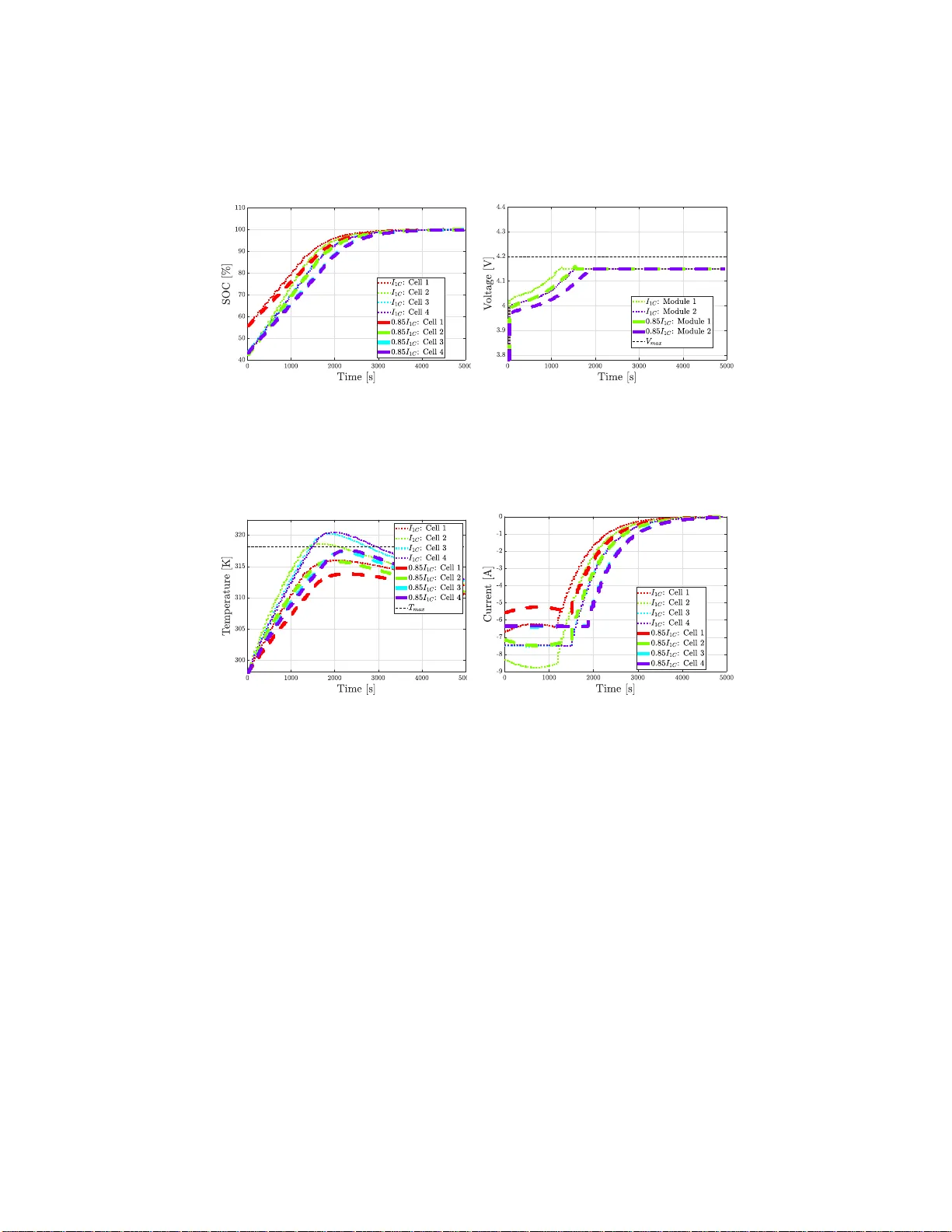
Optima l Charg ing of an Electr ic V ehicle Ba ttery Pac k: A Rea l-Time Sensit ivity-Based MPC a pproach Andrea Pozzi ∗ University of Pavia, Via F err ata 5, 271 00, Pavia Marcello T orchio Unite d T e chnolo gies Rese ar ch Ce ntr e Ir eland Ltd, 2nd Flo or Penr ose Business Ce ntr e, Cork, Ir eland Richard D. Br aatz Massachusetts Institute of T e chnolo g y, 77 Massachusetts Avenue, Cambridge, MA, 02139 Davide M. Raimondo University of Pavia, Via F e rr ata 5, 27100 , Pavia Abstract Lithium-ion battery packs are usually composed of hundreds of cells arranged in series and parallel connections. The proper functioning of these complex devices requires s uitable Battery Management Systems (BMSs). Adv a nced BMSs rely on mathematical mo dels to assure safety and hig h p erformance. While many approaches ha ve been pro po sed for the ma nagement of single cells, the co nt r o l of m ultiple cells has b een le ss inv estigated a nd usually relies on simplified mo dels such as eq uiv a lent circuit mo dels. This pa pe r addre sses the manag ement of a battery pac k in whic h eac h cell is explicitly mo delled a s the Single Particle Mo del with e le ctrolyte and thermal dyna mics. A nonlinea r Mo del P redictive Control (MPC) is pres ent ed for optimally charging the battery pack while taking volt- age and temp era ture limits o n each cell into acco un t. Since the computational cost o f no nlinear MPC g r ows sig nificantly with the complexity o f the under ly - ing mo del, a s e nsitivit y- ba sed MPC (sMPC) is prop osed, in which the mo del ∗ Corresp onding author Email addr ess: andrea.pozzi03@ universitadipavia.it (Andrea Pozzi) Pr eprint submitte d to Journal of L A T E X T emplates Septemb er 30, 2019 adopted is obtained by linear izing the dynamics alo ng a nominal tra jectory that is up dated ov er time. The resulting sMPC o ptimizations are quadratic pro grams which ca n b e so lved in rea l-time even for large battery packs (e.g . fully elec tric motorbike with 15 6 cells) while achieving the sa me p erformance of the nonlinear MPC. Keywor ds: Lithium-ion batteries, Battery mana g ement sy stems, Adv anced battery management systems, Mo del predictive control, Pr edictive con trol 1. In tro duction Electric vehicle battery packs usually consist of several cells which a re ar- ranged in series a nd para lle l co nnections in order to meet p ow er and c apacity requirements. The prop er functioning of these complex devices requires Ba ttery Management Systems (BMSs) [1]. One of the ma in tasks of a BMS is to s afely charge the battery . This ob jectiv e is usually addresse d thr ough standa rd pro- to cols, such as C o nstant Cur rent or Cons tant Current–Constan t V oltag e [2, 3]. These metho ds rely on fixed voltage limits that a ssure reaso nable p erforma nce for each cell comp osing the pack o ver its lifetime. In practice, these approaches lead to a sub optimal exploita tion of the battery , in which some cells a r e under- charged and some a r e ov ercharged. As a consequence, some cells may exp erie nc e fast degr a dation, therma l runaw ay , and, in certain c a ses, even explosions. These problems can b e significa n tly alleviated if a dv anced BMSs, w hich rely o n ma th- ematical mo dels o f the pack, are e mployed [4]. In this work, we fo cus on batter ies bas ed on lithium-ion chemistries which, thanks to their unique characteristics, hav e prov en to b e the most promising energy accumulators for many applicatio ns [5, 6]. Within this context, the t wo main categor ies of cell mo dels employ ed in a dv a nced B MSs a re: Eq uiv- alent Circuit Mo dels (ECMs, [7]) and E lectro chemical Mo dels (EMs, [8, 9]). While the former are simple and in tuitive, the latter provide a detailed descrip- tion o f the electro chemical phenomena which o ccur inside a cell. Among the EMs, the P seudo-Two-Dimensional (P2 D) mo del [10] – also known a s Doyle- 2 F uller-Newman – is the most widely us e d. This mo del consists o f co upled and nonlinear Partial Differential Algebraic Equatio ns (P DAEs). Due to its high computational co st, the P2 D is more suited for simulation pur po ses ra ther than for on-bo ard control applications. Mo reov er, the use of the P2D mode l within a control fra mework is limited by identifiabilit y a nd observ ability issues [11, 12]. F or all these r easons, the r esearch communit y has b een interested in the de- velopmen t of s implified electro chemical mo dels, which are faster to simulate, are identifiable and observ able, and still pr ovide a rea sonable description of the int erna l ce ll phenomena [13]. Among them, the Single P a r ticle Mo de l (SPM) [14, 9]), which is derived from the P2 D by mo delling the electro des as s ingle particles, has received a lot of a ttention. The parameter s in the SPM are fit to input-output data from the battery . The para meter identifiabilit y a nd state observ ability of the SPM have been ana lyzed in several w or ks, e.g. [15, 16, 17]. While the SPM ha s muc h low er computational cost than the P2D, which is an adv an tag e for control pur po ses, the SP M negle c ts electrolyte, thermal, and a g e- ing dynamics. The mo de l fidelity has been increased by extending the SPM to include electrolyte dynamics (SPMe) [18] and thermal dynamics (SPMeT) [19]. The mo del- based charging of lithium-io n batteries has b een addres s ed b y many authors ov er the years. Most o f the liter ature fo cuses on the control of a single lithium-ion cell. Within this context, different control approaches have bee n considered, such as fuzzy logic [20, 21, 2 2, 2 3], empir ical r ules [2 4, 25, 26, 27], a nd optimization-based strategies [28, 2 9, 30, 31, 3 2, 1 9, 33, 34]. Mo del Predictive Control (MPC) [35, 36] app ears to be the most used optimization- based metho dolo gy for charging of cells [37, 29, 31, 32, 38, 39, 33, 40, 41, 42, 43]. MPC is particula rly appr opriate for controlling multiv ariable nonlinear systems while taking an ob jective function and constr a int s on b oth inputs and states into account. In the co n text of lithium-ion c e lls, MPC a ims to minimize the charging time while satisfying temp eratur e a nd v olta ge constraints. In particular, the works in [37, 31, 43] hav e prop ose d MPC stra teg ies ba sed o n ECMs , while [29, 33, 42, 41] have suggested the use of elec tr o chemical mo dels tog ether with MPC in or der to achiev e b etter p er fo rmance. In order to allev iate the complexity of 3 ph ysic s-based mo dels, input-output descriptions hav e b een used in combination with MPC in [32] and [38]. In particular, [3 2] relied on a linear input-output mo del, while a piecewise Auto Reg ressive Exogeno us (ARX) input-o utput mo del was pro po sed in [38]. Finally , in order to achieve a reasona ble tra deoff b etw een computational time and a c curacy in the pr ediction, the usa ge of L ine a r Time V arying (L TV) mo dels for MPC has b een addressed [39, 40]. The works lis ted ab ov e fo cused on the charging o f a single lithium-ion cell. Batteries comp osed of s e veral cells are neces sary in many applica tions, such as hybrid electric v ehicles . The optimal charging of battery packs has be en less inv estigated than the ca se of single cells. In par ticular, mos t of the av ailable lit- erature r elies, as control mo dels, o n v er y simple lump e d E CMs (see e.g . [44, 45]). F ew works tackle the optimal control o f lithium-ion batteries by directly mo d- elling e a ch cell individually . This le vel o f detail is necess ary in imp or ta n t tasks such as the mo del-ba s ed State of Charge (SOC) balancing of s eries-connec ted cells [46, 4 7, 48, 49, 50, 51]. Most of the rese a rch pro duced in this area relies on linear E CMs for each cell (with the exception of [5 1] which is based on the SP- MeT). The usage of such models in the ba ttery optimal control c ontext ha s the adv an tag e of a low co mputational c o st, which allows for real- time implementa- tion even in the cas e of a hig h num ber o f cells. On the other side, simple linear mo dels often fail to gra s p the r eal b ehaviour of the battery pa ck. As a c o nse- quence, the resulting ch a r ging may be sub optimal and may not even s a tisfy the safety constra int s o n all the different cells. The use of electr o chemical mo dels within a control fra mework would be a p ossibility , but comes a t the pr ice of a prohibitive computational cost. As a co mpr omise, the use o f linearized ele ctro- chemical mo dels seems pro mising in order to a chiev e high p erfor mance with a reasona ble computational load. In this w ork , w e c o nsider a ba ttery pack co mp os ed by ser ies-connected mo d- ules, each of whic h are constituted of para llel-connected cells mo delled according to the SPMeT. The resulting mo del co nsists of a set o f nonlinea r Different ial Algebraic Equa tions (D AEs), for which suitable linear ization metho ds are a p- plied. In the following, in order to provide high accuracy fo r the mo del used for 4 the con tro l, we re ly on a s e ns itivit y-ba sed linear iz ation metho d, which ha s b een describ ed in detail in [52, 5 3] for a system o f Or dinary Differential Equatio ns (ODE) and here extended to the case o f a s y stem of D AEs. Such an approach differs from standard L TV techniques [54], since the sensitivities of the states and outputs to input v aria tions ar e contin uously int eg r ated together with the mo del equa tions r ather than ev aluated o nly at discre te time s teps. The main co nt ributio n of this work is the applica tio n of a sensitivity-based linear MPC to the manag ement of larg e battery packs, taking into acc o unt safet y constraints (such as temp eratur e and voltage limits) on all the differ en t c e lls . T o the b est of our knowledge, this is the first time that such a n appr oach is us e d in the context of the co nt r o l of ba ttery packs. As shown in the Results section, a detailed a nalysis is conducted by co mparing a standard nonlinear MPC a nd the Constant-Current Constant-V oltage algorithm with the prop os ed sensitivity- based MPC over an incr easing num ber of ser ies and par allel connected cells. The sensitivity-based MPC has m uch low er computational cost than no nlinear MPC while achieving compara ble p erforma nce . Since the c hoice of the nominal tra jector y is fundamental in order to obta in a n a ccurate linearization, we also provide an adaptive method in order to up date the nominal tra jector y during the charge. In a ddition, the need for an optimal management of the different cells is made evident by highlig h ting the disadv antages of standar d charging proto cols, such as the CC-CV. The v alue of the pr op osed metho dology is demonstrated by application to the o ptimal ma nagement of an electric mo torbike battery pack comp osed by 156 cells. In this applica tion, the sensitivity-based MPC provides optimal p erformance with a computational cost compatible with the sampling time. The pap er is orga nized as follows. Sectio n 2 recalls the equations o f the mo del used in the control algo rithm, while Section 3 prop os e s the sensitivity-based mo del predictive control alg orithm. The adapting of this MPC formulation for the context o f lithium-ion batteries a nd the ma in r e sults are provided in Section 4. Finally , Sec tion 5 concludes the pap er. 5 2. Mo del In this sectio n, the main e q uations o f the s implified electro chemical mo del prop osed in [51] ar e recalled. The latter consist of a r eduction o f the P 2 D [10] mo del which is detailed but also suitable fo r co nt r o l purp oses. In particular, starting fr om the SPMe [18], the Partial Differen tial Equation (PDE) which de- scrib es the diffusio n of ions within the electro lyte is spatially discr etized acco rd- ing to the finite volume metho d [55]. Moreov er, a p olynomial approximation of the ion conce n tra tion a lo ng the r adial axis of each electro de is considered in or der to reduce the Fick’s laws in to O rdinary Differential Equatio ns (ODEs) [56], as previo usly done in the context o f SPMe by [57]. In a ddition, the thermal dynamics are descr ib e d by a dapting the eq uations prop osed in [19, 58], wher e the heat generated by the ce ll is tr ansferred to a prop er co o ling sys tem. The cell mo del is pr esented in Section 2.1, while the equatio ns of the batter y pack mo del ar e g iven in Sec tion 2.2. 2.1. Mo del of a Single Cel l In this subsection, the index j ∈ { p, s, n } refers to a ll the cell sections, while the index i ∈ { p, n } is used in equations v alid only for the elec tro des. The independent v ariables x ∈ R a nd r ∈ R a re the axial and radia l co o rdinates resp ectively , and t ∈ R is the time. According to the approximation in [56], the io n co nc e n tra tion along the ra dial axis r of each electro de is describ ed by a fourth-o rder p olyno mial function of r . This a pproach results in co efficients that ar e functions of the so lid average concentration ¯ c s,i ( t ) a nd the av era ge concentration flux ¯ q i ( t ). In the following, we introduce the dynamics of such v ariables that are necessary fo r reconstructing the v alue o f the ion concentration along the r adial axis. Consider the av erag e sto ichiometry in the electro des defined by ¯ θ i ( t ) = ¯ c s,i ( t ) c max s,i (1) where c max s,i is the max im um s olid concentration. Relying on the fact that the moles of lithium in the solid pha se a re pre s erved [1 5], the a verage s toichiometry 6 in the ano de can be expressed in ter ms of the catho de by ¯ θ n ( t ) = θ 0% n + ¯ θ p ( t ) − θ 0% p θ 100% p − θ 0% p ( θ 100% n − θ 0% n ) (2) where θ 0% i and θ 100% i represent the v alue of the stoichiometries resp ectively when the cell is fully discharged and co mpletely charged. F rom [56], the tem- po ral evolution of the average s to ichiometry in the p o sitive electro de can b e approximated by ˙ ¯ θ p ( t ) = 3 I app ( t ) a p R p,p L p F A (3) where I app ( t ) is the applied current input (defined as b eing negative during charging b y conven tion), R p,i is the par ticle r adius, L j is the thickness o f the j th sec tio n, F is the F ara day constant, A is the contact area b etw een solid and electrolyte phase, and a i = 3 ǫ act i R p,i is the sp ecific active surface area , with the active material volume fraction ǫ act i defined by ǫ act p = − C ∆ θ p AF L p c max s,p (4a) ǫ act n = C ∆ θ n AF L n c max s,n (4b) in whic h C is the cell capacity and ∆ θ i = θ 100% i − θ 0% i . In acco rdance with [56], the volume-a veraged concentration fluxes ca n b e descr ibe d by ˙ ¯ q p ( t ) = − 3 0 D s,p ( T ( t )) R 2 p,p ¯ q p ( t ) + 45 2 R 2 p,p F AL p a p I app ( t ) (5a) ˙ ¯ q n ( t ) = − 3 0 D s,n ( T ( t )) R 2 p,n ¯ q n ( t ) − 45 2 R 2 p,n F AL n a n I app ( t ) (5b) where D s,i ( T ( t )) = D 0 s,i e − E a,D s,i RT ( t ) (6) is the solid diffusion c o efficient for the i th section which dep ends o n the cell temper ature T ( t ) a ccording to the Arrenhius law, D 0 s,i is a pre-exp onential co- efficient whic h is assumed to b e co nstant, E a,D s,i is the activ a tion e nergy asso c i- ated with the par ameter D s,i ( T ( t )), and R is the universal gas constant. Then, 7 in accordance with [56], the surfa ce sto ichiometries in the p ositive and negative electro des are resp ectively given by the algebr a ic equations θ p ( t ) = ¯ θ p ( t ) + 8 R p,p ¯ q p ( t ) 35 c max s,p + R p,p I app ( t ) 35 D s,p ( T ( t )) F AL p a p c max s,p (7a) θ n ( t ) = ¯ θ n ( t ) + 8 R p,n ¯ q n ( t ) 35 c max s,n − R p,n I app ( t ) 35 D s,n ( T ( t )) F AL n a n c max s,n (7b) Finally , the s tate of charge S O C ( t ) is defined a s S O C ( t ) = 100 ¯ θ n ( t ) − θ 0% n θ 100% n − θ 0% n (8) In this work, the P DE s gov er ning the diffusio n of the electroly te concentra- tion c e,j ( x, t ) [18] ar e discretized according to the FV metho d, as prev iously done in this con text by the authors in [59], wher e the spa tia l domain is divided into P non-ov erla pping v olumes for each section. The k th volume, with k = 1 , · · · , P , of the j th section is ce n tered a t the spatial co or dinate x j,k and spans the interv al Ω j,k = x j, ¯ k , x j,k , whose width is ∆ x j = L j /P . Defining c [ k ] e,j ( t ) as the av er a ge electrolyte concentration ov er the k th volume of j th section gives ǫ p ∂ c [ k ] e,p ( t ) ∂ t = " ˜ D e ( x, T ( t )) ∆ x p ∂ c e,p ( x, t ) ∂ x # x p, ¯ k x p,k − 1 − t + F AL p I app ( t ) (9a) ǫ s ∂ c [ k ] e,s ( t ) ∂ t = " ˜ D e ( x, T ( t )) ∆ x s ∂ c e,s ( x, t ) ∂ x # x s, ¯ k x s,k (9b) ǫ n ∂ c [ k ] e,n ( t ) ∂ t = " ˜ D e ( x, T ( t )) ∆ x n ∂ c e,n ( x, t ) ∂ x # x n, ¯ k x n,k + 1 − t + F AL n I app ( t ) (9c) where t + is the tra nsference num ber , ǫ j is the material p or osity , and the other terms are ev aluated as expla ined in detail in [5 9]. In particular, the electrolyte diffusion co efficients ˜ D e ( x, T ( t )) a re computed from ˜ D e ( x, T ( t )) = D e, 1 if x ∈ { x p,P , x s, 1 } D e, 2 if x ∈ { x s,P , x n, 1 } D ef f e,j ( T ( t )) otherwise (10) 8 with D e, 1 = H D ef f e,p ( T ( t )) , D ef f e,p ( T ( t )) , ∆ x p , ∆ x s (11a) D e, 2 = H D ef f e,s ( T ( t )) , D ef f e,n ( T ( t )) , ∆ x s , ∆ x n (11b) where H is the harmo nic mean op era tor, defined as H ( ρ 1 , ρ 2 , λ 1 , λ 2 ) = ρ 1 ρ 2 ( λ 1 + λ 2 ) ρ 1 λ 2 + ρ 2 λ 1 (12) and D ef f e,j ( T ( t )) = D e ( T ( t )) ǫ p j j with p j being the Br uggeman co efficient and D e ( T ( t )) being the diffusion co efficient within the electroly te which depends on the temper ature according to the Arrenhius law as in (6). The terminal voltage is given by V ( t ) = − I app ( t ) R sei + ¯ U p ( t ) − ¯ U n ( t ) + ¯ η p ( t ) − ¯ η n ( t ) + ∆Φ e ( t ) (13) where R sei ( t ) is the SEI resis tance, the O pen Circuit Poten tials (O CPs) in the po sitive and neg ative electro des are given by ¯ U p ( t ) =18 . 4 5 θ 6 p ( t ) − 4 0 . 7 θ 5 p ( t ) + 2 0 . 94 θ 4 p ( t ) + 8 . 07 θ 3 p ( t ) − 7 . 837 θ 2 p ( t ) + 0 . 02414 θ 1 p ( t ) + 4 . 571 (14a) ¯ U n ( t ) = 0 . 1261 θ n ( t ) + 0 . 00694 θ 2 n ( t ) + 0 . 699 5 θ n ( t ) + 0 . 00405 (14b) whose expr essions in terms o f surface s toichiometries are obtained by fitting the exp erimental data collected in [6 0] and dep end on the co nsidered ce ll (in this case, Kok am SLP B 7 5 1061 0 0), and ¯ η p ( t ) and ¯ η n ( t ) are the ov erp otentials for the po sitive and neg ative electro dese given by ¯ η p ( t ) = 2 RT ( t ) F sinh − 1 − I app ( t ) 2 AL p a p ¯ i 0 ,p ( t ) (15a) ¯ η n ( t ) = 2 RT ( t ) F sinh − 1 I app ( t ) 2 AL n a n ¯ i 0 ,n ( t ) (15b) with the exchange current density defined as ¯ i 0 ,i ( t ) = F k i ( T ( t )) q ¯ c e,i ( t ) θ i ( t )(1 − θ i ( t )) (16) 9 where k i ( T ( t )) is the temper ature-dep endent (according to the Arrenhius law) rate reaction cons tant and ¯ c e,i ( t ) is the av erage electrolyte concentration in the i th sec tion, approximated by ¯ c e,i ( t ) = 1 P P X k =1 c [ k ] e,i ( t ) . (17) Moreov er , ∆Φ e ( t ) is computed as ∆Φ e ( t ) = Φ dr op e ( t ) + 2 RT ( t ) F (1 − t + ) log e c [1] e,p c [ P ] e,n ! (18) where, ass uming that the ionic current i e ( x, t ) has a trap ezoida l shape ov er the spatial domain [18], the e le ctrolyte voltage drop Φ dr op e ( t ) can b e approximated by Φ dr op e ( t ) ≃ − I app ( t ) 2 P ( φ p ( t ) + 2 φ s ( t ) + φ n ( t )) (19) in which φ p ( t ) = ∆ x p P X k =1 2 k − 1 κ ( c [ k ] e,p ( t ) , T ( t )) ǫ p p p (20a) φ s ( t ) = ∆ x s P X k =1 1 κ ( c [ k ] e,s ( t ) , T ( t )) ǫ p s s (20b) φ n ( t ) = ∆ x n P X k =1 2 P − 2 k + 1 κ ( c [ k ] e,n ( t ) , T ( t )) ǫ p n n (20c) where κ ( c [ k ] e,j ( t ) , T ( t )) is the temper ature-dep endent electrolyte co nductivit y for the k th volume o f the j th section, which is usually ex pressed as an empirica lly derived nonlinear function of the electroly te concentration in that volume: k ( γ [ k ] j ( t ) , T ( t )) = 0 . 2667 γ [ k ] j ( t ) 3 − 1 . 29 83 γ [ k ] j ( t ) 2 + 1 . 79 19 γ [ k ] j ( t ) + 0 . 1726 e − E a,κ RT ( t ) (21) where γ [ k ] j ( t ) = 10 − 3 c [ k ] e,j ( t ). The express ion in (21) is still r eferred to the case of K o k am SLPB 751 06100 . As men tioned ab ov e, this pap er co nsiders a lump ed thermal mo del [19, 58] in which the temp era ture dy na mics a re g iven b y C th ˙ T ( t ) = Q ( t ) − T ( t ) − T sink R th (22) 10 where C th is the therma l capacity o f the cell and R th is the therma l resistance betw een the cell and the co o lant, whose temp era ture is her e assumed to b e constant and equal to T sink . The hea t genera tio n term Q ( t ) is due to the cell po larization and is describ ed b y Q ( t ) = | I app ( t ) | · | V ( t ) − ( ¯ U p ( t ) − ¯ U n ( t )) | . (23) In order to simplify the nota tion in the next sections, define the v ariables for the av erag e sto ichiometry and concentration flux θ ( t ) = θ p ( t ) (24a) q ( t ) = [ q p ( t ) , q n ( t )] ⊤ (24b) and ex press the vector of the electroly te concentrations in the different finite volumes as c e ( t ) =[ c [1] e,p ( t ) , · · · , c [ P ] e,p ( t ) , c [1] e,s ( t ) , · · · , c [ P ] e,s ( t ) , c [1] e,n ( t ) , · · · , c [ P ] e,n ( t )] ⊤ . (24c) 2.2. Mo del of a Battery Pack This subsection consider s the ba ttery pa ck configuration in Figur e 1 , which consists o f N s eries-connec ted mo dules, ea ch of which is constituted of M parallel-co nnected ce lls. The total nu mber of cells is given by N cells = N M , with all cells modelled accor ding to the equations in Section 2.1. The mo delling of a lithium-ion battery pack as a set of connected electro chemical models con- stitutes a key p oint of this work with resp ect to the existing literature, in which the battery is usually des crib ed with a very simple equiv alent circuit mo del. The use o f a mo r e a ccurate mo del is motiv ated by the fact that lithium-io n battery packs are complex systems which r equire suitable c ontrol strategies in order to guarantee the satisfactio n of sa fet y constraints on each single cell. How ever, the usag e of an accur ate mo del in optimal control has the disa dv a nt ag e of high computational burden. This latter can b e reduced by pro pe r ly linearizing the dynamics (see Sec tio n 3). 11 In the following, the indexes i = 1 , · · · , N and j = 1 , · · · , M which refer to the j th cell of the i th mo dule. Moreover, the voltage, state of charge, tem- per ature, a nd applied current o f the cells are indicated resp ectively by V i,j ( t ), S O C i,j ( t ), T i,j ( t ), and I i,j ( t ), while the voltage o f the i th mo dule is defined as V i ( t ). The scheme in Figure 1 cons is ts also o f a supply circuitry which a llows Figure 1: Simplified circuital sc heme. charging of the batter y (a batter y charger) and balancing the energy sto red in the differen t cells (current gener ators). In particular, the battery charger s up- plies the cur rent I ch ( t ) ≥ 0, which can b e assumed co nstant ( I ch ( t ) = I ch ), while the N g enerators I b,i ( t ) ≥ 0 , i = 1 , 2 , · · · , N allow draining of the c ur rent whic h flows thro ugh the different mo dules. In the case o f cons tant I ch , these latter represent the sy s tem inputs and a r e fundamental in order to achieve an o ptimal current co n tro l of the different cells. Such current g enerator s can b e realiz e d in practice in several wa ys. F or instance, simple prop or tional-integral-deriv ative (PID) controllers can be used to regulate the v alue of a v ariable resisto r in par- 12 allel to each module. As an alter native, a Puls e Width Mo dula tion (PWM) approach or a method base d on the cell bypass through active element s [51] can be ado pted. In this work, the heat generation due to the bypassing pr o cess is ass umed to be neglig ible (see [61] for mor e details on the different supply and balancing circuitr y schemes). The battery pack is mo delled as a system of D AEs with N cells algebraic v a riables ( I i,j ( t ) , i = 1 , · · · , N , j = 1 , · · · , M ) and corres p onding N cells algebraic equations. Each module i , with i = 1 , · · · , N , is describ ed b y M algebr aic equations: V i, 1 ( t ) = V i, 2 ( t ) (25a) V i, 2 ( t ) = V i, 3 ( t ) (25b) . . . (25c) V i,M − 1 ( t ) = V i,M ( t ) (25d) I ch ( t ) = − M X j =1 I i,j ( t ) + I b,i (25e) These e q uations cor resp ond to the K irchhoff ’s cur rent law at each mo dule a nd are written acco rding to the conv entions that the supply charger provides a po sitive current in order to charge the ba ttery pack, the battery cells ar e charged by neg ative cur r ents, and the bypassing system reduces the battery charging by draining p ositive currents. The cur r ent genera ted by the battery c har ger is assumed to be co mpletely bypassed through the generato rs I b,i when the i th mo dule completes its charging pr o cedure (i.e. I b,i ( t ) = I ch , t ≥ ¯ t i , wher e ¯ t i is the time a t which the i th mo dule is completely c har g ed). The heat exchange betw een the cells is als o a ssumed to b e neglig ible. 3. Sensitivity-Based Mo del Predictive Cont rol This section prop oses a sensitivity-based linear MPC (sMPC) for the control of gener a l nonlinear contin uous-time sy s tems describ ed by semi-explicit DAEs as in Section 3.1. The main a dv an tage of this appro ach is the s ignificant c om- putational time reduction with res pect to nonlinea r MP C (nMPC, see Section 13 3.2), while having comparable pe rformance. The s MPC stra tegy , which is pres e nted in Section 3.3, r elies on the mo del linearization ar ound a nomina l input tra jectory , and is based on the computation of the sens itivities of states, o utputs, and alg e braic v a riables with r esp ect to input p erturbatio ns. Such sensitivities are obtained by integrating additio nal contin uous-time differential equations tog ether with the mo del in (2 6). Using this appro a ch, the re s ulting linearized mo del provides higher accur acy than obtained with s tandard L TV appr oaches, in which the sensitivities a re ev aluated only at discr ete time steps. Next, Section 3.4 describ es how to use the sensitivity-based linea rized mo del in an MP C fra mework. In order to addr ess model mismatches in a practica l implemen tation, the so ftening of the output cons traints in sMP C and nMPC is describ ed in Section 3.5. 3.1. Nonline ar DAE system Consider the contin uous-time system of s emi-explicit nonlinear D AEs de- scrib ed by ˙ x ( t ) = f ( x ( t ) , u ( t ) , z ( t )) (26a) 0 = h ( x ( t ) , u ( t ) , z ( t )) (26b) y ( t ) = g ( x ( t ) , u ( t ) , z ( t )) (26c) where t ∈ R is the time, x ( t ) ∈ R n is the s tates vector, u ( t ) ∈ R m is the control input, z ( t ) ∈ R s is the vector of the alg ebraic v aria ble s , y ( t ) ∈ R p is the output, f : R n × m × s → R n and g : R n × m × s → R p are the state and output functions resp ectively , a nd h : R n × m × s → R m sp ecifies the set of algebra ic constra int s. The system of DAEs in (26) is assumed to b e index- 1 [54]. Moreov er, a dig ital controller is assumed to apply a piecewise constant input at the discr e te times t k , k ∈ N with sa mple time T s . Within this co nt ext, define the ge neric input sequence applied in the time interv al [ t k , t k + H ], with H ∈ N , as u [ t k ,t k + H ] = u ⊤ ( t k ) , u ⊤ ( t k +1 ) , · · · , u ⊤ ( t k + H − 1 ) ⊤ (27) 14 while the corresp onding tempo ral evolution of states, algebr aic v ariables, and outputs is obtained by integrating the equations in (26) ov er [ t k , t k + H ], with initial condition x ( t k ) = x k , to g ive x [ t k ,t k + H ] = x ⊤ ( t k ) , x ⊤ ( t k +1 ) , · · · , x ⊤ ( t k + H ) ⊤ (28a) z [ t k ,t k + H ] = z ⊤ ( t k ) , z ⊤ ( t k +1 ) , · · · , z ⊤ ( t k + H ) ⊤ (28b) y [ t k ,t k + H ] = y ⊤ ( t k ) , y ⊤ ( t k +1 ) , · · · , y ⊤ ( t k + H ) ⊤ (28c) 3.2. Nonline ar MPC This s ection summar iz e s the main features o f nonlinear MPC, which is a control technique suitable fo r multiv aria ble nonlinear systems in the pres ence of constra int s. The formulation co ns iders a contin uous-time mo del as in (26 ) and a digital controller, which keeps the input constant ov er each sa mpling time. Nonlinear MP C requir es the so lution of a finite-hor iz o n optimal control problem at ea ch time step t k 0 , who s e solution provides the optimal co n tro l sequence u ∗ [ t k 0 ,t k 0 + H ] ov er a predictio n hor izon o f H steps, where u ∗ [ t k 0 ,t k 0 + H ] = h u ∗ ⊤ ( t k 0 ) , u ∗ ⊤ ( t k 0 +1 ) , · · · , u ∗ ⊤ ( t k 0 + H − 1 ) i ⊤ . (29) According to the r e c e ding horizon paradigm, only the first ele ment u ∗ ( t k 0 ) is applied to the sy stem and the re ma ining future o ptimal mov es discarded. The optimization is then rep eated at the next time step over a s hifted pr ediction window, with the newly av aila ble measurements [62]. The r e sulting optimization to b e so lved at each time t k 0 is des c r ib e d b e low. Finite H orizon Optim al Contr ol Problem 1. Find the optima l input se- quenc e u ∗ [ t k 0 ,t k 0 + H ] that solves u ∗ [ t k 0 ,t k 0 + H ] = argmin u [ t k 0 ,t k 0 + H ] J ( t k 0 ) (30) for the c ost function J ( t k 0 ) = k 0 + H X k = k 0 k y ( t k ) − y r ef k 2 Q + k 0 + H − 1 X k = k 0 k u ( t k ) − u r ef k 2 R + J r eg ( t k 0 ) (31) 15 in which y r ef ∈ R p and u r ef ∈ R m ar e t he r efer enc e ve ctors for the out put and for the input, r esp e ctively, and t he m atric es Q ∈ R p × p and R ∈ R m × m ar e design p ar ameters which ar e weights in the MPC c ost function, with Q ≥ 0 and R > 0 . The additional term J r eg ( t k 0 ) acts as a smal l r e gularization factor in or der to avoid abrupt variations and spikes in the input c ontr ol law and it is given by J r eg ( t k 0 ) = k 0 + H − 1 X k = k 0 k u ( t k ) − u ( t k − 1 ) k 2 R re g (32) wher e R r eg ∈ R m × m . Note that y ( t k ) ∈ R p is obtaine d by evaluating (26c) at discr ete time instants t k . The optimization is subje ct to the system dynamic in (26) and the c onstr aints u lb ≤ u ( t k ) ≤ u ub , k = k 0 , k 0 + 1 , · · · , k 0 + H − 1 (33a) y lb ≤ y ( t k ) ≤ y ub , k = k 0 , k 0 + 1 , · · · , k 0 + H (33b) wher e u lb , u ub ∈ R m and y lb , y ub ∈ R p ar e the minimum and maximum al low- able values of the inputs and outputs, r esp e ctively. 3.3. Sensitivity-Base d Line arization Along a Nominal T ra je ctory The main dr awbac k of the optimal c o nt r o l for m ulatio n in Section 3.2 is its high computational co st, which comes fro m the use of a nonlinear mo del to predict the future s ystem b ehaviour. This s tep inv olves the s olution of a nonlinear o ptimization a t ea ch time step whose complexity can b e prohibitive for certain online control applications. As an a lternative, w e prop ose a sensitivity- based linearization o f the sy s tem (26), which ca n be explo ited to provide a fast MPC solution. As in the previous sections, the discussion is carrie d on by considering a digital controller which applies a piecewise consta n t input at the discrete times t k . Consider a nominal input s ignal u ( t ) and the nominal input sequence u [ t k ,t k + H ] = [ u ⊤ ( t k ) , u ⊤ ( t k +1 ) , · · · , u ⊤ ( t k + H − 1 )] ⊤ ov er the time window [ t k , t k + H ]. The corres p onding nominal tra jector ies for sta tes, a lgebraic v ariables, and o utputs are x [ t k ,t k + H ] , z [ t k ,t k + H ] , a nd y [ t k ,t k + H ] (see (28)). Define S x ( t, t k ) = ∂ x ( t ) ∂ u ( t k ) , 16 S z ( t, t k ) = ∂ z ( t ) ∂ u ( t k ) , and S y ( t, t k ) = ∂ y ( t ) ∂ u ( t k ) which are the sensitivities of the sta tes, algebraic v ariables, and outputs to a v ariation in the input u ( t k ) with r esp ect to its nominal v alue u ( t k ) at the discr ete time t k . In pa rticular, the ma trices S x ( t, t k ) ∈ R n × m , S z ( t, t k ) ∈ R s × m , a nd S y ( t, t k ) ∈ R p × m are obta ined by solving, to gether with (26), the system of equations ˙ S x ( t, t k ) = F x ( t ) S x ( t, t k ) + F z ( t ) S z ( t, t k ) + F u ( t )∆ t k ( t ) (34a) 0 = H x ( t ) S x ( t, t k ) + H z ( t ) S z ( t, t k ) + H u ( t )∆ t k ( t ) (34b) S y ( t, t k ) = G x ( t ) S x ( t, t k ) + G z ( t ) S z ( t, t k ) + G u ( t )∆ t k ( t ) (34c) with initial condition S x ( t k , t k ) = 0 n × m – since we a ssume that (26) is a causa l system – a nd F ν ( t ) = ∇ ν f ( x ( t ) , z ( t ) , u ( t )) , ν = { x, z , u } (35a) H ν ( t ) = ∇ ν h ( x ( t ) , z ( t ) , u ( t )) , ν = { x, z , u } (35b) G ν ( t ) = ∇ ν g ( x ( t ) , z ( t ) , u ( t )) , ν = { x, z , u } (35c) where ∇ ν is the Jaco bian op erator with resp ect to ν a nd ∆ t k ( t ) = H ( t − t k ) − H ( t − t k − T s ), with H ( t − t k ) be ing the unitary Heaviside step function H ( t − t k ) = 0 , t < t k 1 , t ≥ t k (36) Now consider a mo dified input sequence ˜ u [ t k ,t k + H ] = [ ˜ u ( t k ) , ˜ u ( t k +1 ) , · · · , ˜ u ( t k + H − 1 )] which can b e obta ine d from the no minal input sequence by ˜ u [ t k ,t k + H ] = u [ t k ,t k + H ] + δ u [ t k ,t k + H ] (37) where δ u [ t k ,t k + H ] = [ δ u ⊤ ( t k ) , δ u ⊤ ( t k +1 ) , · · · , δ u ⊤ ( t k + H − 1 )] ⊤ is the s equence of the input v ariations over the time window [ t k , t k + H ]. The sensitivity-based approximation o f the states, algebraic v aria bles, and output tr a jectories which corres p ond to the s equence ˜ u [ t k ,t k + H ] is g iven b y [6 3, 52, 53] ˆ x [ t k ,t k + H ] = x [ t k ,t k + H ] + Π x [ t k ,t k + H ] δ u [ t k ,t k + H ] (38a) ˆ z [ t k ,t k + H ] = z [ t k ,t k + H ] + Π z [ t k ,t k + H ] δ u [ t k ,t k + H ] (38b) ˆ y [ t k ,t k + H ] = y [ t k ,t k + H ] + Π y [ t k ,t k + H ] δ u [ t k ,t k + H ] (38c) 17 where the matrices Π ν [ t k ,t k + H ] , with ν = { x, z , y } , are defined by Π ν [ t k ,t k + H ] = S ν ( t k , t k ) 0 · · · 0 S ν ( t k +1 , t k ) S ν ( t k +1 , t k +1 ) · · · 0 S ν ( t k +2 , t k ) S ν ( t k +2 , t k +1 ) · · · 0 . . . . . . . . . . . . S ν ( t k +( H − 1) , t k ) S ν ( t k +( H − 1) , t k +1 ) · · · S ν ( t k +( H − 1) , t k +( H − 1) ) (39) in which S ν , for ν = { x, z , y } , is obtained by integrating the co nt inuous-time system in (3 4) together w ith (26). This step constitutes the main difference with res pect to a sta ndard L TV appr oach, for which the mo del s ensitivities are computed only at dis crete time instants, resulting in a loss of accur a cy . 3.4. Sensitivity-Base d Line ar MPC This section presents a mo del predictive control approa ch for the system (26) based on the linea rized mo del (38). Using the la tter , the optimiza tion can be formulated as a Quadra tic P r ogra m (QP) which significantly reduces the computational c ost compar ed to no nlinear MP C, thus enabling the use of the prop osed strateg y in on-line control applicatio ns . The o b jectiv e function to b e minimized at ea ch time s tep t k 0 is J lin ( t k 0 ) = k 0 + H X k = k 0 k ˆ y ( t k ) − y ref k 2 Q + k 0 + H − 1 X k = k 0 k δ u ( t k ) + ¯ u ( t k ) − u ref k 2 R + J reg ( t k 0 ) (40) and the r esulting o ptimization is formulated b elow. Finite H orizon Optim al Contr ol Problem 2. Find t he optimal se quenc e of the inpu t variations δ u ∗ [ t k 0 ,t k 0 + H ] that solves δ u ∗ [ t k 0 ,t k 0 + H ] = ar gmin δ u [ t k 0 ,t k 0 + H ] J lin ( t k 0 ) (41) 18 for the c ost function (40 ) . The optimization is subje ct t o the system dynamics in (38) and t he c onstr aints u lb ≤ ˜ u ( t k ) ≤ u ub , k = k 0 , k 0 + 1 , · · · , k 0 + H − 1 (42a) y lb ≤ ˆ y ( t k ) ≤ y ub , k = k 0 , k 0 + 1 , · · · , k 0 + H (42b) The optima l control sequence is obtained as u ∗ [ t k 0 ,t k 0 + H ] = u [ t k 0 ,t k 0 + H ] + δ u ∗ [ t k 0 ,t k 0 + H ] (43) The p erforma nc e of the sensitivity-based linea r ization and the co r resp onding MPC alg orithm ar e significantly a ffected by the choice of the nominal input sequence u [ t k 0 ,t k 0 + H ] . Her e we adopt the following c hoice . Supp o se tha t, at the beg inning, the no minal input sequence is not known. Then use the mo st likely input sequenc e as the initial guess, since no further information is av ailable. Then, after e a ch itera tion of the MPC algor ithm, the nominal input sequence is up dated a s u [ t k 0 +1 ,t k 0 + H +1 ] = [ u ∗ ⊤ [ t k 0 +1 ,t k 0 + H ] , u ∗ ⊤ [ t k 0 + H − 1 ,t k 0 + H ] ] ⊤ (44) where u ∗ [ t k 0 ,t k 0 + H ] is the o ptimal solution o f the sMP C at the time t k 0 . In case of highly no nlinear systems, the initializa tion of the nominal input sequence has to b e done car efully to achiev e a sufficien tly accurate linearized mo del in the first iter ation. 3.5. Soft Constr aints for Pr actic al Implementation The constraints o n the o utputs for b oth the nonlinear (33b) and linearized (42b) systems ca n b e softened in or der to deal with, in a prac tica l implemen- tation, p oss ible mo del mismatches. In particular, us ing a set of slack v aria bles ξ ∈ R p , with ξ ≥ 0, the constraint in (3 3b) ca n b e rela xed a s y lb ≤ y ( t k ) + ξ ( t k ) , k = k 0 , k 0 + 1 , · · · , k 0 + H (45a) y ( t k ) − ξ ( t k ) ≤ y ub , k = k 0 , k 0 + 1 , · · · , k 0 + H (45b) 19 and y lb ≤ ˆ y ( t k ) + ξ ( t k ) , k = k 0 , k 0 + 1 , · · · , k 0 + H (46a) ˆ y ( t k ) − ξ ( t k ) ≤ y ub , k = k 0 , k 0 + 1 , · · · , k 0 + H (46b) can b e us e d for the constraint in (42b). The cost functions for sMPC and nMPC ar e reformulated acc ordingly as J ( t k 0 ) = k 0 + H X k = k 0 k y ( t k ) − y ref k 2 Q + k 0 + H − 1 X k = k 0 k u ( t k ) − u ref k 2 R + J reg ( t k 0 ) + J s ( t k 0 ) (47a) J lin ( t k 0 ) = k 0 + H X k = k 0 k ˆ y ( t k ) − y ref k 2 Q + k 0 + H − 1 X k = k 0 k δ u ( t k ) + ¯ u ( t k ) − u ref k 2 R + J reg ( t k 0 ) + J s ( t k 0 ) (47b) with J s ( t k 0 ) = k 0 + H − 1 X k = k 0 c ⊤ ξ ( t k ) (48) where c ∈ R p is a suitable vector of weigh ts. 4. Results This section ev aluates the prop osed metho dolo gy to the co n tro l of a lithium- ion battery pac k. Section 4.1 in tro duces the optimal control pr oblem, while the parameters a nd simulation settings a r e given in Section 4.2. The simulation results are pr ovided in Sections 4 .3 – 4.4. Section 4.3 compares the pro po sed sensitivity-based a ppr oach to nonlinear MPC, and a standard charging metho d, namely the Co nstant Current-Constant V oltage (CC-CV), is consider ed as a benchmark in Section 4.4. Then, Section 4.5 analyzes how the computationa l times o f sMPC a nd nMPC gr ow w ith increasing the num b er of cells. Finally , the metho dolo gies ar e tested on a challenging scenario of the battery pa ck of an electric motorbike. 20 4.1. Optimal Contr ol of a Lithium-Ion Battery In this section, the optimal control metho ds in Sectio n 3 a re adapted to the o ptimal management o f a lithium-ion battery , whose cells a re arra nged as in Figure 1, with N series mo dules of M para llel-connected cells. The total nu mber o f cells is given by N cells = N M . The ob jectiv e of the control algor ithm is to bring the s tate o f charge of each cell as close a s p ossible to 100% while satisfying all the safety constra int s. Each cell is mo delled a ccording to the equations describ ed in Section 2.1, while the mo del of the whole battery pack is g iven in Se c tio n 2.2 . The v ariables are defined by u ( t k ) = [ I b, 1 ( t k ) , I b, 2 ( t k ) , · · · , I b,N ( t k )] ⊤ (49a) x ( t k ) = [ x ⊤ 1 , 1 ( t k ) , x ⊤ 1 , 2 ( t k ) , · · · , x ⊤ N ,M ( t k )] ⊤ (49b) z ( t k ) = [ I 1 , 1 ( t k ) , I 1 , 2 ( t k ) , · · · , I N ,M ( t k )] ⊤ (49c) y ( t k ) = [ y ⊤ 1 , 1 ( t k ) , y ⊤ 1 , 2 ( t k ) , · · · , y ⊤ N ,M ( t k )] ⊤ (49d) where x i,j ( t k ) ∈ R N x and y i,j ( t k ) ∈ R N y represent r esp ectively the states and outputs of the j th cell of the i th mo dule. The notation in tro duced in (24) implies that x i,j ( k ) = h ¯ θ i,j ( k ) , ¯ q ⊤ i,j ( k ) , c e ⊤ i,j ( k ) , T i,j ( k ) i ⊤ (50a) y i,j ( k ) = [ V i,j ( k ) , T i,j ( k ) , I i,j ( k ) , S O C i,j ( k )] ⊤ (50b) where θ i,j ( k ), ¯ q i,j ( k ), and c e i,j ( k ) refer to the stoichiometry , av erag e concentra- tion flux, and elec tr olyte concentration of the j th cell of the i th mo dule. The elements of the vector c e i,j ( k ) are the v alues of the electr olyte concentration alo ng the spa tial axis which is discretized according to the finite volume metho d. The resulting mo del is a se mi-explicit contin uous time sy stem of DAEs (see (26)) where n = N cells N x , m = N , s = N cells , and p = N cells N y , with N cells = N M and in which N x = 4 + 3 P (for a P num b er of finite v olumes ) and N y = 4 a re the num ber of s tates a nd o utputs of each single cell, resp ectively . The weight ing 21 matrices Q ∈ R p × p ≥ 0 and R ∈ R m × m > 0 were specified to be diagonal Q = q 0 · · · 0 0 q · · · 0 . . . . . . . . . . . . 0 0 · · · q , R = r 0 · · · 0 0 r · · · 0 . . . . . . . . . . . . 0 0 · · · r (51) where r ∈ R > 0 and q ∈ R N y × N y ≥ 0 is defined a s q = q V 0 0 0 0 q T 0 0 0 0 q I 0 0 0 0 q S O C . (52) The reference vector and the limits for the output vector, resp ectively , ar e given by y ref = [ y ⊤ r , y ⊤ r , · · · , y ⊤ r ] ⊤ (53a) y lb = [ y ⊤ min , y ⊤ min , · · · , y ⊤ min ] ⊤ (53b) y ub = [ y ⊤ max , y ⊤ max , · · · , y ⊤ max ] ⊤ (53c) with y r , y min , y max ∈ R N y defined by y min = [ V min , T min , I min , S O C min ] ⊤ (54a) y max = [ V max , T max , I max , S O C max ] ⊤ (54b) y r = [ V r , T r , I r , S OC r ] ⊤ (54c) where I min and I max are the maximum and the minimum v alues o f current that can flow thro ugh a single cell, V min and V max are the upp er a nd lower bo unds for the voltage, and T min and T max , a nd S OC min and S O C max , a re the limits for the temp era ture and the state of charge resp ectively . Since the limits on the curr ent flowing thro ugh each cell a re ex plicitly consider ed in the optimization, low er a nd upp er b ounds on the input vector ( u lb and u ub ) are not required. Finally , the r eference v a lues for voltage, temper ature, current, and state o f charge are deno ted by V r , T r , I r , and S OC r resp ectively . 22 Remark 1 . A lthough t he int ernal states of e ach c el l ar e not me asur able in pr ac- tic e, al l the r elevant states ar e assume d available her e. The use of observers go es b eyond the sc op e of t his work whose obje ctive is to highlight the suitability of the sensitivity-b ase d app r o ach t o r e al-time optimal c ontr ol. F or t he design of ob- servers for b attery states, the inter este d r e ader c an r efer to e.g. [64]. 4.2. Mo del Par ameters and Simulations Settings Here the virtual testbed cons idered in the simulations is describ ed in de- tail in order to allow the presented r e sults to be repro ducible by others. The electro chemical parameters adopted for all the cells are those exp erimentally measured in [60, 65] from a c omplete electro chemical characterization of a commercial cell (the K o k am SLPB 7 51061 00). The thermal capacity , ther- mal resis tance, and s ink temp erature are assumed equal to C th = 4186 J / K, R th = 169 . 5 K/W, and T sink = 2 98 . 15 K , and the initia l v alue for the temp er- ature is set to T 0 = 298 . 15 K for all cells. The initial electrolyte concentra- tion and av era g e concentration flux are a ssumed to start a t equilibrium v alues 1000 mo l/ m 3 and zero re s pec tively . The initial state of charge of the differ - ent cells, as well as the capacity and the SEI res istance, are extracted from a Gaussian distr ibution as S O C 0 i,j ∈ N ( S O C 0 , σ 2 S O C ) (55a) C 0 i,j ∈ N ( C 0 , σ 2 C ) (55b) R 0 sei,i,j ∈ N ( R 0 sei , σ 2 R sei ) (55c) with S OC 0 = 5 0%, R 0 sei = 1 5 mΩ, a nd C 0 = 7 . 5 Ah (i.e., I 1 C = 7 . 5 A), while the standard deviations a re σ S O C = 10%, σ R sei = 0 . 7 5 mΩ, and σ C = 0 . 3 7 5 Ah. The o ptimization s ettings a re rep or ted in T able 1, with the voltage, temper - ature, and current of each cell app earing in the cons traint set but not weigh ted in the co st function ( q V = 0, q T = 0, and q I = 0). The corr e s po nding reference v alues V r , T r , and I r are set equal to zero. All the sim ulatio ns were p erformed on a Windows 10 p ersonal computer with 16 Gbytes o f RAM and a 2.5 GHz i7vP ro pro cessor. The control problems 23 P H T s S O C r I ch r 2 3 40 s 100% 1 . 5 M I 1 C 1 . 78 × 1 0 − 5 q V q T q I q S O C V min V max 0 0 0 10 − 2 2 . 7 V 4 . 2 V T min T max I min I max S O C min S O C max 253 . 15 K 318 . 15 K − 1 . 5 I 1 C 0 A 0% 100% T able 1: Pa rameters of the optimal cont rol algorithms. were so lved using CasADi [66], a symbolic framew or k for automatic differen tia- tion. This s oft ware offers a Matlab interface for the Interior Poin t Optimization Metho d (IPO P T) [67, 68] used for solving the optimiza tions, a nd for the SUN- DIALS suite [69] used for integrating the pro ce s s dyna mics. More ov er, CasADi was used for the computation of the se ns itivit y matrices along the no minal tra- jectory . In order to provide a fair compariso n b e t ween sMPC and nMP C, b oth of the under lying o ptimizations were solved using IPOP T. 4.3. Comp arison Betwe en sMPC and nMPC This section considers a battery pack comp ose d by N = 2 mo dules with M = 2 para llel connected cells for each mo dule. The p erformance of the prop osed sensitivity-based MPC is compar ed with the no nlinear MPC as the b e nc hmar k for the parameter s of e ach ce ll rep orted in the prev ious section. The temp oral evolution of the states and outputs obtained by sMPC (dotted line) and nMPC (dashed line) are very similar (see Figures 2 a–4a ), with nearly co mplete overlap. F or both MPC formulations, the state o f charge for all of the cells r each the desired target of 100% within 350 0 s (Figure 2 (a )). The cons tr aints on the voltage and temper ature for all of the battery cells ar e satisfied for all time (Figures 2(b) and 3(a)). The curre nt flowing in the different cells a re nearly 24 State of Charge (a) State of charge Terminal Voltage (b) V oltage Figure 2: T emp oral evolut ion of the state of charge and volta ge for sMPC and nMPC. Only the voltage of the tw o mo dules is shown in (b) since all the cells of a particular mo dule presen t the same v oltage due to the parallel connection. ident ica l for the tw o MPC fo rmulations (Figure 3(b)), and the input actions are nearly identical for ea ch mo dule (Figure 4(a )), cons is ting of the drained c urrents I b, 1 and I b, 2 . Since the main g oal of this pap er is to develop a control algor ithm that achiev es high p erforma nce while having low enough on-line computationa l cos t being implementable in r eal time, the mea n computational times needed b y the tw o metho ds to compute the optimal co n tro l sequence at each time step are rep orted in Figure 4 (b). While having very similar closed-lo o p p erformance , the on-line computatio nal cost of the sens itivit y-ba sed MPC is significantly low er than for nMPC, motiv ating the use of sMPC in the context of real-time co nt ro l of battery packs. Also, the on-line computational time of nMPC is highly v ariable while b eing nearly deterministic for sMPC, as its o ptimization is a quadratic progra m whos e co mputational co s t for solution is weakly dep endent on the v alues of its pa rameters. Having low v a riability in its on-line computational cost is a nother desirable feature of sMPC. 4.4. Standar d CC-CV Metho d T o demonstrate the need for a n optimal mana gement of a lithium-ion batter y pack that is able to ta ke into account input and output co nstraints, a standard 25 Lumped Temperature (a) T emp erature Applied Current (b) Current Figure 3: T emp oral ev olution of the temperature and current for sMPC and nM PC. Drained Current (a) Drai ned curren t Computational Burden (b) Computational time Figure 4: T emp oral evolution of the dr ai ned current for the tw o mo dules and the computa- tional times f or sMPC and nMPC. charging method – namely the Co nstant Cur rent-Constan t V oltage (CC-CV) – is applied to the same configuratio n considered in Section 4.3. The CC- CV metho d is comp osed o f tw o phases. In the first phase, a co ns tant charging current I cc is applied to the ser ies co nnected mo dules. This phase ends se parately for the different mo dules, as so o n as their voltage r e aches a pre defined thresho ld V th (that in this case is assumed to be equal to 4 . 15 V, which corr e spo nds to the OCPs differe nc e v alue at 1 00% of SOC). Note that this v alue can be low er than the maxim um allow ed v olta ge sp ecified by the cell data-shee t. The second 26 phase consis ts of a separa te constant voltage charging of the different mo dules with a voltage g enerator of V cv = V th . The ch ar ging pr o cedure is completed when the max im um current flowing through the different mo dules achiev es the threshold I th (whic h in this case is assumed to b e equal to 0 . 1 M I 1 C ). In order to implemen t such a pr o cedure, the battery pack needs to b e equipp ed with a system o f switches which a llows to commute from the first phase to the seco nd phase of the CC- CV. F or the CC-CV charging pr oto cols, the temp ora l evolution of the state of charge, voltage, temp erature, and currents a pplied to the different cells a re shown in Figures 5(a), 5(b), 6(a ), a nd 6 (b). Two scenar ios were cons idered which differ in the v alue o f the cur rent applied during the constant current phase. The constant c ur rent o f I cc = M I 1 C (dotted line) results in high temp eratur e constraint v iolation in mo st of the cells, with a charging time o f 3960 s . On the other hand, for the low er consta n t current (dashed line) o f I cc = 0 . 85 M I 1 C , the temper ature constraint is satisfied for ea ch cell, but the c har ging time increases significantly (4360 s). Moreover, the v alue of the constant curre n t I cc which guarantees the s atisfaction of the tempera ture constr a int must be found exp er- imen tally and can change a c cording to the externa l environment co nditions as well as with the ba ttery a geing and degradatio n. T able 2 compares the charging time, computationa l time, a nd maximum temper ature and voltage for the sMPC, nMPC, a nd tw o CC-CV charging pro- to cols. The MPC alg orithms have the sa me charging times and ma ximum temper ature and voltage, while sMPC require d only ab out 6% of the o n-line computational time. 4.5. Sc aling of t he Computational Time for Incr e asing Nu mb er of Cel ls The ab ov e simulations s how ed that the s MPC ha s muc h low er on-line com- putational cost tha n nMPC for a battery pack of 4 cells. Fig ure 7 displays the mean computational time for sMP C and nMPC for an increasing the num ber of ser ies and pa r allel connectio ns. sMPC is ab out an o rder o f magnitude fas ter than nMPC, which is a sig nificant savings in on-line co mputational cost when 27 State of Charge (a) State of charge Terminal Voltage (b) V oltage Figure 5: T emp oral evolution of the state of charge and v oltage for CC-CV charging f or tw o v alues for the v alue of the constant curr en t Lumped Temperature (a) T emp erature Applied Current (b) Current Figure 6: T emporal evolution of the temp erature and applied curr en t (the sum of the current for the cells of eac h mo dule pro duces the CC-CV profile) f or CC-CV c harging for tw o v alues for the constant curr en t. dealing with large battery packs. 4.5.1. Optimal Contr ol of an Ele ctric Motorbike Battery Pack This s ection demonstrates the applicability of the prop os e d sensitivity-based MPC to the control of large ba tter y packs, for which nMPC has high o n-line computational c ost. In this case study , the task is to control the battery of a fully elec tric motorbike, namely , the electr ic V espa Pia g gio with a sto red 28 sMPC nMPC CC-CV CC-CV ( I 1 C ) (0 . 85 I 1 C ) Charging Time 3280 s 3280 s 39 60 s 4360 s Comp. Time 0 . 24 s 3 . 91 s – – Max. T emp. 318 . 15 K 318 . 15 K 320 . 42 K 317 . 55 K Max. V oltag e 4 . 2 V 4 . 2 V 4 . 15 V 4 . 15 V T able 2: Comparis on of charging time, computationa l time and maximum temperature and v oltage reac hed for sMPC, nM PC, and CC- CV charging. 1 2 3 4 5 6 Series Connections 1 2 3 4 5 6 Parallel Connections Computational Time for sMPC 0.5 1 1.5 2 2.5 3 3.5 Time [s] (a) sMPC 1 2 3 4 5 6 Series Connections 1 2 3 4 5 6 Parallel Connections Computational Time for nMPC 5 10 15 20 25 Time [s] (b) nMPC Figure 7: Mean computat ional tim e for the tw o MPC for mu lations for up to 6 series and 6 parallel connections. The mean v alue was computed for hundreds of i terations to ensure statistical significance. energy of 86 Ah and a nominal voltage of 4 8 V (i.e., a configuration with 156 cells, arr anged in 13 series- c o nnected mo dules, each with 12 pa rallel-co nnected cells, for the Ko k am SLP B 7510 6100). The mean computational time requir e d for each iter ation of nMP C was 25 0 s, which is incompatible with the desired sampling time ( T s = 40 s). On the other hand, the mean computational time of sMPC was 30 s, which is le ss tha n the s ampling time. 29 5. Conclusions This work addre s ses the optimal charging o f a battery pa ck co mpo sed of several cells arra nged in series and parallel connections. Each cell is describ ed through an electr o chemical mo del that includes k inetics , mass transp ort, and thermal effects in o rder to capture the int er nal physicochemical phenomena. A nonlinear model predictive control (MPC) for m ulation is formulated tha t achiev es high p erforma nce while ensuring constraint satisfactio n. An a lternative sensitivity-based MPC fo r mulation is pr op osed that has very similar clos ed-lo op per formance but grea tly reduce s the o nline computational cost, which makes o p- timal mo del-ba sed control suitable for a r e al-time implementation on a battery pack c ompo sed of dozens of cells. The effectiveness of the str ategy is demo n- strated. The sensitivity-based MP C is successful in providing real-time o ptimal charging for a fully electric motorbike comp osed by 156 cells. References [1] L. Lu, X. Han, J. Li, J. Hua, M. Ouyang, A r eview o n the key issues for lithium-ion battery manage men t in electr ic vehicles, Jo urnal of p ow er sources 226 (2013 ) 272– 288. [2] P . H. Notten, J. O. het V eld, J. V an Beek, Bo o stcharging li-io n batteries: A challenging new c har ging concept, Journa l of Po wer Sour ces 14 5 (1) (2005) 89–94 . [3] P . Keil, A. Jos sen, Cha rging proto cols for lithium-io n batteries and their impact on cycle lifean ex p er imen tal study with different 18650 hig h-p ower cells, Jour nal of Ener gy Stora ge 6 (2016 ) 125– 141. [4] N. A. Chaturvedi, R. Klein, J. Christensen, J. Ahmed, A. Ko jic, Algorithms for adv anced battery - management systems, IE EE Control Systems 3 0 (3) (2010) 49– 68. [5] B. Dunn, H. Kama th, J .-M. T arasco n, Electr ical energy storage for the grid: a battery of choices, Science 334 (6058 ) (2011) 928–9 35. 30 [6] J.-M. T ar ascon, M. Armand, Iss ues and challenges fa c ing r echargeable lithium batteries, in: Materials F or Sustaina ble E nergy: A Colle c tion of Peer-Reviewed Res e a rch and Review Articles from Nature Publishing Group, W orld Scientific, 20 11, pp. 17 1–179 . [7] X. Hu, S. Li, H. Peng, A comparative study of equiv a lent circuit mo dels for li-ion batteries, Jo urnal of Po wer Sources 198 (2012) 359 –367. [8] P . M. Gomada m, J . W. W eidner, R. A. Dougal, R. E. White, Ma themat- ical mo deling of lithium-ion and nick el battery s ystems, Jo urnal of p ow er sources 110 (2) (2002) 267 –284. [9] S. Sant hana gopalan, Q. Guo, P . Ramadass, R. E. White, Review of mo dels for pr edicting the cycling p er formance of lithium ion batteries, Journa l of Po wer Sources 1 56 (2) (20 06) 62 0–628 . [10] M. Doyle, T. F. F uller, J. Newman, Mo deling of ga lv anos tatic charge and discharge of the lithium/po lymer/inser tion cell, Journa l o f the E lectro- chemical So ciety 140 (6) (199 3) 1526 –153 3 . [11] D. C. Lop ez C, G. W ozny , A. Flo r es-Tlacuahuac, R. V asquez-Medrano , V. M. Zav ala, A computational fra mework for iden tifiability and ill- conditioning a nalysis of lithium-ion battery mo dels , Industrial & Engineer- ing Chemistry Resear ch 55 (11 ) (20 16) 302 6–30 4 2. [12] S. J. Moura , E stimation and control of battery electr o chemistry mo dels: A tutorial, in: Decision and Control (CDC), 2 015 IEEE 54th Ann ual Confer- ence on, IEEE, 2015 , pp. 3906 –3912 . [13] C. Zou, C. Manzie , S. Anw ar, Control-oriented mo deling of a lithium-ion battery for fast charging, IF A C Pr o ceedings V olumes 47 (3) (201 4) 39 12– 3917. [14] G. Ning, B. N. Pop ov, Cycle life mo deling of lithium-io n batterie s, J ournal of The Electro chemical So ciety 151 (10) (2004 ) A158 4–A159 1 . 31 [15] D. Di Domenico, A. Stefano po ulou, G. Fiengo , Lithium-io n batter y state of charge and critical surfa c e charge estimatio n using an elec tr o chemical mo del-based ex tended k alman filter, Journal of dyna mic sy stems, measure - men t, a nd control 132 (6) (20 10) 06 1302. [16] A. M. Bizeray , J.-H. K im, S. R. Duncan, D. A. How ey , Identifiabilit y and parameter estimation of the single pa rticle lithium-io n battery mo del, IE E E T ransactio ns on Control Systems T echnology (99) (2018 ) 1– 16. [17] A. Pozzi, G. Ciara mella, K. Gopalak rishnan, S. V olkwein, D. M. Raimondo, Optimal des ign of exp er iment for par ameter estimation of a s ingle particle mo del for lithium-ion batteries, in: 201 8 IEEE Conference on Decision and Control (CDC), IEEE, 20 18, pp. 6482 –6487 . [18] S. J. Moura , F. B . Argomedo, R. Klein, A. Mirtabataba ei, M. Krstic, Ba t- tery state estimation for a single particle mo del with electrolyte dynamics, IEEE T ra ns actions on Control Systems T echnology 25 (2) (2017 ) 45 3–468 . [19] H. E. Perez, X. Hu, S. J. Moura, Optimal c har g ing of ba tteries via a single particle mo del w ith electrolyte and ther mal dyna mics, in: 20 16 America n Control Conference (ACC), IEE E, 201 6, pp. 400 0–400 5. [20] G.-C. Hsieh, L.-R. Chen, K.-S. Huang, F uzzy - controlled li-ion battery charge system with active state-of-charge controller, IEE E T ra ns actions on industrial electronics 4 8 (3) (200 1) 585 –593. [21] J.-W. Huang, Y.-H. Liu, S.-C. W ang, Z.-Z. Y a ng, F uzzy-control-based five- step li-io n battery charger, in: 20 09 International Co nference on Po wer Electronics and Drive Systems (PE DS), IEE E , 2 0 09, pp. 154 7–155 1. [22] H. Asadi, S. H. A. Kab o li, A. Moha mma di, M. O ladazimi, F uzzy-control- based five-step li-ion batter y charger by using a c imp edance technique, in: F ourth international co nference o n machine vision (ICMV 20 11): machine vision, image pro ces s ing, and pa ttern analysis, V ol. 834 9, International So ciety for Optics and Pho tonics, 201 2, p. 83 4 939. 32 [23] S.-C. W ang, Y.-H. Liu, A pso-based fuzzy-co n tro lled sea rching for the op- timal charge pattern of li-ion ba tteries, IEE E T ra nsactions o n Industria l Electronics 62 (5) (2014 ) 2983 –2993 . [24] B. Purusho thaman, U. Landau, Rapid charging o f lithium-ion batteries using pulsed currents a theoretical ana ly sis, Jo ur nal of The Electro chemical So ciety 153 (3) (200 6 ) A533–A5 42. [25] L.-R. Chen, R. C. Hsu, C.-S. Liu, A des ig n of a grey-pr edicted li-io n battery charge sys tem, IEEE T ransactions on Industrial Electronics 55 (10) (2008) 3692– 3701. [26] L.-R. Chen, J.-J. Chen, N.-Y. Ch u, G.-Y. Han, Cur r ent-pumped ba tter y charger, IEEE T ransa ctions o n Industr ial Electr onics 5 5 (6) (200 8) 24 82– 2488. [27] A. B. Kha n, W. Choi, Optimal charge pattern for the hig h- per formance m ultistag e co nstant current charge metho d for the li-ion batter ies, IEEE T ransactio ns on Energy Conv ersio n 33 (3) (2 018) 1132 –1140 . [28] Y.-H. Liu, Y.-F. Luo, Search for an optimal rapid-charging pattern for li- ion batteries using the taguchi appro ach, IE EE transactions on industrial electronics 57 (12) (200 9 ) 3963 –3971 . [29] R. Klein, N. A. Chaturvedi, J. Chris tensen, J . Ahmed, R. Findeisen, A. K o- jic, O ptimal charging s trategies in lithium-ion battery , in: American Co n- trol Conference (ACC) , 2011 , IEEE, 2011 , pp. 3 82–38 7. [30] S. J. Mour a, N. A. Cha turvedi, M. Krsti´ c, Constr aint mana g ement in li-io n batteries: A mo dified reference gov erno r approa ch, in: America n Control Conference (ACC) , 2 013, IE EE, 20 13, pp. 5 332–5 337. [31] M. A. Xavier, M. S. T rimboli, Lithium-ion battery cell-level co ntrol using constrained mo del predictive control and equiv alent cir cuit mo dels, Jour na l of Po wer Sources 285 (2 015) 3 7 4–384 . 33 [32] M. T or chio, N. A. W olff, D. M. Raimo ndo, L. Magni, U. Kr ewer, R. B. Gopaluni, J. A. Paulson, R. D. Br aatz, Real-time mo del predictive con tro l for the o ptimal charging of a lithium-ion battery , in: America n Control Conference (ACC) , 2 015, IE EE, 20 15, pp. 4 536–4 541. [33] S. Lucia, M. T or ch io, D. M. Ra imondo, R. K lein, R. D. Br aatz, R. Find- eisen, T ow ar ds adaptive health-aw are charging of li-ion batter ies: A real- time predictive control approa ch using first- principles mo dels, in: America n Control Conference (ACC), 201 7, IEE E, 201 7, pp. 471 7–472 2. [34] R. Ro magnoli, L. D. Couto, M. K innaert, E. Ga rone, Co n tro l of the state- of-charge o f a li-io n battery cell via refer e nce gov ernor , IF AC-PapersOnLine 50 (1) (2017 ) 1374 7 –137 5 3. [35] J. M. Macie jowski, Predictive control: with constr aints, Pearso n educatio n, 2002. [36] E. F. Camacho, C. B. Alba, Mo del predictive control, Spring er Sc ie nc e & Business Media, 201 3. [37] J. Y an, G. Xu, H. Qian, Y. Xu, Z. Song, Mo del pre dic tive c o nt ro l-based fast charging for vehicular batteries, Ener gies 4 (8) (20 1 1) 117 8–119 6. [38] M. T orchio, L. Mag ni, R. D. Braa tz, D. M. Raimondo, Optimal charging of a li- ion cell: A hybrid mo del predictive co ntrol appr oach, in: Decision and Control (CDC), 20 1 6 IEEE 55th Conference o n, IEEE , 2016, pp. 4 053– 4058. [39] M. T orchio, L. Magni, R. D. Bra atz, D. Raimondo , Design of piecewise affine and linear time-v arying mo del predictive control str ategies for ad- v anced battery manag emen t systems, Journa l of The Electro chemical So- ciety 164 (4) (2017 ) A949– A9 59. [40] C. Z ou, X. Hu, Z. W ei, X. T ang, E le ctrothermal dynamics-co nscious lithium-ion batter y cell- level charging ma na gement via state-monitor e d predictive control, Ener gy 14 1 (2017 ) 250– 259. 34 [41] C. Zou, C. Manzie, D. Ne ˇ si´ c, Mo del predictive con tro l for lithium-ion bat- tery optimal charging, IE EE/ASME T ransactions on Mechatronics 23 (2) (2018) 947 –957. [42] A. Pozzi, M. T orchio, D. M. Raimondo, Film gr owth minimization in a li- ion cell: a pseudo tw o dimensional mo del-ba sed optimal charging appr oach, in: 2018 Eur op ean Control Confere nc e (ECC), IE E E, 2018 , pp. 1753– 1758 . [43] A. Pozzi, M. T o rchio, D. M. Raimondo , Assessing the p erformance of mo del-based ener gy saving charging str a tegies in li-ion cells, in: 201 8 IEEE Conference on Cont ro l T echnology and Applica tions (CCT A), IEEE, 2018, pp. 806–8 11. [44] J. Liu, H. Peng, Mo deling and c o nt r o l of a p ower-split hybrid vehicle, IEEE transactions on control systems technology 16 (6) (20 08) 12 42–12 51. [45] S. J. Moura , H. K. F ath y , D. S. Callawa y , J. L. Stein, A sto chastic optimal control appro ach for power management in plug-in hybrid electric v ehicles, IEEE T rans a ctions on control systems technology 19 (3) (20 10) 54 5–555 . [46] M. Einhorn, W. Ro es s ler, J. Fleig, Improv ed p erforma nce of seria lly con- nected li-ion ba tteries with active cell balancing in e le c tric vehicles, IE EE T ransactio ns on V ehicular T echnology 60 (6) (201 1) 244 8–245 7. [47] C. Danielso n, F. B orrelli, D. Oliver, D. Anders on, M. Kuang, T. Phillips, Balancing of ba ttery net works via constr a ined optimal control, in: Pro- ceedings of the 2012 America n Control Conference (ACC 2012 ), 20 1 2, pp. 4293– 4298. [48] M. Caspar, S. Ho hmann, Optimal cell bala ncing with mo del-bas ed casca de control by duty cycle adaption, IF AC Pro cee ding s V olumes 47 (3) (20 14) 10311 –1031 8. [49] F. Altaf, B. Ega r dt, L. J. M ˚ ardh, Loa d management of mo dular ba tter y using mo del predictive cont r o l: Thermal and s ta te-of-charge balancing , IEEE T rans a ctions on Control Systems T echnology 25 (1) (20 1 7) 47– 62. 35 [50] L. McCurlie , M. Pr eindl, A. Emadi, F a st mo del predictive control for redis- tributive lithium-ion battery balancing, IE EE T r a nsactions on Industrial Electronics 64 (2) (2017 ) 1350 –1357 . [51] A. Pozzi, M. Zambelli, A. F erra ra, D. M. Ra imondo, Balancing-aware charging str ategy for series- connected lithium-ion cells: A nonlinear mo del predictive control appro ach, ar Xiv prepr int arXiv:1902 .02122 . [52] N. M. De Oliveira, L. T. Bieg ler, An ex tension of ne w to n-type algor ithms for nonlinear pro cess control, Automatica 31 (2) (19 95) 28 1–286 . [53] O. ˇ Santin, O. Mikul´ a ˇ s, D. Pachner, M. Herceg, J. Pek a ˇ r, T ow ar ds ecu- ready nonlinear mo del predictive co nt ro l: Tip-in ma ne uver case study , in: 201 6 IEEE 55 th Conference o n Decision a nd Control (CDC), IEEE , 2 0 16, pp. 1602– 1607. [54] S. L. Campb ell, Linea r ization of dae s along tra jectories, Zeitschrift f ¨ ur angewandte Mathematik und Physik ZAMP 46 (1) (1995 ) 70 –84. [55] R. E ymard, T. Gallou¨ et, R. Herbin, Finite volume metho ds, Handb o ok o f nu meric al a nalysis 7 (2000) 7 13–10 18. [56] V. R. Subramanian, V. D. Diwak ar , D. T apriyal, Efficient macr o-micro scale co upled mo deling o f batter ie s, J ournal of The E lectro chemical So ciety 152 (10) (2005 ) A2002– A2008. [57] A. Pozzi, G. Cia ramella, S. V olkwein, D. M. Raimo ndo, Optimal design o f exp eriments fo r a lithium-ion cell: pa rameters identification of an isother- mal single particle mo del with electrolyte dynamics , Industria l & E ngineer- ing Chemistry Resear ch 58 (3) (2018) 1 2 86–1 2 99. [58] H. E. Perez, X. Hu, S. Dey , S. J. Moura , Optimal charging of li-ion bat- teries with co upled electro-thermal-a ging dyna mics , IEEE T ransa ctions on V ehicular T echnology 66 (9) (201 7) 7761 –777 0 . 36 [59] M. T or chio, L. Magni, R. B. Gopaluni, R. D. Braatz, D. M. Raimondo , Lionsimba: a matlab fr amework based o n a finite volume mo del suitable for li-io n battery design, simulation, and control, Jo ur nal of The Electr o - chemical So ciety 163 (7) (201 6) A1192 –A1205 . [60] M. Ec ker, T. K . D. T ran, P . Dechen t, S. K¨ a bitz, A. W arneck e, D. U. Sauer, Parameterization o f a ph ys ic o -chemical mo del of a lithium-ion battery i. de- termination of para meters, Journal of The E lectro chemical So ciety 162 (9 ) (2015) A1836 –A1848 . [61] J. Gallar do-Lozano , E. Romer o-Cadav al, M. I. Milanes- Montero, M. A. Guerrero -Martinez, Ba ttery equalization activ e metho ds, Journa l o f P ow er Sources 246 (2014 ) 934–9 49. [62] A. Bemp o rad, M. Morar i, Robust mo del predictive control: A survey , in: Robustness in identification and control, Spr inger, 19 99, pp. 20 7–226 . [63] W. C. Li, L. T. Biegler, A multistep, newton-type control str a tegy for constrained, nonlinea r pr o cesses, in: 1989 American Control Conference, IEEE, 198 9, pp. 1526– 1527 . [64] W. W aag, C. Fleischer, D. U. Sauer, Cr itical review o f the metho ds for monitoring o f lithium-ion ba tter ies in electric and hybrid vehicles, Journa l of Po wer Sources 258 (2 014) 3 2 1–339 . [65] M. Eck er, S. K ¨ abitz, I. Laresg o iti, D. U. Sauer , Parameter iz ation o f a ph ysic o-chemical mo del of a lithium-ion battery ii. mo del v alidation, Jo ur - nal of The Electro chemical So ciety 162 (9) (2015 ) A1849– A1857. [66] J. Andersso n, J. ˚ Akesson, M. Diehl, CasADi – A sym b olic pack ag e for automatic differentiation and o ptimal control, in: S. F orth, P . Hovland, E. Phipps, J. Utk e, A. W alther (E ds.), Recent Adv ances in Algorithmic Different iatio n, L e cture Notes in Computationa l Science a nd Enginee r ing, Springer, Berlin, 201 2, pp. 297 –307. 37 [67] J. No cedal, S. J. W right, No nlinea r Equa tions, Spr inger, 20 06. [68] A. W¨ a ch ter, L. T. Biegler, On the implementation of a n interior-p oint filter line-sea rch algor ithm fo r large- s cale nonlinea r progr a mming, Math. Progr am. 106 (1) (2006) 25– 57. [69] A. C. Hindmar sh, P . N. Brown, K. E. Grant, S. L. Lee, R. Serban, D. E . Sh umaker, C. S. W o o dward, Sundia ls: Suite of nonlinea r and differen- tial/algebr aic eq uation solvers, A CM T ra nsactions on Mathematica l So ft- ware (TOMS) 31 (3) (2005 ) 363–3 96. 38
Original Paper
Loading high-quality paper...
Comments & Academic Discussion
Loading comments...
Leave a Comment