Multipath interference analysis of IR-UWB systems in indoor office LOS environment
Bit error rate (BER) performance of impulse radio Ultra-Wideband (UWB) systems in the presence of intrasymbol interference, inter-symbol interference, multiuser interference and addictive white Gaussian noise (AWGN) is presented in this paper. By ana…
Authors: Chao Luo, Xuanli Wu, Yang Cao
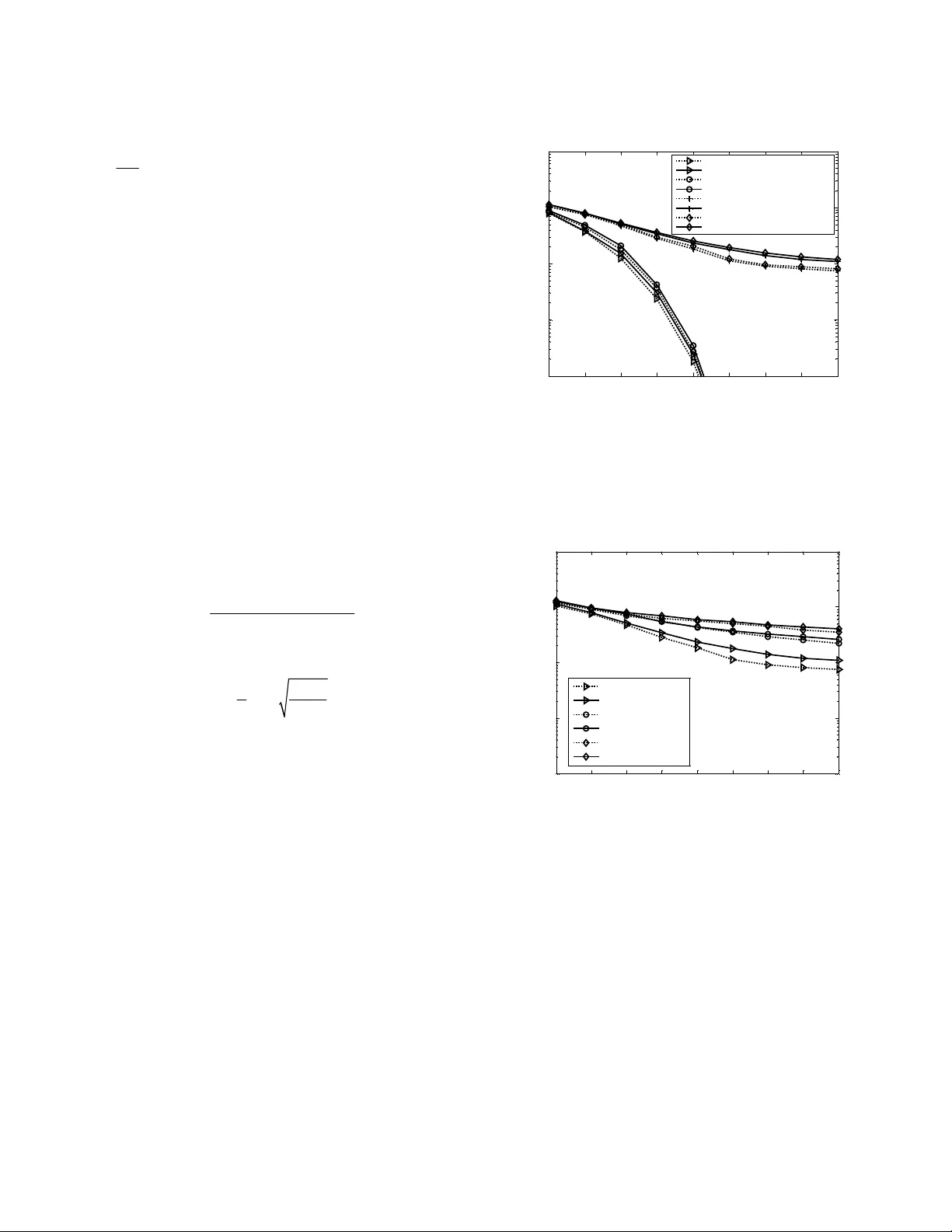
Multipath Interference Analysis of IR -UWB Systems in Indoor Office LOS Environment Luo Chao School of Electroni cs and Inform ation Engi neer ing Harbin In stitut e of Technology Harbin, China chlu ochao@163.com Wu Xuanli School of Computer S cience and Te chnol ogy School of Electroni cs and Inform ation Engi neer ing Harbin In stitut e of Technology Harbin, China xlwu 2002@hit .edu.cn Cao Yang School of Electroni cs and Inform ation Engi neer ing Harbin In stitute of Techn ology Harbin, China xiaoyang _cao@126.com Abstrac t —Bit error rate (BE R) perform ance of im pulse radio Ultra-Wideband (UWB) sy stems in the pres ence of intra- symbol interference, inter-symbol interference, multiuser interference and addictiv e white Gaussian noise (AWGN) is presented i n this paper. By analy zing the indoor of fice LOS channel m odel defined by IEEE 802.15 .4a Task Group and deducing the variance for intra-sym bol interference (IASI), inter-symbol interf erence (ISI) and multiuser interference (MUI), the s ystem BER express ion is obtained an d verifi ed by MATLAB simulations. Through co mparing the simulatio n results with an d without intra-symbol interference, the conclusion that intra-symbol interference cann ot be neglected is drawn-m oreover, such interference will significantly decrease perform ance of UWB based w ireless s ensor networks (WSN). Then , the BER pe rform ance of UWB systems in multius er environment is also analyzed an d analysis results show that multi user interference will further worsen the tr ansmi ssio n perfor mance of UWB syste ms. Keywords-ultra-wideband;IEEE 802.15.4a; BER performance analysis I. I NTRODUCTION As a hi gh da ta rate , ene rgy -effi cient and low complex ity wirel ess access techno logy, UWB is becoming an incr easingly popular fiel d for resea rchers . Many lite ratures indic ate th at UWB is on e of th e feas ible t echnol ogies for w ireless sens or networks [ 1]. And , the IE EE 802.1 5.4a Group Ta sk choose UWB as one of the phy sical la yer t echn iqu es [2 ]. H ow ever, in certa in specifi c environments , especi ally indoor offic e environm ent, the d ense mu ltipath chann el of UWB exhibits an obstacle to collect energ y eff ectively with substanti al m ultipath interfe rence. There are tw o ty pes of m ultipath interfe renc es: One is caused by the in terfer ence of two ad jacent data sym bol (ISI ). An other is cause d by the inte rfe rence between a pul se and its own multipaths , which is called intr a-symbol interfe rence ( IASI). The avai lable literatu res in this are a have already analy zed th e sys tem perf orm ance in the pres ence of narrow band interf erenc e, m ultiuser inte rferenc e, and multipa th inter ference [3-8] . Referenc e [3] and [4] mainly discussed multiuser interf erence and propose d the energy -detecti on receive r and non-line ar fi lterin g approa ch t o m itigate such interfer ence. R eference [5] main ly investigate d the system perfor mance of IR-U WB with narro w band inter ference ( NBI) and conclu ded that NBI will greatly worsen system perfo rman ce. Refer ence [ 6-8] have an alyzed the in ter-s ymbol interfe rence ( ISI) and figu re d out that ISI ef fect can be neglect ed w hen data transm ission rate is l ow w hile for the hig h data rat e, ISI can impo se a significant influence on system perfor mance. Ne verthele ss, the literat ures above do not consi der the int ra-sym bol inte rferen ce (IA SI) effe ct and do not pres ent a pers uasive proo f that I ASI can be ne glected i n IEEE 802.1 5.4a indoor office e nvironment. In thi s pa per , w e are goi ng t o pr ove th at IA SI c annot be neglect ed an d esta blish a pr oper m athem atical m odel t o mak e a detaile d resea rch int o tw o types of m ultipath in terfe rences, i .e., intra-sym bol inte rferen ce an d inter-sy mbol in terfer ence, as well as m ultiuser interf erence, and then an alyse h ow they affect th e BER pe rform ance of UWB sy stem . II. U WB M ULTIUSER AND M ULT IPA TH C HANNEL M ODLE In a TH-UWB sy stem modulated by BPSK, the transm itted signal ca n be expressed as: 1 (, ) (, ) () , 0 () ( ) . s N ni ni n p fi j c j s td E p t j T C T − = =− − ∑ (1) where, p(t) is a un it energy puls e w aveform w ith energy E n . T f is the m ean pulse re petition perio d. () , {1 , 2 , 3 } n ij h CN = ……, is the tim e-h opping se quenc e of th e i -t h bit of t he n -th user, T c is t he tim e-h opping sl ot t im e, (, ) {1 , 1 } ni d ∈− repres ents the binary data s equ ence . On e dat a sy mbol is con vey ed w ith N s pulses . The UWB chan nel mode l discus se d in thi s pape r i s gener ated from the IE EE 802.15.4 a indoor offic e LOS enviro nment with pa th freq uency depe ndence . In time domain, the im pulse resp onse of UWB system can b e written as follows: This w ork is su pported by S pecializ e d Resear ch Fund f or t he Docto ral Program of High er Ed ucat ion (New Teachers ) (Gran t No. 2 009230 212000 1), China P ost docto ral Scien ce F ound ation ( Gr ant No . 20 1004 71080) , a n d Heil ong jiang Pos tdoc tor al G rant (G rant N o. L BH -Z0915 3). ,, 11 () () ( ) . LK kl l kl lk ht f t t T αδ τ == =∗ − − ∑∑ (2) And in frequ ency dom ain, it c an be written as: ,, 11 () () e x p ( ( ) ) . LK kl l kl lk HF j T ωω α ω τ == =− ⋅ + ∑∑ (3) where, L an d K denote the total num ber of clust ers and ray s. , kl α is the ta p weig ht of the k- th ray in th e l- th clust er, and , kl τ is the arriva l tim e of k -th ray r elative to l -th cluster arri val time l T . And () F ω denotes th e f requ ency de penden ce of ray arri vals, which can be give n by: 00 () ( / ) . FC κ ωω ω − = (4) where, C 0 is a constant, κ is the freque ncy dependen ce of the pathloss, and 0 ω is the reference f requency. Furtherm ore, () F ω can be expan ded in Taylor series as ( ) ( ) ( )( ). cc c FF F ωω ω ω ω ′ ≈+ − ( 5) where, ω c is the center frequency . In indoor offi ce LOS envir on ment, κ is considerably small an d ( ) F ω is a slowly var ying f unct ion o f κ wi thin the appli ed frequen cy bandw idth [9]. Thu s we can obtain the approx imation of 0 () ( ) FF ωω ≈ by ignoring the high er order term s of Tay lor series. It is noted t hat for IR-UWB syste ms using pulse ba sed transm itter and rec eiver , the puls e has only positive an d negat ive pol arity. T hus, ther e is no need to co nsider random phase angl e in equat ion (2). Thus, t he received signa l can be demonstrat ed as: (, ) ( ) 11 () ( ) () () . uI N N ni n f ni r t s t i T ht nt τ == =− + ∗ + ∑∑ (6) where, n(t) den otes ad dictive w hite Gaussian noise an d () n τ is the n -th user’s re fere nce dela y rela tive to fir st user bec ause of asynchrono us transmission, assuming (1) 0 τ = . N I repres ents the number o f interferi ng pulse s fro m the pre vious per iods. max max / If b s NT R N ττ ⎡⎤ == ⎡⎤ ⎢⎥ ⎢⎥ , R b is tra nsmis sio n bit ra te, max τ is maximum multipath delay . Withou t loss of generality , we suppose the first ray in the first cluster is th e desired ray to be received, wh ose energy is 0 Ω . Then the delay of th e n -th use r re sult ing fr o m diffe re nt propagation distance and different transmitting time is () () ( 1 ) nn u t ττ =− . Moreover, for th e same user th e delay of the l -th cluster relative to the fi rst cluster is () 1 n cl tT T =− . And in the same cluster, the delay of the k -th ray relative to the first ray is () ,1 , k p kl l t ττ =− . () () () ,0 , () nn n code i j j c CC T τ =− ⋅ d enotes the TH code interval between the i -th interfering pulse and the current receiving pu lse with T c correspondin g to th e hop width . According t o IEEE 8 02.15. 4a c hannel model, the distri bution of the c luster arriv al tim es is giv en by a Poisson p rocesses: 11 (/ ) e x p [ ( ) ] , 0 . ll l l l l pT T T T l −− =Λ − Λ − > (7 ) where, l Λ is the cluster rate. Sim ilarl y, th e dis tri buti on of , kl τ i s m odele d w ith a m ix ture of tw o Poisson processes as follow s: ,( 1 ) , 1 1 , ( 1 ) , 22 , ( 1 ) , (/ ) e x p [ ( ) ] (1 ) e x p [ ( ) ] , 0 kl k l kl k l kl k l p k ττ β λ λ τ τ βλ λ τ τ −− − =− − +− − − > . (8) where, β is the m ixtu re proba bility , wh ile 1 λ and 2 λ are t he ray a rrival rates . Accord ing to p robabil ity th eory , () l c t obe ys P o i ss o n dist ribu tion w ith t w o param eters Λ and l , and th e pro bability dense func tion (PD F) can be given by [9] (2 ) () ( ) e xp( ) . (2 ) ! l c x fx x l − Λ =Λ − Λ − (9) Nevert heless, () k p t is describ ed with a m ixtur e Poisson processes and it is difficult to analy ze its distri bution functi on and probab ilit y dense function (PDF). Mea nwhile, we notice that in indoor o ffice LOS enviro nment, β is consider ably small, w hich in dicates that th e occu rrence of Poiss on process with p arameter 1 λ is very sm all and the Poisson process w ith param ete r 2 λ is do minant. To simplify our computat ion, we take () k p t as a single Poisson proce ss with param eter 2 λ and the PDF is give n by (2 ) 2 22 () () e x p ( ) . (2 ) ! k p x fx x k λ λλ − =− − (10) The PDF of () () n code i τ follo ws () 1/ (2 ) [ , ] () . 0 ss s code i Tx T T fx elsewhere ∈− ⎧ = ⎨ ⎩ (11) where, T s is the maximum time hoppin g position with s f TT ≤ . For the fa ding am plitude , kl α , it f ollow s a Nakag ami-m distribu tion w ith p aram eters ( , m Ω ) acco rdi ng to [10] ,, 21 ,, 2 ,, , ,, , 2 ( ) ( ) exp( ). () kl k l mm kl kl kl kl kl kl kl kl mm pdf m αα α − =− ΓΩ Ω (12) wh ere, ( ) Γ⋅ corr espon ds to the Gamm a fun ction, m is the Nakaga mi m-factor which is mod eled a s a lognormall y dist ribu tion ran dom varia ble, 2 ,, [] kl kl E α =Ω . The m ean power of different rays is expresse d by 11 , 11 ,, 12 11 exp( / ) and [] . [( 1 ) 1 ] 0o r lk l l kl k l l kk l l E kkl l τγ αα γ β λ β λ Ω− ⎧ == ⎪ =− + + ⎨ ⎪ ≠≠ ⎩ (13) where, l Ω corresponds to the integ rated energy of the l -th cluster, and l γ is the intra-cluster decay time constant. l γ is linearly depen ded on the arrival time of the cluster, 0 ll kT γ γγ ∝+ . (14) and the mean energy of the l -t h clu ster is give n b y 1 0 log( ) 10 log (exp( / )) . ll c l u s t e r TM Ω= − Γ + (15) III. M ULT IPT H I NTERF ERENCE M ODLE Accordi ng to literat ures [11-12], it is generally supposed that the inte rferen ce betw een a pulse and its ow n multipaths can be ignored, namely the di fferent multipath com ponents comi ng f rom on e pu lse c an us ually be res olve d an d they do not resu lt in int ra-sym bol inte rferen ce ( IASI) . How ever, these literatu res do not pr esent a defin ite proof on this point of vie w . In the foll owing par t, we are going to prove tha t intra-symb ol inter ferenc e cannot be ignored in IEE E 802.15 .4a indoor office LOS enviro nment. Accord ing to the channe l mode, we can obtain th e m ean ray interv al and th e mean clus ter in terval . The m ean ray inte rval ( τ Δ ) is 2 2 0 2 1 [] . p pp Ee d λ τ λ λ +∞ −Δ Δ= Δ Δ = ∫ (16) And in indoor of fice LOS environm ent 2 2.97( 1 / ns) λ = according to (16) , the mean interval is approxim ately 0.34n s. However, the pulse duration m entioned in available literatures ranges f rom 0.5ns to 2ns. In this case, the mean ray interv al is shorter than pulse duration and th ere is a probability that several adjacent ray s may overlap w i th each other and res ult in intra-symbol interference. Similarly , the mean clust er int erval ( c Δ ) is 1 [] . c E Δ= Λ (17) We can figu re out [ ] c E Δ is 62.5ns . Noticing that [ ] c E Δ is much larger than the time duration of current receiving pulse, we can conclude intra-sym bol interference primarily comes from the first cluster and the interf erence from other clusters can be neg lected. Assume that we are going to receive signals of the first ray from the first cluster. And correlation receiver is employed in the system, and the template for demodulation is 1 (1) 11 , 1 0 () ( ) . s N fj c j vt pt j T C T T τ − = =− − − − ∑ (18) The output decis ion variables of correlation receiver are g iven by (1 ) () () . f f iT u n IASI ISI MUI iT Zr t v t d t Z Z Z Z Z + == + + + + ∫ (19) where, u Z , Z n , Z IASI , Z ISI , Z MUI account f or desired sign al, additive white Gaussian noise, intra-sy mbol interference, inter-symbol interf erence and multiuser interference, respectively. The energy f or the desired sign al b E and the energy for white Gaussian noise 2 n σ can be expres sed as 22 00 22 00 () () () () / 2 . bu s nn s EE Z F N EZ F NN ω σω == Ω . == (20) where, 0 Ω is give n b y 0 01 2 1 . [( 1 ) 1 ] γβ λ β λ Ω= −+ + ( 2 1 ) And th e vari ance of intra- sym bol interfe rence 2 IASI σ is expre ssed as 11 11 1 22 (1 ) (1,1) 0, , 11 (1,1) 2 1,1 1 1,1 22 2 0, , 1 , 1 11 2 0 , , , 1, 1 , 1,1 () () [ [ ( ) () ] ( ) ] () [ ] [ ( ) ] ( ) [ ] [( )( ) ] f f IASI IASI LK iT kl l kl iT lk LK sk l k l lk sk l k l k l k l k EZ FE s t T st T v t d t FN E E R FN E E R R σ ωα τ ατ ωα τ τ ωα α τ τ τ τ + == == = =− − − −− =− + −− ∑∑ ∫ ∑∑ 1 11 11 LK LK lk l == == . ∑∑∑∑ (22) where, ,, kl l kl T ττ =+ , and ( ) R ⋅ represents th e autocorrelation function of the transmitted pulse waveform, and k and l cannot equal to 1 simultaneously. Moreover, 1 k and k , 1 l and l should not b e the same simultaneousl y. Under these conditions, w e can get 11 ,, [] kl k l E αα is zero and the second term of the above equation is zero. Given that only the first cluster is taken into consideration and 1,1 τ equals zero, the equation can be further sim plified into 22 2 00 0 2 ( ) e x p ( / ) () () . m K T IASI s p k F Ny f y R y d y σω γ = =Ω − ∑ ∫ (23) where, y denotes , kl τ . Since o ne i nfor mati on s ymb ol us uall y co mprise s se vera l pulses, for each receiv ed pulse, w e can attribute the mu ltipath interference from its previous pulses to inter-sym bol interference (ISI). Thus, the number of in terfering pulses is equi vale nt to Is NN . Meanwhile, Poisson process h as the characteristic of m emorylessness, so we can apply the s imilar method as IA SI to analy ze ISI and jus t change th e energy of th e fi rst in te rf erin g ray 0 Ω to Σ Ω . Σ Ω is th e su m of the average en ergy of the fi rst ray of all the interfering pulses. Considerin g that diff erent users adopt th e hom ogeneous t ime hopping sequence, () () n code i τ ha s the same distr ib ution fo r diffe re nt n and i . Therefore, w e use code τ to represent the m all. Hence, the v ariance for inter-symbol in terference (ISI) is give n by 22 2 / 2 0 2 () ( ) e ( ) ( ) m m K T y ISI IS I s p T k E ZF N f y R y d y γ σω − Σ − = == Ω . ∑ ∫ (24) where, Σ Ω can be expres sed as (25) where, s Ω represents the s -th interfering pu lse’s energy. The analysis of multiuser interference (MUI) is similar to IAS I, and we just add u t to the w hole dela y. u t is the delay of other us ers relative to th e first user. Suppos e there exists 1 u N + users in th e system, the variance of MUI is 22 /2 2/ 2 00 /2 2 /2 2/ 2 0 /2 2 () () e ( ) ( ) () e ( ) ( ) fm f fm f MUI MUI K TT z y bs u p Tz k K TT z y bs u p Tz k EZ F R N N f y R y z dydz F RN N f y R y z d y d z γ γ σ ω ω − − −− = − − Σ −− = = =Ω + +Ω + . ∑ ∫∫ ∑ ∫∫ (26) where, y represents , kl τ and z repres ents u t . Finally, the signal to inter ference plus noise ratio (SINR) can be written as 22 2 2 SI NR . b nI A S II S IM U I E σσ σ σ = ++ + (27) And for BPSK system the bit error probability BER is 1S I N R () . 22 BER erf c = (28) IV. S IM U LA T I O N R ESU LTS The conve ntiona l sec ond ord er de riva tion o f Gaus sian pulse waveform with time duration 0.5 ns m T = is adopted in simu lation an d its 10dB ban dwidth is 5.6GHz . Withou t loss of gener ali ty, we co nside r N s equals 1. Plu s, w e set the h opping wid t h c T equals m T and the num ber of hops h N is chosen to be 16. A ll the sim ulation i s conduct ed under th e indoor of fice LOS environment and data transmission rate is chosen to be 1Mbps and 15M bps, respecti vely . The results are show n in Fig. 1. As is shown in Fig. 1, the assumptio n that there does not exist intra-symbol interference (IASI) does not match with simulation, nam ely IASI cannot be neglected in the analysis. In addition, the figure reveals that IASI is a primary impact factor to sy stem analysis becau se even for h igh 0 / b E N va lue s, the BER is still high. On the other hand, we can co nclude that inter-symbol interference (ISI) h as very little effect to the system performance when the data transmission rate is low (in the simulation we set 1Mbps and its simulation curve is very close to AWGN ch annel). 0 2 4 6 8 10 12 14 16 10 -4 10 -3 10 -2 10 -1 10 0 E b /N 0 BER 1Mbps-w ithout IA SI, s i mul ati on 1Mbps-w ithout IA SI, anal ysi s 15Mbps-Wi thout IA SI, s imul ati on 15Mbps-Wi thout IA SI, ana l ysis 1Mbps-Wi th IA SI , s i mul ati on 1Mbps-Wi th IA SI , anal ysis 15Mbps-Wi th IA SI , s i mul ati on 15Mbps-Wi th IA SI , anal ysis Fig ur e 1 . Analysi s and simu lati on result s with and wit hout intra -symbol interferenc e Fig. 2 presen ts the BER performan ce of UWB with 1 user, 2 users, 4 us ers and 8 users , respectively. And each user’ s transmission data rate is set to be 1 5Mbps. Figure2. Ana lysis a nd simulat ion results with multiu ser interference From Fig. 2, w e can see that the analysis curves are very close to simulation curves, and the BER f ormulation have a very accurate evaluation of system perform ance in the presence of noise and different in terferences. Furthe rmore, we can s ee that multiuser in terference will further w orsen system transmission performance com pared with single user sy stem. An oth er issu e is th e d is crepa ncy be tw een analy s is an d simulation results. It should be noted that the simulation plo ts have a bet ter BER perform ance than th e analysis plots especially w hen 0 / b E N is high. And there can be two reasons for the di fference abov e: (1) In the an alysis, we adopt t he cont inuo us sec ond ord er deri vatio n o f Gauss ia n pul se wi th time duration from negative infinit y to positive infinity to derive all the interference formulation, while in the max 1 1 1 () / / 0 0 11 11 [] 1 ee 2 () ( ) . Is Is s f c ode fc o d e l l sf c o d e NN s s NN L Ts T sT T T Ts T ls s c l c l l l c ode E T fT fT d T d T d ττ τγ τ τ − Σ = − + −+− −Γ −+ == ++ Ω= Ω =Ω × ∑ ∑∑ ∫∫ ∫ 0 2 4 6 8 10 12 14 16 10 -4 10 -3 10 -2 10 -1 10 0 E b /N 0 BER 1 user, simula tion 1 us e r , anal ys i s 4 u ser s, sim u la tion 4 us e r s , anal ys i s 8 u ser s, sim u la tion 8 us e r s , anal ys i s simulation, a truncated waveform with time du ration 0.5ns m T = is employed. That is to say we introduce more interference in the an alysis and as a resu lt, a worse BER perform ance is shown in th e analysis plots . (2) We adopt a simpl e way to describe t he com ing of ran dom rays , as is talked in Section Ⅱ . Precisely speaking , the coming of rays should be m odele d with a m ixture of two Pois son proces ses with param eters ( 12 , λλ ). However, considering the low occurrence of Poisson process ( 1 λ ) and also a sim pler way of computat ion, the coming of rays is modele d as a single Poisso n pro cess ( 2 λ ) in the analysis. Such simplification results in more interference in the analysis. It sh ould be noted that the mean ray interval ( τ Δ ) is in in verse proporti on to λ and 2 λ is far greater th an 1 λ : 21 λλ >> . In this case, we can conclude that the 2 λ Poisson process will have a mu ch higher probability to generate a very dense multipath rays than the 1 λ Poisso n pro cess. Ther efore , a si ngle P oisso n pro cess (anal ysis res ults) means a more seve re i nterfere nce t han a mixture of t wo Poisso n p roce sses (si mulatio n res ults). V. C ONCLUSION By an alyzing the indoor of fice LOS channel model def ined by IEEE 802. 15.4a Task Group, a s ystem model for B ER analysis of UWB sys tems with intra-sym bol interference, inter-symbol interference, multiuser interf erence and AWGN is proposed. Furth ermore, th e variance for IA SI, ISI and MUI is also derived as w ell as system BER formulation, and MATLAB simulation sho ws that the f ormulation can give an accurate evaluation of the system transmis sion performance. Moreover, thi s paper also proves th at the int ra-symbol interference should n ot be neglected by calculating the mean ray interv al and co mparin g it with simulation. In the futu re, we will continue to an alyze those different parameters in the syst em model, an d try to im prove sys tem perform ance by parameter optimization. R EFERENCES [1] A. Be rthe , A. L eco intre, D . Drag omire scu, a nd R. Plan a, “Sim ulat ion Platf orm for Wire les s Sens or N etw orks Base d o n I mpuls e Radio Ultr a Wide Ban d,” Eighth Intern at ional C onferenc e on n etwork, 200 9: 61–66 . [2] E. Kara pist oli, F. N. Pa vlidou, I. Gragop oulos a nd I. Tsetsi na s, “An Overview of the IEEE 802. 15.4a Stan dard,” I EEE Comm. Mag., v ol. 48, p p. 4 7–53, Janu ary 2 010. [3] M. F lury , R. Mer z, J. L. Bo udec and J. Z ory , “ Perfo rmance Ev alua tion of an I EEE 80 2.15.4 a Phy sical L ayer w ith Ene rgy De tection a nd Mult i- User Interfe rence ,” Ultra- Wide band IEEE I nte rnational Confe rence, p p. 663 -668, Sept emb er 2007. [4] Z. Sahin oglu, I. Guvenc, P. Orlik an d A. F. Molis ch, “Interfe rence Suppr essio n i n Non- cohe re nt Time -Ho pping I R-UW B Rang ing,” Ul tra- Wideban d IEEE I nternat ional Confe rence, pp . 507- 511, Septe mber 2006 . [5] M. D. Renz o, f. Te mpedta, L . A . Anno ni, F . Sa ntucci , F. G raz iosi, R. Minut olo and M. Mont ana ri, “Perform ance Eva luati on of IR-UWB D- Rake Re ceive s ov er I EEE 802.15. 4a Mul tipath F ading C hanne ls w ith Norr ow-Band I n terfe rence ,” Ultra- Wide band I EEE Inte rnatio nal Confe re nce, pp. 71-7 6, Se ptembe r 2009. [6] H. L . Gong , H. Nie and Z . Z. Che n, “P erf ormance of UW B Sy stems with S ubop timal Rece iver s unde r I EEE 80 2.15.4 a I ndustr ial Enviro nmen ts,” Comm unica tion N etw orks an d Ser vice s Rese arc h, Fift h Annual Confe re nce, pp. 283- 286 , May 2009. [7] W. D . Wu, C. C. L ee, C. H . W ang a nd C. C. Chao, “S ignal- to- Interf eren ce-P lus -Noi se Ra ti o Analysis for Di rect -Seq uen ce Ult ra- Wideband Sy stems in G eneral ized Saleh-V alanzuela Cha nnel,” I EEE Signa l Processi ng, vol. 1, pp.483-497 ,Oct ober 200 7. [8] F. Har oon, K. M. A hmed, and H. Rashee d, “A n Adaption of I EEE 802.1 5.4a in an I ndus tria l F ield Bus,” I EEE I ndus trial I nfor matics, pp.531 -536, August 201 0. [9] R. C. Q iu and I . Lu, “ Multip ath r eso lving with fr eque ncy depe ndence for broadb and w ire le ss channe l mo deling ,” I EEE T ransaction.Ve hicul ar. Techn ology., vo l. 2 , pp. 273–2 85,19 99. [10] V. Sip al, B. Allen and D. Ed wards, “E xplora tion of Na kagami fad ing in ultra- wide band wir ele ss chan nel s”, I EEE El ectro nics Le tters , vol 47, pp. 520, Apri l. 201 1 [11] M. Z. Win and R. A. S ch oltz, “O n the en ergy ca ptur e of ult ra-wid e bandwidt h signals i n dense multi path envir onments, ” I EEE Commun. Lett. , vol. 2 , pp. 245–2 47, Sep. 1 998. [12] D. Cass ioli, M. Z. W in, a nd A . F . Mo lisch, “ The ultra- wide ban dwidt h indoor channel : From statistical mode l to simulat ions,” I EEE Jour nal. Select ed Areas C ommu nic ation, vol. 20, p p. 1 247–12 57, Aug. 2 002.
Original Paper
Loading high-quality paper...
Comments & Academic Discussion
Loading comments...
Leave a Comment