Joint timing and frequency synchronization based on weighted CAZAC sequences for reduced-guard-interval CO-OFDM systems
A novel joint symbol timing and carrier frequency offset (CFO) estimation algorithm is proposed for reduced-guard-interval coherent optical orthogonal frequency-division multiplexing (RGI-CO-OFDM) systems. The proposed algorithm is based on a constan…
Authors: Oluyemi Omomukuyo, Deyuan Chang, Jingwen Zhu
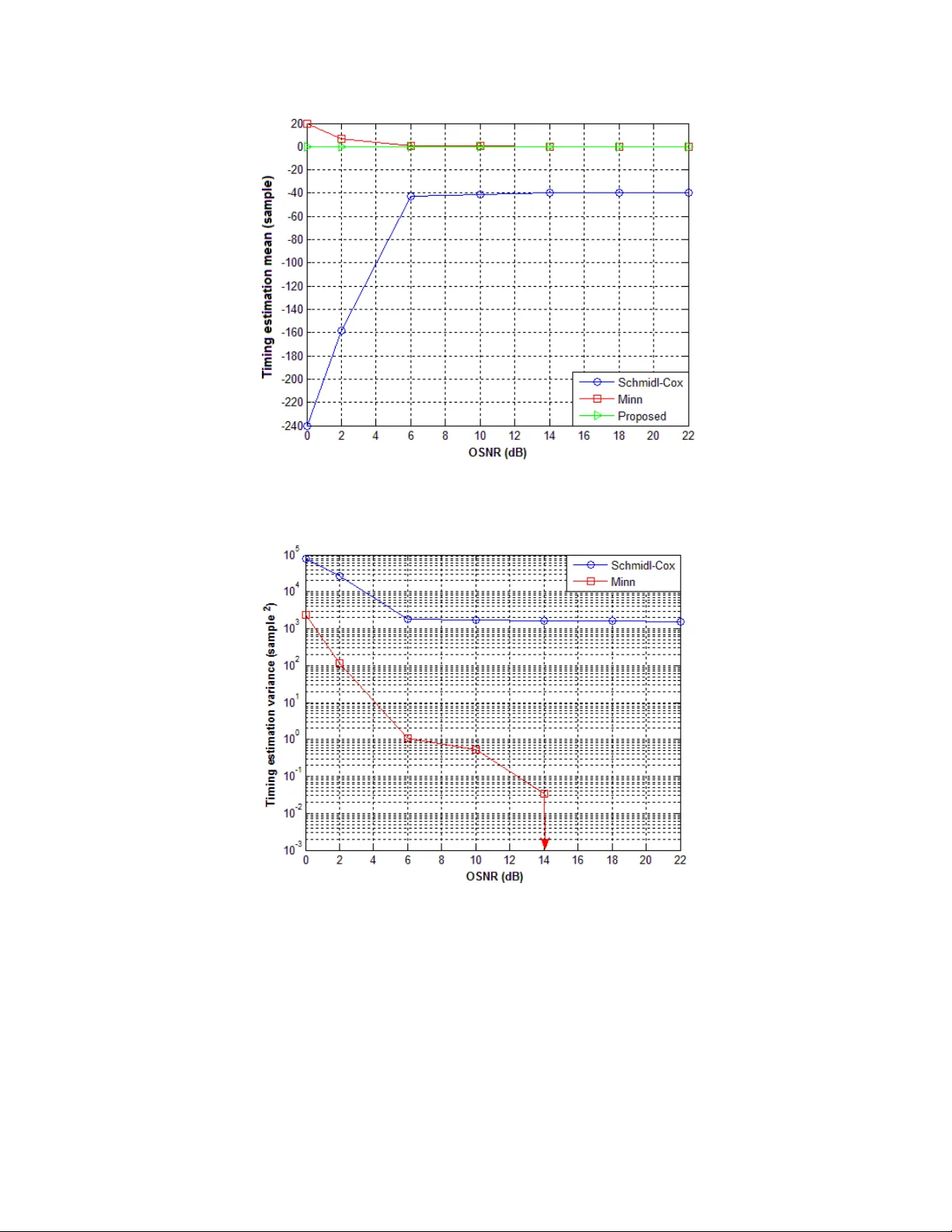
Joint timing and frequency synchronization based on weighted CAZAC sequences for reduced-guard-interval CO -OFDM sy stems Oluyemi Omo mukuyo, 1 Deyuan Chang, 1 Jingwen Zhu, 1 Octavia Dobre, 1 Ramachandran Venkatesan, 1 Telex Ngatched, 2 and Chuck Ru mbolt 1 Faculty of Engi neering and Ap plied Science , M emorial Universit y, St. John’s, NL, A1B 3X5, Canad a 2 Division of Sc ience, Greenfell C ampus, Memorial Un iversity, Corner Brook, NL, A2H 5G4, Canada Abstract: A novel joint symbo l tim ing and carr ier frequency o ffset (CFO) estimation algorith m is pr oposed for reduced- guard-interval co herent optical orthogonal frequency-d ivision multiplexing ( RGI- CO -O FDM) systems. The proposed algorithm is based on a constant amplitude ze ro autoco rrelation (CAZAC) sequence weighted by a pse udo -random noise (PN) sequence. The sym bol timing is acco mplished b y using onl y one traini ng symbol o f two identica l hal ves, with the weighting applied to the second half. The special struct ure o f the training s ymbol is also utilized in esti mating the CFO. T he perfor mance of t he p roposed algorithm is d emonstrated by means of numerical simulations in a 1 15.8-Gb/s 16 -QAM RGI- CO -OFDM system. References and links 1. W. Shieh, H. Bao, and Y. T ang, “Cohe rent optical OF DM: theory and design,” Op t. Express 16 (2), 841-859 (2008). 2. A. J. Lowe ry, L. Diu, and J . Armstrong, “ Orthogonal fr equency division multiplexing fo r adaptive dispersion compensation in lo ng haul W DM syste ms,” in Proc. Op tical Fiber Comm un. Conf. (OF C) 2006, p aper PDP39. 3. I. B. Djordjev ic and B. Vasic , “Orthog onal frequency division multiplexing for high-speed op tical transmission,” O pt. Express 14 ( 9), 3767-3775 ( 2006). 4. S. L. Jansen, I . Morita, T. C. Schenk, and H. Tanaka , “Long -haul transmissi on of 16×5 2.5 Gbits/s pol arization- division-multiple xed OFD M enabled by M IMO pro cessing (I nvited),” J. O pt. Netw . 7 (2), 173-182 (2008). 5. P. Poggiol ini, A. Carena, V. Curri, and F . Forg hieri, “Evaluation of t he computation al effo rt for chromatic dispersion compe nsation in cohe rent optical PM-OFD M and PM- QAM sy stems,” Opt. Expres s 17 ( 3), 1 385- 1403 (2009). 6. D. R. Go ff and K. S. Hansen , Fiber Optic Referenc e Guide: A Pr actical G uide to Comm unications Te chnology (Focal, 2002). 7. X. Liu, S. Chandrase khar, B. Zhu, P. J. W inzer, A . H. Gnauck, a nd D. W. Pe ckham, “448 -Gb/s reduced-guard- interval CO-O FDM transmission over 2000 km of ultra-large-are a fiber and five 80-GHz- g rid ROADMS,” J. Lightwave Technol. 29 (4), 483-490 ( 2011). 8. T. Polle t, M. V. Bladel, and M . Moenecl aey, “BER sensitivi ty of OF DM systems to carr ier fre quency offse t and Wiener phase noise,” IEEE T rans. Commun . 43 (2/3/4), 19 1-193 (1995). 9. T. M. Schmi dl and D. C. Co x, “Robus t frequency and timing sy nchronization for O FDM,” I EEE Trans. Commun . 45 (12), 1613- 1621 (1997). 10. H. Minn, M. Ze ng, and V. K . Bhargava, “O n timing offse t estimation for OF DM systems,” I EEE Commun. Lett. 4 (7), 242 – 24 4 (2000). 11. B. Park, H. Cheo n, C. Kang, and D. H ong, “A novel timing estim ation metho d for OF DM syste ms,” IEEE Commun. Le tt . 7 (5), 239-241 ( 2003). 12. J. J. van de Beek, M. Sandel l, and P. O. Borje sson, “ML es timation of time and fre quency of fset in OFDM systems,” I EEE Trans. Signal Pr ocess. 45 (7), 1800-1805 ( 1997). 13. X. Zhou, X. Ya ng, R. L i, and K. Lo ng, “Efficient jo int carrier fre quency offset and phase noise compens ation scheme for high-spe ed coher ent optical OF DM systems,” J. L ightwave Technol. 31 ( 11), 175 5-1761 (2013). 14. Y. Huang, X. Z hang, and L . Xi, “Mod ified synchro nization sche me for cohe rent optical OF DM sy stems,” J. Opt. Commun. Ne tw. 5 (6), 584-59 2 (2013). 15. X. Zhou, K. L ong, R. L i, X. Yang, and Z. Z hang, “A simple and effic ient fre quency offse t estimation algo rithm for high- spee d coherent optical O FDM sy stems,” Opt. Ex press 20 (7), 735 0-7361 (2012). 16. X. Zhou, X. Che n, and K . Long, “W ide -range frequency of fset estimation al gorithm for optic al coherent systems using training sequence ,” I EEE Photon. Te chnol. Le tt. 24 (1), 8 2-84 (2012). 17. Optical I nternetworking F orum, “I ntegrable T unable L aser Assembly MSA,” OI F -ITLA-MSA-01.1 (Nov. 22 , 2005). 18. R. Frank, S. Z adoff, and R. He imille r, “Phase shift pulse codes w ith good per iodic correl ation properties,” I RE Trans. I nform. Theory 8 (6), 381 – 382 (1962). 19. D. C. Chu, “Poly phase code s with go od periodic corr elation prope rties,” I EEE Trans. I nform. Theo ry 18 (4 ), 531-532 (1972). 20. A. Milewski, “Pe riodic seq uences with op timal prope rties for channel e stimation and fas t start- up equalizat ion,” IBM J. Res. De velop. 27 (5), 426 – 431 ( 1983). 21. Z. Yang, L . Dai, J. Wang, J. W ang, and Z . Wang, “T ransmit dive rsity fo r TDS -OFDM broadcasti ng over doubly selective fading channels,” I EEE Tr ans. Broa dcast. 57 (1), 135-142 (201 1). 22. G. Ren, Y. Cha ng, H. Zhang, and H. Z hang, “Synchroniz ation method based on a ne w constant e nvelo p preamble for OFD M systems,” IEEE Tr ans. Broadcast 51 (1), 139-143 (200 5). 23. H. Wang, L . Zhu, Y. Shi, T. X ing, an d Y. Wang, “A novel synchronization alg orithm for OF DM syste ms with weighted CAZA C sequence ,” J. Comput. I nf. Sy st. 8 (6), 2275 – 228 3 (2012). 24. C. E. M. Silva, F . J. Harris, a nd G. J. D olecek, “Sy nchronization al gorithms base d on we ighted CAZA C preambles for OFD M systems,” in Pr oc. I EEE International Symposium C ommun. I nf. Te chnol. (ISCIT) 2013. 25. S. L. Jansen, I . Morita, T. C. W. Schenk, N. Takeda, an d H. Tanaka, “ Cohere nt optical 25.8 -Gb/s OFDM transmission ove r 4160- km SSMF ,” J. L ightwave Technol. 26 (1), 6-15 ( 2008). 26. R. Kudo, T. K obayashi, K. I shihara, Y. T akatori, A. Sa no, and Y. Miy amoto, “Co herent optical s ingle carrie r transmission usi ng overl ap frequency domai n equalizatio n for long- haul optical sy stems,” J. L ightwave Technol. 27 (16), 3721-37 28 (2009). 1. Introduction In recent years, orthogonal frequency division multiplexing (OFDM) has beco me an attractive technology for high-speed optical communication systems because it offers high spectral efficiency a nd hi gh tolerance to both the fiber chromatic dispersion (CD) a nd p olarization mode dispersion (P MD) [1 – 3]. Coherent optical OFDM (CO-OFDM) has de monstrated superior transmissio n performance i n ter ms of spectral effici ency a nd receiver sensiti vity than it s direct-detectio n counterp art [1] , making it more suitable for long- haul transmissio n. Conventional CO -OFDM sy stems utilize a cyclic prefix (CP) between adjacent OFDM symbols to acco mmodate the inter-symbol interference (I SI) arising from the fiber CD and PMD [4 ,5]. Given that CD i ncreases quadraticall y with an increase in the data rate [ 6], the large CD -induced channel memory length poses a problem for long -haul, high-speed transmission, espec ially when there is no in -line optical dispersion compensation [7]. T his is because a long CP duration would be required to compensate f or the CD, resulting in a lar ger overhead and poor er spectral efficiency. To overco me t his problem, reduced -guard -interval CO -OFDM (RGI- CO -OFDM ) [7] has been proposed. RGI- CO -OFDM systems employ a reduced guard interval to accommodate only the P MD, whi le the CD is co mpensated usi ng frequency-do main equalization (FDE) at the receiver s imilar to single-carrier (SC) sys tems. Despite its several advantages, OFDM systems su ffer f rom a higher degree o f se nsitivity to frequency synchronization errors when co mpared with SC syste ms [8 ] . OFDM systems require tim ing and frequency synchro nization be fore an accurate symbol decisio n can be made at the receiver. T iming synchronization e ntails find ing a n e stimate of the cor rect position of the Discrete Fourier Transform (DFT ) window at the receiver so as to avoid I SI, while frequency synchronization involves estimating and compensating for the carrier frequency offset ( CFO) which may cause inter-carrier interf erence (ICI) between the OFDM subcarriers. In wireless co mmunications, several algorithms for ca rrying out OFDM timing and frequenc y synchronizat ion either jointl y or individua lly hav e bee n pro posed [9-12 ] . These algorithms can be classified into data -aided (DA) [9 -11] and non-data-aided (NDA) [1 2 ] methods. In DA algorit hms, which are the focus of this paper, the timing and frequency synchronization is usually based on exploiting the correlation property of speciall y-designed training symbols (t ypically with some sort o f repetitive pattern) . One of the most popular DA algorithms, proposed by Schmidl and Cox [9] , uses a training s ymbol with two iden tical halves for the timing synchronization. Ho wever, the ti ming metric o f t he Schmidl and Cox’s algorit hm ha s a plateau which results in a large timing offset estimation varia nce. In order to eliminate the timing metric plateau of the Schmidl and Cox’s algorithm, Minn et al . [1 0] proposed a modified tr aining symbol with four id entical par ts having spec ific sign changes f or the se parts. The resulting ti ming metric has a steeper ro lloff, but has a large timing estimation variance in ISI channels . Park et al . [11] proposed an algorithm based on reverse autoco rrelation, which uses a repeated -conjugated-symmetric sequence to i mprove the ti ming e stimation variance o f the Minn’s al gorithm . Although the Park’s algor ithm results in a n impulse-shaped timing metric which yields a more ac curate timing o ffset esti mation, t he ti ming m etric ha s t wo large side lobes w hich can result in error s in the timing synchronization. So me of these al gorithms have been co nsidered for timing synchronization in cohere nt optical systems [13-16 ]. Unlike in co nventional OFD M wireless systems, where the CFO is usuall y due to the Doppler effect, the CFO i n CO -OFDM systems is br ought abo ut by t he incoherence of t he signal laser of the tra nsmitter and the local osc illator (LO) laser of the rec eiver. S ince commercially-availab le lasers are usually locked to an International T elecommunication Union (IT U) standard, but only with a frequency acc uracy within ± 2.5 GHz over their lifetime [1 7], the CFOs in CO-OFDM systems is t ypically within the range [ -5 GHz, +5 GHz]. Given that optical p hase-locked loops ar e disadvantaged by high co st and complexity, frequency synchronization algorit hms are essential to CO -OFDM receivers . The Sch midl and Cox’s algorithm ca n ca rry out frequency synchronization b y computing t he phase difference between the t wo ha lves of the training symbol. However, th e CFO es ti mation range is li mited to ±subcarrier spacing, ma king it unsuitable for u se in CO -OFDM systems. T he CFO estimation range can however be increased b y e mploying a second train ing symbol, but at the cost of extra overhead [9] . In this paper , we pr opose and demonstrate, for the first time to our knowledge, a joint timing and frequency synchro nization algorithm for RGI - CO -OFDM systems using only one training symbol based o n a co nstant amplitude zero au tocorrelation (CAZAC) sequence weighted by a pse udo-random noise ( PN) sequence. CAZAC seq uences, wh ich are a type o f polyphase codes, have constant amplitude elements and good periodic autocorrelation properties [ 18 -20] and have b een applied in wireless co mmunications systems for various applications, including c hannel estimation [ 21] and s ynchronization [ 22 - 24 ] . T he performance of the pro posed technique is de monstrated by means of numerical si mulations in a 115.8-Gb/s 16 -QAM RGI- CO -OFDM syste m. T he pro posed algorithm is sho wn to ha ve a w ide CFO estimation range, as well as a more precise timing offset estimation and a better CFO estimation perfor mance than po pular existing synchro nization methods. 2. Principle of proposed synchro nization algo rithm The proposed synchronization algorithm makes use of a traini ng s ymbol of t wo identical halves, with the seco nd hal f weighted b y a P N sequence. Ea ch half of the training symbol has a length of 2 MN , and is gen erated by an - M point inverse fa st Fourier transform (IFFT ) of a CAZAC sequence of le ngth 2 sc LN , where sc NN is t he number of OFDM subcarriers, and N is the IFFT size. The CAZAC sequence, cm can be expr essed as: 2 exp 0, 1 , , 1 , j rm c m m L L (1) where r is a positive integer which is relative -prime to L [19 ]. The autocorrelation property of the CAZAC seque nce is: 1 * 0 mod ,0 0, 0 L m L L c m m c (2) where the s uperscript * rep resents the co mplex conjugat ion o peration and mod L is the modulo- L operator. The structure of the pro posed training symbo l is: , MM TS A B (3) where M A represents the - M point IFFT of cm and M B is obtained by multipl ying M A by a real-valued PN sequence, 1 , 1 pn , where 0, 1 , , 1 n M . Note that pn is introduced to scramble the sa mples in the second half of the training s ymbol so as to eliminate the timing m etric plateau as sociated with the Schmidl and Cox’s algorithm. In this regard , a PN sequence of all “1s” or all “ - 1s” will not work in eliminating thi s platea u. The samples in the second half of the trai ning symbol have to b e later descrambled in the recei ver. 2.1 Timing syn chronization The timing synchronization i s based on the timing metric, Md , which is defined as : 2 2 () Pd Rd Md , (4) with 1 0 * M n P d r d n p n r d n M , (5) and 1 0 2 1 2 N k R r d k d , (6) where rn represents the discrete sa mples of the rec eived OFDM signal, d is the time index corr esponding to the first received sample in a windo w of N sa mples, Pd represents the cr oss-corr elation between the two halves of t he window, and Rd is the half - symbol energy in the N sam ples of the w indow. The timing m etric defined in Eq. (4) contains two modifications to the t iming metric of the Sc hmidl and Cox’s algor ithm. The first modification is the introduction of pn in Eq . (5) to descramble the sa mples in the second half of the training symbol. For the second m odification, all samples over one s ymbol period are used in computing Rd instead o f using o nly t he sa mples in the second hal f sy mbol period. T he timing of fset estimate is obtained as the time index at whic h () Md has it s peak value: ˆ arg max d d M d . (7) 2.2 Frequency syn chronization After transmission through the optical fiber, if the l aser phase noise and a mplified spontaneous e mission (ASE) noise are b oth ne glected, and it is assumed that the phase shift induced by the CD has b een compensated for, the two ha lves of the trai ning symbol will differ by pn and a phase shift ind uced by the CFO. The CFO f can b e d ecomposed into a fractional part with a magnitude N f , and an integer part, which is a multiple o f 2 N f , where N f is the OFDM subcarrier frequenc y spacing [9] . I f we let N f f be the normalized CFO, can be expressed as: 2 , (8) where is the nor malized fractional CFO and 2 is the normalized integer CFO, with 1 and integer spanning the range o f possible CFOs . It is str aightforward to express the received samples i n the seco nd half of the training s ymbol as: j r n M p n r n e . (9) Equation (9) shows that the t wo halve s of the trainin g symbol di ffer onl y by the P N sequence and a p hase shift of . Consequently, if ti ming synchronization has already been carried out, an esti mate , ˆ , of can be obtained as: 1 0 * 1 ˆˆ ˆ M n an gle r d n p n r d n M . (10) Equation (10 ) indicates that the correct timing information is necessary to co mpute ˆ . In order to estimate the i nteger C FO, the samples of the trainin g s ymbol ha ve to b e first counter - rotated at an angular speed of ˆ 2 N ft , where 0 tT and T is the us eful OFDM symbo l duration. By co mpensating for the fractional CFO, ICI is e liminated, and there is no lo ss o f orthogonality a mong the OFD M subcarrier s. Ho wever, because o f the u ncompensated i nteger CFO, the fast Fo urier transform (FFT ) outputs will be shifted by 2 . In order to obtain , we compute the correlation in the f requency domain of the f r actional CFO - co mpensated training symbol with the original trans mitted training s ymbol. Let the FFT o f the rec eived training s ymbol with only inte ger CFO be f Rk and let the FFT of the o riginal tr aining s ymbol be f Bk . We can define the nor malized cross- correlation bet ween f Rk and f Bk as: 2 1 0 2 2 1 0 * 2 , 1 , , 1 2 2 2 ff f N k N k B k R k M M M Bk . (11) The estimate, ˆ , of is obtained as the index t hat maximizes : ˆ ar g m ax . (12) The estimate of the co mbined normalized CFO would then b e: ˆ ˆˆ 2 . (13) From the ab ove, it can be deduced that th e CFO esti mation range of the p roposed algorit hm is ˆ 1 N M M f . 3. Simulation setup The simulation schematic of the RGI - CO -OFDM syste m used to inv estigate the p erformance of the pro posed synchronizati on algorithm is shown in Fig. 1 (a) . T he digital signal processing (DSP) a t the tra nsmitter and receiver is p erformed in M ATLAB while the optical syste m model is built using VPI T ransmissionMaker. At the transmitter, a 2 19 deBruijn sequence is generated and the n mapped o nto the OFDM subcarriers with 1 6-ar y quadr ature a mplitude modulation (1 6-QAM). T he time-do main RGI- CO -OFDM signal is generated using a 51 2- point IFFT with a CP length of 9 % to acco mmodate the ISI induced b y the fiber P MD and to increase the tolerance of t he system to s ynchronization errors . Of t he 5 12 channels, 412 are data su b carriers , 99 are zero-valued edge subcarriers f or ~ 20% oversampling to combat aliasing, and one zero -valued subcarrier is r eserved for the DC term. After CP in sertion, the training s ymbol used for synchronization is inserted at the beginning of the OFDM fra me, and one training symbol is employed ever y 50 data sym bol s f or channel estimation, resulting in a training symbol overhead o f ~ 2% [25]. For the synchronization training symbol, r is c hosen to be 1 L . The structure of the OFDM frame is shown in Fig. 1( b). Fig. 1. (a) Simulation setup of the RGI- CO -OFDM system. (b) OFDM frame structure . S/ P: serial- to -parallel conversion. P/S: parallel- to -serial conversion. LPF: low-pass filter. OBPF : optical band-pass fil ter. SYN: sy nch ronization sy mbol. DS: data sy mb ol. TS: training sy mbol. Although the sche matic depicted in Fig. 1 is for a single polarization system, it can be extended for dual-polar ization transmission. In such a case, an identical CAZAC trai ning symbol would be i nserted at the begin ning of each OFDM frame for each polar ization. The proposed algorithm w ould then be used for the synchronization of the OFDM frames in the two polarization branches as d escribed in Section 2. Taking into account the o verheads from the CP and the training symbols, the net data rate of the RGI- CO -OFDM signal is 115.8 Gb/s { 40 GS a /s × 4 × (412/5 12) × [1/(1.02 × 1.09)]} and the OFDM subcarrier spacing is 7 8.125 MHz (40 GHz/512). The real and im a ginary parts of the RGI- CO -OFDM signa l are loaded to digital- to -analog converters (DACs) operating at 40 GSa/s and then used to drive an I/Q modulator whose sub M ach -Zehnder modulators ( MZMs) are biased at the tra nsmission null. The I/Q modulator is used to modulate the signal laser to generate the optical RGI - CO -OFDM signal. T he signal laser is a continuous wave ( CW) laser with a linewidth of 100 kHz , center emissio n wavelength of 1550 nm and average output power of 0 dBm. The optical signal is launched into a recirculating loop consisting o f 80-km standard single mode fiber (S SMF) and an erbium -doped fiber a mplifier (EDF A). The gain and noise figure o f the EDFA are 16 dB and 4 dB, respectively. T he CD parameter, P MD coeff i cient, loss and nonlinearit y of the fiber are 1 6 ps/nm/km, 0.1 ps/ √ km, 0.2 dB/km a nd 2.6 × 10 -20 m 2 /W, respectively. An optical band-pass filter (OBPF) with bandwidth of 0.8 nm is used for ASE suppression. At the r eceiver, the RGI - CO -OFDM is mix ed w ith t he LO laser o perating in CW m o de with a linewidth of 1 00 kHz, and then detected by a co herent receiver comprising a 2 × 4 quadrature op tical hybrid and t wo pairs of balanced photodiodes. Next, the coherently - detected signal is digitized by analog - to -digital co nverters (ADCs) at 40 GSa/s with 8 -bit resolution prior to CD compensati on. A freq uency-domai n equalizer using the overlap -add method [26] is utilized for CD compensation. Ti me a nd freq uency s ynchronization is accomplished b y the pro posed algorithm while the R F-pilo t method [25] is used for phase noise compensation. The training s ymbols are utilized for chan nel estimation and a one-tap equalizer is e mployed after t he FFT to compensate for the P MD and any residual CD . The OFDM symbols are then demapped and the bit error rate (BER) is obtained b y direct error counting. 4. Simulation results 4.1 Timing syn chronization performance Figure 2(a) sh ows the measur ed timing m etric of the proposed algorithm for 800 -km SSMF transmission (with CD co mpensation), without optical noise. There is also no CFO between the s ignal and LO laser s. At the receiver, a timin g o ffset is modeled as a dela y in the rece ived signal. T he correct timing instant, indexed 0 in the figure , is the start of the useful part of the training symbol . The timing metrics co rresponding to the Schmidl and Cox’s a nd the M inn ’s algorithms are also included for co mparison. As can be seen in F ig. 2(a), the ti ming metric of the Sc hmidl and Co x’s method maintains a platea u for the entire CP length (46 sa mples). It is evident t hat this plateau res ults in some uncertainty as to the ac tual start of the DFT win do w. Unlike the Schmidl and Cox’s method , the timing metr ic of t he Minn’s method has a triangular shape with no traj ectory plateau. The ti ming metric obtained using the prop osed algorithm is i mpulse -shaped with no sidelo bes, and has a sharp peak at the correc t timing instant while the value s are almost zero at all o ther positions. Figure 2(b) sho ws the measured ti ming metrics of the three esti mators in the absence of optical noise but with a CFO of 5 GHz. It can be seen that unlike t he ti ming metrics of the other two es timators, in t he pr esence o f such a large CFO, t he peak value of the timing metric of the proposed algorithm has reduced fro m its ideal value of 1 . Ho w ever, the timi ng metric o f the propo sed method still maintains its i mpulse shape, with t he peak at the correc t timing instant, implying that no ti ming uncertaint y is brought about by the CFO. Figure 2 (c) shows the timi ng metrics of the three estimators wh en t he optical signal- to - noise ratio (OSNR) and CFO are 6 d B and 5 GHz, r espectively. It can be seen that the tim ing metric of the Schmidl and Cox’s method has deter iorated significantly in the presence of the high le vel of optical noise. This w ould result in a large timing uncertai nty. T he tim ing metric of the Mi nn’s m ethod is also affected by o ptical noise, but to a lesser degree than the Sc hmidl and Cox’s. Although the Min n’s ti ming metric still has a triang ular s hape, there is no w a shift at the top of the tr iangle which would r esult in timin g uncertaint y. In co ntrast, the timing metric of the p roposed method is still i mpulse -shaped, allowing it to achieve a more acc urate timing offset estimation e ven at low OSNR levels. Fig. 2 . Comparison of timing metric of estimat ors for 800-km SSMF transmission. (a) without CF O and without optical n oise. (b) wit h a CFO of 5 G Hz an d without optical noise. (c) with a CFO of 5 G Hz and for an OSNR of 6 dB. Fig ures 3 and 4 show the means a nd varia nces of t he ti ming estimators versus OSNR for 800 -km SSMF tra nsmission and with a CFO of 5 GHz . It c an b e seen from Fi g. 3 that e ven at high le vels of OSNR, t he mean value of the Schmidl and Cox’s method is within t he CP, yielding a high timing es timation variance as illustrated in Fig. 4. Further reduction in the OSNR results in more erro rs in the mean timing offset estimation and consequently, a larger timing estimation variance. The Minn’s algorith m keeps the correct timing estimation with small timing estimatio n variance at high OSN R levels , but starts to yield i naccuracies at OSNR values less than 14 d B. T he pro posed method giv es a more accurate timing estima tion than the other methods o ver the ra nge of co nsidered OSNRs. I n ad dition, since no timing offset variations are ob served for the proposed method, the timing estimation variance i s not included in the results of Fi g. 4. Fig. 3. Timing estimation mean vs. OSNR for 800 -km SS M F transmission with a CFO of 5 GHz. Fig. 4. Timing estimation variance vs . OSNR for 800 -km SSMF transmission with a CFO of 5 GHz (no timing offset variations are observed for the proposed method, hence, the corresponding re sults are not included in t he figure). 4.2 Frequ ency synchronization perfo rmance For the investigatio ns o n t he frequenc y s ynchronization perfor mance o f t he proposed method, the maximum CFO between the signal and LO lasers is li mited to ± 5 GHz and the SSMF length is fixed at 8 00 km . In a ddition, th e in vestigations are carried o ut in the p resence o f the original timing offset used in the simulation s in Section 4.1 . Figure 5 shows the mea n of the estimated CFO as a function of the actual CFO for an OSNR o f 18 dB. For c omparison, w e have also included the CFO estimation performances of the Schmidl and Cox’s algorithm , as well as the RF -pilot aided frequency o ffset estimation (RAFOE) scheme pr oposed by Zhou et al . [13]. Fig. 5. Mean of estimated CFO vs. actual CFO for 800 -km SSMF transmission and an OSNR of 18 dB. Figure 6 shows a zoomed -in version of Fig. 5. The Sch midl and Cox’s algorithm utilizes the sa me training sy mbol emplo yed for ti ming synchro nization a nd for fractional CFO estimation. Fig. 6. Zoomed- in version of Fig. 5, illustrating the CF O estimation range of the Schmidl and Cox’s algo rithm w hen 1 TS is used . It can be observed from Fi g. 6 that the CFO estimation range of th e Sch midl and Cox’s algorithm whe n this training symbol is used is li mited to ± 78.125 MHz. This w o uld rend er it unsuitable for CFO esti mation in high -speed CO -OFDM systems, unless a second training symbol is e mployed to measure in teger C FOs and thus increa se the CFO estimation rang e, as seen in Fig. 5. In contrast, the CFO estimation range of the proposed m ethod is -20 GHz ≤ ρ ≤ 19.92 G Hz , allo wing it to comfortabl y e stimate CFOs within the maximum expected range of ±5 GHz. The RAFOE algor ithm also use s the first training s ymbol o f the Sch midl and Cox’s method both for timing synchronization and for estimating the fractional CFO, while the integer CFO is estimated using an RF-pilot. The theoretical esti mation range of the RAFOE algorit hm is as wide as ha lf of the sampling rate [1 3]. This al so m a kes it suitable for estimating CFO s in CO -OFDM systems without r equiring a ny extra training symbol overhead. In order to illustrate the accur acy of the CFO estimatio n of the three method s, the mean square error (MSE) of the CFO estim ation in the p resence of o ptical noise has been obtained as shown in Fig. 7 for a CFO of 5 GHz . The second tr aining symbol has been e mployed for the Schmidl and Cox’s algorithm to increa se its CFO estimation ra nge to cover 5 GHz. It is clear from Fig. 7 that t he pro posed method has a s maller MSE and hence a more acc urate CFO e stimation than the other algorith ms. The i mprovement in t he MSE performance shown by t he proposed algorithm can b e attributed to the more accurate timing offset estimation it demonstrates, and t he ample phase infor mation co ntained in the t wo halves of the training symbol. A combination of th ese two factors would result in a more accurate fractional CFO estimation and consequently, a more accurate co mbined CFO esti mate. Since the RAFOE algorithm uses the first traini ng symbol of the Schmidl and Cox’s algor ithm for joint timing synchronization a nd for fractional CF O estimation, it sho ws a si milar MSE perfor mance as the Schmidl and Cox’s method. Fig. 7. MSE of the est imated CFO vs. OSNR for 800 -km SS MF transmiss ion and a CFO of 5 GHz. Figure 8 shows the BER (post-CFO co mpensation) as a function o f the given CFO using the proposed algorithm for OSNRs of 18 dB and 22 dB. I t is important to sta te that t he BER values ar e o btained w ithout i mplementing forward err or correctio n (FEC). The results of Fig. 8 show t hat for t he different levels of OSN R, the BER ba sically re mains constant over the range of CFOs considered . Fig. 8. BER vs. CF O for 800 -km SS MF transmiss ion. Figure 9 shows t he BER against the OSNR for the cases when there is no CFO, and when there is a CFO of 5 GHz com pensated for by using the three methods. It ca n be seen that for all the OSN R values, the pro posed method ha s virtuall y the same BER per formance as the system with no CFO. I n contrast, there is a noticeable OSNR penalt y for the other methods . Fig. 9 . BER vs. OS NR for 8 00 -km SS MF transmiss ion. 5. Conclusion A novel j oint timing and freq uency synchronization a lgorithm using o nly o ne trai ning symbol based o n a weighted CAZAC seque nce has bee n prop osed, and its performance numericall y investigated in a 115.8-Gb/s 16 -QAM RGI- CO -OFDM s ystem. T he proposed algor ithm h as a wide CFO esti mation ra nge and has demonstrated b etter timing and CFO estimation performance even at low OSNR values when co mpared with popular existing synchronizatio n algorithms. Acknowledg ment This work ha s bee n supp orted by the Atlantic Ca nada Opportunities Agenc y (ACO A) , Research and Develop ment Corp oration (RDC), and Altera Corp oration.
Original Paper
Loading high-quality paper...
Comments & Academic Discussion
Loading comments...
Leave a Comment