Geometric Properties of Assur Graphs
In our previous paper, we presented the combinatorial theory for minimal isostatic pinned frameworks - Assur graphs - which arise in the analysis of mechanical linkages. In this paper we further explore the geometric properties of Assur graphs, with …
Authors: Brigitte Servatius, Offer Shai, Walter Whiteley
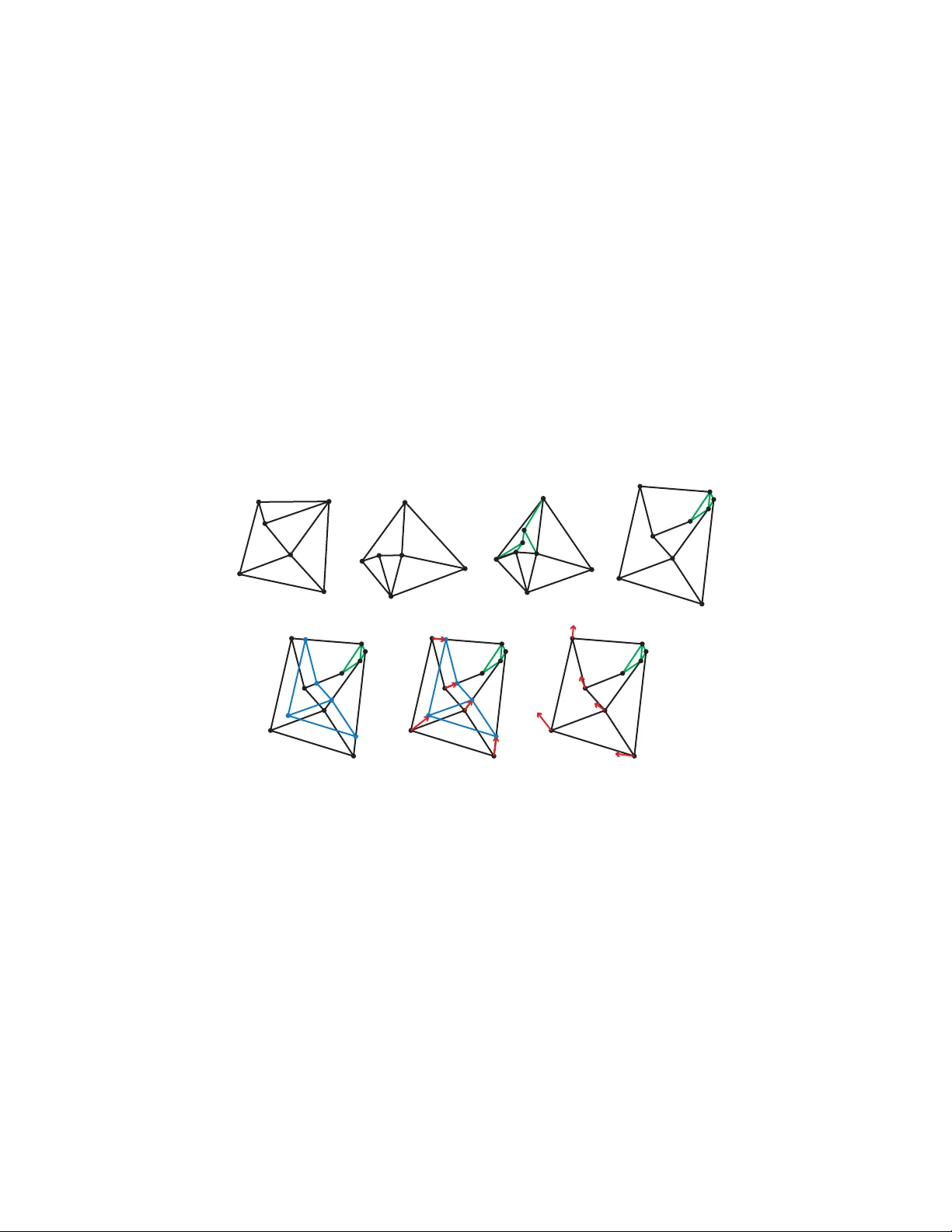
Geometric Prop erties of Assur Graphs Brigitte Serv atius ∗ Offer Shai † W alter Whiteley ‡ July 11, 2021 Abstract In our previous pap er, w e presen ted the com binatorial theory for mini- mal isostatic pinned frameworks - Assur graphs - which arise in the analy- sis of mechanical link ages. In this pap er w e further explore the geometric prop erties of Assur graphs, with a fo cus on singular realizations which ha v e static self-stresses. W e provide a new geometric characterization of Assur graphs, based on sp ecial singular realizations. These singular p ositions are then related to dead-end p ositions in which an asso ciated mec hanism with an inserted driver will stop or jam. 1 In tro duction In our previous pap er [13], we developed the combinatorial prop erties of a class of graphs which arise naturally in the analysis of minimal one-degree of freedom mec hanisms in the plane with one driver, with one rigid piece designated at the ‘ground’. W e defined an underlying isostatic graph (generically indep enden t and rigid) formed by replacing the driv er - the Assur graph, named after the Russian mec hanical engineer who introduced and b egan the analysis of this class. Every other mechanism, which is indep enden t (whose degree of freedom increases if w e remov e an y bar) is formed by comp osing a partially ordered collection of k such Assur graphs (see Figure 5). The techniques of combinatorial rigidity pro vided an algorithm for decomp osing an arbitrary link age into these Assur comp onen ts. In this pap er, we in v estigate the geometric prop erties (self-stresses and first- order motions) of suc h Assur graphs G , when realized as a framew ork G ( p ) in special or singular p ositions p . The properties of a full self-stress combined with a ull motion relativ e to the ground, at selected singular p ositions provide an additional, geometric necessary and sufficient condition for Assur graphs (see § 3). ∗ Mathematics Department, W orcester Polytec hnic Institute. bserv atius@math.wpi.edu † F acult y of Engineering, T el-Aviv Universit y . shai@eng.tau.ac.Il ‡ Department of Mathematics and Statistics, Y ork Universit y T oronto, ON, Canada. white- ley@mathstat.yorku.ca. W ork supp orted in part by a gran t from NSER C Canada 1 Geometric prop erties of Assur graphs are also imp ortant in terms of sp ecial p ositions reached b y the mechanisms, when moving under forces applied through a driver ( § 4). These p osition include configurations in which this driv er is unable to force a contin uing motion, b ecause of the transmission difficulties, or reach ‘dead end’ p ositions in whic h the mechanism will ‘jam’ under the motion of the driv er, and contin ued motion will requre will need to b e reversed. As with the first pap er, our initial motiv ation was to provide a more com- plete grounding and mathematical precision for some geometric observ ations and conjectures developed b y Offer Shai, and presented at the Vienna work- shop in April/May 2006. More generally , using the first-order and static theory of plane frameworks, w e wan t to pro vide a careful mathematical description for the prop erties, observ ations and op erations used by mechanical engineers in their practice. W e also hop e to develop new techniques and extensions in an ongoing collab oration b et ween mathematicians and engineers. 2 Preliminaries W e will summarize some k ey results from the larger literature on rigidit y [7, 21], and from our first pap er [13]. Throughout this pap er, we will assume that all framew orks are in the plane and w e only consider rigidity in the plane. 2.1 F ramew orks and the rigidity matrix A plane fr amework is a graph G = ( V , E ) together with a configuration p of p oin ts for the vertices V in the Euclidean plane, with pairs of vertices sharing an edge in distinct positions. T ogether they are written G ( p ). A first-or der motion of a framework G ( p ) is an assignment of plane vectors p 0 to the n = | V | v ertices of G ( p ) such that, for eac h edge ( i, j ) of G : ( p i − p j ) · ( p 0 i − p 0 j ) = 0 . (1) If the only first-order motions are trivial , that is, they arise from first-order translations or rotations of R 2 , then w e say that the framew ork is infinitesimal ly rigid in the plane. Equation 1 defines a system of linear equations, indexed b y the edges ( i, j ) ∈ E , in the v ariables for the unknown velocities p 0 i for the framew ork G ( p ). The rigidity matrix R G ( p ) is the real E by 2 n matrix of this system. As an example, w e write out co ordinates of p and of the rigidity matrix R G ( p ), in the case n = 4 and the complete graph K 4 . p = ( p 1 , p 2 , p 3 , p 4 ) = ( p 11 , p 12 , p 21 , p 22 , p 31 , p 32 , p 41 , p 42 ); p 11 − p 21 p 12 − p 22 p 21 − p 11 p 22 − p 12 0 0 0 0 p 11 − p 31 p 12 − p 32 0 0 p 31 − p 11 p 32 − p 12 0 0 p 11 − p 41 p 12 − p 42 0 0 0 0 p 41 − p 11 p 42 − p 12 0 0 p 21 − p 31 p 22 − p 32 p 31 − p 21 p 32 − p 22 0 0 0 0 p 21 − p 41 p 22 − p 42 0 0 p 41 − p 21 p 42 − p 22 0 0 0 0 p 31 − p 41 p 32 − p 42 p 41 − p 31 p 42 − p 32 2 A framework ( V , E , p ), with at least one edge, is infinitesimally rigid (in dimension 2) if and only if the matrix of R G ( p ) has rank 2 n − 3. W e say that the configuration on n vertices p is in generic p osition if the determinant of any submatrix of R K n ( p ) is zero only if it is iden tically equal to zero in the v ariables p i . F or a generic configuration p , linear dep endence of the rows of R G ( p ) is determined by the graph and the rigidity prop erties of a graph are the same for an y generic embedding. A graph G on n vertices is generic al ly rigid if the rank ρ of its rigidity matrix R G ( p ) is 2 n − 3, where R G ( p ) is the submatrix of R ( p ) con taining all rows corresp onding to the edges of G , for a generic configuration p for V . An first-order motion p 0 is a solution to the matrix equation R G ( p ) p 0 = 0, and first-order rigidit y is studied through the column rank. W e can also analyze the rigidit y through the row rank of the rigidity matrix, or through the cok ernel: [ Λ ] R G ( p ) = 0 . Equiv alently , these row dep endencies Λ are assignmen ts of scalars λ ij to the edges such that at eac h vertex i : X { j | ( i,j ) ∈ E } λ ij ( p i − p j ) = 0 (2) These dep endencies Λ are called static self-str esses , or self-str esses for short, in the language of structural engineering and mathematical rigidity , and the cok ernel is the vector space of self-stresses. Equation 2 is also called the e qui- librium c ondition , since the entries λ ij ( p i − p j ) can b e considered as forces applied to the v ertex p i . Equation 2 then states that these forces are in lo cal equilibrium at each vertex. Equiv alently , a framework G ( p ) is indep endent if the only self-stress is the zero stress, and we see that framew ork with at least one bar is first-order rigid if and only if the space of self-stresses has dimension | E | − (2 n − 3). 2.2 Isostatic graphs and rigidit y circuits A framework G ( p ) is isostatic if it is infinitesimally rigid and indep enden t. There is a fundamental characterization of generically isostatic graphs (graphs that are isostatic when realized at generic configurations p ). Theorem 1 (Laman [8]) . A gr aph G = ( V , E ) has a r e alization p in the plane as an first-or der rigid, indep endent fr amework G ( p ) if and only if G satisfies L aman ’s c onditions: | E | = 2 | V | − 3 | F | ≤ 2 | V ( F ) | − 3 for al l F ⊆ E , F 6 = ∅ ; (3) Such a gr aph is also generic al ly rigid in the plane. Minimally dep enden t sets, or cir cuits , are edge sets C satisfying | C | = 2 | V ( C ) | − 2 and ev ery prop er non-empty subset of C satisfies inequality (3). Note that these circuits, called rigidity cir cuits , alw a ys hav e an even num ber of edges. 3 If a rigidity circuit C = ( V , E ) induces a planar graph, then a planar embed- ding of C (with no crossing edges) has as man y v ertices as it has faces, which fol- lo ws immediately from Euler’s formula for planar em b eddings ( | V | − | E | + | F | = 2). The geometric dual graph C d is also a rigidity circuit, see [12, 3]. (The v ertices of C d are the faces of the embedded graph C and tw o v ertices of C d are adjacen t if the corresp onding faces of C share an edge, see Figure 1). A B C D E a b c d e Figure 1: The geometric dual G ∗ (red) of a planar graph G (blac k) In our previous pap er [13], we presented an ov erview theorem which pre- sen ted an inductive construction of all rigidit y circuits from K 4 b y a simple sequence of steps, along with some other prop erties of circuits. 2.3 Recipro cal diagrams In this paper, we will use a classical geometric metho d for analyzing self- stresses in planar framew orks (frameworks on planar graphs): the recipro cal diagram [4, 5]. This construction has a rich literature in structural engineering, b eginning with the work of James C lerk Maxell [9] and contin uing with the w ork of Cremona [6]. This technique has b een revived in the last 25 years as a v aluable technique for visualizing the b eha viour of suc h frameworks [4, 5], in sp ecific geometric realizations, as well as for the study of mechanisms [16, 17]. W e describ e this construction and some k ey prop erties in the remainder of this subsection. An example is work ed out in Figure 2. Giv en a framew ork G ( p ) with a non-zero self-stress Λ (Figure 2 (a)-(c)), there is a geometric w a y to verify the v ertex equilibrium conditions of Equa- tion 2. If the forces λ ij ( p i − p j ) are drawn end to end, as a p olygonal path, then X { j | ( i,j ) ∈ E } λ ij ( p i − p j ) = 0 if, and only if, the path closes to a p olygon (classically called the p olygon of forces, Figure 2 (d), (e)). If we start with a self-stress on a planar drawing of a planar graph G , then we can cycle clo c kwise through the edges at a vertex in the order of the edges, creating a p olgon for the original vertex, and a vertex for each of the ‘faces’ (regions) of the drawing. When we create p olygons for 4 A B C D E b a c d e 1/4 1/4 1/2 -1 -1 -3 1 4 A B E D b a c d e a) b) c) d) e ) f ) C Figure 2: The geometric recipro cal (f ) of a self-stress on a planar framework (c). eac h of the original vertices, we note that the tw o ends of each original bar use opp osite v ectors (Figure 2 (b), (c)): λ ij ( p i − p j ) and λ ij ( p j − p i ). W e can then patch these p olygons together at each dual vertex (original region of the dra wing) (Figure 2 (e), (f )). Ov erall, there is a question whether all of these lo cal p olygons patch together in to a global drawing of the dual graph of the planar drawing? If we started with a self-stress in a planar graph, the answer is y es [4, 5]! As just describ ed, this is a r e cipr o c al figur e as studied b y Cremona [6], with original edges parallel to the edges in the recipro cal dra wing. Note that only the edges with a non-zero self-stress λ ij will ha v e non-zero length in the recipro cal. If the entire recipro cal is turned 90 o , then we hav e the recipro cal figures as presented by Maxwell [9, 4, 5]. Con v ersely , we can start with a configuration for a planar graph G ( p ) and a configuration for the dual graph G d ( q ) with edges in G ( p ) parallel to the edges in G d ( q ): a r e cipr o c al p air . W e can then use the lengths of the dual edge to define the scalars for a self-stress, b y solving for λ ij in the equation: λ ij ( p i − p j ) = ( q h − q k ) where edge hk is dual to the edge ij . Ov erall, the existence of the recipro cal also implies the existence of a self-stress and this self-stress would recreate the 5 recipro cal. Note that, in this presen tation eac h of the drawings is a recipro cal of the other. That is, each side corresp onds to a self-stress of the other side of the pair. The following theorem summarizes some key prop erties of frameworks and their recipro cals. W e translate the results of [4, 5] into equiv alen t statements of the form we will use in § 3. Theorem 2 (Crap o and Whiteley [5]) . Given a planar fr amework G ( p ) with a self-str ess, and a r e cipr o c al diagr am G d ( q ) , ther e ar e isomorphisms b etwe en: 1. the ve ctor sp ac e of self str esses of the r e cipr o c al fr amework G d ( q ) ; 2. the sp ac e of fr ameworks G ( p || ) with this r e cipr o c al (with one fixe d vertex); and 3. the sp ac e of p ar al lel dr awings G ( p || ) with one vertex fixe d (e quivalently, first-or der motions with one vertex fixe d) of the fr amework G ( p ) . Recipro cal diagrams are particularly nice for rigidit y circuits, as they exist for all generic realizations. They were studied in a muc h broader context in [4, 19] as well as in the con text of link ages in [17]. W e will return to them in the pro of of Theorems 7 and 8. 2.4 Isostatic pinned framew orks Giv en a framework, we are interested in its in ternal motions, not the trivial ones, so we ‘pin’ the framework by prescribing, for example, the co ordinates of the endp oin ts of an edge, or in general by fixing the p osition of the v ertices of some rigid subgraph. Alternatively , we take some rigid subgraph (a single bar or an isostatic blo c k) which w e mak e in to the ‘ground’ and fix all its vertices whic h connect to the rest of the graph. W e call these vertices with fixed p ositions pinne d , the others unpinne d , fr e e , or inner . Edges b et w een pinned vertices are irrelev ant to the analysis of a pinned framew ork. W e will denote a pinned graph b y G ( I , P ; E ), where I is the set of inner vertices, P is the set of pinned vertices, and E is the set of edges, and each edge has at least one endp oint in I . A pinned graph G ( I , P ; E ) is said to satisfy the Pinne d F r amework Condi- tions if | E | = 2 | I | and for all subgraphs G 0 ( I 0 , P 0 ; E 0 ) the following conditions hold: 1. | E 0 | ≤ 2 | I 0 | if | P 0 | ≥ 2, 2. | E 0 | = 2 | I 0 | − 1 if | P 0 | = 1 , and 3. | E 0 | = 2 | I 0 | − 3 if P 0 = ∅ . W e call a pinned graph G ( I , P ; E ) (pinne d) isostatic if G ( V , E ∪ F ) is iso- static as an unpinned graph, where V k I ∪ P , no F has any v ertex from I as endp oin t and the restriction of G to P = V \ I is rigid. In other words, we can “replace” the pinned v ertex set by an isostatic graph containing the pins and 6 call G ( I , P ; E ) isostatic, if this replacement graph on the pins pro duces an (un- pinned) isostatic graph G . Whic h isostatic framework we choose, and whether there are additional vertices there, is not relev ant to either the combinatorics in the first pap er or the geometry in this second pap er. In [13] we prov ed the follo wing result: Theorem 3. Given a pinne d gr aph G ( I , P ; E ) , the fol lowing ar e e quivalent: (i) Ther e exists an isostatic r e alization of G . (ii) The Pinne d F r amework Conditions ar e satisfie d. (iii) F or al l plac ements P of P with at le ast two distinct lo c ations and al l generic p ositions of I the r esulting pinne d fr amework is isostatic. 2.5 Com binatorial characterizations of Assur graphs In our previous paper [13], w e pro v ed the equiv alence of a series of com binatorial prop erties which b ecame the definition of an Assur gr aph . Theorem 4. Assume G = ( I , P ; E ) is a pinne d isostatic gr aph. Then the fol lowing ar e e quivalent: (i) G = ( I , P ; E ) is minimal as a pinne d isostatic gr aph: that is for al l pr op er subsets of vertic es I 0 ∪ P 0 , I 0 ∪ P 0 induc es a pinne d sub gr aph G 0 = ( I 0 ∪ P 0 , E 0 ) with | E 0 | ≤ 2 | I 0 | − 1 . (ii) If the set P is c ontr acte d to a single vertex p ∗ , inducing the unpinne d gr aph G ∗ with e dge set E , then G ∗ is a rigidity cir cuit. (iii) Either the gr aph has a single inner vertex of de gr e e 2 or e ach time we delete a vertex, the r esulting pinne d gr aph has a motion of al l inner vertic es (in generic p osition). (iv) Deletion of any e dge fr om G r esults in a pinne d gr aph that has a motion of al l inner vertic es (in generic p osition). An Assur gr aph is a pinned graph satisfying one of these four equiv alent conditions. Some examples of Assur graphs are drawn in Figure 3 and their Figure 3: Assur graphs corresp onding rigidity circuits in Figure 4. W e also demonstrated a decomp osition theorem for all isostatic pinned frame- w orks. Theorem 5. A pinne d gr aph is isostatic if and only if it de c omp oses into Assur c omp onents. The de c omp osition into Assur c omp onents is unique. 7 Figure 4: Corresp onding circuits for Assur graphs The decomp osition pro cess describ ed in the pro of of Theorem 5 of [13] in- duces a partial order on the Assur comp onen ts of an isostatic graph and this partial order in turn can b e used to re-assemble the graph from its Assur comp o- nen ts. This partial order can b e represented in an ‘Assur sc heme’ as in Figure 5 III IV a) b) I IV V c) II III II I V Figure 5: An isostatics pinned framew ork a) has a unique decomp osition into Assur graphs b) which is represented b y a partial order or Assur sc heme c). 3 Singular Realizations of Assur Graphs W e now sho w that these Assur graphs hav e an additional geometric prop ert y at selected sp ecial p ositions, and that this geometric prop ert y b ecomes another equiv alent characterization. F rom the general analysis of frameworks, we know that the p ositions p of such Assur graphs such that G ( p ) is not isostatic are the solutions to a polynomial Pur e Condition [19]. F or an pinned isostatic framew ork, this pure condition is created by inserting distinct v ariables for the co ordinates of the vertices (including the pinned vertices) and taking the deter- minan t of the square | E | × 2 | V | rigidity matrix. W e are particularly interested in the typical solutions to the pure condition (the regular p oin ts of the asso- ciated algebraic v ariet y). These prop erties are related to the b ehavior of the asso ciated link age when it reaches a ‘dead-end’ p osition and lo c ks [16, 11] (see § 4, Corollary 1 b elo w). 8 3.1 A sufficien t condition from stresses and motions W e first show that given a singular realization G ( p ) with a sp ecial 1-dimensional space of self-stresses and 1-dimensional space of first-order motions, G must b e an Assur graph. This is based on an observ ation of Offer Shai. Theorem 6. Assume a pinne d gr aph G has a r e alization p such that 1. G ( p ) has a unique (up to sc alar) self-str ess Λ which is non-zer o on al l e dges; and 2. G ( p ) has a unique (up to sc alar) first-or der motion, and this is non-zer o on al l inner vertic es; then G is an Assur gr aph. Pr o of. First we show that G is an isostatic pinned graph. F or a pinned graph with inner vertices V , and any realization p : | E | − 2 | V | = dim(Stresses[ G ( p )]) − dim(First-order Motions[ G ( p )]) . Since dim(Stresses[ G ( p )]) − dim(First-order Motions[ G ( p )]) = 1 − 1 = 0, we kno w that | E | = 2 | V | . Similarly , assume there is some subgraph G 0 (unpinned, or pinned with one v ertex, or pinned with tw o verti ces) which is generically dep enden t. This will alw a ys hav e a non-zero internal self-stress in G ( p ) - which is zero outside of this subframew ork G 0 ( p ). Therefore, this unique self-stress cannot b e non-zero on all edges. This contradiction implies the o v erall graph G is isostatic. No w we assume that the graph G is not an Assur graph. Therefore it can b e decomp osed into a base Assur graph G A , and the rest of the vertices and edges G 1 . With this decomp osition, we can sort the v ertices and edges of G A , to the end of the indicies for the rigidity matrix to give the rigidity matrix a blo c k upp er diagonal form. Since we hav e a first-order motion, non zero on all the inner vertices of G A , we hav e the equation. h R 1 ( p ) R 1 A ( p ) 0 R A ( p ) ih u 1 u A i = h 0 0 i whic h implies the equation for G A : [ R A ( p )][ u A ] = 0 , with [ u A ] 6 = 0 . Since G A is an Assur graph (generically isostatic), [ R A ( p ))] has a row dep endence. Equiv alently , there is a self-stress Λ A [ R A ( p )] = 0. This is also a self-stress on the whole framework G ( p )), which is zero on all edges in G 1 . Since w e assumed G ( p ) had a 1-dimensional space of self-stresses, this contradicts the assumption that there is a self stress non-zero on all edges. W e conclude that G is an Assur graph. In the next tw o sections we prov e that this condition is also necessary , com- pleting this geometric characterization of the Assur graphs. 9 3.2 Stressed realizations of planar Assur graphs Since this is a geometric theorem, we need to use some key geometric tec hniques for stresses and motions of frameworks G ( p ). W e b egin with the sp ecial sub- class of planar Assur graphs G , where we can use the techniques of recipro cal diagrams [4, 15]. Theorem 7. If we have a planar Assur gr aph G then we have a c onfigur ation p , such that: 1. G ( p ) has a one-dimensional sp ac e of self-str esses, and this self-str ess is non-zer o on al l e dges; and 2. ther e is a unique (up to sc alar) non-trivial first-or der motion of G ( p ) and this is non-zer o on al l inner vertic es. a) d ) 1 2 3 4 6 5 b) A B C E D S P Q R e ) A B C E D S P Q R f ) A B C E D S P Q R A B C E D 5 1 2 3 4 6 K A B C E D S P Q R c) Figure 6: The sequence of steps for producing the configuration for a planar Assur graph which has b oth a non-zero self-stress and a non-zero motion: (a) tak e a generic realization of the underlying circuit and form its recipro cal; (b) Split the reciprocal face K in order to generate a self-stress that will separate the ground vertex in the original into predescrib ed distinct ground v ertices (c), still with a self-stress; (d) use a second self-stress to form a parallel drawing; (e) use this parallel drawing to create difference vectors; and (f ) turn these difference v ectors to create the first-order motion which is non-zero on all inner vertices. Pr o of. W e will use prop erty (i) from the combinatorial characterization Theo- rem 4: G is a minimal isostatic pinned framework. W e assume that the graphs G and G ∗ (with the pinned vertices identified) are planar. Since G ∗ is a planar circuit, it has a dual graph G ∗ d whic h is also 10 a planar c ircuit (Figure 6 (a)). W e take a generic realization of this dual graph G ∗ d ( q ∗ ), whic h will hav e a non-zero self-stress Λ ∗ whic h is non-zero on all edges, and the graph will b e first-order rigid. W e hav e the corresp onding recipro cal diagram G ∗ ( p ∗ ) which also is first-order rigid and has a self-stress non-zero on all edges, by the general theory of recipro cal diagrams ( § 2.3 and [4]). a) b) k K c) d) e) f) T T D dual dual insert into dual polygon triangulate dual identify pins Figure 7: Given an Assur graph G we identify the pins to k which has a dual p olygon K (a,b,c). W e triangulate the ground (d) which gives a dual triv alen t tree T (e). This tree is inserted in to K (f ) giving an additional self-stress whose recipro cal gives bac k the triangulated ground and and separates the pins (f,b). W e will now mo dify this pair to split up the indentified ‘ground vertex’ k while main taining the self-stress and in troducing a first-order motion p 0 whic h is non-zero on all v ertices not in the ground. This process is illustrated in Figure 7. F or simplicity , we create this ground for the pinned vertices as an isostatic triangulation on the pinned vertices. In the extreme case where we hav e only tw o ground vertices, we are adding one edge - and this app ears as a corresp onding added dual edge T in the recipro cal. More generally , we take the original graph G with m ≥ 3 pinned vertices, and topologically add an isostatic framework of triangles in place of the ‘ground’ to create the extended framework b G , with the dual graph b G d . (F or uniformity , we can take a path connecting the pinned v ertices p 1 , . . . , p m and then connect p 1 to each of the remaining vertices. This will b e suc h a generically isostatic triangulation, see Figure 7 (d).) If there were m pinned v ertices, then we add 2 m − 3 edges to create the triangulation, and create t = m − 2 triangles. In the dual b G d , this adds a 3- v alent tree T with interior v ertices for each of the triangles Figure 7 (e), and lea v es attached to the vertices of the recipro cal p olygon K K (Figure 7 (f )). T ransferring the counts to the recipro cal, we hav e added t v ertices and 2 t + 1 edges into the dual p olygon K . Since we added 2 t + 1 edges and t vertices to a generically rigid framework G ∗ d ( q ∗ ), we hav e added an additional self-stress if all the vertices are in generic p osition q . This added self-stress is non-zero on some of these added edges. Because the inserted graph is a 3-v alen t tree, if the self-stress is non-zero on one 11 edge, then resolution at any interior vertex in general p osition requires it to b e non-zero on all edges at this vertex. In short, the added self-stress is non-zero on all edges in the tree. This is now a realization of b G d - the dual to the original pinned graph with an isostatic triangulated ground (Figure 6 (b)). In the tw o dimensional space of self-stresses in the dual, adding a small multiple of the new self-stress to the original Λ ∗ on G ∗ d ( q ∗ ) (with zero on the added edges) gives a self-stress Λ on b G d ( q ) non-zero on all edges. The recipro cal of this self-stress is the desired realization b G ( p ) of the original pinned framework with a triangulated (isostatic) ground (Figure 6 (c)). Since the self-stress on b G d ( q ) is non-zero on all edges, all edges are of non-zero length in b G ( p ) b y the basic prop erties of recipro cals. Moreo v er, since all edges of b G d ( q ) hav e non-zero length, all edges in b G ( p ) hav e non-zero self-stress. With the added sub-framework D replaced by the ground, this is the realization G ( p ) required for condition (i). It remains to prov e that this also satisfies condition (ii): there is a non- trivial first-order motion with all inner vertices having non-zero velocities while the ground has zero velocities. If we add an additional small multiple of the non-zero self-stress Λ ∗ (extended with zeros on in the added tree in K ) to Λ, then we hav e a second self-stress Λ v whic h is the same on the edges interior to K but different on all other edges. T aking a second drawing recipro cal to Λ v will giv e a second drawing b G ( p || ) whic h is identical on the pinned v ertices and the ground triangulation, but mov es all other edges to new p ositions with differen t lengths than in b G ( p ) (b ecause of the differen t self-stress on these edges) (Figure 6 (d)). This is a parallel drawing of b G ( p ). In particular, all of the edges of the recipro cal polygon K hav e different stresses, so the edges from inner vertices to the pinned v ertices in b G ( p || ) all ha v e different lengths (Figure 6 (d)). W e can take the differences in p ositions ( p || − p ) as parallel drawing vectors u (Figure 6 (e)). By general arguments, in v olving the 90 degree rotation of the ‘parallel drawing v ectors’ [4, 14], these parallel drawing vectors u conv ert the first-order motion v = u ⊥ of b G ( p ) which is zero on the ground and non-zero on all the inner vertices (Figure 6 (e,f )). This completes the pro of that G ( p ) satisfies condition (ii). 3.3 Extension to non-planar Assur graphs W e hav e the desired conv erse result for all planar Assur graphs. In order to extend this to singular realizations of all Assur graphs, we turn to another 19th cen tury technique for conv erting a singular realization of a general framework G ( p ) into a singular realization of a related planar framework without actual crossings of edges, using the same lo cations for the original vertices plus the crossing p oin ts [10]. This technique is named after the American structural engineer Bow who introduced it to assist in the analyis of any plane drawing of a framew ork, in whic h the visible regions and the edges separating them became the pieces for the analysis of the framework via a recipro cal diagram. 12 Theorem 8. If we have an arbitr ary Assur gr aph G then we have a c onfigur a- tion p , such that 1. G ( p ) has a single self str ess, and this self-str ess is non-zer o on al l e dges; and 2. ther e is a unique (up to sc alar) non-trivial first-or der motion of G ( p ) and this is non-zer o on al l inner vertic es. A B C D K a) b) A B C D K K X X 1 1 2 2 3 3 4 4 5 6 5 6 Figure 8: Given a non-planar graph (or drawing) (a) we can insert crossing p oin ts to create a planar graph (Bow’s Notation). W orking on this planar graph we hav e a recipro cal (b) which also is a non-planar drawing of the planar recipro cal (c). Pr o of. W e already know the result for planar Assur graphs. The key step for non-planar graphs is the classical metho d called ‘Bow’s notation’. Given a non- planar framework realizing a graph G , we select pairs of edges with transv ersal crossings, and insert those vertices, splitting the t wo edges, creating a new graph G b [18] (Figure 8). (Note that these ‘crossings’ do not hav e to b e at internal p oin ts of the segments - just not at v ertices of the segments. The ’crossings are iden tified top ologically , but the added vertices are geometrically on the p oin ts of intersection of the tw o infinite lines.) The general theorem is that the tw o framew orks hav e isomorphic spaces of self-stresses, and first-order motions. With this technique in mind, we can sketc h a plane dra wing of the final graph we wan t, with the ground triangulation isolated with no crossings. This sk etc h identifies the crossing p oin ts to b e added, within the identified circuit - the ‘Bow ed framework’. T ak e a generic realization of the iden tified circuit G ∗ . Add the crossing p oin ts as iden tified, to create a ‘planar graph’ needed for the recipro cal diagrams G ∗ b ( p ). Create a recipro cal diagram G ∗ d b ( q ) for this planar framework. In this recipro cal, the iden tified framework, the duals of the ‘crossing p oints’ app ear as parallelograms. W e now contin ue with the planar pro cess, as outlined in the previous pro of. With the addition of the vertices and edges to split the ‘dual face’ K for the 13 ground in the dual, we create a stressed framework, and an extended recipro cal whic h has the graph of the Bow ed framework. Moreov er, since the dual graph is realized with parallelograms dual to the v ertices added in the Bo wed framework, the crossings inv olv e transversal crossings with the required × -app earance for later remov al. This framework will hav e a self-stress which is non-zero on all edges and a non-trivial motion whic h is non-zero on all inner vertices. Moreov er, this Bo w ed framework and the framework with the crossing p oints remov ed, ha ve the isomorphic spaces of self-stresses and infiniesimal motions. In particular, a self-stress which is non-zero on all edges of the Bo w ed framework is non-zero on all edges of the original graph, and the first-order velocities of the original graph are exactly those velocities assigned at these vertices within the Bo w ed framew ork. W e ha ve created the required configuration for the original (non-planar) graph with a self-stress non-zero on all edges, and a first-order motion which is zero on the ground and non-zero on all free vertices. 3 6 a) A B C D X X K 1 K 1 K 2 K 2 b) 1 2 3 4 6 5 1 2 4 5 c) A B C D X K 1 K 2 d) A B C D X K 1 K 2 e) A B C D X K 1 K 2 Figure 9: Given the recipro cal pair, w e can again split the face K (b) and split the ground vertex in the original. This configuration of the Bow ed graph has a non-zero stress, as do es the non-planar original. The non-trivial parallel dra wing of the Bow ed graph is a non-trivial parallel drawing of the non-planar original (c) and induces the required first-order motion on the non-planar original (d,e). 14 3.4 Extensions to other singular realizations With some sp ecial effort, and careful attention to some geometric details, it is p ossible to extend the previous result to show the existence of such a sp ecial configuration p whic h extends an y initial configuration of the ground vertices as distinct p oin ts. Without giving all the details, the idea is to form an isostatic triangulation on the ground v ertices as positioned, which in turn giv es an appro- priate dual tree t with dual edges for the triangles which are on the b oundary of the ground, still as rays. The ‘ground’ p olygon K is then placed on these ra ys, in general p osition. It remains to see that the rest of the dual graph G ∗ d can b e realized with this initial p olygon and a unique self-stress, non-zero on all edges. Because we started with a generic circuit, this can b e accomplished by using some details ab out the ‘p olynomial pure conditions’ of these graphs [19], and the o ccurance of the remaining vertices in these p olynomial conditions. There is also a conjectured generization of the result abov e to an y realization of an Assur graph with a non-zero self-stress on all edges. The key seems to b e not to insist that every vertex has a non-zero v elo cit y , but to relax this to ask that every bar has at least one of its vertices with a non-zero velocity . The reader can review the pro of in § 3.1 to see that this is the condition we actually used in the sufficiency condition. Conjecture 1. Assume we have an Assur gr aph G and a r e alization p such that ther e is a single self str ess which is non-zer o on al l e dges. Then ther e is a unique (up to sc alar) non-trivial first-or der motion and this is non-zer o on at le ast one end of e ach b ar. 4 Inserting Driv ers in to Assur Graphs F or simplicitly , we will assume that our graph G is generically indep enden t in the plane. In a 1 DOF link age G ( p ) at an indep enden t realization, a driver d is either (i) a piston ab whic h changes the distance b et ween the pair ab where ab this distance is changing during the 1 DOF motion; (ii) an angle driver which changes the angle ∠ abc b et w een t w o bars ab, bc where this angle is changing during during the 1 DOF motion. More generally , if we ha v e a driver d in aindep endent 1 DOF link age G ( p ), this driver will cause a finite motion in some indep enden t realizations, and we con tin ue to call this a piston or angle driver even in singular p ositions of the same 1 DOF graph as a link age. W e will discuss such singular p ositions in § 3.3. 4.1 Replacing driv ers In the previous pap er [13], we created the isostatic framework from a 1 DOF link age by ‘replacing the driver’ to remov e the degree of freedom. T o return to 15 a 1 DOF link age from an Assur graph, we can ‘insert a driv er’. So far, w e hav e used quotation marks here, because we find there are sev eral alternativ es for the pro cess of replacing the driver, and con verse op erations to insert a driver b ecause the pro cesses are not yet defined - though mechanical engineering practice can guide us. W e b egin b e defining one clear pro cess for ‘replacing a driv er’ with an added bar. A simple metho d to remov e the 1 DOF is to insert one bar in a wa y that blo c ks the single degree of freedom (Figure 10). Sp ecifically , given a one-degree of freedom link age G ( p ) at a generic configuration: 1. to replace a piston ab , w e insert the bar ab ; 2. to replace an angle driv er on ∠ abc , at an internal vertex b of degree ≥ 3, w e insert the bar ac ; 3. to replace an angle driv er on ∠ abc , at an internal vertex b of degree 2, we insert the bar ac and remov e vertex b ; 4. to replace an angle driv er on an angle ∠ ap i p j where p i p j are pinned ver- tices, we add a as a pinned vertex. This driver r eplac ement creates a pinned graph G and a pinned framew ork G ( p ). Piston Bar Angle Brace Angle Driver Piston Pin Driver Angle Brace (ground) Pinned Vertex a) b) e) d) f) c) Figure 10: There are four t yp es of driv ers: a) driving a distance ab with a piston; b) driving an interior angle ∠ abc ; c) driving an angle at a pin ∠ ap i p j , and the sp ecial type illustrated in Figure 11. Belo w these are the wa ys in whic h each of these drivers is replaced to create an isostatic graph by d) an added edge (for a piston); e) an added angle brace; or f ) an added pinned vertex resulting from adding an angle brace to the ground. In the key example of our previous pap er [13] Figures 1,2, we actually re- placed the pistons in tw o steps: 16 1. we replaced the piston with a 2-v alent vertex attached to the ends (which is mechanically equiv alen t); and 2. we contracted one of these edges to form the single edge which was inserted ab o ve. A similar pro cess could b e applied to any angle driver, and the net effect would b e the edge insertion presented ab o v e (Figure 11). Piston Bar Piston a b a b a b o Angle Driver a c a’ Pin Driver p i a p j a) b) c) d) e) f) o a c a’ p i p j o a a c a p i p j Figure 11: As an alterative to the simple insertions, we can replace each driv er b y a 2-v alen t vertex o (a,b,c), and then contract o to one of the end vertices, creating the same result (d,e,f ) as the previous insertion. The driv er is active at a specific position G ( p ) if it is p ossible, infinitesimally , to change the length of the bar we are adding without changing the lengths of an y of the other bars. Sp ecifically , in the rigidity matrix of G , with the added bar d at the b ottom: R G ( p ) p 0 = (0 , . . . , 0 , s d ) tr has a solution p 0 for all p ossible v alues of the strain s d (instan taneous change in length) of d . More generally , we claim G ( p ) is isostatic, and G is generically isostatic, pro vided that G ( p ) is indep enden t and the driver was active. Theorem 9. Given an indep endent 1 DOF linkage G with an active driver d , the driver r eplac ement G is an isostatic pinne d fr amework. Pr o of. Consider an indep enden t realization G ( q ). There is a 1 dimensional v ector space of non-trivial first-order motions v 0 , with the pinned v ertices fixed 17 (whic h extends to a finite motion by general principles of algebraic geometry [1]). F or a piston ab , the added bar i, j is indep enden t if, and only if, the added bar is on a pair i, j with a non-zero str ain : ( q i − q j ) · ( v i − v j ) 6 = 0 The definitions of a piston driver the added bar has this required prop ert y , so inserting this bar blo c ks the motion, at first-order. Similarly , for an angle driver ∠ abc at an interior vertex b , adding the bar ac is also indep enden t, generating an isostatic framework. If we were replacing an angle driv er at a 2-v alen t vertex, then with the added bar this vertex is attached to an isostatistic subframework with just tw o non-collinear bars. This v ertex can b e remov ed to leav e an isostatic framework on the remaining v ertices. This is done to preven t the app earance of an extra ‘Assur comp onen t’ in the derived isostatic graph and fo cus the analysis on the b eha viour of the rest of the graph. If w e w ere replacing an angle driv er ∠ ap i P j at the ground, then inserting the bar ap j will create an isostatic framework. It will also pin the vertex a to the ground, artifically creating an extra Assur comp onen t. T o assist the analysis of the original mechanism, w e just pin the vertex a and analyze the mo dified pinned framework. W e can sp eak of a 1 DOF graph G with a driver d as an Assur me chanism , if replacing the driver creates an Assur graph G . 4.2 Inserting a Driv er Con v ersely , we can start with an Assur graph, and insert a driver using one of the three steps: (i)) Remov e a bar ab and insert a piston ab ; (ii) Remov e an edge ac which is in a triangle abc and insert an angle driver on the angle ∠ abc ; (iv) remov e an edge ac and insert a new 2-v alen t vertex b , with bars ab, bc and an angle driver on the angle ∠ abc ; (iv) if there are at least three pinned vertices p i p j p k , make a pinned vertex p k in to an inner v ertex a , with a single bar to one of the other pinned v ertices p i and an angle driver on the angle ∠ ap i p j . These op erations are the reverse op erations of the four wa ys of replacing a driver. As a generic op eration, we know that this driver insertion tak es an isostatic framew ork to a 1 DOF framework. W e now show that for an Assur graph, the driv er insertion will create a 1 DOF framework with all inner vertices in motion relativ e to the ground. 18 Theorem 10. If we have an Assur gr aph G , r e alize d as an indep endent fr ame- work G ( p ) with the pins not al l c ol line ar, and we insert a driver as ab ove, then the fr amework has 1 DOF, with al l inner vertic es in motion, and activating the driver wil l extend this to a c ontinuous p ath. Pr o of. The original framework is an indep enden t pinned framework with | E | = 2 | V | . F or insertions (i) (ii), w e hav e remov ed one bar, so there is 1 DOF. Since this is an Assur graph, the Characterization Theorem 4 (iii) guaran tees all inner v ertices hav e a non-zero velocity . Moreo v er, the non-trivial first-order motion will hav e a non-zero strain on the pair of the remov ed bar. If we inserted a piston, this will change this length and drive the motion. If we inserted an angle driver on a triangle abc , then driving the angle will change the length ac and thus drive the motion. Finally , if we changed a pin to an in terior vertex, then we can assume that the vertex b eing made an inner vertex is not collinear with t w o of the other pinned vertices. W e can assume that is vertex is 2-v alent in the isostatic ground framew ork, so that making it inner lea v es an isostatic ground, and creates a new inner v ertex a attached to the ground by tw o edges ap i , ap j . Removing ap j giv es a 1 DOF link age, as required. In the resulting motion, a will ha v e a non-zero v elo cit y , so driving the angle ∠ ap i p j will drive this 1 DOF. It remains to chec k that all other inner vertices are hav e non-zero velocities. If some inner v ertex h has the zero velocity , then it is attached to the remaining ground through an isostatic subframework. This would mean h is contained in an isostatic pinned subframework which do es not include a . This is a contradiction of our assumption that G was Assur. Driv er insertion and driver replacement are inv erses of one-another. That is, if we start with an Assur graph and insert a driver, then replacing the driver will return us to the same Assur graph. Conv ersely , if w e start with a driver, and replace it, then we can choose to re-insert the same driver and return to the same 1 DOF link age. (There is a choice in the insertion, one of whic h is corresp onds to the original replacement. ) Ho w ev er, it is now clear that we hav e: (i) as many wa ys to insert a piston as we hav e interior bars; (ii) three time as many w a ys to insert an angle driver as we hav e in terior triangles; (iii) as man y wa ys to insert a 2-v alen t angle driver as there are interior bars; (iv) as many wa ys to insert a pinned angle driver as we hav e pins, provided there are at least tw o pins. In short, there are a lot of 1 DOF link age with drivers which come from the same underlying Assur graph. All of these will b e Assur mechanisms. Con v ersely , if we hav e a 1 DOF link age, we can identify a n um ber of pairs whose distances are c hange, and angles whic h are changing. Each of these could b e used to insert a driver. How ever, different insertions will lead, after replacemen t, to different graphs G . One ma y b e an Assur graph while another ma y not. Figure 12 gives such an example. 19 (a) (c) (b) Figure 12: Given a 1 DOF link age (a), there are several wa ys to insert a driver (b,c). One of these generates an Assur graph (b), while the other is a comp osite (though isostatic) graph (c). 4.3 Singular p ositions with a driv er The geometric question is: can we find p ositions at which this still has a self- stress? If we do, is it p ossible that some vertices must hav e zero velocities relativ e to the ground? Or more generally is it p ossible that the first-order motion do es not con tin ue in the same direction as the original motion? W e recall that if first-order motion p 0 is a first-order motion, then − p 0 is also a first-order motion. If b oth of these velocities extend to a finite motion, then w e say the driver has a finite motion in b oth dir e ctions . As a contrapositive of the Theorem 10, we hav e the following corollary . Corollary 1. If the linkage G d ( p ) with the driver do es not have a finite motion in b oth dir e ctions, then the linkage with the driver insert has a self-str ess. Suc h configurations without a finite motion (contin uing in b oth directions) are called ‘dead ends’ in the literature of link ages [16]. F or example, the existence of a dead-end with an angle driver at the ground requires a self-stress with the driv er join t pinned, so the original isostatic graph was realized in a singular p osition. As another example, if the driver is a piston, the driver edge is part of this singular p osition, so that its line applies the ’ground force’ required for the self-stress of the isostatic graph. That an indep endent 1 DOF link age can mov e under a driver to such a singular p osition (with the driver replacement), is one reason why w e ha v e in v estigated the o ccurance of such singular p ositions with a self-stress on all members (including the edge used to replace the driver). That all the inner vertices hav e non-zero velocities at that singular p osition indicates that we could hav e mov ed into the self-stress p osition in the driven motion. It is not true that every self-stress gives a dead end p osition, just that dead end p ositions require the self-stress. The study of such configurations is the sub ject of a recent pap er of Rudi Penne [11]. That study fo cuses on centers of motion, rather than self-stresses, and it is well-understoo d in the literature that these are equiv alent to ols for man y purp osed, each giving its own insight into the geometry and the combinatorics of link ages. 20 5 Concluding commen ts W orking with several driv ers. In the previous pap er, we presen ted a de- comp osition of a general isostatic pinned framew ork into Assur comp onents. With suc h a decomp osition, we could insert one driver into all, or some, of the comp onen ts, creating a larger mec hanism with as many degrees of freedom as the drivers inserted. See, for example, the mec hanism in Figures 1 and 2 of [13]. These drivers will b e indep enden t, in the sense that each of them could b e given distinct instantaneous driving instructions without any interference or instabilit y . W e could also insert sev eral drivers into a single Assur graph extra analysis will b e needed to ensure that these are indep enden t. More generally , giv en a mec hanism with a n um ber of drivers, their ‘indep endence’ is equiv alent to whether replacing all the drivers pro duces a graph whic h is isostatic. Pro jective geometry for self-stresses. The instantaneous kinematics and statics of plane frameworks are pro jectively in v ariant. Th us the singular p osition of a graph G ( p ) can b e transferred to any pro jective image of the configuration p . In particular, we hav e seen that it is common in mec hanical engineering to include pistons (also called ‘slide joints’ in structural engineering). These pistons are actually mechanically equiv alen t to ’joints at infinity’ b et w een the t w o ends of the slide [4] - and therefore are incorp orated in the geometric (and com binatorial) theory we hav e describ ed in these tw o pap ers. W e also note that spherical mechanisms (with join ts built as pines p oin ted to the center of the sphere), share the same pro jective geometry as the plane mec hanisms. As this suggests, all of the combinatorial and geometric metho ds and results presented in our tw o pap ers extend immediately from the plane to the spherical frameworks. In animating a one degree of freedom mechanism in computer science, it is common to find that a single link cannot b e taken as the ‘driver’ whic h completes a circle while preserving all of the edges of the mechanism. Somewhere along the path, the link age will exp erience a self-stress. Some of these singular p ositions will ‘jam’, others will not. The analysis of the singular p ositions, helps clarify this situation. How ever the decision of whic h ‘new driver’ to pick to mov e p oin ts along the sub ject of another study . Extensions to 3-D. In the conclusion of our earlier pap er [13], we indicated that the combinatorial results do hav e appropriate generalizations in 3-space, at least for some ‘nice classes’ of structures, such as bar and b ody structures. These will still hav e drivers and will hav e sp ecial geometry for their dep en- dencies and for dead-end p ositions. The sp ecific geometric theorems given are conjectured to also extend, but w e will need new metho ds, b ecause techniques suc h as ‘recipro cal diagrams’ are limited to plane structures. 21 References [1] L. Asimow and B. Roth. The rigidity of graphs. T r ans. Amer. Math. So c. (245): 279–289, 1978. [2] Alex R. Berg and Tibor Jord´ an. A pro of of Connelly’s conjecture on 3-connected circuits of the rigidity matroid. J. Combin. The ory Ser. B , 88(1):77–97, [3] Laura Chav ez, Lily Moshe, and W alter Whiteley . Extending basis and circuits for 2-rigidity via tree cov erings. pr eprint , 2005. [4] Henry Crap o and W alter Whiteley . Plane stresses and pro jected p olyhedra i: the basic pattern. Structur al T op olo gy , (20):55–78, 1993. [5] Henry Crap o and W alter Whiteley . Spaces of stresses, pro jections, and par- allel dra wings for spherical p olyhedra. Beitr ae ge zur Algebr a und Ge ometrie / Contributions to Algebr a and Ge ometry , (35): 259–281, 1994. [6] L. Cremona. Gr aphic al Statics. (1872), English translation, Oxford Uni- v ersit y Press London 1890. [7] Jack Grav er, Brigitte Serv atius, and Herman Serv atius. Combinatorial rigidity , v olume 2 of Gr aduate Studies in Mathematics . American Mathe- matical So ciety , Providence, RI, 1993. [8] G. Laman. On graphs and rigidity of plane skeletal structures. J. Engr g. Math. (4): 331–340 1970, [9] J. Clerk Maxwell. On recipro cal figures and diagrams of forces. Philos. Mag. (4):250–261, 1864. [10] J. Clerk Maxwell: On Bow’s metho d of drawing diagrams in graphical statics, with illustrations from Peaucellier’s link age. Pr o c. Camb. Phil. So c. (2), 407-414, 1876 [11] R. Penne Relative Centers of Motion, Implicit Bars and Dead-Center P ositions for Planar Mechanisms. Pr eprin t Department of Industrial Sciences and T echnology , Karel de Grote-Hogeschool, An t w erp, Belgium, Rudi.P enne@kdg.b e, 2007. [12] Brigitte Serv atius and P eter R. Christopher. Construction of self-dual graphs. A mer. Math. Monthly , 99(2):153–158, 1992. [13] Brigitte Serv atius, Offer Shai, and W alter Whiteley . Combinatorial char- acterization of the Assur graphs from engineering. Preprint, 2008. [14] Brigitte Serv atius and W alter Whiteley . Constraining plane configurations in computer-aided design: com binatorics of directions and lengths. SIAM J. Discr ete Math. , 12(1):136–153 (electronic), 1999. 22 [15] O. Shai. Deriving structural theorems and metho ds using T ellegen’s the- orem and combinatorial represen tations. Internat. J. Solids Structur es , 38(44-45):8037–8052, 2001. [16] O. Shai and I. Polansky . Finding dead-point p ositions of planar pin- connected link ages through graph theoretical duality principle. J. Me chan- ic al Design , 128:599–609, 2006. [17] O. Shai and G. P enno c k. Extension of graph theory to the duality b et w een static systems and mechanisms. J. Me chanic al Design , 128:179–191, 2006. [18] Tiong-Seng T ay and W alter Whiteley . Generating isostatic frameworks. Structur al T op olo gy , (11):21–69, 1985. Dual F rench-English text. [19] Neil L. White and W alter Whiteley . The algebraic geometry of stresses in framew orks. SIAM J. Algebr aic Discr ete Metho ds , 4(4):481–511, 1983. [20] Neil White and W alter Whiteley . The algebraic geometry of motions of bar-and-b ody frameworks. SIAM J. A lgebr aic Discr ete Metho ds , 8(1):1– 32, 1987. [21] W alter Whiteley . Rigidit y and Scene Analysis. in Handb o ok of Dis- crete and Computational Geometry , 2nd Edition J. O’Rourk e and J. Go o dman (eds): 1327-1354, 2004. 23
Original Paper
Loading high-quality paper...
Comments & Academic Discussion
Loading comments...
Leave a Comment