How is a data-driven approach better than random choice in label space division for multi-label classification?
We propose using five data-driven community detection approaches from social networks to partition the label space for the task of multi-label classification as an alternative to random partitioning into equal subsets as performed by RAkELd: modulari…
Authors: Piotr Szymanski, Tomasz Kajdanowicz, Kristian Kersting
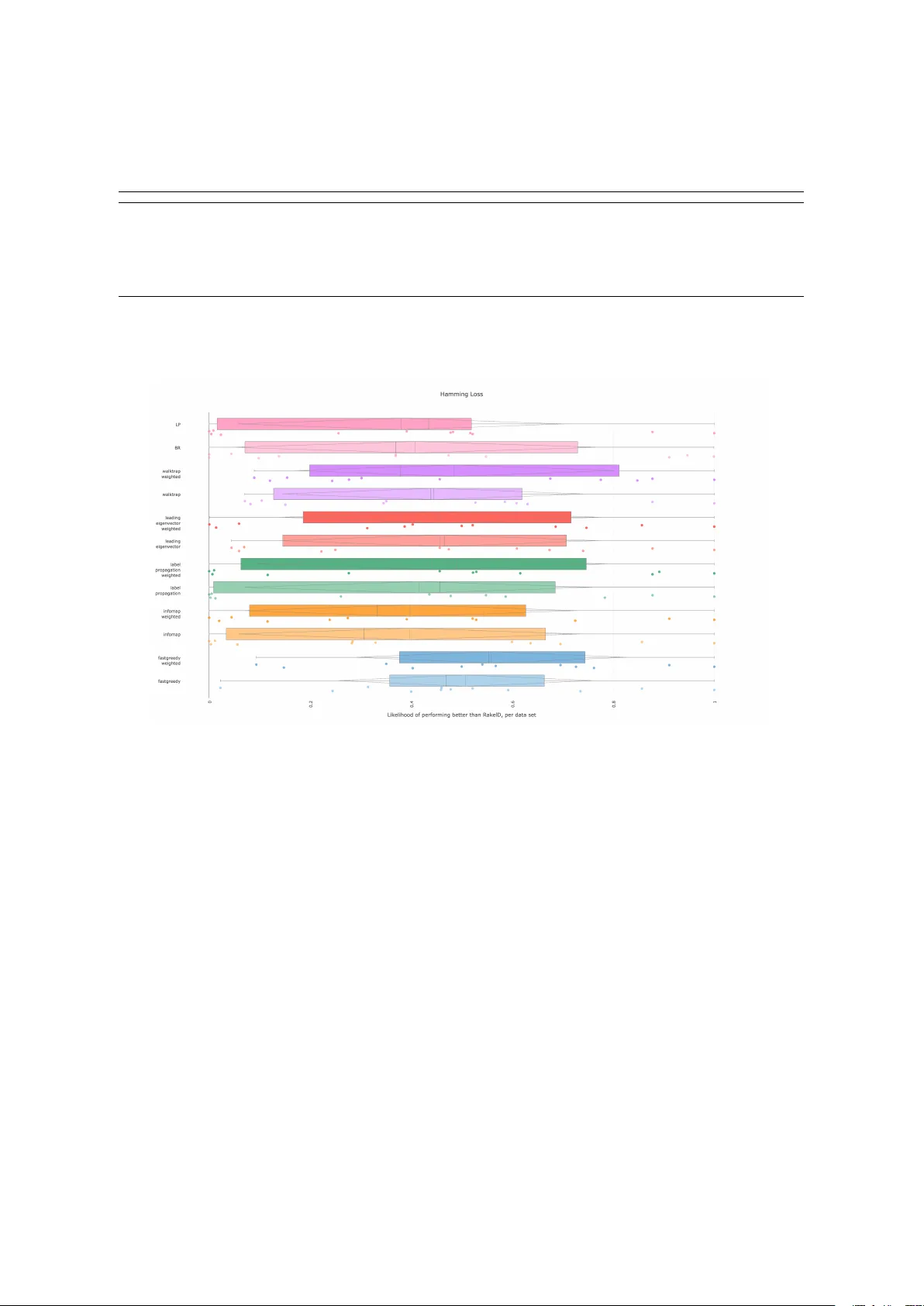
Arxiv Preprint How is a data-driven approach better than random choice in label space division for multi-label classification? Piotr Szyma ´ nski 1,2 *, T omasz Kajdanowicz 1 , Kristian Kersting 3 1 Department of Computational Intelligence, W rocław University of T echnology , Wybrze ˙ ze Stanisława W yspia ´ nskiego 27, 50-370 W rocław , Poland 2 illimites Foundation, Gajowicka 64 lok. 1, W rocław , Poland 3 Computer Science Department, TU Dortmund University , August-Schmidt-Straße 4, 44221 Dortmund, Germany * Correspondence: piotr .szymanski@pwr .edu.pl Uploaded: June 9, 2016 Abstract: W e propose using five data-driven community detection approaches from social networks to partition the label space for the task of multi-label classification as an alternative to random partitioning into equal subsets as performed by RA k EL d : modularity-maximizing fastgreedy and leading eigenvector , infomap, walktrap and label propagation algorithms. W e construct a label co-occurence graph (both weighted an unweighted versions) based on training data and perform community detection to partition the label set. W e include Binary Relevance and Label Powerset classification methods for comparison. W e use gini-index based Decision T rees as the base classifier . W e compare educated appr oaches to label space divisions against random baselines on 12 benchmark data sets over five evaluation measures. W e show that in almost all cases seven educated guess approaches are more likely to outperform RA k EL d than otherwise in all measures, but Hamming Loss. W e show that fastgr eedy and walktrap community detection methods on weighted label co-occurence graphs are 85-92% more likely to yield better F1 scores than random partitioning. Infomap on the unweighted label co-occurence graphs is on average 90% of the times better than random paritioning in terms of Subset Accuracy and 89% when it comes to Jaccard similarity . W eighted fastgreedy is better on average than RA k EL d when it comes to Hamming Loss. Keywords: label space clustering; label co-occurrence; label grouping; multi-label classification; clustering; machine learning; random k-labelsets;ensemble classification 1. Introduction Shanon’s work on the unpredictability of information content inspired a search for the area of multi-label classification that requires more insight - where has the field still been using random approaches to handling data uncertainty when non-random methods could shed the light and provide the ability to make better pr edictions? Interestingly enough, random methods are prevalent in well-cited, and multi-label classification approaches, especially in the problem of label space partitioning, which is a core issue in the problem-transformation appr oach to multi-label classification. A gr eat family of multi-label classification methods, called problem transformation approaches, depends on converting an instance of a multi-label classification problem to one or more single-label single-class or multi-class classification pr oblems, perform such classification and then convert the results back to multi-label classification r esults. Such a situation stems from the fact that historically , the field of classification started out with solving single-label classification problems. In general a classification problem of understanding the relationship (function) between a set of objects and a set of categories that should be assigned to it. If the object is allocated to at most one category , the problem is called a single-label classification. Arxiv 2 of 23 When multiple assignments per instance ar e allowed, we are dealing with a multi-label classification scenario. In the single label scenario, in one variant we deal with a case when there is only one category , i.e. the pr oblem is a binary choice - whether to assign a category or not, such a scenario is called single-class classification, ex. the case of classifying whether there is a car in the picture or not. The other case is when we have to choose at most one from many possible classes - such a case is called multi-class classification - i.e. classifying a picture with the dominant brand of cars present in it. The multi-label variant of this example would concern classifying a picture with all car brands present in it. As both single- and multi-class classification problems have been considerably r esearched during the last decades. One can naturally see, that it is reasonable to transform the multi-label classification case, by dividing the label space, to a single- or a multi-class scenario. A great introduction to the field was written by [ 1 ]. The two basic approaches to such transformation are Binary Relevance and Laber Powerset. Binary Relevance takes an a priori assumption that the label space is entirely separable, thus converting the multi-label problem to a family of single-class problems, one for every label - and making a decision - whether to apply it or not. Converting the results back to multi-label classification is based just on taking a union of all assigned labels. Regarding our example - binary relevance assumes that correlations between car brands are not important enough and discards them a priori by classifying with each brand separately . Label Powerset makes an opposite a priori assumption - the label space is non-divisible label-wise, and each possible label combination becomes a unique class. Such an approach yields a multi-class classification problem on a set of classes equal to the power set of the label set, i.e. growing exponentially if one treats all label combinations as possible. In practice, this would be intractable. Thus, as [ 2 ] note, Label Powerset is most commonly implement to handle only these combinations of classes that occur in the training set - and as such is pr one to both overfitting. It is also - per [ 3 ] - prone to differ ences in label combination distributions between the training set and the test set as well as to an imbalance in how label combinations are distributed in general. T o remedy the overfitting of Label Powerset, T soumakas et. al. [ 3 ] proposes to divide the label space into smaller subspaces and use Label Powerset in these subspaces. The source of proposed improvements come from the fact that it should be easier for Label Powerset to handle a lar ge number of label space combinations in a smaller space. T wo proposed approaches ar e called random k-labelsets (RA k EL ). RA k EL comes in two variants - a label space partitioning RA k EL d which divides the label set into k disjoint subsets and RA k EL o which is a sampling approach that allows overlapping of label subspaces. In our example, RA k EL would randomly select a subset of brands and use the label powerset approach for brand combinations in all of the subspaces. While these methods wer e developed, we saw advances in other fields br ought us more and more tools to explore r elations between entities in data. Social and complex networks have been flourishing after most of the well-established methods were published. In this paper , we propose a data-driven approach for label space partitioning in multi-label classification. While we tackle the problem of classification, our goal is to spark a r eflection on how data-driven approaches to machine learning using new methods fr om complex/social networks can improve established pr ocedures. W e show that this direction is worth pursuing, by comparing method-driven and data-driven approaches towards partitioning the label space. Why should one rely on label space division at random? Should not a data-driven approach be better than random choice? Are methods that perform simplistic a priori assumptions truly worse than the random approach? What are the variances of result quality upon label space partitioning? Instead of selecting random subspaces of brands, we could consider that some city brands occur more often with each other , and less so with other suburban brands. Based on such a premise we could build a weighted graph depicting the frequency of how often two-brands occur together in Arxiv 3 of 23 photos. Then using well-established community detection methods on this graph, we could provide a data-driven partition for the label space. In this paper , we wish to follow Shanon’s ambition to search for a data driven solution, an approach of finding structur e instead of accepting uncertainty . W e run RA k EL d on 12 benchmark data sets, with up differ ent values of parameter k - taking k equal to 10%, 20%, . . . , 90% of the label set size. W e draw 250 distinct partitions of the label set into subsets of k labels, per every value of k . In case ther e are less than 250 possible partitions of the label space (for ex. because there are less than 10 labels), we consider all possible partitions. W e then compar e these r esults against the performance of methods based both on a priori assumptions - Binary Relevance and Label Powerset - and also well-established community detection methods employed in social and complex network analysis to detect patterns in the label space. For each of the measures we state thr ee hypotheses: RQ1 : a data-driven approach performs statistically better than the average random baseline RQ2 : a data-driven approach are more likely to outperform RA k EL d than methods based on a priori assumptions RQ3 : a data-driven approach has a higher likelihood to outperform RA k EL d in the worst case than methods based on a priori assumptions RQ4 : a data-driven appr oach is more likely to perform better than RA k EL d , than otherwise, i.e. the worst-case likelihood is greater than 0.5 W e describe used methods in Section 3 and compar e the results of the likelihood of an data-driven approach being better than randomness in Section 6 . W e provide technical detail of the experimental scenario in Section 5 . W e conclude with main findings of the paper and future work in section 7 . 2. Related work Our study builds on two kinds of approaches to multi-label classification: problem transformation and ensemble. W e extend the Label Powerset pr oblem transformation method by employing an ensemble of classifiers to classify obtained partitions of the label space separately . W e show that partitioning the label space randomly - as is done in the RAkEL approach - can be improved by using a variety of methods to infer the structure of partitions fr om the training. W e extend the original evaluation of random k -labelsets performance using a larger sampling of the label space and providing deeper insight into how RA k EL d performs. W e also provide some insights into the nature of random label space partitioning in RA k EL d .Finally we provide alternatives to random label space partitioning that are very likely to yield better results than RA k EL d depending on the selected measure, and we show which methods to use depending on the generalization strategy . Classifier chains [ 4 ] approach to label space partitioning is based on a bayesian conditioning scheme, in which labels are ordered in a chain and then the n-th classification is performed taking into account the output of the last n-1 classifications. These methods suffer from a variety of challenges: the results are not stable when ordering of labels in the chain changes and finding the optimal chain is NP-hard. Existing methods that optimize towards best quality cannot handle more than 15 labels in a data set (ex. Bayes-Optimal PCC [ 5 ]). Also in every classifier chain approach one always needs to train at least the same number of classifiers as there are labels, and if ensemble approaches are applied - much mor e. In our appr oach we use community detection methods to divide the label space into a fewer number of cases to classify as multi-class pr oblems, instead of transforming to a large number of single-class problems that are interdependent. W e also do not strive to find the directly optimal solution to community detection problems on the label co-occurence graph, to avoid overfitting - instead we perform approximations of the optimal solutions. This approach provides a large overhead over random approaches. W e note that it would be an interesting question whether the random orderings in classifier chains are as suboptimal of a solution, as random partitioning turns out to be in label space partitioning. Y et it is not a subject of the study and is open to further resear ch. Arxiv 4 of 23 T soumakas et. al.’s [ 6 ] HOMER is a method of 2-step hierar chical multi-label classification in which the label space is divided based on label assignment vectors and then observations are classified first with cluster metalabels, and finally for each cluster they were labeled with, they are classified with labels of that cluster . W e do not compare to HOMER directly in this article, due to a differ ent natur e of the classification scheme, as the subject of this study is to evaluate how data-driven label space partititioning using complex/social network methods - which can be seen as weak classifiers (as all objects are assigned automatically to all subsets) - can improve the random partitioning multi-label classification. HOMER uses a strong classifier to decide which object should be classified in which subspace. Although we do not compare directly to HOMER, due to differ ence in the classification scheme and base classifier , our resear ch shows similarities to T soumakas’s result that abandoning random label space partitioning for k-means based educaed guess improves classification results. Thus our results are in accord, yet we provide a much wider study as we have performed a much larger sampling of the random space then the authors of HOMER in their method describing paper . Madjarov et. al. [ 7 ] compare performance of a 12 of multi-label classifiers on 11 benchmark sets evaluated by 16 measures. T o provide statistical support they use a Friedman multiple comparison procedur e with a post-hoc Nemenyi test. They include the RA k EL o procedur e in their study , i.e. the random label subsetting instead of partitioning. They do not evaluate the partitioning strategy RA k EL d - which is the main subject of this study . Our main contribution - the study of how RA k EL d performs against more informed approaches, therefor e fills the unexplored space of Madjarov’s et. al.’s extensive comparison. Note that, due to computational limits, we use CART decision trees instead of SVM as single-label base classifier , as explained in 5.2 . Zhang et. al. [ 8 ] review theoretical aspects and reported experimental performance of 8 multi-label algorithms and categorize them by the order of correlations taken into account and evaluation measur e that they try to optimize. W e follow the idea of their review table in T able 6 with entries related to data-driven approaches for label space partitioning under a flat classification scheme. 3. Multi-label classification In this section we aim to provide a more rigid description of methods we use in the experimental scenario. W e start by formalizing the notion of classification. Classification aims to understand a phenomenon, a relationship (function f : X → Y ) between objects and categories, by generalizing from empirically collected data D : • objects are r epresented as featur e vectors ¯ x from the input space X • categories, i.e. labels or classes come from a set L and it spans the output space Y : – in case of single-label single-class classification | L | = 1 and Y = 0, 1 – in case of single-label multi-class classification | L | > 1 and Y = 0, 1, . . . , | L | – in case of multi-label classification Y = 2 L • the empirical evidence collected: D = ( D x , D y ) ⊂ X × Y • a quality criterion function q In practice the empirical evidence D is split into two groups: the training set for learning the classifier and the test set to use for evaluating the quality of classifier performance. For the purpose of this section we will denote D tr a i n as the training set. The goal of classification is to learn a classifier h : X → Y such that h generalizes D tr a i n in a way that maximizes q . W e are focusing on problem-transformation approaches that perform multi-label classification by transforming it to a single-label classification and convert the results back to the multi-label case. In this paper we use CAR T decision tress as the single-label base classifier . CART decision tr ees are a single-label classification method capable of both single- and multi-class classification. A decision tree Arxiv 5 of 23 constructs a binary tree in which every node performs a split based on the value of a chosen feature X i from the featur e space X . For every feature, a threshold is found that minimizes an impurity function calculated for a threshold on the data available in the current node’s subtree. For the selected pair of a feature X i and a threshold θ a new split is performed in the current node. Objects with values of the feature lesser than θ are evaluated in the left subtree of the node, while the rest in the right. The process is repeated recursively for every new node in the binary tree until the depth limit selected for the method is reached or there is just one observation left to evaluate. In all our scenarios we use CAR T as the base single-label single- and multi-class base classifier . Binary Relevance learns | L | single-label single-class base classifiers b j : X → { 0, 1 } for each L j ∈ L and outputs the multi-label classification using a classifier h ( ¯ x ) = { L j ∈ L : b j ( ¯ x ) = 1 } . Label Powerset constructs a bijection l p : 2 L → C between each subset of labels L i and a class C i . Label Powerset then learns a single-label multi-class base classifier b : X → C and transforms its output to a multi-label classification result l p − 1 ( b ( ¯ x ) ) . RA k EL d performs a random partition of the label set L into k subsets L j | k 1 . For each L j a Label Powerset classifier b j : X → L j is learned. For a given input vector ¯ x the RA k EL d classifier h performs multi-label classification with each b j classifier and then sums the results, which can be formally described as h ( ¯ x ) = S k j = 0 b j ( ¯ x ) . Following the RA k EL d scenario from [ 3 ] all partitions of the set L into k subsets are equally probable. 4. The data-driven approach Having described the baseline random scenario of RA k EL d we now turn to explaining how complex/social network community detection methods fit into a data-driven perspective for label space division. In this scenario we ar e transforming the problem exactly like RA k EL d , but instead of performing random space partitioning we construct a label co-occurence graph from the training data and perform community detection on this graph to obtain a label space division. 4.1. Label co-occurrence graph W e construct the label co-occurrence graph as follows. W e start with and undirected co-occurrence graph G with the label set L as the vertex set and the set of edges constructed from all pairs of labels that wer e assigned together at least once to an input object ¯ x in the training set (here l i , j ,.. denote labels, i.e. elements of the set L ): E = { λ i , λ j } : ∃ ( ¯ x , Λ ) ∈ D tr a i n λ i ∈ Λ ∧ λ j ∈ Λ One can also extend this unweighted graph G to a weighted graph by defining a function w : L → N : w ( λ i , λ j ) = number of input objects ¯ x that have both labels assigned = = ¯ x : ( ¯ x , Λ ) ∈ D tr a i n ∧ λ i ∈ Λ ∧ λ j ∈ Λ Using such graph G , weighted or unweighted, we find a label space division by using one of the following community detection methods to partition the graph’s vertex set which is equal to the label set. 4.2. Dividing the label space Community detection methods are based on different principles as differ ent fields defined communnities differ ently . W e ar e employing a variety of methods Modularity-based approaches such as the fast greedy [ 9 ] and the spectral leading eigenvector algorithms are based on detecting a partition of label sets that maximizes the modularity measur e by [ 10 ]. Behind this measur e lies an assumption that true community structure in a network corresponds to a Arxiv 6 of 23 statistically surprising arrangement of edges [ 10 ], i.e. that a community structur e in a real phenomenon should exhibit a structure different than an average case of a random graph, which is generated under a given null model . A well-established null model is the configuration model, which joins vertices together at random, but maintains the degree distribution of vertices in the graph. For a given partition of the label set, the modularity measure is the differ ence between how many edges of the empirically observed graph have both ends inside of a given community , i.e. e ( C ) = { ( u , v ) ∈ E : u ∈ C ∧ v ∈ C } versus how many edges starting in this community would end in a differ ent one in the random case: r ( C ) = ∑ v ∈ C de g ( v ) | E | . More formally this is Q ( C ) = ∑ c ∈ C e ( c ) − r ( c ) . In case of weights, instead of counting the number of edges the total weight of edges is used and instead of taking vertex degrees in r , the vertex str enghts are used - a precise description of weighted modularity can be found in Newman’s paper [ 11 ]. Finding ¯ C = argmax C Q ( C ) is NP-hard as shown by Brandes et. al. [ 12 ]. W e thus employ three differ ent approximation-based techniques instead: a greedy , a multi-level hierarchical and a spectral recursively dividing algorithm. The fast greedy approach works based greedy aggregation of communities, starting with singletons and merging the communities iteratively . In each iteration the algorithm merges two communities based on which merge achieves the highest contribution to modularity . The algorithm stops when there is no possible merge that would increase the value of the current partition’s modularity . It’s complexity is O ( N l o g 2 N ) . The leading eigenvector approximation method depends on calculating a modularity matrix for a split of the graph into two-communities. Such a matrix allows to rewrite the two-community definition of modularity in a matrix form which can be than maximized using the largest positive eigenvalue and signs of the corresponding elements in the eigenvector of the modularity matrix - negative ones assigned to one community , positive ones to another . The algorithm starts with all labels in one community and performs consecutive splits recursively until all elements of the eigenvector have the same sign, or the community is a singleton. The method is based on the simplest variant of spectral modularity approximation as pr oposed by Newman [ 13 ]. It’s complexity is O ( M + N 2 ) . Infomap algorithm concentrates on finding the community structure of the network with respect to flow and to exploit the inference-compr ession duality to do so [ 14 ]. It relies on finding a partition of the vertex set that minimizes the map equation. The map equation divides flows through the graph into intra-community ones and the between-community ones and takes into consideration and entropy-based frequency-weighted average length of codewords used to label nodes in communities and inter-communities. It’s complexity is O ( M ) . The label propagation algorithm [ 15 ] assigns a unique tag to every vertex in the graph. Next it iteratively updates the tag of every vertex with the tag assigned to the majority of the elements neighbours. The updating order is randomly selected at each iteration. The algorithm stops when all vertices have tags that ar e in accor d with the dominant tag in their neighbour hood. It’s complexity is O ( N + M ) . The walktrap algorithm is based on the intuition that random walks on a graph tend to get “trapped” into densely connected parts corresponding to communities [ 16 ]. It starts with a set of singleton communities and agglomerates obtained communities in a greedy iterative approach based on how close two vertices are in terms of random-walk distance. More pr ecisely each step merges two communities to maximize the decrease of the mean (averaged over vertices) of squared distances between a vertex and all the vertices that are in the vertex’s community . The random walk distance between two nodes is measured as the L 2 distance between random walk probability distribution starting in each of the nodes. The distances are of the same maximum length pr ovided as a parameter to the method. It’s expected complexity is O ( N 2 ∗ l o g ( N ) ) . In complexity notations N is the number of nodes and M the number of edges. Arxiv 7 of 23 4.3. Classification scheme In our data-driven scheme, the training phase is performed as follows: 1. the label co-occurence graph is constr ucted based on the training data set 2. the selected community detection algorithm is executed on the label co-occurence graph 3. for every community L i a new training data set D i is created by taking the original input space with only the label columns that are pr esent in L i 4. for every community a classifier h i is learned on training set D i The classification phase is performed by performing classification on all subspaces detected in the training phase and taking the union of assigned labels: h ( ¯ x ) = S k j = 0 b j ( ¯ x ) . 5. Experiments and Materials T o prepare ground for results, in this section we describe which data sets we have selected for evaluation and why . Then we pr esent and justify model selection decisions for our experimental scheme. Next we describe the configuration of our experimental environment. Finally we describe the measures used for evaluation. 5.1. Data Sets Following Madjarov’s study ([ 7 ]) we have selected 12 dif ferent well-cited multi-label classification benchmark data sets. The basic statistics of datasets used in experiments, such as the number of data instances, the number of attributes, the number of labels, labels’ cardinality , density and the distinct number of label combinations are available online[ 17 ]. W e selected the data sets to obtain a balanced representation of pr oblems in terms of number of objects, number of labels and domains. At the moment of publishing this is one of the largest study of RA k ELd both in terms of data sets examined and in terms of random label partitioning sample count. This study also has exhibits higher ratio of number of data sets to number of methods that other studies. The text domain is represented by 5 data sets: bibtex , delicious , enron , medical , tmc2007-500 . Bibtex ([ 18 ]) comes from the ECML/PKDD 2008 Discovery Challenge and is based on data from the Bibsonomy .org publication sharing and bookmarking website. It exemplifies the pr oblem of assigning tags to publications repr esented as an input space of bibliographic metadata such as: authors, paper/book title, journal volume, etc. Delicious ([ 6 ]) is another user -tagged data set. It spans over 983 labels obtained by scraping the 140 most popular tags from the del.icio.us bookmarking website, r etrieving the 1000 most recent bookmarks, selecting the 200 most popular , deduplication and filtering tags that were used to tag less than 10 websites. For those labels, websites tagged with them wer e scraped and fr om their contents top 500 words ranked by χ 2 method wer e selected as input features. Tmc2007 ([ 6 ]) contains an input space consisting of similarly selected top 500 words appearing in flight safety reports. The labels repr esent the pr oblems being described in these reports. Enron ([ 19 ]) contains emails from senior Enron Corporation employees categorized into topics by the UC Berkeley Enron E-mail Analysis Project 1 with the input space being a bag of wor d representation of the e-mails. Medical ([ 4 ]) data set is Medical Natural Language Processing Challenge 2 challenge. The input space is a bag-of-words r epresentation of patient symptom history and labels repr esent diseases following International Classification of Diseases. The multimedia domain consists of five datasets scene , corel5k , mediamill , emotions and birds . The image data set scene ([ 20 ]) semantically indexes still scenes annotated with any of the following categories: beach, fall-foliage, field, mountain, sunset and urban. Birds data set [ 21 ] repr esents a pr oblem of matching bird voice recor dings extracted featur es features with a the subset of 19 1 http://bailando.sims.berkeley .edu/enron_email.html 2 http://www .computationalmedicine.org/challenge/ Arxiv 8 of 23 bird species that is present in the r ecording, each label repr esents one spiecies. This data set was introduced ([ 22 ]) during the The 9th annual MLSP competition. A larger image set corel5k ([ 23 ]) containing normalized-cut segmented images clustered into 499 bins. The bins were labeled with subsets 374 labels. Mediamill data set of annotated video segments ([ 24 ]) was introduced during the 2005 NIST TRECVID challenge 3 . It is annotated with 101 labels referring to elements observable on the video. The emotions data set [ 25 ] represents the problem of automated detection of emotion in music, assigning a subset of music emotions based on the T ellegen-W atson-Clark model to each of the songs. The biological domain is repr esented with two data sets: yeast and genbase . The yeast [ 26 ] data set concerns the problem of assigning functional classes to genes of saccharomyces cer evisiae genome. The genbase [ 27 ] data set represents the problem of assigning classes to proteins based on detected motifs that serve as input features. 5.2. Experiment design Using 12 benchmark data sets evaluated with five performance measures we compare eight approaches to label space partitioning for multi-label classification: • five methods that divide the label space based on structure inferred from the training data via label co-occurrence graphs - in both unweighted and weighted versions of the graphs • 2 methods that take an a priori assumption about the nature of the label space: Binary Relevance and Label Powerset • 1 random label space partitioning approach that draws partitions with equal probability - RA k EL d In the random baseline (RA k EL d ) we perform 250 samplings of random label space partitions into k -label subsets for each evaluated value of k . If a data set had mor e than 10 labels, we took values of k ranging from 10% to 90% with a step of 10%, rounding to closest integer number if necessary . In case of two data sets with a smaller number of labels i.e. scene and emotions we evaluated RA k EL d for all possible label space partitions due to their low number . The number of label space division samples per dataset can be found in T able 7 . As noone knows the true distribution of classification quality over label space partitions we’ve decided to use a large number of samples - 250 per each of the groups, 2500 alltogether - to get as close to a representative sample of the population, as was possible with our infrastructur e limitations. As the base classifier , we use CAR T decision trees. While we recognize that the majority of studies prefer to use SVMs, we note that it is intractable to evaluate nearly 32500 samples of the random label space partitions using SVMs. W e have thus decided to use a classifier that presents a reasonable trade-of f between quality and computational speed. W e perform statistical evaluation of our approaches by comparing them to average performance of the random baseline of RA k EL d .W e average RA k EL d results per data set, which is justified by the fact that, this is the expected result one would get without performing extensive parameter optimization. Following Derrac et. al.’s [ 28 ] de facto standard modus operandi we use Friedman test with Iman-Davenport modifications to detect differ ences between methods and we check whether a given method is statistically better than the average random baseline using Rom’s post-hoc pairwise test. W e use these tests’ results to confirm or reject RH1 . W e do not perform statistical evaluation per group ( i.e. isolating each value of k from 10% to 90%) due to lack of non-parametric repeated measure tests as noted by Demsar in the classic paper [ 29 ]. Instead to account for variation, we consider the probability that a given data-driven approach to label space division is better than random partitioning. These pr obabilities were calculated per 3 http://www .science.uva.nl/resear ch/mediamill/challenge/ Arxiv 9 of 23 data set, as the fraction of random outputs that yielded worse r esults than a given method. Thus for example if infomap has 96.5% probability of having higher better Subset Accuracy (SA) than the random approach in Corel5k, this means that on this data set infomap’s SA score was better than scores achieved by 96.5% of all RA k EL d experiments. W e check the median, the mean, and the minimal ( i.e. worst case) likelihoods. W e use these r esults to confirm or reject RH2 , RH3 and RH4 . 5.3. Environment W e used scikit-multilearn [ 30 ] - version 0.0.1- a scikit-learn API compatible library for multi-label classification in python that provides own implementation of several classifiers and uses scikit-learn [ 31 ] multi-class classification methods. All of the data sets come from MULAN [ 32 ] data set library [ 17 ] and follow MULAN’s division into the train and test subsets. W e use CAR T decision trees from the scikit-learn package - version 0.15 - with the Gini index as the impurity function. W e employ community detection methods from the Python version of the igraph library [ 33 ] for both weighted and unweighted graphs. Performance measures’ implementation comes from the scikit-learn metrics package. 5.4. Evaluation Methods Following Madjarov et. al.’s [ 7 ] taxonomy of multi-label classification evaluation measures we use three example-based measures: hamming loss, subset accuracy and Jaccard similarity and a label-based measure - F1 as evaluated by two averaging schemes: micro and macro. In all following definitions: • X is the set of objects used in the testing scenario for evaluation • L is the set of labels that spans the output space Y • ¯ x denotes an example object undergoing classification • h ( ¯ x ) denotes the label set assigned to object ¯ x by the evaluated classifier h • y denotes the set of true labels for the observation ¯ x • t p j , f p j , f n j , tn j are respectively true positives, false positives, false negatives and true negatives of the of label L j , counted per label over the output of classifier h on the set of testing objects ¯ x ∈ X , i.e. h ( X ) • the operator [ [ p ] ] converts logical value to a number , i.e. it yields 1 if p is true and 0 if p is false 5.4.1. Example-based evaluation methods Hamming Loss is a label-wise decomposable function counting the fraction of labels that were misclassified. ⊗ is the logical exclusive or . HammingLoss ( h ) = 1 | X | ∑ ¯ x ∈ X 1 | L | ∑ L j ∈ L [[ ( L j ∈ h ( ¯ x ) ) ⊗ ( L j ∈ y ) ] ] Accuracy score and subset 0/1 loss are instance-wise measures that count the fraction of input observations that have been classified exactly the same as in the golden truth. SubsetAccuracy ( h ) = 1 | X | ∑ ¯ x ∈ X [[ h ( ¯ x ) = y ] ] Jaccard similarity is a measure of the size of similarity between the prediction and the ground truth comparing what is the cardinality of an intersection of the two, compared to the union of the two. In other words what fraction of all labels taken into account by any of the prediction or ground truth wer e assigned to the observation in both of the cases. Jaccard ( h ) = 1 | X | ∑ ¯ x ∈ X h ( ¯ x ) ∩ y h ( ¯ x ) ∪ y Arxiv 10 of 23 5.4.2. Label-based evaluation methods The F1 measur e is a harmonic mean of precision and recall wher e none of the two are more preferr ed than the other . Precision is the measure of how much the method is immune to the T ype I error i.e. falsely classifying negative cases as positives: false positives or FP . It is the fraction of correctly positively classified cases ( i.e. true positives ) to all positively classified cases. It can be interpreted as the probability that an object without a given label will not be labeled as having it. Recall is the measure of how much the method is immune to the T ype II err or i.e. falsely classifying positive cases as negatives: false negatives or FN . It is the fraction of correctly positively classified cases ( i.e. true positives ) to all positively classified label. It can be interpreted as the probability that an object with a given label will be labeled as such. These measures can be averaged from two perspectives that are not equivalent in practice due to a natural non-uniformity of distribution of labels among input objects in any testing set. T wo averaging techniques are well-established as noted by [ 34 ]. Micro-averaging gives equal weight to every input object and performs a global agregation of true/false positives/negatives, averaging over all objects first. Thus: precision mi cr o ( h ) = ∑ | L | j = 1 t p j ∑ | L | j = 1 t p j + f p j recall mi cr o ( h ) = ∑ | L | j = 1 t p j ∑ | L | j = 1 t p j + f n j F1 mi cr o ( h ) = 2 · precision mi cr o ( h ) · recall mi cr o ( h ) precision mi cr o ( h ) + recall mi cr o ( h ) In macro-averaging the measur e is first calculated per label, then averaged over the number of labels. Macro averaging thus gives equal weight to each label, regardless of how often the label appears. precision m ac ro ( h , j ) = t p j t p j + f p j recall m ac ro ( h , j ) = t p j t p j + f n j F1 m ac ro ( h , j ) = 2 · precision m ac ro ( h , j ) · recall m ac ro ( h , j ) precision m ac ro ( h , j ) + recall m ac ro ( h , j ) F1 m ac ro ( h ) = 1 | L | | L | ∑ j = 1 F1 m ac ro ( h , j ) 6. Results and Discussion W e describe performance per measure first and then look at how methods behave across measures. W e evaluate each of the r esearch hypotheses: RH1 - RH4 for each of the measur es. W e then look how these methods performed acr oss data sets. W e compare the median and the mean of achieved probabilities to assess average advantage over randomness, the higher the better . W e compare the median and the means, as in some cases methods admit a single worst-performing outlier while in general providing lar ge advantage over random approaches. W e also check how each method’s perform in the worst case i.e. what is the minimum probability of it being better than randomness in label space division? Arxiv 11 of 23 6.1. Micro-averaged F1 scor e 5e−05 7e−05 0 0.02059 0.00241 0.02059 0.00241 0.00024 7e−05 0.02059 0.00045 0 random LP infomap label.propagation infomap.w eighted label.propagation.weighted walktrap leading.eigenvector fastgreedy leading.eigenvector .weighted BR walktrap.w eighted fastgreedy.weighted Algorithm Figure 1. Statistical evaluation of method’s performance in terms of micro averaged F1 score. Gray - baseline, white - statistically identical to baseline, otherwise, the p-value of hypothesis that a method performs better than the baseline. When it comes to ranking of how well methods performed in micro averaged F1, fast gredy and walktrap approaches used on weighted label co-occurence graph performed best, followed by BR, leading eigenvector and unweighted walktrap / modularity-maximizations methods. Also weighted label propagation and infomap were statistically significantly better than the average random performance. W e confirm RH1 . In terms of micro-averaged F1 weighted fast greedy approach has both the highest mean (86%) and median (92%) likelihood of scoring better than random baseline. Binary Relevance and weighted variants of walktrap, leading eigenvector also performed well with a mean likelihood of 83-85% and a lower , but still satisfactory median of 85-88%. W e confirm RH2 . Modularity-based approaches also turn out to be most resilient. The weighted variant of walktrap was the most resilient with a 69.5% likelihood in the worst case, followed closely by a weighted fast greedy appr oach with 67% and unweighted walktrap with 66.7%. W e note that, apart from a single outlying data sets, all methods (apart from Label Powerset) had better than 50% likelihood of performing better than RA k EL d .Binary Relevance worst case likelihood was exactly 0.5. W e this confirm both RH3 and RH4 . Fast greedy and walktrap weighted approaches yielded the best advantage over RA k EL d both in average and worst cases. Binary Relevance also provided a strong overhead against random label space division, while achieving just 0.5 in the worst case scenario. Thus, when it comes to micro-averaged F1 scores RA k EL d random approaches to label space partitions should be dropped in favor of weighted fast greedy and walktrap methods or Binary Relevance. All of these methods are also statistically significantly better than the average random baseline. W e therefore confirm RH1 , RH2 , RH3 , RH4 for micro-averaged F1 scor es. Figure 2. Histogram of methods’ likelihood of performing better than RA k EL d in Micro-averaged F1 score aggr egated over data sets Arxiv 12 of 23 W e also note that RA k EL d was better than Label Powerset on micro-averaged F1 in 57% of cases in the worst case while T soumakas et. al.’s original paper [ 3 ] pr ovides argumentation of micro-F1 improvements over LP yielded by RA k EL d , using SVMs. W e note that our observation is not contrary - LP failed to produce significantly differ ent results than the averange random baseline in our setting. Instead our r esults ar e complementary , as we use a dif ferent classifier but the intuition can be used to comment on T soumakas et. al.’s r esults. While in some cases RA k EL d provides an improvement over LP in F1 score, on average the probability of drawing a random subspace better is only 30%. W e still note that it is much better to use one of the recommended community detection based approaches instead of a method based on a priori assumptions. T able 1. Likelihood of performing better than RA k EL d in Micro-averaged F1 score of every method for each data set BR LP fastgreedy fastgreedy-weighted infomap infomap-weighted label_propagation label_propagation-weighted leading_eigenvector leading_eigenvector-weighted walktrap walktrap-weighted Corel5k 0.856444 0.608000 0.961333 0.804000 0.524000 0.881778 0.601333 0.524000 0.949778 0.818222 0.745333 0.799111 bibtex 0.997778 0.782667 0.756444 0.794222 0.664889 0.816889 0.749333 0.882222 0.812000 0.800889 0.835111 0.833333 birds 0.968562 0.438280 0.843736 0.946833 0.591771 0.433657 0.364309 0.478964 0.630606 0.830791 0.694868 0.836338 delicious 0.914667 0.869333 0.941778 0.936444 0.864000 0.874222 0.892889 0.868889 0.934667 0.918667 0.912889 0.916000 emotions 0.500000 0.521739 0.565217 0.673913 0.739130 0.586957 0.673913 0.913043 0.717391 0.630435 0.739130 0.891304 enron 0.802000 0.873000 0.934500 0.938000 0.786000 0.776500 0.815500 0.839000 0.776000 0.945500 0.761000 0.859500 genbase 0.941778 0.880000 0.864444 0.919111 0.862222 0.913333 0.880000 0.882667 0.882667 0.862222 0.882667 0.880000 mediamill 0.740889 0.609333 0.769778 0.932000 0.627556 0.562222 0.615111 0.589333 0.709333 0.886667 0.715111 0.854222 medical 0.938500 0.596500 0.769000 0.799500 0.688000 0.736000 0.772000 0.623000 0.770000 0.729500 0.667500 0.698500 scene 0.673913 0.608696 0.695652 0.695652 0.478261 0.586957 0.521739 0.608696 0.673913 0.695652 0.695652 0.695652 tmc2007-500 0.999343 1.000000 1.000000 1.000000 1.000000 1.000000 1.000000 1.000000 1.000000 1.000000 1.000000 1.000000 yeast 0.746458 0.671141 0.740492 0.926174 0.815063 0.808352 0.718867 0.791201 0.790455 0.891872 0.733781 0.960477 6.2. Macro-averaged F1 scor e 0 2e−05 0 0.04842 0.00108 0.04842 0.00159 0.00013 3e−05 0.02807 4e−05 2e−05 random label.propagation infomap LP label.propagation.weighted infomap.w eighted leading.eigenvector walktrap leading.eigenvector .weighted walktrap.w eighted fastgreedy BR fastgreedy.weighted Algorithm Figure 3. Statistical evaluation of method’s performance in terms of macro averaged F1 score. Gray - baseline, white - statistically identical to baseline, otherwise, the p-value of hypothesis that a method performs better than the baseline. All methods, apart from unweighted label propagation and infomap, performed significantly better than the average random baseline. The highest ranks were achieved by weighted fast greedy , Binary Relevance and unweighted fast greedy . W e confirm RH1 . Fast gredy and walktrap approaches used on weighted label co-occurence graph were most likely to perform better than RA k EL d samples, followed by BR, leading eigenvector and unweighted walktrap / modularity-maximizations methods. Also weighted label pr opagation and infomap were statistically significantly better than the average random performance. Binary Relevance, weighted fast greedy were the two approaches that surpassed the 90% likelihood of being better than random label space divisions in both median (98.5% and 97% respectively) and mean (92% and 90%) cases. W eighted walktrap and leading eigenvector followed closely with both the median and the mean likelihood of 87-89%. W e confirm thus reject RH2 as Binary Relevance achieved greater likelihoods than the best data-driven approach. When it comes to resilience - all modularity (apart from unweighted fast greedy) methods, achieve the same high worst-case 70% probability of performing better than RA k EL d .Binary Relevance underperformed in worst-case with being better exactly in 50% of the cases. All methods on all data sets, apart from outlier case of infomap’s and label propagation’s performance on the scene data set, are likely to yield a better macro-averaged F1 score than the random approaches. W e confirm RH3 and RH4 . W e recommend using Binary Relevance or weighted fast greedy approaches when generalizing to achieve best macro-averaged F1 score, as they are both significantly better than average random performance, more likely to perform better than RA k EL d samplings and this likelihood is high even in the worst case. Thus for macro-averaged F1 we confirm hypotheses RH1 , RH3 , RH4 . Binary Arxiv 13 of 23 Relevance had a slightly better likelihood of beating RA k EL d than data-driven approaches and thus we reject RH2 . Figure 4. Histogram of methods’ likelihood of performing better than RA k EL d in Macro-averaged F1 score aggr egated over data sets T able 2. Likelihood of performing better than RA k EL d in Macr o-averaged F1 score of every method for each data set BR LP fastgreedy fastgreedy-weighted infomap infomap-weighted label_propagation label_propagation-weighted leading_eigenvector leading_eigenvector-weighted walktrap walktrap-weighted Corel5k 1.000000 0.665778 0.980889 0.968444 0.615111 0.996889 0.596444 0.712444 0.836444 0.901333 0.845333 0.969778 bibtex 1.000000 0.871111 0.839111 0.869333 0.803111 0.887111 0.849333 0.945778 0.880000 0.878222 0.881333 0.876000 birds 0.992603 0.559408 0.883957 0.999075 0.804901 0.673601 0.449376 0.671290 0.736477 0.847896 0.786408 0.897365 delicious 0.997778 0.937778 1.000000 1.000000 0.929333 0.956444 0.996889 0.974222 1.000000 1.000000 1.000000 1.000000 emotions 0.500000 0.543478 0.543478 0.717391 0.717391 0.608696 0.630435 0.913043 0.695652 0.695652 0.717391 0.891304 enron 0.991500 0.966500 1.000000 0.973000 0.943500 0.948000 0.875500 0.954000 0.981500 0.992000 0.949000 0.830000 genbase 0.953333 0.829333 0.881778 0.892444 0.836000 0.892000 0.840444 0.840889 0.882667 0.836000 0.848444 0.840444 mediamill 0.964444 0.860444 0.882667 0.969778 0.835111 0.743111 0.792444 0.759556 0.881333 0.964889 0.840889 0.943111 medical 0.977500 0.725500 0.768500 0.750500 0.696000 0.722500 0.730000 0.697500 0.783500 0.703000 0.701500 0.745000 scene 0.673913 0.565217 0.695652 0.695652 0.478261 0.500000 0.478261 0.521739 0.695652 0.695652 0.695652 0.695652 tmc2007-500 1.000000 1.000000 1.000000 1.000000 1.000000 1.000000 1.000000 1.000000 1.000000 1.000000 1.000000 1.000000 yeast 0.979866 0.829232 0.921700 0.970172 0.858315 0.893363 0.811335 0.869500 0.847129 0.950783 0.871738 0.934377 Arxiv 14 of 23 6.3. Subset Accuracy 0.35901 0.05158 0.10897 3e−05 0.00027 1e−05 0.00053 0.18603 0.25702 6e−05 0.07803 0.01927 random BR leading.eigenvector .weighted leading.eigenvector fastgreedy.weighted walktrap fastgreedy walktrap.w eighted label.propagation.weighted infomap.w eighted LP infomap label.propagation Algorithm 0.05 Corrected p−values Figure 5. Statistical evaluation of method’s performance in terms of Jaccard Similarity score. Gray - baseline, white - statistically identical to baseline, otherwise, the p-value of hypothesis that a method performs better than the baseline. All methods apart fr om weighted leading eigenvector modularity maximization approach were statistically significantly better than the average random baseline. Label propagation, infomap, Label Powerset, weighted infomap, label propagation and walktrap are the methods that performed statistically significantly better than average random baseline, order ed by ranks. W e confirm RH1 . Also unweighted infomap and label propagation are the most likely to yield r esults of higher subset accuracy than random label space divisions, both r egarding the median (96%) and the mean (90-91%) likelihood. Label Powerset follows with a 95.8% median and 89% mean. W eighted versions of infomap and label powerset are fourth and fifth with 5-6 percentage points less. W e confirm RH2 . Concerning r esiliency of the advantage, only infomap versions pr oved to be better than RA k EL d in more than half of the times - the unweighted version in 58% of cases, the weighted one in 52%. All other methods were below the 50% threshold in the worst case, with Label Powerset and label propagation likelihood of 33% for both variants. If one or two most wrong outliers were to be discarded, all methods are more than 50% likely to be better than random label space partitioning. W e confirm RH3 and RH4 . Figure 6. Histogram of methods’ likelihood of performing better than RA k EL d in Subset Accuracy aggregated over data sets W e thus recommend using unweighted infomap as the data-driven alternative to RA k EL d , as it is both significantly better than the random baseline, very likely to perform batter than RA k EL d and most resilient among evaluated methods in the worst case. W e confirm RH1 , RH2 , RH3 and RH4 for subset accuracy . Arxiv 15 of 23 T able 3. Likelihood of performing better than RA k EL d in Subset Accuracy of every method for each data set BR LP fastgreedy fastgreedy-weighted infomap infomap-weighted label_propagation label_propagation-weighted leading_eigenvector leading_eigenvector-weighted walktrap walktrap-weighted Corel5k 0.000000 0.953778 0.652000 0.301778 0.965778 0.652000 0.953778 0.826667 0.000000 0.000000 0.301778 0.780889 bibtex 0.492000 0.975111 0.828000 0.723111 0.971556 0.761778 0.975111 0.761778 0.800000 0.788000 0.799111 0.761778 birds 0.380028 0.336570 0.213130 0.061951 0.651872 0.525659 0.380028 0.336570 0.051780 0.039297 0.078132 0.429958 delicious 1.000000 1.000000 1.000000 1.000000 1.000000 1.000000 1.000000 1.000000 1.000000 1.000000 1.000000 1.000000 emotions 0.326087 0.717391 0.826087 0.847826 0.956522 0.891304 0.847826 0.891304 0.826087 0.891304 0.760870 1.000000 enron 0.504000 0.964000 0.775500 0.817000 0.959000 0.941000 0.990500 0.986500 0.865500 0.795000 0.659500 0.775500 genbase 0.907556 0.871556 0.851111 0.907556 0.851111 0.907556 0.871556 0.871556 0.871556 0.851111 0.871556 0.871556 mediamill 0.318222 0.924000 0.801333 0.856889 0.987111 0.858667 0.953333 0.936000 0.776889 0.836444 0.914222 0.844444 medical 0.866500 0.893000 0.686500 0.839000 0.580500 0.782500 0.839000 0.743500 0.814000 0.853000 0.631000 0.665500 scene 0.282609 1.000000 0.869565 0.652174 1.000000 1.000000 1.000000 1.000000 0.826087 0.543478 0.869565 0.630435 tmc2007-500 1.000000 1.000000 1.000000 1.000000 1.000000 1.000000 1.000000 1.000000 1.000000 1.000000 1.000000 1.000000 yeast 0.619687 0.990306 0.998509 0.964206 0.997017 0.990306 0.995526 0.985831 0.987323 0.953020 0.986577 0.966443 6.4. Jaccard score Figure 7. Histogram of methods’ likelihood of performing better than RA k EL d in Jaccar d Similarity aggregated over data sets 0.00642 0.00386 0.00856 7e−05 0.00012 1e−05 0.00012 0.00567 0.02591 7e−05 0.00567 0.00185 random leading.eigenvector .weighted fastgreedy.weighted BR leading.eigenvector walktrap fastgreedy walktrap.w eighted infomap.w eighted label.propagation.weighted infomap LP label.propagation Algorithm Figure 8. Statistical evaluation of method’s performance in terms of micro averaged F1 score. Gray - baseline, white - statistically identical to baseline, otherwise, the p-value of hypothesis that a method performs better than the baseline. All methods apart fr om weighted leading eigenvector modularity maximization approach were statistically significantly better than the average random baseline. Unweighted label propagation, Label Powerset and infomap were the highest ranked method. W e confirm RH1 . Jaccard score is similar to Subset Accuracy in rewarding exact label set matches. In effect, it is not surprising to see that unweighted infomap and label propagation are the most likely than RA k EL d to yield a result of higher Jaccard both in terms of median (94.5% and 92.9% respectively) and mean likelihoods (88.9% and 87.9% resp.). Out of the two, infomap provides the most resilient advantage with a 65% probability of performing better than random approaches in the worst case. Label propagation is in worst cases only 34-35% likely to be better than random space partitions. W e recommend using unweighted infomap approach over RA k EL d when Jaccard similarity is of importance and confirm RH1 , RH2 , RH3 and RH4 for this measure. Arxiv 16 of 23 T able 4. Likelihood of performing better than RA k EL d in Jaccard Similarity of every method for each data set BR LP fastgreedy fastgreedy-weighted infomap infomap-weighted label_propagation label_propagation-weighted leading_eigenvector leading_eigenvector-weighted walktrap walktrap-weighted Corel5k 0.675111 0.828444 0.888889 0.562667 0.788000 0.787111 0.803111 0.597333 0.888444 0.644444 0.504889 0.644889 bibtex 0.984444 0.998667 0.780889 0.720889 0.975556 0.758222 0.995111 0.866222 0.867556 0.796000 0.938222 0.824000 birds 0.820620 0.355987 0.542302 0.298197 0.653722 0.510865 0.345816 0.440592 0.163199 0.464170 0.238558 0.725381 delicious 0.976000 0.973333 0.943556 0.900444 0.964444 0.968444 0.992444 0.984000 0.938222 0.828889 0.988889 0.963111 emotions 0.456522 0.652174 0.760870 0.652174 0.956522 0.826087 0.891304 0.956522 0.891304 0.652174 0.891304 1.000000 enron 0.735500 0.984500 0.951000 0.904500 0.934000 0.960500 0.976000 0.994000 0.784500 0.957000 0.760000 0.827000 genbase 0.911111 0.904444 0.864444 0.911111 0.869333 0.952889 0.909778 0.884000 0.904000 0.869333 0.884000 0.909778 mediamill 0.537333 0.866667 0.682222 0.976000 0.921778 0.774667 0.893333 0.823556 0.706222 0.895556 0.914222 0.900444 medical 0.897500 0.789500 0.765500 0.850000 0.650000 0.745000 0.810500 0.722000 0.827500 0.751000 0.691000 0.688500 scene 0.456522 1.000000 0.891304 0.782609 0.978261 1.000000 0.978261 1.000000 0.913043 0.739130 0.891304 0.782609 tmc2007-500 0.998029 1.000000 1.000000 1.000000 1.000000 1.000000 1.000000 1.000000 0.999343 1.000000 1.000000 1.000000 yeast 0.661447 0.900820 0.979866 0.950037 0.984340 0.979120 0.947800 0.977629 0.973900 0.931394 0.956003 0.962714 6.5. Hamming Loss Figure 9. Histogram of methods’ likelihood of performing better than RA k EL d in Hamming Loss Similarity aggregated over data sets Hamming Loss is certainly a fascinating case in our experiments. As the measure is evaluated per each label separately , we can expect it to be the most stable over differ ent label space partitions. The first surprise comes with Friedman-Iman-Davenport test r esult, wher e the test practically fails to find a difference in performance between random approaches and data-driven methods, yielding a p-value of 0.049. While the p-value is lower than α = 0.05, but the difference cannot be taken as significant given the characteristics of the test. Lack of significance is confirmed by pairwise tests against random baseline (all hypotheses of differ ence are str ongly rejected). W e reject RH1 . W eighted fast greedy was the only approach to be more likely to yield a lower Hamming Loss than RA k EL d on average, both in median and mean (55%) likelihoods. The unweighted version was better than slightly over 50% more cases than RA k EL d , with a median likelihood of 46%. Binary Relevance and Label Powerset achieved likelihoods lower by close to 10 percentage points. W e thus confirm RH2 . When it comes to worst-case observations Binary Relevance, Label Powerset and infomap in both variants wer e never better than RA k EL d .The methods with the most resilient advantage in likelihood (9%) in the worst case wer e weighted versions of fastgreedy and walktrap. W e confirm RH3 and reject RH4 . W e conclude that fast greedy approach can be recommended over RA k EL d , as even given such large standard deviation of likelihoods it still yields lower Hamming Loss than random label space Arxiv 17 of 23 divisions on more than half of the data sets. Y et we r eject RH1 , RH2 and RH4 for Hamming Loss. W e confirm RH3 as a priori methods do not provide better performance than RA k EL d in the worst case. T able 5. Likelihood of performing better than RA k EL d in Hamming Loss of every method for each data set BR LP fastgreedy fastgreedy-weighted infomap infomap-weighted label_propagation label_propagation-weighted leading_eigenvector leading_eigenvector-weighted walktrap walktrap-weighted Corel5k 0.000000 0.004000 0.400000 0.148000 0.003556 0.115556 0.004889 0.009778 0.069333 0.000444 0.350667 0.243556 bibtex 0.097778 0.023111 0.022222 0.093333 0.011556 0.044444 0.012444 0.116000 0.059111 0.059111 0.070667 0.089333 birds 0.474341 0.008322 0.459085 0.540915 0.055941 0.019880 0.002774 0.006472 0.044383 0.013870 0.104022 0.154415 delicious 0.000000 0.000000 0.244444 0.350667 0.000000 0.000000 0.000000 0.000000 0.249778 0.387111 0.081778 0.120444 emotions 0.369565 0.391304 0.478261 0.695652 0.695652 0.521739 0.586957 0.891304 0.673913 0.521739 0.608696 0.847826 enron 0.044000 0.483000 0.460000 0.567500 0.284000 0.274500 0.436000 0.522500 0.474500 0.313000 0.151000 0.277000 genbase 0.911111 0.877778 0.856889 0.911111 0.856889 0.911111 0.877778 0.877778 0.877778 0.856889 0.877778 0.877778 mediamill 0.138222 0.256000 0.314667 0.403111 0.329333 0.238667 0.260889 0.276444 0.222222 0.403111 0.345333 0.301778 medical 0.947000 0.517000 0.735000 0.762000 0.636500 0.725000 0.783500 0.529000 0.740500 0.747000 0.585500 0.675500 scene 0.369565 0.521739 0.521739 0.500000 0.282609 0.391304 0.478261 0.456522 0.456522 0.500000 0.630435 0.456522 tmc2007-500 0.999343 1.000000 1.000000 1.000000 1.000000 1.000000 1.000000 1.000000 1.000000 1.000000 1.000000 1.000000 yeast 0.548098 0.478001 0.592095 0.726324 0.599553 0.528710 0.548098 0.615958 0.609247 0.686055 0.527218 0.775541 7. Conclusions W e have compared seven appr oaches as an alternative to random label space partition. RA k EL d served as the random baseline for which we have drawn at most 250 distinct label space partitions for at most ten differ ent values of the parameter k of label subset sizes. Out of the seven methods, five inferred the label space partit ioning fr om training data in the data sets, while the two others wer e based on a priori assumption on how to divide the label space. W e evaluated these methods on 12 well-established benchmark data sets. W e conclude that in four of five measures: micro-/macr o-averaged F1 score, Subset Accuracy , and Jaccard similarity all of our proposed methods were more likely to yield better scores than RA k EL d apart from single outlying data sets, a data-driven approach was better than average random baseline with statistical significance at α = .05. Data-driven approach was also better than RA k EL d in worst case scenarios. Thus hypotheses RH1 , RH3 and RH4 has been successfully confirmed with these measures When it comes to resear ch hypotheses number two ( RH2 ), we’ve confirmed that with micro-averaged F1, subset accuracy , hamming loss, and jaccard similarity , the data-driven approaches have a higher likelihood of outperforming RA k EL d than a priori methods do. The only exception to this is the case of macro averaged F1 where Binary Relevance was most likely to beat random approaches, while followed closely by a data-driven appr oach - weighted fast greedy . Hamming Loss forms a separate case for discussion, as this measures is most unrelated to label groups - it is calculated per label only . W ith this measure most data-driven methods performed much worse than in other methods. Our study failed to observer a statistical difference between data-driven methods and the random baseline, thus we reject hypothesis RH1 . For best performing data-driven methods worst-case likelihood of yielding a lower hamming loss than RA k EL d was close to 10% which is far fr om a resilient score, thus we also reject RH4 . W e confirm RH2 and RH3 as ther e existed a data-driven approach that performed better than a priori appr oaches. All in all, statistical significance of a data-driven approach performing better than the averaged random baseline ( RH1 ) has been confirmed for all measures except Hamming Loss. W e have confirmed that data-driven approach was more likely than Binary Relevance/Label Powerset to perform better than RA k EL d ( RH2 ) in all measur es apart fr om macro-averaged F1 score, where it followed the best Binary Relevance close. Data-driven were always more likely to outperform RA k EL d in the worst case than Binary Relevance/Label Powerset, confirming RH3 for all measures. Finally for all measures apart from Hamming Loss data-driven approaches were mor e likely to outperform RA k EL d in the worst case, than otherwise. RH4 is thus confirmed for all measures except Hamming Loss. In case of measures that are label-decomposable the fast greedy community detection approach computed on a weighted label co-occurence graph yielded best results among data driven perspectives and is the r ecommended choice for F1 measures and Hamming Loss. When the measure Arxiv 18 of 23 is instance-decomposable and not label-decomposable, such as Subset Accuracy or Jaccard Similarity , the infomap algorithm should be used on an unweighted label co-occurence graph. W e conclude that community detection methods offer a viable alternative to both random and a priori assumption-based label space partitioning approches. W e summarize our findings in the T able 6 , answering the question in the title of how data driven appr oach to label space partitioning is likely to perform better than random choice. T able 6. The summary of evaluated hypotheses and proposed recommendations of this paper Measure Micro-averaged F1 Micro-averaged F1 Subset Accuracy Jaccard Similarity Hamming Loss RH1 : Data-driven approach is significantly better than random (alpha = 0.05) Y es Y es Y es Y es No RH2 : Data-driven approach is more likely to outperform RAkELd than a priori methods Y es No Y es Y es Y es RH3 : Data-driven approach is more likely to outperform RAkELd than a priori methods in the worst case Y es Y es Y es Y es Y es RH4 : Data-driven approach is more likely to perform better than RAkELd in the worst case, than otherwise Y es Y es Y es Y es No Recommended data-driven approach W eighted fast greedy and weighted walktrap W eighted fast greedy Unweighted infomap Unweighted infomap W eighted fast greedy Acknowledgments: The work was partially supported by Fellowship co-financed by European Union within European Social Fund; The European Commission under the 7th Framework Programme, Coor dination and Support Action, Grant Agreement Number 316097 [ENGINE]; The National Science Centre the research project 2014-2017 decision no. DEC-2013/09/B/ST6/02317. The authors wish to thank Łukasz Augustyniak for helping with proofr eading the article. Author Contributions: Piotr Szyma ´ nski wrote the experimental code and wrote most of the paper . T omasz Kajdanowicz helped design experiments, supported interpreting the results, supervised the work, wrote parts of the paper and corrected and pr oofread the paper . Conflicts of Interest: The authors declare no conflict of inter est. Appendix: Result T ables T able 7. Number of random samplings fr om the universum of RakelD label space partitions for cases differ ent then 250 samples. Set Name k Number of samplings birds 17 163 emotions 2 15 3 10 4 15 5 6 scene 2 15 3 10 4 15 5 6 tmc2007-500 21 22 yeast 12 91 Arxiv 19 of 23 T able 8. Likelihood of performing better than RakelD in Micro-averaged F1 score aggregated over data sets Minimum Median Mean Std BR 0.500000 0.885556 0.840028 0.152530 LP 0.438280 0.640237 0.704891 0.171726 fastgreedy 0.565217 0.806757 0.820198 0.127463 fastgreedy-weighted 0.673913 0.922643 0.863821 0.106477 infomap 0.478261 0.713565 0.720074 0.153453 infomap-weighted 0.433657 0.792426 0.748072 0.170349 label_propagation 0.364309 0.734100 0.717083 0.175682 label_propagation-weighted 0.478964 0.815100 0.750085 0.174347 leading_eigenvector 0.630606 0.783227 0.803901 0.116216 leading_eigenvector-weighted 0.630435 0.846506 0.834201 0.107420 walktrap 0.667500 0.742232 0.781920 0.102776 walktrap-weighted 0.695652 0.856861 0.852037 0.091232 T able 9. Likelihood of performing better than RakelD in Macro-averaged F1 score aggregated over data sets Minimum Median Mean Std BR 0.500000 0.985683 0.919245 0.160273 LP 0.543478 0.829283 0.779482 0.163611 fastgreedy 0.543478 0.883312 0.866478 0.139572 fastgreedy-weighted 0.695652 0.969111 0.900483 0.116022 infomap 0.478261 0.820006 0.793086 0.147108 infomap-weighted 0.500000 0.889556 0.818476 0.164492 label_propagation 0.449376 0.801890 0.754205 0.182183 label_propagation-weighted 0.521739 0.855195 0.821663 0.148561 leading_eigenvector 0.695652 0.863565 0.851696 0.108860 leading_eigenvector-weighted 0.695652 0.889778 0.872119 0.118911 walktrap 0.695652 0.846889 0.844807 0.105977 walktrap-weighted 0.695652 0.894335 0.885253 0.095436 Arxiv 20 of 23 T able 10. Likelihood of performing better than RakelD in Subset Accuracy aggregated over data sets Minimum Median Mean Std BR 0.000000 0.498000 0.558057 0.323240 LP 0.336570 0.958889 0.885476 0.190809 fastgreedy 0.213130 0.827043 0.791811 0.214756 fastgreedy-weighted 0.061951 0.843413 0.747624 0.288200 infomap 0.580500 0.968667 0.910039 0.143954 infomap-weighted 0.525659 0.899430 0.859231 0.152637 label_propagation 0.380028 0.964444 0.900555 0.174854 label_propagation-weighted 0.336570 0.913652 0.861642 0.189690 leading_eigenvector 0.000000 0.826087 0.734935 0.340537 leading_eigenvector-weighted 0.000000 0.843778 0.712555 0.345277 walktrap 0.078132 0.834338 0.739359 0.288072 walktrap-weighted 0.429958 0.812667 0.810542 0.175723 T able 11. Likelihood of performing better than RakelD in Hamming Loss aggregated over data sets Minimum Median Mean Std BR 0.000000 0.369565 0.408252 0.375954 LP 0.000000 0.434653 0.380021 0.338184 fastgreedy 0.022222 0.469130 0.507034 0.266736 fastgreedy-weighted 0.093333 0.554208 0.558218 0.280209 infomap 0.000000 0.306667 0.396299 0.352963 infomap-weighted 0.000000 0.332902 0.397576 0.345339 label_propagation 0.000000 0.457130 0.415966 0.361819 label_propagation-weighted 0.000000 0.489511 0.441813 0.363469 leading_eigenvector 0.044383 0.465511 0.456441 0.330251 leading_eigenvector-weighted 0.000444 0.451556 0.457361 0.328774 walktrap 0.070667 0.438943 0.444424 0.312845 walktrap-weighted 0.089333 0.379150 0.484974 0.331186 Arxiv 21 of 23 T able 12. Likelihood of performing better than RakelD in Jaccard Similarity aggregated over data sets Minimum Median Mean Std BR 0.456522 0.778060 0.759178 0.202349 LP 0.355987 0.902632 0.854545 0.189086 fastgreedy 0.542302 0.876667 0.837570 0.135707 fastgreedy-weighted 0.298197 0.875222 0.792386 0.205646 infomap 0.650000 0.945261 0.889663 0.125510 infomap-weighted 0.510865 0.889488 0.855242 0.148578 label_propagation 0.345816 0.928789 0.878622 0.181165 label_propagation-weighted 0.440592 0.920261 0.853821 0.181186 leading_eigenvector 0.163199 0.889874 0.821436 0.222219 leading_eigenvector-weighted 0.464170 0.812444 0.794091 0.154102 walktrap 0.238558 0.891304 0.804866 0.227916 walktrap-weighted 0.644889 0.863722 0.852369 0.122837 T able 13. The p-values of the assessment of performance of the multi-label learning approaches compared against random baseline by the Iman-Davenport-Friedman multiple comparison, per measure Iman-Davenport p-value accuracy 0.0000000004 f1-macro 0.0000000000 f1-micro 0.0000000177 hl 0.0491215784 jaccard 0.0000124790 T able 14. The post-hoc pairwise comparison p-values of the assessment of performance of the multi-label learning approaches compared against random baseline by the Iman-Davenport-Friedman test with Rom post-hoc procedur e, per measure accuracy f1-macro f1-micr o hl jaccard BR 0.3590121 0.0000003 0.0000500 1.0000000 0.0064229 fastgreedy 0.0515844 0.0000234 0.0000656 1.0000000 0.0038623 fastgreedy .weighted 0.1089704 0.0000001 0.0000001 0.3472374 0.0085647 infomap 0.0000257 0.0484159 0.0205862 1.0000000 0.0000705 infomap.weighted 0.0002717 0.0010778 0.0024092 1.0000000 0.0001198 label.propagation 0.0000112 0.0484159 0.0205862 1.0000000 0.0000098 label.propagation.weighted 0.0005315 0.0015858 0.0024092 1.0000000 0.0001196 leading.eigenvector 0.1860319 0.0001282 0.0002372 1.0000000 0.0056673 leading.eigenvector .weighted 0.2570154 0.0000274 0.0000653 1.0000000 0.0259068 LP 0.0000641 0.0280673 0.0205862 1.0000000 0.0000705 walktrap 0.0780264 0.0000397 0.0004457 1.0000000 0.0056673 walktrap.weighted 0.0192676 0.0000239 0.0000040 1.0000000 0.0018482 Arxiv 22 of 23 Bibliography 1. T soumakas, G.; Katakis, I. Multi-label classification: An overview . International Journal of Data War ehousing and Mining (IJDWM) 2007 , 3 , 1–13. 2. Dembczy ´ nski, K.; W aegeman, W .; Cheng, W .; Hüllermeier , E. On label dependence and loss minimization in multi-label classification. Machine Learning 2012 , 88 , 5–45. 3. T soumakas, G.; Katakis, I.; Vlahavas, I. Random k-Labelsets for Multilabel Classification. IEEE T ransactions on Knowledge and Data Engineering 2011 , 23 , 1079–1089. 4. Read, J.; Pfahringer , B.; Holmes, G.; Frank, E. Classifier chains for multi-label classification. Machine Learning 2011 , 85 , 333–359. 5. Dembczynski, K.; Cheng, W .; Hüllermeier , E. Bayes Optimal Multilabel Classification via Probabilistic Classifier Chains. Proceedings of the 27th International Conference on Machine Learning (ICML-10), June 21-24, 2010, Haifa, Israel, 2010, pp. 279–286. 6. T soumakas, G.; Katakis, I.; Vlahavas, I. Effective and efficient multilabel classification in domains with large number of labels. Proc. ECML/PKDD 2008 W orkshop on Mining Multidimensional Data (MMD’08), 2008, p. 30–44. 7. Madjarov , G.; Kocev , D.; Gjorgjevikj, D.; Džeroski, S. An extensive experimental comparison of methods for multi-label learning. Pattern Recognition 2012 , 45 , 3084–3104. 8. Zhang, M.L.; Zhou, Z.H. A review on multi-label learning algorithms. Knowledge and Data Engineering, IEEE T ransactions on 2014 , 26 , 1819–1837. 9. Clauset, A.; Newman, M.E.J.; Moore, C. Finding community structur e in very large networks. Physical Review E 2004 , 70 , 066111. 10. Newman, M.E.J.; Girvan, M. Finding and evaluating community structure in networks. arXiv:cond-mat/0308217 2003 . Phys. Rev . E 69, 026113 (2004). 11. Newman, M.E. Analysis of weighted networks. Physical Review E 2004 , 70 , 056131. 12. Brandes, U.; Delling, D.; Gaertler , M.; Görke, R.; Hoefer , M.; Nikoloski, Z.; W agner , D. On Modularity Clustering. IEEE T ransactions on Knowledge and Data Engineering 2008 , 20 , 172–188. 13. Newman, M.E.J. Finding community structure in networks using the eigenvectors of matrices 2006 . 74 , 036104, [physics/0605087] . 14. Rosvall, M.; Axelsson, D.; Ber gstrom, C.T . The map equation. European Physical Journal Special T opics 2009 , 178 , 13–23, [arXiv:physics.soc-ph/0906.1405] . 15. Raghavan, U.N.; Albert, R.; Kumara, S. Near linear time algorithm to detect community structures in large-scale networks 2007 . 76 , 036106, [arXiv:physics.soc-ph/0709.2938] . 16. Pons, P .; Latapy, M. Computing communities in lar ge networks using random walks (long version). ArXiv Physics e-prints 2005 , [physics/0512106] . 17. MULAN. Multilabel Datasets. http://mulan.sourcefor ge.net/datasets- mlc.html , 2016. 18. Katakis, I.; T soumakas, G.; Vlahavas, I. Multilabel text classification for automated tag suggestion. In: Proceedings of the ECML/PKDD-08 W orkshop on Discovery Challenge, 2008. 19. Klimt, B.; Y ang, Y . The enr on corpus: A new dataset for email classification r esearch. Machine Learning: ECML 2004 2004 , pp. 217–226. 20. Boutell, M.R.; Luo, J.; Shen, X.; Brown, C.M. Learning multi-label scene classification. Pattern Recognition 2004 , 37 , 1757–1771. 21. Briggs, F .; Lakshminarayanan, B.; Neal, L.; Fern, X.Z.; Raich, R.; Hadley , S.J.K.; Hadley , A.S.; Betts, M.G. Acoustic classification of multiple simultaneous bird species: A multi-instance multi-label approach. The Journal of the Acoustical Society of America 2012 , 131 . 22. Briggs, F .; Huang, Y .; Raich, R.; Eftaxias, K.; Lei, Z.; Cukierski, W .; Hadley , S.; Hadley , A.; Betts, M.; Fern, X.; Irvine, J.; Neal, L.; Thomas, A.; Fodor , G.; T soumakas, G.; Ng, H.W .; Nguyen, T .N.T .; Huttunen, H.; Ruusuvuori, P .; Manninen, T .; Diment, A.; V irtanen, T .; Marzat, J.; Defretin, J.; Callender , D.; Hurlburt, C.; Larrey , K.; Milakov , M. The 9th annual MLSP competition: New methods for acoustic classification of multiple simultaneous bird species in a noisy environment. Machine Learning for Signal Processing (MLSP), 2013 IEEE International W orkshop on, 2013, pp. 1–8. Arxiv 23 of 23 23. Duygulu, P .; Barnard, K.; Freitas, J.F .G.d.; Forsyth, D.A. Object Recognition As Machine T ranslation: Learning a Lexicon for a Fixed Image V ocabulary . Proceedings of the 7th European Conference on Computer V ision-Part IV; Springer-V erlag: London, UK, UK, 2002; ECCV ’02, p. 97–112. 24. Snoek, C.G.M.; W orring, M.; Gemert, J.C.V .; Geusebr oek, J.m.; Smeulders, A.W .M. The challenge pr oblem for automated detection of 101 semantic concepts in multimedia. In Proceedings of the ACM International Conference on Multimedia. ACM Press, 2006, p. 421–430. 25. T rohidis, K.; T soumakas, G.; Kalliris, G.; Vlahavas, I.P . Multi-Label Classification of Music into Emotions. ISMIR, 2008, V ol. 8, pp. 325–330. 26. Elisseeff, A.; W eston, J. A Kernel Method for Multi-Labelled Classification. In Advances in Neural Information Processing Systems 14. MIT Press, 2001, pp. 681–687. 27. Diplaris, S.; T soumakas, G.; Mitkas, P .A.; Vlahavas, I. Protein Classification with Multiple Algorithms. IEEE T ransactions on Pattern Analysis and Machine Intelligence 2005 , pp. 448–456. 28. Derrac, J.; Gar cía, S.; Molina, D.; Herrera, F . A practical tutorial on the use of nonparametric statistical tests as a methodology for comparing evolutionary and swarm intelligence algorithms. Swarm and Evolutionary Computation 2011 , 1 , 3 – 18. 29. Demšar , J. Statistical Comparisons of Classifiers over Multiple Data Sets. J. Mach. Learn. Res. 2006 , 7 , 1–30. 30. Szyma ´ nski, P . Scikit-multilearn: Enhancing multi-label classification in Python. http://scikit- multilearn. github.io/ , 2016. 31. Pedregosa, F .; V ar oquaux, G.; Gramfort, A.; Michel, V .; Thirion, B.; Grisel, O.; Blondel, M.; Prettenhofer , P .; W eiss, R.; Dubourg, V .; V anderplas, J.; Passos, A.; Cournapeau, D.; Brucher , M.; Perrot, M.; Duchesnay , E. Scikit-learn: Machine Learning in Python. Journal of Machine Learning Research 2011 , 12 , 2825–2830. 32. T soumakas, G.; Spyr omitros-Xioufis, E.; V ilcek, J.; Vlahavas, I. Mulan: A Java Library for Multi-Label Learning. Journal of Machine Learning Research 2011 , 12 , 2411–2414. 33. Csardi, G.; Nepusz, T . The igraph software package for complex network research. InterJournal 2006 , Complex Systems , 1695. 34. Y ang, Y . An Evaluation of Statistical Approaches to T ext Categorization. Inf. Retr . 1999 , 1 , 69–90. c 2016 This article is an open access preprint distributed under the terms and conditions of the Creative Commons by Attribution (CC-BY) license (http://creativecommons.or g/licenses/by/4.0/).
Original Paper
Loading high-quality paper...
Comments & Academic Discussion
Loading comments...
Leave a Comment