On asymptotic dimension of amalgamated products and right-angled Coxeter groups
We prove the inequality $$ \as A\ast_CB\le\max\{\as A,\as B,\as C+1\} $$ and we apply this inequality to show that the asymptotic dimension of any right-angled Coxeter group does not exceed the dimension of its Davis' complex.
Authors: Alex, er Dranishnikov
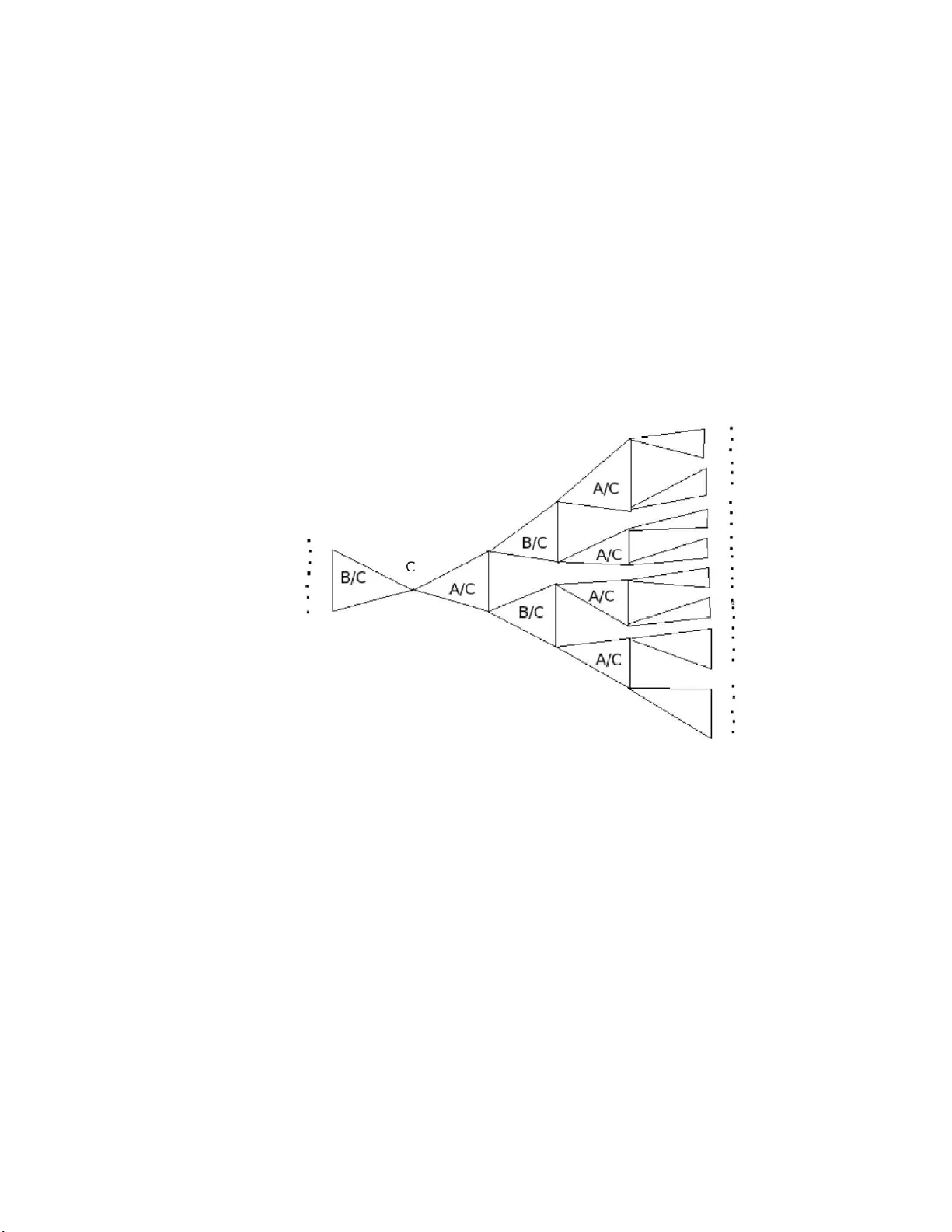
ON ASYMPTOTIC DIMENSION OF AMA LGAMA TED PR ODUCTS AND RIGHT-ANGLED CO XETER GR OUPS A. Dranishniko v A b st r act . W e pro ve the inequality asdim A ∗ C B ≤ max { asdim A, asdim B , asdim C + 1 } Then we apply this ineq uality to show that the asymptotic dimension of any right- angled Co xeter group does not exceed the dim ension of its Da vis’ complex. § 0 Intr oduction Asymptotic dimension was in tro duced b y Gromov as an inv ari an t of finitely generated groups [Gr]. It is defined for metri c spaces and applied to finitely generated groups wit h the word metric. Since by the definition it is quasi-isometry inv a rian t, it do es not dep end on the c hoice of a finit e generating set. It turns out that t he a symptotic dimension is a coarse in v arian t in sense of Ro e [ Ro] . Since all prop er left in v arian t metrics on any coun table group are coarsely equiv alen t ( [DSm], [Sh]), the notion of asymptotic dimension can b e extended to al l cou n table groups . The i n terest to t he asy mpt o tic dimension was sparked by Gouli a ng Y u’s proo f of the No viko v Higher Signature conjecture for manifol ds whose fundamen tal group has finite asymptotic di mension [Y u1]. Similar prog r ess on re lated conje ctures w as done under assumption of finite asymptotic dimension in the w orks [Ba],[CG], [ Dr1],[DFW]. Finite asymptotic dimensionality is pro v en for man y classes of groups. The e xact computation of a symptotic dimension of gro ups is a more difficult task. T o t he b est of m y knowledge it is completed only for p o lycyclic g roups a nd for h yp erb ol ic gro ups. 1991 M athematics Subje ct Cla s s ific ation . Primary 20F69 . Key wor ds and phr ases. asymptotic dimension, amalgamated pro duct, Coxeter group. The author was partially supported by NSF grants DMS-060449 4 T yp eset b y A M S -T E X 1 2 A. DRANISHNI KO V F or p olycyclic groups the asymptotic dimension equals the H irsc h length: asdim Γ = h (Γ) ( see [BD3] for the inequalit y i n one direction and [DSm] for the other direction). The asymptotic dimension of a finit ely generated hyperb ol i c group equals the cov ering dimension of its bo undary plus one: asdim Γ = di m ∂ ∞ Γ + 1 [B],[BL]. In view of Bestv ina- Mess’ form ula [ BM] we hav e asdim Γ = v cd (Γ) for t hose h yp erb ol ic groups for which the virtual cohomol ogical dimension is defined (e.g. f or residually finite h yp erb oli c groups). The Co xeter groups are considered as a pla yground for man y problems and conjec - tures in Geometric Grou p The ory . All Coxeter gr o ups ha v e finite asymptotic di men- sion since they isometr i cally em b eddable in the finite pro duct of trees [DJ] . The orig- inal s uc h em b edding is due to Jan uszkiewi cz and it gi v es an estimate asdim Γ ≤ | S | for a Coxeter system (Γ , S ). In [DSc] w e noticed that Jan uszkiewicz tec hnique can be pushed t o bring a b etter estimate to asdim Γ ≤ ch ( N (Γ)) where N (Γ) is the nerv e of (Γ , S ) and ch ( N (Γ)) i s t he c hromatic nu mber of the 1-sk eleton of N ( Γ). A low b ound for the a sy mptotic dimension of Coxeter groups is g iv en by C o rollary 4.11 in [Dr2]: v cd Γ ≤ asdim Γ. Since dim N + 1 ≤ ch ( N ) for every simplicial complex N and v cd (Γ) ≤ dim Σ(Γ) = dim N (Γ) + 1 , i t is nat ural to assume that asdim Γ ≤ dim N (Γ) + 1 where Σ(Γ) denotes the Da vis complex of (Γ , S ). In this pap er we prov e this inequalit y for righ t-angled Co xeter groups. Generally , the estimate asdim Γ ≤ dim N (Γ) + 1 is not optimal. P erhaps t he most natural guess w ould b e that asdim Γ = v cd Γ but i n v iew of Bestvi na’s candidate among r i gh t-angled Coxeter groups for a coun t erexample to the Eilen b erg-Ganea problem [D] this conjecture seems to b e v ery difficult. The prop osed equality has to be c hec k ed first for Γ wi th 2-dimensional acyclic nerves N (Γ). In thi s pap er the estimate asdim Γ ≤ dim N (Γ) + 1 is prov en by induc tion on dimension of the nerve. The main ingredien t here is the inequal it y for the asympt o tic dimension of the amalgamated pro duct ( ∗ ) asdim A ∗ C B ≤ max { asdim A , asdim B , asdim C + 1 } whic h is pro ven in this pap er. This inequality w as conjectured in [BD2] as t he equality . It was pro v en when C i s a finite g roup in [BD3]. Later J-P . Caprice found an ex ample a mong Coxeter groups where the inequalit y is strict. As a corollary o f (*) this pap er giv es a new proof of the free pro duct equal it y asdim A ∗ B = max { asdim A, asdim B , 1 } . The existed pro of i n [B DK] i s quite long and it app eals to the asymptoti c inductive dimension t heory developed in [ DZ ] . ON ASYMP TOTIC DIMENSION O F AMALGAMA TED PR ODUCTS AND RIG HT-ANGLED CO XETER GROUPS 3 § 1 As ymptotic dimension W e recall the definition of asymptoti c dimension of a metric space [Gr]: asdim X ≤ n if for every r < ∞ the r e exist unif ormly b ounde d, r -disj oint f amilies U 0 , . . . , U n of subsets of X such that ∪ i U i is a c ove r of X . Let r ∈ R + b e given and let X b e a metri c space. W e will say that a famil y U of subsets of X is r - disjo i nt if d ( U , U ′ ) ≥ r for ev ery U 6 = U ′ in U . Here, d ( U, U ′ ) = inf { d ( x, x ′ ) | x ∈ U, x ′ ∈ U ′ } . F or a cov er U of a metri c space X we denote b y L ( U ) = inf U ∈ U sup x ∈ X d ( x, X \ U ) the Leb esgue n um b er of U . W e recall that the order ord U o f a cov er U i s the ma x imal n um b er of elemen ts with the nonempt y in tersection. W e say that ( r, d )-dim X ≤ n if for ev ery r > 0 there exists a d -b ounded cov er U of X with ord U ≤ n + 1 and with the Leb esgue n um b er L ( U ) > r . W e refer to suc h a cov er as to an ( r, d ) -co v er of X . Prop osition 1.1. [BD2] F or a metric sp ac e asdim X ≤ n if and onl y if ther e is a function d ( r ) such that ( r , d ( r )) - dim X ≤ n for al l r > 0 . Let B R ( x ) denote the closed R -ball cen t ered at x and l et N R ( A ) = { x ∈ X | d ( x, A ) ≤ R } denotes the closed R -neigh b orho o d of A . Th us, B R ( x ) = N R ( { x } ). Prop osition 1.2. Supp ose that X ⊂ Y is given the r es tri ction metric and let U b e an ( r , d ) -c over of X . Then N r/ 4 ( X ) admits an ( r / 4 , d + r ) - c over ˜ U with ord ˜ U ≤ ord U . Pr o of. F or ev ery U ∈ U we define ¯ U = [ { I ntB r/ 2 ( x ) | d ( x, X \ U ) ≥ r } . Clearly , N r/ 2 ( X ) ⊂ ∪ U ∈ U ¯ U . W e sho w that ord { ¯ U | U ∈ U } ≤ ord U . Let y ∈ ¯ U 1 ∩· · ·∩ ¯ U k . Let x i ∈ U i b e suc h that d ( x i , y ) < r/ 2 and d ( x i , X \ U i ) ≥ r . Since d ( x i , x 1 ) < r and d ( x i , X \ U i ) ≥ r , it follows that x 1 ∈ U i for all i . Thu s, U 1 ∩ · · · ∩ U k 6 = ∅ . Let ˜ U = ¯ U ∩ N r/ 4 ( X ). Then ˜ U = { ˜ U } is an ( r / 4 , d + r )-co ver ˜ U with ord ˜ U ≤ ord U . Let K b e a coun table simplicial complex . There is a metric on | K | called uniform whic h comes from the geometri c realization of K . It i s defin ed b y embedding of K in to the Hilb ert space ℓ 2 = ℓ 2 ( K (0) ) b y mapping eac h vertex v ∈ K (0) to a corresp onding elemen t of an orthonormal basis for ℓ 2 and giv ing K t he metric it inherits as a subspace. A map ϕ : X → Y b et w een metr i c spaces is uniformly c ob ounde d if for every R > 0, diam( ϕ − 1 ( B R ( y ))) is uniformly b ounded. W e cal l a map ϕ : X → | K | to a simplicial complex c - c ob ounde d , c ∈ R + , i f diam( ϕ − 1 (∆)) < c for all simplices ∆ ⊂ K . The following w as pro v en b y Gromov [Gr] (see also [BD2], [Ro]) . 4 A. DRANISHNI KO V Theorem 1.1. L et X b e a metric sp ac e. The f ol lowing c onditions ar e e quivalent. (1) asdim X ≤ n ; (2) for e v e ry ǫ > 0 ther e is a uniformly c ob ounde d, ǫ -Lipschitz map ϕ : X → K to a uniform simplicial c omplex of dimension n. This theorem is pro ved b y using pro jections to the nerv es of op en cov ers. The pro jec- tion p U : X → N er v e ( U ) ⊂ ℓ 2 ( U ) defined b y the formula p U ( x ) = ( φ U ) U ∈ U , φ U ( x ) d ( x, X \ U ) P V ∈U d ( x, X \ V ) is call ed c anonic al . A map f : X → Y betw een metric spaces is a c o ars e emb e dding if there exist non- decreasing functions ρ 1 and ρ 2 , ρ i : R + → R + suc h that ρ i → ∞ and for ev ery x, x ′ ∈ X ρ 1 ( d X ( x, x ′ )) ≤ d Y ( f ( x ) , f ( x ′ )) ≤ ρ 2 ( d X ( x, x ′ )). Suc h a map is often called a c o a r s ely uniform emb e dding or just a uniform emb e dding . The metric spaces X and Y are c o arsely e quiv alent if t here i s a coa r se embedding f : X → Y so that there is some R suc h that Y ⊂ N R ( f ( X ) ). Observ e that quasi-isometric spaces a re coarsely equiv alent with l inear ρ i . Prop osition 1.3. L et f : X → Y b e a c o arse e quivalenc e. Then asdim X = asdim Y . As a coroll ary we obtain that asdim Γ is an in v ari an t for finitely generated groups. One can extend this definition of a sdim for all coun table groups b y considering left-inv ari a n t prop er metrics on Γ. All suc h metri cs are coarsely eq uiv alent [DSm], [Sh]. Theorem 1.2. [DSm] L et G b e a c ountable g r oup. Then asdim G = sup asdim F wher e the supr e mum is take n over al l finitely gener ate d s ub gr oups F ⊂ G . F or a subset Y ⊂ X of metric space X when we write asdim Y w e assume that Y is take n with the metric obtai ned by restriction. Also we use i n this pap er the following t w o theorems from [BD1]: Finite Union The orem. F or every metric s p ac e pr esente d as a finite union X = ∪ X i ther e is the formula asdim( ∪ X i ) = max { asdim X i } . ON ASYMP TOTIC DIMENSION O F AMALGAMA TED PR ODUCTS AND RIG HT-ANGLED CO XETER GROUPS 5 Infinite Un ion The orem. L et X = ∪ α X α b e a metric sp ac e wher e the family { X α } satisfies the ine quality a sdim X α ≤ n uniformly. Supp ose further that for every r ther e is a Y r ⊂ X with asdim Y r ≤ n so that d ( X α \ Y r , X α ′ \ Y r ) ≥ r whenever X α 6 = X α ′ . Then asdim X ≤ n . W e recall that the family { X α } of subsets of X sati sfies the inequali t y asdim X α ≤ n uniformly if for eve ry r < ∞ one can find a constant R so that for ev ery α there exist r -disjoin t families U 0 α , . . . , U n α of R -b ounded subsets of X α co v ering X α . The following Prop ositi ons are tak en from [BD2] (Prop osition 2 and Lemma 1). Prop osition 1.4. F or every simplici al map g : X → Y the mappi ng cylinder M g admits a triangulation with the s et of vertic es e qual to the disjoint union of vertic es of X and Y . W e consider the uniform metric on M g . F or a co v er U of a metric space X we denote b y b ( U ) = sup U ∈ U diam ( U ) the diameter of U . W e not e that if for tw o co vers b ( V ) < L ( U ) then there is a map G : V → U with the prop erty G ( V ) ⊂ U . Note that any suc h map G : V → U defines a simplicial m a p g : N er v e ( V ) → N er v e ( U ) of t he nerv es. W e use the notations ∂ N r ( A ) = { x | d ( x, A ) = r } for the b o undary of the r - neigh b orho o d and r -In t( A ) = A \ N r ( X \ A ) for the r -interi o r of A . Lemma 1.1. [BD2] F or every n ∈ N ther e is a monotone tending to infini ty function µ : R + → R + with the f ol lowin g pr op erty: Gi ven ǫ > 0 , let W ⊂ X b e a subset of a ge o desic metric sp ac e X and let λ ≥ 1 /ǫ . Then for every two c o v ers V of N λ ( ∂ W ) and U of W by op en subse ts of X wi th the or der ≤ n + 1 , and with L ( U ) > b ( V ) > L ( V ) ≥ µ ( λ ) , ther e is a 2 b ( U ) -c ob ounde d ǫ -Lips chitz map f : W → M g to the mapping cylinder of a simplicial map g : N er v e ( V ) → N er v e ( U ) b etwe en the nerves such that f | ∂ W = p V | ∂ W wher e p V : N λ ( ∂ W ) → N er v e ( V ) ⊂ M g is the c anonic al pr oje ction. W e note that the formulation of Lemma 1 . 1 differs sligh tly from Lemma 1 in [BD2 ]. Namely , Lemma 1.1 b ecomes Lemma 1 if one consider the case W = N r ( ∂ W ). N ever- theless the same formula for f a nd the same pro of as i n [BD2] are v al id for the general case. A p artition of a metric space X is a presen tation as a union X = ∪ i W i suc h that In t( W i ) ∩ In t( W j ) = ∅ wheneve r i 6 = j . P artition Theorem. L et X b e a g e o desic metric sp ac e. Supp ose that for every R > 0 ther e is d > 0 and a p artition X = ∪ ∞ i W i with asdim W i ≤ n uni f ormly on i such that ( R, d ) - dim( ∪ i ∂ W i ) ≤ n − 1 wher e ∪ i ∂ W i is taken with a metric r estri cte d fr om X . Then asdim X ≤ n . 6 A. DRANISHNI KO V Pr o of. W e apply Theorem 1.1. Given ǫ > 0 w e construct a uniformly cob ounded ǫ - Lipsc hitz map φ : X → K . W e apply the assumption with R = 4 µ (1 /ǫ ) where µ is take n from Lemma 1. 1 . Let λ = 1 /ǫ . Since λ ≤ R/ 4 a nd µ ( t ) ≥ t , b y Prop ositi on 1. 2 there is an ( r / 4 , 2 d )-co ver V o f N λ ( ∪ i ∂ W i ) of order ≤ n . W e ma y assume that it is a co v er b y op en i n X sets. Let V i = V | ∂ W i b e the restriction, i.e., V i consists o f those elemen ts of V t hat ha v e a nonempt y in tersection with ∂ W i . Let U i b e a co ver of W i with L ( U i ) > 2 d ≥ b ( V i ) and with b ( U i ) < D for all i for some fixed D . By Lemma 1.1 there is a 2 D -cob ounded ǫ -Lipsc hitz ma p f i : W i → M g i to a uniform complex where M g i is the mapping cy linder of a simplicia l map g i : N er v e ( V i ) → N er v e ( U i ) and f i coincides on ∂ W i with t he canonical pro jection to the nerv e p V : ∪ i ∂ W i → N er v e ( V ). W e define K = ( N er v e ( V ) a a i M g i ) / ∼ as t he quoti en t space under iden tification along t he complexes N er v e ( V i ). Then the union of f i defines a map f : X → K . Clearly , f is 2 D -cob ounded. Since X is geo desic and eac h f i is ǫ -Lipsc hitz, f is ǫ -Lipsc hitz with respect to the uniform metric on K . § 2 As ymptotic dimension of amalgam a ted p ro duct Let A and B b e finitely generated groups and let C b e a common subgroup. W e fix finite generating symmet r i c sets S A and S B . Let d denote the word metric on A ∗ C B corresp onding to the generati ng set S A ∪ S B . The group G = A ∗ C B acts on the Bass- Serre tree whose v ertices are the left cosets G/ A ` G/B and the v ertices xA and xB , x ∈ G , and only them are joined b y edges. The edges [ xA, xB ] are lab eled b y the cosets xC . W e consider the a ction of G on the dual graph K . Th us vertices of K are the left cosets xC . T wo ve rtices xC and x ′ C are joined by an edge i f an only if the edges in the Bass-Serre tree with these label s hav e a common v ertex. Not e t hat K is a t ree-graded space i n the sense of Drutu-Sap ir [ DS] with pieces ∆( A ) and ∆( B ), the 1 -sk eletons of the simplices spanned b y A/C or B /C . Thu s, K is partitioned into these pieces in a w ay that ev ery tw o pieces ha ve at most one common v ertex and the nerv e of the partition is a tr ee. The graph K has an additi o nal prop ert y that al l ve rtices are the i n tersection p oin ts of exactl y t w o pieces of the different types ∆( A ) a nd ∆( B ). W e consider t he simplicial metri c on K , i.e., every edge has length one and we use the notat ion | u, v | for the distance b etw een ve rtices u, v ∈ K (0) . F or u ∈ K (0) b y | u | we denote the di sta nce to the the v ertex with lab el C . No t e K has the unique geo desic prop erty for every pai r of v ertices. There is a natural pro jection π : G → K defined by the action: π ( g ) = g C . Assertion 2.1. The map π : G → K extends to a simplicial map of the Cayley gr a p h of G , π : C ( G ) → K . ON ASYMP TOTIC DIMENSION O F AMALGAMA TED PR ODUCTS AND RIG HT-ANGLED CO XETER GROUPS 7 Pr o of. Let g ∈ G a nd s ∈ S A ∪ S B . If s ∈ C , then π ( g ) = π ( g s ) and the edge [ g , g s ] ⊂ C ( G ) i s mapp ed to the v ertex g C = g sC . With out loss of generality w e may assume that s ∈ A \ C . W e need to sho w that π ( g ) = g C and π ( g s ) = g sC are joined b y an edge in K . N ote that g A is the common vertex for t he edges [ g B , g A ] and [ g A , g s B ] in the Bass-Serre tree. Hence the vertices corresp onding these edges are joined by an edge i n K . Thus , the vertices g C and g sC are joined b y an edge in K . As a corollary we obtain that π is 1-Lipsc hitz. The t ree-graded complex K The base v ertex C separates K in to tw o parts K A \ { C } and K B \ { C } . Let ¯ d denote the graph metric on K . W e denote b y B A r the r -ball, r ∈ N , i n K A cen tered at C . There is a part ial order on vertices of K defined as follo ws: v ≤ u if and o nl y if v lies i n the geo desic segmen t [ C , u ] joining the base ve rtex with u . F or u ∈ K (0) of nonzero lev el and r > 0 we denote by K u = { v ∈ K (0) | v ≥ u } , B u r = { v ∈ K u | | v | ≤ | u | + r } . F or every v ertex u ∈ K (0) represen ted b y a coset g C with | u | even w e hav e the equalit ies B u r = g B A r , K u = g K A and hence the equal ities π − 1 ( B u r ) = g π − 1 ( B A r ) and π − 1 ( K u ) = g π − 1 ( K A ). 8 A. DRANISHNI KO V W e sa y that a set F ⊂ G se p ar a te s tw o subsets H 1 and H 2 in G if it separates t hem in the Cayley g r a ph C ( G ), that is eve ry pat h in C ( G ) with t he endp oin ts in H 1 and H 2 meets F . Let D R = { x ∈ G | d ( x, C ) = R } b e the b oundary of the R -neighborho o d of C in π − 1 ( K A ), R ∈ N . F or u ∈ K (0) w e denote D u R = g u ( D R ), g u ∈ G , where the coset g u C represen ts u . Note that π ( D u R ) ⊂ B u R . Prop osition 2.1. F or every v ertex u ∈ K with even | u | and f or every v ∈ K (0) inc om- p ar able with u or sa ti sfying v < u , the set D u R sep ar ates π − 1 ( v ) and π − 1 ( u ′ ) in A ∗ C B whenever u < u ′ and | u ′ | − | u | > R . Pr o of. Since G acts b y isometri es, it suffices to sho w that D R separates π − 1 ( K B ) and π − 1 ( u ′ ) with | u ′ | > R and u ′ ∈ K A . In view of the fact that π is 1-Lipsc hitz, d ( C, π − 1 ( u ′ )) > R . H ence D R separates C a nd π − 1 ( u ′ ). B y Assertion 2.1 the image of a path i n C ( G ) is a path in K . Since every path in K from K A to K B hits the vertex C , i t follo ws t hat ev ery path i n the Ca yley graph from π − 1 ( K A \ C ) to π − 1 ( K B \ C ) hits the set C = π − 1 ( { C } ). Hence every path from π − 1 ( u ′ ) t o π − 1 ( K B ) hit s D R . Prop osition 2.2. If R ≤ r / 4 , then d ( g D R , g ′ D R ) ≥ 2 R for g , g ′ ∈ G with | g C | , | g ′ C | ∈ nr , n ∈ N , and g C 6 = g ′ C . Pr o of. W e use notations u = g C and u ′ = g ′ C for t he v ertices in K . First consider the case when | u | 6 = | u ′ | . Since π ( g D R ) ⊂ B u R , ¯ d ( B u R , B u ′ R ) ≥ r − R ≥ 3 R , a nd π i s 1-Lipsc hitz, w e obta in that d ( g D R , g ′ D R ) ≥ 3 R . Let | u | = | u ′ | and let x ∈ g D R and y ∈ g ′ D R . Si nce ev ery path i n K b et we en π ( x ) and π ( y ) goes t hrough the vertices u and u ′ and a path in t he Ca yley graph C ( G ) is pro jected t o a path i n K (see A ssertion 2.1), a g eo desic from x to y in C ( G ) passes through g C and g ′ C . Since d ( x, g C ) = R and d ( y , g ′ C ) = R we obtai n the inequality d ( x, y ) ≥ 2 R . W e fix t wo set-theoretic sections s A : A/C → A and s B : B /C → B of π A and π B and denote by X = im ( s A ) \ C and Y = im ( s B ) \ C . These sections give ri se the normal presen tation of elemen ts in A ∗ C B . Namely , eve ry elemen t γ ∈ A ∗ C B can b e presen ted uniquely in the following form γ = z 1 . . . z k c where c ∈ C , z i ∈ X ∪ Y , and z i are alternating i n a sense that if z i ∈ X then z i +1 ∈ Y a nd if z i ∈ Y t hen z i +1 ∈ X . Denote b y l ( z 1 . . . z k c ) = k the length of the normal presen tati on. Clearly , l ( γ ) = | γ C | where γ C is treated as a v ertex of K . If X ′ and Y ′ is a different choice o f represen tatives and γ = z 1 . . . z k c and γ = z ′ 1 . . . z ′ k c ′ are corresponding normal presen tations, then z ′ 1 = z 1 c 1 , z ′ 2 = c − 1 1 z 2 c 2 , . . . , z ′ i = c − 1 i − 1 z i c i , . . . , z ′ k − 1 = c − 1 k − 2 z k − 1 c k − 1 , and z ′ k c ′ = c − 1 k − 1 z k c where c i ∈ C , i = 1 , . . . , k . ON ASYMP TOTIC DIMENSION O F AMALGAMA TED PR ODUCTS AND RIG HT-ANGLED CO XETER GROUPS 9 Assertion 2.2. L et γ ∈ A ∗ C B . Then k γ k ≥ d ( β k c, C ) for the normal pr esentation γ = β 1 . . . β k c for any choic e of r epr esentatives X and Y . Pr o of. Let γ = t 1 . . . t n , n = k γ k , b e the shortest presen tation. Then the w ord t 1 . . . t n can b e partitioned in to a normal presen tation (for some ch oice of X and Y ) γ = α 1 . . . α k , α i ∈ A (or α i ∈ B ), with k = l ( γ ). Then k γ k ≥ k α k k = d ( α k , 1) ≥ d ( α k , C ) . If X ′ and Y ′ is a differen t c hoice of represen t a tive s and γ = β 1 . . . β k c are corresp onding normal presen tations, then β 1 = α 1 c 1 , β 2 = c − 1 1 α 2 c 2 , . . . , β i = c − 1 i − 1 α i c i , . . . , β k − 1 = c − 1 k − 2 α k − 1 c k − 1 , and β k c ′ = c − 1 k − 1 α k where c i ∈ C , i = 1 , . . . , k . Th us, β k c ′ = cα k . This implies that k γ k ≥ d ( β k c, C ) . Lemma 2.1. L et asdim A, asdim B ≤ n . Then asdim( AB ) m ≤ n for al l m wher e ( AB ) m = AB . . . AB ⊂ A ∗ C B . Pr o of. W e pro v e that asdim AB . . . A ( B ) ≤ n b y induction on the length of the pro duct k . The inequality i s a true statemen t for k = 1. Assume that it holds for k . F or the sake of concreteness assume t hat k is o dd. Th us, asdim F 1 . . . F k ≤ n where F 2 i − 1 = A and F 2 i = B . W e sho w that asdim F 1 . . . F k B ≤ n . Consider t he family { w B | l ( w ) = k } . Since al l sets w B are isometric to B , asdim w B ≤ k uniformly . Giv en r we define Y r = AB . . . AC B r where B r is the r -ball i n B . W e sho w that d ( w B \ Y r , w ′ B \ Y r ) ≥ r . Let b, b ′ ∈ B \ C B r . Then d ( b, C ) ≥ r and d ( b ′ , C ) ≥ r . Since w − 1 w ′ / ∈ B , the normal presen tation of b − 1 w − 1 w ′ b ′ ends with c ′ b ′ for c ′ ∈ C . Then by Assertion 2.2, k b − 1 w − 1 w ′ b ′ k ≥ d ( c ′ b ′ , C ) ≥ r . Then by t he Infinite U ni o n Theorem we obtain that asdim( F 1 . . . F k ∩ L k ) B ≤ n where L k is the set of al l elements w ∈ A ∗ C B with l ( w ) = k , F i = A ( B ) are alternating, and F 0 = A . Let L 0 b e g iv en. T ake r > 4 R . In v i ew of Prop ositio n 2.1 G = X + ∪ X − with X + ∩ X − = D R suc h t hat X + ⊂ π − 1 ( K A ), π − 1 ( K B ) ⊂ X − and D R separates X + \ D R and X − \ D R . F or ev ery v ertex u ∈ K A w e fix an elemen t g u ∈ G such that t he coset g u C represen t s u . W e denote b y X u ± = g u ( X ± ) and define V r = X + ∩ ( T | u | = r X u − ). N o te that π ( V r ) ⊂ B r + R . Let V u r denote g u ( V r ). Consider the parti tion π − 1 ( K A ) = [ | u | = nr,n ∈ N + V u r ∪ N A R ( C ) where N A R ( C ) = N R ( C ) ∩ π − 1 ( K A ). Clearly , if V u r ∩ V w r 6 = ∅ , then eit her u < w and | w | = | u | + r or w < u and | u | = | w | + r . If V u r ∩ V w r 6 = ∅ and u < w then V u r ∩ V w r = D w R where D w R = g w D R . Th us Z = [ | u | = nr,n ∈ N + ∂ V u r = [ | u | = nr,n ∈ N + D u R . W e show that ( R , d )-asdim Z ≤ n − 1 for some d > 0. Since D R is coa rsely equiv alent to C , w e hav e asdim D R ≤ n − 1 . Hence there is d > 0 and a n ( R , d )-co ver U of D R with ord U ≤ n . In view of Prop osition 2.2, ˜ U = ∪ | u | = nr,n ∈ N + g u ( U ) is an ( R, d ) -cov er of Z . Since π − 1 ( B s ) ⊂ ( AB ) s +1 , b y Lemma 2.1 we hav e asdim π − 1 ( B s ) ≤ n . Hence asdim π − 1 ( B r + R ) ≤ n and therefore, asdim V u r ≤ n uniformly . Note that asdim N A R ( C ) ≤ n (i n fact, it i s ≤ n − 1). By the P artition Theorem, asdim π − 1 ( K A ) ≤ n § 3 As ymptotic dimension of right-angle d Coxeter groups A symmetr i c matrix M = ( m ss ′ ) s,s ′ ∈ S is called a Co xeter matrix if m ss ′ ∈ N ∪ {∞} , and m ss = 1 for a ll s ∈ S . A group Γ with a generati ng set S is called a Co xeter group if there is a Co xeter matrix M = ( m ss ′ ) s,s ′ ∈ S suc h that Γ admits a presen tation h S | ( ss ′ ) m ss ′ , s, s ′ ∈ S i . A Coxeter group Γ is called even if all finite non-diagonal en tries of M are even. It is called ri ght-angle d if al l finite non-diagonal entries equal 2. Ev ery subset W ⊂ S defines a subgroup Γ W ⊂ Γ whic h will b e call ed p a r ab olic . Let (Γ , S ) b e a Co xeter group with a g enerating set S and wit h a presen tati o n giv en b y means ON ASYMP TOTIC DIMENSION O F AMALGAMA TED PR ODUCTS AND RIG HT-ANGLED CO XETER GROUPS 1 1 of a Co xeter S × S matri x M . The nerve N ( Γ) is a simplicial complex with the set of v ertices S where a subset W ⊂ S spans a simplex if and only i f the group Γ W is finite. Th us, s, s ′ ∈ S , s 6 = s ′ , form an edge if and only if m ss ′ 6 = ∞ . W e cal l the n um ber m ss ′ a lab el o f the edge [ s s ′ ]. By N ′ w e denote t he barycen tric subdivi si o n of N . The cone C = C oneN ′ o v er N ′ is call ed a chamb er for Γ. The Davi s c o mplex Σ = Σ(Γ , S ) is the image of a simplicial map q : Γ × C → Σ defined b y the following equiv alence rela t ion on the vertices: a × v σ ∼ b × v σ pro vided a − 1 b ∈ Γ σ where σ is a simplex in N a nd v σ is the barycen ter of σ . W e i den tify C with the i ma ge q ( e × C ). The group Γ acts prop erly and simpli cially on Σ with the orbit space equiv alen t t o the c ham b er. Th us, the Davis complex is obtai ned b y gluing the cham b ers γ C , γ ∈ Γ along their b oundaries. The main feature of Σ is that it is con tractible ( see [D] ). Theorem 3.1. F or every right-angle d Coxeter gr oup asdim Γ ≤ dim N (Γ) + 1 . Pr o of. W e prov e t his inequality b y induction on the dimension of the nerv e N = N (Γ). If dim N = 0, then Γ i s virtuall y free group ( p ossibly of zero rank) and hence asdim Γ ≤ 1 = dim N + 1. Let dim N = n and let N b e finite. W e prov e the inequality a sdim Γ ≤ n + 1 b y induction on the num ber of vertices in N . If this nu m b er i s minimal, i. e., n + 1 , the inequality hol ds since the group Γ in t his case is finite. W e assume that there is a vertex v ∈ N such that the star st ( v , N ) do es not con tain all other vertices of N . If there is no suc h v , t hen the 1-dimensional skeleton N (1) coincides wi t h the 1-ske leton of a simplex ∆. Since the gro up i s right-angled, N = ∆, and the group i s finite, so this case has b een already considered . W e take K to b e t he l ink L k ( v , N ) of suc h ve rtex v and take N 1 to b e the star st ( v , N ) of this vertex. W e define N 2 = N \ O st ( v , N ) where O s t ( v , N ) is the op en star of v . Then Γ = Γ N 1 ∗ Γ K Γ N 2 . By induction assumption asdim Γ K ≤ n . By the internal induction asdim Γ N i ≤ n +1, i = 1 , 2. Then Theorem 2.1 implies that asdim Γ ≤ n +1. Corollary 3.1. F or every right-angle d Coxeter gr oup asdim Γ ≤ dim Σ(Γ) wher e Σ(Γ) is the Davis c omplex. In view of recen t result of Dyma ra and Sc hick [DySc] w e obtain Corollary 3.2. F or a right- a ng le d building X , asdim X ≤ dim X . REMARK. In order to extend Theorem 3.1 to a l l Co xeter groups one needs to sho w the inequality asdim Γ ≤ dim N + 1 in t he case when N (1) is t he 1-skeleton of a simplex. Reference s [Ba] A. Bartels, Sque ezing and higher algebr aic K-the ory , K-theory 28 (2003), 19-37. 12 A. DRANISHNI KO V [BD1] G. Bell and A. Dranishniko v, On asymp totic dimension of gr oups , Algebr. Geom. T op ol. 1 (2001), 57-71 . [BD2] G. Bel l and A. Dranishnikov, On asymp totic dimension of gr oups acting on tr e es , Geom. Dedicata 103 (2004), 89-101. [BD3] G. Bel l and A. Dranishniko v, A Hur ewicz-typ e the or em for asymptotic dimension and a p plic a- tions to ge ometric gr oup the ory. , T rans AMS 358 No 11 (2006), 4749-4764. [BDK] G. Be ll, A. Dranishniko v, and J. K eesling, On a formula for the a symptotic dimension of fr e e pr o ducts , F und. Math. 183 No 1 (2004), 39-45. [BM] M. Bestvina and A. G. Me ss, The b oundary o f ne gatively curve d gr oups , Journal of AMS 4 No 3 (1991 ), 469-481. [Bu] S. Buyalo, Asymptotic dimension of a hyp erb olic sp ac e and c ap acity d imension of its b oundary at infinity , St. Petersburg Math. J. 17 No 2 (2006), 70-9 5 (Pre print math.GT/05054 27). [BL] S. Buyalo and N. Leb edev a, D imensions of loc al ly and asy mptotic a l ly self-similar spac es , preprint math.GT/0509433 (2005). [CG] G. Carlsso n and B. Goldfarb, The inte gr al K- the o r etic Novikov c onje ctur e for gr oups with finite asymptotic dimension , In ven tiones Math. 157 No 2 (2004), 405–418. [D] M. Da vis, The ge ometry and top olo gy of Coxeter gr oups , preprint (2006). [Dr1] A. Dranishniko v, O n hy p ersphericity of manifolds with finite asymptotic dimension , T rans. Amer. Math. So c. 355 no 1 (2003 ), 155-167. [Dr2] A. Dranishniko v, Coho m o lo gic al ap pr o ach to asymptotic dimension , preprin t (2006 ). [DFW] A. Dranishniko v, S. F erry , S. W einberger, A n etale appr o ach to the Novikov c onje ctur e , P reprint of MPI f¨ ur Mathematik (2005). [DJ] A. Dranishniko v, T. Janus zki ewicz, Every Coxeter gr oup acts amenably on a c omp act sp ac e , T op ology Pro c. 24 (1999), 135-141. [DSc] A. Dranishniko v and V. Schroeder, Emb e dding of Coxete r gr oups in a pr o ducts of tr e es , preprint math.GR/040239 8 (2004). [DSm] A. Dranishniko v J. Smith, Asymptotic dimension o f discr ete gr oups , F undamenta Mathem aticae 189 (2006), 27-34. [DZ] A. Dranishniko v and M. Zarichn yi, Universal spac es for asymp totic dimension , T op ology Appl. 140, no. 2-3 (2004 ), 203–225. [DS] C. Drutu and M. Sapir, T r e e-gr ade d sp ac es and asymp totic c ones of gr oups , T op ology 44 (2005), 959-105 8. [DySc] J. Dymara and T. Schic k, Buildings have finite asymp totic dimension , Preprint ArXiv: math.MG/070399v1. [Gr1] M. Gromov, Asymptotic invariants of infinite gr oups , Geometric Group The ory , vol 2, Cambridge Universit y P ress, 1993. [Ro] J. Roe, L e ctur es on c o arse ge ometry , Univ ersity Lecture series, V olume 31 (2003), AMS. [Sh] Y. Shalom, Harmonic analysis, c ohomology, a nd the lar ge-sc ale ge ometry of amenable gr oups , Acta Math. 192 No 2 (2004), 119-1 85. [Y u] G. Y u, The Novikov c onje ctur e for gr oups with finite asy mptotic dimension , Ann. of Math 147 (1998), no. 2, 325-355. U ni ve r si t y o f F l o r id a, D e p artme n t o f M a th em a t ic s, P .O . B o x 1 1 8 1 05 , 35 8 Li tt l e H a l l , G a in es vi l l e, F L 32 6 1 1 -8 1 0 5, U S A E-mail ad dr ess : dranish@mat h.ufl.edu
Original Paper
Loading high-quality paper...
Comments & Academic Discussion
Loading comments...
Leave a Comment