Operated semigroups, Motzkin paths and rooted trees
Combinatorial objects such as rooted trees that carry a recursive structure have found important applications recently in both mathematics and physics. We put such structures in an algebraic framework of operated semigroups. This framework provides t…
Authors: Li Guo
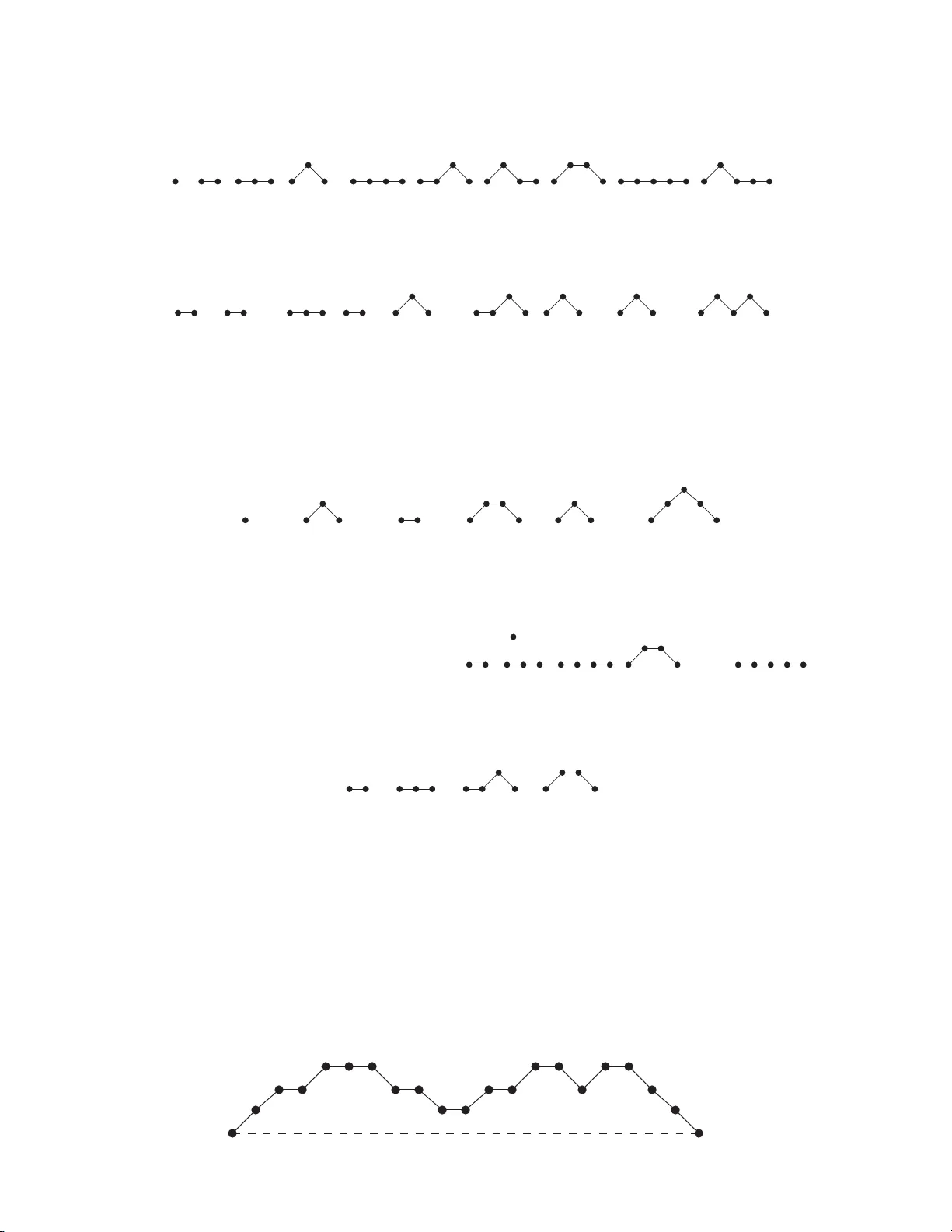
OPERA TED SEMIGR OUPS, MOTZKIN P A THS AND R OOTED TREES LI GUO Abstract. Com binatorial ob jects such as r o oted tre es that carry a recursive structure hav e found impo rtant applications recently in b oth mathematics and physics. W e put such structures in an algebraic framework of op era ted se migroups. This fr a mework provides the concept of op erated semigr oups with intuitiv e and conv enien t combinatorial descriptions, and at the same time endows the familiar c o mbin atoria l ob jects with a precise alg ebraic int erpretation. As an application, we obtain constructions o f free Rota-Ba xter algebra s in terms o f Motzkin paths a nd ro o ted trees. Contents 1. In tro duction 1 1.1. Motiv ation 1 1.2. Definitions and examples 2 1.3. Outline of the pap er 4 2. F ree op erated semigroups a nd monoids in terms of Motzkin pat hs 4 3. F ree op erated semigroups a nd monoids in terms of brack eted words 8 3.1. Motzkin w ords 8 3.2. Brac k eted words 10 4. F ree op erated semigroups in terms of planar ro o ted trees 12 5. Some natural bijections 14 5.1. Angularly decorated forests 15 5.2. The bijections 16 6. Constructions of free Rota-Baxter algebras 21 6.1. Review of the Rota-Baxter algebra structure on angularly decorated fo r ests 21 6.2. Rota-Baxter algebra structure on Motzkin paths 22 6.3. Rota-Baxter algebra structure on brack eted w ords 24 6.4. Rota-Baxter algebra structure on leaf decorated ro o t ed f o rests 25 References 26 Key w ords: op erated s emigroups, op erated algebras, free algebras, brac k eted w or ds, planar r o oted trees, Motzkin paths, D yc k pa ths, R o ta-Baxter algebras. 1. Intr oduction 1.1. Motiv ation. T his pap er explores the relationship b etw een t w o sub jects that ha ve b een studied separately un til rece n t ly . One sub ject conside rs algebraic structures, suc h as semigroups and asso ciative algebras, with an op erator acting o n them. Suc h structures include differen tial algebras, difference a lg ebras and Rota–Baxter algebras (See Example 1.3 1 2 LI GUO for the definitions). Another sub ject studies ob jects, often com binat o rial in na ture, t hat ha v e underlying recursiv e structures, suc h as ro o ted trees and Motzkin paths. Since the 1990s, a lgebraic structures on ro o ted trees hav e b een studied in the w o rk of Connes and Kreimer [10, 11] on the renormalization o f quan tum field theory , G rossman and Larson [24] on data s tructures and of Lo day and Ronco [36, 37] on operads. The grafting opera t o r on trees plays an imp or t a n t role in their w o rks. More recen tly [2, 17 ], free Rota –Baxter algebras w ere constructed using planar ro o t ed trees with sp ecial decorations. In this pap er, we relate these tw o sub jects through the concepts of op erated semigroups, op erated monoids and op erated algebras. W e establish that free op erat ed semigroups ha v e natural com binat orial in t erpretat io n in terms of Motzkin paths and planar ro oted forests. This freeness c haracterization o f ro oted forests and Motzkin pat hs giv es an alg ebraic ex- planation of the f undamen tal r o les pla y ed b y these combinatorial ob jects and their r elat ed n umerical sequences suc h as the Catalan n um b ers and Motzkin n umbers [46]. This char- acterization should b e useful in further algebraic studies of these com binatorial ob jects. This connection also endow s the concept of op erated algebras and semigroups with f amiliar com binato rial con ten ts, giving significance to these op era t ed alg ebraic structures beyond the a bstract generalization. As a cons equence, w e obtain sev eral constructions of free Rota-Baxter algebras whic h can b e adopted to free o b jects in the other r elated a lgebraic structures. 1.2. Definitions and example s. Definition 1.1. An operated semigroup (or a semigroup with an operator ) is a semigroup U to gether with an op erator α : U → U . α is called t he distinguished op erator on U . A mor phism from an op erat ed semigroup ( U, α ) to an op erated semigroup ( V , β ) is a semigroup homomorphism f : U → V suc h that f ◦ α = β ◦ f , that is, suc h that the follo wing diagram comm utes. U α / / f U f V β / / V More g enerally , let Ω b e a set. An Ω -operated semigroup is a semigroup U to gether with a set o f op erators α ω : U → U, ω ∈ Ω. In other words, an Ω-op erated semigroup is a pair ( U, α ) with a semigroup U and a map α : Ω → Map( U, U ) , α ( ω ) = α ω . He re Map( U, U ) is the set of maps from U to U . A morphism from an Ω-o p erated semigroup ( U, { α ω , ω ∈ Ω } ) to an Ω-op erated semigroup ( V , { β ω , ω ∈ Ω } ) is a semigroup homomo r phism f : U → V suc h that f ◦ α ω = β ω ◦ f for ω ∈ Ω . Remark 1.2. When a semigroup is replaced b y a monoid w e obtain the concept of a n (Ω-) op erated monoid . L et k b e a commutativ e ring. W e similarly define the concepts of an (Ω-) op erated k-algebra o r (Ω-) op erated non unitary k-algebra . Example 1.3. Here are some examples of op erat ed k - algebras with one op erator. (a) A semigroup is an o p erated semigroup when the distinguished op erator is tak en to b e the identit y; (b) A differen t ia l algebra [3 3, 45 ] is a n asso ciative a lgebra A with a linear operato r d : A → A such that d ( xy ) = d ( x ) y + xd ( y ) , ∀ x, y ∈ A ; OPERA TED SEMIGROUPS, MOTZKIN P A THS A ND ROOTED TREES 3 (c) A difference alg ebras [9, 44] is an asso ciativ e a lg ebra A with an algebra endomor- phism on A ; (d) Let λ b e fixed in the ground ring k . A R o ta-Baxter a lgebras [4, 7, 11, 1 6, 27, 39, 40] (of weigh t λ ) is defined to b e an asso ciative algebra A with a linear op erator P suc h that (1) P ( x ) P ( y ) = P ( xP ( y )) + P ( P ( x ) y ) + λP ( xy ) , ∀ x, y ∈ A ; (e) A differen tia l alg ebras of w eight λ [29] is defined to b e an algebra A together with a linear o p erator d : A → A suc h that d ( xy ) = d ( x ) y + xd ( y ) + λ d ( x ) d ( y ) , ∀ x, y ∈ A. Other examples of o p erated alg ebras can b e fo und in [40]. Here ar e some Ω-op erated alg ebras with multiple op erators. (a) A ∆ -differen tial algebras [33] is a n algebra with multiple differen tial op erators δ ∈ ∆ t hat commute with eac h other; (b) A σ δ -algebra [43] is an algebra with a comm uting pa ir of a difference op erator σ and a differential op erator δ ; (c) A differen tial Rota-Baxter algebra of w eigh t λ [29] is an algebra with a differ- en tial op erator d of w eigh t λ and a Rota-Baxter a lgebra P of w eigh t λ , such that d ◦ P = id . This la st relation is a natural g eneralization of the First F undamen tal Theorem of Calculus when d is tak en to b e the usual deriv a t ion and P is the integral op erator P [ f ]( x ) = R x a f ( t ) dt ; (d) As an v aria tion, w e can consider an a lgebra with a differential op erator and a Rota- Baxter op erat or of w eight − 1 [31] that commute with eac h other. It arises na t ur a lly in the study of multiple zeta v alues by renormalization metho ds; (e) A Rota-Baxter fa mily on an algebra R is a collection of linear op erators P ω on R with ω in a semigroup Ω, suc h that P α ( x ) P β ( y ) = P αβ ( P α ( x ) y ) + P αβ ( xP β ( y )) + λP αβ ( xy ) , ∀ x, y ∈ A, α, β ∈ Ω . It arises nat ur a lly in renormalization of quantum field theory [15 , Prop. 9.1]. Our main goal here is to give com binatorial constructions of free ob jects in the cat ego ry of Ω-op erated semigroups and Ω-op erated monoids. They naturally g iv e fr ee ob jects in the category of op erated algebras. These free o b jects are obtained as the adjoint functor of the forgetful functor fr o m the category of op erated semigroups and op erated monoids to the category of sets in the usual w ay . More precisely , Definition 1.4. A free op erated semigroup on a set X is an opera t ed sem igroup ( U X , α X ) together with a map j X : X → U X with t he prop ert y that, f or any op erated semi- group ( V , β ) and any map f : X → V , there is a unique morphism ¯ f : ( U X , α X ) → ( V , β ) of op erated semigroups suc h that f = ¯ f ◦ j X . In other words, the fo llo wing diagram comm utes. X j X / / f & & N N N N N N N N N N N N N N U X ¯ f V 4 LI GUO Let · b e the binary op eration on the semigroup U X , we also use the quadruple ( U X , · , α X , j X ) to denote the free o p erated semigroup on X , except when X = ∅ , when w e drop j X and use the triple ( U X , · , α X ). W e similarly define the concepts of f r ee op erated monoids, a nd fr ee op era t ed unitary and non unitary k -algebras. W e also similarly define the more g eneral concept of f ree Ω-op erated monoids. See Theorem 2.1 for the precise definition. 1.3. Outline of t he pap er. In Section 2 , free op erated semigroups and f r ee operated monoids are constructed in terms of Mot zkin paths (Corollary 2.2). In f act, we construct free Ω-op erated semigroups and free Ω-op erated monoids in terms of a natural generalization of Motzkin paths (Theorem 2.1). Through the Motzkin w ords, w e relate the Motzkin paths with the recursiv ely constructed brac k eted words in Section 3 (Theorem 3.4). This in turn allo ws us to construct free op erated semigroups and free op erated mono ids in terms of brac keted w o r ds (Coro lla ry 3.6). In Section 4, free Ω-op era t ed semigroups are constructed in terms of ve rtex decorated planar roo ted f orests, through a natural isomorphism from the free op erated semigroup of p eak-free Motzkin paths to the op erated semigroup of the v ertex decorated planar ro oted forests (Theorem 4.2). One can regard these results on the free ob jects as a first step in the study of op erated semigroups and op erat ed algebras that generalizes the extensiv e work on semigroups [21, 23, 32, 4 2]. But we a lso ha v e in mind the more practical purp ose of using these free ob jects to underly the alg ebraic structures on the com binatorial ob jects o f planar ro oted trees and Motzkin paths, and to study Rota- Baxter algebras and related structures. Giv en the recen t progresses o n Rota - Baxter algebra in b oth theoretical and applicatio n asp ects [1, 2, 10 , 16, 17, 19, 20, 26, 27, 29, 30, 31], it is desirable t o obtain con v enien t constructions of free Rota-Baxter algebras. T o this end, in Section 5, w e put t o gether bijections and inclusions among brack eted w ords, Motzk in path, v ertex decorated f orests and angular decorated forests, as w ell as their v a r ious subsets (Theorem 5 .1). These maps preserv es the structure of op erated semigroups. In Section 6, w e use these bij ections and the construction of fr ee Rota-Baxter algebra in terms o f angularly decorated ro oted forests [17] to construct free Rota-Baxter algebras in terms of Motzkin paths, brack eted w ords and leaf decorated f orests (Corollary 6.3 – 6.5). Notations: W e will use N to denote the set of non-negative in tegers. By an algebra w e mean a n asso ciative unitary a lg ebra unless otherwise sp ecified. F or a commutativ e ring k and a set Y , w e use k Y to denote the free k -mo dule with basis Y . When Y is a monoid (resp. se migroup), k Y carries the natural k - a lgebra (resp. non unita ry k -algebra) structure. W e use • [ to denote a disjoint union. Ac kno wledgemen ts: This w ork is supp orted in part by NSF grant DMS-0505643 . 2. Fre e op era ted semigro ups and monoids in terms of M otzkin p a ths W e sho w that free op erated semigroups and monoids ha v e a natural cons truction b y Motzkin paths. Recall [13, 14] that a Mot z kin path is a lattice path in N 2 from (0 , 0) to ( n, 0) whose p ermitted steps are a n up diagonal step (or up step fo r short) (1 , 1), a down diagonal step OPERA TED SEMIGROUPS, MOTZKIN P A THS A ND ROOTED TREES 5 (or down step ) (1 , − 1) and a horizontal step (or lev el step ) (1 , 0). The first few Motzkin paths are (2) The height of a Motzkin path is simply the maxim um of the heigh t of the p oin ts on the path. Let P b e the set of Motzkin pat hs. F or Motzkin paths m and m ′ , define m ◦ m , called the link pro duct of m and m ′ , to b e t he Motzkin path obtained b y joining t he la st v ertex of m with the first ve rtex o f m ′ . F or example, ◦ = , ◦ = , ◦ = The link pro duct is obv iously a sso ciativ e with the trivial Motzkin path • as the iden tit y . Let I b e t he set of indecomp osable (also called prime ) Motzkin paths, consisting of Motzkin paths that touc h the x -axis only at the t wo end ve rtices. It is clear that a Motzkin path is indecomposable if and only if it is not the link pro duct of tw o non-trivial Motzkin paths. Next for a Motzkin path m , denote / m \ to b e t he Motzkin path obtained by raising m on the left end by an up step and on the right end b y a do wn step. F or example, / \ = , / \ = , / \ = This defines an o p erator / \ on P , called the raising operator . Th us P , with the link pro duct ◦ and the raising op erato r / \ , is an op erated monoid. Let D denote set of Dyc k paths whic h are defined to b e paths that do not hav e any lev el steps. Then ( D , ◦ , / \ ) is an op erated submonoid o f the op erated monoid ( P , ◦ , / \ ). A Motzkin path is called p eak-free if it is not and do es not hav e an up step follow ed immediately b y a do wn step. F or example, and in the list ( 2) ar e p eak-free while the rest are no t. Let L denote the set o f p eak-free Motzkin paths. Then ( L , ◦ , / \ ) is an o p erated subsemigroup (but not submonoid) of ( P , ◦ , / \ ). Let X b e a set. An X -decorated (or colored) Motzkin path [8, 13 ] is a Motzkin path whose leve l steps a r e decorated (colo red) by elemen ts in X . Some examples are x x y x x Let P ( X ) b e the set of X -decorated Motzkin paths and let L ( X ) b e the set of p eak-free X -decorated Motzkin paths. Note that Motzkin paths with no decorations can b e iden tified with X -decorated Motzkin paths where X is a singleton. W e next generalize the concept of Motzkin paths to allo w decorations on the up and do wn steps. A matc hing pair of steps in a Motzkin path consists of an up step and the first do wn step to the r ig h t of this up step with the same heigh t. T o put it another wa y , a matc hing pa ir of steps is an up step and a do wn step to its righ t suc h that the path b etw een (and excluding) these tw o steps is a Motzkin path. Let Ω b e a set. By an ( X , Ω) -decorated or a fully decorated Motzkin path we mean a Motzkin path where eac h matching pair of steps is decorated by an elemen t of Ω, and where eac h leve l step is decorated by an elemen t of X . F or example, α β a γ b c γ d β e δ f σ g σ τ h τ δ α 6 LI GUO is a n ( X , Ω)-decorated Motzkin path with a, b, c, d, e, f , g , h ∈ X and α, β , γ , δ, σ, τ ∈ Ω. The set of ( X , Ω)-decorated Motzkin paths is denoted b y P ( X, Ω). W e similarly define ( X , Ω) -decorated p eak-free Motzkin paths L ( X , Ω) and Ω -decorated Dyck paths D (Ω). The last notatio n make s sense since a Dyck path do es not ha v e an y lev el steps a nd th us do es not in volv e decorations by X . The link pro duct of t w o ( X , Ω)-decorated Motzkin pat hs is defined in the same wa y as for Motzkin paths. F urther, for eac h ω ∈ Ω and an ( X , Ω)-decorated Motzkin path m , we define / ω m \ ω to b e the Motzkin path obtained b y raising m on the left end by a n up step on the right end by a do wn step, b oth decorated by ω . F or example, w e hav e / ω \ ω = ω ω , / ω x \ ω = ω x ω , / ω β β \ ω = ω β β ω Th us for eac h ω ∈ Ω, w e obtain a map / ω \ ω on eac h of t he semigroups or monoids P ( X, Ω), L ( X, Ω) and D ( Ω), ma king it into an Ω-op erated semigroup or an Ω-op erated monoid. The concepts of heigh t and indecomp osability in P ( X , Ω) are defined in the same wa y as in P . F or n ≥ 0, let P n ( X , Ω) b e the submonoid of ele men ts of P ( X, Ω) of height ≤ n . Also define P − 1 ( X , Ω) = ∅ . D efine L n ( X , Ω) = P n ( X , Ω) ∩ L ( X , Ω) and D n (Ω) = P n ( X , Ω) ∩ D (Ω). Theorem 2.1. L et Ω an d X b e non- e m pty sets. L et j X : X → L ( X , Ω) ⊆ P ( X , Ω) b e define d by j X ( x ) = x , x ∈ X . (a) The quadruple P ( X , Ω) , ◦ , { / ω \ ω ω ∈ Ω } , j X is the fr e e Ω -op er ate d monoid on X . Mor e pr e cise ly, for any Ω -op er ate d monoid ( H , { α ω ω ∈ Ω } ) c ons isting of a m onoid H and maps α ω : H → H for ω ∈ Ω , ther e is a unique morphis m ¯ f : ( P ( X , Ω) , { / ω \ ω ω ∈ Ω } ) → ( H , { α ω ω ∈ Ω } ) of op er a te d monoids such that f = ¯ f ◦ j X . (b) The quadruple ( L ( X , Ω) , ◦ , { / ω \ ω ω ∈ Ω } , j X ) is t he fr e e Ω -op er a te d semigr oup on X . (c) The triple ( D (Ω) , ◦ , { / ω \ ω ω ∈ Ω } ) i s the fr e e Ω -op e r ate d monoid o n the e mpty set. Pr o of. W e only need to pro v e (a). The pro of of the other parts are similar. Let ( H, { α ω ω ∈ Ω } ) be an Ω-op erated mo no id with a monoid H and maps α ω : H → H , ω ∈ Ω. Let f : X → H b e a set map. W e will use induction on n to construct a unique sequence o f monoid ho momorphisms (3) ¯ f n : P n ( X , Ω) → H , n ≥ 0 , with t he fo llo wing pro p erties. (a) ¯ f n P n − 1 ( X, Ω) = ¯ f n − 1 . (b) ¯ f n ◦ ( / ω \ ω ) = α ω ◦ ¯ f n − 1 on P n − 1 ( X , Ω) for each ω ∈ Ω. In other w o rds, t he fo llo wing diag rams comm ute. P n − 1 ( X , Ω) _ ¯ f n − 1 / / H P n ( X , Ω) ¯ f n 6 6 m m m m m m m m m m m m m m m P n − 1 ( X , Ω) ¯ f n − 1 / / / ω \ ω H α ω P n ( X , Ω) ¯ f n / / H OPERA TED SEMIGROUPS, MOTZKIN P A THS A ND ROOTED TREES 7 When n = 0, P 0 ( X , Ω) is the monoid of paths from (0 , 0) to ( m, 0), m ≥ 0, consisting of only lev el steps whic h are decorated by elemen t s of X . Th us P 0 ( X , Ω) is the free monoid generated b y { x x ∈ X } . Then the map f : X → H extends uniquely to a monoid homomorphism ¯ f 0 : P 0 ( X , Ω) → H suc h that ¯ f 0 ◦ j X = f . ¯ f 0 trivially satisfies prop erties (a) a nd (b) since P − 1 ( X , Ω) = ∅ b y con ven tion. F or giv en k ≥ 0, as sume that there is a unique map ¯ f k : P k ( X , Ω) → H satisfying the prop erties (a) and (b). Note that P k +1 ( X , Ω) is the free monoid generated b y I k +1 ( X , Ω), the set of indecomp osable Motzkin paths of height ≤ k + 1, and note that an indecomp osable Motzkin path o f heigh t k + 1 is of the form / ω ¯ m \ ω for an ω ∈ Ω and an ¯ m ∈ P k ( X , Ω) of heigh t k . This is b ecause an m ∈ I k +1 ( X , Ω) touc hes the x - a xis only at the b eginning and the end of the path. So the first step m ust b e a rise step and the last step mu st b e a fall step, decorated b y the same ω ∈ Ω. F urther, if the first step and the last step are remo v ed, w e still hav e a Motzkin path ¯ m o f height k and m = / ω ¯ m \ ω . Th us w e hav e the disjoin t union I k +1 ( X , Ω) = I k ( X , Ω) • [ • [ ω ∈ Ω / ω L k ( X , Ω) \ L k − 1 ( X , Ω) \ ω . Define f k +1 : I k +1 ( X , Ω) → H b y requiring f k +1 ( m ) = ¯ f k ( m ) , m ∈ I k ( X , Ω) , α ω ( ¯ f k ( ¯ m )) , m = / ω ¯ m \ ω ∈ / ω ( L k ( X , Ω) \ L k − 1 ( X , Ω)) \ ω , ω ∈ Ω . Then extend f k +1 to the fr ee monoid P k +1 ( X , Ω) on I k +1 ( X , Ω) by m ultiplicit y and obtain ¯ f k +1 : P k +1 ( X , Ω) → H . By t he construction of f k +1 , ¯ f k +1 satisfies pr o p erties (a) a nd (b), and it is the unique suc h monoid homomorphism. By Prop ert y (a), the sequence { ¯ f n , n ≥ 0 } , forms a direct system of monoid homomor- phisms and th us giv es the direct limit (4) ¯ f = lim − → ¯ f n : P ( X , Ω) → H whic h is naturally a monoid homomorphism. By Property (b), w e further hav e ¯ f ◦ ( / ω \ ω ) = α ω ◦ ¯ f , ∀ ω ∈ Ω . Th us ¯ f is a homo mo r phism of Ω-op erated monoids suc h that ¯ f ◦ j X = f . F urthermore, if ¯ f ′ : P ( X , Ω) → H is another homomorphism o f Ω-op erated monoids suc h that ¯ f ′ ◦ j X = f . Let ¯ f ′ n = ¯ f ′ P n ( X, Ω) . Then w e ha v e ¯ f ′ ◦ j X = f = ¯ f ◦ j X and hence ¯ f ′ 0 = ¯ f 0 since P 0 ( X , Ω) is the free monoid g enerated b y j X ( X ). F urther, { ¯ f ′ n , n ≥ 0 } a lso satisfies Prop erty (a) b y its construction, and s atisfies Property (b) since ¯ f ′ is a homomorphism of Ω-op erated mono ids. But by our inductiv e construction of { ¯ f n , n ≥ 0 } , suc h ¯ f n are unique. Th us w e hav e ¯ f ′ n = ¯ f n , n ≥ 0, and therefore ¯ f = ¯ f ′ . This pro v es the uniqueness of ¯ f . By t a king Ω to b e a singleton in Theorem 2.1, w e hav e: 8 LI GUO Corollary 2.2. (a) L et X b e a non-empty set. T h e quadruple ( P ( X ) , ◦ , / \ , j X ) is the fr e e op er a te d monoid on X . In p articular, ( P , ◦ , / \ ) is t he fr e e op er ate d monoid on one gener ator. (b) L et X b e a non-empty set. Th e quadruple ( L ( X ) , ◦ , / \ , j X ) is the fr e e op er ate d semigr oup on X . In p articular, ( L , ◦ , / \ ) is the f r e e op er ate d semigr oup on one gener ator. (c) The triple ( D , ◦ , / \ ) is the fr e e op er a te d monoid on the empty set. Recall that for a semigroup (resp. monoid) Y , w e use k Y to denote the corresp onding non unitary (resp. unitary) k - a lgebra. W e then hav e Corollary 2.3. L et Ω and X b e n on-empty sets. L et j X b e as defin e d in The or em 2.1. (a) The quad ruple ( k P ( X , Ω) , ◦ , { / ω \ ω ω ∈ Ω } , j X ) is the fr e e Ω -op er a te d k -algeb r a on X . (b) The quad ruple ( k L ( X , Ω) , ◦ , { / ω \ ω ω ∈ Ω } , j X ) is the fr e e Ω -op er ate d nonunitary k -algebr a on X . (c) The quadruple ( D (Ω) , ◦ , { / ω \ ω ω ∈ Ω } , j X ) is t he fr e e Ω -op er ate d k -algebr a on the empty set. Pr o of. (a). The forgetful functor from the category Ω- O A lg of Ω-op erated algebras to the category Set o f sets is the comp osition of the forgetful functor f rom Ω- O Alg to the category Ω- OMon of op erated monoids and the forgetful functor from Ω- OMon to Set . As is we ll-kno wn (fo r example from Theorem 1 in page 1 01 o f [38]), the adjoin t f unctor of a comp o sed functor is the comp osition of the adjoint functors. T his prov es (a). The pro ofs of the others parts are the same. 3. Free opera ted s emigroups and monoids in terms of bracketed w ords 3.1. Motzkin w ords. W e recall the following definition [3, 22, 41]. Definition 3.1. A w o rd from the alphab et set X ∪ { /, \ } (of ten denoted b y X ∪ { U, D } ) is called an X -decorated Motz kin word if it has the prop erties that (a) the num b er of / in the w ord equals the n um b er of \ in the w ord; (b) coun ting fr o m the left, the num b er of o ccurrence of / is alwa ys greater or equal to the n umber of o ccurrence of \ . Th us an X -decorated Motzkin w ord is an elemen t in the free monoid M X ∪ { /, \ } on the set X ∪ { /, \ } with ab ov e t w o prop erties. X -decorated Motzkin w ords are used to co de Motzkin paths so that ev ery up (resp. do wn) step in a Motzkin path corresponds to the sym b ol / (resp. \ ) and ev ery leve l step decorated by x ∈ X corresp onds to x . Under this co ding, the set o f D yc k paths correspo nds to the set of legal brack etings [5, 6], consisting of words fr o m the alphab et set { /, \ } with the ab ov e t w o prop erties. W e now generalize the concept of decorated Motzkin words. Consider the free monoid (5) M X, Ω = M X ∪ { / ω ω ∈ Ω } ∪ {\ ω ω ∈ Ω } on the set X ∪ { / ω ω ∈ Ω } ∪ {\ ω ω ∈ Ω } . F or a giv en ω ∈ Ω, define P ω : M X, Ω → M X, Ω , P ω ( m ) = / ω m \ ω , m ∈ M X, Ω . OPERA TED SEMIGROUPS, MOTZKIN P A THS A ND ROOTED TREES 9 Then M X, Ω is a n Ω -op erated monoid. Define W ( X, Ω) to b e the Ω-o p erated submonoid of M X, Ω generated b y X . Elemen ts of W ( X, Ω) are called ( X, Ω) -decorated Motzkin w ords. W e next s ho w that, as in the case of Motzkin w ords, ( X, Ω)-decorated Motzkin w o r ds co de ( X , Ω)-decorated Mot zkin paths. Prop osition 3.2. The Ω -op er a te d monoids P ( X , Ω) an d W ( X , Ω) ar e isomorphi c . Cons e- quently, W ( X , Ω) is the fr e e Ω -op er ate d mon oid on X . Pr o of. By the freeness of P ( X , Ω), there is a unique Ω-o p erated monoid homomorphism (6) φ P , W : P ( X , Ω) → W ( X , Ω) suc h that φ P , W ( x ) = x, x ∈ X . This homomorphism is surjectiv e since W ( X , Ω) is generated by X as an Ω-op erat ed mono id. T o prov e the injectivit y of φ P , W , we describ e φ P , W explicitly . In tuitive ly , under φ P , W , (7) up step in a Motzkin path decorated b y ω ∈ Ω ↔ / ω , do wn step in a Motzkin path decorat ed by ω ∈ Ω ↔ \ ω , lev el step in a Motzkin path decorated b y x ∈ X ↔ x. T o b e more precise, w e not e that an undecorated Motzkin path from (0 , 0) to (0 , n ), as a piecewise linear function f : [0 , n ] → R , is uniquely determined b y ~ f = ( f 1 , · · · , f n ) where, for each 1 ≤ i ≤ n , f i : [ i − 1 , i ] → R , f i ( t ) = f ( i − 1) + U ( t − i + 1) D ( t − i + 1) , L ( t − i + 1) t ∈ [ i − 1 , i ] , (8) where U ( s ) = s D ( s ) = − s, L ( s ) = 0 s ∈ [0 , 1] . More generally , an ( X , Ω)-decorated Motzkin path f r om (0 , 0) to (0 , n ) is a piecewise linear function f : [0 , n ] → R in Eq. (8) with eac h linear piece decorated by a ce rtain elemen t of X ∪ Ω. Th us an ( X, Ω)-decorated Motzkin path is uniq uely determined b y ~ F = ( F 1 , · · · , F n ) with F i = ( f i , d i ) where f i is as in Eq. (8) and d i ∈ X ∪ Ω. Then w e hav e φ P , W ( F 1 , · · · , F n ) = w 1 · · · w n , w here (9) w i = / ω , if F i = ( f i , d i ) with f i = f ( i − 1) + U ( t − i + 1) and d i = ω ∈ Ω , \ ω , if F i = ( f i , d i ) with f i = f ( i − 1) + D ( t − i + 1) and d i = ω ∈ Ω , x, if F i = ( f i , d i ) with f i = f ( i − 1) + L ( t − i + 1) and d i = x ∈ X . No w supp ose t w o Motzkin paths m and m ′ are dis tinct and are giv en b y ( F 1 , · · · , F n ) and ( F ′ 1 , · · · , F ′ m ) respectiv ely . If n 6 = m , then the t w o w o rds φ P , W ( m ) = w 1 · · · w n and φ P , W ( m ′ ) = w ′ 1 · · · w ′ m ha v e differen t length and hence are distinct. If n = m , then there is a k ∈ { 1 , · · · , n } suc h that F i = F ′ i for 1 ≤ i ≤ k − 1 and F k 6 = F ′ k . This means tha t in F k = ( f k , d k ) and F ′ k = ( f ′ k , d ′ k ) either f k 6 = f ′ k or f k = f ′ k but d k 6 = d ′ k . In either case we ha v e w k 6 = w ′ k and hence φ P , W ( m ) 6 = φ P , W ( m ′ ). This prov es the injectivity o f φ P , W . Remark 3. 3. Through the bijection φ P , W , w e can use the definition o f a ( X, Ω)-Motzkin path to c har acterize an ( X , Ω)-Motzkin word to b e a w ord w ∈ M X, Ω suc h that 10 LI GUO (a) ignoring t he Ω-decoratio n of w , w e hav e an X -decorated Motzkin w ord; (b) for any letter / in w decorated an ω ∈ Ω, its conjugate \ is a lso decorat ed by the same ω . Here fo r eac h / in w , the conjugate of / is the \ in w to the righ t of this / suc h tha t the sub word of w b etw een (and excluding) these / and \ is a X -decorated Motzkin w ord. The existence a nd uniqueness of the conjugate follow fr o m t he matc hing do wn step of an up step in the matching pair of Motzkin pa t hs. 3.2. Brac keted w or ds. W e use the following recursion to giv e an external construction of ( X , Ω)-decorated Motzkin words a nd hence of the free op erated semigroup and free op erated monoid o v er X . F or a n y set Y , let S ( Y ) denote the free semigroup generated b y Y , let M ( Y ) denote the free monoid generated b y Y . F or a fixed ω ∈ Ω, let ⌊ ω Y ⌋ ω b e the set {⌊ ω y ⌋ ω y ∈ Y } which is in bijection with Y , but disjoin t fro m Y . Also assume the sets ⌊ ω Y ⌋ ω to b e disjoin t with eac h o t her a s ω ∈ Ω v aries. W e no w inductiv ely define a direct system { S n = S n ( X , Ω) , i n,n +1 : S n → S n +1 } n ∈ N of free semigroups and a direct system { M n = M n ( X , Ω) , ˜ i n,n +1 : M n → M n +1 } n ∈ N of free monoids, b oth with inclusions as the transition maps, and suc h that, f o r each ω ∈ Ω, (10) ⌊ ω S n ⌋ ω ⊆ S n +1 , ⌊ ω M n ⌋ ω ⊆ M n +1 , n ∈ N . W e do this b y first letting S 0 = S ( X ) a nd M 0 = M ( X ) = S ( X ) ∪ { 1 } , and t hen define S 1 = S X ∪ ( ∪ ω ∈ Ω ⌊ ω S 0 ⌋ ω ) = S X ∪ ( ∪ ω ∈ Ω ⌊ ω S ( X ) ⌋ ω ) , M 1 = M X ∪ ( ∪ ω ∈ Ω ⌊ ω M 0 ⌋ ω ) with i 0 , 1 and ˜ i 0 , 1 b eing the inclusions i 0 , 1 : S 0 = S ( X ) ֒ → S 1 = S X ∪ ( ∪ ω ∈ Ω ⌊ ω S 0 ⌋ ω ) , ˜ i 0 , 1 : M 0 = M ( X ) ֒ → M 1 = M X ∪ ( ∪ ω ∈ Ω ⌊ ω M 0 ⌋ ω ) . Clearly , ⌊ ω S 0 ⌋ ω ⊆ S 1 and ⌊ ω M 0 ⌋ ω ⊆ M 1 for each ω ∈ Ω. Inductiv ely assume that S n − 1 and M n − 1 ha v e b een defined f o r n ≥ 2, with the inclusions (11) i n − 2 ,n − 1 : S n − 2 ֒ → S n − 1 and ˜ i n − 2 ,n − 1 : M n − 2 → M n − 1 . W e then define (12) S n := S X ∪ ( ∪ ω ∈ Ω ⌊ ω S n − 1 ⌋ ω ) and M n := M X ∪ ( ∪ ω ∈ Ω ⌊ ω M n − 1 ⌋ ω ) . The inclusions in Eq. (11) giv e the inclusions ⌊ ω S n − 2 ⌋ ω ֒ → ⌊ ω S n − 1 ⌋ ω and ⌊ ω M n − 2 ⌋ ω ֒ → ⌊ ω M n − 1 ⌋ ω , yielding inclusions of free semigroups and free monoids i n − 1 ,n : S n − 1 = S X ∪ ( ∪ ω ∈ Ω ⌊ ω S n − 2 ⌋ ω ) ֒ → S X ∪ ( ∪ ω ∈ Ω ⌊ ω S n − 1 ⌋ ω ) = S n , ˜ i n − 1 ,n : M n − 1 = M X ∪ ( ∪ ω ∈ Ω ⌊ ω M n − 2 ⌋ ω ) ֒ → M X ∪ ( ∪ ω ∈ Ω ⌊ ω M n − 1 ⌋ ω ) = M n . By Eq. (1 2 ), ⌊ ω S n − 1 ⌋ ω ⊆ S n and ⌊ ω M n − 1 ⌋ ω ⊆ M n . This completes the inductiv e construc- tion of the direct systems . Define the direct limit of semigroups (13) S ( X , Ω) = lim − → S n = [ n ≥ 0 S n OPERA TED SEMIGROUPS, MOTZKIN P A THS A ND ROOTED TREES 11 whose elemen ts are called nonu nitary brack eted words and the direct limit o f monoids (14) M ( X , Ω) = lim − → M n = [ n ≥ 0 M n whose elemen ts are called unitary brac keted w ords . Then by Eq. (10), ⌊ ω S ( X , Ω) ⌋ ω ⊆ S ( X , Ω) a nd ⌊ ω M ( X , Ω) ⌋ ω ⊆ M ( X, Ω) fo r ω ∈ Ω. Th us S ( X , Ω) (resp. M ( X , Ω)) carries an Ω-op erated semigroup (resp. monoid) structure. Theorem 3.4. (a) The Ω -op er ate d mono ids M ( X , Ω) and W ( X , Ω) ar e natu r al ly iso- morphic. (b) The Ω -op er ate d monoids M ( X , Ω) and P ( X , Ω) ar e n atur al ly isomorphi c . (c) The Ω -mapp e d semigr oups S ( X , Ω) and L ( X , Ω) ar e natur al ly isom o rphic. Pr o of. (a) By Theorem 2.1 and Prop osition 3.2, ( W ( X ) , ◦ , / \ ) is a free Ω-op erated mono id on X . Th us there is a unique homomo r phism of Ω-op erated monoids (15) φ W , M : W ( X , Ω) → M ( X , Ω) suc h that φ W , M ( x ) = x. Let M ′ b e the Ω-op erated submonoid of M ( X , Ω) generated b y X . Then an inductiv e argumen t sho ws t ha t M n ⊆ M ′ for all n ≥ 0. Th us the Ω-operated monoid M ( X , Ω) is generated by X and therefore φ W , M is surjectiv e. T o pro v e that φ W , M is injective , w e only need t o define a homomorphism of Ω-o p erated monoids (16) φ M , W : M ( X , Ω) → W ( X , Ω) suc h that φ M , W ◦ φ W , M = id W ( X, Ω) . F or this, w e define φ M , W ,n : M n → W ( X , Ω) b y induction o n n ≥ 0. When n = 0, M 0 is the free monoid on X . Th us there is a unique monoid isomorphism φ M , W , 0 : M 0 → W ( X , Ω) sending x to x , x ∈ X . Supp ose a monoid homomorphism φ M , W ,n : M n → W ( X , Ω) ha s b een defined for n ≥ 0. Then for eac h ω ∈ Ω, we obta in a map (17) ⌊ ω φ M , W ,n ⌋ ω : ⌊ ω M n ⌋ ω → W ( X , Ω) , ⌊ ω m ⌋ ω 7→ / ω φ M , W ,n ( m ) \ ω . Th us w e o btain a homomorphism of monoids φ M , W ,n +1 : M n +1 = M X ∪ ( ∪ ω ∈ Ω ⌊ ω M n ⌋ ω ) → W ( X , Ω) with φ M , W ,n +1 M n = φ M , W ,n . T aking the direct limit, w e o btain a monoid homomorphism. (18) φ M , W = lim − → φ M , W ,n : M ( X , Ω) = lim − → M n → W ( X , Ω) . By Eq. (17), fo r eac h ω ∈ Ω, the brack et op erator ⌊ ω ⌋ ω on M ( X , Ω) is compatible with the op erator P ω on W ( X, Ω). Th us φ M , W is an Ω-op erated mono id homomorphism. F urther, since φ M , W ◦ φ W , M is the iden tit y on X , b y the univ ersal prop erty of W ( X , Ω), w e m ust ha v e φ M , W ◦ φ W , M = id W ( X, Ω) . (b). The isomorphism is (19) φ M , P = φ − 1 P , W ◦ φ M , W for φ P , W in Eq. (6 ) and φ M , W in Eq. (1 6). 12 LI GUO (c) Since S ( X , Ω) (resp. L ( X , Ω)) is the Ω-op erated semigroup of M ( X , Ω) ( r esp. P ( X , Ω)) generated b y X (resp. { x x ∈ X } ), the Ω-op erated monoid isomorphism φ M , P in Eq. (19 ) restricts to a n isomorphism φ S , L : S ( X , Ω) → L ( X, Ω) of Ω-op erated semi- groups. Remark 3.5. As we can see in the pro of of Theorem 3.4, the isomorphism φ M , W : M ( X , Ω) → W ( X , Ω) is almo st lik e the iden tit y map. F or example, φ M , W ( x ⌊ ω y ⌋ ω ) = φ M , W ( x ) φ M , W ( ⌊ ω y ⌋ ω ) = x / ω y \ ω . The difference is that in x ⌊ ω y ⌋ ω , ⌊ ω y ⌋ ω is a new sym b ol, while in x / ω y \ ω , / ω y \ ω is a w ord consisting of the three sym b ols / ω , y and \ ω . Th us w e can iden t if y M ( X , Ω) with the W ( X , Ω), allo wing us to use M ( X, Ω) to g iv e a recursiv e description of W ( X , Ω) and use W ( X , Ω) to give an explicit description of M ( X , Ω). By Theorem 2.1 and Theorem 3.4, we ha v e Corollary 3.6. L et j X denote the natur al emb e ddi n gs X → M ( X , Ω) or X → S ( X , Ω) . (a) With the wor d c onc atenation pr o duct, the triple ( M ( X , Ω) , ⌊ ⌋ , j X ) is the fr e e Ω - op er ate d monoid on X . (b) With the wo r d c o nc atenation pr o duct, the triple ( S ( X, Ω) , ⌊ ⌋ , j X ) is the fr e e Ω - op er ate d semigr oup on X . W e will use j X here and later to denote the natura l em b eddings of X to v arious op erated monoids and operated semigroups. The meaning will be cle ar fr o m the conte xt. By the same pro of as fo r Corollar y 2 .3, we further hav e: Corollary 3.7. L et j X denote the natur al emb e ddi n gs fr om X to k M ( X ) or k S ( X ) . (a) The triple ( k M ( X ) , ⌊ ⌋ , j X ) is the fr e e op er ate d (unitary) k -algebr a on X . (b) The triple ( k S ( X ) , ⌊ ⌋ , j X ) is the fr e e op er ate d nonunitary k -algebr a on X . 4. Free opera ted s emigroups in terms of planar roo ted trees W e fo llow the notations and terminologies in [12, 47]. A free tree is an undirected graph that is connected and con tains no cycles. A ro ot ed tree is a free tree in whic h a pa r t icular v ertex has b een distinguished as t he ro ot . A planar ro oted tree (o r ordered tree) is a ro oted tree with a fixed em b edding in to the plane. The depth d( T ) of a ro oted tree T is the length of t he lo ng est path from its ro ot to its lea v es. Let T b e the set of planar ro oted tr ees. A planar ro ot ed forest is a noncomm uta tiv e concatenation of planar ro oted tree s, denoted by T 1 ⊔ · · · ⊔ T b or simp ly T 1 · · · T b , with T 1 , · · · , T b ∈ T . The num b er b = b( F ) is called the breadth of F . The depth d( F ) of F is the maxim um of the depths of the trees T i , 1 ≤ i ≤ b . Let F b e the set of planar ro oted forests. Then F is the free semigroup generated by T with the tree concatenation pro duct. Remark 4.1. F or the rest of this pa p er, a tree or fo r est means a planar ro oted tree or a planar r o oted forest unless otherwise sp ecified. Let ⌊ T 1 · · · T b ⌋ denote the usual grafting of the trees T 1 , · · · , T b b y adding a new ro ot together with an edge from the new ro ot to the ro o t of eac h of the trees T 1 , · · · , T b . OPERA TED SEMIGROUPS, MOTZKIN P A THS A ND ROOTED TREES 13 F or t w o non-empt y sets X and Ω, let F ( X , Ω) b e the set of planar ro oted forests whose leaf ve rtices are decorated b y elemen ts of X and no n- leaf vertic es are decorated b y elemen ts of Ω. The only ve rtex of the tree • is ta ken to b e a leaf v ertex. F or example, (20) α β e δ a γ d b c f σ g τ h with a, b, c, d, e, f , g , h ∈ X and α , β , γ , δ , σ , τ ∈ Ω. As s p ecial cases, w e hav e F ( X, X ) of planar r o oted forests whose ve rtices are decorat ed by elemen ts of X . Whe n X = Ω = { x } , F ( X , X ) is iden tified with the planar ro oted forests without decorat io ns. As in the abov e case of planar ro oted forests without decorations, F ( X , Ω), with the concatenation pro duct, is a semigroup. F urther, for ω ∈ Ω and F = T 1 · · · T b ∈ F ( X , Ω), let ⌊ ω F ⌋ ω b e the grafting of T 1 , · · · , T b with the new ro ot decorated by ω . Then with the grafting op erators ⌊ ω ⌋ ω , ω ∈ Ω, F ( X, Ω) is an Ω-op erated semigroup. W e describe the recursiv e structure on F ( X , Ω) in algebraic terms. F or an y subset Y of F ( X, Ω), let h Y i b e the sub-semigroup of F ( X , Ω) generated b y Y . Le t F 0 ( X , Ω) = h{• x x ∈ X }i , consisting of forests compo sed of t r ees • x , x ∈ X . These are also the forests decorated b y X of depth zero. Then recursiv ely define (21) F n ( X , Ω) = h X ∪ ( ∪ ω ∈ Ω ⌊ ω F n − 1 ( X , Ω) ⌋ ω ) i . It is clear that F n ( X , Ω) is the set o f ( X , Ω)-decorated forests with depth less or equal to n and (22) F ( X , Ω) = ∪ n ≥ 0 F n ( X , Ω) = lim − → F n ( X , Ω) . Theorem 4.2. L et X and Ω b e non - e mpty sets. (a) F ( X , Ω) is the fr e e Ω -op er ate d sem igr oup on X . (b) k F ( X , Ω) is the fr e e Ω -op er a te d non - unitary alge b r a on X . Pr o of. (a) It can be pro ve d directly fo llo wing the pro of of Theorem 2.1.(b), using the recursiv e structure on F ( X , Ω) in Eq. (21 ). Just replace L ( X , Ω) and L n ( X , Ω) , n ≥ 0 b y F ( X , Ω) and F n ( M , Ω). W e le a v e the de tails to the in terested reader and turn to a n indirect pro of b y sho wing that the Ω-operated semigroup F ( X , Ω) is isomorphic to the Ω-op erated semigroup L ( X , Ω). Hence F ( X , Ω) is free b y Theorem 2.1.(b). W e obta in suc h an isomorphism by starting with the natural set map f : X → F ( X , Ω) , x 7→ • x , x ∈ X . Then b y Theorem 2 .1 .(b), there is a unique homo mo r phism (23) φ L , F : L ( X, Ω) → F ( X, Ω) of Ω-o p erated semigroups suc h that φ L , F ( x ) = • x , x ∈ X . W e o nly need to show t hat φ L , F is bij ective . By an inductiv e argumen t, the Ω-op erated s ubsemigroup of F ( X , Ω) generated b y X con ta ins F n ( X , Ω) for all n ≥ 0. Th us by Eq. (2 1), F ( X, Ω) is generated by X as a n Ω- op erated semigroup. Th us φ L , F is surjectiv e. T o prov e that φ L , F is injectiv e, w e construct a homomor phism of Ω-op erated semigroups (24) φ F , L : F ( X , Ω) → L ( X , Ω) 14 LI GUO suc h that φ F , L ◦ φ L , F = id L ( X , Ω) . This follow s b y m ultiplicity from a map (25) φ F , L : T ( X , Ω) → L ( X , Ω) ∩ I ( X , Ω) . This explicitly defined com binatoria l bijection migh t b e of in terest on its own righ t. T rees and Motzkin pa t hs ha v e b een related in previous w orks such as [13]. T o define φ F , L in Eq. (25), we first combine the w ell- kno wn pro cesses of preorder and p ostorder of tra v ersing a planar ro oted tree to define the pro cess of biorder. The vertex biorder list of a tree T ∈ T ( X, Ω) is defined as fo llo ws. (a) If T has only one v ertex, then that v ertex is the v ertex biorder list of T ; (b) If T ha s more than one vertice s, then t he ro o t v ertex of T has branche s T 1 , · · · , T k , k ≥ 1, listed fr om the left to the right. The n the v ertex biorder list of T is the ro ot of T , follo w ed by the v ertex biorder list o f T 1 , · · · , fo llow ed b y the ve rtex biorder list of T k , fol lowe d by the r o ot of T . W e use the adjectiv e v ertex with biorder to distinguish it from the edge biorder list to b e in t r o duced in Remark 5.2. F or example, the v ertex biorder list of t he tr ee in Eq. (20) is (26) αβ aγ bcγ dβ eδ f σ g σ τ hτ δ α It is clear that a v ertex app ears exactly once in the list if it is a leaf and exactly twic e if it is not a leaf . The only vertex of • is tak en to b e a leaf. Th us we can record / ω (instead of ω ) if a no n- leaf v ertex decorated b y ω is listed f o r the first time and \ ω (instead of ω ) if this v ertex is listed for the second time. This g iv es a w ord in M X, Ω defined in Eq. (5 ) and satisfies the required properties o f an ( X , Ω)-Motzkin w o rd describ ed in R emark 3.3 and therefore giv es an ( X , Ω)-Motzkin w ord. F or example, the Motzkin word from Eq. (26) is (27) / α / β a / γ b c \ γ d \ β e / δ f / σ g \ σ / τ h \ τ \ δ \ α Then through the bijection φ P , W in Eq. (7), suc h an ( X , Ω)-decorated Motzkin w ord gives an ( X, Ω)-decorated Motzk in path. As an example, the Motzkin w ord in Eq. (2 7) ab o v e corresp onds to the Motzkin path (28) α β a γ b c γ d β e δ f σ g σ τ h τ δ α This completes the construction of φ F , L in Eq. (25) and hence in Eq. (24). It is clear that this corresp o ndence sends the concatenation of ro o ted forests to the link of Motzkin paths and sends the g rafting op erator of ro oted forests to the raising op erat o r of p eak-free Motzkin paths. Since ( φ F , L ◦ φ L , F )( x ) = x for x ∈ X , b y the freeness of L ( X, Ω), we hav e φ F , L ◦ φ L , F = id L ( X , Ω) , as needed. (b) The pro of fo llo ws in the same w a y as the pro of of Corollary 3.7. 5. Some na tural bijections As no t ed in Example 1.3, w ell- kno wn algebras with op erat o rs suc h as differen tial a lg e- bras, difference algebras and Rota- Baxter algebras are op erated algebra w ith additional conditions on their op erators. Th us the free ob jects in these cat ego ries are quotien ts of f r ee op erated a lgebras. In this con text, results in previous sections sho w that free ob jects in these categories are quotien ts of the op erated algebras of Motzkin paths or planar ro oted OPERA TED SEMIGROUPS, MOTZKIN P A THS A ND ROOTED TREES 15 forests. F o r some of these categories it is p ossible to find a canonical subset of t he Motzkin paths o r planar ro oted forests that pro jects t o a basis in these quotien ts. This is the case for Rota-Baxter algebras. It w a s sho wn in [2, 17] that free Rota- Baxter a lgebras on a set can b e constructed fro m a subset of planar ro o t ed fo r ests with decorations on the angles. W e no w g iv e similar constructions in terms of Motzkin paths and leaf decorated trees, as w ell as in terms of bra c ke ted w o rds which relates to the construction in [16]. F or certain applications, these new constructions ar e probably more natural then the construction in terms of root ed trees w ith decorations on t he angles. W e remark that there are sev eral v a r iations of c onstructions of free Rot a -Baxter algebras, dep ending on w hether they are regarded as the adjoint functors of the forgetful functors f rom t he category of Rota -Baxter algebras to the category of algebras, or to the category of mo dules, o r to the category of sets. W e will construct the f ree Rota- Ba xter algebra on a set as w as considered in [2, 17]. The constructions of the other cases are similar. 5.1. Angularly decorated for est s. F or later references, we review the concept of angu- larly decorated planar ro o ted forests. See [17] for further details. Let X be a non-empt y set. Let F ∈ F with ℓ = ℓ ( F ) le a v es. Let X F denote the set of pairs ( F ; ~ x ) where ~ x is in X ( ℓ ( F ) − 1) . W e use the c on v en tion that X • = { ( • ; 1 ) } . Let X F = • [ F ∈ F X F . W e call ( F ; ~ x ) an angularly decorated for est since it can b e iden tified with the forest F together with an ordered decoration b y ~ x on the angles of F . F or example, w e ha ve ; x = x , ; ( x, y ) = x y , ; ( x, y ) = x y . x y is denoted b y ⊔ x y in [17]. Let ( F ; ~ x ) ∈ X F . Let F = T 1 · · · T b b e the decomp o sition of F into trees. W e consider the corresp onding decomposition of the d ecorated forest. If b = 1, then F is a tree and ( F ; ~ x ) has no further decomp ositions. If b > 1, denote ℓ i = ℓ ( T i ) , 1 ≤ i ≤ b . Then ( T 1 ; ( x 1 , · · · , x ℓ 1 − 1 )) , ( T 2 ; ( x ℓ 1 +1 , · · · , x ℓ 1 + ℓ 2 − 1 )) , · · · , ( T b ; ( x ℓ 1 + ··· + ℓ b − 1 +1 , · · · , x ℓ 1 + ··· + ℓ b )) are w ell-defined angularly decorated t r ees when ℓ ( T i ) > 1. If ℓ ( T i ) = 1, then x ℓ i − 1 + ℓ i − 1 = x ℓ i − 1 and we use the conv en tion ( T i ; x ℓ i − 1 + ℓ i − 1 ) = ( T i ; 1 ). Th us we hav e, ( F ; ( x 1 , · · · , x ℓ − 1 )) = ( T 1 ; ( x 1 , · · · , x ℓ 1 − 1 )) x ℓ 1 ( T 2 ; ( x ℓ 1 +1 , · · · , x ℓ 1 + ℓ 2 − 1 )) x ℓ 1 + ℓ 2 · · · x ℓ 1 + ··· + ℓ b − 1 ( T b ; ( x ℓ 1 + ··· + ℓ b − 1 +1 , · · · , x ℓ 1 + ··· + ℓ b )) . W e call this the standard decomp osition o f ( F ; ~ x ) and abbreviate it as ( F ; ~ x ) = ( T 1 ; ~ x 1 ) x i 1 ( T 2 ; ~ x 2 ) x i 2 · · · x i b − 1 ( T b ; ~ x b ) = D 1 x i 1 D 2 x i 2 · · · x i b − 1 D b (29) where D i = ( T i ; ~ x i ) , 1 ≤ i ≤ b . F or example, ; ( v , x, w , y ) = ; 1 v ; x ) w ; y = v x w y W e note that ev en though X F is not closed under concatenation of forests, it is closed under the grafting op erator: ⌊ ( F ; ~ x ) ⌋ = ( ⌊ F ⌋ ; ~ x ) . 16 LI GUO 5.2. The bijections. W e list b elow all t he ob jects w e ha v e encoun tered so far in order to study their relations in Theorem 5.1. Let X b e a non-empty set a nd let Ω b e a singleton. Th us w e will dro p Ω in the follow ing notations. (a) M ( X ) is t he o p erated monoid of unitary brac ke ted w o r ds o n the alphab et set X , defined in Eq. ( 1 3); (b) S ( X ) is the op erated semigroup of nonunitary brac k eted w ords on the alpha b et set X , defined in Eq. (14); (c) R ( X ) is the set of Rot a-Baxter brack eted w ords [16, 30] on the alphab et set X . Suc h a word is defined to b e a w o rd in M ( X ) that do es no t con t a in ⌋ ⌊ , suc h ⌊ x ⌋⌊ y ⌋ ; (d) P ( X ) is the set of Motzkin paths with lev el steps decorated by X , c onsidered in Corollary 2.2 ; (e) L ( X ) is the set of p eak- f ree Motzkin paths with lev el steps decorated by X , consid- ered in Coro llary 2.2; (f ) V ( X ) is the set of v alley-free Motzkin paths with leve l steps decorated b y X , con- sisting of Motzkin paths in P ( X ) with no down step fo llo w ed immediately by an up step; (g) F ( X ) is the set of planar ro oted forests with lea v es decorated b y X , defined in Eq. (2 2 ); (h) Define F ℓ ( X ) to b e the subset of F ( X ) consisting of leaf decorated forests tha t do not ha v e a vertex with adjacent no n-leaf bra nc hes. Suc h a forest is called leaf-spaced . F or example, the tree e a d b c f g h is not leaf- spaced since the tw o righ t most bra nches , with leav es decorated b y g and h , are not separated by a leaf branc h. But the tr ee (30) e a d b c g f h is leaf - spaced; (i) X F is the set of planar ro ot ed tree with angles decorated by X , defined in Section 5.1; (j) X F 0 b e the subset of X F consisting of ladder-free forests , namely those forests that do not hav e a ladder tree , the latter b eing defined to b e a subtree 6 = • with only o ne leaf. Equiv alen t ly , a ladder- free forest is a forest 6 = • that do es not ha v e a subtree . F or example, x is ladder- free, but x is not ladder-free b ecause of its rig h t branch. OPERA TED SEMIGROUPS, MOTZKIN P A THS A ND ROOTED TREES 17 Theorem 5.1. Ther e ar e maps a mong the sets in the ab ove list that fit into the fol low ing c ommutative di a gr am of bije ction and inclusions. M ( X ) φ M , P S ( X ) φ S , L ' φ S , M 4 4 i i i i i i i i i i i i i i i i i i i i i i i P ( X ) R ( X ) φ R , V 7 W φ R , M j j T T T T T T T T T T T T T T T T T T T T L ( X ) φ L , F ' φ L , P 4 4 i i i i i i i i i i i i i i i i i i i i i i i V ( X ) φ V , X F 7 W φ V , P j j T T T T T T T T T T T T T T T T T T T T F ( X ) S ( X ) ∩ R ( X ) φ S R , L V 3 S φ S R , S e e L L L L L L L L L L L L L L L L L L L L L L L L L L , φ S R , R : : t t t t t t t t t t t t t t t t t t t t t t t t X F L ( X ) ∩ V ( X ) x x φ L V , F ℓ x x x x p p p p p p p p p p p 3 S φ L V , L e e L L L L L L L L L L L L L L L L L L L L L L L L L L , φ L V , V : : t t t t t t t t t t t t t t t t t t t t t t t t & & φ L V , X F 0 & & & & L L L L L L L L L L L F ℓ ( X ) / / φ F ℓ , X F 0 / / / / , L φ F ℓ , F Z Z 6 6 6 6 6 6 6 6 6 6 6 6 6 6 6 6 6 X F 0 3 φ X F 0 , X F E E The maps wil l b e r e c al le d or define d in the pr o of. Each of the maps is c om p atible with the pr o ducts, whenever defin e d, and is c omp atible with the distinguishe d op er ators. Pr o of. All the inclusions a re clear fro m the definition o f t he sets. So we only need to v erify the claimed prop erties for the bijectiv e maps. The isomorphism φ M , P is obtained in Eq. (19). The isomorphism φ S , L is the r estriction of φ M , P . See Theorem 3 .4.(c) and its pro of. The isomorphism φ L , F is defined in Eq. (23) whose in v erse is φ F , L in Eq. (24). φ R , V is the restriction of the operated monoid isomorphism φ M , P to R ( X ). By Theo- rem 3 .4 and Remark 3.5, a bra c kete d word W is in R ( X ) if and only if the corresp onding Motzkin w o rd do es not hav e a \ follow ed immediately b y a / whic h means φ M , P ( W ) is in V ( X ). φ S R , L V is defined t o be the res triction of φ M , P . Hence its bijectivity follo ws from the bijectivities of φ S , L and φ R , V whic h are b ot h restrictions o f φ M , P . φ L V , F ℓ is defined to b e the restriction of the bijectiv e map φ L , F to L ( X ) ∩ V ( X ). By the explicit description of φ F , L = φ − 1 L , F in the pro of of Theorem 4.2, a Motzkin path m ∈ L ( X ) has a p eak if and only if the correspo nding leaf decorated ro oted fo rest φ L , F ( m ) = φ L , F ( m ) ∈ F ( X ) has a v ertex with tw o adjacen t non- leaf branches . Th e bijectivit y of φ L V , F ℓ follo ws. W e will define b elo w a bijectiv e map (31) φ V ,X F : V ( X ) → X F that restricts to a bijective map (32) φ L V ,X F 0 : L ( X ) ∩ V ( X ) → X F 0 and is compatible with the distinguished op erators. Then by comp osition, w e obtain a bijectiv e map φ F ℓ ,X F 0 = φ L V ,X F 0 ◦ φ − 1 L V , F ℓ : F ℓ ( X ) → L ( X ) ∩ V ( X ) → X F 0 18 LI GUO that is compatible with the distinguished operato rs. See also Remark 5.3 for an explicit com binato rial description of φ F ℓ ,X F 0 . Th us it remains to construct a bijectiv e map (33) φ V ,X F : V ( X ) → X F with the presc rib ed properties ab o v e. F or this w e define the direct system of mutually in vers e maps φ V ,X F ,n : V n ( X ) → X F n , φ X F , V , n : X F n → V n ( X ) b y induction o n the heigh ts n ≥ 0 of Motzkin paths and forests. See R emark 5 .2 fo r an explicit com bina t o rial description of φ X F , V . When n = 0, V n ( X ) = P n ( X ) is the mono id o f Motzkin paths of heigh t 0. Suc h a path is either • or m = x 1 ◦ x 2 ◦ · · · ◦ x b Accordingly define φ V ,X F , 0 ( • ) = ( • ; 1 ) and (34) φ V ,X F , 0 ( m ) = • x 1 • x 2 • · · · • x k • = ( • ; 1 ) x 1 ( • ; 1 ) x 2 ( • ; 1 ) · · · ( • ; 1 ) x b ( • ; 1 ) . This is clearly a bijection from V 0 ( X ) to X F 0 since an y angularly decorated forest of height 0 is either • or • x 1 • x 2 • · · · • x b • . T ake φ X F , V , 0 = φ − 1 V ,X F , 0 . Let k ≥ 0. Supp ose φ V ,X F ,k : V k ( X ) → X F k and its in v erse φ X F , V , k : X F k → V k ( X ) ha v e b een defined. F or an y m ∈ V k +1 ( X ), let (35) m = m 1 ◦ · · · ◦ m p . b e the decomp osition of m in to indecomposable decorated Motzkin paths m i 6 = • , 1 ≤ i ≤ p . Since m is v alley free, there are no consecutiv e m i and m i +1 that hav e heigh t greater or equal to 1. Th us w e can r ewrite Eq. (35) as follo ws. If m 1 = x , then rewrite m 1 as • ◦ m 1 . If m p = x , then rewrite m p = m p ◦ • . If m i ◦ m i +1 = x ◦ y , then rewrite m i ◦ • ◦ m i +1 . Note that any indecomp osable Motzkin path is of the f o rm • , x or an indecomp osable Motzkin path of height at least one. In this w a y Eq. ( 3 5) is uniquely rewritten as (36) m = V 1 ◦ x i 1 ◦ V 2 ◦ · · · ◦ V b − 1 ◦ x i b − 1 ◦ V b where e ac h V j , 1 ≤ j ≤ b, is eithe r • o r an indecompo sable v alley-free Motzkin path of heigh t at least one. Call this the standard decomp osition o f m . One example of suc h a standard decomp osition is x 1 x 2 x 3 x 4 x 5 x 6 = ◦ x 1 ◦ x 2 ◦ x 3 ◦ x 4 ◦ x 5 ◦ ◦ x 6 ◦ Note that an indecompo sable v alley-free Motzkin path V j of heigh t at least one is of the form / V j \ for another Motzkin path V j ∈ V k ( X ). W e can then define (37) φ V ,X F ,k +1 ( m ) = φ V ,X F ,k +1 ( V 1 ) x i 1 φ V ,X F ,k +1 ( V 2 ) · · · φ V ,X F ,k +1 ( V b − 1 ) x i b − 1 φ V ,X F ,k +1 ( V b ) , with (38) φ V ,X F ,k +1 ( V j ) = ( • , 1 ) , V j = • , ⌊ φ V ,X F ,k ( V j ) ⌋ , V j = /V j \ . Th us b y the induction h yp othesis, the expression is w ell-defined and is an angularly deco- rated forest in its standard decomposition in Eq. (29). OPERA TED SEMIGROUPS, MOTZKIN P A THS A ND ROOTED TREES 19 Con vers ely , for an y giv en angularly decorated ro oted forest D ∈ X F k +1 , let D = D 1 x i 1 D 2 · · · D b − 1 x i b − 1 D b b e its standard decomp osition in Eq. (29). The n define (39) φ X F , V , k + 1 ( D ) = φ X F , V , k + 1 ( D 1 ) ◦ x i 1 ◦ φ X F , V , k + 1 ( D 2 ) ◦ · · · ◦ x i b − 1 ◦ φ X F , V , k + 1 ( D b ) where on the rig ht hand side (40) φ X F , V , k + 1 ( D j ) = • , D j = ( • ; 1 ) , /φ X F , V , k ( D j ) \ , D j = ⌊ D j ⌋ . Here w e note that, b y the definition of the standard decomposition in Eq. (29), any D j is either ( • ; 1 ) or ( ⌊ T j ⌋ ; ~ x j ) = ⌊ ( T j ; ~ x j ) ⌋ = ⌊ D j ⌋ , where D j = ( T j ; ~ x j ) is in X F k . Th us φ X F , V , k + 1 ( D ) is w ell-defined b y the induction h yp othesis. Then it is immediately c heck ed that φ X F , V , k + 1 : X F k +1 → V k +1 ( X ) is the in vers e of φ V ,X F ,k +1 : V k +1 ( X ) → X F k +1 , c om- pleting the inductiv e construction of φ V ,X F ,n . T hen φ V ,X F := lim − → φ V ,X F ,n is bijectiv e and is compatible with the distinguished op erators on V ( X ) and on X F . Note that φ X F , V ( ) = φ X F , V ( ⌊ • ⌋ ) = /φ X F , V ( • ) \ = Th us if D ∈ X F do es not ha v e a subtree then φ X F , V ( D ) do es not ha v e a subpath , namely φ X F , V ( D ) is p eak free. This sho ws that φ X F , V restricts to a bijection φ X F 0 , L V in Eq. (3 2 ). This completes the pro of of the theorem. Remark 5.2. ( A combina torial description of φ X F , V .) Th e X -decorated Motzkin path φ X F , V ( D ) from an angularly decorated planar ro oted tr ee D can b e describ ed as follows. Let D = ( T ; ~ x ) with T a planar ro oted t r ee and ~ x the v ector of ang ular decorations on T . W e first list the edges of T in biorder. The edge biorder list o f T is defined as follows . (a) If T has only one v ertex, then there is nothing in the edge biorder list of T ; (b) If T has more than one v ertices, then the ro ot v ertex of T has subtrees T 1 , · · · , T k , k ≥ 1, listed from left t o right. Then the edge biorder list of T is • U , fo llo w ed b y the edge biorder list of T 1 , follow ed by D , • · · · , • U , fo llo w ed b y the edge biorder list of T k , follow ed by D . Mo difying the “w orm” illustration o f t he v ertex preorder in [46, Figure 5- 1 4], imagine that a worm b egins just left of the r o ot of the tree and crawls counterc lo c kwise along the outside of t he tree until it returns to the start p oin t. As it cra wls along, for eac h of the edges it passes, it records a / if it is crawling aw ay fro m the ro o t and records a \ if it is cra wling to the r o ot. Note that this w ay , eac h edge is recorded t wice, the first by a / and the second time by a \ . F or example, the edge biorder list of the angular decorated tree e a d b c f g h (ignoring the decorations for now ) is / / \ / / \ / \ / \ \ / \ \ / / / \ / \ \ / / \ / \ \ \ . 20 LI GUO Regarding an edge biorder list a s a w ord w with the alphab et set { /, \ } , coun ting from the left of w , the n umber of o ccurrences of / (resp. \ ) is the n umber of edges that are encoun tered for the first (resp. the second) time. Th us w is a Motzkin w or d b y its definition (Definition 3.1). In fa ct, it is a Dyc k w ord in the sense that it co des a Dyc k path. Next w e deduce a Motzkin word with L -letters from this edge biorder list b y replacing eac h o ccurrence of \ / by an L . F or example, the ab ov e edge biorder list is deduced to / / L / LL \ L \ L / / L \ L / L \ \ \ . Note that eac h time the “worm” passes an a ngles of the t ree it records a pair \ / in the edge bior der list a nd hence an L in the corresp onding Motzk in w ord. So the n um b er of angles of the tree T e quals the num b er o f L -letters in the Motzkin path. Th us we can use the en tries of ~ x in D = ( T ; ~ x ) to decorate and replace the L -letters, giving rise to an X -decorated Motzkin w o r d. F or our example ab ov e, w e ha v e / / a / bc \ d \ e / / f \ g / h \ \ \ and hence the Motzkin pa t h a b c d e f g h Remark 5.3. ( A com binatorial description of φ F ℓ ,X F 0 .) W e giv e a direct description of the bijection φ F ℓ ,X F 0 = φ L V ,X F 0 ◦ φ − 1 L V , F ℓ : F ℓ ( X ) → X F 0 . Let L ∈ F ℓ ( X ) b e a leaf-spaced forest w ith the leav es decorated by X . Construct an angularly decorated forest D f rom L as follows. F or a fixed v ertex of L , the non-leaf branch es, if there is any , of this ve rtex divide the leaf branc hes of this v ertex in to blo c ks of lea v es. Eac h suc h a blo ck is one of the follo wing forms. (a) • x 1 • x 2 · · · • x k , namely a ll branc hes of this ve rtex a r e leaf branche s; (b) • x 1 • x 2 · · · • x k , namely there ar e no branches t o the left of this blo ck , but there is a non- leaf branch, denoted by , to its right; (c) • x 1 • x 2 · · · • x k , namely there a r e no branc hes to the right o f this blo ck , but there is a non- leaf branch, denoted by , to its left; (d) • x 1 • x 2 · · · • x k , namely t he blo c k is b ounded fr o m b oth sides by non- leaf branc hes. Then φ V ,X F do es not c hange the non- leaf v ertices, but change a leaf blo ck of L in the ab ov e four cases a s fo llo ws (41) φ V ,X F : • x 1 • x 2 · · · • x k 7→ • x 1 • x 2 • · · · • x k • ; • x 1 • x 2 · · · • x k 7→ • x 1 • x 2 • · · · • x k ; • x 1 • x 2 · · · • x k 7→ x 1 • x 2 • · · · • x k • ; • x 1 • x 2 · · · • x k 7→ x 1 • x 2 • · · · • x k OPERA TED SEMIGROUPS, MOTZKIN P A THS A ND ROOTED TREES 21 So in the first case, a n extra leaf sibling is added to create k angles for the k leaf decorat io ns x 1 , · · · , x k . In particular, if L has a ladder subtree, then the corresp onding leaf is the only (leaf or non-leaf ) child of its paren t, then this leaf m ust b e split to a for k under φ V ,X F . Th us φ V ,X F ( L ) is ladder-free. In the second (resp. third) case, just shift the leaf decorations to the rig h t (resp. left) angles. In the fourth case, remo v e one o f the leaf siblings to get the righ t n umber of angles for these k leaf decorations. Note that, b y the definition of F ℓ ( X ), there mu st b e a leaf betw een tw o non- leaf branc hes of a v ertex. Thu s ev ery angle of φ V ,X F ( L ) is decorated. W e illustrate this by revisiting t he example in Eq. (30) and get (42) φ V ,X F : e a d b c g f h 7→ e a d b c f g h Note that the t w o ladder s ubtrees with leav es g and h are transformed to non-ladder subtrees. T o describ e φ − 1 V ,X F , for eac h v ertex in an a ngularly decorated tree D = ( T ; ~ x ) ∈ X F 0 , w e similarly use the non-leaf branc hes of this v ertex to divide the angles of this v ertex in to blo c ks, eac h in one o f the four forms on the righ t hands of the corresp ondence in Eq. (4 1). Then follo w Eq. (41) backw a rds. Note that if t wo non- leaf branc hes of a v ertex in a n F ∈ X F 0 has no leaf in b et w een, then we are in the fourth case with k = 1. Then b y the rule, a new leaf v ertex mu st b e inserted with the same decoration t ha t decorated t he a ngle b et w een t he tw o branc hes. Therefore φ − 1 V ,X F ( F ) mus t b e leaf-spaced. This is the case for the angle decorated b y e and g in Eq. (42 ). 6. Constructions of free R ot a-Baxter algebras In [17] (see also [2]), f r ee Rota- Baxter algebras on a set X is constructed using angularly decorated pla nar forests. W e first recall this construction and then sho w how, through the natural bijections in Theorem 5.1, w e can t r a nsp ort t his Ro ta-Baxter algebra structure on angularly decorated forests to suc h a structure on Motzkin paths, leaf dec orated planar forests a nd brac keted w o r ds. 6.1. Review of the R ot a-Baxter algebra structure on angularly decorated forests. On the set of angularly decorated forests X F defined in Section 5.1, define the free k -mo dule k X F (denoted b y X N C ( X ) in [17]). Note that if D = ( F ; ~ x ) ∈ X F is a tree (that is, if F is a tree), then since F is either • or ⌊ F ⌋ f or F ∈ F , w e hav e either D = ( • ; 1 ) or D = ⌊ D ⌋ where D = ( F ; ~ x ). The depth filtration on F in Eq. (21) induces a depth filtration on X F . In [17], w e use this filtration to define a m ultiplication ⋄ on k X F that is c haracterized b y the follo wing prop erties. (a) ( • ; 1 ) is the m ultiplicatio n iden t ity; (b) If D and D ′ are angularly decorated trees no t equal to • , so D = ⌊ D ⌋ , D ′ = ⌊ D ′ ⌋ for D, D ′ ∈ X F , then (43) D ⋄ D ′ = ⌊ D ⋄ D ′ ⌋ + ⌊ D ⋄ D ′ ⌋ + λ ⌊ D ⋄ D ′ ⌋ . 22 LI GUO (c) If D = D 1 x i 1 · · · x i b − 1 D b and D ′ = D ′ 1 x ′ i ′ 1 · · · x ′ i ′ b ′ − 1 D ′ b ′ are the standard decomp osition of the a ng ularly decorated forests D and D ′ in Eq. (2 9), then (44) D ⋄ D ′ = D 1 x i 1 · · · D b − 1 x i b − 1 ( D b ⋄ D ′ 1 ) x ′ i ′ 1 D ′ 2 · · · x ′ i ′ b ′ − 1 D b ′ . F or example, applying Eq. (43) and Eq. (44) we ha v e x ⋄ y = ⌊ • x • ⌋ ⋄ ⌊ • y • ⌋ = ⌊ ( • x • ) ⋄ y ⌋ + ⌊ x ⋄ ( • y • ) ⌋ + λ ⌊ ( • x • ) ⋄ ( • y • ) ⌋ = ⌊ • x y ⌋ + ⌊ x y • ⌋ + λ ⌊ • x • y • ⌋ (45) = x y + y x + λ x y Similarly , (46) x ⋄ = x + x + λ x . Extending the pro duct ⋄ bilinearly , we obtain a binary op eration ⋄ : k X F ⊗ k X F → k X F . F or ( F ; ~ x ) ∈ X F , define (47) P X ( F ; ~ x ) = ⌊ ( F ; ~ x ) ⌋ = ( ⌊ F ⌋ ; ~ x ) ∈ X ⌊ F ⌋ , extending to a linear op erator P X on k X F . Let (48) j X : X → k X F b e the map sending x ∈ X to ( • • ; x ). The following theorem is pro v ed in [17]. Theorem 6.1. The quadruple ( k X F , ⋄ , P X , j X ) is the fr e e R ota–Baxter algebr a of weig h t λ on the s e t X . Mor e pr e cisely, for any R ota–B axter algebr a ( R, P ) and map f : X → R , ther e is a unique R ota–Ba xter algebr a homomorph ism ¯ f : k X F → R such that f = ¯ f ◦ j X . Similarly, The quadruple ( k X F 0 , ⋄ , P X , j X ) is t he fr e e nonunitary R ota–Ba xter algebr a of weight λ on the set X . Her e X F 0 is the set o f ladder-fr e e angularly de c or ate d f o r ests in The or em 5.1. 6.2. Rota-Baxter algebra structure on Motzkin paths. W e now tr a nsp ort the Rota- Baxter algebra structure from k X F to k V ( X ) through the bijection φ X F , V in Eq. (3 9) and its inv erse φ V ,X F in Eq. (37). Note that an indecomp osable X -decorated Motzkin path is either • or or / ¯ m \ f or a no ther X -decorated Motzkin path ¯ m . Theorem 6.2. The bije ction φ X F , V : X F → V extends to an i s omorphism φ X F , V : ( k X F , ⋄ , P X ) → ( k V , ⋄ v , ⌊ ⌋ ) of R ota-Bax ter algebr as wher e the multiplic ation ⋄ v on k V is define d r e cursively with r e sp e ct to the heig h t of Motzkin p aths an d is char acterize d by the fol lowing pr op erties. (a) The trivial p ath • is the multiplic ation identity; OPERA TED SEMIGROUPS, MOTZKIN P A THS A ND ROOTED TREES 23 (b) If m and m ′ ar e inde c omp osa b l e X -d e c or ate d Motzkin p a ths not e qual to • , then (49) m ⋄ v m ′ = m ◦ m ′ , m = x or m ′ = x ′ , / ¯ m ⋄ v m ′ \ + / m ⋄ ¯ m ′ \ + λ / ¯ m ⋄ v ¯ m ′ \ , m = / ¯ m \ , m ′ = / ¯ m ′ \ ; (c) If m = m 1 ◦ · · · ◦ m p and m ′ = m ′ 1 ◦ · · · ◦ m ′ p ′ ar e the de c omp ositions of m , m ′ ∈ V ( X ) into inde c om p osable p aths, then (50) m ⋄ v m ′ = m 1 ◦ · · · ◦ ( m p ⋄ v m ′ 1 ) ◦ · · · ◦ m p ′ . F urther, the R ota-Bax ter algebr a isomorphi s m φ X F , V r estricts to an isom o rphism φ X F 0 , L V : k X F 0 → k ( L ∩ V ) of nonunitary R ota-Baxter algebr as. As a n illustration, the example in Eq. (4 5) corr esp onds to x ⋄ v y = / x \ ⋄ v / y \ = / x ⋄ v y \ + / x ⋄ v y \ + λ / x ⋄ v y \ = / x y \ + / x y \ + λ / x y \ (51) = x y + x y + λ x y Pr o of. W e just need to show that under the bijection φ X F , V , the pro duct ⋄ on k X F c har- acterized by (a) – (c) in § 6.1 correspo nds to the pro duct ⋄ v c hara cterized b y (a) – ( c ) in Theorem 6.2. First of all, since φ X F , V ( • ) = • ∈ V ( X ), • is the id en tity for t he m ultiplication ⋄ v . Next let m and m ′ b e indecomp osable X -decorated Motzkin paths that are not • . Then either m = x or m = / ¯ m \ . Similarly for m ′ . Then by Eq. (34) and Eq. (38), w e hav e φ V ,X F ( m ) = • x • , m = x , ⌊ φ V ,X F ( ¯ m ) ⌋ , m = ⌊ ¯ m ⌋ . φ V ,X F ( m ′ ) = • x ′ • , m = x ′ , ⌊ φ V ,X F ( ¯ m ′ ) ⌋ , m ′ = ⌊ ¯ m ′ ⌋ . Denote D = φ V ,X F ( m ) , D ′ = φ V ,X F ( m ′ ) , D = φ V ,X F ( ¯ m ) , D ′ = φ V ,X F ( ¯ m ′ ) . It then follo ws fr o m Eq. (4 3) and ( 4 4) that φ V ,X F ( m ) ⋄ φ V ,X F ( m ′ ) = • x • x ′ • , m = x , m ′ = x ′ , • x ⌊ D ′ ⌋ , m = x , m ′ = / ¯ m ′ \ , ⌊ D ⌋ x ′ • , m = / ¯ m \ , m ′ = x ′ , ⌊ D ⋄ D ′ ⌋ + ⌊ D ⋄ D ′ ⌋ + λ ⌊ D ⋄ D ′ ⌋ , m = / ¯ m \ , m ′ = / ¯ m ′ \ . By definition, the product ⋄ v on k V obtained from the product ⋄ on k X F through the isomorphism φ X F , V is m ⋄ v m ′ = φ X F , V ( φ V ,X F ( m ) ⋄ φ V ,X F ( m ′ )) . 24 LI GUO Th us b y Eq. (39) and ( 40) a nd the fact tha t φ V ,X F and φ X F , V are the in vers e of each and preserv e the distinguished op erators, w e ha v e m ⋄ v m ′ = x ◦ x ′ = m ◦ m ′ , m = x , m ′ = x ′ , x ◦ / ¯ m ′ \ = m ◦ m ′ , m = x , m ′ = / ¯ m ′ \ , / ¯ m \ ◦ x ′ = m ◦ m ′ , m = / ¯ m \ , m ′ = x ′ , / ¯ m ⋄ v m ′ \ + / m ⋄ v ¯ m ′ \ + λ / ¯ m ⋄ v ¯ m ′ \ , m = / ¯ m \ , m ′ = / ¯ m ′ \ . This is Eq. (4 9 ). If m = m 1 ◦ · · · ◦ m p and m ′ = m ′ 1 ◦ · · · ◦ m ′ p ′ are the decomp ositions of m , m ′ ∈ V ( X ) into indecomp o sable paths. Let m = V 1 ◦ x i 1 ◦ V 2 ◦ · · · ◦ x i b − 1 ◦ V b and m = V ′ 1 ◦ x ′ i ′ 1 ◦ V ′ 2 ◦ · · · ◦ x ′ i ′ b ′ − 1 ◦ V ′ b ′ b e their standard decomp ositions as in Eq. (36). Then b y Equations (37), (39) and (44), w e hav e (52) m ⋄ v m ′ = V 1 ◦ x i 1 ◦ V 2 ◦ · · · ◦ x i b − 1 ◦ ( V b ⋄ v V ′ 1 ) ◦ x ′ i ′ 1 ◦ V ′ 2 ◦ · · · ◦ x ′ i ′ b ′ − 1 ◦ V ′ b ′ . By the definition of the standar d decomp osition m = V 1 ◦ x i 1 ◦ V 2 ◦ · · · ◦ x i b − 1 ◦ V b of m , we see that if m p = x , then V b = • and hence V 1 ◦ x i 1 ◦ V 2 ◦ · · · ◦ x i b − 1 = m . If m p 6 = x , then V b = m p and hence V 1 ◦ x i 1 ◦ V 2 ◦ · · · ◦ x i b − 1 = m 1 ◦ · · · ◦ m p − 1 . Similarly , if m ′ 1 = x ′ , then V ′ 1 = • and x ′ i ′ 1 ◦ V ′ 2 · · · ◦ x ′ i ′ b ′ − 1 ◦ V ′ b ′ = m ′ . If m ′ 1 6 = x ′ , then V ′ 1 = m ′ 1 and x ′ i ′ 1 ◦ V ′ 2 · · · ◦ x ′ i ′ b ′ − 1 ◦ V ′ b ′ = m ′ 2 ◦ · · · ◦ m ′ p ′ . Then w e see that in all cases of m p and m ′ 1 , E q. (52) agrees with Eq. (50). This completes the pro of that φ X F , V in Eq. (3 9) is a Rota-Baxter algebra isomorphism. Since φ X F , V restricts to a bijection φ X F 0 , L V : X F 0 → L ∩ V b y Theorem 5.1 (see Eq. (32)), the second part o f the theorem follo ws. F urthermore the map j X : X → X F in Eq. (4 8) is tra nslated to (53) j X : X → P ( X ) , j X ( x ) = x . Then b y Theorem 6 .1 and Theorem 6.2 we hav e Corollary 6.3. Th e quadruple ( k V ( X ) , ⋄ v , / \ , j X ) ( r esp. ( k ( V ( X ) ∩ L ( X )) , ⋄ v , / \ , j X )) is the fr e e R ota-Baxter algebr a ( r e sp. fr e e nonunitary R ota-B axter algebr a ) on X . 6.3. Rota-Baxter algebra structure on brac keted words. Through the natur a l bijec- tion φ R , V : R ( X ) → V ( X ) in Theorem 5.1 which is the restriction of φ M , P : M ( X ) → P ( X ) in Eq. ( 1 9), the R ota-Baxter algebra structure on k V ( X ) in Theorem 6.2 is transp orted to a Rota- Baxter algebra structure o n k R ( X ), giving another construction of the free Rota- Baxter algebra on X , in terms o f brac k eted w o rds. Se e also [16, 30] f or v ariations of this construction. A brac kete d word W ∈ M ( X ) is called indecomp osable if either W = 1 or W = x ∈ X or W = ⌊ W ⌋ where W is another brac k eted word. Clearly , W ∈ M ( X ) is indecompo sable if and only if the Motzkin path φ M , P ( W ) ∈ P ( X ) is indecomp osable. It then follow s that an y bra c kete d w o rd has a unique decomp osition a s a pro duct of indecomp osable bra ck eted w ords. OPERA TED SEMIGROUPS, MOTZKIN P A THS A ND ROOTED TREES 25 Since φ M , P is an isomorphism of op erated monoids, its restriction φ R , V and its in v erse φ V , R are compatible with the multiplic ations (link pro duct on pa t hs and concatenation pro duct on w ords) a nd the distinguished op erators (t he raising and brac k eting op erators). The n we transp ort the pro duct ⋄ v on k X F , c haracterized by Eq. (49) and Eq. (50) , to a pro duct ⋄ w on k R ( X ) , c har a cterized b y the follo wing prop erties. (a) 1 is the m ultiplication identit y . (b) If W and W ′ are indecomp osable w ords in R ( X ) not equal to 1 , then (54) W ⋄ w W ′ = W W ′ (w or d concatenation) , W = x or W ′ = x ′ , x, x ′ ∈ X , ⌊ W ⋄ w W ′ ⌋ + ⌊ W ⋄ w W ′ ⌋ + λ ⌊ W ⋄ w W ′ ⌋ , W = ⌊ W ⌋ , W ′ = ⌊ W ′ ⌋ . (c) If W = W 1 · · · W b and W ′ = W ′ 1 · · · W ′ b ′ are the decompositions of W, W ′ ∈ R ( X ) in t o indecomp osable w ords, then (55) W ⋄ w W ′ = W 1 · · · ( W b ⋄ w W ′ 1 ) · · · W ′ b ′ . The example in Eq. (51) corresp onds to (56) ⌊ x ⌋ ⋄ w ⌊ y ⌋ = ⌊ x ⋄ w ⌊ y ⌋⌋ + ⌊⌊ x ⌋ ⋄ w y ⌋ + λ ⌊ x ⋄ w y ⌋ = ⌊ x ⌊ y ⌋⌋ + ⌊⌊ x ⌋ y ⌋ + λ ⌊ xy ⌋ Similarly , (57) ⌊ x ⌋ ⋄ w ⌊ 1 ⌋ = ⌊ x ⋄ w ⌊ 1 ⌋⌋ + ⌊⌊ x ⌋ ⋄ w 1 ⌋ + λ ⌊ x ⋄ w 1 ⌋ = ⌊ x ⌊ 1 ⌋⌋ + ⌊⌊ x ⌋⌋ + λ ⌊ x ⌋ F urther the map j X : X → R ( X ) in Eq. (53 ) is transp or ted t o (58) j X : X → S ( X ) ∩ R ( X ) ⊆ R ( X ) , j X ( x ) = x. Then b y Theorem 6 .2 and Coro lla ry 6.3 we hav e Corollary 6.4. (a) The bije ction φ R , V : R ( X ) → V ( X ) ex tend s to an isomo rp h ism φ R , V : ( k R ( X ) , ⋄ w , ⌊ ⌋ ) → ( k V ( X ) , ⋄ v , / \ ) of R o ta-B axter algebr as. Thi s isomor- phism r estricts to an i s omorphism φ S R , L V : ( k ( S ( X ) ∩ R ( X )) , ⋄ w , ⌊ ⌋ ) → ( k ( L ( X ) ∩ V ( X )) , ⋄ v , / \ ) of nonunitary R ota-B axter algebr as. (b) The quadruple ( k R ( X ) , ⋄ w , ⌊ ⌋ , j X ) ( r esp. ( k ( S ( X ) ∩ R ( X )) , ⋄ w , ⌊ ⌋ , j X )) is the fr e e R ota-Baxter a l g ebr a ( r es p . fr e e nonunitary R ota-Baxter algebr a ) on X . 6.4. Rota-Baxter algebra struct ure on leaf decorated ro oted forests. W e finish this pap er by obtaining a fr ee Rota- Ba xter algebra structure on the free k -mo dule k F ℓ ( X ) of leaf decorated ro oted forests. Through the bijection φ L V , F ℓ : L ( X ) ∩ V ( X ) → F ℓ ( X ) in Theorem 5.1, the free nonunitary Rota-Baxter algebra on k ( L ( X ) ∩ V ( X )) in Corollar y 6.3 giv es us a fr ee non unitary Rota - Baxter algebra structure on k F ℓ ( X ). Since φ L V , F ℓ sends the link pro duct of paths to the concatenation of forests and sends the raising op era t o r to the graf ting op erator, the t w o prop erties in Eq. (49) and Eq. (50) translate to the follo wing prop erties c haracterizing the m ultiplicatio n ⋄ ℓ on leaf-spaced leaf decorated forests. (a) If F and F ′ are leaf decorated trees, then (59) F ⋄ ℓ F ′ = F F ′ (concatenation of trees) , F = • x or F ′ = • ′ x , ⌊ F ⋄ ℓ F ′ ⌋ + ⌊ F ⋄ ℓ F ′ ⌋ + λ ⌊ F ⋄ ℓ F ′ ⌋ , F = ⌊ F ⌋ , F ′ = ⌊ F ′ ⌋ . Here the second line makes sense since a leaf decorated tree is either of the form • x for some x ∈ X , or is of the for m ⌊ F ⌋ where F is the leaf decorated fo rest obtained 26 LI GUO from F by remo ving its ro ot. In other w ords, F is the for est of the branche s of the ro ot o f F , with the same leaf decoration as for F . (b) If F = F 1 · · · F b and F ′ = F ′ 1 · · · F ′ b ′ are in F ℓ ( X ) with t heir corr espo nding decom- p osition in to leaf decorated trees, then (60) F ⋄ ℓ F ′ = F 1 · · · ( F b ⋄ ℓ F ′ 1 ) · · · F b ′ . The example in Eq. (51) tr a nslates to x ⋄ ℓ y = ⌊ • x ⌋ ⋄ ℓ ⌊ • y ⌋ = ⌊ • x ⋄ ℓ y ⌋ + ⌊ x ⋄ ℓ • y ⌋ + λ ⌊ • x ⋄ ℓ • y ⌋ = ⌊ • x y ⌋ + ⌊ x • y ⌋ + λ ⌊ • x • y ⌋ (61) = y x + x y + λ x y F urther the map j X : X → L ( X ) ∩ V ( X ) in Eq. (53) is transp orted to (62) j X : X → F ℓ ( X ) , j X ( x ) = • x , x ∈ X . Then b y Theorem 6 .2 and Coro lla ry 6.3 we hav e Corollary 6.5. (a) The bij e ction φ L V , F ℓ : L ( X ) ∩ V ( X ) → F ℓ ( X ) extends to a n iso- morphism φ L V , F ℓ : ( k ( L ( X ) ∩ V ( X )) , ⋄ v , / \ ) → ( k F ℓ ( X ) , ⋄ ℓ , ⌊ ⌋ ) of nonunitary R ota-Baxter a l g ebr as. (b) The quadruple ( k F ℓ ( X ) , ⋄ ℓ , ⌊ ⌋ , j X ) is the fr e e nonunitary R ota-Ba x ter algebr a on X . Reference s [1] M. Aguiar , On the asso ciative analog of Lie bia lgebras, J. of Algeb r a 244 (2001 ), 492 - 532. [2] M. Aguiar and W. Mor eira, Combinatorics of the free Baxter algebra, Ele ctr on. J. Combin. 13 (2006) R17. arXiv:math.CO/ 05101 69 [3] L. Alonso, Uniform gener a tion of a Motzkin word, The or etic al Computer Scienc e 1 34 (19 94), 529-5 36. [4] G. Baxter, An analytic problem whose solution follows from a simple algebr aic identit y , Pacific J. Math. , 10 (196 0 ), 73 1-742 . [5] S. Benchekroun and P . Mo szko wski, A new bijection b etw een order ed trees and le gal br a ck etings Eur op. J. Combinatorics 17 (1 996), 60 5 611. [6] T. Bertr and, So lutio n d’un proble` eme, C. R. A c ad. Sci. Paris , 105 (1887 ), 369. [7] P . Ca rtier, On the str uctur e of free Baxter algebra s, A dv. in Math. , 9 (197 2), 25 3-265 . [8] W. Y. C. Chen, L. W. Shapiro, L. L. M. Y a ng, Parit y r e versing in volutions on pla ne trees and 2-Motzkin paths, Eur op. J. Combinatorics 2 7 (20 06), 28 3 -289. [9] R.M. Cohn, “Difference Algebra ” , Interscience Publisher s, 19 65. [10] A. Connes, D. K reimer, Hopf alg ebras, r e no rmalization and noncommutativ e geometry, Comm. Math. Phys. 199 (199 8), 20 3-242 . [11] A. Connes and D. Kreimer , Renormalization in quantum field theory and the Riemann-Hilb ert problem. I. T he Hopf algebr a structure of gr aphs and the main theorem., Comm. Math. Phys. , 210 (2000), no. 1 , 24 9-273 . [12] R. Diestel, ”Graph Theory”, Third editio n, Springer- V erlag, 2 005. Av ailable on-line: ht tp://www.math.uni-hamburg.de/home/dies tel/ bo oks/gra ph.theo ry/download.h tml [13] E Deutsc h a nd L. W. Shapir o, A bijection b e t ween o r dered tr e e s and 2-Motzkin pa ths adn its many consequences, Discr ete Math. 256 (20 02), 655-67 0. OPERA TED SEMIGROUPS, MOTZKIN P A THS A ND ROOTED TREES 27 [14] R. Donaghey and L. W. Shapiro, Motzkin n umbers , J. Combin. The ory Ser. A 23 (1977), 291-3 01. [15] K. Bbrahimi-F a rd, J. M. Gracia -Bondia and F. Patras, A Lie theor etic a pproach to renor mal- ization, arXiv:hep-th/ 06090 35 . [16] K. Ebrahimi-F a rd and L. Guo, Rota–Baxter algebra s and dendrifor m dialgebra s, arXiv: math.RA/0503 6 47. [17] K. Ebrahimi-F ard and L. Guo, F r ee Rota– B axter algebr as and r o oted trees, arXiv:math.RA/05 1 0266. [18] K. Ebrahimi-F a rd, L. Guo a nd D. Kreimer , Integrable Renor malization I I: the Ge ner al cas e , Annales Henri Poinc ar e 6 (2005), 3 69-39 5. [19] K. E brahimi-F ar d, L. Guo and D. Kreimer, Spitzer’s Iden tity and the Algebra ic Bir k hoff Decomp osition in pQFT, J. Phys. A: Math. Gen. , 37 (2004 ), 110 37-11 052. [20] K. Ebrahimi-F ard, L. Guo and Dominique Manchon, Birkhoff t yp e decomp ositions and the Baker-Campb ell-Hausdorff recursion, Comm. in Math. Phys. 267 (20 06) 821-8 45, a rXiv: math-ph/060 2004 . [21] K.-J. Engel and R. Nagel, One-para meter s emigroups for linea r evolution equations, Gra duate T exts in Mathematics, 194 , Springer-V er lag, New Y ork, 2000 . [22] P . Fla jolet, Mathematical metho ds in the analys is of a lgorithms a nd data structures. T rends in theoretica l computer science (Udine, 1984), Principles Comput. Sci. Ser., 12, Co mputer Sci. Press, Rockville, MD, 1988 , 225–3 04. [23] R. A. Grillet, Commutativ e Semigro ups, Springer, 200 6 . [24] R. Grossman a nd R. G. Lar son, Hopf-a lgebraic structures of families of trees, J. Alg. 26 (1 989), 184-2 10. [25] L. Guo, Ba xter algebras and the umbral calc ulus, A dv. in Appl. Math., 27 (2001 ), 40 5 -426. [26] L. Guo, Ba xter alg ebras, Stirling num b er s and partitions, J. Alg ebr a Appl. , 4 (20 0 5), 1 53-16 4. [27] L. Guo and W. Keigher, Baxter alg ebras and shu ffle pro ducts, Adv . Math. , 1 50 (2000), 117 -149. [28] L. Guo and W. Keig her, On free Ba x ter alg ebras: co mpletions and the internal constr uctio n, A dv. Math. 151 (2000), 1 01–12 7. [29] L. Guo and W. Keigher, O n differen tial Ro ta-Baxter algebras , a rXiv: math.RA/07 03780. [30] L. Guo and W. Y u Sit, Enum enation of Rota-B a xter words, to a ppea r in Pro ceeding s ISSAC 2006, Genoa, Italy , ACM Press, ar Xiv: math.RA/0 60244 9 . [31] L. Guo and B. Zha ng, Reno r malization o f multiple ze ta v a lues, a r Xiv:math.NT/0606 076 . [32] K. H. Hofmann, J. D. Lawson and E. B. Vin ber g, Semigro ups in Algebr a, Geometry and Anal- ysis, W alter de Gruyter, 1995 . [33] E. Kolchin, “Differential Algebr a and Algebra ic Groups.” Academic Press, New Y ork, 1973. [34] D . K r eimer, On the Hopf algebr a structure of p ertur bative qua n tum field theor ies, A dv. The or. Math. Phys. , 2 (19 98), 303 -334. [35] G. Kreweras, Sur les even tails de segments, Cahiers du B.U.R.O. , 15 (1970). [36] J.-L. Lo day , Dialgebr a s, in Dia lg ebras a nd related op erads, L e ctur e Notes i n Math. , 1763 , (2001), 7-66 , arXiv:math.QA/0 1020 5 3 . [37] J.-L. Lo da y a nd M. Ronco, T rialgebr as a nd families of p olyto pes , in “ Homotopy Theory : Re- lations with Algebr aic Geometry , Gr o up Cohomolog y , a nd Alg ebraic K-theo ry” Contempo rary Mathematics, 346 , (2004), 3 69-39 8. [38] S. MacLane, “Categories for the W orking Ma thematician,” Springer-V er lag, New Y ork, 1971 . [39] G. Rota , B a xter algebras and combinatorial identities I, Bul l. Amer. Math. So c., 5 , 1969, 325- 329. [40] G. Rota, Baxter op erator s, an introductio n, In: “ Gia n-Carlo Ro ta on Combinatorics, Intro duc- tory pap ers and commentaries”, J oseph P .S. K ung, Editor, B ir kh¨ auser, Bo ston, 1 995, 5 04-51 2. [41] A. Sap ouna kis and P . Tsikouras, On k -co lored Mo tzk in words, Jour. Inte ger Se quenc es , 7 (20 04), Article 04.2.5 . [42] K. P . Shum , Y. Guo, M. Ito and Y. F ong (ed.), Semig roups, the International Conference on Semigroups and its Related T opics held a t Y unnan University , K unming, August 1 8–23, 1 995. Springer-V er lag, Singap ore , 199 8. 28 LI GUO [43] M. Singe r , T alk at the Second In ter national W orks hop on Differen tial Algebra and Rela ted T opics, April 12-13 , 2007 , Rutgers University - Newark, New Jer s ey . [44] M. Singe r and M. v an der Put, “Ga lois Theory of Difference Equa tions”, Lecture Notes in Mathematics 166 6 , Springer, 1997. [45] M. Singer a nd M. v an der Put, “Galo is Theory of Linear Different ial Eq uations”, Springer, 2003. [46] R. R. Stanley , Enumerative Combinatorics, V o l. 2, Ca m bridge University Pr ess, 1999. [47] E. W. W eisstein, ”T r ee.” F ro m MathW or ld, http://math world.w olfram.com/T ree.html Dep ar tment of Ma thema tics and Computer Science, R utgers U niversity, N ew ark, NJ 07102 E-mail addr ess : liguo@ newark .rutgers.edu
Original Paper
Loading high-quality paper...
Comments & Academic Discussion
Loading comments...
Leave a Comment