The K(pi, 1) problem for the affine Artin group of type widetilde{B}_n and its cohomology
In this paper we prove that the complement to the affine complex arrangement of type \widetilde{B}_n is a K(\pi, 1) space. We also compute the cohomology of the affine Artin group G of type \widetilde{B}_n with coefficients over several interesting l…
Authors: Filippo Callegaro, Davide Moroni, Mario Salvetti
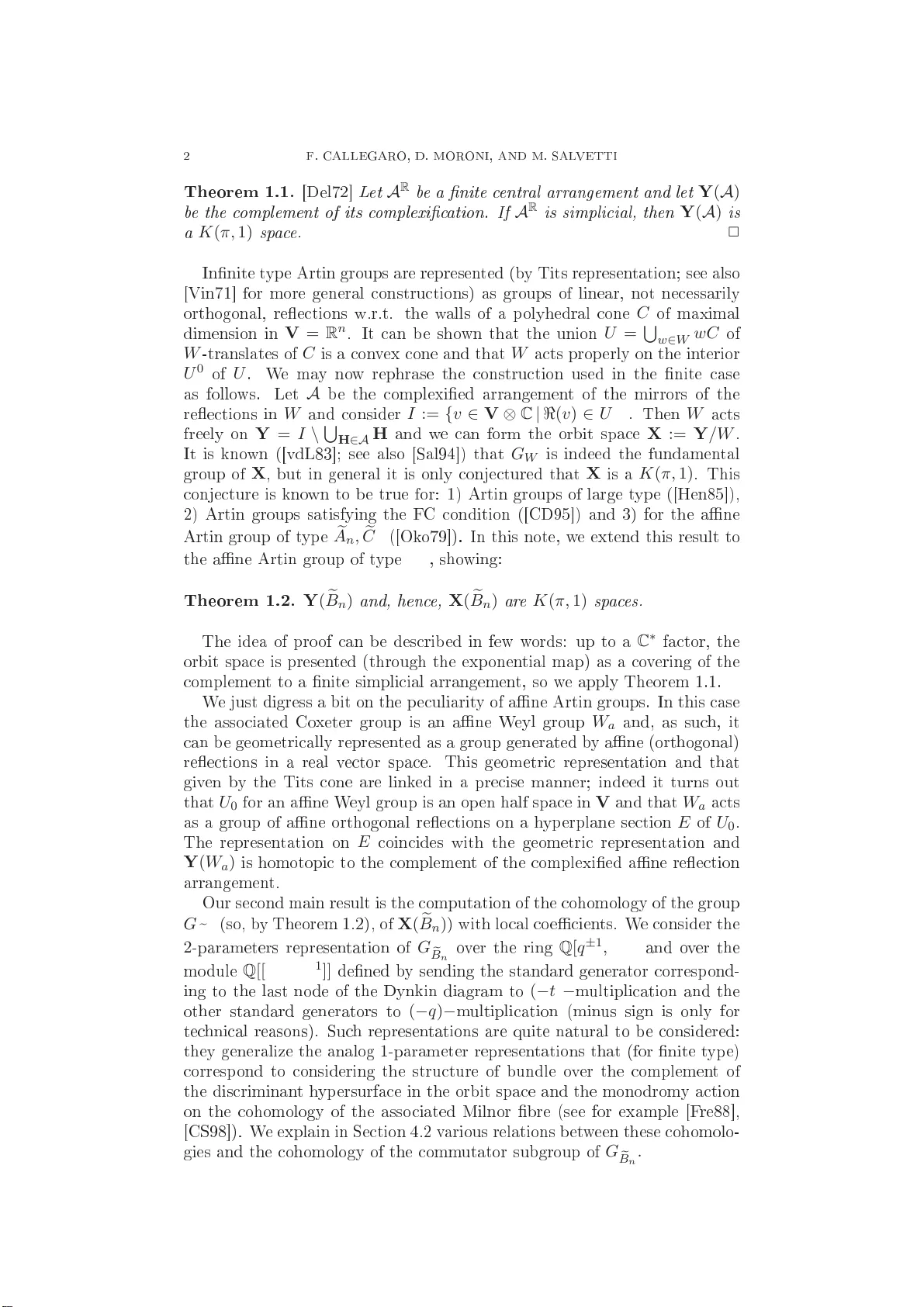
THE K ( π , 1) PR OBLEM F OR THE AFFINE AR TIN GR OUP OF TYPE e B n AND ITS COHOMOLOGY FILIPPO CALLEGAR O, D A VIDE MOR ONI, AND MARIO SAL VETTI Abstra t. In this pap er w e pro v e that the omplemen t to the ane omplex arrangemen t of t yp e e B n is a K ( π, 1) spae. W e also om- pute the ohomology of the ane Artin group G e B n (of t yp e e B n ) with o eien ts o v er sev eral in teresting lo al systems. In partiular, w e on- sider the mo dule Q [ q ± 1 , t ± 1 ] , where the rst n -standard generators of G e B n at b y ( − q ) -m ultipliation while the last generator ats b y ( − t ) - m ultipliation. Su h represen tation generalizes the analog 1 -parameter represen tation related to the bundle struture o v er the omplemen t to the disriminan t h yp ersurfae, endo w ed with the mono drom y ation of the asso iated Milnor bre. The ohomology of G e B n with trivial o e- ien ts is deriv ed from the previous one. 1. Intr odution Let ( W , S ) b e a Co xeter system, so a presen tation for W is < s ∈ S | ( ss ′ ) m ( s,s ′ ) = 1 > where m ( s, s ′ ) ∈ N ≥ 2 ∪ {∞} for s 6 = s ′ and m ( s, s ) = 1 (see [Bou68℄, [Hum90 ℄). The Artin group G W asso iated to ( W , S ) is the extension of W giv en b y the presen tation (see [BS72 ℄) < g s , s ∈ S | g s g s ′ g s ... = g s ′ g s g s ′ ... ( s 6 = s ′ , m ( s, s ′ ) fators ) > . One sa ys that an Artin group G W is of nite typ e when W is nite. W e are in terested in nitely gener ate d Artin groups, that is when S is nite. In this ase, W an b e geometrially represen ted as a linear reetion group in R n (for example, b y using the Tits r epr esentation of W , see [Bou68 ℄). Let A R b e the arrangemen t of h yp erplanes giv en b y the mirrors of the reetions in W and let its omplemen t b e Y ( A R ) := R n \ S H R ∈A R H R . The onneted omp onen ts of the omplemen t Y ( A R ) are alled the hamb ers of A R . Consider (for nite t yp e) the arrangemen t A in C n obtained b y omplex- ifying the h yp erplanes of A R and let Y ( A ) b e its omplemen t. W e ha v e an indued ation of W on Y ( A ) and it turns out that the orbit sp a e Y ( A ) /W has the Artin group G W as fundamen tal group (see [Bri73 ℄). Moreo v er, it follo ws from a Theorem b y Deligne ([Del72 ℄) that Y ( A ) /W is a K ( π , 1) spae. Indeed the Theorem onerns a more general situation. Reall that a real arrangemen t A R is said to b e simpliial if all its ham b ers onsist of simpliial ones; reetion arrangemen ts are kno wn to b e simpliial [Bou68℄. Date : No v em b er 3, 2021. 2000 Mathematis Subje t Classi ation. 20J06 (Primary); 20F36, 55P20 (Seundary). The third author is partially supp orted b y M.U.R.S.T. 40%. 1 2 F. CALLEGAR O, D. MOR ONI, AND M. SAL VETTI Theorem 1.1. [Del72 ℄ L et A R b e a nite entr al arr angement and let Y ( A ) b e the omplement of its omplexi ation. If A R is simpliial, then Y ( A ) is a K ( π , 1) sp a e. ✷ Innite t yp e Artin groups are represen ted (b y Tits represen tation; see also [Vin71 ℄ for more general onstrutions) as groups of linear, not neessarily orthogonal, reetions w.r.t. the w alls of a p olyhedral one C of maximal dimension in V = R n . It an b e sho wn that the union U = S w ∈ W wC of W -translates of C is a on v ex one and that W ats prop erly on the in terior U 0 of U . W e ma y no w rephrase the onstrution used in the nite ase as follo ws. Let A b e the omplexied arrangemen t of the mirrors of the reetions in W and onsider I := { v ∈ V ⊗ C | ℜ ( v ) ∈ U 0 } . Then W ats freely on Y = I \ S H ∈A H and w e an form the orbit spae X := Y /W . It is kno wn ([vdL83 ℄; see also [Sal94 ℄) that G W is indeed the fundamen tal group of X , but in general it is only onjetured that X is a K ( π , 1) . This onjeture is kno wn to b e true for: 1) Artin groups of large t yp e ([ Hen85 ℄), 2) Artin groups satisfying the F C ondition ([ CD95 ℄) and 3) for the ane Artin group of t yp e e A n , e C n ([Ok o79 ℄). In this note, w e extend this result to the ane Artin group of t yp e e B n , sho wing: Theorem 1.2. Y ( e B n ) and, hen e, X ( e B n ) ar e K ( π , 1) sp a es. The idea of pro of an b e desrib ed in few w ords: up to a C ∗ fator, the orbit spae is presen ted (through the exp onen tial map) as a o v ering of the omplemen t to a nite simpliial arrangemen t, so w e apply Theorem 1.1 . W e just digress a bit on the p euliarit y of ane Artin groups. In this ase the asso iated Co xeter group is an ane W eyl group W a and, as su h, it an b e geometrially represen ted as a group generated b y ane (orthogonal) reetions in a real v etor spae. This geometri represen tation and that giv en b y the Tits one are link ed in a preise manner; indeed it turns out that U 0 for an ane W eyl group is an op en half spae in V and that W a ats as a group of ane orthogonal reetions on a h yp erplane setion E of U 0 . The represen tation on E oinides with the geometri represen tation and Y ( W a ) is homotopi to the omplemen t of the omplexied ane reetion arrangemen t. Our seond main result is the omputation of the ohomology of the group G e B n (so, b y Theorem 1.2 ), of X ( e B n ) ) with lo al o eien ts. W e onsider the 2 -parameters represen tation of G e B n o v er the ring Q [ q ± 1 , t ± 1 ] and o v er the mo dule Q [[ q ± 1 , t ± 1 ]] dened b y sending the standard generator orresp ond- ing to the last no de of the Dynkin diagram to ( − t ) − m ultipliation and the other standard generators to ( − q ) − m ultipliation (min us sign is only for te hnial reasons). Su h represen tations are quite natural to b e onsidered: they generalize the analog 1 -parameter represen tations that (for nite t yp e) orresp ond to onsidering the struture of bundle o v er the omplemen t of the disriminan t h yp ersurfae in the orbit spae and the mono drom y ation on the ohomology of the asso iated Milnor bre (see for example [F re88 ℄, [CS98 ℄). W e explain in Setion 4.2 v arious relations b et w een these ohomolo- gies and the ohomology of the omm utator subgroup of G e B n . THE K ( π, 1) PR OBLEM F OR e B n AND ITS COHOMOLOGY 3 The main to ol to p erform omputations is an algebrai omplex whi h w as diso v ered in [Sal94 ℄, [DS96℄ b y using top ologial metho ds (and inde- p enden tly , b y algebrai metho ds in [Squ94 ℄). The ohomology fatorizes in to t w o parts (see also [DPSS99 ℄) : the invariant part redues to that of the Artin group of nite t yp e B n , whose 2 -parameters ohomology w as om- puted in [CMS06 ℄; for the anti-invariant part w e use suitable ltrations and the asso iated sp etral sequenes. Let ϕ d b e the d -th ylotomi p olynomial in the v ariable q . W e dene the quotien t rings { 1 } i = Q [ q ± 1 , t ± 1 ] / (1 + tq i ) { d } i = Q [ q ± 1 , t ± 1 ] / ( ϕ d , 1 + tq i ) {{ d }} j = Q [ q ± 1 , t ± 1 ] / ( ϕ d , d − 1 Y i = o 1 + tq i ) j . The nal result is the follo wing one: Theorem 1.3. The ohomolo gy H n − s ( G e B n , Q [[ q ± 1 , t ± 1 ]]) is given by Q [[ q ± 1 , t ± 1 ]] for s = 0 M h> 0 {{ 2 h } } f ( n,h ) for s = 1 M h> 2 i ∈ I ( n,h ) { 2 h } c ( n,h,s ) i ⊕ M d | n 0 ≤ i ≤ d − 2 { d } i ⊕ { 1 } n − 1 for s =2 M h> 2 i ∈ I ( n,h ) { 2 h } c ( n,h,s ) i ⊕ M d | n 0 ≤ i ≤ d − 2 d ≤ n j +1 { d } i for s =2 + 2 j M h> 2 i ∈ I ( n,h ) { 2 h } c ( n,h,s ) i ⊕ M d ∤ n d ≤ n j +1 { d } n − 1 for s =3 + 2 j wher e c ( n, h, s ) = max (0 , ⌊ n 2 h ⌋ − s ) , f ( n, h ) = ⌊ n + h − 1 2 h ⌋ and I ( n, h ) = { n, . . . , n + h − 2 } if n ≡ 0 , 1 , . . . , h mo d(2 h ) and I ( n, h ) = { n + h − 1 , . . . , n + 2 h − 1 } if n ≡ h + 1 , h + 2 , . . . , 2 h − 1 mo d(2 h ) . As a orollary w e also deriv e the ohomology with trivial o eien ts of G e B n (Theorem 4.6 ) The pap er is organized as follo ws. In Setion 2 w e reall some result and notations ab out Co xeter and Artin groups, inluding a 2 -parameters P oinaré series whi h w e need in the b oundary op erators of the ab o v e men- tioned algebrai omplex. In Setion 3 w e pro v e Theorem 1.2 . In Setion 4 w e use a suitable ltration of the algebrai omplex, reduing omputation of the ohomology mainly to: 4 F. CALLEGAR O, D. MOR ONI, AND M. SAL VETTI B n 1 2 3 4 n − 2 n − 1 n 4 e B n 1 3 4 n − 1 n n +1 2 4 D n 1 3 4 n − 2 n − 1 n 2 T able 1. Co xeter graphs of t yp e B n , e B n , D n . - alulation of generators of ertain sub omplexes for the Artin group of t yp e D n (whose ohomology w as kno wn from [DPSS99 ℄, but w e need expliit suitable generators); - analysis of the asso iated sp etral sequene to dedue the ohomology of e B n with lo al o eien ts; - use of some exat sequenes for the ohomology with ostan t o e- ien ts. 2. Preliminar y resul ts In this Setion w e x the notation and reall some preliminary results. W e will use lassial fats ([Bou68 ℄, [Hum90℄) without further referene. 2.1. Co xeter groups and Artin braid groups. A Coxeter gr aph is a nite undireted graph, whose edges are lab elled with in tegers ≥ 3 or with the sym b ol ∞ . Let S , E b e resp etiv ely the v ertex and edge set of a Co xeter graph. F or ev ery edge { s, t } ∈ E let m s,t b e its lab el. If s, t ∈ S ( s 6 = t ) are not joined b y an edge, set b y on v en tion m s,t = 2 . Let also m s,s = 1 . T w o groups are asso iated to a Co xeter graph (as in the In tro dution): the Coxeter gr oup W dened b y W = h s ∈ S | ( s t ) m s,t = 1 ∀ s, t ∈ S su h that m s,t 6 = ∞i and the A rtin br aid gr oup G W dened b y (see [BS72 ℄, [Bri73℄, [Del72 ℄): G = h s ∈ S | stst . . . | {z } m s,t − terms = tst s . . . | {z } m s,t − terms ∀ s, t ∈ S su h that m s,t 6 = ∞i . There is a natural epimorphism π : G W → W and, b y Matsumoto's Lemma [Mat64 ℄, π admits a anonial set-theoreti setion ψ : W → G W . 2.2. In this pap er, w e are primarily in terested in Artin braid groups asso- iated to Co xeter graphs of t yp e B n , e B n and D n (see T able 1). THE K ( π, 1) PR OBLEM F OR e B n AND ITS COHOMOLOGY 5 The asso iated Co xeter groups an b e desrib ed as reetion groups with resp et to an arrangemen t of h yp erplanes (or mirrors). Let x 1 , . . . , x n b e the standard o ordinates in R n . Consider the linear h yp erplanes: H k = { x k = 0 } L ± ij = { x i = ± x j } and, for an in teger a ∈ Z , their ane translates: H k ( a ) = { x k = a } L ± ij ( a ) = { x i = ± x j + a } The Co xeter group B n is iden tied with the group of reetions with resp et to the mirrors in the arrangemen t A ( B n ) := { H k | 1 ≤ k ≤ n } ∪ { L ± ij | 1 ≤ i < j ≤ n } . As su h it is the group of signed p erm utations of the o ordinates in R n . No- tie that B n is generated b y n basi reetions s 1 , . . . , s n ha ving resp etiv ely as mirrors the n − 1 h yp erplanes L + i,i +1 ( 1 ≤ i ≤ n − 1 ) and the h yp erplane H n . This n um b ering of the reetions is onsisten t with the n um b ering of the v erties of the Co xeter graph for B n sho wn in T able 1 . The ane Co xeter group e B n is the semidiret pro dut of the Co xeter group B n and the oro ot lattie, onsisting of in teger v etors whose o ordinates add up to an ev en n um b er. The arrangemen t of mirrors is then the ane h yp erplane arrangemen t: (1) A ( e B n ) := { H k ( a ) | 1 ≤ k ≤ n, a ∈ Z } ∪ { L ± ij ( a ) | 1 ≤ i < j ≤ n, a ∈ Z } . It is generated b y the basi reetions for B n plus an extra ane reetion e s ha ving L − 12 (1) as mirror. The latter omm utes with all the basi reetions of B n but s 2 , for whi h ( e ss 2 ) 3 = 1 . This aoun ts for the Co xeter graph of t yp e e B n in the table, where, ho w ev er, w e hose b y our on v eniene a somewhat un usual v ertex n um b ering. Finally the group D n has reetion arrangemen t: A ( D n ) := { L ± ij | 1 ≤ i < j ≤ n } and it an b e regarded as the group of signed p erm utations of the o ordinates whi h in v olv e an ev en n um b er of sign hanges. In partiular D n is a subgroup of index 2 in B n . The group is generated b y n basi reetions w.r.t. the h yp erplanes L − 12 and L + i,i +1 ( 1 ≤ i ≤ n − 1 ). 2.3. Generalized P oinaré series. F or future use in ohomology ompu- tations, w e will need some analog of ordinary P oinaré series for Co xeter groups. Consider a domain R and let R ∗ b e the group of unit of R . Giv en an ab elian represen tation η : G W → R ∗ of the Artin group G W and a nite subset U ⊂ W , w e ma y onsider the η -P oinaré series: U ( η ) = X w ∈ U ( − 1) ℓ ( w ) η ( ψ w ) ∈ R where ℓ is the length in the Co xeter group and ψ : W → G W is the anonial setion. In partiular, when W is nite, w e sa y that W ( η ) is the η -P oinaré 6 F. CALLEGAR O, D. MOR ONI, AND M. SAL VETTI series of the group. Notie that for R = Q [ q ± 1 ] w e ma y onsider the represen- tation η q that sends the standard generators of G W in to ( − q ) -m ultipliation; in this situation w e reo v er the ordinary P oinaré series: W ( η q ) = W ( q ) F urther, for the Artin group of t yp e W = B n , e B n w e are in terested in the represen tation η q ,t : G W → Q [ q ± 1 , t ± 1 ] dened sending the last standard generator (the one la ying in the tree lea v e lab elled with 4 ) to ( − t ) -m ultipliation and the remaining ones to ( − q ) - m ultipliation. The asso iated P oinaré series B n ( q , t ) := B n ( η q ,t ) will b e alled the ( q , t ) -weighte d Poin ar é series for B n . In order to reall losed form ulas for P oinaré series, w e rst x some notations that will b e adopted throughout the pap er. W e dene the q -analog of a p ositiv e in teger m to b e the p olynomial [ m ] q := 1 + q + · · · q m − 1 = q m − 1 q − 1 It is easy to see that [ m ] = Q i | m ϕ m ( q ) . Moreo v er w e dene the q -fatorial and double fatorial indutiv ely as: [ m ] q ! := [ m ] q · [ m − 1] q ! [ m ] q !! := [ m ] q · [ m − 2] q !! where is understo o d that [1]! = [1]!! = [1] and [2]!! = [2] . A q -analog of the binomial m i is giv en b y the p olynomial m i q := [ m ] q ! [ i ] q ![ m − i ] q ! W e an also dene the ( q , t ) -analog of an ev en n um b er [2 m ] q ,t := [ m ] q (1 + tq m − 1 ) and of the double fatorial [2 m ] q ,t !! := m Y i =1 [2 i ] q ,t = [ m ] q ! m − 1 Y i =0 (1 + tq i ) Notie that sp eializing t to q , w e reo v er the q -analogue of an ev en n um b er and of its double fatorial. Finally , w e dene the p olynomial (2) m i ′ q ,t := [2 m ] q ,t !! [2 i ] q ,t !![ m − i ] q ! = m i q m − 1 Y j = i (1 + tq j ) With this notation the ordinary P oinaré series for D n and B n ma y b e writ- ten as D n ( q ) := X w ∈ D n q ℓ ( w ) = [2( n − 1)] q !! · [ n ] q (3) B n ( q ) := X w ∈ B n q ℓ ( w ) = [2 n ] q !! (4) THE K ( π, 1) PR OBLEM F OR e B n AND ITS COHOMOLOGY 7 while the ( q , t ) -weighte d Poin ar é series for B n is giv en b y (see e.g. [Rei93℄): (5) B n ( q , t ) = [2 n ] q ,t !! 3. The K ( π , 1) pr oblem f or the affine Ar tin gr oup of type e B n Using the expliit desription of the reetion mirrors in Equation (1), the omplemen t of the omplexied ane reetion arrangemen t of t yp e e B n is giv en b y: Y := Y ( e B n ) = { x ∈ C n | x i ± x j / ∈ Z for all i 6 = j , x k / ∈ Z for all k } On Y w e ha v e, b y standard fats, a free ation b y translations of the o w eigh t lattie Λ , iden tied with the standard lattie Z n ⊂ C n . Pro of of Theorem 1.2 W e rst expliitly desrib e the o v ering Y → Y / Λ applying the exp onen tial map y = exp(2 π i x ) omp onen t wise to Y : Y π Y / Λ ≃ { y ∈ C n | y i 6 = y ± 1 j , y k 6 = 0 , 1 } ( x 1 , . . . , x n ) exp (2 π i x 1 ) , . . . , exp (2 π i x n ) Notie no w that the funtion C \ { 0 , 1 } ∋ y 7→ g ( y ) = 1 + y 1 − y ∈ C \ {± 1 } satises g ( y − 1 ) = − g ( y ) . F urther g is in v ertible, its in v erse b eing giv en b y z 7→ z − 1 z +1 . Therefore applying g omp onen t wise to Y / Λ , w e ha v e: Y / Λ ≃ { z ∈ C n | z i 6 = ± z j , z k 6 = ± 1 } Consider no w the arrangemen t A in R n +1 onsisting of the h yp erplanes L ± ij for 1 ≤ i < j ≤ n + 1 and H 1 and let Y ( A ) b e the omplemen t of its omplexiation. W e ha v e an homeomorphism η : C ∗ × Y / Λ → Y ( A ) dened b y η λ, ( z 1 , . . . , z n ) = ( λ, λz 1 , . . . , λz n ) T o sho w that Y / Λ is a K ( π , 1) , it is then suien t to sho w that Y ( A ) is a K ( π , 1) . W e will sho w in Lemma 3.1 b elo w that A is simpliial, and therefore the result follo ws from Deligne's Theorem 1.1 . ✷ Remark By the same exp onen tial argumen t one ma y reo v er the results of [Ok o79 ℄ for the ane Artin group of t yp e e A n , e C n (for further appliations w e refer to [All02℄). Lemma 3.1. L et A b e the r e al arr angement in R n +1 onsisting of the hy- p erplanes L ± ij for 1 ≤ i < j ≤ n + 1 and H 1 . Then A is simpliial. Pro of. Notie that A is the union of the reetion arrangemen t A ( D n +1 ) of t yp e D n +1 and the h yp erplane H 1 = { x 1 = 0 } . Hene w e study ho w the ham b ers of A ( D n +1 ) are ut b y the h yp erplane H 1 . Sine the Co xeter group D n +1 ats transitiv ely on the olletion of ham b ers, it is enough to 8 F. CALLEGAR O, D. MOR ONI, AND M. SAL VETTI onsider ho w the fundamen tal ham b er C 0 of A ( D n +1 ) is ut b y the D n +1 - translates of the h yp erplane H 1 , i.e. b y the o ordinate h yp erplanes H k for k = 1 , 2 , . . . , n + 1 . W e ma y ho ose C 0 = {− x 2 < x 1 < x 2 < . . . < x n < x n +1 } as fundamen tal ham b er. Of ourse, this is a simpliial one. Notie that the o ordinate of a p oin t in C 0 are all p ositiv e exept (p ossibly) the rst. Th us it is lear that for k ≥ 2 the h yp erplanes H k do not ut C 0 . A qui k he k sho ws instead that H 1 uts C 0 in to t w o simpliial ones C 1 , C 2 giv en preisely b y: C 1 = { 0 < x 1 < x 2 < . . . < x n < x n +1 } C 2 = { 0 < − x 1 < x 2 < . . . < x n < x n +1 } ✷ 4. Cohomology In this Setion w e will ompute the ohomology groups H ∗ ( G e B n , Q [[ q ± 1 , t ± 1 ]] q ,t ) where Q [[ q ± 1 , t ± 1 ]] q ,t is the lo al system o v er the mo dule of Lauren t se- ries Q [[ q ± 1 , t ± 1 ]] and the ation is ( − q ) − m ultipliation for the standard generators asso iated to the rst n no des of the Dynkin diagram, while is ( − t ) − m ultipliation for the generator asso iated to the last no de. 4.1. Algebrai omplexes for Artin groups. As a main to ol for oho- mologial omputations w e use the algebrai omplex desrib ed in [Sal94 ℄ (see the In tro dution); the algebrai generalization of this omplex b y De Conini-Salv etti [DS96 ℄ pro vides an eetiv e w a y to determine the ohomol- ogy of the orbit spae X ( W ) with v alues in an arbitrary G W -mo dule. When X ( W ) is a K ( π , 1) spae, of ourse, w e get the ohomology of the group G W . F or sak e of simpliit y , w e restrit ourself to the ab elian represen tations onsidered in Setion 2.3. Let ( W , S ) b e a Co xeter system. Giv en a a rep- resen tation η : G W → R ∗ , let M η b e the indued struture of G W -mo dule on the R -mo dule M . W e ma y desrib e a o hain omplex C ∗ ( W ) for the ohomology H ∗ ( X ( W ); M η ) as follo ws. The o hains in dimension k onsist in the free R -mo dule indexed b y the nite parab oli subgroup of W : (6) C k ( W ) := M Γ: | Γ | = k | W Γ | < ∞ M .e Γ and the ob oundary map are ompletely desrib ed b y the form ula: (7) d( e Γ ) = X Γ ′ ⊃ Γ | Γ ′ | = | Γ | +1 | W Γ ′ | < ∞ ( − 1) α (Γ , Γ ′ ) W Γ ′ ( η ) W Γ ( η ) e Γ ′ THE K ( π, 1) PR OBLEM F OR e B n AND ITS COHOMOLOGY 9 where W Γ ( η ) is the η -P oinaré series of the parab oli subgroup W Γ and α (Γ , Γ ′ ) is an inidene index dep ending on a xed linear order of S . F or Γ ′ \ Γ = { s ′ } it is dened as α (Γ , Γ ′ ) := |{ s ∈ Γ : s < s ′ }| W e iden tify (onsisten tly with T able 1 ) the generating reetions set S for e B n with the set { 1 , 2 , . . . , n + 1 } . It is useful to represen t a subset Γ ⊂ S with its harateristi funtion. F or example the subset { 1 , 3 , 5 , 6 } for e B 6 ma y b e represen ted as the binary string: 0 1 10110 T o determine the ohomology of G e B n , it will b e neessary to giv e a lose lo ok to the ohomology of G D n . It is on v enien t to n um b er the v ertex of D n as in table 1 and to regard parab oli subgroups as binary strings as b efore. 4.2. Let R b e the ring of Lauren t p olynomials Q [ q ± 1 , t ± 1 ] and M b e the R -mo dule of Lauren t series Q [[ q ± 1 , t ± 1 ]] and let R q ,t , M q ,t b e the orre- sp onding lo al systems, with ation η q ,t . Our main in terest is to ompute the ohomology with trivial rational o eien t of the group Z e B n = k er ( G e B n → Z 2 ) that is the omm utator subgroup of G e B n . By Shapiro Lemma (see [Bro82℄) w e ha v e the follo wing equiv alene: H ∗ ( Z e B n , Q ) ≃ H ∗ ( G e B n , M q ,t ) and the seond term of the equalit y is omputed b y the Salv etti omplex C ∗ ( e B n ) o v er the mo dule M q ,t . Notie that the nite parab oli subgroups of W e B n are in 1 − 1 orresp ondene with the prop er subsets of the set of simple ro ots S . W e an dene an augmente d Salv etti omplex b C ∗ ( e B n ) as follo ws: b C ∗ ( e B n ) = C ∗ ( e B n ) ⊕ ( M q ,t ) .e S . W e need to dene the b oundary map for the n -dimensional generators. Let w e rst dene a quasi-P oinaré p olynomial for G e B n . W e set c W S ( q , t ) = c W e B n ( q , t ) = [2( n − 1)]!! [ n ] n − 1 Y i =0 (1 + tq i ) . It is easy to v erify that c W e B n ( q , t ) is the least ommon m ultiple of all W Γ ( q , t ) , for Γ ⊂ S with | Γ | = n . This allo ws us to dene the b oundary map for the generators e Γ , with | Γ | = n : d ( e Γ ) = ( − 1) α (Γ ,S ) c W e B n ( q , t ) W Γ ( q , t ) e S and it is straigh tforw ard to v erify that b C ∗ ( e B n ) is still a hain omplex. More- o v er w e ha v e the follo wing relations b et w een the ohomologies of C ∗ ( e B n ) and b C ∗ ( e B n ) : H i ( C ∗ ( e B n )) = H i ( b C ∗ ( e B n )) 10 F. CALLEGAR O, D. MOR ONI, AND M. SAL VETTI for i 6 = n, n + 1 and w e ha v e the short exat sequene 0 → H n ( b C ∗ ( e B n ) , M q ,t ) → H n ( C ∗ ( e B n ) , M q ,t ) → M q ,t → 0 . Finally one an pro v e that the omplex b C ∗ ( e B n ) with o eien ts in the lo al system R q ,t is wel l lter e d (as dened in [Cal05 ℄) with resp et to the v ariable t and so it giv es the same ohomology , mo dulo an index shifting, of the om- plex with o eien ts o v er the mo dule Q [ t ± 1 ][[ q ± 1 ]] . Another index shifting an b e pro v ed with a sligh t impro v emen t of the results in [ Cal05 ℄, allo wing to pass to the mo dule M . Hene w e ha v e the follo wing Prop osition 4.1. H i ( Z e B n , Q ) ≃ H i ( b C ∗ ( e B n ) , M q ,t ) ≃ H i +2 ( b C ∗ ( e B n ) , R q ,t ) ≃ H i +2 ( G e B n , R q ,t ) for i 6 = n, n + 1 and H n ( Z e B n , Q ) ≃ H n ( G e B n , M q ,t ) ≃ M H n +1 ( Z e B n , Q ) ≃ H n +1 ( G e B n , M q ,t ) ≃ 0 . ✷ F rom no w on w e deal only with the omplex b C ∗ ( e B n ) with o eien ts in the lo al system R q ,t . 4.3. F or Co xeter groups of t yp e W = D n , e B n the Salv etti's omplex C ∗ W exhibits an in v olution σ dened b y: 0 0 A σ − → 0 0 A 1 1 A σ − → − 1 1 A 0 1 A σ − → 1 0 A 1 0 A σ − → 0 1 A. Let I ∗ W b e the mo dule of σ -in v arian ts and K ∗ W the mo dule of σ -an ti- in v arian ts. W e ma y then split the omplex in to: C ∗ W = I ∗ W ⊕ K ∗ W . In partiular the omputation of the ohomolgy of C ∗ W ma y b e p erformed analyzing separately the t w o sub omplexes. 4.4. Cohomology of K ∗ D n . The ohomology of the an ti-in v arian t sub om- plex for D n w as ompletely determined in [DPSS99 ℄. Ho w ev er w e will need for our purp oses generators for the ohomology groups whi h are not easily dedued from the argumen t in the original pap er. So w e briey reall this result. Let G 1 n b e the sub omplex of C ( D n ) generated b y the strings of t yp e 0 1 A and 1 1 A . It is easy to see that G 1 n is isomorphi (as a omplex) to K ( D n ) . Dene the set S n = { h ∈ N s. t. 2 h | n or h | n − 1 and 2 h ∤ ( n − 1) } Note that h app ears in S n if and only if n = 2 λh (i.e. n is an ev en m ultiple of h ) or n = (2 λ + 1) h + 1 ( n is an o dd m ultiple of h inremen ted b y 1 ). THE K ( π, 1) PR OBLEM F OR e B n AND ITS COHOMOLOGY 11 Prop osition 4.2 ([DPSS99 ℄) . The top- ohomolo gy of G 1 n is: H n G 1 n = M h ∈ S n { 2 h } wher e as for s > 0 one has: H n − 2 s G 1 n = M h ∈ S n 1 < h < n 2 s { 2 h } H n − 2 s +1 G 1 n = M h ∈ S n 1 < h ≤ n 2 s { 2 h } . ✷ W e need a desription of the generators for these mo dules. First w e dene the follo wing basi binary strings: o µ [ h ] = 0 1 1 h − 1 for µ = 0 1 1 1 2 µh − 2 01 h for µ ≥ 1 e µ [ h ] = 1 1 1 (2 µ − 1) h − 1 01 h − 2 for µ ≥ 1 s h = 01 h − 2 l h = 01 h . A set of andidate ohomology generators is giv en b y the follo wing o yles: o µ, 2 i [ h ] = 1 ϕ 2 h d ( o µ [ h ]( s h l h ) i ) o µ, 2 i +1 [ h ] = 1 ϕ 2 h d ( o µ [ h ]( s h l h ) i s h ) e µ, 2 i [ h ] = 1 ϕ 2 h d ( e µ [ h ]( l h s h ) i ) e µ, 2 i +1 [ h ] = 1 ϕ 2 h d ( e µ [ h ]( l h s h ) i l h ) . Indeed these o yles aoun t for all the generators: Prop osition 4.3. (1) L et n = 2 λh . Then for 0 ≤ s < λ the summand of H n − 2 s ( G 1 n ) isomorphi to { 2 h } is gener ate d by e λ − s, 2 s [ h ] . Simi- larly for 0 ≤ s < λ the summand of H n − 2 s − 1 ( G 1 n ) is gener ate d by o λ − s − 1 , 2 s +1 [ h ] . (2) L et n = (2 λ + 1) h + 1 . Then for 0 ≤ s ≤ λ the summand of H n − 2 s ( G 1 n ) isomorphi to { 2 h } is gener ate d by o λ − s, 2 s [ h ] . F or 0 ≤ s < λ the summand of H n − 2 s − 1 ( G 1 n ) is gener ate d by e λ − s, 2 s +1 [ h ] . Prop osition 4.3 is b est pro v en b y indution on n , reo v ering in partiular the quoted result from [DPSS99 ℄. 12 F. CALLEGAR O, D. MOR ONI, AND M. SAL VETTI Pro of. W e lter the omplex G 1 n from the righ t and use the asso iated sp etral sequene. Let: F k G 1 n = h A 1 k i b e the sub omplex generated b y binary strings ending with at least k ones. W e ha v e a ltration G 1 n = F 0 G 1 n ⊃ F 1 G 1 n ⊃ . . . ⊃ F n − 2 G 1 n ⊃ F n − 1 G 1 n − 1 ⊃ 0 in whi h the subsequen t quotien ts for k = 1 , 2 , . . . , n − 3 F k G 1 n F k +1 G 1 n = h A 01 k i ≃ G 1 n − k − 1 [ k ] are isomorphi to the omplex for G 1 n − k − 1 shifted in degree b y k , while F n − 2 G 1 n F n − 1 G 1 n = 0 1 1 n − 2 ≃ R [ n − 1] F n − 1 G 1 n = 1 1 1 n − 2 ≃ R [ n ] . Therefore the olumns of the E 1 term of the sp etral sequene are either the mo dule R or are giv en b y the ohomology of G 1 n ′ with n ′ < n . Reasoning b y indution, w e ma y th us supp ose that their ohomology has the generators presrib ed b y the prop osition. Sine there an b e no non-zero maps b et w een the mo dule { 2 h } , { 2 h ′ } for h 6 = h ′ , w e ma y separately detet the ϕ 2 h -torsion in the ohomology . Fix an in teger h > 1 . Then the relev an t mo dules for the ϕ 2 h -torsion in the E 1 term are suggested in T able 2. W e will all a olumn even if it is relativ e to G 1 2 µh and o dd if it is relativ e to G 1 (2 µ +1) h +1 for some µ . The dieren tial o 2 , 0 e 2 , 1 o 1 , 2 e 1 , 3 o 0 , 4 e 2 , 0 o 1 , 1 e 1 , 2 o 0 , 3 o 1 , 0 e 1 , 1 o 0 , 2 e 1 , 0 o 0 , 1 o 0 , 0 R R G 1 5 h +1 G 1 4 h G 1 3 h +1 G 1 2 h G 1 h +1 d h +1 d h − 1 d h +1 d h − 1 d 1 T able 2. Sp etral sequene for G 1 n d 1 is zero ev erywhere but d 1 : E ( n − 2 , 1) 1 → E ( n − 1 , 1) 1 where it is giv en b y THE K ( π, 1) PR OBLEM F OR e B n AND ITS COHOMOLOGY 13 m ultipliation b y [2( n − 1)]!! / [ n − 1]! . Th us the E 2 term diers from the E 1 only in p ositions ( n − 2 , 1) and ( n − 1 , 1) , where: E ( n − 2 , 1) 2 = 0 E ( n − 1 , 1) 2 = R [2( n − 1)]!! / [ n − 1]! Then all other dieren tials are zero up to d h − 2 . It is no w useful to distinguish among 4 ases aording to the remainder of n mo d(2 h ) : a) n = 2 λh + c for 1 ≤ c ≤ h b) n = (2 λ + 1) h + 1 ) n = (2 λ + 1) h + 1 + c for 1 ≤ c ≤ h − 2 d) n = 2 λh - In ase a), note the rst olumn relev an t for ϕ 2 h -torsion is ev en (see also T able 3). ...... ...... ...... ...... ...... ...... R ( ϕ 2 h ) λ G 1 2 λh G 1 (2 λ − 1) h +1 G 1 4 h G 1 3 h +1 G 1 2 h G 1 h +1 d h − 1 d h − 1 d h − 1 T able 3. E h − 1 -term of the sp etral sequene for G 1 n in ase a) The dieren tial d h − 1 maps the mo dules of p ositiv e o dimension of an ev en olumn G 1 2 µh ( 1 ≤ µ ≤ λ ) to those in the o dd olumn G 1 (2 µ − 1) h +1 . Using the suitable generators of t yp e e · , · [ h ] , o · , · [ h ] , the map d h − 1 ma y b e iden tied with the m ultipliation b y (8) n − (2 µ − 1) h − 1 h − 1 = 2( λ − µ ) + c + h − 1 h − 1 Sine this p olynomial is non-divisible b y ϕ 2 h , the restrition of d h − 1 to p os- itiv e o dimension elemen ts in ev en olumns is injetiv e. It follo ws that in the E h -term the only surviv ors are in p ositions ( c + 2( λ − µ ) h − 1 , 2 µh ) , generated b y e µ, 0 [ h ] and E ( n − 1 , 1) h ≃ E ( n − 1 , 1) 2 = R [2( n − 1)]!! / [ n − 1]! . Note that in E ( n − 1 , 1) h the only torsion of t yp e ϕ l 2 h is giv en b y the summand: R ( ϕ 2 h ) λ 14 F. CALLEGAR O, D. MOR ONI, AND M. SAL VETTI The setup is summarized in T able 4. In the T able the surviv ors are in dark grey b o xes while annihilated terms are in ligh t grey . F urther, using the generators and up to an in v ertible, w e ma y iden tify the dieren tial d 2 µh : E ( c +2( λ − µ ) h − 1 , 2 µh ) 2 µh → E n − 1 , 1 2 µh with the m ultipliation b y ϕ λ − µ 2 h ( 1 ≤ µ ≤ λ ). Th us, for example, in the E 2 h +1 term the mo dule in p osition ( c + 2( λ − 1) h − 1 , 2 h ) v anishes and the ϕ 2 h -torsion in E ( n − 1 , 1) 2 h +1 is redued to R/ ( ϕ 2 h ) λ − 1 . Con tin uing in this w a y , all ϕ 2 h -torsion v anishes. In summary there is no ϕ 2 h -torsion in the ohomology of G 1 n ; this ends ase a). ...... ...... ...... ...... ...... ...... R ( ϕ 2 h ) λ G 1 2 λh G 1 (2 λ − 1) h +1 G 1 4 h G 1 3 h +1 G 1 2 h G 1 h +1 d 2 λh d 4 h d 2 h T able 4. Setup for the higher degree terms in the sp etral sequene for G 1 n in ase a) F or ase b ) , the rst olumn in the sp etral sequene relev an t for ϕ 2 h is still ev en. The dieren tial d h − 1 ma y b e iden tied again as m ultipliation as in form ula 8, but no w it v anishes, sine the p olynomial is divisible b y ϕ 2 h . ...... ...... ...... ...... ...... ...... R ( ϕ 2 h ) λ +1 G 1 2 λh G 1 (2 λ − 1) h +1 G 1 2( λ − 1) h G 1 3 h +1 G 1 2 h G 1 h +1 d h +1 d h +1 d h +1 T able 5. E h − 1 -term of the sp etral sequene for G 1 n in ase b) THE K ( π, 1) PR OBLEM F OR e B n AND ITS COHOMOLOGY 15 The next non-v anishing dieren tial is d h +1 . See T able 5. It tak es the mo dule in p ositiv e o dimension in an o dd olumn G 1 (2 µ +1) h +1 to the elemen ts in the ev en olumn G 1 2 µh (for 1 ≤ µ ≤ λ − 1 ). Via generators, it ma y b e iden tied with the m ultipliation b y (9) n − 2 µh h + 1 = 2( λ − µ ) h + h + 1 h + 1 and it is therefore injetiv e when restrited to mo dules in p ositiv e o dimen- sion in o dd olumns. F urther d h +1 is also non-zero as a map E (2 λh − 1 ,h +1) h +1 → E ( n − 1 , 1) h +1 . A tually the term E ( n − 1 , 1) h +1 ≃ E ( n − 1 , 1) 2 ≃ R [2( n − 1)]!! / [ n − 1]! has R/ ( ϕ 2 h ) λ +1 as the only summand with torsion of t yp e ϕ l 2 h . It is easy to he k that the relativ e map an b e iden tied with the m ultipliation b y ϕ λ 2 h . Th us, the only surviv ors in the E 2 h term are the rst ev en olumn, the top mo dules in the o dd olumns, generated in p ositions (2( λ − µ ) h − 1 , (2 µ + 1) h + 1) b y o µ, 0 for 1 ≤ µ ≤ λ − 1 , as w ell as E ( n − 1 , 1) 2 h whi h has R/ ( ϕ 2 h ) λ as summand. Note that the higher dieren tials v anish when restrited to the rst ev en olumn. A tually w e ma y lift the generators of t yp e e λ − s, 2 s [ h ] to global generators e λ − s, 2 s +1 [ h ] for 0 ≤ s < λ . Similarly for 0 ≤ s < λ w e ma y lift o λ − s − 1 , 2 s +1 [ h ] to the global generator o λ − s − 1 , 2 s +2 [ h ] . Finally , as in ase a), ...... ...... ...... ...... ...... ...... R ( ϕ 2 h ) λ G 1 2 λh G 1 (2 λ − 1) h +1 G 1 2( λ − 1) h G 1 3 h +1 G 1 2 h G 1 h +1 d (2 λ − 1) h +1 d 3 h +1 T able 6. Setup for the higher degree terms in the sp etral sequene for G 1 n in ase b) the mo dule in p ositions (2( λ − µ ) h − 1 , (2 µ + 1) h + 1) for 1 ≤ µ ≤ λ − 1 v anish in the higher terms of the sp etral sequene while the mo dule in p osition ( n − 1 , 1) has ev en tually as summand R/ϕ 2 h . Clearly the ob oundary o λ, 0 [ h ] pro jets on to a generator of the latter. Case ) and d) presen t no new ompliations and are omitted. ✷ 16 F. CALLEGAR O, D. MOR ONI, AND M. SAL VETTI 4.5. Sp etral sequene for G e B n . W e an no w ompute the ohomology H ∗ ( G e B n , R q ,t ) . W e will do this b y means of the Salv etti omplex b C ∗ e B n . As in Setion [4.3 ℄, let b I e B n b e the mo dule of the σ -in v arian t elemen ts and b K e B n the mo dule of the σ -an ti-in v arian t elemen ts. W e an split our mo dule c C ∗ e B n in to the diret sum: c C ∗ e B n = b I e B n ⊕ b K e B n . Using the map β : C ∗ B n → c C ∗ e B n so dened: β : 0 A 7→ 0 0 A β : 1 A 7→ 1 0 A + 0 1 A one an see that the submo dule b I e B n is isomorphi (as a dieren tial omplex) to C ∗ B n . Its ohomology has b een omputed in [CMS06 ℄. W e reall the result: Theorem 4.4 ([CMS06 ℄) . H i ( G B n , R q ,t ) = L d | n, 0 ≤ i ≤ d − 2 { d } i ⊕ { 1 } n − 1 if i = n L d | n, 0 ≤ i ≤ d − 2 ,d ≤ n j +1 { d } i if i = n − 2 j L d ∤ n,d ≤ n j +1 { d } n − 1 if i = n − 2 j − 1 . ✷ Hene w e only need to ompute the ohomology of b K e B n . In order to do this w e mak e use of the results presen ted in Setion 4.4 . First onsider the sub omplex of c C ∗ e B n dened as L 1 n = < 0 1 A, 1 1 A > . W e dene the map κ : L 1 n → b K e B n b y κ : 0 1 A 7→ 0 1 A − 1 0 A κ : 1 1 A 7→ 2 1 1 A. It is easy to he k that κ giv es an isomorphism of dieren tial omplex. No w w e dene a ltration F on the omplex L 1 n : F i L 1 n = < 0 1 A 1 i , 1 1 A 1 i > . The quotien t F i L 1 n / F i +1 L 1 n is isomorphi to the omplex G 1 n − i [ t ± 1 ] [ i ] (see Prop osition 4.2 ) with trivial ation on the v ariable t . Hene w e use the sp etral sequene dened b y the ltration F to ompute the ohomology of the omplex L 1 n . THE K ( π, 1) PR OBLEM F OR e B n AND ITS COHOMOLOGY 17 The E 0 -term of the sp etral sequene is giv en b y E i,j 0 = F i L 1 n ( i + j ) ( F i +1 L 1 n ) ( i + j ) = ( G 1 n − i ) ( i + j ) [ t ± 1 ] [ i ] =( G 1 n − i ) j [ t ± 1 ] for 0 ≤ i ≤ n − 2 . Finally: E n − 1 , 1 0 = R E n, 1 0 = R and all the other terms are zero. The dieren tial d 0 : E i,j 0 → E i,j + 1 0 orre- sp onds to the dieren tial on the omplex G 1 n − i .It follo ws that the E 1 -term is giv en b y the ohomology of the omplexes G 1 n − i : E 1 i,j = H j ( G 1 n − i )[ t ± 1 ] for 0 ≤ i ≤ n − 2 and E n − 1 , 1 1 = R, E n, 1 1 = R. As in Setion 4.4 , w e an separately onsider in the sp etral sequene E ∗ the mo dules with torsion of t yp e ϕ l 2 h for an in teger h ≥ 1 . F or a xed in teger h > 0 , let c ∈ { 0 , . . . , 2 h − 1 } b e the ongrueny lass of n mo d(2 h ) and let λ b e an in teger su h that n = c + 2 λh . W e onsider the t w o ases: a) 0 ≤ c ≤ h ; b) h + 1 ≤ c ≤ 2 h − 1 . In ase a) the mo dules of ϕ 2 h -torsion are: with 0 ≤ µ ≤ λ − 1 , 0 ≤ i ≤ λ − µ − 1 E c +2 µh, 2( λ − µ ) h − 2 i 1 ≃ { 2 h } [ t ± 1 ] generated b y e λ − µ − i, 2 i [ h ]01 c +2 µh ; with 0 ≤ µ ≤ λ − 1 , 0 ≤ i ≤ λ − µ − 1 E c +2 µh, 2( λ − µ ) h − 2 i − 1 1 ≃ { 2 h } [ t ± 1 ] generated b y o λ − µ − i − 1 , 2 i +1 [ h ]01 c +2 µh ; with 0 ≤ µ ≤ λ − 1 , 0 ≤ i ≤ λ − µ − 1 E c +2 µh + h − 1 , 2( λ − µ ) h − h +1 − 2 i 1 ≃ { 2 h } [ t ± 1 ] generated b y o λ − µ − i − 1 , 2 i [ h ]01 c +2 µh + h − 1 ; with 0 ≤ µ ≤ λ − 2 , 0 ≤ i ≤ λ − µ − 2 E c +2 µh + h − 1 , 2( λ − µ ) h − h +1 − 2 i − 1 1 ≃ { 2 h } [ t ± 1 ] generated b y e λ − µ − i − 1 , 2 i +1 [ h ]01 c +2 µh + h − 1 . In ase b) the mo dules of ϕ 2 h -torsion are: with 0 ≤ µ ≤ λ − 1 , 0 ≤ i ≤ λ − µ − 1 E c +2 µh, 2( λ − µ ) h − 2 i 1 ≃ { 2 h } [ t ± 1 ] 18 F. CALLEGAR O, D. MOR ONI, AND M. SAL VETTI generated b y e λ − µ − i, 2 i [ h ]01 c +2 µh ; with 0 ≤ µ ≤ λ − 1 , 0 ≤ i ≤ λ − µ − 1 E c +2 µh, 2( λ − µ ) h − 2 i − 1 1 ≃ { 2 h } [ t ± 1 ] generated b y o λ − µ − i − 1 , 2 i +1 [ h ]01 c +2 µh ; with 0 ≤ µ ≤ λ, 0 ≤ i ≤ λ − µ E c +2 µh − h − 1 , 2( λ − µ ) h + h +1 − 2 i 1 ≃ { 2 h } [ t ± 1 ] generated b y o λ − µ − i, 2 i [ h ]01 c +2 µh − h − 1 ; with 0 ≤ µ ≤ λ − 1 , 0 ≤ i ≤ λ − µ − 1 E c +2 µh − h − 1 , 2( λ − µ ) h + h +1 − 2 i − 1 1 ≃ { 2 h } [ t ± 1 ] generated b y e λ − µ − i, 2 i +1 [ h ]01 c +2 µh − h − 1 . In the E 1 -term of the sp etral sequene, the only non-trivial map is the map d 1 : E n − 1 , 1 1 → E n, 1 1 , that orresp onds to the m ultipliation b y the p olynomial c W e B n [ q , t ] W B n [ q , t ] = n − 1 Y i =1 (1 + q i ) = Y h ≤ n ϕ ⌊ n − 1 h ⌋−⌊ n − 1 2 h ⌋ 2 h . Then in E 2 w e ha v e: E n − 1 , 1 2 = 0 and E n, 1 2 = M R/ ( ϕ ⌊ n − 1 h ⌋−⌊ n − 1 2 h ⌋ 2 h ) . Notie that the in teger f ( n, h ) = ⌊ n − 1 h ⌋ − ⌊ n − 1 2 h ⌋ orresp onds to λ in ase a) and to λ + 1 in ase b). No w w e onsider the higher dieren tials in the sp etral sequene. The rst p ossibly non-trivial maps are d h − 1 and d h +1 . In ase a) the map d h − 1 is giv en b y the m ultipliation b y n + h − 2 Y i = n (1 + tq i ) and the map d h +1 is the n ull map. The maps d 2( λ − µ ) h : { 2 h } [ t ± 1 ] = E c +2 µh, 2( λ − µ ) h 2( λ − µ ) h → E n, 1 2( λ − µ ) h where µ go es from λ − 1 to 0 , orresp ond, up to in v ertibles, mo dulo ϕ 2 h ,to m ultipliation b y ϕ µ 2 h ( 2 h − 1 Y i =0 (1 + tq i )) λ − µ . Moreo v er they are all injetiv e and the term E n, 1 2( λ ) h +1 is giv en b y the quotien t R/ ( ϕ λ 2 h , ϕ λ − 1 2 h 2 h − 1 Y i =0 (1 + tq i ) , . . . , ( 2 h − 1 Y i =0 (1 + tq i )) λ ) = = R/ ( ϕ 2 h , 2 h − 1 Y i =0 (1 + tq i )) λ . THE K ( π, 1) PR OBLEM F OR e B n AND ITS COHOMOLOGY 19 In ase b) the map d h − 1 is n ull and the map d h +1 is the m ultipliation b y the p olynomial n +2 h − 1 Y i = n + h − 1 (1 + tq i ) . The maps d 2( λ − µ ) h + h +1 : { 2 h } [ t ± 1 ] = E c +2 µh + h − 1 , 2( λ − µ ) h − h 2( λ − µ ) h + h +1 → E 1 ,n 2( λ − µ ) h + h +1 where µ go es from λ to 0 , orresp ond, up to in v ertibles, mo dulo ϕ 2 h ,to m ultipliation b y ϕ µ 2 h ( 2 h − 1 Y i =0 (1 + tq i )) λ − µ +1 . Hene they are all injetiv e and the term E n, 1 2( λ ) h + h +2 is giv en b y the quotien t R/ ( ϕ 2 h , 2 h − 1 Y i =0 (1 + tq i )) λ +1 . Sine all the generators lift to global o yles, it turns out that all the other dieren tials are n ull. Hene w e pro v ed the follo wing: Theorem 4.5. H n +1 ( b K e B n ) ≃ M h> 0 {{ 2 h } } f ( n,h ) and, for s ≥ 0 : H n − s ( b K e B n ) ≃ M h> 2 i ∈ I ( n,h ) { 2 h } ⊕ max (0 , ⌊ n 2 h ⌋− s ) i with I ( n, h ) = { n, . . . , n + h − 2 } if n ≃ 0 , 1 , . . . , h mo d(2 h ) , f ( n, h ) = ⌊ n + h − 1 2 h ⌋ and I ( n, h ) = { n + h − 1 , . . . , n + 2 h − 1 } if n ≃ h + 1 , h + 2 , . . . , 2 h − 1 m o d (2 h ) . ✷ Putting together the results of Theorem 4.4 and 4.5 , w e get Theorem 1.3 . As a orollary , w e use the long exat sequenes asso iated to 0 − → Q [[ t ± 1 ]] m ( q ) − → M 1+ q − → M − → 0 and 0 − → Q m ( t ) − → Q [[ t ± 1 ]] 1+ t − → Q [[ t ± 1 ]] − → 0 to get the onstan t o eien ts ohomology for G e B n . Here m ( x ) is the m ul- tipliation b y the series X i ∈ Z ( − x ) i . W e giv e only the result, omitting details whi h ome from non diult anal- ysis of the ab o v e men tioned sequenes and realling that the Euler hara- teristi of the omplex is 1 , for n ev en, and − 1 , for n o dd. 20 F. CALLEGAR O, D. MOR ONI, AND M. SAL VETTI Theorem 4.6. H i ( G e B n , Q ) = Q if i = 0 Q 2 if 1 ≤ i ≤ n − 2 Q 2+ ⌊ n 2 ⌋ if i = n − 1 , n wher e the t and q ations orr esp ond to the multipli ation by − 1 . ✷ Referenes [All02℄ D. Allo k, Br aid pitur es for Artin gr oups , T rans. A.M.S. 354 (2002), 3455 3474. [Bou68℄ N. Bourbaki, Gr oup es et algebr ès de Lie , v ol. Chapters IV-VI, Hermann, 1968. [Bri73℄ E. Briesk orn, Sur les gr oup es de tr esses [d'apr ès V. I. Arnol'd℄ , Séminaire Bour- baki, 24ème année (1971/1972), Exp. No. 401, Leture Notes in Math. 317 (1973), 2144. [BS72℄ E. Briesk orn and K. Saito, A rtin-Grupp en und Coxeter-Grupp en , In v en t. Math. 17 (1972), 245271. [Bro82℄ Kenneth S. Bro wn, Cohomology of Gr oups , GTM, v ol. 87, Springer-V erlag, 1982. [Cal05℄ F. Callegaro, On the ohomolo gy of A rtin gr oups in lo al systems and the asso- iate d milnor b er , J. Pure Appl. Algebra, 197 , no. 1-3, pp. 323332 (2005). [CMS06℄ F. Callegaro, D. Moroni and M. Salv etti, Cohomolo gies of the ane A rtin br aid gr oups and appli ations , to app ear, Ma y 2006 (math.A T:0705.2823). [CD95℄ R. Charney and M.W. Da vis, The k ( π , 1) -pr oblem for hyp erplane omplements asso iate d to innite r ee tion gr oups , J. of AMS 8 (1995), 597627. [CS98℄ D. Cohen, A. Suiu Homolo gy of iter ate d semidir e t pr o duts of fr e e gr oups Jour. of Pure Appl. Alg., 126, pp 87-120 (1998). [Del72℄ P . Deligne, L es immeubles des gr oup es de tr esses génér alisés , In v en tiones math. 17 (1972), 273302. [DS96℄ C. De Conini and M. Salv etti, Cohomolo gy of Artin gr oups , Math. Res. Lett. 3 (1996), 293297. [DPSS99℄ C. De Conini, C. Pro esi, M. Salv etti, and F. Stum b o, A rithmeti pr op erties of the ohomolo gy of Artin gr oups , Ann. Suola Norm. Sup. Pisa Cl. Si. 28 (1999), no. 4, 695717. [F re88℄ E. V. F renk el Cohomolo gy of the ommutator sub gr oup of the br aids gr oup , F un. Anal. Appl., 22 , no. 3, pp. 248-250 (1988). [Hen85℄ H. Hendriks, Hyp erplane omplements of lar ge typ e , In v en t. Math. 79 (1985), 375381. [Hum90℄ J.E. Humphreys, R ee tion gr oups and Coxeter gr oups , Cam bridge Univ ersit y Press, 1990. [Mat64℄ H. Matsumoto, Génér ateurs et r elations des gr oup es de Weyl génér alisés , C. R. A ad. Si. P aris, 258 , pp. 34193422 (1964). [Ok o79℄ C. Ok onek, Das k ( π , 1) -pr oblem für die anen wurzelsysteme vom typ A n , C n , Mathematis he Zeits hrift 168 (1979), 143148. [Rei93℄ Vitor Reiner, Signe d p ermutation statistis , Europ. J. Com binatoris 14 (1993), 553567. [Sal94℄ M. Salv etti, The homotopy typ e of Artin gr oups , Math. Res. Lett. 1 (1994), 567577. [Squ94℄ Craig C. Squier, The homolo gi al algebr a of A rtin gr oups , Math. Sand. 75 , no. 1, 543 (1994). [vdL83℄ H. v an der Lek, The homotopy typ e of omplex hyp erplane omplements , Ph.D. thesis, Univ ersit y of Nijmegan, 1983. [Vin71℄ E.B. Vin b erg, Disr ete line ar gr oups gener ate d by r ee tions , Math. USSR Izv estija 5 (1971), no. 5, 10831119. THE K ( π, 1) PR OBLEM F OR e B n AND ITS COHOMOLOGY 21 Suola Normale Superiore, P.za dei Ca v alieri, 7, Pisa, It al y E-mail addr ess : f.allegarosns.it Dip ar timento di Ma tema tia G.Castelnuo v o , P.za A. Mor o, 2, R oma, It al y -and- ISTI-CNR, Via G. Mor uzzi, 3, Pisa, It al y E-mail addr ess : davide.moroniisti.nr.it Dip ar timento di Ma tema tia L.Tonelli , Lar go B. Ponteor v o, 5, Pisa, It al y E-mail addr ess : salvettidm.unipi.it
Original Paper
Loading high-quality paper...
Comments & Academic Discussion
Loading comments...
Leave a Comment