Two-connected graphs with prescribed three-connected components
We adapt the classical 3-decomposition of any 2-connected graph to the case of simple graphs (no loops or multiple edges). By analogy with the block-cutpoint tree of a connected graph, we deduce from this decomposition a bicolored tree tc(g) associat…
Authors: Andrei Gagarin (1), Gilbert Labelle (2), Pierre Leroux (2)
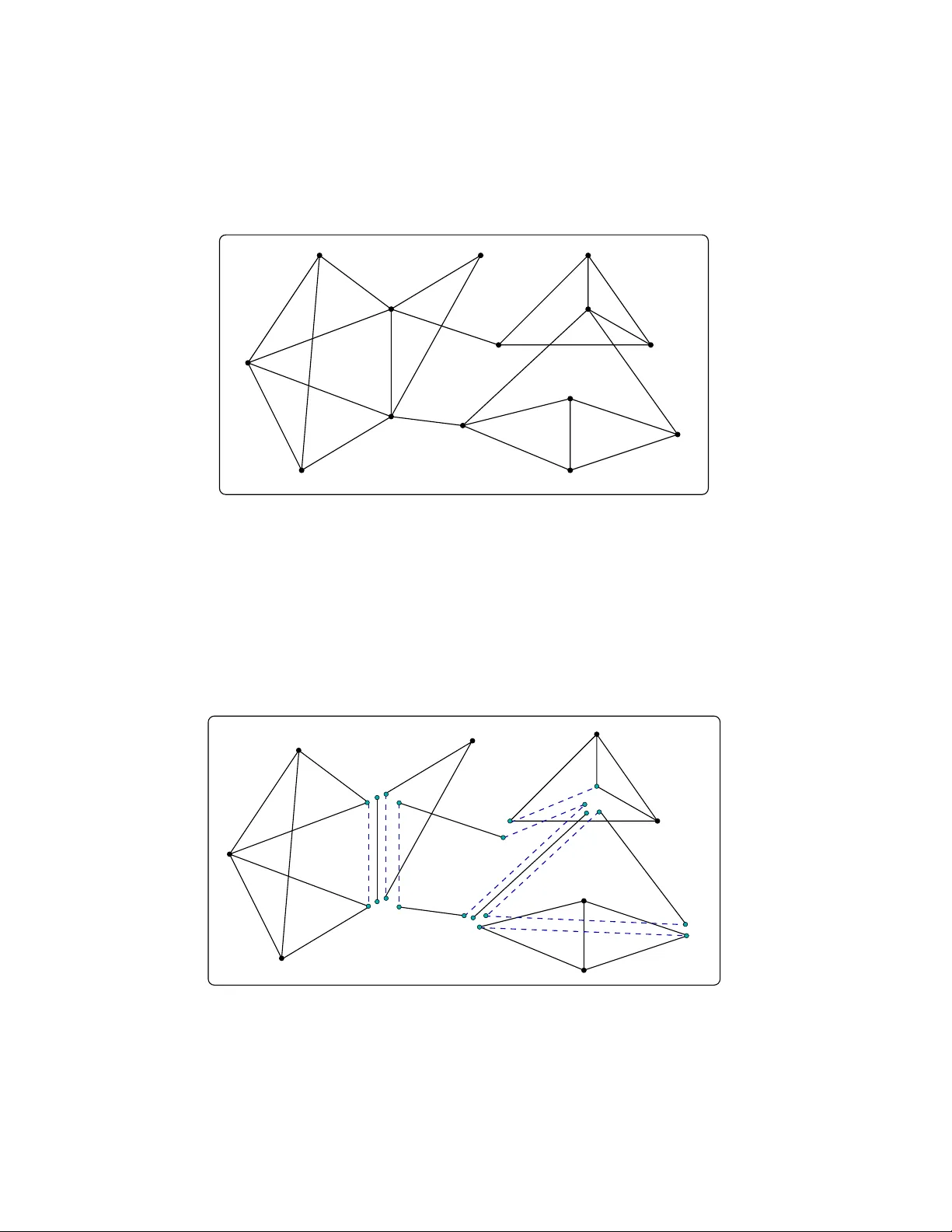
Tw o-connected graphs with prescrib ed three-connected comp onen ts Andrei Gagarin ∗ , Gilb ert Lab elle † , Pierre Leroux † , and Timoth y W alsh † Octob er 22, 2018 Abstract W e adapt the classical 3-decomp osition of any 2-connected graph to the case of simple graphs (no loops or multiple edges). By analogy with the block-cutpoint tree of a connected graph, w e deduce from this decomp osition a bicolored tree tc( g ) asso- ciated with any 2-connected graph g , whose white v ertices are the 3-c omp onents of g (3-connected comp onen ts or p olygons) and whose black v ertices are bonds linking together these 3-comp onen ts, arising from separating pairs of v ertices of g . Tw o fundamen tal relationships on graphs and netw orks follow from this construction. The first one is a dissymmetry theorem whic h leads to the expression of the class B = B ( F ) of 2-connected graphs, all of whose 3-connected comp onen ts b elong to a giv en class F of 3-connected graphs, in terms of v arious ro otings of B . The second one is a functional equation which c haracterizes the corresp onding class R = R ( F ) of t wo-pole net works all of whose 3-connected comp onen ts are in F . All the ro ot- ings of B are then expressed in terms of F and R . There follo w corresp onding iden tities for all the asso ciated series, in particular the edge index series. Numerous en umerative consequences are discussed. 1 In tro duction A graph is assumed to b e simple, that is, with no loops or m ultiple edges. A graph G is called k -c onne cte d if at least k of its v ertices and their inciden t edges m ust b e deleted to disconnect it. In general, a k -connected graph is assumed to hav e more than k vertices. Ho wev er, by conv en tion, the complete graph K 2 will be considered as a 2-connected graph. A connected graph G is planar if there exists a 2-cell em b edding (i.e. eac h face is ∗ Jo drey Sc ho ol of Computer Science, Acadia Univ ersity , W olfville, Nov a Scotia, Canada, B4P 2R6. † Lab oratoire de Combinatoire et d’Informatique Math´ ematique (LaCIM), Universit ´ e du Qu´ eb ec ` a Mon tr ´ eal (UQAM), Mon tr ´ eal, Qu ´ eb ec, CANAD A, H3C 3P8. With the partial support of NSERC (Canada). 1 homeomorphic to an op en disk) of G on the sphere, with similar definitions for tor oidal and pr oje ctive-planar graphs. A sp e cies is a class C of lab elled combinatorial structures (for example, graphs or rooted trees) which is closed under isomorphism. Eac h C -structure has an underlying set (for example, the v ertex set of a graph), and isomorphisms are obtained b y relab elling along bijections b et w een the underlying sets. Unlabelled structures are defined as isomorphism classes of structures. W e sometimes denote a species b y the name of represen tativ es of the isomorphism classes. F or example, K n is used to denote the sp ecies of complete graphs on n vertices. One adv an tage of sp ecies is that v ery often com binatorial identities can b e expressed at this structural level, within the algebra of sp ecies and their op erations (sum, pro duct, substitution and a sp ecial substitution, of netw orks for edges, etc.). There follo w corresponding iden tities for the v arious generating series that are used for labelled and / or unlab elled en umeration. The reader is referred to the b o ok [1] for more details on sp ecies, their op erations and asso ciated series. The t wo-pole net works that we use hav e distinguished p oles 0 and 1 and are called 01-net works. A 01- network (or more simply a network ) is defined as a connected graph N with tw o distinguished vertices 0 and 1, such that the graph N ∪ 01 is 2-connected, where the notation N ∪ ab is used for the graph obtained from N by adding the edge ab if it is absent. See Figure 1 for an example. The v ertices 0 and 1 are called the p oles of N , and all the other vertices of N are called internal v ertices. The in ternal v ertices of a net work form its underlying set. The trivial net work, consisting of only the p oles 0 and 1 and having no edges, is denoted b y 1 1. b y x z 1 a c 0 Figure 1: A 01-netw ork In this pap er, we first adapt to the case of simple graphs the classical 3-decomp osition of 2-connected multigraphs (see Maclaine [12] T utte [18, 19], Hop croft and T arjan [9] and Cunningham and Edmonds [4]). By analogy with the block-cutpoint tree b c( c ) of a connected graph c , w e deduce from this decomp osition a bicolored tree tc( g ) asso ciated with an y 2-connected graph g , whose white vertices are the 3-c omp onents of g (3-connected comp onen ts or p olygons) and whose black vertices are b onds linking together these 3- comp onen ts, arising from separating pairs of v ertices of g , acting as hinges. Tw o fundamental relationships on graphs and netw orks follow from this construction. The first one is a dissymmetry theorem which leads to the expression of the class B = B ( F ) of 2-connected graphs, all of whose 3-connected comp onen ts b elong to a giv en class F of 3-connected graphs in terms of v arious ro otings of B . See Theorem 1 b elo w. The second one is a functional equation whic h characterizes the corresp onding class R = R ( F ) of non- 2 trivial 01-netw orks all of whose 3-connected comp onents are in F . See Theorem 8. Note that the 3-comp onents of a net w ork N are obtained b y considering the 3-decomp osition of the graph N ∪ 01. All the ro otings of B are then expressible in terms of F and R and hence also B itself b y virtue of the dissymmetry theorem. Although more or less implicit in previous w ork of one of the authors (see [21, 22]), these identities are given here for the first time in the structural con text of sp ecies. There follo w corresponding identities for all the associated series, in particular the edge index series, and n umerous en umerative consequences are obtained. Among the examples that we ha v e in mind and that will b e discussed further in this pap er are the following: 1. If w e tak e F = F all , the class of all 3-connected graphs, then w e ha ve B ( F ) = B all , the class of all 2-connected graphs, and R ( F ) = R all , the class of all non-trivial 01-net works. 2. If we tak e F = 0, the empty sp ecies, then B and R are the classes of 2-connected series-p ar al lel graphs and of series-p ar al lel netw orks, resp ectiv ely . 3. One of the motiv ations for the presen t pap er was to extend some earlier tables for the num b er of K 3 , 3 -free pro jectiv e planar and toroidal 2-connected graphs (see [7]), whic h require the en umeration of str ongly planar networks , that is of non-trivial net works N such that the graph N ∪ 01 is planar. This class, denoted b y N P , can b e obtained by considering the class F = F P of planar 3-connected graphs. Then the corresp onding sp ecies B P = B ( F P ) is the class of planar 2-connected graphs, since a graph is planar if and only if all its 3-connected comp onen ts are planar, and R ( F P ) = N P , the class of strongly planar net works. 4. As quoted by Thomas (see [16], Theorem 1.2, page 1), W agner [20] has sho wn that a 2-connected graph is K 3 , 3 -free if and only if it can b e obtained from planar graphs and K 5 ’s by means of 2-sums (see also Kelmans [11]). This means that if we take F = F P + K 5 , then the corresp onding B = B ( F ) is the class of K 3 , 3 -free 2-connected graphs. This fact was also observed by Gimenez, Noy and Ru ´ e in [8]. Section 2 contains the dissymmetry theorem. Section 3 discusses v arious op erations on 01-netw orks, in particular series and parallel comp osition and the substitution of net- w orks for edges in graphs or net works. It also presen ts the fundamental relationship c haracterizing the sp ecies R = R ( F ) and the expressions of the v arious ro otings of B in terms of F and R . Applications to the lab elled enumeration of these sp ecies are also presen ted. Section 4 is devoted to the series tec hniques for sp ecies of graphs and netw orks that are necessary for their unlab elled enumeration. These results are then applied to the en umeration of several classes of graphs and net works in Section 5. 3 2 A dissymmetry theorem for 2 -connected graphs. In the standard decomposition of a 2-connected multigraph (multiple edges allo wed but no lo ops) into 3-comp onen ts (see [18, 19, 9] and [4]), the comp onents are either 3-connected graphs (here called 3-c onne cte d c omp onents ), p olygons with at least three sides, or b onds, that is sets of at least 3 multiple edges. g a c e f l m n b i j d h k Figure 2: A 2-connected graph g Ho wev er, in the case of simple graphs, b onds are not needed as 3-comp onents and the decomp osition is simpler. W e illustrate the construction with the graph g of Figure 2. By definition, a sep ar ating p air of a 2-connected graph g is a pair of vertices { x, y } whose remo v al disconnects the graph. One can then in eac h resulting connected comp onent re-in tro duce the tw o v ertices x and y together with their incident edges and the edge xy . e a b c d A P T U B C f Figure 3: The 3-decomp osition of g 4 W e also note whether the edge xy is presen t or not in the original graph g . This has b een done in Figure 3 for the separating pairs { a, b } , { c, d } , { c, f } and { e, f } and w e see the 3-components appearing: the 3-connected comp onents A , B , and C , and the polygons P , T and U . The ab ov e dissection could also b e p erformed for the separating pairs { a, e } or { c, e } , for example, but that would cut the p olygon P in to smaller p olygons; so it is not done since the maximalit y of the p olygonal comp onen ts ensures the unicit y of the decomp osition. W e refer the reader to the bibliography for more details. The essential separating pairs of g , ( { a, b } , { c, d } , { c, f } and { e, f } in the example) will b e referred to as the b onds of the 3-decomp osition. Hence a b ond { x, y } links together 2 or more 3-comp onen ts, together with p ossibly the edge xy , with the exception of tw o p olygons alone which is forbidden. By analogy with the blo ck-cutpoint tree b c( c ) of a connected graph c , w e deduce from this decomp osition a bicolored tree tc( g ) asso ciated with any 2-connected graph g , whose white vertices are the 3-comp onents of g (3-connected components or polygons) and whose blac k v ertices are the separating pairs linking together these 3-comp onents (the b onds). See Figure 4. ab cf cd ef B U C A T P Figure 4: The tc-tree of g No w let F b e a given sp ecies of 3-connected graphs and B = B F b e the class of 2- connected graphs all of whose 3-connected components are in F . Note: b y conv en tion, K 2 is in B . W e in tro duce the follo wing classes of r o ote d graphs in B , relativ e to the concept of tc-tree: B ◦ denotes the class of all graphs g ∈ B , ro oted at a distinguished 3-comp onen t (3-connected comp onen t or p olygon); B • denotes the class of all graphs g ∈ B together with a distinguished b ond; B ◦−• denotes the class of all graphs g ∈ B with a distinguished pair of adjacen t 3-comp onen t and b ond. Theorem 1 (Dissymmetry Theorem for 2-connected graphs). L et F b e a given sp e cies of 3-c onne cte d gr aphs and B = B F b e the class of 2-c onne cte d gr aphs al l of whose 3-c onne cte d c omp onents ar e in F . We then have the fol lowing identity (sp e cies isomor- phism): B ◦ + B • = B − K 2 + B ◦−• . (1) 5 Pro of. The pro of uses the concept of c enter of a tree. Notice that all the lea ves of a tc-tree are of the same color (white). This implies that its center is a vertex, blac k or white. No w a structure s b elonging to the left-hand side of (1) is a graph g ∈ B whic h is ro oted at either a tricomp onen t or a b ond of g , that is at a white or blac k vertex of tc( g ). It can happ en that the ro oting is p erformed right at the center. This is canonically equiv alen t to doing nothing and is represen ted b y the term B − K 2 in the righ t-hand side of (1). On the other hand, if the ro oting is done at an off-cen ter v ertex, black or white, then there is a unique adjacent vertex of the other color in tc( g ) which is lo cated closer to the cen ter, thus defining a unique B ◦−• -structure. It is easily chec k ed that this corresp ondence is bijective and indep endent of any lab elling, giving the desired sp ecies isomorphism. Our next goal is to find closed form expressions for the sp ecies B ◦ , B • and B ◦−• . This will b e achiev ed using the op eration of substitution of 01-netw orks for the edges of c or e graphs, as explained in the next section. 3 Op erations on net w orks and their exp onen tial gen- erating functions. W e first describ e the exp onential generating functions which are used for the lab elled en umeration of graphs and netw orks and of related sp ecies, according to the num b er of edges. F or a sp ecies G of graphs the exp onential generating function G ( x, y ), where the v ariable y acts as an edge coun ter, is defined b y G ( x, y ) = X n ≥ 0 g n ( y ) x n n ! = X n ≥ 0 X m ≥ 0 g n,m y m x n n ! , (2) where g n,m is the num b er of graphs in G with m edges ov er a giv en n -elemen t set of v ertices. Similar definitions can b e given for asso ciated (for example ro oted) sp ecies of graphs. F or a sp ecies N of 01-net works, the exp onential generating function N ( x, y ) is defined by N ( x, y ) = X n ≥ 0 ν n ( y ) x n n ! = X n ≥ 0 X m ≥ 0 ν n,m y m x n n ! , (3) where ν n,m is the n umber of 01-netw orks in N with m edges ov er an n -element set of in ternal v ertices. W e define an op erator τ acting on 01-net works, N 7− → τ · N , that interc hanges the p oles 0 and 1. A class N of net works is called symmetric if N ∈ N = ⇒ τ · N ∈ N . If M is a sp ecies of netw orks not containing the edge 01, then we denote b y y M the class obtained b y adding this edge to all the netw orks in M . Observe that there are t wo distinct net works on the empty set, namely , the trivial network 1 1 consisting of tw o isolated vertices 0 and 1, and the one-edge net work y 1 1. 6 Let B b e a given sp ecies of 2-connected graphs, for example B = B all , the class of all 2-connected graphs, B = K 2 , or B = B P , the class of all 2-connected planar graphs. W e denote by B ( y ) the sp ecies of graphs obtained b y selecting and removing an edge from graphs in B in all p ossible w ays. Note that the remov ed edge is remembered so that B ( y ) ( x, y ) = ∂ ∂ y B ( x, y ) . (4) If, moreo ver, the endpoints of the selected and remov ed edge are unlab elled and num b ered as 0 and 1, in all p ossible wa ys, the resulting class of netw orks is denoted b y B 0 , 1 . F or example, ( B all ) 0 , 1 is the class of netw orks having non-adjacen t p oles, ( K 2 ) 0 , 1 = 1 1, and the class of strongly planar netw orks can b e expressed as N P = (1 + y )( B P ) 0 , 1 − 1 1, where the m ultiplication y · B 0 , 1 corresp onds to adding the edge 01 to all netw orks in B 0 , 1 . As another example, ( K 5 ) 0 , 1 , is illustrated in Figure 11. Relab elling the t wo p oles yields the iden tity x 2 B 0 , 1 ( x, y ) = 2 B ( y ) ( x, y ) (5) so that B 0 , 1 ( x, y ) = 2 x 2 ∂ ∂ y B ( x, y ) . (6) 3.1 Series comp osition Definition 2 a) Let M and N b e tw o non-trivial disjoint net works. The series c omp osi- tion of M follow ed b y N , denoted by M · s N , is a v ertex-ro oted netw ork whose underlying set is the union of the underlying sets of M and N plus an extra element. It is obtained b y taking the graph union of M and N , where the 1-pole of M is identified with the 0-p ole of N , and this c onne cting vertex is lab elled b y the extra element and is the ro ot of M · s N . See Figure 5. b) The underlying (unro oted) net work of a series composition is called an s - network . c) The series c omp osition M · s N of tw o sp ecies of non-trivial netw orks M and N is the class obtained by taking all series comp ositions M · s N of netw orks with M ∈ M and N ∈ N . The sp ecies M · s N can b e expressed as the sp ecies pro duct M X N , where the factor X corresp onds to the connecting v ertex, and we hav e ( M · s N )( x, y ) = x M ( x, y ) N ( x, y ) . (7) If for an y M · s N -structure the t w o comp onen ts M ∈ M and N ∈ N are uniquely determined by the resulting net w ork (for example if no M ∈ M is an s -netw ork), then the series comp osition is called c anonic al and the ro oting of the connecting vertex can b e neglected. W e say that a sp ecies of net works R is close d under series c omp osition and de c omp osition if for any s -netw ork R , R is in R if and only if each individual factor of R is in R . 7 g 0 b a e f d c 0 1 b a d 0 c e 1 1 f g Figure 5: Series comp osition of netw orks Prop osition 3 L et R b e a sp e cies of networks which is close d under series c omp osition and de c omp osition and let S denote the class of s -networks in R . Then we have S = ( R − S ) · s R (8) the series c omp osition b eing c anonic al, and also S = X R 2 1 + X R . (9) Pro of . An y s -netw ork in R can b e decomp osed uniquely into a first net w ork whic h is not an s -net work follo w ed b y an arbitrary net work of R , whence (8). W e also ha ve S = ( R − S ) X R and solving for S yields (9). Corollary 4 Under the hyp othesis of Pr op osition 3, we have, for the exp onential gener- ating function, S ( x, y ) = x R 2 ( x, y ) 1 + x R ( x, y ) . (10) Remark. Iterating the idea behind the decomp osition (8), one has the more symmetric canonical decomp osition S = ( R − S ) · s ( R − S ) + ( R − S ) · s ( R − S ) · s ( R − S ) + · · · . (11) 3.2 P arallel comp osition Definition 5 a) Let N b e a finite set of disjoint non-trivial 01-netw orks ha ving non- adjacen t p oles. The p ar al lel c omp osition of N is the p artitione d 01-netw ork obtained b y taking the union of the graphs in N , where all 0-p oles are merged in to one 0-p ole, and similarly for the 1-p oles; the partition of the internal v ertices into those of the net w orks 8 of N is part of the structure. An example is given in Figure 6. By con ven tion, the par- allel comp osition of an empt y set of net works is the trivial net work 1 1, while the parallel comp osition of one netw ork is the net work itself. b) The underlying (unpartitioned) net w ork of a parallel composition of at least t w o net- w orks is called a p - network . An y netw ork having adjacen t p oles is also considered as a p -net work. c) If N is a sp ecies of non-trivial 01-net works ha ving non-adjacent p oles, then the p ar- al lel c omp osition of N is defined as the class of all parallel comp ositions of finite sets of disjoin t net w orks in N . This op eration is denoted by E ( N ), the ordinary comp osition of sp ecies, where E denotes the sp ecies of sets, since a parallel comp osition can b e seen as an assem bly of netw orks, with all 0-p oles iden tified and also all 1-p oles. As mentioned ab o v e, 1 1 = E 0 ( N ) and N = E 1 ( N ). f 0 1 d 0 1 0 1 e f b a 0 c 1 ab c d e Figure 6: P arallel composition of netw orks If each netw ork in a class M can b e view ed unam biguously as a parallel comp osition of net works in N , then we sa y that the parallel composition is called c anonic al . This happ ens if and only if none of the net w orks in N is a p -netw ork. Then w e can write M = E ( N ) and for the exp onen tial generating functions, we ha v e M ( x, y ) = exp( N ( x, y )) . (12) 3.3 The ↑ -comp osition (substitution of netw orks for edges) Definition 6 Let M be a sp ecies of graphs (or netw orks) and N be a symmetric sp ecies of non-trivial net works. W e denote by T = M ↑ N the class of pairs ( M , T ) such that 1. the graph (or netw ork) M (called the c or e ) is in M , 2. there exists a family { N e } of netw orks in N (called the c omp onents ) suc h that the graph T can b e obtained from M b y substituting N e for each edge e of M , the p oles of N e b eing iden tified with the extremities of e . 9 1 0 0 0 1 1 0 h c M b c f g i T d 0 1 h a e j 0 b f g i N e } { 1 d a j e 1 1 0 Figure 7: Example of a ( M ↑ N )-structure ( M , T ), with M = K 4 \ e An example of an ( M ↑ N )-structure ( M , T ) is presen ted in Figure 7, where M = K 4 \ e and N is the class of all netw orks. Notice that if the net work N e whic h is substituted for the edge e = xy is not the one-edge netw ork y 1 1, then the pair of vertices { x, y } is a separating pair of T . As another example, take G = K 2 and let N be any symmetric sp ecies of netw orks. Then K 2 ↑ N consists of ro oted graphs obtained from netw orks in N b y lab elling the tw o p oles 0 and 1, the ro oting b eing at this pair of vertices. Prop osition 7 L et M b e a sp e cies of gr aphs (or networks) and N b e any symmetric sp e cies of non-trivial networks. Then we have, for the lab el le d enumer ation, ( M ↑ N )( x, y ) = M ( x, N ( x, y )) . (13) Pro of . See [21] or [5]. The comp osition M ↑ N is called c anonic al if for any structure ( M , T ) ∈ M ↑ N the core M ∈ M is uniquely determined by the graph (or netw ork) T . In this case, we can iden tify M ↑ N with the species of resulting graphs (or net works) T . 3.4 F unctional equations Let F b e a species of 3-connected graphs and let B = B F (resp. R = R F ) denote the class of all 2-connected graphs (resp. non-trivial net w orks) all of whose 3-connected comp onen ts are in F , where the 3-comp onen ts of a net w ork N are defined by applying the 3-decomp osition to the graph N ∪ 01. Then R = (1 + y ) B 0 , 1 − 1 1 , (14) where multiplication by y corresp onds to adding the edge 01 to all netw orks in B 0 , 1 . 10 One example of a non-canonical ↑ -comp osition is given b y F ↑ R which represen ts the sp ecies of 2-connected graphs in B ro oted at some 3-connected comp onent. By contrast, as stated in Theorem 8 b elow, any comp osition of the form F 0 , 1 ↑ N is canonical. Let S denote the sub class of R consisting of s -netw orks. By virtue of Prop osition 3, w e ha ve S = X R 2 1 + X R . (15) P arts a) and b) of the next theorem can b e seen as a sp ecies form of T rakhten brot’s decomp osition theorem [17] which w as originally stated and pro ved for netw orks in which parallel edges are allo w ed. See [21, 22] for a precise statemen t of T rakh tenbrot’s Theorem. A pro of in English is a v ailable from the fourth author on request. Theorem 8 L et F b e a sp e cies of 3 -c onne cte d gr aphs and R = R F b e the c orr esp onding class of 01 -networks asso ciate d to F . Then: a) F or any (symmetric) sp e cies N of non-trivial networks, the c omp osition F 0 , 1 ↑ N is c anonic al. b) L et H denote the sub class of h -networks, define d by H = F 0 , 1 ↑ R . (16) Then we have R = S + P + H , (17) wher e P denotes the sub class of p -networks of R (see Definition 5 b)) , which satisfies P = (1 + y ) E ≥ 2 ( H + S ) + y ( H + S ) + y 1 1 . (18) c) The sp e cies R is char acterize d by the functional r elation R = (1 + y ) E ( F 0 , 1 ↑ R + X R 2 1 + X R ) − 1 1 . (19) Pro of . As men tioned ab ov e, parts a) and b) are essentially a reformulation of T rakhten- brot’s decomp osition theorem for netw orks, where parallel edges are not allo w ed. In tu- itiv ely , for a), observ e that in any F 0 , 1 -net work M , the p oles are non-adjacent. Hence, the same will b e true for any net w ork T arising from a F 0 , 1 ↑ N -structure ( M , T ). Applying the 3-decomp osition of 2-connected graphs of Section 2 to the graph T ∪ 01, we can see that th ere is a unique 3-connected component in T containing the vertices 0 and 1, namely M itself. F or b), it is easy to see whether a net w ork N ha ving non-adjacen t p oles is an s -net work (the graph is not 2-connected) or a p -net work (the poles form a separating pair) and, otherwise, that N is in fact of the form F 0 , 1 ↑ R , again using the 3-decomp osition of 2-connected graphs. If the netw ork has adjacen t p oles, then it m ust b e of the form y ( 1 1 + H + S + E ≥ 2 ( H + S ) = y E ( H + S )) so that (17) and (18) are satisfied. c) Putting (17) and (18) together, w e find that R = H + S + y 1 1 + y ( H + S ) + (1 + y ) E ≥ 2 ( H + S ) = (1 + y ) E ( H + S ) − 1 1 (20) 11 and (19) follo ws from (20), (16) and (15). W e are no w in p osition to express the three ro otings B ◦ , B • and B ◦−• of the sp ecies B = B F asso ciated with a given sp ecies of 3-connected graphs F , which o ccur in the Dissymmetry Theorem for 2-connected graphs (Theorem 1), in terms of the corresponding class R = R F of 01-net w orks. Let C denote the sp ecies of p olygons, that is of (unorien ted) cycles of length ≥ 3. Theorem 9 We have the fol lowing identities: B ◦ = F ↑ R + C ↑ ( R − S ) , (21) B • = K 2 ↑ (1 + y ) E ≥ 2 ( H + S ) − E 2 ( S ) (22) = K 2 ↑ R − (1 + y )( H + S ) − y 1 1 − E 2 ( S ) , (23) B ◦−• = K 2 ↑ ( H + S )( R − y 1 1) − S 2 , (24) wher e R is char acterize d by e quation (19) , S = X R 2 1+ X R and H = F 0 , 1 ↑ R . Pro of . Recall that B ◦ denotes the class of all graphs g ∈ B ro oted at a distinguished 3-comp onen t. If the distinguished comp onen t C is a 3-connected graph, then g is obtained b y replacing each edge of C b y a netw ork in R . Otherwise, C is a p olygon and g will be obtained by replacing eac h edge of C by a netw ork in R − S , by virtue of the maximality of p olygonal 3-comp onen ts. This establishes (21). Also recall that the K 2 ↑ op erator transforms netw orks in to ro oted graphs by labelling the tw o p oles 0 and 1, the ro oting b eing at this pair of v ertices. Now B • denotes the class of all graphs g ∈ B together with a distinguished b ond. This separating pair { a, b } decomp oses g in to t wo or more pieces whic h can b e seen as either h -net w orks or s -net works. This yields the term (1 + y ) E ≥ 2 ( H + S ), the factor (1 + y ) accounting for the p ossibility that the vertices a and b b e adjacent. How ev er, the case of a non-adjacent separating pair joining tw o s -net works has to b e excluded since this would imply decomp osing a p olygon in to t w o smaller ones, which is prohibited. Hence (22). F orm ula (23) then follo ws easily , using (20). The pro of of (24) is similar, the difference b eing that now one of the separated com- p onen ts is also distinguished. Details are left to the reader. Corollary 10 (Explicit form of the Dissymmetry Theorem) L et F b e a given sp e- cies of 3-c onne cte d gr aphs and B = B F b e the sp e cies of 2-c onne cte d gr aphs al l of whose 3-c onne cte d c omp onents ar e in F . Also let R = R F denote the c orr esp onding sp e cies of 01-networks. We then have the fol lowing identity: B = F ↑ R + C ↑ ( R − S ) + K 2 ↑ R − ( H + S )( R + 1) − E 2 ( S ) + S 2 , (25) wher e R is char acterize d by e quation (19) , S = X R 2 1+ X R and H = F 0 , 1 ↑ R . 12 4 Series tec hniques for the unlab elled en umeration of graphs and net w orks T raditionally , tw o generating series are used for the unlab elled enumeration of structures: the ordinary (tilde) generating function and the cycle index series. These are now review ed in the con text of graphs and net w orks where the num b er of vertices and the num b er of edges are taken into account and where a v arian t of the cycle index series is necessary when dealing with the ↑ -composition, the substitution of net works for edges. This v ariant, the e dge index series , is introduced in [22] and called W alsh index series in [7]. Detailed pro ofs of most of their main prop erties can b e found in [7]. F or a sp ecies M of (p ossibly ro oted) graphs or netw orks, the ordinary ( tilde ) gener- ating function f M ( x, y ) = M ˜ ( x, y ) is defined as follo ws: f M ( x, y ) = X n ≥ 0 ˜ µ n ( y ) x n = X n ≥ 0 X m ≥ 0 ˜ µ n,m y m x n , (26) where ˜ µ n,m is the num b er of isomorphism classes of graphs (resp. netw orks) in M ha ving n vertices (resp. in ternal vertices) and m edges. Let G b e a sp ecies of graphs and let N b e a sp ecies of net works. The three edge index series W G ( a ; b ; c ), W + N ( a ; b ; c ) and W − N ( a ; b ; c ), in v ariables a = ( a 1 , a 2 , . . . ), b = ( b 1 , b 2 , . . . ) and c = ( c 1 , c 2 , . . . ) are defined in what follo ws. Let G = ( V ( G ) , E ( G )) b e a graph in G . A p ermutation σ of V ( G ) that is an au- tomorphism of the graph G induces a p erm utation σ (2) of the set E ( G ) of edges whose cycles are of t wo p ossible sorts: if c is a cycle of σ (2) of length l , then either σ l ( a ) = a and σ l ( b ) = b for each edge e = ab of c (a cylindric al edge cycle), or else σ l ( a ) = b and σ l ( b ) = a for each edge e = ab of c (a M¨ obius edge cycle). F or example, the au- tomorphism σ = (1 , 2 , 3 , 4)(5 , 6 , 7 , 8) of the graph of Figure 8 (i) induces the cylindrical edge cycle (15 , 26 , 37 , 48), and the automorphism σ = (1 , 2 , 3 , 4 , 5 , 6 , 7 , 8) of the graph of Figure 8 (ii) induces the M¨ obius edge cycle (15 , 26 , 37 , 48). 1 3 4 5 6 8 1 3 4 5 6 7 8 2 2 7 i) ii) Figure 8: (i) Cylindrical edge cycle, (ii) M¨ obius edge cycle. F or an automorphism σ ∈ Aut( G ) of G , denote by σ k the num b er of cycles of length k of σ , by cyl k ( G, σ ) the n umber of cylindrical edge cycles of length k , and b y m¨ ob k ( G, σ ) the n um b er of M¨ obius edge cycles of length k induced by σ in G . Given a graph G ∈ G 13 and an automorphism σ of G , the weight w ( G, σ ) of suc h a structure is the following cycle index monomial: w ( G, σ ) = a σ 1 1 a σ 2 2 · · · b cyl 1 ( G,σ ) 1 b cyl 2 ( G,σ ) 2 · · · c m¨ ob 1 ( G,σ ) 1 c m¨ ob 2 ( G,σ ) 2 · · · . (27) The e dge index series W G ( a ; b ; c ) of G is defined as W G ( a ; b ; c ) = X G ∈ Typ( G ) 1 | Aut( G ) | X σ ∈ Aut( G ) w ( G, σ ) , (28) where the notation G ∈ T yp( G ) means that the summation should b e tak en o ver a set of represen tatives G of the isomorphism classes of graphs in G . Examples. 1. The edge index series of the species K 2 is given by W K 2 = 1 2 ( a 2 1 b 1 + a 2 c 1 ) . (29) 2. The edge index series of the species C n of (unorien ted) cycles of length n is a refinemen t of the usual cycle index p olynomial for C n . It is given b y W C n ( a ; b ; c ) = 1 2 n X d | n φ ( d ) a n d d b n d d + 1 2 ( a 1 a n − 1 2 2 b n − 1 2 2 c 1 , n o dd 1 2 ( a n 2 2 b n − 2 2 2 c 2 1 + a 2 1 a n − 2 2 2 b n 2 2 ) , n even (30) where φ is the Euler φ -function. See [22] and [7] which con tains a t yp o in formula (43). By summing o ver n ≥ 3, w e obtain the edge index series of C . The result is W C = 1 2 X d ≥ 1 φ ( d ) d log 1 1 − a d b d − 1 2 a 1 b 1 − 1 4 a 2 1 b 2 1 − 1 4 a 2 b 2 + 1 4 (2 a 1 c 1 + a 2 c 2 1 + a 2 1 b 2 ) a 2 b 2 1 − a 2 b 2 . (31) Note that any isomorphism of netw orks ϕ : N ˜ − → N 0 is assumed to b e p ole-preserving, i.e. ϕ (0) = 0 and ϕ (1) = 1. In particular, any automorphism of a netw ork N should b e p ole-preserving. It will b e necessary to consider the sub class N τ of N consisting of τ - symmetric networks , i.e. N τ = { N ∈ N | τ · N ' N } . (32) Let U be the underlying set of a netw ork N and supp ose that σ is in S [ U ], i.e. σ is a p ermutation of U . W e can extend σ to p ermutations on U ∪ { 0 , 1 } , σ + = (0)(1) σ and σ − = (0 , 1) σ ; in other words, σ + preserv es the p oles and σ − exc hanges them. F or any net work N ∈ N , denote by ˆ N the corresp onding graph on U ∪ { 0 , 1 } . Then we introduce the notation Aut + ( N ) = { σ ∈ S [ U ] | σ + ∈ Aut( ˆ N ) } (33) 14 and Aut − ( N ) = { σ ∈ S [ U ] | σ − ∈ Aut( ˆ N ) } . (34) In other w ords, a σ + in (33) is a p ole-preserving graph automorphism, i.e. a netw ork automorphism, while a σ − in (34) is a p ole-reversing gr aph automorphism. Notice that Aut + ( N ) = Aut( N ) and that if Aut − ( N ) is not empt y , then | Aut − ( N ) | = | Aut + ( N ) | . This can b e seen b y using the comp osition of automorphisms. F or N ∈ N and σ ∈ Aut + ( N ), w e assign the w eigh t w ( N , σ ) = w ( ˆ N , σ + ) a 2 1 , (35) where the second w is defined b y (27), and for N ∈ N and σ ∈ Aut − ( N ), w e set w ( N , σ ) = w ( ˆ N , σ − ) a 2 . (36) In other words, only the in ternal vertex cycles are accoun ted for. Then, for a sp ecies N of netw orks, the follo wing tw o e dge index series are defined by W + N ( a ; b ; c ) = X N ∈ T yp( N ) 1 | Aut + ( N ) | X σ ∈ Aut + ( N ) w ( N , σ ) , (37) W − N ( a ; b ; c ) = X N ∈ Typ( N τ ) 1 | Aut − ( N ) | X σ ∈ Aut − ( N ) w ( N , σ ) . (38) As the next prop osition sho ws, the edge index series con tain all the enumerativ e (la- b elled and unlab elled) information. Prop osition 11 ([7, 22]) L et G b e a sp e cies of gr aphs and N b e a sp e cies of networks. Then the fol lowing series identities hold: G ( x, y ) = W G ( x, 0 , 0 , . . . ; y , y 2 , y 3 , . . . ; y , y 2 , y 3 , . . . ) , (39) e G ( x, y ) = W G ( x, x 2 , x 3 , . . . ; y , y 2 , y 3 , . . . ; y , y 2 , y 3 , . . . ) , (40) N ( x, y ) = W + N ( x, 0 , 0 , . . . ; y , y 2 , y 3 , . . . ; y , y 2 , y 3 , . . . ) , (41) e N ( x, y ) = W + N ( x, x 2 , x 3 , . . . ; y , y 2 , y 3 , . . . ; y , y 2 , y 3 , . . . ) , (42) N τ ( x, y ) = W − N ( x, 0 , 0 , . . . ; y , y 2 , y 3 , . . . ; y , y 2 , y 3 , . . . ) , (43) e N τ ( x, y ) = W − N ( x, x 2 , x 3 , . . . ; y , y 2 , y 3 , . . . ; y , y 2 , y 3 , . . . ) . (44) Another description of the edge index series is v ery useful for understanding them and for establishing their properties. It consists of expressions which inv olve exp onen tial generating functions of lab elled en umeration. These are recalled from Section 6 of [7]. 15 F ollo wing an idea of Joy al [10], w e in tro duce the auxiliary weigh ted sp ecies G aut = G aut w . F or any finite set U (of v ertices), G aut [ U ] is defined as the set of graphs in G [ U ] equipp ed with an automorphism σ , i.e. G aut [ U ] = { ( G, σ ) | G ∈ G [ U ] , σ ∈ S [ U ] : σ · G = G } , where S [ U ] is the set of all p erm utations of U . The relab elling rule of G aut -structures along a bijection β : U ˜ − → U 0 is defined as follows: β · ( G, σ ) = ( β · G, β ◦ σ ◦ β − 1 ) , where β · G is the graph obtained from G b y relab elling along β and the comp osition ◦ is taken from righ t to left. It is easy to v erify that G aut w is a well-defined weigh ted sp ecies, where the weigh t function w ( G, σ ) is the cycle index monomial defined by (27). Recall that |G aut [ n ] | w denotes the total weigh t of G aut w -structures ov er the vertex set [ n ] := { 1 , 2 , . . . , n } , i.e. |G aut [ n ] | w = X ( G,σ ) ∈G aut w [ n ] w ( G, σ ) . Prop osition 12 ([7]) Using the exp onential gener ating function of lab el le d G aut w -structur es, we have W G ( a ; b ; c ) = X n ≥ 0 1 n ! |G aut [ n ] | w = G aut w ( x ) | x =1 . (45) Pro of . The pro of follo ws from the fact that the n um b er of distinct graphs on [ n ] obtained b y relab elling a giv en graph G with n v ertices is given b y n ! | Aut( G ) | . A similar approac h can b e used for the edge index series W + N and W − N of a giv en species of 2-p ole netw orks N . W e introduce the sets N + [ U ] = { ( N , σ ) | N ∈ N [ U ] , σ ∈ Aut + ( N ) } and N − [ U ] = { ( N , σ ) | N ∈ N [ U ] , σ ∈ Aut − ( N ) } , where Aut + ( N ) and Aut − ( N ) are defined b y (33) and (34), resp ectively . Then, using the w eight functions given by (35) and (36), N + w and N − w are weigh ted sp ecies whose lab elled en umerations yield by sp ecialization the series W + N and W − N . Prop osition 13 ([7]) F or a sp e cies of networks N , the e dge index series W + N and W − N c an b e expr esse d by the formulas W + N ( a ; b ; c ) = N + w ( x ) | x =1 , W − N ( a ; b ; c ) = N − w ( x ) | x =1 . (46) 16 In order to describ e the edge index series of an ↑ -comp osition, we in tro duce the fol- lo wing familiar plethystic notation. F or an y series of edge index type f ( a ; b ; c ) and an y in teger k ≥ 1, we set f k = f k ( a ; b ; c ) = f ( a k , a 2 k , a 3 k , . . . ; b k , b 2 k , b 3 k , . . . ; c k , c 2 k , c 3 k , . . . ) . (47) Morev ov er, for an y series ` = ` ( a ; b ; c ), f = f ( a ; b ; c ), g = g ( a ; b ; c ), h = h ( a ; b ; c ), we set ` [ f ; g ; h ]( a ; b ; c ) = ` ( f 1 , f 2 , f 3 , . . . ; g 1 , g 2 , g 3 , . . . ; h 1 , h 2 , h 3 , . . . ) (48) and for series α = α ( x, y ), β = β ( x, y ) and γ = γ ( x, y ), w e also set ` [ α ; β ; γ ]( x, y ) = ` α ( x, y ) , α ( x 2 , y 2 ) , α ( x 3 , y 3 ) , . . . ; β ( x, y ) , β ( x 2 , y 2 ) , β ( x 3 , y 3 ) , . . . ; γ ( x, y ) , γ ( x 2 , y 2 ) , γ ( x 3 , y 3 ) , . . . . (49) Theorem 14 ([7, 22]) L et G b e a sp e cies of gr aphs and N b e a symmetric sp e cies of networks. Then the e dge index series and the tilde series of the sp e cies G ↑ N ar e given by W G ↑N ( a ; b ; c ) = W G ( a 1 , a 2 , . . . ; W + N , W + N , 2 , . . . ; W − N , W − N , 2 , . . . ) = W G [ a 1 ; W + N ; W − N ] (50) and ( G ↑ N ) ˜ ( x, y ) = W G ( x, x 2 , . . . ; e N ( x, y ) , e N ( x 2 , y 2 ) , . . . ; e N τ ( x, y ) , e N τ ( x 2 , y 2 ) , . . . ) = W G [ x ; e N ( x, y ); e N τ ( x, y )] . (51) Pro of . See [7]. Similarly , for a comp osition of net works M ↑ N , w e ha ve the follo wing. Theorem 15 ([22]) L et M b e a sp e cies of networks and N b e a symmetric sp e cies of networks. Then the e dge index series and the tilde series of the sp e cies M ↑ N ar e given by W + M↑N ( a ; b ; c ) = W + M [ a 1 ; W + N ; W − N ] , (52) W − M↑N ( a ; b ; c ) = W − M [ a 1 ; W + N ; W − N ] , (53) and ( M ↑ N ) ˜ ( x, y ) = W + M [ x ; e N ( x, y ); e N τ ( x, y )] , (54) ( M ↑ N ) ˜ τ ( x, y ) = W − M [ x ; e N ( x, y ); e N τ ( x, y )] . (55) 17 Pro of . The pro of is similar to that of Theorem 14, giv en in [7]. F or (52) and (53), one uses the fact that the p oles of an M ↑ N -structure are preserved (resp. exchanged) if and only if the p oles of its core are preserved (resp. exc hanged). Notice that (54) and (55) are consequences of (52) and (53) by virtue of Prop osition 11. Prop osition 16 ([7, 22]) L et B b e a sp e cies of 2 -c onne cte d gr aphs, with K 2 ∈ B . Then the e dge index series of the asso ciate d sp e cies of networks B 0 , 1 and N B = (1 + y ) B 0 , 1 − 1 1 ar e given by W + B 0 , 1 ( a ; b ; c ) = 2 a 2 1 ∂ ∂ b 1 W B ( a ; b ; c ) , (56) W − B 0 , 1 ( a ; b ; c ) = 2 a 2 ∂ ∂ c 1 W B ( a ; b ; c ) , (57) W + N B ( a ; b ; c ) = (1 + b 1 ) W + B 0 , 1 ( a ; b ; c ) − 1 , (58) W − N B ( a ; b ; c ) = (1 + c 1 ) W − B 0 , 1 ( a ; b ; c ) − 1 . (59) Note that for the op erator N 7→ y N , where N is a sp ecies of netw orks with non-adjacen t p oles, whic h consists in adding the edge 01 to all netw orks in N , we ha ve W + y N = b 1 W + N and W − y N = c 1 W − N . (60) F or the series comp osition of netw orks, we ha v e the following edge index series iden- tities. Theorem 17 L et M and N b e sp e cies of non-trivial networks. Then we have W + M· s N ( a ; b ; c ) = a 1 W + M ( a ; b ; c ) W + N ( a ; b ; c ) , (61) W − M· s M ( a ; b ; c ) = a 1 W + M , 2 ( a ; b ; c ) , (62) W − M· s N · s M ( a ; b ; c ) = a 2 W + M , 2 ( a ; b ; c ) W − N ( a ; b ; c ) . (63) Pro of . W e can use the representations (46) for the edge index series W + and W − whic h in terpret these series as exp onential generating functions of lab elled structures. Thus in the first case we are interested in the exp onential generating function ( M · s N ) + w ( x ). No w a M · s N -structure is a pair ( M · s N , σ ), where M · s N is a series comp osition with M ∈ M and N ∈ N and σ is a p ole-preserving automorphism of M · s N . It is clear that the connecting v ertex of the series comp osition is left fixed b y σ and that σ can b e restricted to p ole-preserving automorphisms σ M and σ N of M and N , resp ectiv ely . Moreo ver, for the w eigh t w defined b y (35), w e hav e w ( M · s N , σ ) = a 1 w ( M , σ M ) w ( N , σ N ) . Hence the generating functions satisfy ( M · s N ) + w ( x ) = xa 1 M + w ( x ) N + w ( x ) and (61) follo ws. 18 In order to pro v e (62), one should en umerate structures of the form ( M · s M 0 , σ ), where M · s M 0 is a τ -symmetric series-comp osition net work, with M and M 0 in M , and σ is a p ole-rev ersing graph automorphism. In this case σ will leav e the connecting v ertex c fixed and will induce t wo net w ork isomorphisms ϕ = σ | M : M ˜ → τ M 0 and ρ = σ 2 | M : M ˜ → M . (64) See Figure 9 where the isomorphism ϕ is represen ted as x 7→ x 0 , for x = a, d, e, f . Con- v ersely , the data of ρ and ϕ determines σ since σ = ϕ ∪ ( c ) ∪ ρ ◦ ϕ − 1 . Moreov er, all the v ertex- and edge-cycles of ρ hav e their lengths doubled in σ . F or example, taking ρ = ( a )( d, e, f ) in Figure 9, w e find that σ = ( a, a 0 )( d, d 0 , e, e 0 , f , f 0 ). It follo ws that ( M · s M ) − w ( x ) = xa 1 M + ( w ) 2 ( x 2 ) , where we set ( w ) 2 ( G, σ ) = w ( G, σ ) 2 , corresp onding to the plethystic notation (47). f’ a’ 0 1 a e’ c d’ f e d Figure 9: τ -symmetric series comp osition of netw orks In the case of (63), the reasoning is similar. Here a p ole-reversing automorphism σ of a series comp osition M · s N · s M 0 will exchange M and M 0 and, furthermore, induce a p ole-rev ersing automorphism of N and in terc hange the t w o connecting v ertices. Details are left to the reader. Prop osition 18 L et R = R F b e the class of non-trivial networks al l of whose 3-c onne cte d c omp onents ar e in a given sp e cies F and let S denote the class of s -networks in R . Then we have W + S ( a ; b ; c ) = a 1 ( W + R ) 2 1 + a 1 W + R (65) and W − S ( a ; b ; c ) = ( a 1 + a 2 W − R ) W + R , 2 1 + a 2 W + R , 2 . (66) Pro of . F rom Prop osition 3, w e ha ve S = ( R − S ) · s R = R · s R − S · s R (67) and, by Theorem 17, W + S = a 1 ( W + R ) 2 − a 1 W + S W + R . (68) 19 Solving for W + S , we obtain (65). How ev er, formula (67) can not b e used for computing the edge index series W − S since the decomp osition is not preserved b y a p ole-rev ersing automorphism. One should rather use the more symmetric canonical decomp osition (11) and then apply (62) and (63). Regrouping the ev en and the o dd · s -p o w ers yields W − S = a 1 ( W + R , 2 − W + S , 2 ) 1 − a 2 ( W + R , 2 − W + S , 2 ) + a 2 ( W + R , 2 − W + S , 2 )( W − R − W − S ) 1 − a 2 ( W + R , 2 − W + S , 2 ) , (69) and, after simplification, W − S = ( W + R , 2 − W + S , 2 )( a 1 + a 2 W − R ) . (70) F orm ula (65) can then b e used and the result follows. Theorem 19 L et N b e a sp e cies of non-trivial networks having non-adjac ent p oles. Then the e dge index series of the sp e cies of p ar al lel c omp ositions E ( N ) ar e given by W + E ( N ) ( a ; b ; c ) = exp ∞ X m =1 W + N ,m m ! (71) and W − E ( N ) ( a ; b ; c ) = exp X m even W + N ,m m + X m o dd W − N ,m m ! . (72) We also have W + E 2 ( N ) = 1 2 (( W + N ) 2 + W + N , 2 ) and W − E 2 ( N ) = 1 2 (( W − N ) 2 + W + N , 2 ) . (73) Pro of . W e use again the represen tations (46) for the edge index series W + and W − . In the first case w e are in terested in the exp onential generating function E ( N ) + w ( x ). An E ( N ) + - structure consists of a parallel comp osition of netw orks in N together with a netw ork automorphism σ . This σ induces a p ermutation σ 0 on the set of individual net works in volv ed in the parallel comp osition. Decomp osing σ 0 in to (oriented) cycles yields a natural notion of c onne cte d E ( N ) + -structure, namely when σ 0 is a circular p ermutation leading to an orien ted cycle of net w ork isomorphisms. These are kno wn as cylindric al m -wr e aths of networks (see [10, 7]), c m : N 1 ϕ 1 − → N 2 ϕ 2 − → . . . ϕ m − 2 − → N m − 1 ϕ m − 1 − → N m ϕ m − → N 1 , (74) where m ≥ 1. Let K m ( N ) denote the sp ecies of cylindrical m -wreaths of netw orks and K • m ( N ) s p ecies of r o ote d cylindrical m -wreaths of net w orks, where one netw ork is dis- tinguished from the others. In fact the description (74) includes a ro oting at N 1 . In the unro oted case, all the p ossible ro otings are considered equiv alen t. It follows that an y 20 E ( N ) + -structure can b e seen as an assem bly of (unro oted) cylindrical wreaths of net w orks and we hav e a w eighted sp ecies isomorphism E ( N ) + w = E X m ≥ 1 K m ( N ) w ! . (75) Giv en a ro oted cylindrical m -wreath of netw orks c m in K • m ( N ), of the form (74), the comp osite ϕ 0 = ϕ m ◦ ϕ m − 1 ◦ . . . ϕ 2 ◦ ϕ 1 is an automorphism of N 1 , and we obtain a N + - structure ( N 1 , ϕ 0 ). Moreov er the sequence of net work isomorphisms ( ϕ 1 , . . . , ϕ m − 1 ) can be enco ded in a set of lists of length m , ( u 1 , u 2 , . . . , u m ), where u 1 runs o ver the underlying set of N 1 and u i +1 = ϕ i ( u i ), i = 1 . . . m − 1, and we can consider the N + -structure ( N 1 , ϕ 0 ) to “liv e” on this set of lists. In other w ords, what w e hav e obtained is an N + ( X m )-structure. Since the isomorphism ϕ m can b e recov ered from ϕ 0 and the other isomorphisms ϕ i , this corresp ondence is bijectiv e. Moreo v er the weigh t of the connected E ( N ) + -structure c m is giv en b y ( w ) m ( N 1 , ϕ 0 ) since all the cycle lengths of ϕ 0 are m ultiplied b y m in ϕ 0 . Hence w e ha ve an isomorphism of w eigh ted sp ecies (see also Prop osition 14 of [7]) K • m ( N ) w = N + ( w ) m ( X m ) (76) and the exp onen tial generating function equalit y K m ( N ) w ( x ) = 1 m K • m ( N ) w ( x ) = 1 m N + ( w ) m ( x m ) . (77) Using (75) and the classical exp onential formula, we find that E ( N ) + w ( x ) = exp X m ≥ 1 1 m N + ( w ) m ( x m ) ! (78) and (71) follo ws. F or (72), one should compute the exponential generating function E ( N ) − w ( x ). An E ( N ) − -structure consists of a parallel composition of netw orks in N together with a p ole-rev ersing automorphism σ . Here tw o kinds of connected comp onents can o ccur. The first kind arises from a cylindrical m -wreath of netw orks suc h as (74), with m ev en, which is reinterpreted as a sequence of p ole-reversing netw ork isomorphisms N 1 ϕ 1 − → τ N 2 ϕ 2 − → N 3 ϕ 3 − → . . . ϕ m − 2 − → N m − 1 ϕ m − 1 − → τ N m ϕ m − → N 1 . (79) Here also the comp osite ϕ 0 = ϕ m ◦ ϕ m − 1 ◦ . . . ϕ 2 ◦ ϕ 1 is an automorphism of N 1 and this accoun ts for the fisrt term on the righ t-hand side of (72). The second kind of connected comp onen t corresp onds to a M¨ obius m -wr e ath of net- works , with m o dd, whic h is defined as a sequence of net w ork isomorphisms N 1 ϕ 1 − → N 2 ϕ 2 − → . . . ϕ m − 2 − → N m − 1 ϕ m − 1 − → N m follo wed by a p ole-rev ersing isomorphism ϕ m : N m − → τ N 1 , whic h can b e reinterpreted as a sequence of p ole-reversing isomorphisms N 1 ϕ 1 − → τ N 2 ϕ 2 − → N 3 ϕ 3 − → . . . ϕ m − 2 − → τ N m − 1 ϕ m − 1 − → N m ϕ m − → τ N 1 . (80) 21 Notice that the composite ϕ 0 = ϕ m ◦ ϕ m − 1 ◦ . . . ϕ 2 ◦ ϕ 1 is a p ole-rev ersing automorphism of N 1 and this accoun ts for the second term on the righ t-hand side of (72). See also [7]. The pro of of (73) relies on the fact that E 2 ( N ) + w = E 2 ( N + w ) + K 2 ( N ) w and E 2 ( N ) − w = E 2 ( N − w ) + K 2 ( N ) w . (81) Details are left to the reader. Remark. A pro of of (71) and (72) obtained b y expressing a parallel composition as an ↑ -comp osition whose core is a “net work” with parallel edges and no internal v ertices app ears in [22]. 5 En umerativ e applications Again let F b e a given class of 3-connected graphs and let B = B F denote the class of 2-connected graphs all of whose 3-connected comp onen ts are in F . Also let R = R F denote the class of netw orks all of whose 3-connected comp onents are in F . Given F , the sp ecies R can b e determined recursiv ely , as w ell as its asso ciated series, from the fundamen tal relations of Theorem 8. Using the dissymmetry theorem, the sp ecies B and its series can also b e determined. The form ulas of the previous sections can be applied to obtain b oth the lab elled and unlab elled enumeration of species of 2- or 3-connected graphs. The lab elled enumeration is usually simpler since it is not necessary to use the Dissymmetry Theorem in order to unro ot the structures and since also the comp osition form ulas are simpler for the exp onen tial generating functions. F or unlab elled enumeration, the formulas are more delicate and are reviewed b elow. Some standard applications and some new ones are also presen ted. 5.0.1 Lab elled enumeration F or the netw ork sp ecies R = R F , we deduce the following functional equation for the exp onen tial generating function: R ( x, y ) = (1 + y ) exp F 0 , 1 ( x, R ( x, y )) + x R 2 ( x, y ) 1 + x R ( x, y ) − 1 . (82) Setting g ( x, y ) = F 0 , 1 ( x, y ) + xy 2 1+ xy , and ζ ( x, y ) = R ( x, y ) < − 1 > y , the comp ositional in v erse of R ( x, y ) with resp ect to y , w e ha ve, from (82), 1 + R ( x, y ) = (1 + y ) exp( g ( x, R ( x, y ))) (83) and 1 + ζ ( x, y ) = (1 + y ) exp( − g ( x, y )) . (84) 22 Notice that ζ ( x, y ) is of the form ζ ( x, y ) = y 1 + (1 + y ) exp( − g ( x, y )) − 1 y (85) so that Lagrange inv ersion can b e used to find R ( x, y ), kno wing F 0 , 1 ( x, y ). Con versely , taking logarithms in (84) yields F 0 , 1 ( x, y ) in terms of R ( x, y ): F 0 , 1 ( x, y ) = log 1 + y 1 + ζ ( x, y ) − xy 2 1 + xy . (86) Finally , note that F ( x, y ) = x 2 2 Z F 0 , 1 ( x, y ) dy and B ( x, y ) = x 2 2 Z 1 + R ( x, y ) 1 + y dy . (87) This is essen tially the approac h used in [21] for the enumeration of lab elled 3-connected graphs, starting with 1- and 2-connected graphs, and in [2], where lab elled 2-connected planar graphs are enumerated, starting from 3-connected planar graphs. 5.0.2 Unlab elled enumeration W e in tro duce the following abbreviations for the edge index series of the sp ecies R , S , of s -net works, and H = F 0 , 1 ↑ R , of h -net w orks: ρ + ( a ; b ; c ) = W + R ( a ; b ; c ) , ρ − ( a ; b ; c ) = W − R ( a ; b ; c ) , (88) σ + ( a ; b ; c ) = W + S ( a ; b ; c ) , σ − ( a ; b ; c ) = W − S ( a ; b ; c ) , (89) and η + ( a ; b ; c ) = W + H ( a ; b ; c ) , η − ( a ; b ; c ) = W − H ( a ; b ; c ) . (90) It follows from equations (15), (16) and (19) and from the prop erties of the edge index series, that ρ + = (1 + b 1 ) exp ∞ X i =1 η + i + σ + i i ! − 1 , (91) ρ − = (1 + c 1 ) exp X i even η + i + σ + i i + X i o dd η − i + σ − i i ! − 1 , (92) η + = W + F 0 , 1 [ a 1 ; ρ + ; ρ − ] , η − = W − F 0 , 1 [ a 1 ; ρ + ; ρ − ] , (93) σ + = a 1 ( ρ + ) 2 1 + a 1 ρ + , σ − = ( a 1 + a 2 ρ − ) ρ + 2 1 + a 2 ρ + 2 . (94) These equations mak e it p ossible to compute recursiv ely the series ρ + , ρ − , η + , η − , σ + and σ − , kno wing W + F 0 , 1 and W − F 0 , 1 . The dissymmetry formula (25) will then yield W B , 23 kno wing W F : W B ( a ; b ; c ) = W F [ a 1 ; ρ + ; ρ − ] + W C [ a 1 ; ρ + − σ + ; ρ − − σ − ] + a 2 1 2 ρ + − ( η + + σ + )( ρ + + 1) − 1 2 ( σ + 2 − ( σ + ) 2 ) + a 2 2 ρ − − ( η − + σ − )( ρ − + 1) − 1 2 ( σ + 2 − ( σ − ) 2 ) , (95) where W C is given by (31). If only the tilde generating functions are desired, for the unlab elled en umeration, equations (91 – 94) yield the following: e R ( x, y ) = (1 + y ) exp ∞ X i =1 ( H + S ) ˜ ( x i , y i ) i ! − 1 , (96) e R τ ( x, y ) = (1 + y ) exp X i even ( H + S ) ˜ ( x i , y i ) i + X i o dd ( H + S )˜ τ ( x i , y i ) i ! − 1 , (97) e H ( x, y ) = W + F 0 , 1 [ x ; e R ( x, y ); e R τ ( x, y )] , (98) e H τ ( x, y ) = W − F 0 , 1 [ x ; e R ( x, y ); e R τ ( x, y )] , (99) where the notation of (49) is used, and e S ( x, y ) = x e R 2 ( x, y ) 1 + x e R ( x, y ) , (100) e S τ ( x, y ) = ( x + x 2 e R τ ( x, y )) e R ( x 2 , y 2 ) 1 + x 2 e R ( x 2 , y 2 ) . (101) Finally , equation (95) gives the follo wing dissymmetry formula : e B ( x, y ) = W F [ x ; e R ; e R τ ] + W C [ x ; e R − e S ; e R τ − e S τ ] + x 2 2 e R − ( e H + e S )( e R + 1) − e S 2 + 1 2 e S 2 + x 2 2 e R τ − ( e H τ + e S τ )( e R τ + 1) + 1 2 e S 2 τ , (102) where e S 2 ( x, y ) = e S ( x 2 , y 2 ). 5.1 3-connected graphs The first application of the abov e form ulas is the en umeration of unlabelled 3-connected graphs in 1982 (see [22], [15]). In this case, where F = F a and B = B a , the sp ecies of all 3-connected and all 2-connected (simple) graphs, resp ectively , it is p ossible to compute 24 the edge index series W B directly , going from all graphs, to connected graphs and then to 2-connected graphs. Since R = (1 + y ) B 0 , 1 − 1, the edge index series ρ + = W + R and ρ − = W − R can b e readily computed, as well as σ + = W + S and σ − = W − S , using (94), and then η + = W + H and η − = W − H , recursively , using equations (91) and (92). The edge index series W F is then extracted recursively , using the dissymmetry form ula (95) and the generating function e F ( x, y ) is then immediately deduced. In [15], the computations are greatly simplified by in tro ducing t w o auxiliary series β ( x, y ) and γ ( x, y ) satisfying ρ + [ x, β ( x, y ) , γ ( x, y )] = y ρ − [ x, β ( x, y ) , γ ( x, y )] = y . (103) The readers are referred to [15] for more details. See [22] and [15] for tables. 5.2 Series-parallel graphs and net works A t the other extreme lies the case where F = 0, where the corresp onding sp ecies of 2-connected graphs is the class B = G sp of series-p ar al lel gr aphs . Th us a series-parallel graph G is a 2-connected graph all of whose 3-comp onen ts are p olygons. G can also b e c haracterized b y the fact it contains no sub division of K 4 . The corresp onding sp ecies of net works is the class R = R sp of series-p ar al lel networks . An example of a series-parallel netw ork is given in Example 1. This class R is defined recursiv ely b y the functional equation R = (1 + y ) E ( X R 2 1 + X R ) − 1 1 , (104) whic h is a sp ecialization to F = 0, of equation (19). W e set ρ + = W + R ( a ; b ; c ) and ρ − = W − R ( a ; b ; c ). Equations (91) and (92) then imply the following: Corollary 20 F or the e dge index series ρ + and ρ − of the sp e cies R = R sp of series- p ar al lel networks, we have the system of e quations ρ + = (1 + b 1 ) exp ∞ X i =1 1 i a i ( ρ + i ) 2 1 + a i ρ + i ! − 1 , (105) ρ − = (1 + c 1 ) exp X i even 1 i a i ( ρ + i ) 2 1 + a i ρ + i + X i o dd 1 i ( a i + a 2 i ρ − i ) ρ + 2 i 1 + a 2 i ρ + 2 i ! − 1 . (106) These edge index series can b e computed recursively and the edge index series W G sp of series parallel graphs can b e deduced b y sp ecializing equation (95): W G sp ( a ; b ; c ) = W C [ a 1 ; ρ + − σ + ; ρ − − σ − ] + a 2 1 2 ( ρ + − σ + − σ + ρ + − 1 2 ( σ + 2 − ( σ + ) 2 )) + a 2 2 ( ρ − − σ − − σ − ρ − − 1 2 ( σ + 2 − ( σ − ) 2 )) , (107) 25 where σ + and σ − are defined b y (94). The exp onential and tilde generating functions are then immediately obtained. F or example, for unlabelled series-parallel graphs counted according to the num b er of vertices (where w e set y = 1), we find f G sp ( x ) = x 2 + x 3 + 2 x 4 + 5 x 5 + 15 x 6 + 51 x 7 + 230 x 8 + 1142 x 9 + 6369 x 10 + 37601 x 11 + 232259 x 12 + 1476120 x 13 + 9599522 x 14 + · · · (108) Similarly , for unlab elled series-parallel netw orks counted according to the n um b er of in- ternal vertices, we find that g R sp ( x ) = 1 + 2 x + 8 x 2 + 38 x 3 + 208 x 4 + 1220 x 5 + 7592 x 6 + 49006 x 7 +325686 x 8 + 2212112 x 9 + 15290182 x 10 + 107191458 x 11 + 760349722 x 12 +5447100396 x 13 + 39354320204 x 14 + · · · (109) and for those that are τ -symmetric, w e ha v e g R sp τ ( x ) = 1 + 2 x + 4 x 2 + 10 x 3 + 24 x 4 + 64 x 5 + 168 x 6 + 458 x 7 + 1250 x 8 + 3492 x 9 +9734 x 10 + 27582 x 11 + 78078 x 12 + 223644 x 13 + 639948 x 14 + · · · (110) In comparing with the existing literature on series-parallel netw orks, recall that here, w e are considering 01-net works without parallel edges. 5.3 2-connected planar graphs and strongly planar net w orks. Let F P denote the sp ecies of 3-connected planar graphs. Then the corresponding species B ( F P ) = B P is the class of 2-connected planar graphs and R ( F P ) = N P is the class of str ongly planar net works, that is of non-trivial netw orks N suc h that N ∪ 01 is planar. As b efore, we hav e N P = (1 + y )( B P ) 01 − 1 1 . Here we compute all the edge index series and generating functions of these sp ecies up to 14 vertices. The enumeration of unlab elled planar graphs is one of the classical fundamen tal op en problems in graph theory and com binatorics. A bridge betw een planar graph en umeration and planar map en umeration is pro vided b y the fact that a 3-connected planar graph admits a unique embedding on the sphere up to homeomorphisms that either preserve or rev erse the orientation of the sphere and that an y graph automorphism of a 3-connected planar graph is a map automorphism of the corresp onding unsensed map, and conv ersely (see [13]). In order to obtain the desired series, w e used the program Plantri [3] to generate all the 3-connected planar maps (alias plane graphs) up to 14 vertices. In fact, version 4.2 of Plan tri con tains an option which yields the graphs together with all their automorphisms and w e computed their edge cycle indices, b oth cylindrical and M¨ obius. In this w ay , the edge index series W F P of 3-connected planar graphs w as secured up to 14 v ertices. This 26 yields successiv ely the edge index series W + and W − for the sp ecies ( F P ) 01 , R ( F P ) = N P , S and H (recursiv ely), and even tually the edge index series W B P of 2-connected planar graphs, using the form ulas of section 5.0.2. The corresponding generating functions n m g n,m n m g n,m n m g n,m 2 1 1 10 10 1 13 13 1 3 3 1 10 11 9 13 14 15 4 4 1 10 12 121 13 15 428 4 5 1 10 13 1018 13 16 8492 4 6 1 10 14 5617 13 17 107771 5 5 1 10 15 20515 13 18 903443 5 6 2 10 16 52068 13 19 5287675 5 7 3 10 17 94166 13 20 22514501 5 8 2 10 18 123357 13 21 71869047 5 9 1 10 19 116879 13 22 175632924 6 6 1 10 20 79593 13 23 333410770 6 7 3 10 21 37859 13 24 496146048 6 8 9 10 22 12066 13 25 581318637 6 9 13 10 23 2306 13 26 536073583 6 10 11 10 24 233 13 27 386948719 6 11 5 11 11 1 13 28 216020293 6 12 2 11 12 11 13 29 91369743 7 7 1 11 13 189 13 30 28288016 7 8 4 11 14 2210 13 31 6047730 7 9 20 11 15 16650 13 32 797583 7 10 49 11 16 83105 13 33 49566 7 11 77 11 17 289532 14 14 1 7 12 75 11 18 727243 14 15 18 7 13 47 11 19 1347335 14 16 616 7 14 16 11 20 1861658 14 17 15350 7 15 5 11 21 1926664 14 18 243897 8 8 1 11 22 1485235 14 19 2550530 8 9 6 11 23 841152 14 20 18598574 8 10 40 11 24 339390 14 21 98777626 8 11 158 11 25 92751 14 22 394640925 8 12 406 11 26 15362 14 23 1214212848 8 13 662 11 27 1249 14 24 2926745166 8 14 737 12 12 1 14 25 5594151239 8 15 538 12 13 13 14 26 8546948259 8 16 259 12 14 292 14 27 10481908901 8 17 72 12 15 4476 14 28 10324262525 8 18 14 12 16 44297 14 29 8139338353 9 9 1 12 17 290680 14 30 5095275794 9 10 7 12 18 1333029 14 31 2497740781 9 11 70 12 19 4434175 14 32 937658515 9 12 426 12 20 10992850 14 33 260094850 9 13 1645 12 21 20663187 14 34 50215417 9 14 4176 12 22 29764598 14 35 6022143 9 15 7307 12 23 32990517 14 36 339722 9 16 8871 12 24 28087447 9 17 7541 12 25 18199252 9 18 4353 12 26 8814281 9 19 1671 12 27 3088000 9 20 378 12 28 740272 9 21 50 12 29 108597 12 30 7595 T able 1: The num b er g n,m of unlab elled 2-connected planar graphs ha ving n vertices and m edges. 27 are immediately deduced. Thus, w e extended to 14 v ertices the generating function f B P ( x, y ) of unlab elled 2-connected planar graphs and to 12 internal vertices the generating functions f N P ( x, y ) and f N P τ ( x, y ) of unlab elled strongly planar net w orks. The co efficients of f B P ( x, y ) are giv en in T able 1. Setting y = 1, w e ha v e f B P ( x ) = x 2 + x 3 + 3 x 4 + 9 x 5 + 44 x 6 + 294 x 7 + 2893 x 8 + 36496 x 9 + 545808 x 10 + 9029737 x 11 + 159563559 x 12 + 2952794985 x 13 + 56589742050 x 14 + · · · (111) f N P ( x ) = 1 + 2 x + 10 x 2 + 72 x 3 + 696 x 4 + 8530 x 5 + 124926 x 6 +2068888 x 7 + 37204942 x 8 + 708076350 x 9 + 14038364914 x 10 +287091103062 x 11 + 6016760068874 x 12 + · · · (112) and f N P τ ( x ) = 1 + 2 x + 6 x 2 + 20 x 3 + 96 x 4 + 470 x 5 + 3074 x 6 + 23408 x 7 + 243482 x 8 +3221018 x 9 + 51729286 x 10 + 929983374 x 11 + 17911049418 x 12 + · · · (113) Remark. Finding the edge index series for 3-connected planar maps without generating them is still an op en problem. W ormald en umerated planar maps up to homeomorphism (see [23, 24] for 1-connected maps) without using cycle indices. 5.4 K 3 , 3 -free 2-connected graphs A graph is called K 3 , 3 - fr e e if it con tains no sub divison of K 3 , 3 or, equiv alently , if it has no minor isomorphic to K 3 , 3 . As men tioned in the in tro duction, a theorem of W agner [20] and of Kelmans [11] implies that if w e take F = F P + K 5 , then the corresp onding sp ecies B = B ( F ) of 2-connected graphs all of whose 3-connected comp onents are planar or isomorphic to K 5 is the class of K 3 , 3 -free 2-connected graphs. Computations are similar to the preceding section 5.3. F or example we find that e B ( x ) = x 2 + x 3 + 3 x 4 + 10 x 5 + 46 x 6 + 308 x 7 + 2997 x 8 + 37471 x 9 + 556637 x 10 +9171526 x 11 + 161679203 x 12 + 2987857791 x 13 + 57218439783 x 14 + · · · (114) e R ( x ) = 1 + 2 x + 10 x 2 + 74 x 3 + 718 x 4 + 8786 x 5 + 128006 x 6 +2108610 x 7 + 37767136 x 8 + 716900760 x 9 + 14191084858 x 10 +289958295858 x 11 + 6074048514588 x 12 + · · · (115) and e R τ ( x ) = 1 + 2 x + 6 x 2 + 22 x 3 + 102 x 4 + 518 x 5 + 3362 x 6 + 25890 x 7 + 267988 x 8 +3524132 x 9 + 56099830 x 10 + 1001483346 x 11 + 19189524860 x 12 + · · · (116) 28 5.5 K 3 , 3 -free pro jectiv e-planar and toroidal graphs. Let PP denote the sp ecies of pro jective-planar graphs whic h are K 3 , 3 -free, 2-connected and non-planar. In [5] w e pro ved the follo wing structural characterization of PP: Theorem 21 ([5]) The sp e cies PP of K 3 , 3 -fr e e 2 -c onne cte d non-planar pr oje ctive-planar gr aphs c an b e expr esse d as a c anonic al c omp osition PP = K 5 ↑ N P , (117) wher e N P denotes the sp e cies of str ongly planar networks. (i) (ii) Figure 10: (i) The graph M (ii) The graph M ∗ A similar c haracterization is pro vided in [6] for the sp ecies T of K 3 , 3 -free 2-connected toroidal (non-planar) graphs. Giv en tw o disjoint K 5 -graphs, the graph obtained by iden- tifying an edge of one of the K 5 ’s with an edge of the other is called an M -gr aph (see Figure 10 (i)), and, when the edge of iden tification is deleted, an M ∗ -gr aph (see Fig- ure 10 (ii)). A tor oidal cr own is a graph H obtained from an unoriented cycle C i , i ≥ 3, by substituting ( K 5 ) 01 -net works for some edges of C i in suc h a w ay that no t wo unsubstituted edges of C i are adjacent in H (see Figure 11 (ii) for an example). Denote b y H the class of toroidal crowns. A tor oidal c or e is defined as either K 5 , an M -graph, an M ∗ -graph, or a toroidal cro wn. 1 (i) (ii) 0 Figure 11: (i) A ( K 5 ) 01 -net work (ii) A toroidal crown Theorem 22 ([6]) The sp e cies T of K 3 , 3 -fr e e 2 -c onne cte d non-planar tor oidal gr aphs c an b e expr esse d as a c anonic al c omp osition T = T C ↑ N P , (118) wher e T C denotes the class of tor oidal c or es, i.e. T C = K 5 + M + M ∗ + H . 29 In [7] we giv e explicit formulas for the edge index series for the graphs K 5 , M , and M ∗ and for the sp ecies H of toroidal cro wns. In order to en umerate unlab elled K 3 , 3 - free toroidal graphs in PP or in T according to the n um b er of vertices and edges, the generating functions f N P ( x, y ) and f N P τ ( x, y ) are also required, since we ha v e f PP( x, y ) = W K 5 [ x ; f N P ( x, y ); f N P τ ( x, y )] , (119) e T ( x, y ) = W T C [ x ; f N P ( x, y ); f N P τ ( x, y )] . (120) Using the results of Section 5.3, w e ha v e extended previous tables to 17 vertices for f PP( x, y ) and to 20 v ertices for ( e T − f PP)( x, y ). f PP( x ) = x 5 + 2 x 6 + 14 x 7 + 102 x 8 + 962 x 9 + 10662 x 10 +139764 x 11 + 2088482 x 12 + 34680722 x 13 + 622943224 x 14 +11854223815 x 15 + 235386309134 x 16 + 4826871283270 x 17 + · · · (121) ( e T − f PP)( x ) = 2 x 8 + 11 x 9 + 127 x 10 + 1388 x 11 + 16905 x 12 +214191 x 13 + 2890154 x 14 + 41748279 x 15 + 650024679 x 16 +10888386896 x 17 + 194674234840 x 18 + 3674322404851 x 19 +72412623360105 x 20 + · · · (122) 5.6 Homeomorphically irreducible graphs. A graph is called home omorphic al ly irr e ducible if it con tains no v ertex of degree 2. In order to enumerate these graphs, we can apply the metho d of W alsh and Robinson ([15, 22]) as follows. Any 2-connected graph G is either a series-parallel graph or contains a unique 2-connected homeomorphically irreducible core C ( G ), whic h is different from K 2 , and unique comp onen ts { N e } e ∈ E ( C ( G )) whic h are series-parallel netw orks, whose comp osition giv es G . Let B b e a sp ecies of 2-connected graphs. Denote b y I B the class of graphs whic h are homeomorphically irreducible cores of graphs in B . Also set B sp = B ∩ G sp whic h is the class of series-parallel graphs in B and let R sp denote the sp ecies of series-parallel net works. W e then hav e the follo wing Prop osition. Prop osition 23 ([5, 21]) L et B b e a sp e cies of 2-c onne cte d gr aphs such that 1. I B is c ontaine d in B , 2. B is close d under e dge substitution by series-p ar al lel networks. Then we have B = B sp + I B ↑ R sp , (123) the c omp osition I B ↑ R sp b eing c anonic al. 30 Prop osition 24 ([15]) Ther e exist unique series β ( x, y ) and γ ( x, y ) satisfying ρ + [ x, β ( x, y ) , γ ( x, y )] = y , ρ − [ x, β ( x, y ) , γ ( x, y )] = y , (124) wher e ρ + = W + R sp and ρ − = W − R sp . Mor e over these series ar e given explicitly by β ( x, y ) = − 1 + (1 + y ) Y j ≥ 1 (1 − x 2 j − 1 y 2 j )(1 − x 2 j y 2 j +1 ) − 1 , (125) γ ( x, y ) = − 1 + (1 + y ) Y j ≥ 1 (1 − x 4 j − 3 y 4 j − 2 )(1 + x 4 j − 1 y 4 j ) (1 + x 4 j − 2 y 4 j − 1 )(1 − x 4 j y 4 j +1 ) . (126) Pro of . W e first note that ρ + = b 1 + a 1 b 2 1 + a 1 b 3 1 + · · · , ρ − = c 1 + a 1 b 2 + a 1 b 2 c 1 · · · , where the remaining terms are of higher order in the v ertex-cycle v ariables so that equa- tions (124) determine recursively unique series β ( x, y ) and γ ( x, y ). In fact, from (105) and (106), w e see that β ( x, y ) and γ ( x, y ) must satisfy 1 + y = (1 + β ( x, y )) exp X i ≥ 1 1 i x i y 2 i 1 + x i y i ! , (127) 1 + y = (1 + γ ( x, y )) exp X i even 1 i x i y 2 i 1 + x i y i + X i o dd 1 i ( x i + x 2 i y i ) y 2 i 1 + x 2 i y 2 i ! , (128) from which (125) and (126) are readily deduced. Prop osition 25 ([15]) F or the sp e cies G sp of series p ar al lel gr aphs, we have W G sp [ x ; β ( x, y ); γ ( x, y )] = − x 2 y 2 + xy ( x + xy (1 − x ))(1 − x 4 y 4 ) − 1 . (129) Pro of . Notice that for the edge index series σ + = W + S and σ − = W − S of series-parallel s -net works, we hav e, using (94), σ + [ x ; β ( x, y ); γ ( x, y )] = xy 2 1 + xy , σ − [ x ; β ( x, y ); γ ( x, y )] = ( x + x 2 y ) y 2 1 + x 2 y 2 . (130) It is then p ossible to use the dissymmetry formula (107) and the result follo ws after some simplifications. Corollary 26 L et B b e a sp e cies of 2-c onne cte d gr aphs such that the hyp othesis of Pr op o- sition 23 ar e satisfie d. Then we have e I B ( x, y ) = ( W B − W B sp )[ x ; β ( x, y ); γ ( x, y )] , (131) wher e B sp = B ∩ G sp . 31 5.6.1 Example: Planar graphs F or the sp ecies B = B P of 2-connected planar graphs, w e hav e B ∩ G sp = G sp . It follows from Prop osition 25 and Corollary 26 that for the sp ecies I P of 2-connected homeomorphically irreducible planar graphs, we ha v e f I P ( x, y ) = W B P [ x ; β ( x, y ); γ ( x, y )] + x 2 y 2 − xy ( x + xy (1 − x ))(1 − x 4 y 4 ) − 1 . (132) 5.6.2 Example: K 3 , 3 -free 2-connected graphs As seen in Section 5.4, the sp ecies B = B F asso ciated to the class F = F P + K 5 con- sists of K 3 , 3 -free 2-connected graphs. Again w e ha v e G sp ⊂ B and for the sp ecies I of homeomorphically irreducible K 3 , 3 -free 2-connected graphs we ha v e e I ( x, y ) = W B [ x ; β ( x, y ); γ ( x, y )] + x 2 y 2 − xy ( x + xy (1 − x ))(1 − x 4 y 4 ) − 1 . (133) 5.6.3 Example: K 3 , 3 -free pro jectiv e planar and toroidal graphs F or the species B = PP and B = T of 2-connected K 3 , 3 -free (non-planar) pro jectiv e planar and toroidal graphs, respectively , w e hav e B ∩ G sp = ∅ . It follows that for the corresp onding species I PP and I T of homeomorphically irreducible graphs w e ha ve f I PP ( x, y ) = W PP [ x ; β ( x, y ); γ ( x, y )] = W K 5 ↑N P [ x ; β ( x, y ); γ ( x, y )] = W K 5 x ; W + N P [ x ; β ( x, y ); γ ( x, y )]; W − N P [ x ; β ( x, y ); γ ( x, y )] . (134) and f I T ( x, y ) = W T [ x ; β ( x, y ); γ ( x, y )] = W T C x ; W + N P [ x ; β ( x, y ); γ ( x, y )]; W − N P [ x ; β ( x, y ); γ ( x, y )] . (135) References [1] F. Bergeron, G. Lab elle, and P . Leroux, Combinatorial Sp e cies and T r e e-like Struc- tur es , Cambrige Univ. Press, 1998. [2] E. A. Bender, Zh. Gao, and N. C. W ormald, “The n umber of lab eled 2-connected planar graphs,” Ele ctr on. J. Combin. 9 (2002), Researc h Paper 43, 13 pp. (electronic). [3] G. Brinkmann and B. McKay , The computer softw are “ Plantri and ful lgen ” w eb- page, (2001). [ http://cs.anu.edu.au/ ∼ bdm/plantri/ ] [4] W.H. Cunningham and J. Edmonds, “A combinatorial decomp osition theory ,” Canad. J. Math. 32 (1980), 734–765. 32 [5] A. Gagarin, G. Lab elle, and P . Leroux, “The structure and lab elled en umeration of K 3 , 3 -sub division-free pro jectiv e-planar graphs,” Pur e Math. Appl. 16 (2005), No. 3, 267–286. [ arXiv:math.CO/0406140 ] [6] A. Gagarin, G. Lab elle, and P . Leroux, “The structure of K 3 , 3 -sub division- free toroidal graphs,” Discrete Mathematics, 307 (2007), 2993–3005 [ arXiv:math.CO/0411356 ] [7] A. Gagarin, G. Labelle, and P . Leroux, “Coun ting unlab elled toroidal graphs with no K 3 , 3 -sub divisions,” A dv. in Appl. Math. 39 (2007), 51–75. [ arXiv:math.CO/0509004 ] [8] O. Gimenez, M. Noy , and J. J. Ru ´ e, “Graph classes with giv en 3-connected comp o- nen ts: asymptotic counting and critical phenomena,” Ele ctr onic Notes in Discr ete Mathematics, 29 (2007), 521–529. [9] J.E. Hop croft and R.E. T arjan, “Dividing a graph into triconnected comp onen ts,” SIAM J. Comput. 2 (1973), 135–158. [10] A. Jo yal, “Une th´ eorie combinatoire des s ´ eries formelles”, A dv. in Math. 42 (1981), 1-82. [11] A. K. Kelmans, “Graph expansion and reduction”, Algebr aic metho ds in gr aph the- ory, V ol. I (Sze ge d, 1978) , Collo q. Math. So c. J´ anos Boly ai, 25, North-Holland, Amsterdam-New Y ork, 1981, 317–343. [12] S. Maclaine, “A structural c haracterization of planar combinatorial graphs,” Duke Math. J. 3 (1937), 460–472. [13] P . Mani, “Automorphismen v on p olyedrisc hen Graphen,” Math. Ann. 192 (1971), 279–303. [German] [14] R. W. Robinson, “Enumeration of non-separable graphs,” J. Comb. The ory 9 (1970), 327-356. [15] R. W. Robinson and T. R. W alsh, “Inv ersion of Cycle Index Sum Relations for 2- and 3-Connected Graphs,” J. Comb. The ory, Series B 57 (1993), 289–308. [16] R. Thomas, “Recen t excluded minor theorems for graphs”. Surveys in c ombinatorics , 1999 (Can terbury), London Math. So c. Lecture Note Ser., 267, Cam bridge Univ. Press, Cambridge, 1999, 201–222. [17] B. A. T rakhten brot, “T ow ards a theory of non-repeating con tact sc hemes,” T rudi Mat. Inst. Akad. Nauk SSSR 51 (1958), 226–269. [Russian] [18] W.T. T utte, “A theory of 3-connected graphs,” Konink. Ne derl. Akad.van W., Pr o c. , 64 (1961), 441–455. [19] W.T. T utte, Gr aph The ory . Encyclop edia of Mathematics, v ol. 21, 1984. 33 [20] K. W agner, “ ¨ Ub er eine Erw eiterung eines Satzes v on Kurato wski,” Deutsche Math. 2 (1937), 280–285. [German] [21] T. R. S. W alsh, “Counting lab elled three-connected and homeomorphically irre- ducible tw o-connected graphs,” J. Comb. The ory Ser. B 32 (1982), 1–11. [22] T. R. S. W alsh, “Coun ting unlab elled three-connected and homeomorphically irre- ducible tw o-connected graphs,” J. Comb. The ory Ser. B 32 (1982), 12–32. [23] N.C. W ormald, “On the n umber of planar maps,” Canad. J. Math. 33 (1) (1981), 1-11. [24] N.C. W ormald, “Counting unro oted planar maps,” Discrete Math. 36 (1981), 205- 225. 34
Original Paper
Loading high-quality paper...
Comments & Academic Discussion
Loading comments...
Leave a Comment