A Unified MGF-Based Capacity Analysis of Diversity Combiners over Generalized Fading Channels
Unified exact average capacity results for L-branch coherent diversity receivers including equal-gain combining (EGC) and maximal-ratio combining (MRC) are not known. This paper develops a novel generic framework for the capacity analysis of $L$-bran…
Authors: Ferkan Yilmaz, Mohamed-Slim Alouini
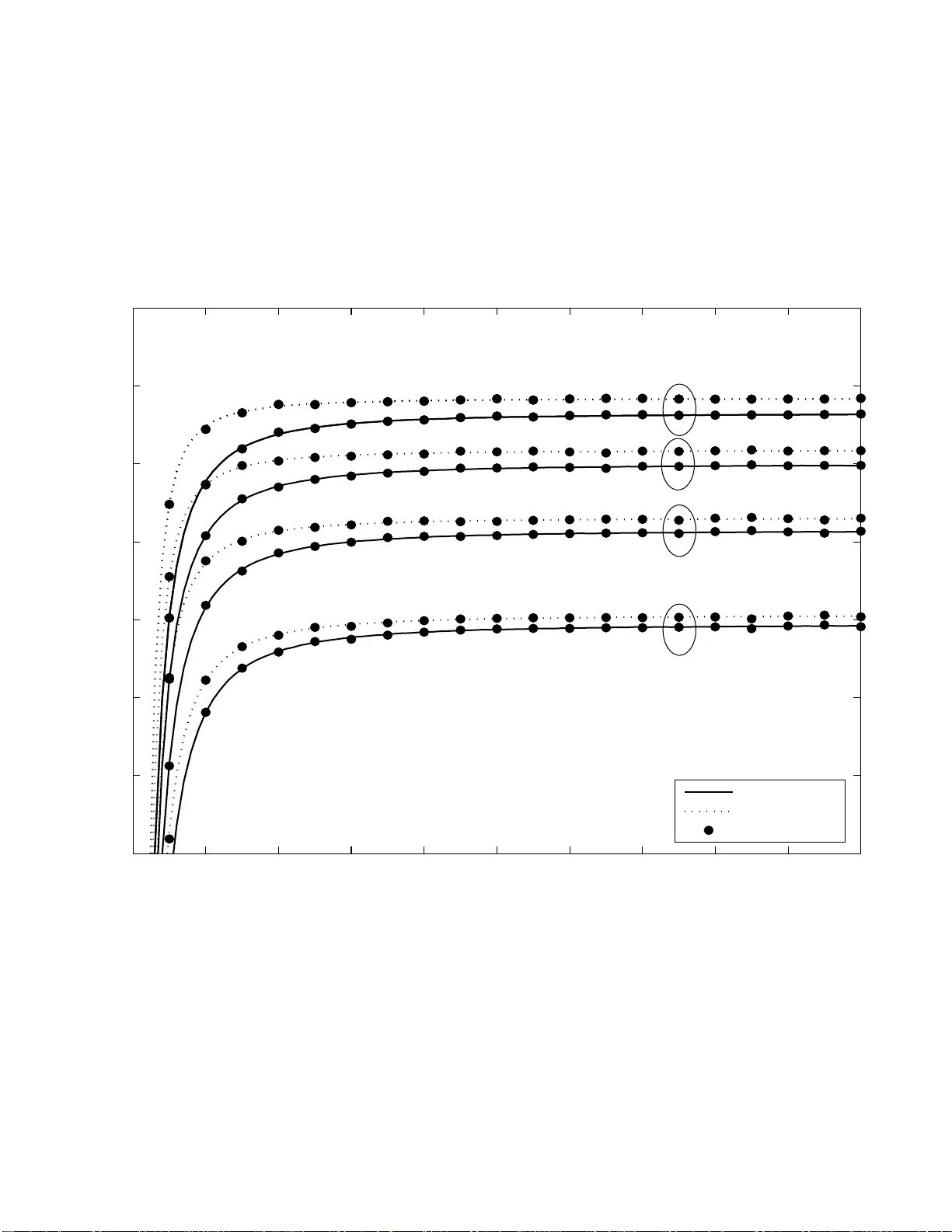
IEEE TRANSA CTIONS ON COMMUNICA TIONS, V OL. X, NO. XX, DEC. 2010 1 A Unified MGF-Based Capaci ty Analysis of Di v ersity Combiners o ver Generaliz ed F ading Channels Ferkan Y ilmaz and Mohamed-Slim Alouini Electrical Engineering Progra m, Di vision of Physical Sciences and Engineering, King Abdullah Uni v ersity of S cience and T echnology (KA UST), Thuwal, Mekkah Province, Saudi Arabia. Email(s): { ferkan.yilmaz, slim.alouini } @kaust.edu.sa Abstract Unified exact av erage capacity results fo r L -branch coher ent diversity recei vers including eq ual-gain com bining (EGC) and maximal-ratio combining (MRC) ar e not kn own. This pa per develops a novel gener ic framework for the cap acity analysis o f L -bran ch EGC/MRC over generalized fading chan nels. The fram ew ork is used to derive new results for th e Gamm a shadowed g eneralized Nakag ami- m fading model which can be a suitable mo del fo r the fading environments encoun tered by high f requen cy ( 60 GHz and above) comm unication s. The m athematical formalism is illustrated with some selected num erical and simulation results confirming the correctness of our newly proposed framework. Index T erms A verag e cap acity , diversity , equal-g ain c ombinin g (EGC), maximal-r atio co mbining (MRC), co rrelated channe l fading, Gamma shadowed generalized Nak agami- m fadin g. I . I N T RO D U C T I O N Equal gain combi ning (EGC) is of practical interest in 60 GHz communi cations because it s perfor- mance is comparable to that of maximal ratio combi ning (MRC) but it offer s a greater simpli city of implementati on (see [1] for an extended discuss ion on EGC and MRC performance differe nce). Du e to high data-rate and coverage requi rements of current, em er ging and future high-frequency (60 GHz IEEE TRANSA CTIONS ON COMMUNICA TIONS, V OL. X, NO. XX, DEC. 2010 2 or above) communication systems, the av erage capacity (A C) analysis of these t wo diversity combiners (i.e., EGC and MRC) becomes an important and fund amental i ssue from both theoretical and practical viewpoints. In literature, there are sev eral papers dealing with the avera ge sym bol error probabili ty (ASEP) analysis of the d iv ersity recei vers (s ee for example [1] and the references therein). Advances over the last decade on th e symb ol error performance analy sis of EGC and MRC div ersity recei vers in fading channels has accentuated the importance of the moment generating functions (MGF) as a powerful tool for simplifyi ng the analysis of div ersity receive rs. For example, the following identit y has been wi dely used to si mplify the symbol error performance analysi s of EGC and MRC div ersity receiv ers i n fading channels, erfc ( √ γ end ) = 2 π Z ∞ 0 exp − γ end sin 2 ( θ ) dθ , (1) where erfc ( · ) is the complementary error function [2, Sec.(6.13)], and where γ end is the total signal- to-noise ratio (SNR) at the div ersity recei ver . On the other hand, and to the best of our knowledge, published papers dealin g with the A C analy sis o f E GC and MRC diversity combiners over fading channels hav e b een scarce when compared to those concerning th e ASEP performance [1]. In particular , Bhaskar deriv ed i n [3] th e av erage capacity of L -branch EGC relying on the Gamm a approximati on of the sum of mutually independent and identi cally di stributed Rayleigh random v ariables (R Vs). In addition, using an MGF-based app roach, Ham di obtained in [4] a new expression for the a verage capacity of MRC diversity combiner over arbitrarily correlated Rician fading channels. More recently , Di Renzo et. al p roposed a new frame work i n [5] in order to compute the av erage capacity of MRC div ersity combi ner over generalized fading channels throu gh the medium of th e exponential integral E i transform. Howe ver , the MGF-based approaches dev eloped in [4], [5] were limited to the capacity of calculation of M RC div ersity recei vers and are n ot easily extendible to the computation of the capacity of EGC div ersity recei vers. In this paper , we show that it is actually possibl e to express the cond itional capacity lo g 2 (1 + γ end ) in a form similar to (1), whi ch facilitates the deve lopment of a n e w unified MGF-based approach for the calculation of the ergodic capacity i n arbitrarily correlated/uncorrelated fading channels. M ore specifically , w e present a unified MGF based av erage capacity com putation not on ly for the L -branch MRC diversity receive r but also for the L -branch EGC diversity receiver over a wide variety of fading channels and for an arbitrary number o f div ersity branches. The remainder of th is paper is organized as follows. In Section II, a u nified capacity analysis of d iv ersity IEEE TRANSA CTIONS ON COMMUNICA TIONS, V OL. X, NO. XX, DEC. 2010 3 recei vers over generalized fading channels is i ntroduced and some key results are presented. In Section III, after t he introd uction of Gamma-shadowed generalized Nakagami- m (GNM) fading channel m odel, the exact a verage capacities for the EG C and MRC div ersity recei vers over Gamm a-shadowed GNM fading channels are derived a nd many special cases are deduced. Numerical examples are then given in Section IV to i llustrate the math ematical formalism . Finally , the main results are su mmarized and some conclusions are drawn in the last secti on. I I . A N M G F - BA S E D C A P AC I T Y A NA LY S I S O F D I V E R SI T Y C O M B I N E R S For EGC and MRC diversity receive rs, before t he signals on the diver sity branches are bein g summed to form the resul tant out put, the signals o n the div ersity branches are first co-phased and then weighted equally in EGC or weighted with the fading en velopes in MRC. The instantaneous SNR γ end at the outp ut of the diversity recei ver can be generically written as γ end = E s N 0 √ L 1 − p + q L X ℓ =1 R p ℓ ! q (2) where t he parameters p ∈ { 1 , 2 } and q ∈ { 1 , 2 } are chosen as ( p, q ) = (1 , 2) , EGC (2 , 1) , MRC . (3) In (2), L denotes the number o f branches and E s / N 0 is the transmitted SNR per sym bol, and for ℓ ∈ { 1 , 2 , 3 , . . . , L } , R ℓ is the ℓ t h branch fading. Considering the (instantaneous) Shannon capacity of the diversity recei ver (i.e., EGC o r MRC) with bandwidth W over fading channels (i.e., C γ end , W log 2 (1 + γ end ) ), t he av erage ergodic channel capacity defined as C avg ≡ E [ W log 2 (1 + γ end )] , where E [ · ] denotes the expectation op erator , can be obt ained by a veraging the inst antaneous capacity C γ end over th e probabil ity density function (PDF) of γ end , namely C avg = W Z ∞ 0 log 2 (1 + γ ) p γ end ( γ ) dγ , (4) where p γ end ( γ ) is the PDF of the inst antaneous SNR γ end (that is, γ end is generically defined in (2)). Due to sev eral reasons (e.g., i nsuffic ient antenna spacing or coupli ng among radio frequency (RF) layers), correlation may exist among diversity branches of the receiv er . W ith or witho ut that , the average capacity IEEE TRANSA CTIONS ON COMMUNICA TIONS, V OL. X, NO. XX, DEC. 2010 4 using (4) i n volves an L -fold i ntegral giv en by C avg = W ∞ Z 0 ∞ Z 0 . . . ∞ Z 0 | {z } L -fold log 2 1 + E s N 0 √ L 1 − p + q L X ℓ =1 r p ℓ ! q ! p R 1 , R 2 ,..., R L ( r 1 , r 2 , . . . , r L ) dr 1 dr 2 . . .dr L , (5) where p R 1 , R 2 ,..., R L ( r 1 , r 2 , . . . , r L ) is the joint mult iv ariate PDF of R 1 , R 2 , . . . , R L fading en velopes. The L -fold in tegration in (5) is tedious and complicated in addition to the fact that it cannot be separated in to a product of one dimensional integrals. In addi tion, it t akes a long ti me to ev aluate numerically , especially as the number of branches L increases. Thus, referring to (4), researchers i n literature hav e tried to find the PDF of t he inst antaneous SNR γ end giv en in (2) in order to find t he ave rage capacity . N e vertheless, this technique i s often complicated and tedious for g eneralized fading en vironment si nce it in volves multiple con volutions / integrals e ven if th e fading en velopes R 1 , R 2 , . . . , R L of th e branches are ass umed to be independent. Referring to (2), the Jensen’ s i nequality [6, Eq . (12.411 )], which is based on concavity of log function such that E [log 2 (1 + γ end )] ≤ lo g 2 (1 + E [ γ end ]) , and fractional moment s [6, Eq. (1.511)], which is based on th e infinite series of lo g 2 (1 + γ end ) such that E [log 2 (1 + γ end )] = − P n ≥ 1 ( − 1) n E [ γ n end ] / log(2 n ) , are comm only used i n particular t o compu te the A C approxim ately . The other m ostly used way to com pute the A C hinges upon the in verse Laplace transform (IL T) whereby the PDF of the inst antaneous SNR γ end can be approximated throu gh the medium o f applying t he IL T on the MGF M γ end ( s ) = E [exp ( − sγ end )] . It is pertinent to say here again that the A C com putation of diversity combi ners (especially for the MGF of EGC since it is often more di ffi cult than that of MRC due to the fact that it may not be poss ible to obtain the MGF of EGC recei ver in g eneral fading en vironments) becomes more difficult, probl ematic, and perplexing as the number o f branches (i.e., L ) increases. In what follows, we present a new exact and u nified MGF-based app roach th at overcomes t he difficulty mentioned above, and offers a g eneric single integral expression for th e av erage capacity of EGC and MRC diversity combiners over g eneralized fading channels. Theor em 1 (A verage Capacity of the Diversity Com biners over Correlated No t-Necessarily Identically Distributed Fading Channels) . The exact average capa city of L -branch di versity combiner over mutuall y not-necessarily independent nor i dentically dis tributed fading channels with a ban dwidth W is given by C avg = W log (2 ) Z ∞ 0 C q ( s ) ∂ ∂ s M ~ R p (Φ p,q s ) ds, (6) IEEE TRANSA CTIONS ON COMMUNICA TIONS, V OL. X, NO. XX, DEC. 2010 5 wher e p ∈ { 1 , 2 } and q ∈ { 1 , 2 } and a r e selected based on (3) , and wher e the parameter Φ p,q is defin ed as Φ p,q = q p E s /N 0 L ( p − q − 1) / 2 , and wher e the auxiliar y function C q ( s ) is g iven by C q ( s ) = − H 1 , 2 3 , 2 1 s q (1 , 1) , (1 , 1) , (1 , q ) (1 , 1) , (0 , 1) , (7) wher e H m,n p,q [ · ] re pr es ents the F ox’ s H fun ction [7, Eq. (1.1. 1)] 1 , 2 . Mor eover , M ~ R p ( s ) ≡ E [exp( − s P ℓ R p ℓ )] is t he joint MGF for the p -exponent of ~ R ≡ {R 1 , R 2 , . . . , R L } fad ing env elopes of the branches. Pr oof : See Appendix A. Note that, in order to find the av erage capacity , the proposed MGF-based technique in Theorem 1 eliminates the necessity of finding th e PDF of the instantaneous SNR γ end through the IL T of the joint p -exponent MGF M ~ R p ( s ) . Shortly , Theorem 1 suggests that one can readily ob tain the av erage capacity of the diversity recei ver by using the joi nt p -exponent MGF M ~ R p ( s ) . Additionall y , the integral i n (1) can be readily estimated accurately by employing the Gauss-Chebyshev quadrature (GCQ) form ula [11, Eq. (25.4 .39)], yielding C avg ≈ W log (2 ) N X n =1 w n C q ( s n ) ∂ ∂ s M ~ R p (Φ p,q s ) s → s n , (8) which con ver ges rapidly and steadily , requiring only fe w terms for an accura te result, where the coef ficients w n and s n are defined as s n = tan π 4 cos 2 n − 1 2 N π + π 4 and w n = π 2 sin 2 n − 1 2 N π 4 N cos 2 π 4 cos 2 n − 1 2 N π + π 4 , (9) respectiv ely , where the truncation index N could b e chosen as N = 5 0 to obt ain a high level of accuracy . In addition, when there is no correlation between the fading env elopes ~ R ≡ {R 1 , R 2 , . . . , R L } for the branches of t he diversity recei ver , the average capacity is g iv en in the following corollary . Corollary 1 (A verage Capacity of the Div ersity Recei ver over Mutually Independent Not N ecessarily Identically Distributed Fading Channels) . The ex act average capacity of L -branch diversity r eceiver over mutually independent and no n-identically di stributed fa ding channels with the bandwidth W i s gi ven b y C avg = W log (2) Z ∞ 0 C q ( s ) L X ℓ =1 ∂ ∂ s M R p ℓ (Φ p,q s ) L Y k =1 k 6 = ℓ M R p k (Φ p,q s ) ds (10) 1 For more information about the Fox’ s H f unction, the readers are referred to [7], [8] 2 Note that the Fox’ s H function is sti ll not av ailable in standard mathematical software packages such as Mathematica® and Maple TM . Ho wev er , using [9, E q. (8.3.2/22)], an efficient mathematica implementation of this function i s av ail able in [10, Appendix A]. IEEE TRANSA CTIONS ON COMMUNICA TIONS, V OL. X, NO. XX, DEC. 2010 6 wher e, for ℓ ∈ { 1 , 2 , . . . , L } , M R p ℓ ( s ) ≡ E [ exp ( − s R p ℓ )] is the MGF of th e f ading R ℓ that t he ℓ th branch is s ubjected t o. Pr oof : When there i s no correlation bet ween the fading en velopes ~ R ≡ {R 1 , R 2 , . . . , R L } , one can readily write M ~ R p ( s ) = Q L ℓ =1 M R p ℓ ( s ) , whose d eriv ative with respect to s is given by ∂ ∂ s M ~ R p ( s ) = L X ℓ =1 ∂ ∂ s M R p ℓ ( s ) L Y k =1 k 6 = ℓ M R p k ( s ) . (11) Finally , subs tituting (11) into (6) results i n (10), which proves Corollary 1. Despite th e fact that the n ovel techniq ue represented by Theorem 1 and Corollary 1 are easy to use, the numerical compu tation of th e auxil iary function C q ( s ) can also be done using the more familiar Meijer’ s G function, which is av ailable in s tandard mathematical software packages s uch as Mathematica® and Maple TM , as s hown in th e following corollary . Corollary 2 (Meijer’ s G Representation of t he Auxil iary Functio n C q ( s ) ) . The auxiliary f unction C q ( s ) can be given in terms of the mor e fami liar Meijer’ s G f unction as fo llows C q ( s ) = − 1 q q (2 π ) 1 − q G 1 , 2 q +2 , 2 " q q 2 q 1 , 1 , Ξ (1) ( q ) 1 , 0 # , (12) wher e Ξ ( x ) ( n ) ≡ x n , x +1 n , . . . , x + n − 1 n with x ∈ C and n ∈ N . Pr oof : See Appendix B. Let u s consider the s pecial cases ( q = 1 for M RC and q = 2 for EGC) of the auxiliary function C q ( s ) in order to check analytical simpli city and accurac y: Special Ca se 1 (Maximal Ratio Comb ining) . F or L -branch M RC div ersity recei ver (i.e., q = 1 ), the auxiliary function C M RC ( s ) ≡ C q ( s ) | q → 1 can b e obtained as C M RC ( s ) = − G 0 , 2 2 , 1 1 s 1 , 1 0 (13) by means of app lying [9, Eq. (8.2. 2/9)] on (12). Utili zing [9, Eq. (8.2.2/1 4)] and [9, Eq. (8.4.11/1)] together , (13) reduces further to C M RC ( s ) = Ei ( − s ) , (14) IEEE TRANSA CTIONS ON COMMUNICA TIONS, V OL. X, NO. XX, DEC. 2010 7 where Ei ( · ) is the exponential int egral function [2, Eq. (6.15.2)]. 3 . Then, referring to Theorem 1, th e a verage capacity of the L -branch MRC receiver can be giv en by C M RC avg = W log (2 ) Z ∞ 0 Ei ( − s ) ∂ ∂ s M ~ R 2 E s N 0 s ds (15) which is in perfect agreement with [5, Eq. (7)] when choosing the t ransmitted power is unit (i.e., E s /N 0 = 1 ). In addition, when the branches are subjected to mutuall y independent and non-identical fading distributions, the ave rage capacity C M RC avg can b e also given, referring to Corollary 1, as follows C M RC avg = W log (2 ) Z ∞ 0 Ei ( − s ) L X ℓ =1 ∂ ∂ s M R 2 ℓ E s N 0 s L Y k =1 k 6 = ℓ M R 2 k E s N 0 s ds. (16) Special Case 2 (Equal Gain Com bining) . Note that, referring (7) with q = 2 , t he auxiliary function for L -branch EGC div ersity recei ver , i.e., C E GC ( s ) ≡ C q ( s ) | q → 2 can b e re-written as C E GC ( s ) = − √ π G 0 , 2 3 , 1 4 s 2 1 , 1 , 1 2 0 , (17) by m eans of setting q = 2 in (12). Eventually , usin g [9, Eq. (8.4 .12/4)], th e aux iliary functi on for L -branch EGC div ersity receiv er C E GC ( s ) simplifies t o C E GC ( s ) = 2 Ci ( u ) , (18) where Ci ( x ) is the cosi ne integral functio n [11, E q. (5. 2.27)] 3 . Then, using Theorem 1 with (18), the a verage capacity of the L -branch EGC div ersity receiv er can be readily expressed as C E GC avg = 2 W log (2) Z ∞ 0 Ci ( u ) " ∂ ∂ s M ~ R r E s N 0 L s !# ds (19) in general wh en the fading R 1 , R 2 , . . . , R L are subjected to are correlated. When the branches are subjected to mutu ally ind ependent and non-identical fading, the av erage capacity C E GC avg can be also given, referring t o Corollary 1, as C E GC avg = 2 W log (2 ) Z ∞ 0 Ci ( u ) L X ℓ =1 " ∂ ∂ s M R ℓ r E s N 0 L s !# L Y k =1 k 6 = ℓ M R k r E s N 0 L s ! ds. (20) In the fol lowing section, the model of Gamma shadowed GNM fading channel will be introduced and 3 Note that both the cosine integral function Ci ( x ) = − R ∞ x cos ( t ) /tdt and the expon ential integral Ei ( x ) = − R ∞ − x exp ( − t ) /tdt are implemented as a built-in function in the more popular mathematical software packages such as Mathematica® and Maple TM . IEEE TRANSA CTIONS ON COMMUNICA TIONS, V OL. X, NO. XX, DEC. 2010 8 then the a verage capacity of both L -branch MRC and L -branch EGC diversity receive rs wil l be derive d for Gamma-shadowed GNM fading channels. I I I . A V E R A G E C A P A C I T Y O F D I V E R SI T Y C O M B I N E R S OV E R G A M M A - S H A D O W E D G E N E R A L I Z E D N A K A G A M I - m F A D I N G C H A N N E L S As an example for the application of both Theorem 1 and Corollary 1, we assume that Gamma shadowing affects the GNM [10] fading channels , t hat is, t he l ocal mean power of the fading is a Gamma R V . For example, in 6 0 GHz non-line-of-sight (NLOS) propagation, standard deviation of shadowing is typically larger than th at of propagation at 5 GHz. It is t herefore not a misst ep to assume that the local mean power of channel fading is a R V dis tributed over (0 , ∞ ) . Hence, the Gamma-shadowed GNM fading model can be accommodated to pretest the e valuation of different wireless communications in 60 GHz non-line-of-sight (NLOS) en vironm ent. Thus , we first deri ve the analytical expressions for b oth PDF and MGF of the fading ampl itudes ~ α ≡ { α 1 , α 2 , . . . , α L } for the branches of L -branch EGC in a Gamma- shadowed GNM fading channel. Using these results, we will find th e exact ave rage capacity for t he EGC over a Gam ma-shadowed GNM fading channel, and w ill give as examples of the simplified expressions for diff erent special cases. W e first derive the analytical e x pressions for bo th PDF and MGF of th e f ading en velopes ~ R ≡ {R 1 , R 2 , . . . , R L } for the branches of L -branch diversity receiver i n a Gam ma-shadowed GNM fading channel. Us ing these results, we wil l find the exact a verage capacity for t he diversity receiver over a Gamma-shadowed GNM fading channel and enumerate th e dif ferent special cases. A. Gamma -Shadowed Generalized Nakagami- m F adin g Channels Let us consider L ≥ 1 mutually independ ent and n on-identical GNM R Vs { α ℓ } L ℓ =1 , each representing the fading amplit ude the L -branch diversity combiner is subjected to and each having the PDF p α ℓ ( α ) = 2 ξ ℓ Γ ( m ℓ ) β ℓ Ω ℓ ξ ℓ m ℓ α 2 ξ ℓ m ℓ − 1 e − β ℓ Ω ℓ ξ ℓ α 2 ξ ℓ , 0 ≥ α (21) where the parameters m ℓ ≥ 1 / 2 , ξ ℓ > 0 and Ω ℓ > 0 are the fading figure, the s haping parameter and the l ocal mean power of t he ℓ th GNM R V and β ℓ = Γ ( m ℓ + 1 /ξ ℓ ) / Γ ( m ℓ ) . Furth ermore, th e special or limitin g cases of the GNM distribution are well-known in li terature as t he Rayleigh ( m ℓ = 1 , ξ ℓ = 1) , exponential ( m ℓ = 1 , ξ ℓ = 1 / 2) , Half-Normal ( m ℓ = 1 / 2 , ξ ℓ = 1) , Nakagami - m ( ξ ℓ = 1) , Gamma ( ξ ℓ = 1 / 2) , W eib ull ( m ℓ = 1) , lo gnormal ( m ℓ → ∞ , ξ ℓ → 0) , and A WGN ( m ℓ → ∞ , ξ ℓ = 1) . IEEE TRANSA CTIONS ON COMMUNICA TIONS, V OL. X, NO. XX, DEC. 2010 9 As menti oned before, let the local m ean power , Ω ℓ of t he GNM fading amplit ude for th e ℓ th branch of the L -branch diversity combiner has, due to th e shadowing, distribution with the Gamma PDF giv en by p Ω ℓ (Ω) = 1 Γ( m sℓ ) m sℓ Ω sℓ m sℓ Ω m sℓ − 1 exp − m sℓ Ω sℓ Ω , 0 ≤ Ω sℓ , 1 2 ≤ m sℓ (22) where Ω sℓ is t he aver age power of shadowing i n the area of interest, and where m sℓ in versely reflect the shadowing severity such that the sev erity of the s hadowing decreases as t he value of m sℓ increases. For example, in th e limit case m sℓ → ∞ , the distri bution of the local mean closes to th e Dirac’ s distribution as p Ω ℓ (Ω) = δ (Ω − Ω sℓ ) . Hence, t here i s no s hadowing effects. Eventually , avera ging (21) with respect to Ω ℓ , i.e., R ∞ 0 p α ℓ ( α ) p Ω ℓ (Ω ℓ ) d Ω ℓ , then utilizi ng [7, Theorem 2.9] with [7, Eq. (2.9.4)], we obtain the PDF of the Gamma-shadowed GNM fading as introduced in th e following definition. Definition 1 (Gamm a-Shado wed Generalized Nakagami- m R V) . The distribution R ℓ follows an Gamma - shadowed GNM distribution if t he PDF of R ℓ is gi ven by p R ℓ ( r ) = 2 Γ( m sℓ )Γ( m ℓ ) β ℓ m sℓ Ω sℓ m sℓ r 2 m sℓ − 1 Γ m ℓ − m sℓ ξ ℓ , 0 , β ℓ m sℓ Ω sℓ r 2 , 1 ξ ℓ (23) wher e m ℓ (0 . 5 ≤ m ℓ < ∞ ) and ξ ℓ (0 ≤ ξ ℓ < ∞ ) r epr esent the fading figur e (diversity severity / or der) and the shap ing f actor , r esp ectively , while m sℓ (0 . 5 ≤ m sℓ < ∞ ) an d Ω sℓ (0 ≤ Ω sℓ < ∞ ) deno te the severity and the average power of shad owing, r espectively . Mor eover , Γ ( · , · , · , · ) i s the extended incomplete Gamma funct ion defined as Γ ( α, x, b, β ) = R ∞ x r α − 1 exp − r − br − β dr [12, Eq. (6.2)] , wher e α and x ar e complex parameters, β > 0 and b is a comple x variable. In what fol lows, the sh orthand not ation R ∼ N S ( m, ξ , m s , Ω s ) denotes that R follows a Gamma- shadowed GNM R V with the fading figure m , the s haping parameter ξ , the shadowing se verity m s and the shadowing a verage power Ω s . Let us consider som e special cases of (23) in order t o check validity . In f act, t his PDF is a very general shadowed PDF whi ch in cludes many sp ecial cases as explained in the second paragraph of this section. For example, By u sing [11, Eq. (6.1.47)] with the Mellin-Barnes contour integral representation [7, Eq. (1.1.1)] of (23), the PDF reduces to the PDF of the GNM dist ribution [10, Eqs. (1) and (2)] for m sℓ → ∞ as expected. Here again, by usin g [12, Eq. (6.41)], the PDF is reduced in to t he PDF of Gamma-shadowed Naka gami- m distribution [13, Eq. (9)] when the shaping parameter ξ ℓ = 1 . Furtherm ore, IEEE TRANSA CTIONS ON COMMUNICA TIONS, V OL. X, NO. XX, DEC. 2010 10 the s pecial o r li miting cases of the Gamma-shadowed GNM distribution are well -known i n l iterature as exponential-shadowed Rayleigh ( m sℓ = 1 , m ℓ = 1 , ξ ℓ = 1) , K distribution ( m sℓ = 1 , ξ ℓ = 1) , generalized- K distribution ( ξ ℓ = 1) , Rayleigh ( m ℓ = 1 , ξ ℓ = 1 , m sℓ → ∞ ) , exponential ( m ℓ = 1 , ξ ℓ = 1 / 2 , m sℓ → ∞ ) , Half-Normal ( m ℓ = 1 / 2 , ξ ℓ = 1 , m sℓ → ∞ ) , Nakagami- m ( ξ ℓ = 1 , m sℓ → ∞ ) , Gamma ( ξ ℓ = 1 / 2 , m sℓ → ∞ ) , W eib ull ( m ℓ = 1 , m sℓ → ∞ ) , lognormal ( m ℓ → ∞ , ξ ℓ → 0 , m sℓ → ∞ ) , and A WGN ( m ℓ → ∞ , ξ ℓ = 1 , m sℓ → ∞ ) . Regarding these special and lim it cases, th e G amma-shadowed GNM distribution R ∼ N S ( m ℓ , ξ ℓ , m sℓ , Ω sℓ ) has t he advantage of m odeling the en velope statistics of most known wireless and optical comm unication channels . Accordingly , it provides a unified theory as to m odel the en velope statistics. Referring to Theorem 1 and Corol lary 1, we need t o obtain th e MGF of the fading en velope R ℓ ∼ N S ( m ℓ , ξ ℓ , m sℓ , Ω sℓ ) , i.e., M R ℓ ( s ) = E [exp ( − s R ℓ )] for ℜ { s } ∈ R + in order to find the exact avera ge capacity of EGC, and also we need to obtain the M GF of the fading power γ ℓ ≡ R 2 ℓ , i.e., M R 2 ℓ ( s ) = E [exp ( − s R 2 ℓ )] for ℜ { s } ∈ R + in order to find t he exact a verage capacity of MRC. As such, in th e following theorem (i.e., Theorem 2), t hese M GF functions are ob tained in a unified closed form such that we can readily reduce it to the MGF of t he ℓ th branch of EGC and for th at of MRC when the values p = 1 and p = 2 are selected, respectiv ely . Theor em 2 (Unified M GF of Gamma-Shadowed GNM R V) . The unifi ed MGF of the Gamma -shadowed GNM env elope distribution R ℓ ∼ N S ( m ℓ , ξ ℓ , m sℓ , Ω sℓ ) , i.e., M R p ℓ ( s ) = E [exp ( − s R p ℓ )] is gi ven by M R p ℓ ( s ) = 4 Γ( m sℓ )Γ( m ℓ ) H 2 , 1 1 , 2 β ℓ m sℓ Ω sℓ p 1 s 2 (1 , 2) ( m sℓ , p ) , ( m ℓ , p/ξ ℓ ) (24) with the con ver gence r e gion ℜ { s } ∈ R + . Pr oof : Note that t he uni fied M GF M R p ℓ ( s ) = E [exp ( − s R p ℓ )] , R ℓ ∼ N S ( m ℓ , ξ ℓ , m sℓ , Ω sℓ ) can readily be given as M R p ℓ ( s ) = R ∞ 0 exp ( − sr p ) p R ℓ ( r ) , wh ere s ubstituti ng the Fox’ s H representation of both extended incomplete Gamm a functi on (i.e., [12, Eq . (6.22)]) and exponential functio n [7, Eq. (2.9.4 )] results in M R p ℓ ( s ) = 2 Γ( m sℓ )Γ( m ℓ ) ∞ Z 0 1 r H 1 , 0 0 , 1 sr p − − − (0 , 1) H 2 , 0 0 , 2 β ℓ m sℓ Ω r − 2 − − − ( m sℓ , 1) , ( m ℓ , 1 /ξ ℓ ) dr . (25) Eventually , applying [7, Theorem 2.3] on (25), one can readily obtain th e MGF of t he Gamma-shadowed GNM d istribution given in (24), which p roves T heorem 2. IEEE TRANSA CTIONS ON COMMUNICA TIONS, V OL. X, NO. XX, DEC. 2010 11 Now , let us consider som e sp ecial cases i n o rder to check analytical sim plicity and accuracy of (24). When sett ing the shadowing sev erity m sℓ → ∞ , and applying lim a →∞ Γ( a + b ) a c Γ( a + c ) a b ≈ 1 , where | b | ≪ a and | c | ≪ a , on the Melli n-Barnes integral representation [7, Eq . (1.1.1)] of (24), t he unified MGF is, as expected, reduced t o the MGFs of GNM [10, Eq. (2)] and generalized Gamm a [14, Eq. (11)] for the values p = 1 and p = 2 , respecti vely . Note th at the unified MGF g iv en by (24) may lead to some computatio n difficulty to com pute d ue t o th e fact that th e implem entation of th e Fox’ s H function is currently not av ail able in s tandard mathem atical software packages but an Mathematica® i mplementation of this function is offered by the auth ors in [10, Appendix A]. As su ch, i t may be useful to represent (24) in terms of M eijer’ s G functi on with the aid of [9, Eq. (8.3.2/2 2)]. More specifically , (26) is t he Meijer’ s G representati on of (24) for the ration al values of t he parameter ξ (that is, we restrict ξ to ξ = k /l , where k and l are arbitrary positive integers.), namely M R p ℓ ( s ) = p l/ π ( k p ) m sℓ ( l p ) m ℓ − 1 (2 π ) kp 2 + lp 2 + k − 2 Γ( m ℓ )Γ( m sℓ ) G k p + lp , 2 k 2 k, k p + lp 2 k s 2 k β ℓ m sℓ Ω sℓ k p ( k p ) k p ( l p ) lp − Ξ ( − 2 k ) (2 k ) Ξ ( m sℓ ) ( kp ) , Ξ ( m ℓ ) ( lp ) . (26) It may be useful to notice th at the rational representation of ξ ℓ ∈ R + remains ess entially unchanged if there does not exist any rational number clo se enou gh to ξ ℓ , ful filling the condition | k /l − ξ ℓ | < ǫ/l 2 , with ǫ chosen to be 10 − 2 . For m ore accuracy to rati onalize ξ ℓ , the conditional parameter ǫ can be chosen much smaller . Never theless, the num ber of coefficients of t he Meijer’ s G function in (26) gets higher as ǫ gets sm aller , so mu ch so that i ts computatio n ef ficiency considerable reduces and its com putation latency 4 increases. In consequence, the Fox’ s H fun ction is preferable in this case since its compu tation effic iency is m uch better th an that of Meij er’ s G function in this situation. B. Uni fied A verage Capacity of D iversity Combiners Let us find the deriv ativ e of the unified MGF given by either (24) or (26) wit h respect to s since we need it in order to find t he av erage capacity of L -branch diversity combiners operating over Gamm a- shadowed GNM fading channel s. Referring to the relation w ith an MGF M R ℓ ( s ) and its deri vati ve, i .e., ∂ ∂ s M R ℓ ( s ) = − E [ R ℓ exp ( − s R ℓ )] , t he derivation of the unified MGF for diversity combi ners o perating over Gamm a-shadowed GNM fading channels in g iv e in the following t heorem. Theor em 3 (Deriv at iv e of the Unified MG F of Gam ma-Shadowe d GNM R V) . The derivat ive of th e unified 4 The computation latency of Meijer’ s G function G m,n p,q [ · ] is primarily addressed by the total number of coefficients p + q . IEEE TRANSA CTIONS ON COMMUNICA TIONS, V OL. X, NO. XX, DEC. 2010 12 MGF for the Gamma-s hadowed GNM en velope dist ribution R ℓ ∼ N S ( m ℓ , ξ ℓ , m sℓ , Ω sℓ ) , i.e., ∂ ∂ s M R p ℓ ( s ) = − E [ R p ℓ exp ( − s R p ℓ )] is given by ∂ ∂ s M R p ℓ ( s ) = 2 /s Γ( m sℓ )Γ( m ℓ ) H 3 , 1 2 , 3 β ℓ m sℓ Ω sℓ p 1 s 2 (1 , 2) , (0 , 1) (1 , 1) , ( m sℓ , p ) , ( m ℓ , p/ξ ℓ ) (27) with the con ver gence r e gion ℜ { s } ∈ R + . Pr oof : Usin g either [7, Eq. (2.2.2)] o r [9, Eq. (8.3.2/ 15)], the proof is obvious. Again, following the same steps in the deriv ation of (26), (27) can be represented on the basis of the Meijer’ s G function for t he rational values of t he parameter ξ = k /l , where k and l are arbitrary positive integers. Accordingly , (27) can be given by ∂ ∂ s M R p ℓ ( s ) = p 4 l /π ( k p ) m sℓ ( l p ) m ℓ − 1 k (2 π ) kp 2 + lp 2 + k − 2 Γ( m ℓ )Γ( m sℓ ) G k p + lp +1 , 2 k 2 k + 1 , k p + lp +1 2 k s 2 k β ℓ m sℓ Ω sℓ k p ( k p ) k p ( l p ) lp − Ξ ( − 2 k ) (2 k ) , 0 1 , Ξ ( m sℓ ) ( kp ) , Ξ ( m ℓ ) ( lp ) . (28) Finally , by e mploying Corollary 1 with (24) and (27), new exact single-integral expressions for the e valuation o f the av erage capacity C avg of L -branch diversity combiners over Gamma-shadowed GNM fading channels are immediately written as C avg = G L Z ∞ 0 C q ( s ) s L X ℓ =1 H 3 , 1 2 , 3 β ℓ m sℓ Ω sℓ p 1 Φ 2 p,q s 2 (1 , 2) , (0 , 1) (1 , 1) , ( m sℓ , p ) , ( m ℓ , p/ξ ℓ ) × L Y k =1 k 6 = ℓ H 2 , 1 1 , 2 β k m sk Ω sk p 1 Φ 2 p,q s 2 (1 , 2) ( m sk , p ) , ( m k , p/ξ k ) ds, (29) where both the coef ficient Φ p,q and the auxiliary functi on C q ( s ) are defined i n Theorem 1. Furthermore, the coef ficient G L is defined as G L = 2 L +1 W log(2) h Q L ℓ =1 Γ( m sℓ )Γ( m ℓ ) i − 1 Additionall y , referring to (8) (i.e., by changing the va riable of the integration in (29) as s = tan( θ ) and th en using GCQ formula [11, Eq. (25.4.39)]), we specifically get a finit e ( N -terms) s um approxi mation con ver ging rapidly and steadily and requiring few t erms for an accurate result as shown C avg ≈ G L N X n =0 w n C q ( s n ) s n L X ℓ =1 H 3 , 1 2 , 3 β ℓ m sℓ Ω sℓ p 1 Φ 2 p,q s 2 n (1 , 2) , (0 , 1) (1 , 1) , ( m sℓ , p ) , ( m ℓ , p/ξ ℓ ) × L Y k =1 k 6 = ℓ H 2 , 1 1 , 2 β k m sk Ω sk p 1 Φ 2 p,q s 2 n (1 , 2) ( m sk , p ) , ( m k , p/ξ k ) , (30) where w n and s n are defined in (9). In the sense of both t hat either special or limit cases of Gamma- IEEE TRANSA CTIONS ON COMMUNICA TIONS, V OL. X, NO. XX, DEC. 2010 13 shadowed GNM N S ( m ℓ , ξ ℓ , m sℓ , Ω sℓ ) model are commonly used fading mo dels in th e literature, and that the auxiliary function C q ( s ) is a unified expression for diversity combiners (e.g., q = 1 for M RC and q = 2 for EGC), it is sufficient to show that the ave rage capacity given by (29) is a unified expression not only for commonly used channel fading model s but als o for the commonl y used MRC and EGC div ersity combiners. For example, referring (14) (i.e., usi ng the MRC special case of the auxil iary function C q ( s ) giv en by (7)) and performing algebraic mani pulations [7, Eqs. (2.1. 1)-(2.1.5)] after choosing p = 2 for MRC, it is straig ht forward to show that, the u nified ave rage capacity (29) reduces to t he av erage capacity of L -branch MRC diversity com biner over Gamma-shadowed GNM fading channels, nam ely C M RC avg = − G L 2 L +1 Z ∞ 0 Ei ( − s ) s L X ℓ =1 H 3 , 1 2 , 3 N 0 β ℓ m sℓ E s Ω sℓ s (1 , 1) , (0 , 1) (1 , 1) , ( m sℓ , 1) , ( m ℓ , 1 /ξ ℓ ) × L Y k =1 k 6 = ℓ H 2 , 1 1 , 2 N 0 β k m sk E s Ω sk s (1 , 1) ( m sk , 1) , ( m k , 1 /ξ k ) ds, (31) Substitutin g the fading figures m ℓ → m , fading shaping factors ξ ℓ = 1 , t he s hadowing sev erities m sℓ → ∞ and shadowing powers Ω sℓ = Ω for all ℓ ∈ { 1 , 2 , . . . , L } in (29), and then using [7, E qs. (2.1 .1), (2.1.2 ), and (2.9.1)], th e a verage capacity given by (31) reduces t o th e average capacity over mut ually i ndependent and identically di stributed N akagami- m fading channels, C M RC avg = − W L log (2)Γ L ( m ) Z ∞ 0 Ei ( − s ) s G 2 , 1 2 , 2 N 0 m E s Ω s 1 , 0 1 , m G 1 , 1 1 , 1 N 0 m E s Ω s 1 m L − 1 ds. (32) Subsequently , note that we hav e G 1 , 1 1 , 1 u | 1 a = u a (1 + u ) − a Γ( a ) [9, Eq. (8.4.2 /5)] and G 2 , 1 2 , 2 h u | 1 , 0 1 ,a i = − u a (1 + u ) − a − 1 Γ( a ) [9, Eq. (8.4.4 9/14)]. The av erage capacity of MRC diversity can be then attained in closed-form through t he instrumentality of the Ei -transform equali ty R ∞ 0 Ei ( − u ) (1 + au ) − b du = − 1 / Γ( b )G 1 , 3 3 , 2 h a 0 , 0 , 1 − b 1 , − 1 i , where a, b ∈ R + , that is , C M RC avg = W L log(2) Γ ( mL + 1) G 1 , 3 3 , 2 ¯ γ m 0 , 0 , − mL 0 , − 1 , (33) where ¯ γ , E s Ω /N 0 is the a verage SNR recovered by one branch of the MRC div ersity combiner . Note that (33) represents an alternative compact closed-form expression (that is not limited to int eger values of the fading figure m ) to the result presented i n either [15, Eqs. (19) and (20)] or [16, Eqs. (23) and (24 )]. In addi tion, by choosing p = 1 and q = 2 for EGC, the auxiliary function C q ( s ) simpl ifies into (18) and the unified a verage capacity given by (29) reduces to the aver age capacity o f L -branch E GC diversity IEEE TRANSA CTIONS ON COMMUNICA TIONS, V OL. X, NO. XX, DEC. 2010 14 combiner over Gamm a-shadowed GNM fading channels, that is , C E GC avg = G L √ π L Z ∞ 0 Ci ( s ) s L X ℓ =1 H 2 , 2 2 , 2 " 4 LN 0 β ℓ m sℓ E s Ω sℓ s 2 (0 , 1) , ( 1 2 , 1) ( m sℓ , 1) , ( m ℓ , 1 ξ ℓ ) # × L Y k =1 k 6 = ℓ H 2 , 2 2 , 2 " 4 LN 0 β k m sk E s Ω sk s 2 (1 , 1) , ( 1 2 , 1) ( m sk , 1) , ( m k , 1 ξ k ) # ds, (34) which is obtained after u sing [7, Eqs. (2.1.1)-(2.1.5)]. Eventually , substit uting the fading figures m ℓ → m , fading shaping factors ξ ℓ = 1 , the shadowing severities m sℓ = m s and shadowing powers Ω sℓ = Ω for all ℓ ∈ { 1 , 2 , . . . , L } in (34), and then using [7, Eqs. (2.1.1), (2.1.2), and (2.9.1)], the a verage capacity gi ven by (34) reduces to the aver age capacity over mutually independent and ident ically distributed generalized- K fading channels as C E GC avg = L G L √ π L Z ∞ 0 Ci ( s ) s G 2 , 2 2 , 2 4 LN 0 mm s E s Ω s s 2 0 , 1 2 m s , m G 2 , 2 2 , 2 4 LN 0 mm s E s Ω s s 2 1 , 1 2 m s , m L − 1 ds, (35) which can be readily comput ed by means of GCQ rule as seen in (8). It m ight b e useful to notice t hat T ables I-III offer sim plified expressions fo r the unified MGF and its deriv ative, for the variety of comm only used generalized fading channels in order to facilitate for the readers th e use of o ur aver age capacity results for bot h M RC and EGC. I V . N U M E R I C A L R E S U LT S In thi s section, we provide som e selected num erical results for the pre vious example, il lustrating the a verage capacity of L -branch d iv ersity receiv er over Gam ma-shadowed GNM fading channels. As s een in all figures (from Fig. 1 to Fig. 4), MRC gives better capacity /performance than EGC as expected, h owe ver it is a com plex techniq ue since it requi res the en velope esti mation of the channel fading. In addition, the minimum di ff erence between th eir performances i s obt ained by t wo-branch combining . In Fig. 1, the av erage capacity of div ersity receiv er is depicted wi th respect to SNR (i.e., E s /N 0 ) for difference number of branches wit h Gamma shadowed GNM fading parameters ∀ ℓ ∈ { 1 , 2 , . . . , L } , m ℓ = 2 , ξ ℓ = 2 , m sℓ = 3 and Ω sℓ = 1 . This figure als o displ ays the capacity per uni t bandwidth (i.e., W = 1 ). Increasing the number o f branches, i .e., L ≫ 2 , the avera ge capacity increases but note that, regarding the relation among d iv ersity gain and num ber of antennas, the dive rsity gain obtained by adding an antenna/branch decreases as the tot al number of antennas/branchs L increases. Not e again that selected numerical and s imulation results are in perfect agreement. IEEE TRANSA CTIONS ON COMMUNICA TIONS, V OL. X, NO. XX, DEC. 2010 15 Amount of fading (AF) is another important stati stical characteristic of fading channels, particularly in the context of applying diversity techniques in the transmission of th e signals from transmitter to the recei ver such as relay technologies. Shortly , this AF is associated with the fading figure / diversity order m ℓ of the PDF given by (23), and for R ℓ ∼ N S ( m ℓ , ξ ℓ , m sℓ , Ω sℓ ) , it is defined as m ℓ ≡ E 2 h R ξ ℓ ℓ i / V ar h R ξ ℓ ℓ i , where V ar [ · ] and E [ · ] are th e variance and the expectation operators, respectively . A s s een in Fig. 2, note that the large d iv ersity gain is obtained by increasing fading figure / diversity o rder from 0 . 5 to 2 . 0 . For example, a relay between transmitter and receiv er or adding one more antenna to the transm itter may increase t he div ersity order from 1 . 0 t o alm ost 2 . 0 . For m ℓ ≫ 2 , i ncreasing the fading figure g radually and linearly increases the average capacity . In ot her words, in creasing the numb er of relays or the num ber of the antennas at the transm itter more t han 2 gradually and linearly in creases the av erage capacity . Finally , note again th at num erical and sim ulation results are in perfect agreement. When the signal recove red by th e ℓ th branch of L -branch diversity receiver from t he wireless channel ( ℓ ∈ { 1 , 2 , . . . , L } ) is compos ed of clusters of a multipath wa ve, each of which propagates in non- homogeneous en vironment 5 such th at they possess s imilar delay tim es and with the delay-t ime s preads of di ff erent clusters and their ph ases are independent [17]–[19]. In this case, t he env elope of the receiv ed signal, i.e., R ℓ is considered as a non-linear function of multipath com ponents. More specifically , let X ℓ and Y ℓ be the in -phase and qu adrature Gaussi an elements of the signal recovered from the ℓ t h branch of th e L -branch dive rsity recei ver . Then, the en velope i s represented as |X ℓ + i Y ℓ | 1 ξ ℓ , wh ere i = √ − 1 is the imaginer num ber and where ξ ℓ is the shapi ng factor . Shortly , the shaping factor is sometimes not a suffi ciently qualified parameter to comprehend and contempl ate the fading condi tions in some wireless communication appli cations. As s uch, for th e PDF p R ℓ ( r ) of the fading en velope R ℓ , the t ail p roperties, i.e., both lim r →∞ p R ℓ ( r ) and lim r →∞ ∂ p R ℓ ( r ) /∂ r are changed by th e shapi ng factor ξ ℓ . As seen in Fig. 3 , t he average capacity goes to zero when the shapi ng factor ξ goes to zero ( ∀ ℓ ∈ { 1 , 2 , . . . , L } , ξ ℓ = ξ ) because, for 0 < ξ ≪ 1 , the tail properti es approach to zero very fast with respect t o t he po ssible en velope values r ∈ [0 , ∞ ) , i.e., lim r →∞ p R ℓ ( r ) = 0 + and lim r →∞ ∂ p R ℓ ( r ) /∂ r = 0 − . Al so note that , for the higher values of shaping factor ξ ≫ 1 , the a verage capacity very gradually and linearly increases as seen i n Fig. 3 as the shaping factor ξ increases. As mentioned at the beginning o f the previous section, the link quality is affected b y variation of the local m ean po wer due to th e shadowing caused by moving obstacles, s catters and reflectors between 5 Note that non-homogeneo us wireless communications environ ment is very common in high frequencies such as 60 GHz or abo ve due to the fact that the wave -length is very small when i t is compared with the non-homogeneo us (singular) en vironment. IEEE TRANSA CTIONS ON COMMUNICA TIONS, V OL. X, NO. XX, DEC. 2010 16 transmitter and the receiv er . The intensit y of shadowing on the branches of L -branch dive rsity recei ver is characterized by t he shadowing factors m sℓ ∈ [0 . 5 , ∞ ) for the branches ℓ ∈ { 1 , 2 , . . . , L } . In Fig. 4 , the a verage capacity is depicted with respect to shadowing factor m s (i.e., ∀ ℓ ∈ { 1 , 2 , . . . , L } , m sℓ = m s ). Note th at, as seen in Fig. 4, the av erage capacity does n ot change as t he shadowing factor m s goes to infinity (i.e., m s → ∞ ) s ince the variation of the local mean power diminishes as m s increases. V . C O N C L U SI O N In this paper , w e presented a uni fied framew ork to compute the average capacity of div ersity combining schemes (i.e., EG C and M RC) over fading channels. W e also propo sed a versatile fading mod el, which we term Gamma-shadowed GNM fading, in order t o characterize the fading en vironm ent in hi gh frequencies such as 60 GHz and above . Addit ionally , we deriv ed novel closed-form expressions for the moment generating function (MGF) of both Gamma shadowed GNM fading and its sp ecial cases. Some selected simulatio ns ha ve been carried out for di f ferent scenarios of fading en vironment i n order to verify th e accurac y of the presented framework. Numerical and simulati on results are in perfect agreement. A C K N OW L E D G M E N T S This work was sup ported b y King Abdull ah University of Science and T echno logy (KA UST). A P P E N D I X A P R O O F F O R T H E O R E M 1 Note that, for q ∈ { 1 , 2 } (i.e., q = 1 for MRC com bining, and q = 2 for EGC combinin g), using the deriv ation equality ∂ log (1 + y X q ) / ∂ y = R q / (1 + y R q ) , we can readily sh ow that 1 X log (1 + X q ) = Z 1 0 1 u X q − 1 1 u + X q du (A.1) for n ∈ R + . Using the equ ality R ∞ 0 z β − 1 exp ( − sz ) E α,β ( − y z α ) dz = s α − β / ( s α + y ) [20, Eq . (5.2 .3)], where E α,β ( · ) is the Mittag-Leffler functi on [21, Eq. (1)], we get 1 X log (1 + X q ) = Z ∞ 0 exp ( − sX ) Z 1 0 1 u E q , 1 − s q u du ds. (A.2) IEEE TRANSA CTIONS ON COMMUNICA TIONS, V OL. X, NO. XX, DEC. 2010 17 Upon substit uting ∂ ∂ s exp ( − sX ) = − X exp ( − sX ) into (A.3), and then applyi ng th e w ell-known Leibnit z rule [11], it is easily shown that log (1 + X q ) can be expressed as log (1 + X q ) = − Z ∞ 0 ∂ ∂ s exp ( − sX ) Z 1 0 1 u E q , 1 − s q u du ds. (A.3) After substituti ng the Mellin-Barnes representation of the Mittag-Lef fler function, i.e., E α,β ( z ) = 1 2 π i H C Γ ( p ) Γ (1 − p ) / Γ ( β − α p ) z − p d p [21, Eq. (3)] and performing algebraic manipulati ons, (A.3) can i mmediately b e expressed as log (1 + X q ) = − Z ∞ 0 ∂ ∂ s exp ( − sX ) H 1 , 2 3 , 2 1 s q (1 , 1) , (1 , 1) , (1 , q ) (1 , 1) , (0 , 1) ds, (A.4) by fa vor of the M ellin-Barnes representati on of Fox’ s H function [7, Eq. (1.1.1)]. Eventually , substit uting (A.4) into (5) and using som e algebraic mani pulations, the av erage capacity o f linear diversity recei vers (EGC and M RC) can be readily given as in (6), which proves Theorem 1. A P P E N D I X B P R O O F F O R C O RO L L A RY 2 Note that, by means o f [7, Eq. (1.1.1)], t he auxi liary functio n C q ( s ) giv en i n (7) can be represented in terms o f Mellin-Barnes int egral as C q ( s ) = − 1 2 π i I C Γ (1 + z ) Γ ( − z ) Γ ( − z ) Γ (1 − z ) Γ (1 + q z ) s q z dz , (B.1) with the con ver gence region ℜ { C } ∈ ( − 1 , 0) , where i is the imagin ary number (i.e., i = √ − 1 ). Then, substitut ing Gauss’ mult iplication formula Γ ( nz ) = (2 π ) 1 2 (1 − n ) n nz − 1 2 Q n k =1 Γ z + k − 1 n [11, Eq. (6.1.20)] into (B.1) and usi ng so me algebraic manip ulations, we get C q ( s ) = − 1 q q (2 π ) 1 − q 1 2 π i I C Γ (1 + z ) Γ ( − z ) Γ ( − z ) Γ (1 − z ) Q q k =1 Γ k q + z q q s q − z dz . (B.2) Finally , applying [7, Eq. (2.9.1 )] on the parenthesis part of (B.2), the auxil iary function C q ( s ) can be deriv ed as in (12), which p roves Corollary 2. R E F E R E N C E S [1] M. K. Simon and M. S. Alouini, Digital Communication over F ading Channels , 2nd ed. Hoboken, New Jersey . USA: John Wiley & Sons, Inc., 2005. [2] D. Z willinger, CRC Standar d Mathematical T ables and F ormulae , 31st ed. Boca Raton, FL: Chapman & Hall/ CRC, 2003. IEEE TRANSA CTIONS ON COMMUNICA TIONS, V OL. X, NO. XX, DEC. 2010 18 [3] V . Bhaskar, “Capacity ev aluation for equal gain di versity schemes ov er Rayleigh fading channels, ” AEU - International Journal of Electr onics and Communications , vol. 63, no. 4, pp. 235–24 0, Jan. 2009. [4] K. A. Hamdi, “Capacity of MRC on correlated Rician fading channels, ” International Jou rnal of Electr onics and Communications (AEU) , vol. 56, no. 5, pp. 708–711, May . 2008. [5] M. Di Renzo, F . Graziosi, and F . S antucci, “Channel capacity ov er generalized fading channels: A nov el MGF-based approach for performance analysis and design of wireless communication systems, ” IEEE T rans actions on V ehicular T echnolo gy , vol. 59, no. 1, pp. 127–14 9, Jan. 2010. [6] I. S . Gradshteyn and I. M. Ryzhik, T able of Inte grals, Series, and Prod ucts , 5th ed. San Diego, CA: Academic Press, 1994. [7] A. Ki lbas and M. S aigo, H-T ransforms: Theory and Applications . Boca R aton, Florida, USA: CRC Pr ess LLC, 2004. [8] A. M. Mathai, R. K. Saxena, and H. J. Haubold, T he H-Function: Theory and Applications , 1st ed. Dordrecht, Heidelberg , London, Ne w Y ork: Springer Science, 2009. [9] A. P . Prudniko v, Y . A. Brychko v, and O. I. Marichev, Integr al and Series: V olume 3, Mor e Special F unctions . CRC Press Inc., 1990. [10] F . Y ilmaz and M.-S . Alouini, “Product of the po wers of generalized Nakagami-m variates and performance of cascaded fading channels, ” in Proce edings of IEEE Global C ommunications Confer ence (GLOBECO M 2009), Honolulu, Hawaii, USA , Nov . 30-Dec. 4 2009. [11] M. Abramowitz and I. A. Stegun, Handbook of Mathematical Functions with F ormulas, Graphs, and Mathematical T ables , 9th ed. Ne w Y ork, US A: Dov er Publications, 1972. [12] M. A. Chaudhry and S. M. Zubair, On a Class of Incomplete G F unctions with Applications , 1st ed. Boca Raton-London-Ne w Y ork-W ashington, D.C. : Chapman & Hall/CRC , 2002. [13] M. Hadzialic, R. Zilic, I. K ostic, and N. Behlilovic, “En velope probability density function of statistically v ariable fast fadin g and slow fading, ” in Pr oceedings of 46th International Symposium on Electron ics in Marine (ELMAR 2004), Zagr eb, CRO ATIA , June 16-18 2004, pp. 368–373. [14] F . Y ilmaz and O. Kucur, “Exact performance of wireless multihop transmission for M-ary coherent modulations ov er generalized Gamma fading ch annels, ” in Pr oceedings of IEEE 19th International Symposium on P ersonal, Indoor and Mobile Radio Communications (PIMRC 2008) - Cannes, Fr ance , Sep. 15-18 2008. [15] M.-S. Alouini and A. J. Goldsmith, “ Adaptiv e mod ulation o ver Nakagami fading chann els, ” W ir eless P ersonal Commu nications , vol. 13 , no. 1, pp. 119–14 3, 2000. [16] M.-S. A louini and A. Goldsmith, “Capacity of Nakagami multipath fading channels, ” in Pr oceedings of I EEE 47th V ehicular T echnolo gy Confer ence (VTC 1997) - Phoenix, AZ , vol. 1, May 1997, pp. 358–362. [17] H. Hashemi, “The indoor radio propagation channel, ” i n Pr oceeding of IEEE , vol. 81, no. 7, pp. 943–968, Jul. 1993. [18] F . Babich and G. Lombardi, “Stati stical analysis and characterization of the indoor propagation channel, ” vol. 48, no. 3, pp. 455–464, Mar . 2000. [19] G. Tzeremes and C. G. Christodoulou, “Use of W eibull distribution f or describing outdoor multipath fading, ” in Proce edings of IEEE Antennas and Propa gation Society International Symposium , June16-21 2002, pp. 232–235 . [20] A. K. Shukla and J. C. Pr ajapati, “On a generalization of Mittag-Lef fler function and its properties, ” Jou rnal of Mathematical Analysis and Applications , vol. 336, no. 2, pp. 797–811, Dec. 2007. [21] V . S. Kiryak ov a, “Multiple (multiindex) Mittag-Leffler functions and relations to generalized fractional calculus, ” J ournal of Mathematical Analysis and Applications , vol. 118, no. 1-2, pp. 241–259, June 2000. [22] S. Ekin, F . Y ilmaz, H. Celebi, K. A. Qaraqe, M.-S. Alouini, and E. Serpedin, “ Achiev able capacity of a spectrum sharing system over hyper fading channels, ” in Proc eedings of IE EE Global T elecommunications Confer ence (GL OBECOM 2009) , Nov . 2009, pp. 1–6. IEEE TRANSA CTIONS ON COMMUNICA TIONS, V OL. X, NO. XX, DEC. 2010 19 [23] P . M. Shankar, “Error rates i n generalized shado wed fading channels, ” W ir eless P ersonal Communications , vol. 28, pp. 233–238, Feb . 2004. [24] P . S. Bithas, “W eibull-Gamma composite distr ibution: alternativ e multipath/shado wing fading model, ” E lectr onics Let ters , vol. 45, no. 14, pp. 749–751, 2 2009. [25] B. D. Carter and M. D. Springer, “The d istribution of pro ducts, quotients and po wers of indep endent H -function variates, ” SIAM J ournal on Applied Mathematics , vol. 33, no. 4, pp. 542–55 8, Dec. 1977. [26] K. Y ao, M. K. S imon, and E. Biglieri, “Unified t heory on wireless communication fading statistics based on SIRP , ” in Proc eedings of IEEE 5th W orkshop on Signal Pro cessing Advances in W ir eless Communications (SP A WC 2004) , July 2004, pp. 135–139. IEEE TRANSA CTIONS ON COMMUNICA TIONS, V OL. X, NO. XX, DEC. 2010 20 0 2 4 6 8 10 12 14 16 18 20 1 2 3 4 5 6 7 EGC Analysis MRC Analysis Simulation L=2 L=3 L=4 L=5 P S f r a g r e p l a c e m e n t s A verage S ymbol Power , i.e. , E s /N 0 [dB] A verage Capacity , i.e., C av g Fig. 1. A verage capacity versus the av erage po wer for different number of branches ov er Gamma-shado wed GNM fading channels ( ∀ ℓ ∈ { 1 , 2 , . . . , L } , m ℓ = 2 , ξ ℓ = 2 , m sℓ = 3 and Ω sℓ = 1 ). The number of samples for t he simulation is chosen as N = 10000 . IEEE TRANSA CTIONS ON COMMUNICA TIONS, V OL. X, NO. XX, DEC. 2010 21 0 1 2 3 4 5 6 7 8 9 10 6.5 7 7.5 8 8.5 9 9.5 EGC Analysis MRC Analysis Simulation L=4 L=3 L=5 L=2 P S f r a g r e p l a c e m e n t s Fading Figure - m ( ∀ ℓ ∈ { 1 , 2 , . . . , L } , m sℓ = m ) A verage Capacity , i.e., C av g Fig. 2. A verage capacity versus the channel fading figure for differen t number of branches ov er Gamma-shado wed GNM fading channels ( ∀ ℓ ∈ { 1 , 2 , . . . , L } , ξ ℓ = 2 , m sℓ = 3 and Ω sℓ = 1 ). The number of samples for the simulation is chosen as N = 10 000 . IEEE TRANSA CTIONS ON COMMUNICA TIONS, V OL. X, NO. XX, DEC. 2010 22 0 1 2 3 4 5 6 7 8 9 10 6 6.5 7 7.5 8 8.5 9 9.5 EGC Analysis MRC Analysis Simulation L=4 L=3 L=5 L=2 P S f r a g r e p l a c e m e n t s Shaping Factor - ξ ( ∀ ℓ ∈ { 1 , 2 , . . . , L } , ξ ℓ = ξ ) A verage Capacity , i.e., C av g Fig. 3. A verage capacity versus the shaping factor for different number of branches over G amma-shado wed GNM fading channels ( ∀ ℓ ∈ { 1 , 2 , . . . , L } , m ℓ = 2 , m sℓ = 3 and Ω sℓ = 1 ). The number of samples for the simulation is chosen as N = 10 000 . IEEE TRANSA CTIONS ON COMMUNICA TIONS, V OL. X, NO. XX, DEC. 2010 23 0 1 2 3 4 5 6 7 8 9 10 6 6.5 7 7.5 8 8.5 9 9.5 EGC Analysis MRC Analysis Simulation L=4 L=3 L=5 L=2 P S f r a g r e p l a c e m e n t s Shado wing Factor - m s ( ∀ ℓ ∈ { 1 , 2 , . . . , L } , m sℓ = m s ) A verage Capacity , i.e., C av g Fig. 4. A verag e capacity versus the shadowing factor for different number of branches ove r Gamma-shado wed GNM fading channels ( ∀ ℓ ∈ { 1 , 2 , . . . , L } , m ℓ = 2 , ξ ℓ = 2 , m sℓ = 3 and Ω sℓ = 1 ). The number of samples for t he simulation is chosen as N = 10000 . IEEE TRANSA CTIONS ON COMMUNICA TIONS, V OL. X, NO. XX, DEC. 2010 24 T ABLE I U N I FI E D M G F S O F S O M E W E L L - K N O W N F A D I NG C H A N N E L M O D E L S En velope Distribution, i.e., p R ℓ ( r ) Unified MGF M R p ℓ ( s ) and its derivativ e ∂ ∂ s M R p ℓ ( s ) , where the e xponent p ∈ { 1 , 2 } One-Sided Gaussian [1 , Sec. 2 .2.1.4 ] p R ℓ ( r ) = s 2 π Ω ℓ exp − r 2 2Ω ℓ defined ove r r ∈ R + , and where Ω ℓ is the ave rage power (i.e., Ω ℓ ≥ 0 ). Note that one-sided G aussian fading coincides with the worst-case fading or equiv alently , the larg est amount of fad ing (AoF) for all Gaussian-ba sed fadin g distrib utions. M R p ℓ ( s ) = 2 √ π H 1 , 1 1 , 1 1 s 2 1 2Ω ℓ p p (1 , 2) ( 1 2 , p ) = 2 q (2 π ) p +1 G p, 2 2 ,p 4 s 2 1 2Ω ℓ p p 1 2 , 1 Ξ ( 1 2 ) ( p ) , ∂ ∂ s M R p ℓ ( s ) = 4 √ π s H 2 , 1 2 , 2 1 s 2 1 2Ω ℓ p p (1 , 2) , (0 , 1) ( 1 2 , p ) , (1 , 1) = 4 q (2 π ) p +1 s G p +1 , 2 3 ,p +1 4 s 2 1 2Ω ℓ p p 1 , 1 2 , 0 Ξ ( 1 2 ) ( p ) , 1 , where G m,n p,q [ · ] and H m,n p,q [ · ] repre sent the Mei jer’ s G function [9, Eq. (8.2.1/1)] and F ox’ s H func tion [9, Eq. (8.3.1/1)], respecti vely . In additi on, the the coef ficient Ξ ( x ) ( n ) of the Meijer’ s G function is a set of coef ficient s such that it is defined as Ξ ( x ) ( n ) ≡ x n , x +1 n , . . . , x + n − 1 n with x ∈ C and n ∈ N . Rayleigh [1 , Eq. (2. 6)] p R ℓ ( r ) = 2 r Ω ℓ exp − r 2 Ω ℓ defined ove r r ∈ R + , and where Ω ℓ is the ave rage power (i.e., Ω ℓ ≥ 0 ). Note that Raylei gh f ading distrib ution has unit AoF (that is, AoF = 1 ). M R p ℓ ( s ) = 2H 1 , 1 1 , 1 1 s 2 Ω p ℓ (1 , 2) (1 , p ) = s 2 p (2 π ) p G p, 2 2 ,p " 4 s 2 (Ω ℓ p ) p 1 2 , 1 Ξ (1) ( p ) # , ∂ ∂ s M R p ℓ ( s ) = 4 s H 2 , 1 2 , 2 1 s 2 (Ω ℓ p ) p (1 , 2) , (0 , 1) (1 , p ) , (1 , 1) = s 8 p (2 π ) p 1 s G p +1 , 2 3 ,p +1 " 4 s 2 1 2Ω ℓ p p 1 , 1 2 , 0 Ξ (1) ( p ) , 1 # , Raylei gh distributi on typi cally a grees very well w ith exp erimental data for mobile systems where no line-of-sight (LOS) path exists between the transmitt er and recei ver antennas [1, Sec. 2.2.1.1]. Nakagami- m [1 , Eq . (2 .20)] p R ℓ ( r ) = 2 Γ( m ℓ ) m ℓ Ω ℓ m ℓ r 2 m ℓ − 1 exp − m ℓ r 2 Ω ℓ defined ove r r ∈ R + , where Ω ℓ is the ave rage po wer , and where m ℓ ( 0 . 5 ≤ m ℓ ) denotes the fading figure. Moreover , Γ( · ) is the Gamma function [6, Sec. 8.31]. M R p ℓ ( s ) = 2 Γ( m ℓ ) H 1 , 1 1 , 1 1 s 2 m ℓ Ω ℓ p (1 , 2) ( m ℓ , p ) = p 2 p 2 m ℓ − 1 p (2 π ) p Γ( m ℓ ) G p, 2 2 ,p " 1 s 2 m ℓ Ω ℓ p p 1 2 , 1 Ξ ( m ℓ ) ( p ) # , ∂ ∂ s M R p ℓ ( s ) = 4 Γ( m ℓ ) s H 2 , 1 2 , 2 1 s 2 m ℓ Ω ℓ p (1 , 2) , (0 , 1) ( m ℓ , p ) , (1 , 1) = p 8 p 2 m ℓ − 1 p (2 π ) p Γ( m ℓ ) s G p +1 , 2 3 ,p +1 " 4 s 2 m ℓ Ω ℓ p p 1 , 1 2 , 0 Ξ ( m ℓ ) ( p ) , 1 # , Note that the Nakagami- m distrib ution s pans via the m parameter the widest range of amount of fading (AoF) among all the multipath distrib utions [1]. As such, Nakagami- q (Hoyt) and Nakagami- n (Rice) can also be closely approximate d by N akagami- m distrib ution [1, Eq. (2.25)], [1, Eq. (2.26)]. W eibul l [1 , Eq. (2 .27)] p R ℓ ( r ) = 2 ξ ℓ ω ℓ Ω ℓ ξ ℓ r 2 ξ ℓ − 1 exp − ω ℓ Ω ℓ ξ ℓ r 2 ξ ℓ defined over r ∈ R + , where ω ℓ = Γ(1 + 1 /ξ ℓ ) and where ξ ℓ ( 0 < ξ ℓ ) den otes the fadi ng shaping fa ctor . Moreo ver , Ω ℓ is the av erage po wer . M R p ℓ ( s ) = 2H 1 , 1 1 , 1 " 1 s 2 ω ℓ Ω sℓ p (1 , 2) (1 , p ξ ℓ ) # = s 2 pk l (2 π ) 2 k + pl − 2 G pl, 2 k 2 k,pl ω pk ℓ (2 k ) 2 k s 2 k Ω pk sℓ ( pl ) pl − Ξ ( − 2 k ) (2 k ) Ξ (1) ( pl ) , ∂ ∂ s M R p ℓ ( s ) = 4 s H 2 , 1 2 , 2 " 1 s 2 ω ℓ Ω sℓ p (1 , 2) , (0 , 1) (1 , p ξ ℓ ) , (1 , 1) # = p 8 pk 3 l q (2 π ) 2 k + pl − 2 s G pl +1 , 2 k 2 k +1 ,pl +1 ω pk ℓ (2 k ) 2 k s 2 k Ω pk sℓ ( pl ) pl − Ξ ( − 2 k ) (2 k ) , 0 Ξ (1) ( pl ) , 1 , where the Meijer’ s G represen tations are gi ven for the rational value of the fading shaping fact or ξ sℓ (that is, we let ξ sℓ = k /l , where k , and l are arbitrary positi ve integers.) through the m edium of algebra ic manipulations utilizi ng [9, Eq. (8.3. 2.22)]. In additi on, note that if R ℓ is a sample of a W eibul l distribut ion with the fad ing s haping factor ξ ℓ , then R α ℓ is also a sample of a W eib ull distrib ution with the fadi ng shaping factor ξ ℓ /α . IEEE TRANSA CTIONS ON COMMUNICA TIONS, V OL. X, NO. XX, DEC. 2010 25 T ABLE II U N I FI E D M G F S O F S O M E W E L L - K N O W N F A D I NG C H A N N E L M O D E L S En velope Distribution, i.e., p R ℓ ( r ) Unified MGF M R p ℓ ( s ) and its derivativ e ∂ ∂ s M R p ℓ ( s ) , where the e xponent p ∈ { 1 , 2 } Hyper Nakag ami- m [22, Eq. (1 )] p R ℓ ( r ) = K X k =1 2 ξ ℓk Γ ( m ℓk ) m ℓk Ω ℓk m ℓk r 2 m ℓk − 1 exp − m ℓk Ω ℓk r 2 defined over r ∈ R + , whe re m ℓk ( 0 . 5 ≤ m ℓk ) is the f ading figure, Ω ℓk ( 0 < Ω ℓk ) is the av erage power , and ξ ℓk ( 0 < ξ ℓk ) is the accrui ng fact or , of the k th fad ing en vironment. M R p ℓ ( s ) = K X k =1 2 ξ ℓk Γ( m ℓk ) H 1 , 1 1 , 1 " m ℓk s 2 p Ω ℓk ! p (1 , 2) ( m ℓk , p ) # = K X k =1 p 2 p 2 m ℓ − 1 ξ ℓk p (2 π ) p Γ( m ℓk ) G p, 2 2 ,p " 2 2 p m ℓk s 2 p Ω ℓk p ! p 1 2 , 1 Ξ ( m ℓk ) ( p ) # , ∂ ∂ s M R p ℓ ( s ) = K X k =1 4 ξ ℓk /s Γ( m ℓk ) H 2 , 1 2 , 2 " m ℓk s 2 p Ω ℓk ! p (1 , 2) , (0 , 1) ( m ℓk , p ) , (1 , 1) # = K X k =1 p 8 p 2 m ℓk − 1 ξ ℓk p (2 π ) p Γ( m ℓk ) s G p +1 , 2 3 ,p +1 " 2 2 p m ℓk s 2 p Ω ℓk p ! p 1 , 1 2 , 0 Ξ ( m ℓk ) ( p ) , 1 # , where Γ( · ) is th e Gamma function [11, Eq. (6.1.1)]. In add ition, It may be useful to not ice that the sum of the acc ruing probabilitie s ξ ℓk , k ∈ { 1 , 2 , . . . , K } of K possible fading en vironments is unit such that P K k =1 ξ ℓk = 1 . Nakagami- q (Ho yt) [ 1, Eq. ( 2.10)] p R ℓ ( r ) = (1 + q 2 ℓ ) r q ℓ Ω ℓ exp − (1 + q 2 ℓ ) 2 r 2 4 q 2 ℓ Ω ℓ ! I 0 1 − q 4 ℓ 4 q 2 ℓ Ω ℓ r 2 defined ov er r ∈ R + , where q ℓ ( 0 < q ℓ < 1 ) is the Nakagami- q fa ding p arameter (that i s, it is defined as ratio of the powers of the recei ved signal’ s in-phase and quadrature with differe nt standard de viation s), and where Ω ℓ ( 0 < Ω ℓ ) is the ave rage power . In addition, I 0 ( · ) is the zeroth order modified Bessel function of the first kind [11, Eq. (9.6.20)]. M R p ℓ ( s ) = 1 + q 2 ℓ q ℓ Φ ℓ ∞ X k =0 Ψ k (2 k )! H 1 , 1 1 , 1 1 s 2 Φ ℓ Ω ℓ p (1 , 2) (2 k + 1 , p ) = 1 + q 2 ℓ q ℓ Φ ℓ ∞ X k =0 p 2 k +1 Ψ k p 2 p (2 π ) p (2 k )! G p, 2 2 ,p " 1 s 2 Φ ℓ Ω ℓ p p 1 , 1 2 Ξ (2 k +1) ( p ) # , ∂ ∂ s M R p ℓ ( s ) = 1 + q 2 ℓ sq ℓ Φ ℓ ∞ X k =0 2Ψ k (2 k )! H 2 , 1 2 , 2 1 s 2 Φ ℓ Ω ℓ p (1 , 2) , (0 , 1) (2 k + 1 , p ) , (1 , 1) = 1 + q 2 ℓ sq ℓ Φ ℓ ∞ X k =0 2 p 2 k +1 Ψ k p 2 p (2 π ) p (2 k )! G p +1 , 2 3 ,p +1 " 1 s 2 Φ ℓ Ω ℓ p p 1 , 1 2 , 0 Ξ (2 k +1) ( p ) , 1 # , where Φ ℓ is defined as Φ ℓ = 0 . 25 1 + q 2 2 /q 2 , and Ψ k is gi ven by Ψ k ( q ) = (2 k )! ( k !) 2 2 2 k (1 − q 2 ) / (1 + q 2 ) 2 k , where k ∈ N . It may be useful to n otice t hat the se ries e xpression of the un ified MGF for t he Nakagami- q (Ho yt) is c on ver ging v ery fast such t hat 10 summati on terms is genera lly enough. Nakagami- n (Rice) [1 , Eq. (2 .15)] p R ℓ ( r ) = 2(1 + n 2 ℓ ) e − n 2 ℓ r Ω ℓ e − (1+ q 2 ℓ ) Ω ℓ r 2 I 0 2 n ℓ s 1 + n 2 ℓ Ω ℓ r 2 ! defined ov er r ∈ R + , where n ℓ ( 0 < n ℓ ) and Ω ℓ ( 0 < Ω ℓ ) are the LOS figure and ave rage powe r , respect iv ely . M R p ℓ ( s ) = 2 ∞ X k =0 Z ℓk k ! H 1 , 1 1 , 1 1 s 2 1 + n 2 ℓ Ω ℓ p (1 , 2) ( k + 1 , p ) = θ p ∞ X k =0 p k Z ℓk k ! G p, 2 2 ,p " 1 s 2 1 + n 2 ℓ Ω ℓ p p 1 , 1 2 Ξ ( k +1) ( p ) # , ∂ ∂ s M R p ℓ ( s ) = 4 s ∞ X k =0 Z ℓk k ! H 2 , 1 2 , 2 1 s 2 1 + n 2 ℓ Ω ℓ p (1 , 2) , (0 , 1) ( k + 1 , p ) , (1 , 1) = 2 θ p s ∞ X k =0 p k Z ℓk k ! G p +1 , 2 3 ,p +1 " 1 s 2 1 + n 2 ℓ Ω ℓ p p 1 , 1 2 , 0 Ξ ( k +1) ( p ) , 1 # , where Z ℓk = η 2 k exp − n 2 ℓ /k ! and the coef ficient θ p = √ 2 p/ p (2 π ) p . In add ition, the LOS figure i .e. n ℓ is rel ated to the Rici an K ℓ fac tor by K ℓ = n 2 ℓ which corresponds to the ratio of the power of the LOS (specular) component to the ave rage power of the scattere d component . K-Distribution [1 , Eq. (2 .15)] p R ℓ ( r ) = 4 m sℓ Ω sℓ m sℓ +1 2 Γ( m sℓ ) r m sℓ K m sℓ − 1 2 s m sℓ r 2 Ω sℓ ! defined ov er r ∈ R + , where m sℓ ( 1 2 ≤ m sℓ ) denote s the shado wing sev erity , and Ω sℓ ( 0 < Ω sℓ ) represents the av erage power . Moreov er , K n ( · ) is the n th order modified Bessel functi on of the second kind [11, Eq. (9.6.24)]. M R p ℓ ( s ) = 2 Γ( m sℓ ) H 2 , 1 1 , 2 1 s 2 m sℓ Ω sℓ p (1 , 2) (1 , p ) , ( m sℓ , p ) = 2 √ π p m sℓ (2 π ) p Γ( m sℓ ) G p, 2 2 ,p " 4 s 2 m sℓ Ω sℓ p 2 p 1 , 1 2 Ξ ( m sℓ ) ( p ) , Ξ (1) ( p ) # , ∂ ∂ s M R p ℓ ( s ) = 2 Γ( m sℓ ) H 2 , 1 1 , 2 1 s 2 m sℓ Ω sℓ p (1 , 2) (1 , p ) , ( m sℓ , p ) = 2 √ π p m sℓ (2 π ) p Γ( m sℓ ) G p, 2 2 ,p " 4 s 2 m sℓ Ω sℓ p 2 p 1 , 1 2 Ξ ( m sℓ ) ( p ) , Ξ (1) ( p ) # , It may be useful to notice that th e shadowi ng effe ct in the channe l disappears when m sℓ approac hes to infinity ( m sℓ → ∞ ) such tha t the worst shado wing occurs when m sℓ = 1 2 . IEEE TRANSA CTIONS ON COMMUNICA TIONS, V OL. X, NO. XX, DEC. 2010 26 T ABLE III U N I FI E D M G F S O F S O M E W E L L - K N O W N F A D I NG C H A N N E L M O D E L S En velope Distribution, i.e., p R ℓ ( r ) Unified MGF M R p ℓ ( s ) and its derivativ e ∂ ∂ s M R p ℓ ( s ) , where the e xponent p ∈ { 1 , 2 } Generalized-K [23 , Eq . (5 )] p R ℓ ( r ) = 4 m sℓ m ℓ Ω sℓ φ ℓ 2 Γ( m sℓ ) r φ ℓ − 1 K ψ ℓ 2 s m sℓ m ℓ r 2 Ω sℓ ! defined ove r r ∈ R + , where φ ℓ = m sℓ + m ℓ and ψ ℓ = m sℓ − m ℓ . Moreov er , m ℓ ( 0 . 5 ≤ m ℓ ) and m sℓ ( 0 . 5 ≤ m sℓ ) represent the fa ding figure (div ersity se verity / order) a nd the shado wing se verit y , respecti vely . Ω sℓ ( 0 < Ω sℓ ) represen ts the av erage powe r . M R p ℓ ( s ) = 2 G ℓ H 2 , 1 1 , 2 1 s 2 m sℓ m ℓ Ω sℓ p (1 , 2) ( m ℓ , p ) , ( m sℓ , p ) = √ 2 p m sℓ + m ℓ − 1 q (2 π ) 2 p − 1 G ℓ G 2 p, 2 2 , 2 p " 4 s 2 m sℓ m ℓ Ω sℓ p 2 p 1 , 1 2 Ξ ( m sℓ ) ( p ) , Ξ ( m ℓ ) ( p ) # , ∂ ∂ s M R p ℓ ( s ) = 4 G ℓ s H 3 , 1 2 , 3 1 s 2 m sℓ m ℓ Ω sℓ p (1 , 2) , (0 , 1) ( m ℓ , p ) , ( m sℓ , p ) , (1 , 1) = 2 √ 2 p m sℓ + m ℓ − 1 q (2 π ) 2 p − 1 G ℓ s G 2 p +1 , 2 3 , 2 p +1 " 4 s 2 m sℓ m ℓ Ω sℓ p 2 p 1 , 1 2 , 0 Ξ ( m sℓ ) ( p ) , Ξ ( m ℓ ) ( p ) , 1 # , where G ℓ = Γ( m sℓ )Γ( m ℓ ) . It may be useful to notice that the shado wing effe ct in the chann el disappea rs and generalized -K distributi on turns into Nakaga mi- m when m sℓ approac hes to infinity ( m sℓ → ∞ ) such that the worst shado wing occurs when m sℓ = 1 2 . Composite Na kagami / Lognorma l [1 , Eq . ( 2.57) ] p R ℓ ( r ) = 2 r 2 m ℓ − 1 Γ( m ℓ ) ∞ Z −∞ m ℓ G ℓ ( u ) m ℓ e − m ℓ r 2 G ℓ ( u ) + u 2 du defined over r ∈ R + , where G ℓ ( u ) = 10 ( √ 2 σ ℓ u + µ ℓ ) / 10 , and where µ ℓ (dB) a nd σ ℓ (dB) a re the mean and th e standard de viati on of channel shadowin g. Moreover , m ℓ ( 0 . 5 ≤ m ℓ ) is the fading figure (di versit y order), and Ω ℓ ( 0 < Ω ℓ ) represent s the av erage powe r . M R p ℓ ( s ) = 1 π N p X n =1 H x n Γ( m ℓ ) H 1 , 2 2 , 1 4 s 2 m ℓ G ℓ ( x n ) p (1 , 1) , ( 1 2 , 1) ( m, p ) = 2 p m ℓ − 1 2 (2 π ) p +1 2 N p X n =1 H x n Γ( m ℓ ) G p, 2 2 ,p " 4 s 2 m ℓ G ℓ ( x n ) p p 1 , 1 2 Ξ ( m ℓ ) ( p ) # , ∂ ∂ s M R p ℓ ( s ) = 1 π s N p X n =1 H x n Γ( m ℓ ) H 2 , 2 3 , 2 4 s 2 m ℓ G ℓ ( x n ) p (1 , 1) , ( 1 2 , 1) , (0 , 1) ( m, p ) , (1 , 1) = 2 p m ℓ − 1 2 s (2 π ) p +1 2 N p X n =1 H x n Γ( m ℓ ) G p +1 , 2 3 ,p +1 " 4 s 2 m ℓ G ℓ ( x n ) p p 1 , 1 2 , 0 Ξ ( m ℓ ) ( p ) , 1 # , where, for n ∈ { 1 , 2 , . . . , N p } , { H x n } and { x n } are the weight fact ors and the zeros (abscissas) of the N p -order Hermite polynomia l [11, T able 25.10]. Composite Nakaga mi / W eibull [2 4, Eq. ( 4)] p R ℓ ( r ) = 2 Γ( m sℓ ) r H 2 , 0 0 , 2 " m sℓ ω ℓ Ω ℓ r 2 − − − ( m sℓ ) , (1 , 1 ξ ℓ ) # defined ove r r ∈ R + , where Ω ℓ ( 0 < Ω ℓ ) is the aver age po wer and ξ ℓ ( 0 < ξ ℓ ) denotes the W eibull (fa ding shaping) fac tor chosen to yield a best fit to measurement results. In additi on, ω ℓ = Γ(1 + 1 /ξ ℓ ) and m sℓ ( 0 . 5 ≤ m sℓ ) is the shado wing sev erity . M R p ℓ ( s ) = 2 Γ( m sℓ ) H 2 , 1 1 , 2 " 1 s 2 m sℓ ω ℓ Ω ℓ p (1 , 2) ( m sℓ , p ) , (1 , p ξ ℓ ) # , ∂ ∂ s M R p ℓ ( s ) = 4 s Γ( m sℓ ) H 3 , 1 2 , 3 " 1 s 2 m sℓ ω ℓ Ω sℓ p (1 , 2) , (0 , 1) ( m sℓ , p ) , (1 , p ξ ℓ ) , (1 , 1) # , Note that Composite Nakagami / Lognormal distrib ution is the special case of Gamma-shado wed GNM distributi on so the Meijer’ s G represent ation of the composite Nakagami / Lognormal distributio n c an be readil y o btained by m eans of substitut ing m ℓ = 1 and Ω sℓ = Ω ℓ into both (26) and (28). Fox’ s H distribution [25, Eq. (3. 1)], [26] p R ℓ ( r ) = K ℓ H m,n p,q G ℓ r ( a 1 , α 1 ) , ( a 2 , α 2 ) , . . . , ( a n , α n ) ( b 1 , β 1 ) , ( b 2 , β 2 ) , . . . , ( b m , β m ) defined ove r r ∈ R + , and where K ℓ ∈ R and G ℓ ∈ R are such two numbers that R ∞ 0 p R ℓ ( r ) dr = 1 . M R p ℓ ( s ) = K ℓ ps 1 p H m,n +1 p +1 ,q " G ℓ s 1 p (1 − 1 p , 1 p ) , ( a 1 , α 1 ) , ( a 2 , α 2 ) , . . . , ( a n , α n ) ( b 1 , β 1 ) , ( b 2 , β 2 ) , . . . , ( b m , β m ) # , ∂ ∂ s M R p ℓ ( s ) = − K ℓ p s p +1 p H m,n +1 p +1 ,q " G ℓ s 1 p ( − 1 p , 1 p ) , ( a 1 , α 1 ) , ( a 2 , α 2 ) , . . . , ( a n , α n ) ( b 1 , β 1 ) , ( b 2 , β 2 ) , . . . , ( b m , β m ) # ,
Original Paper
Loading high-quality paper...
Comments & Academic Discussion
Loading comments...
Leave a Comment