Scatter and regularity imply Benfords law... and more
A random variable (r.v.) X is said to follow Benford's law if log(X) is uniform mod 1. Many experimental data sets prove to follow an approximate version of it, and so do many mathematical series and continuous random variables. This phenomenon recei…
Authors: Nicolas Gauvrit, Jean-Paul Delahaye
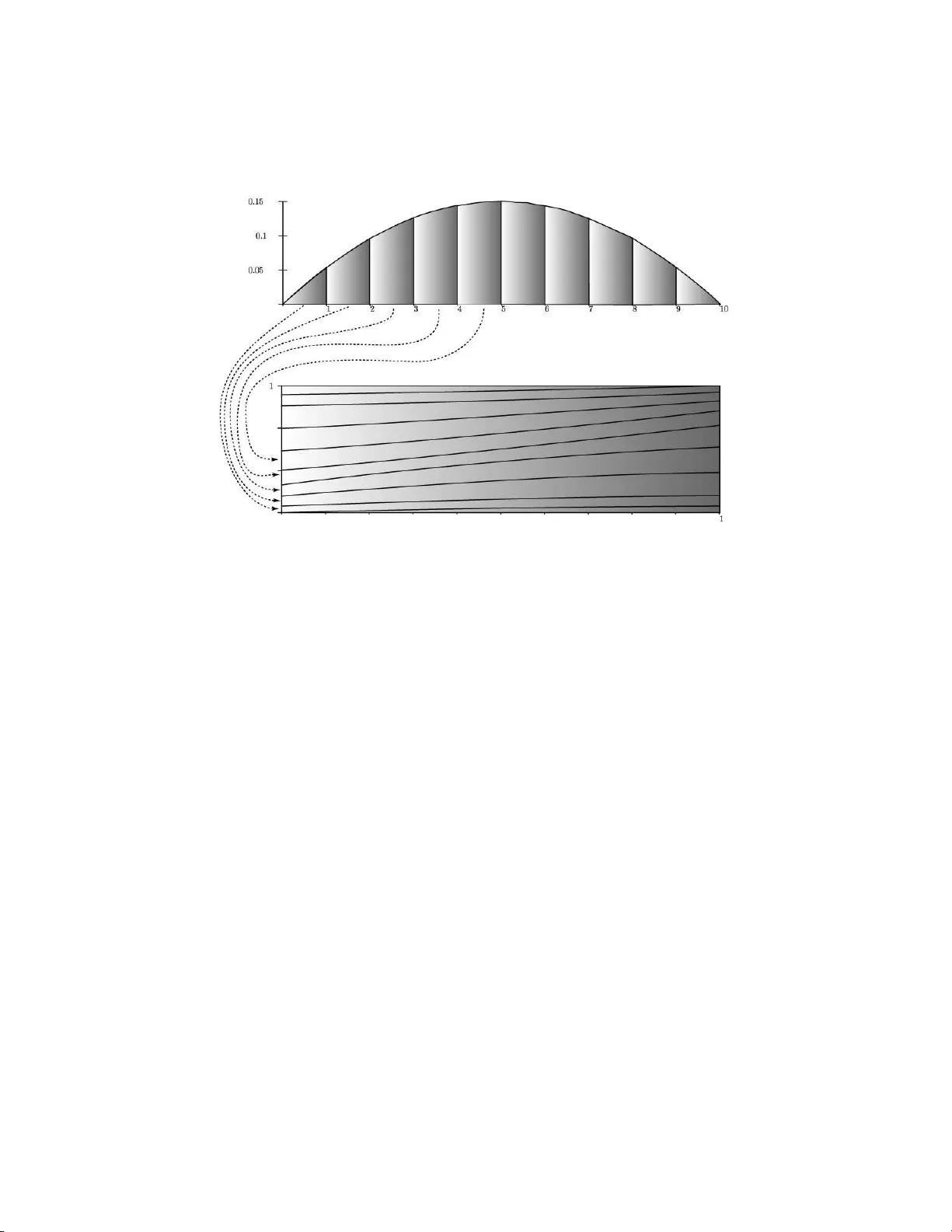
Scatter and regularit y imply Benford’s La w... and more N. Gauvrit ∗ L ab or atoir e Andr ´ e R evuz, Un iversity Paris VII , F r anc e J.-P . D elaha y e L ab or atoir e d’Informa t ique F ondamentale, USTL, Lil le, F ra nc e Abstract A random v aria ble (r.v.) X is s aid to follo w Benford’s la w if log ( X ) is uniform mo d 1. Man y exp erimen ta l data sets prov e to follow an appro ximate v ersion of it, a nd so do man y mathematical series and con tin uous random v ariables. This phenomenon receiv ed some in terest, and sev eral explanatio ns ha ve b een put forw ard. Most of them fo cus on specific dat a , dep ending on strong assumptions, often link ed with the log function. Some authors hin ted - implicitly - that the tw o most imp ortant c harac- teristics of a random v ariable when it comes to Benford are regularit y and scatter. In a first part, we pro v e tw o theorems, making up a forma l v ersion of this in tuition: s cattered and regular r .v.’s do appro ximately follow Benford’s law. The pro ofs only need simple mathematical to ols, making the analysis easy . Previous explanations th us b ecome corollaries of a more general and simpler one. These results suggest that Benford’s law do es not dep end on prop erties link ed with the log function. W e th us prop ose and test a g eneral v ersion of the Benford’s law. The success of these tests may b e view ed as an a p osteriori v alidation o f the analysis form ulated in the first part. Key wor ds: Benford’s law, scatter, digit analysis JEL co de C16 2010 MSC: 00A06, 47N30 ∗ Corresp o nding author Email addr esses: adems @free. fr (N. Gauvr it), jpd @lifl. fr (J.-P . Delahaye) Pr eprint submitte d to Mathematic al So cial Scienc es Novemb er 5, 2018 1. In tro duction First noticed b y New com b (1881), and again later by Benford (1938), the so-called Benford’s law states that a sequence of ” r andom” n umbers should b e suc h that their logarithms are uniform mo d 1. As a consequence , the first non-zero digit of a sequence of ”random” n um b ers is d with probability log 1 + 1 d , an unexp ectedly non- uniform probability law. log here stands for the base 10 logarithm, but an easy generalisation follow s: a random v a riable (r.v.) conforms to b ase b Benford’s la w if its base b logarithm log b ( X ) is uniform mo d 1. Lolb ert (2008) r ecently prov ed that no r.v. follo ws base b Benford’s law fo r all b. Man y exp erimen tal data roughly conform to Benford’s law (most of whic h no more than r oughly). Ho w ev er, the v ast ma jority of real da ta sets t ha t hav e b een tested do not fit this law a t all. F or instance, Scott and F asli (2001) rep orted that only 1 2 .6% of 23 0 real data sets passed the test for Benford’s la w. In his seminal pap er, Benford (1938) tested 20 data sets including lak es areas, length of rive rs, p opulat io ns, etc., half of whic h did not confo r m to Benford’s law . The same is true of mathematical sequences or con tinuous r.v.’s. F or ex- ample, binomial arrays n k , with n ≥ 1 , k ∈ { 0 , ..., n } , tend tow ard Benford’s la w (Diaconis , 1977), whereas simple sequences suc h as (10 n ) n ∈ N ob viously don’t. In spite of all this, Benford’s law is a ctually used in the so-called ”digital analysis” to detect anomalies in pricing (Sehit y et al., 2005) or fra uds, for instance in accoun ting rep orts (Dra ke and Nigrini, 2000) or campaign finance (Cho and Gaines , 2007). F ak ed dat a indeed usually depart from Benford’s la w more than real ones (Hill, 1988). Ho wev er, Hales et al. (2008) advise caution, arguing that real dat a do not alw ay s fit the law . Man y explanations hav e b een put forw ar d to elucidate the app earance of Benford’s la w on natural or mathematical data. Some authors fo cus on pa r - ticular random v ariables (Engel and Leuen b erger , 2003), sequence (Jo lissaint, 2005), real data (Burk e and Kincanon , 1991), or orbits of dynamical systems (Berger et al., 2004). As a rule, other explanations assume special prop erties of the data. Hill (1995 b) or Pinkham (1961 ) sho ws that scale in v a riance im- plies Benford’s la w. Base in v ariance is an o ther sufficien t condition (Hill, 1995a). Mixtures of uniform distributions (Jan vresse and Delarue, 2004) 2 also conform to Benford’s law, and so do the limits of some random pro- cesses (Sh ¨ urger, 2008). Multiplicativ e pro cesses ha v e b een men tioned as w ell (Pietronero et a l., 2001). Eac h of these explanations accoun ts for some ap- p earances of data fitting Benford’s law, but lac ks generalit y . While lo oking for a truly general explanation, some authors noticed that data sets are more like ly to fit Benfor d’s la w if they w ere scattered enough. More precisely , a sequence should ”co ve r sev eral orders of magnitude”, a s Raimi (1976) expres sed it. Of course, scatter alo ne is no sufficien t condition. The sequence 0.9, 9, 90, 900... indeed co v ers sev eral orders of magnitude, but is far from conforming to Benford’s law. The con tinuous random v aria bles that a r e known to fit Benford’s law usually presen t some ” regularit y”: ex- p onen tial densities, normal densities, or lognormal densities are of this kind. In v ar ia nce assumptions (base-inv ariance or scale-in v ariance) lead to ”regu- lar” densities and so do cen tral limit-lik e theorem assumptions of mixture. Some tec hnical explanations ma y b e view ed as a mathematical expression of the idea that a random v ariable X is more lik ely to confor m to Benford’s la w if it is regular and scattered enough. (Mardia and Jupp, 2000, Exam- ple 4.1.) link ed Benford’s la w to P oincar ´ e’s theorem in circular statistics, and Smith (2007) expresse d it in terms of F ourier tra nsforms and signal pro cessing. Ho wev er, a non exp ert reader would hardly not ice the smo oth- and-scattered implications of these deve lo pments. Though scatter has b een explicitly mentioned and regularity allusiv ely ev ok ed, the idea t ha t scatter and regularit y (in a sense that will b e made clear further) may actually b e a s ufficient explanation for Benford’s phenomenon related to contin uo us r.v.’s ha v e nev er b een fo rmalized in a simple wa y , to our kno wledge, except in a recen t article by F ewster (2009). In this pap er, F ews ter h yp othesizes that ” any distribution [...] that is r e as onably sm o oth and c overs sever al or ders o f magni tude is almost guar ante e d to ob ey Ben for d’s law.” He then defines a smo othing pro cedure fo r a r.v. X based on [ π 2 ( x )] ′′ , π b eing the pro babilit y densit y function (henceforth p.d.f. ) of log ( X ) , and illustrates with a few elo quen t examples that under smo o thness a nd scatter constrain ts, a r.v. cannot depart m uch from Benford’s law. Ho w eve r, no theorem is given that w ould formalise this idea. In the first part of this pap er, w e prov e a theorem from whic h it follows that scatter and regularity can b e mo delled in suc h a w a y that they , alone, imply r ough compliance to Benford’s la w (again: real da t a usually do not p erfectly fit Benfo r d’s law, irrespectiv e of the sample size). It is not surprising that man y data sets or ra ndom v ariables samples ar e 3 scattered and regular hence our explanation o f Benford’s phenomena corrob- orates a widespread in tuition. The pro of o f this theorem is straigh tfor ward and requires only basic ma t hematical to ols. F urthermore, as we shall see, sev eral of the existing explanations can b e understo o d a s corollaries of ours. Our explanation encompasses more sp ecific ones, and is fa r simpler to un- derstand and to pro ve . Scatter and regularit y do not presuppo se an y lo g-related prop erties (suc h as the prop erty of log-normality , scale-in v ariance, or m ultiplicative prop er- ties). F or this reason, if w e are right, Benford’s law should also admit ot her v ersions. W e set that a r.v. X is u -Benford for a f unction u if u ( X ) is uni- form mo d 1. The classical Benford’s la w is th us a sp ecial case of u -Benford’s la w, with u = log. W e test real data sets and mathematical sequences for ” u - Benfordness” with v arious u , and test a second theorem ec hoing the first one. Most data conform to u - Benfo r d’s law for differen t u , whic h is an argumen t in fav our of our explanation. 2. Scatter and regularit y: a k ey t o Benford The basic idea at the r o ot of t heorem 1 ( b elo w) is t wofold. First, w e hypothesize that a con tinuous r.v. X with densit y f is almost uniform mo d 1 as so on as it is scattered and regular. More precisely , an y f that is non-decreasing o n ] − ∞ , a ], and then non-increasing on [ a, + ∞ [ (for regularit y) and suc h that its maxim um m = sup( f ) is ” small” ( f or scatter) should corresp ond to a r.v. X approaching uniformit y mo d 1 . Figure 1 il- lustrates this idea. 4 Figure 1 — Illustration of the idea tha t a regular p.d.f. is almost b ound to giv e rise to uniformit y mo d 1. The strip es — restrictions of the densit y on [ n, n + 1] — o f the p.d.f. of a r.v. X are stac k ed to form the p.d.f. of X mo d 1 . The slop es partly comp ensate, so that the resulting p.d.f. is almo st uniform. If the initia l p.d.f. is linear on ev ery [ n, n + 1] , the comp ensation is p erfect. Second, note t hat if X is scattered a nd regular enough, so should b e log ( X ). These tw o ideas ar e fo rmalized and prov ed in theorem 1. Henceforth, for any real n umber x, ⌊ x ⌋ will denote the greatest in teger not exce eding x, and { x } = x − ⌊ x ⌋ . Any positive x can b e written as a pro duct x = 1 0 ⌊ log x ⌋ . 10 { log x } , and the Benford’s law may b e rephrased as the uniformit y o f the random v aria ble { log ( X ) } . Theorem 1. L et X b e a c on tinuous p ositive r andom variable with p.d.f. f such that I d.f : x 7− → xf ( x ) c onfo rm s to the two fol lowing c onditions : ∃ a > 0 such that (1) max( I d.f ) = m = a.f ( a ) and (2) I d.f is nonde c r e asing on ]0 , a ] , a nd nonincr e a s i ng on [ a, + ∞ [ . Then, f o r any z ∈ ]0 , 1] , | P ( { lo g X } < z ) − z | < 2 ln (10) m. In p articular, ( X n ) b eing a s e quenc e of c ontinuous r.v.’s with p.d.f. f n sat- isfying these c onditions and such that m n = max ( I d.f n ) − → 0 , { log ( X n ) } c onv e r ges towar d uniformity on [0 , 1[ in law. 5 Proo f. W e first prov e t ha t for an y contin uous r.v. Y with densit y g such that g is nondecreasing on ] − ∞ , b ] , and then nonincreasing o n [ b, + ∞ [ , the follo wing holds: ∀ z ∈ ]0 , 1] , | P ( { Y } < z ) − z | < 2 M where M = g ( b ) = sup ( g ) . W e may supp o se without loss of generality that b ∈ [0 , 1[ . Let z ∈ ]0 , 1[ (the case z = 0 is obv io us). Put I n,z = [ n, n + z [ . F or an y in teger n ≤ − 1 , 1 z Z I n,z g ( t ) dt ≤ Z n +1 n g ( t ) dt. Th us 1 z X n ≤− 1 Z I n,z g ( t ) dt ≤ Z 0 −∞ g ( t ) dt. F or an y inte ger n ≥ 2 , 1 z Z I n,z g ( t ) dt ≤ Z n + z n − 1+ z g ( t ) dt, so 1 z X n ≥ 2 Z I ,z g ( t ) dt ≤ Z + ∞ 1+ z g ( t ) dt. Moreo v er, R I 0 ,z g ≤ z M a nd R I ,z g ≤ z M . Hence, 1 z X n ∈ Z Z I n,z g ≤ Z ∞ −∞ g + 2 M . W e prov e in the same fashion t hat 1 z X n ∈ Z Z I n,z g ≥ Z ∞ −∞ g − 2 M . Since P Z R I n,z g = P ( { Y } < z ) , z < 1 and R ∞ −∞ g = 1 , the result is pro v ed. No w, applying this to Y = log ( X ) pro v es theorem 1 . Remark 1. The conv ergence theorem is still v alid if w e accept f to hav e a finite num b er of mono ton y c hanges, provide d this num b er do es not exceed a previously fixed k . The pro o f is straightforw a rd. Remark 2. The assumptions made on I d.f ma y b e seen as a measure of scatter and regula rit y f o r X , adjusted for our purp ose. 6 3. Examples 3.1. T yp e I Par eto A con tin uous r.v. X is type I P ar eto with parameters α and x 0 ( α, x 0 ∈ R ∗ + ) iff it admits a density function f x 0 ,α ( x ) = αx α 0 x α +1 I [ x 0 , + ∞ [ Besides its classic al use in income and w ealth mo delling, type I Pareto v ariables a rise in hyd ro logy and astronom y (Paolella, 2006, page 252 ) . The function I d.f = g : x 7− → αx α 0 x α I [ x 0 , ∞ [ is decreasing. Its ma ximum is sup ( I d.f ) = I d.f ( x 0 ) = α. Therefore, X is nearly Benford-lik e, in the exten t that | P ( { lo g X } < z ) − z | < 2 ln(10) α. 3.2. T yp e I I Par e to A r.v. X is type I I P areto with para meter b > 0 iff it a dmits a densit y function defined b y f b ( x ) = b (1 + x ) b +1 I [0 , + ∞ [ It arises in a so-called mixtur e mo del , with mixing comp onents b eing gamma distributed r .v.’s sequences. The function I d.f b = g b : x 7− → bx (1+ x ) b +1 I [0 , + ∞ [ is C ∞ ( R + ) , with deriv ative g ′ b ( x ) = b (1 − bx ) ( x + 1) b +2 , whic h is p ositiv e whenev er x < 1 b , then negat ive. F rom this result we deriv e sup g b = g b 1 b = 1 1 + 1 b 1+ b = b 1 + b b +1 , since ln " b 1 + b b +1 # = ( b + 1) [ln b − ln ( b + 1)] , whic h tends tow ard −∞ when b tends t ow ard 0, sup g b − → b − → 0 0 . Theorem 1 applies. It fo llo ws that X confo r m to w ard Benford’s la w when b − → 0 . 7 3.3. L o gnorma l distributions A r.v. X is log normal iff log ( X ) ∼ N ( µ, σ 2 ). Lognormal distributions ha v e b een related to Benford ( ? ). It is easy to prov e that whenev er σ − → ∞ , X tends to w ard Benford’s law. Although the pro o f may use differen t to ols, a straigh tfo rw ard w a y to do it is t heorem 1. One classical explanation of Benford’s law is that man y data sets are ac- tually built through m ultiplicative pro cesses (Pietronero et al., 20 01). Th us, data may b e see n a s a pro duct of man y small effects . This ma y be mo delled b y a r.v. X that ma y b e written as X = Y i Y i , Y i b eing a sequence of random v ariables. Using the log transfor ma t io n, this leads to log ( X ) = P log ( Y i ) . The multiplic ative c entr al - l i m it the or em therefore pro ve s that, under usual assumptions, X is b ound to b e almost lognormal, with log ( X ) ∼ N ( µ, σ 2 ) , and σ − → ∞ , thu s ro ughly conforming to Benford, as an application of theorem 1. 4. Generalizing Benford If we are righ t to think that Benford’s law is to b e understo o d as a conse- quence of mere scatter and regularity , instead of sp ecial characteristic s link ed with m ultiplicative, scale-in v ar ia nce, or whatev er log- related prop erties, we should b e able to state, prov e, a nd c hec k on real data sets, a generalized v ersion of the Benford’s la w w ere some function u replaces the log . Indeed, our basic idea is that X b eing scattered and regular enough im- plies log ( X ) t o b e scattered and regular as well, so that log ( X ) should b e almost uniform mo d 1. The same should be true of any u ( X ) , u being a function preserving scatter and regularity . Actually , some u should ev en b e b etter shots than log , since log reduces scatter o n [1 , + ∞ [ . First, let us set out a generalized v ersion of theorem 1, the pro of of whic h is closely similar to tha t of theorem 1. Theorem 2. L et X b e a r.v. taking values in a r e a l interval I , with p.d.f. f . L et u b e a C 1 incr e asing function I − → R , such that f u ′ : x 7− → f ( x ) u ′ ( x ) c onfo rms to the fol lowing: ∃ a > 0 such that (1) max f u ′ = m = f u ′ ( a ) and 8 (2) f u ′ is non- de cr e asing on ]0 , a ] , and non- incr e asing o n [ a, + ∞ [ ∩ I . Then, for al l z ∈ [0 , 1[ , | P ( { u ( X ) } < z ) − z | < 2 m. In p articular, if ( X n ) is a se quenc e of such r.v.’s with p.d.f. f n and max ( f n /u ′ ) = m n , and lim + ∞ ( m n ) = 0 , then { u ( X n ) } c onver ges i n law towar d U ([0 , 1[) when n − → ∞ . A r.v. X suc h that { u ( X ) } ∼ U ([0 , 1[) will b e said u -Benford henceforth. 4.1. Se quenc e Although our t wo theorems o nly apply to con tinuous r.v.’s, the underly- ing in tuition that log - Benford’s law is only a sp ecial case (hav ing, how ever, a sp ecial interes t thanks to its implication in terms of leading-dig its interpre- tation) of a more general law do es also apply to sequence. In this section, w e exp erimentally t est u - Benfor dness for a f ew sequences ( v n ) and a four functions u. W e will use six mathematical sequences. Three of them, namely ( π n ) n ∈ N , prime nu mbers ( p n ), and ( √ n ) n ∈ N are known not to follow Benfor d. The three others, ( n n ) n ∈ N , ( n !) n ∈ N and ( e n ) n ∈ N conform to Benfor d. As for u, we will fo cus on four cases: x 7− → log [log ( x ) ] x 7− → log ( x ) x 7− → √ x x 7− → π x 2 The first o ne increases v ery slow ly , so w e ma y exp ect that it will not w ork p erfectly . The second leads to the classical Benford’s law. The π co efficien t of the last u allows us to use in teger n umbers, for whic h { x 2 } is nil. The result of the exp erimen t is giv en in T able 1. v n log ◦ log ( v n ) log ( v n ) √ v n π v 2 n √ n ( N = 10 000 ) 68 . 90 ( . 000 ) 45 . 90 ( . 000) 4 . 94 ( . 000) 0 . 02 ( . 000) π n ( N = 10 000) 44 . 08 ( . 000 ) 26 . 05 ( . 000) 0 . 19 (1 . 000 ) 0 . 80 ( . 544) p n ( N = 10 000 ) 53 . 92 ( . 000 ) 22 . 01 (0 . 000) 0 . 44 (0 , 990) 0 . 69 ( . 719) e n ( N = 1 000) 6 . 91 (0 . 000 ) 0 . 76 (1 . 000) 0 . 63 ( . 8 1 5) 0 . 79 ( . 56 0) n ! ( N = 1 00 0) ( ∗ ) 7 . 39 ( . 000) 0 . 5 8 ( . 8 87) 0 . 61 ( . 844) 0 . 90 ( . 387) n n ( N = 1 000) ( ∗ ) 7 . 45 ( . 000) 0 . 80 ( . 543) 16 . 32 ( . 000) 0 . 74 ( . 646 ) 9 T a ble 1 — Results of the K olmogorov-Smirno v tests applied on { u ( v n ) } , with four differen t functions u ( columns) and six sequences (lines). Eac h sequence is tested through its first N terms (from n = 1 to n = N ) , with an exception for log ◦ log ( n n ) and log ◦ log ( n !) , f o r whic h n = 1 is not considered. Eac h cell displa ys the Ko lmogorov - Smirnov z and the corresp onding p v alue. The sequences ha v e b een arranged according to the sp eed with whic h it con v erges to + ∞ ( and so a re t he functions u ). None of the six sequences is log ◦ log -Benford (but a faster div ergen t sequence suc h as 10 e n w ould do). Only the last three are log-Benford. These are the sequenc es go ing to ∞ faster than a n y p olynomial. Only o ne sequence ( n n ) do es not satisfy √ . - Benfordness. Ho we ver, this can b e understo o d as a pathological case, since √ n n is integer whenev er n is eve n, or is a perfect square. Doing the same Kolmogorov-Smirno v test with o dd n umbers not b eing p erfect squares giv es z = 0 , 45 and p = 0 , 987 , showing no discrepancy with √ . -Benfordness for ( n n ) . All six sequences are π . 2 -Benford. Putting aside the case of √ n n , what T able 1 rev eals is that the conv er- gence speed of u ( v n ) completely determines the u -Benfordness of ( v n ) . More precisely , it seem s that ( v n ) is u -Benford whenev er u ( v n ) increases as fast as √ n, and is not u -Benford whenev er u ( v n ) increase as slo wly as ln ( n ) . Of course, this rule-of-thum b is not to b e tak en as a theorem. Obvious ly enough, one can actually decide to increase or decreas e conv ergence sp eed of u ( v n ) without c hanging { u ( v n ) } , adding or substracting ad ho c integer n um b ers. Nev ertheless, this observ ation suggests that w e giv e a closer lo ok at se- quence f ( n ) , where f is an increasing and concav e real function conv erging to ward ∞ , a nd lo ok for a condition for ( { f ( n ) } ) n to conv erge to unifor- mit y . An in tuitive idea is tha t ( { f ( n ) } ) n will depart f rom uniformit y if it do es not increase fast enough: w e may define brack ets of integers — namely [ f − 1 ( n ) , f − 1 ( n + 1) − 1[ ∩ N , within whic h ⌊ f ( n ) ⌋ is constan t, and of course { f ( n ) } increasing. If these brac ke ts are ” to o lar g e”, the relativ e heigh t o f the last considered brac k et is so imp ortan t that it ov ercomes the first terms of the sequence f (0) , ..., f ( n ) mo d 1. In that case, there is no limit to the prob- abilit y distribution of ( { f ( n ) } ) . The we ight of the brac kets should therefore b e small relativ e to f − 1 ( n ) , whic h ma y b e written as f − 1 ( n ) − f − 1 ( n + 1) f − 1 ( n ) − → ∞ 0 . 10 Pro vided that f is regular, this leads to ( f − 1 ) ′ ( x ) f − 1 ( x ) − → ∞ 0 , or ln f − 1 ( x ) ′ − → ∞ 0 . F unctions f : x 7− → x α , α > 0 satisfy this condition. Any n α should then sho w a uniform limit probabilit y la w, except for pathological cases ( α ∈ Q ) . T a king α = 1 π giv es (with N = 100 0 ) , a Kolmo g oro v-Smirnov z = 1 , 331 , and a p -v alue 0.058, whic h means there is no significan t discrepancy from uniformit y . On the other hand, the log function whic h do es not confo rm to this condition is suc h that { lo g ( n ) } is not uniform, confirming once again our rule-of-thum b conjecture. 4.2. R e al data W e test three data sets for u -Benfordness using a Kolmogorov-Smirno v test for uniformity . First dat a set is the op ening v alue of the D o w Jones, the first da y of eac h mon th from O cto b er 1928 to Nov ember 2007. The second and t hir d are country a reas expressed in millions of square-km 2 and the p opulations of the differen t coun tries, as estimated in 2008, expressed in millions of inhabitants. The t wo last seque nces are provided by the CIA 1 . T a ble 2 displa ys the results. log ◦ log ( v n ) log ( v n ) √ v n π v 2 n Do w Jones ( N = 950) 5 . 90 ( . 000) 5 . 20 ( . 0 00) 0 . 75 ( . 635) 0 . 44 ( . 99 2) Area pa ys ( N = 256) 1 . 94 ( . 001) 0 . 51 ( . 9 59) 0 . 89 ( . 404) 1 , 88 ( . 002) P opulations ( N = 242) 3 . 39 ( . 000 ) 0 . 79 ( . 568) 0 . 83 ( . 494 ) 0 . 42 ( . 9 94) T a ble 2 — Results of the K olmogorov-Smirno v tests applied on { u ( v n ) } . This table confirms our analysis: classical Benfordness is actually less often b o rne o ut than √ . -Benfordness on these data. The la st column show s that our previous conjectured rule has exceptions: div ergence sp eed is no t an absolute criterion by itself. F or country areas, the fast growin g u : x 7− → π x 2 giv es a discrepancy from uniformity , whereas the slo w-growing log do es not. Ho w ev er, allo wing for exceptions, it is still a go o d rule-of-thum b. 1 ht tp:// www.cia.gov/librar y/publications/the- world-factbo ok/do cs/rankorderguide.h tml 11 4.3. Continuous r.v .’s Our theorems apply on con tin uous r.v.’s. W e no w fo cus on three examples of suc h r.v.’s, with the same u as ab o ve (except for log ◦ log , which is not defined ev erywhere on R ∗ + ): the uniform densit y on ]0 , k ] ( k > 0) , exp onential densit y , a nd absolute v alue of a normal distribution. 4.3.1. Uniform r.v.’s It is a kno wn fact that a unifor m distribution X k on ]0 , k ] ( k > 0 ) do es not approac h classical Benfordness, eve n as a limit. On ev ery bra c k et [10 j − 1 , 10 j − 1[ , the leading digit is uniform. Therefore, taking k = 10 j − 1 leads to a uniform (and not lo g arithmic) distribution for leading digits, whatev er j migh t b e. The densit y g k of √ X k is g k ( x ) = 2 x k , x ∈ i 0 , √ k i and g k ( x ) = 0 otherwise. It is an increasing f unction on ] − ∞ , √ k ], decreasing on [ √ k , + ∞ [ with maximum 2 √ k − → 0 when k − → ∞ . Theorem 2 applies, sho wing t ha t X k tends tow ard √ . -Benfordness in la w. No w, theorem 3 b elow prov es t hat X k tends tow ar d u -Benfordness, when u ( x ) = π x 2 . Theorem 3. If X fol lows a uniform density on ]0 , k ] , { π X 2 } c o n ver ges in law towar d uniformity on [0 , 1[ when k − → ∞ . Proo f. Let X ∼ U (]0 , k ]) . The p.d.f. g of Y = π X 2 is g ( x ) = 1 2 a √ x , x ∈ ]0 , a 2 ] where a = k √ π . The c.d.f. G of Y is then G ( x ) = √ x a , x ∈ ]0 , a 2 ] . Let now δ ∈ ]0 , 1[ . Call P δ the probability that { Y } < δ . ⌊ a 2 − δ ⌋ X j =0 G ( j + δ ) − G ( j ) ≤ P δ ≤ ⌊ a 2 − δ ⌋ +1 X j =0 G ( j + δ ) − G ( j ) 12 1 a ⌊ a 2 − δ ⌋ X j =0 p j + δ − p j ≤ P δ ≤ 1 a ⌊ a 2 − δ ⌋ +1 X j =0 p j + δ − p j The square-ro ot function b eing conca ve, p j + δ − p j ≥ δ 2 √ j + δ and, for a n y j > 0 , p j + δ − p j ≤ δ 2 √ j . Hence, δ 2 a ⌊ a 2 − δ ⌋ X j =0 1 √ j + δ ≤ P δ ≤ 1 a √ δ + ⌊ a 2 − δ ⌋ +1 X 1 δ 2 √ j δ 2 a ⌊ a 2 − δ ⌋ X j =0 1 √ j + δ ≤ P δ ≤ √ δ a + δ 2 a ⌊ a 2 − δ ⌋ +1 X 1 1 √ j x 7− → 1 √ x b eing decreasing, ⌊ a 2 − δ ⌋ X j =0 1 √ j + δ ≥ ⌊ a 2 − δ ⌋ +1+ δ Z δ 1 √ t dt ≥ 2 h p ⌊ a 2 − δ ⌋ + 1 + δ − √ δ i and ⌊ a 2 − δ ⌋ +1 X 1 1 √ j ≤ Z ⌊ a 2 − δ ⌋ +1 0 1 √ t dt ≤ 2 h p ⌊ a 2 − δ ⌋ + 1 i . So, δ a h p ⌊ a 2 − δ ⌋ + 1 + δ − √ δ i ≤ P δ ≤ δ a h p ⌊ a 2 − δ ⌋ + 1 i . As a consequence , for an y fixed δ , lim a − →∞ ( P δ ) = δ , a nd { π X 2 } con v erges in law to uniformit y on [0 , 1[. 13 4.3.2. Exp onential r.v.’s Let X λ b e an exp onential r.v. with p.d.f. f λ ( x ) = λ exp ( − λx ) ( x ≥ 0 , λ > 0) . Engel and Leuen b erger [200 3] demonstrated that X λ tends to ward the Ben- ford’s law when λ − → 0 . The p.d.f. of √ X λ is x 7− → 2 λx exp ( − λx 2 ) , whic h increase s on 0 , 1 2 λ and then decreases. Its maxim um is exp − 1 4 λ . Theorem 2 th us applies, sho wing that X λ is √ . -Benford as a limit when λ − → 0 . Finally , theorem 4 b elo w demonstrates that X λ tends tow ard u -Benfordness for u ( x ) = π x 2 as w ell. Theorem 4. If X ∼ E X P ( λ ) ( with p.d.f. f : x 7− → λ exp ( − λx )) , then Y = π X 2 c onv e r ges towar d uniformity mo d 1 when λ − → 0 . Proo f. Let X b e suc h a r.v. Y = π X 2 has densit y g with g ( x ) = µ 2 √ x exp − µ √ x , x ≥ 0 where µ = λ √ π . The Y c.d.f. G is th us, fo r all x ≥ 0 G ( x ) = 1 − e − µ √ x . Let P δ denote the probability that { Y } < δ , for δ ∈ ]0 , 1[ . P δ = ∞ X j =0 h e − µ √ j − e − µ √ j + δ i x 7− → exp ( − µ √ x ) b eing con v ex, δ µ 2 √ j + δ e − µ √ j + δ ≤ e − µ √ j − e − µ √ j + δ for any j ≥ 0 , and e − µ √ j − e − µ √ j + δ ≤ δ µ 2 √ j e − µ √ j for any j > 0 . Th us δ ∞ X j =0 µ 2 √ j + δ e − µ √ j + δ ≤ P δ ≤ 1 − e − µ √ δ + δ ∞ X j =1 µ 2 √ j e − µ √ j . 14 x 7− → 1 √ x exp ( − µ √ x ) b eing decreasing, δ ∞ X j =0 µ 2 √ j + δ e − µ √ j + δ ≥ δ Z ∞ √ δ µ 2 √ t e − µ √ t dt ≥ δ h − e − µ √ t i ∞ √ δ = δ e − µ √ δ , and 1 − e − µ √ δ + δ ∞ X j =1 µ 2 √ j e − µ √ j ≤ 1 − e − µ √ δ + δ Z ∞ 0 µ 2 √ t e − µ √ t dt ≤ 1 − e − µ √ δ + δ The t w o expressions tend tow ard δ when µ − → 0 , so that P δ − → δ. The pro of is complete. 4.3.3. Absolute value of a normal di s tribution T o test the absolute v alue of a normal distribution X with mean 0 and v ariance 10 8 , w e pick ed a sample of 2000 v alues a nd used the same pro cedure as for real data. It app ear s, a s sho wn in T able 3, that X significan tly departs from u -Benfordness with u = log and u = π . 2 , but not with u = √ .. log ( X ) √ X π X 2 U ([0 , k [) k − → ∞ NO YES YES E X P ( λ ) λ − → 0 YES YES YES |N ( 0 , 10 8 ) | 14 . 49 ( . 000) 0 . 647 ( . 797) 28 . 726 ( . 000) T a ble 3 — The ta ble display s if uniform distributions, exp onential distributions, and absolute v alue of a normal distribution, a r e u -Benford for differen t functions u, or not. The last line sho ws the results (and p -v alues) of the Kolmogorov-Smirno v tests applied to a 2 000-sample. It could b e read as ”NO; YES; NO”. As w e already noticed, the b est shot when one is lo oking for Benford seems to b e the square-ro o t rather than log . 15 5. Discussion Random v aria bles exactly conforming the Benford’s classical la w are rar e, although many do roughly approach the la w. Indeed, man y explanations hav e b een prop osed for this approx imate law to hold so often. These explanations in v olve complex characteris tics, sometimes directly related to log arithms, sometimes through m ultiplicativ e pr o p erties. Our idea — f o rmalized in theorem 1 — is mor e simple a nd general. The fact that real data often are r egula r and scattered is intuitiv e. What we pro v ed is an idea which has b een recen tly expressed b y F ewster [2009]: scatter and regularit y are actually sufficient condition to Benfordness. This fact thus pro vides a new explanation of Benford’s la w. Ot her expla- nations, of course, ar e acceptable as well. But it may b e a rgued that some of the most p opular explanations a re in fact corollaries of our theorem. As w e ha ve seen when studying P areto ty p e I I densit y , mixtures o f distributions ma y lead to regular and scattered densit y , to whic h theorem 1 applies. Th us, w e ma y argue that a mixture o f densities is nearly Benford b e c ause it is nec- essarily scattered and regular. In the same fashion, multiplic atio ns of effects lead to Benford-like densities, but also ( as the m ultiplicative central-limit theorem states) to regular and scattered densities. Apart from the fact that our explanation is simpler and (arguably) more general, a go o d argumen t in its f a v or is tha t Benfordness may b e generalized — unlik e log-related explanations. Scale in v ariance or m ultiplicativ e prop er- ties are log-related. But as we ha v e seen, Benfordness is not dep endan t on log, a nd can easily b e generalized. Actually , it seems that square ro ot is a b etter candidate than log. The historical imp o r tance o f log -Benfordness is of course due t o the implications in terms of leading digits whic h b ears no equiv alence with square-ro o t. References Benford, F., 1 9 38. The law of anomalous num b ers. Pro ceedings of the Amer- ican Philosophical So ciet y 78, 5 51–572. Berger, A., Bunimo vich, L ., Hill, T., 2004. One-dimensional dynamical sys- tems and b enford’s law. T ransactions of the American Mathematical So- ciet y 357, 197– 2 19. 16 Burk e, J., Kincanon, E., 1 991. Benford’s law and ph ysical constan ts: The distribution o f initial digit s. American Jo urnal of Ph ysics 5 9 , 952. Cho, W. K. T., Gaines, B. J., 2007. Breaking the (b enford) law: Statistical fraud detection in campaig n finances. The American Statistician 61, 218– 223. Diaconis, P ., 1977. The distribution of leading digits and unifo rm distribution mo d 1 . The Annals o f Probabilit y 5, 72 –81. Drak e, P . D ., Nigrini, M. J., 2000. Computer a ssisted analytical pro cedures using b enford’s law . Journal of Accoun ting Education 18, 127–1 4 6. Engel, H.- A., Leuen b erger, C., 2 003. Benford’s law f or expo nen tial random v ariables. Statistics and Probabilit y Letters 63 , 361– 365. F ews ter, R., 2009. A simple explanation of b enford’s law. The American Statistician 63, 26–32 . Hales, D. N., Sridharan, V., Radhakrishnan, A., Chakrav orty , S. S., Siha, S., 2008 . T esting the accuracy of employ ee-rep ort ed data : An inexp ensiv e alternativ e appro ac h to traditional metho ds. Europ ean Journa l of Op era- tional Research 189, 583– 5 93. Hill, T., 1988. Random-num b er guessing and the first-digit phenomenon. Psyc holo gical Rep o rts 62, 96 7–971. Hill, T., 1995a. Base-in v ariance implies b enford’s law. Pro ceedings of the American Mathematical So ciet y 123, 887–895. Hill, T., 19 95b. A statistical deriv ation of the significant-digit law. Statistical Science 10 , 354–363. Jan vresse, E., Delarue, T., 2004. F rom uniform distributions to b enford’s la w. Journal of Applied Probability 41, 1203– 1210. Jolissain t, P ., 2005. L o i de b enford, relations de r ´ ecurrence et suites ´ e quidistribu ´ ees. Elemen te der Mathematik 60, 10–18 . Lolb ert, T., 2008 . On the non- existence of a general b enford’s law. Mathe- matical So cial Sciences 55, 103–1 06. 17 Mardia, K. V., Jupp, P . E., 2000 . Directional statistics. Chic hester: Wiley . New com b, S., 1881. Note on the frequency of use of the different digits in natural num b ers. American Journal of Mathematics 4, 39–40. P aolella, M. S., 2006. F undamen tal probabilit y: A computational a ppro ac h. Chic hester: Wiley . Pietronero, L., T osatti, E., T osatti, V., V espignani, A., 2001. Explaining the unev en distribution o f n umbers in nat ure: The laws of b enford and zipf. Ph ysica A 29 3 , 297–304. Pinkham, R. S., 1961. On the distribution of first significan t digits. Annals of mathematical statistics 32 , 1223–12 3 0. Raimi, R . A., 1976. The first digit pro blem. The American Mathematical Mon thly 83, 521– 538. Scott, P . D., F asli, M., 2001. Benford’s law: An empirical in ves - tigation and a nov el explanation. Ph.D. thesis, CSM tec hnical re- p ort 349, Departmen t of Computer Science, U nivers ity of Es sex, h ttp://citeseer.ist.psu.edu/709593.h tml. Sehit y , T., Ho elzl, E., Kirc hler, E., 2005. Price dev elopmen ts after a nominal sho c k: Benford’s law and psyc holog ical pr icing after the euro in tro duction. In ternational Journal o f Researc h in Marke ting 2 2, 471–48 0 . Sh ¨ urger, K., 2008. Extensions o f blac k-sc holes pro cesses a nd b enford’s law. Sto c hastic Pro cesses and their Applications 118 , 1219–124 3. Smith, S. W., 2007. The scien tist and engineer’s guide to digital signal pro- cessing. http://www.ds pguide.com/. 18
Original Paper
Loading high-quality paper...
Comments & Academic Discussion
Loading comments...
Leave a Comment