A Method of Trend Extraction Using Singular Spectrum Analysis
The paper presents a new method of trend extraction in the framework of the Singular Spectrum Analysis (SSA) approach. This method is easy to use, does not need specification of models of time series and trend, allows to extract trend in the presence…
Authors: Theodore Alex, rov
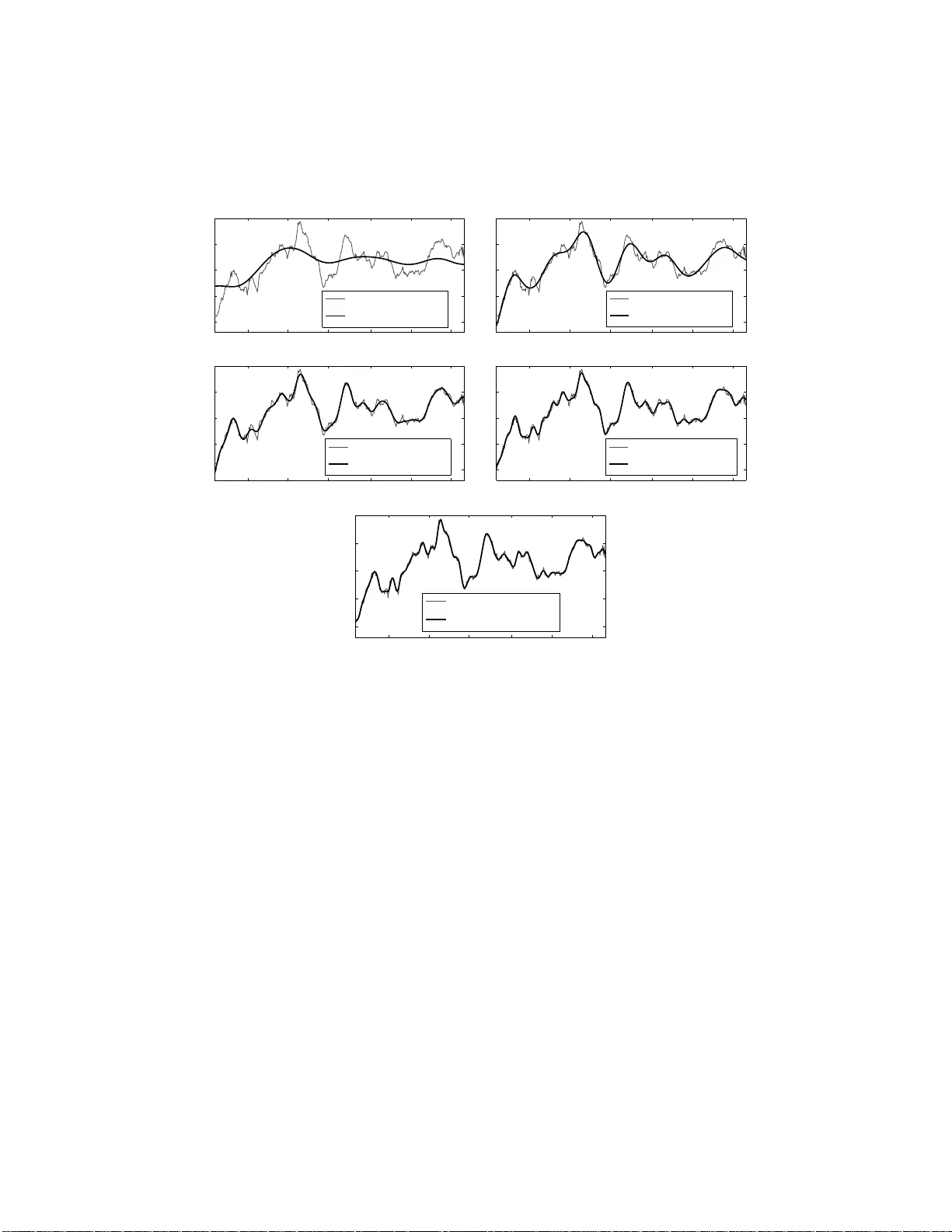
A METHOD OF TREND EXTRA CTION USING SINGULAR SPECTR UM ANAL YSIS Theo dore Alexandro v Cen ter for Industrial Mathematics, Univ ersity of Bremen, German y (theo dore@math.uni-bremen.de) Octob er 22, 2018 Abstract The pap er presents a new metho d of trend extraction in the frame- work of the Sing ular Sp ectrum Analysis (SSA) approach. This metho d is easy to us e , do es not need sp ecification of models of time s eries a nd trend, allows to extract trend in the presence o f noise and o scillations and ha s o nly tw o parameter s (b esides basic SSA parameter called win- dow length). One par ameter manages sca le of the extr acted trend and another is a metho d s pecific threshold v alue. W e pr op ose pro cedures for the choice of the par ameters. The presented metho d is ev aluated on a simulated time ser ies with a p olyno mial trend and an o s cillating com- po nent with unkno wn per io d and on the seasonally adjusted mont hly data of unemployment level in Alask a for the p erio d 19 76/01 -2006 /09. Keyw ords: Time ser ies; trend extraction; Singular Sp ectrum An alysis. 1 INTR ODUCTION T rend e xtr action is an imp ortan t task in app lied time series analysis, in particular in economics and engineering. W e present a new metho d of trend extraction in the framewo rk of the Singular S p ectrum Analysis approac h. T rend is usually defi ned as a smo oth add itiv e co mp onent conta in in g information ab out time series global c h ange. This defin ition is r ather v ague (whic h t yp e of smo othness is used? whic h kind of in formation is cont ained in the trend?). I t may sound strange, bu t there is no m ore p recise defin ition of the trend accepted by the m a j ority of researc hers and practitioners. Eac h approac h to trend extraction defines trend with resp ect to the m athematica l to ols used (e .g. using F ourier t r ansformation or deriv ativ es). Thus in the 1 corresp onding literature one can fin d v arious sp ecific definitions of the trend . F or furth er discussion on trend issues we refer to [2]. Singular S p ectrum Analysis (SSA) is a g ener al approac h to time series analysis and forecast. Algo r ithm of SSA is similar to that of P r incipal Com- p onents Analysis (PCA) of m ultiv ariate data. I n con trast to P CA which is applied to a matrix, SSA is applied to a time series and pro vides a rep re- sen tation of the giv en time serie s in terms of eig env alues and eigen v ectors of a matrix made of t h e time series. The basic idea of SSA h as b een p ro- p osed by [5] for dimension calculation and r econstruction of attrac tors of dynamical systems, see historica l reviews in [10] and in [11]. In this pap er w e mostly follo w the notations of [11 ]. SSA can b e used for a wide r ange of tasks: trend or quasi-p erio dic com- p onent detection and extractio n , d enoising, forecasting, change- p oin t detec- tion. T he pr esen t b ib liograph y on SSA in cludes tw o m onographes, sev eral b o ok c hapters, and o ver a hundred pap ers. F or more details see references at the website SS Aw iki: ht tp://www.math.u ni-bremen.de/ ∼ theo dore/ssa wiki. The metho d p resen ted in this pap er has b een fir st p rop osed in [3] and is studied in detail in the author’s unpu blished Ph.D. thesis [1] a v ailable only in Russ ian at h ttp://www.p dmi.ras.ru/ ∼ theo/autossa. The prop osed method is easy to u se (h as only t w o parameters), d o es not need s p ecification of mo dels of time series and trend , allo w s one to sp ecify desired trend sca le, and extracts trend in the presence of n oise and oscillati ons . The outline of this p ap er is as follo ws. Section 2 introd u ces SSA, form u- lates p rop erties of trend s in SSA and p resen ts the already existing metho ds of trend extrac tion in SS A. Section 3 prop oses our metho d of trend extrac- tion. In section 4 we discus s the frequen cy prop erties of add itiv e comp onen ts of a time series and p resen t ou r pro cedure for the c h oice of first parameter of the metho d, a lo w-fr equency b oundary . Section 5 starts with in vesti gation of the role of the second metho d parameter, the lo w -fr equency con tribu tion, based on a simulat ion example. Then we p r op ose a h euristic strategy for the c hoice of th is parameter. In section 6, applications of the prop osed m etho d to a sim ulated time series with a p olynomial trend and oscil lations and on the unemplo yment lev el in Alask a are considered. Finally , section 7 offers conclusions. 2 2 SINGULAR SPECTR UM ANAL YSIS Let us ha v e a time series F = ( f 0 , . . . , f N − 1 ), f n ∈ R , of length N , and w e are lo oking for some sp ecific additiv e comp on ent of F (e.g. a trend). The cen tral idea of SSA is to em b ed F in to h igh-dimensional euclidean space, then find a sub s pace corresp ond ing to the sough t-for comp onent and, fi nally , reconstruct a time s eries comp onent c orr esp onding to this su bspace. The c hoice of the su bspace is a crucial question in SSA. The basic SSA algorithm consists of decomp osition of a time series and r econstruction of a desired additiv e comp onent. These tw o steps are summarized b elo w; for a detaile d description, s ee page 16 of [11]. Decomp osition. Th e decomp osition take s a time s er ies of length N and comes up w ith an L × K matrix. This stage starts b y defin ing a parameter L (1 < L < N ), called the window length, a n d constructing the so- called tra jectory matrix X ∈ R L × K , K = N − L + 1, with stepwise tak en p ortions of the orig in al time series F as columns: F = ( f 0 , . . . , f N − 1 ) → X = [ X 1 : . . . : X K ] , X j = ( f j − 1 , . . . , f j + L − 2 ) T . ( 1) Note that X is a Hankel matrix and (1) defi n es one-to -one corresp ondence b et ween series of length N and Hank el matrices of size L × K . Then Sin gular V alue Decomp osition (SVD) of X is app lied, w here j -th comp onen t of SVD is sp ecified b y j -th eigen v alue λ j and eigen vect or U j of XX T : X = d X j =1 p λ j U j V j T , V j = X T U j . p λ j , d = m ax { j : λ j > 0 } . Since the matrix XX T is p ositiv e-definite, their eigen v alues λ j are p ositiv e. The SVD comp onents are num b ered in the d ecreasing order of eigen v alues λ j . W e define j -th Empirical Orthogonal F unction (EO F) as th e sequence of elements of the j -th eigen v ector U j . T he triple ( p λ j , U j , V j ) is called j -th eigen triple, p λ j is called the j -th sin gu lar v alue, U j is the j -th left singular v ector and V j is the j -th righ t sin gular v ector. Reconstruction. Reconstru ction g o es fr om an L × K matrix in to a time series of le n gth N . This stage co mbines (i) selec tion of a subgroup J ⊂ { 1 , . . . , L } of SVD comp onents; (ii) hank elization (a v eraging along en- tries w ith indices i + j = const ) of the L × K matrix from th e selected J comp onen ts of the SVD; (iii) reconstruction of a time series comp onen t of length N from the Hank el ma tr ix b y the ment ioned one-to-one corr esp on- dence (like in (1) bu t in the reve r s e dir ection, s ee b elo w the exact formulae). 3 The resu lt of the r econstruction stage is a time s er ies additiv e co mp onent : X J = X j ∈J p λ j U j V j T → G = ( g 0 , . . . , g N − 1 ) . F or the sak e of brevit y , let us d escrib e the hank elization of the matrix X J and the s u bsequent reconstruction of a time series comp onen t G as b eing app lied to a matrix Y = y ij i = L,j = K i,j =1 as it is introdu ced in [11]. First w e in tro duce L ∗ = min { L, K } , K ∗ = max { L, K } and defin e an L ∗ × K ∗ matrix Y ∗ as giv en by Y ∗ = Y if L 6 K and Y ∗ = Y T if L > K . Th en the elemen ts of the time series G = ( g 0 , . . . , g N − 1 ) formed from the matrix Y are calculated b y a v eraging al ong cross-diagonals of matrix Y ∗ as g n = 1 n +1 n +1 P m =1 y ∗ m,n − m +2 , 0 6 n < L ∗ − 1 , 1 L ∗ L ∗ P m =1 y ∗ m,n − m +2 , L ∗ − 1 6 n < K ∗ , 1 N − n N − K ∗ +1 P m = n − K ∗ +2 y ∗ m,n − m +2 , K ∗ 6 n < N . (2) Changing the wind o w length p arameter and, what is more imp ortan t, the subgrou p J of SVD comp onen ts used for reconstruction, one can c h ange the outp u t time series G . In the problem of trend extraction, we are lo oking for G approximat in g a tr en d of a time series. Thus, the t r end extractio n problem in SSA is reduced to (i) the c hoice of a windo w length L used for decomp osition and (ii) the selection of a su bgroup J of SVD comp onen ts used for reconstruction. The fi rst pr oblem is thoroughly discussed in section 1.6 of [1 1 ]. In this paper , w e p rop ose a solution for the second problem. Note that f or the reconstru ction of a time series comp onent, SSA consid- ers the wh ole time series, as its algorithm uses S VD of th e tra jectory m atrix built fr om all parts of the time series. Therefore, SS A is not a lo cal metho d in contrast to a lin ear fi ltering or wa v elet metho ds . On the other h an d , this prop erty makes SSA r obust to outliers, see [11] for more details. An essentia l disad v anta ge of SSA is its computational complexity for th e calculatio n of S VD. Th is shortcoming can b e reduced by using mo d ern [9] and parallel algorithms for SVD. Moreo v er, for trend revision in case of receiving n ew data p oin ts, a computationally attractiv e algorithm of [12 ] for up d ating SVD can b e used. It is worth to men tion here that the similar id eas of using SVD of the tra- jectory matrix ha ve b een prop osed in other areas, e.g. in signal extraction in o ceanology [8] and estimatio n of parameters of damp ed complex exp onen tial signals [13]. 4 2.1 T rend in SSA SSA is a non p arametric approac h whic h do es n ot need a pr iori sp ecification of mo dels of time series and trend, neither d eterministic nor sto c hastic ones. The classes of trends and residuals which can b e successfully s eparated by SSA are c haracterized as follo ws. First, since we extract an y trend b y select in g a sub group of all d SVD comp onen ts, this tr en d should generate less than d SVD comp onent s. F or an infi n ite time series, a class of su c h trend s coincides with the class of time series go verned b y fin ite difference equations [11]. This class can b e d escrib ed explicitly as linear co mbinations o f pro du cts of p olynomials, exp onen tials and sin es [6 ]. An elemen t of th is class suits w ell for repr esen tation of a smo oth and slo w v arying trend. Second, a residual should b elong to a cl ass of time series w hic h ca n b e separated from a trend. The separabilit y theory du e to [14] helps us deter- mine this class. In [14] it w as pro ved that (i) an y deterministic fun ction can b e asymptotic ally separated from an y ergo dic sto c hastic noise as the time series length and window length tend to infinit y; (ii) un der some conditions an y trend can b e separated from an y quasi-p erio dic comp onen t, see also [11]. These pr op erties of SSA m ak e this approac h feasible for trend extraction in the p resence of n oise and quasi-p erio dic oscillating components. Finally , as trend is a smo oth and s lo w v arying time series comp onen t, it generates SVD comp onent s with smo oth and slo w v arying EOFs. Eigen ve c- tors repr esent an orthonormal basis of a tra jectory v ector sp ace spann ed on the column s of tra jectory matrix. T h us e ach EO F is a linea r com bination of p ortions of the corresp onding time series and in h erits its global smo oth- ness prop erties. This idea is considered in detail in [11] for the cases of p olynomial and exp onen tial trends. 2.2 Existing metho ds of t rend extraction in SSA A naiv e app roac h to trend extrac tion in SSA is to reconstruct a tr end from sev eral fir st S VD co mp onent s. Despite its simplicit y , this approac h works in man y real-life cases for the follo wing reason. An eigen v alue repr esen ts a con tribution of the corresp onding SVD comp onent int o the form of the time series, see sectio n 1 .6 o f [11]. Since a trend usually c haracterizes the shap e of a time series, its eigenv alues are larger th an the other ones, that implies small order n umbers of the trend SVD comp onent s. Ho we ver, the selecti on pro cedure fails when the v alues of a trend are s m all enough as c omp ared with a r esidual, or w hen a trend has a complicated structure (e. g. a high- 5 order p olynomial) and is characte r ized by man y (not only by the first on es) SVD comp onen ts. A smarter w ay of selecting tr en d SVD comp onen ts is to c h o ose the com- p onents with smooth and slo w v arying EOFs (w e ha ve explained this f act ab o ve) . At presen t, there exist only one parametric method of [15] whic h follo ws this approac h. In [15] it w as prop osed using the Kendall co r rela- tion co efficien t for testing for m onotonic gro wth of an EOF. Un fortunately , this met h o d is far from per f ect since it is not p ossible to establish wh ich kinds of tr en d ca n b e extrac ted by it s means. This metho d seems to be aimed at extraction of monotonic tren d s b ecause their EOFs are usually monotonic. Ho we ver, ev en a monotonic trend can p ro duce non-monotonic EOF, esp ecially in case of noisy obs er v ations. An example could b e a linear trend which generate s a linear and a constan t EO Fs. If there is a n oise or another time series comp onen t added, then t h is comp onent is often mixed with trend comp onen ts corrup ting its EOFs. Then , ev en in case of v ery small corruption, the constant EOF can b e highly non monotonic. Nat- urally , the metho d using the Ken d all co rr elation coefficient does not suit for non monotonic tr ends p ro ducing n on monotonic EOFs. F or example, a p olynomial of lo w order w hic h is often used f or trend mod elling u sually pro du ces non monotonic EOFs, f or details see e.g. [11]. 3 PR OPOSED METHOD F OR TREND EXTRA C- TION In this s ection, we presen t our metho d of tren d extractio n . First, follo w - ing [11], w e introd uce the p erio dogram of a time series. Let u s consid er the F ourier representa tion of the elemen ts of a time s er ies X of lengt h N , X = ( x 0 , . . . , x N − 1 ), see e.g . section 7.3 of [7 ]: x n = c 0 + X 1 6 k 6 N − 1 2 c k cos(2 πn k / N ) + s k sin(2 π nk / N ) + ( − 1) n c N/ 2 , where k ∈ N , 0 6 n 6 N − 1, and c N/ 2 = 0 if N is an odd n um b er. T hen the p erio dogram of X at th e frequencies ω ∈ { k / N } ⌊ N/ 2 ⌋ k =0 is d efined as I N X ( k / N ) = N 2 2 c 2 0 , k = 0 , c 2 k + s 2 k , 0 < k < N / 2 , 2 c 2 N/ 2 , if N an ev en n umb er and k = N / 2 . (3) 6 Note that this per io d ogram is different from the perio d ogram usu ally used in sp ectral analysis, see e.g. [4] or [7 ]. T o sh o w this difference, let us denote the k -th elemen t o f the discrete F ourier transform of X as F k ( X ) = N − 1 X n =0 e − i 2 π nk / N x n , then th e p erio dogram I N X ( ω ) at the frequencies ω ∈ { k / N } ⌊ N/ 2 ⌋ k =0 is calculated as I N X ( k / N ) = 1 N ( 2 |F k ( X ) | 2 , if 0 < k < N / 2 , |F k ( X ) | 2 , if k = 0 or N is ev en and k = N / 2 . One ca n see that in addition to the n ormalizatio n differen t fr om that in [4] and [7] , the v alues for f requencies in the interv al (0 , 0 . 5) a r e m ultiplied b y t wo . This is done to ensu re the follo win g prop ert y: || X || 2 2 = N − 1 X n =0 x 2 n = ⌊ N/ 2 ⌋ X k =0 I N X ( k / N ) . (4) Let us introd uce th e cum u lativ e co ntribution of the f requencies [0 , ω ] as π N X ( ω ) = P k :0 ≤ k / N ≤ ω I N X ( k / N ), ω ∈ [0 , 0 . 5]. T hen, for a give n ω 0 ∈ (0 , 0 . 5), w e defi ne the cont r ibution of lo w frequ encies from the in terv al [0 , ω 0 ] to X ∈ R N as C ( X, ω 0 ) = π N X ( ω 0 ) /π N X (0 . 5) . (5) Then, giv en parameters ω 0 ∈ (0 , 0 . 5) and C 0 ∈ [0 , 1], w e prop ose to select those SVD comp onen ts w hose eigen v ectors sa tisfy the follo wing criterion: C ( U j , ω 0 ) > C 0 , (6) where U j is th e corresp onding j -th eigen v ector. One ma y in terp r et this metho d as sele ction of S VD comp onents with EOFs most ly c haracterized b y low-frequency fluctuations. It is w orth noting here that w h en w e apply C , π or I (defi ned ab o ve for a time series) to a vecto r , they are simply applied to a series of elemen ts of th e v ector. Ha ving the trend SVD comp onents selec ted using (6), one reconstructs the trend according to secti on 2. Th e question is ho w to s elect ω 0 and how to define the threshold C 0 . These issues are discussed in sections 4 an d 5, resp ectiv ely . 7 4 THE LOW-FREQUE NCY BOUND AR Y ω 0 The lo w-frequency b oundary ω 0 manages the scale of the extrac ted trend: the lo wer is ω 0 , the slo wer v aries th e extracted trend. Selectio n of ω 0 can b e done a priori based on ad d itional information ab out the data th us pr esp ec- ifying th e desired scale of the trend. F or example, if we assu me to ha v e a quasi-p erio dic co mp onent with kno wn p erio d T , then we should select ω 0 < 1 /T in order n ot to include this comp onen t in the trend. F or extraction of a trend of m on thly data with p ossible seasonal oscillati ons o f p erio d 12, we suggest to select ω 0 < 1 / 12 , e.g. ω 0 = 0 . 075. In this pap er w e also prop ose a metho d of selecti on of ω 0 considering a time series p erio dogram. Since a trend is a slow v arying comp onen t, its p erio dogram has large v alues close to zero frequency and small v alues for other frequencies. The problem of selec ting ω 0 is the problem of finding suc h a lo w-frequency v alue that the frequencies corresp onding to the large trend p er io d ogram v alues are insid e the interv al [0 , ω 0 ]. A t the same time, ω 0 cannot b e to o large b ecause then an oscillating comp onent with a fre- quency less than ω 0 can b e included in the trend p ro duced. Considering the p erio dogram of a tren d, w e could find the pr op er v alue of ω 0 but for a giv en time series its trend is u n kno wn . What w e pr op ose is to c ho ose ω 0 based on the p erio dogram of the original time series. The foll owing pr op osition subs tantiat es this app roac h. Prop osition 4.1. L et us have two time series G = ( g 0 , . . . , g N − 1 ) and H = ( h 0 , . . . , h N − 1 ) of length N , then for e ach k : 0 ≤ k ≤ ⌊ N / 2 ⌋ the fol lowing ine quality holds: I N G + H ( k / N ) − I N G ( k / N ) − I N H ( k / N ) 6 2 q I N G ( k / N ) I N H ( k / N ) . (7) Pr o of of Pr op osition 4.1. Let us first consider the case when 0 < k < N / 2. W e denote as c k ,X and s k ,X the co efficien ts of F ourier r epresen tation of a time series X used in the p erio d ogram definition (3). Then, b y this defin ition, I N G + H ( k / N ) − I N G ( k / N ) − I N H ( k / N ) = = N 2 c 2 k ,G + H + s 2 k ,G + H − c 2 k ,G − s 2 k ,G − c 2 k ,H − s 2 k ,H . Since c k ,G + H = 2 N ℜF k ( G + H ) = c k ,G + c k ,H (where ℜ z denotes an imaginary part of a complex n umb er z ) and, analog ous ly , s k ,G + H = s k ,G + s k ,H , w e ha ve I N G + H ( k / N ) − I N G ( k / N ) − I N H ( k / N ) = N ( c k ,G c k ,H + s k ,H s k ,H ) . (8) 8 Let us consider the per io d ograms m ultiplication used in t h e r ight part of (7): I N G ( k / N ) I N H ( k / N ) = N 2 4 c 2 k ,G + s 2 k ,G c 2 k ,H + s 2 k ,H . (9) Since for all real a, b, c, and d it holds that ( a 2 + b 2 )( c 2 + d 2 ) = ( | ac | + | bd | ) 2 + ( | ad | − | bc | ) 2 , then I N G ( k / N ) I N H ( k / N ) = N 2 4 ( | c k ,G c k ,H | + | s k ,G s k ,H | ) 2 +( | c k ,G s k ,H | − | c k ,H s k ,G | ) 2 . (10) Finally , taking the s quare of (8), dividin g it b y four and taking int o ac- coun t (10), w e ha v e 1 4 I N G + H ( k / N ) − I N G ( k / N ) − I N H ( k / N ) 2 = = N 2 4 ( c k ,G c k ,H + s k ,G s k ,H ) 2 6 N 2 4 ( | c k ,G c k ,H | + | s k ,G s k ,H | ) 2 6 6 N 2 4 ( | c k ,G c k ,H | + | s k ,G s k ,H | ) 2 + ( | c k ,G s k ,H | − | c k ,H s k ,G | ) 2 = = I N G ( k / N ) I N H ( k / N ) and the inequalit y in (7) holds 0 < k < N / 2. Second, w e consider the case when k = 0 o r k = N / 2. Again, b y the definition of the p erio dogram 2 q I N G ( k / N ) I N H ( k / N ) = 2 q N 2 c 2 k ,G c 2 k ,H = 2 N | c k ,G c k ,H | . A t the same time, I N G + H ( k / N ) − I N G ( k / N ) − I N H ( k / N ) = N c 2 k ,G + H − c 2 k ,G − c 2 k ,H = N | 2 c k ,G c k ,H | whic h leads for k = 0 or k = N/ 2 to I N G + H ( k / N ) − I N G ( k / N ) − I N H ( k / N ) = 2 q I N G ( k / N ) I N H ( k / N ) and the result in (7) holds with equalit y . Corollary 4 .2. L et us define f or a time series F of length N the fr e quency supp ort of the p erio do gr am I N F as a subset of fr e quencies { k / N } ⌊ N/ 2 ⌋ k =0 such that I N F ( k ′ / N ) > 0 for k ′ / N fr om this subset. If the f r e quency supp orts of two time series G and H ar e disjoint then I N G + H ( k / N ) = I N G ( k / N ) + I N H ( k / N ) 9 Let us demonstrate that when supp orts of p erio dograms o f time series G and H a r e nearly disjoint, th e p erio dogram of the su m G + H is clo s e to the su m of their p erio dograms. The fact that the p erio dograms of G and H are v ery d ifferen t at k/ N can b e expressed as I N G ( k / N ) /I N H ( k / N ) = d ≫ 1 , since withou t loss of generalit y w e can assume I N G ( k / N ) > I N H ( k / N ). Then using Prop osition 4.1 we ha ve that I N G + H ( k / N ) − I N G ( k / N ) − I N H ( k / N ) 6 6 2 q I N G ( k / N ) I N H ( k / N ) = 2 √ d I N G ( k / N ) ≪ I N G ( k / N ) , that means that the difference I N G + H ( k / N ) − I N G ( k / N ) − I N H ( k / N ) is sig- nifican tly smaller than the v alue of th e largest p erio dogram (of I N G , I N H ) at the p oin t k / N . In man y applications, the giv en time series ca n b e modelled as made of a trend with large p erio dogram v alues at lo w-frequency in terv al [0 , ω 0 ], oscillati ons with p erio d s smaller than 1 /ω 0 , and noise whose frequ ency con- tribution sp reads o ve r all the fr equ encies [0 , 0 . 5] bu t is relativ ely small. In this case the p erio dogram supp orts of the trend and the residual can b e considered as nearly disj oint. Therefore, from Corollary 4.2, w e conclud e that the p erio d ogram of the time series is approxi m ately equal to the sum of the per io d ograms of th e trend, oscillations and noise. F or a time series X of length N , w e prop ose to select the v alue of the parameter ω 0 according to the follo wing rule: ω 0 = max k / N , 0 6 k 6 N/ 2 k / N : I N X (0) , . . . , I N X ( k / N ) < M N X , (11) where M N X is the median of the v alues of p erio d ogram of X . The mo d - elling of a time series as a sum of a trend , oscillati ons and a noise (let us supp ose to ha v e a normal noise) motiv ates this rule as follo ws. Sin ce the frequency su pp orts of the trend and oscillat in g co mp onent s do not o ve r lap, only the v alues of the noise p erio dogram can mix with the v alues of the trend p erio dogram. First, the v alues of the noise p erio dogram for neighbor- ing ordinates are asymptotic ally indep endent (see e.g. sec tion 7. 3.2 of [7]). Second, supp osing a relat ively long time series an d narrow frequency sup- p orts of trend and oscillating comp onen ts, the median of v alues of the time series p er io d ogram gi ves an estimation of the median of the v alues of the 10 noise p erio dogram. S in ce a trend is sup p osed to ha v e large con tribution to the shap e of the time se r ies (i.e. a l arge L 2 -norm) compared to the noise and its frequency supp ort i s quite narro w compared to the whole in terv al [0 , 0 . 5], its p erio dogram v alues are r elativ ely larger than th e median of the noise p erio dogram v alues due to (4). Therefore, the condition used in (11 ) is fulfilled only for such a frequ ency ω 0 that the trend p erio dogram v alues is close to zero (outside the trend fr equency int erv al). Large n oise p erio d ogram v alues in this frequency region can lead to selecting larger than necessary ω 0 . But remem b er th at we co mp are the p er io d ogram v alues with their m edian and the noise p erio dogram v alues are indep end en t (asymptotically). Hence, with p r obabilit y app ro ximately equal to 1 − 0 . 5 m (e.g. this v alue is equal to 0.9375 for m = 4) we select the m -th p oint (of the grid { k / N } ) lo cated to the right side of the tr en d frequency interv al (where the trend p eridogram v alues are larger then the noised p erio dogram median). Note that the lengths N of the time series and L of e igenv ector are differen t ( L < N ) whic h causes differen t resolution of their p erio dograms. Ha ving estimated ω 0 after co n sideration of the p er io d ogram of the original time series, one should select ω ′ 0 = ⌈ Lω 0 ⌉ /L. (12) Dep endence of ω 0 on the time series resolution. Let us defin e the resolution ρ of the original time series as ρ = ( τ n +1 − τ n ) − 1 , where τ n is the time of n -th measur emen t. If one ha v e estimate d ω 0 for the data with resolution ρ and there co mes th e same data but measured with higher res- olution ρ ′ = mρ ( m ∈ R ) thus increasing the data length in m times, then in order to extract the same trend , one sh ould tak e the new thr eshold v alue ω ′ 0 = ω 0 /m . In a similar manner, after decima tion of the data reducing the resolution in m times, th e v alue ω ′ 0 = mω 0 should b e tak en. Example 4.3 (Th e c hoice of ω 0 for a noised exp onent ial trend) . L et us c onsider an examp le of sele ction of the tr eshold ω 0 for an exp onential tr end and a white Gaussian noise which also demo nstr ates Pr op osition 4.1. L et the time series F = G + H b e of length N = 1 20 , wher e the c omp onents G and H ar e define d as g n = Ae 0 . 01 n , h n = B ε n , ε n ∼ iid N (0 , 1) and A, B ar e sele cte d so that || G || 2 = || H || 2 = P N − 1 n =0 g n = P N − 1 n =0 h n = 1 . The normaliza tion is done to ensur e that P 60 k =0 I N G ( k / N ) = P 60 k =0 I N H ( k / N ) = 1 . Figur e 1 sho ws a) the simulate d time series F , b) its c omp onents, c) th e p erio do gr ams of the c omp onents, d) the p erio do gr ams zo ome d to gether with a line c orr esp onding to the me dian of the noise p erio do gr am values e qual 11 to 0 . 0126, e) the p erio do gr am I N F of F and a kind o f “c onfidenc e” interval of its estimat ion I N G + I N H c alculate d ac c or ding Pr op osition 4.1 and a line c orr esp onding to the me dian M 120 F of t he time series p erio do gr am v alues (use d for estimating ω 0 ), and f ) the discr ep ancy, the differ enc e b etwe en I N F and I N G + I N H to gether with the values of this differ e nc e estimate d in the right side of (7). Note tha the me dian o f the p erio do gr am values of F is e qual to 0.0141 , which is clo se to the me dian o f the noise p erio do gr am val u es e qual to 0.0126. The value of ω 0 estimate d ac c or ding to the pr op ose d rule (11) is e qual to 6 / 12 0 = 0 . 05 . a) Origi nal time series F = G + H 0 20 40 60 80 100 120 −0.2 −0.1 0 0.1 0.2 0.3 0.4 0.5 n F = G + H b) Time series comp onents G and H 0 20 40 60 80 100 120 −0.2 −0.1 0 0.1 0.2 0.3 n G H c) Periodog rams of comp onents G and H 0 0.1 0.2 0.3 0.4 0.5 0 0.2 0.4 0.6 0.8 ω I 120 G ( ω ) I 120 H ( ω ) d) Per i o dograms of G and H (zoomed) 0 0.1 0.2 0.3 0.4 0.5 0 0.02 0.04 0.06 0.08 0.1 ω I 120 G ( ω ) I 120 H ( ω ) this line corresponds to the median of the noise periodogram values, equal to 0.0126 e) Periodogram o f F and its estimates 0 0.05 0.1 0.15 0.2 0.25 0 0.05 0.1 0.15 0.2 ω I G + H ( ω ) I G ( ω ) + I H ( ω ) + C ( ω ) I G ( ω ) + I H ( ω ) − C ( ω ) this line corresponds to M 120 F , the median of the time series periodogram values, equal to 0.0141 estimated value of ω 0 f ) Discrepancy 0 0.1 0.2 0.3 0.4 0.5 −0.1 −0.05 0 0.05 0.1 ω I G + H ( ω ) − I G ( ω ) − I H ( ω ) + C ( ω ) − C ( ω ) Figure 1: T he c hoice of ω 0 for an exp onential trend and Gaussian noise; The v alue C ( ω ) used in the legends is equal to 2 q I N G ( ω ) I N H ( ω ). 5 THE LO W-F REQUENCY CONTRIBUTION C 0 Before suggesting a pro cedure for selection of the second paramete r of the prop osed metho d, the lo w-frequency threshold C 0 , w e inv estiga te the effect of the c hoice of C 0 on the qualit y of the trend extracted. F or th is aim, we con- 12 sider a time series mo del with a trend that generates SVD comp onen ts with kno wn n u m b ers. Then , for a s u fficien t n umb er of sim ulated time series, we compare our trend extractio n procedu re with a SSA-based pr o cedure which simply reconstru cts the trend using the kno wn trend SVD comp onents. 5.1 A sim ulation example: an exp onen tial trend plus a Gaus- sian noise The mo d el considered is the s ame as in examp le ab o ve. Let the time series F = ( f 0 , . . . , f N − 1 ) consist of an exp onen tial trend t n plus a Gaussian white noise r n : f n = t n + r n , t n = e αn , r n = σ e αn ε n , ε n ∼ iidN (0 , 1) . (13) According to [11], for suc h a time series with mo derate noise the first SVD comp onen t corresp onds to the trend. W e c onsid ered only the noise lev- els wh en this is tru e (empirically c hec k ed). Note that the noise r n has a m ultiplicativ e m o del as its standard deviation is prop ortional to the trend . In the follo win g, we consider the follo wing prop er ties. Fi r st, w e calculate the difference b et w een the trend ˆ t n ( C 0 ) resulted from our metho d with C 0 used and the reconstru ction ˜ t n of the first S VD c omp onen t exploiting the w eight ed mean square error (MSE ) b ecause this measure is more rele v ant for a model with a m ultiplicativ e noise th an a sim p le MSE: D ( ˆ t n ( C 0 ) , ˜ t n ) = 1 N N − 1 X n =0 e − 2 αn ˆ t n ( C 0 ) − ˜ t n 2 . (14) This m easur e compares our trend and the ideal SS A trend. Second, w e calculate the weigh ted mean square errors b etw een ˆ t n ( C 0 ), ˜ t n and the tru e trend t n separately: D ( ˆ t n ( C 0 )) = 1 N N − 1 X n =0 e − 2 αn t n − ˆ t n ( C 0 ) 2 , D ( ˜ t n ) = 1 N N − 1 X n =0 e − 2 αn t n − ˜ t n 2 . (15) 5.1.1 Sc heme of estimation of the errors using simulation The errors (14), (15) are estimated using the follo wing scheme. W e sim ulate S r ealizat ions of the time series F acco r d ing to the mo d el (13) and calculate the mean of D ( ˆ t n ( C 0 ) , ˜ t n ) for all v alues of C 0 from the large grid 0:0 . 01:1: D ( ˆ t n ( C 0 ) , ˜ t n ) = 1 S S X s =1 D ( ˆ t ( s ) n ( C 0 ) , ˜ t ( s ) n ) , (16) 13 where ˆ t ( s ) n ( C 0 ) and ˜ t ( s ) n denote trends of th e s -th sim ulated time series. T h e mean errors D ( ˆ t n ( C 0 )), D ( ˜ t n ) b etw een the true trend t n and the extrac ted trends ˆ t n ( C 0 ) and ˜ t n , resp ectiv ely , are calculated similarly . Let us also denote the min imal v alues of the mean errors as D min ( ˆ t n , ˜ t n ) = m in C 0 D ( ˆ t n ( C 0 ) , ˜ t n ) , D min ( ˆ t n ) = min C 0 D ( ˆ t n ( C 0 )) (17) and the v alue of C 0 pro vidin g the minimal mean error b et w een the extracted trend and the ideal S SA trend as C opt 0 = arg min C 0 D ( ˆ t n ( C 0 ) , ˜ t n ) , so that D min ( ˆ t n , ˜ t n ) = D ( ˆ t n ( C opt 0 ) , ˜ t n ). The simulate d time series are of length N = 47. In order to ac hiev e the b est separabilit y [11] we ha ve selected the SSA window length L = ⌈ N / 2 ⌉ = 24. The estimates of the mean errors are calculated on S = 10 4 realizatio n s of the time s eries. W e consider different v alues of the mo del parameters α and σ . The v alues of α are 0 (co r resp ondin g to a constan t trend), 0.01 and 0.02 whic h corresp ond to the increase of trend v alues (from t 0 to t N − 1 ) in 1, 1.6 and 2.5 times, resp ectiv ely . The lev els of noise are 0 . 2 6 σ 6 1 . 6. It was empirically c hec ked that for su c h le vels of noise the fi rst SVD co mp onent corresp onds to the trend. Moreo v er, w e estimated the probabilit y of the t yp e I error of not selecting the first SVD comp onen t as the ratio of times when the fi rst comp on ent is not iden tified as a trend comp onen t by our p r o cedure to the num b er of rep etitions S . Choice of ω 0 . In order to select the lo w-frequ en cy threshold ω 0 , w e con- sidered sev eral sim ulated time series with differen t α and the maximal noise σ = 1 . 6. Tw o examples of their p erio dograms for α = 0 and α = 0 . 02 are dep icted in Figure 2. The median v alues for th e p erio dograms depicted in Figure 2 are 2.936 a n d 2.924 whic h leads to ω 0 = 0 for α = 0 and ω 0 = ⌈ 1 / N · L ⌉ /L = 1 / 24 ≅ 0 . 042 for α = 0 . 0 2 estimated using (12). W e decided to take the same ω 0 = 0 . 042 (the largest one) for all α co n sidered. 5.1.2 Sim ulation results Figure 3 sho ws the evo lu tion of the square ro ots of th e mean errors and C opt 0 as a fun ction of σ . The v alues α = 0 and α = 0 . 02 are u sed. The square ro ots 14 0 0.1 0.2 0.3 0.4 0.5 0 50 100 ω Periodograms of the simulated time series I F ( ω ) , α = 0 I F ( ω ) , α = 0 . 0 2 this line corresponds to the medians of the time series periodogram values, equal to 2.936 for α =0 and 2.924 for α =0.02 Figure 2: The p erio dograms of t wo time ser ies of the m o del (13) with σ = 1 . 6 and α = 0 , 0 . 02. of the mean errors (i.e. sta n dard deviations) are tak en for b etter comparison with σ whic h is the standard deviation m ultiplier of the noise. The plots of the m in imal mean error D min ( ˆ t n , ˜ t n ) and the optimal C opt 0 for α = 0 . 02 are depicted in F igur e 3, where the v alues for α = 0 are also sho wn in gra y colo r . The estimates for α = 0 . 01 are not rep orted h ere. The in terpr etation of the pro duced results is as follo w s . First, the trend extracted with the optimal C 0 is v ery similar to the id eal S SA trend , r econ- structed b y the first SVD comp onen t since D min ( ˆ t n , ˜ t n ) ≪ D min ( ˆ t n ) (the error b etw een our trend and the id eal trend is muc h s m aller th an the error of the ideal trend itself ), especially when σ 6 0 . 8. Moreo v er, the estimated probabilit y of th e t yp e I error (i.e . th e pr obabilit y of not selec ting the first SVD comp onen t) is less than 0.05 for σ 6 1 . 4. All this allo ws us to conclude that in case of an exp onen tial trend and a wh ite Gaussian noise the prop osed metho d of tr en d extraction with an optimal C 0 with high probabilit y selects the r equ ired first S VD comp onent corresp onding to the tr end. The trend ˆ t n ( C opt 0 ) extracted with an optimal C 0 estimates the tru e trend quite go o d when comparing the deviation q D min ( ˆ t n ) with the noise stan- dard deviation σ . F or example, for σ = 1 . 6 th e v alue of q D min ( ˆ t n ) is appro ximately equal to 0 . 5. Note that for d ifferent α the mean errors D min ( ˆ t n ) are very similar though the used optimal v alues of C 0 are qu ite differen t (F igur e 3). This sho ws that the metho d adapts to the c han ge of the mo d el parameter α . Let us consider the dep enden ce of inaccuracy of the prop osed trend ex- 15 0.2 0.4 0.6 0.8 1 1.2 1.4 1.6 0 0.1 0.2 σ Squ a r e r o o t s o f t he me a n D -e rr or s D min ( ˆ t n , ˜ t n ) , α = 0 D min ( ˆ t n , ˜ t n ) , α = 0 . 02 0.2 0.4 0.6 0.8 1 1.2 1.4 1.6 0.8 0.85 0.9 0.95 1 σ C 0 providing m inimal D ( ˆ t n ( C 0 ) , ˜ t n ) C opt 0 , α = 0 C opt 0 , α = 0 . 02 0.2 0.4 0.6 0.8 1 1.2 1.4 1.6 0 0.1 0.2 0.3 0.4 0.5 σ Squ a r e r o o t s o f t he me a n D -e rr or s D min ( ˆ t n ), α = 0 D min ( ˆ t n ), α = 0 . 0 2 0.2 0.4 0.6 0.8 1 1.2 1.4 1.6 0 0.1 0.2 0.3 0.4 0.5 σ Square ro o t s o f t he me a n D -e rr or s D ( ˜ t n ), α = 0 D ( ˜ t n ), α = 0 . 0 2 Figure 3: Th e square ro ots of the mean errors D min ( ˆ t n , ˜ t n ) (top left) D min ( ˆ t n ) (b ottom left) and D ( ˜ t n ) (b ottom righ t) as well as the optimal C 0 v alue providing a minimal mean err or D min ( ˆ t n , ˜ t n ) b et we en the extracted trend and the ideal S SA trend (top righ t); all for α = 0 and α = 0 . 02. traction metho d on the v alue of C 0 . As ab o v e, the inaccuracy is measured with the minimal mean err or D min ( ˆ t n , ˜ t n ) b etw een the extract ed trend and the ideal SS A trend. Figure 4 sho ws the graphs of this error as a fu nction of C 0 for d ifferen t exp onen tials α and n oise lev els σ . One can see that it is cru cial not to select to o large C 0 since in this case the trend comp onen t can b e not in cluded in the reconstruction (that is also confirmed by the esti m ated probabilit y of the type I error whic h is not rep orted here). A t the same time without significan t loss of acc u racy one can choose C 0 smaller than C opt 0 (corresp onding to the b est accuracy). T his is true du e to th e small con tribution of eac h of n oise comp on ents wh ich can b e erron eously included for C 0 < C opt 0 . 16 0 0.2 0.4 0.6 0.8 1 0 0.1 0.2 C 0 D ( ˆ t n ( C 0 ) , ˜ t n ) α = 0 , σ = 0 . 8 α = 0 , σ = 1 . 4 α = 0 . 02 , σ = 0 . 8 α = 0 . 02 , σ = 1 . 4 Figure 4: The error D ( ˆ t n ( C 0 ) , ˜ t n ) as a fu nction of C 0 for differen t com bin a- tions of α = 0 , 0 . 02 and σ = 0 . 8 , 1 . 4. 5.2 Heuristic pro cedure for t he c hoice of C 0 Based on the obser v ations of section 5.1, w e prop ose the follo win g heur istic pro cedure for c ho osing th e v alue of the metho d lo w-fr equ ency threshold C 0 . As discuss ed, trend EOFs v ary slo w. First we sho w that this prop er ty is inherited by the trend elemen tary reconstructed comp onents, the time series comp onen ts eac h r econstructed fr om one tren d SVD comp onen t. Prop osition 5.1. L et ( √ λ, U, V ) b e an eigentriple o f SSA de c omp osition of a time series F , U = ( u 1 , . . . , u L ) T , V = ( v 1 , . . . , v L ) T , and G b e a time series r e c onstructe d by this eigentriple. If it is true that ∃ δ 1 , δ 2 ∈ R : ∀ k , 1 6 k 6 L − 1 : | u k +1 − u k | < δ 1 , | v k +1 − v k | < δ 2 , then for the elements of G = ( g 0 , . . . , g N − 1 ) the fol lowing holds: ∃ ǫ ( δ 1 , δ 2 ) : ∀ n, L ∗ − 1 6 n < K ∗ : g n +1 − g n < ǫ ( δ 1 , δ 2 ) , wher e L ∗ = min { L, K } , K ∗ = max { L, K } . Pr o of of Pr op osition 5.1. O ne can easil y pro v e this p r op osition taking in to accoun t ho w the elemen tary r econstructed comp onent G is constructed from its eigent r ip le ( √ λ, U, V ), see section 2. First, the matrix Y = √ λU V T is constructed. Second, th e hanke lization of Y is p erformed. 17 Let us sho w how to ca lculate ǫ u sing (2) for δ 1 , δ 2 when L 6 K . F or other cases ǫ ( δ 1 , δ 2 ) is ca lculated similarly . g n +1 − g n = √ λ L L X m =1 u m v n − m +3 − u m v n − m +2 < < √ λ L L X m =1 | u m || v n − m +3 − v n − m +2 | < < √ λ L δ 2 L X m =1 | u m | < δ 2 √ λ L u 1 + ( L − 1) δ 1 . Let us ha ve a time s er ies F and denote its trend extracted w ith the metho d with parameters ω 0 , C 0 as T ( ω 0 , C 0 ). In order to prop ose the pro cedure selecting C 0 , we first define the norm alized con tribution of lo w- frequency oscillations in the resid ual F − T ( ω 0 , C 0 ) as: R F ,ω 0 ( C 0 ) = C F − T ( ω 0 , C 0 ) , ω 0 C ( F , ω 0 ) − 1 , where C is defin ed in equation (5). Based on Prop osition 5.1 , w e exp ect that the ele mentary reconstructed comp onen ts corresp onding to a tren d hav e large cont r ibution of low fre- quencies. Thus, the maximal v alues of C 0 whic h lead to selection of tr en d- corresp onding SVD comp onen ts should generate ju mps of R F ,ω 0 ( C 0 ). Exploiting this id ea, we p rop ose the f ollo w ing w a y of c ho osing C 0 : C R 0 = min C 0 ∈ [0 , 1] : R F ,ω 0 ( C 0 + ∆ C ) − R F ,ω 0 ( C 0 ) ≥ ∆ R , (18) where ∆ C is a searc h step and ∆ R is the giv en threshold. On one h and, this strategy is heur istic and requires selection of ∆ R , b ut on the other h and, the sim ulation results and app lication to d ifferen t time series sho we d its abilit y to choose reasonable C 0 in man y cases. Based on this empirical exp erience, w e suggest us in g 0 . 05 ≤ ∆ R ≤ 0 . 1. The step ∆ C is to b e chosen as small as p ossible to discrimin ate id entificatio n s o ccurring at differen t v alues of C 0 . T o redu ce computational time, we commonly take ∆ C ≥ 0 . 01 and suggest a default v alue of ∆ C = 0 . 01. 6 EXAMPLES Sim ulated example with p olynomial trend. The firs t example illus- trates the c h oice of parameters ω 0 and C 0 . W e simulated a time series of 18 0 50 100 150 200 250 300 − 20 0 20 Original time series 0 50 100 150 200 250 300 − 20 0 20 Original time series Original trend Extracted trend 0 0.05 0.1 0.15 0.2 0.25 0 2000 4000 6000 frequency Time series periodogram 0 0.2 0.4 0.6 0.8 1 0 0.2 0.4 C 0 threshold ∆ R =0.05 R F,0.02 ( C 0 + ∆ C )− R F,0.02 ( C 0 ), ∆ C =0.01 C 0 R =0.53 obtained Figure 5: Simulated example with a p olynomial trend: original time series (top left); th e orig in al trend and an extracted one with L = 180, ∆ C = 0 . 01, and ∆ R = 0 . 05 (top righ t); zo omed ti m e series p er io d ogram inside ω ∈ [0 , 0 . 25] (b ottom left); th e v alues o f R F ,ω 0 ( C 0 + ∆ C ) − R F ,ω 0 ( C 0 ) u sed for the c hoice of C 0 resulted in a v alue C R 0 = 0 . 53 (bottom righ t). length N = 300 , sho wn in Figure 5, c ontaining a p olynomial trend, an exp onent ially-mo du lated sine w a ve, and a wh ite Gaussian noise, whose n -th elemen t is exp ressed as f n = 10 − 11 ( n − 10)( n − 70)( n − 160) 2 ( n − 290) 2 + exp(0 . 01 n ) sin(2 π n/ 12) + ε n , ε n is iidN (0 , 5 2 ). The p erio d of the sine wa v e is assu med to b e unknown. W e ha v e c hosen the wind o w length L = N/ 2 = 150 for ac hieving b etter separabilit y of trend and residu al. The v alue ω 0 = 6 / N = 0 . 02 w as selec ted using (11), w here the calculated median v alue is M N X ≅ 37 . 06. The searc h for C 0 using (18) has b een done with ste p ∆ C = 0 . 01 and ∆ R = 0 . 05. As sho wn in Figure 5, d espite of the strong noise and oscillatio ns , the extracte d trend appro ximates the original one v ery w ell. The ac h iev ed m ean squ are error is 0 . 79. F or example, the ideal lo w p ass fi lter with the cutoff frequency 0 . 02 pro duced the error of 3 . 14. This su p eriorit y is ac h iev ed mostly due to b etter appr o ximation at the first and last 50 p oin ts of the time series. All the calculations w ere p er f ormed using our Matlab-based soft wa re AutoSSA a v ailable at http://www.p dmi.ras.ru/ ∼ theo/autossa. 19 Jan80 Jan85 Jan90 Jan95 Jan00 Jan05 1 1.5 2 2.5 3 x 10 4 0 0.02 0.04 0.06 0.08 0.1 0 0.5 1 1.5 2 x 10 9 frequency Time series periodogram Figure 6: Unemp lo ymen t lev el in Alask a: original d ata (left-hand side panel), zo omed p erio dogram (right -h an d side pan el). T rends of the unemplo yment lev el. Let u s demonstrate extraction of tren d s of differen t scale. W e to ok the data of the un emplo yment lev el (unemplo yed p ersons) in Ala s k a for the p er io d 1976/0 1-2006/09 (mon thly data, seasonally adjus ted), provided b y the Bureau of Lab or Statistics at h ttp://www.bls.go v under the identifier LASST02000 004 (Figure 6). This time series is t ypical for economical app lications, where data con tain rela- tiv ely li ttle noise and are sub ject to abrupt c hanges. Eco n omists are often in terested in the “short” term tr end wh ic h includes cyclical fluctuations and is r eferred to as trend-cycle. The length of the data is N = 369. F or ac hieving b etter s ep arabilit y of trend and residual w e selected L close to N/ 2 bu t divisible b y the p erio d T = 12 of p robable seasonal oscil lations: L = 12 ⌊ N/ 24 ⌋ = 180. W e extracted trends of differen t scale s using the follo wing v alues of ω 0 : 0.01, 0 .02, 0.05, 0.0 75, and 0.095, see Figure 7 for t h e results. The v alue 0 . 095 ≅ ⌈ 33 / 369 · 180 ⌉ / 1 80 was s elected according to (12), where M N X ≅ 5 . 19 · 10 5 . The v alue 0.075 is th e default v alue for mon thly data (section 4 ). Other v alues (0.0 1, 0.02 a n d 0.05) w ere considered for b etter illustration of ho w the v alue of ω 0 influences th e scale of the extracted trend. Th e search for C 0 w as p erformed as describ ed in section 5 in the in terv al [0 . 5 , 1] with the step ∆ C = 0 . 01 and ∆ R = 0 . 05. 20 Jan80 Jan85 Jan90 Jan95 Jan00 Jan05 1 1.5 2 2.5 3 x 10 4 Original time series Trend with ω 0 =0.01 Jan80 Jan85 Jan90 Jan95 Jan00 Jan05 1 1.5 2 2.5 3 x 10 4 Original time series Trend with ω 0 =0.02 Jan80 Jan85 Jan90 Jan95 Jan00 Jan05 1 1.5 2 2.5 3 x 10 4 Original time series Trend with ω 0 =0.05 Jan80 Jan85 Jan90 Jan95 Jan00 Jan05 1 1.5 2 2.5 3 x 10 4 Original time series Trend with ω 0 =0.075 Jan80 Jan85 Jan90 Jan95 Jan00 Jan05 1 1.5 2 2.5 3 x 10 4 Original time series Trend with ω 0 =0.095 Figure 7: Un emplo yment lev el in Alask a: extracted trends of different scales with ω 0 = 0 . 01 , 0 . 02 , 0 . 05 , 0 . 075, and 0 . 095 ( L = 180, ∆ C = 0 . 01, and ∆ R = 0 . 05). 7 CONCLUSIONS SSA is an attractiv e approac h to trend extraction b ecause it: (i) requires no mo del sp ecification of time series and trend, (ii) extracts trend of n oisy time series con taining oscillatio n s of unknown p erio d . In th is pap er, we presen ted a metho d whic h inherits these prop erties and is easy to use since it requires selection of only t w o parameters. A cknow le dgments. Th e author warmly thanks his Ph.D. thesis advisor Nina Gol yandina for her sup ervision and guidance that help ed h im to pro- duce the r esults p resen ted in this pap er. The author greatly appreciate s an anon ymous review er for his v aluable and constructiv e comments. 21 References [1] Ale xandro v, T. (2 006). Softwar e p ackage for auto matic extr action and for e c ast of additive c omp onents of time series in the fr amework of the Caterpil lar-SSA appr o ach . PhD thesis, St.P etersbur g State Un iv er- sit y . In Russian, a v ailable at h ttp://www.p dmi.ras.ru / ∼ theo/autossa. [2] Ale xandro v, T., Biancon cini, S ., D a gum, E. B., Maass, P., and McElro y, T. S . (2008 ). A review of some mod ern approac hes to the problem of trend extraction. US C ensus Bureau T ec hRep ort RRS 2008 / 0 3. [3] Ale xandro v, T., a n d Gol y an dina, N. (2005) . Automatic extrac- tion and forecast of time s er ies cyclic comp onents within the f ramew ork of SSA. In “Pro c. of th e 5t h St.Pete r sburg W orkshop on Sim ulation”, 45–50 . [4] Brill inger , D. R. (2001) . Time Series: Data A nalysis and The- ory . So ciet y for I n dustrial and App lied M athematics, Philadelphia, P A, USA. [5] Broomhead, D. S. and King, G. P. (1986). Extracting qualitativ e dynamics fr om exp er im ental data. Physic a D 20 , 217–236 . [6] Buc h st a ber, V. M. (1995 ). Time series analysis and grassmannians. In “Amer. Math. So c. T rans”, v ol. 162. AMS, 1–17. [7] Cha tfield, C. (2003). The Analy sis of Time Series: A n Intr o duction . 6th ed., Chapman & Hall/CR C. [8] Cole b rook, J. M. (1978). Con tin uous plankton records — zo oplank- ton and e vir on m en t, northeast A tlant ic and North Sea, 1948–197 5. Oc e anol. A cta. 1 , 9–23. [9] Drma ˇ c, Z., and Veseli ´ c, K. (2 005). New fast and accurate jacobi svd algorithm: I, I I. T ec h . Rep. LAP A CK W orking Note 169, Dep. of Mathematics, Un iv ersit y of Zagreb, Croatia. [10] G hil, M.; Allen , R. M.; Det t inger, M. D.; Ide, K.; K on - drashov, D.; M a nn, M. E.; R ober tson, A.; S aunders, A.; Tian, Y.; V aradi, F.; and Yiou, P. (2002) . Adv anced sp ectral metho ds for climatic time series. R ev. Ge ophys. 40 , 1 , 1– 41. 22 [11] G ol y a ndina, N. E.; Nekrutkin, V. V., and Zhiglj a vs ky, A. A. (2001 ). Analysis of Time Series Structure: SS A and Related T ec h- niques. Boca Raton, FL: Chapman&Hall/CR C. [12] G u, M., and Eisenst a t, S. C. (1993 ). A stable and fast al- gorithm for u p dating the singular v alue d ecomp osition. T ec h. Rep. Y ALEU/DCS/RR-96 6, Dep. of Computer Science, Y al e Univ ers it y . [13] Kumaresan, R., and Tufts, D. W. ( 1980). Data-adaptiv e p rin- cipal co mp onent signal pr o cessing. In “Proc. of IEEE Conference On Decision and Con trol”, Albuquerque, 949–9 54. [14] Nekr utkin, V. (1996). Theoretica l proper ties of the “Caterpillar” metho d of time serie s analysis. In “Pro c. 8t h IEEE Signal Pro cessing W orkshop on Statistical S ignal and Ar r a y Pro cessing”, IEEE Comp u ter So ciet y, 395– 397. [15] V a ut ard, R.; Yiou, P., and Ghil, M. (1992). Singular-sp ectrum analysis: A toolkit for short, noisy c haotic signals. Phy sic a D 5 8 , 95– 126. 23
Original Paper
Loading high-quality paper...
Comments & Academic Discussion
Loading comments...
Leave a Comment