L2 Orthogonal Space Time Code for Continuous Phase Modulation
To combine the high power efficiency of Continuous Phase Modulation (CPM) with either high spectral efficiency or enhanced performance in low Signal to Noise conditions, some authors have proposed to introduce CPM in a MIMO frame, by using Space Time…
Authors: Matthias Hesse (I3S), Jerome Lebrun (I3S), Luc Deneire (I3S)
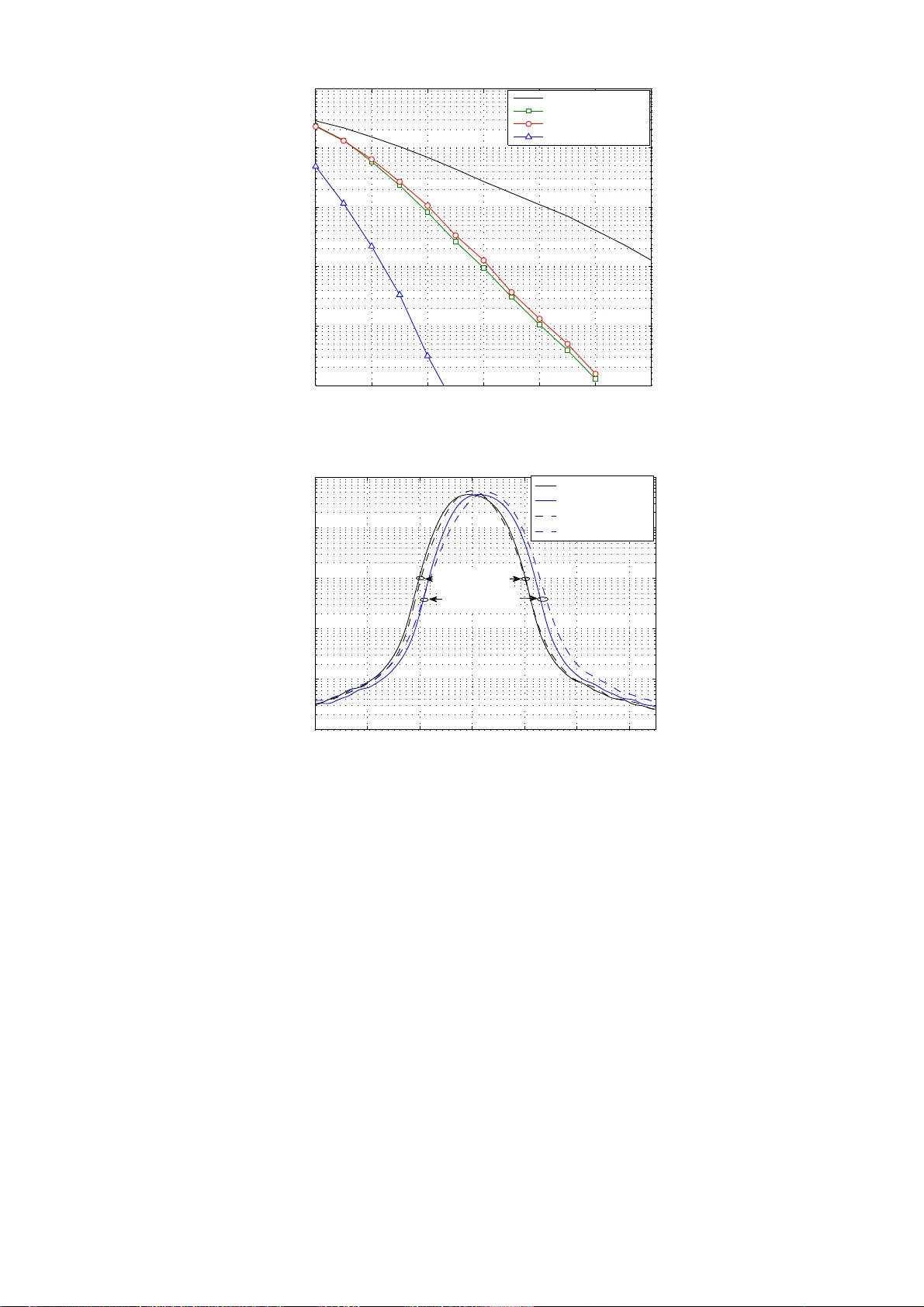
L2 Orthogonal Space T ime Code for Continuous Phase Modulation Matthias Hesse, J ´ er ˆ ome Lebrun and Luc Den eire Abstract T o combine the high po wer ef ficiency of Continuous Phase Modulation (CPM) with either high spectral efficienc y or enhanced performance i n low S ignal to Noise conditions, some authors hav e proposed to introdu ce CPM in a MIMO frame, by using Space T ime Codes (STC). In this paper , we address the code design problem of Space T ime Block Codes combined with CPM and introduce a new design criterion based on L 2 orthogonality . This L 2 orthogonality condition, with t he help of simplifying assumption, leads, i n the 2x2 case, to a ne w family of codes. These codes generalize the W ang and Xia code, which was based on pointwise orthogonality . Simulations indicate that the new codes achiev e full di ve rsity and a slightly better coding gain. Moreov er , one of the codes can be interpreted as two antennas fed by two con v entional CPMs using the same data but with dif ferent alphabet sets. Inspection of these alphabet sets lead also to a simple e xplanation of the (small) spectrum broaden ing of Space T ime Coded CPM. I . I N T R O D U C T I O N Since the pio neer work of Alamo uti [1] and T arok h [2], Space Time Coding has been a fast growing field of research wher e numero us coding schemes have been intr oduced. Se veral years later Zhan g and Fitz [3], [4] were the first to apply the idea of STC to continuou s p hase modu lation (CPM) by constru cting trellis codes. In [5] Zaji ´ c and St ¨ uber d erived con ditions for partial respo nse STC-CPM to g et full diversity and optimal coding gain. A STC for nonco herent detectio n based on diag onal blocks was in troduced b y Silvester et al. [6]. The first orthogona l STC for CPM fo r full and partial response was de veloped by W ang and Xia [7], [8]. The scope of this p aper is also the design of an o rthogo nal STC for CPM. But unlike W ang-Xia ap rroach [8] which starts from a QAM orthog onal Space-T ime Code (e.g. Alamo uti’ s sch eme [1]) and m odify it to achieve continuou s phases for th e transmitted signals, we show here that a more gen eral L 2 condition is sufficient to ensure fast max imum likelihood d ecoding with full div ersity . In the considered system m odel (Fig .1), the data sequence d j is define d over the signal constellation set Ω d = {− M + 1 , − M + 3 , . . . , M − 3 , M − 1 } (1) for an alp habet with log 2 M bits. T o obtain th e struc ture f or a Space T ime Block Co de ( STBC) this seque nce is mapp ed to data matrices D ( i ) with elements d ( i ) mr , where m d enotes the tran smitting an tenna, r the time slot into a block and ( i ) a p arameter for p artial respon se CPM. Th e data matrices are then used to m odulate the sending matrix S ( t ) = " s 11 ( t ) s 12 ( t ) s 21 ( t ) s 22 ( t ) # . (2) Each eleme nt is defined for (2 l + r − 1) T ≤ t ≤ (2 l + r ) T as s mr ( t ) = r E s T e j 2 π φ mr ( t ) (3) The work of Matthi as Hesse is supporte d by the EU by a Marie-Curie Fell owshi p (EST -SIGNAL program : http://est-si gnal.i3s.unice .fr ) under contract No MEST -CT -2005-021175. The authors are with Lab . I3S, CNRS, Uni ver sity of Nic e, Sophia Antipolis, France; E-Mail: { hesse,lebrun,d eneire } @i3s.unice. fr L2 OR THOGON AL SP ACE TIME CODE FOR CONTINUOUS PHASE MODUL A TION 2 Fig. 1. Structure of a MIMO T x/Rx system where E s is the symbol e nergy and T the symbo l time. Th e phase φ mr ( t ) is defined in the conventional CPM manner [9 ] with an additional cor rection factor c mr ( t ) and is therewith giv en by φ mr ( t ) = θ m (2 l + r ) + h 2 l + r X i =2 l +1+ r − γ d ( i ) mr q ( t − ( i − 1 ) T ) + c mr ( t ) (4) where h = 2 m 0 /p with m 0 and p relativ e primes is called the modulation index. T he phase smoothing function q ( t ) has to be a continuo us fu nction with q ( t ) = 0 for t ≤ 0 and q ( t ) = 1 / 2 for t ≥ γ T . The mem ory length γ determines the length o f q ( t ) and affects the sp ectral comp actness. For large γ we obtain a compact spectrum but also a higher n umber of possible phase states which increases the decoding effort. For full response CPM, we have γ = 1 an d for partial response sy stems γ > 1 . The cho ice of the correctio n factor c mr ( t ) in Eq. (4) is along with the m apping of d j to D ( i ) , the key element in th e design of ou r codin g scheme. It will be d etailed in Section II. W e then define θ m (2 l + r ) in a most general way θ m (2 l + 3) = θ m (2 l + 2) + ξ (2 l + 2) = θ m (2 l + 1) + ξ (2 l + 1) + ξ (2 l + 2) . (5) The function ξ (2 l + r ) will b e fully d efined fr om the contribution c mr ( t ) to the pha se memory θ m (2 l + r ) . For conv entional CPM system, c mr ( t ) = 0 an d we h av e ξ (2 l + 1) = h 2 d 2 l +1 − γ . The channel coefficients α mn are a ssumed to be Rayleigh distributed and indep endent. Each coefficient α mn characterizes the fading between the m th transmit (Tx) anten na an d the n th receive (Rx) antenn a where n = 1 , 2 , . . . , L r . Further more, th e received signals y n ( t ) = α mn s mr ( t ) + n ( t ) (6) are c orrupted by a complex additive white Gaussian noise n ( t ) with variance 1 / 2 per dimension. At the receiver , the detectio n is done on each of the L r received signals separately . Th erefore, in general, each code block S ( t ) has to be detected by block . E .g. for a 2x2 block , estimatin g the symbols ˆ d j implies computatio nal co mplexity pr oportio nal to M 2 . Now , th is comp lexity can be re duced to 2 M by introd ucing an ortho gonality prop erty as well as simplifyin g assumptions on the code. Criteria for su ch STBC are given in Section II. In Section III, the criteria are used to constru ct OSTBC for CPM. I n Section IV we test th e designed code a nd compare it with the STC from W ang an d Xia [8]. Fin ally , some conclusion s are drawn in Section V. I I . D E S I G N C R I T E R I A The purpose of the design is to achiev e full di versity and a fast m aximum lik elihood d ecoding wh ile m aintaining the continuity of the signal phases. This section shows h ow th e ne ed to perform fast ML decod ing leads to the L 2 orthog onality condition as well as to simplifying assumptio ns, which can b e combined with the continuity co nditions. For con venience we only co nsider one Rx antenna and drop the index n in α mn . L2 OR THOGON AL SP ACE TIME CODE FOR CONTINUOUS PHASE MODUL A TION 3 A. F ast Maximum Likelihood Decoding Commonly , due to the trellis stru cture of CPM, the V iterbi algo rithm is used to perfor m the ML demo dulation . On block l each state in the trellis has M 2 incoming b ranches and M 2 outgoin g b ranches with a distance D l = (2 l +1) T Z 2 lT y ( t ) − 2 X m =1 α m s m 1 ( t ) 2 d t + (2 l +2) T Z (2 l +1) T y ( t ) − 2 X m =1 α m s m 2 ( t ) 2 d t. (7) The numb er of bran ches re sults from the blockwise decoding and the correlatio n b etween th e sent symbols s 1 r ( t ) and s 2 r ( t ) . A way to reduce the nu mber of branches is to structurally d ecorrelate th e sign als sent by the two transmitting ante nnas, i.e. to put to zero the inter-antenna cor relation α 2 α ∗ 1 (2 l +1) T Z 2 lT s 21 ( t ) s ∗ 11 ( t ) d t + α 1 α ∗ 2 (2 l +1) T Z 2 lT s 11 ( t ) s ∗ 21 ( t ) d t + α 2 α ∗ 1 (2 l +2) T Z (2 l +1) T s 22 ( t ) s ∗ 12 ( t ) d t + α 1 α ∗ 2 (2 l +2) T Z (2 l +1) T s 12 ( t ) s ∗ 22 ( t ) d t = 0 . (8) Pointwise orthog onality as defined in [8] is ther efore a su fficient condition but not nece ssary . A less restrictive L 2 orthog o- nality is also sufficient. From Eq . (8), the distance g iv en in Eq. (7) can then be simplified to D l = (2 l +1) T Z 2 lT f 11 ( t ) + f 21 ( t ) − | y ( t ) | 2 d t + (2 l +2) T Z (2 l +1) T f 12 ( t ) + f 22 ( t ) − | y ( t ) | 2 d t (9) with f mr ( t ) = | y ( t ) − α m s mr ( t ) | 2 . When ea ch s mr ( t ) depends only o n d 2 l +1 or d 2 l +2 the branches c an be split a nd calculated separately for d 2 l +1 and d 2 l +2 . The co mplexity of the ML decision is re duced to 2 M . The co mplexity for detecting two symbols is thus red uced from pM γ +1 to pM γ . The STC introd uced by W ang and Xia [8] d idn’t take f ull advantage of the orthog onal design since s mr ( t ) was depen ding on both d 2 l +1 and d 2 l +2 . The gain they obtain ed in [8] was then rely ing on other p roperties of CP M, e.g. some restrictio ns put on q ( t ) a nd p . These restrictions m ay also be applied to o ur desig n code, which w ould lead to ad ditional co mplexity reduction . Howev er, this is not in the scope of this paper and is b e the subject of another up coming paper . B. Orthogonality Conditio n In this section we show how L 2 orthog onality fo r CPM, i.e. k S ( t ) k 2 L 2 = R (2 l +2) T 2 lT S ( t ) S H ( t ) d t = 2 I , can be o btained. As such, the correlation between the two transmitting antennas per cod ing block is cancelled if (2 l +2) T Z 2 lT s 1 r ( t ) s ∗ 2 r ( t ) d t = (2 l +1) T Z 2 lT s 11 ( t ) s ∗ 21 ( t ) d t + (2 l +2) T Z (2 l +1) T s 12 ( t ) s ∗ 22 ( t ) d t = 0 . (10) Replacing s mr ( t ) by the corre sponding CPM symbo ls from Eq. (4), we get (2 l +1) T Z 2 lT exp n j 2 π ˆ θ 1 (2 l + 1) + h 2 l +1 X i =2 l +2 − γ d ( i ) 1 , 1 q ( t − ( i − 1) T ) + c 1 , 1 ( t ) − θ 2 (2 l + 1) − h 2 l +2 X i =2 l +3 − γ d ( i ) 2 , 1 q ( t − ( i − 1) T ) − c 2 , 1 ( t ) ˜ o d t + (2 l +2) T Z (2 l +1) T exp n j 2 π ˆ θ 1 (2 l + 2) + h 2 l +2 X i =2 l +3 − γ d ( i ) 1 , 2 q ( t − ( i − 1) T ) + c 1 , 2 ( t ) − θ 2 (2 l + 2) − h 2 l +1 X i =2 l +2 − γ d ( i +1) 2 , 2 q ( t − iT ) − c 2 , 2 ( t ) ˜ d t o = 0 . (11) L2 OR THOGON AL SP ACE TIME CODE FOR CONTINUOUS PHASE MODUL A TION 4 The phase m emory θ m (2 l + r ) is independ ent of time and has not to be considered for integration . Using Eq. (5) to replace phase mem ory θ m (2 l + 2) of the second time slot, we obtain (2 l +1) T Z 2 lT exp n j 2 π ˆ h 2 l +1 X i =2 l +2 − γ d ( i ) 1 , 1 q ( t − ( i − 1) T ) + c 1 , 1 ( t ) − h 2 l +1 X i =2 l +2 − γ d ( i ) 2 , 1 q ( t − ( i − 1) T ) − c 2 , 1 ( t ) ˜ o d t + exp n j 2 π ˆ ξ 1 (2 l + 1) − ξ 2 (2 l + 1) ˜ o · (2 l +1) T Z 2 lT exp n j 2 π ˆ h 2 l +1 X i =2 l +2 − γ d ( i +1) 1 , 2 q ( t − ( i − 1) T ) + c 1 , 2 ( t + T ) − h 2 l +1 X i =2 l +2 − γ d ( i +1) 2 , 2 q ( t − ( i − 1) T ) − c 2 , 2 ( t + T ) ˜ o d t = 0 . (12) C. Simplifying assump tions T o simplify this e xpression , we factor Eq. (12) in to a time in depend ent an d a time depe ndent part. For merging the two integrals to one time depend ent p art, we h av e to map d ( i ) m 2 to d ( i ) m 1 and c mr ( t ) to a different c m ′ r ′ ( t ) . Con sequently , f or the data symbols d ( i ) mr there exist th ree po ssible ways of mapping: • cr osswise mapp ing with d ( i ) 1 , 1 = d ( i ) 2 , 2 and d ( i ) 1 , 2 = d ( i ) 2 , 1 ; • r epetitive m apping with d ( i ) 1 , 1 = d ( i ) 1 , 2 and d ( i ) 2 , 1 = d ( i ) 2 , 2 ; • parallel mapp ing with d ( i ) 1 , 1 = d ( i ) 2 , 1 and d ( i ) 1 , 2 = d ( i ) 2 , 2 . The same approach can be applied to c mr ( t ) : • cr osswise mapp ing with c 11 ( t ) = − c 22 ( t − T ) and c 12 ( t ) = − c 21 ( t − T ) ; • r epetitive m apping with c 11 ( t ) = c 12 ( t − T ) and c 21 ( t ) = c 22 ( t − T ) ; • parallel mapp ing with c 11 ( t ) = c 21 ( t ) a nd c 12 ( t ) = c 22 ( t ) . For each combination of map pings, Eq. (12) is now the product of tw o facto rs, one c ontaining the integral and the other a time in depend ent pa rt. T o fu lfill Eq. (12) it is suf ficient if one factor is zero, namely 1 + e j 2 π [ ξ 1 (2 l +1) − ξ 2 (2 l +1)] = 0 , i.e. if k + 1 2 = ξ 1 (2 l + 1) − ξ 2 (2 l + 1) (13) with k ∈ N . W e thus g et a very sim ple cond ition which o nly dep ends on ξ m (2 l + 1) . D. Continuity of Phase In this section we determine the fu nctions ξ m (2 l + 1) to ensure the ph ase continu ity . Precisely , the phase of the CPM sym bols has to be equ al at all intersections of symbols. For an ar bitrary block l , it means that φ m 1 ((2 l + 1 ) T ) = φ m 2 ((2 l + 1 ) T ) . Using Eq. (4), it results in ξ m (2 l + 1) = h 2 l +1 X i =2 l +2 − γ d ( i ) m, 1 q ((2 l + 2 − i ) T ) + c m, 1 ((2 l + 1 ) T ) − h 2 l +2 X i =2 l +3 − γ d ( i ) m 2 q ((2 l + 2 − i ) T ) − c m 2 ((2 l + 1 ) T ) . (14) For the second intersection at (2 l + 2) T , since φ m 2 ((2 l + 2 ) T ) = φ m 1 ((2 l + 2 ) T ) , we get ξ m (2 l + 2) = h 2 l +2 X i =2 l +3 − γ d ( i ) m 2 q ((2 l + 3 − i ) T ) + c m 2 ((2 l + 2 ) T ) − h 2( l +1)+1 X i =2( l +1)+2 − γ d ( i ) m, 1 q ((2 l + 3 − i ) T ) − c m, 1 ((2 l + 2 ) T )] . (15) Now , by choosing one of the mapp ings d etailed in Section III, these equ ations can be greatly simplified. Hence, we have all the tools to construct our cod e. I I I . O RT H O G O N A L S PAC E T I M E C O D E S In this section we will have a closer look at two codes constructed under the afore-mentio ned con ditions. L2 OR THOGON AL SP ACE TIME CODE FOR CONTINUOUS PHASE MODUL A TION 5 A. Existing Code As a first example, we will give an alternative con struction of the co de given by W ang and Xia in [8]. In deed, the pointwise orthog onality co ndition used by W ang and Xia is a sp ecial case of the L 2 orthog onality cond ition, hence, the ir ST -code can be o btained within our framework. For the first anten na W ang a nd Xia use a con ventional CPM with d ( i ) 1 r = d i for i = 2 l + r + 1 − γ , 2 l + r + 2 − γ , . . . , 2 l + r and c 1 r ( t ) = 0 . The symbols of the secon d antenn a are mapped cr osswis e to th e first d ( i ) 21 = − d i +1 for i = 2 l + 2 − γ , 2 l + 3 − γ , . . . , 2 l + 1 and d ( i − 1) 22 = − d i − 1 for i = 2 l + 3 − γ , 2 l + 4 − γ , . . . , 2 l + 2 . Using th is cr oss mapp ing makes it d iffi cult to compute ξ m (2 l + 1 ) since th e CPM typical order of the data symbols is mixed. W ang and Xia circu mvent this by introducin g another cor rection factor f or the seco nd an tenna c 2 r ( t ) = γ − 1 X i =0 ( h ( d 2 l +1 − i + d 2 l +2 − i ) + 1) q 0 ( t − (2 l + r − 1 − i ) T ) (16) By first computing ξ m (2 l + 1) with Eq. (17) a nd then Eq. (13), we get the L 2 orthog onality of the W ang-Xia-STC. B. P arallel Code T o get a simpler co rrection facto r as in [ 8], we d esigned a new c ode b ased on the p arallel structure which permits to maintain th e conventional CPM m apping for b oth an tennas. Hence we choose the follo wing mapping : d ( i ) m 1 = d ( i − 1) m 2 = d i for i = 2 l + r + 1 − γ , 2 l + r + 2 − γ , . . . , 2 l + r . Then, Eq. (14) and (1 5) can be simplified into ξ m (2 l + 1) = h 2 d 2 l +2 − γ + c m 1 ((2 l + 1 ) T ) − c m 2 ((2 l + 1 ) T ) (17) ξ m (2 l + 2) = h 2 d 2 l +3 − γ + c m 2 ((2 l + 2 ) T ) − c m 1 ((2 l + 2 ) T ) . (18) W ith this simplified function s, the or thogon ality conditio n only depen ds on the start and end values of c mr ( t ) , i.e. k + 1 2 = c 11 ((2 l + 1 ) T ) − c 12 ((2 l + 1 ) T ) − c 21 ((2 l + 1 ) T ) + c 22 ((2 l + 1 ) T ) . (19) T o merge the two integrals in Eq. (12) not only the mapping of d ( i ) mr is necessary but also an equ ality b etween different c mr ( t ) . From the three possible m appings, we choose the r epeat mapp ing because of the possibility to set c mr ( t ) to zero fo r one antenna. Hen ce we are able to send a conventional CPM signal o n one antenna an d a mo dified o ne on the second. Using Eq. (19) and the equa lities for the mapping, we can formulate the following cond ition k + 1 2 = c 12 (2 l T ) − c 12 ((2 l + 1 ) T ) − c 22 (2 l T ) + c 22 ((2 l + 1 ) T ) . (20) W ith c 11 ( t ) = c 12 ( t ) = 0 , we can take for c 21 ( t ) = c 22 ( t ) any continu ous function which is zero at t = 0 and 1 / 2 at t = T . Another po ssibility is to choo se th e co rrection factor of the second anten na with a structure similar to CPM modulation, i.e. c 2 r ( t ) = 2 l +1 X i =2 l +1 − γ q ( t − ( i − 1 ) T ) (21) for (2 l + r − 1) T ≤ t ≤ (2 l + r ) T . W ith this approac h, the corre ction factors can be in cluded in a classical CPM modulation with co nstant offset of 1 /h . Th is offset m ay also be expressed as a modified alph abet for th e secon d antenna Ω d 2 = {− M + 1 + 1 h , − M + 3 + 1 h , . . . , M − 3 + 1 h , M − 1 + 1 h } (22) Consequently , th is L 2 -ortho gonal design may be seen a s two co n ventional CPM designs with different alphabet sets Ω d and Ω d 2 for each antenna. Howe ver , in th is method, the constant offset to the ph ase may cau se a shift in frequency . But as shown by ou r simulation s in th e next section, this shift is quite moder ate. I V . S I M U L A T I O N S In this section we verify the proposed algo rithm by simulations. Therefore a STC-2REC-CPM-sender w ith two transmitting antennas has b een implemented in MA TLAB. For the signal of the first antenna we use conventional Gray-cod ed CPM with L2 OR THOGON AL SP ACE TIME CODE FOR CONTINUOUS PHASE MODUL A TION 6 P S f r a g r e p l a c e m e n t s E b / N 0 BER 2 T x , 2 R x 1Tx, 1Rx 2Tx, 1Rx 2Tx, 1Rx, W ang 2Tx, 2Rx 0 0 . 1 0 . 2 0 . 3 0 . 4 0 . 5 0 . 6 0 . 7 0 . 8 0 . 9 1 5 10 15 20 25 30 35 0 0 . 1 0 . 2 0 . 3 0 . 4 0 . 5 0 . 6 0 . 7 0 . 8 0 . 9 1 10 − 4 10 − 3 10 − 2 10 − 1 10 0 Fig. 2. Simulated BE R for dif ferent numbers of Tx and Rx antennas of the proposed STC and of the W ang-Xia-STC P S f r a g r e p l a c e m e n t s Normalized F requenzy f · T b Po wer 2 n d T x a n t . W a n g 1 st Tx ant. 2 nd Tx ant. 1 st Tx an t.W ang 2 nd Tx an t.W ang 1 st antenna 2 nd antenna 1 st antenna 0 0 . 1 0 . 2 0 . 3 0 . 4 0 . 5 0 . 6 0 . 7 0 . 8 0 . 9 1 -6 -4 -2 0 2 4 6 0 0 . 1 0 . 2 0 . 3 0 . 4 0 . 5 0 . 6 0 . 7 0 . 8 0 . 9 1 10 − 6 10 − 5 10 − 4 10 − 3 10 − 2 10 − 1 Fig. 3. Simulated psd for each Tx antenna of the proposed S TC (continuous line) and the W ang-Xia-ST C (dashed line) a modulation index h = 1 / 2 , the length of th e ph ase re sponse fun ction γ = 2 an d an alphabe t size of M = 8 . The sign al o f the second an tenna is mo dulated by a CPM with the same parameter s but a different alphabet Ω d 2 , correspon ding to Eq. (22). The channel used is a f requency flat Rayleigh fading model with additi ve wh ite Gaussian n oise. The fading co efficients α mn are constant for the duration of a code block (block fading) an d known at receiver (co herent d etection). The received signal y n ( t ) is de modulated by two filterbanks with pM 2 filters, which are u sed to calculate the corre lation b etween the received and candidate signals. D ue to the o rthogo nality of the an tennas each filterbank is independen tly ap plied to th e co rrespond ing time slot k of the block code. T he correlation is used as metric for the V iterbi algorithm ( V A) which has pM states and M paths leaving ea ch state. In our simulation , the V A is truncated to a path memory of 10 co de block s, which means that we get a de coding delay o f 2 · 10 T . From the simulation results gi ven in Figu re 2, we can reason ably assume that th e proposed code ac hiev es full di versity . Indeed , the curves f or th e 2x1 and 2 x2 systems re spectiv ely show a slop e of 2 and 4. Mor eover , th e curve of the 2x1 systems follows the sam e slope as the ST cod e propo sed by W ang and Xia [8], which was proved to hav e f ull diversity . Note also that the n ew co de provid es a slightly better performance. A main reason of using CPM for STC is the spectral efficiency . Figure 3 show the simulated power spectral density (p sd) L2 OR THOGON AL SP ACE TIME CODE FOR CONTINUOUS PHASE MODUL A TION 7 for b oth Tx antenn as of the proposed ST code (c ontinuo us line) and the ST code propo sed by W ang and Xia [8]. The fir st antenna of our app roach u ses a conventional CPM sign al and hence shows an eq ual psd. The spectrum of the seco nd antenna is shif ted due to adding an offset c mr ( t ) with a non zero mean . Minimizing th e difference between the two spectra by shif ting one, result in a p hase d ifference of 0 . 3 7 5 measured in nor malized freque ncy f · T d , where T d = T / log 2 ( M ) is the bit symbol length. The first antenna o f the W ang- Xia-algorith m has almost the sam e psd while th e spectrum of the second antenn a is shifted by app roximately 0 . 56 f · T d . This means that the OSTC by W an g and Xia requires a slightly larger bandwidth than our OSTC. V . C O N C L U S I O N In app lications where the p ower efficiency is crucial, com bination of Continu ous Phase Modu lation and Space Time Coding has the p otential to provide h igh sp ectral e fficienc y , thanks to spatial div ersity . T o address this p ower efficiency , ST code d esign for CPM has to ensure both lo w c omplexity d ecoding an d f ull di versity . T o fulfill these requirem ents, we hav e p roposed a new L 2 orthog onality co ndition. W e hav e shown that this c ondition is sufficient to ach iev e low co mplexity M L decod ing a nd leads, with the help of simplifying assumptio n to a simple code. Moreover , simu lations in dicate th at the co de most proba bly achieves full diversity . Further work w ill be concentrated on th e d esign of o ther cod es based on L 2 orthog onality as in the meanwhile, we ha ve been able to ob tain the d esign of full div ersity , full rate L 2 orthog onal codes for 3 antennas [1 0]. R E F E R E N C E S [1] S. M. Alamouti, “ A simple transmit div ersity techni que for wireless communications, ” IEE E J . Sel. Ar eas Commun. , vo l. 16, no. 8, pp. 1451 – 1458, 1998. [2] V . T arokh, H. Jaf arkhani, and A. R. Calderbank, “Space-ti me block codes from orth ogonal designs, ” IEEE T rans. Inf . Theory , vol. 45, no. 5, pp. 1456 – 1567, 1999. [3] X. Zhang and M. P . Fitz , “Space-t ime coding for rayleigh fa ding channels in CPM system, ” Pr oc. 38th Annu. Allerton Conf . Communic ation, Contr ol, and Computing , 2000. [4] X. Zhang and M. P . Fitz, “Space-time code design with conti nuous phase modulat ion, ” IEEE J. Sel. Areas Commun. , vol. 21, no. 5, pp. 783 – 792, 2003. [5] A. Zaji ´ c and G. St ¨ uber , “ A spac e-time code desig n for partial-respon se CPM: Di ve rsity order and coding gai n, ” IEEE ICC , 2007. [6] A. -M. Silvester , L. Lampe, and R. Schober , “Diagonal s pace-t ime code design for contin uous-phase modulation, ” GLOBECOM , 2006. [7] G. W ang and X.-G. Xia, “ An orthogonal space-ti me coded CPM system with fa st decoding for two transmit ant ennas, ” IEEE T rans. Inf . Theory , vol. 50, no. 3, pp. 486 – 493, 2004. [8] D. W ang, G. W ang, and X.-G. Xia, “ An orthogon al spac e-time coded partial response CPM system with fast de coding for two transmit antennas, ” IEEE T ra ns. W ir el ess Commun. , v ol. 4, no. 5, pp. 2410 – 2422, 2005. [9] J .B. Anderson, T . Aulin, and C.-E. Sundberg, Digital Phase Modulatio n , Ple num Press, 1986. [10] M. Hesse, J. Lebrun, and L. Deneire, “L2 OST C-CPM: Theory and design, ” T ech . Rep. I3S/R R-2008-03, CNRS/Uni v ersity of Nice, Sophia Antipolis, 2008.
Original Paper
Loading high-quality paper...
Comments & Academic Discussion
Loading comments...
Leave a Comment