Triangular Peg Solitaire Unlimited
Triangular peg solitaire is a well-known one-person game or puzzle. When one peg captures many pegs consecutively, this is called a sweep. We investigate whether the game can end in a dramatic fashion, with one peg sweeping all remaining pegs off the…
Authors: George I. Bell
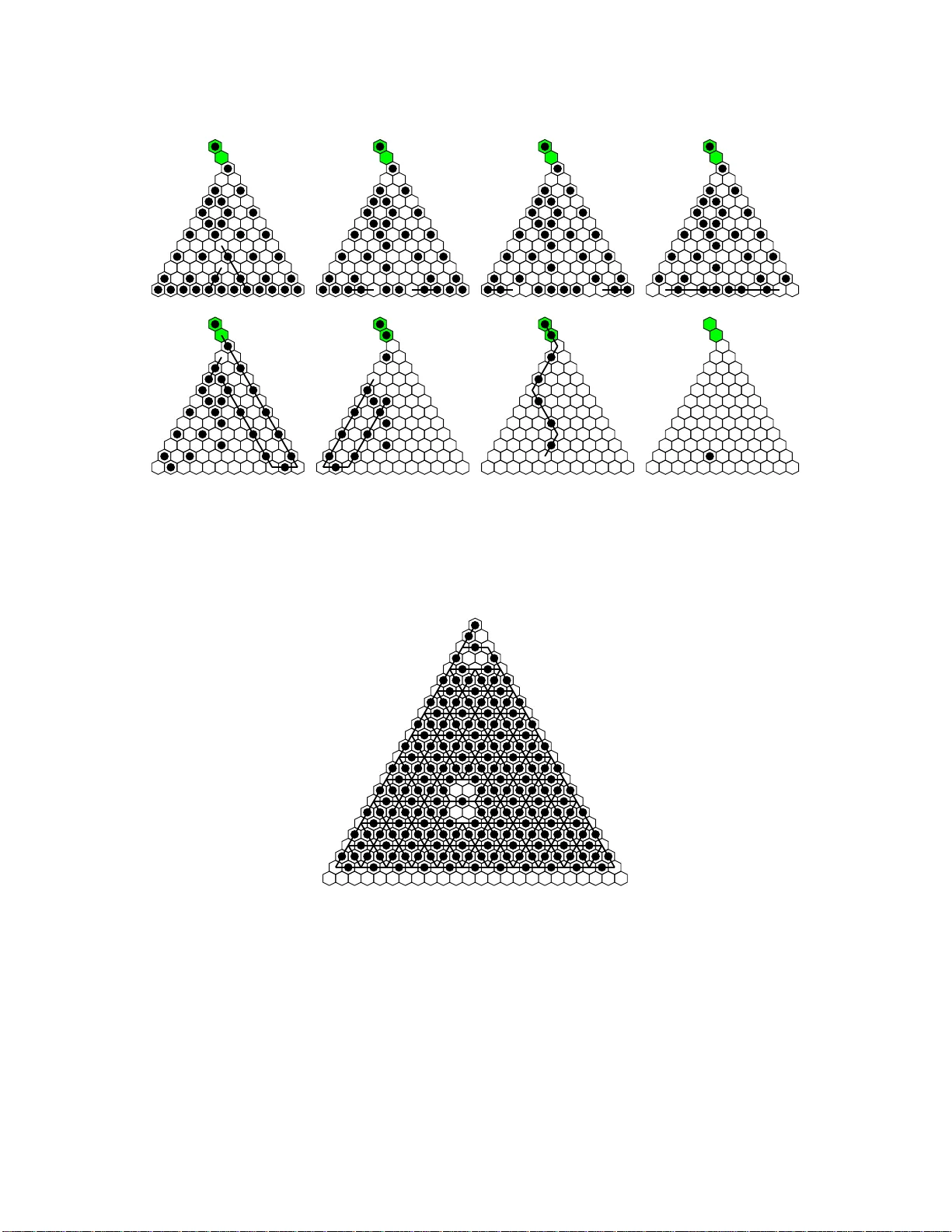
T riangul ar P eg Solitaire Unlimited George I. Bell Decem b er 2004 1 gibell@c omcast.net Abstract T riangular p eg solitaire is a w ell-kno wn one-p erson ga me or puzzle. When one p eg captures man y p egs consecutiv ely , this is called a sw eep. W e inv estigate whether the game can end in a dramatic fashion, with one p eg sw eeping all remaining p egs off the b o a rd. F o r triangular b oards of side 6 and 8 (with 21 and 36 holes, resp ectiv ely) the geometrically longest swe ep can o ccur as the final mo v e in a ga me. On larger triangular b oards, w e demonstrate how to construct solutions that finish with arbitrarily long sw eeps. W e also consider the problem of finding solutions that minimize the tota l n um b er of mo ve s (where a mo ve is one or more consecutiv e j umps b y the same p eg). 1 In tro duction P eg solitaire on a 15- hole triangular b oard is an old puzzle but it remains p opular. In the United States, one can find the se puzzles at tables in C rack er Barrel R restauran ts. The 15-hole puzzle is also amenable to exhaustiv e computer searc h and this is a common pro- gramming assignmen t f o r computer science classes. Here w e consider p eg solitaire on an (equilateral) tr ia ngular b oard with n holes on eac h side. This b oard will b e referred to as T riangle ( n ) and can b e con v enien tly presen ted on an array of hexagons (F igure 1). The T riangle ( n ) b oard has T ( n ) = n ( n + 1) / 2 holes, where T ( n ) is the n ’th triangular n umber. The notation used to iden tify the holes in the b oard is sho wn in Figure 1—it differs from that g iven in Beasley [1] and is ba sed on the system for square lattice b oards. A nice prop erty of this nota t io n is that the top corner hole is alw ay s “a1”. The rules o f the game are simple: start fro m a b oard with a p eg in eve ry hole but one, called the starting v acancy . Then jump one p eg o v er another into a n empt y hole, remov ing the jump ed p eg from the b oard. The goal is to c ho ose a sequenc e of jumps to finish with o ne p eg (the co ordinate of this final p eg is called the finishing lo cation ). This general problem 1 Original version at http:/ /gpj. connectfree.co.uk/gpjr.htm Conv erted to L A T E X by the author with so me mo difications to the text, Nov em b er 200 7. The Games and Puzzles Journal—Issue 36, No v ember-Decem b er 2 004 2 a1 a2 b2 a3 b3 c3 a4 b4 c4 d4 a5 b5 c5 d5 e5 a6 b6 c6 d6 e6 f6 Figure 1: The g eneral triangular b oard with hole co ordinates. of going from a b oard p osition with one p eg missing to a b oard po sition with one p eg will b e referred to as a p eg solitaire problem . The sp ecial case where the starting v acancy and finishing lo cation ar e the same is r eferred to as a complemen t problem . GPJ #28 [6] considered p eg solitaire on bo ards based o n a square lattice. T riangular p eg solitaire differs in that the holes are based on a triangular lattice, with a maxim um of six jumps a v ailable in to an y hole (rather than four). How ev er the theory of the g ame (in particular the fundamen tal classes) is v ery similar, see [1], or [4] for details. An y solution to a problem on the 15-ho le triangular b oard consists of exactly 13 jumps b ecause we start with 14 p egs and finish with 1. How eve r, when the same p eg jumps o ne or more p egs consecutiv ely , w e call this one mo v e . Give n a particular p eg solitaire problem, what is the solution with the least n um b er of mov es? While this question has historically pla y ed an imp ortant role in p eg solitaire on the standard 33-hole cross-shap ed b o ard, it has barely b een considere d for triangular b oards. The followin g terminology is used in referring to mov es in volv ing m ultiple jumps: when a p eg remov es i pegs in a single mov e, w e refer to it as a sweep , or more sp ecifically , an i -sw eep . After attempting a p eg solitaire problem, many p eople get the idea to try to solv e it b ackwar ds from the final p eg. What is not so ob vious is that this is exa ctly the same as the original game, where the concepts of “hole” and “p eg” are in terc hanged. In fa ct the solution to any p eg solitaire problem really con tains two solutions: the original (“fo rw ard” solution) plus this “bac kw ard” solution, where the individual jumps ar e executed in the same direction, but in rev erse o rder, and the starting v acancy a nd finishing lo cation are sw app ed. An imp orta nt observ ation is that when an i - swe ep is rev ersed, w e must rev erse the individual jumps, and it b ecomes i si ngle jump mo v es. In other w ords, sw eeps in forward solutions c ann ot b e sw eeps in rev ersed solutions (and vice v ersa). Bac kw ard pla y is hard to comprehend, b ecause our brain do es not easily in terc hange t he concepts of “hole” and “p eg”. It is easier to understand “bac kw ard pla y” b y realizing that it is the same as fo rw ard play fro m the complemen t of the curren t bo a rd p osition (the complemen t of a b oard p osition is where w e replace ev ery hole b y a p eg, and vice ve rsa). This leads to a theorem used extens ive ly in the remainder of this pap er. Suppose w e ha ve a b oard p osition B and we w onder if it could app ear during a solution to a p eg solitaire problem. The Games and Puzzles Journal—Issue 36, No v ember-Decem b er 2 004 3 F orw ard/Bac kward Theorem : Board p o sition B can app ear during a solution t o a p eg solitaire problem if and o nly if b oth 1. B can b e reduced to a single p eg (the finishing lo cation) using p eg solitaire jumps. 2. The complemen t of B can b e reduced to a single p eg (the starting lo cation) using p eg solitaire jumps. A pro of of this theorem just b oils do wn to the equiv alence of play ing the game forw ard or bac kw ard. It ma y seem obv ious, but is ke y to understanding ho w to reac h complex sw eep p ositions. A practical problem that a rises is finding a tr ia ngular b oard to pla y on. Fifteen hole T rian- gle (5) b oar ds a re common, but cannot b e easily extended to larger triangular b oards. The b est b oard I hav e found is a Chinese Chec ke rs set, whic h allows one to pla y on b o ards as large as T riangle (13). T o help f ollo w the argumen ts b elo w, I recommend play ing out the solutions on a Chinese Chec k ers set. It is particularly helpful to see solutions pla ye d fo rward and bac kw ard. 2 Maximal sweeps on o dd-sid e tr i ang u lar b oards T riangular b oards supp ort the longest sw eeps of any p eg solitaire b oar d. This is b ecause from an y b oard lo cation the to tal n um b er of p ossible jumps is eve n . If the b oar d size n is o dd, there exist sw eeps that jump in to or o v er ev ery single lo cation on the b oard. Suc h sw eeps are maximal in the sense that they are the longest sw eep geometrically p ossible o n the b oard. The figure b elow show s examples of the first four maximal sw eeps Figure 2: Maximal Sw eeps o n T riangl e ( n ), where n = 3, 5, 7 and 9. These sw eeps are shown starting and ending at a1 , but can b egin and end at other b oard lo cations. The length of this sw eep is 3 T (( n − 1) / 2) = 3( n 2 − 1) / 8. Related geometrical tours on a triangular lattice hav e app eared in GPJ #20 [5] under “T rap ezoidal T o urs”. As these sw eep patterns b ecome larger and larger, how can we b e sure a p eg can tra ve rse the en tire pattern? If w e consider the pattern of the sw eep as a graph, one of the most elemen tary theorems in graph theory , due to Euler, ensures that suc h a trav ersal is alw ay s p ossible when there are at most t wo no des of o dd degree. Since maximal sw eeps hav e all no des of eve n degree, they can alw a ys b e t r av ersed, and the starting and ending b oard lo cations mus t b e the same. This theorem also guarante es that the more complex sw eep patterns seen later can b e trav ersed. The Games and Puzzles Journal—Issue 36, No v ember-Decem b er 2 004 4 Note that the sw eep length divided b y the b oard size approac hes 3 / 4 as the b oa r d size increases. If this sw eep is the final mo v e to a solitaire game it remov es nearly 3 / 4 of the p egs that we started with in one mo v e! But can these maximal sw eeps b e realized during a solitaire game? If w e tak e the compleme nt of t he sw eep pattern, not a single j ump is p ossible. Thus , by the forw ard-back ward theorem, maximal sw eep patterns cannot app ear in solitaire games on o dd size b oards. 3 Maximal sweeps on ev en-si d e t ri ang ular b oards The same maximal sw eep o n an o dd tria ngular b o ard is also maximal on the ev en b oard one size larger, b ecause the added ro w cannot b e reac hed to extend the sw eep. Ho w ev er, the added row can mak e it p ossible to reac h the sw eep p osition during a p eg solitaire game. On the T riangle (6) a nd T riangle (8) b oards this can b e w ork ed out by hand, F ig ure 3 sho ws this pro cess on T riangle (6): (a) (b) Figure 3: Constructing a solitaire solution that finishes with the 9-sw eep to a 1. (a) Bac kw ard: pla ying from the complemen t of the sw eep pattern to c5. (b) F orw ard: The completed solution from the c5 v acancy ending with a 9-swe ep to a1 . The forw ard solution in F ig ure 3b has only 9 mo v es. In the final section o f this pap er, w e pro ve that it’s im p ossible to solv e this problem in fewe r than 9 mo v es. Th us, b esides con taining a maximal length sw eep, the solution of F igure 3b solv es the problem in the minim um n um b er of mo v es. This solution was disco v ered b efore 1975 b y Harry O. Davi s [3]. There are three problems o n T riang le (6) that can con tain a 9-sw eep: 1. V acate c5, play to finish at a1 with the last mo v e a 9-sw eep (Figure 3). 2. V acate c5, play to finish at a4 with the last mo v e a 9-sw eep. The Games and Puzzles Journal—Issue 36, No v ember-Decem b er 2 004 5 3. V acate c5, play to finish at a4 with the second to the last mov e a 9-sw eep. The reader is inv ited to solv e problems 2 a nd 3. As in Fig ure 3, the tric k is to figure out what the final sw eep m ust lo ok lik e, and then solv e bac kw ards (play ing forward from the complemen t of the sw eep p osition). Then exactly rev erse the jumps in y our “ bac kw ard” solution and y ou will repro duce the swe ep p osition. On T riangle (8), the 18- swe ep can also b e reached . There are three problems on this b o a rd that can con tain the 18-sw eep: 1. V acate c5, play to finish at a1 with the last mo v e an 18-sw eep (F ig ure 4). 2. V acate b6 or e6, pla y to finish at c8 with the last mo v e an 18- sw eep. 3. V acate c5, play to finish at b6 with the second t o the last mo v e an 18 -sw eep. These problems are more difficult than those on T riangle (6), but are still quite reasonable to w ork out b y hand. Figure 4 show s the solution to the first problem, pla y ed forw ard. This solution w as disco v ered, as usual, by attempting to play bac kw ard fro m the complemen t of the swe ep p osition. This solution con tains 15-mov es, but it is p o ssible to solve this problem in 14 mov es (without the 1 8 -sw eep), so this solution do es not ha v e the minimu m n um b er of mo v es. Figure 4: A 15-mov e solution to problem #1 on T riangle (8) (finishing with an 18-sw eep). Note: more than one mo v e is sometimes shown b et w een b oard snapshots. On T ria ngle (10), a computational searc h for a p eg solitaire solution con taining a maximal 30-sw eep has come up empt y (although a solution was found whic h ends with a 29 -sw eep). T riangle (12) do es not app ear to hav e a maximal 45- sw eep solution either. I hav en’t c hec k ed all p ossible configurations o f this 45- sw eep, but m y prog ram has shown the most ob vious candidates can’t b e reac hed from a single v acancy start. It app ears that the T riangle (8) b oard is the largest tr ia ng ular b oard for whic h a solution to a p eg solitaire problem can con tain a maximal sw eep. The Games and Puzzles Journal—Issue 36, No v ember-Decem b er 2 004 6 4 Long s w eeps on arbitrarily large b oards Although maximal swe eps app ear not to b e attainable in p eg solitaire problems on large triangular b oards, it turns out swe eps of only sli g htly r e duc e d length are p ossible. A v ery sp ecial solution w as disco v ered by hand on the 78-hole T riangle (12) b oard. This solution finishes with a 42- swe ep when run forward, and is sho wn in Figure 5. (a) (b) moves 1&2 moves 3&4 moves 5&6 moves 7&8 move 9 move 10 move 11 Figure 5: Building a solitaire solution that finishes with the 42 -sw eep (a) F orw ard: the finishing 42-sw eep (from a1 to a3) (b) Bac kw ard: sho wing how to reduce the complemen t o f the sw eep pattern to one p eg. This solution is remark able b ecause it can b e extend ed to ev en larger triangular b o a rds. W e can extend the final sw eep to co ve r the b ottom of T riangle (14) and the complemen t can still b e reduced to a single p eg. W e do this by kee ping mo v es along the b ottom row the same, while extending other mo ve s v ertically . In particular mov es 1 & 2 end at the same b oard lo cations but b egin fr o m the b ottom row of the b o ard. The U-shap ed mo ve s 9 & 10 b ecome ve rtically elongated, but ha ve the same starting and ending b oard lo cations. Finally additional mov es need to b e added after mov e 11 to reduce the remaining pattern of p egs to a single surviv or (whic h do es not end up a t the same lo cation as in Figure 5b). W e can con tin ue stepping the b oard size up b y 2 and still reduce the compleme nt to a single p eg up to T riangle (20). Ho w ev er if w e try this on T riangle (22), w e find w e can no longer reduce the remaining pattern to a single p eg. The Games and Puzzles Journal—Issue 36, No v ember-Decem b er 2 004 7 As the b oard is extended, the middle of the low er p o r t io n of the b oard b ecomes similar to the original pr oblem on T riangle (12). This k ey insigh t suggests that we ma y b e able to p erform an inductiv e step, and extend the b o a r d ind e finitely . This is in fa ct p o ssible, and will b e described b elow . In effect we can construct solutions to p eg solitaire problems on triangular b oards of arbitra rily large size. No t o nly that, these solutions finish with a r bitrar ily long sw eep mov es! A Triangle(12) B Triangle(12) Figure 6: F itting the inductiv e comp onen ts together to mak e a long finishing sw eep on T riangle (24). T o complete the inductiv e step, we add a nother solution for T riangle (12) underneath the first one to obtain a solution o n the 300-hole T riangle (24) b oard. Figure 6 sho ws the o ve rall geometry o f the solution; w e use “comp onen t A ” (Fig ure 5) in the upp er part of the b oard and “comp onen t B ” (F ig ure 7) in the lo we r part of the b oa r d. In the reve rsed solution, the remaining (white) areas of the b oard are cleared b y extensions of the mo v es to clear A , and the final mov e snak es down v ertically through b oth A and B to the b otto m of the b oard. The final swe ep pattern will b e close to the maximal sw eep, but comp onent A con tains a “defect” in this sw eep pattern, and so m ust comp onen t B . Figuring out exactly where to place this defect in comp onen t B is critical to making ev erything w ork o ut. A t first I tried putting the defect symme trically ov er the y -axis of the b oard, but this nev er seems to w ork out. What did w ork was to put it sligh tly off cen ter. While comp onen t A can b e considered a solution itself on T riangle (12), comp onen t B is inheren tly tied to the b oard a b o ve it, for there m ust b e mo ve s whic h link the tw o b oards. Figure 7 sho ws ho w to solv e comp onent B , whic h lo oks very similar to comp onen t A . Note, ho w ev er, that the U-shap ed mo v es actually go in the opp o site direction f rom b efore. The en tire solution is constructed to enable the final mo v e to pass v ertically do wn the b oard. The final sw eep pattern alw ays starts at a1 and finishes a t a3 . The initial v acancy , or finishing lo cation for the rev ersed solution is alw ays directly under a3 o n the low est row that has a hole in ve rtical alignmen t with a3 (on T riangle (24), this starting v acancy is at k23). The en tire solution on T riangle (24), when executed in the f orw ard direction, has a final mov e The Games and Puzzles Journal—Issue 36, No v ember-Decem b er 2 004 8 Figure 7: Inductiv e Comp o nen t B . Bac kw ard: sho wing ho w to reduce the complemen t of the sw eep pattern to one p eg. The top tw o holes (in green) are part of the b oard ab ov e. whic h is a 19 1-sw eep (F ig ure 8): Figure 8: F orward: the finishing 191-sw eep on T riangle(24). Th is sw eep pattern is the maximal 198-sw eep with t w o “defects”. By stac king additional copies of comp onen t B under the diagram of Fig ure 6, w e can extend this pro cess indefinitel y . The net result is that on T riangle (12 i ), w e can construct a solution to a solitaire problem that finishes with a sw eep of length 54 i 2 − 13 i + 1 (this is 4 i − 1 shorter than the the maximal sw eep length). The b oard itself has 72 i 2 + 6 i holes, so asymptotically this finishing sw eep remo v es 3 / 4 of the p egs on the b oa rd. The forw ard solution consists of 18 i 2 + 19 i − 3 jumps, follow ed b y the final sw eep mov e. By reordering a few jumps, w e can reduce t he total num b er of mo v es in the forw ard solution sligh tly to 18 i 2 + 14 i − 3. T able 1 The Games and Puzzles Journal—Issue 36, No v ember-Decem b er 2 004 9 giv es statistics o n these solutions as the b oard size increases. Board size Final sw eep % p egs remo v ed F o rw ard solution i Board (# holes) length (# jumps) b y final sw eep length (# mo v es) 1 T riangle (12) 78 42 55.3% 29 2 T riangle (24) 300 191 64.1% 97 3 T riangle (36) 666 448 67.5% 201 10 T riangle (120) 7,260 5,271 72.6% 1,937 T able 1: Statistics on long swe ep solutions on T riangle (12 i ). Although this construction tec hnique has giv en us solutions on b oards with sides a m ultiple of 12, it is not hard to extend it to T riangle ( n ) f or an y even n ≥ 12. The w ay to do this is using the same tec hnique we used to extend comp onen t A on T riangle (12) to T riangle (14), T riangle (16), etc. 5 Short solutions Giv en a b o a rd and a (solv able) p eg solitaire problem, what is the least num b er of mov es that can solv e it? While this question has b een imp o r ta n t in the history of the standard 33-hole cross-shaped b oard, it has not receiv ed m uc h attention on triangular b o ards. Informally , this question can b e rephrased: “What is the solution which inv olve s touc hing the smallest n um b er of p egs?” In 196 6, Harry O. D a vis studied short solutions on the T riangle (5) b oard analytically [2]. He w as able to find minimal solutions “for all starting lo cations” and pro v e that his solutions w ere the shortest p ossible. In particular, he f o und a 10 mov e solution to the a1-complemen t, and pro ve d that the problem could not b e solve d in less t han 10 mov es. I ha v e now completed exhaustiv e computer calculations on all p eg solitaire problems on b oards up to T riangle (7), and all complemen t problems on T riangle (8). T able 2 summarizes m y results, for more information with examples and complete lists of shortest solutions see [4]. In T able 2, we coun t only d istinct p eg solitaire problems that cannot b e reduced to another problem b y means of rotation or reflection o f the b oard. F or example, o n the T riangle (5) b oard, T a ble 2 indicates that there are 1 7 distinct p eg solitaire problems, but only 1 2 are solv able. Of these 1 2 solv able problems, t w o can b e done in a minim um o f 9 mo v es, six in 10 mo v es and four in 11 mo v es. Surprisingly , ov er half the problems on the T riangle (6) b oard can b e solv ed in 9 mov es, so on a ve rag e, it’s p ossible to solv e problems o n this b oard in fewer mo v es than for T riangle (5)! The Games and Puzzles Journal—Issue 36, No v ember-Decem b er 2 004 10 T otal P eg solitaire problems # with minimal solution length Board holes total solv able 9 10 11 12 13 14 15 T riangle (5) 15 17 12 2 6 4 - - - - T riangle (6) 21 29 29 16 11 2 - - - - T riangle (7) 28 27 27 - - - 19 8 - - T riangle (8) 36 80 80 - - - - 1 † 5 † 2 † T able 2: Summary of minimal solution lengths (found b y computational searc h) on triangular b oards of side 5–8 ( † - complemen t problems only). There are 80 differen t problems on T riangle (8), I hav e only run the 8 complemen t problems plus a few non-complemen t problems. Among the complemen t problems, only one can b e accomplished in 13 mo ve s, the a7-complemen t (Figure 9) [due to b oar d symmetry , this problem is equiv alent to the complemen t problem at 5 other b oard lo cations: a2, b2, b8, g7 or g8]. The computer run also determined that this 13-mov e solution is unique in the sense that any o ther 13-mov e solution to the a7- complemen t mus t contain the exact same set of jumps , although not necessarily in the same order. I ha v e found sev eral other 13-mo v e solutions to non-c omplemen t problems on the T riangle (8) b oard. Figure 9: The minimal 13-mov e solution to the a7 - complemen t on T riangle (8). Note: more than one mo v e is sometimes sho wn b etw een b oa r d snapshots. 6 Bounds o n the length of the s hortest solu t i o n It is quite difficult to determine the shortest solution on b oards larger than T riangle (8). Ho w ev er, we can obtain a low er b ound on the length of the shortest solution b y dividing the b oard in to “ Merson Regions” (named after Robin Merson who first used this concept in 1962 [1, p. 203]). The shap e o f a region is chose n suc h that when it is completely filled with p egs, there is no w ay to remov e a p eg in the region without a mo v e that o r ig inates in the region. On the edge of the b oard the regions can b e corners or t w o consecutiv e holes, but in The Games and Puzzles Journal—Issue 36, No v ember-Decem b er 2 004 11 the in terior we mus t use hexagons 2 holes on a side (7 holes total). Figure 10 sho ws three triangular b oards divided into Merson R egions. R = 9 R = 13 R = 18 Figure 10: Dividing T riangle (6), T riangle (8) and T riangle (10) in to “Merson Regions” ( R is the n um b er of regions). An y region that starts out full m ust hav e at least one mov e starting from inside it. Since the starting p osition has ev ery hole filled b y a p eg except one, all regions start full except p ossibly the region that con tains the starting lo cation. If we start in a corner, then this region starts out empty but is filled b y the first mo ve , hence there still m ust b e a mo ve out of this corner region. W e can summarize these results as follo ws: If R is the n umber of Merson Regions, then 1. If the starting v acancy is a corner, or is not in any region (white b oard lo cations in Figure 10), then a n y solution to the p eg solitaire problem (no matter where it finishes) has at least R mov es. 2. If the starting v acancy is in a r egion (but not a corner), then a n y solution to the p eg solitaire problem (no matter where it finishes) has at least R − 1 mov es. F o r example, on T riangle (6), this prov es that any solution to “V acate c5, finish at a1” will tak e at least 9 mov es. On T riangle (8), this analysis indicates that the a7-complemen t m ust tak e at least 12 mov es. It can b e seen that the 13-mov e solution in Fig ure 9 con tains one “extra” mov e ab o ve this minim um, in that there are t w o mov es out of the cen tral (blue) hexagon region. Therefore, 13 mov es is not prov ed the shortest p ossible b y this metho d, although exhaustiv e computer searc h indicates no 12- mov e solution exists. As the triangular b oard b ecomes very large, the n um b er of int erior hexagons ev en tually dominates the num b er of regions, b ecause this is the only region coun t grow ing quadratically . W e can then “tile” the b oard with t hese hexagons without lea ving an y gaps (except near the edge of the b oard). So no solution can b e shorter than the n um b er of holes in the b oard divided by 7. No matter ho w large the triangular b oard, w e cannot hop e to find a solution whic h do es b etter than a 7-sw eep av eraged o v er all mov es. Of course, a ve raging an ywhere near this w ould b e quite remark able—note that the 13-mov e solution in Figure 9 remov es an a v erage of only 34 / 13 ≈ 2 . 6 p egs p er mo v e. Using the long sw eep solution in the last section, w e can obtain an upper b ound on the length of the shortest solution of a ny problem on T riangle (12 i ). This upp er b ound is a solution of length 1 8 i 2 + 14 i − 3 on a b oard o f size 72 i 2 + 6 i . As i increases , this shows that there exist The Games and Puzzles Journal—Issue 36, No v ember-Decem b er 2 004 12 solutions that a ve rage (asymptotically) a 4-swe ep fo r ev ery mov e. Therefore, com bining the result of the last paragraph, w e see that for larg e triangular b oa rds, the shortest solution m ust av erag e b et we en 4 and 7 p egs captured p er mov e. Of course, finding any suc h solution will b e v ery difficult. References [1] J. Beasley , The Ins and Out s of Pe g Solitair e , Oxford Univ. Press, Oxford, New Y ork, 1 992. [2] Letter to Martin Ga rdner, 16 June 196 6, now prese r ved in the Bo dleian Library . Infor mation com- m unicated by J. D. Bea s ley . [3] M. Gardner, Penn y Puzzles, in Mathematic al Carnival , 1 2 –26, Alfred A. Knopf, Inc., 1975 (reprint of an or iginal article which app eare d in Scientific Americ an , F ebrua r y 1966). [4] http:/ /www.g eocities.com/gibell.geo/pegsolitaire/ (sho uld this web address change in the future I sug gest a search on k eywords: “triang ular peg solitaire Georg e Bell” ) [5] G. Jelliss, The Games and Puzzles Jour nal, Is s ue 20, F ebruary 200 1 h ttp://www.g p j.connectfree.co.uk/g p jb.h tm [6] J. Beasley (editor), The Ga mes and Puzz les Jour nal, Issue 28, September 2 0 03 h ttp://www.g p j.connectfree.co.uk/g p jj.h tm, arXiv:0 811.0 851 [m ath.C O]
Original Paper
Loading high-quality paper...
Comments & Academic Discussion
Loading comments...
Leave a Comment