Four-node Relay Network with Bi-directional Traffic Employing Wireless Network Coding with Pre-cancellation
Network coding has the potential to improve the overall throughput of a network by combining different streams of data and forwarding them. In wireless networks, the wireless channel provide an excellent medium for physical layer network coding as si…
Authors: Su Kiang Kuek, Chau Yuen, Woon Hau Chin
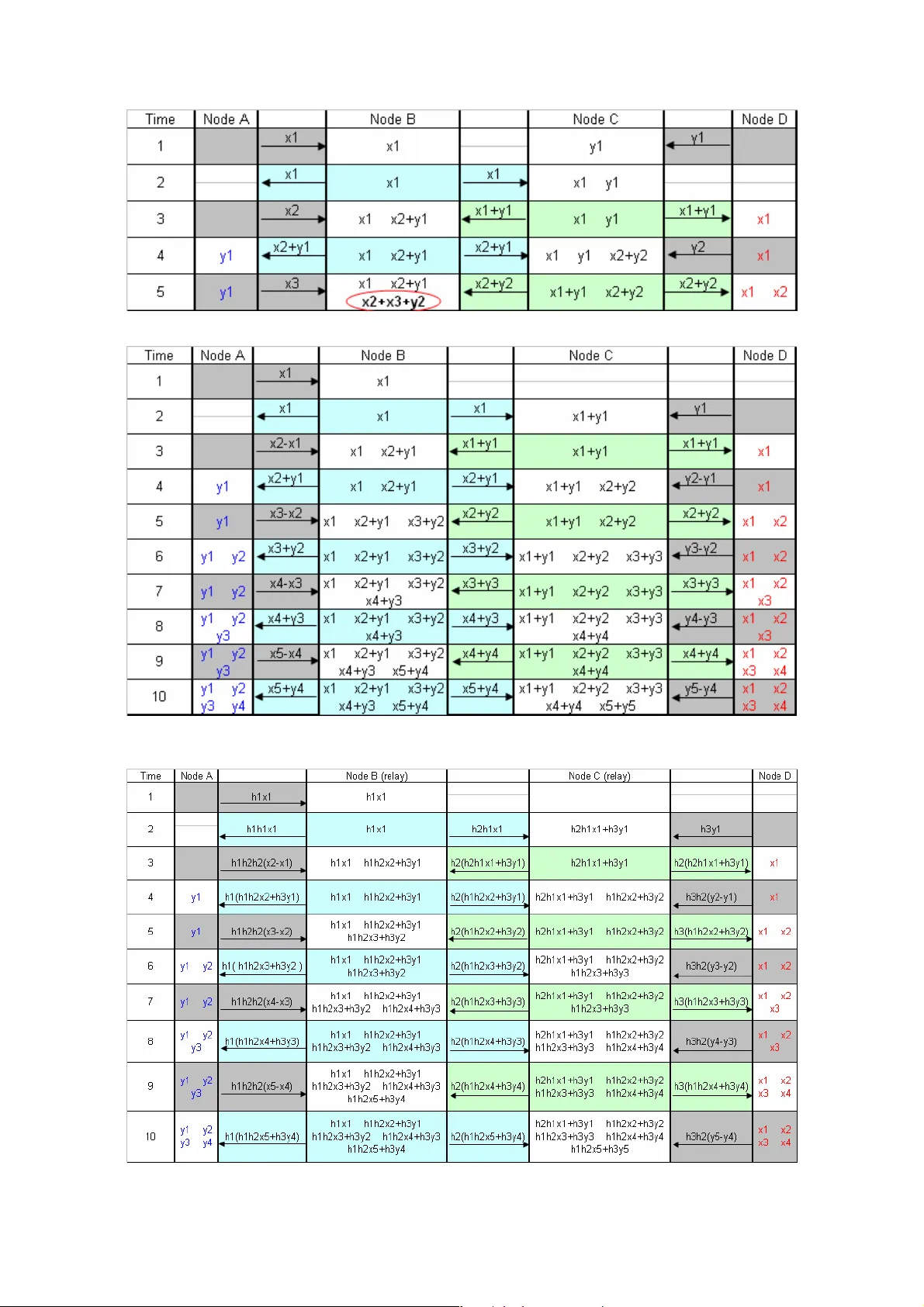
Four -node Rela y Ne twor k with Bi-d irec tional Traffic Empl o y in g Wirele ss Network Coding with Pre-can cel lati on Su Kia ng Ku ek Natio nal U nive rsity of S ing apo re Chau Y uen , Woon Hau Chin In sti tut e for In focom m Res ea r ch cyu en @i 2r .a -s tar. edu . sg , w.h .ch in@i eee. or g Ab st ract— N et wo rk co din g h as th e po ten tia l to im pro v e the o verall t hro ug hpu t o f a n etw o rk b y co m b in ing different str eams o f data and fo rwarding them . In wire les s net wo rk s , th e w i re less ch an n el p ro vid e an ex cel lent m ed iu m f or p h ys ical lay er netw o r k co din g a s sig na ls f ro m d iffe ren t t ransm itters ar e co mb ined au t om atically b y th e w i re less ch an ne l. I n su ch scen ario s, it wo u ld b e int erest ing to in v es tiga te p ro to cols and algo rithm s w h ich c a n o ptim ally rela y info rm atio n. I n th i s pa p e r, we look at a four -n ode t wo- w ay or b i - di r e c t i ona l re lay n e t work , an d p r op ose a r e l ay p r ot oc ol wh ich ca n re la y in fo rm atio n ef fi ci en tly in this netwo rk. Ke ywords: wir ele ss net work coding , a nalogy net work coding , t wo-way / bi -dir ecti onal re lay com munic ati ons, fou r-no de netwo rk. I. I NTRODUCTION The b ro adc ast na tu re o f the w irele s s c ha nnel f ac ilit ate s th e em pl o y men t of n et wo r k codi n g to en han ce th e throughput o f a w ir eles s netw o rk. W hil e mo st netwo rk co din g res e a rch hav e foc u se d o n b it le v e l m a nipu latio n of th e d ata str eam, r ecent l y , th er e h a ve been in t er est s in “an alo g ne tw o r k co ding ” (A N C) , o r “ p hy si c al lay er netw o r k co din g” . AN C is pa r ticu l a rly u sef u l in w irele s s netw orks as the wire le ss chan nel ac ts as a natu ral imple me ntat io n o f netw o r k co din g by summi ng the w ir e le ss sig nals o v e r the air . In th is pap er, we on ly con si d er AN C, an d shal l u se ANC a nd w i re le s s ne tw o rk c o di ng (W N C) s y no ny mo u s l y . In t his p ap e r, w e c o nsid e r bi- d i rec tio n al t raf f ic f lows w here two n od e s tries to s end me s sag es to eac h o ther thr ough th e r ela y net wor k in bet ween them . Th e si m plest cas e, a th r ee n ode ( t wo s our ces/ d est i na t i o n s, one r el ay) r el a y netwo rk was s tudied in [1] a nd [2]. Mo st o f th e av aila b le lite ra tu re c o nti nue to conside r t he t hree - nod e b i-direc tio nal relay netw o rk. I nt e restingly , usin g wireless netw o rk codin g i n an ef f ec tiv e w ay fo r mo re tha n t hree n od e s is unk no w n in the l ite r atu re . In this pa per, w e conside r a f o ur node w i r ele ss relay netw o r k w it h b idi rec tio nal t raff ic. U nlike i ts t h ree - no de co unter p art, fo ur n ode netw o rk poses a chal le ngi ng task, as th i s set u p can no l o n ger sim p ly r eceive a n d b r oa dca st . Her e, we propo s e to solv e th is prob le m by propo sing a tec hnique cal l “p r ecan cel l at i o n ”. By c ombi n in g th i s t echn i qu e wit h w irele ss netw ork c o d ing, w e show th at w e are ab le to achiev e a sign ifica nt throug hput ga in in a fo ur node relay netwo rk. II. T HREE N ODE B I -D IREC TIONAL R ELAY N ET WORKS We fi r s t i l lu str at e th e p r obl em of bi -d ir ect i on al tr a ffic relay ing by intr oduc i ng th e c lass ical three node b idir ec tional rel ay cas e . Eac h o f the re lay s invo lve d are ass ume d to b e half duplex, i.e. e ac h rel ay can o nly e ithe r tra nsm it o r r ecei ve a t an y on e time. To k e e p th e p ro b le m s imple , w e al so assum e that th e tr ansmi ssions ar e noisel ess at thi s stage. In this netw o rk, w e hav e tw o node s (A an d C) ac ting as bot h th e in for ma ti on s our ce an d sin k. Th ese two n odes a r e un a ble t o com m un i cate d ir ect l y wi th each oth er, but ar e able to t r an s mit t o a n d r ecei ve i n f or m ati on fr om th e r elay n ode B. The mo s t st rai g htfo r w ard so lutio n to t he p ro b le m is fo r o ne o f the p a rty (say A) to f irst t ra nsm it t he me ssage , x , to B and B to relay the me ss age to C. Sub s e que n tly , C w ill tra ns mit y to B and B will relay the me s sag e to A. T his so lution is il lus t rate d in Fig u re 1 , w he re the s h aded b o x es in d icat e th e tran smitt in g n ode. Fr om th e fig ur e, we can ob s e rve th at th is s o lu tio n re qu i re s f o ur ti me s lo ts to t r ans mit tw o se ts of i nf o rma tio n. Alte rn a tiv e ly , we c an c o nside r the so lution i n [2] , w hic h is i llu st r ate d i n F igu r e 2 . I n t his c as e , w e allo w both A and C to tra nsm it s i mul ta neo u sly to B. D ue to the s up e rpo sitio n na t ur e of th e wir el ess chan n el, B recei ve s x + y . B can th en br oa d c a st x + y to b oth A a nd C at t he s a me t ime . S ince A ha s kn owled ge o f x, i t can ex tra ct y f r om th e r ecei ved x + y . L ike w ise, C is ab le to d e c o de x . By us in g WN C, t he numb er ti me slo ts required f o r th e tra ns miss io n o f tw o me ssag es is redu c e d f ro m f o u r to tw o, doub ling the t hroug hput of the sy stem. Fig u re 1 A b i-di r ec tio nal t rans mis s io n f o r 3 - no de rel ay netw o r k w it ho ut w irele ss netw ork c o ding Fig u re 2 A b i-di r ec tio nal t rans mis s io n f o r 3 - no de rel ay netwo rk wit h w ireless netw o rk coding III. F OUR N ODE B I -D IRECTIO NAL R ELAY N ETWOR KS Unl i k e th e thr ee- n ode r elay net wor k d escr i bed in th e prev io us se c tio n , the f our no de ( tw o s o urce s /de s tinat io ns, tw o re lay s ) c ase is muc h mo re c o mplicate d. T he re lay s will hav e to coordi nate s uc h t hat o nly o ne o f th em is t ra nsm it ti ng at a ny one time , a n d t hey can no lo n ge r be p ass iv e by si m pl y r ecei vin g an d b r oad ca st in g the m ess ag es th ey r ecei ve. For n or mal bi -dir ect i ona l r elayin g in th is cas e, the o ptima l me s sage tr a nsm iss io n sc heme w ith o ut W N C w o uld be to ha v e bo th sources , A and D t ransmitt ing, x 1 an d y 1 resp e c tiv e ly , at the s ame ti me in the f ir st t ime s lo t. I n t he next t ime s lo t, B w ill broad c ast x 1 w hile C liste ns i n a nd keep s y 1 i n i ts b uf f e r. Sub seq ue ntly , C w ill t ra nsm it y 1 , an d both B and C transmi t y 1 an d x 1 re sp e c tiv e ly in t he las t time slo t. T his p ro c e ss is illus trate d i n F i gu re 3 . For WNC , th e scen ari o is a l so n ot str ai ght for war d. The rel ay s can n o lo nge r sim ply rece iv e and b ro adc ast t he mes sa ges th ey recei ved a s t h a t w ill re su lt in multip le co pies of me ssage s be in g summe d up and t his makes t he dec o din g of the me s s age at t he de s ti natio n no de s be co me s diff icult. Th is pr obl em ca n be obs er ve d i n t i m e s l ot 5 in Fi gur e 4 , w here t he p ro b le matic me s s age is hig h lig hte d . To o ver come t h e pr o blem , pr e- can cel l ati on a t th e sour ce nodes is propo sed. As shown in Figu re 5, at time slot 3, ins tead o f tra ns mit ti ng x 2 f ro m A to B, A trans mits x 2 – x 1 so as t o can cel th e pr evi ous m essa g e fr om t h e r el ay. H en ce fr om t i m e s l ot 3 on war ds , we n oti ce a pa tt e rn in th e tr an sm is si on. At th e sour ce nod e, you tr an smit x k – x k -1 . By do ing s o , a t no de B , it w ill relay x k + y k -1 ; an d no de C, it w ill re l ay x k + y k . Fr om th e n ew tr an smi ssi on schem e we can in fer the fol lo win g co n ject ur e: Conjecture 1: I n a relay network, th e t hroug hput gain provide d by wireless netwo rk co din g w ith pre-ca ncellation is ap pro xim ate ly do ub le of the one w itho ut ne tw o r k co ding . Proof: In the th r ee-n od e r ela y n et wor k , with wi r el ess netw o r k c o ding have a 2 time s th rou g hpu t ga i n (1 ms g/ ti me v s 0 .5 ms g /ti me ). I n t he cas e o f fou r-no de rel ay netw ork, f rom time s lo t 5 o nw a rds, it take s o nly two ad ditio nal ti me slo ts to e xc hange tw o mess age s , i.e . ab o ut 1 msg /time . T his is als o do ub le o f the th roug h pu t f o r th e c as e w ithou t netwo rk co ding. This s ugges ts that the l arge r the netw ork size , as lo ng as t he t ime app r oa c he s i nf inity , and if yo u manage to enco de an d rel ay the message s prope rly , throughput g ain o f using netw ork co ding is abo ut do ub le of th at wi th out n etwo r k codi n g. ■ Next , we ex t en d th e ca se b y ta k in g ch an n el coef fici en t in t o acc oun t, a s s h own in Fi gur e 6. Th e chan n el coe ffi ci en t be tween n ode A and B , B and C and C and D is de note d by h 1 , h 2 an d h 3 an d a re ass ume to be co n sta nt a nd k no w n to all nodes t hroug hout the pe r iod of t r ans missio n. It c a n be noted th at th e i n cl u sion of ch ann el coef fici en ts d o n ot af fe ct t h e throughput gai n p rov ided by w ir eles s netw o rk coding wit h pr e-can cel l ati on as discu ssed ea rl i er in Conject u r e 1. Coding at t he so urce node is f urther e nhance d f rom time sl ot 3 on war ds t o in cl ude th e c h ann el coeffi ci en t for effi ci en t pr e-can cel la ti on . A s sh own i n F igur e 6 , fr om t im e sl ot 3 on war ds , h 2 h 2 is co de d at th e transmitting s o urce node A at odd t ime slo t and h 3 h 2 is coded a t th e tran smi tt in g sour ce n ode D a t ev en t im e sl ot to a l low ef fici en t pr e- canc e ll atio n . F rom ti me s lo t 3 o n w a rds, t he i nte r me dia te n odes B an d C also r em ove th e comm on h 2 ch an n e l coe f fici en t f r om th e r eceived pa cket . Finally , we complete the c ase by in cluding t he pow er n orma l iz at ion fact or an d n oise in t o th e tr an s mi ss ion char t , as s how n in Fig u re 7. It is ass ume d th at t he po wer no r m ali za t io n c o ns t a n t α an d β is t he s ame f o r eve ry od d an d even tim e in stan ce r esp ect ivel y an d is kn own to a l l n odes. N oise i s r an dom and is a dd ed at ever y r ecei vin g node. Throug hput is u naffe c ted and α , β are in cluded at ever y tr an sm itt in g n ode an d r emoved a t th e r ecei ved n od e as it is a co mmo n f ac to r. Der i va ti on of α an d β Fr om t ime s lot 3 on wa r d s, th e r eceiv ed pa cket a t t h e inte r med i ate nod e is de note d b y U a nd V res pe c tiv ely . Fo r odd time s l o t 2 n +1 w he r e n > 0 , i ntege r, 2 21 12 3 () () odd n n odd n n uh x x vh h x h y α α + =− =+ (1) For even ti m e sl ot 2 n w h er e n > 1 , i ntege r, 12 3 1 21 () () even n n even n n uh h x h y vh y y β β − − =+ =+ (2) Fr om E [ | u | 2 + | v | 2 ] = 1, it can be sh ow n that 2 42 22 22 1 3 2 22 2 2 12 3 2 1 || || | | | | 1 || | | | | 2 | | hh h h hh h h α β = ++ = ++ (3) IV. S IM ULATIONS A M at lab s im ul atio n is w r itte n to i nv es tigate t he e rr o r pe rfo r mance o f the 4 node s tw o -w ay / b i- direc tio nal relay netw ork w it h w i re le ss netw o rk co din g . I t is assu me d t hat t he thr ee chan n el coe ffi ci en t s an d power n or ma liza ti on fa ctor s ar e con st an t and kn own t o a ll nodes . Wh it e Ga us si an n oise is als o ad ded at ever y recei vi n g n ode f or ea c h tim e in stan ce. v u Inter med iate n o de Send in g nod e Send in g nod e Simulatio ns we re performed f or 10, 50 and 100 t ime s lots for each ru n fo r SNR from 0 to 60. I t is ass umed t hat t he SN R f o r e v e r y n o de is t he s a me . Figure 8 (uppe r figure) B it e rro r rate f o r packe t x with out pow er n o rmalizatio n facto r F ig u re 9 ( l o w e r f ig u re) Bi t e rro r r a te f o r p ac ke t y w ith out pow er n o rmalizatio n facto r Fig 10. (upper figur e) B it error rat e f o r packet x w ith pow er n o rmalizatio n facto r Fig 11. (lower figur e) B it error rat e f o r packet y w ith pow er n o rmalizatio n facto r As in Fig 8 to Fig 9, It c a n b e obs e rv ed that the b it erro r ra t e (BE R) d ecr ea ses a s th e SNR in c r eas es fr om 0 t o 60. It can al so be ob ser ved th at th e bi t err or r at e gr aph s fo r p ack et x an d y ar e not th e sam e. Th is i s du e t o th e di ffer en ce i n th e pow er alloc ate d to t he t ra ns mit te d s y m b o ls at nod e A a nd D r esp ect ivel y . From Figures 6 a nd 7, it c ould be seen that the transmissio n at node B in troduc ed a do ub le Ray leigh fading fact or f or th e y mes s age s to nod e A. W hile t he t rans miss io n of x me s sag e s at node C to nod e D int rod uc e d a trip le Ra yleig h fa din g fact or. Th i s d iffer en ce con tr i but ed t o th e di ffer en ce in th e BER of th e t wo da t a str eam s. Th e bi t er r or r at e i s al so lo wer for tr an s mis si on cycle wit h sh or ter ti m e in stan ce. It can be seen in Fig ur e 6 that th e nois e ge ne rate d f ro m e ac h t ra nsm iss io n s ta rti n g f ro m ti me slo t 1 w ill b e pres e nt and add e d to e ac h sub seq ue nt tr an sm is si on til l th e e n d of th e cycl e. Hen ce t r an s mi ss i on cy c le with s ho rte r ti me i nst a nce w ill hav e le s s nois e in t erfer en ce and r esu lt in the l ower bit err or ra t e. T he b it e rro r ra t e f o r tr a ns mi s s io n w it h po we r nor m ali za tio n f ac to r is s how n i n F ig u re 1 0 to 11. V. C ONCLUSION In t hi s pa per, we p r opos ed a p r otoc ol ba s ed on wir el es s netwo rk co ding fo r a f o ur-node relay netw o rk with tw o -w a y / b idirec tio nal t raf f ic . To the b e st o f ou r kno w ledge , this is th e fi r st p aper dea lin g with a r el a y n et work with an even numb er of no de s . Unlike t rad it io nal w ir ele s s netw ork co ding tha t s imp ly sum u p t he s ig nal at t he relay s, the no v e lty of th e pr oposed s ch em e l i es in the p art th at th e sour ce n ode woul d pr e-can cel som e of th e p ri or mess ag e, su ch th at th e mes s age w o uld no t ”o sc illa te ” w ith i n the ne tw o rk, a nd th is is crucial fo r a four-node netw o rk. We believe thi s tec hnique can be easi l y ext en d ed t o a n y net wor k th at em pl oy ev en nu m b e r o f no de s. REFERENCES [1 ] S . K a tti, H. Rah ul, W. Hu, D. Ka ta bi, M. M dar d, an d J. Cro w c rof t, “ X OR s in the ai r: p ractic al w i re le ss netw ork co ding,” in Proc . ACM SIGCO MM 2006, pp. 243–254, 2006. [2] P. Po po v ski an d H . Yo mo, “ Wireless netw o rk co din g by a m pl i f y-a n d for war d for bi- d ir ect i on al tr affi c fl o ws , ” I E E E Comms L etters , vo l. 11, pp . 16–18 , J an 2007 . Fig u re 3 A no rma l b i-di re c tio nal 4 - nod e relay w itho ut w irele s s ne tw o r k c o di ng Fig u re 4 A b i-di re c tio n a l 4 - no de rel ay with p ro b le mat ic me s sag e Fi g ur e 5 A bi - d ir ect i on al 4-n ode r e la y wi t h wi r e l ess n et wor k codi n g an d pr e- can cel l a ti on Fi gur e 6 A bi- dir ecti on al 4-n ode r ela y w it h wir el ess n et work codi n g an d pre- can cel l a ti on with ch an n el coeffi cien t ta k e n int o accou n t Fig u re 7 . A b i-di re c tio nal 4 - no de rel ay w ith w i re le ss netw o rk c o din g a nd p re- c anc e llat io n , tak ing i nto ac c o un t t he c h an n e l ef fe c ts and p o w er nor mal iz at io n. Tim e Node A Node B ( rel a y) Node C ( rel a y) Nod e D Bh3 y1 Bh3h2(y3-y 2) Ah3(h2h1x2+h3y2+N/ AABB+ N/B AB+N /AB+N/ B) Bh3h2(y2-y 1) Bh2(h1h2x2+h3y1+N/AAB+N/BA+N/A) Ah2(h2h1x2+h3y2+N/ AABB+ N/BAB+ N/ AB+N/ B) Bh2(h1h2x3+h3y2+N/ AABBA+ N/BABA + N/ABA+ N/BA+ N/ A) Ah3(h2h1x1+h3y1+N/AB+N/B) Ah1x1+N1 Bh2(h1x1+N/A) Ah2(h2h1x1+h3y1+N/AB+N/B) h1x1+N1/A h1x1+N1/A h1h2x2 +h3y 1+N/ AAB+N/ BA+ N/A h1x1+N1/A Bh1(h1h2x3+h3y2+N/ AABBA+ N/BABA +N /ABA+ N/BA+ N/A ) Ah1h2h2(x3-x2) Bh1(h1h2x2+h3y1+N/AAB+N/BA+N/A) Ah1h2h2(x2-x1) Bh1(h1x1+N/A) x1 x2 x1 x2 x1 x1 h2h1x1+h3y1+N/AB+N/B h2h1x1+h3y1+N/AB+N/B h2h1x1+h3y1+N/A+N/B, h2h1x2+h3y2+N/ AABB+ N/BAB+ N/AB+ N/ B 5 6 h2h1x1+h3y1+N/A+N/B, h2h1x2+h3y2+N/ AABB+ N/BAB+ N/AB+ N/ B h2h1x1+h3 y 1+N/A +N/ B, h2h1x2+h3y2+N/ AABB+ N/BAB+ N/AB+ N/ B, h2h1x3+h3 y 3+N/AA BBAB+N/ BABAB +N/ y1 1 2 3 4y 1 y1 y2 h1x1+N1/A h1h2x2 +h3y 1+N/ AAB+N/ BA+ N/A h1x1+N1/A h1h2x2+h3y1+N/AAB+N/BA+N/A , h1h2x3+h3y2+N/ AABBA+ N/BABA +N/ABA+ N/BA+ N/ A h1x1+N1/A h1h2x2+h3y1+N/AAB+N/BA+N/A , h1h2x3+h3y2+N/ AABBA+ N/BABA +N/ABA+ N/BA+ N/ A
Original Paper
Loading high-quality paper...
Comments & Academic Discussion
Loading comments...
Leave a Comment