The ancient Greeks present: Rational Trigonometry
Pythagoras' theorem, the area of a triangle as one half the base times the height, and Heron's formula are amongst the most important and useful results of ancient Greek geometry. Here we look at all three in a new and improved light, using quadrance…
Authors: N. J. Wildberger
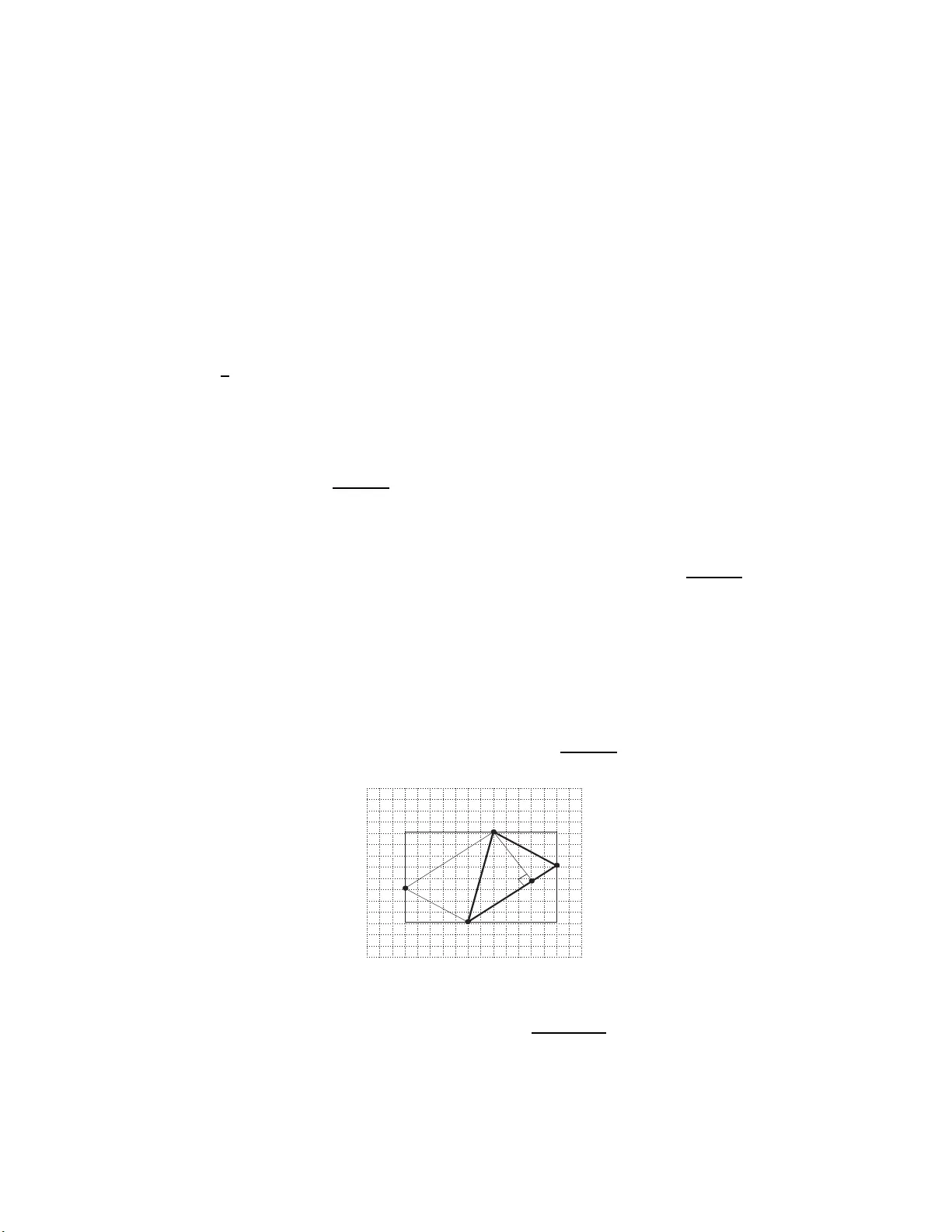
The ancien t Greeks presen t: Rational T rigonometry N J Wildb erger Sc ho ol o f Mathematics and Statistics UNSW Sydney 2052 Australia w ebpages: h ttp://web.m aths.unsw.edu/˜norman/ Octob er 22, 2018 Abstract Pythagoras’ theorem, the area of a triangl e as one half the base time s the height, and Heron’s formula are amongst the most important and useful results of ancien t Greek geometry . Here we lo ok at all three in a new and impro ved ligh t, using quadr anc e not distanc e . This leads to a simpler and more elegan t trigonometry , in whic h angle is replaced by spr e ad , and which extends to arbitrary fields and more general qu adratic forms. Three ancien t Greek theorems There a re three classical theore ms a bo ut triang le s that every mathematics stu- dent tr a ditionally meets. T o state these, c o nsider a triangle A 1 A 2 A 3 with side lengths d 1 ≡ | A 2 , A 3 | , d 2 ≡ | A 1 , A 3 | and d 3 ≡ | A 1 , A 2 | . Pythagoras’ theorem The triangle A 1 A 2 A 3 has a right angle at A 3 pr e cisely when d 2 1 + d 2 2 = d 3 3 . Area of triangle The ar e a of a triangle is one half the lengt h of the b ase times the height. Heron’s formula If s ≡ ( d 1 + d 2 + d 3 ) / 2 is t he semi-p erimeter of a t riangle, then its ar e a is area = p s ( s − d 1 ) ( s − d 2 ) ( s − d 3 ) . In this paper we will reca st all three in simpler and mor e gener al forms . As a reward, w e find that r ational trigonometry fa lls into our la ps, essentially for free. Our r eformulation works ov er a general field (not of characteristic tw o), in arbitrar y dimensions, and even with an ar bitr ary qua dr atic for m—see [2 ], [3] and [4]. 1 Pythagoras’ theorem Euclid and other ancient Greeks reg arded ar e a , not distanc e , as the fundamen- tal q uant ity in pla nar ge o metry . Indeed they work e d with a straightedge and compass in their co ns tructions, not a ruler and pro tr actor. A line s egment was measured by constructing a squar e on it, and determining the are a of that square. Two line segments were considere d equal if they were c ongruent , but this was indepe ndent of a direct notion of distance measurement. Area is an affine c onc ept : more pre cisely pr op ortions b et ween a r eas are maintained by linear transformations. Even with a different metrical ge ometry , for example a relativistic ge o metry in whic h x 2 − y 2 plays the role o f x 2 + y 2 , the notion of signed area defined by a determinant applies. In other words, in planar geometry a r ea is a basic notio n and may be consider ed prior to any theory of linear measurement. T o Euclid, P ythagoras ’ theor e m is a relation abo ut the area s of square s built on ea ch of the sides o f a right tria ngle. This insight has largely b een lost in the mo dern formulation, but with a sheet of gr aph pape r it is still a n attractive w ay to in tro duce studen ts to the sub j e ct, as the area of many simple figures can b e computed by sub dividing, transla ting and co unting cells. A A 1 2 A 3 25 5 20 Figure 1: Pythago r as’ theorem using a reas The squar es on the sides o f triangle A 1 A 2 A 3 shown in Figure 1 have areas 5 , 20 a nd 25 . The lar gest squar e for exa mple can b e seen as four triang les which can b e rearra nged to g et tw o 3 × 4 rectangles, together with a 1 × 1 squa re, for a total area of 25 . So from this p oint of view P ythagoras ’ theorem is a result which can b e established by c ounting , a nd the us e of irrationa l n umber s to describ e leng ths is not necessa ry . This applies to an y right triangle with rational co ordinates. 2 F ollowing the Greek terminology of ‘quadrature’, we define the quadrance Q of a line segment to b e the area of the squa re constructed on it. Py thagoras ’ theorem a llows us to a s sert that if A 1 ≡ [ x 1 , y 1 ] and A 2 ≡ [ x 2 , y 2 ] , then the quadrance betw een A 1 and A 2 is Q ( A 1 , A 2 ) = ( x 2 − x 1 ) 2 + ( y 2 − y 1 ) 2 . So for example the quadrance betw een the p oints [0 , 0] and [1 , 2] is Q = 5 . The usual distance b etw een the points is the ‘square r o o t’ of the qua dr ance and requires a prior theor y of irr ational num b ers. Clearly the irrational num b er √ 5 ≈ 2 . 23 6 067 9 77 . . . is a far more sophisticated and complicated ob ject than the natural num b er 5 . In statistics, v a riance is mor e natura l than standar d deviation. In quantum mechanics, wa ve functions are more basic than proba bilit y amplitudes. In har- monic analysis , L 2 is more pleasant than L 1 . In geo metry , quadr anc e is mor e fundamental t han distanc e . F or a triangle A 1 A 2 A 3 we define the quadrance s Q 1 = Q ( A 2 , A 3 ), Q 2 = Q ( A 1 , A 3 ) and Q 3 = Q ( A 1 , A 2 ). Here then is Pythagor as’ t he or em as the Gr e eks viewe d it —a nd it ex tends to ar bitrary fields, to many dimensions, and even with genera l quadra tic for ms. Theorem 1 (Pythagoras) The lines A 1 A 3 and A 2 A 3 of the triangle A 1 A 2 A 3 ar e p erp endicular pr e cisely when Q 1 + Q 2 = Q 3 . Area of a triangle The ar e a of a triangle is one-half t he b ase t imes the height . Let’s see how we might remove some of the irrationalities that o ccur with this ancient formula by loo king at a n example. T he area of the triang le A 1 A 2 A 3 in Figure 2 is one A A F 1 2 A A 3 4 Figure 2: A triangle and an asso cia ted para lle lo gram half of the area of the asso ciated parallelogr am A 1 A 2 A 3 A 4 . 3 The latter area may be calculated b y removing from the circumscr ibed 12 × 8 rectangle four tria ng les, whic h can b e comb ined to form t wo rectangles, one 5 × 3 and the other 7 × 5 . The area of A 1 A 2 A 3 is th us 2 3 . T o apply the one-half base times height r ule, the base A 1 A 2 by Pytha goras has length d 3 = | A 1 , A 2 | = p 7 2 + 5 2 = √ 74 ≈ 8 . 6 02 325 267 04 . . . . T o find the length h of the altitude A 3 F , set the o rigin to b e at A 1 , then the line A 1 A 2 has Cartes ian e quation 5 x − 7 y = 0 while A 3 = [2 , 8] . A well-kno wn result fro m co o rdinate geometry then states that the distance h = | A 3 , F | from A 3 to the line A 1 A 2 is h = | 5 × 2 − 7 × 8 | √ 5 2 + 7 2 = 46 √ 74 ≈ 5 . 34 7 391 3 82 22 . . . . If an engineer doing this calculation works with the sur d forms of b oth ex pr es- sions, she will notice that the tw o o ccurr e nc e s of √ 74 conv eniently ca ncel when she tak es one half the pro duct o f d 3 and h , giving a n a rea of 23 . Howev er if she works immediately with the de c ima l forms, she may be surprised that her calculator gives area ≈ 8 . 602 3 25 267 04 . . . × 5 . 34 7 391 3 8 2 22 . . . 2 ≈ 23 . 0 00 000 000 01 . The us ua l for m ula forces us to descend to the level o f irr ational num b ers and square ro ots, even when the even tual answer is a natural num b er, and this int r o duces unnecessar y a pproximations a nd inaccura cies in to the sub ject. It is not hard to see how the use of quadrance allows us to reformulate the r esult. Theorem 2 (T riangle area) The squar e of t he ar e a of a triangle is one-quarter the qu adr anc e of the b ase times the quadr anc e of the c orr esp onding altitude. As a formula, this would b e area 2 = Q × H 4 where Q is the qua drance of the ba se and H is the quadrance of the altitude to that base. Heron’s or A rc himedes’ T heorem The same triangle A 1 A 2 A 3 of the previous section has side lengths d 1 = √ 34 d 2 = √ 68 d 3 = √ 74 . The semi-p erimeter s, defined to b e one half of the sum of the side lengths, is then s = √ 34 + √ 68 + √ 74 2 ≈ 11 . 3 39 744 206 6 . . . . 4 Using the usual Heron’s formula, a computation with the ca lculator shows that area = r s s − √ 34 s − √ 68 s − √ 74 ≈ 23 . 0 00 000 . Again w e have a formula inv olving square ro ots in which there app ear s to b e a surprising in teg ral o utcome. Let’s now give another form of Her on’s formula, with a new na me. Arab so urces sugg est that Archimedes knew Heron’s fo r m ula earlier, and the greatest mathematician of all time deser ves credit for more than he currently gets. Theorem 3 (Arc hime des) The ar e a of a triangle A 1 A 2 A 3 with quadr anc es Q 1 , Q 2 and Q 3 is given by 16 area 2 = ( Q 1 + Q 2 + Q 3 ) 2 − 2 Q 2 1 + Q 2 2 + Q 2 3 . In our example the triang le has quadra nces 34 , 68 and 7 4 , each obtained by Pythagor as’ theorem. So Archimedes’ theor em sta tes that 16 a rea 2 = (34 + 68 + 74) 2 − 2 34 2 + 68 2 + 74 2 = 846 4 and this gives an area of 23 . In rational trigonometry , the quantit y A = ( Q 1 + Q 2 + Q 3 ) 2 − 2 Q 2 1 + Q 2 2 + Q 2 3 is the quadrea of the triangle, and turns out to be the single most impo rtant nu m ber a sso ciated to a triangle. Note that A = 4 Q 1 Q 2 − ( Q 1 + Q 2 − Q 3 ) 2 = − 0 Q 1 Q 2 1 Q 1 0 Q 3 1 Q 2 Q 3 0 1 1 1 1 0 . It is instructive to see how to g o from Heron’s formula to Archimedes’ the- orem. In terms of the side lengths d 1 , d 2 and d 3 : 16 a rea 2 = ( d 1 + d 2 + d 3 ) ( d 1 + d 2 − d 3 ) ( − d 1 + d 2 + d 3 ) ( d 1 − d 2 + d 3 ) = ( d 1 + d 2 ) 2 − d 2 3 d 2 3 − ( d 1 − d 2 ) 2 = 2 d 1 d 2 + d 2 1 + d 2 2 − d 2 3 2 d 1 d 2 − d 2 1 + d 2 2 − d 2 3 = 4 d 2 1 d 2 2 − d 2 1 + d 2 2 − d 2 3 2 = 4 Q 1 Q 2 − ( Q 1 + Q 2 − Q 3 ) 2 = ( Q 1 + Q 2 + Q 3 ) 2 − 2 Q 2 1 + Q 2 2 + Q 2 3 . Archimedes’ theorem implies another for m ula of consider able imp ortance. 5 Theorem 4 (T riple quad form ul a) The t hr e e p oints A 1 , A 2 and A 3 ar e c ol line ar pr e cisely when ( Q 1 + Q 2 + Q 3 ) 2 = 2 Q 2 1 + Q 2 2 + Q 2 3 . The pro of is of course immediate, a s collinear it y is equiv alent to the area o f the triangle being zero. Spread b et w een lines An angle is the r atio of a cir cular distanc e to a line ar distanc e, and this is a c omplicated concept. T o define an ang le pr ope r ly you r e qu ir e c alculus , an impo rtant p oint es sent ially understo o d b y Arc himedes. V agueness a bo ut angles , and the accompanying ambiguities in the definition of the circula r functions cos θ, sin θ and tan θ weaken most calculus texts. There is a rea son that classical trigonometry is painful to studen ts—it is b ase d on the wr ong notions . As a result, mathematics teachers are forced to contin ually r ely on 90 − 45 − 45 and 90 − 60 − 30 triangle s for examples and test questions, which makes the sub ject very na rrow a nd rep etitiv e . Rational trigonometry , developed in [2], see also [4], shows how to simplify and enrich the sub ject, leading to g reater accurac y and quick e r computatio ns. W e want to show that the basic r esults of this new theor y fol low natur al ly fr om the ab ove pr esentation of Pythagor as’ t he or em, the T riangle ar e a t he or em, and Ar chime des’ the or em . The key innov ation is to replace angle with a completely a lgebraic concept. The sepa ration b etw een lines l 1 and l 2 is ca ptured rather by the notion of spr e ad , which may b e defined as the ratio of tw o quadrances as follows. Suppo se l 1 and l 2 int e r sect at the po in t A. Cho ose a p oint B 6 = A o n o ne of the lines , say l 1 , a nd let C be the fo ot o f the per pendicula r fro m B to l 2 . Then A s B C l l 1 2 Q R Figure 3: Sprea d s b etw een tw o lines l 1 and l 2 the spread s betw een l 1 and l 2 is s = s ( l 1 , l 2 ) = Q ( B , C ) Q ( A, C ) = Q R . 6 This r atio is indep endent of the choice of B , acco rding to Thales, and is defined b etwe en lines, not r ays . P arallel lines are defined to hav e spr ead s = 0 , while per pendicula r lines hav e spread s = 1 . The spread betw ee n the lines l 1 and l 2 with equations a 1 x + b 1 y + c 1 = 0 and a 2 x + b 2 y + c 2 = 0 turns out to b e s ( l 1 , l 2 ) = ( a 1 b 2 − a 2 b 1 ) 2 ( a 2 1 + b 2 1 ) ( a 2 2 + b 2 2 ) . (1) Since this is a r ational expressio n, spread b ecomes a useful co ncept also over general fields, although in this paper we stick to the usual situatio n ov er the decimal n umber s. Y ou may chec k that the s pread cor resp onding to 30 ◦ or 150 ◦ or 21 0 ◦ or 33 0 ◦ is s = 1 / 4 , the spread cor resp onding to 45 ◦ or 13 5 ◦ etc. is s = 1 / 2, and the spread corresp onding to 60 ◦ or 120 ◦ etc. is 3 / 4 . The following spr e ad pr otr actor was cr eated b y M. Oss ma nn [1]. Figure 4: A spread protra ctor W e us e the notatio n that a tr iangle A 1 A 2 A 3 has quadrances Q 1 , Q 2 and Q 3 , as well as sprea ds s 1 , s 2 and s 3 , lab elled as in Fig ure 5. Note the diagr ammatic conv entions that help us distinguish these quantities from dis ta nce a nd a ngle. A 1 A 3 A 2 s 1 Q 1 Q 3 Q 2 s 3 s 2 Figure 5: Quadranc e s and spreads of a triangle 7 Rational trigonometry Let’s s e e how to c o m bine the three ancient Greek theorems as re s tated ab ov e to derive the main laws of r ational trig onometry , independent of c lassical tr igonom- etry , and without any need for tra ns cenden ta l functions. If H 3 is the qua drance of the altitude from A 3 to the line A 1 A 2 , then the T riangle ar ea theorem and the definition of spread give area 2 = Q 3 × H 3 4 = Q 3 Q 2 s 1 4 = Q 3 Q 1 s 2 4 . By symmetry , w e g et the following a nalog of the Sine law. Theorem 5 (Spread l a w) F or a triangle with quadr anc es Q 1 , Q 2 and Q 3 , and spr e ads s 1 , s 2 and s 3 , s 1 Q 1 = s 2 Q 2 = s 3 Q 3 = 4 a r ea 2 Q 1 Q 2 Q 3 . By equating the for m ula s for 16 area 2 obtained from the T ria ngle ar ea the- orem and Archim edes’ theorem, w e get 4 Q 2 Q 3 s 1 = ( Q 1 + Q 2 + Q 3 ) 2 − 2 Q 2 1 + Q 2 2 + Q 2 3 = 2 Q 1 Q 2 + 2 Q 1 Q 3 + 2 Q 2 Q 3 − Q 2 1 − Q 2 2 − Q 2 3 . Rearra ng ing gives the following a nalog o f the Co sine law. Theorem 6 (Cross la w) F or a triangle with qu adr anc es Q 1 , Q 2 and Q 3 , and spr e ads s 1 , s 2 and s 3 , ( Q 1 − Q 2 − Q 3 ) 2 = 4 Q 2 Q 3 (1 − s 1 ) . Now substitute Q 1 = s 1 D , Q 2 = s 2 D and Q 3 = s 3 D , wher e D = Q 1 Q 2 Q 3 / 4 a r ea 2 from the Spread law into the Cro ss law, and cancel the common factor of D 2 . The result is the relation ( s 1 − s 2 − s 3 ) 2 = 4 s 2 s 3 (1 − s 1 ) betw een the three spr eads of a tria ngle, which can b e rewritten mo re symmet- rically as follows. Theorem 7 (T riple spread form ula) ( s 1 + s 2 + s 3 ) 2 = 2 s 2 1 + s 2 2 + s 2 3 + 4 s 1 s 2 s 3 . This formula is a defor mation of the T r iple qua d fo rmu la by a single cubic term, and is the a nalog in ratio nal trigo nometry to the classica l fact that the three angles of a triangle sum to 3 . 141 59 2 653 5 9 . . . . The T riple quad formula , Pythagor as’ the or em , the Spr e ad law , the Cr oss law and the T riple spr e ad formula a re the five main laws o f ra tional tr ig onometry . 8 W e now s ee these ar e closely linked to the g e ometrical work of the ancient Greeks. As demonstrated at some length in [2], these for m ula s and a few additional ones suffice to s olve the ma jor it y of trigo nometric pro blems, usua lly more simply , more accurately and more elegan tly than the classical theory in volving transcen- dent a l circular functions and their in verses. As shown in [3] and [5], the same formulas ex tend to geo metry o ver arbitrary fields (not of c har acteristic t wo) and with general quadratic forms. In retrosp ect, the blind sp ot firs t o ccur red with the Pythago reans, who ini- tially b elieved that all of natur e should b e expressible in terms o f natural num- ber s and their prop ortio ns . When they discovered tha t the ratio of the length o f a diag onal to the length of a side of a squar e was the incommensurable pr op or- tion √ 2 : 1 , legend has it that they tossed the exp oser of the secret ov er bo a rd while at sea. Had they maint a ined their b eliefs in the workings of the Divine Mind, and stuck with the squar es of the lengths as the crucial quantities in ge ometry, then mathematics would have had a significantly different history , Einstein’s sp ecial theory of relativity w ould p oss ibly hav e b een disc ov ered earlier, algebraic geom- etry would hav e quite another as p ect, a nd students w ould today be s tudying a simpler and more elegant trigono metry—muc h mor e happily! References [1] M. Ossmann, ‘Print a Protractor’, do wnloa d online at ht tp:/ / www.ossmann.com/ protractor / . [2] N. J. Wildb erger , Divine Pr op ortions: R ational T rigonometry to U niversal Ge ometry , Wild Egg Bo oks, Sydney , 2005, ht tp:/ / wildegg.com. [3] N. J. Wildberger, Affine and Pro jective Ra tional T rigo no metry , 2006 arXiv:math/06 12499 . [4] N. J. Wildb erge r, A Ratio nal Approach to T rig onometry , Math H orizons , Nov. 2007 . [5] N. J. Wildb erger, One dimensional metrical geometry , Ge ometriae De dic ata , 128 , no. 1, 145-166 , 2007. 9
Original Paper
Loading high-quality paper...
Comments & Academic Discussion
Loading comments...
Leave a Comment