The complexity of planar graph choosability
A graph $G$ is {\em $k$-choosable} if for every assignment of a set $S(v)$ of $k$ colors to every vertex $v$ of $G$, there is a proper coloring of $G$ that assigns to each vertex $v$ a color from $S(v)$. We consider the complexity of deciding whether…
Authors: Shai Gutner
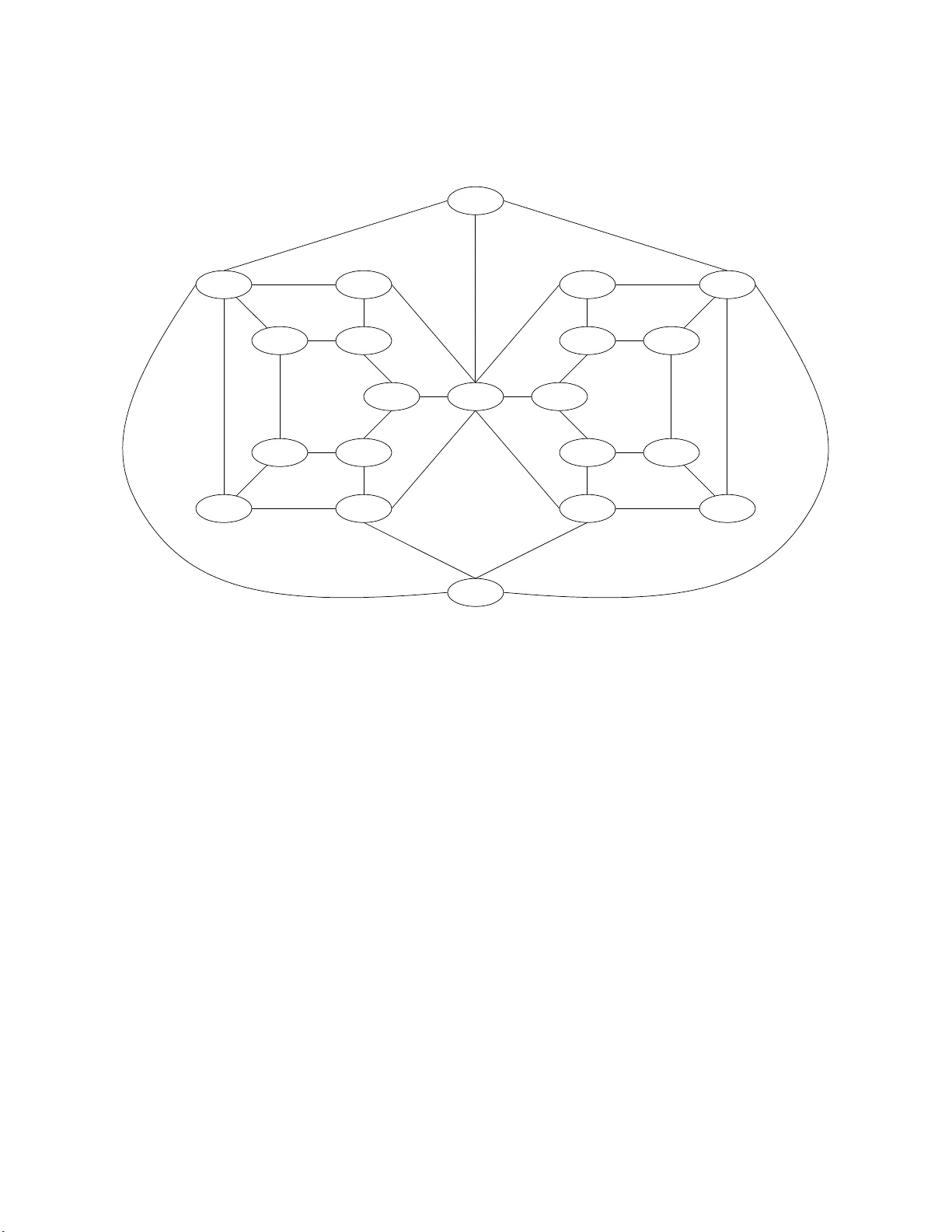
The complexit y of plana r graph c ho os abilit y ∗ Shai Gutner Departmen t of Computer Science Sc ho ol of Mathematical Sciences Ra ymond and Beve rly Sa c kler F acult y of Exact Sciences T el Aviv Univ ersit y , T el Aviv, Israel Abstract A graph G is k -cho osable if for every ass ignment of a set S ( v ) of k colors to every vertex v of G , th ere is a prop er coloring of G th at assig ns to eac h vertex v a color from S ( v ). W e consider the complexit y of deciding whether a g iven g raph is k -choosable for some constan t k . In particular, it is sho wn that deciding whether a giv en planar graph is 4-choosable is NP-hard, and so is the p roblem of deciding whether a giv en planar triangle-free graph is 3-choosable. W e also obtain simple constructions of a planar graph whic h is not 4-c ho osable and a planar triangle -free gra ph which is not 3-choosable. ∗ This pap er forms part of a Ph. D. thesis written b y the author under the sup ervision of Prof. N. Alon and Prof. M . T arsi in T el Aviv Universit y . 0 1 In tro duction All graphs consider ed here are finite, undirected and simple (i.e., ha ve no lo ops and no para lle l edges ). If G = ( V , E ) is a gr aph, and f is a function that ass igns to each vertex v of G a po sitive integer f ( v ), we say tha t G is f -choosa ble if for ev ery assignment o f s ets of integers S ( v ) ⊆ Z for all vertices v ∈ V , where | S ( v ) | = f ( v ) for all v , there is a prop er vertex coloring c : V 7→ Z s o that c ( v ) ∈ S ( v ) for all v ∈ V . The graph G is k -cho osable if it is f -cho osable for the cons tant function f ( v ) ≡ k . The choic e numb er o f G , denoted ch ( G ), is the minim um in teger k so that G is k -choo sable. The study of c hoice n umbers of graphs w as initiated by Vizing in [11] and by E rd˝ os, Rubin and T a ylor in [2]. A characteriza tion of all 2-choo sable g raphs is giv en in [2]. If G is a connected graph, the c or e of G is the graph obta ined from G by rep eatedly deleting vertices of degree 1 until there is no suc h vertex. Theorem 1. 1 ([ 2]) A simple gr ap h is 2 -cho osable if and only if the c or e of e ach c onne cte d c omp onent of it is either a single vertex, or an even cycle, or a gr aph c onsisting of two vertic es with thr e e even internal ly disjoint p aths b etwe en them, wher e the length of at le a st two of the p aths is exactly 2 . In the present pap er we consider the complexity of deciding whether a given g r aph is k - choosable fo r some co nstant k . It is shown in [2] that the following problem is Π p 2 -complete: (for termino logy see [3]) BIP AR TITE GRAPH (2,3 )- C H OOSABILITY (BG (2,3)-CH) INST ANCE: A bipartite g raph G = ( V , E ) and a fun ction f : V 7→ { 2 , 3 } . QUESTION: Is G f -choo sable? Consider the following decision pro ble m: BIP AR TITE GRAPH k -C H OOSABILITY (BG k -CH) INST ANCE: A bipartite g raph G . QUESTION: Is G k - cho osable? It is prov ed in [4] that this problem is Π p 2 -complete for every c o nstant k ≥ 3. It follows easily fr om Theor em 1.1 that the case k = 2 is so lv able in p olynomial time. The following results are known concerning the choice n um b ers of planar graphs: Theorem 1. 2 ([ 9]) Every planar gr aph is 5 - cho osable. Theorem 1. 3 ([ 12]) Ther e exists a planar gr aph (with 238 vertic e s) which is not 4 -cho osable. Theorem 1. 4 ([ 1]) Every bip artite planar gr aph is 3 -cho osable . Theorem 1. 5 ([ 13]) Ther e exists a planar triangle-fr e e gr aph (with 166 vertic es) which is n ot 3-ch o osab le. 1 Theorem 1. 6 ([ 10]) Every pl anar gr aph with girth 5 is 3 -cho osa ble. The fo llowing t w o theo r ems improve upon Theorems 1.3 and 1.5 a nd us e m uch simpler co nstructions. Theorem 1. 7 Ther e exists a planar gr aph with 75 vertic es which is n ot 4 -cho osable. Theorem 1. 8 Ther e exists a planar triangle-fr e e gr ap h with 164 vertic es whic h is not 3 -cho o sable. It follo ws easily from Theorems 1 .1 and 1.4 that the c hoice n um b er of a g iven bipartite plana r graph ca n be determined in p olynomial time. Consider the following decision problems: BIP AR TITE PLANAR GRAPH (2 , 3) -CHOOSABILITY (BPG (2 , 3) -CH) INST ANCE: A bipartite pla nar gr a ph G = ( V , E ) and a function f : V 7→ { 2 , 3 } . QUESTION: Is G f -choo sable? PLANAR TRIANGLE-FR EE GRAPH 3 -CHOOSABILITY (PTF G 3 -CH) INST ANCE: A planar tr ia ngle-free g raph G . QUESTION: Is G 3-cho osable? PLANAR GR APH 4 -CHOOSABILITY (PG 4 -CH) INST ANCE: A planar g raph G . QUESTION: Is G 4-cho osable? UNION OF TWO FORESTS 3 -CH OOSABILITY (U2F 3 -CH ) INST ANCE: Two fores ts F 1 and F 2 with V ( F 1 ) = V ( F 2 ). QUESTION: Is the union of F 1 and F 2 3-choos able? W e pr ove the following results: Theorem 1. 9 BIP AR TITE PLANAR GRAPH (2, 3)-CHOOSABILITY is Π p 2 -c omple te. Theorem 1. 10 PLANAR TRIANGLE-FR EE GR APH 3 -CHOOSABILITY is Π p 2 -c omple te. Theorem 1. 11 PLANAR GR APH 4 -CHOOSABILITY is Π p 2 -c omple te. The decisio n pro blem U2F 3 -CH was formulated by M. Stiebitz [8] in light of the fact that every planar triangle-fr ee g raph is the union of t w o forests. The following Theorem can b e derived easily from the constructions used in the pro ofs of Theorems 1 .9 a nd 1.10. Theorem 1. 12 UNIO N OF TWO FORESTS 3 -CHO OSABILITY is Π p 2 -c omple te. The r est of the pap er is organized as follows. In section 2 we prov e Theorems 1.7 and 1.8. The Π p 2 - completeness pro of of the decision problem BG (2,3)-CH taken from [2] forms the ba sis fo r the pro o f of Theorem 1 .9 g iven in section 3 . Section 4 cont ains the pro o fs of Theorems 1.10 and 1.11 . 2 ab34 a134 a256 ab12 ab56 b134 b256 v u y 1 y 3 x 2 y 2 w x 1 x 3 Figure 1 : The graph W 1 . 2 Tw o planar graphs In this section we construc t t w o pla nar g raphs in order to pro ve Theorems 1.7 a nd 1 .8. Pro of of Theorem 1.7 The gr aph H is co nstructed as follows: W e take the disjoint union o f the graphs { G i : 1 ≤ i ≤ 12 } , w he r e eac h G i is a copy o f the graph W 1 in Fig . 1. All the 12 vertices na med u are identifi ed, as well as a ll the 12 vertices named v . The edg e ( u, v ) is added to obtain the gra ph H , which is ob viously planar. W e claim tha t the graph H is not 4-cho osable. T o prov e this, take S ( u ) = S ( v ) = { 7 , 8 , 9 , 10 } . Denote A = { ( a, b ) ∈ S ( u ) × S ( v ) | a 6 = b } , then sur e ly | A | = 1 2. With every i , 1 ≤ i ≤ 12 we ass o ciate a different element p i = ( a, b ) ∈ A , and define the sets of every vertex of G i except for u and v to b e a s in Fig. 1. It can b e easily verified that there is no prop er vertex co loring for this as signment, and ther e fore H is not 4 - choosable . T o see this, supp os e the v ertex u is colo red with the color a a nd the vertex v is colored with the co lo r b , where ( a, b ) = p i ∈ A . The vertex w in the gra ph G i can b e colo red with either the color 1 or the color 2, and in both cases the coloring in the gr a ph G i cannot b e completed. W e now construct a planar gr aph H ′ which is not 4- choosable and has few er vertices tha n H . The graph H ′ is obta ined from H b y identifying the vertex y 2 of G i with the vertex x 2 of G i +1 for e very i , 1 ≤ i < 12. W e claim that H ′ is not 4- choosable. The previous definitions of S ( u ), S ( v ), A and p i are used. F or every i , 1 ≤ i < 12 we do the following: Denote p i = ( a, b ) and p i +1 = ( c, d ). The set of the v ertex y 2 of G i (whic h is the same as the s et of the vertex x 2 of G i +1 ) is chosen so that it contains the co lors a , b , c and d (and maybe other color s if p i and p i +1 are not disjoin t). In the same manner as b efore, we conclude that H ′ is not 4-choosa ble. The gr aph H ′ is planar and has 2 + 1 2 ∗ 7 − 11 = 75 vertices. ✷ 3 135 389 589 789 189 367 b16 689 289 589 245 489 467 b26 689 789 a12 ab3 ab4 u v x 1 x 2 w x 3 x 4 y 1 y 2 y 3 y 4 Figure 2 : The graph W 2 . Pro of of Theorem 1.8 The gr aph H is co nstructed as follows: W e take the disjoint union o f the graphs { G i : 1 ≤ i ≤ 9 } , where each G i is a copy of the graph W 2 in Fig . 2. All the 9 vertices named u are identified, a s well as all the 9 vertices named v , to obtain the planar triang le-free graph H . W e cla im that the gra ph H is not 3 - choosable . T o pro ve this, tak e S ( u ) = { 10 , 11 , 12 } and S ( v ) = { 13 , 14 , 15 } . With every i , 1 ≤ i ≤ 9 we ass o ciate a differen t elemen t ( a, b ) ∈ S ( u ) × S ( v ), and define the sets of ev ery v ertex of G i except for u and v to be as in Fig. 2. As in the pro of of Theorem 1 .7 , we conclude that H is not 3-choos able. W e now construct a planar triangle- free gra ph H ′ which is not 3-choos a ble and has fewer vertices than H . The g raph H ′ is obtained from H by identifying the v ertex y 2 of G i with the vertex x 2 of G i +1 for ev ery i , 1 ≤ i ≤ 9 (indices tak en modulo 9). W e claim that H ′ is not 3 - choosable . The previous definitions of S ( u ) and S ( v ) are used. Consider the following ordering of the elements of S ( u ) × S ( v ): { p i } 9 i =1 = (10 , 13) , (10 , 14) , (10 , 15) , (11 , 15) , (11 , 13) , ( 11 , 14) , (12 , 14) , (12 , 15) , (12 , 13) . F or every i , 1 ≤ i ≤ 9 we do the following: Denote p i = ( a, b ) and p i +1 = ( c, d ). The set of the vertex y 2 4 of G i (whic h is the sa me as the set of the vertex x 2 of G i +1 ) is defined as { a, b, c, d } (this is a set of size 3 ). In the s ame manner as befor e, we conclude that H ′ is not 3- choosa ble. H ′ is a pla nar triangle-free graph and has 2 + 9 ∗ 18 = 164 vertices. ✷ 3 The c ho osabilit y of bipartite planar graphs The Π p 2 -completeness pro of o f the decision pro blem BG (2,3)-CH taken fro m [2] forms the basis for the pro of of Theorem 1.9 given in this s ection. The ordina ry Planar Satisfiability pro ble m is well kno wn to be NP-complete ([3 ],[6]). W e use a reduction from the follo wing problem: RESTRICTED PLANAR SA TISFIABILITY (RPS) INST ANCE: An expression o f the form ( ∀ U 1 ) · · · ( ∀ U k )( ∃ V 1 ) · · · ( ∃ V r )Φ s uch that (1) Φ is a formula in conjunctive nor mal form with a set C o f clauses ov er the set X = { U 1 , . . . , U k , V 1 , . . . , V r } of v ariables, (2) each clause inv olves exa ctly three distinct v ariables, (3) every v ariable oc c urs in at most thr e e clauses, and (4) the gr aph G Φ = ( X ∪ C, { xc | x ∈ c ∈ C o r x ∈ c ∈ C } ) is planar. QUESTION: Is this expr ession true? A similar pr oblem is used in [5] for proving r esults concerning the co mplexity of list co lorings. The same transformatio n used in [6 ] for proving that the decisio n pro blem Pla nar Quantified Bo olea n F ormula is P-space- complete can b e used for proving that the follo wing pro blem is Π p 2 -complete: ORDINAR Y PLANAR SA TISFIABILITY (OPS) INST ANCE: An expression o f the form ( ∀ U 1 ) · · · ( ∀ U k )( ∃ V 1 ) · · · ( ∃ V r )Φ s uch that (1) Φ is a formula in conjunctive nor mal form with a set C o f clauses ov er the set X = { U 1 , . . . , U k , V 1 , . . . , V r } of v ariables, (2) each clause inv olves at most three distinct v ariables, (3 ) the graph G Φ = ( X ∪ C , { xc | x ∈ c ∈ C or x ∈ c ∈ C } ) is planar. QUESTION: Is this expr ession true? W e a pply ideas from [7] for proving the following lemma: Lemma 3.1 RE STRICTED PLANAR SA TISFIABILITY is Π p 2 -c omple te. Pro of It is easy to s e e that RPS ∈ Π p 2 . W e transform OPS to RPS . Let the expres sion B be an instance of OPS , a nd suppo se that B has the form ( ∀ U 1 ) · · · ( ∀ U k )( ∃ U k +1 ) · · · ( ∃ U k + r )Φ. T a ke a planar embedding of G Φ . F o r every v ariable V we do the following: Let ( V , C 1 ) , . . . , ( V , C n ) be the edges adjacent to the v a riable V in the graph G Φ in a clo ckwise order acco rding to the pla nar embedding. Now introduce new v a riables V 1 , . . . , V n and clauses V i ∨ V i +1 , i = 1 , . . . , n (indices ta ken mo dulo n ), and r eplace the literals V , V 5 OUT 2 2 3 3 2 3 IN Figure 3 : HALF-PROP AGA TOR. in cla uses C i by the literals V i , V i , r esp ectively , for i = 1 , . . . , n . The quant ified v aria ble V is replaced with the v ariable V 1 quantified with the same qua ntifier. A new quantifier blo ck existentially quantifying the v a riables V 2 , . . . , V n is app ended to the list of quan tifiers. T o ev ery clause whic h in volv es exactly tw o v ariables we a dd a new v ariable V and insert the quan tified v a riable ( ∀ V ) in the be g inning of the expression. In a similar ma nner we handle clauses with only one v a riable. It is ea sily seen that the mo dified formula has the desired proper ties and that it is true if and only if B is true. ✷ Pro of of Theorem 1.9 It is easy to se e that BPG (2 , 3) -CH ∈ Π p 2 . W e transfo rm RPS to BPG (2 , 3) - CH . Let the expression ( ∀ U 1 ) · · · ( ∀ U k )( ∃ U k +1 ) · · · ( ∃ U k + r )Φ, denoted as B , b e an instance of R PS . W e sha ll construct a bipartite plana r graph G = ( V , E ) and a function f : V 7→ { 2 , 3 } suc h that G is f - choosable if and only if B is tr ue . Supp ose that Φ ha s the following form: C 1 ∧ C 2 ∧ · · · ∧ C m where each C i is of the form ( X i 1 ∨ X i 2 ∨ X i 3 ) a nd each X ij is U s or U s . The basic ideas of co nstructs fo r the gra ph inv olve ”propaga to rs”, ” ha lf-propag ators” , ”multioutput propaga tors”, and ”initial graphs”, with so me no des designated as input nodes , and some no des desig nated as output no des. In the following figures a n umber on a no de will be the v alue f takes on that no de when G is formed. The v alue on an in no de will be acquir ed when it gets merged with an out no de. A half-propag ator is the gr aph is Fig. 3. A pr opagato r can be made by merging the out no de of any ha lf-propag a tor with the in no de of any other half-pr opaga to r. A multioutput propagator is sho wn in Fig. 4. The initial graphs are the g raphs in Fig. 5 and 6. The gr aph G cons ists of the following. F or each i fro m 1 to k , we have a ∀ -gra ph, with the o ut no des named U i and U i . F or each i fro m k + 1 to k + r , we hav e a ∃ - graph, with the out no des names U i and U i . W e think o f the C i ’s as cla uses, and think of U s and U s as literals. F or each literal V we connect a m ultioutput pr opaga tor to the no de named V , iden tifying the in no de of the pr opaga tor with V . All the m ultioutput propagator s lo o k alike having 3 m output no des, one for e a ch i j where 1 ≤ i ≤ m and 1 ≤ j ≤ 3. Now w e a dd m new no des (each with f ( C i ) = 3) named C 1 , C 2 , . . . , C m . F o r ea ch i from 1 to m , and 6 2 3 2 2 2 3 2 2 2 3 IN OUT OUT OUT propagator propagator propagator an y length Figure 4 : MUL TIOUTPUT PROP A GA TOR. OUT 2 2 2 OUT Figure 5 : A ” ∃ -g raph”. each j from 1 to 3 , co nnect C i to the ij no de o f the multioutput propag ator a ttached to the node named X ij . That describ e s the g r aph G , which is o bviously bipartite. Every v a riable occur s in a t most thr ee clauses, and therefore it occurs either a t mo st once po sitive or a t most once negative. Co mb ining this with the fact that G Φ is planar, w e conclude that G is plana r. W e use here a different half-propagato r fro m the one used in [2], and therefo re the following prop e rties needed for the pr o of sho uld b e v erified for our half-pr opagato r. 1. A 2-colo ration will giv e the out no de opposite color to that of the in no de. 2. F or any choice of a letter from the in no de, and no matter what letters are put o n no des other than the in node, there is a compatible c hoice of letters from the remaining nodes of the half-propaga tor. 3. F or any assignment of letters to no des other than the in node , for any choice of a letter from the out no de, there is at mo st one choice of letter incompatible with it on the in no de. (This is a direct consequence of K 2 , 3 being 2-choo sable) 4. There is an assignment of letters, and a choice o f in letter, such that only one choice of a letter from the o ut no de is compatible with it. (See Fig . 7) The pro o f which app ear s in [2] ca n be used to c o nclude that G is f -choo sable iff B is true. ✷ 7 OUT 2 2 2 2 2 OUT 2 Figure 6 : A ” ∀ -g raph”. 234 1 12 13 145 56 467 Figure 7 : An ass ig nment for the half-propagator . 4 The c ho osabilit y of planar graphs In this section we prove Theo rems 1 .10 and 1.11. Lemma 4.1 L et G = ( V , E ) b e an o dd cycle, and supp ose we have an assignment of sets of inte gers S ( v ) ⊆ Z for al l vertic es v ∈ V , whe r e S ( v ) = 2 for al l v . Ther e exists a pr op er c olo ring c : V 7→ Z so that c ( v ) ∈ S ( v ) for al l v ∈ V if and only if not al l the sets S ( v ) ar e e qu al. Pro of Supp ose first that not all the sets S ( v ) ar e equal. Let x 1 and x k be adjace nt vertices for whic h S ( x 1 ) 6 = S ( x k ), wher e G is the cy cle x 1 − · · · − x k − x 1 . Cho o se a c olor c 1 ∈ S ( x 1 ) − S ( x k ), a nd g o in a sequence c ho osing c 2 ∈ S ( x 2 ) − { c 1 } , c 3 ∈ S ( x 3 ) − { c 2 } , . . . un til c k ∈ S ( x k ) − { c k − 1 } . W e hav e obtained a prop er coloring of G , as needed. If the sets S ( v ) are equal there is no colo ring as χ ( G ) = 3. ✷ Lemma 4.2 Su pp o se that C 1 and C 2 ar e two disjoint c opi es of the o dd cycle of length k , which we denote by C 1 = x 1 − · · · − x k − x 1 and C 2 = y 1 − · · · − y k − y 1 . L et G b e c omp ose d of C 1 and C 2 to gether with the e dges ( x i , y i ) , i = 1 , . . . , k . Supp ose we have an assignment of sets of inte gers S ( v ) ⊆ Z for al l vertic es v ∈ C 2 , wher e S ( v ) = 3 for al l v ∈ C 2 . Then ther e is at most one pr op er c olo ring of C 1 which c annot b e c omp lete d to a pr op er c olori ng of G by assigning to e ach vertex v ∈ C 2 a c ol or fr om S ( v ) . 8 Pro of Suppo se that c is a prop er coloring of C 1 which cannot b e completed to a prop er colo ring of G . Denote c i = c ( x i ), i = 1 , . . . , k . If follows from lemma 4.1 that there exis t tw o color s a and b s o that S ( y i ) = { a, b, c i } , i = 1 , . . . , k . Since c is a prop er coloring, surely ∩ k i =1 S ( y i ) = { a, b } . By applying lemma 4.1 again, we conclude that c is the only pr op er coloring with the r equired pr o p erties for the considered a ssignment of sets S ( y i ) = { a, b, c i } . ✷ Definition 4.3 A gr aph G = ( V , E ) is k -res trictly-choos able if G is f v -cho o sable for every v ∈ V , wher e the function f v is define d as f v ( v ) = k − 1 and f v ( w ) = k for every w ∈ V − { v } . Definition 4.4 A gr aph G is k -choice-critical if G is k - cho osable bu t not k -r estrictly-cho osable. Definition 4.5 L et G = ( V , E ) b e a gr a ph, and s u pp o se that u and v ar e two distinct vertic es of G . L et S b e an assignment of sets of inte gers S ( w ) ⊆ Z for al l vertic es w ∈ V . We denote by incomp ( G, u, v , S ) the set { ( a, b ) ∈ S ( u ) × S ( v ) | t her e is no pr op er vertex c oloring c : V 7→ Z so that c ( u ) = a , c ( v ) = b and c ( w ) ∈ S ( w ) for al l w ∈ V } . Lemma 4.6 L et W 2 = ( V , E ) b e the gr aph in Fig. 2. If S is an assignment of set s of inte gers S ( w ) ⊆ Z for al l vertic es w ∈ V , wher e S ( w ) = 3 for al l w , then | incomp ( W 2 , u, v , S ) | ≤ 1 . Pro of Supp ose that ( a, b ) ∈ i n comp ( W 2 , u, v , S ). It is easy to verify , by applying lemma 4.2, that a 6 = b , a ∈ S ( w ), b ∈ S ( x 4 ) ∩ S ( y 4 ) and { a, b } ⊆ S ( x 2 ) ∩ S ( y 2 ). Co mbin ing lemma 4 .2 with the fact that ( a, b ) ∈ in comp ( W 2 , u, v , S ), w e obtain that there exist a coloring of the vertices x 1 , . . . , x 4 , w with the c olors c 1 , . . . , c 5 , res pe c tively , and a co loring of the v ertices y 1 , . . . , y 4 , w with the color s d 1 , . . . , d 5 , resp e ctively , which hav e the prop er ties stated in the lemma. It follows eas ily that S ( w ) = { a, c 5 , d 5 } a nd S ( x 2 ) = { a, b, c 2 } . In the same manner w e ca n prove that if ( g , h ) ∈ incomp ( W 2 , u, v , S ), then g 6 = h , S ( w ) = { g , c 5 , d 5 } and S ( x 2 ) = { g , h , c 2 } , whic h implies that g = a and h = b . This proves that | incomp ( W 2 , u, v , S ) | ≤ 1 , as needed. ✷ W e co nstruct the graph H 1 as follows: W e take the disjoin t union of the graphs { G i : 1 ≤ i ≤ 6 } , where each G i is a copy of the gr aph W 2 in Fig. 2 . All the 6 vertices named u ar e identified, as well as all the 6 vertices named v , to obtain the planar triang le -free gra ph H 1 . Lemma 4.7 The gr aph H 1 is 3 -cho osa ble. Pro of Let S b e an assignment of s e ts of integers S ( w ) ⊆ Z for all vertices w ∈ V , where S ( w ) = 3 for all w . Suppo se first that ther e exists a color c ∈ S ( u ) ∩ S ( v ). It follows immedia tely that b y coloring u and v with the co lor c w e can find a proper coloring. Suppo se next that S ( u ) ∩ S ( v ) = ∅ . It follows from lemma 4.6 that | incomp ( G i , u, v , S ) | ≤ 1 for i = 1 , . . . , 6, a nd there fo re | incomp ( H 1 , u, v , S ) | ≤ 6 . Since | incomp ( H 1 , u, v , S ) | < | S ( u ) × S ( v ) | = 9, w e conclude that a coloring in po s sible. ✷ 9 Lemma 4.8 The gr aph H 1 is not 3 -r estrictly-cho osable. Pro of T a ke S ( u ) = { 1 0 , 11 } and S ( v ) = { 1 2 , 13 , 14 } . Pro ceed a s in the pro o f of T heo rem 1 .8. ✷ Lemma 4.9 Ther e exists a planar triangle-fr e e gr aph which is 3 -choic e- critic a l. Pro of Co mbine lemmas 4.7 and 4.8. ✷ Pro of o f Theorem 1.10 It is e asy to s ee that PTFG 3 -CH ∈ Π p 2 . W e tr a nsform BPG (2 , 3) -CH to PTF G 3 -CH . Let the gr aph G = ( V , E ) and the function f : V 7→ { 2 , 3 } be a n instance o f BPG (2 , 3 ) - CH . W e shall c onstruct a planar tr iangle-free gr aph G ′ = ( V ′ , E ′ ) such that G ′ is 3-choo sable if and only if G is f -cho osable. If follows from lemma 4.9 that there exis ts a planar triang le-free graph W which is 3-choice-critical. Let u b e a vertex of W for which W is not g u -choosa ble, where the function g is defined as g u ( u ) = 2 and g u ( w ) = 3 otherwise. The gr aph G ′ is obtained fro m G b y adding a disjo int copy o f W for every v ∈ V ( G ) for which f ( v ) = 2, and connecting v to the vertex u of this co py . Since b oth G and W are planar tria ngle-free graphs, it is easy to see that G ′ is also a planar triangle-free graph (reca ll that W has a n embedding in the plane so that u app ears o n the exterior face.) W e fir st prove that if G is f - cho osable, then G ′ is 3-cho osable. T ake a n assignment of sets of in tegers S ( w ) ⊆ Z for a ll vertices w ∈ V ′ , where S ( w ) = 3 for all w . The gr aph W is 3- choosable, and so w e find a proper co loring in each copy of W in the gr aph G ′ . F or each copy of W , the co lor c hosen in the vertex u is remov ed from the vertex of G adjacen t to u . The coloring ca n b e completed, since G is f -choo s able. W e now pro ve that if G ′ is 3-choo sable, then G is f -cho osable. Supp os e we ha ve an a ssignment o f sets of integers S ( w ) ⊆ Z for all vertices w ∈ V ( G ), where | S ( w ) | = f ( w ) fo r all w . T ake an ass ignment which prov es that W is no t g u -choosa ble, and put it in each copy of W in the graph G ′ . Let d b e a new color. F or each co py W , we add the color d to the v ertex u o f this copy a nd to its neighbor in G . Since G ′ is 3-choos able, w e can find a prop er coloring c of G ′ assigning to each v ertex a color from its set. The coloring c r estricted to G implies that G is f -choo s able. ✷ In order to prov e that deciding whether a given planar gr a ph is 3- choosable is Π p 2 -complete (a weaker version of Theore m 1.10 ), it is p ossible to us e the planar gr aph W 3 in Fig. 8. In a s imila r manner to the previous pro ofs, one can prov e that W 3 is 3-choice-critical. The assignment given in Fig . 8 pro ves that W 3 is not 3-restrictly- choosable. Lemma 4.10 L et W 1 = ( V , E ) b e the gr aph in Fig. 1. If S is an assignment of set s of inte gers S ( w ) ⊆ Z for al l vertic es w ∈ V , wher e S ( w ) = 4 for al l w , then | incomp ( W 1 , u, v , S ) | ≤ 1 . Pro of Suppose that { a , b } ∈ i ncomp ( W 1 , u, v , S ). It is ea sy to verify , by applying lemma 4.1, that a 6 = b , a ∈ S ( x 1 ) ∩ S ( y 1 ), b ∈ S ( x 3 ) ∩ S ( y 3 ) and { a, b } ⊆ S ( w ) ∩ S ( x 2 ) ∩ S ( y 2 ). Combining lemma 4.1 with the 10 45 245 345 345 123 245 145 145 Figure 8 : The graph W 3 . fact that { a , b } ∈ i n comp ( W 1 , u, v , S ), we obtain tha t there ex ist three distinct colors c , d a nd e so that S ( x 2 ) = { a, b, c, d } , S ( x 1 ) = { a, c, d, e } and S ( x 3 ) = { b , c, d, e } . In the same manner we can pr ov e that if ( g , h ) ∈ in comp ( W 1 , u, v , S ), then g 6 = h , S ( x 1 ) = { g , c, d, e } and S ( x 3 ) = { h, c, d, e } , whic h implies that g = a and h = b . This pro ves that | incomp ( W 1 , u, v , S ) | ≤ 1, as needed. ✷ Lemma 4.11 Ther e exists a planar gr aph whic h is 4 -choic e-critic al. Pro of T a ke 12 pairwise disjoin t copies o f the g raph W 1 in Fig. 1 and identif y all the 12 v ertices named u as well as all the 12 v ertices named v . Use lemma 4 .1 0 and pr o ceed a s in the pro ofs of lemmas 4.7 a nd 4 .8. ✷ Pro of of Theorem 1.11 Apply lemma 4.1 1 as in the proof of Theorem 1 .10. ✷ Ac kno wledgement I would like to tha nk Noga Alon and Michael T arsi for helpful discussions. References [1] N. Alon and M. T ars i, Colorings and orientations of gr aph s , Combinatorica 12 (199 2 ), 12 5 -134 . [2] P . Erd˝ os, A. L. Rubin and H. T aylor, Ch o osabi lity in gr ap hs , Pro c. W est Coast Conf. on Combinatorics, Graph Theo ry and Computing, Congr essus Numerantium XXVI, 1979, 125- 1 57. [3] M. R. Gare y and D. S. Johnson, Computers and Intra ctability , A Guide to the Theory of NP-Completene ss , W. H. F reeman and Compan y , New Y o rk, 1 979. [4] S. Gutner and M. T ar si, Some r esults on ( a : b ) -cho osa bility , submitted. [5] J. Krato chvil and Zs. T uza, Algorithmic c omplexity of list c olorings , Discr ete Applied Mathematics, 1994, in prin t. 11 [6] D. Lic htenstein, Planar formulae and their uses , SIAM J. Co mput. 11 (1982), 32 9-343 . [7] M. Middendorf a nd F. Pfeiffer, On the c ompl exity of the disjo int p aths pr o blem , Co mbinatorica 13 (1993) 97-10 7. [8] M. Stiebitz, Pr iv ate commun ication. [9] C. Tho massen, Every planar gr aph is 5-cho osable , T echnical rep ort, The T echnical Univ ersity of Den- mark, 199 3. [10] C. Thomassen, 3 -list-c oloring planar gr aphs of girth 5, T echnical rep or t, The T echnical Universit y of Denmark, F ebrua ry 199 4. [11] V. G. Vizing, Coloring the vertic es of a gr aph in pr escrib e d c olors (in Russia n), Diskret. Analiz. No. 29, Meto dy Diskre t. Anal. v. T eor ii Ko dov i Shem 101 (1 9 76), 3-1 0. [12] M. V oigt, List c olourings of planar gr aphs , Discr ete Math. 120 (199 3), 215- 219. [13] M. V oigt, A not 3 -cho osa ble planar gr aph without 3 -cycles , Disc r ete Math., in pre ss. 12
Original Paper
Loading high-quality paper...
Comments & Academic Discussion
Loading comments...
Leave a Comment