Rate Regions for the Partially-Cooperative Relay Broadcast Channel with Non-causal Side Information
In this work, we consider a partially cooperative relay broadcast channel (PC-RBC) controlled by random parameters. We provide rate regions for two different situations: 1) when side information (SI) S^n on the random parameters is non-causally known…
Authors: A. Zaidi, L. V, endorpe
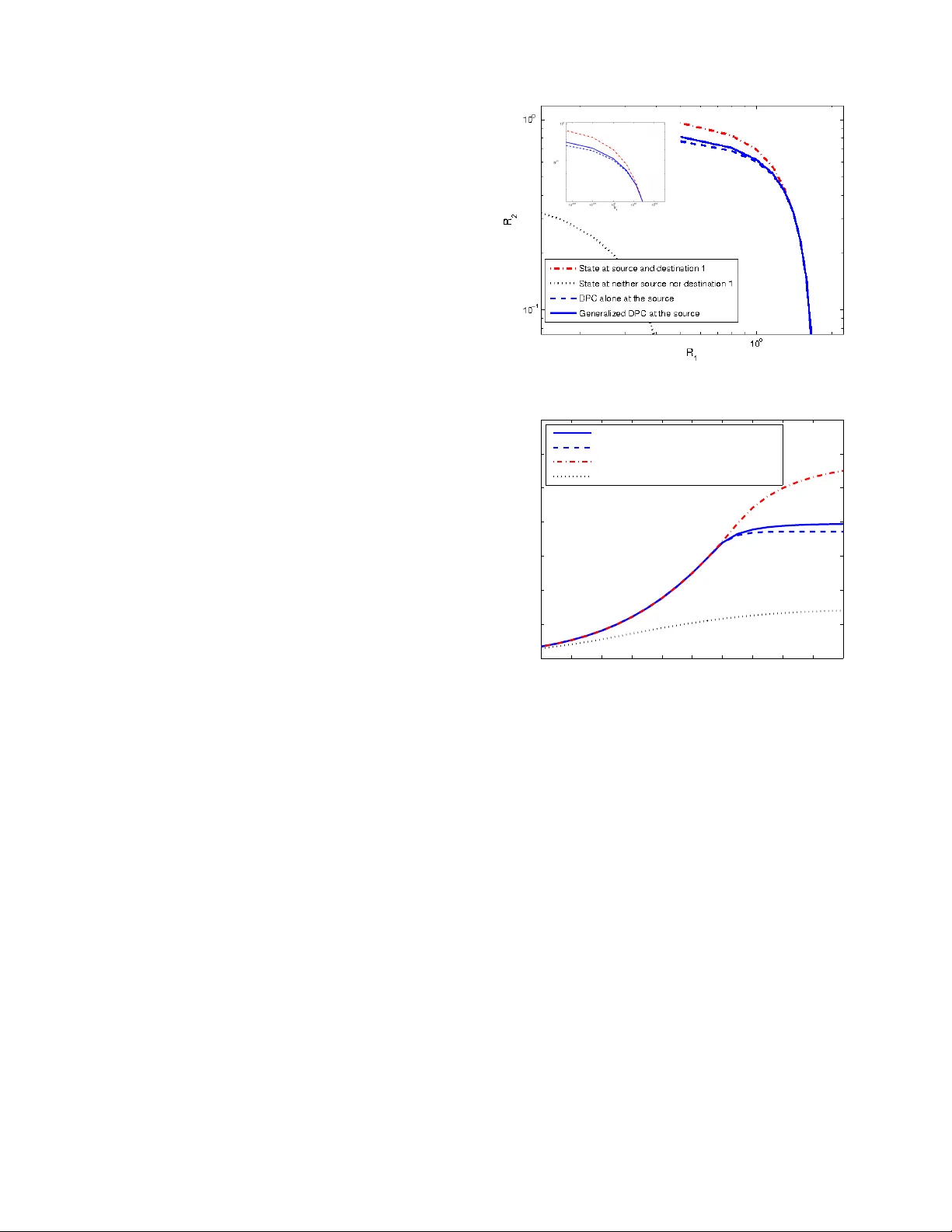
Rate Re gions for the P artiall y-Coop erati v e Relay Broadcast Channel with Non-causal Side Information Abdellatif Zaidi Communica tion and Remote Sensing Lab. (TELE) Universit ´ e Catholiqu e de Lou vain Louvain-La-Neu ve, 1348, Belgium Email: Abdellatif.Z aidi@ensta.org Luc V andend orpe Communica tion and Remote Sensing Lab . (TELE) Universit ´ e Catho lique de L ouvain Louvain-La-Neu ve, 1348, Belgium Email: Luc.V andendo rpe@tele.ucl.ac. be Abstract — In this work, we consider a p artially coopera tive relay b roa dcast channel (PC-RBC) controlled b y random pa- rameters. W e provide rate regions for two diff erent situ ations: 1) when sid e information (SI) S n on th e random parameters is non-causally known at both th e source and th e relay and, 2) when side information S n is non-causally known at the source only . These achieva ble regions are deriv ed for the general discrete memoryless case first and t hen extended to the case when the channel is degraded Gaussian and the SI i s additive i.i.d. Gaussian. In thi s case, the source uses generalized dirty paper coding (GDPC), i.e., DPC combined wi th p artial state cancellation, when onl y the source is informed, and DPC alone when both the source and th e relay are informed. It appears that, ev en though it can not completely eliminate the effect of th e SI (in contrast to the case of sourc e and relay being informed), GDPC is p articularly useful when only the source is informed. I . I N T R O D U C T I O N A thr ee-node r elay bro adcast channel (RBC) is a comm uni- cation network where a sou rce node transmits both com mon informa tion and pr i vate informa tion sets to two destination nodes, d estination 1 a nd d estination 2 , that co operate by exchanging infor mation. This may model ”d ownlink” commu- nication systems that exploit relayin g and user co operation to improve reliability and through put. In this work , we co nsider the RBC in which only on e of the two destination s (e.g., destination 1 ) assists the oth er d estination. Th is ch annel is referred to as partially coop erative RBC (PC-RBC) [1], [2]. Moreover , we assume that the ch annel is con trolled by r andom parameters and that side in formation S n on these r andom parameters is non -causally known either at both the sourc e and destination 1 (i.e., th e relay ) ( we refer to this situation as PC- RBC with info rmed sour ce and r elay ) o r at the sou rce only (we refer to this situatio n as PC-RBC with informed so ur ce o nly ). The ran dom state may rep resent random fading, interf erence imposed by other users, etc. (see [3] for a c omprehe nsi ve overview on state-depen dent channels). The PC-RBC u nder in vestigation is shown in Fig. 1. I t includes th e standard r elay channel (RC) as a special case, when no pr i vate infor mation is sent to d estination 1 , which the n simply acts as relay fo r destination 2 . For the discre te m emoryless PC-RBC with inf ormed sou rce P S f r a g r e p l a c e m e n t s Tx Rx 2 Relay A B Rx 1 ( W 0 , W 1 , W 2 ) Y 1 X 2 X 1 Y 2 S n S n & p ( y 1 , y 2 | x 1 , x 2 , s ) ( ˆ W 0 , ˆ W 2 ) Fig. 1. Parti ally-coope rati ve relay broadc ast channel (PC-RBC) with state informati on S n non-causa lly known either at both the source and the relay (A) or at the source only (B). and relay (Section II), we de riv e an achiev able rate region based on the relay operatin g in the de code-fo rward (DF) scheme. W e also show that this region is tigh t and pr ovides the full capacity region when the channel outputs are corrupted by degraded Gaussian no ise terms and the SI S n is additive i.i.d. Ga ussian (refer red to as D-A WGN p artially cooperative RBC ). Similarly to [4], [5], it ap pears that, in this ca se, the SI does n ot affect th e capacity region, ev en thoug h destination 2 h as n o knowledge of the state. The result o n the pr operty that a kn own additive state do es no t affect capa city ( as long as full knowledge o f this state is available at the transmitter) has been initially established for single-user G aussian chann el in [4], an d th en extended to some other multi-u ser Gaussian channels in [5]. For t he PC-RBC with info rmed source only (Section III), we derive achiev able r ate r egions fo r the discrete memo ryless an d the D- A WGN memor yless cases, b ased on the relay operating in DF . Th e D-A WGN case uses gener alized dirty p aper cod ing (GDPC), which allo ws arbitr ary (ne gative) correlation between codewords an d the SI, at the source. In this case, we show that, even thoug h the r elay is un informed , it benefits from the av ailability of the SI a t the source, which then h elps the r elay by allo cating a fraction of its p ower to cancel the state, an d uses the rem aining of its power to tran smit pure informa tion u sing DPC. Howev er, even thoug h this region is larger than that o btained b y DPC alon e (i.e. , witho ut pa rtial state cancellation) , the ef fect of the state can n ot be completely canceled as in the c ase when both th e sou rce and the re lay are informe d. The results in this paper readily apply to the standard relay channel (RC), as a special case of a PC-RBC when no private informa tion is sent to de stination 1 . M ore gener ally , they shed light on co operation b etween in formed and unin formed nodes and can in principle be extended to chann els with m any cooper ating nodes, with o nly a subset of them b eing info rmed. Section I V g iv es a n illustrative numer ical example. Section VI draw some conclu ding remark s. Proof s are relegated to Section VI. I I . P A RT I A L LY - C O O P E R A T I V E R B C W I T H I N F O R M E D S O U R C E A N D R E L A Y Consider the channe l model for the discrete memory- less PC-RBC with inf ormed source an d relay d enoted by { X 1 × X 2 , p ( y 1 , y 2 | x 1 , x 2 , s ) , Y 1 × Y 2 , S } and depicted in Fig.1. It consists of a sou rce with input X 1 , a relay with input X 2 , a state-depende nt probab ility distribution p ( y 1 , y 2 | x 1 , x 2 , s ) and two channel ou tputs Y 1 and Y 2 at de s- tinations 1 (the relay ) and 2 , respectively . The so urce send s a common me ssage W 0 that is decod ed by bo th destinations a nd priv ate messages W 1 and W 2 that are deco ded b y destinations 1 and 2 , respectively . In th is section, we consider th e scenario in which the PC- RBC is embed ded in some environment with SI S n av ailable non-ca usally at both the source and th e relay . W e assume that S i ’ s are i.i.d. ra ndom variables ∼ p ( s ) , i = 1 , . . . , n , and that the chann el is memory less. A. Inner boun d on capa city r e gion The following L emma gives an inn er bou nd on capacity region for the PC-RBC with informed sour ce and relay , b ased on the relay opera ting in the decode-and- forward (DF) scheme. Lemma 1: For a discrete m emoryless partially cooperative relay broadcast ch annel p ( y 1 , y 2 | x 1 , x 2 , s ) with state informa- tion S n non-ca usally av ailable at the sourc e and destina tion 1 ( which also acts as a relay fo r destina tion 2 ) but n ot at destination 2 , a rate tuple ( R 0 , R 1 , R 2 ) is achiev able if R 1 < I ( X 1 ; Y 1 | S U 1 X 2 ) , R 0 + R 2 < min n I ( U 2 ; Y 1 | S U 1 ) , I ( U 1 U 2 ; Y 2 ) − I ( U 1 U 2 ; S ) o , (1) for some joint d istribution of the fo rm p ( s ) p ( u 1 , u 2 , x 1 , x 2 | s ) p ( y 1 | x 1 , x 2 , s ) p ( y 2 | y 1 , x 2 ) , where U 1 and U 2 are auxiliar y ran dom variables with finite cardinality bound s. The proo f is similar to tha t, gi ven in Section V, for Lemma 2 (see below). Howe ver , it is more lengthy . W e omitted it here for brevity . B. D-A WGN P artially Cooperative RBC W e now assume that the state is add iti ve i.i.d. Gau ssian. Furthermo re, we assume that the chan nel outputs are corrupted by degrad ed Gaussian n oise terms. W e refer to th is chann el as the D -A WGN PC-RBC with in formed sou rce a nd relay , meaning that there exist rand om v ariab le Z 1 ∼ N (0 , N 1 ) and Z ′ 2 ∼ N (0 , N 2 − N 1 ) with N 1 < N 2 , independ ent o f each other an d independ ent of th e state S n , such that Y 1 = X 1 + S + Z 1 , Y 2 = Y 1 + X 2 + Z ′ 2 . (2) The chan nel input sequences { x 1 ,n } an d { x 2 ,n } ar e subject to power constraints P 1 and P 2 , respectively , i.e., P n i =1 x 2 1 i ≤ nP 1 and P n i =1 x 2 2 i ≤ nP 2 ; and th e state S n is distributed accordin g to N (0 , QI ) . The D-A WGN PC-RBC with no state has bee n introdu ced and studied in [1]. It has been shown th at its capacity r egion is giv en by the re gion with the rate tuple s ( R 0 , R 1 , R 2 ) satisfying [1] R 1 < C γ P 1 N 1 (3a) R 0 + R 2 < max β min C ( β ¯ γ P 1 γ P 1 + N 1 ) , C ¯ γ P 1 + P 2 + 2 p ¯ β ¯ γ P 1 P 2 γ P 1 + N 2 , (3b) for som e γ ∈ [0 , 1] , wh ere ¯ γ = 1 − γ , ¯ β = 1 − β and C ( x ) := 0 . 5 lo g 2 (1 + x ) . W e now turn to the case whe n there is an additive i.i. d. SI S n which is no n-causally known to bo th the source and destination 1 (th e relay ) but n ot to destination 2 . W e obtain the follo wing result, s imilar in nature (an d in p roof) to that provided for a phy sically degraded Gaussian RC in [5 , Theorem 3]. Theor em 1: The capacity region of the D- A WGN Partially Cooperative Relay Broadcast Ch annel with state in formatio n non-ca usally available at the source, destina tion 1 ( the relay) but not destination 2 is given by the standard capacity (3). Pr oof: Similarly to Costa’ s app roach [4 ], we need only prove the achievability of th e region , which follows by ev aluating the region (1) with the input distribution g i ven by (4). N ote that region (1) has b een established for the discrete memoryless case b ut it can be extended to memoryless channels with d iscrete time an d co ntinuou s alp habets using standard tec hniques [6 ]. The choice o f p ( u 1 , u 2 , x 1 , x 2 | s ) is giv en by U 1 ∼ N ( α 1 S, P (1) ) , U 2 ∼ N ( α 2 S, P (2) ) (4a) X 2 = (1 − λ )( U 1 − α 1 S ) , λ = p ¯ β ¯ αP 1 √ P (1) , (4b) X ′ 1 ∼ N (0 , γ P 1 ) , (4c) X 1 = λ ( U 1 − α 1 S ) + ( U 2 − α 2 S ) + X ′ 1 , (4d) where P (1) = ( p ¯ β ¯ αP 1 + √ P 2 ) 2 , P (2) = β ¯ α P 1 and α k = P ( k ) P (1) + P (2) + ( αP 1 + N 2 ) , k = 1 , 2 . Furthermo re, we let X ′ 1 be indep endent of U 1 , U 2 and the state S . A (more intuitiv e) alternativ e approach is as follo ws. The source uses super position cod ing to send the info rmation in- tended for d estination 1 , on top of that intended for d estination 2 ( and carried th rough the relay). W e dec ompose the sou rce input X 1 into two pa rts, X ′ 1 with power αP 1 (stands for the informa tion intended fo r destination 1 ), and U with power ¯ αP 1 (stands f or the inform ation in tended f or destination 2 ), i.e., X 1 = X ′ 1 + U . For the transmission of U , bo th the source and destina tion 1 know the state S n and coope rate over a relay channel (co nsidering X ′ 1 as noise) to ach iev e the ra te (3b) [5 ]. Next, to deco de its own message, destinatio n 1 first peals S and U to make the chann el Y 1 equiv alent to Y ′ 1 = X ′ 1 + Z 1 . This gives us the ra te (3a) fo r m essage W 1 . I I I . P A RT I A L LY - C O O P E R AT I V E R B C W I T H I N F O R M E D S O U R C E O N LY In th is section , w e assume that only the source non-cau sally knows the SI S n . A. Discr ete memoryless PC-RBC The following L emma gives an inn er bou nd on capacity region for the PC-RBC with info rmed so urce only . Th e result is based on the relay operating in th e DF scheme. Lemma 2: For a discrete m emoryless partially cooperative relay broadcast ch annel p ( y 1 , y 2 | x 1 , x 2 , s ) with state informa- tion S n non-ca usally av ailable a t the sour ce only , a ra te tuple ( R 0 , R 1 , R 2 ) is achiev able if R 1 < I ( U 1 ; Y 1 | U 2 X 2 ) − I ( U 1 ; S | U 2 X 2 ) R 0 + R 2 < min n I ( U 2 ; Y 1 | X 2 ) − I ( U 2 ; S | X 2 ) , I ( U 2 X 2 ; Y 2 ) − I ( U 2 ; S | X 2 ) o , (5) for some joint d istribution of the fo rm p ( s ) p ( u 1 , u 2 , x 1 , x 2 | s ) p ( y 1 | x 1 , x 2 , s ) p ( y 2 | y 1 , x 2 ) , where U 1 and U 2 are auxiliar y ran dom variables with finite cardinality bound s. The p roof is based on a comb ination of slidin g-window [7], [8 ], superp osition-cod ing [9] an d Gelfand and Pinsker’ s binning [10]. See Section VI for an outline of it. B. D-A WGN P artially Coo perative RBC Assume now that th e PC-RBC with info rmed source on ly is degraded Gau ssian,i.e., th e ch annel o utputs ca n be w ritten as Y 1 = X 1 + S + Z 1 , Y 2 = Y 1 + X 2 + Z ′ 2 , (6) where Z 1 ∼ N (0 , N 1 ) and Z ′ 2 ∼ N (0 , N 2 − N 1 ) , with N 1 < N 2 , are indepen dent of each other and indep endent of the state S n ∼ N (0 , QI ) ; and the in put seque nces { x 1 ,n } and { x 2 ,n } ar e subject to a verage p ower con straints P 1 and P 2 , respectively . W e obtain an inner boun d on capacity region by having the source using a gen eralized dir ty p aper cod ing (GDPC), which allows arb itrary (negative) correlation between th e codeword and the SI and can be v ie wed as a partial state can cellation [11]. Definition 1: Let Q ′ ( γ , ρ ) := ( p Q − p ρ ¯ γ P 1 ) 2 , A ( γ , ρ, β , α ) := (1 − β 2 ) ¯ ρ ¯ γ P 1 (1 − β 2 ) ¯ ρ ¯ γ P 1 + Q ′ ( γ , ρ ) + γ P 1 + N 1 , B ( γ , ρ, β , α ) := (1 − α ) 2 (1 − β 2 ) ¯ ρ ¯ γ P 1 Q ′ ( γ , ρ ) + ( N 1 + γ P 1 ) (1 − β 2 ) ¯ ρ ¯ γ P 1 + α 2 Q ′ ( γ , ρ ) , C ( γ , ρ, β , α ) := (1 − β 2 ) ¯ ρ ¯ γ P 1 ¯ ρ ¯ γ P 1 + P 2 + Q ′ ( γ , ρ ) + 2 β p ¯ ρ ¯ γ P 1 P 2 + γ P 1 + N 2 , D ( γ , ρ, β , α ) := (1 − α ) 2 (1 − β 2 ) ¯ ρ ¯ γ P 1 Q ′ ( γ , ρ ) + ( N 2 + γ P 1 ) (1 − β 2 ) ¯ ρ ¯ γ P 1 + α 2 Q ′ ( γ , ρ ) , r 1 ( γ , ρ, β , α ) := 1 2 log 2 A ( γ , ρ, β , α ) B ( γ , ρ, β , α ) , r 2 ( γ , ρ, β , α ) := 1 2 log 2 C ( γ , ρ, β , α ) D ( γ , ρ, β , α ) , for giv en 0 ≤ γ ≤ 1 , 0 ≤ ρ ≤ min { 1 , Q ¯ γ P 1 } , 0 ≤ β ≤ 1 , 0 ≤ α ≤ 1 and wher e ¯ γ = 1 − γ and ¯ ρ = 1 − ρ . The following th eorem gives an inner bou nd on capacity region f or D- A WGN partially coopera ti ve RBC with in formed source only . Theor em 2: Let R in ( γ ) be the set of all rate tuples ( R 0 , R 1 , R 2 ) satisfying R 1 ≤ 1 2 log 2 (1 + γ P 1 N 1 ) (7a) R 0 + R 2 ≤ max α 2 ,β ,ρ min n r 1 ( γ , ρ, β , α 2 ) , r 2 ( γ , ρ, β , α 2 ) o , (7b) for som e 0 ≤ γ ≤ 1 , wh ere maximization is over 0 ≤ ρ ≤ min { 1 , Q ¯ γ P 1 } , 0 ≤ α 2 ≤ 1 and 0 ≤ β ≤ 1 . Th en, R in ( γ ) is contained in capacity r egion of th e D-A WGN PC-RBC (6), where state in formation S n is non-cau sally av ailable at the source only . Pr oof: The source uses a comb ination of superpo sition coding and gene ralized DPC. More specifically , we deco mpose the so urce input X 1 as X 1 = X ′ 1 + U, (8a) U = − s ρ ¯ γ P 1 Q S + U w , (8b) where X ′ 1 (of power γ P 1 ), U w (of power ¯ ρ ¯ γ P 1 ) and S are indepen dent, and E [ U w X 2 ] = β √ ¯ ρ ¯ γ P 1 P 2 . W ith this cho ice of input signals, c hannels Y 1 and Y 2 in (6) b ecome Y ′ 1 = X ′ 1 + U w + S ′ + Z 1 (9a) Y ′ 2 = U w + X 2 + S ′ + X ′ 1 + Z 1 + Z ′ 2 , (9b) where the Gau ssian state S ′ = (1 − q ρ ¯ γ P 1 Q ) S is known to the source an d has power Q ′ ( ρ, γ ) = ( √ Q − √ ρ ¯ γ P 1 ) 2 . Then, giv en tha t the result of Lemm a 2 which has b een established for the d iscrete m emoryless case can be extended to mem oryless channe ls with discrete time an d con tinuous alphabets using stand ard tec hniques [6], th e p roof o f ac hiev- ability fo llows by evaluating the region (5) (in wh ich Y 1 , Y 2 and S are replaced by Y ′ 1 , Y ′ 2 and S ′ , respectively) with the following choice of input distribution: U 1 ∼ N ( α 1 (1 − α 2 ) S ′ , γ P 1 ) , (10a) U 2 ∼ N ( α 2 S ′ , ¯ ρ ¯ γ P 1 ) , (10b) X 2 ∼ N (0 , P 2 ) , (10c) X 1 = U 1 + U 2 − ( α 1 + α 2 − α 1 α 2 + √ ρ ¯ γ P 1 √ Q − √ ρ ¯ γ P 1 ) S ′ , (10d) where α 1 = γ P 1 / ( γ P 1 + N 1 ) and 0 ≤ α 2 ≤ 1 . Furtherm ore, we let E [ U w X 2 ] = β √ ¯ ρ ¯ γ P 1 P 2 and choo se X ′ 1 , X 2 and S ′ to be inde pendent. Thro ugh straight algebra which is o mitted for brevity , it can be shown that (10) ac hiev e the rates in (7) to complete the proof . The intuition for (10) is as follows. Consider the ch annel (9). Th e source allo cates a f raction γ P 1 of its power to send message W 1 (input X ′ 1 ) to destinatio n 1 and the r emaining power , ¯ γ P 1 , to sen d message W 2 (input U ) to destination 2 , throug h the r elay . Howe ver , sinc e the relay do es not kn ow the state S n , the source allocates a fraction ρ ( 0 ≤ ρ ≤ min { 1 , Q ¯ γ P 1 } ) of the power ¯ γ P 1 to cancel the state so tha t the relay can b enefit from this cancellation . Th en, it uses the remain ing power , ¯ ρ ¯ γ P 1 , fo r pure in formation transmission (input U w ). For the transmission of message W 2 to d estination 2 , we treat the interfer ence X ′ 1 combined with the channel noise Z 1 + Z ′ 2 as a n unknown Gaussian no ise. Hence, the sou rce uses a DPC U 2 ∼ N ( α 2 S ′ , ¯ ρ ¯ γ P 1 ) , (11a) U w = U 2 − α 2 S ′ . (11b) Furthermo re, the relay can de code U 2 = U w + α 2 S ′ and p eal it of to make the ch annel to the rela y eq uiv alent to Y ′ 1 = Y 1 − U 2 = X ′ 1 + (1 − α 2 ) S ′ + Z 1 . (12) Thus, for the transmission of message W 1 to destination 1 , the source uses another D PC U 1 ∼ N ( α 1 (1 − α 2 ) S ′ , γ P 1 ) , (13a) X ′ 1 = U 1 − α 1 (1 − α 2 ) S ′ , (13b) where (1 − α 2 ) S ′ is the known state a nd α 1 = γ P 1 / ( γ P 1 + N 1 ) . This g i ves u s the rate 1 2 log 2 (1 + γ P 1 N 1 ) for rate R 1 . Remark 1 : Here, we hav e used in essence tw o superimposed DPCs, with one of them bein g generalized . The first ap proach which su ggests itself and which consists in using two stand ard (not generalized) DPCs corresp onds to the special c ase o f ρ = 0 . Also, note tha t, f or the GDPC, ther e is n o loss in restricting the correlation (between the so urce in put U and the state S ) to h av e the form in (8b), in this case. Remark 2 : A straightf orward o uter bound f or the capacity region of the D- A WGN pa rtially-coop erativ e RBC with only the sour ce being informed is gi ven by (3), for this is th e capacity regio n of the D- A WGN PC-RBC without state o r with state known everywhere. Remark 3 : The r esults of Lemmas 1 an d 2 and Theo rems 1 and 2 specialize to the relay ch annel (RC), b y letting destination 1 de code no priv ate message (i.e., R 1 =0). For the case of a RC with informed source and relay , this g iv es us th e achiev ability o f th e rate R = max p ( u 1 ,u 2 ,x 1 ,x 2 | s ) min n I ( U 1 ; Y 1 | S U 2 ) , I ( U 1 U 2 ; Y 2 ) − I ( U 1 U 2 ; S ) o . (14) Note th at, even th ought this rate is in gene ral smaller than the one given in [5, Lemma 3 ] (in wh ich I ( U 1 ; Y 1 | S X 2 ) is used instead of I ( U 1 ; Y 1 | S U 2 ) in (1 4)), th e two rates coin cide in the Gaussian (no t necessarily physically degrade d) case. T o see that, note th at in th e Gaussian c ase, X 2 is a linear co mbination of U 2 and S [ 4], an d hence I ( U 2 S ; Y 1 ) = I ( X 2 S ; Y 1 ) . Then, writing I ( U 1 U 2 S X 2 ; Y 1 ) = I ( X 2 S ; Y 1 ) + I ( U 1 ; Y 1 | S X 2 ) + I ( U 2 ; Y 1 | S X 2 U 1 ) , = I ( U 2 S ; Y 1 ) + I ( U 1 ; Y 1 | S U 2 ) + I ( X 2 ; Y 1 | S U 1 U 2 ) , and noticin g that I ( X 2 ; Y 1 | S U 1 U 2 ) = 0 (sinc e p X 2 | U 2 S = 0 , 1 ) and I ( U 2 ; Y 1 | S X 2 U 1 ) = 0 (since ( U 1 , U 2 ) ⊖ ( X 1 , X 2 , S ) ⊖ ( Y 1 , Y 2 ) forms a Markov chain under the specified distribution in ( 14)), we get I ( U 1 ; Y 1 | S X 2 ) = I ( U 1 ; Y 1 | S U 2 ) . I V . N U M E R I C A L E X A M P L E This section illustrates the a chiev able rate regions for D- A WGN PC-RBC and physically degrad ed Gaussian RC, with the help of an example. W e illu strate the effect o f applyin g GDPC in imp roving the throu ghput whe n only the source is informe d. Fig.2 depicts the inner bou nd using g eneralized DPC in Theorem 2. Also shown for compar ison are: a n inner bo und using DPC a lone ( i.e., GDPC with ρ = 0 ) a nd a n o uter b ound, obtained by assuming both the source and the relay being informe d. Rate curves ar e depicted for both D-A WGN PC- RBC and p hysically d egraded Gaussian RC. W e see that even though th e state is known on ly at the source, both the sou rce and the r elay benefit. For th e physically d egraded Gau ssian RC, the improvement is mainly visible at high SNR = P 1 / N 1 [dB]. This is because, the relay being ope rating in DF , coop eration between the source an d the relay is m or e efficient a t h igh SNR. In such range of SNR, ca pacity of the degrad ed Gaussian RC is driven by the am ount of info rmation that the source an d the relay can, to gether, transfer to the d estination (given by the term I ( X 1 X 2 ; Y 2 ) in the capa city of the degraded RC). At small SNR however , cap acity of the degraded Gaussian RC is constrained b y the b roadcast bottlen eck (term I ( X 1 ; Y 2 | X 2 ) ). Hence, in such range of SNR, ther e is no need for the so urce to assist the relay by (partially) cancelling the state for it (since th is would be accom plished at the cost of th e power that can be alloc ated to transmit inform ation fr om the sou rce to the relay) . An alternative inte rpretation is as f ollows. At high SNR, the source and th e r elay fo rm two fictitiou s user s (with only one of them being inform ed) s end ing information to same destinatio n, over a MAC . The sum rate over this MAC is more enlarged (b y the use of GDPC) at high SNR. This interpretatio n conform s with the result in [1 1] for a MAC with only on e info rmed encoder . Howe ver , note this interpr etation deviates from [11], in that the fictitious MAC con sidered here has correlated inputs). For the D-A WGN PC-RBC, we see that both destination 1 and destination 2 benefits from using GDPC at the source. This can be easily un derstood as follows. Since app lying GDPC at the source improves rate R 2 for destination 2 (w .r .t. using DPC alone), the sour ce n eeds lesser power , for the same amo unt of informa tion to b e transm itted to destination 2 (i.e., for the same R 2 ). Hence, the power put aside can be used to increase rate R 1 (see the zoom on the to p lef t of Fig . 2(a)). V . C O N C L U D I N G R E M A R K S In many practical comm unication system s th at exploit no de cooper ation to incre ase throug hput or impr ove reliab ility , dif- ferent (possibly n ot co -located) co operating no des r arely have access to the same state information (SI) about the channel (in- terference , fadin g, etc.). In this case, a mor e gen eral app roach to ad dress node cooperatio n in such chann els is to co nsider different SI at the different n odes. Also, as these n odes rarely have the ability to measur e d irectly , or estimate, the chan nel state, a more in volved appro ach would b e to acco unt f or the cost of co n veying SI (e.g ., b y a third party) to the different nodes (as alread y do ne for MA C, in [12 ]). In th is paper, we have co nsidered th e basic three- node network in wh ich two nodes transmit infor mation over a partially coo perative relay broadc ast channel (PC-RBC). W e in vestigated two different situations: when both the sour ce and th e relay non- causally know the ch annel state a nd, when only the sou rce k nows the state. One impo rtant findin g in the latter case is that, in th e degraded Gaussian case, the source can still h elp the relay (which suffers from th e in terfering chann el state) , by using generalized dirty paper cod ing (GDPC),i.e ., DPC co mbined with partial state cancellation. V I . O U T L I N E O F P R O O F F O R L E M M A 2 In the following, we den ote the set o f strongly jo intly ǫ - typical sequences (see [13 , Chapter 14. 2]) with distribution (a) D-A W GN Partiall y Cooperati v e RBC −10 −8 −6 −4 −2 0 2 4 6 8 10 0 0.2 0.4 0.6 0.8 1 1.2 1.4 P 1 /N 1 [dB] Rate R Generalized DPC at the source DPC alone at the source State at both source and relay State at neither source nor relay (b) Physically Degrade d Gaussian Relay Channel Fig. 2. Achie va ble rate regi ons for D-A WGN PC-RBC and physically degra ded Gaussian RC. (a) P 1 = P 2 = 1 = Q , N 1 = 10 N 2 = 1 . (b) P 1 = P 2 = 1 , Q = 2 , N 2 = 1 . p ( x, y ) as T n ǫ [ x , y ] . W e define T n ǫ [ x , y | x n ] as T n ǫ [ x , y | x n ] = { y n : ( x n , y n ) ∈ T n ǫ [ x , y ] } . (16) Note th at it suffices to pr ove th e result for the case witho ut common m essage (i. e. R 0 = 0 ) . Th is is because o ne ca n v ie w part of the rate R 2 to be comm on rate R 0 , since destinatio n 1 a lso decodes message W 2 . W e assume th at the sou rce uses a com bination of superpo- sition cod ing [13, Chapter 1 4.6] and Gelfand and Pinsker’ s binning [1 0]. W e adopt the regular enco ding/sliding window decodin g strategy [ 8] for the deco de-and -forward sch eme. Decoding is based on a co mbination of joint typ icality and sliding-wind ow . W e c onsider a tran smission over B blo cks, each with len gth n . A e ach of the first B − 1 blocks, a pair of messages ( w 1 ,i , w 2 ,i ) ∈ W 1 × W 2 is sent, where i denotes the index of the b lock, i = 1 , . . . , B − 1 . For fixed n , the r ate pair ( R 1 B − 1 B , R 2 B − 1 B ) a pproach es ( R 1 , R 2 ) a s B − → + ∞ . W e use rando m codes for the proof . Fix a joint probability distrib ution of U 1 , U 2 , X 1 , X 2 , S, Y 1 , Y 2 of the form p ( s ) p ( u 1 , u 2 , x 1 , x 2 | s ) p ( y 1 | x 1 , x 2 , s ) p ( y 2 | y 1 , x 2 ) , where U 1 and U 2 are two au xiliary ran dom variables with bound ed alphabet cardinality which stand for the inform ation being carried by the source input X 1 and in tended for d esti- nation 1 and destination 2 , respectively . Fix ǫ > 0 . L et J 1 , 2 n ( I ( U 1 ; S | U 2 X 2 )+2 ǫ ) , J 2 , 2 n ( I ( U 2 ; S | X 2 )+2 ǫ ) , M 1 , 2 n ( R 1 − 4 ǫ ) , M 2 , 2 n ( R 2 − 6 ǫ ) . Rando m codeb ook g eneration: W e generate two statistically indepen dent codebo oks (co debook s 1 an d 2 ) by following the steps outlined belo w twice. Th ese code books will be u sed for b locks with odd and ev en indices, r espectiv ely (see the encodin g step). 1. Ge nerate M 2 i.i.d. c odew or ds x 2 ( w ′′ ) , o f leng th n each, indexed by w ′′ ∈ { 1 , 2 , . . . , M 2 } , a nd e ach with distribution Π i p ( x 2 i ) . 2. For each x 2 ( w ′′ ) , gener ate a c ollection b ( x 2 ( w ′′ )) of u 2 -vectors b x 2 ( w ′′ ) = n u 2 j 2 ,w ′ ( x 2 ( w ′′ )) , j 2 ∈ { 1 , 2 , · · · , J 2 } , w ′ ∈ { 1 , 2 , · · · , M 2 } o indepen dently of each other , each with d istribution Π i p ( u 2 i | x 2 i ( w ′′ )) . 3. For each x 2 ( w ′′ ) , fo r each u 2 j 2 ,w ′ ( x 2 ( w ′′ )) , gen erate a collection a of u 1 -vectors a x 2 ( w ′′ ) , u 2 j 2 ,w ′ ( x 2 ( w ′′ )) = n u 1 j 1 ,w ( u 2 j 2 ,w ′ ( x 2 ( w ′′ ))) , j 1 ∈ { 1 , 2 , · · · , J 1 } , w ∈ { 1 , 2 , · · · , M 1 } o indepen dently of each other , each with d istribution Π i p ( u 1 i | u 2 i ( j 2 , w ′ ) , x 2 i ( w ′′ )) . Re veal the collections a and b an d the seq uences { x 2 } to the source an d desti- nations 1 a nd 2 . Encodin g: W e encode messages usin g codebo oks 1 a nd 2 , r espectiv ely , for blo cks with odd and even indices. Usin g indepen dent codebo oks fo r blocks with odd and even ind ices makes the error ev ents correspo nding to these bloc ks ind e- penden t and hence, the correspon ding prob abilities easier to ev aluate. At the beginning of block i , let ( w 1 ,i , w 2 ,i ) be the n ew message pair to be sent from the source and ( w 1 ,i − 1 , w 2 ,i − 1 ) be the pair sent in th e previous b lock i − 1 . Assume that at the beginning of block i , the r elay has d ecoded w 2 ,i − 1 correctly . The relay send s x 2 ( w 2 ,i − 1 ) . Given a state vector s = s n , let j 2 ( s , w 2 ,i − 1 , w 2 ,i ) be the smallest in teger j 2 such that u 2 j 2 ,w 2 ,i ( x 2 ( w 2 ,i − 1 )) ∈ T n ǫ [ u 2 , x 2 , s | x n 2 ] . (17) If such j 2 does not exist, set j 2 ( s , w 2 ,i − 1 , w 2 ,i ) = J 2 . Sometimes, we will use j ⋆ 2 as sho rthand for the chosen j 2 . Let j 1 ( s , w 2 ,i − 1 , w 2 ,i , w 1 ,i ) be the smallest integer j 1 such that u 1 j 1 ,w 1 ,i ( u 2 j ⋆ 2 ,w 2 ,i ( x 2 ( w 2 ,i − 1 ))) , s ∈ T n ǫ [ u 1 , u 2 , x 2 , s | u n 2 , x n 2 ] . (18) If such j 1 does not exist, set j 1 ( s , w 2 ,i − 1 , w 2 ,i , w 1 ,i ) = J 1 . Sometimes, we will u se j ⋆ 1 as shorthan d f or the chosen j 1 . Finally , gener ate a vector of input letters x 1 ∈ X n 1 accordin g to th e memory less distribution defin ed by the n − p roduct of Π i p ( x 1 i | u 1 i ( u 2 ( x 2 )) , u 2 i ( x 2 ) , s i ) (19) Decoding : T he deco ding pr ocedures at the end of block i are as f ollows. 1. d estination 1 , having known w 2 ,i − 1 , de clares that ˆ w 2 ,i is sent if there is a u nique ˆ w 2 ,i such that u 2 j 2 , ˆ w 2 ,i ( x 2 ( w 2 ,i − 1 )) , y 1 ( i ) ∈ T n ǫ [ u 2 , x 2 , y 1 ( i ) | x n 2 ] . It can be shown that th e decodin g error in this step is small for sufficiently large n if R 2 < I ( U 2 ; Y 1 | X 2 ) − I ( U 2 ; S | X 2 ) . (20) 2. d estination 1 , having known w 2 ,i − 1 and w 2 ,i , declares that the message ˆ w 1 ,i is sent if th ere is a un ique ˆ w 1 ,i such that u 1 j 1 , ˆ w 1 ,i ( u 2 j 2 , ˆ w 2 ,i ( x 2 ( w 2 ,i − 1 ))) , y 1 ( i ) ∈ T n ǫ [ u 1 , u 2 , x 2 , y 1 ( i ) | x n 2 , u n 2 ] . It can be shown that th e decodin g error in this step is small for sufficiently large n if R 1 < I ( U 1 ; Y 1 | U 2 X 2 ) − I ( U 1 ; S | U 2 X 2 ) . (21) 3. De stination 2 knows w 2 ,i − 2 and decod es w 2 ,i − 1 based on the in formation r eceiv ed in block i − 1 and block i . It declar es that th e message ˆ w 2 ,i − 1 is sent if ther e is a unique ˆ w 2 ,i − 1 such that x 2 ( ˆ w 2 ,i − 1 ) , y 2 ( i ) ∈ T n ǫ [ x 2 , y 2 ] , u 2 j 2 , ˆ w 2 ,i − 1 ( x 2 ( w 2 ,i − 2 )) , y 2 ( i − 1 ) ∈ T n ǫ [ u 2 , x 2 , y 2 | x n 2 ] . It can be shown that th e decodin g error in this step is small for sufficiently large n if R 2 < I ( U 2 X 2 ; Y 2 ) − I ( U 2 ; S | X 2 ) . (23) R E F E R E N C E S [1] Y . L iang and V . V . V eera val li, “Cooperati ve relay broadcast chan- nels, ” Submitt ed to IEE E T rans. on Inf o. Theory; availabl e at http:// www .arxi v .or g/PS-cach e/cs/pdf/0605/0605016.pdf , July 2005. [2] Y . L iang and G. Kramer , “Rate regions for relay broadcast channels, ” Submitte d to IEEE Tr ans. on Info. Theory; , June 2006. [3] E. Bigli eri, J. Proakis, and S. Shamai, “F ading channels: Information- theoret ic and communicat ion aspect s, ” IEEE T rans. on Info. Theory , vol. 44, pp. 2619–2692, Oct. 1998. [4] M. H. M. Costa, “Writ ing on dirty paper , ” IEEE Tr ans. on Info. Theory , vol. 29, pp. 439–441, may 1983. [5] Y .-H. Kim, A. Suti von g, and S. Sigurj onsson, “Multiple user writing on dirty paper , ” in Proc. ISIT 2004 , Chicago-USA, June 2004, p. 534. [6] R. G. Gall ager , Information Theory and Reliable Communi cation . Ne w Y ork: J ohn Will ey , 1968. [7] R. C. King, Mul tiple access channe ls with ge neralized feedba ck . Sta n- ford, CA: Ph.D. dissertation, Stanford Univ ., May 1978. [8] A. B. Carlei al, “Multiple -access channe ls with diff erent genera lized feedbac k signals, ” IEEE T rans. on Info. Theory , vol. IT -28, pp. 841– 850, Nov ember 1982. [9] T . M. Cover , “Broadc ast channels, ” IEEE T rans. on Info. Theory , vol. IT -18, pp. 2–14, Junuary 1972. [10] S. I. G el’f and and M. S. Pinsker , “Coding for channel with random paramete rs, ” P r oblems of Contr ol and IT . , vol. 9, pp. 19–31, 1980. [11] S. Kotagiri and J. N. Laneman, “ Achie v able rates for multiple access channe ls with state informati on kno wn at one encoder , ” in P r oc. Allerton Conf . Communications, Contr ol, and Computing , 2004. [12] Y . Cemal and Y . Steinberg, “The multiple -access channe l with partial state informatio n at the encoders, ” IEEE T rans. on Info. Theory , vol . IT -51, pp. 3992–4003, Nov ember 2005. [13] T . M. Co ver and J. A. Thomas, Elements of Information Theory . Ne w Y ork: J ohn Will ey & Sons INC., 1991.
Original Paper
Loading high-quality paper...
Comments & Academic Discussion
Loading comments...
Leave a Comment