Bounding the number of stable homotopy types of a parametrized family of semi-algebraic sets defined by quadratic inequalities
We prove a nearly optimal bound on the number of stable homotopy types occurring in a k-parameter semi-algebraic family of sets in $\R^\ell$, each defined in terms of m quadratic inequalities. Our bound is exponential in k and m, but polynomial in $\…
Authors: Saugata Basu, Michael Kettner
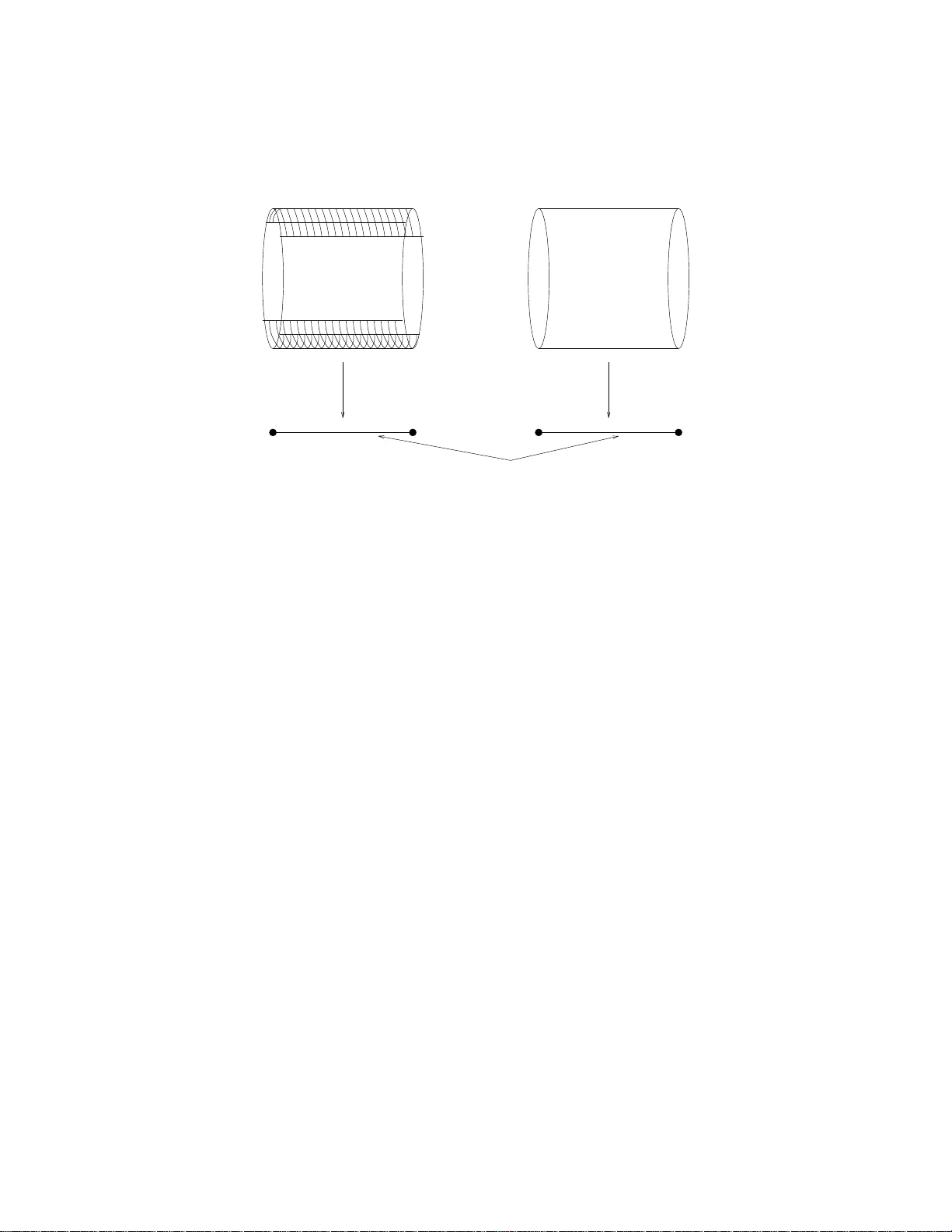
BOUNDING THE NUMBER OF ST ABLE HO MOTOPY TYPES OF A P ARAMETRIZED F AMIL Y OF SE MI-ALGEBRAIC SETS DEFINED BY QUADRA TIC INEQ UALITIES SAUG A T A BASU AND MICHAEL KETTNER Abstract. W e prov e a nearly optimal b ound on the n um ber of stable homo- top y types occurring in a k -parameter semi- algebraic family of sets in R ℓ , each defined in te rms of m q uadratic inequa lities. Our bound is ex ponential in k and m , but p olynomial in ℓ . More precisely , we prov e the following. Let R b e a r eal closed field and let P = { P 1 , . . . , P m } ⊂ R[ Y 1 , . . . , Y ℓ , X 1 , . . . , X k ] , with deg Y ( P i ) ≤ 2 , deg X ( P i ) ≤ d, 1 ≤ i ≤ m . Let S ⊂ R ℓ + k be a semi- algebraic set, defined b y a Boolean f ormula without negations, whose atoms are of the form, P ≥ 0 , P ≤ 0 , P ∈ P . Let π : R ℓ + k → R k be the pro jection on the last k c o-ordinates. Then, the num b er of stable homotop y types amongst the fibers S x = π − 1 ( x ) ∩ S is b ounded by (2 m ℓk d ) O ( mk ) . 1. Introduction Let S ⊂ R ℓ + k be a semi-algebraic set o ver a real closed field R. Let π : R ℓ + k → R k be the pro jection ma p on the last k co-ordina tes, and for any S ⊂ R ℓ + k we will denote by π S the restric tion of π to S . Moreo ver, when the map π is clear fro m context, for any x ∈ R k we will denote by S x the fiber π − 1 S ( x ). A fundamen tal theor em in s emi-algebra ic geometr y states, Theorem 1.1. (Har dt’s trivia lity the or em [22] ) Ther e exists a semei -algebr aic p ar- tition of R k , { T i } i ∈ I , such that the map π S is definably trivial over e ach T i . Theorem 1 .1 implies that for each i ∈ I and any po in t y ∈ T i , the pre-image π − 1 ( T i ) ∩ S is semi-a lg ebraically homeomo rphic to S y × T i by a fib er preserving homeomorphism. In particular, for ea ch i ∈ I , all fib ers S y , y ∈ T i , a re semi- algebraic ally homeo morphic. Hardt’s theorem is a corolla ry of the existence of cylindric al algebr aic de c omp o- sitions (see [12]), which implies a double ex po nen tial (in k and ℓ ) upp er b ound on the car dina lit y of I and hence on the num b er of homeomorphism types o f the fib ers of the map π S . No better b ounds than the double exp onential b ound are k nown, even though it seems reas onable to conjecture a single exp onential upp er bo und on the num b er of homeo morphism types of the fib ers of the map π S . In [9], the weaker problem o f b ounding the num b er of distinct homotopy typ es , o ccurring amongs t the se t of all fiber s of π S was cons idered, and a sing le exp onential upper b ound was pr ov ed on the num b er of ho motopy types of such fib ers. Before stating this result mor e precisely we need to introduce a few notation. Let R b e a real c lo sed field, P ⊂ R[ Y 1 , . . . , Y ℓ , X 1 , . . . , X k ], a nd let φ b e a B o olean Key wor ds and phr ases. Homotopy types, Quadratic i nequalities, Semi- algebraic sets. 1 2 SAUGA T A BASU AND MICHAEL KE TTNER formula with atoms o f the form P = 0, P > 0, or P < 0 , where P ∈ P . W e call φ a P -formula, a nd the semi-algebr aic se t S ⊂ R ℓ + k defined by φ , a P -semi-alg ebraic set. If the Bo olean formula φ co n tains no negations, and its atoms ar e of the form P = 0, P ≥ 0, or P ≤ 0 , with P ∈ P , then we call φ a P -clos e d for mula, a nd the semi-algebr aic set S ⊂ R ℓ + k defined by φ , a P - closed semi-alg ebraic se t. The following theorem app ears in [9]. Theorem 1.2. [9] L et P ⊂ R[ Y 1 , . . . , Y ℓ , X 1 , . . . , X k ] , with deg( P ) ≤ d for e ach P ∈ P and c ar dinality # P = m . Then, ther e exists a fin ite set A ⊂ R k , with # A ≤ (2 ℓ mk d ) O ( k ℓ ) , such that for every x ∈ R k ther e exist s z ∈ A such that for every P -s emi-algebr aic set S ⊂ R ℓ + k , the set S x is semi-algebr aic al ly homotopy e qu ivalent to S z . In p artic- ular, for any fixe d P - semi-algebr aic set S , the numb er of differ ent homotopy typ es of fib ers S x for various x ∈ π ( S ) is also b oun de d by (2 ℓ mk d ) O ( k ℓ ) . A re sult similar to Theo r em 1.2 ha s b een proved for semi-Pfaffian sets as well in [9], and has b een extended to arbitra r y o- minimal structures in [6]. The b ounds o n the n um ber of homoto p y types pr ov ed in [9, 6] ar e all exponential in ℓ as w ell as k . The follo wing ex a mple, which app ears in [9], shows that in this generality the single exp onential dep endence on ℓ is unav oidable . Example 1 .3. Let P ∈ R[ Y 1 , . . . , Y ℓ ] ֒ → R [ Y 1 , . . . , Y ℓ , X ] b e the p olynomial defined by P = ℓ X i =1 d − 1 Y j =0 ( Y i − j ) 2 . The algebra ic set defined by P = 0 in R ℓ +1 with co-o rdinates Y 1 , . . . , Y ℓ , X , consists of d ℓ lines all parallel to the X ax is. Consider now the semi- algebraic set S ⊂ R ℓ +1 defined by ( P = 0) ∧ (0 ≤ X ≤ Y 1 + d Y 2 + d 2 Y 3 + · · · + d ℓ − 1 Y ℓ ) . It is eas y to verify that, if π : R ℓ +1 → R is the pro jection map o n the X coo rdinate, then the fib ers S x , for x ∈ { 0 , 1 , 2 , . . . , d ℓ − 1 } ⊂ R ar e 0-dimensiona l and of different cardinality , and hence hav e differ en t homotopy types. 1.1. Semi - algebraic sets defined by quadratic inequaliti e s. One particular ly int eresting class o f semi-a lgebraic sets is the cla ss of semi-a lgebraic sets defined by quadratic inequalities . This clas s of sets has b een investigated from an alg orithmic standp oint [2, 20, 4 , 5, 10], as well as from the p oint of view to p olo gical complex it y , [1, 3, 8]. Semi-algebra ic sets defined by quadratic ineq ualities a re distinguished from ar- bitrary semi-algebra ic sets by the fact that, if the n umber of inequalities is fixed, then the sum of their Betti num b ers is b ounded p olynomially in the dimensio n. The following b ound was prov ed by Ba rvinok [3]. BOUNDING THE NUMBER OF HOMOTOPY TYPES 3 Theorem 1.4. L et S ⊂ R ℓ b e a semi-algebr aic set defin e d by t he ine qualities, P 1 ≥ 0 , . . . , P m ≥ 0 , deg ( P i ) ≤ 2 , 1 ≤ i ≤ m . Then, ℓ X i =0 b i ( S ) ≤ ( mℓ ) O ( m ) , wher e b i ( S ) denotes the i -th Betti numb er of S . An extension of Ba rvinok’s b ound to ar bitrary P -clo sed (not just ba sic clo sed) semi-algebr aic sets defined in terms o f quadratic inequalities has been done recently in [11]. Now suppo se that we have a pa rametrized family of sets, eac h defined in ter ms of m quadratic inequa lities. More pr ecisely , let P = { P 1 , . . . , P m } ⊂ R[ Y 1 , . . . , Y ℓ , X 1 , . . . , X k ] , with deg Y ( P i ) ≤ 2 , deg X ( P i ) ≤ d, 1 ≤ i ≤ m ( X 1 , . . . , X k are the p ar ameters ), and let S ⊂ R ℓ + k be a P -close d semi-algebr a ic set. Let π : R ℓ + k → R k denote the pro jection on the last k co-o r dinates. Then, for each x ∈ R k the semi-algebr aic set S x is defined by a Bo o lean formula inv o lving at most m q uadratic p olynomials in Y 1 , . . . , Y ℓ . Bounding the num b er o f top ologica l types amongs t the fib ers , S x , x ∈ R k , is an int eresting s p ecia l ca se of the more general problem mentioned in the last section. In view of the top olo gical simplicit y of semi-a lg ebraic sets defined by few quadratic inequalities a s opp osed to gener al semi-alge braic sets (cf. Theo rem 1.4), o ne mig ht exp ect a muc h tighter b ound on the n umber of to po logical types co mpared to the general case. How ever one should b e cautious, since a tight bo und on the Betti nu m ber s of a class of semi-alg ebraic sets do es not automatically imply a similar bo und o n the num b er of top olog ic al or even homotopy types o ccurr ing in that class. In this pa pe r w e consider the problem of b ounding the num b er of stable homotopy typ es (see Definition 3.4 below) of fibers S x , where π a nd S a r e as defined ab ov e. W e prov e a b ound which for each fixed m , is p olyno mial in ℓ (the dimensio n of the fib ers). In so me sp ecial ca ses our b ound can be extended to the num b er of homotopy types (see Theo rem 4.1 7). Our result can b e seen a s a follow-up to the recent work on b ounding the num b er of homotopy types of fib ers o f genera l semi-alg ebraic maps studied in [9]. Howev er, the b ound in [9] applied to the s pec ia l case of se ts defined by quadr a tic inequalities would yield a b ound e xpo nent ial in b oth k and ℓ , as shown by Example 1.3, where the semi- algebraic set S is defined in terms of three po lynomials. R emark 1.5 . Note that the notions of homeo morphism t ype, homotopy type and stable ho motopy type are each strictly weaker than the previous one, since tw o semi-algebr aic sets might b e stable homo topy equiv alent, without b eing homotopy equiv alent (see [24], p. 46 2), and a lso homotop y equiv alent without b eing homeo- morphic. How e ver, tw o closed and bo unded semi-algebr aic sets which are stable homotopy equiv alent hav e isomorphic homolo gy groups . 1.2. Prior and Related W ork. Since sets defined by quadra tic equalities and inequalities are the simplest class of top ologic ally non- tr ivial semi- algebraic sets, the problem of classifying suc h sets top olo g ically has a ttracted the atten tion of many res earchers. 4 SAUGA T A BASU AND MICHAEL KE TTNER Motiv ated by pr oblems related to s ta bilit y of maps, W all [27] consider ed the sp ecial ca se of r eal a lgebraic sets defined by tw o simultaneously diagona lizable qua- dratic forms in ℓ v ariables. He obtained a full topolo gical classificatio n of suc h v arieties making use of Gale dia grams (from the theor y of con vex p olytop es). In our notation, letting Q 1 = ℓ X i =1 X i Y 2 i , Q 2 = ℓ X i =1 X i + ℓ Y 2 i , and S = { ( y , x ) ∈ R 3 ℓ | k y k = 1 , Q 1 ( y , x ) = Q 2 ( y , x ) = 0 } , W all obtains as a co ns equence o f his classification theorem, that the num b er of different top ologica l types of fib ers S x is b ounded b y 2 ℓ − 1 . Notice that in this case the num b er of parameters ( X 1 , . . . , X 2 ℓ ), as well as the num b er of v ariables ( Y 1 , . . . , Y ℓ ), are bo th O ( ℓ ). Similar results were also obtained by L´ op ez [2 3] using different tec hniques. Much mor e recently Briand [14] ha s obtained explicit char- acterization o f the isotopy classes of r eal v arieties defined by tw o g e neral co nics in R P 2 in terms of the c o efficient s of the poly nomials. His method a ls o gives a decision algorithm for testing whether tw o such g iven v arieties are isotopic. In a nother direction Agrachev [1] studied the topo logy of semi-algebr aic sets defined b y qua dratic inequalities, and he defined a cer tain spectra l sequence con- verging to the ho mo logy gro ups of such sets. A para metr ized version of Agrachev’s construction is in fact a sta rting po in t of o ur pr o of of the main theorem in this pap er. 2. Main Resul t The ma in result of this pap er is the following theorem. Theorem 2.1. L et R b e a r e al close d field and let P = { P 1 , . . . , P m } ⊂ R[ Y 1 , . . . , Y ℓ , X 1 , . . . , X k ] , with deg Y ( P i ) ≤ 2 , deg X ( P i ) ≤ d, 1 ≤ i ≤ m . L et π : R ℓ + k → R k b e the pr o- je ction on the last k c o-or dinates. Then, for any P -close d semi-algebr aic set S ⊂ R ℓ + k , the numb er of stable homotopy typ es amongst the fib ers, S x , is b ounde d by (2 m ℓk d ) O ( mk ) . R emark 2.2 . Note that the bound in Theo rem 2.1 (unlike that in Theo rem 1.2) is po lynomial in ℓ for fixed m and k . The expo nential dep endence on m is unavoidable, as ca n be seen from a slight mo dification of E x ample 1.3 ab ov e. Consider the se mi- algebraic set S ⊂ R ℓ +1 defined by Y i ( Y i − 1 ) = 0 , 1 ≤ i ≤ m ≤ ℓ, 0 ≤ X ≤ Y 1 + 2 · Y 2 + . . . + 2 m − 1 · Y m . Let π : R ℓ +1 → R b e the pro jection on the X -co ordinate. Then, the sets S x , x ∈ { 0 , 1 . . . , 2 m − 1 } , hav e different num b er of c o nnected comp onents, a nd hence hav e distinct (stable) homotopy type s . BOUNDING THE NUMBER OF HOMOTOPY TYPES 5 R emark 2.3 . Note that the technique used to pr ove Theorem 1.2 in [9] do es not directly pro duce better b ounds in the qua dratic case, and hence we need a new approach to pr ov e a s ubs ta n tially b etter b ound in this case. How ever, due to techn ical reas ons, we only obtain a b ound on the num b er of stable ho motopy types, rather than homotopy types. 3. Ma thema tical Preliminaries W e fir st need to fix some notatio n and a few preliminary res ults needed later in the pro of. 3.1. Some Notation. Let R b e a r eal closed field. F or an element a ∈ R introduce sign( a ) = ( 0 if a = 0 , 1 if a > 0 , − 1 if a < 0 . If P ⊂ R[ X 1 , . . . , X k ] is finite, we wr ite the s et of zer os of P in R k as Z( P ) = n x ∈ R k | ^ P ∈P P ( x ) = 0 o . A sign c ondition σ on P is an element of { 0 , 1 , − 1 } P . The r e alization of the sign c ondition σ is the basic semi-algebr a ic set R ( σ ) = n x ∈ R k | ^ P ∈P sign( P ( x )) = σ ( P ) o . A sign conditio n σ is r e alizable if R ( σ ) 6 = ∅ . W e de no te by Sign( P ) the set of realizable sign conditions o n P . F or σ ∈ Sign( P ) we define the level of σ as the cardinality # { P ∈ P | σ ( P ) = 0 } . F or each lev el p , 0 ≤ p ≤ # P , we denote by Sign p ( P ) the subset of Sig n( P ) of elements of lev e l p . Moreover, for a sign condition σ let Z ( σ ) = n x ∈ R k | ^ P ∈P , σ ( P )=0 P ( x ) = 0 o . 3.2. Use of Infinites i mals. Later in the paper , we will extend the ground field R b y infinitesimal elements. W e denote by R h ζ i the r e al closed field of alg e br aic Puiseux series in ζ with co efficient s in R (see [1 2] for mor e details ). The s ign of a Puiseux series in R h ζ i agrees with the sig n of the co efficient of the lowest degree term in ζ . This induces a uniq ue or der on R h ζ i which makes ζ infinitesimal: ζ is po sitive and smaller than any positive element of R. When a ∈ R h ζ i is b ounded from ab ov e a nd below by some elements of R, lim ζ ( a ) is the consta n t term of a , obtained by substituting 0 for ζ in a . Given a se mi- algebraic set S in R k , the extension o f S to R ′ , denoted Ext( S, R ′ ) , is the semi-alg ebraic subset of R ′ k defined by the same quantifi er fre e formula that defines S . The s e t E x t( S, R ′ ) is well defined (i.e. it only dep ends on the set S and no t on the qua ntifier free formula chosen to describ e it). This is an ea sy consequence of the T arski- Seidenberg transfer principle (see for instance [12]). W e will also need the following remar k ab out extensions which is aga in a conse- quence of the T arski- Seiden ber g tra nsfer principle. 6 SAUGA T A BASU AND MICHAEL KE TTNER R emark 3.1 . Let S, T be t wo closed and b ounded s emi-algebra ic subsets of R k , and let R ′ be a rea l clo sed extension of R. Then, S a nd T a re semi-algebraically homotopy equiv alent if and only if Ext( S, R ′ ) and Ext( T , R ′ ) are semi-alg e braically homotopy equiv alent. W e will need a few results fro m a lgebraic top ology , which we state here without pro of re fer ring the reader to pap ers wher e the pro ofs a ppea r. The following inequalities ar e consequences o f the Mayer-Vietoris exact s equence. 3.3. Betti n umbe rs and Ma yer-Vietoris Inequalities. W e will use the fo llow- ing notation. Notation 1 . F or ea ch m ∈ Z ≥ 0 we will denote by [ m ] the set { 1 , . . . , m } . Prop ositio n 3.2 (Mayer-Vietoris inequalities) . L et the subset s W 1 , . . . , W r ⊂ R n b e al l op en or al l close d. Then, for e ach i ≥ 0 we have, (3.1) b i [ 1 ≤ j ≤ r W j ≤ X J ⊂ [ r ] b i − (# J )+1 \ j ∈ J W j and (3.2) b i \ 1 ≤ j ≤ r W j ≤ X J ⊂ [ r ] b i +(# J ) − 1 [ j ∈ J W j . Pr o of. See [12]. The following pr op osition gives a b ound o n the Betti num b ers of the pro jection π ( V ) of a clos e d a nd bo unded semi-a lgebraic set V in terms of the n um ber and degrees of po lynomials defining V . Prop ositio n 3.3. [21] L et R b e a r e al close d field and let ψ : R m + k → R k b e the pr oje ction m ap on to last k c o-or dinates. L et V ⊂ R m + k b e a close d and b ounde d semi-algebr aic set define d by a Bo ole an formula with s distinct p olynomials of de gr e es not exc e e ding d . Then the n -t h Betti num b er of the pr oje ction b n ( ψ ( V )) ≤ ( nsd ) O ( k + nm ) . Pr o of. See [21]. 3.4. Stable homotopy equiv alence. F or an y finite CW-complex X we will de- note by S ( X ) the susp ension o f X . Recall from [25] that for tw o finite CW-co mplexes X and Y , an element o f (3.3) { X ; Y } = lim − → i [ S i ( X ) , S i ( Y )] is called an S- map (or map in the susp ension c ate gory ). (When the context is cle ar we will sometime deno te an S-map f ∈ { X ; Y } by f : X → Y ). Definition 3.4. An S-map f ∈ { X ; Y } is a n S- equiv alence (als o called a stable homotopy equiv alence) if it admits an in verse f − 1 ∈ { Y ; X } . In this case w e sa y that X and Y are stable ho motopy equiv ale n t. BOUNDING THE NUMBER OF HOMOTOPY TYPES 7 If f ∈ { X ; Y } is an S-map, then f induce s a homomor phism, f ∗ : H ∗ ( X ) → H ∗ ( Y ) . The following theorem characterizes stable homo to p y equiv alence in ter ms of homology . Theorem 3.5. [24] L et X and Y b e two fin ite CW-c omplexes. Then X and Y ar e stable homotopy e quivalent if and only if ther e exists an S -map f ∈ { X ; Y } which induc es isomorphisms f ∗ : H i ( X ) → H i ( Y ) (se e [17] , pp. 604). 3.4.1. Sp anier-Whitehe ad duality. In order to compare the complement s o f clo sed and b ounded semi-alge braic sets whic h are homotopy equiv alent , we will use the duality theory due to Spanier a nd Whitehead [25]. W e will need the following facts ab out Spanier- Whitehead duality (see [1 7], pp. 6 03 for mo re details). Let X ⊂ S n be a finite CW-complex. Then there exists (up to stable homotopy equiv alence) a dual complex, denoted D n X ⊂ S n \ X . The dual c o mplex D n X is defined only up to S-equiv alence. In pa rticular, any deformation retract of S n \ X repres ent s D n X . Moreov er, the functor D n has the following prop erty . If Y ⊂ S n is a nother finite CW-complex, and the S-map repr esented b y φ : X → Y is a stable homotopy equiv alence, then there e x ists a stable homotopy equiv alence D n φ . Mo reov e r , if the map φ : X → Y is an inclusion, then the dua l S-ma p D n φ is also repres ent ed by a corres p onding inclusion. R emark 3.6 . No te that, since Spanier-Whitehead duality theory deals only with finite p olyhedr a over R , it extends without difficult y to g eneral real closed fields using the T ars k i-Seidenberg transfer principle. 3.5. Homo to p y colim i ts. Let A = { A 1 , . . . , A n } , wher e each A i is a s ub-complex of a finite CW-complex. Let ∆ [ n ] denote the standa r d simplex of dimensio n n − 1 with vertices in [ n ]. F or I ⊂ [ n ], we deno te b y ∆ I the (# I − 1)-dimensional face of ∆ [ n ] corres p onding to I , and by A I the CW-co mplex \ i ∈ I A i . The ho motopy colimit, ho colim( A ), is a CW-complex defined as follows. Definition 3.7. ho colim( A ) = · [ I ⊂ [ n ] ∆ I × A I / ∼ where the equiv alence relation ∼ is defined a s follows. F or I ⊂ J ⊂ [ n ], let s I ,J : ∆ I ֒ → ∆ J denote the inclusio n map of the face ∆ I in ∆ J , a nd let i I ,J : A J ֒ → A I denote the inclusio n map of A J in A I . Given ( s , x ) ∈ ∆ I × A I and ( t , y ) ∈ ∆ J × A J with I ⊂ J , then ( s , x ) ∼ ( t , y ) if and only if t = s I ,J ( s ) a nd x = i I ,J ( y ). W e have a obvious map f : ho co lim( A ) − → colim( A ) = [ i ∈ [ n ] A i sending ( s , x ) 7→ x . It is a conse q uence of the Sma le-Vietoris theorem [26] tha t Lemma 3.8. The map f : ho co lim( A ) − → colim( A ) = [ i ∈ [ n ] A i 8 SAUGA T A BASU AND MICHAEL KE TTNER is a ho motopy e qu ivalenc e. Now let A = { A 1 , . . . , A n } (resp. B = { B 1 , . . . , B n } ) b e a set of sub-c o mplexes of a finite CW-complex. F or each I ⊂ [ n ] let f I ∈ { A I ; B I } b e a s table homo topy equiv alence, having the proper t y tha t for each I ⊂ J ⊂ [ n ], f J = f I | A J . Then, w e hav e an induced S-ma p, f ∈ { ho colim( A ); ho colim( B ) } , and we hav e that Lemma 3 . 9. The induc e d S-map f ∈ { ho co lim( A ); ho colim( B ) } is a stable homo- topy e quivalenc e. Pr o of. Using the Mayer-Vietoris exa ct sequence it is easy to s ee that if the f I ’s induce isomo rphisms in homolo g y , so do es the map f . Now apply Theorem 3 .5. 4. Proof of Theorem 2.1 4.1. Pro of Strategy. The strateg y underlying our pro of of Theorem 2.1 is as follows. W e fir st consider the sp ecial case of a semi-algebraic s ubs et, A ⊂ S ℓ , defined by a disjunction of m homoge ne o us quadr atic ine q ualities res tricted to the unit s phere in R ℓ +1 . W e then show that there exists a closed a nd bounded semi- algebraic set C ′ (see (4.14) b elow for the precise definition o f the semi-a lgebraic set C ′ ), co nsisting of certa in s phere bundles, glued alo ng c e rtain sub-sphere bundles, which is homotopy equiv a len t to A . The n um ber of these sphere bundles, a s w ell descriptions of their ba ses, ar e b ounded po lynomially in ℓ (for fixed m ). In the pr e sence of parameter s X 1 , . . . , X k , the se t A , as w ell as C ′ , will dep end on the v alues of the par ameters. How ever, using some basic homotop y prop erties of bundles, w e show tha t the homotopy type of the set C ′ stays inv a riant, under contin uous deformation o f the bases of the different sphere bundles which constitute C ′ . These bases als o dep end on the par ameters, X 1 , . . . , X k , but the degree s of the po lynomials defining them have degrees bo unded by O ( ℓd ) in X 1 , . . . , X k . Now, using techniques similar to those used in [9], w e are a ble to control the num ber of isotopy t y pes of the bases which o ccur, a s the par ameters v ary over R k . The bo und on the n umber of isotopy types, also gives a b ound on the num b er of p ossible homotopy types of the set C ′ and hence of A , for differ en t v alues of the par ameter. In order to prov e the results for semi-a lgebraic se ts defined by more general formulas than disjunctions of weak ineq ualities, we first us e Spanier- Whitehead duality to obtain a b ound in the case of conjunctions, and then use the constructio n of homotopy co limits to prov e the theor e m for general P -closed sets. B ecause of the use of Spa nie r -Whitehead duality we ge t b ounds o n the num ber of stable homotopy t ype s, rather than homo topy types. 4.2. T op ology of sets defined b y quadratic constraint s. O ne of the main ideas b ehind our pro o f of Theor em 2 .1 is to para metrize a co nstruction introduced by Agra chev in [1] while studying the top olog y of sets defined by (purely) quadr atic inequalities (that is without the par ameters X 1 , . . . , X k in our notation). How ever, we avoid construction of Leray spectra l sequences a s done in [1]. F or the rest o f this section, we fix a set of p olynomials Q = { Q 1 , . . . , Q m } ⊂ R[ Y 0 , . . . , Y ℓ , X 1 , . . . , X k ] which are ho mogeneous of degree 2 in Y 0 , . . . , Y ℓ , a nd of degree at mo st d in X 1 , . . . , X k . BOUNDING THE NUMBER OF HOMOTOPY TYPES 9 W e will denote by Q = ( Q 1 , . . . , Q m ) : R ℓ +1 × R k → R m , the map defined by the p olynomia ls Q 1 , . . . , Q m , and g enerally , for I ⊂ { 1 , . . . , m } , we deno te by Q I : R ℓ +1 × R k → R I , the map whos e co-or dinates are given by Q i , i ∈ I . W e will often dro p the subscript I fro m our notation, when I = [ m ]. F or a n y subset I ⊂ [ m ], let A I ⊂ S ℓ × R k be the semi-alg ebraic s et defined by (4.1) A I = [ i ∈ I { ( y , x ) | | y | = 1 ∧ Q i ( y , x ) ≤ 0 } , and let (4.2) Ω I = { ω ∈ R m | | ω | = 1 , ω i = 0 , i 6∈ I , ω i ≤ 0 , i ∈ I } . F or ω ∈ Ω I we denote by ω Q ∈ R[ Y 0 , . . . , Y ℓ , X 1 , . . . , X k ] the p olynomial defined by (4.3) ω Q = m X i =0 ω i Q i . F or ( ω , x ) ∈ F I = Ω I × R k , we will denote by ω Q ( · , x ) the quadr atic form in Y 0 , . . . , Y ℓ obtained from ω Q by s pec ia lizing X i = x i , 1 ≤ i ≤ k . Let B I ⊂ Ω I × S ℓ × R k be the semi-alg ebraic set defined by (4.4) B I = { ( ω , y , x ) | ω ∈ Ω I , y ∈ S ℓ , x ∈ R k , ω Q ( y , x ) ≥ 0 } . W e denote by φ 1 : B I → F I and φ 2 : B I → S ℓ × R k the tw o pro jection maps (see diagr am be low). (4.5) B I F I = Ω I × R k R k S ℓ × R k z z t t t t t t t t t t t φ I , 1 $ $ J J J J J J J J J J J J φ I , 2 / / o o The follo wing k e y propo sition w a s prov ed b y Agr achev [1] in the unparametriz ed situation, but as we see b elow it works in the par ametrized case as well. Prop ositio n 4.1. The map φ 2 gives a homotopy e quivalenc e b etwe en B I and φ 2 ( B I ) = A I . Pr o of. In or der to s implify notation we prov e it in the case I = [ m ], a nd the case for any other I would follow immediately . W e first prove that φ 2 ( B ) = A. If ( y , x ) ∈ A, then there e xists some i, 1 ≤ i ≤ m, such that Q i ( y , x ) ≤ 0. Then for ω = ( − δ 1 ,i , . . . , − δ m,i ) (where δ i,j = 1 if i = j , and 0 otherwise), we see that ( ω , y , x ) ∈ B . Conv er sely , if ( y , x ) ∈ φ 2 ( B ) , then there exis ts ω = ( ω 1 , . . . , ω m ) ∈ Ω such that, m X i =1 ω i Q i ( y , x ) ≥ 0 . 10 SAUGA T A BASU AND MICHAEL KE TTNER Since, ω i ≤ 0 , 1 ≤ i ≤ m, and no t all ω i = 0 . This implies that Q i ( y , x ) ≤ 0 for some i, 1 ≤ i ≤ m . This shows that ( y , x ) ∈ A . F or ( y , x ) ∈ φ 2 ( B ), the fiber φ − 1 2 ( y , x ) = { ( ω , y , x ) | ω ∈ Ω such that ω Q ( y , x ) ≥ 0 } , is a non-empt y subset of Ω defined by a sing le linear inequa lity . Th us, eac h non- empt y fib er is an intersection of a conv ex co ne with S m − 1 , and hence co n tractible. The prop osition no w follo ws fro m the well-known Smale-Vietoris theorem [26]. W e will use the following nota tio n. Notation 2 . F or any quadr atic for m Q ∈ R[ Y 0 , . . . , Y ℓ ], we will deno te by index( Q ), the n umber of negativ e eige n v alues o f the symmetric matrix of the corr esp onding bilinear form, that is of the matrix M Q such that, Q ( y ) = h M Q y , y i for all y ∈ R ℓ +1 (here h· , ·i denotes the usual inner pro duct). W e will also denote b y λ i ( Q ) , 0 ≤ i ≤ ℓ , the eig en v alues of Q , in non-decrea sing or der, i.e. λ 0 ( Q ) ≤ λ 1 ( Q ) ≤ · · · ≤ λ ℓ ( Q ) . F or I ⊂ [ m ], we denote by (4.6) F I ,j = { ( ω , x ) ∈ Ω I × R k | index ( ω Q ( · , x )) ≤ j } . It is c le a r that each F I ,j is a clo sed semi-algebr aic s ubset of F I and that they induce a filtration of the space F I , given by F I , 0 ⊂ F I , 1 ⊂ · · · ⊂ F I ,ℓ +1 = F I . Lemma 4.2. The fib er of the map φ I , 1 over a p oint ( ω , x ) ∈ F I ,j \ F I ,j − 1 has t he homotopy typ e of a spher e of dimension ℓ − j . Pr o of. As b efore, we prove the lemma only for I = [ m ]. The pro of for a g eneral I is ident ical. First notice that for ( ω , x ) ∈ F j \ F j − 1 , the fir st j eigen v alues of ω Q ( · , x ), λ 0 ( ω Q ( · , x )) , . . . , λ j − 1 ( ω Q ( · , x )) < 0 . Moreov er, letting W 0 ( ω Q ( · , x )) , . . . , W ℓ ( ω Q ( · , x )) be the co-ordinates with r esp ect to a n or thonormal ba s is, e 0 ( ω Q ( · , x )) , . . . , e ℓ ( ω Q ( · , x )) , consisting of eigenvectors of ω Q ( · , x ), we have that φ − 1 1 ( ω , x ) is the s ubset of S ℓ = { ω } × S ℓ × { x } defined by ℓ X i =0 λ i ( ω Q ( · , x )) W i ( ω Q ( · , x )) 2 ≥ 0 , ℓ X i =0 W i ( ω Q ( · , x )) 2 = 1 . Since, λ i ( ω Q ( · , x )) < 0 , 0 ≤ i < j, it follows that for ( ω , x ) ∈ F j \ F j − 1 , the fiber φ − 1 1 ( ω , x ) is homo to p y equiv alent to the ( ℓ − j )-dimensional sphere defined by setting W 0 ( ω Q ( · , x )) = · · · = W j − 1 ( ω Q ( · , x )) = 0 on the sphere de fined by P ℓ i =0 W i ( ω Q ( · , x )) 2 = 1 . BOUNDING THE NUMBER OF HOMOTOPY TYPES 11 F or each ( ω , x ) ∈ F I ,j \ F I ,j − 1 , let L + j ( ω , x ) ⊂ R ℓ +1 denote the sum of the non-negative e igenspaces of ω Q ( · , x ) (i.e. L + j ( ω , x ) is the larg est linear subs pace of R ℓ +1 on which ω Q ( · , x ) is p ositive semi-definite). Since index( ω Q ( · , x )) = j stays inv ariant as ( ω , x ) v arie s ov er F I ,j \ F I ,j − 1 , L + j ( ω , x ) v aries contin uo usly with ( ω , x ). W e will denote by C I the semi- algebraic set defined by (4.7) C I = ℓ +1 [ j =0 { ( ω , y , x ) | ( ω , x ) ∈ F I ,j \ F I ,j − 1 , y ∈ L + j ( ω , x ) , | y | = 1 } . The following prop ositio n relates the ho motopy type of B I to tha t of C I . Prop ositio n 4. 3. The semi-algebr aic set C I define d ab ove is homotopy e quivalent to B I (se e (4.4) for the definition of B I ). Pr o of. W e give a deformation re tr action of B I to C I constructed a s follows. F o r each ( ω , x ) ∈ F I ,ℓ \ F I ,ℓ − 1 , we ca n retract the fiber φ − 1 1 ( ω , x ) to the zero-dimensio na l sphere, L + ℓ ( ω , x ) ∩ S ℓ by the following retraction. Let W 0 ( ω Q I ( · , x )) , . . . , W ℓ ( ω Q I ( · , x )) be the co-o rdinates with resp ect to an orthonor ma l basis e 0 ( ω Q ( · , x )) , . . . , e ℓ ( ω Q ( · , x )), consisting of eigenvectors of ω Q I ( · , x ) cor resp onding to non- de c reasing order of the eigenv alues o f ω Q ( · , x ). Then, φ − 1 1 ( ω , x ) is the subset of S ℓ defined by ℓ X i =0 λ i ( ω Q I ( · , x )) W i ( ω Q I ( · , x )) 2 ≥ 0 , ℓ X i =0 W i ( ω Q I ( · , x )) 2 = 1 . and L + ℓ ( ω , x ) is defined by W 0 ( ω Q I ( · , x )) = · · · = W ℓ − 1 ( ω Q I ( · , x )) = 0. W e re- tract φ − 1 1 ( ω , x ) to the zer o -dimensional sphere, L + ℓ ( ω , x ) ∩ S ℓ by the retraction sending, ( w 0 , . . . , w ℓ ) ∈ φ − 1 1 ( ω , x ), at time t to ((1 − t ) w 0 , . . . , (1 − t ) w ℓ − 1 , t ′ w ℓ ), where 0 ≤ t ≤ 1 , and t ′ = 1 − (1 − t ) 2 P ℓ − 1 i =0 w 2 i w 2 ℓ ! 1 / 2 . No tice that even though the lo ca l co-o rdinates ( W 0 , . . . , W ℓ ) in R ℓ +1 with r esp ect to the orthono rmal ba- sis ( e 0 , . . . , e ℓ ) may not b e uniquely defined at the p oint ( ω , x ) (for instance, if the quadra tic for m ω Q I ( · , x ) has multiple e ig en-v alues), the retraction is still well- defined since it only dep ends on the decomp osition of R ℓ +1 int o or thogonal comple- men ts span( e 0 , . . . , e ℓ − 1 ) and span( e ℓ ) whic h is w ell defined. W e can thus retra ct simult aneously all fib ers o ver F I ℓ \ F I ,ℓ − 1 contin uously , to o btain a semi-a lgebraic set B I ,ℓ ⊂ B I , which is mor eov er homotopy equiv alent to B I . This retr a ction is schematically s hown in Figure 1 , wher e F I ,ℓ is the closed segment, and F I ,ℓ − 1 are its end p oints. Now starting from B I ,ℓ , retra ct all fib ers over F I ,ℓ − 1 \ F I ,ℓ − 2 to the corr esp ond- ing one dimensional spher es, by the retractio n sending, ( w 0 , . . . , w ℓ ) ∈ φ − 1 1 ( ω , x ), at time t to ((1 − t ) w 0 , . . . , (1 − t ) w ℓ − 2 , t ′ w ℓ − 1 , t ′ w ℓ ), where 0 ≤ t ≤ 1, and t ′ = 1 − (1 − t ) 2 P ℓ − 2 i =0 w 2 i P ℓ i = ℓ − 1 w 2 i ! 1 / 2 to obtain B I ,ℓ − 1 , which is homo topy equiv alent 12 SAUGA T A BASU AND MICHAEL KE TTNER φ I , 1 B I B I ,ℓ F I ,ℓ φ I , 1 Figure 1. Schematic picture of the retr a ction of B I to B I ,ℓ . to B I ,ℓ . Con tin uing this pro cess w e finally obtain B I , 0 = C I , which is clearly homotopy equiv alent to B I by constr uc tio n. Notice tha t the s e mi- algebraic set φ − 1 1 ( F I ,j \ F I ,j − 1 ) ∩ C I is a S ℓ − j -bundle ov er F I ,j \ F I ,j − 1 under the map φ 1 , and C I is a unio n of these spher e bundles. W e hav e go o d control over the bases, F I ,j \ F I ,j − 1 , o f these bundles, that is we have go o d b ounds on the nu m ber as well as the degrees o f poly no mials used to de fine them. How ever, these bundles could b e p os sibly glue d to each other in complica ted wa ys, and it is not immediate how to control this g lueing data , s ince different t yp es of g lueing could give rise to different homoto p y types of the underlying space. In order to g et around this difficulty , we consider certa in closed subs e ts, F ′ I ,j of F I , where each F ′ I ,j is an infinitesimal deformation of F I ,j \ F I ,j − 1 , and form the ba se of a S ℓ − j -bundle. More over, these new sphere bundles are glued to each o ther along sphere bundles ov er F ′ I ,j ∩ F ′ I ,j − 1 , and their union, C ′ I , is homo topy equiv alent to C I . Finally , the p oly nomials defining the sets F ′ I ,j are in genera l p osition in a very strong sens e, and this prop erty is used later to b ound the n um ber of isoto py clas ses of the sets F ′ I ,j in the para metrized situation. W e now make precise the argument o utlined above. Let Λ I be the p olynomial in R[ Z 1 , . . . , Z m , X 1 , . . . , X k , T ] defined by Λ I = det( M Z I · Q + T Id ℓ +1 ) , = T ℓ +1 + H I ,ℓ T ℓ + · · · + H I , 0 , where Z I · Q = P i ∈ I Z i Q i , a nd each H I ,j ∈ R[ Z 1 , . . . , Z m , X 1 , . . . , X k ]. Notice, that H I ,j is obtained from H j = H [ m ] ,j by setting for each i 6∈ I , the v ariable Z i to 0 in the p olyno mial H j . Note also that for ( z , x ) ∈ R m × R k , the po lynomial Λ I ( z , x , T ) b eing the charac- teristic p olyno mia l of a r eal symmetr ic matrix has all its r o ots rea l. It then follows from Descartes’ rule o f signs (see for insta nce [12]), that for each ( z , x ) ∈ R m × R k , BOUNDING THE NUMBER OF HOMOTOPY TYPES 13 where z i = 0 for a ll i 6∈ I , index ( z Q ( · , x )) is determined by the sig n vector (sign( H I ,ℓ ( z , x )) , . . . , sign( H I , 0 ( z , x ))) . Hence, denoting by (4.8) H I = { H I , 0 , . . . , H I ,ℓ } ⊂ R[ Z 1 , . . . , Z m , X 1 , . . . , X k ] , we hav e Lemma 4.4. F or e ach j, 0 ≤ j ≤ ℓ + 1 , F I ,j is the interse ction of F I with a H I -close d semi-algebr aic set D I ,j ⊂ R m + k . Notation 3 . Let D I ,j be defined by the formula (4.9) D I ,j = [ σ ∈ Σ I ,j R ( σ ) , for some Σ I ,j ⊂ Sign( H I ). Note that, Sign( H I ) ⊂ Sign( H ) and Σ I ,j ⊂ Σ j for all I ⊂ [ m ]. Now, let ¯ δ = ( δ ℓ , . . . , δ 0 ) and ¯ ε = ( ε ℓ +1 , . . . , ε 0 ) b e infinitesimals such that 0 < δ 0 ≪ · · · ≪ δ ℓ ≪ ε 0 ≪ · · · ≪ ε ℓ +1 ≪ 1 , and let (4.10) R ′ = R h ¯ ε, ¯ δ i Given σ ∈ Sign( H I ), and 0 ≤ j ≤ ℓ + 1, we denote by R ( σ c j ) ⊂ R ′ m + k the set defined by the formula σ c j obtained by taking the c o njunction o f − ε j − δ i ≤ H I ,i ≤ ε j + δ i for each H I ,i ∈ H I such that σ ( H I ,i ) = 0 , H I ,i ≥ − ε j − δ i , for each H I ,i ∈ H I such that σ ( H I ,i ) = 1 , H I ,i ≤ ε j + δ i , for each H I ,i ∈ H I such that σ ( H I ,i ) = − 1 . Similarly , w e denote by R ( σ o j ) ⊂ R ′ m + k the set defined by the formula σ o ob- tained by taking the co njunction of − ε j − δ i < H I ,i < ε j + δ i for each H i,I ∈ H I such that σ ( H I ,i ) = 0 , H I ,i > − ε j − δ i , for each H I ,i ∈ H I such that σ ( H I ,i ) = 1 , H I ,i < ε j + δ i , for each H I ,i ∈ H I such that σ ( H I ,i ) = − 1 . F or ea ch j, 0 ≤ j ≤ ℓ + 1, let D o I ,j = [ σ ∈ Σ I ,j R ( σ o j ) , D c I ,j = [ σ ∈ Σ I ,j R ( σ c j ) , D ′ I ,j = D c I ,j \ D o I ,j − 1 , F ′ I ,j = Ext( F I , R ′ ) ∩ D ′ I ,j . (4.11) where we denote by D o I , − 1 = ∅ . W e also deno te by F ′ I = E xt( F I , R ′ ). W e now note some extra prop erties of the se ts D ′ I ,j ’s. 14 SAUGA T A BASU AND MICHAEL KE TTNER Lemma 4.5. F or e ach j, 0 ≤ j ≤ ℓ + 1 , D ′ I ,j is a H ′ I -close d s emi-algebr aic set, wher e (4.12) H ′ I = ℓ [ i =0 ℓ +1 [ j =0 { H I ,i + ε j + δ i , H I ,i − ε j − δ i } . Pr o of. F ollows from the definition of the sets D ′ I ,j . Lemma 4.6. F or 0 ≤ j + 1 < i ≤ ℓ + 1 , D ′ I ,i ∩ D ′ I ,j = ∅ . Pr o of. In order to keep no tation simple we prove the prop ositio n only for I = [ m ]. The pro of for a gener al I is identical. The inclusions, D j − 1 ⊂ D j ⊂ D i − 1 ⊂ D i , D o j − 1 ⊂ D c j ⊂ D o i − 1 ⊂ D c i . follow directly from the definitions of the sets D i , D j , D j − 1 , D c i , D c j , D o i − 1 , D o j − 1 , and the fact that, ε j − 1 ≪ ε j ≪ ε i − 1 ≪ ε i . It follows immediately that, D ′ i = D c i \ D o i − 1 is disjoint from D c j , a nd hence from D ′ j . W e now as s o ciate to ea ch F ′ I ,j a ( ℓ − j )-dimensional sphere bundle as follows. F or ea ch ( ω , x ) ∈ F ′′ I ,j = F I ,j \ F ′ I ,j − 1 , let L + j ( ω , x ) ⊂ R ℓ +1 denote the sum of the non-negative e igenspaces of ω Q ( · , x ) (i.e. L + j ( ω , x ) is the larg est linear subs pace of R ℓ +1 on which ω Q ( · , x ) is p ositive semi-definite). Since index( ω Q ( · , x )) = j stays inv ariant as ( ω , x ) v aries ov er F ′′ I ,j , L + j ( ω , x ) v aries co nt in uously with ( ω , x ). Let, λ 0 ( ω , x ) ≤ · · · ≤ λ j − 1 ( ω , x ) < 0 ≤ λ j ( ω , x ) ≤ · · · ≤ λ ℓ ( ω , x ) , be the eigenv a lues of ω Q ( · , x ) for ( ω , x ) ∈ F ′′ I ,j . There is a contin uous e xtension of the map sending ( ω , x ) 7→ L + j ( ω , x ) to ( ω , x ) ∈ F ′ I ,j . T o see this observe that for ( ω , x ) ∈ F ′′ I ,j the blo ck of the first j (negative) eigen- v alues, λ 0 ( ω , x ) ≤ · · · ≤ λ j − 1 ( ω , x ), and hence the sum of the eigenspaces corre- sp onding to them can b e ex tended contin uously to any infinitesimal neighborho o d of F ′′ I ,j , and in particular to F ′ I ,j . Now L + j ( ω , x ) is the orthog onal c omplement of the sum of the eigenspa c e s corresp onding to the blo ck of negative eige nv alues, λ 0 ( ω , x ) ≤ · · · ≤ λ j − 1 ( ω , x ). W e will denote by C ′ I ,j ⊂ F ′ I ,j × R ′ ℓ +1 the semi- algebraic set defined by (4.13) C ′ I ,j = { ( ω , y , x ) | ( ω , x ) ∈ F ′ I ,j , y ∈ L + j ( ω , x ) , | y | = 1 } . Note that the pro jection π I ,j : C ′ I ,j → F ′ I ,j , makes C ′ I ,j the total space of a ( ℓ − j )-dimensio nal sphere bundle over F ′ I ,j . Now obser ve that, C ′ I ,j − 1 ∩ C ′ I ,j = π − 1 I ,j ( F ′ I ,j ∩ F ′ I ,j − 1 ) , BOUNDING THE NUMBER OF HOMOTOPY TYPES 15 and π I ,j | C ′ I ,j − 1 ∩ C ′ I ,j : C ′ I ,j − 1 ∩ C ′ I ,j → F ′ I ,j ∩ F ′ I ,j − 1 is also a ( ℓ − j ) dimensional s pher e bundle ov er F ′ I ,j ∩ F ′ I ,j − 1 . Let (4.14) C ′ I = ℓ +1 [ j =0 C ′ I ,j . W e have that Prop ositio n 4. 7. C ′ I is homotopy e quivalent to Ext( C I , R ′ ) , wher e C I and R ′ ar e define d in (4.7) and (4.10) r esp e ctively. Pr o of. Let ¯ ε = ( ε ℓ +1 , . . . , ε 0 ) and let R i = R h ¯ ε, δ ℓ , . . . , δ i i , 0 ≤ i ≤ ℓ, R h ε ℓ +1 , . . . , ε i − ℓ − 1 i , ℓ + 1 ≤ i ≤ 2 ℓ + 2 , R , i = 2 ℓ + 3 . First observe that C I = lim ε ℓ +1 C ′ I where C I is the semi-algebra ic set defined in (4.7) ab ove. Now let, C I , − 1 = C ′ I , C I , 0 = lim δ 0 C ′ I , C I ,i = lim δ i C I ,i − 1 , 1 ≤ i ≤ ℓ, C I ,ℓ +1 = lim ε 0 C I ,ℓ , C I ,i = lim ε i − ℓ − 2 C I ,i − 1 , ℓ + 2 ≤ i ≤ 2 ℓ + 3 . Notice that each C I ,i is a clo sed and b ounded semi-algebr aic set. Also, for i ≥ 0, let C I ,i − 1 ,t ⊂ R m + ℓ + k i be the semi-a lgebraic set obtained by re placing δ i (resp., ε i ) in the definition of C I ,i − 1 by the v ariable t . Then, there exists t 0 > 0, such that for all 0 < t 1 < t 2 ≤ t 0 , C I ,i − 1 ,t 1 ⊂ C I ,i − 1 ,t 2 . It follows (see Lemma 16.1 7 in [12]) that for each i , 0 ≤ i ≤ 2 ℓ + 3, Ext( C I ,i , R i ) is homotopy equiv alent to C I ,i − 1 . 4.2.1. Partitioning the p ar ameter sp ac e. The g oal of this sectio n is to pr ove the following prop ositio n (Prop osition 4.8). The techniques us ed in the pro of are similar to tho se used in [9] for proving a similar result. W e go thro ugh the pro o f in de ta il in order to extr act the right b ound in terms o f the parameter s d, k , ℓ a nd m . Prop ositio n 4.8 . Ther e exists a finite set of p oints T ⊂ R k , with # T ≤ (2 m ℓk d ) O ( mk ) , such that for any x ∈ R k , ther e exists z ∈ T , with the fol lowing pr op erty. Ther e is a semi-algebr aic p ath, γ : [0 , 1] → R ′ k and a c ont inuous semi-algebr aic map, φ : Ω × [0 , 1 ] → Ω (se e (4.2) and (4.10 ) for the definition of Ω and R ′ ), with γ (0) = x , γ (1 ) = z , and for e ach I ⊂ [ m ] , φ ( · , t ) | F ′ I ,j, x : F ′ I ,j, x → F ′ I ,j,γ ( t ) is a ho me omorphism for e ach 0 ≤ t ≤ 1 . 16 SAUGA T A BASU AND MICHAEL KE TTNER Before pr oving Pro po sition 4.8 we need a few preliminar y r esults. Let (4.15) H ′′ = H ′ ∪ { Z 1 , . . . , Z m , Z 2 1 + · · · + Z 2 m − 1 } , where H ′ = H ′ [ m ] is defined in (4 .12) ab ove. Note that for each j , 0 ≤ j ≤ ℓ + 1, F ′ I ,j is a H ′′ -closed semi-a lgebraic set. Moreov er, let ψ : R ′ m + k → R ′ k be the pro jectio n onto the last k co-or dinates. Notation 4 . W e fix a finite set of p oints T ⊂ R k such that for ev e r y x ∈ R k there exists z ∈ T such that for every H ′′ -semi-alge br aic set V , the set ψ − 1 ( x ) ∩ V is homeomorphic to ψ − 1 ( z ) ∩ V . The ex istence of a finite set T with this pro p er t y follows fro m Hardt’s tr iv iality theorem (Theor em 1.1) and the T ar ski-Seidenberg transfer principle, as well a s the fact that the num b er o f H ′′ -semi-alge br aic sets is finite. Now, we note s ome extra prop erties of the family H ′′ . Lemma 4.9. If σ ∈ Sign p ( H ′′ ) , then p ≤ k + m and R ( σ ) ⊂ R ′ m + k is a non- singular ( m + k − p ) -dimensional manifold such t hat at every p oint ( z , x ) ∈ R ( σ ) , the ( p × ( m + k )) -Jac obi matrix , ∂ P ∂ Z i , ∂ P ∂ Y j P ∈H ′′ , σ ( P )=0 , 1 ≤ i ≤ m, 1 ≤ j ≤ k has the m ax imal r ank p . Pr o of. Let Ext( S m − 1 , R ′ ) b e the unit sphere in R ′ m . Supp ose without los s of generality that { P ∈ H ′′ | σ ( P ) = 0 } = { H i 1 − ε j 1 − δ i 1 , . . . , H i p − 1 − ε j p − 1 − δ i p − 1 , m X i =1 Z 2 i − 1 } since the equatio n Z i = 0 elimina tes the v ariable Z i from the p olynomia ls. It follows that it suffices to show tha t the a lgebraic set (4.16) V = p − 1 \ r =1 { ( z , x ) ∈ Ext( S m − 1 , R ′ ) × R ′ k | H i r ( z , x ) = ε j r + δ i r } is a smo oth (( m − 1 ) + k − ( p − 1))-dimensio nal manifold such that at every p oint on it the ( p × ( m + k ))-Jacobi matrix, ∂ P ∂ Z i , ∂ P ∂ Y j P ∈H ′′ , σ ( P )=0 , 1 ≤ i ≤ m, 1 ≤ j ≤ k has the maximal rank p . Let p ≤ m + k . Cons ider the semi-a lgebraic map P i 1 ,...,i p − 1 : S m − 1 × R k → R p − 1 defined by ( z , x ) 7→ ( H i 1 ( z , x ) , . . . , H i p − 1 ( z , x )) . By the s e mi- algebraic version of Sard’s theorem (see [13]), the set of critical v alues of P i 1 ,...,i p − 1 is a s emi-algebra ic subset C of R p − 1 of dimension s trictly less than p − 1. Since ¯ δ and ¯ ε are infinitesimals, it follows that ( ε j 1 + δ i 1 , . . . , ε j p − 1 + δ i p − 1 ) / ∈ E xt( C, R ′ ) . Hence, the algebr aic set V defined in (4 .1 6) has the desir ed pro pe r ties, and the same is true for the basic semi-algebr aic set R ( σ ). BOUNDING THE NUMBER OF HOMOTOPY TYPES 17 W e now prov e that p ≤ m + k . Supp os e tha t p > m + k . As we hav e just prov ed, { H i 1 ( z , x ) = ε j 1 + δ i 1 , . . . , H i m + k − 1 ( z , x ) = ε j m + k − 1 + δ i m + k − 1 } is a finite set of p oints. But the p oly nomial H i p − 1 − ε j p − 1 − δ i p − 1 cannot v anish o n each of these p o ints as ¯ δ and ¯ ε are infinitesimals. Lemma 4.10. F or every x ∈ R k , and σ ∈ Sign p ( H ′′ x ) , wher e H ′′ x = { P ( Z 1 , . . . , Z m , x ) | P ∈ H ′′ } , the fol lowing holds. (1) 0 ≤ p ≤ m , and R ( σ ) ∩ ψ − 1 ( x ) is a non-singular ( m − p ) -dimensional manifold such that at every p oint ( z , x ) ∈ R ( σ ) ∩ ψ − 1 ( x ) , the ( p × m ) - Jac obi matrix , ∂ P ∂ Z i P ∈H ′′ x ,σ ( P )=0 , 1 ≤ i ≤ m has t he maximal r ank p . Pr o of. Note that P x = P ( Z 1 , . . . , Z m , x ) ∈ R ′ [ Z 1 , . . . , Z m ] for each P ∈ H ′′ and x ∈ R k . The pr o of is now identical to the pro o f of L e mma 4.9. Lemma 4.11. F or any b ounde d H ′′ -semi-algebr aic set V define d by V = [ σ ∈ Σ V ⊂ Sign( H ′′ ) R ( σ ) , the p artitions R ′ m + k = [ σ ∈ S ign( H ′′ ) R ( σ ) , V = [ σ ∈ Σ V R ( σ ) , ar e c omp atible Whitney str atific ations of R ′ m + k and V r esp e ctively. Pr o of. F ollows directly from the definition o f Whitney stra tification (see [19, 16]), and Lemma 4.9. Fix s ome sig n condition σ ∈ Sign( H ′′ ). Recall that ( z , x ) ∈ R ( σ ) is a critic al p oint o f the ma p ψ R ( σ ) if the Jaco bi matrix, ∂ P ∂ Z i P ∈H ′′ ,σ ( P )=0 , 1 ≤ i ≤ m at ( z , x ) is no t o f the maximal poss ible rank. The pro jection ψ ( z , x ) o f a critical po int is a critic al value of ψ R ( σ ) . Let C 1 ⊂ R ′ m + k be the set of critica l p oints of ψ R ( σ ) ov er a ll sig n conditions σ ∈ [ p ≤ m Sign p ( H ′′ ) , (i.e., over all σ ∈ Sign p ( H ′′ ) with dim( R ( σ )) ≥ k ). F or a b ounded H ′′ -semi- algebraic set V , let C 1 ( V ) ⊂ V be the set of cr itical p oints of ψ R ( σ ) ov er all s ig n conditions σ ∈ [ p ≤ m Sign p ( H ′′ ) ∩ Σ V 18 SAUGA T A BASU AND MICHAEL KE TTNER (i.e., over all σ ∈ Σ V with dim( R ( σ )) ≥ k ). Let C 2 ⊂ R ′ m + k be the union of R ( σ ) over all σ ∈ [ p>m Sign p ( H ′′ ) (i.e., over all σ ∈ Sign p ( H ′′ ) with dim( R ( σ )) < k ). F or a b ounded H ′′ -semi- algebraic set V , let C 2 ( V ) ⊂ V b e the unio n of R ( σ ) ov er a ll σ ∈ [ p>m Sign p ( H ′′ ) ∩ Σ V (i.e., over all σ ∈ Σ V with dim( R ( σ )) < k ). Denote C = C 1 ∪ C 2 , a nd C ( V ) = C 1 ( V ) ∪ C 2 ( V ). Lemma 4 . 12. F or e ach b ounde d H ′′ -semi-algebr aic V , t he set C ( V ) is close d and b ounde d. Pr o of. The set C ( V ) is b ounded since V is b ounded. The union C 2 ( V ) of strata of dimensions less than k is clos ed since V is closed. Let σ 1 ∈ Sign p 1 ( H ′′ ) ∩ Σ V , σ 2 ∈ Sign p 2 ( H ′′ ) ∩ Σ V , where p 1 ≤ m , p 1 < p 2 , and if σ 1 ( P ) = 0, then σ 2 ( P ) = 0 for a ny P ∈ H ′′ . It follo ws that str atum R ( σ 2 ) lies in the closure of the stratum R ( σ 1 ). Let J b e the finite family of ( p 1 × p 1 )-minors such that Z ( J ) ∩ R ( σ 1 ) is the set of all critical po in ts o f π R ( σ 1 ) . Then Z ( J ) ∩ R ( σ 2 ) is either con tained in C 2 ( V ) (when dim( R ( σ 2 )) < k ), or is contained in the set of all critical po in ts of π R ( σ 2 ) (when dim( R ( σ 2 )) ≥ k ). It follows that the clos ure of Z ( J ) ∩ R ( σ 1 ) lies in the union of the following sets: (1) Z ( J ) ∩ R ( σ 1 ), (2) sets of cr itical p oints of so me strata of dimensions les s than m + k − p 1 , (3) some strata of dimension less than k . Using induction on descending dimensions in cas e (2), we conclude that the c lo sure of Z ( J ) ∩ R ( σ 1 ) is contained in C ( V ). Hence, C ( V ) is c lo sed. Definition 4.13. W e denote b y G i = ψ ( C i ) , i = 1 , 2, a nd G = G 1 ∪ G 2 . Simi- larly , for each b ounded H ′′ -semi-alge br aic set V , we denote by G i ( V ) = ψ ( C i ( V )), i = 1 , 2, a nd G ( V ) = G 1 ( V ) ∪ G 2 ( V ). Lemma 4.14. We have T ∩ G = ∅ . In p articular, T ∩ G ( V ) = ∅ for every b ounde d H ′′ -semi-algebr aic set V . Pr o of. By Lemma 4.10, for all x ∈ T , and σ ∈ Sign p ( H ′′ x ), (1) 0 ≤ p ≤ m , and (2) R ( σ ) ∩ ψ − 1 ( x ) is a non-singula r ( m − p )-dimensional manifold such that a t every po int ( z , x ) ∈ R ( σ ) ∩ ψ − 1 ( x ), the ( p × m )-Jacobi matrix , ∂ P ∂ Z i P ∈H ′′ x ,σ ( P )=0 , 1 ≤ i ≤ m has the maximal rank p . If a point x ∈ T ∩ G 1 = T ∩ ψ ( C 1 ), then there exists z ∈ R ′ m such tha t ( z , x ) is a critical p oint o f ψ R ( σ ) for some σ ∈ S p ≤ m Sign p ( H ′′ ), and this is imp ossible by (2). Similarly , x ∈ T ∩ G 2 = T ∩ ψ ( C 2 ), implies that there exists z ∈ R ′ m such tha t ( z , x ) ∈ R ( σ ) fo r some σ ∈ S p>m Sign p ( H ′′ ), and this is imp oss ible by (1). BOUNDING THE NUMBER OF HOMOTOPY TYPES 19 Let D be a connected compone nt of R ′ k \ G , a nd for a b ounded H ′′ -semi-alge br aic set V , let D ( V ) b e a connected comp onent o f ψ ( V ) \ G ( V ). Lemma 4.15. F or every b ounde d H ′′ -semi-algebr aic set V , al l fi b ers ψ − 1 ( x ) ∩ V , x ∈ D ar e home omorphic. Pr o of. Lemma 4 .10 and Lemma 4.11 imply that b V = ψ − 1 ( ψ ( V ) \ G ( V )) ∩ V is a Whitney stratified set ha ving stra ta o f dimensio ns at lea st k . Mor eov er, ψ | b V is a prop er stra tified s ubmersion. By Thom’s first isotopy lemma (in the semi-algebr aic version, ov er real c lo sed fields [16]) the map ψ | b V is a lo cally tr ivial fibra tion. In particular, all fib ers ψ − 1 ( x ) ∩ V , x ∈ D ( V ) are homeomor phic for every connected comp onent D ( V ). The lemma follows, since the inc lus ion G ( V ) ⊂ G implies that either D ⊂ D ( V ) for s ome connected comp onent D ( V ), or D ∩ ψ ( V ) = ∅ . Lemma 4. 1 6. F or e ach x ∈ T , ther e exists a c onne cte d c omp onent D of R ′ k \ G , such t hat ψ − 1 ( x ) ∩ V is home omorphic t o ψ − 1 ( x 1 ) ∩ V for every b ounde d H ′′ -semi- algebr aic set V and for every x 1 ∈ D . Pr o of. Let V be a b ounded H ′′ -semi-alge br aic set and x ∈ T . By Lemma 4 .14, x belo ng s to some connected comp onent D of R ′ k \ G . Lemma 4.1 5 implies that ψ − 1 ( x ) ∩ V is homeomor phic to ψ − 1 ( x 1 ) ∩ V for every x 1 ∈ D . W e now are able to pro o f Prop os ition 4.8. Pr o of of Pr op osition 4.8. Recall that G = G 1 ∪ G 2 , where G 1 is the union of sets of critical v alues of ψ R ( σ ) ov er all strata R ( σ ) of dimensio ns a t least k , and G 2 is the union of pro jections of all s trata of dimensions les s than k . By Lemma 4.16 it suffices to b ound the num b er o f connected co mpo nen ts of the set R ′ k \ G . Denote by E 1 the family of clo sed sets of critical p o int s o f ψ Z ( σ ) , over all sig n conditions σ such that str ata R ( σ ) hav e dimensions a t le a st k (the notation Z ( σ ) was in tro duced in Section 3.1). Let E 2 be the family of clos e d sets Z ( σ ), ov er all sig n conditions σ such that str ata R ( σ ) have dimensio ns equal to k − 1 . Le t E = E 1 ∪ E 2 . Denote by E the image under the pro jection ψ of the union of all sets in the family E . Because of the transversality condition, every stratum of the stratificatio n of V , having the dimension less than m + k , lies in the clo sure of a stratum, having the nex t higher dimension. In pa r ticular, this is true for strata of dimensions le s s than k − 1. It follows that G ⊂ E , and th us every connected comp onent of the complement R ′ k \ E is contained in a connected comp onent o f R ′ k \ G . Since dim( E ) < k , every connected comp onent of R ′ k \ G contains a co nnec ted comp onent of R ′ k \ E . Therefore, it is sufficient to estimate from ab ov e the Betti num b er b 0 (R ′ k \ E ) which is equal to b k − 1 ( E ) by the Alexa nder’s duality . The to tal num ber o f sets Z ( σ ), s uc h that σ ∈ Sign( H ′′ ) and dim ( Z ( σ )) ≥ k − 1, is O ( ℓ 2( m +1) ) beca use each Z ( σ ) is defined by a conjunction of at mos t m + 1 of po ssible O ( ℓ 2 + m ) p olynomia l equations. Thu s, the cardinality # E , as well as the num b er of images under the pro jection π o f sets in E is O ( ℓ 2( m +1) ). Acco rding to (3.1) in Prop osition 3.2, b k − 1 ( E ) does not exceed the sum of certain Betti num b er s of se ts of the type Φ = \ 1 ≤ i ≤ p π ( U i ) , 20 SAUGA T A BASU AND MICHAEL KE TTNER where every U i ∈ E and 1 ≤ p ≤ k . More precisely , we have b k − 1 ( E ) ≤ X 1 ≤ p ≤ k X { U 1 ,...,U p }⊂ E b k − p \ 1 ≤ i ≤ p π ( U i ) . Obviously , there are O ( ℓ 2( m +1) k ) sets of the kind Φ. Using inequality (3.2) in P rop osition 3.2, we have that for each Φ as ab ov e, the Betti num b er b k − p (Φ) do es not exceed the sum of certain Betti n um ber s of unio ns of the kind, Ψ = [ 1 ≤ j ≤ q π ( U i j ) = π [ 1 ≤ j ≤ q U i j , with 1 ≤ q ≤ p . Mo re prec is ely , b k − p (Φ) ≤ X 1 ≤ q ≤ p X 1 ≤ i 1 < ··· 0 b e an infinitesimal. F or 1 ≤ i ≤ m , we define (4.22) ˜ Q i = Q i + ε ( Y 2 0 + · · · + Y 2 ℓ ) , (4.23) ˜ A i = { ( y , x ) | | y | = 1 ∧ ˜ Q i ( y , x ) ≤ 0 ) } . Note that the s e t \ i ∈ I ˜ A i, x is homotopy e q uiv alent to Ext( \ i ∈ I A i, x , R h ε i ) for each I ⊂ [ m ] and x ∈ R k . Applying Lemma 4.19 (se e Remark 4.20) to the family 24 SAUGA T A BASU AND MICHAEL KE TTNER ˜ Q = { − ˜ Q 1 , . . . , − ˜ Q m } , we hav e, that there exists a finite set T ⊂ R k , with # T ≤ (2 m ℓk d ) O ( mk ) , such that for every x ∈ R k there ex ists z ∈ T s uc h that for each I ⊂ [ m ], the following diagr am (4.24) ˜ D I , x , z Ext( [ i ∈ I ˜ A i, x , R ′′ ) Ext( [ i ∈ I ˜ A i, z , R ′′ ) z z t t t t t t t t ˜ f I , x ∼ $ $ J J J J J J J J ˜ f I , z ∼ where for each x ∈ R k we denote ˜ A i, x = { ( y , x ) | | y | = 1 ∧ − ˜ Q i ( y , x ) ≤ 0 ) } , ˜ f I , x , ˜ f I , z are ho motopy equiv alences. Note that for each x ∈ R k , the set Ext( \ i ∈ I A i, x , R ′′ ) is a deformation r e tr act of the c o mplement o f Ext( [ i ∈ I ˜ A i, x , R ′′ ) and hence is Spanier-Whitehead dual to Ext( [ i ∈ I ˜ A i, x , R ′′ ). The lemma no w follows b y taking the Spanier-Whitehead dual of diagr am (4 .24) ab ove for ea ch I ⊂ [ m ]. Pr o of of The or em 4.17. F ollows direc tly from Lemma 4 .1 9. Pr o of of The or em 4.18. F ollows direc tly from Lemma 4 .2 1. W e now prove a homog enous version o f Theor em 2.1 Theorem 4.22. L et R b e a r e al close d field and let Q = { Q 1 , . . . , Q m } ⊂ R[ Y 0 , . . . , Y ℓ , X 1 , . . . , X k ] , wher e e ach Q i is homo gene ous of de gr e e 2 in the variables Y 0 , . . . , Y ℓ , and of de gr e e at most d in X 1 , . . . , X k . L et π : S ℓ × R k → R k b e the pr oje ction on the last k c o-or dinates. Then, for any Q -close d semi-algebr aic set S ⊂ S ℓ × R k , the nu m b er of stable homotopy typ es amongst the fi b ers S x is b ounde d by (2 m ℓk d ) O ( mk ) . Pr o of. W e fir st replace the fa mily Q by the family , Q ′ = { Q 1 , . . . , Q 2 m } = { Q, − Q | Q ∈ Q } . Note that the ca rdinality of Q ′ is 2 m . Let A i = { ( y , x ) | | y | = 1 ∧ Q i ( y , x ) ≤ 0 ) } . It follows from Lemma 4.2 1 that, ther e exists a s et T ⊂ R k and with # T ≤ (2 m ℓk d ) O ( mk ) BOUNDING THE NUMBER OF HOMOTOPY TYPES 25 such that for ev ery I ⊂ [2 m ] and x ∈ R k , there exists z ∈ T and a s e mi- algebraic set E I , x , z defined ov er R ′′ = R h ε, ¯ ε, ¯ δ i and S-maps g I , x , g I , z as sho wn in the diagram below such that g I , x , g I , z are b oth stable homo to p y equiv alences . (4.25) E I , x , z Ext( \ i ∈ I A i, x , R ′′ ) Ext( \ i ∈ I A i, z , R ′′ ) : : t t t t t t t t g I , x ∼ d d J J J J J J J J J g I , z ∼ Now notice that each Q -closed set S is a union of se ts of the form \ i ∈ I A i with I ⊂ [2 m ]. Let S = [ I ∈ Σ ⊂ 2 [2 m ] \ i ∈ I A i . Moreov er, the intersection of any sub-collection o f sets of the kind, T i ∈ I A i with I ⊂ [2 m ], is a ls o a set of the same kind. More pre cisely , for a ny Σ ′ ⊂ Σ there exists I Σ ′ ∈ 2 [2 m ] such that \ I ∈ Σ ′ \ i ∈ I A i = \ i ∈ I Σ ′ A i . W e are no t able to s how directly a stable homotopy eq uiv alence b e t w een S x and S z . Instead, we note that the S-maps g I , x and g I , z induce S-maps (cf. Definition 3.7) ˜ g x : ho colim( { E xt( \ i ∈ I A i, x , R ′′ ) | I ∈ Σ } ) − → ho colim( { E I , x , z | I ∈ Σ } ) ˜ g z : ho colim( { E xt( \ i ∈ I A i, z , R ′′ ) | I ∈ Σ } ) − → ho colim( { E I , x , z | I ∈ Σ } ) which a re stable homotopy eq uiv alences by L e mma 3.9 s inc e eac h g I , x and g I , z is a stable homotopy equiv alence. Since ho colim( { \ i ∈ I A i, x | I ∈ Σ } ) (r esp. ho c olim( { \ i ∈ I A i, z | I ∈ Σ } )) is homotopy equiv alent by Lemma 3.8 to [ I ∈ Σ \ i ∈ I A i, x (resp. [ I ∈ Σ \ i ∈ I A i, z ), it follows (see Re- mark 3.1) that S x = [ I ∈ Σ \ i ∈ I A i, x is stable ho motopy equiv a lent to S z = [ I ∈ Σ \ i ∈ I A i, z . This proves the theo rem. 4.4. Inhomoge neous ca se. W e ar e now in a p osition to pr ove Theorem 2.1. Pr o of of The or em 2.1. Let φ be a P -closed formula defining the P -closed semi- algebraic set S ⊂ R ℓ + k . Let 1 ≫ ε > 0 b e an infinitesimal, and let P 0 = ε 2 ℓ X i =1 Y 2 i + k X i =1 X 2 i ! − 1 . Let ˜ P = P ∪ { P 0 } , and let ˜ φ b e the ˜ P -closed formula defined by ˜ φ = φ ∧ { P 0 ≤ 0 } , 26 SAUGA T A BASU AND MICHAEL KE TTNER defining the ˜ P -closed semi- a lgebraic set S b ⊂ R h ε i ℓ + k . Note that the set S b is bo unded. It follows from the loca l conical str ucture of s emi-algebra ic sets at infinit y [13] that the semi-algebr aic set S b has the same homotopy type as Ext( S, R h ε i ). Considering each P i as a p olynomial in the v ar iables Y 1 , . . . , Y ℓ with co efficients in R[ X 1 , . . . , X k ], and let P h i denote the homogenization of P i . Thus, the p olynomia ls P h i ∈ R[ Y 0 , . . . , Y ℓ , X 1 , . . . , X k ] a nd are ho mogeneous of degree 2 in the v ar ia bles Y 0 , . . . , Y ℓ . Let S h b ⊂ S ℓ × R h ε i k be the semi-a lgebraic set defined by the ˜ P h -closed formula ˜ φ h (replacing P i by P h i in ˜ φ ). It is clear that S h b is a union of tw o disjoint, closed and b ounded semi-alg e braic sets each homeo morphic to S b , which has the same homotopy type as E xt( S, R h ε i ). The theo rem is now pr oved by a pplying Theor em 4.22 to the family ˜ P h and the semi-algebr aic set S h b . Note that tw o fib ers S x and S y are stable homo to p y equiv a- lent if and o nly if Ex t( S x , R h ε i ) and E x t( S y , R h ε i ) ar e stable homotopy equiv alent (see Remark 3.1). 5. Metric upper bounds In [9] certa in metric upper b ounds rela ted to ho motopy t y pes were proved as applications o f the main result. Similar r esults ho ld in the quadratic case, except now the b ounds hav e a better dep endence on ℓ . W e state these r esults without pro ofs. W e first re c all the following results from [9]. Let V ⊂ R ℓ be a P -se mi- algebraic set, where P ⊂ Z [ Y 1 , . . . , Y ℓ ]. Let for each P ∈ P , deg( P ) < d , and the maximum of the abs olute v alues of co e fficien ts in P b e les s than some co nstant M , 0 < M ∈ Z . F or a > 0 w e de no te by B ℓ (0 , a ) the o p en ball of r adius a in R ℓ centered at the origin. Theorem 5.1. Ther e ex ists a c onst ant c > 0 , such that for any r 1 > r 2 > M d cℓ we have, (1) V ∩ B ℓ (0 , r 1 ) and V ∩ B ℓ (0 , r 2 ) ar e homotopy e quivalent, and (2) V \ B ℓ (0 , r 1 ) and V \ B ℓ (0 , r 2 ) ar e homotop y e quivalent. In the spec ia l case of qua dratic po ly nomials w e get the following improv ement of Theore m 5.1. Theorem 5.2. L et R b e a re al close d field. L et V ⊂ R ℓ b e a P - semi-algebr aic set, wher e P = { P 1 , . . . , P m } ⊂ R[ Y 1 , . . . , Y ℓ ] , with deg ( P i ) ≤ 2 , 1 ≤ i ≤ m and t he maximum of the absolute values of c o efficients in P is less than some c onst ant M , 0 < M ∈ Z . Ther e ex ists a c onst ant c > 0 , such that for any r 1 > r 2 > M ℓ cm we have, (1) V ∩ B ℓ (0 , r 1 ) and V ∩ B ℓ (0 , r 2 ) ar e stable homotopy e quivalent, and (2) V \ B ℓ (0 , r 1 ) and V \ B ℓ (0 , r 2 ) ar e stable homotopy e quivalent. References [1] A.A. Agrachev , T op ology of quadratic maps and H essians of smo oth maps, Algebra, T opol - ogy , Geometry , V ol 26 (Russian),85-124, 162, Itogi Nauki i T ekhniki, Ak ad. Nauk SSSR, Vsesoy uz. Inst. Nauchn.i T ekhn. Infor m., Moscow, 1988. T ranslated in J. Soviet M athemat- ics. 49 (1990), no. 3, 990-1013. BOUNDING THE NUMBER OF HOMOTOPY TYPES 27 [2] A.I. Ba r vinok , F easibility T esting for Systems of Real Quadratic Equations, Discr ete and Computational Ge ometry , 10:1-13 (1993). [3] A. I. Bar vinok On the Betti n umbers of semi-algebraic sets defined b y few quadratic in- equalities, Mathematische Zeitschrift , 225, 231-244 (1997). [4] S. Basu , Efficient algori thm for computing the Euler-Poincar ´ e charact eristic of semi -algebraic sets defined by few quadratic i nequalities, Computational Complexity , 15, 236-251, (2006). [5] S. Basu , C omputing the top few Betti num b ers of semi-algebraic sets defined by quadratic inequalities in p olynomial time, to appear in F oundations of Computational M athematics and av ailable at [arXi v:math.AG /060326 2] . [6] S. Basu , O n the num b er of topolgi cal types o ccurring in a parametrized f amily of arrange- men ts, preprint, av ailable at [arXi v:0704.0295]. [7] S. Ba su On Bounding the Betti Numbers and Computing the Euler Characteristic of Semi- algebraic Set, Discr ete and Computational Ge ometry , 22:1-18 (1999). [8] S. Basu, M. Kettner , A sharp er estimate on the Betti num b ers of sets defined by quadratic inequalities, Discr et e and Computational Geo metry , to app ear. Av ailable at [arXiv:math/0610954]. [9] S. Basu, N. Vor objov , On the num ber of homotop y types of fib ers of a definable map, to ap- pear i n Journal of the L ondon Mathematic al So c i ety , av ailable at [ arXiv:math.AG/06 05517]. [10] S. Basu, T. Zell , On pro jections of semi-algebraic sets defined by few quadratic inequalities, to app ear in Discr ete and Computational Ge ometry , av ailable at [arXi v:math.AG /0602398]. [11] S. Basu, D. P asechnik, M.-F. Ro y , Betti num bers of semi -algebraic sets defined by partly quadratic systems of p olynomials, preprint . [12] S. Basu, R. Pollack, M.-F. Roy , Algorithms in R e al Algebr aic Ge ometry , Second Edition, Springer-V erlag, (2006). [13] J. Bochna k, M. Coste and M .-F. Ro y , R e al Algebr aic Ge ometry , Springer-V erlag, Berlin - Heidelber g, (1998). [14] E. Briand Equations, inequations and i nequalities charact erizing the configurations of t w o real pro jectiv e conics, Applic able A lgebr a i n Engine ering, Communic ation and Computing , No.1-2, pp. 21-52, V ol. 18, (2007). [15] M. Coste , An Intr o duction to Semialgebr aic Ge ometry , (Istituti Editoriali e Poligrafici In- ternazionali, Pi sa - Roma 2000). [16] M. Coste and M. Sh iot a , Thom’ s first isotop y lemma: a semi algebraic version, with uniform bound, in: R e al Algebr aic and Analytic Ge ometry, F. Bro glia et al., e ds. , 83–101, W al ter de Gruyter, Berli n - New Y ork, (1995) . [17] J. A. Dieudonne History of Algebr aic and differ ent ial T op olo gy . Birkhauser V erlag, 1989. [18] D.B. Fuks and V.A. Rokhlin , Be gi nne r’s Course in T op olo gy : Ge ometric Chapters , Springer-V erlag, New Y ork, (1984). Original Russian Edition: Nachal’nyj Kurs T op olo gii: Ge ometricheskie Glavy , Nauk a, Moscow (1977). [19] M. Goresky and R. M acPherson , Stra tifie d Morse the ory, Springer-V erlag, N ew Y ork, (1987). [20] D. G rigor ’ev, D.V. P a sechnik , Polynomial tim e computing ov er quadratic maps I. Sampling in real algb er aic sets, Computational Complexity , 14:20-52 (2005). [21] A. Gabrielov, N. Vor ob jov and T. Zell , Betti nu mbers of semi-algebraic and sub-Pf affian sets, J. L ondon Math. So c. , 69, 27–43, (2004). [22] R. M. Hardt , Semi-algebraic Lo cal T ri vi ality in Semi-algebraic Mappings, Am. J. Math. , 102, 291-302, (1980). [23] S. L ´ opez de Medrano, Santiago , T op ol ogy of the in tersection of quadrics in R n , A lgebr aic top olo gy (Ar c ata, CA, 1986) , Lecture Notes in Math., V ol. 1370, 280–292, Springer, (1989). [24] E. H. Sp an ier Algebraic T op ology, M cGra w- Hill Bo ok Compan y , 1966. [25] E. H. Spanier, J.H.C. Whitehea d Duality in Relative Homotopy Theory , Annals of Math- ematics , V ol. 67, No. 2, 203-238 (1958). [26] S. Sm ale A Vietoris mapping theorem for homotop y, Pr o c . Amer. Math. So c. 8:3, 604-610 (1957). [27] C. T. C. W all , Stabili t y , pencils and p olytopes, Bul l. L ondon Math. So c. , 12(6):401–421, (1980). School of Ma thema tics, Georgia Institute of Techn ology , A tlan t a, GA 30332, U.S.A. E-mail addr ess : { saugat a,mkettn er } @math.gatech.edu
Original Paper
Loading high-quality paper...
Comments & Academic Discussion
Loading comments...
Leave a Comment