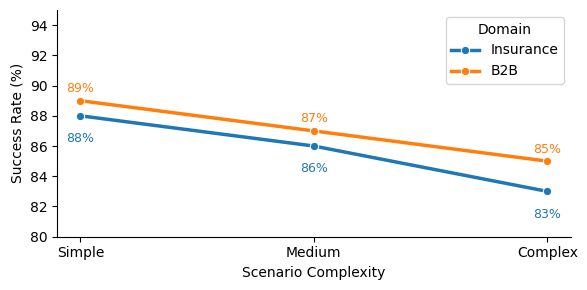
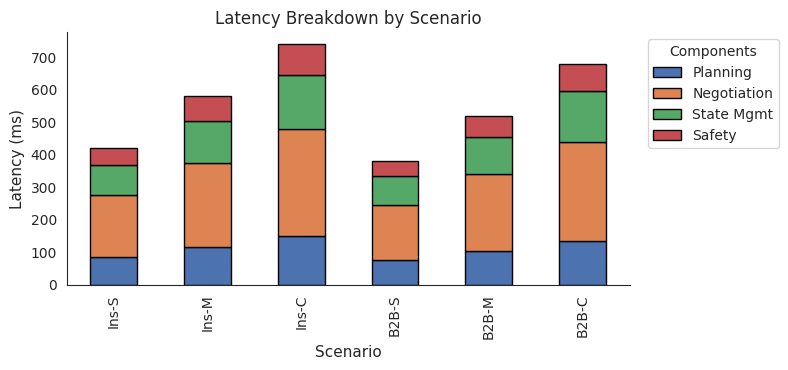
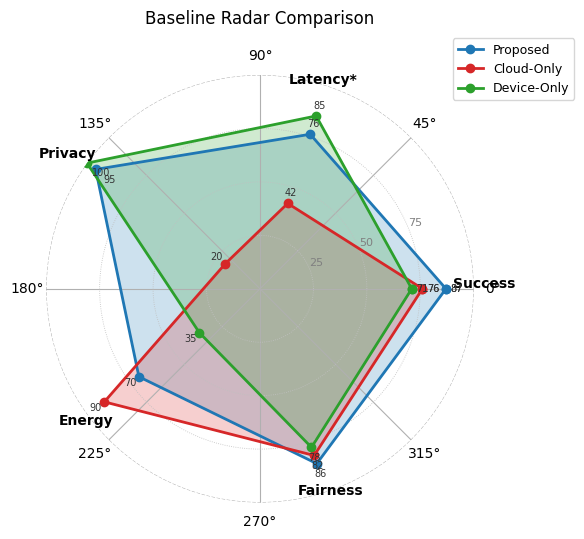
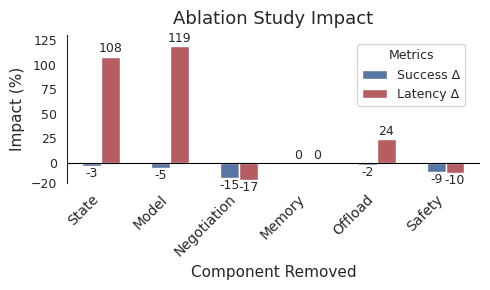
Automated negotiations in insurance and businessto-business (B2B) commerce encounter substantial challenges. Current systems force a trade-off between convenience and privacy by routing sensitive financial data through centralized servers, increasing security risks, and diminishing user trust. This study introduces a device-native autonomous Agentic AI system for privacy-preserving negotiations. The proposed system operates exclusively on user hardware, enabling real-time bargaining while maintaining sensitive constraints locally. It integrates zero-knowledge proofs to ensure privacy and employs distilled world models to support advanced on-device reasoning. The architecture incorporates six technical components within an Agentic AI workflow. Agents autonomously plan negotiation strategies, conduct secure multi-party bargaining, and generate cryptographic audit trails without exposing user data to external servers. The system is evaluated in insurance and B2B procurement scenarios across diverse device configurations. Results show an average success rate of 87%, a 2.4× reduction in latency relative to cloud baselines, and strong privacy preservation through zero-knowledge proofs. User studies show 27% higher trust scores when decision trails are available. These findings establish a foundation for trustworthy autonomous agents in privacy-sensitive financial domains.
Insurance and business-to-business (B2B) commerce typically rely on static pricing models, offering customers fixed quotes that do not allow for negotiation. For example, health insurance applicants cannot trade higher deductibles for lower premiums, and procurement managers cannot negotiate bulk discounts in real time. Although manual bargaining is possible, it remains slow, inconsistent, and generally limited to highvalue transactions, which leads to rigid, often suboptimal pricing decisions.
Autonomous agents present a promising direction to address these limitations [1], [2]. In bilateral negotiations, buyer and seller agents conduct real-time bargaining on behalf of their principals. Buyers can specify constraints, such as a maximum budget and acceptable trade-offs, while the agents manage the negotiation process automatically. However, several significant challenges persist: privacy (users must not disclose financial constraints to external servers), explainability (regulatory requirements mandate decision transparency [3]), resource limitations (restricting on-device algorithm complexity), and fairness (preventing exploitative agreements [4]).
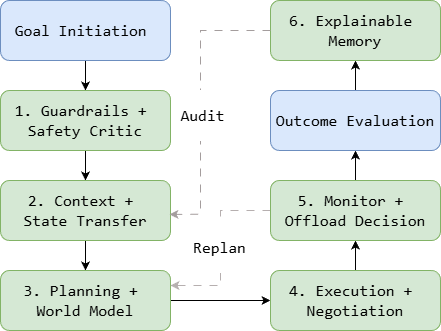
This work introduces a device-native Agentic AI system for autonomous negotiations. The proposed approach converts static pricing into privacy-preserving bargaining through a sixlayer architecture that addresses these challenges through (1) Selective state transfer, (2) Explainable memory, (3) World model distillation [5], (4) Privacy-preserving protocols with zero-knowledge proofs [6], (5) Model-aware offloading, and (6) Simulation-critic safety mechanisms.
Recent frameworks have advanced autonomous AI reasoning. ReAct [1] integrates reasoning and acting within language models. AutoGPT [2] sequences large language model (LLM) calls to address complex tasks. LangChain [7] provides tools for constructing agent applications. Although these systems demonstrate autonomous capabilities, they share limitations. All depend on cloud infrastructure for execution and lack privacy-preserving mechanisms. None supports bilateral negotiation protocols or runs on resource-constrained devices.
Game theory provides foundational principles for automated negotiation. Nash bargaining [4] defines fair outcomes in bilateral settings. Rubinstein’s alternating offers model [8] describes sequential bargaining dynamics. These theoretical frameworks inform the protocol design presented in this work.
Recent multi-agent systems demonstrate potential for agent cooperation. MetaGPT [9] assigns distinct roles to collaborating agents, while CAMEL [10] facilitates communication through role-playing mechanisms. However, these systems primarily address collaborative task completion rather than bilateral negotiation involving competing interests. Privacy considerations are minimally addressed in their designs.
Zero-knowledge proofs facilitate private computation without disclosing underlying data [11]. zk-SNARKs [6] enable efficient proof generation suitable for practical deployment. Recent research applies these techniques to machine learning [12]. The present work integrates them into negotiation protocols. This allows agents to demonstrate constraint satisfaction without revealing the constraints themselves.
Research in explainable AI demonstrates that audit trails improve user trust [13]. LIME and SHAP [14] provide post-hoc explanations for model predictions. Financial AI systems must comply with regulations that require decision transparency [3].
Current agent systems lack cryptographic auditability, as decision logs typically consist of informal text traces without verifiability guarantees. The proposed explainable memory system employs Merkle trees for tamper-evident logging and utilizes blockchain anchoring to enable independent verification.
Table I summarizes the comparison. The proposed framework combines autonomous reasoning, privacy-preserving negotiation, and cryptographic explainability within a devicenative architecture.
This section presents the device-native Agentic AI architecture for autonomous negotiations. The workflow is described first, followed by detailed explanations of the 6 components.
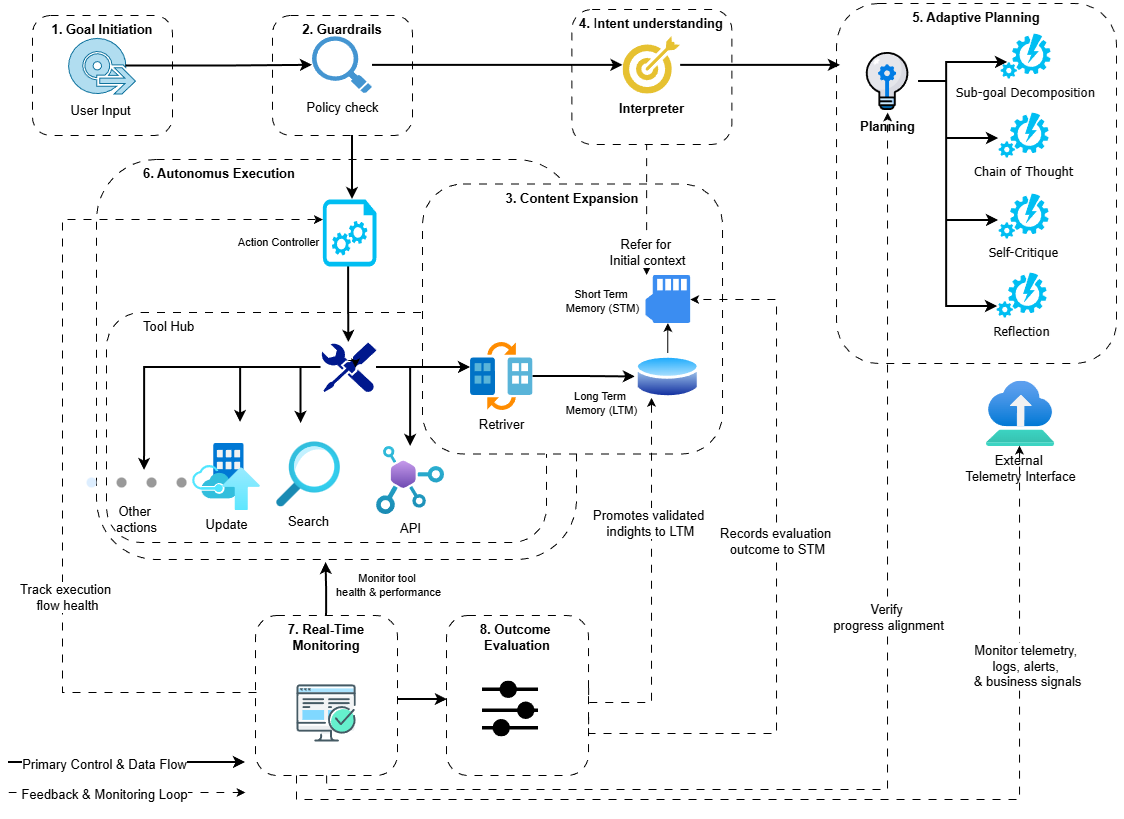
Figure 1 illustrates the eight-step Agentic AI workflow that governs negotiation behavior. The process begins with users defining negotiation objectives in the Goal Initiation, where target price ranges and acceptable tradeoffs are specified. In the subsequent Guardrails phase, these goals are validated against policy constraints to ensure adherence to budget limits and regulatory compliance.
In the Context Expansion, relevant information is retrieved from both short-term memory (STM) and long-term memory (LTM). STM stores the current negotiation state, whereas LTM contains records of past transactions, learned preferences, and domain-specific knowledge. The Intent Understanding interprets the negotiation goal within this expanded context, identifies the negotiation type, and
This content is AI-processed based on open access ArXiv data.