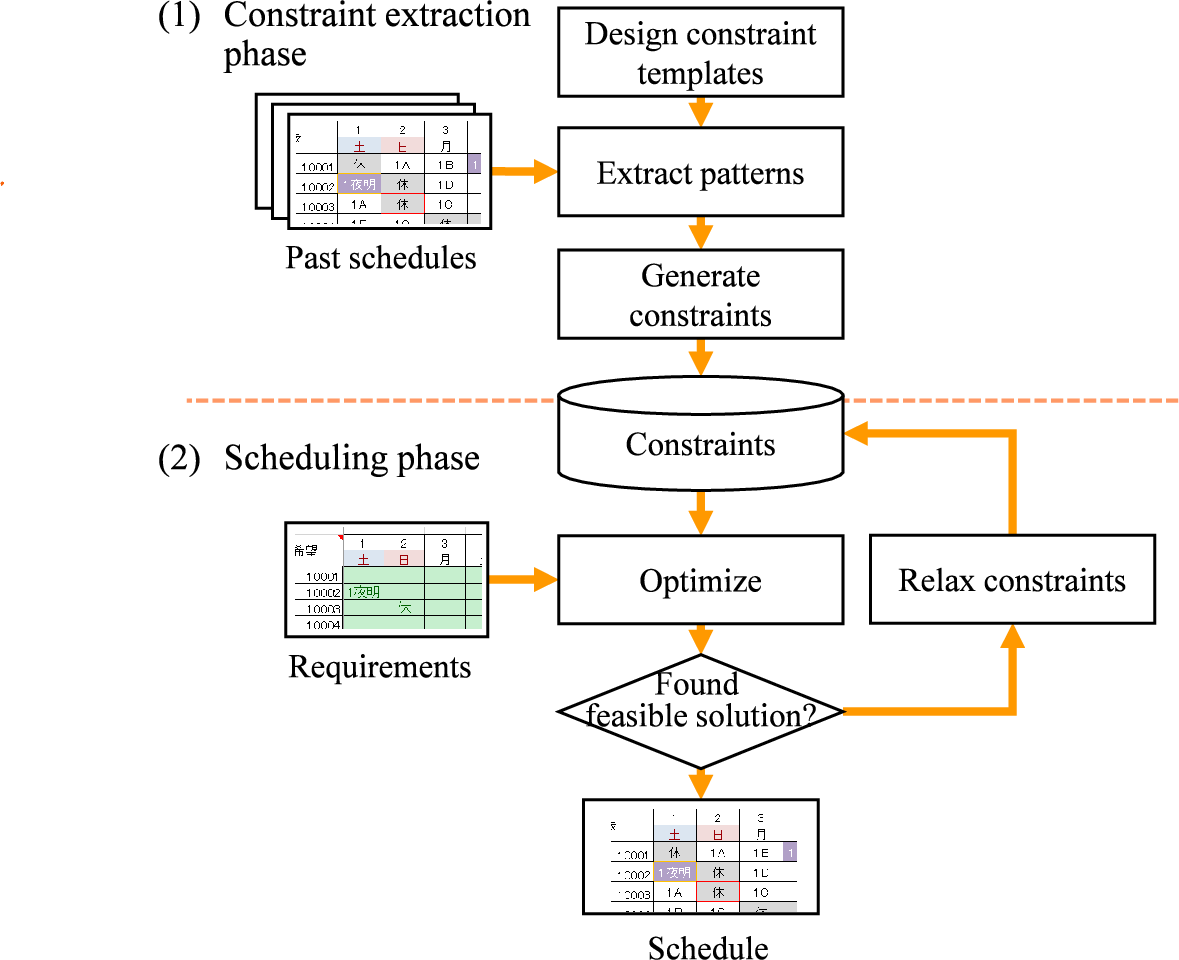
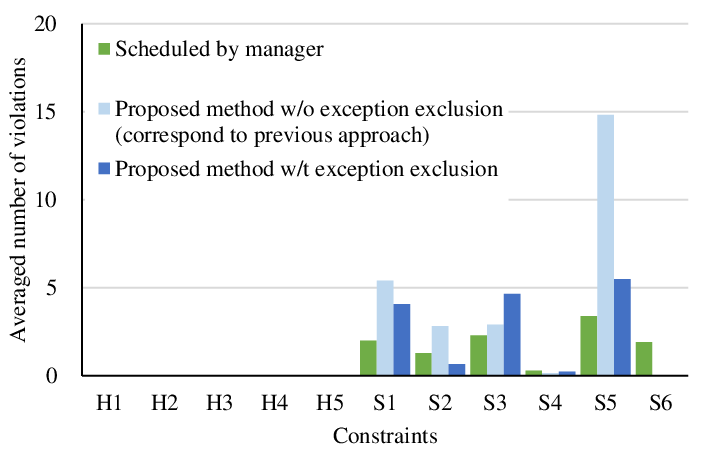
Technologies for automatically generating work schedules have been extensively studied; however, in long-term care facilities, conditions vary between facilities, making it essential to interview the managers who create shift schedules to design facility-specific constraint conditions. The proposed method utilizes constraint templates to extract combinations of various components, such as shift patterns for consecutive days or staff combinations. The templates can extract a variety of constraints by changing the number of days and the number of staff members to focus on and changing the extraction focus to patterns or frequency. In addition, unlike existing constraint extraction techniques, this study incorporates mechanisms to exclude exceptional constraints. The extracted constraints can be employed by a constraint programming solver to create care worker schedules. Experiments demonstrated that our proposed method successfully created schedules that satisfied all hard constraints and reduced the number of violations for soft constraints by circumventing the extraction of exceptional constraints.
The nursing care industry has recently been facing a severe labor shortage, and reducing staff turnover has become a critical issue alongside efforts to recruit new personnel. Creating work shifts that satisfy staffing demands is an essential measure for attracting personnel and retaining employees [1,7]. Care worker scheduling resembles nurse scheduling problems (NSP) [4]; each must consider primary constraints, such as the number of staff needed, each staff member's workdays, work hours, and leave requests, and additional factors such as interpersonal relationships among the staff. Creating a care worker schedule typically requires an entire workday.
Technologies for automatically generating work schedules have been extensively studied [4]; however, in longterm care facilities, conditions differ significantly across facilities, and it is necessary to define constraints for each. Consequently, many interviews are required to obtain sufficient constraints to create a schedule automatically. Such interviews are a heavy burden for the facilities, which has hindered the introduction of the work schedule generation system, and very few facilities have introduced such a system [3]. Furthermore, compared to nurse scheduling, care worker scheduling is subject to various constraints, such as the number of available shifts varying significantly from person to person, the qualification status of staff varying, and many part-time staff working short hours. This study proposes a method for extracting constraints from past schedules and generating care worker schedules using the extracted constraints. The proposed method employs constraint templates to extract combinations of various components, such as shift patterns for consecutive days or staff combinations. In addition, unlike existing constraint extraction techniques, this study incorporates mechanisms to exclude exceptional constraints. That is, in past schedules, if there were days or a staff member with many leave requests, shifts assigned to them to compensate for staff shortages-despite being undesirable-are excluded from constraint analysis.
2 Related work
Care worker scheduling problems are typically categorized into home-and facility-based types [1]. The homebased type involves problems of determining dates and times for service and the period of service provided to a person in need of home care services. The facility-based type involves problems of determining shift assignments that respect staff leave requests and other preferences while promoting fairness in the working environment. Compared with NSPs, facility-type care worker scheduling problems are often over-constrained, making it difficult to obtain feasible solutions due to budget limitations and staffing shortages. Therefore, this study focuses on care worker scheduling problems in facilities. Kurokawa et al. solved the problems of maximizing overall sales by accumulating services by packing as many as possible into the hours when helpers are on duty while maintaining fairness in the working environment. They used genetic algorithms, differential evolution, tabu search, and quasi-annealing methods and compared the results [7]. Sakaguchi et al. proposed a schedule planning and caregiver assignment method that equalizes the workload of each care worker [9].
Research on the automatic design of constraints from past solutions has recently emerged. Constraints are essential when formulating real-world problems. Fajemisin et al. formalized the process of learning constraints from data, and reviewed recent literature on constraint learning [5].
Studies have also begun to be conducted on NSPs [6]. Paramonov et al. proposed a method for extracting constraints from two-dimensional tabular data using constraint templates [8]. Their method aggregates data within specific blocks and extracts element counts and combinations according to specified criteria. Kumar et al. proposed a method for extracting constraints from multidimensional design variables using tensor expressions [6]. This method uses aggregate functions to extract constraints that include numerical terms. Ben et al. focused on NSP’s dynamic characteristics, including unpredictable and unforeseen events such as accidents and nurses’ sick leave. They proposed a method for automatically and implicitly learning NSP’s constraints and preferences from available historical data without prior knowledge [2].
Although these previous studies have examined methods for extracting diverse constraints, the problem of identifying undesirable patterns within the extracted constraints remains underexplored.
3 The proposed method
This paper proposes a method to extract constraints from past schedules of a long-term care facility for elderly individuals using constraint templates and to generate a monthly daily care worker schedule based on the extracted constraints. Following are the key ideas of the proposed method.
Idea 1: Extracting constraints from past
This content is AI-processed based on open access ArXiv data.