Title: Evaluating the Impact of Compression Techniques on the Robustness of CNNs under Natural Corruptions
ArXiv ID: 2512.24971
Date: 2025-12-31
Authors: Itallo Patrick Castro Alves Da Silva, Emanuel Adler Medeiros Pereira, Erick de Andrade Barboza, Baldoino Fonseca dos Santos Neto, Marcio de Medeiros Ribeiro
📝 Abstract
Compressed deep learning models are crucial for deploying computer vision systems on resource-constrained devices. However, model compression may affect robustness, especially under natural corruption. Therefore, it is important to consider robustness evaluation while validating computer vision systems. This paper presents a comprehensive evaluation of compression techniques-quantization, pruning, and weight clustering-applied individually and in combination to convolutional neural networks (ResNet-50, VGG-19, and MobileNetV2). Using the CIFAR-10-C and CIFAR-100-C datasets, we analyze the trade-offs between robustness, accuracy, and compression ratio. Our results show that certain compression strategies not only preserve but can also improve robustness, particularly on networks with more complex architectures. Utilizing multiobjective assessment, we determine the best configurations, showing that customized technique combinations produce beneficial multiobjective results. This study provides insights into selecting compression methods for robust and efficient deployment of models in corrupted real-world environments.
💡 Deep Analysis
📄 Full Content
Evaluating the Impact of Compression Techniques
on the Robustness of CNNs under Natural
Corruptions
1st Itallo Patrick Castro Alves Da Silva
Computing Institute
Federal University of Alagoas
Macei´o, Brazil
0009-0008-8543-7776
2nd Emanuel Adler Medeiros Pereira
Center of Technology
Federal University of Rio Grande do Norte
Natal, Brazil
0000-0002-6694-5336
3rd Erick de Andrade Barboza
Computing Institute
Federal University of Alagoas
Macei´o, Brazil
0000-0002-0558-9120
4th Baldoino Fonseca dos Santos Neto
Computing Institute
Federal University of Alagoas
Macei´o, Brazil
0000-0002-0730-0319
5th M´arcio de Medeiros Ribeiro
Computing Institute
Federal University of Alagoas
Macei´o, Brazil
0000-0002-4293-4261
Abstract—Compressed deep learning models are crucial for
deploying computer vision systems on resource-constrained de-
vices. However, model compression may affect robustness, es-
pecially under natural corruption. Therefore, it is important
to consider robustness evaluation while validating computer
vision systems. This paper presents a comprehensive evaluation
of compression techniques—quantization, pruning, and weight
clustering—applied individually and in combination to convolu-
tional neural networks (ResNet-50, VGG-19, and MobileNetV2).
Using the CIFAR-10-C and CIFAR-100-C datasets, we analyze
the trade-offs between robustness, accuracy, and compression
ratio. Our results show that certain compression strategies not
only preserve but can also improve robustness, particularly on
networks with more complex architectures. Utilizing multiobjec-
tive assessment, we determine the best configurations, showing
that customized technique combinations produce beneficial multi-
objective results. This study provides insights into selecting
compression methods for robust and efficient deployment of
models in corrupted real-world environments.
Index Terms—System Validation, Machine Learning, Image
Classification, Robustness, Compression Techniques, Edge AI,
TinyML.
I. INTRODUCTION
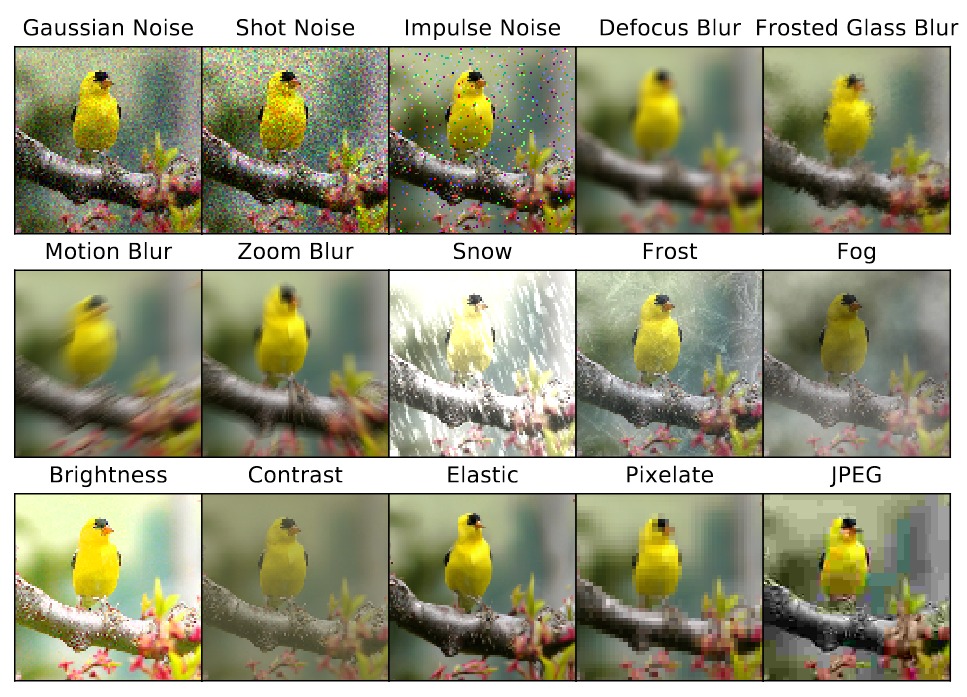
Humans can adapt to changes in image structures and
styles, including snow, blur, and pixelation; however, computer
vision models struggle with such variations. Consequently,
the performance of the model decreases when the input
is naturally distorted, which poses challenges in practical
settings where such distortions are inevitable. For example,
autonomous vehicles must handle diverse conditions such as
fog, frost, snow, sandstorms, or falling leaves to accurately
read traffic signs. However, predicting all natural conditions is
not feasible. Therefore, evaluating the robustness of the model
This study was financially supported by the National Council for Scientific
and Technological Development (CNPq) project grant 404825/2023-0.
is crucial to validate the reliability of computer vision and
machine learning systems in safety-critical contexts [1].
The robustness of models against different types of per-
turbation has been a studied topic in the machine learning
community. Natural corruptions, which are an important type
of disturbance, are common in real scenarios and can reduce
the accuracy of models, so their study has been widely carried
out [1]–[3]. Models are sometimes deployed on resource-
limited devices, such as embedded systems and smartphones,
necessitating a reduction in model size while maintaining ac-
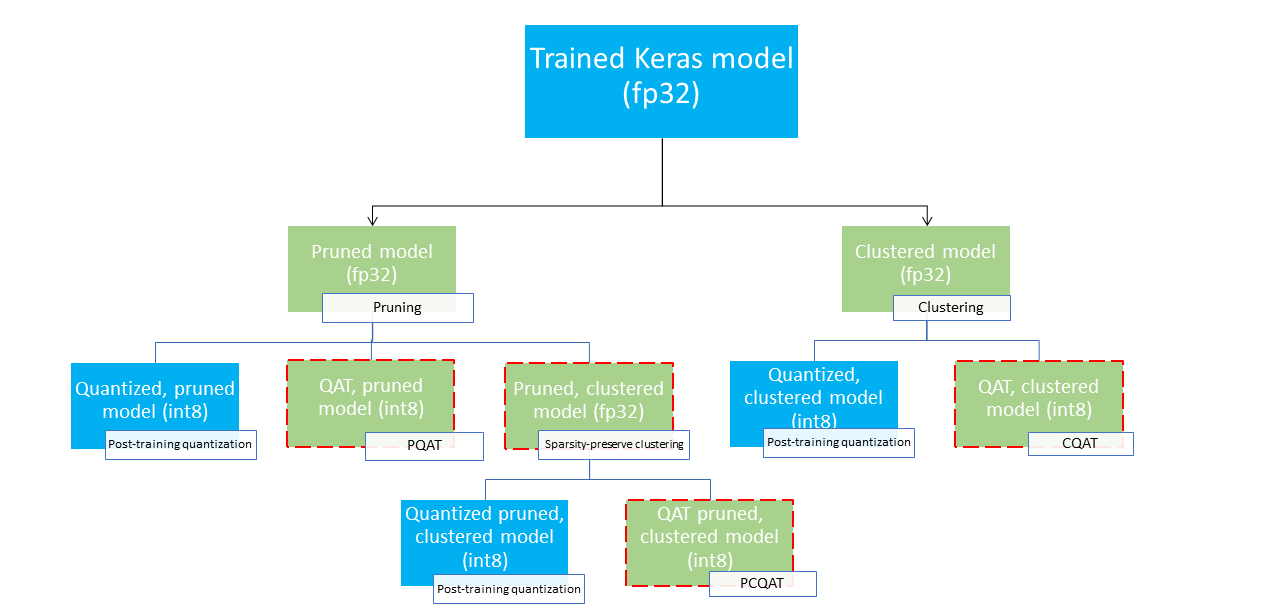
curacy. Techniques such as pruning (sparsity) [4], quantization
[5], and weight sharing (clustering) [6] have been suggested
for this purpose. These methods can be used individually or
in combination to take advantage of their unique strengths in
reducing the size of the model [7].
Therefore, it is important to study the robustness of these
compressed models against natural corruptions, as they will
be used in environments prone to corrupted images, exposing
potential vulnerabilities. Works such as [8]–[11] applied com-
pression techniques to machine learning models and evaluated
the robustness of these optimized models. Although [11] ap-
plies two or more successive techniques to reduce model, their
study focuses on robustness against adversarial attacks, and the
combinations of techniques explored were more limited.
The purpose of this study is to analyze the impact of
model compression techniques on robustness against natural
corruption. From there, analyze the impact of these compres-
sion techniques in relation to different models and also how
robustness relates to other important metrics in relation to the
compressed model. Our main contributions are as follows.
• Evaluate the impact of compression techniques and their
combinations on robustness under natural corruptions of
models with different architectures.
arXiv:2512.24971v1 [cs.CV] 31 Dec 2025
• Evaluate the trade-off between robustness, accuracy, and
compression ratio.
The structure of this paper is as follows: Section II surveys
the literature pertinent to our research. Section III outlines
the corruptions, compression methods, models, and evaluation
criteria.