Title: Expert System for Bitcoin Forecasting: Integrating Global Liquidity via TimeXer Transformers
ArXiv ID: 2512.22326
Date: 2025-12-26
Authors: Sravan Karthick T
📝 Abstract
Bitcoin price forecasting is characterized by extreme volatility and non-stationarity, often defying traditional univariate time-series models over long horizons. This paper addresses a critical gap by integrating Global M2 Liquidity, aggregated from 18 major economies, as a leading exogenous variable with a 12-week lag structure. Using the TimeXer architecture, we compare a liquidity-conditioned forecasting model (TimeXer-Exog) against state-of-the-art benchmarks including LSTM, N-BEATS, PatchTST, and a standard univariate TimeXer. Experiments conducted on daily Bitcoin price data from January 2020 to August 2025 demonstrate that explicit macroeconomic conditioning significantly stabilizes long-horizon forecasts. At a 70-day forecast horizon, the proposed TimeXer-Exog model achieves a mean squared error (MSE) 1.08e8, outperforming the univariate TimeXer baseline by over 89 percent. These results highlight that conditioning deep learning models on global liquidity provides substantial improvements in long-horizon Bitcoin price forecasting.
💡 Deep Analysis
📄 Full Content
Expert System for Bitcoin Forecasting: Integrating
Global Liquidity via TimeXer Transformers
Sravan Karthick T∗
RV College of Engineering (RVCE), Bengaluru, India
Rakshita A
RV College of Engineering (RVCE), Bengaluru, India
Dr. Minal Moharir
RV College of Engineering (RVCE), Bengaluru, India
Abstract
Bitcoin price forecasting is characterized by extreme volatility and non-stationarity, making
it hard for univariate time-series prediction models over long-horizons. By integrating Global
M2 Liquidity as an exogenous variable, aggregated from 18 major economies, we improve the
predictions over long-horizons.
Using TimeXer, we compare a liquidity-conditioned univariate forecasting model (TimeXer-
Exog) against state-of-the-art univariate models, Long Short-Term Memory(LSTM), Neural
Basis Expansion Analysis for interpretable Time-Series (N-BEATS), Patch Time-Series Trans-
former(PatchTST), and standard TimeXer. Experiments conducted on daily Bitcoin price data
from January 2020 to August 2025 demonstrate that explicit macroeconomic conditioning sig-
nificantly stabilizes long-horizon forecasts.
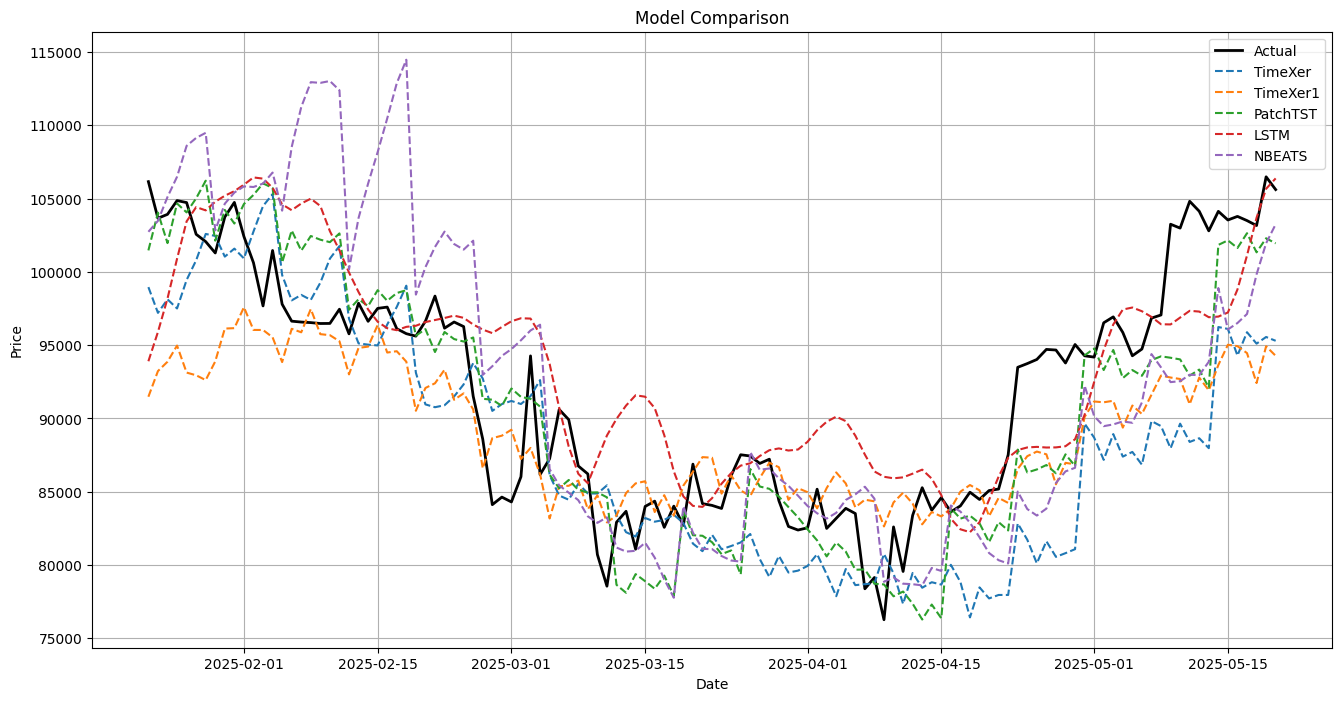
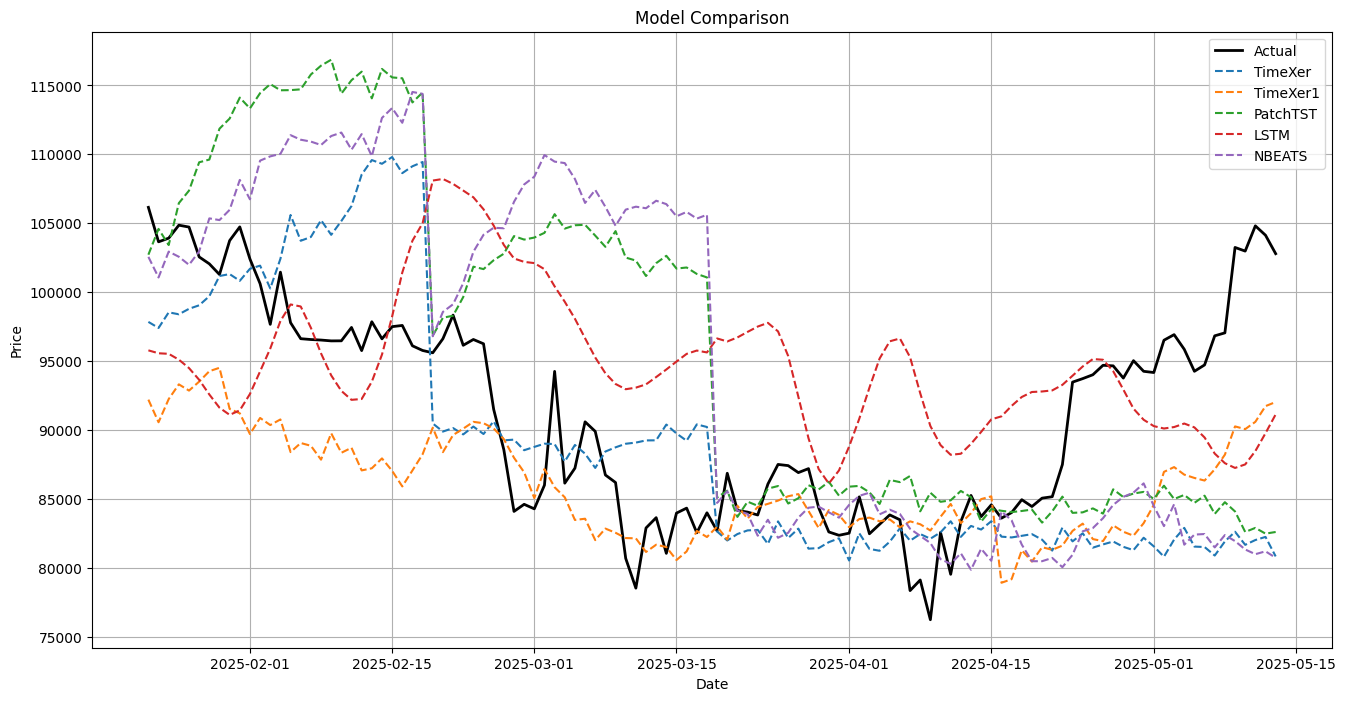
At a 70-day forecast horizon, the proposed TimeXer-Exog model achieves a Mean Squared
Error (MSE) of 10.814, scaled by 107, which outperformed the univariate TimeXer baseline
by over 89%. The results show that explicitly conditioning deep learning models on Global
Liquidity as an exogenous variable gives substantial improvements in long-horizon Bitcoin price
forecasting.
Keywords: Bitcoin forecasting, Global liquidity, TimeXer, Transformers, Deep learning, Macroe-
conomic conditioning, Long-horizon forecasting
1
Introduction
Early attempts to forecast Bitcoin prices were made using statistical tools, especially the ARIMA
models (Sagheer et al., 2025; Xu, 2025). ARIMA is good at picking up short-term linear patterns,
like the ones in a relatively calm equity index over a few weeks. However, bitcoin does not behave
like that. Its price is noisy and very volatile, which statistical models and tools do not capture.
ARIMA requires stationarity and linear structure, which is exactly what bitcoin lacks. Large rallies,
sudden crashes, or regime shifts often get smoothed away (Pratas et al., 2023; Mizdrakovic, 2024).
∗Corresponding author. Email: sravankt.cs20@rvce.edu.in
1
arXiv:2512.22326v2 [cs.LG] 11 Jan 2026
As a result, these models can perform well over a short horizon, their accuracy drops once the
forecast horizon is about 60 or 90 days (Mousa, 2025; Kareem and Aue, 2025).
Researchers moved to RNN models, which were designed to handle sequences. Long Short-Term
Memory (LSTM) and Gated Recurrent Unit (GRU) models were successful in learning the non-
linear patterns from the data (Bagheri and Giudici, 2025; Xu, 2025). They can, for example, react
differently to a slow upward trend than to a sudden spike triggered by a regulatory headline. These
models are not perfect. Because they process data step by step, they scale poorly and struggle
when dependencies stretch far back in time. Capturing relationships across hundreds of days still
remains hard, and unreliable (Zhao et al., 2022; Zheng, 2025).
More recently, attention has shifted toward Transformer-based models, time series forecasting
moved to self-attention rather than strict sequence processing (Nie, 2022; Zhao et al., 2022). Instead
of remembering the past one step at a time, these models can look across an entire window at once.
PatchTST takes this idea further by breaking the time series into patches, small segments that
preserve local structure while keeping computation manageable (Nie, 2022). For time series fore-
casting which require long look-back windows, Transformer models have repeatedly outperformed
LSTM-based approaches, especially for long-horizon predictions (Nie, 2022; Zheng, 2025).
Long-term forecasting improves when models are allowed to look beyond price history itself.
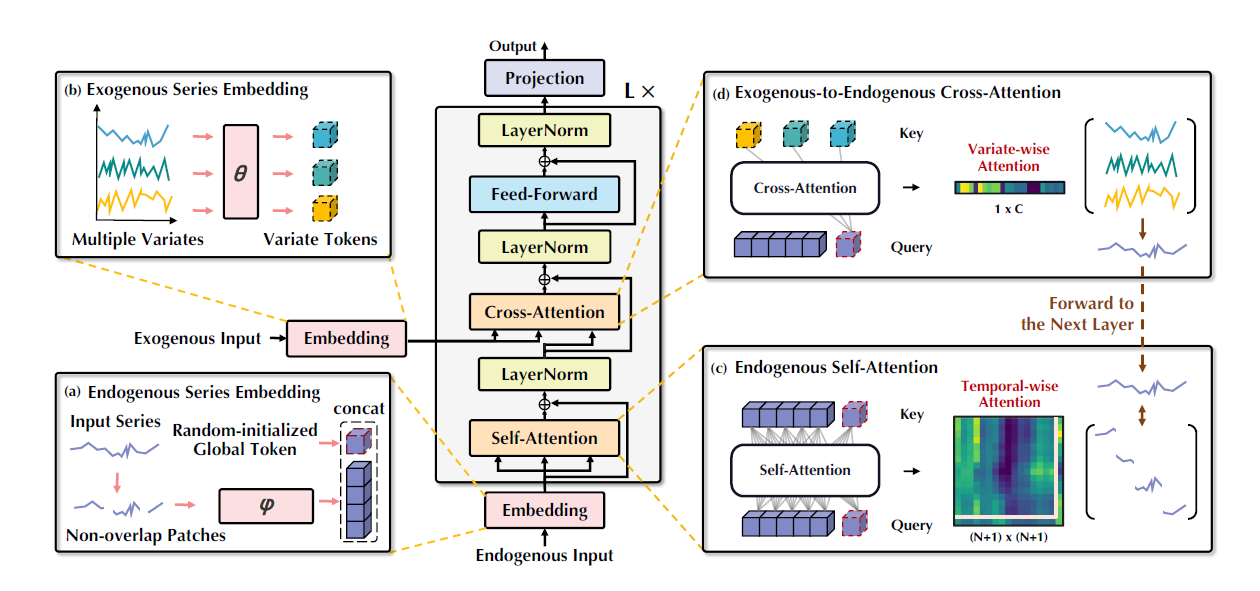
The TimeXer framework reflects this shift. It combines patch-wise attention for the main series with
cross-attention for external variables, making it possible to integrate data that arrive at different
frequencies and are not neatly aligned in time (Wang, 2024). This is closer to how real financial
systems operate. Macroeconomic indicators do not update on a daily basis, yet markets tend to
respond to them gradually and unevenly.
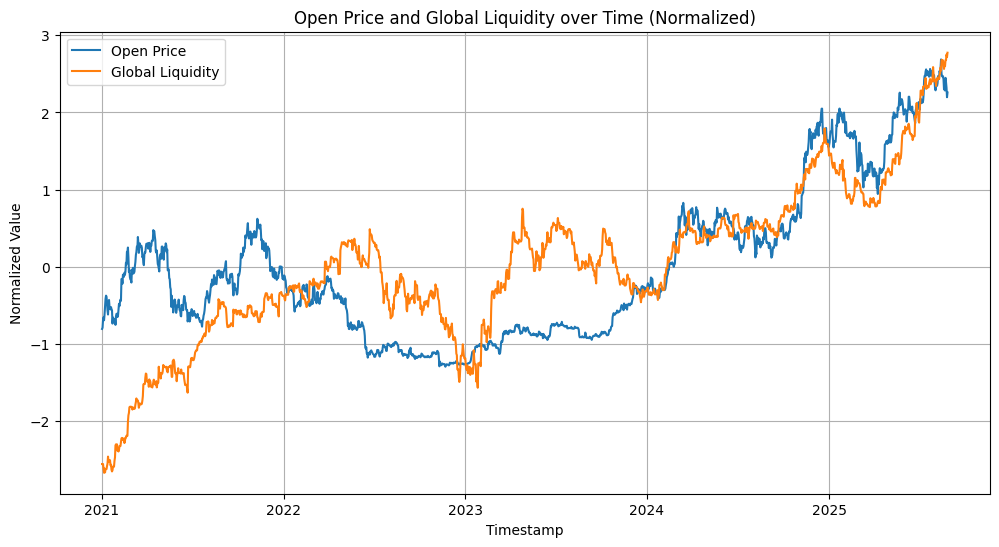
Global liquidity is often measured by M2 money supply, which has particularly attracted atten-
tion (Gu and Chen, 2025). Although the relationship is not perfectly stable, the logic is intuitive.
According to empirical work using time-varying Granger causality, the influence of M2 on Bitcoin
prices is not constant. It strengthens during expansionary regimes and weakens in other regimes
(Gu and Chen, 2025). Co-integration analyses go further by pointing towards a long-run equi-
librium relationship in which Bitcoin prices respond more than proportionally to liquidity growth
(Kokabian, 2025). It is important to note that these effects do not come into the pi