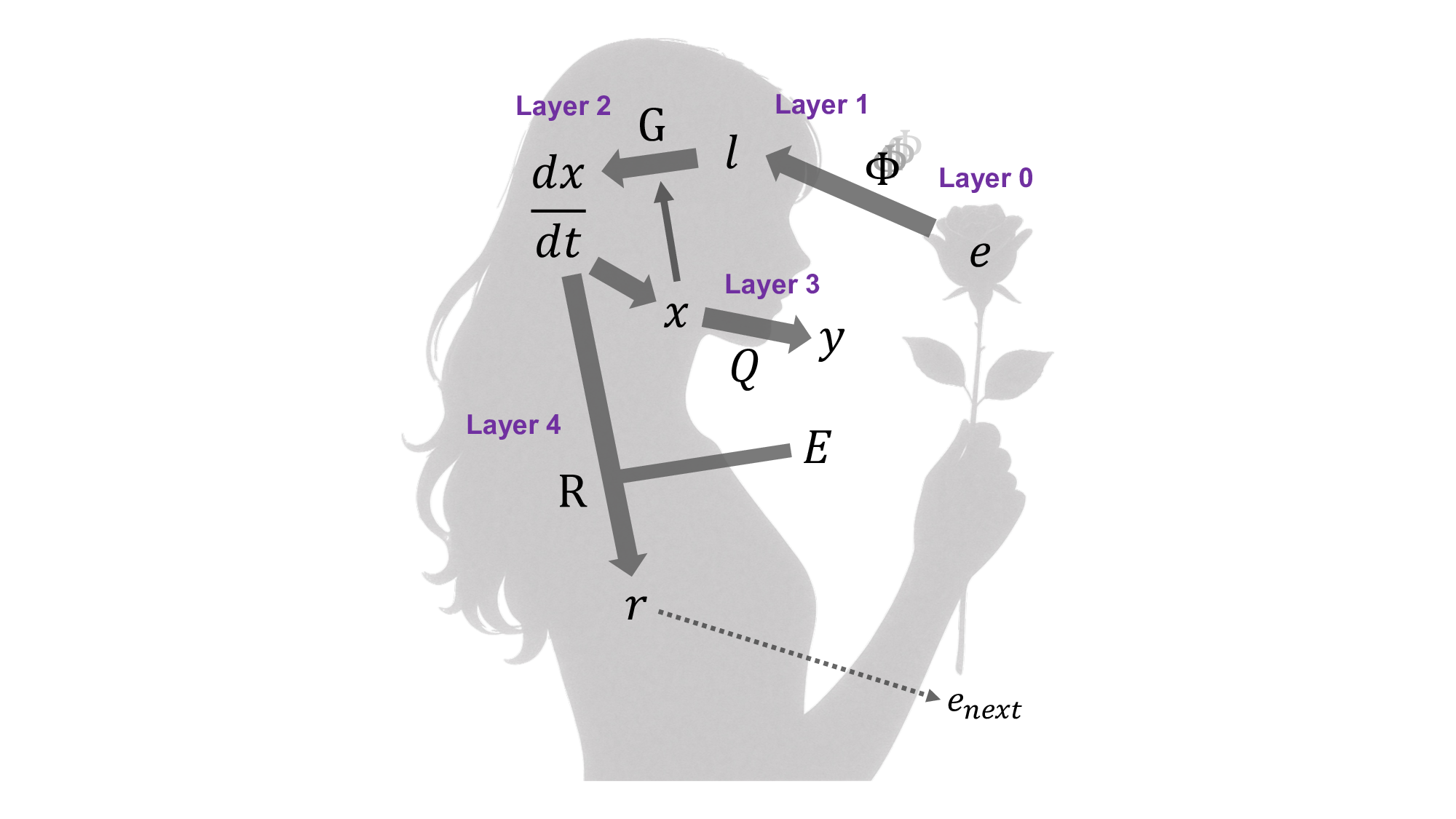
Understanding learning as a dynamic process is challenging due to the interaction of multiple factors, including cognitive load, internal state change, and subjective evaluation. Existing approaches often address these elements in isolation, limiting the ability to describe learning phenomena within a unified and structurally explicit framework. This paper proposes a multi-layer formal descriptive framework for learning dynamics. Rather than offering a predictive or prescriptive model, the framework introduces a symbolic language composed of state variables, mappings, and layer-specific responsibilities, enabling consistent description of learning processes without commitment to specific functional forms or optimization objectives. This descriptive framework is intended to serve as a structural substrate for analyzing learning processes in human learners, and by extension, in adaptive and Al-assisted learning systems. A central design principle is the explicit separation of descriptive responsibilities across layers, distinguishing load generation, internal understanding transformation, observation, and evaluation. Within this structure, cognitive load is treated as a relational quantity arising from interactions between external input and internal organization, while subjective evaluation is modeled as a minimal regulatory interface responding to learning dynamics and environmental conditions. By emphasizing descriptive clarity and extensibility, the framework provides a common language for organizing existing theories and supporting future empirical and theoretical work.
Learning is commonly described using fragmented perspectives: instructional design focuses on task structure, cognitive theories emphasize internal capacity limits, and motivational theories address persistence and disengagement. While each perspective captures important aspects of learning, they often operate with incompatible assumptions, vocabularies, and levels of abstraction.
As a result, it remains difficult to describe learning phenomena such as acceleration, stagnation, or withdrawal in a unified and structurally explicit manner, particularly without attributing outcomes directly to fixed personal traits such as ability or motivation.
This work is motivated by a simple but persistent question:
Can learning dynamics be described using a formal language that makes structural dependencies explicit, without committing to a specific predictive model?
Rather than proposing a new learning theory or algorithm, we aim to construct a descriptive symbolic framework that clarifies where and how different processes intervene in learning.
We propose a multi-layer formal framework designed explicitly as a language for describing learning dynamics.
The framework introduces:
• State variables representing internal understanding and generalizable capability
• Mappings that describe transformations between descriptively distinct layers
• A layered causal structure that enforces explicit separation of responsibilities Crucially, the framework is not intended to predict numerical outcomes. No specific functional forms are imposed, and no optimization criteria are assumed.
Instead, the goal is to provide a structural vocabulary that allows researchers and practitioners to:
• Distinguish between different sources of learning difficulty
• Identify where interventions act within the learning process
• Describe learning trajectories without reducing them to fixed traits or global explanations In this sense, the framework functions analogously to a programming language: it defines permissible structures and relations, as well as constraints on their use, rather than specific programs or solutions.
A central design principle of the proposed framework is the explicit separation of descriptive responsibilities across the entire learning process.
Rather than treating learning as a single explanatory mechanism, the framework decomposes it into distinct layers, each responsible for a specific descriptive role: the existence of external input, its decomposition relative to representational bases, the internal transformation of understanding over time, the externalization of internal state, and the modulation of the learning loop through subjective evaluation.
Within this structure, processes such as load generation and understanding dynamics are assigned to separate mappings with non-overlapping responsibilities. More generally, no layer is permitted to explain phenomena outside its designated scope. In particular, the framework prohibits interpreting load generation as learning, internal state change as evaluation, or persistence and withdrawal as properties of fixed learner traits.
By enforcing this separation, the framework avoids circular definitions and makes theoretical commitments explicit. It also enables existing theories, such as Cognitive Load Theory, to be situated as partial specifications operating within particular layers or mappings, rather than as competing end-to-end explanations of learning.
This principle of separation is not merely methodological, but structural: it defines what kinds of statements are admissible at each level of description, thereby providing a common language in which heterogeneous theories and observations can be related without conceptual collapse.
Several influential frameworks address parts of the learning process, yet each leaves structural gaps when considered in isolation.
Cognitive Load Theory (CLT) provides a powerful vocabulary for discussing limitations of working memory and instructional design. However, its focus lies primarily on task-level load categorization and optimization, offering limited means to describe how internal understanding states evolve over time.
Motivation theories, such as Self-Determination Theory, richly characterize psychological needs and motivational orientations, but often rely on latent constructs that are difficult to connect to observable learning dynamics or concrete intervention points.
Reinforcement learning models formalize reward-driven behavior with mathematical rigor, yet typically abstract away the internal representational changes that constitute understanding.
These approaches are not incorrect; rather, they operate at different descriptive layers of the learning process. What is missing is a shared descriptive language that can express how these layers relate and interact, without collapsing them into a single explanatory dimension. The issue is not the inadequacy of these approaches, but the absence of a common descri
This content is AI-processed based on open access ArXiv data.