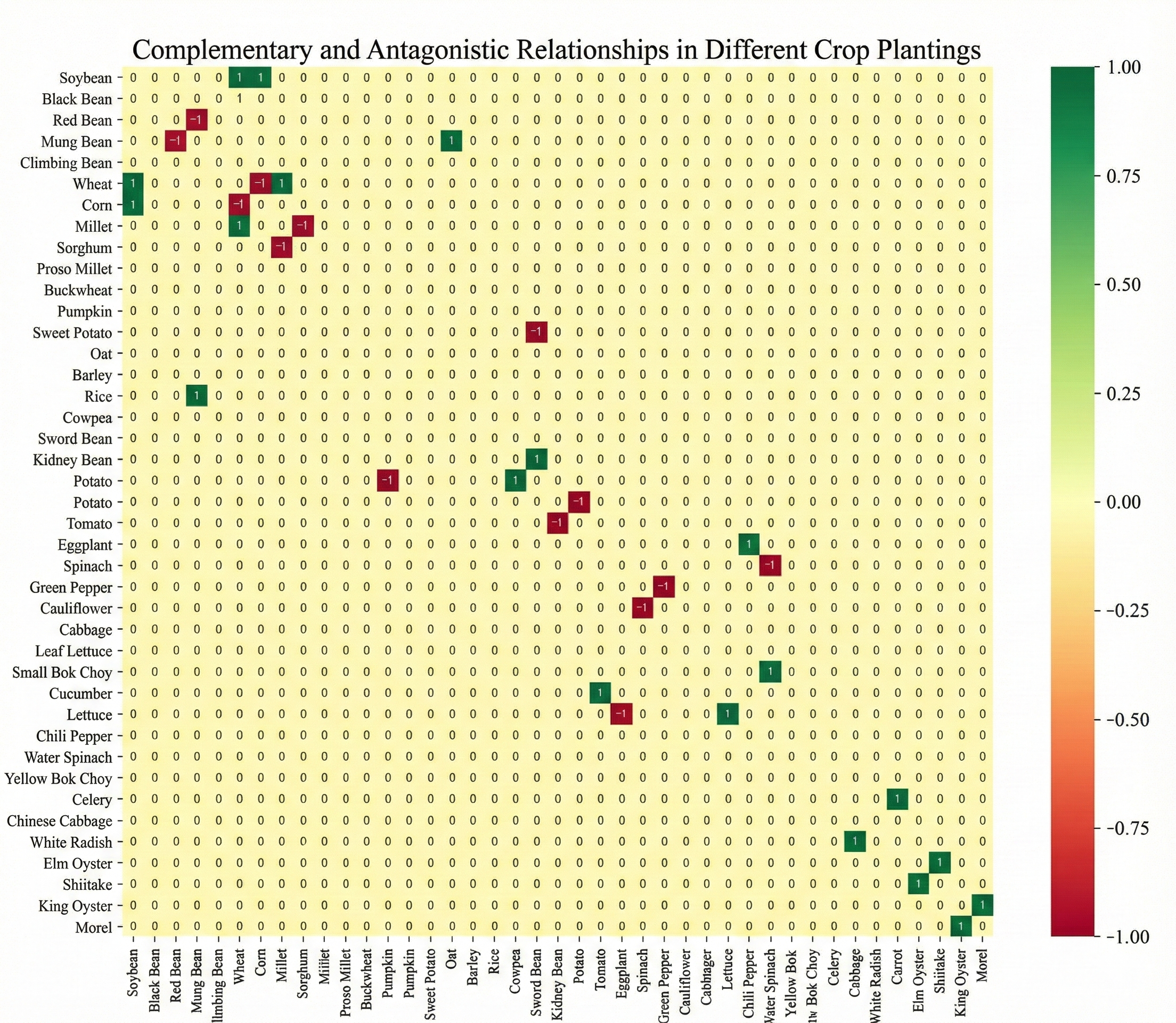
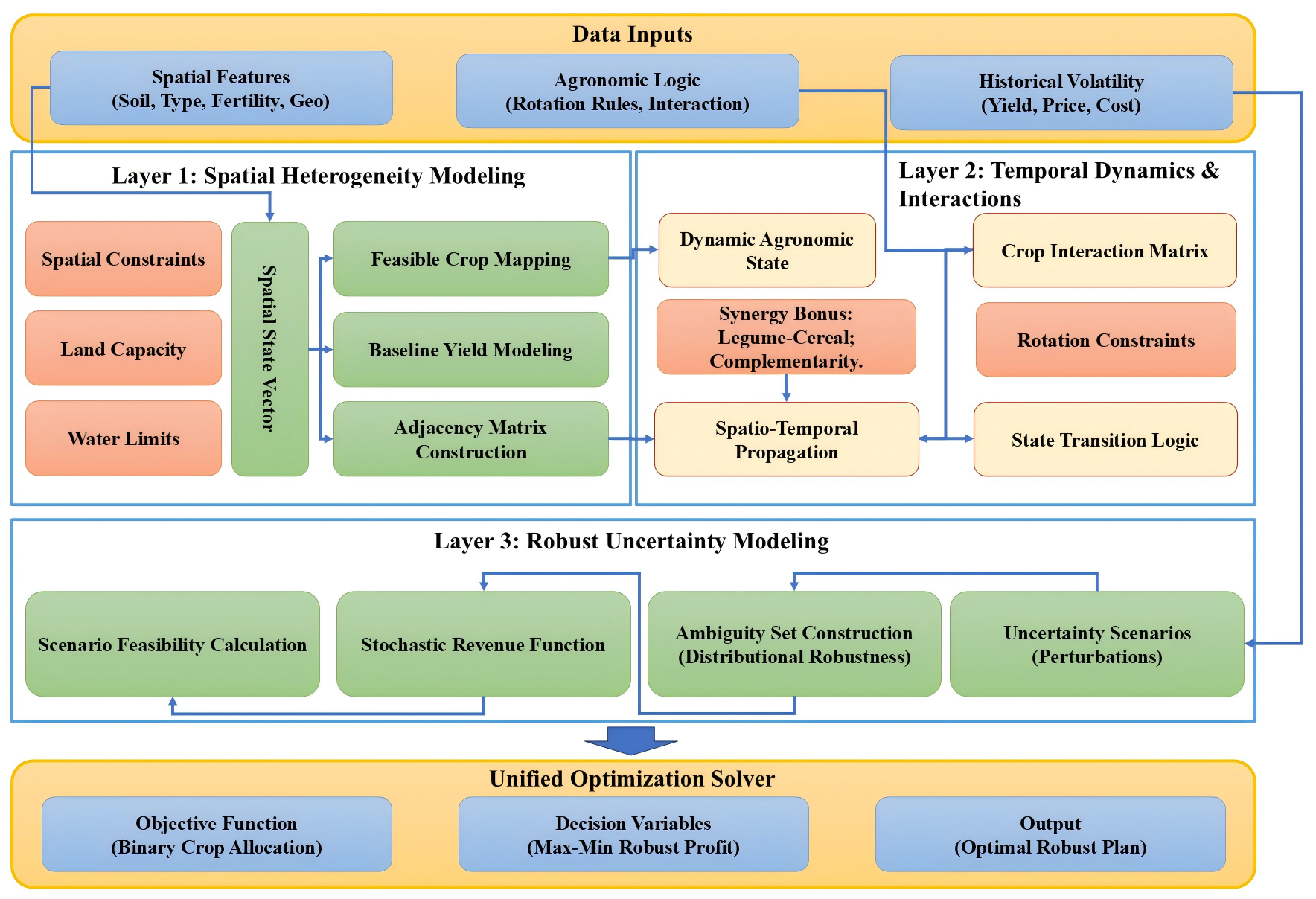
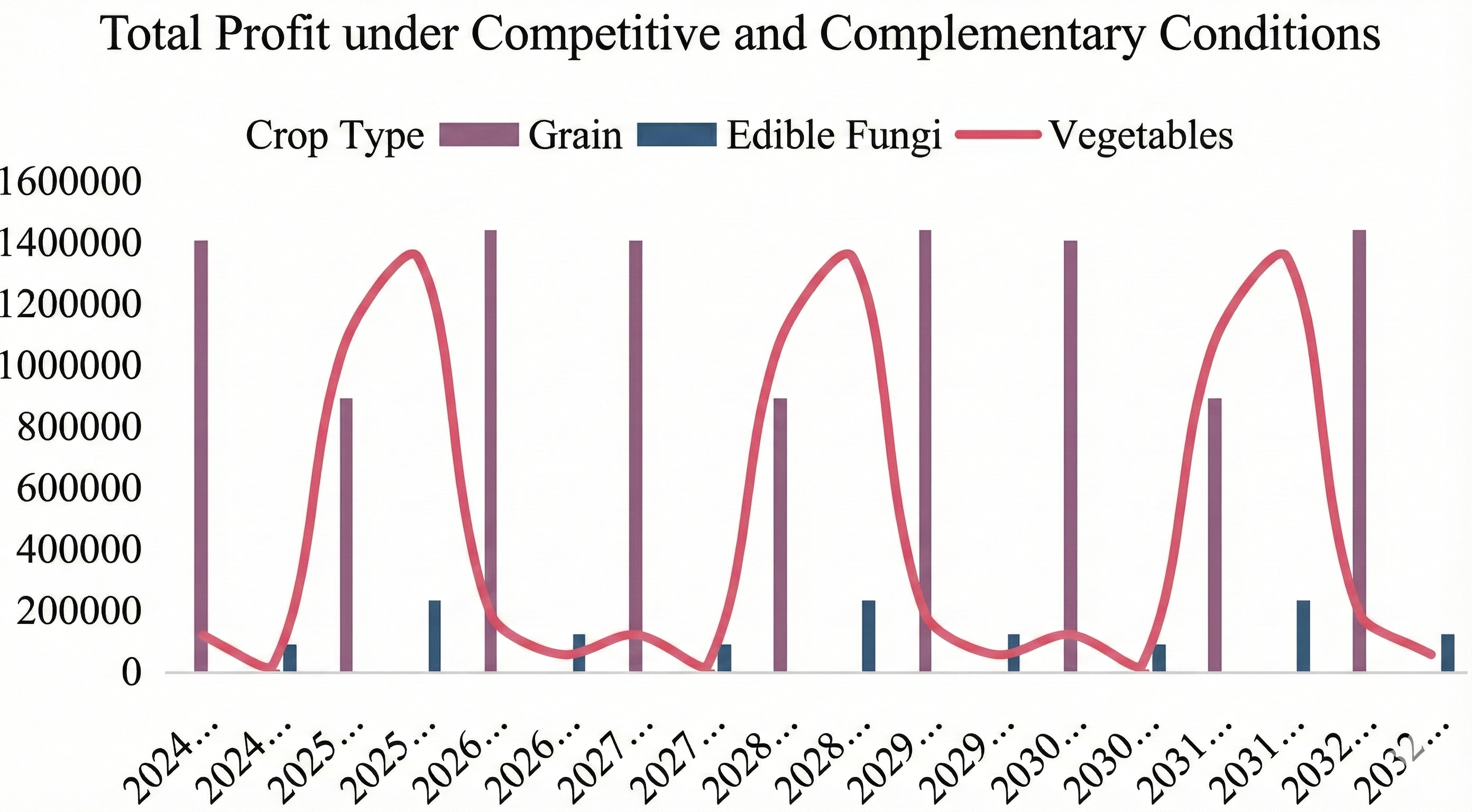
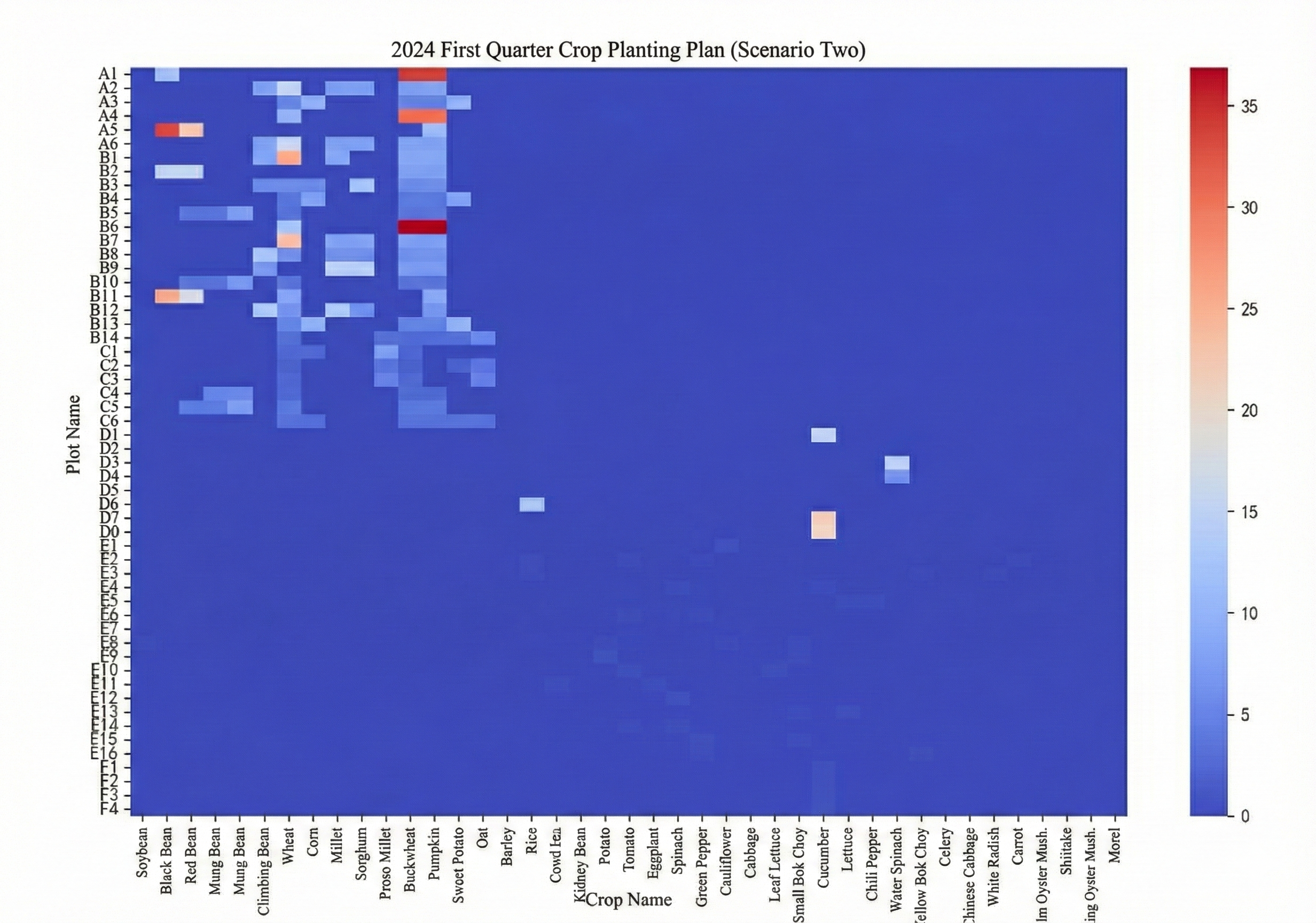
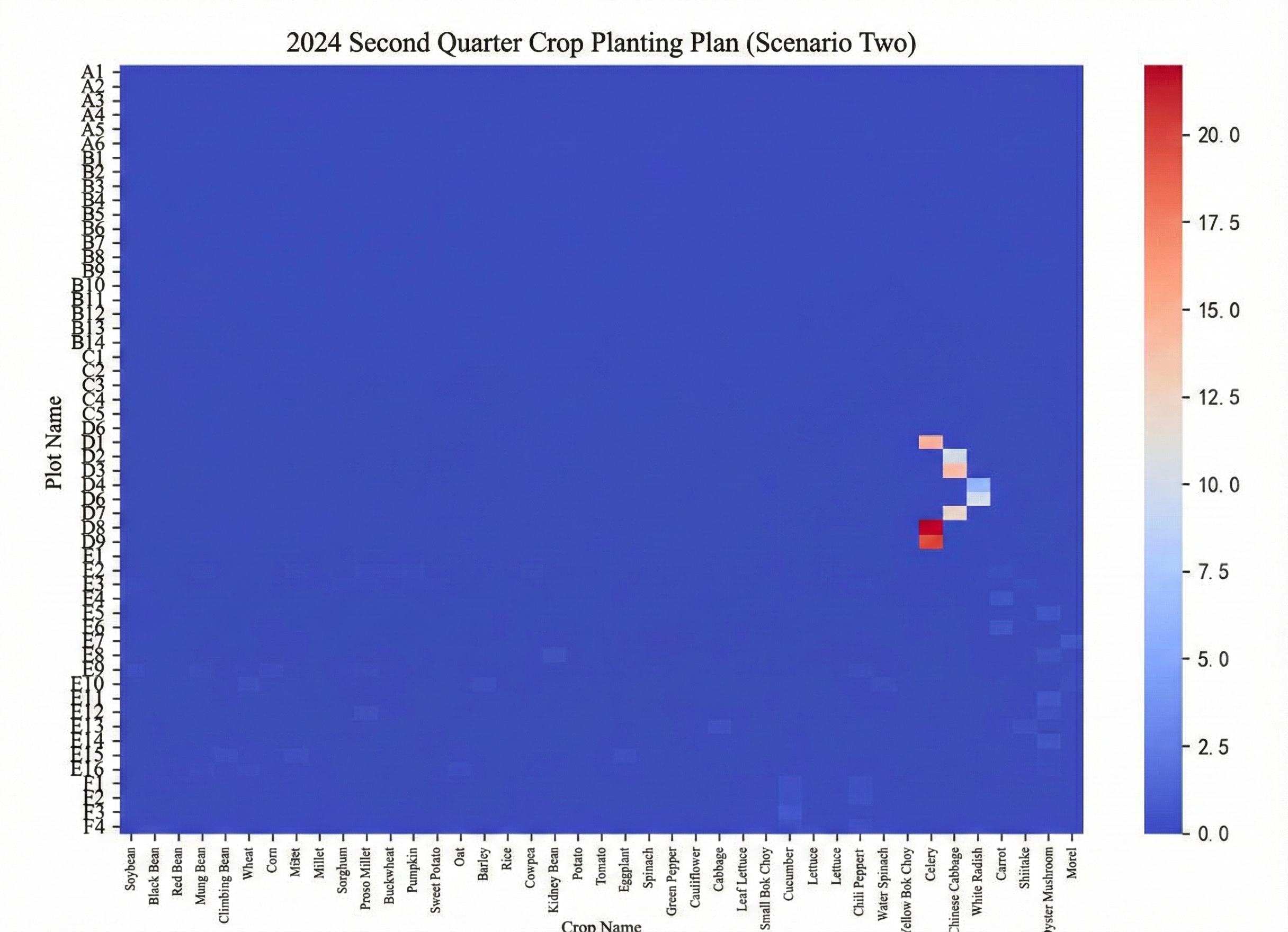
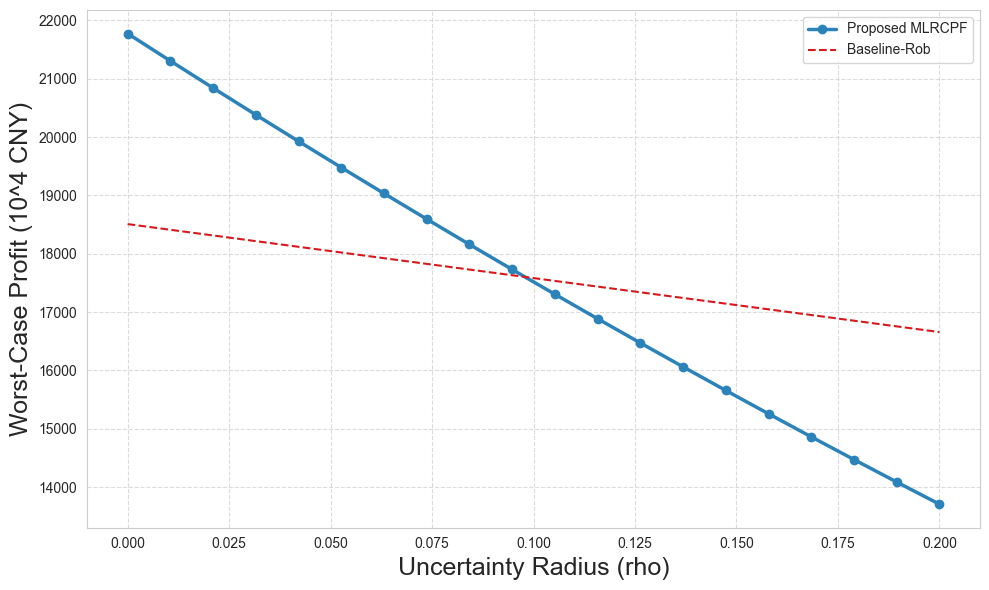
Long-horizon agricultural planning requires optimizing crop allocation under complex spatial heterogeneity, temporal agronomic dependencies, and multi-source environmental uncertainty. Existing approaches often treat crop interactions, such as legume-cereal complementarity, which implicitly or rely on static deterministic formulations that fail to guarantee resilience against market and climate volatility. To address these challenges, we propose a Multi-Layer Robust Crop Planning Framework (MLRCPF) that integrates spatial reasoning, temporal dynamics, and robust optimization. Specifically, we formalize crop-to-crop relationships through a structured interaction matrix embedded within the state-transition logic, and employ a distributionally robust optimization layer to mitigate worst-case risks defined by a data-driven ambiguity set. Evaluations on a real-world high-mix farming dataset from North China demonstrate the effectiveness of the proposed approach. The framework autonomously generates sustainable checkerboard rotation patterns that restore soil fertility, significantly increasing the legume planting ratio compared to deterministic baselines. Economically, it successfully resolves the trade-off between optimality and stability. These results highlight the importance of explicitly encoding domain-specific structural priors into optimization models for resilient decision-making in complex agricultural systems.
Agricultural production is undergoing a transition from experience-driven decision making to data-driven and model-based planning. Traditional planting strategies, which rely heavily on local knowledge and incremental adjustment, can function adequately in small-scale settings with limited uncertainty. However, under intensified climate variability, frequent market fluctuations, and increasingly binding land-resource constraints, such approaches become insufficient. Decision makers must simultaneously balance yield, economic return, risk exposure, and ecological considerations within finite farmland (Tuncel and Gunturk 2024). At the same time, key factors such as crop yield, production cost, market price, and demand volume exhibit pronounced uncertainty and evolve dynamically across seasons and years. This creates a complex system characterized by multiple temporal scales, spatial heterogeneity, and tightly coupled operational constraints. Relying solely on static or single-period optimization is therefore inadequate to support long-term, stable, and resilient planting strategies (Hernández-Ochoa et al. 2022). These challenges highlight the need for a theoretical framework capable of systematically representing land heterogeneity, sequential decision processes, uncertainty propagation, and interactions among crops, and for applying such a framework to real-world regional planting planning (Cui, Su, and Zheng 2025;Li et al. 2025).
Linear programming is widely used for optimizing agricultural resource allocation (Bukar et al. 2025;Bhatia and Rana 2020;Xiao, Zhang, and Sang 2024;Nematian 2023), yet deterministic approaches often fail to capture parameter uncertainty and dynamic agronomic processes (Alotaibi and Nadeem 2021). To address this, recent studies integrate methods like Monte Carlo simulation (Sun 2025), fuzzy logic (Erdogdu et al. 2025), and distributionally robust optimization (Wang et al. 2025). While these approaches handle multi-source risks and ecological objectives (González, Bert, and Podestá 2020;Li et al. 2020;Pan and Chen 2024), they frequently face computational challenges regarding global optimality. Furthermore, although crop interactions are increasingly modeled using statistical or clustering techniques (Tenreiro et al. 2021;Burdett and Wellen 2022;Lahza et al. 2023;Pergner et al. 2024) within optimization frameworks (Deng, Li, and Tian 2025;Piepho and Williams 2024), they are typically treated implicitly. There remains a lack of explicit, structured representations for long-term agronomic complementarity, highlighting the need for models that rigorously encode these relationships.
Overall, existing studies have significantly advanced agricultural optimization by improving economic efficiency, enhancing risk awareness, and incorporating partial aspects of agronomic structure. However, most approaches remain fragmented: they either rely on deterministic formulations, address uncertainty without capturing multi-year decision dynamics, or consider crop interactions only implicitly. Consequently, there is still a lack of an integrated framework that jointly models spatial heterogeneity, temporal evolution, multi-source uncertainty, and structured crop-crop relationships. To address these gaps, this paper introduces three key innovations:
• A unified multi-layer optimization framework that integrates plot-level land heterogeneity, seasonal production cycles, rotation constraints, and cross-year decision structures into a single mathematical formulation. This provides a coherent theoretical basis for long-term planning under realistic agronomic rules. • A dynamic robust optimization model that incorporates multi-source uncertainty in yield, cost, price, and demand through scenario-based and uncertainty-set representations. Unlike conventional single-period or static approaches, our formulation captures the sequential propagation of uncertainty across years and ensures solution robustness under adverse conditions. • An explicit interaction-structured crop allocation mechanism that models complementarity and competition through dedicated interaction matrices embedded directly into the optimization objective and constraints. This enables systematic representation of agronomic relationships and their long-term effects on planting decisions, going beyond the implicit or qualitative treatments common in existing literature.
The planning problem addressed in this study concerns the design of multi-year crop allocation strategies over a heterogeneous agricultural landscape under temporal dependencies and uncertain production conditions. The planner must determine feasible crop sequences for each land unit that satisfy spatial suitability, agronomic rotation requirements, and interaction-related compatibility among crops, while maintaining stable economic performance in the presence of fluctuating yields, prices, and costs. This formulation treats crop planning as a long-horizon decision process
This content is AI-processed based on open access ArXiv data.