Microscopic Pedestrian Simulation Model is computer simulation model of pedestrian movement where every pedestrian in the model is treated as individual. Most of pedestrian researches have been done on macroscopic level, which does not consider the interaction between pedestrians and does not well suited for prediction of pedestrian flow performance in pedestrian areas or building with some objects that reduce the effective width of it. In the other hand, microscopic level has more general usage and considers detail of the design. Tough the analytical model for microscopic pedestrian model is existed exist, the numerical solution of the model is very difficult and simulation is favorable. The model has practical application of Evacuation from building, Design of pedestrian area, and Experimental & Optimization Design Tool. In general, Microscopic Pedestrian Simulation Model consist of two terms, that make the pedestrian moving toward the destination and make repulsive effect toward other pedestrian or obstacles.
Teknomo, Kardi; Takeyama, Yasushi; Inamura, Hajime, Review on Microscopic Pedestrian Simulation
Model, Proceedings Japan Society of Civil Engineering Conference March 2000, Morioka, Japan, March
2000
1
Review on Microscopic Pedestrian Simulation Model
Kardi Teknomo1, Yasushi Takeyama2, Hajime Inamura3
1 Doctoral Student, Graduate School of Information Science, Tohoku University Japan
2 Associate Professor, Graduate School of Information Science, Tohoku University Japan
3 Professor, Graduate School of Information Science, Tohoku University Japan
Microscopic Pedestrian Simulation Model is
computer
simulation
model
of
pedestrian
movement where every pedestrian in the model is
treated as individual. Most of pedestrian
researches have been done on macroscopic level
[for best classical examples: Fruin (1971), HCM
(1985)], which does not consider the interaction
between pedestrians and does not well suited for
prediction of pedestrian flow performance in
pedestrian areas or building with some objects
that reduce the effective width of it. In the other
hand, microscopic level has more general usage
and considers detail of the design. Tough the
analytical model for microscopic pedestrian
model is existed exist [Henderson (1974),
Helbing (1992)], the numerical solution of the
model is very difficult and simulation is
favorable. The model has practical application of
Evacuation from building, Design of pedestrian
area, and Experimental & Optimization Design
Tool. There are several microscopic pedestrian
simulation models:
a. Benefit Cost Cellular Model
Gipps and Marksjo (1985) propose this model. It
simulates the pedestrian as particle in a cell. Each
cell can be occupied by at most one pedestrian
and a score assigned to each cell on the basis of
proximity to pedestrians. The score represent the
gain made by the pedestrian when moving toward
his destination. The repulsive effect of the nearby
pedestrians, and formulated as:
β
+
α
Δ
2
2
i
i
2
i
i
i
i
i
i
i
i
i
i
)
(
1
|
X
D
| .
|
X
S
|
| )
X
).(D
X
(S
|
).
X
).(D
X
(S
.
K
Score
(1)
Where the field of two pedestrian overlap, the
score in each cell is the sum of the score
generated by pedestrian individually. The score is
calculated in the nine-cell neighbor of the
pedestrian
(including
the
location
of
the
pedestrian). Pedestrian will move to the next cell
that has maximum net benefit.
b. Magnetic Force Model
Prof. Okazaki (1979-93) developed this model
with Matsushita. The application of magnetic
models and equation of motion in the magnetic
field cause pedestrian movement. Each pedestrian
and obstacle have positive pole. Negative pole is
assumed to be located at the goal of pedestrians.
Pedestrian moves to their goals and avoids
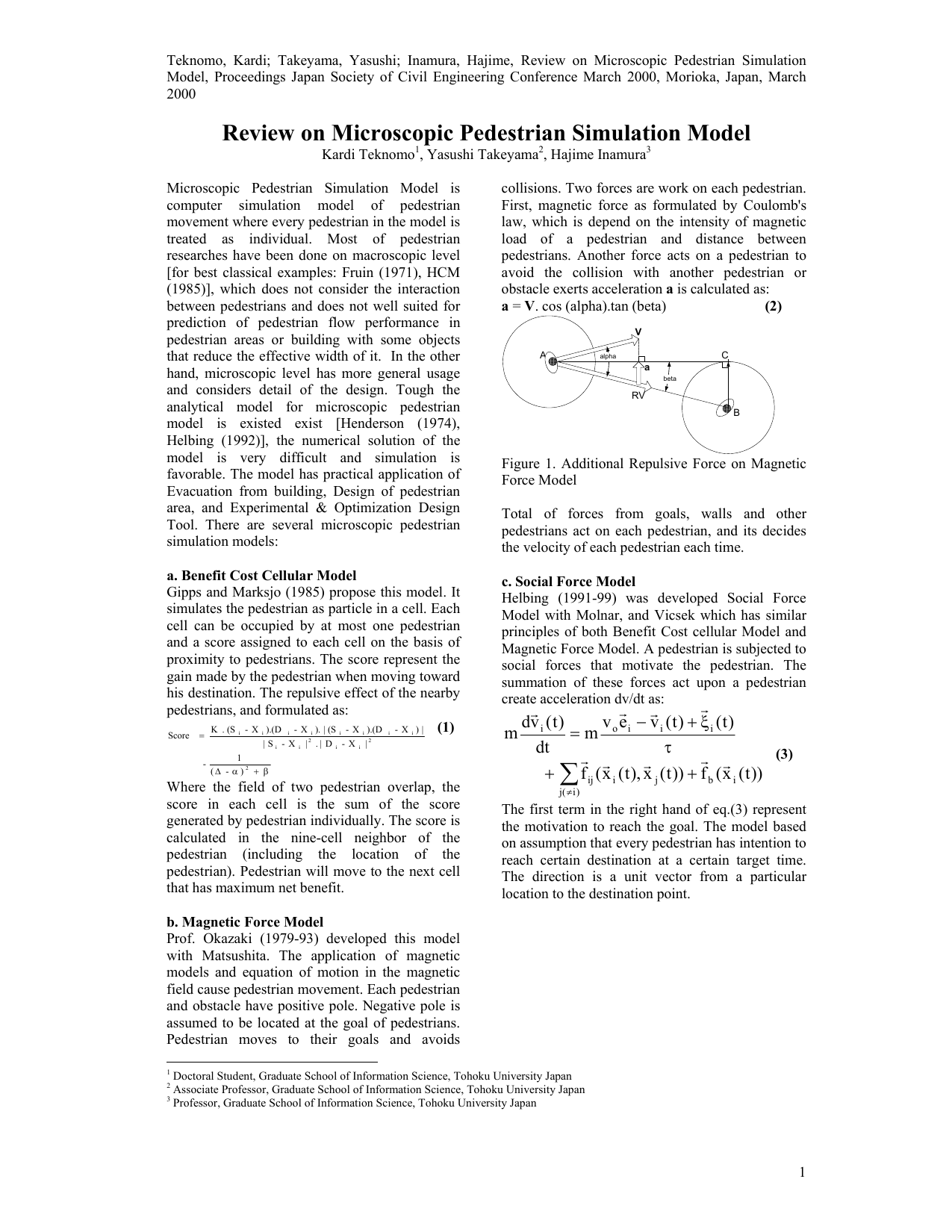
collisions. Two forces are work on each pedestrian.
First, magnetic force as formulated by Coulomb’s
law, which is depend on the intensity of magnetic
load of a pedestrian and distance between
pedestrians. Another force acts on a pedestrian to
avoid the collision with another pedestrian or
obstacle exerts acceleration a is calculated as:
a = V. cos (alpha).tan (beta)
(2)
beta
alpha
A
B
V
RV
a
C
Figure 1. Additional Repulsive Force on Magnetic
Force Model
Total of forces from goals, walls and other
pedestrians act on each pedestrian, and its decides
the velocity of each pedestrian each time.
c. Social Force Model
Helbing (1991-99) was developed Social Force
Model with Molnar, and Vicsek which has similar
principles of both Benefit Cost cellular Model and
Magnetic Force Model. A pedestrian is subjected to
social forces that motivate the pedestrian. The
summation of these forces act upon a pedestrian
create acceleration dv/dt as:
∑
≠
+
+
τ
ξ
+
−
)i
(j
i
b
j
i
ij
i
i
i
o
i
))
t(
x
(
f
))
t(
x
),
t(
x
(
f
)t(
)t(
v
e
v
m
dt
)t(
v
d
m
G
G
G
G
G
G
G
G
G
(3)
The first term in the right hand of eq.(3) represent
the motivation to reach the goal. The model based
on assumption that every pedestrian has intention to
reach certain destination at a certain target time.
The direction is a unit vector from a particular
location to the destination point.
2
Table 1. Comparison Microscopic Pedestrian Simulation Models
Benefit Cost Cellular
Magnetic Force
Social Force
Movement to goal
Gain Score
Positive and negative
magnetic force
Intended velocity
Repulsive Effect
Cost Score
Positive
and
positive
magnetic forces
Interaction forces
Pedestrian movement
discreet
continuous
continuous
Value of variables
arbitrary
physical meaning
physical meaning
Phenomena explained
queuing
queuing, way finding in
maze, evacuation
queuing,
self
organization, oscillatory
change
Higher
programming
orientation in
cellular based
heuristic
mathematics
Evacuation Application
possible
possible
not possible
Parameter Calibration
by insp
This content is AI-processed based on open access ArXiv data.