In memoriam: Dmitri Ivanenko
📝 Original Info
- Title: In memoriam: Dmitri Ivanenko
- ArXiv ID: 1607.03828
- Date: 2016-07-15
- Authors: G. Sardanashvily
📝 Abstract
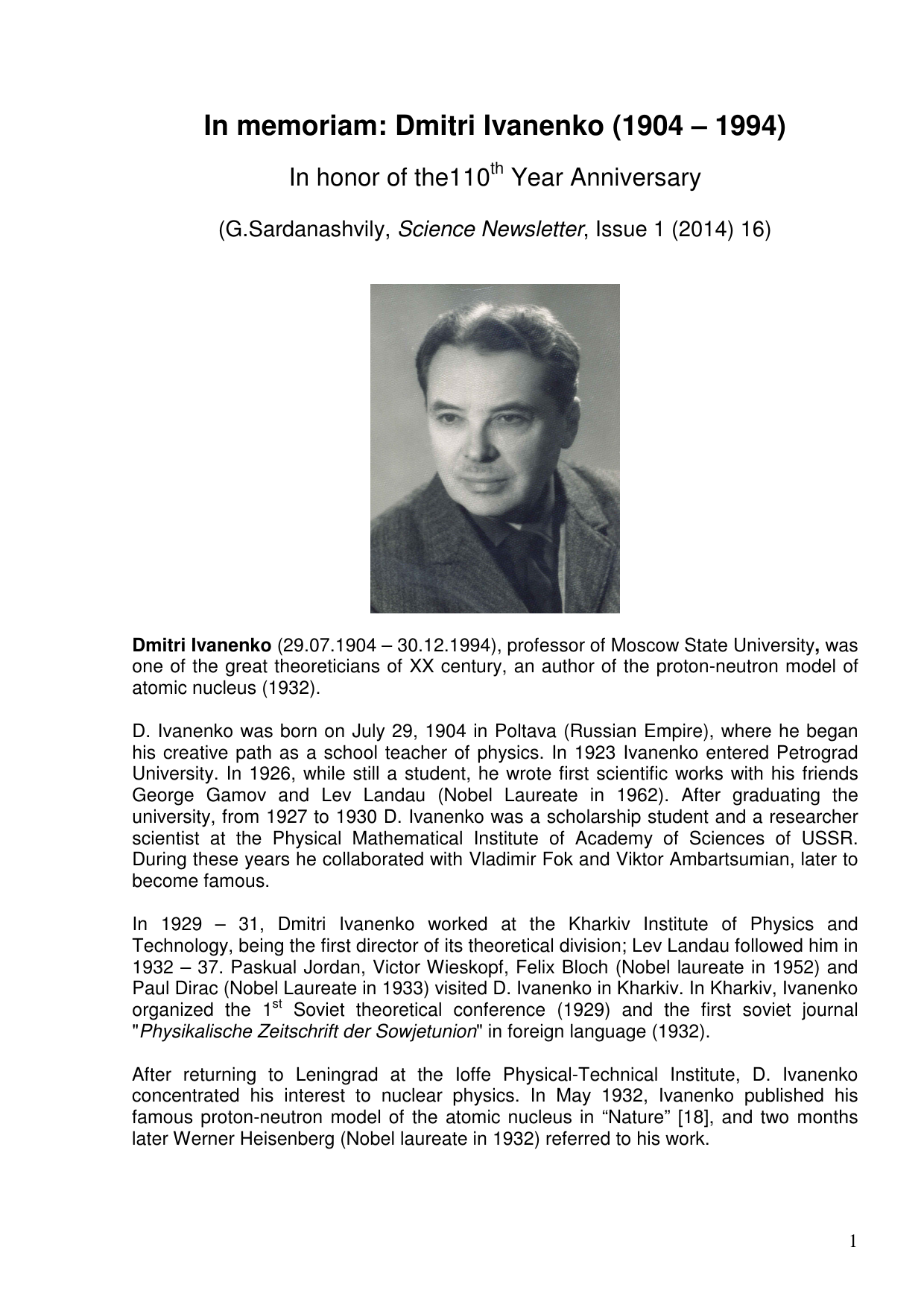
Dmitri Ivanenko, professor of Moscow State University, was one of the great theoreticians of XX century, an author of the proton-neutron model of atomic nucleus. In honor of the 110th Year Anniversary.💡 Deep Analysis
📄 Full Content
Ivanenko’s success pushed forward the nuclear physics in the USSR. In 1933 on the initiative of Dmitri Ivanenko and Igor Kurchatov, the 1 st Soviet nuclear conference was organized. Paul Dirac, Frédéric Joliot-Curie (Nobel laureate in 1935), Fransis Perrin, Ftanko Rasetti, Victor Wieskopf et al participated in this Conference.
The realization of Ivanenko’s far-reaching plans and hopes was interrupted, however. In 1935 he was arrested in connection with the Sergey Kirov affair. Exile to Tomsk followed. D. Ivanenko was a professor at Tomsk and Sverdlovsk Universitie until the beginning of the World War II. From 1943 and until the last days of his life, he was closely associated with the Physics Faculty of M.V. Lomonosov Moscow State University.
Dmitri Ivanenko made the fundamental contribution to many areas of nuclear physics, field theory and gravitation theory.
In 1928, Ivanenko and Landau developed the theory of fermions as skew-symmetric tensors in contrast with the Dirac spinor model [4]. Their theory, widely known as the Ivanenko –Landau -Kahler theory, is not equivalent to Dirac’s one in the presence of a gravitational field, and only it describes fermions in contemporary lattice field theory.
In 1929, Ivanenko and Fock generalized the Dirac equation and described parallel displacement of spinors in a curved space-time (the famous Fock -Ivanenko coefficients) [9]. Nobel laureate Abdus Salam called it the first gauge field theory.
In 1930, Ambartsumian and Ivanenko suggested the hypothesis of creation and annihilation of massive particles which became the corner stone of contemporary quantum field theory [16].
In 1934 Dmitri Ivanenko and Igor Tamm (Nobel Laureate in 1958) suggested the first non-phenomenological theory of paired electron-neutrinor nuclear forces [24]. They made the significant assumption that interaction can be undergone by an exchange of massive particles. Based on their model, Nobel laureate Hideki Yukawa developed his meson theory. In the 70 -80th, D. Ivanenko was concentrated on gravitation theory. He developed different generalizations of Einstein’s General Relativity, including gravity with torsion, the hypothesis of quark stars [63] and gauge gravitation theory [79]. In 1985, D. Ivanenko and his collaborators published two monographs “Gravitation” and “Gauge Gravitation Theory”.
Theoretical physics in the USSR has been enormously influenced by the seminar on theoretical physics organized by D. D. Ivanenko in 1944 that has continued to meet for 50 years under his guidance at the Physics Faculty of Moscow State University. The distinguishing characteristic of Ivanenko’s seminar was the breadth of its grasp of the problems of theoretical physics and its discussion of the links between its various divisions, for example, gravitation theory and elementary particle physics. The most prominent physicists in the world participated in the seminar: Niels and Aage Bohr, Paul Dirac, Hideki Yukawa, Julian Schwinger, Abdus Salam, Ilya Prigogine, Samuel Ting, Paskual Jordan, Tullio Regge, John Wheeler, Roger Penrose et al.
The scientific style of Dmitri Ivanenko was characterized by great interest in ideas of frontiers in science where these ideas were based on strong mathematical methods or experiment.
It should be noted that seven Nobel Laureates: P.A.M. Dirac, H. Yukawa, N.Bohr, I. Prigogine, S. Ting, M. Gell-Mann, G. ’t Hooft wrote their famous inscriptions with a chalk on the walls of Ivanenko’s office in Moscow State University.
📸 Image Gallery