Non-Tiles and Walls - A Variant on the Heesch Problem
📝 Original Info
- Title: Non-Tiles and Walls - A Variant on the Heesch Problem
- ArXiv ID: 1605.09203
- Date: 2016-06-01
- Authors: Erich Friedman and R. Nandakumar
📝 Abstract
The Heesch problem 'grades' polygons that fail to tile the plane in terms of the number of layers (or corollas) of copies of it that can be formed around a central unit. We study the different topology of ' walls', which we define to be simply connected regions that divide the plane exactly into two simply connected regions. We present preliminary results and conjectures.💡 Deep Analysis
📄 Full Content
Erich Friedman Dept. of Mathematics, Stetson University, DeLand, FL 32720 erich.friedman@stetson.edu
R. Nandakumar
Amrita School of Arts and Sciences, Idapalli North, Kochi 682024, India
nandacumar@gmail.com
Introduction
The Heesch number of a 2D shape is defined as the maximum number of layers of copies of the same shape that can surround it ([1], [2], [3], [4]). A shape that tiles the plane has Heesch number infinity and the Heesch number of a shape that fails to tile the plane (a ‘non-tile’) gives a measure of how much it can progress towards tiling the plane. In this paper, we introduce another scheme for ranking non-tiles - using the concept of a ‘wall’ and a number called ‘wall thickness’ (or simply ‘thickness’).
Definitions: A wall is a simply connected region of the plane formed by infinitely many copies of a region R and dividing the plane into exactly 2 simply connected regions A and B that are a positive distance apart (intuitively, regions A and B are clearly separated by the wall and the wall has no ‘cavities’ inside it).
A wall W has thickness 2 (generally n) if it is the union of two 2 (n) walls which only share a boundary but is not the union of 3(n+1) walls. Obviously, a region that can form a wall of infinite thickness tiles the plane. For every non-tile R, we associate a thickness number – the thickness of the thickest wall that can be formed with copies of R.
Examples – Walls and Thickness Numbers
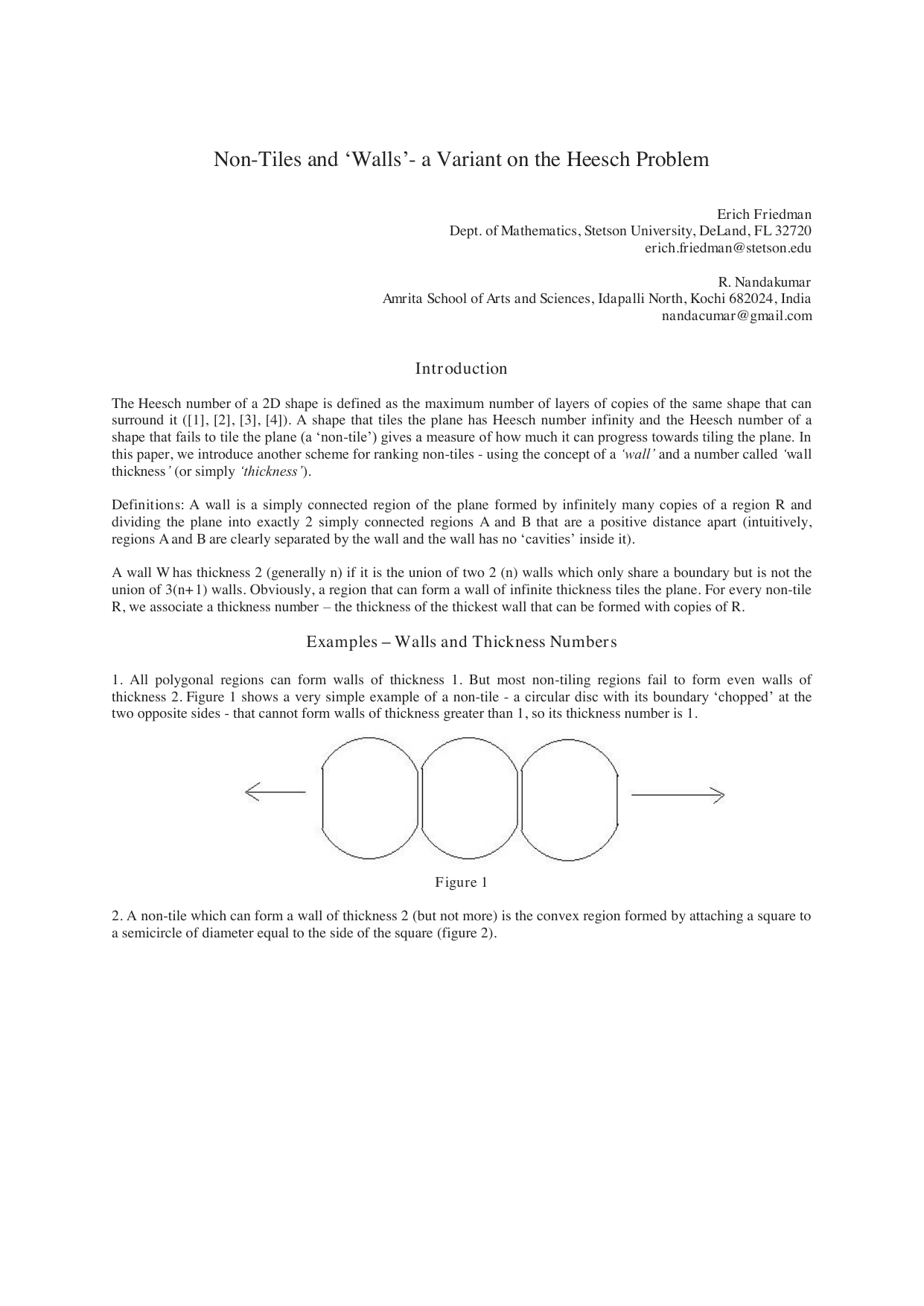
- All polygonal regions can form walls of thickness 1. But most non-tiling regions fail to form even walls of thickness 2. Figure 1 shows a very simple example of a non-tile - a circular disc with its boundary ‘chopped’ at the two opposite sides - that cannot form walls of thickness greater than 1, so its thickness number is 1.
Figure 1
- A non-tile which can form a wall of thickness 2 (but not more) is the convex region formed by attaching a square to a semicircle of diameter equal to the side of the square (figure 2).
Figure 2 3. The Heesch Pentagon, with Heesch number 1, can form a wall of thickness 2 by repeating the pattern shown in figure 3 in the horizontal direction. Note that this arrangement is very different from the arrangement of copies of this shape that shows Heesch number 1 (see [4]).
Figure 3
4. Figure 4 shows a non-convex region - a 5x7 rectangle with three 1x1 additions and one 1x1 hole – with Heesch
number 1([2]). But it can be easily seen that this region can form walls of only thickness 1- its thickness number is 1.
Figure 4
A Region with Thickness Number = 4
Lemma: If a shape can form a wall of thickness 2n+1, it necessarily has Heesch number at least equal to n.
Proof: Indeed, a wall of thickness 2n+1 is, by definition, formed by ‘stacking’ without cavities 2n+1 walls of
thickness 1 each. Consider any unit R in the nth of these thickness 1 walls. If we move from the boundary of R in any
outward direction, we are guaranteed to pass through a minimum of n units before we exit the big wall of thickness
2n+1. This plus the requirement that the big wall has no cavities guarantees that within the wall, unit R sits surrounded
by n layers of copies of itself. QED.
Searching for non-tiles which can form walls of thickness greater than 2, we find a non-convex figure – a hexagon
with two small outward bulges and an inward dent that forms a wall of thickness 4 as shown in figure 2.
Figure 5
Theorem: The above deformed hexagon has thickness number 4.
Proof: It is sufficient to show that the hexagon cannot form walls of thickness 5 (that would automatically imply no higher thickness wall is possible). From the lemma above, for a wall of thickness 5 to be formed, the shape necessarily should have a Heesch number of at least 2 (ie. one should be able to surround a central unit with two layers of copies). So here, we only need to prove that the region cannot form two layers of copies of itself around a central unit.
Figure 6
As in figure 6, let ‘1’ be the central unit and 2-7 be the units surrounding it forming the first layer of a Heesch arrangement around 1. Since a unit has to have outward bulges on 2 adjacent edges, Unit 2 has to have an outward bulge into one of units 3 or 7. Without loss of generality, we take 2 to have a bulge into 3 - and the latter has to have a corresponding inward dent. Note that the edges in the layout shown as dashed thick lines in figure 6 have to be necessarily straight (indeed, the two edges of a unit adjacent to an edge with an inward dent have to be both straight). We have not shown the inward dent on unit 2 above because it is not important in the discussion.
Consider the outer boundary of first layer around unit 1. We observe that
📸 Image Gallery