There is an increasing demand for smart fogcomputing gateways as the size of cloud data is growing. This paper presents a Fog computing interface (FIT) for processing clinical speech data. FIT builds upon our previous work on EchoWear, a wearable technology that validated the use of smartwatches for collecting clinical speech data from patients with Parkinson's disease (PD). The fog interface is a low-power embedded system that acts as a smart interface between the smartwatch and the cloud. It collects, stores, and processes the speech data before sending speech features to secure cloud storage. We developed and validated a working prototype of FIT that enabled remote processing of clinical speech data to get speech clinical features such as loudness, short-time energy, zero-crossing rate, and spectral centroid. We used speech data from six patients with PD in their homes for validating FIT. Our results showed the efficacy of FIT as a Fog interface to translate the clinical speech processing chain (CLIP) from a cloud-based backend to a fog-based smart gateway.
The rising number of sensor nodes and their sampling frequency in telemedicine applications has significantly increased the size of big data in the cloud. For example, typical sensors such as smartwatches, ECG t-shirts, and sensor-rich smart homes will generate huge amounts of data surpassing the terabyte level. These applications not only increase the data size but also the communication bandwidth and computational burden on the cloud. Fog computing that uses embedded systems holds great promise to reduce the burden of the complex medical big data by acting as a local gateway (close to the sensor nodes) for communication, computation, storage, networking, and other functions [7,8]. We designed a fog-computing interface, FIT, that enables communication between a smartwatch and the cloud for the specific purpose of analyzing acoustic data of individuals with speech disorders. In the current study, the smartwatch was given to patients with Parkinson's disease (PD), a neurodegenerative disorder, affecting 4 million individuals worldwide [1]. Perceptual speech impairments include reduced loudness, harsh or breathy voice quality, monotonous pitch, irregular speech rate, and imprecise articulation that can interfere with speech intelligibility [2]. One of the major challenges for speech-language pathologists (SLPs) in speech treatments is to monitor the patients when they perform homework exercises at home. FIT uses a smartwatch to collect speech data from patients when they do their exercises at home and outside the clinical settings. FIT receives data from the smartwatch and performs on-demand processing, analysis and storage. The essential component of the Fog interface is Intel Edison, i.e., an embedded system. FIT made following novel contributions:
• Embedded signal processing: It is capable of handling psychoacoustic analysis for extracting clinical features.
The Internet-of-Things (IoT) is defined as a framework that can interconnect sensors, actuators, and the cloud, communicating via the internet or other wireless networking capabilities such that end-users can benefit from connected intelligence [8]. Cisco coined the term “Fog Computing” [7] to describe a new category of devices and services that can provide computational intelligence at the edge of the networks. Fog computing is defined as a distributed computing paradigm that fundamentally functions as a middleman between the sensors and/or actuators and the cloud [8]. In other words, Fog computing generates three-tier architecture (clients ßà fog ßà cloud). The key benefits of adopting fog computing over traditional cloud computing include; reduction in network traffic [9] and data storage on the cloud; low response latency in IoT applications [5,6,10].
Fog computing is increasingly penetrating the area of healthcare, especially to improve telehealth and telemedicine infrastructure that promise to cope up with the rising healthcare needs in elderly population and individuals with chronic conditions around the world. For example, fog computing upgrades the standards of body sensor networks for medical signal processing [10], energy-efficient computing, and privacy and se-# The presented work is supported by a grant (No: 20144261) from Rhode Island Foundation Medical Research. curity [9]. Recently, we developed EchoWear [3][4][5][6] that leverages an Android smartwatch to manage and tele-monitor inhome speech exercises of patients with PD. For example, each exercise session lasts for 15-20 minutes, generating 40-50 MB of speech data. In this paper, we developed FIT, a fogcomputing interface to reduce the data complexity and introduce computational intelligence at the edge, rather than in the cloud. In the subsequent sections, we will unfold the architecture and functions of FIT.
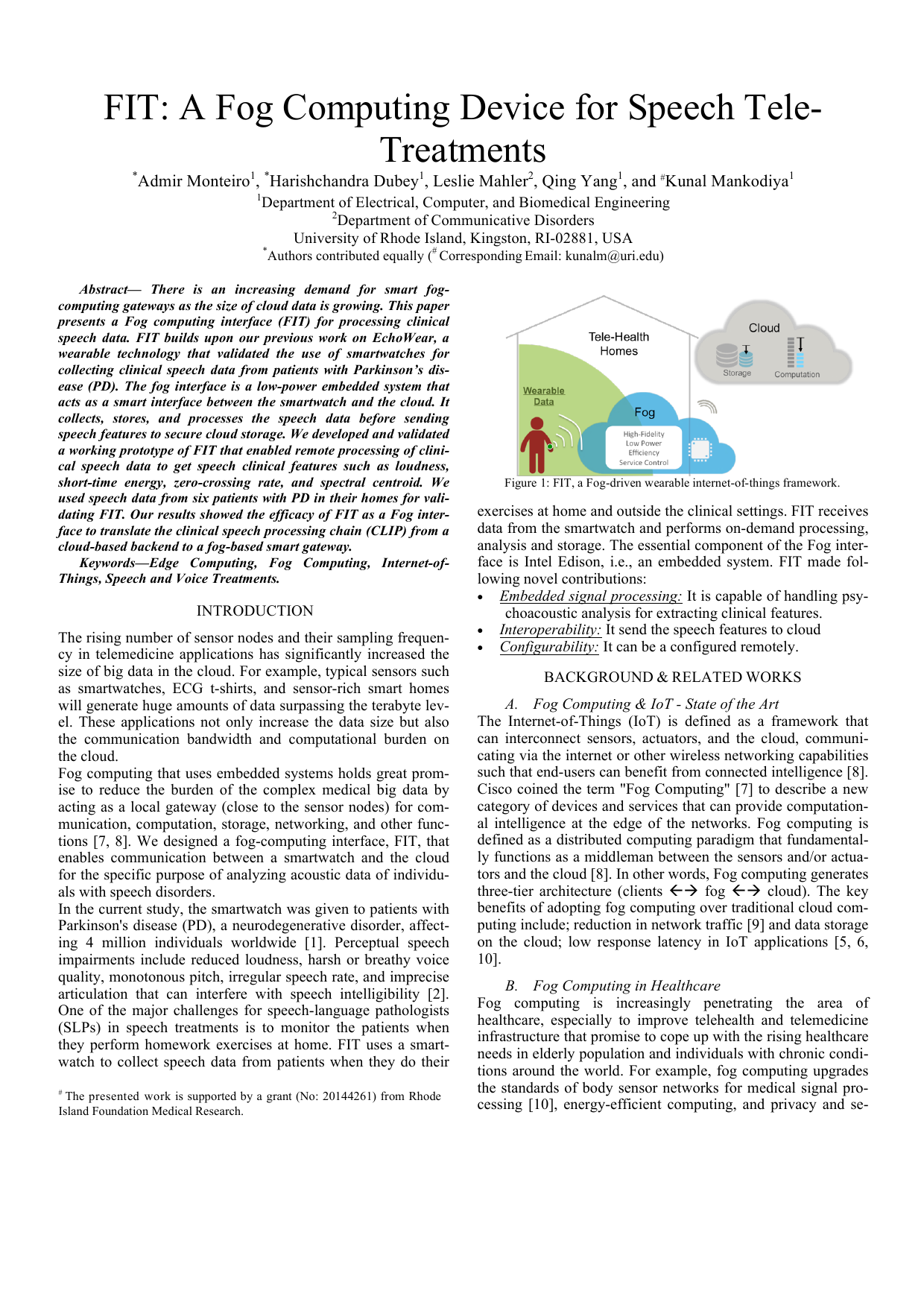
The proposed fog-driven IoT interface, named as FIT is shown in • Cloud: Finally, the extracted features are sent to the secured cloud storage for long-term analysis. These databases can be queried by clinicians to tele-monitor the progress of their patients.
The Intel Edison was chosen because of its size and configurability capabilities. The essential components of the Intel Edison Board are that it supports a System on a Chip 22-nm Intel SoC that includes a dual-core, dual-threaded Intel Atom CPU at 500-MHz and a 32-bit Intel Quark micro-controller at 100 MHz. It has a random access memory of 1 GB LPDDR3 POP memory (2 channel 32bits @ 800MT/sec), a flash storage of 4 GB eMMC (v4.51 spec), wireless Broadcom 43340 802.11 a/b/g/n; Dual-band (2.4 and 5 GHz) with the option for on board antenna or external antenna [16]. Its compactness brings the wireless and Bluetooth 4.0 hardware. Another reason for using Edison is that we were able to increase its storage. Its expansion slot can be attached to an Arduino breakout kit board. The dimensions of the Edison is 60mm x 29mm x 8mm (the mini breakout board is attached with it). Intel Edison is a low power embedded board with
This content is AI-processed based on open access ArXiv data.