Title: Upper Limit on the Diffuse $nu_mu$ Flux with the ANTARES Telescope
ArXiv ID: 1101.2974
Date: 2015-03-17
Authors: Simone Biagi
📝 Abstract
A search for very-high energy cosmic muon neutrinos from unresolved sources is presented using data collected by the ANTARES neutrino telescope. Data corresponding to 334 days of equivalent live time show that the observed number of events is compatible with the expected number of background events. A 90% c.l. upper limit on the diffuse $\nu_\mu$ flux is set at $E^2\Phi_{90%} = 5.3 \times 10^{-8} \ \mathrm{GeV\ cm^{-2}\ s^{-1}\ sr^{-1}} $ in the energy range 20 TeV -- 2.5 PeV.
💡 Deep Analysis
📄 Full Content
Nuclear Physics B Proceedings Supplement 00 (2021) 1–1
Nuclear Physics B
Proceedings
Supplement
Upper Limit on the Diffuse νµ Flux with the ANTARES Telescope
Simone Biagi for the ANTARES collaboration
Dipartimento di Fisica dell’Universit`a and INFN, Viale Berti Pichat 6/2, 40127 Bologna, Italy
Abstract
A search for very-high energy cosmic muon neutrinos from unresolved sources is presented using data collected
by the ANTARES neutrino telescope. Data corresponding to 334 days of equivalent live time show that the observed
number of events is compatible with the expected number of background events. A 90% c.l. upper limit on the diffuse
νµ flux is set at E2Φ90% = 5.3 × 10⁻⁸ GeV cm−2 s−1 sr−1 in the energy range 20 TeV – 2.5 PeV.
Keywords: cosmic neutrinos, diffuse flux, underwater neutrino telescope
The ANTARES neutrino telescope is a three-
dimensional array of 885 photomultiplier tubes (PMT)
distributed over 12 lines installed in the Mediterranean
Sea [1]. A search for a diffuse flux of muon neutrinos
using data collected from December 2007 to December
2009 is presented.
Atmospheric muons and neutrinos are the main
sources of background in a neutrino telescope.
The
former can be suppressed by applying requirements on
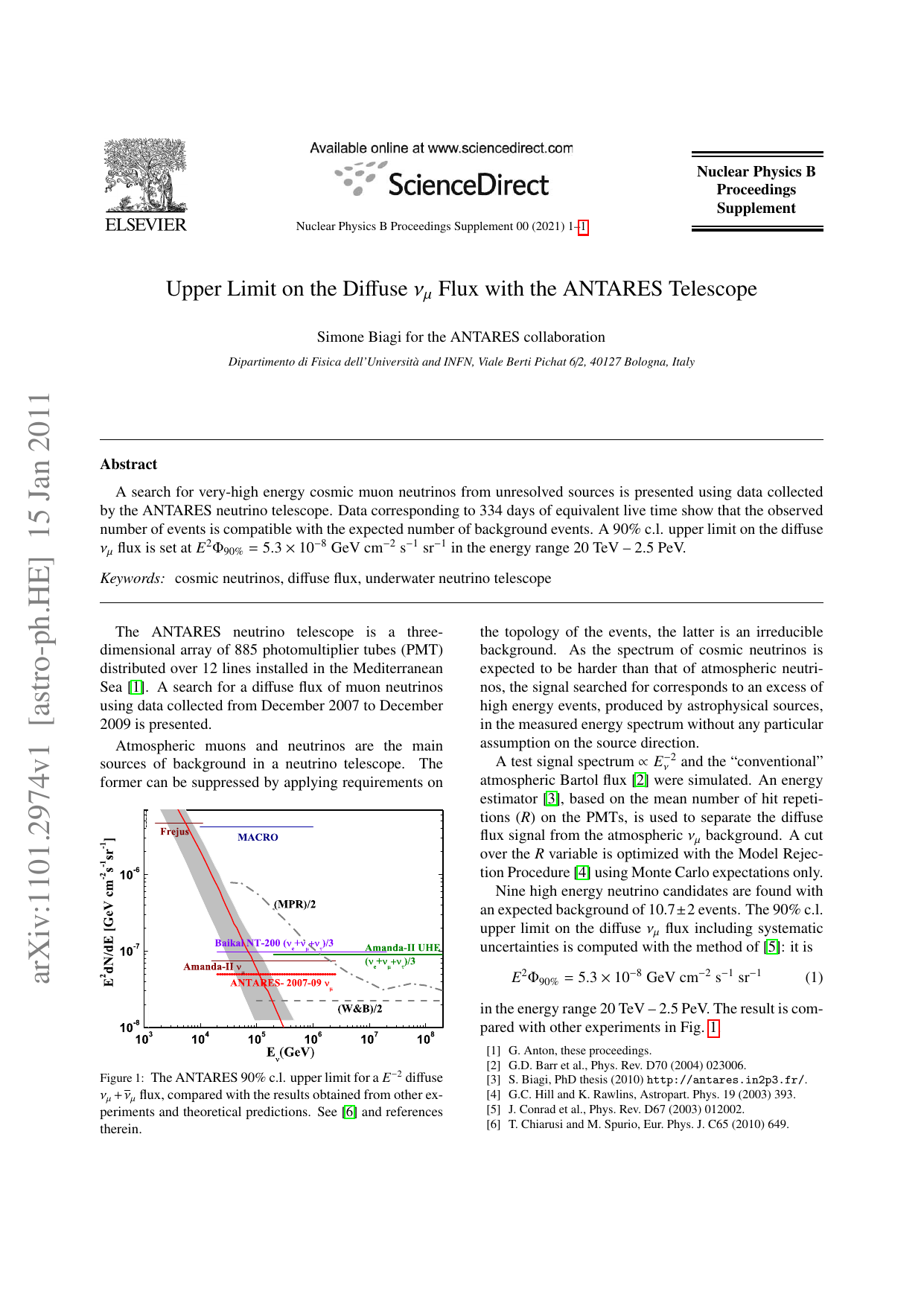
Figure 1: The ANTARES 90% c.l. upper limit for a E−2 diffuse
νµ +νµ flux, compared with the results obtained from other ex-
periments and theoretical predictions. See [6] and references
therein.
the topology of the events, the latter is an irreducible
background. As the spectrum of cosmic neutrinos is
expected to be harder than that of atmospheric neutri-
nos, the signal searched for corresponds to an excess of
high energy events, produced by astrophysical sources,
in the measured energy spectrum without any particular
assumption on the source direction.
A test signal spectrum ∝E−2
ν
and the “conventional”
atmospheric Bartol flux [2] were simulated. An energy
estimator [3], based on the mean number of hit repeti-
tions (R) on the PMTs, is used to separate the diffuse
flux signal from the atmospheric νµ background. A cut
over the R variable is optimized with the Model Rejec-
tion Procedure [4] using Monte Carlo expectations only.
Nine high energy neutrino candidates are found with
an expected background of 10.7±2 events. The 90% c.l.
upper limit on the diffuse νµ flux including systematic
uncertainties is computed with the method of [5]: it is
E2Φ90% = 5.3 × 10⁻⁸ GeV cm−2 s−1 sr−1
(1)
in the energy range 20 TeV – 2.5 PeV. The result is com-
pared with other experiments in Fig. 1.
[1] G. Anton, these proceedings.
[2] G.D. Barr et al., Phys. Rev. D70 (2004) 023006.
[3] S. Biagi, PhD thesis (2010) http://antares.in2p3.fr/.
[4] G.C. Hill and K. Rawlins, Astropart. Phys. 19 (2003) 393.
[5] J. Conrad et al., Phys. Rev. D67 (2003) 012002.
[6] T. Chiarusi and M. Spurio, Eur. Phys. J. C65 (2010) 649.
arXiv:1101.2974v1 [astro-ph.HE] 15 Jan 2011