A Majorization Order on Monomials and Termination of a Successive Difference Substitution Algorithm
📝 Original Info
- Title: A Majorization Order on Monomials and Termination of a Successive Difference Substitution Algorithm
- ArXiv ID: 1109.0686
- Date: 2014-05-19
- Authors: Jia Xu and Yong Yao
📝 Abstract
We introduce a majorization order on monomials. With the help of this order, we derive a necessary condition on the positive termination of a general successive difference substitution algorithm (KSDS) for an input form $f$.💡 Deep Analysis
📄 Full Content
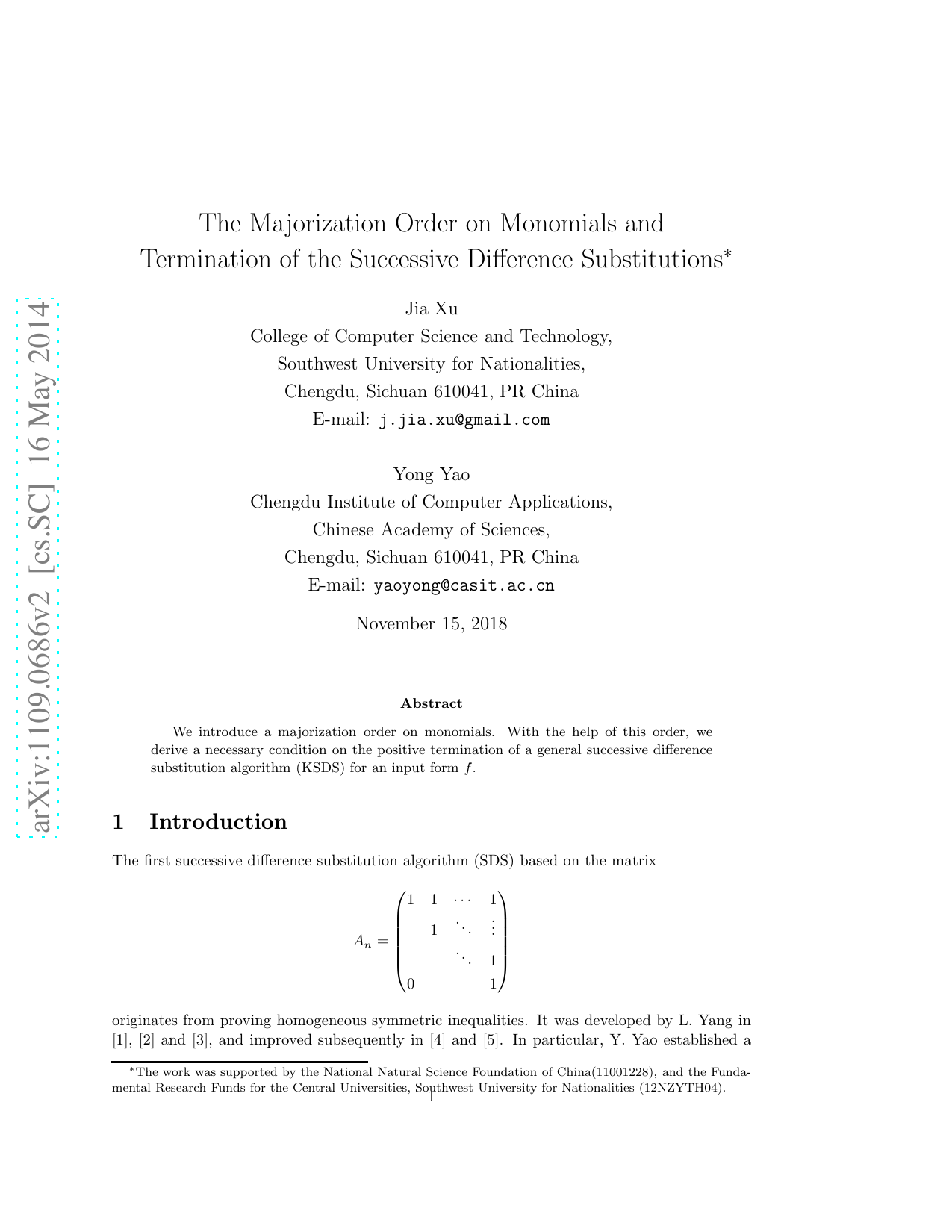
originates from proving homogeneous symmetric inequalities. It was developed by L. Yang in [1], [2] and [3], and improved subsequently in [4] and [5]. In particular, Y. Yao established a new successive difference substitution algorithm based on the matrix
.
His method is named as NEWTSDS, which has many interesting properties (see [5]). These results illustrate that SDS may be an effective tool for solving many problems in real algebra. However, it is still very hard to find necessary and/or sufficient conditions on the termination of SDS and NEWTSDS. In this paper, we will study the termination of a general successive difference substitution algorithm (KSDS) by the majorization order on monomials. Our main result is as follows:
Main result A necessary condition of positively terminating of KSDS for an input f is that, for an arbitrary ordering of variables, every monomial of f with negative coefficient is majorized by at least one monomial of f with positive coefficient.
The paper is organized as follows. In Section 2, we introduce KSDS and present some background materials. In Section 3, we discuss necessary conditions on the termination of KSDS using the majorization order on monomials. The future research directions are outlined in Section 4.
A form (i.e., a homogeneous polynomial) f of degree d can be written as
The next definition is given in [5].
Definition 2.1. A form f is said to be trivially positive if the coefficient C α of every monomial X α is nonnegative. It is said to be trivially negative if f (1, 1, . . . , 1) < 0 (i.e., the sum of coefficients of f is less than zero).
We denote by PSD the set of all the positive semi-definite forms on R n + . Furthermore, a positive semi-definite form f is said to be positive definite on R n + if f > 0 for (x 1 , . . . , x n ) = (0, . . . , 0). The set of all the positive definite forms is denoted by PD.
There are two obvious results describing the relation between trivially positive (negative) and PSD:
If a form f is trivially positive, then f ∈ PSD.
If a form f is trivially negative, then f / ∈ PSD.
Given positive real numbers q 1 , . . . , q n , we consider the matrix
Notice that
So K n is a general form of the matrices including A n and G n . Suppose that S n is a symmetric group of degree n. For σ ∈ S n , let P σ be an n × n permutation matrix corresponding to σ. For example, suppose that σ = (1)(23) is a permutation. Then it corresponds to the matrix
in which the second and third rows are permuted from the identity matrix.
Using the notation in [5], we introduce a few terminologies.
Definition 2.3. The n × n matrix B σ with σ ∈ S n is defined by
As an example, let us consider again σ = (1)(23). Then
The set SDS K (f ) is called the set of difference substitution for f based on the matrix K n .
It is easy to show the following equivalence relations (see [5])
Repeatedly using the above two equivalence relations and Definition 2.1, we have an algorithm for testing positive semi-definite of polynomials, which is called the successive difference substitution algorithm based on the matrix K n (KSDS) in [5]. There is a fundamental question on the algorithm KSDS. Namely, under what conditions does the algorithm terminate? This question is very hard to solve. Quite recently, Yang and Yao ([4], [5]) obtained some results about the termination of SDS and NEWTSDS. Their results lead to the following definition.
Definition 2.5. The algorithm KSDS is positively terminating if the output is “f ∈ PSD” for the input f . The algorithm KSDS is negatively terminating if the output is “f / ∈ PSD” for the input f . Otherwise, KSDS is not terminating for f . According to Definition 2.5, it is easy to get the following assertions. Lemma 2.1 1. The algorithm KSDS is positively terminating for an input f if and only if there exists a positive integer m such that all of the coefficients of the polynomial
are positive.
- The algorithm KSDS is negatively terminating if and only if there exist m permutations σ 1 , . . . , σ m ∈ S n such that
3 Majorization order on monomials and the main result
Given two monomials
with |α| = |β|, we cannot order them unless some further conditions are imposed. For example, let α = (3, 1, 1), β = (2, 1, 2) and x 1 ≥ x 2 ≥ x 3 ≥ 0, then we have
This example inspires us to use a majorization order on monomials for our analysis of the termination of KSDS.
Before that, we first introduce the majorization between two vectors given in [6] and [7].
then we say that α majorizes β, which is denoted as α β.
Note that " “is a partial order. With the help of Definition 3.1, we construct the definition of majorization order on monomials. Definition 3.2 (Majorization order on monomials) Let X α and X β be two monomials with |α| = |β|. Suppose that σ is a permutation on the set {1, 2, . . . , n}. If (α σ(1) , . . . , α σ(n) ) (β σ(1) , . . . ,
📸 Image Gallery